
Molar Mass of Elements and Compounds: HSC Chemistry Guide
Learn how to calculate molar mass from relative atomic masses, read chemical formulas correctly, and convert between moles and grams.
You have \(1.00\ \text{mol}\) of magnesium atoms and \(1.00\ \text{mol}\) of oxygen atoms. Both samples contain exactly the same number of atoms. Should they have the same mass?
Predict before reading on.
They do not. One mole of magnesium atoms has a mass of about \(24.31\ \text{g}\), while one mole of oxygen atoms has a mass of about \(16.00\ \text{g}\). A mole tells you how many particles you have. Molar mass tells you how heavy that many particles are.
That distinction is the whole point of molar mass.
01Moles count particles, molar mass connects them to grams
A mole is a counting unit. Just as a dozen means 12 objects, \(1\ \text{mol}\) means \(6.022 \times 10^{23}\) particles.
The particles might be atoms, molecules, ions, or formula units. You need to know which one you are counting.
For example:
- \(1\ \text{mol}\) of Mg atoms contains \(6.022 \times 10^{23}\) Mg atoms.
- \(1\ \text{mol}\) of \(\ce{O2}\) contains \(6.022 \times 10^{23}\) \(\ce{O2}\) molecules.
- \(1\ \text{mol}\) of \(\ce{NaCl}\) contains \(6.022 \times 10^{23}\) formula units of \(\ce{NaCl}\).
The mole itself doesn’t tell you the mass. A dozen bowling balls and a dozen grapes have the same number of objects, but you’d notice the difference if someone dropped each box on your foot.
Chemistry has the same problem. We need a conversion between amount in moles and mass in grams.
That conversion is the molar mass, \(M\).
You can think of molar mass as an exchange rate:
\[ \text{moles} \longleftrightarrow \text{grams} \]
A substance with a molar mass of \(58.44\ \text{g mol}^{-1}\) has a mass of \(58.44\ \text{g}\) for every \(1\ \text{mol}\) of that substance.
The analogy has a limit. Moles and grams aren’t two currencies describing the same thing. Moles measure amount of substance, while grams measure mass. Molar mass connects those two different quantities.
02Where the periodic table number comes in
Look at magnesium on a periodic table and you will find a relative atomic mass close to \(24.31\).
The relative atomic mass, written \(A_r\), tells us the average mass of an atom relative to \(1/12\) of the mass of a carbon-12 atom.
Relative atomic mass has no unit. It is a ratio.
For magnesium:
\[ A_r(\ce{Mg}) = 24.31 \]
The molar mass of magnesium atoms has the same numerical value, but now it has units:
\[ M(\ce{Mg}) = 24.31\ \text{g mol}^{-1} \]
So:
\[ 1.00\ \text{mol Mg atoms} = 24.31\ \text{g Mg} \]
This is a useful pattern:
For an element made of individual atoms, its relative atomic mass from the periodic table has the same numerical value as its molar mass in \(\text{g mol}^{-1}\).
Be careful with the phrase made of individual atoms. Some elemental substances exist as molecules.
Oxygen is the classic trap.
The periodic table tells us:
\[ A_r(\ce{O}) = 16.00 \]
So one mole of oxygen atoms has a mass of:
\[ 16.00\ \text{g} \]
But ordinary oxygen gas is \(\ce{O2}\). Each molecule contains two oxygen atoms, so:
\[ M(\ce{O2}) = 2(16.00) = 32.00\ \text{g mol}^{-1} \]
One mole of oxygen molecules therefore has a mass of \(32.00\ \text{g}\), not \(16.00\ \text{g}\).
03Compounds: add the atoms in the formula
Suppose you want the molar mass of water, \(\ce{H2O}\).
What does the formula actually tell you?
Each water molecule contains:
- 2 hydrogen atoms
- 1 oxygen atom
Using \(A_r(\ce{H}) = 1.008\) and \(A_r(\ce{O}) = 16.00\):
\[ M(\ce{H2O}) = 2(1.008) + 1(16.00) \]
\[ M(\ce{H2O}) = 18.016\ \text{g mol}^{-1} \]
So one mole of water molecules has a mass of about \(18.02\ \text{g}\).
The general idea is:
\[ M = \sum n_i A_{r,i} \]
where:
- \(M\) is the molar mass in \(\text{g mol}^{-1}\)
- \(n_i\) is the number of atoms of a particular element in the chemical formula
- \(A_{r,i}\) is the relative atomic mass of that element
In plain English: count each type of atom, multiply by its relative atomic mass, then add everything together.
04Read the formula before touching the calculator
Most molar mass errors aren’t arithmetic errors. They’re formula-reading errors.
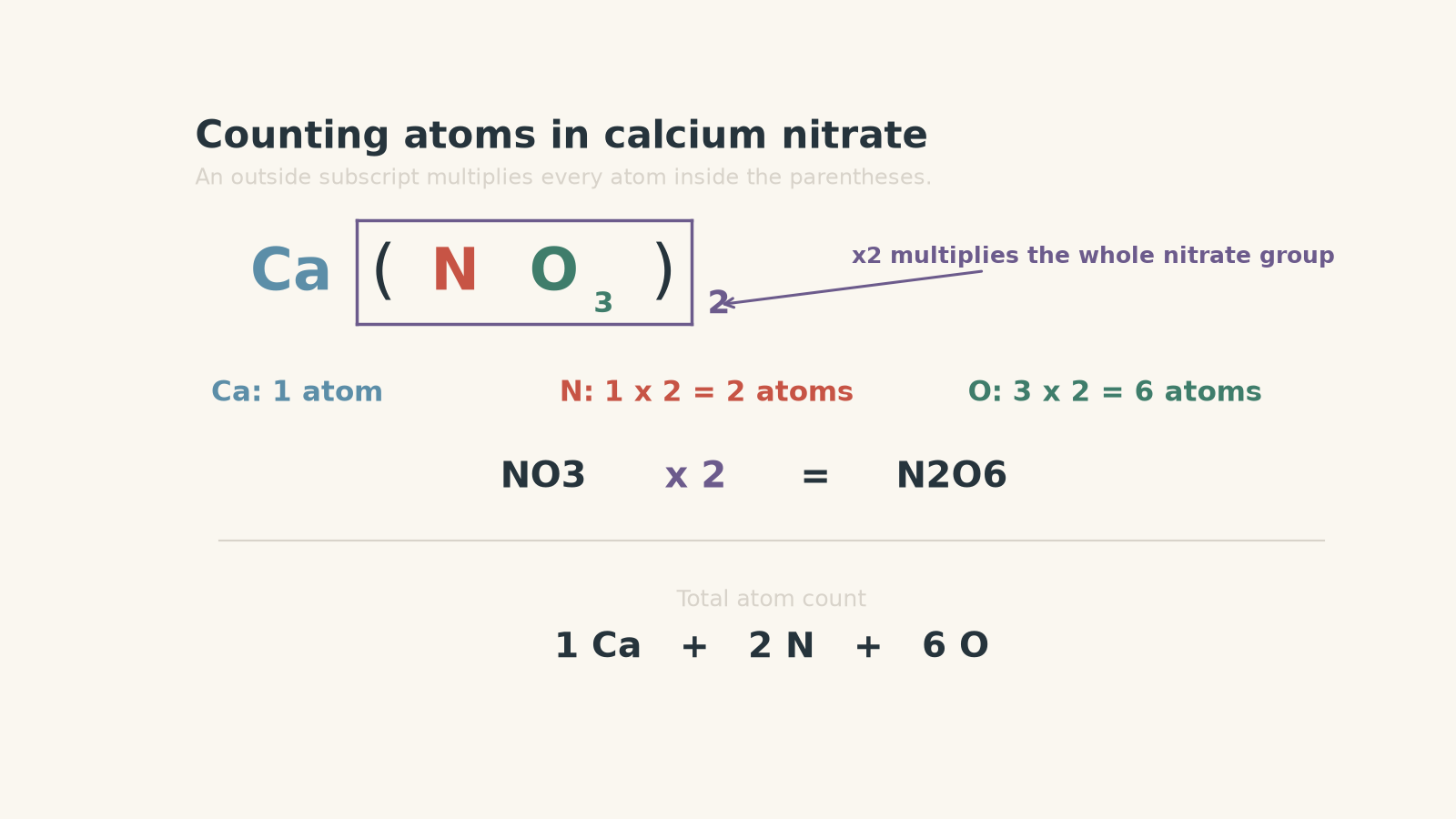
Consider calcium nitrate:
\[ \ce{Ca(NO3)2} \]
Before calculating anything, count the atoms.
There is:
- 1 Ca atom
- 2 N atoms
- 6 O atoms
Why six oxygen atoms?
The subscript 2 outside the brackets multiplies everything inside the brackets:
\[ 2 \times \ce{NO3} = \ce{N2O6} \]
A student who calculates \(1\) Ca, \(2\) N, and only \(3\) O has ignored the bracket multiplier.
Worked example: What is the molar mass of magnesium chloride?
Calculate the molar mass of \(\ce{MgCl2}\) using \(A_r(\ce{Mg}) = 24.31\) and \(A_r(\ce{Cl}) = 35.45\).
Step 1
\(\ce{MgCl2}\) contains one Mg atom and two Cl atoms per formula unit.
Step 2
\[ M(\ce{MgCl2}) = 1(24.31) + 2(35.45) \]
Step 3
\[ M(\ce{MgCl2}) = 24.31 + 70.90 = 95.21\ \text{g mol}^{-1} \]
So:
\[ \boxed{M(\ce{MgCl2}) = 95.21\ \text{g mol}^{-1}} \]
This means \(1.00\ \text{mol}\) of \(\ce{MgCl2}\) formula units has a mass of \(95.21\ \text{g}\).
Notice that we said formula units, not molecules. Ionic compounds such as magnesium chloride form extended ionic lattices, so “molecule of \(\ce{MgCl2}\)” isn’t the best description.
05Molar mass also lets you move between moles and mass
Once molar mass is known, the relationship between mass and amount is:
\[ n = \frac{m}{M} \]
where:
- \(n\) is amount of substance in moles, \(\text{mol}\)
- \(m\) is mass in grams, \(\text{g}\)
- \(M\) is molar mass, \(\text{g mol}^{-1}\)
Rearranging:
\[ m = nM \]
This equation makes physical sense. If one mole has a certain mass, then two moles should have twice that mass, half a mole should have half that mass, and so on.
Before doing the next example, predict this: if \(0.250\ \text{mol}\) of a substance is used, should its mass be larger or smaller than its molar mass expressed in grams?
Smaller. \(0.250\ \text{mol}\) is only one quarter of a mole, so its mass should be one quarter of the mass of one mole. That prediction gives you a useful check on the calculation.
Worked example: Find the mass of calcium nitrate
Calculate the mass of \(0.250\ \text{mol}\) of \(\ce{Ca(NO3)2}\). Use \(A_r(\ce{Ca}) = 40.08\), \(A_r(\ce{N}) = 14.01\), and \(A_r(\ce{O}) = 16.00\).
Step 1
One formula unit of \(\ce{Ca(NO3)2}\) contains:
- 1 Ca
- 2 N
- 6 O
Step 2
\[ \begin{aligned} M(\ce{Ca(NO3)2}) &= 1(40.08) + 2(14.01) + 6(16.00)\\ &= 40.08 + 28.02 + 96.00\\ &= 164.10\ \text{g mol}^{-1} \end{aligned} \]
Step 3
\[ \begin{aligned} m &= nM\\ &= (0.250\ \text{mol})(164.10\ \text{g mol}^{-1})\\ &= 41.025\ \text{g} \end{aligned} \]
To three significant figures:
\[ \boxed{m = 41.0\ \text{g}} \]
So \(0.250\ \text{mol}\) of calcium nitrate has a mass of \(41.0\ \text{g}\).
Our earlier prediction also works: \(41.0\ \text{g}\) is one quarter of \(164.10\ \text{g}\).
06Why relative atomic masses are usually decimals
It can seem strange that chlorine has a relative atomic mass of about \(35.45\). A single chlorine atom doesn’t contain \(35.45\) protons and neutrons.
The decimal appears because a natural sample of an element can contain different isotopes.
Chlorine occurs mainly as chlorine-35 and chlorine-37. These isotopes have the same number of protons, but different numbers of neutrons. The periodic table value is a weighted average based on their natural abundances.
So:
\[ A_r(\ce{Cl}) \approx 35.45 \]
does not mean a chlorine atom has a mass number of \(35.45\). Mass number belongs to one particular isotope and is a whole number. Relative atomic mass is an average for the element.
That average is the value you normally use when calculating molar masses from the periodic table.
07Three traps worth checking every time
Trap 1: Thinking one mole always has the same mass
One mole always contains the same number of specified particles, not the same mass.
For example:
\[ 1\ \text{mol C atoms} \approx 12.01\ \text{g} \]
while:
\[ 1\ \text{mol Pb atoms} \approx 207.2\ \text{g} \]
Same number of atoms. Very different mass.
Trap 2: Forgetting what particle the formula represents
For oxygen:
\[ M(\ce{O}) = 16.00\ \text{g mol}^{-1} \]
but:
\[ M(\ce{O2}) = 32.00\ \text{g mol}^{-1} \]
The periodic table gives atomic information. You still have to read the chemical formula.
Trap 3: Treating a subscript outside brackets as if it affects only one atom
For \(\ce{Al2(SO4)3}\), the atom count is:
- 2 Al
- 3 S
- 12 O
The outside 3 multiplies the entire \(\ce{SO4}\) group.
If your atom count is wrong, perfect calculator work will still give the wrong molar mass.
08A reliable method under exam pressure
For any molar mass calculation:
- Write or inspect the chemical formula.
- Count every atom before substituting numbers.
- Find each \(A_r\) value from the supplied periodic table or data source.
- Multiply each \(A_r\) by the number of those atoms.
- Add the contributions.
- Give the molar mass in \(\text{g mol}^{-1}\).
- If the question asks for an actual sample mass, use \(m = nM\).
The unit is a useful check. A molar mass should be in \(\text{g mol}^{-1}\). A sample mass should be in grams. If your final quantity is supposed to be a mass but you have written \(\text{g mol}^{-1}\), you have probably stopped one step too early.
09Questions and solutions
Question 1
Neon has a relative atomic mass of \(20.18\). What is the mass of \(1.00\ \text{mol}\) of neon atoms?
Solution 1
The mass is \(\boxed{20.18\ \text{g}}\).
For an element present as individual atoms, the molar mass has the same numerical value as its relative atomic mass:
\[ M(\ce{Ne}) = 20.18\ \text{g mol}^{-1} \]
Using \(m = nM\):
\[ \begin{aligned} m &= nM\\ &= (1.00\ \text{mol})(20.18\ \text{g mol}^{-1})\\ &= 20.18\ \text{g} \end{aligned} \]
So one mole of neon atoms has a mass of \(20.18\ \text{g}\). The important idea is that the periodic table value becomes a mass per mole when used as a molar mass.
Question 2
Calculate the molar mass of ammonium nitrate, \(\ce{NH4NO3}\). Use \(A_r(\ce{N}) = 14.01\), \(A_r(\ce{H}) = 1.008\), and \(A_r(\ce{O}) = 16.00\).
Solution 2
The molar mass is \(\boxed{80.05\ \text{g mol}^{-1}}\).
The formula \(\ce{NH4NO3}\) contains two nitrogen atoms in total, four hydrogen atoms, and three oxygen atoms. A common mistake is to notice only the first N.
\[ \begin{aligned} M(\ce{NH4NO3}) &= 2(14.01) + 4(1.008) + 3(16.00)\\ &= 28.02 + 4.032 + 48.00\\ &= 80.052\ \text{g mol}^{-1} \end{aligned} \]
Therefore:
\[ \boxed{M(\ce{NH4NO3}) = 80.05\ \text{g mol}^{-1}} \]
This means \(1\ \text{mol}\) of ammonium nitrate formula units has a mass of about \(80.05\ \text{g}\).
Question 3
A sample contains \(0.0750\ \text{mol}\) of iron(III) sulfate, \(\ce{Fe2(SO4)3}\). Calculate its mass using \(A_r(\ce{Fe}) = 55.85\), \(A_r(\ce{S}) = 32.06\), and \(A_r(\ce{O}) = 16.00\).
Solution 3
The sample has a mass of \(\boxed{30.0\ \text{g}}\) to three significant figures.
First count the atoms correctly. \(\ce{Fe2(SO4)3}\) contains 2 Fe atoms, 3 S atoms, and 12 O atoms.
Its molar mass is:
\[ \begin{aligned} M(\ce{Fe2(SO4)3}) &= 2(55.85) + 3(32.06) + 12(16.00)\\ &= 111.70 + 96.18 + 192.00\\ &= 399.88\ \text{g mol}^{-1} \end{aligned} \]
Now use \(m = nM\):
\[ \begin{aligned} m &= (0.0750\ \text{mol})(399.88\ \text{g mol}^{-1})\\ &= 29.991\ \text{g} \end{aligned} \]
Therefore:
\[ \boxed{m = 30.0\ \text{g}} \]
The main trap is the bracket. Three sulfate groups contain \(3 \times 4 = 12\) oxygen atoms, not four.
Question 4
An oxide has the formula \(\ce{XO2}\) and a molar mass of \(79.87\ \text{g mol}^{-1}\). Oxygen has \(A_r = 16.00\). Determine the relative atomic mass of \(X\), and identify the element from the values \(A_r(\ce{Ti}) = 47.87\), \(A_r(\ce{V}) = 50.94\), and \(A_r(\ce{Cr}) = 52.00\).
Solution 4
The relative atomic mass of \(X\) is \(\boxed{47.87}\), so \(X\) is \(\boxed{\ce{Ti}}\).
The molar mass contains the contribution from one \(X\) atom and two oxygen atoms:
\[ M(\ce{XO2}) = A_r(X) + 2A_r(\ce{O}) \]
Substitute the known values:
\[ 79.87 = A_r(X) + 2(16.00) \]
So:
\[ \begin{aligned} A_r(X) &= 79.87 - 32.00\\ &= 47.87 \end{aligned} \]
The listed element with \(A_r = 47.87\) is titanium.
The tempting mistake is to divide \(79.87\) by three because there are three atoms in the formula. That would assume all three atoms contribute equal mass, which they do not. The oxygen contribution must be removed according to its actual relative atomic mass.
Question 5
A student says, “The periodic table gives oxygen as 16.00, so one mole of oxygen gas must have a mass of \(16.00\ \text{g}\).” Explain whether the statement is correct.
Solution 5
The statement is incorrect for ordinary oxygen gas. One mole of \(\ce{O2}\) has a mass of \(\boxed{32.00\ \text{g}}\).
The value \(16.00\) is the relative atomic mass of one oxygen atom. It therefore corresponds numerically to a molar mass of:
\[ M(\ce{O}) = 16.00\ \text{g mol}^{-1} \]
Ordinary oxygen gas consists of diatomic \(\ce{O2}\) molecules. Each molecule contains two oxygen atoms:
\[ \begin{aligned} M(\ce{O2}) &= 2(16.00)\\ &= 32.00\ \text{g mol}^{-1} \end{aligned} \]
Therefore:
\[ 1.00\ \text{mol }\ce{O2} = 32.00\ \text{g} \]
The student’s reasoning feels plausible because the periodic table number is used to obtain molar mass. The missing step is identifying the actual particle being counted. \(1\ \text{mol}\) of O atoms and \(1\ \text{mol}\) of \(\ce{O2}\) molecules are different samples.
Question 6
Two substances both have the empirical formula \(\ce{CH2O}\). A student claims they must therefore have the same molar mass. Is that conclusion justified? One of the substances has a measured molar mass of \(180.16\ \text{g mol}^{-1}\). Determine its molecular formula using \(A_r(\ce{C}) = 12.01\), \(A_r(\ce{H}) = 1.008\), and \(A_r(\ce{O}) = 16.00\).
Solution 6
The conclusion is not justified. An empirical formula gives only the simplest whole-number ratio of atoms, so different molecular formulas can share the same empirical formula.
First calculate the mass corresponding to one empirical formula unit, \(\ce{CH2O}\):
\[ \begin{aligned} M_{\text{empirical}} &= 1(12.01) + 2(1.008) + 1(16.00)\\ &= 30.026\ \text{g mol}^{-1} \end{aligned} \]
Now compare the measured molar mass with the empirical formula mass:
\[ \frac{180.16}{30.026} \approx 6.00 \]
So the molecular formula contains six empirical formula units:
\[ (\ce{CH2O})_6 = \ce{C6H12O6} \]
Therefore the molecular formula is:
\[ \boxed{\ce{C6H12O6}} \]
The hidden assumption in the student’s claim is that the empirical formula is automatically the molecular formula. It isn’t. Molar mass provides the extra information needed to determine how many empirical formula units are present in each molecule.
10Where molar mass takes you next
Molar mass is the bridge between the microscopic language of chemical formulas and the measurable mass you can put on a balance.
Once you can move confidently between grams and moles, you can start comparing substances according to their chemical equations. That is the basis of stoichiometry: converting a measured mass into moles, using a mole ratio from a balanced equation, then converting the result into the mass, volume, or concentration you actually need.