
Whole-number mole ratios from experimental data | HSC Chemistry
Learn how experimental data can reveal simple whole-number mole ratios, using limiting reagents, reaction breakpoints, gas measurements, and uncertainty.
Suppose you react a fixed amount of magnesium with hydrochloric acid and collect the hydrogen gas. At first, adding more acid gives more hydrogen. Then something odd happens: you add even more acid, but the final volume of hydrogen barely changes.
That change from “more acid gives more product” to “more acid does nothing” can reveal the reaction’s mole ratio.
Before seeing the explanation, make a prediction. If 2.00 mmol of magnesium needs exactly two moles of hydrochloric acid for every mole of magnesium, how much hydrochloric acid should be needed before adding more becomes useless?
It should be 4.00 mmol. The experiment below shows how that number can be found from measurements rather than assumed from a balanced equation.
01Make the mole ratio show itself
Imagine a conical flask containing a measured amount of magnesium. The flask is sealed. One opening allows hydrochloric acid to be added, while a delivery tube from the flask leads to a gas syringe.
The path is simple:
- Hydrochloric acid enters the flask.
- It contacts the magnesium.
- Hydrogen gas forms.
- The gas travels through the delivery tube.
- The gas pushes out the gas syringe.
- The final gas volume is recorded once the reaction has finished.
Each trial uses the same amount of magnesium, but a different amount of hydrochloric acid.
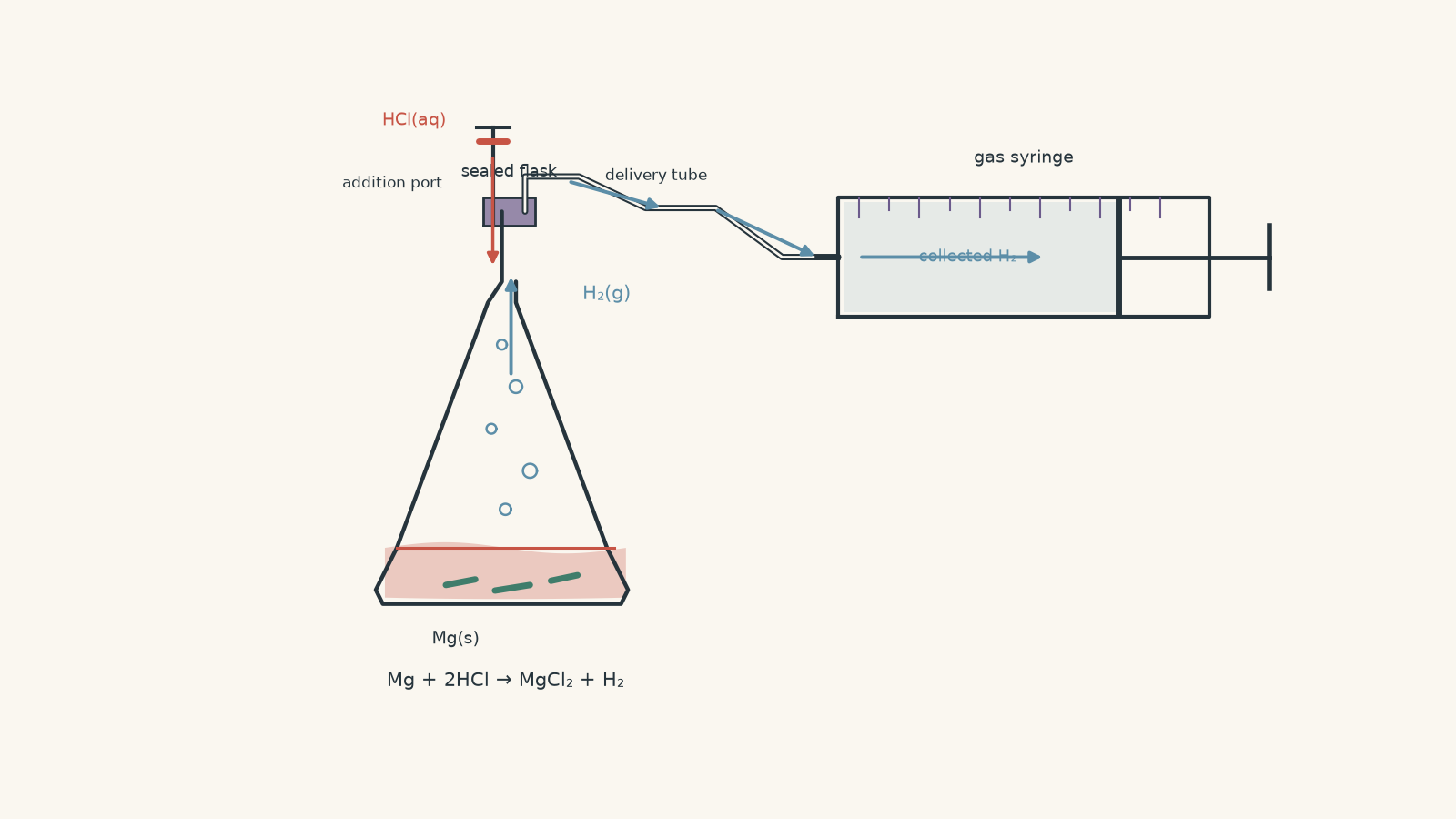
The point is not just to watch bubbles. We want to find the amount of acid at which magnesium changes from having too little acid available to having more acid than it can use.
Suppose every trial contains 0.0486 g of magnesium. Using a molar mass of \(24.3\ \text{g mol}^{-1}\),
\[ n(\ce{Mg})=\frac{m}{M} =\frac{0.0486\ \text{g}}{24.3\ \text{g mol}^{-1}} =2.00\times10^{-3}\ \text{mol} \]
So each flask contains \(2.00\ \text{mmol}\) of magnesium.
Here, \(n\) is amount in moles, \(m\) is mass in grams, and \(M\) is molar mass in \(\text{g mol}^{-1}\).
Now use \(0.200\ \text{mol L}^{-1}\) hydrochloric acid and increase its volume from trial to trial.
The following is a constructed teaching dataset with realistic measurement scatter. It is not a report of a particular laboratory run.
| HCl volume | HCl amount | Final \(\ce{H2}\) volume |
|---|---|---|
| 5.0 mL | 1.00 mmol | 12.0 mL |
| 10.0 mL | 2.00 mmol | 24.5 mL |
| 15.0 mL | 3.00 mmol | 36.7 mL |
| 20.0 mL | 4.00 mmol | 48.8 mL |
| 25.0 mL | 5.00 mmol | 49.1 mL |
| 30.0 mL | 6.00 mmol | 48.9 mL |
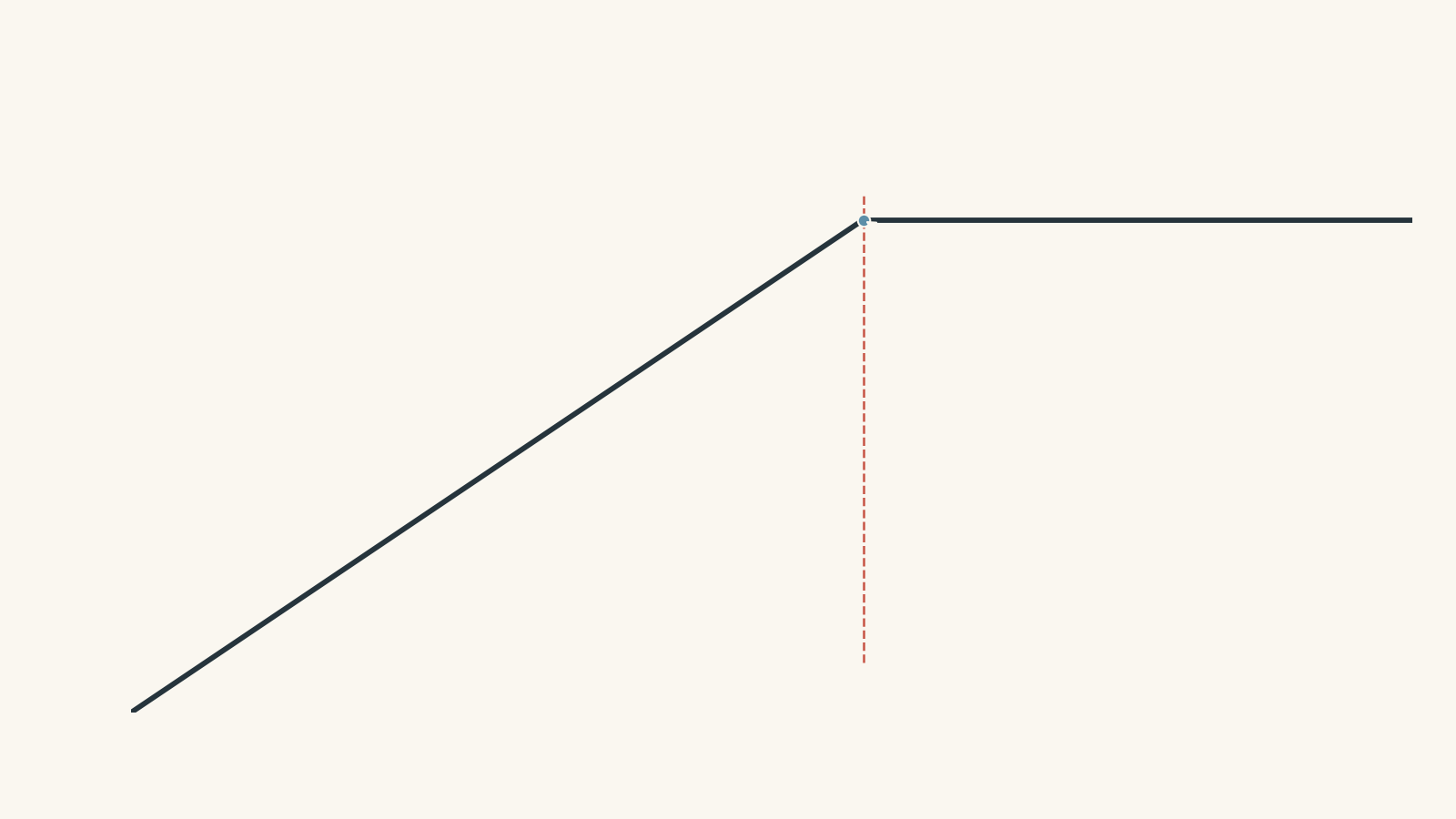
Up to about \(4.00\ \text{mmol}\) of HCl, adding more acid produces more hydrogen. Beyond that point, the gas volume levels off at roughly \(49\ \text{mL}\).
That bend in the data is the important part.
02Why the plateau reveals the ratio
Start with the first trial. There is plenty of magnesium but only \(1.00\ \text{mmol}\) of HCl. The acid runs out first.
Chemists call the reactant that runs out first the limiting reagent. Once it has been completely consumed, no more product can form.
Add more HCl and more magnesium can react, so the hydrogen volume rises.
Eventually, at roughly \(4.00\ \text{mmol}\) HCl, there is enough acid to react with all \(2.00\ \text{mmol}\) of magnesium. Beyond this point, magnesium becomes the limiting reagent. Adding even more acid cannot create extra hydrogen because there is no magnesium left to react.
The amounts at this changeover are therefore approximately
\[ n(\ce{HCl}):n(\ce{Mg}) =4.00:2.00 =2:1 \]
The experiment supports a hydrochloric acid to magnesium mole ratio of \(2:1\).
Worked example: infer a reaction ratio from the breakpoint
A student reacts 0.0486 g of magnesium with different volumes of \(0.200\ \text{mol L}^{-1}\) HCl. The final hydrogen volume stops increasing once about 20.0 mL of acid is used. Determine the experimental mole ratio of HCl to Mg.
Step 1
\[ n(\ce{Mg}) =\frac{m}{M} =\frac{0.0486}{24.3} =2.00\times10^{-3}\ \text{mol} \]
So there are \(2.00\ \text{mmol}\) of Mg.
Step 2
For a solution,
\[ n=cV \]
where \(n\) is amount in moles, \(c\) is concentration in \(\text{mol L}^{-1}\), and \(V\) is volume in litres.
\[ n(\ce{HCl}) =(0.200\ \text{mol L}^{-1})(0.0200\ \text{L}) =4.00\times10^{-3}\ \text{mol} \]
So there are \(4.00\ \text{mmol}\) of HCl at the breakpoint.
Step 3
\[ \ce{HCl}:\ce{Mg} =4.00:2.00 =2:1 \]
Step 4
The data indicates that two moles of HCl react for every one mole of Mg.
The balanced molecular equation is consistent with this:
\[ \ce{Mg(s) + 2HCl(aq) -> MgCl2(aq) + H2(g)} \]
The coefficient 2 in front of HCl is not just balancing decoration. It describes a measured stoichiometric relationship.
03Why does the ratio come out as whole numbers?
At the particle level, magnesium does not react with some vague continuous smear of hydrogen ions.
The useful net ionic equation is
\[ \ce{Mg(s) + 2H+(aq) -> Mg^2+(aq) + H2(g)} \]
One magnesium atom becomes one \(\mathrm{Mg}^{2+}\) ion by losing two electrons:
\[ \ce{Mg -> Mg^2+ + 2e^-} \]
Two hydrogen ions accept those two electrons and form one hydrogen molecule:
\[ \ce{2H+ + 2e^- -> H2} \]
So each reaction event needs one Mg atom and two \(\mathrm{H}^{+}\) ions. The counts are discrete.
A slightly silly way to picture this is a very strict group booking that requires two hydrogen ions for every magnesium atom. If a magnesium atom has only one hydrogen ion available, the required group cannot be completed. Extra hydrogen ions also become useless once every magnesium atom has reacted.
The analogy breaks because particles are not deliberately forming little teams. The real process involves collisions and electron transfer. What survives from the analogy is the counting rule.
A mole simply scales that particle-level counting to an enormous number of particles. If the particle ratio is \(2:1\), the mole ratio is also \(2:1\).
This does not mean reactions can only use whole numbers of moles.
For example,
\[ 0.00340\ \text{mol Mg} \]
would require
\[ 0.00680\ \text{mol HCl} \]
for the same \(2:1\) ratio.
The individual amounts are decimals. It is their ratio that simplifies to small whole numbers.
04Does the gas volume make sense?
The plateau is around \(49\ \text{mL}\) of hydrogen. We can check whether that is a sensible scale.
From the equation,
\[ \ce{Mg + 2HCl -> MgCl2 + H2} \]
one mole of Mg produces one mole of \(\ce{H2}\). Therefore \(2.00\ \text{mmol}\) Mg can produce at most \(2.00\ \text{mmol}\) \(\ce{H2}\).
For an approximate check, assume the gas behaves ideally at \(25^\circ\text{C}\) and \(100\ \text{kPa}\).
Using
\[ PV=nRT \]
where \(P\) is pressure, \(V\) is gas volume, \(n\) is amount of gas, \(R=8.314\ \text{L kPa mol}^{-1}\text{K}^{-1}\), and \(T\) is temperature in kelvin,
\[ V =\frac{nRT}{P} =\frac{(2.00\times10^{-3})(8.314)(298)}{100} =0.0496\ \text{L} =49.6\ \text{mL} \]
That is close to the measured plateau.
We should not expect perfect agreement. Gas can escape, the temperature and pressure may differ slightly, and experimental readings have uncertainty. The useful evidence is the combination of the approximate gas yield and the clear change in behaviour near \(4.00\ \text{mmol}\) HCl.
05Another experiment: find the ratio from a maximum
A plateau is not the only way to expose a reaction ratio.
Suppose two solutions, A and B, react to form an insoluble product. You prepare a series of mixtures while keeping the total solution volume constant.
At first, increasing the proportion of A gives more precipitate because A is limiting. Eventually the mixture reaches the stoichiometric proportion. Beyond this point, B becomes limiting, so increasing A means reducing the amount of B and the precipitate mass falls.
The result is a peak.
The mixture at the peak tells you the reacting mole ratio, provided the reaction is sufficiently complete and the measurement method is valid.
There is one trap: volume ratio is not automatically mole ratio.
You need
\[ n=cV \]
unless the two solutions have the same concentration.
Worked example: when the volume ratio is misleading
Solutions A and B form a solid product. In every trial, their combined volume is 45.0 mL. The largest precipitate mass is obtained using 18.0 mL of \(0.200\ \text{mol L}^{-1}\) A and 27.0 mL of \(0.100\ \text{mol L}^{-1}\) B. Determine the simplest experimental mole ratio A:B.
Step 1
\[ n(\mathrm{A}) =cV =(0.200)(0.0180) =3.60\times10^{-3}\ \text{mol} \]
So \(n(\mathrm{A})=3.60\ \text{mmol}\).
Step 2
\[ n(\mathrm{B}) =(0.100)(0.0270) =2.70\times10^{-3}\ \text{mol} \]
So \(n(\mathrm{B})=2.70\ \text{mmol}\).
Step 3
\[ \mathrm{A:B} =3.60:2.70 \]
Divide both values by \(2.70\):
\[ \mathrm{A:B} =1.333\ldots:1 \]
Multiply both parts by 3:
\[ \mathrm{A:B}=4:3 \]
Step 4
The data supports a reaction requiring four moles of A for every three moles of B.
Notice that the volume ratio was
\[ 18.0:27.0=2:3 \]
which is completely different. The concentrations were different, so comparing volumes alone would give the wrong conclusion.
06Finding a whole-number ratio from imperfect data
Real experimental results rarely hand you numbers such as exactly \(2.000:1.000\).
Suppose an experiment gives
\[ 1.48:1.00 \]
That is close to
\[ 1.50:1.00=3:2 \]
If the uncertainty in the measurements makes \(1.50:1.00\) a reasonable value, then \(3:2\) may be the best-supported simple ratio.
But do not turn this into a game of “force every decimal towards a nice fraction”.
If careful measurements repeatedly give something like
\[ 1.27:1.00 \]
you cannot simply announce \(5:4\) because \(1.25\) happens to be nearby. You need to consider measurement uncertainty, systematic error, incomplete reaction, side reactions, and whether your model of the reaction is even correct.
A sensible process is:
| Step | What to do | Why |
|---|---|---|
| 1 | Convert all measured quantities to moles | Stoichiometry compares amounts of particles, not raw masses or volumes |
| 2 | Identify the stoichiometric point | Look for a plateau, maximum, endpoint, or other change in behaviour |
| 3 | Divide each mole amount by the smallest | This normalises the ratio |
| 4 | Compare with simple integers | Values such as \(1.50:1\) become \(3:2\) |
| 5 | Check the uncertainty | Do not pretend noisy data is exact |
| 6 | Check chemical conservation | The proposed equation must conserve atoms and charge |
07What the simple experiment cannot control
The first magnesium experiment has an important weakness. We quietly assumed that the final gas volume really measures the total amount of reaction.
Several things can interfere with that assumption.
Gas can escape
If hydrogen escapes before reaching the gas syringe, the measured volume will be too low.
A gas-tight apparatus reduces this error. Starting the reaction only after the system is sealed is also important.
The reaction may not be finished
Suppose a student records the hydrogen volume exactly 30 seconds after adding the acid.
That is no longer purely a stoichiometry experiment.
Higher acid concentration can increase the reaction rate. A trial containing less acid might simply be reacting more slowly at the 30-second mark. The student could mistake a rate effect for a mole-ratio effect.
The correct comparison is the final amount of gas after each reaction has reached completion, not the amount formed after an arbitrary equal time.
Gas volume depends on temperature and pressure
The same number of moles of gas occupies different volumes at different temperatures and pressures.
Trials should therefore be compared under similar conditions, or gas volumes should be corrected using an appropriate gas relationship.
The experimental steps may be too widely spaced
If the only acid amounts tested were 2 mmol, 4 mmol, and 6 mmol, the data might suggest that the breakpoint is “somewhere near 4 mmol”, but not locate it very precisely.
A better investigation would use coarse measurements first, then repeat the experiment with smaller increments around the suspected transition.
For example, after locating the change near \(4.0\ \text{mmol}\), a second set of trials might investigate \(3.6\), \(3.8\), \(4.0\), \(4.2\), and \(4.4\ \text{mmol}\).
Replicating those measurements would help show whether an odd result is genuine or just experimental scatter.
08What the evidence actually proves
It is tempting to say:
The experiment proves that all chemicals react in whole-number mole ratios.
That claim is too broad.
A better statement is:
For a well-defined chemical reaction represented by a balanced equation, the stoichiometric coefficients specify the relative numbers of reacting particles, and therefore the relative numbers of moles. These coefficients can be expressed as a simple whole-number ratio.
The magnesium data supports a \(2:1\) acid-to-magnesium stoichiometric ratio for the reaction being studied.
It does not mean that every beaker must initially contain exactly that ratio. You can deliberately add excess acid. It also does not mean every particle in a reversible system must eventually be consumed.
The ratio describes the reaction relationship.
09From the experimental ratio to the equation
Experimental data can tell us that two moles of acid are required for every mole of magnesium, but a mole ratio alone does not identify every product.
Chemical knowledge is still needed.
For magnesium reacting with hydrochloric acid, the observed gas can be identified as hydrogen, and magnesium forms \(\mathrm{Mg}^{2+}\) ions. The net ionic equation is
\[ \ce{Mg(s) + 2H+(aq) -> Mg^2+(aq) + H2(g)} \]
Check what is conserved:
| Quantity | Left side | Right side |
|---|---|---|
| Mg atoms | 1 | 1 |
| H atoms | 2 | 2 |
| Overall charge | \(+2\) | \(+2\) |
Chloride ions do not participate in the net change. Restoring those spectator ions gives
\[ \ce{Mg(s) + 2HCl(aq) -> MgCl2(aq) + H2(g)} \]
The experimental \(2:1\) ratio and the balanced equation are therefore telling the same story in two different ways.
10Questions and solutions
Question 1
A \(1.50\ \text{mmol}\) sample of metal Z is reacted with increasing amounts of acid HX. The final gas yield stops increasing once \(3.00\ \text{mmol}\) of HX has been added.
Assuming the breakpoint represents complete stoichiometric reaction, determine the mole ratio HX:Z.
Solution 1
The mole ratio HX:Z is \(2:1\).
At the breakpoint,
\[ n(\mathrm{HX}):n(\mathrm{Z}) =3.00\ \text{mmol}:1.50\ \text{mmol} \]
Divide both values by \(1.50\ \text{mmol}\):
\[ \mathrm{HX:Z}=2.00:1.00=2:1 \]
This means two moles of HX are required per mole of Z in the reaction.
The important point is that the ratio comes from the amounts present at the changeover between HX being limiting and Z being limiting.
Question 2
Solutions P and Q have the same concentration, \(0.120\ \text{mol L}^{-1}\). In each trial their combined volume is 50.0 mL.
The maximum product yield occurs when 20.0 mL of P is mixed with 30.0 mL of Q.
Determine the simplest mole ratio P:Q.
Solution 2
The mole ratio P:Q is \(2:3\).
Because both solutions have the same concentration, their mole ratio is the same as their volume ratio.
We can still verify this using \(n=cV\).
For P,
\[ n(\mathrm{P}) =(0.120)(0.0200) =2.40\times10^{-3}\ \text{mol} \]
For Q,
\[ n(\mathrm{Q}) =(0.120)(0.0300) =3.60\times10^{-3}\ \text{mol} \]
Therefore,
\[ \mathrm{P:Q} =2.40:3.60 =2:3 \]
The peak indicates that the reactants are present in their stoichiometric proportion at this composition.
Question 3
A continuous-variation experiment uses \(0.250\ \text{mol L}^{-1}\) solution A and \(0.100\ \text{mol L}^{-1}\) solution B.
The greatest product yield occurs when 12.0 mL of A and 30.0 mL of B are mixed.
A student argues that the reaction ratio is \(12:30=2:5\).
Determine the actual mole ratio A:B and explain the student’s mistake.
Solution 3
The actual mole ratio A:B is \(1:1\), not \(2:5\).
For A,
\[ n(\mathrm{A}) =cV =(0.250)(0.0120) =3.00\times10^{-3}\ \text{mol} \]
For B,
\[ n(\mathrm{B}) =(0.100)(0.0300) =3.00\times10^{-3}\ \text{mol} \]
Therefore,
\[ \mathrm{A:B} =3.00:3.00 =1:1 \]
The student’s \(2:5\) result compares volumes, not amounts in moles.
Volume ratios only equal mole ratios for solutions when their concentrations are equal. Here, solution A is 2.5 times as concentrated as solution B, so a smaller volume of A can contain the same number of moles.
Question 4
An experiment estimates that \(4.44\pm0.12\ \text{mmol}\) of reactant X is required for \(3.00\ \text{mmol}\) of reactant Y.
A student says, “The ratio is 1.48:1, so this reaction does not have a simple whole-number mole ratio.”
Evaluate this claim.
Solution 4
The claim is not supported. The measurements are consistent with a \(3:2\) mole ratio.
The experimental ratio is
\[ \mathrm{X:Y} =\frac{4.44}{3.00}:1 =1.48:1 \]
A \(3:2\) ratio is
\[ \frac{3}{2}:1 =1.50:1 \]
The measured amount of X is \(4.44\pm0.12\ \text{mmol}\), giving a possible range from
\[ 4.32\ \text{mmol} \]
to
\[ 4.56\ \text{mmol} \]
For an exact \(3:2\) ratio with \(3.00\ \text{mmol}\) of Y, the expected X amount would be
\[ n(\mathrm{X}) =\frac{3}{2}(3.00\ \text{mmol}) =4.50\ \text{mmol} \]
The value \(4.50\ \text{mmol}\) lies within the experimental uncertainty.
Therefore, the results are consistent with \(3:2\). They do not establish the ratio with perfect certainty, but they certainly do not disprove simple whole-number stoichiometry just because the measured ratio was \(1.48:1\).
The trap is treating experimental measurements as exact numbers.
Question 5
A student repeats the magnesium and hydrochloric acid investigation, using the same amount of magnesium in every trial.
Instead of waiting for each reaction to finish, the student records the hydrogen volume exactly 30 seconds after adding the acid. The graph continues increasing until about \(5.0\ \text{mmol}\) HCl, so the student concludes that \(2.00\ \text{mmol}\) Mg reacts with \(5.0\ \text{mmol}\) HCl in a \(2.5:1\) ratio.
Is this conclusion valid?
Solution 5
No. The experiment cannot reliably determine the stoichiometric ratio because it mixes up reaction rate with total reaction yield.
A measurement after exactly 30 seconds tells us how much hydrogen has formed by that time, not necessarily how much can form once the reaction is complete.
Increasing the amount or concentration of acid can increase the frequency of successful collisions at the magnesium surface. The reaction may therefore proceed faster in trials containing more acid.
A lower-acid trial could still eventually produce its full stoichiometric amount of hydrogen, but not within the 30-second measurement period.
That would make its gas volume look artificially low and could shift the apparent breakpoint towards a larger HCl amount.
To determine the mole ratio, the student should compare the final hydrogen yield after each trial has finished, while controlling other important variables.
The tempting mistake is assuming that equal reaction time means equal reaction completeness.
Question 6
A reversible reaction is represented by
\[ \ce{2A(g) + B(g) <=> 2C(g)} \]
A mixture is prepared with A and B in the stoichiometric \(2:1\) mole ratio. At equilibrium, measurements show that both A and B are still present.
A student concludes that the equation cannot really describe a \(2:1\) reacting ratio because the reactants were not completely consumed.
Explain why this conclusion is incorrect.
Solution 6
The \(2:1\) stoichiometric ratio is still correct. A stoichiometric ratio does not require complete consumption in a reversible reaction.
The equation
\[ \ce{2A + B <=> 2C} \]
means that whenever the forward reaction advances by one reaction unit, two moles of A are consumed for every one mole of B consumed.
For example, if the forward reaction has a net extent of \(0.30\ \text{mol}\), the changes are
\[ \Delta n(\mathrm{A})=-2(0.30)=-0.60\ \text{mol} \]
\[ \Delta n(\mathrm{B})=-1(0.30)=-0.30\ \text{mol} \]
and
\[ \Delta n(\mathrm{C})=+2(0.30)=+0.60\ \text{mol} \]
The amounts of A and B consumed are still in the ratio
\[ 0.60:0.30=2:1 \]
At equilibrium, the forward and reverse reactions continue at equal rates. There is therefore no requirement that either reactant be completely used up.
The whole-number coefficients describe the relative changes caused by the reaction, not the final amounts that must remain in the container.
Once a reaction’s whole-number mole ratio is known, the next useful question is usually not “what is the ratio?” but which reactant runs out first for the amounts actually supplied? That is the limiting-reagent problem. The same coefficients you extracted from experimental data become the comparison numbers used to predict excess reactant and theoretical yield.