
Percentage Composition and Empirical Formulae: HSC Chemistry
Learn how to calculate percentage composition and derive empirical formulae from mass and percentage data. Includes worked examples, common traps, and practice questions with solutions.
A compound is 50.0% sulfur and 50.0% oxygen by mass. Would you predict its formula is \(\ce{SO}\), because the percentages are equal?
That prediction feels reasonable, but it mixes up mass with number of particles. In 50.0 g of sulfur there are fewer atoms than in 50.0 g of oxygen because sulfur atoms are heavier. Once we convert each mass to moles, the ratio is about 1 mole of sulfur atoms to 2 moles of oxygen atoms. Equal masses can hide an unequal particle ratio.
That is the whole problem this topic solves. Percentage composition tells you how the mass is divided. An empirical formula tells you the simplest whole-number ratio of atoms. Moles are the bridge between them.
01From mass to particle ratio
Picture two bags, each with a mass of 1 kg. One contains bowling balls and the other contains tennis balls. The masses are equal, but the numbers of balls certainly aren’t.
Elements work in a similar way. A mole of carbon atoms and a mole of oxygen atoms contain the same number of atoms, but they have different masses. So you cannot use masses directly as formula subscripts.
The analogy has a limit. Atoms are not little macroscopic balls sitting separately inside a compound. What matters here is simply the counting idea: if objects have different masses, weighing them does not directly tell you how many you have.
Chemists convert mass to amount using
\[
n=\frac{m}{M}
\]
where:
- \(n\) is the amount in moles (mol)
- \(m\) is the mass in grams (g)
- \(M\) is the molar mass in grams per mole (\(\mathrm{g\,mol^{-1}}\))
If that conversion still feels shaky, revise moles from mass and molar mass before pushing further. Almost every empirical formula calculation depends on it.
02Calculating percentage composition from a formula
Suppose you already know a compound’s formula. Percentage composition asks:
What percentage of the compound’s total mass comes from each element?
For an element \(X\),
\[
\% \text{ by mass of }X
=
\frac{\text{mass contributed by }X\text{ in 1 mol of compound}}
{\text{molar mass of the compound}}
\times 100
\]
The important phrase is mass contributed. If an element appears more than once in the formula, you must include every atom of that element.
For example, \(\ce{Mg(NO3)2}\) contains:
- 1 Mg atom
- 2 N atoms
- 6 O atoms
A common mistake is to see the 3 beside oxygen and use only three oxygen atoms. The outside 2 multiplies everything inside the brackets.
Worked example: Percentage composition of magnesium nitrate
Calculate the percentage by mass of magnesium, nitrogen, and oxygen in \(\ce{Mg(NO3)2}\). Use molar masses Mg = \(24.31\ \mathrm{g\,mol^{-1}}\), N = \(14.01\ \mathrm{g\,mol^{-1}}\), and O = \(16.00\ \mathrm{g\,mol^{-1}}\).
Step 1
One mole of \(\ce{Mg(NO3)2}\) contains 1 mol Mg, 2 mol N, and 6 mol O.
\[
\begin{aligned}
M(\ce{Mg(NO3)2})
&=24.31+2(14.01)+6(16.00)\\
&=24.31+28.02+96.00\\
&=148.33\ \mathrm{g\,mol^{-1}}
\end{aligned}
\]
Step 2
\[
\%\,\ce{Mg}
=
\frac{24.31}{148.33}\times100
=
16.4\%
\]
So 16.4% of the compound’s mass comes from magnesium.
Step 3
Two moles of nitrogen atoms contribute \(28.02\) g to one mole of the compound.
\[
\%\,\ce{N}
=
\frac{28.02}{148.33}\times100
=
18.9\%
\]
Step 4
Six moles of oxygen atoms contribute \(96.00\) g.
\[
\%\,\ce{O}
=
\frac{96.00}{148.33}\times100
=
64.7\%
\]
Step 5
\[
16.4+18.9+64.7=100.0\%
\]
The percentage composition is therefore approximately 16.4% Mg, 18.9% N, and 64.7% O by mass.
If your percentages add to something like 99.9% or 100.1%, that is normally just rounding. If they add to 87%, something has gone wrong.
03Going backwards: composition to empirical formula
Now reverse the problem.
You are given masses or percentages and need to discover the simplest atom ratio.
An empirical formula is the simplest whole-number ratio of the elements in a compound. For example, a compound with a carbon : hydrogen : oxygen ratio of \(1:2:1\) has the empirical formula \(\ce{CH2O}\).
The central idea is:
mass data -> mole amounts -> mole ratio -> whole-number ratio
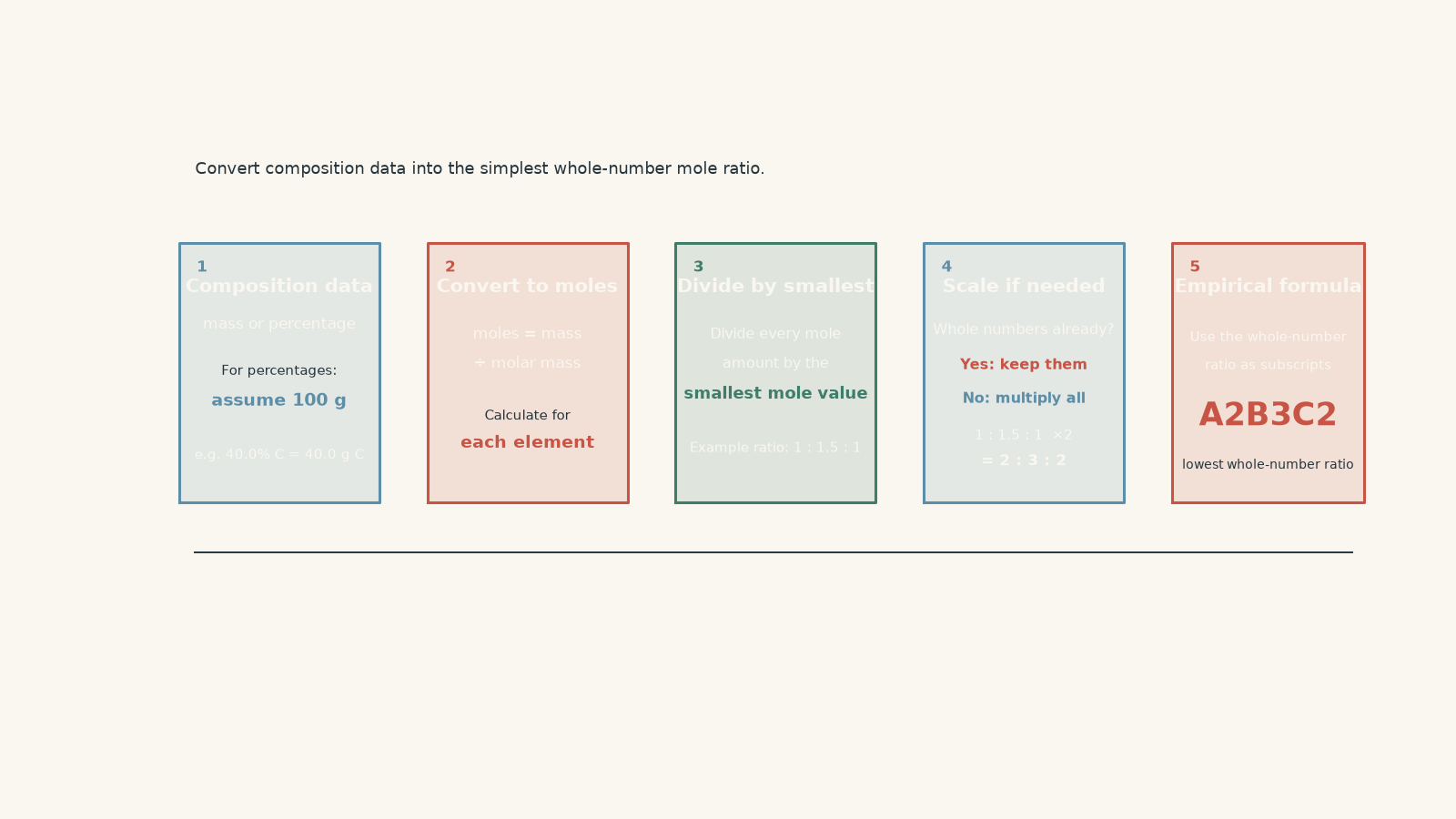
Step 1: Turn percentages into masses if needed
If the question gives percentages, imagine you have exactly 100 g of the compound.
Then:
- 37.0% becomes 37.0 g
- 12.5% becomes 12.5 g
- 50.5% becomes 50.5 g
This is not claiming the laboratory sample actually weighed 100 g. It is a mathematical convenience. Percentage means “per hundred”, so a 100 g sample makes each percentage numerically equal to a mass in grams.
If the question already gives actual masses, do not convert them to percentages first. Use the masses directly.
Step 2: Convert every mass to moles
Divide each element’s mass by its molar mass.
This is the crucial move. Empirical formulae describe particle ratios, so mass must be converted into an amount of particles.
Step 3: Divide every mole amount by the smallest
Suppose your mole amounts are
\[
0.150,\quad 0.300,\quad 0.150
\]
Divide all three by \(0.150\):
\[
1.00:2.00:1.00
\]
The empirical formula would have a \(1:2:1\) ratio.
Step 4: Decide whether the ratio is really whole-number
This is where students often lose an otherwise correct calculation.
Experimental data and atomic masses rarely produce ratios such as exactly 2.000000. You might obtain \(1.00:1.99:1.01\). That is clearly consistent with \(1:2:1\).
But suppose you get \(1.00:1.50\). Do not round 1.50 to either 1 or 2. Neither choice preserves the ratio.
Instead, multiply every part of the ratio by the same small integer:
\[
1.00:1.50
\]
Multiply both by 2:
\[
2.00:3.00
\]
So the whole-number ratio is \(2:3\).
These patterns are useful:
| Ratio you see | Useful action | Example result |
|---|---|---|
| Close to whole numbers | Round cautiously | \(1.00:1.99 \to 1:2\) |
| Contains about 0.50 | Multiply all ratios by 2 | \(1:1.50 \to 2:3\) |
| Contains about 0.33 or 0.67 | Multiply all ratios by 3 | \(1:1.33 \to 3:4\) |
| Contains about 0.25 or 0.75 | Multiply all ratios by 4 | \(1:1.75 \to 4:7\) |
This is a decision rule, not permission to force messy data into a formula. A ratio such as \(1.00:1.47\) might reasonably be close to \(1:1.5\) if the measurements have limited precision. A ratio such as \(1.00:1.82\) needs more thought. You should not automatically choose whichever integer happens to be nearby.
04A simple empirical formula calculation
Worked example: Formula from measured masses
A compound contains 2.402 g of carbon, 0.403 g of hydrogen, and 3.200 g of oxygen. Determine its empirical formula. Use C = \(12.01\ \mathrm{g\,mol^{-1}}\), H = \(1.008\ \mathrm{g\,mol^{-1}}\), and O = \(16.00\ \mathrm{g\,mol^{-1}}\).
Step 1
\[
\begin{aligned}
n(\ce{C})&=\frac{2.402}{12.01}=0.2000\ \mathrm{mol}\\
n(\ce{H})&=\frac{0.403}{1.008}=0.3998\ \mathrm{mol}\\
n(\ce{O})&=\frac{3.200}{16.00}=0.2000\ \mathrm{mol}
\end{aligned}
\]
The hydrogen value is not exactly 0.4000 mol because the given mass has been rounded.
Step 2
\[
\ce{C}:\ce{H}:\ce{O}
=
1.000:1.999:1.000
\]
Step 3
The values are extremely close to
\[
1:2:1
\]
so the empirical formula is
\[
\boxed{\ce{CH2O}}
\]
This means the compound has carbon, hydrogen, and oxygen atoms in the simplest ratio \(1:2:1\). It does not yet tell us the compound’s molecular formula.
05When the ratio is not immediately whole
The most tempting mistake is to round too aggressively.
Imagine a dating app somehow reports that for every 1 person in group A, there are 1.5 people in group B. Obviously, nobody is bringing half a person on a date. But rounding 1.5 down to 1 changes the ratio, and rounding it up to 2 also changes the ratio.
The sensible move is to scale the whole group: 2 people in A for every 3 in B.
That is exactly what you do with empirical formula ratios. The analogy breaks because atoms are not choosing dinner reservations, but the scaling logic is the same.
Worked example: A ratio containing 2.5
An oxide contains 43.64% phosphorus and 56.36% oxygen by mass. Determine its empirical formula. Use P = \(30.97\ \mathrm{g\,mol^{-1}}\) and O = \(16.00\ \mathrm{g\,mol^{-1}}\).
Step 1
The sample would contain:
- 43.64 g P
- 56.36 g O
Step 2
\[
\begin{aligned}
n(\ce{P})&=\frac{43.64}{30.97}=1.409\ \mathrm{mol}\\
n(\ce{O})&=\frac{56.36}{16.00}=3.523\ \mathrm{mol}
\end{aligned}
\]
Step 3
\[
\ce{P}:\ce{O}
=
1.000:2.500
\]
Do not turn 2.500 into 3.
Step 4
\[
1.000:2.500
\quad\longrightarrow\quad
2.000:5.000
\]
Therefore, the empirical formula is
\[
\boxed{\ce{P2O5}}
\]
The result says the simplest ratio is two phosphorus atoms for every five oxygen atoms. An empirical formula does not, by itself, prove that an individual molecule contains exactly two phosphorus and five oxygen atoms.
06The three mistakes worth actively avoiding
Mistake 1: Using percentages as subscripts
Suppose a substance is 40% element A and 60% element B.
That does not mean its empirical formula has an atom ratio \(40:60\), or \(2:3\). Those are mass percentages.
You first need to divide each mass by the corresponding molar mass.
Mistake 2: Rounding before you have the full ratio
Keep several significant figures while calculating moles and dividing ratios.
For example,
\[
1.00:1.49
\]
is much more informative than prematurely writing
\[
1:1
\]
The 1.49 is a strong clue that the intended ratio may be \(1:1.5\), which becomes \(2:3\).
Mistake 3: Treating empirical and molecular formulae as the same thing
The empirical formula is only the simplest whole-number ratio.
For example, the formulae
\[
\ce{CH2O},\qquad \ce{C2H4O2},\qquad \ce{C6H12O6}
\]
all have the same simplest carbon : hydrogen : oxygen ratio of \(1:2:1\).
Percentage composition can therefore identify an empirical ratio without uniquely identifying the substance.
07When one percentage is missing
Sometimes a question gives the percentages of some elements and expects you to find the rest by subtraction.
If a compound is known to contain only carbon, hydrogen, and oxygen, and its composition is:
- 52.0% carbon
- 13.0% hydrogen
then oxygen must make up
\[
100.0-52.0-13.0=35.0\%
\]
But notice the hidden assumption: the compound must contain only those three elements.
If nitrogen, sulfur, or another element could also be present, you cannot simply call the missing percentage oxygen. The arithmetic would work, but the chemistry would not be justified.
08Questions and solutions
Question 1
Calculate the percentage by mass of calcium and chlorine in \(\ce{CaCl2}\). Use Ca = \(40.08\ \mathrm{g\,mol^{-1}}\) and Cl = \(35.45\ \mathrm{g\,mol^{-1}}\).
Solution 1
The composition is 36.1% calcium and 63.9% chlorine by mass.
First find the molar mass:
\[
\begin{aligned}
M(\ce{CaCl2})
&=40.08+2(35.45)\\
&=110.98\ \mathrm{g\,mol^{-1}}
\end{aligned}
\]
Now calculate each mass percentage:
\[
\begin{aligned}
\%\,\ce{Ca}
&=\frac{40.08}{110.98}\times100\\
&=36.1\%\\
\%\,\ce{Cl}
&=\frac{70.90}{110.98}\times100\\
&=63.9\%
\end{aligned}
\]
The two percentages add to 100.0%, which is a useful check.
The important point is that chlorine contributes \(2(35.45)=70.90\) g per mole of \(\ce{CaCl2}\), because there are two chloride ions for every calcium ion in the formula ratio.
Question 2
A compound contains 50.0% sulfur and 50.0% oxygen by mass. Determine its empirical formula. Use S = \(32.06\ \mathrm{g\,mol^{-1}}\) and O = \(16.00\ \mathrm{g\,mol^{-1}}\).
Solution 2
The empirical formula is \(\ce{SO2}\), not \(\ce{SO}\).
Assume a 100 g sample. It contains 50.0 g S and 50.0 g O.
Convert these masses to moles:
\[
\begin{aligned}
n(\ce{S})&=\frac{50.0}{32.06}=1.560\ \mathrm{mol}\\
n(\ce{O})&=\frac{50.0}{16.00}=3.125\ \mathrm{mol}
\end{aligned}
\]
Divide both by the smaller value:
\[
\ce{S}:\ce{O}
=
\frac{1.560}{1.560}:\frac{3.125}{1.560}
=
1.000:2.003
\]
This is effectively
\[
1:2
\]
so the empirical formula is
\[
\boxed{\ce{SO2}}
\]
The trap is assuming equal mass percentages mean equal numbers of atoms. Oxygen has a lower molar mass than sulfur, so 50.0 g of oxygen contains about twice as many moles of atoms as 50.0 g of sulfur.
Question 3
A nitrogen oxide is found to contain 36.9% nitrogen and 63.1% oxygen by mass. Determine its empirical formula. Use N = \(14.01\ \mathrm{g\,mol^{-1}}\) and O = \(16.00\ \mathrm{g\,mol^{-1}}\).
Solution 3
The empirical formula is \(\ce{N2O3}\).
Assume 100 g of the compound:
\[
m(\ce{N})=36.9\ \mathrm{g},
\qquad
m(\ce{O})=63.1\ \mathrm{g}
\]
Convert to moles:
\[
\begin{aligned}
n(\ce{N})&=\frac{36.9}{14.01}=2.634\ \mathrm{mol}\\
n(\ce{O})&=\frac{63.1}{16.00}=3.944\ \mathrm{mol}
\end{aligned}
\]
Divide by \(2.634\) mol:
\[
\ce{N}:\ce{O}
=
1.000:1.497
\]
The oxygen ratio is very close to 1.5. Rounding 1.497 directly to either 1 or 2 would change the ratio.
Multiply both values by 2:
\[
2.000:2.994\approx2:3
\]
Therefore,
\[
\boxed{\ce{N2O3}}
\]
The key decision was recognising the half-integer ratio and scaling both numbers by 2.
Question 4
An analysis of a compound gives 54.5% carbon and 9.1% hydrogen by mass. The compound is known to contain only carbon, hydrogen, and oxygen.
Determine its empirical formula. Then explain why the same calculation would not be justified if the list of elements were unknown.
Use C = \(12.01\ \mathrm{g\,mol^{-1}}\), H = \(1.008\ \mathrm{g\,mol^{-1}}\), and O = \(16.00\ \mathrm{g\,mol^{-1}}\).
Solution 4
The empirical formula is \(\ce{C2H4O}\), but that conclusion relies on knowing that carbon, hydrogen, and oxygen are the only elements present.
Because the three elements must account for 100% of the mass, the oxygen percentage is
\[
100.0-54.5-9.1=36.4\%
\]
For a 100 g sample:
\[
m(\ce{C})=54.5\ \mathrm{g},\qquad
m(\ce{H})=9.1\ \mathrm{g},\qquad
m(\ce{O})=36.4\ \mathrm{g}
\]
Convert to moles:
\[
\begin{aligned}
n(\ce{C})&=\frac{54.5}{12.01}=4.538\ \mathrm{mol}\\
n(\ce{H})&=\frac{9.1}{1.008}=9.028\ \mathrm{mol}\\
n(\ce{O})&=\frac{36.4}{16.00}=2.275\ \mathrm{mol}
\end{aligned}
\]
Divide each value by \(2.275\) mol:
\[
\ce{C}:\ce{H}:\ce{O}
=
1.995:3.968:1.000
\]
These values are consistent with
\[
2:4:1
\]
so the empirical formula is
\[
\boxed{\ce{C2H4O}}
\]
If the elements present were not known, the subtraction step would be unjustified. The missing 36.4% could include nitrogen, sulfur, or another element instead of being entirely oxygen. The hidden assumption is chemical, not mathematical.
Question 5
Two pure compounds contain only carbon, hydrogen, and oxygen. Both are measured as 40.0% carbon, 6.7% hydrogen, and 53.3% oxygen by mass.
Compound A has a molar mass of approximately \(60.0\ \mathrm{g\,mol^{-1}}\). Compound B has a molar mass of approximately \(180\ \mathrm{g\,mol^{-1}}\).
Determine their empirical formula. Then decide whether the identical percentage compositions prove that A and B are the same compound. If possible, determine a molecular formula consistent with each molar mass.
Use C = \(12.01\ \mathrm{g\,mol^{-1}}\), H = \(1.008\ \mathrm{g\,mol^{-1}}\), and O = \(16.00\ \mathrm{g\,mol^{-1}}\).
Solution 5
Both compounds have the empirical formula \(\ce{CH2O}\), but they are not necessarily the same compound. The given molar masses are consistent with molecular formulae \(\ce{C2H4O2}\) for A and \(\ce{C6H12O6}\) for B.
Start with a 100 g sample:
\[
m(\ce{C})=40.0\ \mathrm{g},\qquad
m(\ce{H})=6.7\ \mathrm{g},\qquad
m(\ce{O})=53.3\ \mathrm{g}
\]
Convert to moles:
\[
\begin{aligned}
n(\ce{C})&=\frac{40.0}{12.01}=3.331\ \mathrm{mol}\\
n(\ce{H})&=\frac{6.7}{1.008}=6.647\ \mathrm{mol}\\
n(\ce{O})&=\frac{53.3}{16.00}=3.331\ \mathrm{mol}
\end{aligned}
\]
Divide by the smallest amount:
\[
\ce{C}:\ce{H}:\ce{O}
=
1.000:1.996:1.000
\approx
1:2:1
\]
So both have empirical formula
\[
\boxed{\ce{CH2O}}
\]
The empirical formula mass is
\[
12.01+2(1.008)+16.00
=
30.026\ \mathrm{g\,mol^{-1}}
\]
For compound A:
\[
\frac{60.0}{30.026}\approx2
\]
so its molecular formula can be two empirical units:
\[
(\ce{CH2O})_2=\boxed{\ce{C2H4O2}}
\]
For compound B:
\[
\frac{180}{30.026}\approx6
\]
so its molecular formula can be
\[
(\ce{CH2O})_6=\boxed{\ce{C6H12O6}}
\]
The trap is assuming that identical percentage composition uniquely identifies a compound. Percentage composition fixes the relative mass contribution, which fixes the empirical ratio, but different molecular formulae can share that same ratio.
09What the empirical formula lets you determine next
Percentage composition gets you from measured mass to the simplest particle ratio. The sequence is worth being able to reproduce without memorising disconnected tricks:
\[
\text{mass or percentage}
\rightarrow
\text{moles}
\rightarrow
\text{divide by the smallest}
\rightarrow
\text{whole-number ratio}
\rightarrow
\text{empirical formula}
\]
The next question is often whether that simplest ratio is the compound’s actual molecular formula.
If the molar mass of the compound is known, compare it with the empirical formula mass. Their ratio tells you how many empirical units fit inside one molecular formula:
\[
k=
\frac{\text{molar mass of compound}}
{\text{empirical formula mass}}
\]
where \(k\) should be close to a positive whole number. The molecular formula is then found by multiplying every subscript in the empirical formula by \(k\).
So the important decision is not just “What formula did I calculate?” It is “Was I asked for the simplest ratio, or for the actual molecular formula?” That distinction is what turns percentage composition from a calculation into evidence about chemical composition.