
How to Prepare a Standard Solution for HSC Chemistry
Learn how to calculate, prepare, transfer, dilute, and mix a standard solution accurately using a measured solute mass and volumetric flask.
Suppose you need 250.00 mL of a sodium carbonate solution with a concentration of exactly \(0.1000\ \text{mol L}^{-1}\). You calculate the mass, weigh it carefully, add water, and end up with 250 mL of solution. Done?
Not necessarily. If some solid stays behind in the beaker, your concentration is too low. If you fill the flask past the calibration mark, it is too low again. If you try to “fix” that mistake by tipping some solution out, the concentration is still wrong.
The difficult part of preparing a standard solution isn’t just the calculation. It is making sure the number of moles you measured actually ends up in the accurately measured final volume.
Before reading on, predict this: a clean volumetric flask is still wet inside with distilled water. Must you dry it before preparing the solution?
No. That water will become part of the final solution, and you will still make the total volume up to the calibration mark. This is one of several places where thinking about moles and final volume is more useful than memorising a list of laboratory rules.
01What are we actually trying to control?
For a solution,
\[ c=\frac{n}{V} \]
where:
- \(c\) is concentration in \(\text{mol L}^{-1}\)
- \(n\) is the amount of dissolved solute in moles
- \(V\) is the final solution volume in litres
If the solute is a solid, its amount can be found from:
\[ n=\frac{m}{M} \]
where:
- \(m\) is the mass of solute in grams
- \(M\) is its molar mass in \(\text{g mol}^{-1}\)
Combining the equations gives:
\[ c=\frac{m}{MV} \]
That equation tells you exactly what the practical procedure has to achieve.
You need:
- an accurately known mass of solute
- all of that solute transferred into the solution
- an accurately known final volume
A standard solution is a solution whose concentration is accurately known. When you prepare one directly from a weighed solid, the solid should be suitable for accurate quantitative work. In practice, a primary standard is preferred because it has high purity and is chemically stable, and it does not readily change mass by absorbing water or reacting with the air.
Anhydrous sodium carbonate, \(\ce{Na2CO3}\), is a common example used in acid-base work.
02Why use a volumetric flask?
Imagine trying to measure exactly 250.00 mL using an ordinary beaker. The markings on a beaker are useful for rough volumes, but they are not designed for precise concentration work.
A volumetric flask solves a different problem. It has a narrow neck with one calibration mark. At the flask’s calibration temperature, filling the solution so that the bottom of the meniscus sits on that mark gives the specified volume much more accurately than a beaker or measuring cylinder.
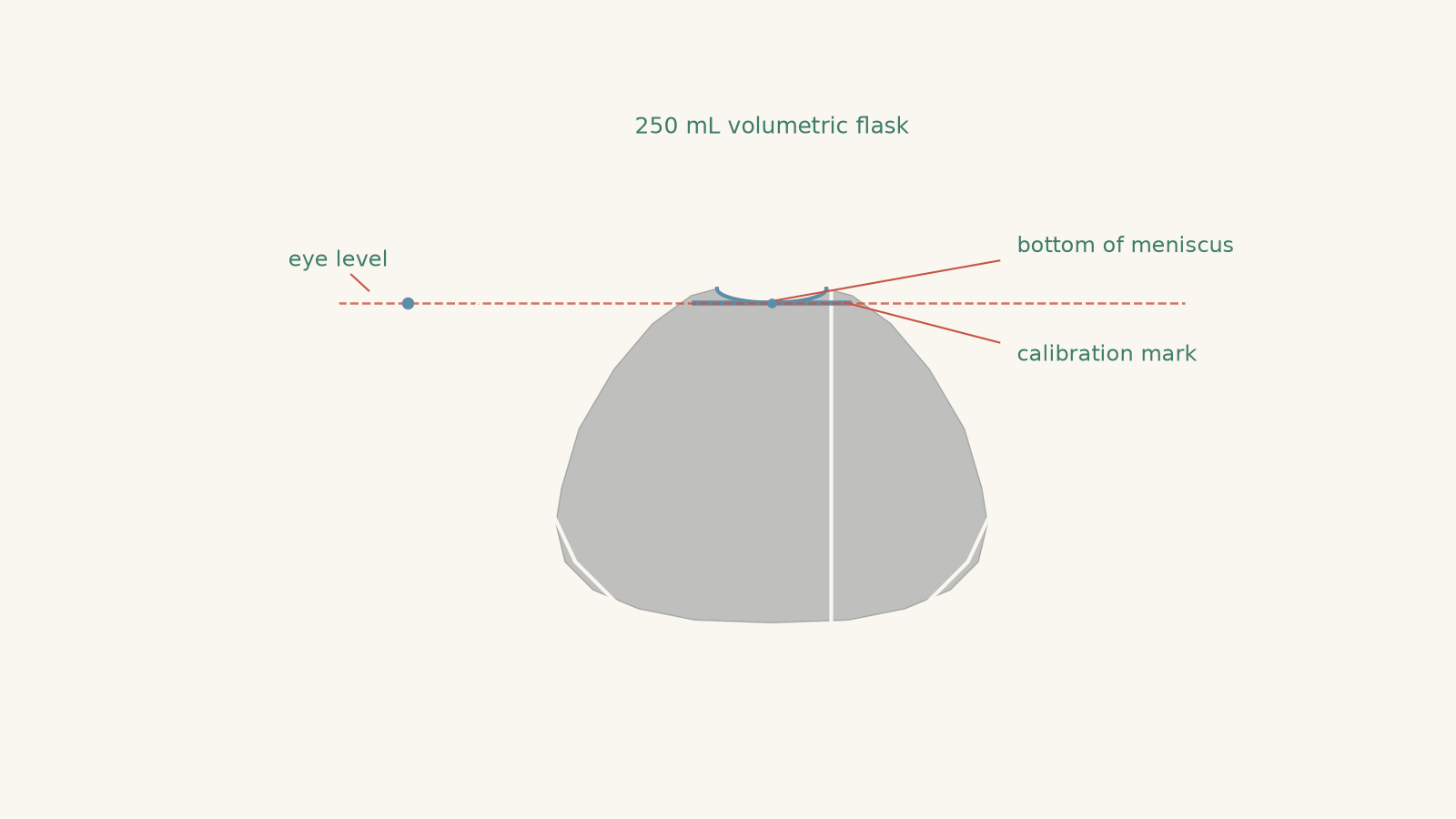
There is a useful mental model here. Think of preparing a standard solution like getting exactly ten people into a room of fixed size. You care about both the number of people and the size of the room. Losing one person changes the “people concentration”. Making the room larger changes it too.
The analogy breaks because dissolved particles do not sit in separate little spaces like people at a party. But it captures the two quantities you must control: amount of solute and final volume.
03The calculation comes before the glassware
Suppose you want to prepare a solution of concentration \(c\) and volume \(V\).
Start with:
\[ n=cV \]
Then use:
\[ m=nM \]
Combining them:
\[ m=cVM \]
Be careful with volume units. If concentration is in \(\text{mol L}^{-1}\), the volume must be in litres.
For example:
\[ 250.00\ \text{mL}=0.25000\ \text{L} \]
Worked example: What mass of sodium carbonate is needed?
Prepare 250.00 mL of \(0.1000\ \text{mol L}^{-1}\) \(\ce{Na2CO3}\). Calculate the required mass of anhydrous sodium carbonate.
Step 1
Using \(M(\ce{Na})=22.99\), \(M(\ce{C})=12.01\), and \(M(\ce{O})=16.00\):
\[ M(\ce{Na2CO3}) =2(22.99)+12.01+3(16.00) =105.99\ \text{g mol}^{-1} \]
Step 2
\[ V=250.00\ \text{mL}=0.25000\ \text{L} \]
Step 3
\[ n=cV =(0.1000\ \text{mol L}^{-1})(0.25000\ \text{L}) =0.02500\ \text{mol} \]
Step 4
\[ m=nM =(0.02500\ \text{mol})(105.99\ \text{g mol}^{-1}) =2.64975\ \text{g} \]
So the required mass is approximately:
\[ \boxed{2.650\ \text{g}} \]
This means that if \(2.650\ \text{g}\) of suitable anhydrous \(\ce{Na2CO3}\) is transferred completely and the final volume is exactly 250.00 mL, the solution will have the required concentration to the precision justified by the measurements.
04Preparing the solution accurately
The exact equipment available can vary, but the reasoning behind the method should not.
1. Accurately weigh the solid
Use an analytical or suitable laboratory balance to measure the required mass of solute.
Record the actual mass measured, rather than pretending you obtained the theoretical mass exactly.
For example, if your calculation says \(2.650\ \text{g}\), but the balance shows \(2.647\ \text{g}\), use \(2.647\ \text{g}\) when calculating the actual concentration.
That is better chemistry than repeatedly adding and removing grains until the display happens to show the target value.
2. Dissolve the solute
Place the weighed solid in a clean beaker and add a moderate amount of distilled or deionised water.
Stir until the solid has completely dissolved.
You do not fill to the final volume at this stage. The beaker is being used to dissolve the solute, not to measure the final solution volume.
3. Transfer the solution quantitatively
Pour the solution into the volumetric flask, usually through a funnel.
Now comes an easily missed idea: pouring the visible liquid into the flask is not enough.
A thin film of solution may remain on:
- the beaker
- the stirring rod
- the funnel
Those droplets contain solute.
Rinse the beaker, stirring rod, and funnel with small amounts of distilled or deionised water, and add those washings to the volumetric flask.
This is called quantitative transfer. The aim is to transfer essentially all of the measured solute.
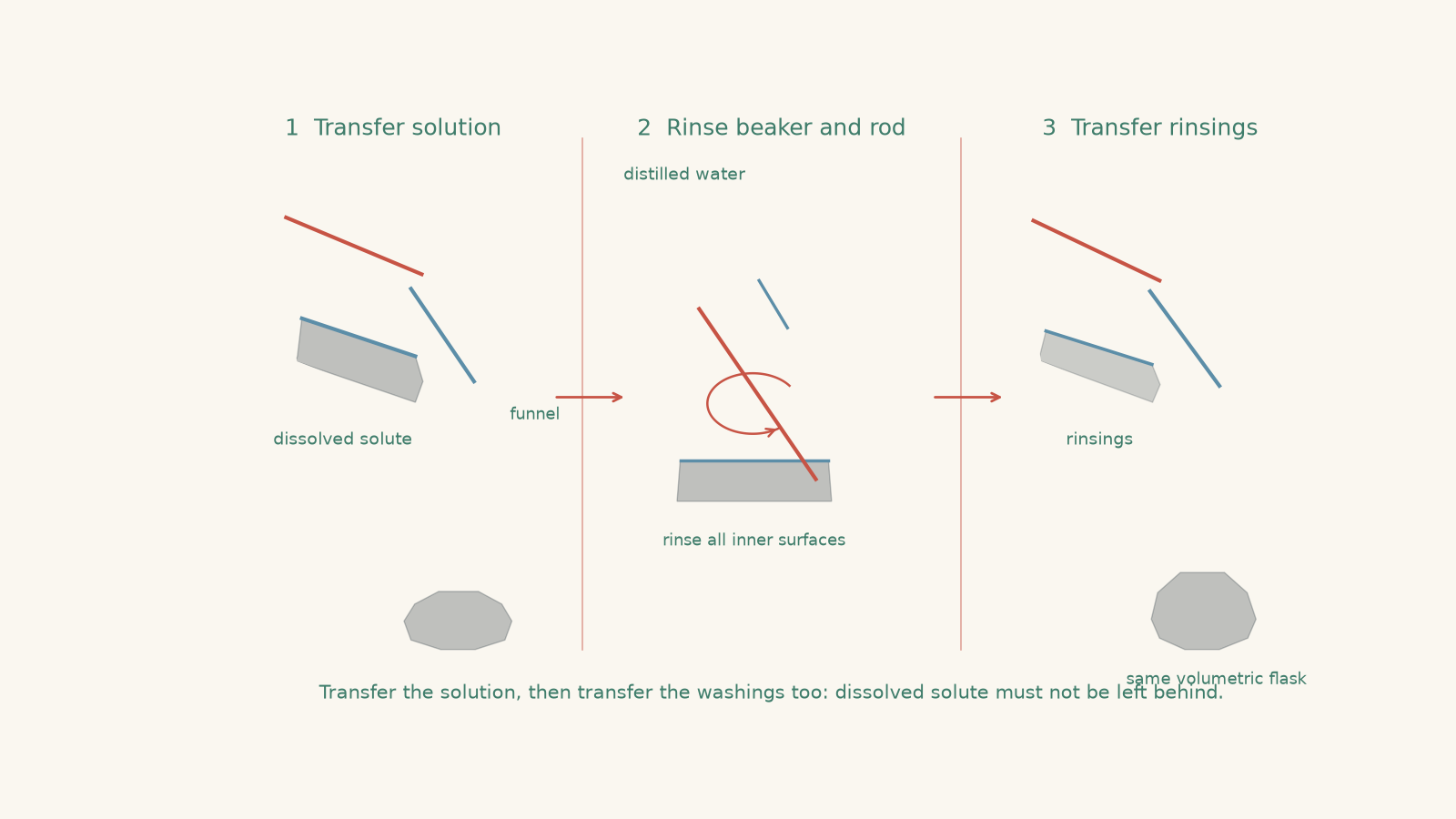
A common student prediction is that adding these rinsings will “dilute the solution too much”. It won’t, provided you have not yet reached the calibration mark.
Why? Because you are eventually adjusting the total volume to one fixed value anyway. The rinsing water changes how much water you add later, not the final volume.
4. Add water close to the calibration mark
Add distilled or deionised water until the liquid level approaches the calibration line.
As you get close, slow down. Use a dropping pipette if needed.
The narrow neck is useful because a small added volume produces a noticeable change in liquid height.
5. Set the meniscus accurately
Place the flask on a level surface and bring your eye to the same height as the calibration mark.
For a typical aqueous solution with a concave meniscus, align the bottom of the meniscus with the calibration line.
Do not read it from above or below. That produces parallax error.
6. Stopper and mix thoroughly
Once the final volume is correct, insert the stopper securely.
Invert the flask several times so that the solution becomes uniform throughout.
This matters because gently adding water to the top does not guarantee that the concentration is immediately identical throughout the flask.
The final standard solution should then be labelled appropriately, including its identity and concentration.
05Why a wet volumetric flask is fine
Return to the prediction from the opening.
Suppose there are a few millilitres of distilled water already inside the flask. You transfer \(0.02500\ \text{mol}\) of solute into it and then add water until the final volume is exactly \(0.25000\ \text{L}\).
The concentration is still:
\[ c=\frac{0.02500\ \text{mol}}{0.25000\ \text{L}} =0.1000\ \text{mol L}^{-1} \]
The existing water merely means you need to add slightly less water later.
This is different from a pipette that must deliver a solution of known concentration. Residual water in that pipette could dilute the solution being delivered. The role of the glassware matters.
06The biggest practical trap: confusing water volume with solution volume
You are not preparing a standard solution by measuring 250.00 mL of water and then adding solute.
The required quantity is 250.00 mL of final solution.
Dissolving a solute can change the total volume. Volumes are not generally perfectly additive at the particle level.
So this procedure is wrong:
- measure 250.00 mL of water
- dissolve the solute in it
- assume the final solution volume is 250.00 mL
The correct procedure is:
- measure the solute
- dissolve and transfer it
- add water until the solution itself reaches the volumetric mark
That is what makes \(V\) in \(c=n/V\) the correct final volume.
07What different mistakes do to the concentration
You do not need to memorise every possible error separately. Ask two questions:
Did the number of moles in the flask change?
Did the final volume change?
Then use \(c=n/V\).
| Mistake | Effect on \(n\) | Effect on \(V\) | Concentration |
|---|---|---|---|
| Some solute is left in the beaker | Lower | Intended volume | Too low |
| Solution is filled above the calibration mark | Same | Higher | Too low |
| Flask contains distilled water before transfer | Same | Still adjusted to intended volume | No effect |
| Some solution is spilled during transfer | Lower | Intended volume | Too low |
| Meniscus is below the calibration mark | Same | Lower | Too high |
| More pure water is added after the flask has been made to the mark | Same | Higher | Too low |
One case deserves special attention.
Suppose you overshoot the calibration mark, then tip out enough solution to bring the level back to the mark. Is the problem fixed?
No.
Once the solution has been mixed, tipping some out removes both solvent and dissolved solute. You no longer know exactly how many moles remain. The original measured amount of solute is no longer all present in the flask.
The reliable response to a significant overshoot is to prepare the solution again.
08Actual concentration when the weighed mass is slightly different
In real laboratory work, the measured mass will rarely be exactly the calculated target.
That is fine. Calculate the concentration from the mass you actually used.
Worked example: Finding the concentration from the actual mass
A student needs approximately \(0.0500\ \text{mol L}^{-1}\) \(\ce{Na2CO3}\). They accurately weigh \(1.321\ \text{g}\) of anhydrous \(\ce{Na2CO3}\), transfer it quantitatively, and make the solution up to 250.00 mL. Calculate the actual concentration.
Use \(M(\ce{Na2CO3})=105.99\ \text{g mol}^{-1}\).
Step 1
\[ n=\frac{m}{M} =\frac{1.321\ \text{g}}{105.99\ \text{g mol}^{-1}} =0.01246\ \text{mol} \]
Step 2
\[ V=250.00\ \text{mL}=0.25000\ \text{L} \]
Step 3
\[ c=\frac{n}{V} =\frac{0.01246\ \text{mol}}{0.25000\ \text{L}} =0.04985\ \text{mol L}^{-1} \]
Therefore:
\[ \boxed{c=0.04985\ \text{mol L}^{-1}} \]
The solution is slightly below \(0.0500\ \text{mol L}^{-1}\), but its concentration is accurately known from the measured mass and final volume. That is more useful than pretending the intended concentration and the actual concentration must be identical.
09Why the choice of solid matters
So far, we have treated the measured mass as though every gram belongs to the chemical named on the bottle. That assumption needs checking.
Imagine you weigh \(2.000\ \text{g}\) of a solid, but some of that mass is actually absorbed water. Your calculation treats the full \(2.000\ \text{g}\) as solute, even though fewer moles of the intended substance are present.
The calculated concentration would then be unreliable.
A substance suitable as a primary standard should generally:
- have high purity
- have a well-defined chemical formula
- be stable during storage and weighing
- not readily absorb water from the atmosphere
- not readily react with gases in the air
- ideally have a reasonably high molar mass, reducing the relative effect of a small mass uncertainty
This is why “weigh a solid and dilute it accurately” does not automatically produce a trustworthy standard solution. The reliability of the mass measurement depends on what you are weighing.
10Accuracy is a chain
Students sometimes focus entirely on the volumetric flask because it looks like the “precision equipment”. But a standard solution is only as reliable as the whole chain of measurements and transfers.
Suppose the final volume is perfect, but 3% of the solute remains stuck to the beaker. The solution is wrong.
Suppose every crystal is transferred, but the flask is filled well above the calibration line. The solution is wrong.
Suppose the transfer and volume are perfect, but the solid has absorbed an unknown amount of water. The calculated number of moles may be wrong.
A useful decision rule is:
For every step, ask whether it changes the known number of moles, the known final volume, or our confidence in either measurement.
That one question explains most standard-solution errors.
11Questions and solutions
Question 1
A student accurately weighs \(0.5300\ \text{g}\) of anhydrous \(\ce{Na2CO3}\) and prepares 100.00 mL of solution in a volumetric flask. Calculate the concentration of the solution.
Use \(M(\ce{Na2CO3})=105.99\ \text{g mol}^{-1}\).
Solution 1
The concentration is approximately \(\boxed{0.05000\ \text{mol L}^{-1}}\).
First calculate the amount of \(\ce{Na2CO3}\):
\[ n=\frac{m}{M} =\frac{0.5300\ \text{g}}{105.99\ \text{g mol}^{-1}} =5.000\times10^{-3}\ \text{mol} \]
Convert the volume to litres:
\[ 100.00\ \text{mL}=0.10000\ \text{L} \]
Then:
\[ c=\frac{n}{V} =\frac{5.000\times10^{-3}\ \text{mol}}{0.10000\ \text{L}} =0.05000\ \text{mol L}^{-1} \]
The calculation uses the final solution volume, not the amount of water added.
Question 2
A student transfers a dissolved sample into a 250.00 mL volumetric flask. A small amount of solution remains coating the original beaker, but the student does not rinse it into the flask. They then fill the volumetric flask correctly to the calibration mark.
State whether the actual concentration is higher than, lower than, or equal to the concentration calculated from the original mass. Explain your reasoning.
Solution 2
The actual concentration is lower than the calculated concentration.
The calculated concentration assumes that all the weighed solute reached the volumetric flask. Some dissolved solute has instead remained in the beaker, so the number of moles in the flask is lower than expected.
The final volume is still 250.00 mL. Therefore, using
\[ c=\frac{n}{V}, \]
a smaller \(n\) with the intended \(V\) gives a smaller concentration.
The important issue is not that some liquid was left behind. It is that the liquid left behind contained some of the measured solute.
Question 3
A clean 250.00 mL volumetric flask contains approximately 8 mL of distilled water after being rinsed. A student says:
“That flask needs to be completely dry. Otherwise the extra water will dilute my standard solution.”
Is the student correct? Explain what should be done.
Solution 3
The student is not correct. The flask can contain distilled water before the solute is transferred.
The concentration depends on the final solution volume:
\[ c=\frac{n}{V} \]
The water already in the flask becomes part of the solution. The student simply adds less water later before the meniscus reaches the 250.00 mL calibration mark.
As long as the same amount of solute is transferred and the final solution volume is 250.00 mL, the concentration is unchanged.
The trap is thinking that the procedure requires a fixed volume of added water. It does not. It requires a fixed final volume of solution.
Question 4
A student calculates that \(1.325\ \text{g}\) of a solute is required. They actually weigh \(1.319\ \text{g}\), but write \(1.325\ \text{g}\) in their calculation because “that was the mass I was meant to use”.
The molar mass is \(106.0\ \text{g mol}^{-1}\), and the final solution volume is 250.00 mL.
Calculate the concentration that should be recorded using the actual mass, and explain why using the intended mass is inappropriate.
Solution 4
The concentration should be recorded as approximately \(\boxed{0.04977\ \text{mol L}^{-1}}\).
The amount of solute actually present is:
\[ n=\frac{m}{M} =\frac{1.319\ \text{g}}{106.0\ \text{g mol}^{-1}} =0.01244\ \text{mol} \]
The final volume is:
\[ V=250.00\ \text{mL}=0.25000\ \text{L} \]
Therefore:
\[ c=\frac{n}{V} =\frac{0.01244\ \text{mol}}{0.25000\ \text{L}} =0.04977\ \text{mol L}^{-1} \]
The intended mass does not determine the actual concentration. The measured mass does.
Using \(1.325\ \text{g}\) would claim that more moles were present than were actually weighed. A standard solution needs an accurately known concentration, not merely a concentration close to the original target.
Question 5
A student prepares a standard solution correctly until the final volume step. They accidentally add water until the meniscus is 3 mm above the calibration mark.
They then stopper and mix the solution thoroughly. To correct the mistake, they use a dropping pipette to remove solution until the meniscus is exactly on the calibration mark.
Has the original intended concentration been restored? Explain carefully.
Solution 5
No. Removing mixed solution does not restore the original intended concentration.
When the student first fills above the calibration mark, the number of moles of solute is unchanged, but the total volume is too large. Therefore:
\[ c=\frac{n}{V} \]
shows that the concentration becomes too low.
After mixing, the solute is distributed throughout the solution. Removing some solution therefore removes both water and solute in the same concentration.
The remaining solution still has the same concentration as the diluted mixture before removal. Removing a portion of a homogeneous solution changes the total amount and total volume proportionally, so it does not increase the concentration back to its intended value.
This is the key trap: bringing the liquid level back to the line does not magically restore the original number of moles that should have been present in that volume.
For accurate quantitative work, the solution should be prepared again.
Question 6
Two students prepare separate 250.00 mL solutions from nominally \(2.650\ \text{g}\) samples of different solids.
Student A uses a pure, stable solid that does not appreciably absorb water from the air.
Student B uses a solid that rapidly absorbs an unknown amount of atmospheric moisture while being weighed.
Both balances and volumetric flasks are used correctly, and both students transfer all of their samples quantitatively.
Student B argues: “My balance measurement was accurate, so my concentration must also be accurately known.”
Evaluate this claim.
Solution 6
Student B’s claim is not justified. An accurate measurement of the total sample mass does not guarantee an accurately known number of moles of the intended solute.
For Student A, the measured mass can be reliably related to moles using:
\[ n=\frac{m}{M} \]
because the sample mass is effectively the mass of the pure substance represented by the stated chemical formula.
For Student B, part of the measured mass may be absorbed water. If the amount of water is unknown, the mass of the actual intended solute is also unknown. The calculation
\[ n=\frac{m}{M} \]
would incorrectly treat the entire measured mass as the intended compound.
This exposes an important hidden assumption in standard-solution calculations: the measured mass must correspond to a known amount of the chemical species being used.
A precise balance cannot compensate for an unsuitable or chemically uncertain sample.
12What this method prepares you for next
Preparing a standard solution gives you a concentration you can trust because both the amount of solute and the final volume are controlled.
That becomes the starting point for volumetric analysis. In a titration, a solution of accurately known concentration can be used to determine an unknown concentration through reaction stoichiometry. The same reasoning continues: first establish exactly how many moles you know, then use the balanced chemical equation to work out the moles you do not know.