
The Mole and Avogadro Constant: HSC Chemistry Guide
Learn how the mole connects to Avogadro's constant, and how to convert between chemical amount and numbers of atoms, molecules, ions, and formula units.
A sealed container holds \(0.250\ \text{mol}\) of water. You can’t count the water molecules one by one, but chemistry still expects you to say how many are there.
Before calculating, make a prediction. Is \(0.250\ \text{mol}\) closer to a thousand molecules, a billion molecules, or \(10^{23}\) molecules?
It is on the scale of \(10^{23}\). That enormous number is the whole reason the mole exists. Atoms, molecules, and ions are so tiny that useful laboratory samples contain absurdly large numbers of them. The mole gives us a practical way to count those particles without actually counting them.
01The mole is a counting unit
You already use counting units that group objects together. A dozen means 12 objects. If someone says “two dozen eggs”, you immediately know they mean 24 eggs.
A mole works the same way, except chemistry needed a much larger group:
\[ 1\ \text{mol} = 6.02214076 \times 10^{23}\ \text{specified particles} \]
That number is connected to the Avogadro constant, \(N_A\):
\[ N_A = 6.02214076 \times 10^{23}\ \text{mol}^{-1} \]
In calculations, you will often see this rounded to \(6.022 \times 10^{23}\ \text{mol}^{-1}\). If a question supplies a value, use the supplied value.
So:
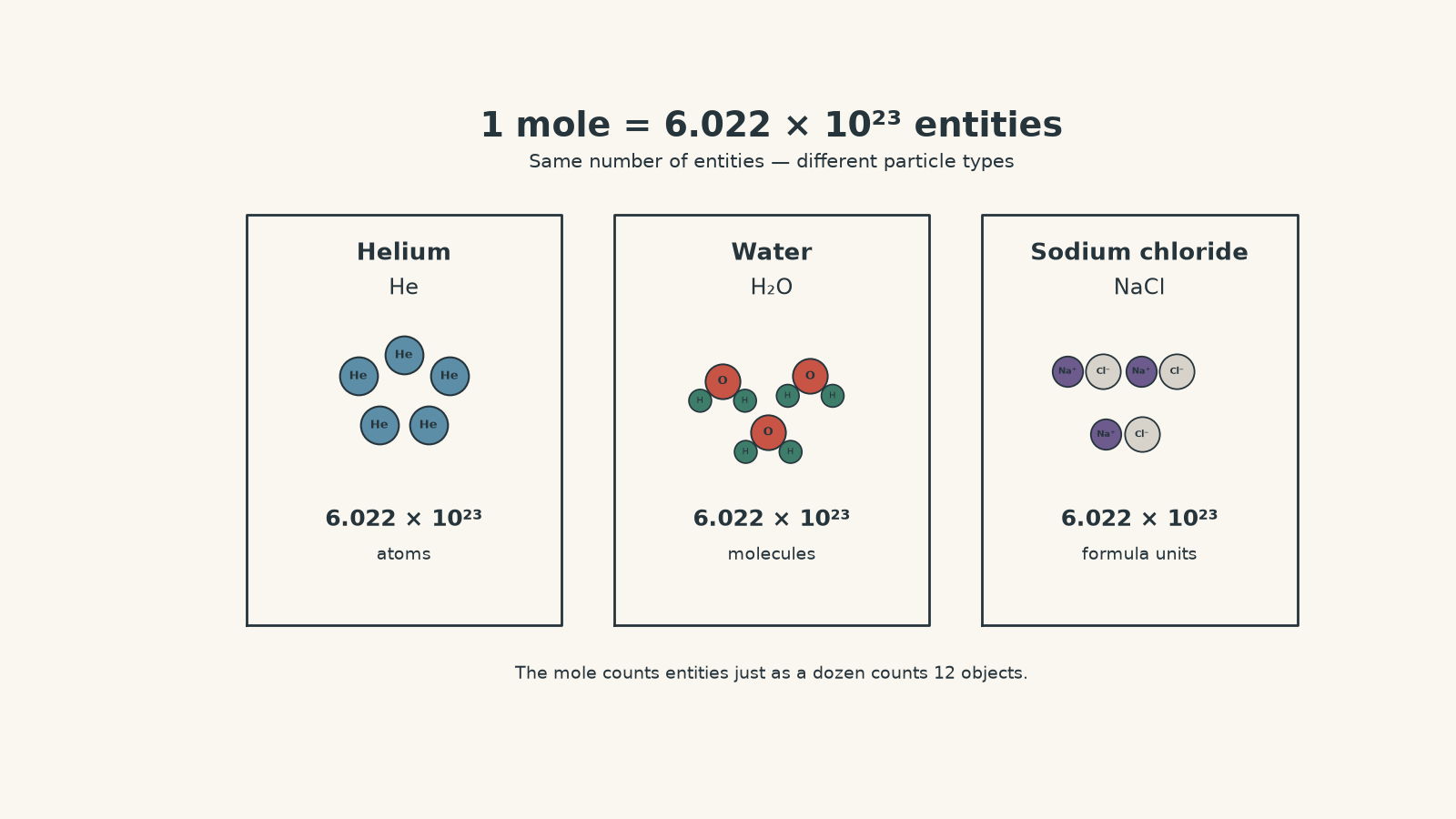
- 1 mol of helium contains \(6.02214076 \times 10^{23}\) helium atoms.
- 1 mol of water contains \(6.02214076 \times 10^{23}\) water molecules.
- 1 mol of sodium chloride contains \(6.02214076 \times 10^{23}\) \(\ce{NaCl}\) formula units.
The dozen analogy is useful, but it has a limit. A dozen tells you there are 12 objects, and a mole tells you there are \(6.02214076 \times 10^{23}\) entities. Neither tells you what those objects are or how much they weigh.
One dozen bowling balls and one dozen marshmallows contain the same number of objects but definitely don’t have the same mass. The same idea applies to moles.
02What does “particle” actually mean?
This is where a lot of mole questions quietly become harder.
Suppose a question says there are \(6.022 \times 10^{23}\) “particles”. What is being counted?
You need to identify the specified entity.
| Substance or situation | Entity usually counted |
|---|---|
| \(\ce{He}\), \(\ce{Ne}\), \(\ce{Fe}\) | atoms |
| \(\ce{H2O}\), \(\ce{CO2}\), \(\ce{O2}\) | molecules |
| \(\ce{NaCl}\), \(\ce{MgCl2}\) | formula units |
| \(\mathrm{Na}^{+}\), \(\mathrm{Cl}^{-}\) in a question about individual ions | ions |
For example, \(1\ \text{mol}\) of \(\ce{O2}\) contains \(6.022 \times 10^{23}\) molecules of \(\ce{O2}\).
But each molecule contains two oxygen atoms. Therefore, \(1\ \text{mol}\) of \(\ce{O2}\) contains twice as many oxygen atoms:
\[ 2(6.022 \times 10^{23}) = 1.2044 \times 10^{24}\ \text{oxygen atoms} \]
This distinction between molecules and the atoms inside them is one of the most common traps in particle-counting questions.
03Connecting amount in moles to number of particles
We use two symbols:
- \(n\) is the chemical amount, measured in moles (\(\text{mol}\)).
- \(N\) is the number of specified particles.
- \(N_A\) is the Avogadro constant, measured in \(\text{mol}^{-1}\).
If you know the amount in moles and want the number of particles:
\[ N = nN_A \]
Why multiply?
Because each mole contains \(6.022 \times 10^{23}\) particles. If you have more moles, you have more groups of that enormous number.
The units also make sense:
\[ \text{mol} \times \text{mol}^{-1} \]
The mole units cancel, leaving a count of entities.
Worked example: How many molecules are in 0.250 mol of water?
Calculate the number of water molecules in \(0.250\ \text{mol}\) of \(\ce{H2O}\).
Step 1
Water is a molecular substance, so we want the number of \(\ce{H2O}\) molecules.
Step 2
\[ N = nN_A \]
Step 3
\[ \begin{aligned} N &= (0.250\ \text{mol})(6.022 \times 10^{23}\ \text{mol}^{-1})\\ &= 1.5055 \times 10^{23} \end{aligned} \]
Step 4
\[ N = 1.51 \times 10^{23}\ \text{\(\ce{H2O}\) molecules} \]
So even a quarter of a mole contains about \(1.5 \times 10^{23}\) molecules.
That is why counting molecules directly isn’t remotely practical.
04Going backwards: particles to moles
Now reverse the problem.
Suppose you know that a sample contains \(3.011 \times 10^{23}\) molecules. How many moles is that?
Since \(1\ \text{mol}\) corresponds to \(6.022 \times 10^{23}\) particles, \(3.011 \times 10^{23}\) should be half a mole.
Formally, rearrange
\[ N = nN_A \]
to give
\[ n = \frac{N}{N_A} \]
This gives a useful decision rule:
| You know | You want | Operation |
|---|---|---|
| moles \(n\) | particles \(N\) | multiply by \(N_A\) |
| particles \(N\) | moles \(n\) | divide by \(N_A\) |
Don’t memorise “multiply going this way, divide going that way” without meaning. Think about the size of the numbers.
A mole is an enormous number of particles. So changing from a normal-sized number of moles to individual particles should produce a huge number. Multiplication by \(N_A\) does that.
Changing a huge particle count back into moles should produce a much smaller number. Division by \(N_A\) does that.
Worked example: Molecules first, then atoms
A methane sample contains \(9.03 \times 10^{22}\) \(\ce{CH4}\) molecules. Calculate:
- the amount of methane in moles
- the number of hydrogen atoms in the sample.
Step 1
We know \(N\), so use
\[ n = \frac{N}{N_A} \]
Substitute:
\[ \begin{aligned} n &= \frac{9.03 \times 10^{22}}{6.022 \times 10^{23}\ \text{mol}^{-1}}\\ &= 0.14995\ \text{mol}\\ &\approx 0.150\ \text{mol} \end{aligned} \]
The sample therefore contains \(0.150\ \text{mol}\) of \(\ce{CH4}\).
Step 2
The formula \(\ce{CH4}\) tells us that every methane molecule contains four hydrogen atoms.
Therefore:
\[ \begin{aligned} N(\ce{H\ atoms}) &= 4N(\ce{CH4\ molecules})\\ &= 4(9.03 \times 10^{22})\\ &= 3.612 \times 10^{23} \end{aligned} \]
So the sample contains
\[ 3.61 \times 10^{23}\ \text{hydrogen atoms} \]
Notice the two different counts. There are \(9.03 \times 10^{22}\) methane molecules, but four times as many hydrogen atoms.
05Subscripts change what you are counting
Imagine \(0.100\ \text{mol}\) of \(\ce{CO2}\).
A tempting prediction is that it contains \(0.100\ \text{mol}\) of atoms because there are \(0.100\ \text{mol}\) of molecules.
That prediction ignores what is inside each molecule.
Every \(\ce{CO2}\) molecule contains:
- 1 carbon atom
- 2 oxygen atoms
- 3 atoms altogether
So \(0.100\ \text{mol}\) of \(\ce{CO2}\) contains:
\[ 0.100\ \text{mol of C atoms} \]
\[ 0.200\ \text{mol of O atoms} \]
and
\[ 0.300\ \text{mol of atoms in total} \]
The subscripts in the chemical formula act as particle ratios.
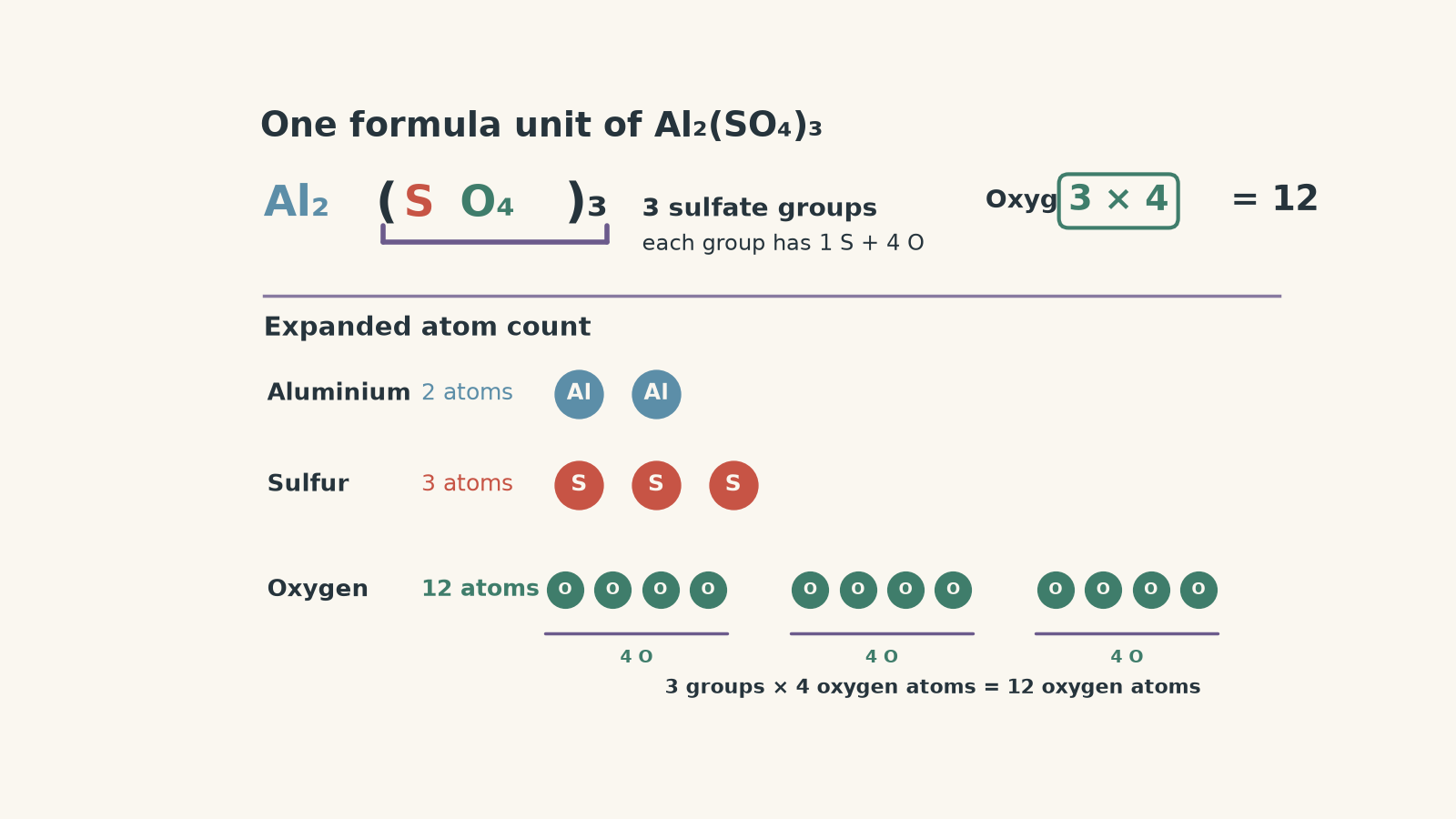
The same reasoning works for ionic compounds. One formula unit of \(\ce{Al2(SO4)3}\) contains:
- 2 aluminium ions
- \(3\) sulfate groups
- \(3 \times 4 = 12\) oxygen atoms
That last step matters. The 3 outside the brackets multiplies everything inside the brackets.
06A reliable method for particle questions
When a question contains both moles and particle counts, use this sequence.
1. Name the entity. Are you counting atoms, molecules, formula units, or ions?
2. Decide whether you are moving between moles and entities.
Use:
\[ N = nN_A \]
or
\[ n = \frac{N}{N_A} \]
3. Check the chemical formula. If the question asks for atoms or ions inside each molecule or formula unit, use the subscripts as a ratio.
For example:
\[ \ce{CaCl2} \]
means each formula unit contains two chloride ions. Once you know the number of \(\ce{CaCl2}\) formula units, multiply by 2 to find the corresponding number of chloride ions.
4. Label the final answer precisely. Writing only \(4.2 \times 10^{23}\) is incomplete. Write \(4.2 \times 10^{23}\) molecules, oxygen atoms, formula units, or whatever is actually being counted.
07The most tempting misconception: one mole always means the same number of atoms
It doesn’t.
One mole always means the same number of specified entities.
Consider \(1\ \text{mol}\) of helium and \(1\ \text{mol}\) of hydrogen gas.
For helium:
\[ 1\ \text{mol He} = 6.022 \times 10^{23}\ \text{He atoms} \]
For hydrogen gas:
\[ 1\ \text{mol \(\ce{H2}\)} = 6.022 \times 10^{23}\ \text{\(\ce{H2}\) molecules} \]
But each \(\ce{H2}\) molecule contains two hydrogen atoms. Therefore:
\[ 1\ \text{mol \(\ce{H2}\)} = 1.2044 \times 10^{24}\ \text{H atoms} \]
Both samples contain one mole of their stated substance. They contain the same number of entities, but not the same number of atoms.
Whenever a particle question feels too easy, check whether the question has quietly changed what is being counted.
08Questions and solutions
Question 1
A sample contains \(0.350\ \text{mol}\) of neon. Calculate the number of neon atoms in the sample.
Solution 1
The sample contains \(2.11 \times 10^{23}\) neon atoms.
Neon is monatomic, so each neon entity is one atom. We convert directly from moles to atoms using
\[ N = nN_A \]
Substituting:
\[ \begin{aligned} N &= (0.350\ \text{mol})(6.022 \times 10^{23}\ \text{mol}^{-1})\\ &= 2.1077 \times 10^{23}\\ &\approx 2.11 \times 10^{23} \end{aligned} \]
Therefore,
\[ \boxed{N = 2.11 \times 10^{23}\ \text{Ne atoms}} \]
The result is huge because even a fraction of a mole contains an enormous number of microscopic particles.
Question 2
A container holds \(4.82 \times 10^{23}\) molecules of \(\ce{NH3}\). Calculate the amount of \(\ce{NH3}\), in moles.
Solution 2
The container holds \(0.800\ \text{mol}\) of \(\ce{NH3}\).
We know the number of molecules and want the amount in moles, so divide by the Avogadro constant:
\[ n = \frac{N}{N_A} \]
Substituting:
\[ \begin{aligned} n &= \frac{4.82 \times 10^{23}}{6.022 \times 10^{23}\ \text{mol}^{-1}}\\ &= 0.8004\ \text{mol}\\ &\approx 0.800\ \text{mol} \end{aligned} \]
Therefore,
\[ \boxed{n = 0.800\ \text{mol \(\ce{NH3}\)}} \]
Dividing makes sense because we are grouping a very large number of individual molecules into mole-sized groups.
Question 3
A sample contains \(0.0750\ \text{mol}\) of \(\ce{Al2(SO4)3}\). Calculate the number of oxygen atoms represented by this amount of aluminium sulfate.
Solution 3
The sample contains \(5.42 \times 10^{23}\) oxygen atoms.
First find the number of \(\ce{Al2(SO4)3}\) formula units:
\[ N = nN_A \]
\[ \begin{aligned} N(\ce{Al2(SO4)3}) &= (0.0750\ \text{mol})(6.022 \times 10^{23}\ \text{mol}^{-1})\\ &= 4.5165 \times 10^{22}\ \text{formula units} \end{aligned} \]
Now inspect the formula. Each formula unit contains three \(\ce{SO4}\) groups, and each group contains four oxygen atoms:
\[ 3 \times 4 = 12\ \text{O atoms per formula unit} \]
Therefore:
\[ \begin{aligned} N(\ce{O}) &= 12(4.5165 \times 10^{22})\\ &= 5.4198 \times 10^{23}\\ &\approx 5.42 \times 10^{23} \end{aligned} \]
So:
\[ \boxed{N(\ce{O}) = 5.42 \times 10^{23}\ \text{oxygen atoms}} \]
The trap is stopping after finding the number of formula units. The question asks for oxygen atoms, so the chemical formula must also be used.
Question 4
Two sealed containers are prepared.
- Container A contains \(0.200\ \text{mol}\) of \(\ce{Ne}\).
- Container B contains \(0.200\ \text{mol}\) of \(\ce{N2}\).
A student says, “Both containers contain the same number of atoms because both contain \(0.200\ \text{mol}\).”
Is the student’s claim correct? Calculate the number of atoms in each container and explain the difference.
Solution 4
The student’s claim is incorrect. Both containers contain the same number of specified particles, but Container B contains twice as many atoms.
For Container A, neon is monatomic:
\[ \begin{aligned} N(\ce{Ne\ atoms}) &= (0.200\ \text{mol})(6.022 \times 10^{23}\ \text{mol}^{-1})\\ &= 1.2044 \times 10^{23}\ \text{atoms} \end{aligned} \]
Therefore:
\[ \boxed{N_A = 1.20 \times 10^{23}\ \text{atoms}} \]
For Container B, the initial mole calculation gives the number of \(\ce{N2}\) molecules:
\[ \begin{aligned} N(\ce{N2\ molecules}) &= (0.200\ \text{mol})(6.022 \times 10^{23}\ \text{mol}^{-1})\\ &= 1.2044 \times 10^{23}\ \text{molecules} \end{aligned} \]
Each \(\ce{N2}\) molecule contains two nitrogen atoms, so:
\[ \begin{aligned} N(\ce{N\ atoms}) &= 2(1.2044 \times 10^{23})\\ &= 2.4088 \times 10^{23}\ \text{atoms} \end{aligned} \]
Therefore:
\[ \boxed{N_B = 2.41 \times 10^{23}\ \text{atoms}} \]
The student’s reasoning feels plausible because both containers contain \(0.200\ \text{mol}\). The hidden problem is that a mole counts the specified entities. For neon, those entities are atoms. For nitrogen gas, they are \(\ce{N2}\) molecules, and every molecule contains two atoms.
Question 5
A sample of a molecular substance contains \(1.8066 \times 10^{24}\) hydrogen atoms. Each molecule of the substance contains three hydrogen atoms.
Calculate the amount of the molecular substance in moles.
Solution 5
The sample contains \(1.000\ \text{mol}\) of molecules.
The given particle count is the number of hydrogen atoms, but Avogadro’s constant must be applied to the entities whose amount we want, which are molecules.
Each molecule contains three hydrogen atoms. Therefore, the number of molecules is:
\[ \begin{aligned} N(\text{molecules}) &= \frac{1.8066 \times 10^{24}}{3}\\ &= 6.022 \times 10^{23}\ \text{molecules} \end{aligned} \]
Now convert molecules to moles:
\[ n = \frac{N}{N_A} \]
\[ \begin{aligned} n &= \frac{6.022 \times 10^{23}} {6.022 \times 10^{23}\ \text{mol}^{-1}}\\ &= 1.000\ \text{mol} \end{aligned} \]
Therefore:
\[ \boxed{n = 1.000\ \text{mol}} \]
The important move is recognising that \(1.8066 \times 10^{24}\) is not the number of molecules. Converting that value directly with \(N_A\) would give the amount of hydrogen atoms instead of the amount of the molecular substance.
Question 6
A student is given \(0.100\ \text{mol}\) of \(\ce{CaCl2}\) and writes:
\[ N = (0.100)(6.022 \times 10^{23}) = 6.022 \times 10^{22} \]
They conclude that the sample contains \(6.022 \times 10^{22}\) chloride ions.
Identify what their calculation has actually found, then determine the number of chloride ions represented by the sample.
Solution 6
The calculation correctly finds \(6.022 \times 10^{22}\) formula units of \(\ce{CaCl2}\), not chloride ions. The sample represents \(1.2044 \times 10^{23}\) chloride ions.
The initial mole conversion is valid:
\[ \begin{aligned} N(\ce{CaCl2}) &= nN_A\\ &= (0.100\ \text{mol})(6.022 \times 10^{23}\ \text{mol}^{-1})\\ &= 6.022 \times 10^{22}\ \text{formula units} \end{aligned} \]
Now use the formula \(\ce{CaCl2}\). Each formula unit contains two chloride ions.
Therefore:
\[ \begin{aligned} N(\mathrm{Cl}^{-}) &= 2(6.022 \times 10^{22})\\ &= 1.2044 \times 10^{23}\ \text{chloride ions} \end{aligned} \]
So:
\[ \boxed{N(\mathrm{Cl}^{-}) = 1.20 \times 10^{23}\ \text{chloride ions}} \]
The student’s arithmetic wasn’t the problem. The mistake was attaching the wrong meaning to the result. In mole calculations, identifying exactly what \(N\) is counting is just as important as using the correct equation.
Once this particle-counting relationship is secure, the next useful connection is mass. Molar mass lets you convert grams into moles, and Avogadro’s constant then converts those moles into particles. That creates one of the central pathways in quantitative chemistry:
\[ \text{mass} \longleftrightarrow \text{moles} \longleftrightarrow \text{number of particles} \]
That pathway is also what makes later stoichiometry possible: chemical equations compare particles, but laboratory measurements are usually made in grams.