
Solution dilution calculations for HSC Chemistry
Use conservation of solute to calculate diluted concentrations and required volumes. Follow worked examples, distinguish sample volume from final volume, and practise with fully explained solutions.
You add pure water to \(30\,\mathrm{mL}\) of sugar solution until its total volume is \(90\,\mathrm{mL}\). Before calculating anything, predict: does the amount of sugar decrease, or does only its concentration decrease?
Only the concentration decreases, assuming no sugar is lost or reacts. The same sugar is now spread through three times the solution volume. Each millilitre contains one-third as much sugar as before. This is dilution: adding solvent to lower a solution’s concentration. :chatgpt-content-reference{index=”0″}
01Same solute, more solution
Here, sugar is the solute, the dissolved substance, and water is the solvent.
Picture the dissolved sugar as 12 dots. After adding water, there are still 12 dots, but they are spread throughout a larger volume. Dilution does not delete dots.
That picture is simplified. Each dot represents an equal amount of dissolved sugar, not an undissolved grain. The picture also leaves out the water molecules, so the gaps between dots are not empty space.
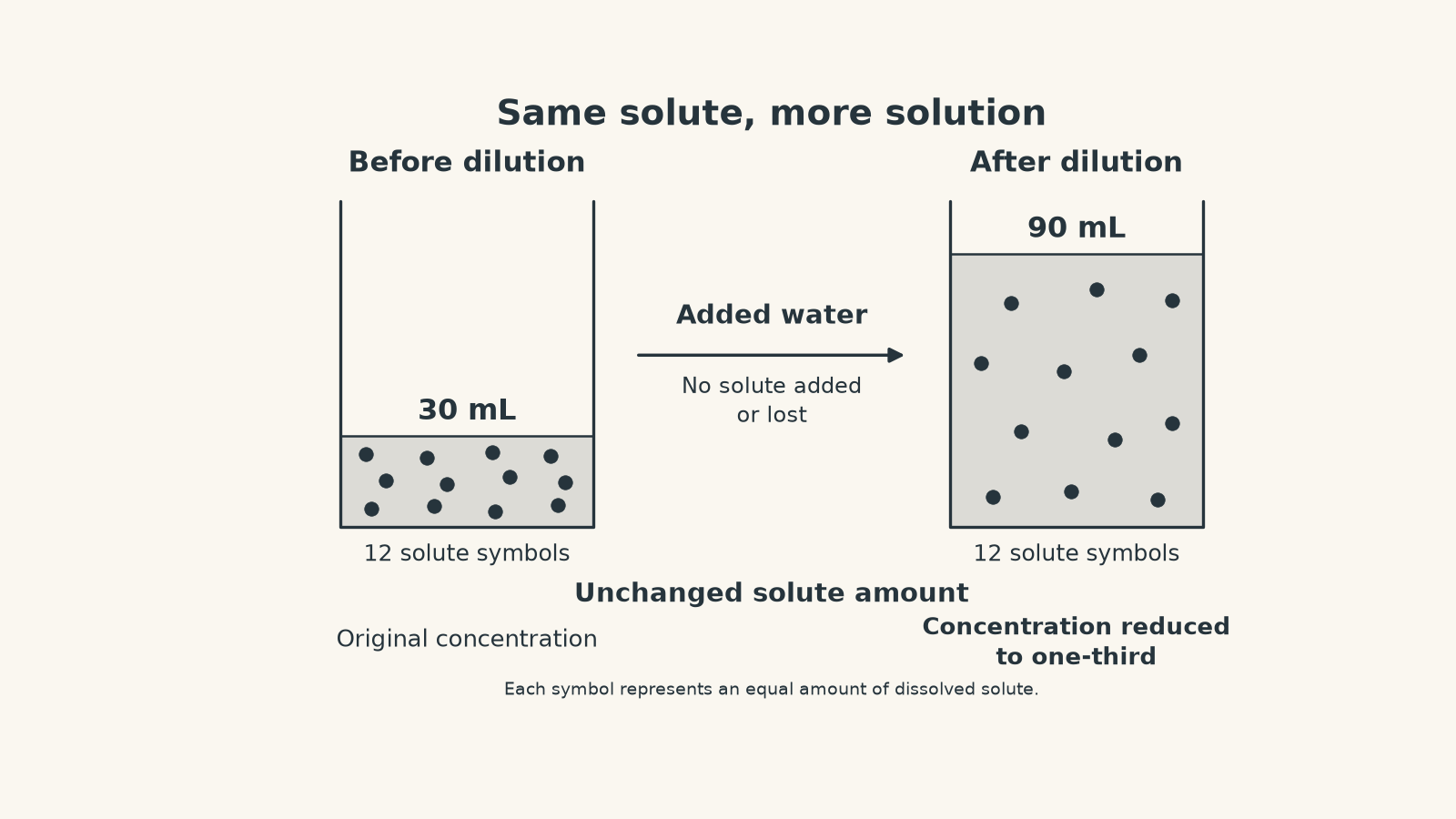
To calculate concentration, we need to distinguish how much solute is present from how much solute there is per litre.
Molar concentration is \(c = n/V\). Here, \(c\) is concentration in moles per litre, \(\mathrm{mol\,L^{-1}}\); \(n\) is the amount of solute in moles, \(\mathrm{mol}\); and \(V\) is the total solution volume in litres, \(\mathrm{L}\). A mole is a unit for measuring amount of substance. :chatgpt-content-reference{index=”1″}
Rearranging gives \(n = cV\): concentration multiplied by solution volume tells you how much solute that volume contains.
During dilution, \(n\) stays constant while \(V\) increases. That makes \(c\) decrease.
02Follow the transferred sample, not the stock bottle
A stock solution is a solution used to prepare other solutions by dilution. The measured portion taken from it is called an aliquot.
The amount of solute in that aliquot before dilution equals the amount in the entire diluted solution afterwards. It does not equal the amount in the whole stock bottle.
Call these amounts \(n_1\) and \(n_2\), where the subscripts 1 and 2 mean before and after dilution. Since \(n_1 = n_2\), substituting \(n = cV\) gives:
\[ c_1V_1 = c_2V_2 \]
The symbols describe two stages of the same transferred sample. :chatgpt-content-reference{index=”2″}
| Symbol | What it represents |
|---|---|
| \(c_1\) | Concentration of the stock solution |
| \(V_1\) | Volume of stock solution actually transferred |
| \(c_2\) | Concentration after dilution |
| \(V_2\) | Total solution volume after dilution |
The equation assumes that the added solvent contains none of the solute being tracked, and that this solute is not lost, consumed in a reaction, or removed from solution.
Keep the units consistent
One litre contains 1000 millilitres: \(1\,\mathrm{L} = 1000\,\mathrm{mL}\).
When calculating moles using \(n = cV\), with concentration in \(\mathrm{mol\,L^{-1}}\), use volume in litres.
When using \(c_1V_1 = c_2V_2\) directly, both volumes can be in litres or both can be in millilitres. The common conversion factor cancels. Both concentrations must also use matching units. :chatgpt-content-reference{index=”3″}
The mistake is mixing a volume in millilitres with another in litres without converting.
Worked example: Which volume belongs in the calculation?
A bottle contains \(420.0\,\mathrm{mL}\) of \(0.650\,\mathrm{mol\,L^{-1}}\) potassium nitrate, \(\ce{KNO3}\), solution. An \(18.0\,\mathrm{mL}\) sample is transferred into another container and diluted with water to \(150.0\,\mathrm{mL}\). Calculate the concentration after dilution.
Step 1
Only \(18.0\,\mathrm{mL}\) leaves the stock bottle. Therefore, \(V_1 = 18.0\,\mathrm{mL}\), not \(420.0\,\mathrm{mL}\).
Step 2
Convert the sample volume to litres: \(18.0\,\mathrm{mL} = 0.0180\,\mathrm{L}\).
\[ n_1 = c_1V_1 = (0.650\,\mathrm{mol\,L^{-1}})(0.0180\,\mathrm{L}) = 0.0117\,\mathrm{mol} \]
Step 3
After dilution, \(n_2 = 0.0117\,\mathrm{mol}\) and \(V_2 = 0.1500\,\mathrm{L}\).
\[ c_2 = \frac{n_2}{V_2} = \frac{0.0117\,\mathrm{mol}}{0.1500\,\mathrm{L}} = 0.0780\,\mathrm{mol\,L^{-1}} \]
The concentration has fallen from \(0.650\) to \(0.0780\,\mathrm{mol\,L^{-1}}\), but the diluted sample still contains \(0.0117\,\mathrm{mol}\) of potassium nitrate.
The unused solution in the stock bottle never entered this calculation.
03Final solution volume is not water added
The instruction “dilute to \(100\,\mathrm{mL}\)” means that the finished solution has a total volume of \(100\,\mathrm{mL}\). The transferred sample is already part of that volume.
It does not mean “add \(100\,\mathrm{mL}\) of water”.
This mistake feels reasonable because water is what you are adding. But concentration is calculated using the volume of the whole solution, not just the added water.
When a calculation assumes that volumes add, the volume of water added, \(V_{\text{water}}\), is \(V_{\text{water}} = V_2 - V_1\). For accurate laboratory preparation, transfer the required sample and add water until the solution reaches the volumetric flask’s calibration mark. That mark specifies the final solution volume. :chatgpt-content-reference{index=”4″}
Worked example: How much stock solution should you take?
You need \(0.2500\,\mathrm{L}\) of \(0.0360\,\mathrm{mol\,L^{-1}}\) sodium chloride, \(\ce{NaCl}\), solution. The available stock solution has a concentration of \(0.600\,\mathrm{mol\,L^{-1}}\). Calculate the stock volume required in millilitres, and describe how to reach the required final volume.
Step 1
The final concentration is \(c_2 = 0.0360\,\mathrm{mol\,L^{-1}}\). The final volume is \(V_2 = 0.2500\,\mathrm{L} = 250.0\,\mathrm{mL}\).
The unknown is \(V_1\), the stock volume to transfer.
Step 2
Divide both sides of \(c_1V_1 = c_2V_2\) by \(c_1\).
\[ V_1 = \frac{c_2V_2}{c_1} = \frac{(0.0360\,\mathrm{mol\,L^{-1}})(250.0\,\mathrm{mL})} {0.600\,\mathrm{mol\,L^{-1}}} = 15.0\,\mathrm{mL} \]
The concentration units cancel, leaving millilitres.
Step 3
Measure and transfer \(15.0\,\mathrm{mL}\) of stock solution into a \(250\,\mathrm{mL}\) volumetric flask. Add pure water to the calibration mark, then stopper and mix thoroughly.
Do not add \(250\,\mathrm{mL}\) of water. The required \(250\,\mathrm{mL}\) is the total volume after dilution.
Only \(15.0\,\mathrm{mL}\) of stock is needed because it contains much more solute per millilitre than the target solution. The stock supplies the solute; the added water lowers its concentration. :chatgpt-content-reference{index=”5″}
For the measuring and transfer technique, see tutorgum’s guide to preparing a standard solution.
04Taking a smaller sample is not dilution
Suppose you remove half of a well-mixed solution into another container. Has the concentration of the remaining half also halved?
No. Both the amount of solute and the solution volume have halved, so their ratio, \(n/V\), is unchanged. You have less solution, not a more dilute solution.
This gives you three useful decisions:
- Adding pure water: the solute amount stays constant, the volume increases, and the concentration decreases.
- Taking an aliquot: the aliquot has the same concentration as the well-mixed solution it came from, but contains only part of its solute.
- Losing some solution: calculate how much solute remains before dividing by the final volume.
For successive dilutions, apply the equation separately to each transferred sample. Do not carry all the moles from the first container into a second container when only an aliquot was transferred.
Before accepting a result for dilution with pure water, expect \(c_2 < c_1\) and \(V_2 > V_1\). If your calculation predicts a higher concentration, revisit your volumes or the proposed method.
05Questions and solutions
Assume the added water contains none of the solute, no chemical reaction occurs, and solutions are mixed thoroughly before sampling. Any solute loss is stated.
Question 1
An \(18.0\,\mathrm{mL}\) sample of \(0.360\,\mathrm{mol\,L^{-1}}\) sodium chloride solution is diluted to \(90.0\,\mathrm{mL}\). Calculate the final concentration and the amount of sodium chloride in the diluted solution.
Solution 1
The final concentration is \(0.0720\,\mathrm{mol\,L^{-1}}\), and the diluted solution contains \(0.00648\,\mathrm{mol}\) of sodium chloride.
Step 1: Find the amount of solute in the original sample.
\[ n_1 = c_1V_1 = (0.360\,\mathrm{mol\,L^{-1}})(0.0180\,\mathrm{L}) = 0.00648\,\mathrm{mol} \]
Step 2: Use the same amount in the final volume.
\[ c_2 = \frac{n_2}{V_2} = \frac{0.00648\,\mathrm{mol}}{0.0900\,\mathrm{L}} = 0.0720\,\mathrm{mol\,L^{-1}} \]
The volume increased by a factor of five, so the concentration became one-fifth of its original value. The amount of solute did not become one-fifth: all \(0.00648\,\mathrm{mol}\) remains.
Question 2
A method must dilute an entire \(32.0\,\mathrm{mL}\) sample of \(0.225\,\mathrm{mol\,L^{-1}}\) potassium nitrate solution to \(0.0600\,\mathrm{mol\,L^{-1}}\). A draft instruction says, “Add \(120.0\,\mathrm{mL}\) of water.”
Determine the required final solution volume and the volume of water actually needed. Explain whether the draft instruction is correct. Assume volumes add.
Solution 2
The required final volume is \(120\,\mathrm{mL}\), so \(88.0\,\mathrm{mL}\) of water is needed. The draft instruction would make the solution too dilute.
Step 1: Calculate the amount of solute available.
\[ n = c_1V_1 = (0.225\,\mathrm{mol\,L^{-1}})(0.0320\,\mathrm{L}) = 0.00720\,\mathrm{mol} \]
Step 2: Find the volume that gives the required concentration.
Rearrange \(c_2 = n/V_2\).
\[ V_2 = \frac{n}{c_2} = \frac{0.00720\,\mathrm{mol}}{0.0600\,\mathrm{mol\,L^{-1}}} = 0.120\,\mathrm{L} = 120\,\mathrm{mL} \]
Step 3: Subtract the sample volume to find the water volume.
\[ V_{\text{water}} = V_2 - V_1 = 0.120\,\mathrm{L} - 0.0320\,\mathrm{L} = 0.0880\,\mathrm{L} = 88.0\,\mathrm{mL} \]
Adding \(120.0\,\mathrm{mL}\) of water would instead produce \(152.0\,\mathrm{mL}\) of solution. The same solute would occupy more than the required \(120\,\mathrm{mL}\), so its concentration would be below the target.
Question 3
An \(8.00\,\mathrm{mL}\) sample of \(0.750\,\mathrm{mol\,L^{-1}}\) potassium nitrate solution is diluted to \(50.0\,\mathrm{mL}\). After mixing, only \(5.00\,\mathrm{mL}\) of this solution is transferred into a second container and diluted to \(75.0\,\mathrm{mL}\).
Calculate the final concentration. What fraction of the solute in the original \(8.00\,\mathrm{mL}\) sample reaches the second container?
Solution 3
The final concentration is \(0.00800\,\mathrm{mol\,L^{-1}}\). Only one-tenth of the original sample’s solute reaches the second container.
Step 1: Calculate the concentration after the first dilution.
Let \(n_A\) and \(c_A\) be the solute amount and concentration in the first diluted solution.
\[ \begin{aligned} n_A &= (0.750\,\mathrm{mol\,L^{-1}})(0.00800\,\mathrm{L}) = 0.00600\,\mathrm{mol} \\ c_A &= \frac{0.00600\,\mathrm{mol}}{0.0500\,\mathrm{L}} = 0.120\,\mathrm{mol\,L^{-1}} \end{aligned} \]
Step 2: Calculate how much solute the second aliquot carries.
The \(5.00\,\mathrm{mL}\) aliquot has concentration \(c_A\), not the original stock concentration. Let \(n_B\) be the amount it transfers and \(c_B\) the final concentration.
\[ \begin{aligned} n_B &= (0.120\,\mathrm{mol\,L^{-1}})(0.00500\,\mathrm{L}) = 0.000600\,\mathrm{mol} \\ c_B &= \frac{0.000600\,\mathrm{mol}}{0.0750\,\mathrm{L}} = 0.00800\,\mathrm{mol\,L^{-1}} \end{aligned} \]
Step 3: Identify the fraction transferred.
The aliquot is \(5.00/50.0 = 0.100\), or one-tenth, of the well-mixed first solution. It therefore carries one-tenth of that solution’s solute.
The trap is setting the original \(0.00600\,\mathrm{mol}\) equal to the amount in the final container. Most of those moles stayed in the first container.
Question 4
A reservoir contains \(100.0\,\mathrm{mL}\) of \(0.110\,\mathrm{mol\,L^{-1}}\) sodium chloride solution. You need \(80.0\,\mathrm{mL}\) of \(0.125\,\mathrm{mol\,L^{-1}}\) solution.
You may remove well-mixed portions, add pure water, and mix. You may not add solute or selectively remove water.
A student argues that the preparation is possible because the reservoir contains more moles than the required solution. Evaluate this argument using calculations and the permitted operations.
Solution 4
The preparation is impossible using the permitted operations, even though enough solute is available.
Step 1: Compare the available and required amounts.
Let \(n_{\text{available}}\) be the amount in the reservoir and \(n_{\text{required}}\) the amount needed in the target solution.
\[ \begin{aligned} n_{\text{available}} &= (0.110\,\mathrm{mol\,L^{-1}})(0.1000\,\mathrm{L}) = 0.0110\,\mathrm{mol} \\ n_{\text{required}} &= (0.125\,\mathrm{mol\,L^{-1}})(0.0800\,\mathrm{L}) = 0.0100\,\mathrm{mol} \end{aligned} \]
The student is correct about the total amounts. However, having enough moles is not sufficient.
Step 2: Find the stock volume containing exactly the required amount.
\[ V_1 = \frac{n_{\text{required}}}{c_1} = \frac{0.0100\,\mathrm{mol}}{0.110\,\mathrm{mol\,L^{-1}}} = 0.0909\,\mathrm{L} = 90.9\,\mathrm{mL} \]
That sample already occupies more than the required \(80.0\,\mathrm{mL}\).
Removing some well-mixed solution would remove solute as well as water, leaving the concentration unchanged. Adding water would lower the concentration.
Neither operation can increase the concentration from \(0.110\) to \(0.125\,\mathrm{mol\,L^{-1}}\). The target requires concentration, not dilution.
Question 5
A \(30.0\,\mathrm{mL}\) sample of \(0.400\,\mathrm{mol\,L^{-1}}\) potassium nitrate solution is being diluted to \(120.0\,\mathrm{mL}\).
At an unknown intermediate stage, the solution is mixed and \(3.00\,\mathrm{mL}\) is accidentally lost. The remaining solution is then diluted to the intended final volume. Its measured concentration is \(0.0950\,\mathrm{mol\,L^{-1}}\).
Determine the total solution volume immediately before the spill. Explain why applying \(c_1V_1 = c_2V_2\) directly between the original sample and the final solution fails. Treat the stated quantities as exact for this reasoning problem.
Solution 5
The solution volume was \(60.0\,\mathrm{mL}\) immediately before the spill. A single dilution equation cannot connect the original and final solutions because some solute left the container.
Step 1: Calculate the initial and final amounts of solute.
Let \(n_{\text{start}}\) and \(n_{\text{final}}\) represent these amounts.
\[ \begin{aligned} n_{\text{start}} &= (0.400\,\mathrm{mol\,L^{-1}})(0.0300\,\mathrm{L}) = 0.0120\,\mathrm{mol} \\ n_{\text{final}} &= (0.0950\,\mathrm{mol\,L^{-1}})(0.1200\,\mathrm{L}) = 0.0114\,\mathrm{mol} \end{aligned} \]
Step 2: Use the missing solute to find the concentration at the spill.
The difference between those amounts is the solute lost, \(n_{\text{lost}}\). All of it was carried away in \(0.00300\,\mathrm{L}\) of well-mixed solution.
Therefore, the concentration immediately before the spill, \(c_{\text{spill}}\), was:
\[ \begin{aligned} n_{\text{lost}} &= n_{\text{start}} - n_{\text{final}} \\ &= 0.0120\,\mathrm{mol} - 0.0114\,\mathrm{mol} = 0.000600\,\mathrm{mol} \\ c_{\text{spill}} &= \frac{0.000600\,\mathrm{mol}}{0.00300\,\mathrm{L}} = 0.200\,\mathrm{mol\,L^{-1}} \end{aligned} \]
Step 3: Find the volume containing the original solute amount at that concentration.
Before the spill, only water had been added. All \(0.0120\,\mathrm{mol}\) was still present. Calling the volume at that moment \(V_{\text{before spill}}\):
\[ V_{\text{before spill}} = \frac{n_{\text{start}}}{c_{\text{spill}}} = \frac{0.0120\,\mathrm{mol}}{0.200\,\mathrm{mol\,L^{-1}}} = 0.0600\,\mathrm{L} = 60.0\,\mathrm{mL} \]
The sample had reached twice its original volume, so its concentration had halved before the spill.
Conservation of solute still works when we include what was lost. The correct balance is \(n_{\text{start}} = n_{\text{final}} + n_{\text{lost}}\), not \(n_{\text{start}} = n_{\text{final}}\).
06Work backwards from a diluted test sample
A concentration measured after dilution belongs to the diluted solution. To recover the original concentration, rearrange the same relationship: \(c_1 = c_2V_2/V_1\).
You are reversing the concentration decrease, not creating extra solute. For a sequence of dilutions, reverse each stage while following the aliquot that actually moved.
Before correcting a test result for dilution, identify the transferred volume, the final solution volume, and whether any solute was lost. Those decisions determine whether your calculation describes the original solution or a different sample altogether.