
How to Count Protons, Neutrons, and Electrons in Atoms and Ions
Use atomic number, mass number, and charge to count the particles in an atom or ion. Follow worked examples and tackle practice questions that reveal common traps about ions and isotopes.
A neutral atom loses two electrons. Predict what happens to its charge: does it become positive, negative, or stay neutral?
It becomes positive. Electrons carry negative charge, so removing two leaves the atom with a charge of \(2+\). No extra protons have appeared. There are simply fewer negative charges to balance the positive ones. :chatgpt-content-reference{index=”0″}
That distinction is the key to counting particles in atoms and ions: keep track of what changed, rather than treating the charge sign as an instruction to add particles.
01Where the particles are
Picture an atom as a tiny central nucleus surrounded by a much larger region containing electrons. Protons and neutrons belong in the nucleus, not among the surrounding electrons. Almost all the atom’s mass is concentrated in that small nucleus. :chatgpt-content-reference{index=”1″}
The three particles have different charges. A relative charge compares their charges using one elementary charge, the magnitude of a proton’s charge, as the unit. :chatgpt-content-reference{index=”2″}
| Particle | Location | Relative charge |
|---|---|---|
| Proton | In the nucleus | \(+1\) |
| Neutron | In the nucleus | \(0\) |
| Electron | In the region surrounding the nucleus | \(-1\) |
Protons and neutrons have similar masses, and both are much heavier than electrons. A neutron contributes mass without contributing electric charge. :chatgpt-content-reference{index=”3″}
For charge counting, imagine matching positive and negative counters into pairs. Each pair contributes zero to the total. Any unmatched counters determine the overall charge.
The pairing is only an analogy for adding charges. Real protons and electrons do not pair up physically and disappear. They occupy different regions of the atom.
There’s another limit to the picture: electrons are not little planets following fixed circular tracks. Circles in shell diagrams help us organise and count electrons. More precisely, electrons are described by allowed energy states and orbitals, which describe their spatial probability distributions. :chatgpt-content-reference{index=”4″}
02Atomic number and mass number count the nucleus
To identify an element, count its protons. Changing the number of neutrons or electrons does not change which element it is.
The atomic number, written \(Z\), is the number of protons. Every atom of a particular element has the same atomic number. :chatgpt-content-reference{index=”5″}
The mass number, written \(A\), counts protons and neutrons together. These nuclear particles are collectively called nucleons, so mass number is also called nucleon number. :chatgpt-content-reference{index=”6″}
Let \(p\), \(n\), and \(e\) represent the numbers of protons, neutrons, and electrons, respectively. Then:
\[ \begin{aligned} Z &= p \\ A &= p+n \\ n &= A-Z \end{aligned} \]
The final line is just subtraction: take all the nuclear particles, remove the proton count, and what remains is the neutron count.
These are particle counts, not masses measured in grams. A mass number of 29 means 29 nucleons, not 29 grams.
In a full atomic symbol, the mass number goes at the upper left, the atomic number goes at the lower left, and any charge goes at the upper right. :chatgpt-content-reference{index=”7″}
Worked example: Build a neutral silicon-29 atom
A model is being built for a neutral silicon-29 atom, \(\ce{^{29}_{14}Si}\). How many protons, neutrons, and electrons are needed, and which particles belong in the nucleus?
Step 1
The lower-left number is \(Z=14\), so \(p=14\). The model needs 14 protons in its nucleus.
Step 2
The upper-left number is \(A=29\):
\[ n=A-Z=29-14=15 \]
The nucleus therefore also needs 15 neutrons.
Step 3
Each proton contributes \(+1\), and each electron contributes \(-1\). For the charges to balance, \(e=p=14\).
The complete model has 14 protons and 15 neutrons in the nucleus, with 14 electrons surrounding it.
Notice that the proton and neutron counts are different. Neutral means equal positive and negative charge. It does not mean equal numbers of all three particles.
03Forming an ion changes the electron count
An ion is an atom or group of atoms with a net electric charge. Here, we’re considering monatomic ions, each formed from one atom.
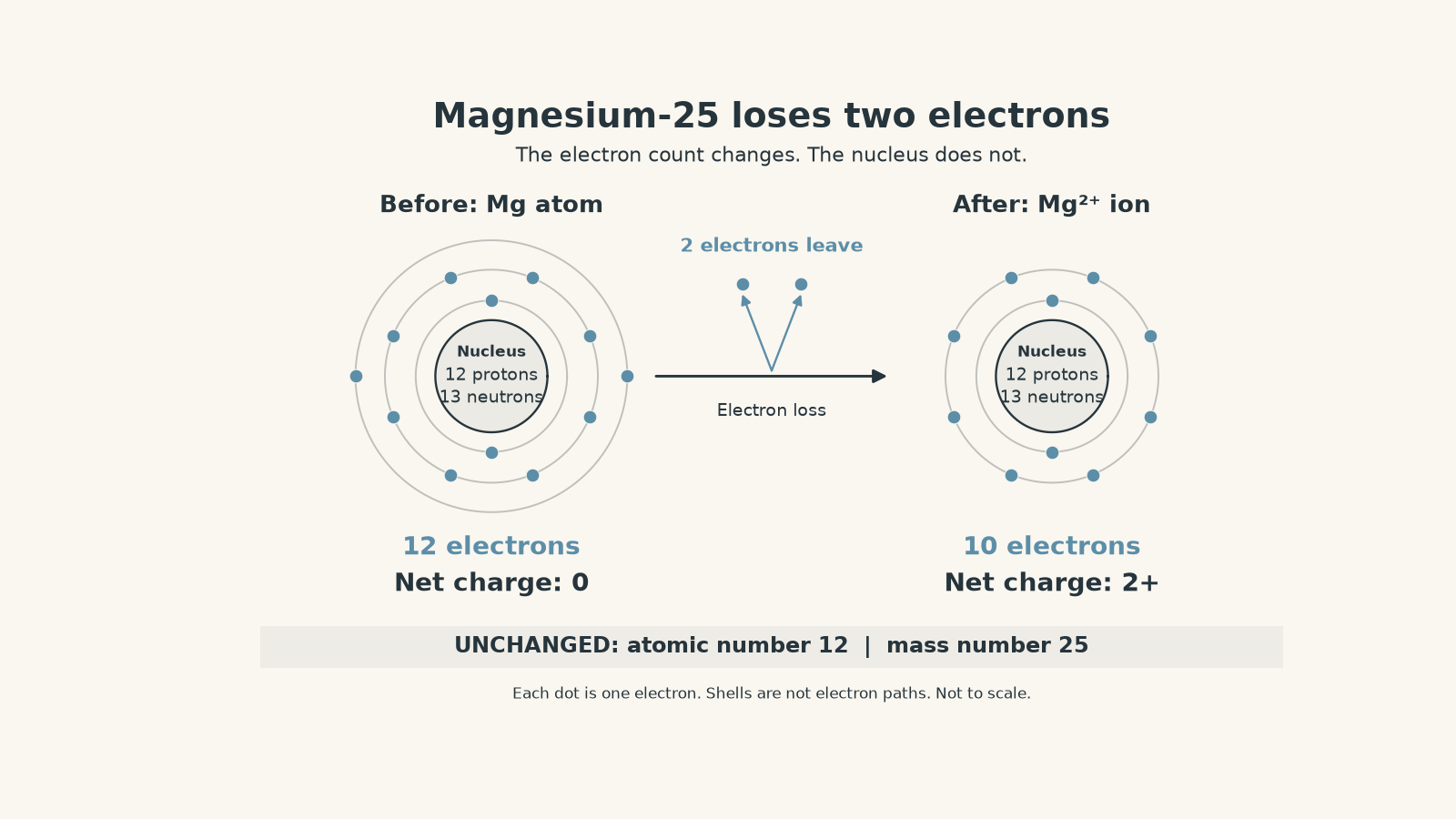
In ordinary ion formation by electron gain or loss, the nucleus remains unchanged. The proton and neutron counts stay fixed, so both atomic number and mass number stay fixed. Starting from a neutral atom, losing electrons produces a positive ion, or cation, while gaining electrons produces a negative ion, or anion. :chatgpt-content-reference{index=”8″}
For example, an atom with 12 protons and 12 electrons is neutral. Losing two electrons leaves 12 protons and 10 electrons. Its relative charge is \(12-10=+2\).
The positive sign does not mean that two protons were added. It describes the imbalance between the charges already present.
Calculate charge without memorising separate rules
Let \(q\) be the signed charge number. For a \(2+\) ion, \(q=+2\). For a \(2-\) ion, \(q=-2\).
Each proton contributes one positive charge unit, and each electron contributes one negative charge unit. Therefore:
\[ \begin{aligned} q &= p-e \\ e &= p-q=Z-q \end{aligned} \]
For a \(2+\) ion, \(e=Z-2\): there are two fewer electrons than protons.
For a \(2-\) ion, \(e=Z-(-2)=Z+2\): subtracting a negative number means adding, so there are two extra electrons.
The sign must agree with your counts: a positive ion has fewer electrons than protons, while a negative ion has more.
Worked example: Does gaining electrons increase mass number?
A neutral sulfur-34 atom, with atomic number 16, gains two electrons. Someone writes the product as \(\ce{^{36}_{16}S^2-}\). Determine the ion’s particle counts and correct its symbol.
Step 1
The atom starts with \(Z=16\) and \(A=34\):
\[ \begin{aligned} p &= Z=16 \\ n &= A-Z=34-16=18 \end{aligned} \]
It has 16 protons and 18 neutrons. Gaining electrons changes neither count.
Step 2
The neutral atom had 16 electrons. It gains two:
\[ e=16+2=18 \]
The ion has 18 electrons.
Step 3
\[ q=p-e=16-18=-2 \]
The correct symbol is \(\ce{^{34}_{16}S^2-}\).
The proposed charge was correct, but the proposed mass number was not. The two extra electrons affect charge, not the number of nucleons. The mass number remains 34.
04Different neutron counts mean different isotopes
Consider two neutral atoms. Each has 12 protons, but one has 12 neutrons and the other has 14 neutrons.
Predict whether the atom with two extra neutrons also needs two extra electrons to stay neutral.
It doesn’t. Neutrons carry no charge, so both neutral atoms need exactly 12 electrons. Their mass numbers differ, however: \(12+12=24\) and \(12+14=26\).
Atoms with the same proton count but different neutron counts are isotopes of the same element. :chatgpt-content-reference{index=”9″}
For these two atoms, the unchanged proton count means they are both magnesium. The different neutron counts make them magnesium-24 and magnesium-26. Either isotope can also lose two electrons and form a \(2+\) ion.
An isotope and an ion are therefore not competing labels. One particle can be both a particular isotope and an ion.
| Information you need | Particle counts that determine it |
|---|---|
| Which element? | Protons |
| Which isotope of that element? | Protons and neutrons |
| What charge? | Protons and electrons |
Mass number is not the periodic table’s average
The relative atomic mass on a periodic table is an abundance-weighted average of isotopic masses on a relative mass scale. It is not the mass number of a particular atom. Don’t round that average to choose an unspecified atom’s mass number. :chatgpt-content-reference{index=”10″}
Without isotope information, atomic number alone does not determine neutron count. The calculation of the average is explained in tutorgum’s guide to relative atomic mass from isotopic composition.
Also, unchanged mass number does not mean exactly unchanged mass. Electrons have mass, even though mass number does not count them. :chatgpt-content-reference{index=”11″}
05Questions and solutions
Question 1
A nucleus contains seven protons and eight neutrons. How many electrons must surround it for the atom to be neutral? Determine the atom’s atomic number and mass number.
Solution 1
The neutral atom needs seven electrons. Its atomic number is 7, and its mass number is 15.
Neutrality requires equal proton and electron counts, so \(e=p=7\). Seven electrons contribute seven negative charge units, balancing the seven positive charge units from the protons.
The nuclear counts give:
\[ \begin{aligned} Z &= p=7 \\ A &= p+n=7+8=15 \end{aligned} \]
The eight neutrons contribute to mass number but not charge. The seven electrons sit outside the nucleus and are not included in mass number.
Question 2
An isolated silicon-29 ion contains 12 electrons. It gains one electron without any change to its nucleus. Silicon has atomic number 14.
Determine its charge before and after the electron gain, its neutron count, and its full symbol after the change.
Solution 2
Its charge changes from \(2+\) to \(1+\). It has 15 neutrons throughout, and its final symbol is \(\ce{^{29}_{14}Si^+}\).
Silicon has \(p=Z=14\) protons. Initially:
\[ q=p-e=14-12=+2 \]
After gaining one electron, it has \(e=12+1=13\) electrons:
\[ q=p-e=14-13=+1 \]
The neutron count is:
\[ n=A-Z=29-14=15 \]
The nucleus has not changed, so the atomic number remains 14 and the mass number remains 29.
The tempting mistake is to call the final particle negative because it gained an electron. Gaining an electron makes its charge more negative, but here that means moving from \(+2\) to \(+1\), not crossing below zero.
Question 3
Two monatomic ions each contain 18 electrons and 20 neutrons. The first has a charge of \(1-\), while the second has a charge of \(2+\).
Identify both ions using full symbols, and decide whether they are isotopes of the same element. Chlorine has atomic number 17, and calcium has atomic number 20.
Solution 3
The ions are \(\ce{^{37}_{17}Cl^-}\) and \(\ce{^{40}_{20}Ca^2+}\). They are not isotopes of the same element.
Rearranging \(q=p-e\) gives \(p=e+q\).
For the \(1-\) ion:
\[ \begin{aligned} p &= e+q=18+(-1)=17 \\ A &= p+n=17+20=37 \end{aligned} \]
Its 17 protons identify it as chlorine. It has 20 neutrons and 18 electrons, giving \(\ce{^{37}_{17}Cl^-}\).
For the \(2+\) ion:
\[ \begin{aligned} p &= e+q=18+(+2)=20 \\ A &= p+n=20+20=40 \end{aligned} \]
Its 20 protons identify it as calcium. It has 20 neutrons and 18 electrons, giving \(\ce{^{40}_{20}Ca^2+}\).
Equal electron counts and equal neutron counts do not establish that two particles are the same element. Isotopes must have the same proton count, which these ions do not.
Question 4
A record for an unknown monatomic ion gives three facts: its mass number is 40, it contains 18 electrons, and its charge is positive.
A student identifies it as \(\ce{^{40}_{20}Ca^2+}\). Does the evidence force that identification? Give two possible ions consistent with the record, and identify one additional measurement that would determine the element.
Relevant atomic numbers are argon, 18; potassium, 19; and calcium, 20.
Solution 4
The identification is not certain. Both \(\ce{^{40}_{19}K^+}\) and \(\ce{^{40}_{20}Ca^2+}\) fit the record. Measuring the exact ionic charge would determine the element.
For potassium-40:
\[ \begin{aligned} p &= Z=19 \\ n &= A-Z=40-19=21 \\ q &= p-e=19-18=+1 \end{aligned} \]
It has 19 protons, 21 neutrons, and 18 electrons. Its mass number is 40, and its charge is positive.
For calcium-40:
\[ \begin{aligned} p &= Z=20 \\ n &= A-Z=40-20=20 \\ q &= p-e=20-18=+2 \end{aligned} \]
It has 20 protons, 20 neutrons, and 18 electrons. It also satisfies all three facts.
An argon-40 particle with 18 electrons would be neutral, so it would not fit the positive-charge requirement.
Knowing only that the charge is positive tells us that \(p>18\). It does not tell us the exact proton count. An exact charge measurement would allow us to calculate \(Z=p=e+q\), identifying the element.
Question 5
The same individual particle is tracked before and after a process. The records are accurate:
| Record | Mass number | Number of electrons surrounding the nucleus | Overall charge |
|---|---|---|---|
| Before | 40 | 18 | \(1+\) |
| After | 40 | 18 | \(2+\) |
A report claims: “The particle lost one of its surrounding electrons. Its nucleus stayed unchanged because its mass number stayed at 40.”
Assess this claim by determining the proton and neutron counts before and after the process.
Solution 5
The claim is incorrect. The nucleus changes from 19 protons and 21 neutrons to 20 protons and 20 neutrons, while the surrounding electron count stays at 18. A nuclear change is required.
Before the process:
\[ \begin{aligned} p &= e+q=18+1=19 \\ n &= A-p=40-19=21 \end{aligned} \]
After the process:
\[ \begin{aligned} p &= e+q=18+2=20 \\ n &= A-p=40-20=20 \end{aligned} \]
If one of the original 18 electrons had left while the nucleus stayed unchanged, the particle would have 17 surrounding electrons. That contradicts the record.
Here, the increased positive charge follows from the increased proton count, not a decreased surrounding electron count.
The mass number stays at 40 because there is one more proton and one fewer neutron. Mass number counts those particles together. An unchanged total does not prove that the nucleus is unchanged.
06What this lets you work out next
Before calculating anything, separate the information: \(Z\) fixes the proton count, \(A-Z\) gives the neutron count, and the charge tells you how the electron count differs from the proton count.
Once you know how many electrons a particle has, the next step is to work out their arrangement. Electronic configuration for atoms and ions moves from counting electrons to placing them in allowed energy levels and sublevels, the basis for explaining chemical behaviour. :chatgpt-content-reference{index=”12″}