HSC tutoring sa Kimika. Maliliit na grupo. Online.
May dalawang oras na klase sa maliit na grupo sa Zoom bawat linggo. May mga takdang-araling kahawig ng mga tanong sa pagsusulit, na may sunod-sunod na solusyon. Maaari ring magtanong nang isa-sa-isa sa tutor.
Mahusay siyang magpaliwanag ng bawat konsepto sa maliliit at madaling maunawaang bahagi.
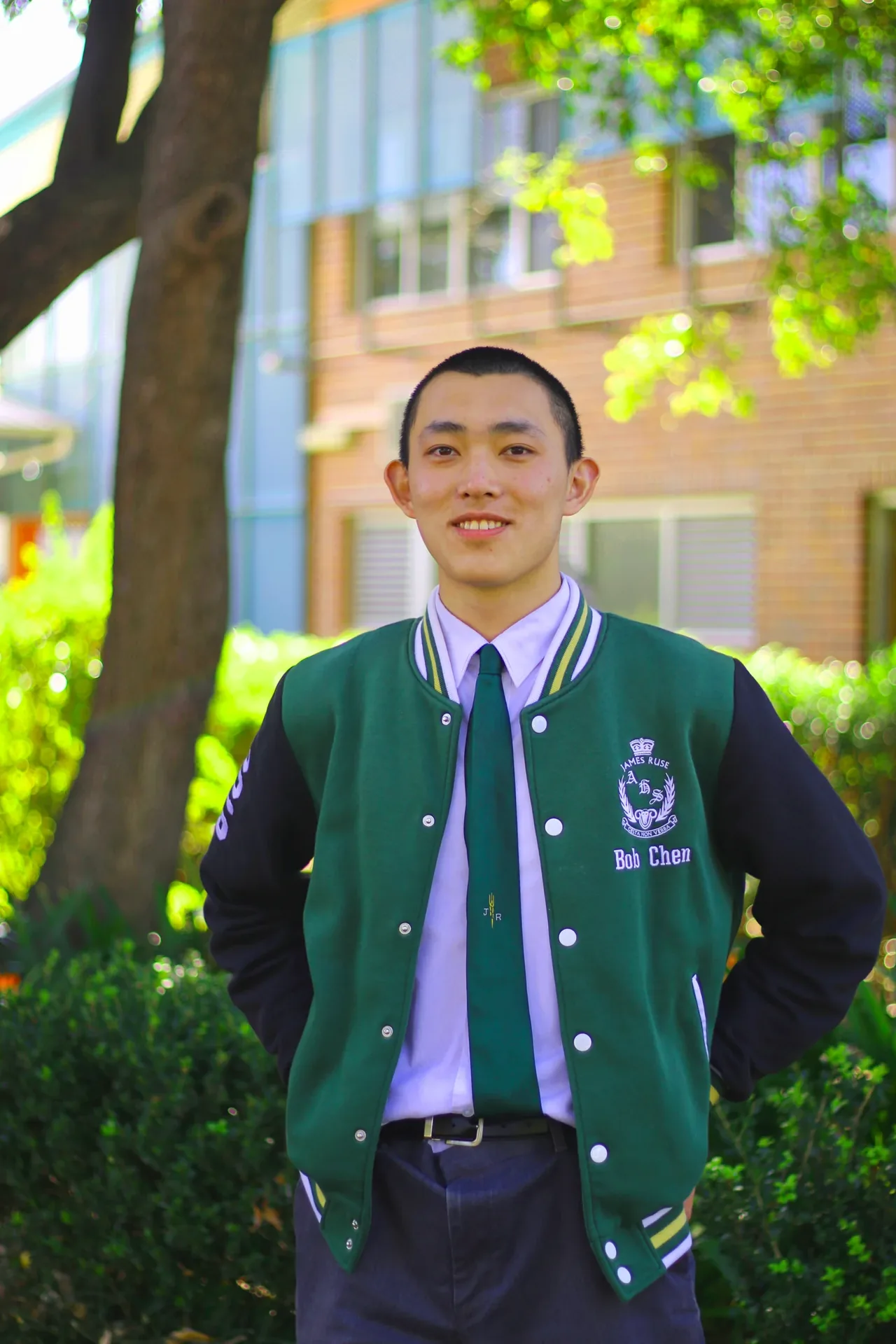
Nagtapos si Jade sa Year 11 na may 49% sa Chemistry. Kailangan niyang maunawaan ang mahihirap na ideya, hindi lang magsagot pa ng mga tanong sa aklat. Ipinaliwanag ni Bob ang mga konsepto nang paisa-isa, tumulong din siya sa labas ng klase, at iniangkop ang pagsasanay sa mga bahaging kailangan pa ni Jade. Kalaunan, nakamit niya ang Band 6 sa HSC Chemistry.
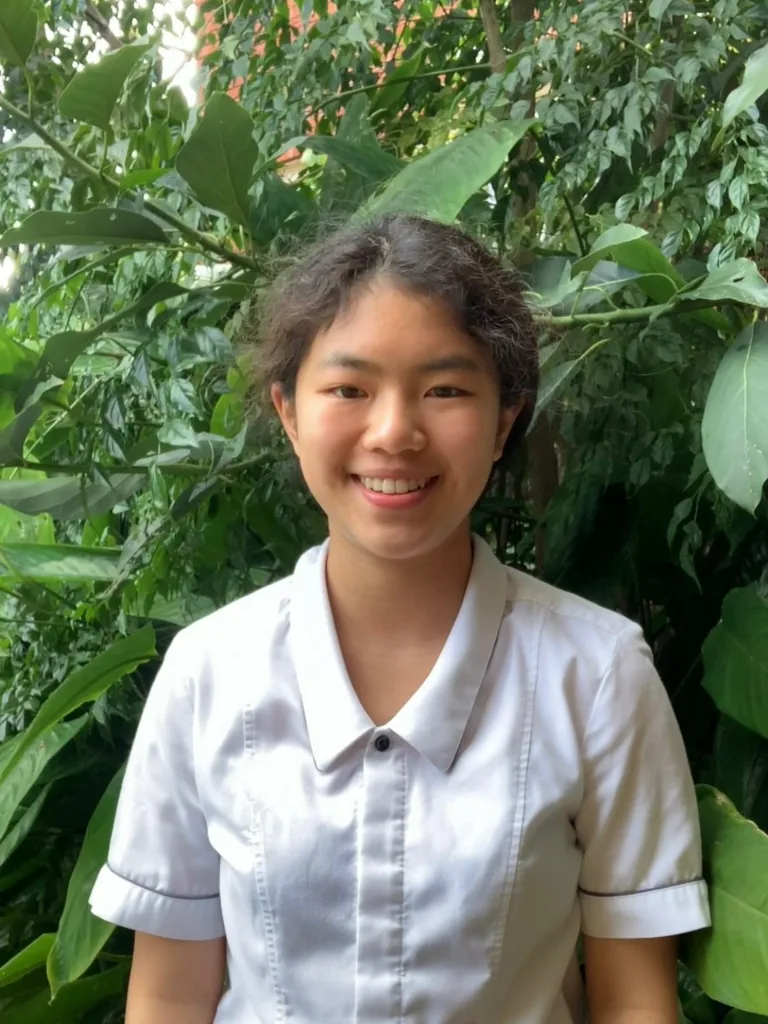
Bumababa ang mga marka ni Kirsten at nagsimula na siyang matakot sa Physics. Sa mga klase na nakatuon sa kaniya, malaya siyang magtanong at matuto sa sarili niyang bilis. Mas naging handa siya dahil sa mahihirap na pagsasanay at tulong sa labas ng klase. Mula 56% sa Chemistry trials, umabot siya sa 91% sa HSC at nakakuha rin ng 92 sa Physics.
Gumawa sila ng masaya, komportable at suportadong kapaligiran.
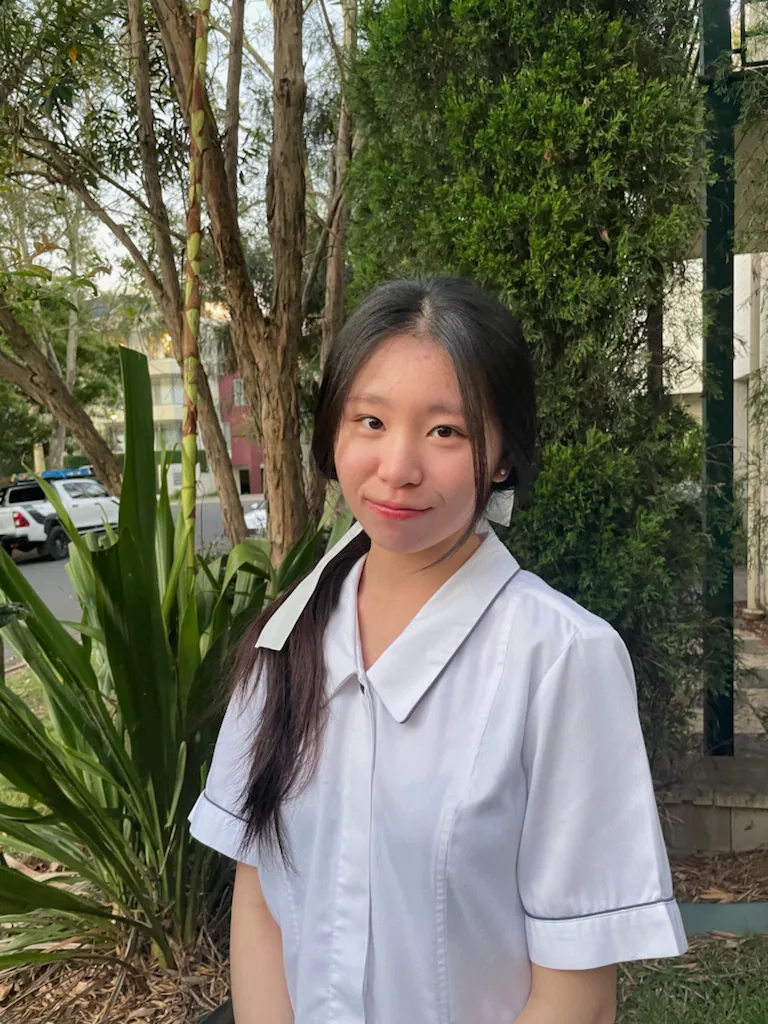
Nagustuhan ni Queenie na may nagtuturo sa kaniya ng ibang paraan ng pag-unawa, sumasagot sa mga tanong niya pagkatapos ng klase at tumutulong sa mga assessment sa paaralan. Dahil dito, natutuhan niya ang Physics sa malikhaing paraan at hindi lang umasa sa aklat. Nagtapos siya sa Hurlstone Agricultural na may 95 sa Physics at ATAR na 99.75.
Bago ako naging una sa Physics sa James Ruse, natatakot akong sabihin kay Nanay ang mga marka ko.
Tagpo sa klase · orihinal na scanned na pagsusulit
Ganito ako noong Year 10.
Hindi magaling.
Pero may isang bagay na mas malala pa ako kaysa mag-selfie.
Agham.
Dahil hindi maganda ang mga marka ko.
Naku. Ika-50 ako sa buong cohort.
Ayaw ko sa agham.
Nag-aral ako. Nagsaulo. Nagsanay.
Mali pa rin ang formula na ginagamit ko. Nanghuhula ako sa mga pagsusulit.
Hindi ako nakaabot sa mataas na ranggo o nakakuha ng lampas 90%.
Nawalan ako ng kontrol.
Ayokong sabihin kay Nanay ang mga marka ko.
Kaya alam kong may kailangang magbago.
Kalaunan, nakamit ko ang
Una sa Physics sa James Ruse: unang puwesto.Una sa Physics sa James Ruse: unang puwesto.
Unang ranggo sa Physics sa buong NSW: unang ranggo.Unang ranggo sa Physics sa buong NSW: unang ranggo.
ATAR 99.85.ATAR 99.85.
Medisina sa USYD.Medisina sa USYD.
Ganito ako noong Year 10.
Hindi magaling.
Pero may isang bagay na mas malala pa ako kaysa mag-selfie.
Agham.
Dahil hindi maganda ang mga marka ko.
Naku. Ika-50 ako sa buong cohort.
Ayaw ko sa agham.
Nag-aral ako. Nagsaulo. Nagsanay.
Mali pa rin ang formula na ginagamit ko. Nanghuhula ako sa mga pagsusulit.
Hindi ako nakaabot sa mataas na ranggo o nakakuha ng lampas 90%.
Nawalan ako ng kontrol.
Ayokong sabihin kay Nanay ang mga marka ko.
Kaya alam kong may kailangang magbago.
Kalaunan, nakamit ko ang
Una sa Physics sa James Ruse: unang puwesto.
Unang ranggo sa Physics sa buong NSW: unang ranggo.
ATAR 99.85.
Medisina sa USYD.
Paano naminito nagawa?
Explained intuitively and from scratch
Salt in water. Let’s look inside one grain.
Salt in water. Let’s look inside one grain.
Its white surface looks smooth. Keep zooming in.
That surface is made of tiny Na⁺ and Cl⁻ ions.
The ions form a repeating lattice.
Let’s follow this Na⁺ ion at the edge.
Oxygen pulls water’s shared electrons closer. Its end is slightly negative; the hydrogen ends are slightly positive.
The negative oxygen ends face Na⁺. Gold dots show their attraction to the ion.
Water pulls outwards. The surrounding Cl⁻ ions hold Na⁺ in the lattice.
Na⁺ separates from the lattice, with water molecules around it.
That’s Na⁺(aq): a sodium ion surrounded by water.
2.Takdang-araling kahawig ng pagsusulit
Alam mo kung ano ang natututuhan sa paaralan…
Pero pagdating sa exam, ganito ang tanong…But then,in the exam,ganito ang tanong…
Paano kung ganitong mga tanong ang takdang-aralin mo bawat linggo?
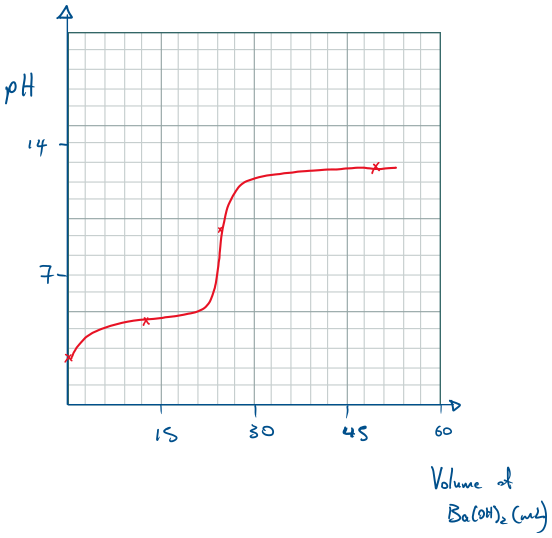
A man begins to titrate 65.7mL of 0.270M acetic acid against 0.350M Ba(OH)2. Acetic acid has a pKa of 4.76. Draw the pH graph, ensuring you label the following points:
The initial pH (2 marks)
The pH at equivalence point (3 marks)
The pH at the optimal buffer point (2 marks)
The pH after 50mL of Ba(OH)2 has been added (2 marks)
At may kumpletong solusyon sa bawat tanong, hakbang-hakbang.
a) The initial pH (2 marks)
ANSWER
Step 1: Thinking
Acetic acid is a weak acid and its dissociation in water can be represented as below:
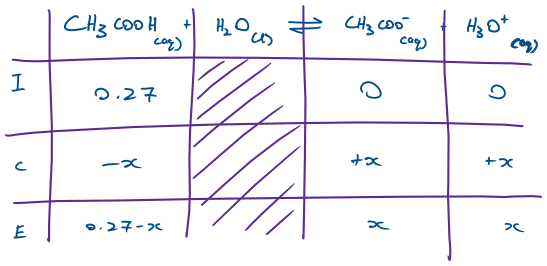
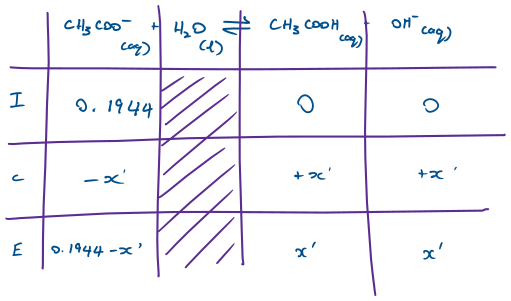
Step 2: Draw up ICE table
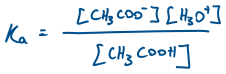
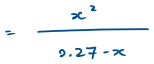
Step 3: Substitute into the Ka expression
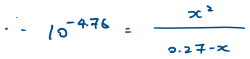
The acid dissociation constant, Ka, can be calculated from the pKa value:
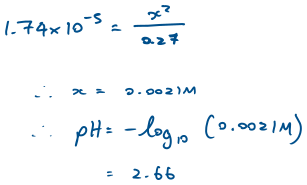
Make the small change assumption
Buksan lahatIpakita nang mas kaunti
a) The initial pH (2 marks)
ANSWER
Step 1: Thinking
Acetic acid is a weak acid and its dissociation in water can be represented as below:
Step 2: Draw up ICE table
Step 3: Substitute into the Ka expression
The acid dissociation constant, Ka, can be calculated from the pKa value:
Make the small change assumption
b) The pH at equivalence point (3 marks)
ANSWER
Step 1: Thinking
At the equivalence point, all of the acetic acid has reacted with the NaOH to form its conjugate base, acetate ion (CH3COO–). This is why there is a pH at equivalence point!
To determine the pH, we need to consider the hydrolysis of acetate ion in water:
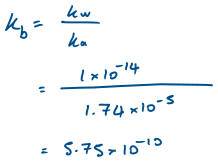
The equilibrium constant for this reaction is given by:
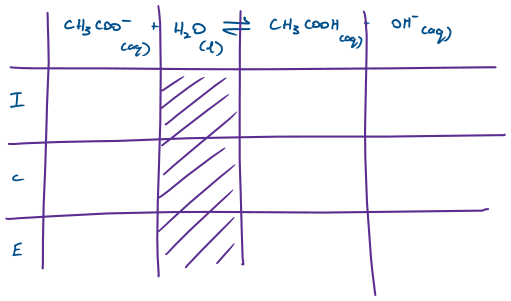
Step 2: Draw ICE table
An ICE table can be used to determine the concentration of OH– ions in the solution at equilibrium:
Hm but we don’t know what the concentration of CH3COO– is at equivalence point! Let’s go calculate it first.
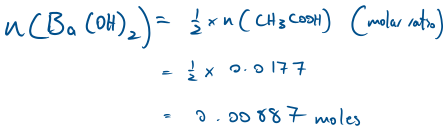
Step 3: Calculate concentration of acetate ion at the equivalence point
At the equivalence point, all of the acetic acid has reacted with the NaOH to form its conjugate base, acetate ion (CH3COO–).
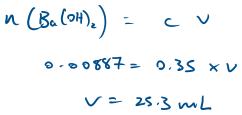
The number of moles of acetic acid initially present is (0.270M)(0.0657L) = 0.0177 moles. To find the concentration we need to know the volume at the end point.
The volume of the solution at the equivalence point is 65.7mL + 25.3mL = 91mL, so the concentration of acetate ion at the equivalence point is (0.0177 moles)/(0.091L) = 0.1944M.
Step 4: Sub into ICE table
Step 4: Substitute into the Kb expression gives:
Kb=[CH3COO−][CH3COOH][OH−]
=0.1944−x′x′2
=0.1944x′2
5.75×10−10=0.1944x′2
x’ ≈ 10.57 × 10⁻⁶
which is the concentration of OH– ions in the solution. The pOH of the solution at equivalence point is therefore:
pOH=−log[OH−]=−log(10.57×10⁻⁶)≈4.976
and its pH is:
pH=14−pOH≈9.02
c) The pH at the optimal buffer point (2 marks)
ANSWER
We need to realise that the optimal buffer point is when there is equimolar acid and conjugate base.
This will occur at halfway to the equivalence point.
To understand this, consider you had 1 mole of CH3COOH.
After you add in 0.5 moles of OH- (or in this case, 0.25 moles of Ba(OH)2) you will have 0.5 moles of CH3COO- and also 0.5 moles of CH3COOH left. Thus, you have equimolar amounts of acid and conjugate base.
Thus, it will be at 0.5 x 25.3mL = 12.65mL
The pH will be:
Ka=[CH3COOH][CH3COO−][H3O+]
=[CH3COOH][CH3COO−][H3O+]
Ka=[H3O+]
1.74×10−5=[H3O+]
pH=4.76
d) The pH after 50mL of Ba(OH)2 has been added (2 marks)
ANSWER
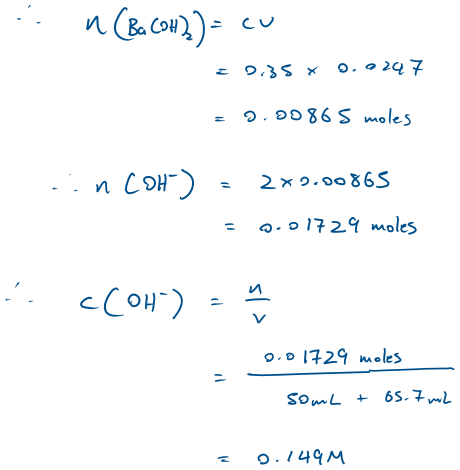
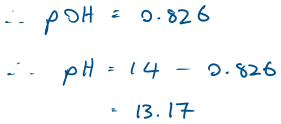
This is about double the equivalence point volume.
Getting to equivalence takes 25.3mL
Thus you add another 24.7 mL of Ba(OH)2.
This just adds pure OH-
And don’t worry, there’s plenty more where that came from.
Flick through the worked answers.
Loading sample…
3.Indibidwal na suporta ng tutor
Magtanong sa klase, pagkatapos nito o anumang oras sa pagitan ng dalawang klase. Makipag-ugnayan sa tutor mo anumang oras.
Hindi kami nag-aalok ng hiwalay na one-to-one tutoring.
Balangkas ng kurso sa Kimika Sunod-sunod na module.
Ipakita ang mga term sa paaralanItago ang mga term sa paaralan+
Tuloy ang klase kahit bakasyon sa paaralanDalawang linggong pahinga tuwing Pasko at Bagong Taon
Modyul 1: Properties and structure of matterAtoms, bonding and the properties of substances+ — lingguhang balangkasMay klase pa rin tuwing Bakasyon pagkatapos ng Term 2
Nagsisimula sa Linggo 1 ang bilang ng bawat modyul. Batay sa kasalukuyang plano ang mga lingguhang paksa at sinusuri ang mga ito para sa bagong syllabus.
Linggo 1
Matter and mixtures
Classify matter and mixtures, compare separation methods and review significant figures.
Linggo 2
The periodic table and chemical naming
Introduce periodic organisation, ionic and covalent bonding and the naming of compounds.
Linggo 3
Valence electrons and bonding
Connect valence electrons to chemical properties, Lewis diagrams and the formulas of compounds.
Linggo 4
Electron configurations
Use SPDF notation and orbital diagrams to describe electron arrangements.
Linggo 5
Electron transitions and flame tests
Connect Bohr's model and electron transitions to observed flame-test colours.
Linggo 6
Periodic trends
Explain patterns in ionisation energy and atomic properties using electron arrangements.
Linggo 7
Bond polarity
Use electronegativity differences to distinguish non-polar, polar and ionic bonding.
Linggo 8
Molecular shapes
Use electron-pair repulsion to predict three-dimensional shapes and connect shape to polarity.
Linggo 9
Bonding and material structures
Explain covalent networks and metallic structures and connect their bonding to material properties.
Linggo 10
Intermolecular forces
Compare dispersion, dipole and hydrogen-bonding interactions and their effects on substances.
May klase pa rin tuwing Bakasyon pagkatapos ng Term 2
Linggo 11
Boiling points and module consolidation
Combine intermolecular forces to explain boiling points and revisit the module's core ideas.
Nagsisimula sa Linggo 1 ang bilang ng bawat modyul. Batay sa kasalukuyang plano ang mga lingguhang paksa at sinusuri ang mga ito para sa bagong syllabus.
Linggo 1
Writing and balancing reactions
Write chemical equations and use conservation of mass and charge to balance them.
Linggo 2
The mole
Connect particle numbers, molar mass and reacting amounts using the mole concept.
Linggo 3
Empirical formulas and limiting reagents
Determine empirical formulas and identify which reactant limits the amount of product.
Linggo 4
Concentration
Distinguish solute and solvent and work with common concentration measures.
Linggo 5
Gas relationships
Use particle ideas to explain gas behaviour and introduce gas-law calculations.
Linggo 6
The ideal gas law
Combine gas relationships with mole calculations in worked examples.
Linggo 7
Quantitative Chemistry revision
Revisit balancing equations, reacting amounts, concentration and gas calculations.
Modyul 3: Chemical reactionsReactions, rates and energy changes+ — lingguhang balangkasMay klase pa rin tuwing Bakasyon pagkatapos ng Term 3May klase pa rin tuwing Bakasyon pagkatapos ng Term 4
Nagsisimula sa Linggo 1 ang bilang ng bawat modyul. Batay sa kasalukuyang plano ang mga lingguhang paksa at sinusuri ang mga ito para sa bagong syllabus.
Linggo 1
Chemical changes and reactions
Distinguish physical and chemical changes and examine evidence that reactions have occurred.
Linggo 2
Precipitation and ionic equations
Use solubility rules to predict precipitates and construct full and net ionic equations.
Linggo 3
Metal reactions and reactivity
Compare metals reacting with acids, oxygen and water and build a reactivity series.
Linggo 4
Displacement and electron transfer
Explain metal displacement reactions using electron transfer and relative reactivity.
May klase pa rin tuwing Bakasyon pagkatapos ng Term 3
Linggo 5
Oxidation numbers and redox equations
Assign oxidation numbers and balance oxidation-reduction reactions.
Linggo 6
Electrochemical cells
Connect separated redox reactions to the production of electrical energy.
Linggo 7
Cell potentials
Calculate cell potentials and interpret electrode-potential relationships.
Linggo 8
Reaction rates
Measure and explain how quickly reactions occur using collision ideas.
Linggo 9
Factors affecting reaction rates
Use collision theory to explain effects of concentration, surface area and other rate factors.
Linggo 10
Reaction-type consolidation
Recognise and compare synthesis, decomposition, combustion, precipitation and acid reactions.
Linggo 11
Enthalpy and energy profiles
Distinguish exothermic and endothermic changes and draw reaction-energy profiles.
Linggo 12
Calorimetry and molar reactions
Solve heat calculations and connect measured heat to the mole ratios in a reaction.
Linggo 13
Bond energy
Explain energy changes by comparing the energy needed to break bonds with that released in bond formation.
Linggo 14
Hess's law
Combine reaction equations and enthalpy changes to find an unknown reaction enthalpy.
Linggo 15
Entropy and spontaneity
Introduce entropy and distinguish chemical spontaneity from everyday ideas about reaction speed.
Linggo 16
Gibbs free energy
Combine enthalpy and entropy to predict spontaneity using Gibbs free energy.
May klase pa rin tuwing Bakasyon pagkatapos ng Term 4
Linggo 17
Drivers of Reactions revision
Review calorimetry, energy profiles, bond energies, Hess's law, entropy and molar reactions.
Year 11 exam reviewPause between Modules 4 and 5 for four module reviews and four mock-paper weeks; contents inferred from the codes.+ — lingguhang balangkas
Nagsisimula sa Linggo 1 ang bilang ng bawat modyul.
Linggo 1
Properties and Structure of Matter review
Practise the module-review paper on bonding, structure and properties.
Linggo 2
Quantitative Chemistry review
Review concentration, gas laws and reacting quantities through module-paper questions.
Linggo 3
Reactive Chemistry review
Revise reaction types and the key ideas used to explain chemical reactions.
Linggo 4
Drivers of Reactions review
Review heat calculations and the relationships between enthalpy, entropy and spontaneity.
Linggo 5
Preliminary mock paper 1
Practise mixed questions on shapes, gas laws, mole calculations, entropy and solubility.
Linggo 6
Preliminary mock paper 2
Review selected questions on enthalpy, reduction potentials and Lewis structures.
Linggo 7
Preliminary mock paper 3
Practise periodic trends, redox, dilution, Hess's law and galvanic-cell questions.
Linggo 8
Preliminary mock paper 4
Work through a further mock paper with emphasis on oxidation-number and redox reasoning.
Modyul 5: Equilibrium and Acid ReactionsEquilibrium, solubility and precipitation+ — lingguhang balangkasPagkatapos ng Linggo 3: bakasyon sa Pasko at Bagong Taon2 linggong pahingaBalik-klase: nagpapatuloy ang modyul na itoMay klase pa rin tuwing Bakasyon sa tag-init
Nagsisimula sa Linggo 1 ang bilang ng bawat modyul.
Linggo 1
Reversible reactions
Introduce chemical reversibility and prepare for the Year 12 approach to study and practice.
Linggo 2
Dynamic equilibrium
Explain reversible reactions in closed systems and relate equal forward and reverse rates to observations.
Linggo 3
Equilibrium shifts and collision theory
Use the Haber reaction and collision theory to explain how equilibrium responds to changes.
Pagkatapos ng Linggo 3: bakasyon sa Pasko at Bagong Taon2 linggong pahinga
May klase pa rin tuwing Bakasyon sa tag-init
Linggo 4
Le Chatelier's principle
Predict responses to disturbances and interpret concentration-time graphs.
Linggo 5
Equilibrium constants
Build an understanding of equilibrium expressions and use the equilibrium constant in calculations.
Linggo 6
Dilution and equilibrium calculations
Examine the effect of water and other disturbances and distinguish concentration changes from changes in the equilibrium constant.
Linggo 7
Dissolution and intermolecular forces
Explain solubility by comparing interactions within solutes, solvents and solutions.
Linggo 8
Solubility equilibria
Introduce the solubility product and connect precipitation to a dynamic equilibrium.
Linggo 9
Harder solubility and equilibrium questions
Practise molar-solubility and common-ion calculations and revisit equilibrium reasoning.
Modyul 6: Acid/Base ReactionsAcids, bases, titrations and buffers+ — lingguhang balangkasMay klase pa rin tuwing Bakasyon pagkatapos ng Term 2
Nagsisimula sa Linggo 1 ang bilang ng bawat modyul.
Linggo 1
Acids and bases
Introduce acid and base definitions and compare their observable properties.
Linggo 2
Neutralisation and acid-base theories
Explore uses and calorimetry of neutralisation and trace the development of acid-base definitions.
Linggo 3
Brønsted-Lowry theory
Explain proton transfer, hydronium and conjugate acid-base pairs.
Linggo 4
Amphiprotic species and salt acidity
Compare proton donation and acceptance and explain acid-base behaviour of oxides and ions.
Linggo 5
pH calculations
Calculate pH from hydrogen-ion concentration and handle logarithms and significant figures.
Linggo 6
Acid and base equilibrium constants
Use Ka, Kb, pKa and pKb and connect them to acid-base equilibria.
Linggo 7
Titrations and equilibrium practice
Revisit acid-base calculations and introduce titration reasoning and concentration determination.
Linggo 8
Titration technique and standard solutions
Choose appropriate standards and explain how glassware preparation affects titration results.
May klase pa rin tuwing Bakasyon pagkatapos ng Term 2
Linggo 9
Buffers
Explain buffer action, natural buffers and responses to added acid or base.
Linggo 10
Titration and conductivity curves
Interpret buffer regions, polyprotic titration features and conductometric reactions.
Linggo 11
Acid-base exam practice
Apply the module's ideas in exam-style questions.
Modyul 7: Organic ChemistryOrganic families, synthesis and polymers+ — lingguhang balangkasMay klase pa rin tuwing Bakasyon pagkatapos ng Term 3
Nagsisimula sa Linggo 1 ang bilang ng bawat modyul.
Linggo 1
Organic molecules and naming
Introduce carbon chemistry, hydrocarbons, functional groups and naming conventions.
Linggo 2
Functional groups and molecular shapes
Name compounds across functional groups and connect hydrocarbon structures to three-dimensional geometry.
Linggo 3
Organic properties and their implications
Compare alcohols and alkanes using bonding and intermolecular forces, then consider social and ethical issues.
Linggo 4
Alkane and alkene reactions
Write and compare combustion and other characteristic hydrocarbon reactions.
Linggo 5
Alcohols
Classify alcohols and connect their structures to physical and chemical properties.
Linggo 6
Alcohol oxidation and related compounds
Analyse alcohol redox reactions and bioethanol, then examine carboxylic acids and amines.
Linggo 7
Esters and amides
Explain esterification, biodiesel production and the formation of amides.
Linggo 8
Soaps, detergents and polymerisation
Connect fats to cleaning agents and introduce addition polymerisation.
Linggo 9
Addition polymers
Compare the structures, properties and uses of polymers including polyethylene, PVC and PTFE.
Linggo 10
Condensation polymers
Explain polyester and polyamide formation and consolidate organic reaction pathways.
May klase pa rin tuwing Bakasyon pagkatapos ng Term 3
Linggo 11
Organic Chemistry exam practice
Apply organic structures, properties and reaction knowledge to exam-style questions.
Modyul 8: Applying Chemical IdeasChemical tests and instrumental analysis+ — lingguhang balangkas
Nagsisimula sa Linggo 1 ang bilang ng bawat modyul.
Linggo 1
Monitoring chemicals and identifying ions
Explain why chemical monitoring matters and use flame and precipitation tests.
Linggo 2
Complex ions and quantitative analysis
Explore complex formation, gravimetric analysis and precipitation titrations.
Linggo 3
Absorption and spectrophotometry
Compare colourimetry, ultraviolet-visible measurements and atomic absorption spectroscopy.
Linggo 4
Atomic absorption and functional-group tests
Explain atomic absorption and select chemical tests for organic functional groups.
Linggo 5
Mass spectrometry
Explain ionisation and fragmentation and use mass spectra to investigate molecular structure.
Linggo 6
Carbon-13 NMR
Connect nuclear shielding, chemical shift and carbon environments to NMR signals.
Linggo 7
Proton NMR
Interpret hydrogen environments, chemical shifts and integration in proton spectra.
Linggo 8
Infrared spectroscopy
Connect bond vibrations to infrared absorption and interpret spectra to identify structures.
Linggo 9
Chemical synthesis case studies
Compare synthesis pathways using reagent availability, conditions, yield, purity and wider impacts.
Trials preparationModule review and trial exam practice+ — lingguhang balangkasMay klase pa rin tuwing Bakasyon pagkatapos ng Term 4
Nagsisimula sa Linggo 1 ang bilang ng bawat modyul.
Linggo 1
Equilibrium revision
Revisit Module 5 theory and practise questions selected around areas needing revision.
Linggo 2
Acid-base revision
Practise theory comparisons, conjugate pairs, salt acidity, pH and titration reasoning.
May klase pa rin tuwing Bakasyon pagkatapos ng Term 4
Linggo 3
Organic Chemistry revision
Review boiling-point trends, reaction pathways, esters, soaps and polymer questions.
Linggo 4
Chemical analysis revision
Practise flame tests, complexes, absorption measurements and structure determination.
Linggo 5
Trial mock paper 1
Apply acid-base, stoichiometric, energetic and organic ideas across a mixed paper.
Linggo 6
Trial mock paper 2
Practise equilibrium, calibration, organic analysis and conductivity questions.
Linggo 7
Trial mock paper 3
Review complexes, scientific skills, enthalpy and organic properties through a further mock paper.
HSC exam preparationInferred from the C10 codes: a possible final seven-week paper and exam-technique block; sequence needs owner confirmation.+ — lingguhang balangkas
Nagsisimula sa Linggo 1 ang bilang ng bawat modyul.
Linggo 1
Solubility-product exam consolidation
Practise precipitation, molar-solubility and common-ion calculations alongside related energetics questions.
Linggo 2
Acid-base exam consolidation
Compare theory limitations and practise conjugate-pair and buffer calculations.
Linggo 3
Organic reaction exam consolidation
Revisit alcohol energetics and build reaction flowcharts for alcohols and hydrocarbons.
Linggo 4
Chemical analysis exam consolidation
Practise precipitation titrations, gravimetric analysis and structure questions from the available paper.
Linggo 5
Mixed Chemistry exam practice
Work through selected buffer, enthalpy, organic, solubility and calculation questions.
Linggo 6
Planning Chemistry responses
Review selected paper questions and practise specific explanations, equations and response planning.
Linggo 7
Chemistry exam technique
Combine final question practice with time management, planning and avoiding common mistakes.
Bayad sa klase sa Kimika
Tingnan ang bayad sa lingguhang maliit na klase, kung ano ang kasama at ang oras na angkop sa iyo.
Year 10/11 Kimika
$55/ oras
AUD 110 kada linggo
Kasama ang dalawang oras na klase
Takdang-aralin na may hakbang-hakbang na solusyon sa bawat tanong
Tulong sa mga karagdagang tanong mo
Paghahanda para sa pagsusulit at malalimang pag-aaral
Send us your year, subject and preferred class. We’ll help you find a suitable lesson. The first lesson is only charged if you want to continue, otherwise it's totally free!
Hindi bagay sa anak ko ang group lessons. Masyado siyang mahiyain para magtanong.
Ako mismo ang dating mahiyaing batang lalaki. Natatakot akong magtanong dahil iniisip ko kung ano ang sasabihin ng iba.
Maaaring magtanong ang mga estudyante nang paisa-isa pagkatapos ng klase o sa pagitan ng mga klase sa email o text.
Nagtatanong ako sa bawat estudyante habang nasa klase para makilahok ang lahat.
Sinusubaybayan ko ang bawat isa para malaman kung may nahihirapang sumabay.
Kung talagang kailangan ninyo ng pribadong one-to-one na klase, mas mabuting humanap kayo ng ibang tutor.
Pero alin ba ang mas mahalaga sa inyo: ang mismong klasehan o ang matuto ang anak ninyo sa isang eksperto? Maraming tutor, pero ilan ba sa kanila ang naging state ranker sa NSW? Hindi lahat ay kasinghusay ko sa chemical equilibrium at electromagnetism, sa pagpapaliwanag ng mga ito para maranasan ng estudyante ang sandaling “Ah, gets ko na!”, o sa pagtukoy kung bakit nawawalan ng marka ang mga estudyante at paano ito maiiwasan. Kaya hindi lahat ay nakapagbibigay ng resultang gaya ng pagtulong kay Kirsten Chu na umangat mula 56% tungo sa 91% noong 2022.
Makakahabol ba ang anak ko sa bilis ng grupo?
Walang gustong mapunta sa grupong napakalayo na niya sa mga kaklase. Para matulungan kayong magpasya kung angkop ito, karaniwang nasa average o bahagyang mas mababa rito ang marka ng mga bagong estudyante namin. May mga estudyante kami mula sa selective schools (NSB, NSG, Ruse at iba pa), private schools (Scots, St Patricks, Meriden at iba pa) at comprehensive schools (Castle Hill, Carlingford HS at iba pa). Tinutulungan namin silang makahabol sa pamamagitan ng pagsagot sa mga tanong pagkatapos ng klase at pagbibigay ng mga materyales para sa mga naunang topic.
Kapag nagtuturo kami ng bagong topic sa klase, ipinapaliwanag namin ito mula sa simula. Kaya kahit may mga naunang konseptong hindi mo pa natutuhan, hindi ka nito hahadlangang maintindihan ang bago.
Paano kung may mga tanong ang anak ko?
Iba ang paraan namin ng pagtuturo sa karamihan ng mga tutor. Handa akong maglaan ng oras para sa iyo nang paisa-isa. Kung may tanong ka, maaari mo akong tanungin pagkatapos ng klase o anumang oras sa buong linggo. Maglalaan ako ng isang oras kung kailangan mo.
Paano ginaganap ang inyong mga klase?
May isang dalawang-oras na klase kami bawat linggo. Online ito at ginaganap sa Zoom.
Ano ang ginagawa ninyo sa klase?
Sinisimulan namin ang klase sa 10 minutong quiz. Pagkatapos, ipinapaliwanag namin ang isang bagong konsepto at nagsasagot ng ilang tanong para mas maunawaan ito. Inuulit namin ang ganitong paraan sa buong klase. Kapag malapit na ang exam, nagkakaroon kami ng mga klase para sa pagrerepaso: nagpapadala kami ng practice exam bago ang klase at pinag-uusapan namin ang mahihirap na tanong na ipinapaliwanag ng mga estudyante.
Paano ang pagbabayad?
Tumatanggap kami ng bayad sa pamamagitan ng bank transfer at karaniwang naniningil kada term. Kung magpapasya kayong huminto, ibabalik namin nang buo ang bayad para sa lahat ng araling hindi pa nagagamit.
Paano kung hindi ako makadalo sa isang klase?
Lubos naming ipinapayo na huwag lumiban sa klase dahil may exam. Kung kapos ka sa oras, mas mabuting ipagpaliban ang homework pero dumalo pa rin. Kung wala ka sa isang klase, ibibigay namin ang lahat ng materyales at ang recording, pero hindi maibabalik ang bayad para sa klaseng iyon.
Oo, tuloy ang mga klase gaya ng dati. Parang walang school holidays. Gayunman, hindi kami nagdaraos ng masisinsing aralin tuwing bakasyon dahil hindi ito epektibo para sa mga estudyante.
Ilan ang estudyante sa bawat grupo?
Nag-iiba ito, pero karaniwan ay nasa lima ang bilang.
Ano ang kailangan ng mga estudyante para sumali online?
Sigasig, panulat at, kung maaari, isang nakalaang notebook. Ipapadala namin ang lahat ng iba pang materyales.
Paano ninyo inihahanda ang mga estudyante para sa school exams?
Ang pangunahing dahilan kung bakit hindi maganda ang resulta ng mga estudyante sa exam ay kulang ang pag-unawa nila sa mahahalagang konsepto. Pagkatapos naming ituro ang mga paksa, hindi na ito karaniwang nagiging problema. Kapag matibay na ang pundasyon, nagbibigay kami ng mga exam-style na tanong bilang lingguhang homework para tuloy-tuloy ang pagsasanay sa exam.
Bago ang mga exam, binibigyan din namin sila ng access sa pribado naming koleksiyon ng mga nakaraang exam paper ng mga paaralan, na pinakamainam na materyal sa pagsasanay. Tinuturo rin namin sa klase ang mga diskarte sa pagsagot sa exam.
Kailan ninyo matatapos ang syllabus?
Sa accelerated classes, karaniwan naming natatapos ang buong syllabus isang term bago ang trial exams (ang huling Year 12 exams sa Week 2 ng Term 3). Nag-iiwan ito ng humigit-kumulang pitong linggong pagrerepaso bago ang trials. Pagkatapos ng trials, may humigit-kumulang sampung linggo pa kaming pagrerepaso bago ang HSC. Nirerepaso namin ang bawat module sa pamamagitan ng lingguhang exam tungkol sa module na iyon, at pagkatapos ay nagsasagot kami ng mga mock paper.
Sa mga klase na sumusunod sa pacing ng paaralan, sumasabay kami sa paaralan kaya may humigit-kumulang anim na linggo para magrepaso para sa HSC.
Sa anong pagkakasunod-sunod ninyo tinatalakay ang mga paksa sa syllabus?
Module 1, 2, 3, 4, 5, 6, 7, 8.
Pero iba ang pagkakasunod-sunod na itinuturo sa paaralan ng anak ko!
May mga paaralang pinipiling magturo nang wala sa pagkakasunod-sunod. Batay sa karanasan ko, ayos lang ito dahil natatalakay pa rin ang parehong mga paksa bago ang exam. Ang pinakamahalaga ay may matutuhan ang estudyante, kahit hindi kasabay ng paaralan ang pagkakasunod-sunod.
Ano ang karaniwang antas ng mga estudyante ninyo?
Karaniwang nasa average o bahagyang mas mababa rito ang marka ng mga bagong estudyante namin. Mayroon kaming mga estudyante mula sa selective schools (NSB, NSG, Ruse at iba pa), private schools (Scots, St Patricks, Meriden at iba pa) at comprehensive schools (Castle Hill, Carlingford HS at iba pa).
Ano ang itsura ng angkop na kandidato para sa programa ninyo?
Hindi nakasalalay sa talino mo ang pag-unlad mo. Ang pinakamahalagang katangiang nagtatakda ng tagumpay sa programa ay kahandaang magsikap. Naglaan ng mahigit 10 oras bawat linggo sa Physics at Chemistry ang mga estudyanteng gaya nina Jade Yang at Kirsten Chu na malaki ang ipinagbago. Pinapadali namin ito para sa iyo: basta kumpletuhin mo ang lahat ng homework (pagsasanay para sa exam) at dumalo sa bawat klase, uunlad ka.
Ang tanong: gagawin mo ba iyon?
May online tutoring ba kayo sa Physics at Chemistry?
Oo. Ang online Physics tutoring at Chemistry tutoring namin ay mga klase sa maliliit na grupo para sa mga estudyante ng NSW HSC sa Year 11 at Year 12. Minsan ay pinaikli ang Physics bilang “phys”, pero iisa pa rin itong asignaturang HSC Physics. Ginaganap ang mga aralin sa Zoom at may kasamang exam-style na homework, mga kumpletong solusyon at indibidwal na suporta ng tutor sa pagitan ng mga klase.
Maaari ba akong sumali mula sa Sydney, probinsiya ng NSW o labas ng NSW?
Oo. Online ang mga klase kaya maaari kang sumali mula sa Sydney, Newcastle, Wollongong, iba pang bahagi ng NSW o saanman sa Australia. Hindi mo kailangang bumiyahe papunta sa tutoring centre.
Dinisenyo ang mga kursong Physics at Chemistry para sa NSW HSC. Kung ibang state syllabus o kurikulum ang pinag-aaralan mo, makipag-ugnayan sa amin at sabihin ang taon mo at mga topic para mapag-usapan natin kung angkop sa iyo ang kurso. Hindi ibig sabihin ng online access na kasama ang lahat ng kurikulum.