Tutorgum
एक कक्षा आज़माएँ

HSC भौतिकी ट्यूशन।
छोटे समूह। ऑनलाइन कक्षा।

हर हफ़्ते Zoom पर छोटे समूह में दो घंटे की एक कक्षा होती है। परीक्षा जैसे सवालों वाले गृहकार्य के हर सवाल का चरणबद्ध हल मिलता है। विद्यार्थी शिक्षक से अलग से भी सवाल पूछ सकते हैं।

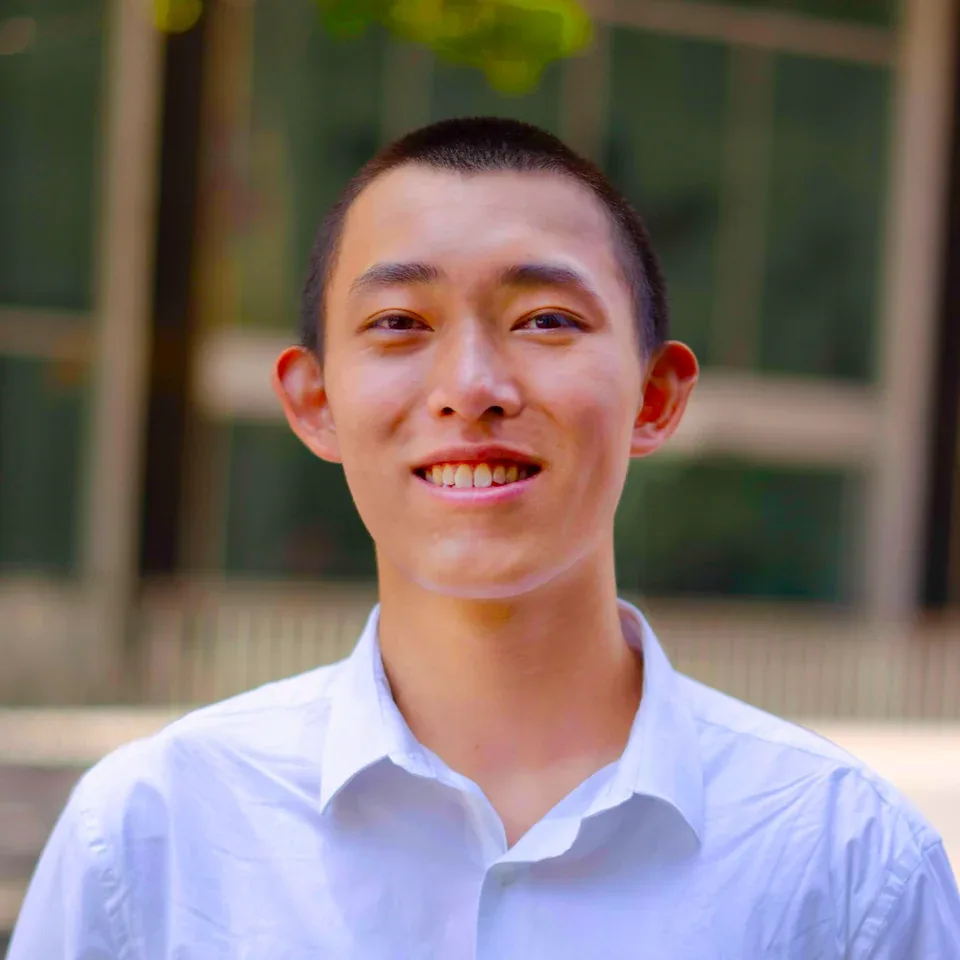
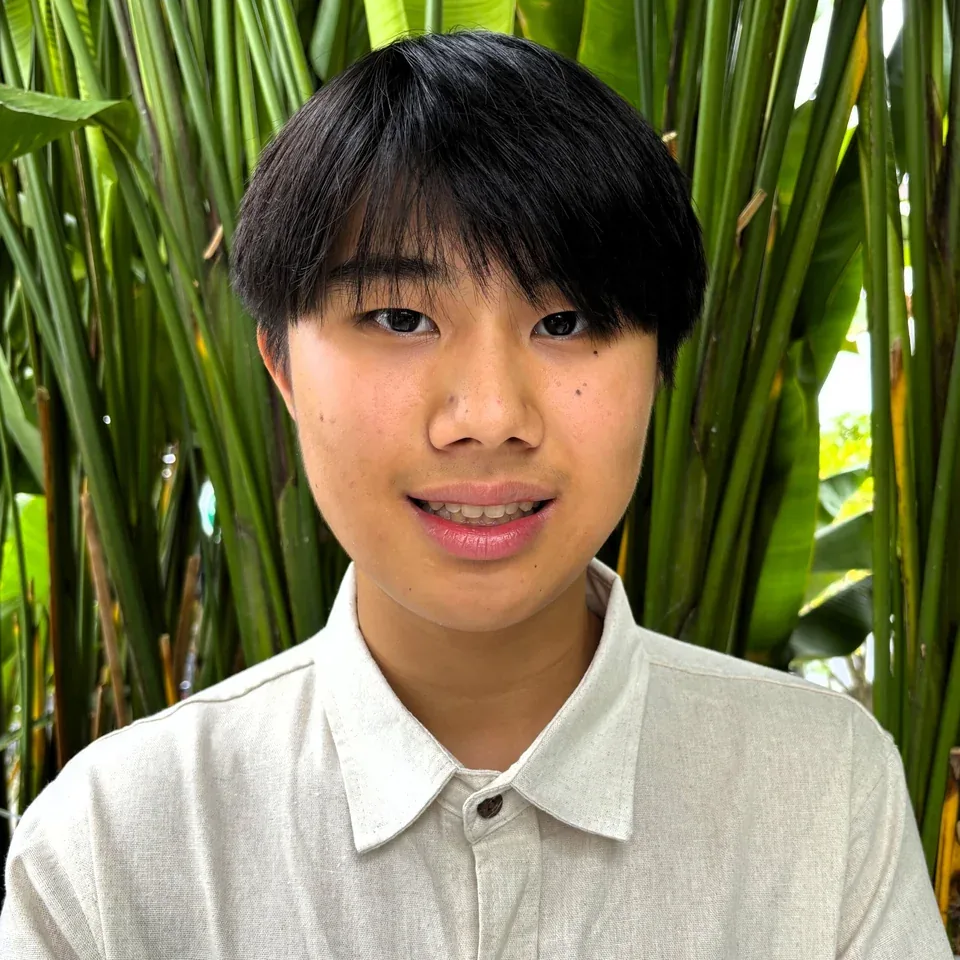
Bob’s Year 10 selfie in his school uniform
50th in
James Ruse Science
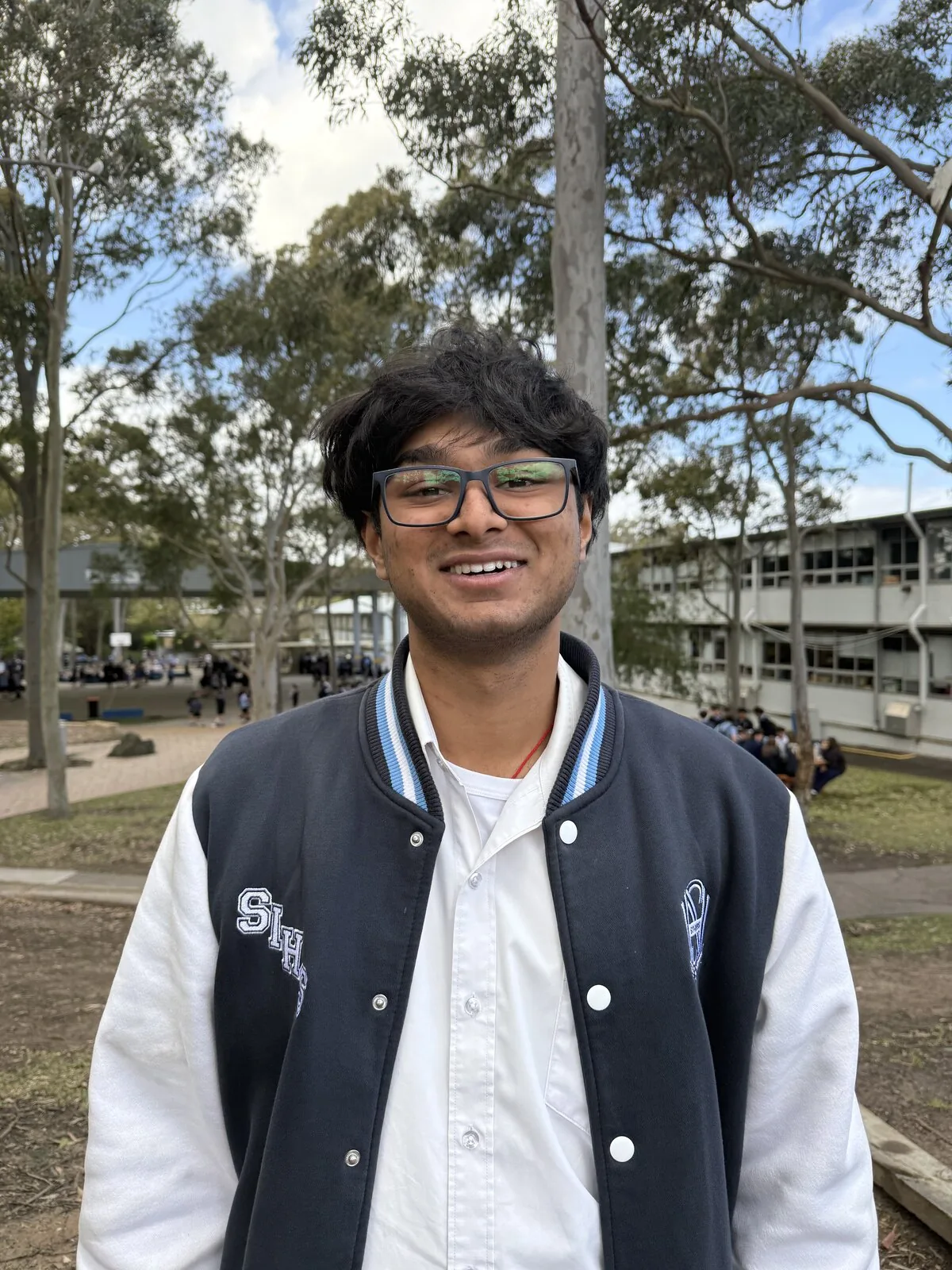
Bob in Year 12 wearing his James Ruse school jacket
1st in
Ruse Physics

Physics state rank99.85 ATARUSYD Med

भौतिकी, रसायन विज्ञान और गणित की HSC ट्यूशन।

10 मिनट का डेमो देखें

हमारे विद्यार्थियों की सफलता

पूरी कहानीपूरी कहानी

Tutorgum के पीछे की कहानी।

James Ruse में भौतिकी में पहला स्थान पाने से पहले मैं माँ को अपने अंक बताने से भी हिचकता था।

कक्षा 10 में स्कूल यूनिफ़ॉर्म में Bob की सेल्फ़ी
James Ruse साइंस में पूरे बैच में 50वाँ स्थान
कक्षा 12 में James Ruse जैकेट पहने Bob
James Ruse भौतिकी में प्रथम

राज्य स्तर पर भौतिकी में प्रथम रैंकATAR 99.85सिडनी विश्वविद्यालय में मेडिसिन

Skip story

James Ruse में भौतिकी में प्रथम आने से पहले,मैं माँ को अपने अंक बताने से भी डरता था।

James Ruse में भौतिकी में प्रथम आने से पहले,
मैं माँ को अपने अंक बताने से भी डरता था।

कक्षा 10 में मैं ऐसा था।

बहुत बुरा।

लेकिन एक चीज़ में मैं सेल्फ़ी लेने से भी ज़्यादा ख़राब था।

विज्ञान।

क्योंकि मेरे अंक अच्छे नहीं आ रहे थे।

धत्त।
पूरे बैच में 50वाँ स्थान।

मुझे विज्ञान से नफ़रत थी।

मैंने पढ़ा। याद किया। अभ्यास किया।

फिर भी मैं गलत सूत्र लगाता था।
परीक्षा में मुझे अंदाज़ा लगाना पड़ता था।

मैं कभी ऊँची रैंक तक नहीं पहुँचा और न 90% से ज़्यादा ला पाया।

मेरा नियंत्रण खो गया था।

मैं माँ को अपने अंक नहीं बताना चाहता था।

इसलिए मुझे पता था कि कुछ बदलना होगा।

आगे चलकर मैंने हासिल किया

  1. James Ruse में भौतिकी में प्रथम।
  2. राज्य स्तर पर भौतिकी में प्रथम रैंक।
  3. ATAR 99.85.
  4. USYD में मेडिसिन।

तो हमने यह कैसे किया?

बिल्कुल शुरुआत से, सहज ढंग से समझें।

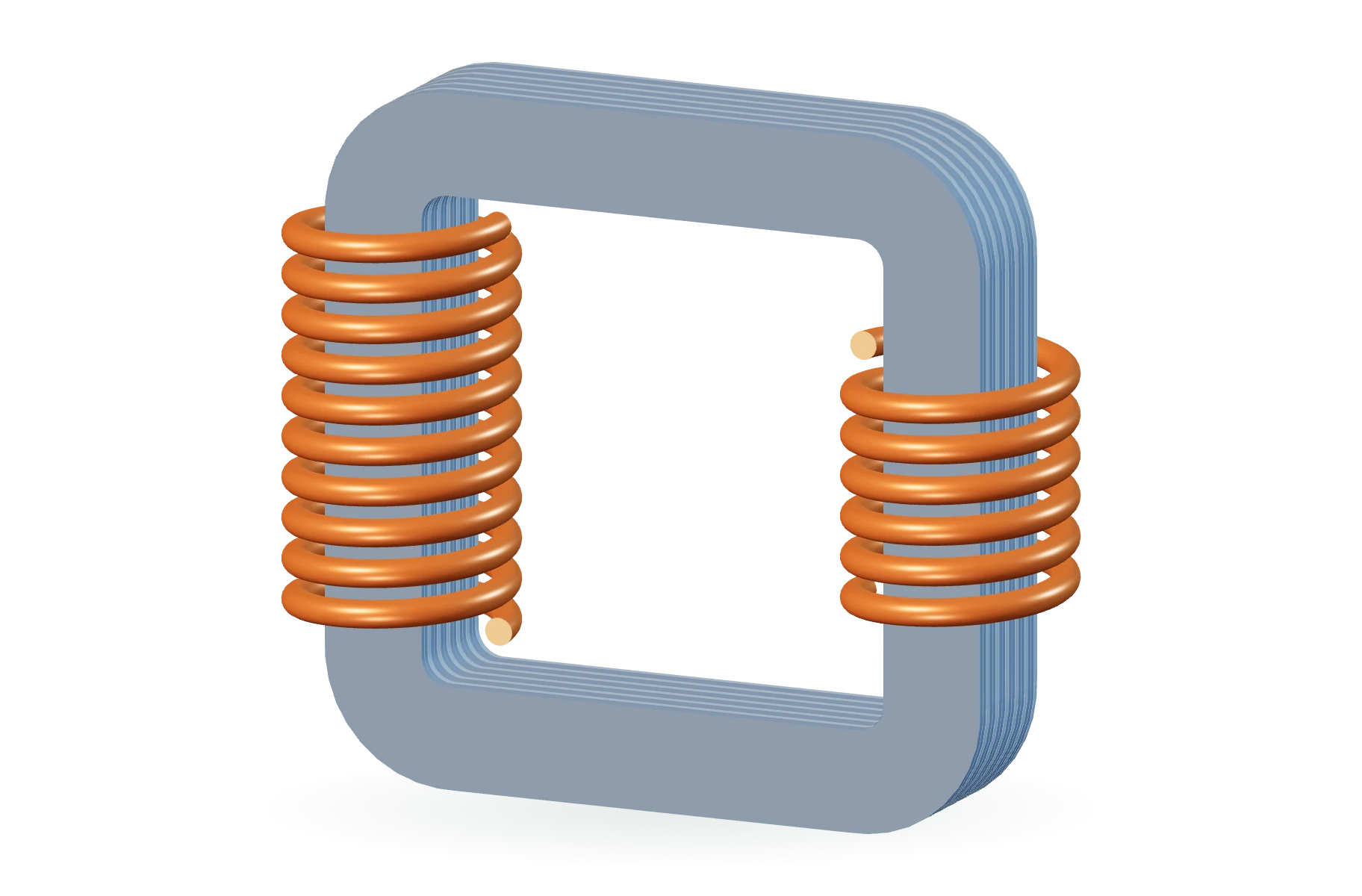
दो तांबे की कुंडलियाँ परतदार लोहे के कोर के चारों ओर लिपटी हैं। पहली कुंडली में बदलती धारा बदलता चुंबकीय क्षेत्र बनाती है, जिससे दूसरी कुंडली में वोल्टेज प्रेरित होता है।

हम सभी ट्रांसफ़ॉर्मर के बारे में पढ़ते हैं। पर क्या आपने सोचा है कि उसका हर हिस्सा ऐसा क्यों होता है?

पहले इसे बुनियादी हिस्सों तक खोलते हैं — बस तार की दो कुंडलियाँ।

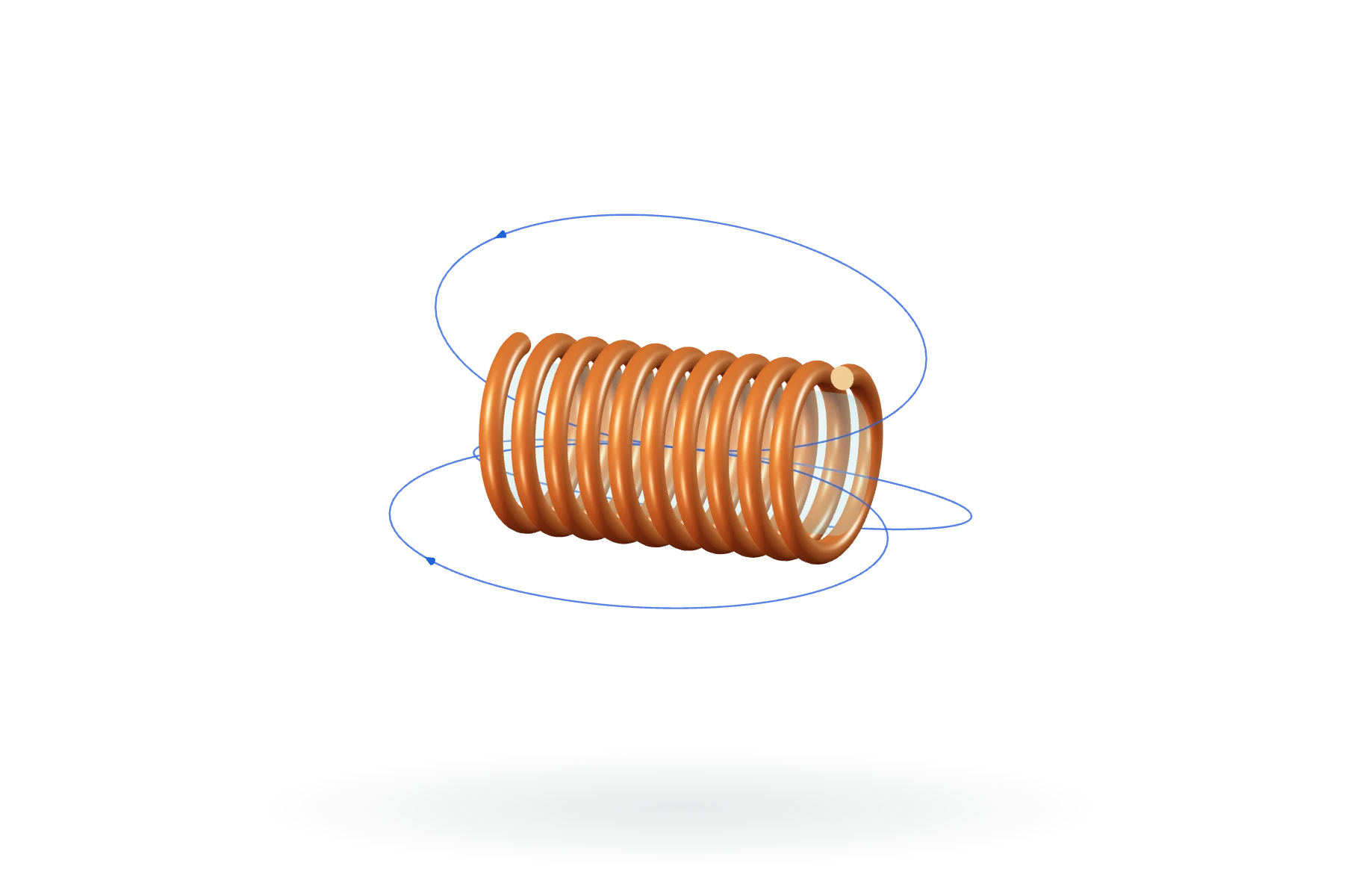
तार में धारा बहने से उसके चारों ओर चुंबकीय क्षेत्र बनता है।

तार को लपेटने पर सोलनॉइड बनता है, जो चुंबकीय क्षेत्र पैदा करता है।

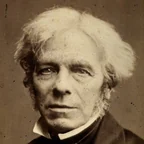
बाईं कुंडली का बदलता चुंबकीय क्षेत्र दाईं कुंडली में वोल्टेज प्रेरित करता है। यही हैफैराडे का नियम।माइकल फैराडे का फ़ोटो

वायरलेस चार्जर इसी एयर-कोर संरचना का उपयोग करते हैं। लेकिन इसे और कुशल बनाया जा सकता है!

नरम लोहे का कोर जोड़ें। इससे बाईं कुंडली का चुंबकीय क्षेत्र बढ़ता है।

खास बात यह है कि लोहे को दाईं कुंडली तक बढ़ाने से अधिक चुंबकीय प्रवाह उसमें पहुँचता है और बदलता है।

चुंबकीय क्षेत्र को लौटने का रास्ता देने के लिए लोहे का घेरा बंद करें।

विद्युतरोधी लोहे की परतें भंवर धाराओं और गर्मी को कम करती हैं। यही पूरा ट्रांसफ़ॉर्मर है!

2.परीक्षा जैसे गृहकार्य

आप जानते हैं, स्कूल में
आप यह सीखते हैं…

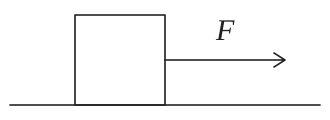
समतल ज़मीन पर एक ब्लॉक पर एक क्षैतिज बल F लग रहा है।F

लेकिन परीक्षा में,
आपको ऐसा मिलता है…
But then, in the exam, आपको ऐसा मिलता है…

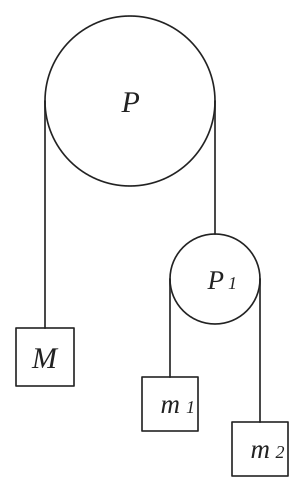
दो पुलियों से जुड़ी तीन वस्तुएँ: द्रव्यमान M बड़ी पुली P से लटका है, जो छोटी पुली P₁ को सहारा देती है; उस पर m₁ और m₂ लटके हैं।PP1Mm1m2

सोचिए, हर हफ़्ते गृहकार्य में ऐसे सवाल मिलें तो?

कक्षा 12 भौतिकी · झुका हुआ मोड़

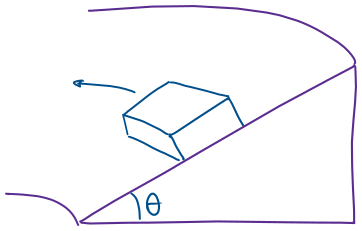
78 मीटर त्रिज्या वाला एक मोड़ 10 डिग्री झुका है। घर्षण गुणांक 0.1 है।

  1. गाड़ी की आदर्श गति कितनी होनी चाहिए ताकि घर्षण का उपयोग न करना पड़े?
  2. इस मोड़ के लिए न्यूनतम गति कितनी है?
  3. अब घर्षण गुणांक 0.3 मानें। गाड़ी कितनी गति-सीमा में मोड़ ले सकती है? समझाएँ कि आपकी गणना में गति ऋणात्मक क्यों आती है।

और हर सवाल का चरण-दर-चरण हल भी हो।

सभी खोलेंकम दिखाएँ

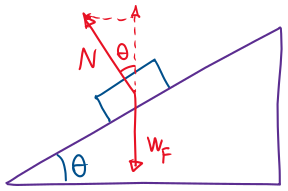
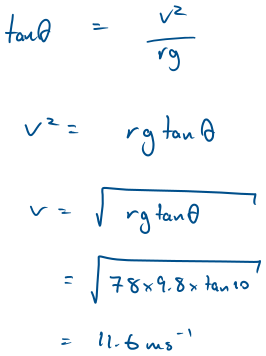
a) गाड़ी की आदर्श गति कितनी होनी चाहिए ताकि घर्षण का उपयोग न करना पड़े?

ANSWER

Step 1: Force diagram
Step 2: Force analysis

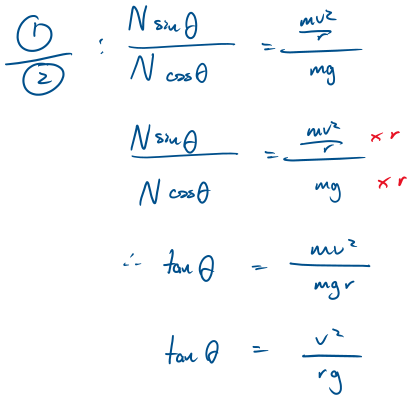
Considering the x – there is a net force! The horizontal part of tension must be the centripetal force!

Considering the y – there is no net force. Thus the vertical part of tension must balance the weight force

Step 3: Set up equation
Step 4: Plug and chug

b) इस मोड़ के लिए न्यूनतम गति कितनी है?

ANSWER

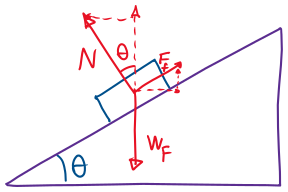
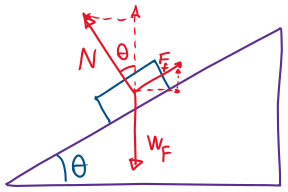
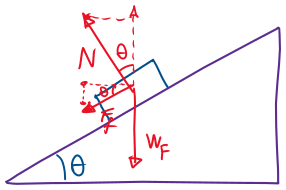
Step 1: Draw force diagram

The force of friction must point up the slope. When the car goes really slow, the car will slip towards the centre.

Step 2: Write out force equations

Vertically:

Ncos⁡θ+Ffsin⁡θ=Wf(1)N\cos \theta +{F}_{f}\sin \theta ={W}_{f}\quad (1)

Horizontally:

FC=Nsin⁡θ−Ffcos⁡θ(2){F}_{C}=N\sin \theta -{F}_{f}\cos \theta \quad (2)

If we transform them:

FC=−Ffcos⁡θ+Nsin⁡θ(2)′{F}_{C}=-{F}_{f}\cos \theta +N\sin \theta \quad {(2)}^{'}
Wf=Ff+sin⁡θ+Ncos⁡θ(1)′{W}_{f}={F}_{f}+\sin \theta +N\cos \theta \quad {(1)}^{'}
Step 3: Maths
(2)′(1)′FCWf=−Ffcos⁡θ+Nsin⁡θFf+sin⁡θ+Ncos⁡θ\frac{{(2)}^{'}}{{(1)}^{'}} \frac{{F}_{C}}{{W}_{f}}=\frac{-{F}_{f}\cos \theta +N\sin \theta }{{F}_{f}+\sin \theta +N\cos \theta }
mv2rmg=−μNcos⁡θ+Nsin⁡θμN+sin⁡θ+Ncos⁡θ\frac{\frac{m{v}^{2}}{r}}{mg}=\frac{-\mu N\cos \theta +N\sin \theta }{\mu N+\sin \theta +N\cos \theta }
v2rg=−μcos⁡θ+sin⁡θμsin⁡θ+cos⁡θ\frac{\frac{{v}^{2}}{r}}{g}=\frac{-\mu \cos \theta +\sin \theta }{\mu \sin \theta +\cos \theta }
v2=−0.1cos⁡10+sin⁡100.1sin⁡10+cos⁡10×78×9.8{v}^{2}=\frac{-0.1\cos 10+\sin 10}{0.1\sin 10+\cos 10}\times 78\times 9.8
v=7.6ms−1v=7.6 {ms}^{-1}

c) अब घर्षण गुणांक 0.3 मानें। गाड़ी कितनी गति-सीमा में मोड़ ले सकती है? समझाएँ कि आपकी गणना में गति ऋणात्मक क्यों आती है।

ANSWER

If you do the calculations, you’ll see that the min speed is negative!

What does this mean!?

It means there is no minimum speed. At any speed the friction will prevent you from sliding down. You could be going at 0m/s and you’ll be able to stay on the curve (there’s just a lot of friction!). it’s like how you can stand on a slanted hill surface.

Step 1: Force equations

Vertically:

Ncos⁡θ+Ffsin⁡θ=Wf(1)N\cos \theta +{F}_{f}\sin \theta ={W}_{f}\quad (1)

Horizontally:

Fc=Nsin⁡θ−Ffcos⁡θ(2){F}_{c}=N\sin \theta -{F}_{f}\cos \theta \quad (2)

At maximum friction:

Ff=μN{F}_{f}=\mu N
Step 2: Maths

Dividing (2) by (1):

FcWf=−μNcos⁡θ+Nsin⁡θμNsin⁡θ+Ncos⁡θ\frac{{F}_{c}}{{W}_{f}}=\frac{-\mu N\cos \theta +N\sin \theta }{\mu N\sin \theta +N\cos \theta }
mv2/rmg=−μcos⁡θ+sin⁡θμsin⁡θ+cos⁡θ\frac{m{v}^{2}/r}{mg}=\frac{-\mu \cos \theta +\sin \theta }{\mu \sin \theta +\cos \theta }
v2rg=−0.3cos⁡10+sin⁡100.3sin⁡10+cos⁡10\frac{{v}^{2}}{rg}=\frac{-0.3\cos 10+\sin 10}{0.3\sin 10+\cos 10}
v2=−89.8{v}^{2}=-89.8

Since v2{v}^{2} cannot be negative, there is no minimum speed.

Step 3: Maximum speed

Friction now acts down the slope, as the car tends to slide up the slope.

Vertically:

Ncos⁡θ−Ffsin⁡θ=Wf(1)N\cos \theta -{F}_{f}\sin \theta ={W}_{f}\quad (1)

Horizontally:

Fc=Nsin⁡θ+Ffcos⁡θ(2){F}_{c}=N\sin \theta +{F}_{f}\cos \theta \quad (2)

Using Ff=μN{F}_{f}=\mu N, divide (2) by (1):

FcWf=μNcos⁡θ+Nsin⁡θNcos⁡θ−μNsin⁡θ\frac{{F}_{c}}{{W}_{f}}=\frac{\mu N\cos \theta +N\sin \theta }{N\cos \theta -\mu N\sin \theta }
v2rg=μcos⁡θ+sin⁡θcos⁡θ−μsin⁡θ\frac{{v}^{2}}{rg}=\frac{\mu \cos \theta +\sin \theta }{\cos \theta -\mu \sin \theta }

Substitute:

v2=78(9.8)(0.3cos⁡10+sin⁡10cos⁡10−0.3sin⁡10){v}^{2}=78(9.8)(\frac{0.3\cos 10+\sin 10}{\cos 10-0.3\sin 10})
v=384.4v=\sqrt{384.4}
v=19.6m/sv=19.6 m/s

Hence the range of speeds is

0≤v≤19.6m/s0\leq v\leq 19.6 m/s

And don’t worry,
there’s plenty more where that came from.

3.ट्यूटर से व्यक्तिगत सहायता

कक्षा में, कक्षा के बाद या दो कक्षाओं के बीच कभी भी सवाल पूछें। अपने ट्यूटर से कभी भी संपर्क करें।

हम अलग से एक-से-एक ट्यूशन नहीं देते।

Bob Chen
7thन्यू साउथ वेल्स भौतिकी राज्य रैंक
Jerome Shin
100%गणित विस्तार 1 परीक्षा · James Ruse

Tutorgum में एक सप्ताह वास्तव में कैसा होता है?

कक्षा खत्म होती है। सीखना जारी रहता है।

सोम
मंगल
बुध
गुरु
शुक्र
शनि
रवि
कक्षा7–9pm
गृहकार्यपरीक्षा जैसे प्रश्न हल करें और चरण-दर-चरण हल से सहायता लें।
ट्यूटर की सहायतासवाल आते ही पूछें। अगली कक्षा तक रुकने की ज़रूरत नहीं।
अपनी कक्षा खोजें

सोमवार 7–9pm

01 / 06
  1. क्विज़

  2. दोहराव

  3. सिद्धांत

  4. प्रश्न

  5. सिद्धांत

  6. प्रश्न

भौतिकी पाठ्यक्रम रूपरेखा
हर मॉड्यूल पर क्रम से।

स्कूल की अवधि दिखाएँस्कूल की अवधि छिपाएँ
स्कूल की छुट्टियों में भी कक्षाएँ जारी रहती हैंक्रिसमस और नए साल पर दो सप्ताह का अवकाश
मॉड्यूल 1: Fundamentals of mechanicsMotion, forces, energy and momentum — साप्ताहिक रूपरेखाटर्म 2 की छुट्टियाँ के दौरान कक्षाएँ जारी रहेंगी

हर मॉड्यूल में सप्ताहों की गिनती 1 से शुरू होती है। साप्ताहिक विषय मौजूदा योजना से लिए गए हैं और नए पाठ्यक्रम के अनुसार उनकी समीक्षा हो रही है।

  1. सप्ताह 1
    Vectors and motion

    Distinguish scalars and vectors, then connect displacement, speed and velocity to everyday motion.

  2. सप्ताह 2
    Motion graphs and relative velocity

    Interpret displacement, velocity and acceleration graphs and describe motion from another observer's perspective.

  3. सप्ताह 3
    SUVAT and free fall

    Apply constant-acceleration equations to harder motion problems, including objects moving under gravity.

  4. सप्ताह 4
    Adding vectors

    Add and subtract vectors, resolve perpendicular components and solve motion problems in two dimensions.

  5. सप्ताह 5
    Motion practice and a first look at forces

    Practise vector and motion questions, then introduce forces as the next step in explaining motion.

  6. सप्ताह 6
    Forces and free-body diagrams

    Review Newton's laws, identify the forces on an object and build useful free-body diagrams.

  7. सप्ताह 7
    Friction, tension and net force

    Work through friction and tension questions and combine forces to find the net force.

  8. सप्ताह 8
    Inclined planes and connected systems

    Resolve forces on slopes, include drag and analyse objects connected as a system.

  9. सप्ताह 9
    Work and energy

    Define work as energy transfer by a force and apply it to force and displacement questions.

  10. सप्ताह 10
    Power and gravitational potential energy

    Connect force, velocity and power, then examine changes in gravitational potential energy.

  11. टर्म 2 की छुट्टियाँ के दौरान कक्षाएँ जारी रहेंगी
  12. सप्ताह 11
    Conservation of mechanical energy

    Choose a convenient zero for potential energy and solve harder gravitational and kinetic energy problems.

  13. सप्ताह 12
    Momentum and collisions

    Introduce momentum and use collision examples to predict how interacting objects move.

  14. सप्ताह 13
    Conservation of momentum

    Analyse collisions, objects sticking together and explosions; compare momentum and kinetic energy.

  15. सप्ताह 14
    Collisions in two dimensions और Dynamics consolidation

    Resolve momentum in perpendicular directions and practise angled collisions and module questions. Revisit the module's harder questions and consolidate the final Dynamics practice.

मॉड्यूल 2: WavesWave properties, sound and light — साप्ताहिक रूपरेखाटर्म 3 की छुट्टियाँ के दौरान कक्षाएँ जारी रहेंगी

हर मॉड्यूल में सप्ताहों की गिनती 1 से शुरू होती है। साप्ताहिक विषय मौजूदा योजना से लिए गए हैं और नए पाठ्यक्रम के अनुसार उनकी समीक्षा हो रही है।

  1. सप्ताह 1
    Wave models and wave graphs

    Compare wave types, read displacement graphs and connect wave motion to energy transfer.

  2. सप्ताह 2
    Huygens' model and wave behaviour

    Explore longitudinal waves and use wavefronts to explain reflection and diffraction.

  3. सप्ताह 3
    Sound and resonance

    Connect natural frequency and resonance to sound, pitch and the inverse-square relationship.

  4. सप्ताह 4
    Standing waves

    Explain sound interference and resonance, then construct standing waves in strings and pipes.

  5. सप्ताह 5
    Refraction and Snell's law

    Explain refraction using changes in wave speed, then apply refractive index, Snell's law and dispersion.

  6. सप्ताह 6
    Total internal reflection and ray diagrams

    Use the critical angle to explain total internal reflection and practise ray diagrams and image formation.

  7. सप्ताह 7
    Lenses and image formation

    Compare converging and diverging lenses, trace images and revisit the earlier wave topics.

  8. सप्ताह 8
    Temperature, heat and internal energy

    Distinguish temperature, heat and internal energy; apply calorimetry and examine phase changes.

  9. टर्म 3 की छुट्टियाँ के दौरान कक्षाएँ जारी रहेंगी
  10. सप्ताह 9
    Thermal transfer

    Explain conduction, convection and radiation and apply thermal conductivity to heat-transfer questions.

  11. सप्ताह 10
    Lesson focus to be confirmed और Waves and thermodynamics revision

    Ask your tutor which topics this class will cover. Consolidate the module through revision and practice questions.

मॉड्यूल 3: Electricity and magnetismCharges, circuits and magnetic fields — साप्ताहिक रूपरेखाटर्म 4 की छुट्टियाँ के दौरान कक्षाएँ जारी रहेंगी

हर मॉड्यूल में सप्ताहों की गिनती 1 से शुरू होती है। साप्ताहिक विषय मौजूदा योजना से लिए गए हैं और नए पाठ्यक्रम के अनुसार उनकी समीक्षा हो रही है।

  1. सप्ताह 1
    Charge and Coulomb's law

    Describe electric charge, compare charging methods and calculate forces between charges.

  2. सप्ताह 2
    Electric fields and voltage

    Draw electric fields and connect field strength, force and electric potential difference.

  3. सप्ताह 3
    Uniform fields and electric energy

    Compare uniform and non-uniform fields, examine fringe effects and use work and equipotential ideas.

  4. सप्ताह 4
    Current, resistance and circuits

    Introduce current and resistance, apply Ohm's law and compare electrical power, AC and DC.

  5. सप्ताह 5
    Series circuits and electrical models

    Explain current and voltage in circuits and calculate equivalent resistance and voltage drops.

  6. सप्ताह 6
    Kirchhoff's laws

    Apply the junction and loop rules to determine currents and voltages in circuits.

  7. सप्ताह 7
    Magnetic fields

    Explore magnetic poles, Earth's field and the rules for drawing magnetic field lines.

  8. सप्ताह 8
    Fields around wires and solenoids

    Use moving charges to explain magnetic fields around current-carrying wires, loops and solenoids.

  9. टर्म 4 की छुट्टियाँ के दौरान कक्षाएँ जारी रहेंगी
  10. सप्ताह 9
    Magnetic forces

    Use right-hand rules and force equations for moving charges and current-carrying conductors.

  11. सप्ताह 10
    Electricity and magnetism revision

    Review charging, fields, circuits, Kirchhoff's laws and magnetic-force directions.

Prelim prepModule review and preliminary exam practice — साप्ताहिक रूपरेखा

हर मॉड्यूल में सप्ताहों की गिनती 1 से शुरू होती है।

  1. सप्ताह 1
    Kinematics review और Dynamics review और Waves and thermodynamics review और Electricity and magnetism review

    Revisit SUVAT, motion problem-solving strategies and common limiting cases. Review work, energy and momentum, including elastic and inelastic collisions. Revise wave classifications, propagation and graphs through exam-style questions. Review charging and electrical concepts alongside feedback on the preceding module paper.

  2. सप्ताह 2
    Preliminary mock paper 1 और Preliminary mock paper 2 और Preliminary mock paper 3

    Practise mixed preliminary questions, including river-boat motion and momentum. Work through a second mock paper with attention to connected-system reasoning. Practise the latest third preliminary mock paper and review your working.

मॉड्यूल 5: Advanced MechanicsProjectiles, circular motion and gravity — साप्ताहिक रूपरेखा

हर मॉड्यूल में सप्ताहों की गिनती 1 से शुरू होती है।

  1. सप्ताह 1
    Projectile motion

    Revise kinematics and vector resolution, then analyse projectiles launched at an angle.

  2. सप्ताह 2
    Harder projectile problems

    Build a systematic approach to horizontal and vertical motion, including hidden information and unknowns.

  3. सप्ताह 3
    Circular motion

    Connect period, speed and centripetal acceleration and distinguish centripetal and centrifugal descriptions.

  4. सप्ताह 4
    Forces in circular motion

    Use friction, tension and banked-track examples to identify the inward force.

  5. सप्ताह 5
    Non-uniform circular motion

    Analyse banked tracks with friction and explore the changing forces in vertical circular motion.

  6. सप्ताह 6
    Circular motion and energy

    Apply radial and tangential reasoning and energy ideas to roller-coaster and circular-motion questions.

  7. सप्ताह 7
    Orbits and Kepler's laws

    Combine gravitation and centripetal force to find orbital speed and interpret Kepler's laws.

  8. सप्ताह 8
    Gravitational potential energy

    Use an infinity reference for gravitational potential energy and compare it with near-Earth approximations.

  9. सप्ताह 9
    Orbital transfers and mechanics review

    Explore Newton's cannon and orbital transfers, then revisit challenging projectile and circular-motion questions.

  10. सप्ताह 10
    Advanced Mechanics exam practice

    Work through the latest Module 5 exam and consolidate the module's problem-solving techniques.

क्रिसमस और नए साल की छुट्टी2 सप्ताह की छुट्टी
मॉड्यूल 6: ElectromagnetismFields, motors and induction — साप्ताहिक रूपरेखागर्मी की छुट्टियाँ के दौरान कक्षाएँ जारी रहेंगी

हर मॉड्यूल में सप्ताहों की गिनती 1 से शुरू होती है।

  1. गर्मी की छुट्टियाँ के दौरान कक्षाएँ जारी रहेंगी
  2. सप्ताह 1
    Fields and the Lorentz force

    Review electric and magnetic fields and introduce forces on moving charges.

  3. सप्ताह 2
    Charged particles in fields

    Apply the Lorentz force to particle paths and harder electric and magnetic field questions.

  4. सप्ताह 3
    The motor effect

    Explain forces on current-carrying conductors and interactions between parallel wires.

  5. सप्ताह 4
    Magnetic flux and Faraday's law

    Define magnetic flux and use changing flux to explain induced electromotive force.

  6. सप्ताह 5
    Lenz's law and eddy currents

    Determine induced-current directions and explain applications of eddy currents.

  7. सप्ताह 6
    Transformers

    Connect induction to transformer operation, practical limitations and induction applications.

  8. सप्ताह 7
    DC motors

    Revise torque and explain how coils, brushes and commutators make a DC motor work.

  9. सप्ताह 8
    Motor applications and back EMF

    Compare motor arrangements and explain the role of back EMF in operation.

  10. सप्ताह 9
    Generators and back torque

    Explain generator operation and the opposing torque associated with electromagnetic induction.

  11. सप्ताह 10
    AC induction motors and braking

    Explore induction motors, three-phase arrangements and electromagnetic braking.

  12. सप्ताह 11
    Electromagnetism exam practice

    Practise exam-style electromagnetic questions and review the module's key ideas.

मॉड्यूल 7: The Nature of LightWaves, photons and relativity — साप्ताहिक रूपरेखाटर्म 2 की छुट्टियाँ के दौरान कक्षाएँ जारी रहेंगी

हर मॉड्यूल में सप्ताहों की गिनती 1 से शुरू होती है।

  1. सप्ताह 1
    Maxwell, Hertz and light

    Trace the development and verification of the electromagnetic model of light.

  2. सप्ताह 2
    Measuring light and reading spectra

    Compare measurements of the speed of light and introduce spectra as evidence about stars.

  3. सप्ताह 3
    Wave and particle models

    Compare Newton and Huygens, then examine Young's double-slit and Poisson-spot evidence.

  4. टर्म 2 की छुट्टियाँ के दौरान कक्षाएँ जारी रहेंगी
  5. सप्ताह 4
    Diffraction and polarisation

    Apply diffraction-grating relationships and Malus' law and compare evidence for light models.

  6. सप्ताह 5
    Blackbody radiation

    Explore the ultraviolet catastrophe and how blackbody radiation challenged classical physics.

  7. सप्ताह 6
    The photoelectric effect

    Compare classical predictions with observations and use the photon model to explain the effect.

  8. सप्ताह 7
    Special relativity

    Introduce time dilation, length contraction and simultaneity through thought experiments and paradoxes.

  9. सप्ताह 8
    Evidence for relativity

    Examine experiments supporting relativity's postulates, time dilation and length contraction.

  10. सप्ताह 9
    Relativistic momentum and energy

    Apply relativistic momentum, mass-energy relationships and velocity addition.

  11. सप्ताह 10
    Explaining changes in light models

    Construct extended responses connecting experimental evidence to the development of light models.

मॉड्यूल 8: From the Universe to the AtomStars, atoms and nuclei — साप्ताहिक रूपरेखाटर्म 3 की छुट्टियाँ के दौरान कक्षाएँ जारी रहेंगी

हर मॉड्यूल में सप्ताहों की गिनती 1 से शुरू होती है।

  1. सप्ताह 1
    The Big Bang and expanding universe

    Explore the Big Bang model, expanding space and the formation of cosmic structures.

  2. सप्ताह 2
    Stars and nucleosynthesis

    Connect stellar spectra, the Hertzsprung-Russell diagram and nuclear reactions in stars.

  3. सप्ताह 3
    Discovering the electron

    Compare cathode-ray experiments, charge-to-mass measurements and Millikan's oil-drop experiment.

  4. सप्ताह 4
    The nucleus and neutron

    Use scattering evidence to explain Rutherford's model and examine Chadwick's neutron discovery.

  5. सप्ताह 5
    Hydrogen spectra and Bohr's model

    Connect hydrogen emission lines and the Rydberg relationship to Bohr's atomic model.

  6. सप्ताह 6
    Matter waves and quantum models

    Explore the limits of Bohr's model, de Broglie's proposal and the development of quantum descriptions.

  7. टर्म 3 की छुट्टियाँ के दौरान कक्षाएँ जारी रहेंगी
  8. सप्ताह 7
    Radioactivity and half-life

    Compare radiation types, calculate radioactive decay and examine nuclear instability.

  9. सप्ताह 8
    Fission, fusion and binding energy

    Connect binding energy to nuclear reactions, reactors and energy release.

  10. सप्ताह 9
    The Standard Model

    Examine evidence for subatomic structure and organise fundamental particles using the Standard Model.

  11. सप्ताह 10
    Particle accelerators

    Explain how accelerators probe matter and contribute to developing particle models.

Trials preparationReview the topics and practise trial questions — साप्ताहिक रूपरेखा

हर मॉड्यूल में सप्ताहों की गिनती 1 से शुरू होती है।

  1. सप्ताह 1
    Advanced Mechanics revision

    Revisit Module 5 theory and practise questions chosen around areas needing revision.

  2. सप्ताह 2
    Electromagnetism revision

    Review forces on charges, helical motion and induction through challenging Module 6 questions.

  3. सप्ताह 3
    The Nature of Light revision

    Practise questions on light measurements, wave evidence, photons and relativity.

  4. सप्ताह 4
    Universe to Atom revision

    Review cosmology, stellar reactions, atomic models and quantum evidence.

  5. सप्ताह 5
    Trial mock paper 1

    Work through mixed questions on mechanics, motors, transformers and scientific reasoning.

  6. सप्ताह 6
    Trial mock paper 2

    Practise mixed questions involving induction, photoelectric observations, light models and relativity.

  7. सप्ताह 7
    Trial mock paper 3

    Work through the third mock-paper stage and revisit the mechanics questions selected in the notes.

HSC exam preparationTimed papers, difficult questions and exam technique — साप्ताहिक रूपरेखाटर्म 4 की छुट्टियाँ के दौरान कक्षाएँ जारी रहेंगी

हर मॉड्यूल में सप्ताहों की गिनती 1 से शुरू होती है।

  1. सप्ताह 1
    Advanced Mechanics exam consolidation

    Practise circular motion, banked tracks and gravitational-energy questions.

  2. टर्म 4 की छुट्टियाँ के दौरान कक्षाएँ जारी रहेंगी
  3. सप्ताह 2
    Induction and back-EMF practice

    Develop explanations and solve harder induction and motor questions.

  4. सप्ताह 3
    Light and photon exam consolidation

    Review Planck's proposal and the photoelectric effect, with emphasis on conceptual responses.

  5. सप्ताह 4
    Mass-defect practice

    Explain mass defect and practise the related calculations.

  6. सप्ताह 5
    Relativity and response review

    Revisit proper time and proper length and review selected written responses.

  7. सप्ताह 6
    Mixed exam-question review

    Work through the selected exam questions and refine your problem-solving approach.

  8. सप्ताह 7
    Physics exam technique

    Practise flux, binding-energy and radiation questions alongside time management and response planning.

  9. सप्ताह 8
    Challenging HSC questions

    Combine mechanics, induction, relativity, spectra and scientific skills in harder exam problems.

  10. सप्ताह 9
    Final HSC paper practice

    Work through the final HSC practice paper and review questions needing further attention.

भौतिकी कक्षा की फीस

साप्ताहिक छोटी कक्षा की फीस, उसमें क्या शामिल है और आपके लिए सही समय देखें।

कक्षा 10/11 भौतिकी

$55/ घंटा

हर सप्ताह 110 AUD

  • दो घंटे की कक्षा शामिल है
  • हर प्रश्न के चरण-दर-चरण हल वाला गृहकार्य
  • आपके अतिरिक्त प्रश्नों में सहायता
  • परीक्षा और गहन अध्ययन की तैयारी
कक्षा 10/11 का समूह खोजें

कक्षा 12 भौतिकी

$60/ घंटा

हर सप्ताह 120 AUD

  • दो घंटे की कक्षा शामिल है
  • हर प्रश्न के चरण-दर-चरण हल वाला गृहकार्य
  • आपके अतिरिक्त प्रश्नों में सहायता
  • परीक्षा और गहन अध्ययन की तैयारी
कक्षा 12 का समूह खोजें

कक्षा का समय समूह के अनुसार बदलता है। वर्तमान कक्षाएँ देखने के लिए नीचे दिए फ़िल्टर चुनें।

कक्षा समय-सारणी

अपनी कक्षा खोजें।

एक कक्षा क्यों न आज़माएँ? कोई जोखिम नहीं!

पहली कक्षा का शुल्क तभी देना होगा जब आप आगे जारी रखना चाहें; वरना यह पूरी तरह निःशुल्क है।

अक्सर पूछे जाने वाले सवाल

क्या Sydney और अन्य जगहों के विद्यार्थियों के लिए ऑनलाइन Physics ट्यूशन है?

हाँ। HSC Physics की कक्षाएँ Zoom पर होती हैं, इसलिए Sydney, NSW के क्षेत्रीय इलाकों और ऑस्ट्रेलिया के अन्य स्थानों के विद्यार्थी जुड़ सकते हैं। Year 11 और 12 के छोटे समूहों में परीक्षा शैली का गृहकार्य, हल किए हुए उत्तर और 1:1 ट्यूटर सहायता शामिल है। पाठ्यक्रम NSW HSC के अनुसार है; दूसरे पाठ्यक्रम के लिए उपयुक्तता जानने को हमसे संपर्क करें।

क्या पाठ्यक्रम शुरू होने के बाद भी जुड़ सकता हूँ?

अपनी कक्षा, अब तक पढ़े विषय और जहाँ कठिनाई हो रही है, हमें बताएँ। हम उपयुक्त कक्षा चुनने और नामांकन से पहले छूटे हुए विषयों पर बात करने में मदद करेंगे।

अगर मेरा स्कूल विषयों को अलग क्रम में पढ़ाता है तो?

हमारा पाठ्यक्रम तय क्रम से चलता है। स्कूल का आकलन कार्यक्रम लाएँ; हम उसकी तुलना कक्षा योजना से करके उन विषयों में पहले सहायता देने पर बात करेंगे जिनकी आपको जल्दी ज़रूरत है।

मुझे तेज़ या सामान्य गति वाला पाठ्यक्रम चुनना चाहिए?

तेज़ पाठ्यक्रम Year 10 के Term 4, Week 1 में शुरू होता है। सामान्य पाठ्यक्रम Year 11 के Term 1, Week 1 में शुरू होता है। दोनों में मॉड्यूल का क्रम समान है। अपनी कक्षा और Physics के अनुभव के बारे में बताएँ ताकि हम सही विकल्प सुझा सकें।

अगर मुझे सवाल पूछने में झिझक हो तो?

आप कक्षा में पूछ सकते हैं या ट्यूटर से निजी तौर पर बात कर सकते हैं। 1:1 सहायता से सवाल सुलझाने और मुश्किल अवधारणा को दोबारा समझने में मदद मिलती है।

What happens when I book a trial?

Send us your year, subject and preferred class. We’ll help you find a suitable lesson. The first lesson is only charged if you want to continue, otherwise it's totally free!

मेरा बच्चा बहुत शर्मीला है और सवाल नहीं पूछ पाता। क्या समूह की कक्षा उसके लिए ठीक है?

मैं भी बचपन में बहुत शर्मीला था। सवाल पूछने से डरता था क्योंकि चिंता रहती थी कि लोग क्या सोचेंगे।

  • विद्यार्थी कक्षा के बाद अकेले में सवाल पूछ सकते हैं या दो कक्षाओं के बीच ईमेल या मैसेज कर सकते हैं।
  • कक्षा में मैं हर विद्यार्थी से सवाल पूछता हूँ, ताकि सभी भाग लें।
  • मैं हर विद्यार्थी की प्रगति देखता हूँ ताकि कोई पीछे छूट रहा हो तो पता चले।

अगर आपको पूरी कक्षा में एक-से-एक पढ़ाई ही चाहिए, तो मैं कोई दूसरा शिक्षक ढूँढ़ने की सलाह दूँगा।

लेकिन आपके लिए कक्षा का तरीका ज़्यादा मायने रखता है या बच्चे का किसी विशेषज्ञ से सीखना? ट्यूटर बहुत हैं, मगर कितनों ने न्यू साउथ वेल्स में शीर्ष स्थान हासिल किया है? सभी मेरी तरह रासायनिक साम्य और विद्युतचुंबकत्व नहीं जानते। सभी यह भी नहीं जानते कि इन्हें कैसे समझाएँ ताकि विद्यार्थी को बात अचानक समझ आ जाए, या अंक कहाँ कटते हैं और इसे कैसे सुधारें। इसलिए हर कोई वैसा सुधार नहीं ला पाता जैसा Kirsten Chu के अंकों में 2022 में 56% से 91% तक हुआ।

क्या मेरा बच्चा समूह की रफ़्तार के साथ चल पाएगा?

कोई भी दूसरों से बहुत पीछे नहीं रहना चाहता। आपको अंदाज़ा देने के लिए, हमारे विद्यार्थी आम तौर पर औसत या उससे थोड़े कम अंकों के साथ आते हैं। वे चयन परीक्षा वाले स्कूलों (जैसे NSB, NSG और Ruse), निजी स्कूलों (जैसे Scots, St Patricks और Meriden) और बिना चयन परीक्षा वाले स्कूलों (जैसे Castle Hill और Carlingford HS) से आते हैं। हम कक्षा के बाद सवालों के जवाब देते हैं और पिछले विषयों की सामग्री उपलब्ध कराते हैं, ताकि वे समूह के साथ चल सकें।

नया विषय हमेशा बुनियाद से समझाया जाता है। पहले की कोई अवधारणा छूट गई हो, तब भी विद्यार्थी नई बात समझ सकते हैं।

अगर मेरे बच्चे के मन में सवाल हों तो?

हमारी समूह कक्षा ज़्यादातर ट्यूटरों की कक्षा से अलग चलती है। मैं अलग से समय देने के लिए तैयार हूँ। विद्यार्थी कक्षा के बाद अकेले में मुझसे पूछ सकते हैं या हफ़्ते के दौरान संपर्क कर सकते हैं। ज़रूरत हो तो मैं एक घंटा भी दे सकता हूँ।

आपकी कक्षाएँ कैसे चलती हैं?

हर हफ़्ते Zoom पर दो घंटे की एक ऑनलाइन कक्षा होती है।

कक्षा में क्या होता है?

पहले 10 मिनट की छोटी परीक्षा होती है। फिर हम एक नई अवधारणा समझाते हैं और उसे पक्का करने के लिए कुछ सवाल हल करते हैं। पूरी कक्षा में यही क्रम दोहराते हैं। परीक्षाएँ पास हों तो हम दोहराव की कक्षाएँ लेते हैं। कक्षा से पहले अभ्यास प्रश्नपत्र भेजते हैं और कक्षा में वे कठिन सवाल समझाते हैं जिन्हें विद्यार्थी पूछते हैं।

भुगतान कैसे होता है?

हम बैंक ट्रांसफ़र स्वीकार करते हैं और आम तौर पर हर स्कूल टर्म के लिए बिल भेजते हैं। अगर आप आगे पढ़ना बंद करना चाहते हैं, तो इस्तेमाल न हुई कक्षाओं की पूरी फीस वापस कर दी जाएगी।

अगर मेरी कोई कक्षा छूट जाए तो?

हम ज़ोर देकर कहते हैं कि परीक्षा की वजह से कक्षा न छोड़ें। समय कम हो तो गृहकार्य बाद में कर सकते हैं, लेकिन कक्षा में आना बेहतर है। अनुपस्थित होने पर आपको सारी सामग्री और कक्षा की रिकॉर्डिंग मिल जाएगी। उस कक्षा की फीस वापस नहीं होगी।

क्या कक्षा के और समय उपलब्ध हैं?

उपलब्ध समय देखने के लिए कक्षा की समय-सारणी देखें।

क्या स्कूल की छुट्टियों में भी कक्षाएँ होती हैं?

हाँ, स्कूल की छुट्टियों में भी कक्षाएँ सामान्य रूप से चलती हैं। छुट्टियों में हम कम समय में बहुत सारी गहन कक्षाएँ नहीं चलाते, क्योंकि वह तरीका विद्यार्थियों के लिए असरदार नहीं होता।

एक समूह में कितने विद्यार्थी होते हैं?

संख्या बदलती रहती है, लेकिन आम तौर पर करीब पाँच विद्यार्थी होते हैं।

ऑनलाइन कक्षा के लिए क्या चाहिए?

सीखने का उत्साह और एक पेन। हो सके तो इस कक्षा के लिए एक अलग कॉपी रखें। बाकी सामग्री हम भेज देंगे।


आप विद्यार्थियों को स्कूल की परीक्षाओं के लिए कैसे तैयार करते हैं?

परीक्षा में कम अंक आने की सबसे बड़ी वजह मूल अवधारणाओं को न समझ पाना है। हमारे साथ विषय पढ़ने के बाद ज़्यादातर विद्यार्थियों को यह समस्या नहीं रहती। नींव मज़बूत होने पर हम हर हफ़्ते गृहकार्य में परीक्षा जैसे सवाल देते हैं, ताकि नियमित अभ्यास हो।

परीक्षा से ठीक पहले हम पिछले सालों के स्कूल प्रश्नपत्रों का अपना संग्रह भी उपलब्ध कराते हैं। उनसे अच्छा अभ्यास होता है। परीक्षा से पहले हम कक्षा में सवाल हल करने की तकनीक भी समझाते हैं।

आप पाठ्यक्रम कब तक पूरा कर लेते हैं?

तेज़ रफ़्तार वाली कक्षाओं में हम आम तौर पर कक्षा 12 की अंतिम अभ्यास परीक्षाओं से एक टर्म पहले पूरा पाठ्यक्रम ख़त्म करते हैं। ये परीक्षाएँ टर्म 3 के दूसरे हफ़्ते में होती हैं। इससे परीक्षा के पहले करीब 7 हफ़्ते और बाद में HSC की तैयारी के लिए करीब 10 हफ़्ते मिलते हैं। हर हफ़्ते एक मॉड्यूल की परीक्षा से उसे दोहराते हैं और फिर अभ्यास प्रश्नपत्र हल करते हैं।

स्कूल की रफ़्तार वाली कक्षाएँ स्कूल के साथ चलती हैं, इसलिए HSC दोहराने के लिए करीब 6 हफ़्ते मिलते हैं।

आप पाठ्यक्रम के मॉड्यूल किस क्रम में पढ़ाते हैं?

मॉड्यूल 1 से 8 तक क्रम से पढ़ाते हैं।

लेकिन मेरा स्कूल अलग क्रम में पढ़ाता है। तब क्या होगा?

कुछ स्कूल अलग क्रम चुनते हैं। मेरे अनुभव में इससे दिक्कत नहीं होती, क्योंकि परीक्षा तक वही सामग्री पढ़ ली जाती है। सबसे अहम बात यह है कि विद्यार्थी कुछ सीखे, भले ही स्कूल का क्रम अलग हो।

आपके पास आम तौर पर किस तरह के विद्यार्थी आते हैं?

शुरुआत में आम तौर पर उनके अंक औसत या उससे थोड़े कम होते हैं। वे चयन परीक्षा वाले स्कूलों (जैसे NSB, NSG और Ruse), निजी स्कूलों (जैसे Scots, St Patricks और Meriden) और बिना चयन परीक्षा वाले स्कूलों (जैसे Castle Hill और Carlingford HS) से आते हैं।

आपका कार्यक्रम किस तरह के विद्यार्थी के लिए सही है?

सुधार इस बात पर निर्भर नहीं करता कि आप कितने होशियार हैं। सबसे ज़रूरी है कि आप मेहनत करने के लिए तैयार हों। Jade Yang और Kirsten Chu जैसे विद्यार्थियों ने अच्छा सुधार किया। उन्होंने हर हफ़्ते भौतिकी और रसायन विज्ञान पर 10 घंटे से ज़्यादा लगाए। हम आपके लिए पढ़ाई आसान बनाते हैं। अगर आप सारा गृहकार्य यानी परीक्षा का अभ्यास करते हैं और हर कक्षा में आते हैं, तो सुधार होगा।

सवाल है, क्या आप ऐसा करेंगे?

क्या आप भौतिकी और रसायन विज्ञान का ऑनलाइन ट्यूशन देते हैं?

हाँ। न्यू साउथ वेल्स के HSC की तैयारी कर रहे कक्षा 11 और 12 के विद्यार्थियों के लिए हम भौतिकी और रसायन विज्ञान के ऑनलाइन छोटे समूह चलाते हैं। भौतिकी को कभी-कभी phys लिखा जाता है, लेकिन विषय वही HSC भौतिकी है। Zoom कक्षाओं के साथ परीक्षा जैसे गृहकार्य, सवालों के विस्तृत हल और कक्षाओं के बीच एक-से-एक सहायता मिलती है।

भौतिकी या रसायन विज्ञान की कक्षाएँ देखें, या फीस और समय जानें।

क्या सिडनी, न्यू साउथ वेल्स के दूसरे क्षेत्रों या राज्य के बाहर से जुड़ सकते हैं?

हाँ। कक्षाएँ ऑनलाइन हैं। आप सिडनी, न्यूकैसल, वोलोंगोंग, न्यू साउथ वेल्स के दूसरे क्षेत्रों या ऑस्ट्रेलिया में कहीं से भी जुड़ सकते हैं। ट्यूशन सेंटर जाने की ज़रूरत नहीं है।

भौतिकी और रसायन विज्ञान की कक्षाएँ न्यू साउथ वेल्स के HSC के लिए हैं। अगर आप किसी दूसरे राज्य या अलग पाठ्यक्रम में पढ़ रहे हैं, तो अपनी कक्षा और विषयों की जानकारी के साथ हमसे संपर्क करें। हम देखेंगे कि कक्षाएँ आपके लिए सही हैं या नहीं। ऑनलाइन कक्षाएँ हर पाठ्यक्रम को शामिल नहीं करतीं।

कोई और सवाल है?

फ़ोन करें 0490 496 078