Mỗi tuần, học sinh học một buổi hai giờ qua Zoom theo nhóm nhỏ. Bài tập về nhà theo dạng đề thi có lời giải từng bước. Học sinh cũng có thể hỏi riêng gia sư.
Thầy có khả năng chia nhỏ từng khái niệm thành những phần rất dễ hiểu.
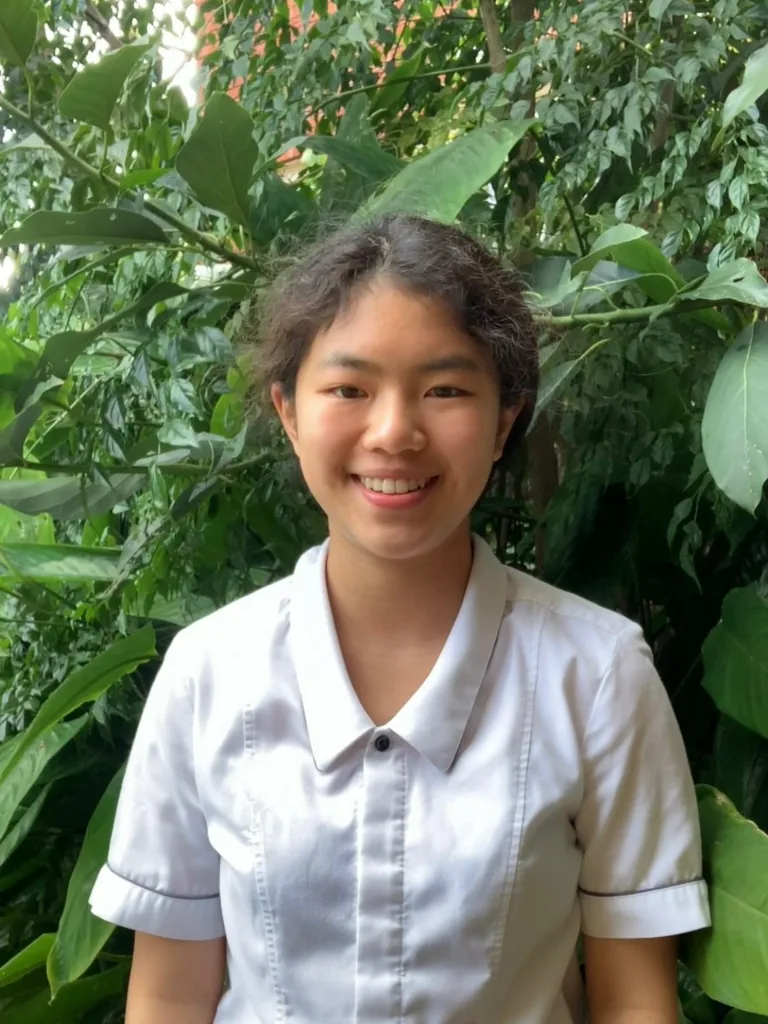
Jade đạt 49% môn Hóa học lớp 11. Em cần hiểu những ý khó thay vì chỉ làm thêm bài trong sách. Bob giải thích từng khái niệm, hỗ trợ ngoài giờ và tập trung luyện đề vào đúng điểm yếu của em. Sau đó em đạt Band 6 môn Hóa học HSC.
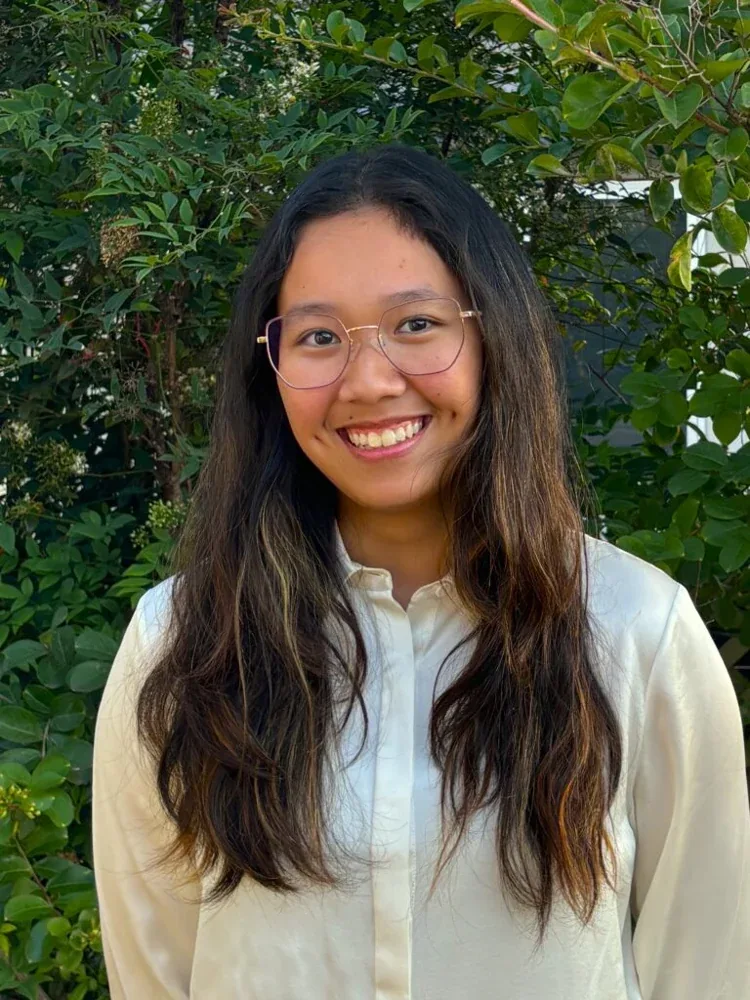
Điểm của Kirsten liên tục giảm và em bắt đầu sợ môn Vật lý. Những buổi học sát với nhu cầu của em tạo cơ hội đặt câu hỏi và học theo nhịp độ riêng. Bài luyện khó hơn và sự hỗ trợ ngoài lớp giúp em chuẩn bị tốt. Điểm thi thử Hóa học tăng từ 56% lên 91% trong HSC; em cũng đạt 92 điểm Vật lý.
Thầy tạo ra một không khí vui vẻ, thoải mái và luôn hỗ trợ học sinh.
Queenie trân trọng việc có người giải thích theo cách khác, trả lời câu hỏi sau giờ và giúp em với bài đánh giá ở trường. Sự hỗ trợ đó giúp em suy nghĩ sáng tạo hơn về Vật lý thay vì chỉ dựa vào sách giáo khoa. Em tốt nghiệp Hurlstone Agricultural với 95 điểm Vật lý và ATAR 99,75.
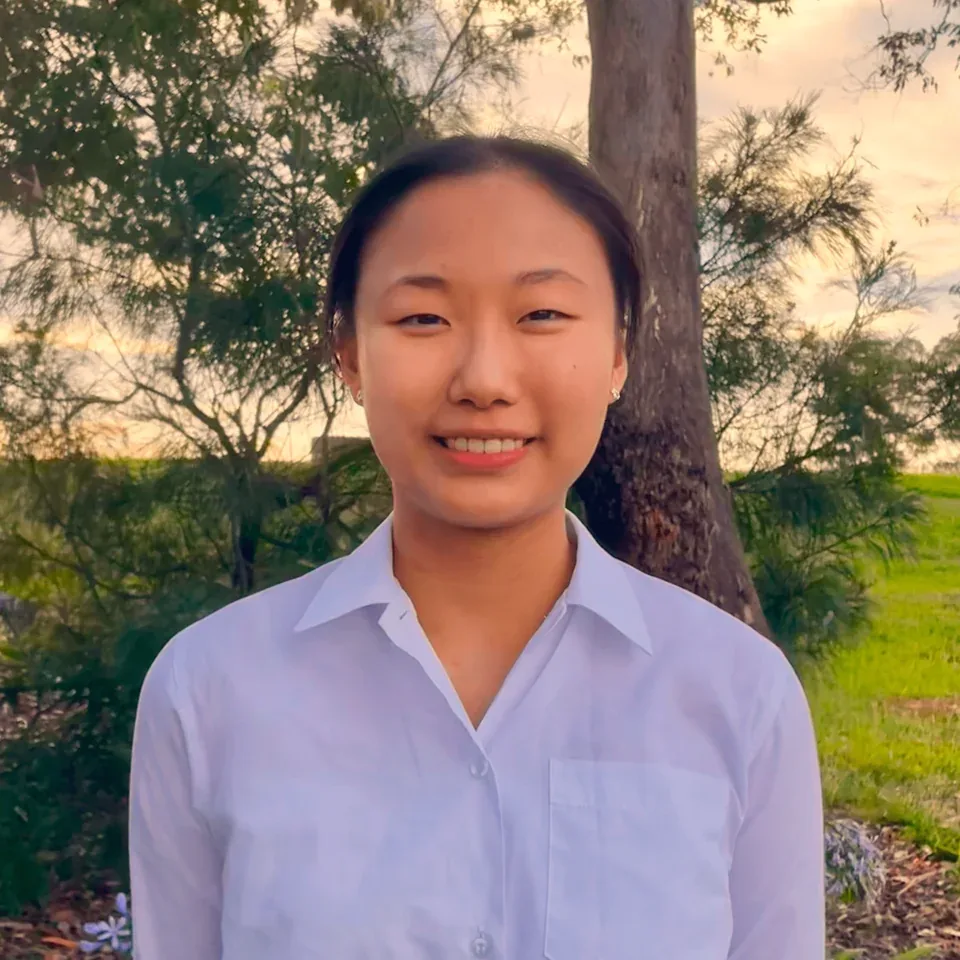
Trước khi đứng đầu môn Vật lý ở James Ruse, tôi còn chẳng dám kể điểm của mình với mẹ.
Cảnh lớp học · bản quét bài thi gốc
Đó là tôi khi học lớp 10.
Thật tệ.
Nhưng có thứ tôi còn kém hơn cả chụp ảnh tự sướng.
Khoa học.
Vì kết quả của tôi chẳng tốt lắm.
Chết tiệt. Đứng thứ 50 trong khối.
Tôi ghét khoa học.
Tôi học. Tôi ghi nhớ. Tôi luyện tập.
Thế nhưng tôi vẫn dùng sai công thức. Vào kỳ thi tôi phải đoán.
Tôi chẳng thể vào nhóm đầu hay đạt trên 90%.
Tôi đã mất kiểm soát.
Tôi không muốn kể điểm của mình với mẹ.
Vì vậy tôi biết mình phải thay đổi điều gì đó.
Sau đó tôi đạt được
Đứng đầu Vật lý ở James Ruse.Đứng đầu Vật lý ở James Ruse.
Xếp hạng Vật lý toàn bang đầu tiên.Xếp hạng Vật lý toàn bang đầu tiên.
ATAR 99,85.ATAR 99,85.
Y khoa, Đại học Sydney.Y khoa, Đại học Sydney.
Đó là tôi khi học lớp 10.
Thật tệ.
Nhưng có thứ tôi còn kém hơn cả chụp ảnh tự sướng.
Khoa học.
Vì kết quả của tôi chẳng tốt lắm.
Chết tiệt. Đứng thứ 50 trong khối.
Tôi ghét khoa học.
Tôi học. Tôi ghi nhớ. Tôi luyện tập.
Thế nhưng tôi vẫn dùng sai công thức. Vào kỳ thi tôi phải đoán.
Tôi chẳng thể vào nhóm đầu hay đạt trên 90%.
Tôi đã mất kiểm soát.
Tôi không muốn kể điểm của mình với mẹ.
Vì vậy tôi biết mình phải thay đổi điều gì đó.
Sau đó tôi đạt được
Đứng đầu Vật lý ở James Ruse.
Xếp hạng Vật lý toàn bang đầu tiên.
ATAR 99,85.
Y khoa, Đại học Sydney.
Vậy chúng tôi đã làmđiều đó thế nào?
Explained intuitively and from scratch
Salt in water. Let’s look inside one grain.
Salt in water. Let’s look inside one grain.
Its white surface looks smooth. Keep zooming in.
That surface is made of tiny Na⁺ and Cl⁻ ions.
The ions form a repeating lattice.
Let’s follow this Na⁺ ion at the edge.
Oxygen pulls water’s shared electrons closer. Its end is slightly negative; the hydrogen ends are slightly positive.
The negative oxygen ends face Na⁺. Gold dots show their attraction to the ion.
Water pulls outwards. The surrounding Cl⁻ ions hold Na⁺ in the lattice.
Na⁺ separates from the lattice, with water molecules around it.
That’s Na⁺(aq): a sodium ion surrounded by water.
2.Bài tập theo dạng đề thi
Bạn biết ở trường mình học những gì…
Nhưng khi vào bài thi, bạn lại gặp…But then,in the exam,bạn lại gặp…
Nếu tuần nào bài tập cũng có những câu như thế này thì sao?
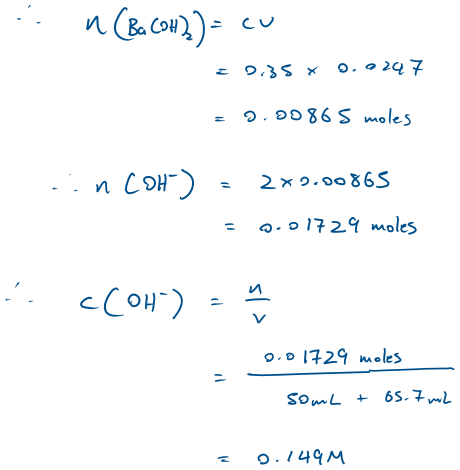
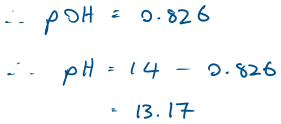
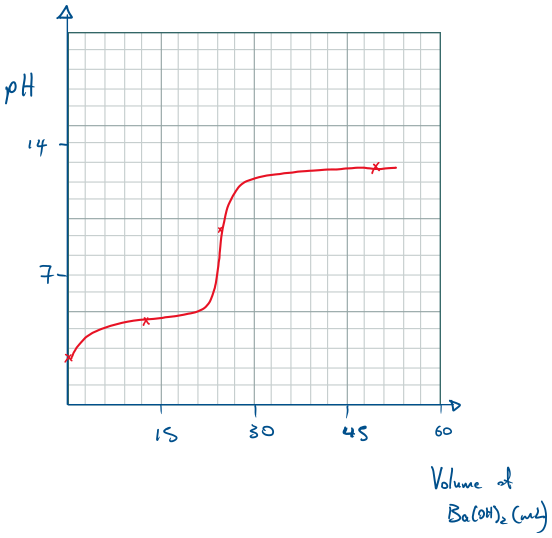
A man begins to titrate 65.7mL of 0.270M acetic acid against 0.350M Ba(OH)2. Acetic acid has a pKa of 4.76. Draw the pH graph, ensuring you label the following points:
The initial pH (2 marks)
The pH at equivalence point (3 marks)
The pH at the optimal buffer point (2 marks)
The pH after 50mL of Ba(OH)2 has been added (2 marks)
Và mỗi câu đều có lời giải từng bước.
a) The initial pH (2 marks)
ANSWER
Step 1: Thinking
Acetic acid is a weak acid and its dissociation in water can be represented as below:
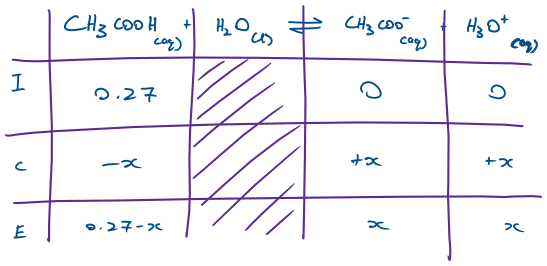
Step 2: Draw up ICE table
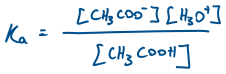
Step 3: Substitute into the Ka expression
The acid dissociation constant, Ka, can be calculated from the pKa value:
Make the small change assumption
Mở rộng tất cảThu gọn
a) The initial pH (2 marks)
ANSWER
Step 1: Thinking
Acetic acid is a weak acid and its dissociation in water can be represented as below:
Step 2: Draw up ICE table
Step 3: Substitute into the Ka expression
The acid dissociation constant, Ka, can be calculated from the pKa value:
Make the small change assumption
b) The pH at equivalence point (3 marks)
ANSWER
Step 1: Thinking
At the equivalence point, all of the acetic acid has reacted with the NaOH to form its conjugate base, acetate ion (CH3COO–). This is why there is a pH at equivalence point!
To determine the pH, we need to consider the hydrolysis of acetate ion in water:
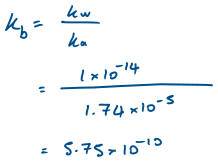
The equilibrium constant for this reaction is given by:
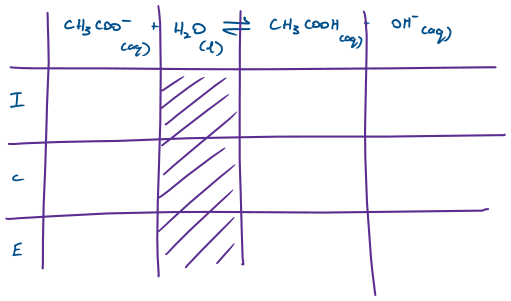
Step 2: Draw ICE table
An ICE table can be used to determine the concentration of OH– ions in the solution at equilibrium:
Hm but we don’t know what the concentration of CH3COO– is at equivalence point! Let’s go calculate it first.
Step 3: Calculate concentration of acetate ion at the equivalence point
At the equivalence point, all of the acetic acid has reacted with the NaOH to form its conjugate base, acetate ion (CH3COO–).
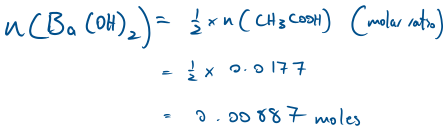
The number of moles of acetic acid initially present is (0.270M)(0.0657L) = 0.0177 moles. To find the concentration we need to know the volume at the end point.
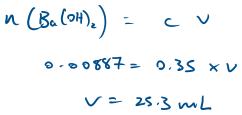
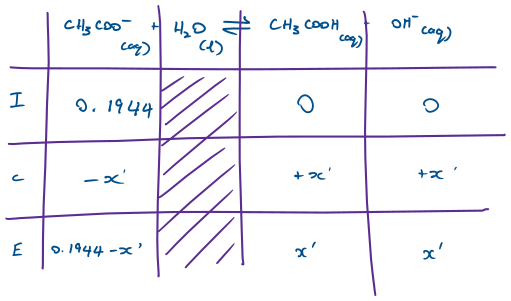
The volume of the solution at the equivalence point is 65.7mL + 25.3mL = 91mL, so the concentration of acetate ion at the equivalence point is (0.0177 moles)/(0.091L) = 0.1944M.
Step 4: Sub into ICE table
Step 4: Substitute into the Kb expression gives:
Kb=[CH3COO−][CH3COOH][OH−]
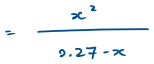
=0.1944−x′x′2
=0.1944x′2
5.75×10−10=0.1944x′2
x’ ≈ 10.57 × 10⁻⁶
which is the concentration of OH– ions in the solution. The pOH of the solution at equivalence point is therefore:
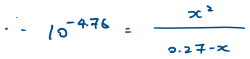
pOH=−log[OH−]=−log(10.57×10⁻⁶)≈4.976
and its pH is:
pH=14−pOH≈9.02
c) The pH at the optimal buffer point (2 marks)
ANSWER
We need to realise that the optimal buffer point is when there is equimolar acid and conjugate base.
This will occur at halfway to the equivalence point.
To understand this, consider you had 1 mole of CH3COOH.
After you add in 0.5 moles of OH- (or in this case, 0.25 moles of Ba(OH)2) you will have 0.5 moles of CH3COO- and also 0.5 moles of CH3COOH left. Thus, you have equimolar amounts of acid and conjugate base.
Thus, it will be at 0.5 x 25.3mL = 12.65mL
The pH will be:
Ka=[CH3COOH][CH3COO−][H3O+]
=[CH3COOH][CH3COO−][H3O+]
Ka=[H3O+]
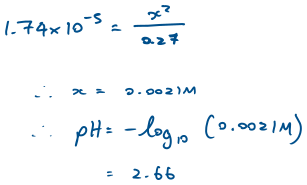
1.74×10−5=[H3O+]
pH=4.76
d) The pH after 50mL of Ba(OH)2 has been added (2 marks)
ANSWER
This is about double the equivalence point volume.
Getting to equivalence takes 25.3mL
Thus you add another 24.7 mL of Ba(OH)2.
This just adds pure OH-
And don’t worry, there’s plenty more where that came from.
Flick through the worked answers.
Loading sample…
3.Hỗ trợ riêng từ gia sư
Hãy hỏi bất cứ lúc nào trong buổi học, sau giờ hoặc giữa các buổi. Bạn cũng có thể liên hệ gia sư bất cứ lúc nào.
Chúng tôi không cung cấp dịch vụ gia sư riêng 1-1.
Lớp vẫn học trong kỳ nghỉ ở trườngNghỉ hai tuần dịp Giáng sinh và Năm mới
Học phần 1: Properties and structure of matterAtoms, bonding and the properties of substances+ — lịch học theo tuầnCác buổi học vẫn diễn ra trong Kỳ nghỉ giữa học kỳ 2
Tuần học của mỗi học phần bắt đầu từ tuần 1. Chủ đề từng tuần dựa trên kế hoạch hiện tại và đang được rà soát theo chương trình mới.
Tuần 1
Matter and mixtures
Classify matter and mixtures, compare separation methods and review significant figures.
Tuần 2
The periodic table and chemical naming
Introduce periodic organisation, ionic and covalent bonding and the naming of compounds.
Tuần 3
Valence electrons and bonding
Connect valence electrons to chemical properties, Lewis diagrams and the formulas of compounds.
Tuần 4
Electron configurations
Use SPDF notation and orbital diagrams to describe electron arrangements.
Tuần 5
Electron transitions and flame tests
Connect Bohr's model and electron transitions to observed flame-test colours.
Tuần 6
Periodic trends
Explain patterns in ionisation energy and atomic properties using electron arrangements.
Tuần 7
Bond polarity
Use electronegativity differences to distinguish non-polar, polar and ionic bonding.
Tuần 8
Molecular shapes
Use electron-pair repulsion to predict three-dimensional shapes and connect shape to polarity.
Tuần 9
Bonding and material structures
Explain covalent networks and metallic structures and connect their bonding to material properties.
Tuần 10
Intermolecular forces
Compare dispersion, dipole and hydrogen-bonding interactions and their effects on substances.
Các buổi học vẫn diễn ra trong Kỳ nghỉ giữa học kỳ 2
Tuần 11
Boiling points and module consolidation
Combine intermolecular forces to explain boiling points and revisit the module's core ideas.
Học phần 2: Quantitative chemistryMoles, equations, gases and concentrations+ — lịch học theo tuần
Tuần học của mỗi học phần bắt đầu từ tuần 1. Chủ đề từng tuần dựa trên kế hoạch hiện tại và đang được rà soát theo chương trình mới.
Tuần 1
Writing and balancing reactions
Write chemical equations and use conservation of mass and charge to balance them.
Tuần 2
The mole
Connect particle numbers, molar mass and reacting amounts using the mole concept.
Tuần 3
Empirical formulas and limiting reagents
Determine empirical formulas and identify which reactant limits the amount of product.
Tuần 4
Concentration
Distinguish solute and solvent and work with common concentration measures.
Tuần 5
Gas relationships
Use particle ideas to explain gas behaviour and introduce gas-law calculations.
Tuần 6
The ideal gas law
Combine gas relationships with mole calculations in worked examples.
Tuần 7
Quantitative Chemistry revision
Revisit balancing equations, reacting amounts, concentration and gas calculations.
Học phần 3: Chemical reactionsReactions, rates and energy changes+ — lịch học theo tuầnCác buổi học vẫn diễn ra trong Kỳ nghỉ giữa học kỳ 3Các buổi học vẫn diễn ra trong Kỳ nghỉ giữa học kỳ 4
Tuần học của mỗi học phần bắt đầu từ tuần 1. Chủ đề từng tuần dựa trên kế hoạch hiện tại và đang được rà soát theo chương trình mới.
Tuần 1
Chemical changes and reactions
Distinguish physical and chemical changes and examine evidence that reactions have occurred.
Tuần 2
Precipitation and ionic equations
Use solubility rules to predict precipitates and construct full and net ionic equations.
Tuần 3
Metal reactions and reactivity
Compare metals reacting with acids, oxygen and water and build a reactivity series.
Tuần 4
Displacement and electron transfer
Explain metal displacement reactions using electron transfer and relative reactivity.
Các buổi học vẫn diễn ra trong Kỳ nghỉ giữa học kỳ 3
Tuần 5
Oxidation numbers and redox equations
Assign oxidation numbers and balance oxidation-reduction reactions.
Tuần 6
Electrochemical cells
Connect separated redox reactions to the production of electrical energy.
Tuần 7
Cell potentials
Calculate cell potentials and interpret electrode-potential relationships.
Tuần 8
Reaction rates
Measure and explain how quickly reactions occur using collision ideas.
Tuần 9
Factors affecting reaction rates
Use collision theory to explain effects of concentration, surface area and other rate factors.
Tuần 10
Reaction-type consolidation
Recognise and compare synthesis, decomposition, combustion, precipitation and acid reactions.
Tuần 11
Enthalpy and energy profiles
Distinguish exothermic and endothermic changes and draw reaction-energy profiles.
Tuần 12
Calorimetry and molar reactions
Solve heat calculations and connect measured heat to the mole ratios in a reaction.
Tuần 13
Bond energy
Explain energy changes by comparing the energy needed to break bonds with that released in bond formation.
Tuần 14
Hess's law
Combine reaction equations and enthalpy changes to find an unknown reaction enthalpy.
Tuần 15
Entropy and spontaneity
Introduce entropy and distinguish chemical spontaneity from everyday ideas about reaction speed.
Tuần 16
Gibbs free energy
Combine enthalpy and entropy to predict spontaneity using Gibbs free energy.
Các buổi học vẫn diễn ra trong Kỳ nghỉ giữa học kỳ 4
Tuần 17
Drivers of Reactions revision
Review calorimetry, energy profiles, bond energies, Hess's law, entropy and molar reactions.
Year 11 exam reviewPause between Modules 4 and 5 for four module reviews and four mock-paper weeks; contents inferred from the codes.+ — lịch học theo tuần
Tuần học của mỗi học phần bắt đầu từ tuần 1.
Tuần 1
Properties and Structure of Matter review
Practise the module-review paper on bonding, structure and properties.
Tuần 2
Quantitative Chemistry review
Review concentration, gas laws and reacting quantities through module-paper questions.
Tuần 3
Reactive Chemistry review
Revise reaction types and the key ideas used to explain chemical reactions.
Tuần 4
Drivers of Reactions review
Review heat calculations and the relationships between enthalpy, entropy and spontaneity.
Tuần 5
Preliminary mock paper 1
Practise mixed questions on shapes, gas laws, mole calculations, entropy and solubility.
Tuần 6
Preliminary mock paper 2
Review selected questions on enthalpy, reduction potentials and Lewis structures.
Tuần 7
Preliminary mock paper 3
Practise periodic trends, redox, dilution, Hess's law and galvanic-cell questions.
Tuần 8
Preliminary mock paper 4
Work through a further mock paper with emphasis on oxidation-number and redox reasoning.
Học phần 5: Equilibrium and Acid ReactionsEquilibrium, solubility and precipitation+ — lịch học theo tuầnSau tuần 3: nghỉ Giáng sinh và năm mớiNghỉ 2 tuầnLớp học tiếp tục: học phần này vẫn cònCác buổi học vẫn diễn ra trong Kỳ nghỉ hè
Tuần học của mỗi học phần bắt đầu từ tuần 1.
Tuần 1
Reversible reactions
Introduce chemical reversibility and prepare for the Year 12 approach to study and practice.
Tuần 2
Dynamic equilibrium
Explain reversible reactions in closed systems and relate equal forward and reverse rates to observations.
Tuần 3
Equilibrium shifts and collision theory
Use the Haber reaction and collision theory to explain how equilibrium responds to changes.
Sau tuần 3: nghỉ Giáng sinh và năm mớiNghỉ 2 tuần
Các buổi học vẫn diễn ra trong Kỳ nghỉ hè
Tuần 4
Le Chatelier's principle
Predict responses to disturbances and interpret concentration-time graphs.
Tuần 5
Equilibrium constants
Build an understanding of equilibrium expressions and use the equilibrium constant in calculations.
Tuần 6
Dilution and equilibrium calculations
Examine the effect of water and other disturbances and distinguish concentration changes from changes in the equilibrium constant.
Tuần 7
Dissolution and intermolecular forces
Explain solubility by comparing interactions within solutes, solvents and solutions.
Tuần 8
Solubility equilibria
Introduce the solubility product and connect precipitation to a dynamic equilibrium.
Tuần 9
Harder solubility and equilibrium questions
Practise molar-solubility and common-ion calculations and revisit equilibrium reasoning.
Học phần 6: Acid/Base ReactionsAcids, bases, titrations and buffers+ — lịch học theo tuầnCác buổi học vẫn diễn ra trong Kỳ nghỉ giữa học kỳ 2
Tuần học của mỗi học phần bắt đầu từ tuần 1.
Tuần 1
Acids and bases
Introduce acid and base definitions and compare their observable properties.
Tuần 2
Neutralisation and acid-base theories
Explore uses and calorimetry of neutralisation and trace the development of acid-base definitions.
Tuần 3
Brønsted-Lowry theory
Explain proton transfer, hydronium and conjugate acid-base pairs.
Tuần 4
Amphiprotic species and salt acidity
Compare proton donation and acceptance and explain acid-base behaviour of oxides and ions.
Tuần 5
pH calculations
Calculate pH from hydrogen-ion concentration and handle logarithms and significant figures.
Tuần 6
Acid and base equilibrium constants
Use Ka, Kb, pKa and pKb and connect them to acid-base equilibria.
Tuần 7
Titrations and equilibrium practice
Revisit acid-base calculations and introduce titration reasoning and concentration determination.
Tuần 8
Titration technique and standard solutions
Choose appropriate standards and explain how glassware preparation affects titration results.
Các buổi học vẫn diễn ra trong Kỳ nghỉ giữa học kỳ 2
Tuần 9
Buffers
Explain buffer action, natural buffers and responses to added acid or base.
Tuần 10
Titration and conductivity curves
Interpret buffer regions, polyprotic titration features and conductometric reactions.
Tuần 11
Acid-base exam practice
Apply the module's ideas in exam-style questions.
Học phần 7: Organic ChemistryOrganic families, synthesis and polymers+ — lịch học theo tuầnCác buổi học vẫn diễn ra trong Kỳ nghỉ giữa học kỳ 3
Tuần học của mỗi học phần bắt đầu từ tuần 1.
Tuần 1
Organic molecules and naming
Introduce carbon chemistry, hydrocarbons, functional groups and naming conventions.
Tuần 2
Functional groups and molecular shapes
Name compounds across functional groups and connect hydrocarbon structures to three-dimensional geometry.
Tuần 3
Organic properties and their implications
Compare alcohols and alkanes using bonding and intermolecular forces, then consider social and ethical issues.
Tuần 4
Alkane and alkene reactions
Write and compare combustion and other characteristic hydrocarbon reactions.
Tuần 5
Alcohols
Classify alcohols and connect their structures to physical and chemical properties.
Tuần 6
Alcohol oxidation and related compounds
Analyse alcohol redox reactions and bioethanol, then examine carboxylic acids and amines.
Tuần 7
Esters and amides
Explain esterification, biodiesel production and the formation of amides.
Tuần 8
Soaps, detergents and polymerisation
Connect fats to cleaning agents and introduce addition polymerisation.
Tuần 9
Addition polymers
Compare the structures, properties and uses of polymers including polyethylene, PVC and PTFE.
Tuần 10
Condensation polymers
Explain polyester and polyamide formation and consolidate organic reaction pathways.
Các buổi học vẫn diễn ra trong Kỳ nghỉ giữa học kỳ 3
Tuần 11
Organic Chemistry exam practice
Apply organic structures, properties and reaction knowledge to exam-style questions.
Học phần 8: Applying Chemical IdeasChemical tests and instrumental analysis+ — lịch học theo tuần
Tuần học của mỗi học phần bắt đầu từ tuần 1.
Tuần 1
Monitoring chemicals and identifying ions
Explain why chemical monitoring matters and use flame and precipitation tests.
Tuần 2
Complex ions and quantitative analysis
Explore complex formation, gravimetric analysis and precipitation titrations.
Tuần 3
Absorption and spectrophotometry
Compare colourimetry, ultraviolet-visible measurements and atomic absorption spectroscopy.
Tuần 4
Atomic absorption and functional-group tests
Explain atomic absorption and select chemical tests for organic functional groups.
Tuần 5
Mass spectrometry
Explain ionisation and fragmentation and use mass spectra to investigate molecular structure.
Tuần 6
Carbon-13 NMR
Connect nuclear shielding, chemical shift and carbon environments to NMR signals.
Tuần 7
Proton NMR
Interpret hydrogen environments, chemical shifts and integration in proton spectra.
Tuần 8
Infrared spectroscopy
Connect bond vibrations to infrared absorption and interpret spectra to identify structures.
Tuần 9
Chemical synthesis case studies
Compare synthesis pathways using reagent availability, conditions, yield, purity and wider impacts.
Trials preparationModule review and trial exam practice+ — lịch học theo tuầnCác buổi học vẫn diễn ra trong Kỳ nghỉ giữa học kỳ 4
Tuần học của mỗi học phần bắt đầu từ tuần 1.
Tuần 1
Equilibrium revision
Revisit Module 5 theory and practise questions selected around areas needing revision.
Tuần 2
Acid-base revision
Practise theory comparisons, conjugate pairs, salt acidity, pH and titration reasoning.
Các buổi học vẫn diễn ra trong Kỳ nghỉ giữa học kỳ 4
Tuần 3
Organic Chemistry revision
Review boiling-point trends, reaction pathways, esters, soaps and polymer questions.
Tuần 4
Chemical analysis revision
Practise flame tests, complexes, absorption measurements and structure determination.
Tuần 5
Trial mock paper 1
Apply acid-base, stoichiometric, energetic and organic ideas across a mixed paper.
Tuần 6
Trial mock paper 2
Practise equilibrium, calibration, organic analysis and conductivity questions.
Tuần 7
Trial mock paper 3
Review complexes, scientific skills, enthalpy and organic properties through a further mock paper.
HSC exam preparationInferred from the C10 codes: a possible final seven-week paper and exam-technique block; sequence needs owner confirmation.+ — lịch học theo tuần
Tuần học của mỗi học phần bắt đầu từ tuần 1.
Tuần 1
Solubility-product exam consolidation
Practise precipitation, molar-solubility and common-ion calculations alongside related energetics questions.
Tuần 2
Acid-base exam consolidation
Compare theory limitations and practise conjugate-pair and buffer calculations.
Tuần 3
Organic reaction exam consolidation
Revisit alcohol energetics and build reaction flowcharts for alcohols and hydrocarbons.
Tuần 4
Chemical analysis exam consolidation
Practise precipitation titrations, gravimetric analysis and structure questions from the available paper.
Tuần 5
Mixed Chemistry exam practice
Work through selected buffer, enthalpy, organic, solubility and calculation questions.
Tuần 6
Planning Chemistry responses
Review selected paper questions and practise specific explanations, equations and response planning.
Tuần 7
Chemistry exam technique
Combine final question practice with time management, planning and avoiding common mistakes.
Học phí môn Hóa học
Xem học phí lớp nhóm hằng tuần, nội dung đã bao gồm và lịch học phù hợp với bạn.
Học sinh ngoài Sydney có thể học Chemistry trực tuyến không?
Có. Lớp Chemistry học qua Zoom dành cho học sinh HSC lớp 11 và 12 ở Sydney, các vùng NSW và nơi khác tại Úc. Lớp nhỏ có bài tập dạng đề thi, lời giải từng bước và hỗ trợ 1:1. Nếu học chương trình khác, hãy gửi các chủ đề để chúng tôi kiểm tra độ phù hợp với HSC NSW.
Học Chemistry có cần giỏi Toán không?
Bạn sẽ dùng tỉ lệ, biến đổi phương trình và ký hiệu khoa học. Chúng tôi liên hệ từng phép tính với kiến thức hóa học để bạn hiểu các con số thể hiện điều gì.
Nếu trường dạy các chủ đề theo thứ tự khác thì sao?
Hãy mang lịch kiểm tra của trường để cùng đối chiếu kế hoạch lớp và bàn cách hỗ trợ sớm những chủ đề bạn cần.
Tôi có thể tham gia sau khi khóa học bắt đầu không?
Hãy cho biết lớp, các chủ đề đã học và phần bạn còn vướng. Chúng tôi sẽ tìm lớp phù hợp và trao đổi nội dung cần học bù trước khi đăng ký.
Tôi có thể hỏi gia sư ngoài giờ học không?
Có. Hãy mang câu hỏi và phần bạn đã làm đến gặp gia sư. Hỗ trợ 1:1 giúp bạn hiểu rõ bước giải hoặc ý tưởng còn khó.
What happens when I book a trial?
Send us your year, subject and preferred class. We’ll help you find a suitable lesson. The first lesson is only charged if you want to continue, otherwise it's totally free!
Con tôi quá nhút nhát nên không dám hỏi. Liệu học nhóm có phù hợp không?
Trước đây tôi cũng là một cậu bé nhút nhát. Tôi sợ đặt câu hỏi vì lo người khác nghĩ gì về mình.
Học sinh có thể hỏi riêng sau buổi học hoặc gửi email hay tin nhắn giữa các buổi.
Tôi đặt câu hỏi cho từng học sinh trong giờ để ai cũng tham gia.
Tôi theo dõi từng học sinh để biết em nào đang theo không kịp.
Nếu bạn nhất định cần lớp một kèm một trong suốt buổi học, bạn nên tìm gia sư khác.
Nhưng với bạn, hình thức lớp học hay việc con được học với người am hiểu chuyên môn quan trọng hơn? Có rất nhiều gia sư, nhưng bao nhiêu người đã đạt thành tích hàng đầu ở New South Wales? Không phải ai cũng hiểu cân bằng hoá học và điện từ học như tôi, biết cách giải thích để học sinh chợt hiểu ra, hoặc biết vì sao các em mất điểm và cách khắc phục. Vì vậy, họ có thể khó đạt những kết quả như trường hợp của Kirsten Chu năm 2022, từ 56% lên 91%.
Con tôi có theo kịp tiến độ của nhóm không?
Không ai muốn tụt xa so với các bạn. Để bạn dễ cân nhắc, học sinh của chúng tôi thường bắt đầu với điểm số ở mức trung bình hoặc thấp hơn một chút. Các em đến từ trường tuyển chọn như NSB, NSG, Ruse, trường tư như Scots, St Patricks, Meriden và trường không tuyển chọn như Castle Hill, Carlingford HS. Chúng tôi giúp các em theo kịp bằng cách giải đáp sau giờ học và cung cấp tài liệu ôn lại các chủ đề trước.
Khi dạy chủ đề mới, chúng tôi luôn giải thích từ đầu. Nếu đã bỏ lỡ vài khái niệm trước đó, các em vẫn có thể hiểu nội dung mới.
Nếu con tôi có câu hỏi thì sao?
Lớp nhóm của chúng tôi hoạt động khác phần lớn các lớp gia sư. Tôi sẵn sàng dành thời gian hỗ trợ riêng. Nếu có thắc mắc, các em có thể hỏi tôi một kèm một sau giờ học hoặc liên hệ trong tuần. Tôi có thể dành một giờ nếu các em cần.
Lớp học diễn ra như thế nào?
Mỗi tuần có một buổi học trực tuyến kéo dài hai giờ qua Zoom.
Các em làm gì trong giờ học?
Chúng tôi bắt đầu bằng bài kiểm tra ngắn 10 phút. Sau đó, chúng tôi giảng một khái niệm mới và làm vài câu để củng cố. Quy trình đó lặp lại trong suốt buổi học. Gần kỳ thi, chúng tôi tổ chức buổi ôn tập, gửi đề luyện trước giờ và chữa những câu khó mà học sinh đề nghị.
Thanh toán như thế nào?
Chúng tôi nhận chuyển khoản ngân hàng và thường thu học phí theo học kỳ. Nếu bạn quyết định dừng học, chúng tôi sẽ hoàn lại toàn bộ tiền của những buổi chưa sử dụng.
Nếu tôi vắng một buổi học thì sao?
Chúng tôi khuyên bạn đừng nghỉ học vì sắp thi. Nếu quá bận, bạn có thể tạm bỏ bài tập nhưng vẫn nên đến lớp. Nếu vắng, bạn sẽ nhận được toàn bộ tài liệu và bản ghi buổi học. Học phí của buổi vắng không được hoàn lại.
Có. Lớp vẫn diễn ra như thường trong kỳ nghỉ của trường. Chúng tôi không tổ chức lớp tăng cường dồn dập trong kỳ nghỉ vì hình thức đó không hiệu quả với học sinh.
Một nhóm có bao nhiêu học sinh?
Sĩ số thay đổi, nhưng thường khoảng năm học sinh.
Học trực tuyến cần chuẩn bị gì?
Hãy mang theo tinh thần học hỏi và một cây bút. Tốt nhất nên có thêm một cuốn vở dành riêng cho lớp. Chúng tôi sẽ gửi các tài liệu còn lại.
Các bạn giúp học sinh chuẩn bị thi ở trường như thế nào?
Lý do chính khiến học sinh thi không tốt là chưa nắm vững các khái niệm cốt lõi. Sau khi học kiến thức với chúng tôi, phần lớn học sinh không còn gặp vấn đề đó. Khi nền tảng đã vững, các em làm bài tập theo dạng đề thi hàng tuần để luyện thi đều đặn.
Ngay trước kỳ thi, chúng tôi còn cho học sinh dùng bộ đề thi các năm trước của các trường mà chúng tôi sưu tầm riêng. Đây là tài liệu luyện tập rất tốt. Chúng tôi cũng hướng dẫn kỹ thuật làm bài trên lớp trước kỳ thi.
Khi nào học xong chương trình?
Với lớp học nhanh, chúng tôi thường hoàn thành toàn bộ chương trình sớm hơn kỳ thi thử cuối lớp 12 một học kỳ. Kỳ thi đó diễn ra vào tuần 2 học kỳ 3. Nhờ vậy có khoảng 7 tuần ôn trước kỳ thi thử và khoảng 10 tuần sau đó để chuẩn bị cho HSC. Mỗi tuần chúng tôi ôn một học phần bằng bài kiểm tra về học phần đó, rồi làm các đề thi thử.
Lớp theo tiến độ trường học bám sát chương trình của trường, nên có khoảng 6 tuần ôn HSC.
Các bạn dạy các học phần theo thứ tự nào?
Chúng tôi dạy lần lượt từ học phần 1 đến học phần 8.
Thứ tự đó khác với trường của tôi thì sao?
Một số trường chọn thứ tự khác. Theo kinh nghiệm của tôi, điều đó không gây vấn đề vì đến lúc thi các em vẫn được học cùng nội dung. Quan trọng nhất là học sinh thực sự tiếp thu, dù tiến độ không trùng với trường.
Học sinh của các bạn thường ở trình độ nào?
Khi mới tham gia, các em thường đạt điểm trung bình hoặc thấp hơn một chút. Các em đến từ trường tuyển chọn như NSB, NSG, Ruse, trường tư như Scots, St Patricks, Meriden và trường không tuyển chọn như Castle Hill, Carlingford HS.
Chương trình phù hợp với học sinh như thế nào?
Tiến bộ không phụ thuộc vào việc bạn thông minh đến đâu. Yếu tố quan trọng nhất là bạn có sẵn sàng nỗ lực hay không. Những bạn tiến bộ rõ rệt như Jade Yang và Kirsten Chu dành hơn 10 giờ mỗi tuần cho Vật lý và Hóa học. Chúng tôi giúp việc học dễ hơn. Nếu làm đủ bài tập, tức là luyện thi, và tham dự mọi buổi học, bạn sẽ tiến bộ.
Câu hỏi là bạn có sẵn sàng thực hiện không?
Các bạn có dạy thêm Vật lý và Hóa học trực tuyến không?
Có. Chúng tôi dạy Vật lý và Hóa học trực tuyến theo nhóm nhỏ cho học sinh lớp 11 và 12 học HSC của New South Wales. Vật lý đôi khi được viết tắt là phys, vẫn là môn Vật lý HSC. Các buổi học diễn ra qua Zoom, có bài tập dạng đề thi, lời giải chi tiết và hỗ trợ riêng với gia sư giữa các buổi.
Tôi có thể học từ Sydney, vùng khác của New South Wales hoặc ngoài bang không?
Có. Vì lớp học trực tuyến, bạn có thể tham gia từ Sydney, Newcastle, Wollongong, các vùng khác của New South Wales hoặc bất cứ nơi nào ở Úc. Bạn không cần đến trung tâm dạy thêm.
Vật lý và Hóa học được thiết kế theo HSC của New South Wales. Nếu học chương trình của bang khác hoặc một chương trình khác, hãy liên hệ với chúng tôi và cho biết lớp cùng những chủ đề bạn đang học để chúng ta trao đổi xem lớp có phù hợp không. Lớp trực tuyến không đồng nghĩa với việc dạy mọi chương trình.