
HSC Physics Module 5 Equations: When to Use Each One
Learn how to choose the right equation for HSC Physics Module 5: Advanced Mechanics. This reference explains key formulas, their assumptions, worked examples, and challenging practice questions with step-by-step solutions.
A ball is launched at \(20\text{ m s}^{-1}\) at \(30^\circ\) above the horizontal. You want to find its maximum height, its time in the air, and its speed when it lands. Do you use the equations of motion, conservation of energy, or a projectile-motion formula?
All three can be useful, but they answer different questions. Pick the wrong starting point and you can end up doing perfectly correct mathematics on the wrong physical model.
This is the purpose of an equation reference: not just to remember formulas, but to recognise what a question is asking, identify which quantities matter, and choose a method that fits the situation.
01The decision rule: start with what changes
Before reaching for an equation, ask yourself three things:
- What am I trying to find? Position, velocity, acceleration, force, momentum, energy, or orbital motion?
- What information is given? Look for quantities such as time, displacement, mass, radius, speed, and launch angle.
- What conditions apply? Is acceleration constant? Is the system isolated from external forces? Is mechanical energy conserved? Is the object moving in a circle?
Use these as your first guide:
| If the question involves… | Start with… |
|---|---|
| Displacement, velocity, acceleration, and time | Constant-acceleration equations |
| A launched object moving through the air | Resolve velocity into horizontal and vertical components |
| An object moving around a circle | \(a_c=v^2/r\) and \(\sum F_{\text{radial}}=mv^2/r\) |
| Gravitational attraction or an orbit | Newton’s law of gravitation and the relevant orbital relationships |
| A collision, recoil, or explosion | Momentum and impulse |
| A change in speed, height, or stored energy | Work-energy relationships |
| How quickly energy is transferred | Power |
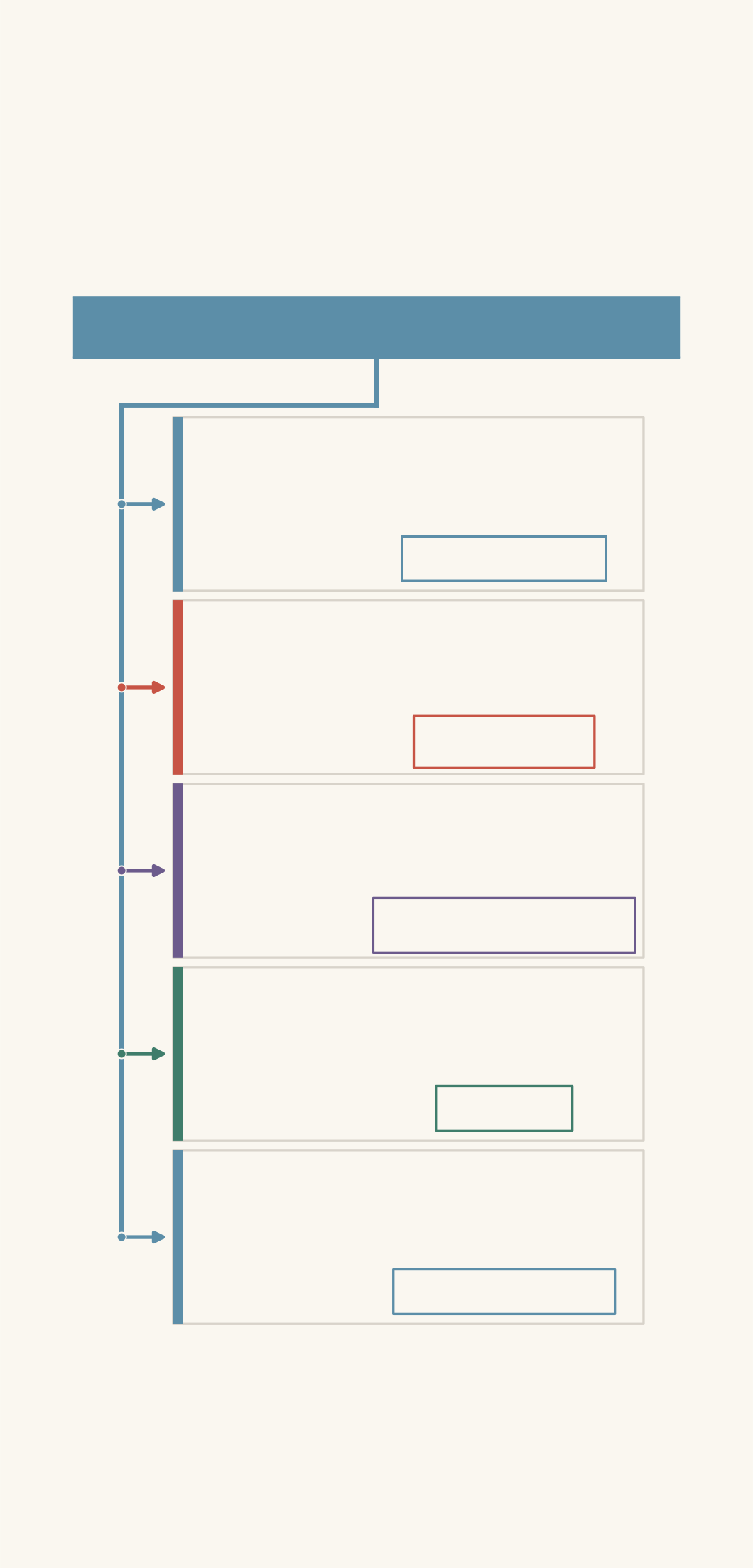
The key is to distinguish an equation that describes motion from a law that explains the interaction causing it. For example, \(a_c=v^2/r\) describes the acceleration required for circular motion. Newton’s second law tells you which forces must combine to produce that acceleration.
The reference below covers the main equation families used in NSW HSC Physics Module 5: Advanced Mechanics. Use the formulas alongside the assumptions stated for each one, rather than treating them as a collection of interchangeable shortcuts.
02Scope and notation
This reference follows the Physics Stage 6 (2017) syllabus, which applies to Year 12 students sitting the HSC in 2026. The replacement 2025 syllabus is being phased in from 2027, with its first HSC examination in 2028.
NSW Education Standards Authority
One clarification about the opening decision table: momentum and impulse are useful mechanics concepts, but they are not part of the Module 5 equation set covered here. The focus is projectile motion, circular motion, rotation and torque, gravitational fields, and orbital motion.
School of Physics HSC Physics Module
Symbols and units you need
| Symbol | Meaning | SI unit |
|---|---|---|
| \(u\) | Initial velocity or speed | \(\text{m s}^{-1}\) |
| \(v\) | Final or instantaneous velocity or speed | \(\text{m s}^{-1}\) |
| \(s,x,y,h\) | Displacement, coordinates, or height | \(\text{m}\) |
| \(a\) | Acceleration | \(\text{m s}^{-2}\) |
| \(t\) | Time | \(\text{s}\) |
| \(m\) | Mass of the moving object | \(\text{kg}\) |
| \(M\) | Mass of the central planet or body | \(\text{kg}\) |
| \(r\) | Radius or distance from a centre | \(\text{m}\) |
| \(G\) | Universal gravitational constant | \(\text{N m}^2\text{ kg}^{-2}\) |
| \(g\) | Gravitational field strength near Earth | \(\text{m s}^{-2}\) or \(\text{N kg}^{-1}\) |
| \(\theta\) | An angle, defined in each context | Degrees or radians |
| \(\omega\) | Angular velocity | \(\text{rad s}^{-1}\) |
| \(T\) | Period of one complete revolution | \(\text{s}\) |
| \(K\) | Kinetic energy | \(\text{J}\) |
| \(U\) | Gravitational potential energy | \(\text{J}\) |
| \(E\) | Total mechanical energy | \(\text{J}\) |
| \(\tau\) | Torque | \(\text{N m}\) |
Use \(g=9.8\text{ m s}^{-2}\) near Earth’s surface unless the question specifies another value. Use \(G=6.67\times10^{-11}\text{ N m}^2\text{ kg}^{-2}\) when calculating gravitational forces and orbits.
Convert quantities to SI units before substituting. In particular, convert kilometres to metres and minutes to seconds.
01Projectile motion: choose an equation for each direction
A basketball, a thrown rock, and a ball rolling off a table all follow projectile motion once they leave their support, provided air resistance is negligible.
The useful observation is that gravity acts vertically. It does not directly accelerate the projectile horizontally.
The constant-acceleration equations
For motion with constant acceleration, use:
\[ v=u+at \]
\[ s=ut+\frac12at^2 \]
\[ v^2=u^2+2as \]
\[ s=\frac{u+v}{2}t \]
These equations describe motion along a single straight axis. In projectile questions, apply them separately to the horizontal and vertical directions.
Choose between them by looking at what you know:
- Use \(v=u+at\) when time is known or when you need velocity after a time.
- Use \(s=ut+\frac12at^2\) when displacement and time are involved.
- Use \(v^2=u^2+2as\) when time is not given and you do not need it.
- Use \(s=\frac{u+v}{2}t\) when initial and final velocities are known under constant acceleration.
The last equation uses the average velocity for constant acceleration. Don’t use it with an arbitrary changing acceleration.
Resolve the launch velocity
Suppose a projectile leaves the launch point at speed \(u\), at an angle \(\theta\) above the horizontal.
Its initial velocity components are:
\[ u_x=u\cos\theta \]
\[ u_y=u\sin\theta \]
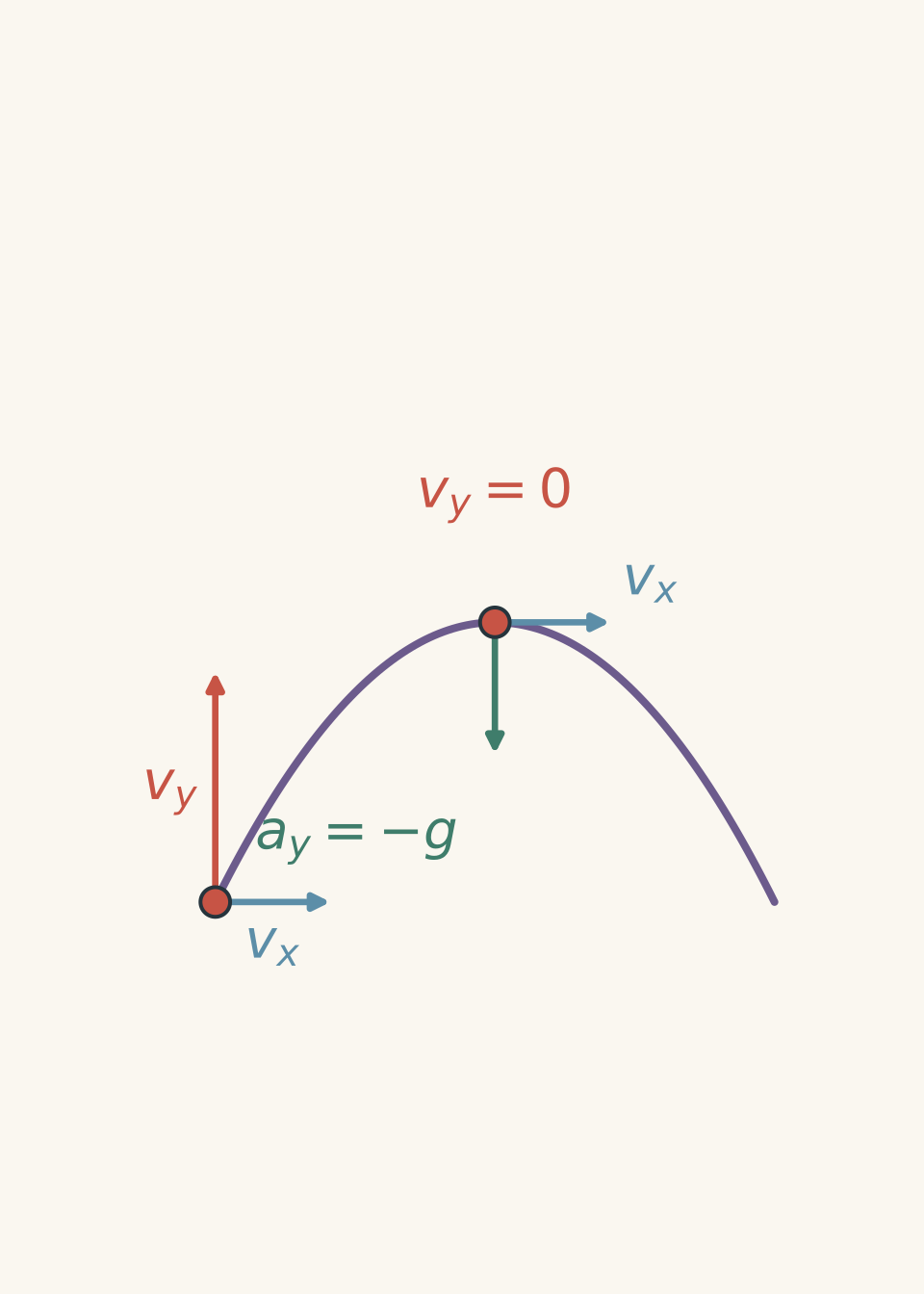
If upward is positive, the horizontal acceleration is zero and the vertical acceleration is \(-g\).
Therefore, the most useful projectile equations are:
\[ x=u\cos\theta\\,t \]
\[ y-y_0=u\sin\theta\\,t-\frac12gt^2 \]
\[ v_x=u\cos\theta \]
\[ v_y=u\sin\theta-gt \]
Here, \(x\) is horizontal displacement, \(y_0\) is the initial vertical coordinate, \(y\) is the later vertical coordinate, and \(v_x\) and \(v_y\) are the instantaneous velocity components.
The horizontal equation is simple because horizontal velocity is constant. The vertical equation includes gravity.
Three useful results, with conditions
At the highest point of the trajectory, the vertical velocity is zero:
\[ v_y=0 \]
That does not mean the projectile stops. Its horizontal velocity remains non-zero.
The maximum height above the launch point is:
\[ H=\frac{u^2\sin^2\theta}{2g} \]
If the projectile lands at its original height, its total flight time is:
\[ t_{\text{flight}}=\frac{2u\sin\theta}{g} \]
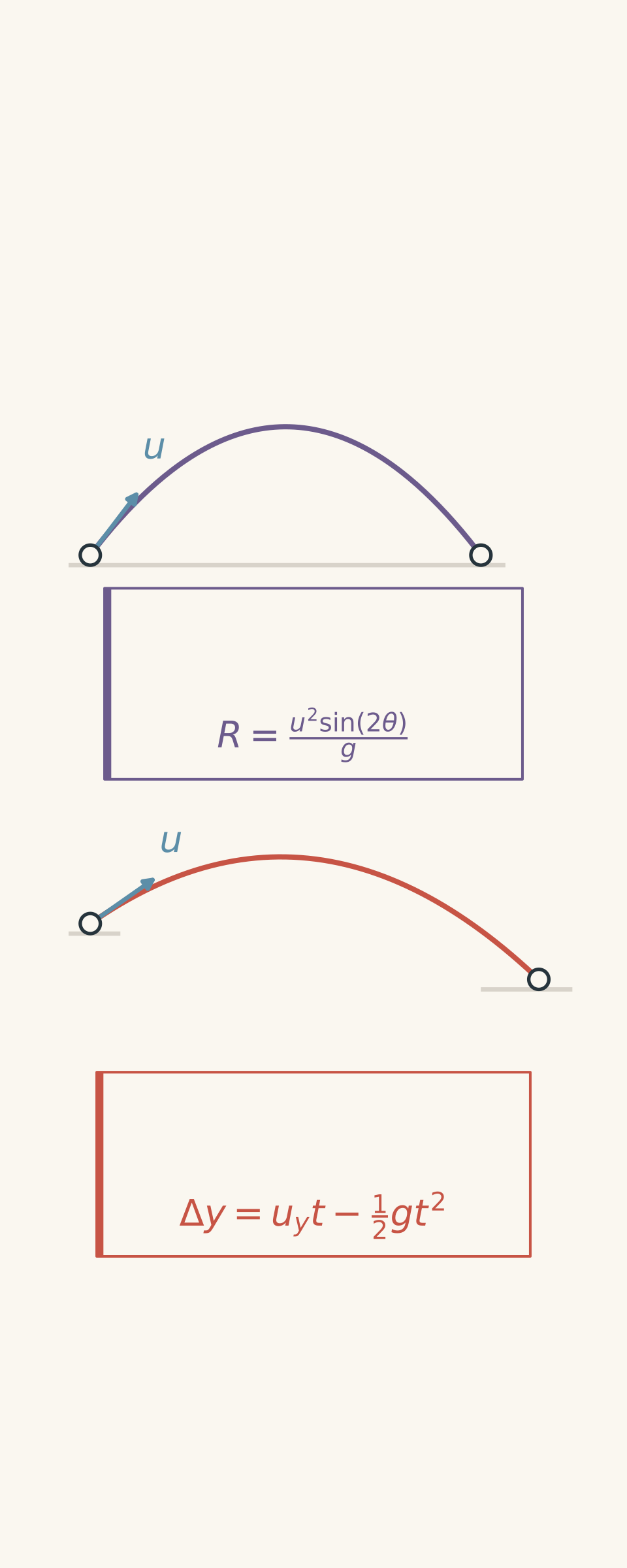
Under that same-height condition, the horizontal range is:
\[ R=\frac{u^2\sin(2\theta)}{g} \]
These three shortcuts assume constant gravitational acceleration, negligible air resistance, and equal launch and landing heights where specified. If a projectile lands on a lower or higher surface, use the vertical displacement equation to find the time first. Then calculate the horizontal displacement.
Worked example: a ball launched at \(30^\circ\)
A ball is launched at \(20\text{ m s}^{-1}\) at \(30^\circ\) above horizontal ground. Neglect air resistance. Find its maximum height, flight time, horizontal range, and speed just before it lands.
Step 1: Resolve the initial velocity into components.
\[ \begin{aligned} u_x&=20\cos30^\circ\\ &=17.32\text{ m s}^{-1}\\[4pt] u_y&=20\sin30^\circ\\ &=10.0\text{ m s}^{-1} \end{aligned} \]
Step 2: Find the maximum height.
At the peak, \(v_y=0\). Use the vertical equation without time:
\[ \begin{aligned} v_y^2&=u_y^2-2gH\\\ 0&=10.0^2-2(9.8)H\\\ H&=\frac{100}{19.6}\\ &=5.10\text{ m} \end{aligned} \]
The ball rises \(5.10\text{ m}\) above its launch point.
Step 3: Find the flight time.
Because the ball lands at its original height, the total flight time is twice the time taken to reach the peak:
\[ \begin{aligned} t_{\text{flight}}&=\frac{2u_y}{g}\\ &=\frac{2(10.0)}{9.8}\\ &=2.04\text{ s} \end{aligned} \]
Step 4: Find the horizontal range.
Horizontal velocity is constant, so:
\[ \begin{aligned} R&=u_xt_{\text{flight}}\\ &=17.32(2.04)\\ &\approx35.4\text{ m} \end{aligned} \]
Step 5: Find the landing speed.
When the ball returns to its original height, its vertical velocity is \(-10.0\text{ m s}^{-1}\). Its horizontal velocity is still \(17.32\text{ m s}^{-1}\).
The speed is the magnitude of the velocity vector:
\[ \begin{aligned} v&=\sqrt{v_x^2+v_y^2}\\ &=\sqrt{17.32^2+(-10.0)^2}\\ &=20.0\text{ m s}^{-1} \end{aligned} \]
The landing speed equals the launch speed because the ball returns to its original height and air resistance is neglected. Its velocity is not the same, though: the vertical component points downwards instead of upwards.
02Circular motion: calculate the required inward acceleration
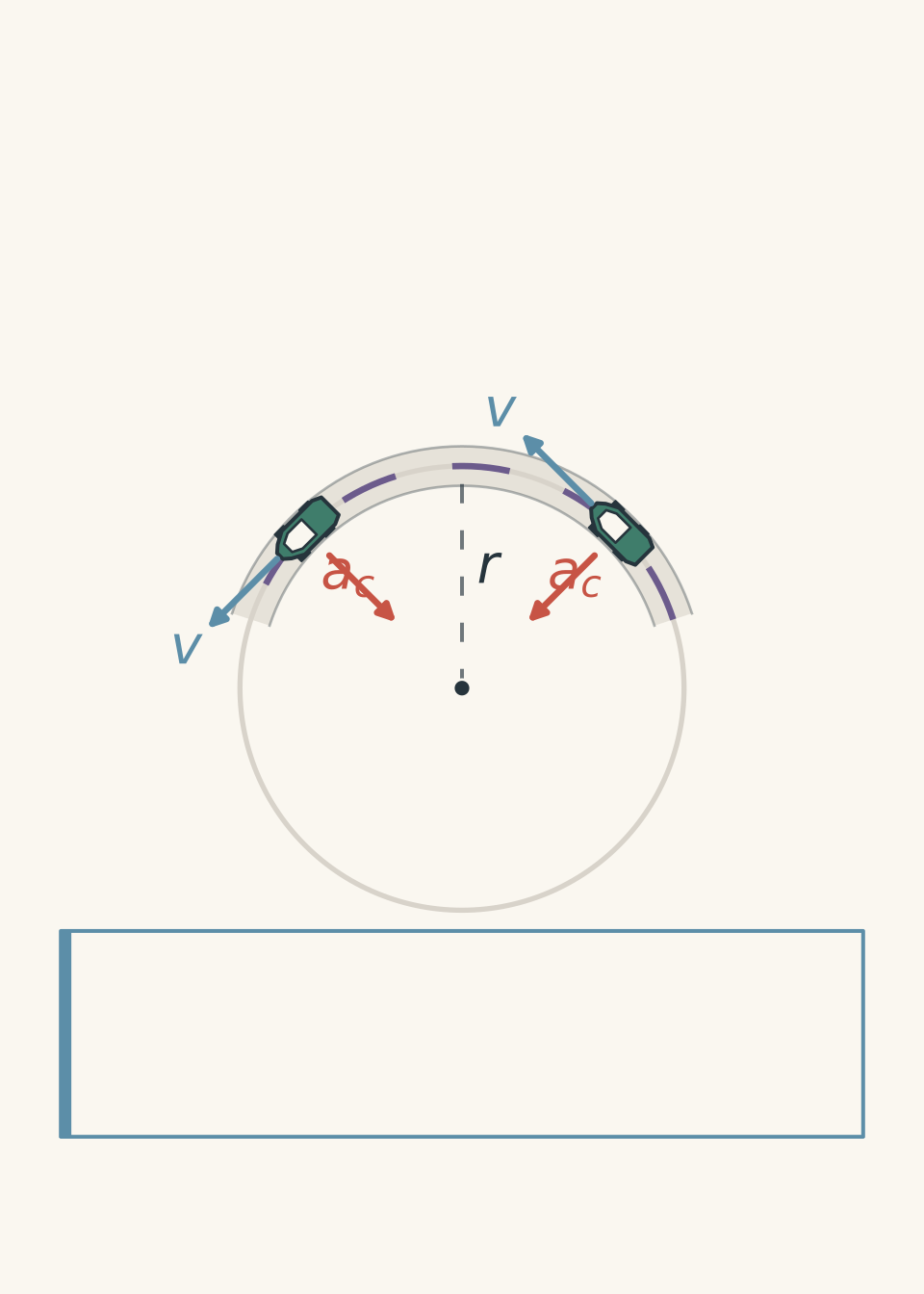
A car can travel around a circular bend at constant speed and still accelerate. That sounds contradictory until you remember that velocity includes direction as well as speed.
In uniform circular motion, speed is constant but velocity changes direction continuously. The resulting acceleration points towards the centre of the circle.
Angular velocity and period
Angular velocity measures how quickly the angular position changes:
\[ \omega=\frac{\Delta\theta}{\Delta t} \]
Here, \(\Delta\theta\) is angular displacement in radians and \(\Delta t\) is elapsed time in seconds. For uniform circular motion, \(\omega\) is constant.
One complete revolution covers \(2\pi\) radians. If \(T\) is the period, the time for one revolution, then:
\[ \omega=\frac{2\pi}{T} \]
The linear speed \(v\) is related to angular velocity by:
\[ v=r\omega \]
Combining these gives:
\[ v=\frac{2\pi r}{T} \]
Use these relationships when a question gives a period, angular velocity, radius, or number of revolutions per second.
Centripetal acceleration and force
The required centripetal acceleration is:
\[ a_c=\frac{v^2}{r}=r\omega^2 \]
The net inward force must therefore satisfy:
\[ \sum F_{\text{inward}}=\frac{mv^2}{r}=mr\omega^2 \]
The word net is important. Centripetal force is not an extra force that you add to a free-body diagram. It is the name for the resultant inward force provided by real forces such as friction, tension, gravity, or the normal force.
For every circular-motion problem:
- Draw the forces acting on the object.
- Identify the direction towards the centre.
- Resolve the forces along that direction.
- Set the net inward force equal to \(mv^2/r\).
Common situations
A car on a flat bend
If friction supplies the entire horizontal inward force,
\[ F_{\text{friction}}=\frac{mv^2}{r} \]
On a level road, the normal force balances the weight, so \(N=mg\). If the maximum static friction is \(F_{\text{friction,max}}=\mu_s mg\), the maximum speed before sliding is:
\[ v_{\max}=\sqrt{\mu_sgr} \]
Here, \(\mu_s\) is the coefficient of static friction. This result assumes friction is the limiting force and the road is level.
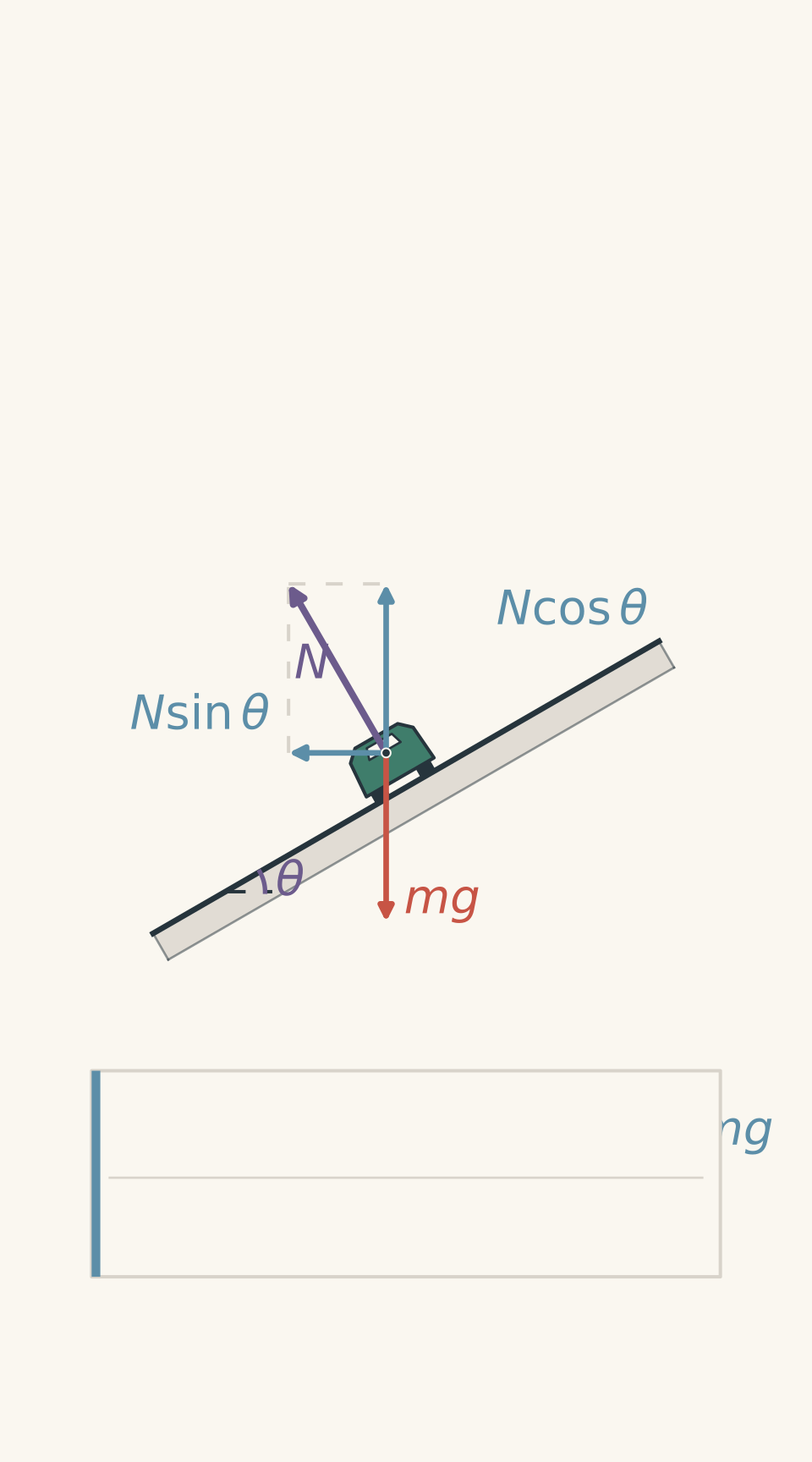
A car on a frictionless banked track
The normal force is tilted towards the centre of the curve. Its vertical component balances the weight, while its horizontal component supplies the centripetal force.
For a bank angle \(\theta\) measured from the horizontal:
\[ N\cos\theta=mg \]
\[ N\sin\theta=\frac{mv^2}{r} \]
Dividing these equations eliminates the normal force:
\[ \tan\theta=\frac{v^2}{rg} \]
Therefore, the speed that requires no friction is:
\[ v=\sqrt{rg\tan\theta} \]
Worked example: a car on a flat bend
A \(1200\text{ kg}\) car travels at \(15\text{ m s}^{-1}\) around a flat bend of radius \(45\text{ m}\). Find the required centripetal force and the minimum coefficient of static friction needed to prevent sliding.
Step 1: Recognise that friction supplies the inward force.
The circular-motion equation is:
\[ F_{\text{friction}}=\frac{mv^2}{r} \]
Step 2: Calculate the required force.
\[ \begin{aligned} F_{\text{friction}}&=\frac{1200(15)^2}{45}\\ &=\frac{270\\,000}{45}\\ &=6000\text{ N} \end{aligned} \]
The road must supply \(6000\text{ N}\) of inward friction.
Step 3: Calculate the normal force.
On a level road, \(N=mg\):
\[ N=1200(9.8)=11\\,760\text{ N} \]
Step 4: Find the minimum coefficient of friction.
At the limiting condition, \(F_{\text{friction,max}}=\mu_sN\).
\[ \begin{aligned} \mu_s&=\frac{6000}{11\\,760}\\ &=0.510 \end{aligned} \]
The minimum coefficient is approximately \(0.51\). A smaller value would not provide enough friction under the stated conditions.
03Work and torque: does a force change speed or cause rotation?
Circular motion also gives you a useful way to distinguish two effects of a force: changing an object’s energy and changing its rotational motion.
Work done by a force
For a constant force acting through a displacement,
\[ W=Fs\cos\phi \]
Here, \(W\) is work done in joules, \(F\) is force in newtons, \(s\) is displacement in metres, and \(\phi\) is the angle between the force and the displacement.
Only the component of force parallel to the displacement does work.
The net work done on an object equals its change in kinetic energy:
\[ W_{\text{net}}=\Delta K =\frac12mv_f^2-\frac12mv_i^2 \]
Here, \(v_i\) and \(v_f\) are initial and final speeds.
In uniform circular motion, the centripetal force points towards the centre while the instantaneous displacement is tangent to the path. They are perpendicular, so the centripetal force does no work. It changes the direction of velocity, not the speed.
A tangential force can do work and change the speed.
Torque: the turning effect of a force
Imagine pushing a door near its hinges, then pushing the same door near its handle. The force can be identical, but the turning effect is different.
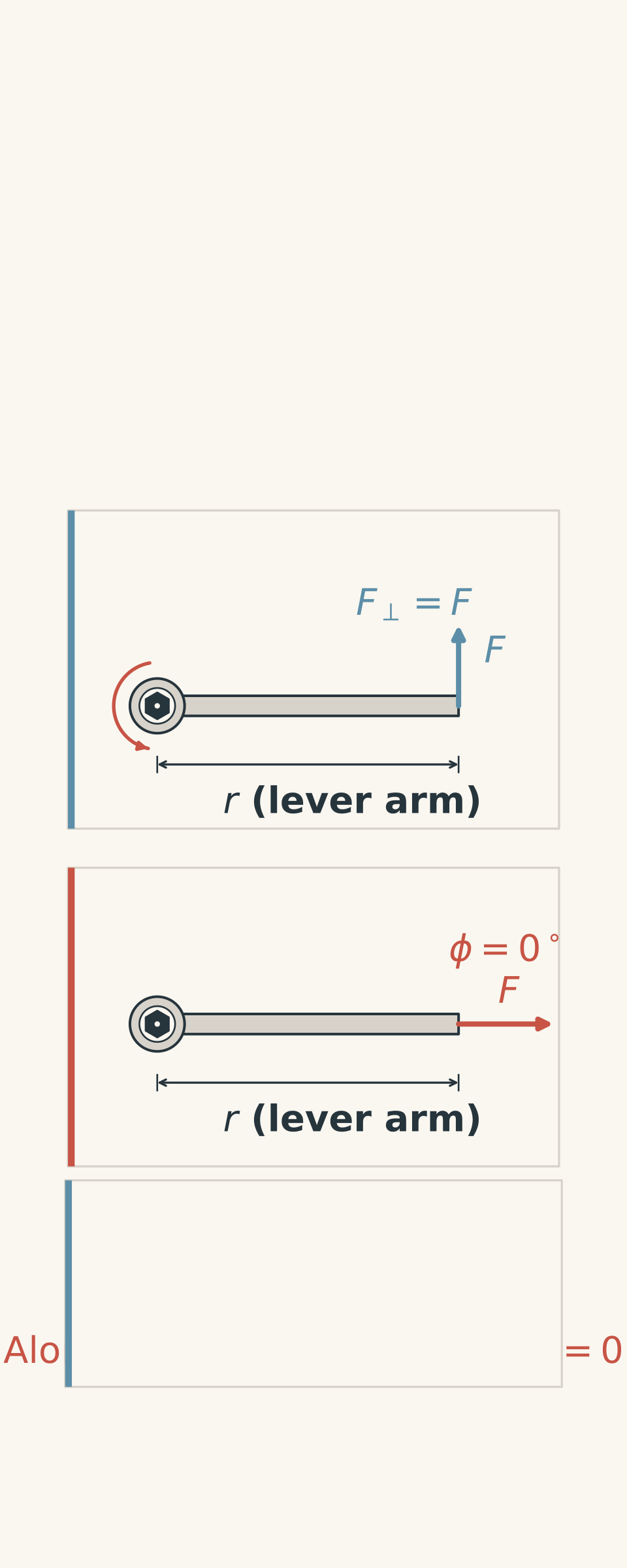
Torque measures that turning effect about a chosen pivot:
\[ \tau=rF\sin\phi \]
Equivalently,
\[ \tau=rF_\perp \]
Here, \(r\) is the distance from the pivot to the point where the force acts, \(F_\perp\) is the component of force perpendicular to the lever arm, and \(\phi\) is the angle between the lever arm and the force.
Torque is measured in newton-metres (\(\text{N m}\)).
- A perpendicular force produces maximum torque for a given force and lever-arm length.
- A force directed along the lever arm produces zero torque.
- A force whose line of action passes through the pivot produces no torque about that pivot.
Do not confuse work and torque. Both involve a force and a distance, but work describes energy transfer, while torque describes a turning effect. Their units have the same dimensions but represent different physical quantities.
04Gravitational fields: use distance from the centre
A satellite does not stop experiencing gravity when it reaches space. Gravity weakens with distance, but it extends far beyond Earth’s surface.
The key decision is whether the question concerns the force between two masses or the gravitational field strength at a location.
Newton’s law of universal gravitation
The magnitude of the gravitational force between two spherical bodies, or bodies that can be modelled as point masses, is:
\[ F_g=\frac{GMm}{r^2} \]
Here, \(M\) and \(m\) are the two masses, \(r\) is the distance between their centres, and \(G\) is the universal gravitational constant.
The force is attractive, so it acts towards the other mass.
Notice the inverse-square relationship. If the centre-to-centre distance doubles, the gravitational force becomes one-quarter as large.
Gravitational field strength
Field strength tells you the gravitational force per unit mass at a location:
\[ g=\frac{F_g}{m} \]
Combining this with Newton’s law gives:
\[ g=\frac{GM}{r^2} \]
The field strength is measured in \(\text{N kg}^{-1}\), which is equivalent to \(\text{m s}^{-2}\).
Near Earth’s surface, where \(g\) is approximately constant, the weight of an object is:
\[ F_{\text{weight}}=mg \]
For a planet of radius \(R_p\), the surface field strength is:
\[ g_{\text{surface}}=\frac{GM}{R_p^2} \]
At altitude \(h\), the distance from the planet’s centre is \(R_p+h\), so:
\[ g(h)=\frac{GM}{(R_p+h)^2} \]
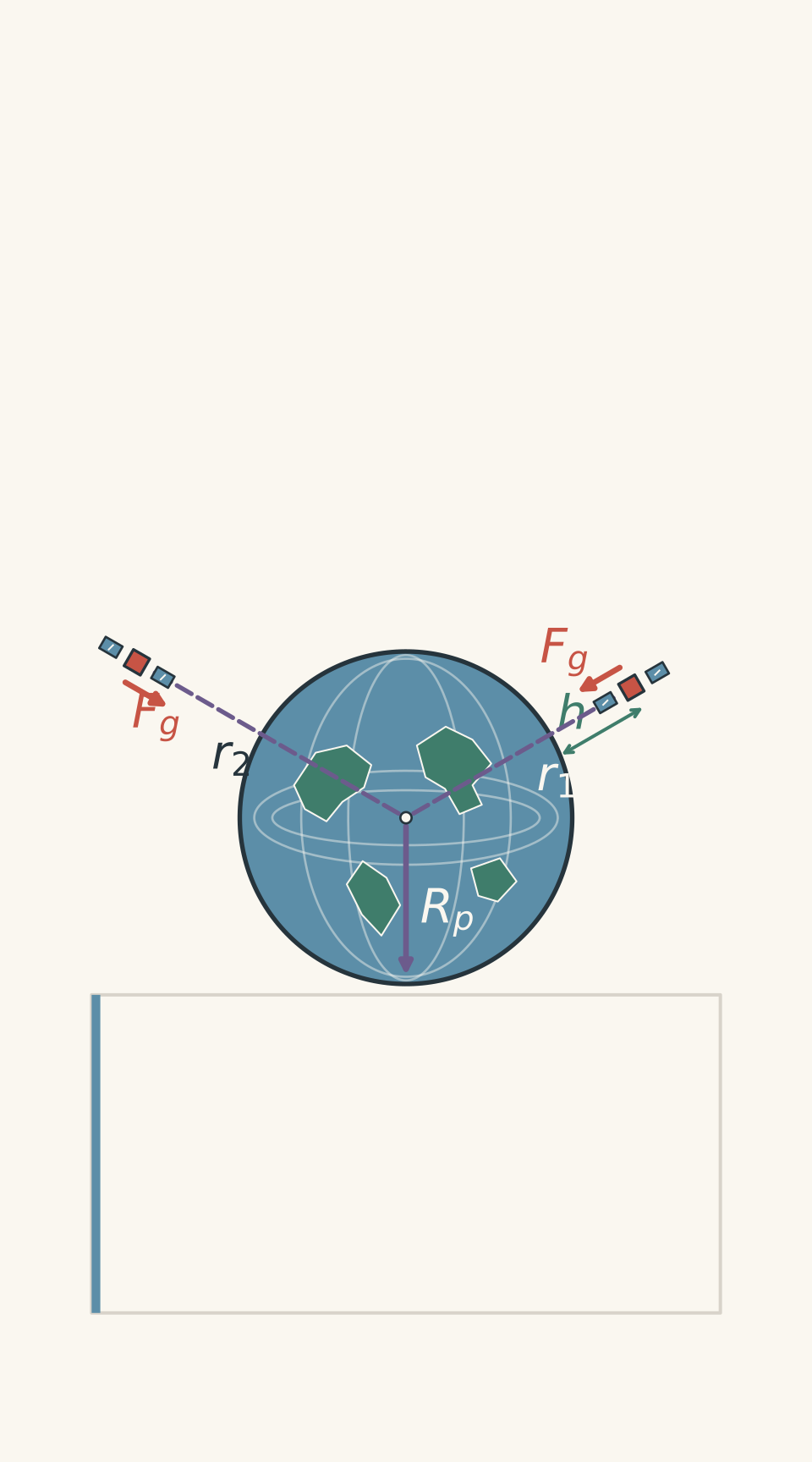
The distinction between \(h\) and \(r\) is crucial. Altitude is measured above the surface. The \(r\) in gravitational equations is measured from the centre.
05Orbital motion: connect gravity to centripetal force
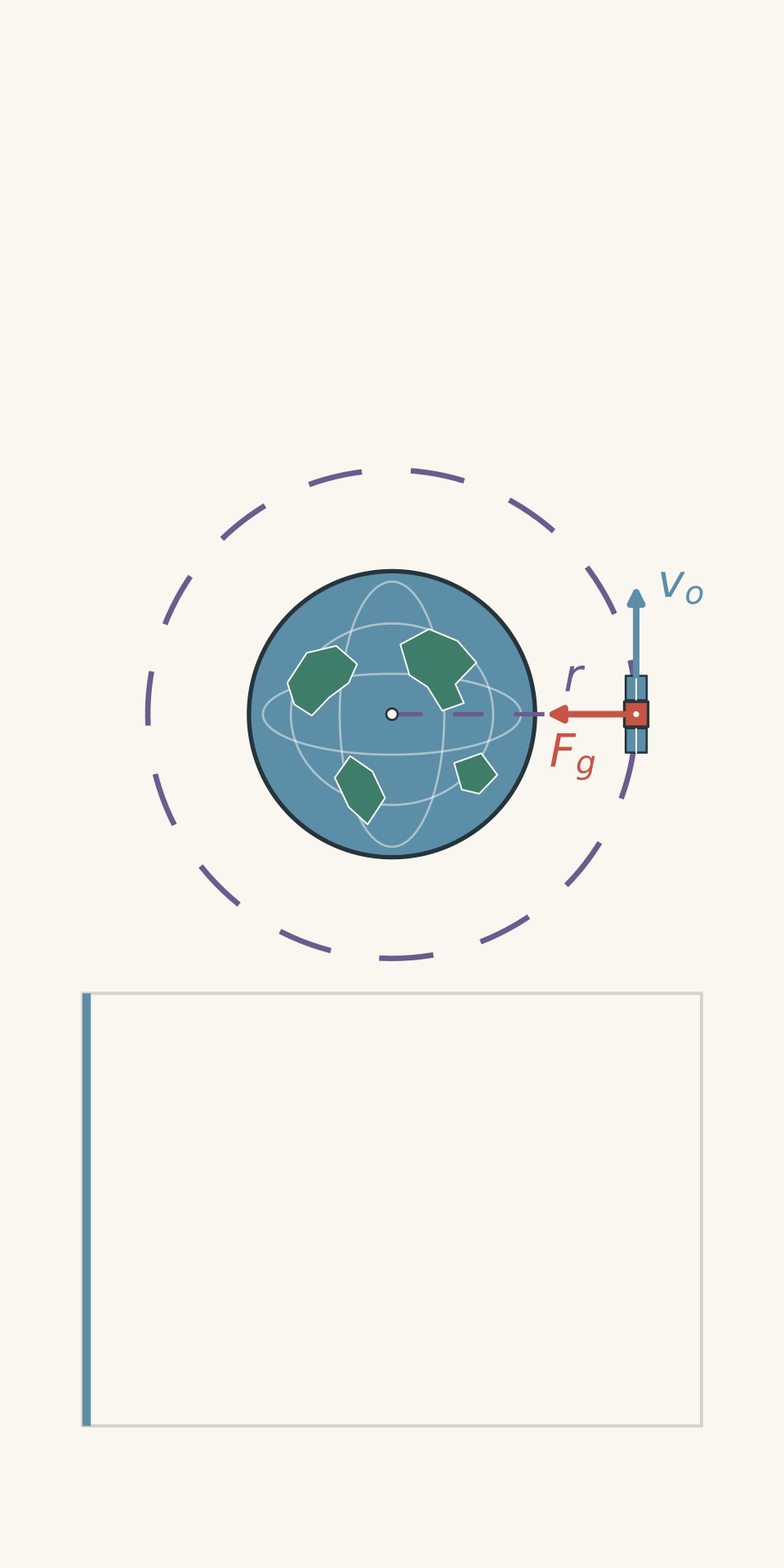
A satellite stays in a circular orbit because gravity continually changes the direction of its velocity. It is falling towards the planet, but its sideways motion means it keeps missing the surface.
For a circular orbit, gravity supplies the entire centripetal force:
\[ \frac{GMm}{r^2}=\frac{mv^2}{r} \]
Cancel the satellite mass \(m\), then rearrange:
\[ v_o=\sqrt{\frac{GM}{r}} \]
This is the orbital speed for a circular orbit. It depends on the central body’s mass and the orbital radius, not the satellite’s mass.
Orbital speed, radius, and period
The distance travelled in one circular revolution is \(2\pi r\). If the period is \(T\), then:
\[ v_o=\frac{2\pi r}{T} \]
Combining this with the circular orbital speed equation gives:
\[ T=2\pi\sqrt{\frac{r^3}{GM}} \]
Rearranging produces Kepler’s third-law relationship:
\[ \frac{r^3}{T^2}=\frac{GM}{4\pi^2} \]
Use these equations when a question gives an orbital radius, period, orbital speed, or the mass of the central body.
The period increases with orbital radius. The circular orbital speed decreases as radius increases. A satellite farther from Earth moves more slowly, but travels around a much larger path, so it takes longer to complete one revolution.
What changes for an elliptical orbit?
Not all orbits are circular. In an elliptical orbit, the distance from the central body changes, and the satellite’s speed changes as well.
Kepler’s laws describe this motion:
- First law: A planet or satellite follows an elliptical orbit, with the central body at one focus.
- Second law: The line joining the orbiting body to the central body sweeps out equal areas in equal times. The body moves faster when closer to the central body and slower when farther away.
- Third law: The square of the orbital period is proportional to the cube of the semi-major axis.
For an elliptical orbit, use the semi-major axis \(a\), not the instantaneous orbital radius \(r\):
\[ \frac{a^3}{T^2}=\frac{GM}{4\pi^2} \]
For a circular orbit, the semi-major axis equals the orbital radius, so \(a=r\).
Geostationary orbits
A geostationary satellite appears fixed above the same point on Earth’s surface. It must orbit in the equatorial plane, move in the same direction as Earth’s rotation, and have a period equal to one sidereal day, approximately \(23\text{ h }56\text{ min}\).
To find its orbital radius, use Kepler’s third law with that period and Earth’s mass. To find its altitude above the surface, subtract Earth’s radius from the calculated orbital radius.
06Gravitational potential energy, orbital energy, and escape velocity
Gravitational potential energy is where a lot of otherwise correct calculations go wrong. Near Earth’s surface, you may have used \(mgh\). That formula is a useful approximation, but it is not the general expression for gravitational potential energy.
Gravitational potential energy
For two masses separated by distance \(r\), taking gravitational potential energy to be zero at infinite separation:
\[ U=-\frac{GMm}{r} \]
The energy is negative because the two masses form a gravitationally bound system. Energy must be supplied to separate them completely, taking the system to infinite separation.
For a change from initial radius \(r_i\) to final radius \(r_f\):
\[ \Delta U=U_f-U_i \]
Therefore,
\[ \Delta U=GMm\left(\frac1{r_i}-\frac1{r_f}\right) \]
If an object moves farther from a planet, its gravitational potential energy increases: it becomes less negative.
The familiar expression
\[ \Delta U\approx mg\Delta h \]
is valid for a small change in height near a planetary surface, where gravitational field strength is approximately constant. Use the radial expression when the distance from the centre changes substantially, such as when a satellite changes orbit.
Energy of a circular orbit
Kinetic energy is:
\[ K=\frac12mv^2 \]
For a circular orbit, \(v^2=GM/r\), so:
\[ K=\frac{GMm}{2r} \]
The total mechanical energy is the sum of kinetic and gravitational potential energy:
\[ E=K+U \]
Substituting the circular-orbit expressions gives:
\[ E=-\frac{GMm}{2r} \]
For an elliptical orbit, the equivalent total-energy relationship uses the semi-major axis:
\[ E=-\frac{GMm}{2a} \]
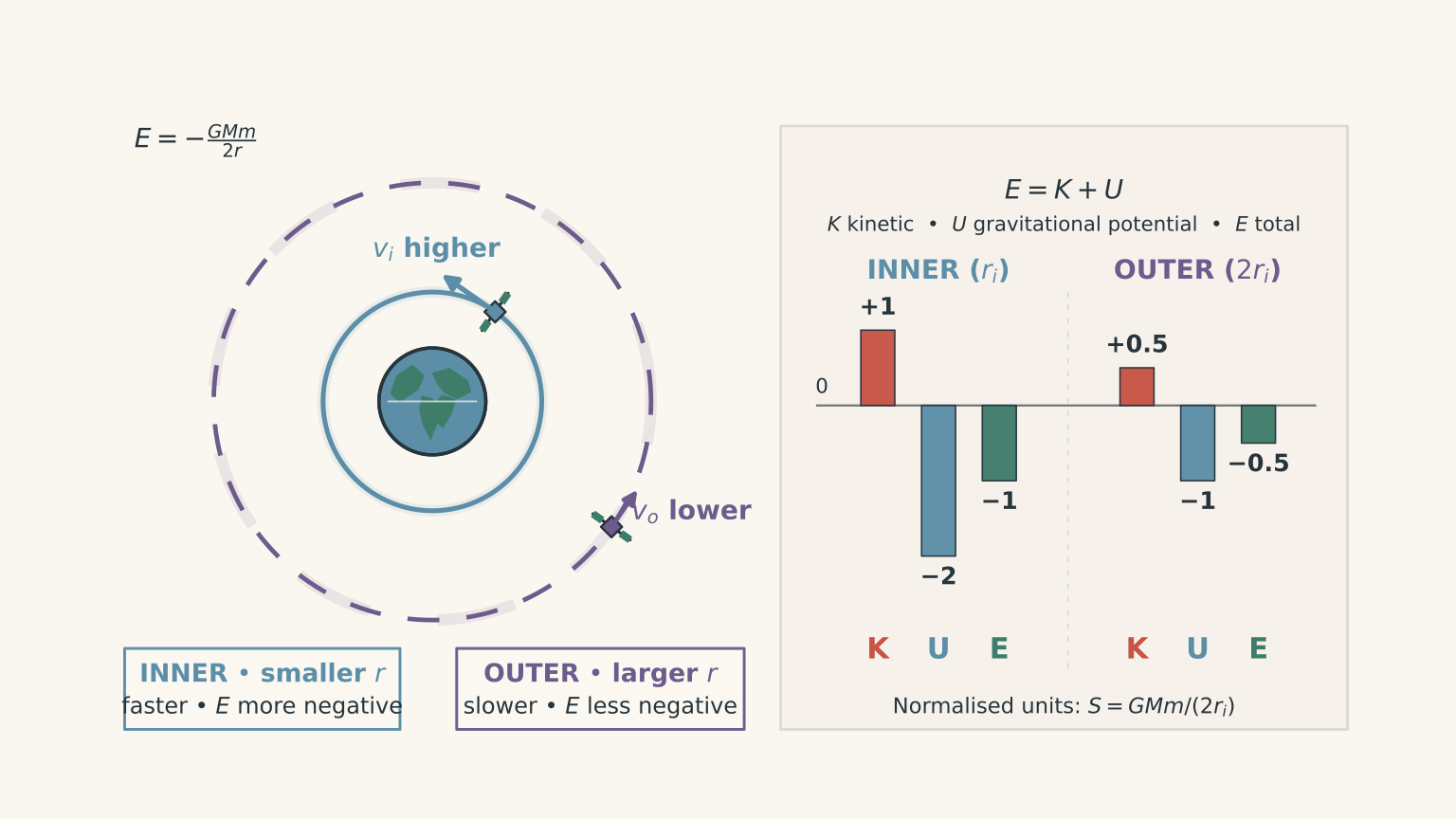
This produces a result that may feel backwards at first: a satellite transferred to a higher circular orbit gains total mechanical energy but has less kinetic energy.
Why? Its gravitational potential energy increases by more than its kinetic energy decreases. The net change in total energy is positive.
For a transfer between two circular orbits, the change in total mechanical energy is:
\[ \Delta E=\frac{GMm}{2} \left(\frac1{r_i}-\frac1{r_f}\right) \]
If \(r_f>r_i\), then \(\Delta E>0\). An ideal orbit-raising manoeuvre must supply this energy.
Escape velocity
Escape velocity is the minimum initial speed required for an object to reach infinite separation with zero remaining speed, assuming no air resistance or further propulsion.
At the escape threshold, total mechanical energy is zero:
\[ \frac12mv_{\text{esc}}^2-\frac{GMm}{r}=0 \]
Rearranging gives:
\[ v_{\text{esc}}=\sqrt{\frac{2GM}{r}} \]
For a circular orbit at the same radius,
\[ v_{\text{esc}}=\sqrt{2}\\,v_o \]
Escape velocity is therefore greater than circular orbital speed. However, an object does not automatically escape just because it is moving quickly: the relevant comparison is with the escape speed at its current radius, under the stated assumptions.
07Worked example: a satellite in low Earth orbit
A satellite orbits Earth in a circular orbit at an altitude of \(400\text{ km}\). Take Earth’s mass as \(5.97\times10^{24}\text{ kg}\), Earth’s radius as \(6.37\times10^6\text{ m}\), and \(G=6.67\times10^{-11}\text{ N m}^2\text{ kg}^{-2}\). Find the orbital speed and period.
Step 1: Calculate the orbital radius from Earth’s centre.
The altitude is not the orbital radius.
\[ \begin{aligned} r&=R_E+h\\ &=6.37\times10^6+4.00\times10^5\\ &=6.77\times10^6\text{ m} \end{aligned} \]
Step 2: Choose the circular orbital speed equation.
Because the orbit is circular and Earth’s mass is known, use:
\[ v_o=\sqrt{\frac{GM}{r}} \]
Substitute:
\[ v_o= \sqrt{\frac{(6.67\times10^{-11}) (5.97\times10^{24})} {6.77\times10^6}} \]
\[ v_o\approx7.67\times10^3\text{ m s}^{-1} \]
The satellite travels at approximately \(7.67\text{ km s}^{-1}\).
Step 3: Calculate the orbital period.
Use the circumference divided by the speed:
\[ \begin{aligned} T&=\frac{2\pi r}{v_o}\\ &=\frac{2\pi(6.77\times10^6)} {7.67\times10^3}\\ &\approx5.55\times10^3\text{ s} \end{aligned} \]
Convert to minutes:
\[ T\approx\frac{5550}{60}=92.5\text{ min} \]
The orbital period is approximately \(92.5\) minutes.
The calculation also illustrates why the orbital radius must include Earth’s radius. Using \(400\text{ km}\) directly would describe a point only \(400\text{ km}\) from Earth’s centre, which is inside the planet.
10Common mistakes to avoid
– Using the same-height projectile shortcut when the projectile lands elsewhere. The familiar range and flight-time formulas depend on equal launch and landing heights. For different heights, solve the vertical equation first.
– Assuming zero vertical velocity means zero velocity. At the highest point, only the vertical component is zero. Horizontal velocity remains constant when air resistance is neglected.
– Adding centripetal force as a new force. Draw the real forces first. Their net inward component must provide the required centripetal force.
– Using altitude instead of orbital radius. Gravitational and orbital equations use distance from the planet’s centre. Add the planet’s radius to the altitude.
– Confusing \(G\) and \(g\). \(G\) is the universal gravitational constant. \(g\) is the local gravitational field strength, which depends on the central body’s mass and your distance from its centre.
– Treating \(mgh\) as exact at every altitude. It assumes a nearly constant gravitational field. For large changes in radius, use \(U=-GMm/r\).
– Assuming a higher orbit means a higher orbital speed. A circular satellite farther from the central body moves more slowly, has a longer period, and has greater total mechanical energy.
– Using \(v=2\pi r/T\) for an elliptical orbit as though \(r\) were constant. That relationship assumes a circular path with constant radius and speed. For an elliptical orbit, use Kepler’s third law with the semi-major axis.
– Using the wrong angle in a torque calculation. The angle in \(\tau=rF\sin\phi\) is between the force and the lever arm, not automatically the angle to the horizontal.
11Questions and solutions
Question 1
A student applies a \(40\text{ N}\) force to a spanner \(0.30\text{ m}\) long. The force acts at \(60^\circ\) to the spanner. Calculate the magnitude of the torque about the nut.
Solution 1
The torque is \(10.4\text{ N m}\). Only the component of force perpendicular to the spanner produces a turning effect.
Use:
\[ \tau=rF\sin\phi \]
Substitute the given values:
\[ \begin{aligned} \tau&=0.30(40)\sin60^\circ\\ &=12(0.866)\\ &=10.4\text{ N m} \end{aligned} \]
A common mistake is to calculate \(rF\) without resolving the force. That would give the maximum possible torque, which occurs only when the force is perpendicular to the spanner.
Question 2
A ball is launched from a cliff \(15\text{ m}\) above level ground at \(18\text{ m s}^{-1}\), at \(35^\circ\) above the horizontal. Neglect air resistance and take \(g=9.8\text{ m s}^{-2}\).
Calculate:
(a) the time until the ball hits the ground
(b) its horizontal distance from the base of the cliff
(c) its impact speed and direction.
Solution 2
The ball takes approximately \(3.10\text{ s}\) to land, travels \(45.6\text{ m}\) horizontally, and hits the ground at approximately \(24.9\text{ m s}^{-1}\), directed \(53.6^\circ\) below the horizontal.
Step 1: Resolve the initial velocity.
\[ \begin{aligned} u_x&=18\cos35^\circ\\ &=14.74\text{ m s}^{-1}\\\ u_y&=18\sin35^\circ\\ &=10.32\text{ m s}^{-1} \end{aligned} \]
Step 2: Find the flight time using vertical motion.
Take upward as positive. The final vertical displacement is \(-15\text{ m}\).
\[ -15=10.32t-4.9t^2 \]
Rearrange:
\[ 4.9t^2-10.32t-15=0 \]
Using the quadratic formula:
\[ t=\frac{10.32\pm \sqrt{10.32^2+4(4.9)(15)}}{9.8} \]
The two roots are approximately \(3.10\text{ s}\) and \(-0.99\text{ s}\). Reject the negative time because it describes a mathematical point before launch.
Therefore,
\[ t=3.10\text{ s} \]
Step 3: Calculate the horizontal distance.
Horizontal velocity is constant:
\[ \begin{aligned} x&=u_xt\\ &=14.74(3.10)\\ &\approx45.6\text{ m} \end{aligned} \]
Step 4: Calculate the impact velocity.
The horizontal component remains \(14.74\text{ m s}^{-1}\). The vertical component is:
\[ \begin{aligned} v_y&=u_y-gt\\ &=10.32-9.8(3.10)\\ &\approx-20.0\text{ m s}^{-1} \end{aligned} \]
The negative sign indicates downward motion.
Step 5: Find the impact speed and angle.
\[ \begin{aligned} v&=\sqrt{v_x^2+v_y^2}\\ &=\sqrt{14.74^2+(-20.0)^2}\\ &\approx24.9\text{ m s}^{-1} \end{aligned} \]
The angle below horizontal is:
\[ \begin{aligned} \phi&=\tan^{-1}\left(\frac{|v_y|}{v_x}\right)\\ &=\tan^{-1}\left(\frac{20.0}{14.74}\right)\\ &\approx53.6^\circ \end{aligned} \]
The equal-height range formula would have been inappropriate here because the ball lands \(15\text{ m}\) below its launch point. The general vertical equation accounts for that height difference.
Question 3
A car travels around a banked track of radius \(100\text{ m}\). The track is inclined at \(20^\circ\) to the horizontal.
(a) Calculate the speed at which the car can negotiate the bend without friction.
(b) If the car travels at \(15\text{ m s}^{-1}\), explain which way friction must act to prevent it sliding on the bank.
Assume the car remains in contact with the road and static friction is sufficient to prevent slipping.
Solution 3
(a) The frictionless design speed is approximately \(18.9\text{ m s}^{-1}\).
(b) At \(15\text{ m s}^{-1}\), friction acts up the bank, towards the outer edge, to oppose the car’s tendency to slide down the slope.
Step 1: Resolve the normal force for the frictionless case.
Let \(N\) be the normal force. Its vertical component balances the weight:
\[ N\cos20^\circ=mg \]
Its horizontal component supplies the centripetal force:
\[ N\sin20^\circ=\frac{mv^2}{r} \]
Step 2: Eliminate the normal force and mass.
Divide the horizontal equation by the vertical equation:
\[ \tan20^\circ=\frac{v^2}{rg} \]
Rearrange:
\[ \begin{aligned} v&=\sqrt{rg\tan20^\circ}\\ &=\sqrt{100(9.8)\tan20^\circ}\\ &\approx18.9\text{ m s}^{-1} \end{aligned} \]
Step 3: Determine the direction of friction at the lower speed.
The actual speed, \(15\text{ m s}^{-1}\), is less than the frictionless design speed. Without friction, the normal force would provide more inward force than is required for that slower motion.
The car would tend to slide down the bank, towards the centre of the curve. Static friction therefore acts up the slope, towards the outer edge. Its outward component reduces the net inward force to the value required by the car’s actual speed.
The tempting mistake is to assume that friction must always point towards the centre because circular motion requires inward force. Friction opposes the tendency to slip relative to the road; its direction depends on the situation.
Question 4
A \(500\text{ kg}\) satellite is transferred from a circular orbit of radius \(7.0\times10^6\text{ m}\) to a circular orbit of radius \(1.4\times10^7\text{ m}\) around Earth.
Take Earth’s mass as \(5.97\times10^{24}\text{ kg}\), and use \(G=6.67\times10^{-11}\text{ N m}^2\text{ kg}^{-2}\).
Calculate:
(a) the change in gravitational potential energy
(b) the change in kinetic energy
(c) the change in total mechanical energy.
Assume the satellite starts and finishes in circular orbits and neglect energy losses.
Solution 4
The gravitational potential energy increases by approximately \(1.42\times10^{10}\text{ J}\), the kinetic energy decreases by approximately \(7.11\times10^9\text{ J}\), and the total mechanical energy increases by approximately \(7.11\times10^9\text{ J}\).
Step 1: Calculate the change in gravitational potential energy.
Use:
\[ \Delta U=GMm\left(\frac1{r_i}-\frac1{r_f}\right) \]
Substituting:
\[ \begin{aligned} \Delta U={}&(6.67\times10^{-11})\\ &\times(5.97\times10^{24})(500)\\ &\times\left(\frac1{7.0\times10^6} -\frac1{1.4\times10^7}\right) \end{aligned} \]
Therefore,
\[ \Delta U\approx+1.42\times10^{10}\text{ J} \]
The positive sign means the potential energy increases as the satellite moves farther from Earth.
Step 2: Calculate the change in kinetic energy.
For a circular orbit:
\[ K=\frac{GMm}{2r} \]
The initial kinetic energy is:
\[ K_i=\frac{GMm}{2r_i} \approx1.42\times10^{10}\text{ J} \]
The final kinetic energy is:
\[ K_f=\frac{GMm}{2r_f} \approx7.11\times10^9\text{ J} \]
Hence,
\[ \begin{aligned} \Delta K&=K_f-K_i\\ &=7.11\times10^9-1.42\times10^{10}\\ &\approx-7.11\times10^9\text{ J} \end{aligned} \]
The negative sign means the satellite’s kinetic energy decreases.
Step 3: Calculate the change in total mechanical energy.
Since \(E=K+U\),
\[ \begin{aligned} \Delta E&=\Delta K+\Delta U\\ &=-7.11\times10^9+1.42\times10^{10}\\ &\approx+7.11\times10^9\text{ J} \end{aligned} \]
The satellite needs a net energy input of approximately \(7.11\times10^9\text{ J}\) to move between these circular orbits under the ideal assumptions.
The key is that an increase in potential energy does not imply an increase in kinetic energy. In a circular orbit, moving farther from Earth reduces orbital speed. The increase in potential energy is twice the magnitude of the kinetic-energy decrease, leaving a positive change in total energy.
Question 5
A satellite of mass \(m\) initially travels in a circular orbit of radius \(r\) around a planet of mass \(M\). Its initial orbital speed is \(v_c=\sqrt{GM/r}\).
The satellite receives an instantaneous tangential boost, increasing its speed to
\[ v'=\sqrt{\frac32}\\,v_c \]
Assume the satellite is then left to move under gravity alone, with no air resistance or further propulsion.
Determine:
(a) whether its new orbit is circular, elliptical, or unbound
(b) the semi-major axis of the new orbit
(c) the apoapsis radius, the greatest distance from the planet
(d) the new orbital period relative to the original period
(e) the changes in kinetic energy, gravitational potential energy, and total mechanical energy at the instant of the boost.
Explain why the increase in speed does not mean the satellite must have a shorter orbital period.
Solution 5
The satellite enters a bound elliptical orbit with semi-major axis \(2r\), apoapsis radius \(3r\), and a period \(2\sqrt{2}\) times its original period. Immediately after the boost, its kinetic energy and total mechanical energy increase, while its gravitational potential energy remains unchanged.
Step 1: Determine whether the orbit is bound.
The new speed squared is:
\[ v'^2=\frac32\frac{GM}{r} \]
The total mechanical energy immediately after the boost is:
\[ E'=\frac12mv'^2-\frac{GMm}{r} \]
Substitute the new speed:
\[ \begin{aligned} E'&=\frac12m\left(\frac32\frac{GM}{r}\right) -\frac{GMm}{r}\\ &=\frac34\frac{GMm}{r} -\frac{GMm}{r}\\ &=-\frac{GMm}{4r} \end{aligned} \]
The total energy is negative. With gravitational potential energy defined as zero at infinite separation, this means the satellite remains gravitationally bound.
It does not escape, even though its speed has increased. Escape depends on the total energy, not merely on whether the speed is greater than the original circular speed.
Step 2: Find the semi-major axis.
For a bound elliptical orbit,
\[ E'=-\frac{GMm}{2a} \]
Equate this to the energy found above:
\[ -\frac{GMm}{2a}=-\frac{GMm}{4r} \]
Cancel the common factors and rearrange:
\[ a=2r \]
The new orbit is elliptical, with semi-major axis \(2r\).
Why not circular? At the instant of the boost, the satellite’s distance from the planet is still \(r\). Its speed is now greater than the circular speed required at that radius. Gravity cannot provide the inward acceleration needed to maintain a circular path at the new speed, so the satellite begins moving away from the planet. The boost point is the periapsis, the closest point of the new orbit.
Step 3: Find the apoapsis radius.
For an ellipse, the periapsis and apoapsis distances satisfy:
\[ r_p+r_a=2a \]
Here, \(r_p=r\) and \(a=2r\). Therefore,
\[ \begin{aligned} r_a&=2a-r_p\\ &=2(2r)-r\\ &=3r \end{aligned} \]
The satellite reaches a maximum distance of \(3r\) from the planet’s centre.
Step 4: Find the new orbital period.
The original circular period is:
\[ T_c=2\pi\sqrt{\frac{r^3}{GM}} \]
For the new elliptical orbit, use the semi-major axis \(a=2r\):
\[ T'=2\pi\sqrt{\frac{(2r)^3}{GM}} \]
Simplifying:
\[ \begin{aligned} T'&=2\pi\sqrt{\frac{8r^3}{GM}}\\ &=2\sqrt2\\,T_c \end{aligned} \]
The new period is approximately \(2.83\) times the original period.
This is the important distinction: the satellite moves faster immediately after the boost, but it is no longer moving in a circle. Its distance from the planet changes, and its speed varies throughout the orbit. The circular formula \(v=2\pi r/T\) cannot be applied using the original radius as though the new orbit had a constant radius.
Step 5: Calculate the energy changes at the instant of the boost.
The radius has not changed yet, so gravitational potential energy is unchanged:
\[ \Delta U=0 \]
The initial kinetic energy was:
\[ K_i=\frac12mv_c^2=\frac{GMm}{2r} \]
The new kinetic energy is:
\[ \begin{aligned} K_f&=\frac12mv'^2\\ &=\frac12m\left(\frac32\frac{GM}{r}\right)\\ &=\frac{3GMm}{4r} \end{aligned} \]
Therefore,
\[ \begin{aligned} \Delta K&=K_f-K_i\\ &=\frac{3GMm}{4r}-\frac{GMm}{2r}\\ &=\frac{GMm}{4r} \end{aligned} \]
Because the potential energy has not changed at that instant,
\[ \Delta E=\Delta K+\Delta U =\frac{GMm}{4r} \]
Both the kinetic energy and total mechanical energy increase by \(GMm/(4r)\), while gravitational potential energy stays constant at the instant of the boost.
As the satellite subsequently moves outward, its potential energy increases and its kinetic energy decreases. The total energy remains constant during that later motion because gravity is the only force doing work.
The result brings the main ideas of Module 5 together: use forces to determine the motion, use orbital relationships to describe the path, and use energy to decide whether the satellite remains bound and how its orbit changes.
The next useful step is to practise moving between these methods without being prompted. Given an orbital radius, for example, you should be able to find the speed from gravity, the period from Kepler’s law, and the energy from the circular-orbit relationship, then check that all three results describe the same physical situation.