
How to Correct Working Clearly in an HSC Exam
Learn how to correct mistakes, cross out unwanted working, and continue answers clearly in your NSW HSC exams. Includes practical examples and guidance on using additional writing booklets.
If you make a mistake halfway through an HSC calculation, change your mind about an explanation, or run out of space, you don’t need to rewrite your entire answer. You need to make it obvious which working is your final attempt and where the marker should continue reading.
The safest approach is simple: cross out unwanted working with a single clear line, leave your corrected answer legible, and label any continuation so that the order of your response is unmistakable.
This isn’t about making your exam paper look beautiful. It’s about making sure the reasoning you’ve done can actually be followed.
01What should you do when you make a mistake?
Imagine you’re answering a Physics question worth four marks. You’ve calculated the acceleration of a moving object, but halfway through your working, you realise you’ve used the wrong velocity.
You have two options:
- Try to squeeze corrections between your original calculations.
- Cross out the incorrect attempt clearly and write the corrected working underneath.
The second option is usually much easier to read.
NESA’s HSC exam preparation advice specifically tells students to cross out mistakes so markers know not to mark them. It also emphasises clear handwriting and using black pen.
The aim is to distinguish between working you’ve abandoned and working you’re asking to be assessed.
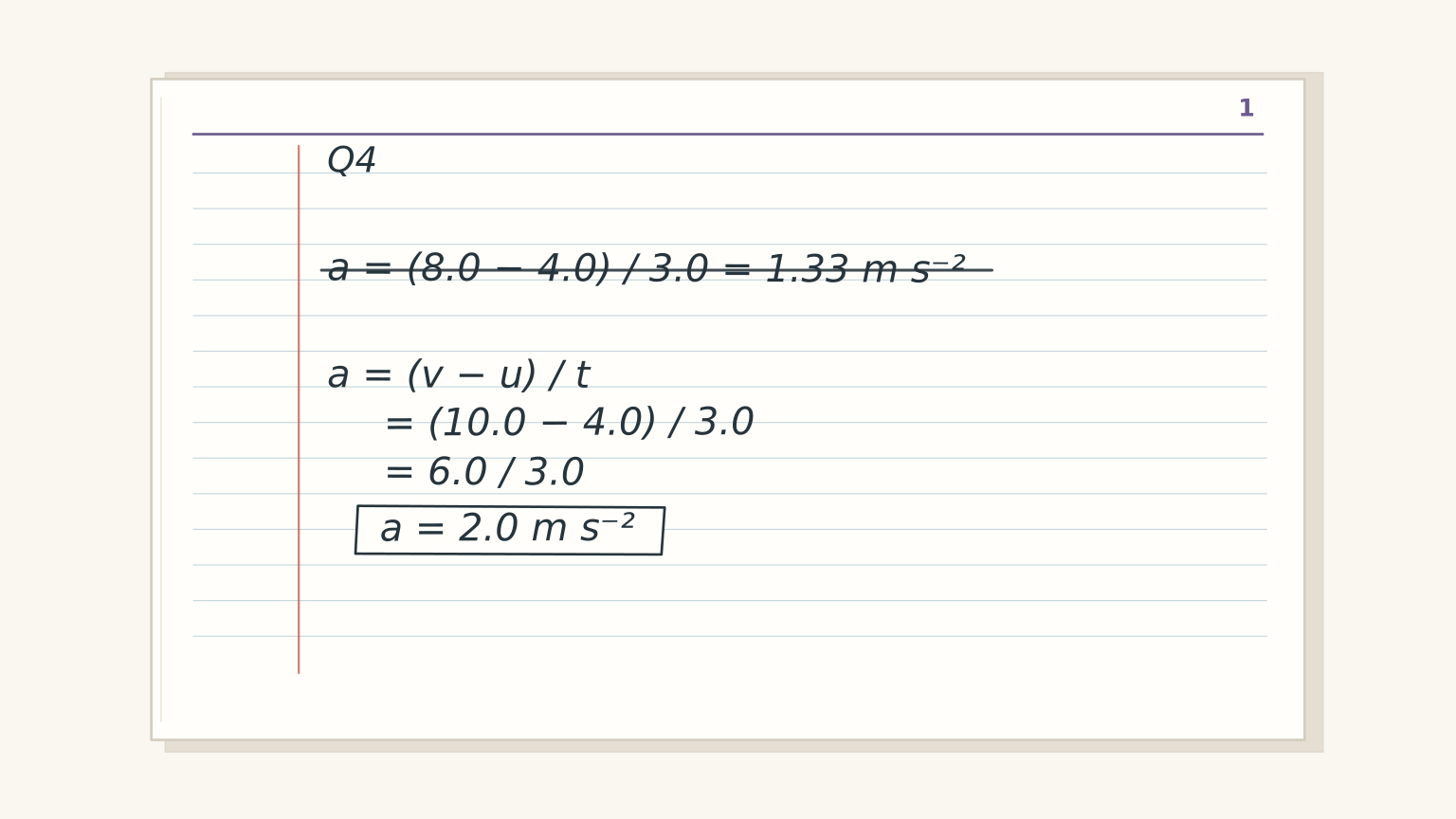
Due to technical limitations, this figure may display incorrectly or contain inaccuracies. Please check key details against your course materials.
01How to cross out incorrect working
Use a single horizontal line through the incorrect sentence, calculation, or diagram. The original attempt should remain visible enough to understand, but it should no longer look like your intended answer.
For example, suppose you need to calculate the acceleration of a car travelling at 20 m/s, which slows to 8 m/s over 4 seconds.
You initially write:
\[ a=\frac{20-8}{4}=3\text{ m/s}^2 \]
Then you realise you’ve calculated the magnitude of the deceleration but haven’t followed the stated positive direction of motion.
If the initial direction is defined as positive, the correct calculation is:
\[ a=\frac{8-20}{4} =-3\text{ m/s}^2 \]
A clear correction would look like this:
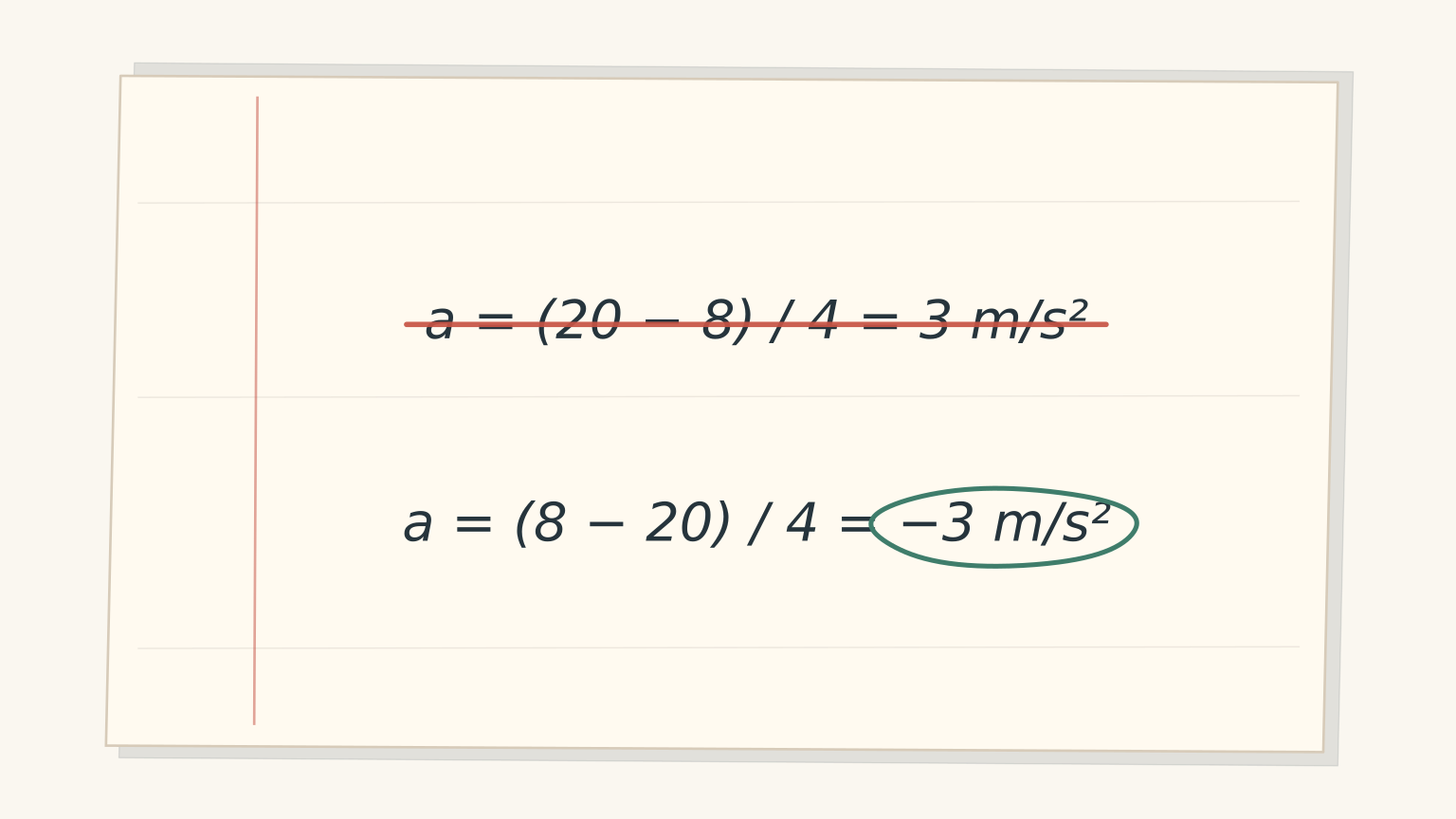
Due to technical limitations, this figure may display incorrectly or contain inaccuracies. Please check key details against your course materials.
The important part isn’t the particular crossing-out technique. It’s that the marker can distinguish the abandoned attempt from the corrected one.
What if you only made a small mistake?
You don’t need to cross out an entire page because you made one arithmetic error.
Suppose you wrote:
\[ v=12\times 5=50\text{ m/s} \]
but notice that \(12\times5=60\).
Cross out the incorrect result and write the corrected value clearly:
\[ v=12\times5=\cancel{50}=60\text{ m/s} \]
In an actual handwritten exam, simply draw a line through the incorrect value and write the replacement beside or underneath it. Don’t rely on mathematical cancellation notation if it could make your intention unclear.
A useful rule is:
- One incorrect number: cross out that number and replace it.
- One incorrect line of working: cross out that line and rewrite it.
- An abandoned method: cross out the abandoned section and start the replacement below it.
- An answer you’ve completely changed: make the original attempt unmistakably cancelled before presenting the new answer.
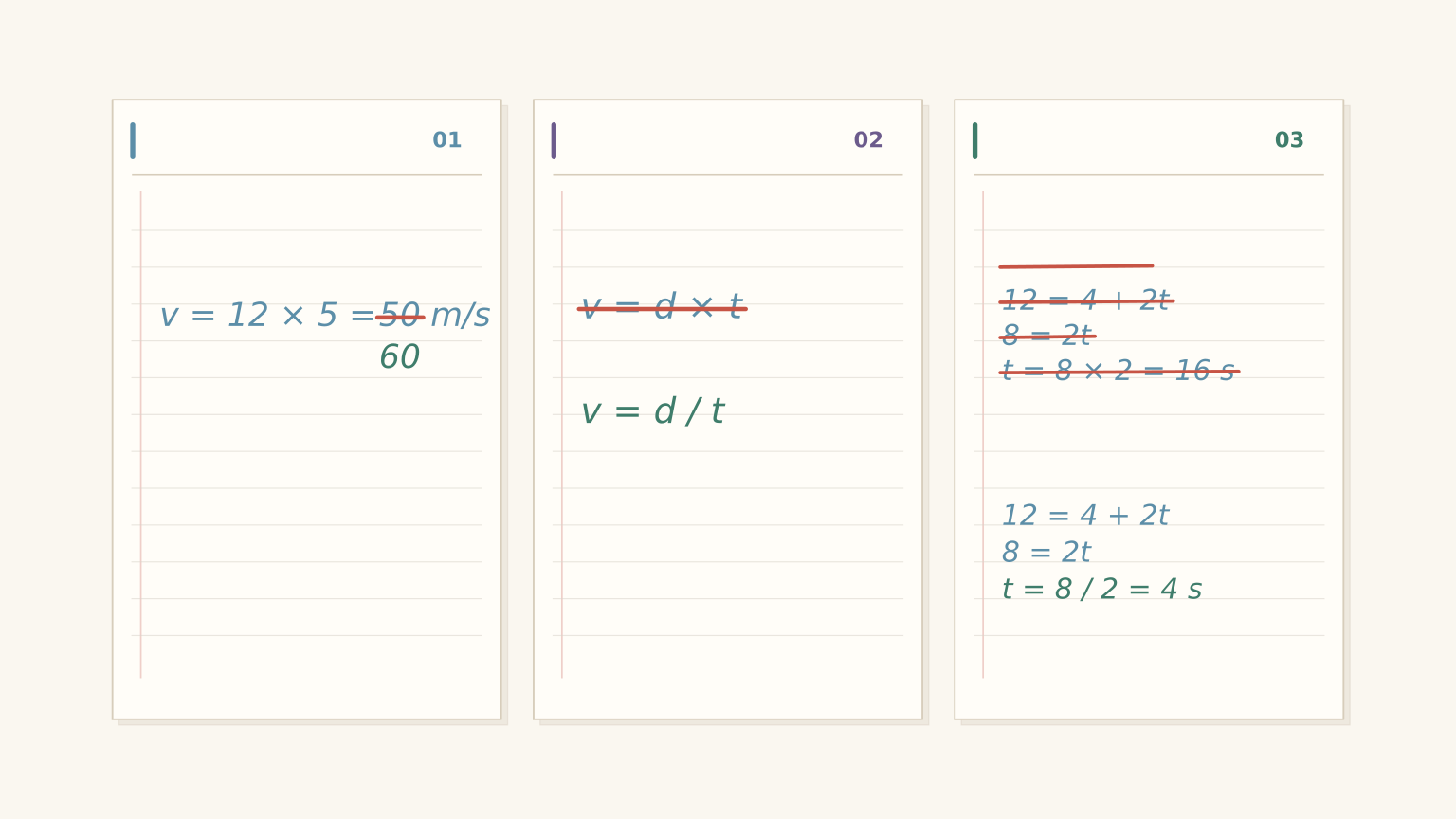
Due to technical limitations, this figure may display incorrectly or contain inaccuracies. Please check key details against your course materials.
Should you scribble out the whole answer?
No. Avoid filling an entire section with heavy scribbling.
A dense black patch makes it difficult to distinguish the abandoned working from the answer you want assessed. It also wastes time.
One clear line is generally enough. You don’t need to explain why you crossed something out, and you shouldn’t waste time writing apologies or lengthy notes about your mistake.
02How to correct a written explanation
Corrections aren’t just for calculations.
In Chemistry, Physics, and Mathematics, you might start an explanation with the wrong physical principle, use an inaccurate term, or realise that your first sentence doesn’t answer the question.
For example, consider this Chemistry explanation:
“The reaction rate increases because the particles become larger.”
You realise that the question is about increasing temperature, and you need to explain why the reaction rate increases.
A clearer corrected response would be:
The reaction rate increases because the particles become larger.
Increasing the temperature increases the average kinetic energy of the reacting particles. Consequently, a greater proportion of collisions have energy equal to or greater than the activation energy, increasing the frequency of successful collisions.
The corrected response does more than replace an inaccurate statement. It explains the causal relationship.
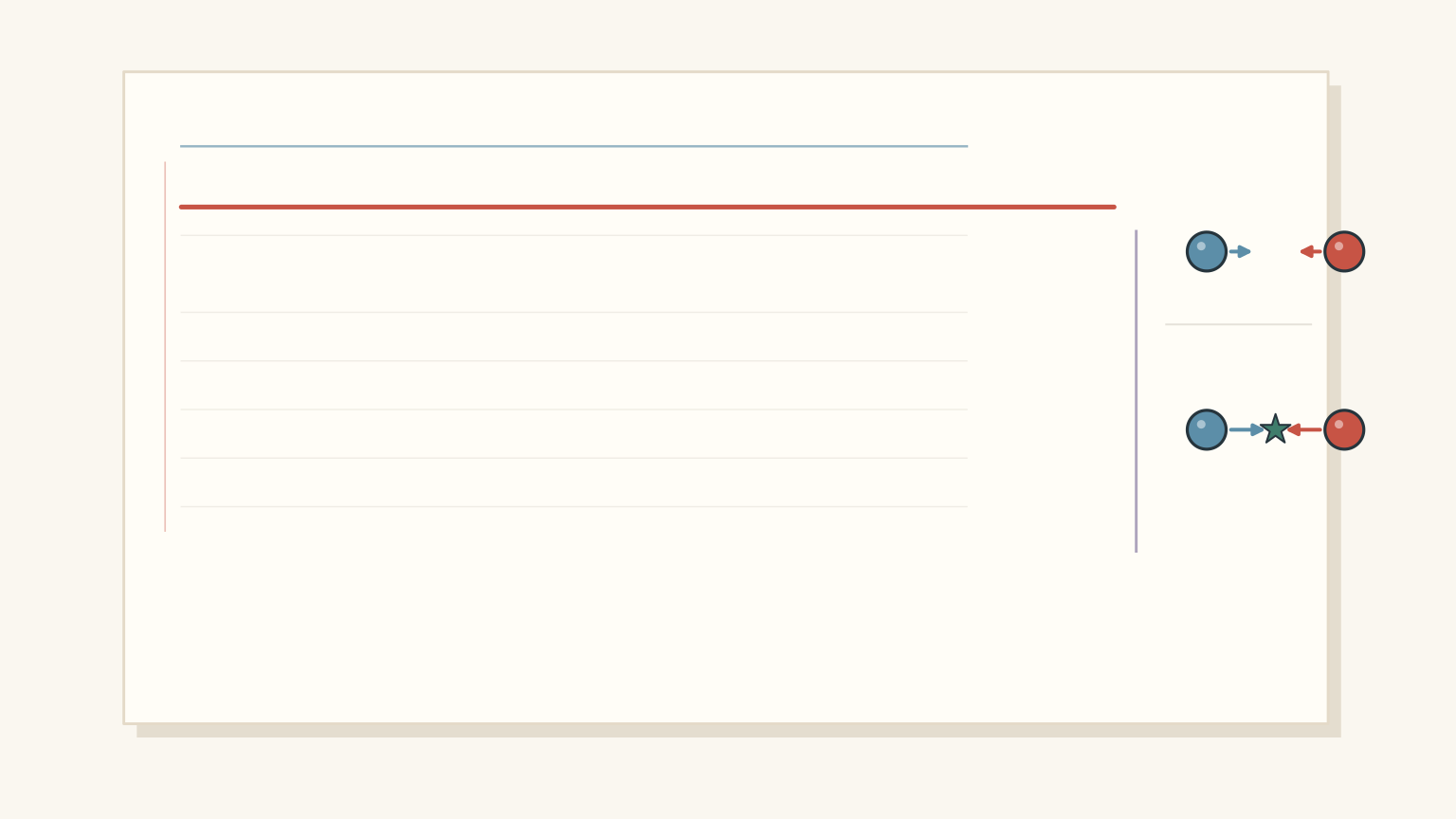
Due to technical limitations, this figure may display incorrectly or contain inaccuracies. Please check key details against your course materials.
The same approach works for mathematical reasoning.
If you’ve started using an incorrect method, don’t try to disguise it by squeezing replacement equations between existing lines. Cross out the abandoned section, then write the new method in a clear sequence.
This is particularly important when your replacement method is longer than your original attempt.
03How to continue an answer when you run out of space
Sometimes your working is correct, but you simply don’t have enough room.
This happens regularly in longer Mathematics questions and extended Physics and Chemistry responses.
The key is to make the continuation unmistakable.
There are two different situations to consider.
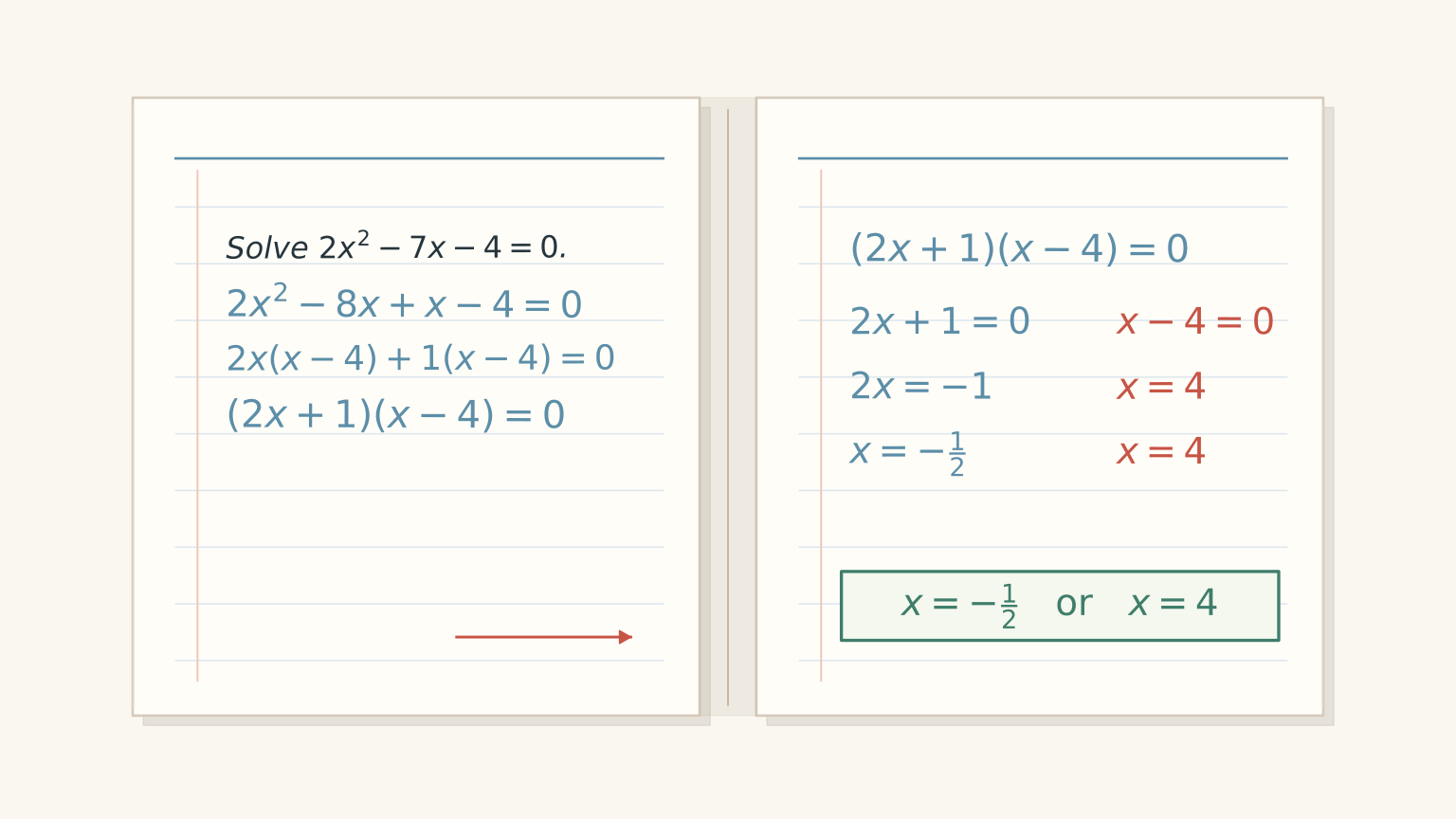
Situation A: Continuing on another page in the same booklet
If the next page has space, continue your answer there, following the booklet’s instructions.
At the end of the first page, write a short direction such as:
Continued on page 6.
At the top of the next page, write:
Question 8(b) continued.
This is a practical way to help someone follow your answer. Make sure you use the designated writing spaces and follow any specific instructions printed in your booklet.
Due to technical limitations, this figure may display incorrectly or contain inaccuracies. Please check key details against your course materials.
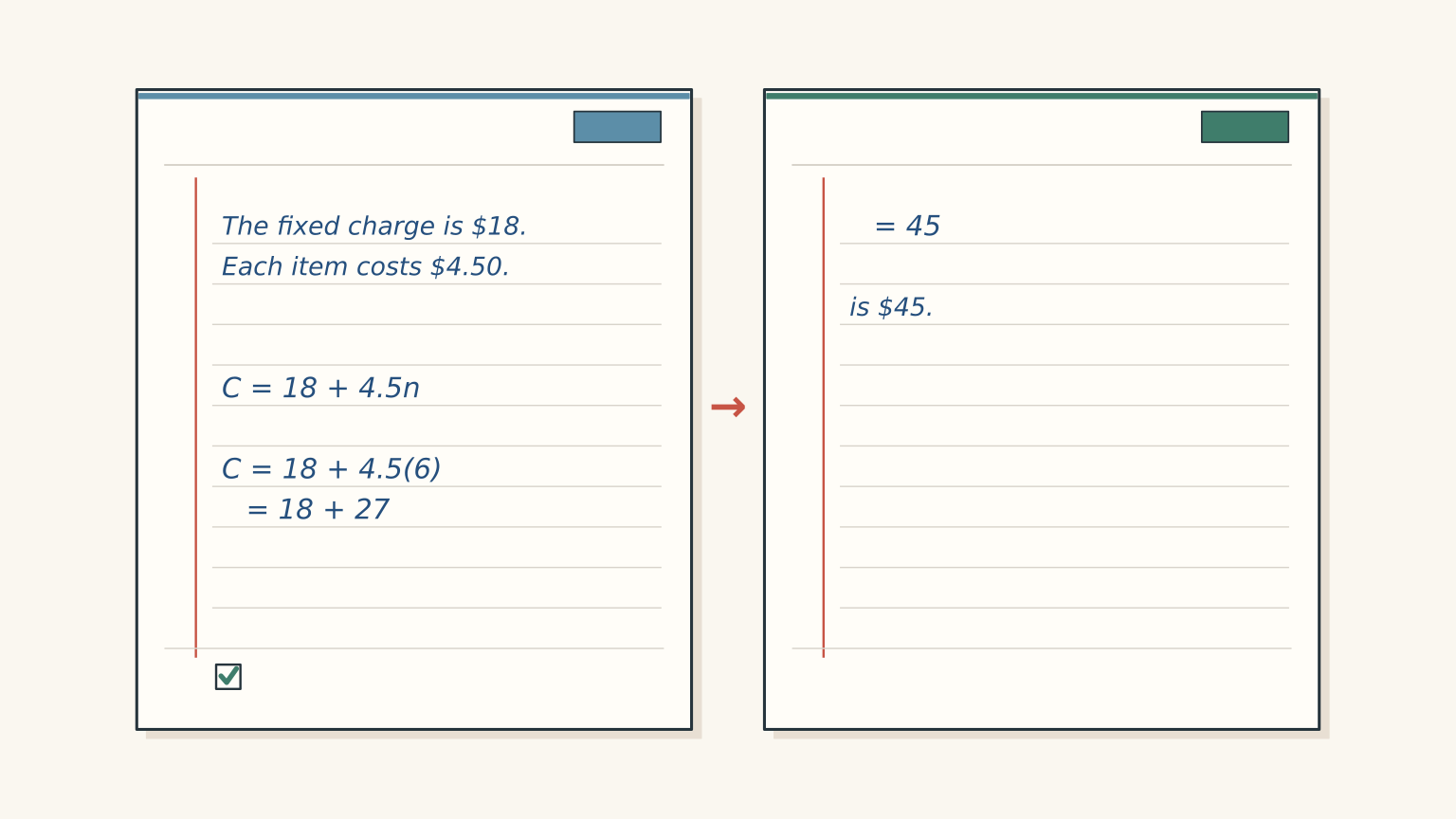
Situation B: Continuing in an additional writing booklet
If you run out of room in your supplied booklet, request an additional generic writing booklet from the exam supervisor.
NESA’s instructions explain that you should:
- Clearly label the additional booklet with the question you are answering.
- Indicate on the exam paper where your answer continues.
- If you use multiple booklets, mark the continuation box on the last page of the earlier booklet.
- Record the total number of booklets used, using labels such as
1 of 2and2 of 2in the spaces provided.
For example, imagine you use one original booklet and one additional booklet for Question 12.
Your booklets should be labelled:
| Booklet | Label |
|---|---|
| First booklet | 1 of 2 |
| Additional booklet | 2 of 2 |
The continuation should also identify the question and part you are answering.
Don’t assume that the marker will automatically find a continuation just because the pages are handed in together. Clear labelling is part of presenting a complete answer.
Due to technical limitations, this figure may display incorrectly or contain inaccuracies. Please check key details against your course materials.
Remember that the labels above are practical examples. Follow the actual boxes and instructions provided in your exam materials rather than assuming every booklet has the same layout.
04What if you write in the wrong booklet?
This is a situation where you should follow NESA’s instructions rather than trying to fix everything yourself.
Some Mathematics exams use personalised writing booklets labelled with individual question numbers. If you accidentally write your Question 11 answer in the Question 12 booklet, don’t panic and start copying everything across.
According to the 2027 HSC Rules and Procedures guide, you must:
- Tell the exam supervisor that you’ve written in the wrong booklet.
- Write a note on the front of the booklet or booklets explaining that you wrote an answer in the wrong place.
- Do not rewrite your answers.
- Clearly label and hand in all parts of your response.
The supervisor can provide directions about what to do next.
This is important because personalised booklets may be associated with particular marking guidelines. Using another question’s booklet to finish an answer could cause your work to be presented incorrectly.
05Common mistakes to avoid when correcting your work
There are a few habits that make an answer harder to follow.
| Avoid doing this | Do this instead |
|---|---|
| Scribbling repeatedly over an incorrect calculation | Use a clear line through the unwanted working |
| Writing a replacement equation between existing lines | Start the replacement underneath |
| Leaving two conflicting final answers uncancelled | Clearly cross out the answer you no longer intend |
| Using correction fluid | Cross out the mistake and rewrite it |
| Writing an answer in a random booklet | Use the correct booklet or request an additional generic booklet |
| Continuing without identifying the question | Label the question and part clearly |
| Assuming the marker will find another booklet automatically | Follow NESA’s continuation and booklet-labelling instructions |
One particularly important point: NESA explicitly states that correction fluid is not allowed in the exam room. It can also smudge your work and make it harder to read.
Does crossing something out mean you lose marks?
Not automatically.
Crossing out an incorrect attempt is precisely what NESA recommends when you don’t want that work marked.
However, don’t assume that a marker will automatically know which of two conflicting answers you intended. Make your final response clear.
There is no need to preserve every attempt you’ve made. Your goal is to present the reasoning and answer you actually want assessed.
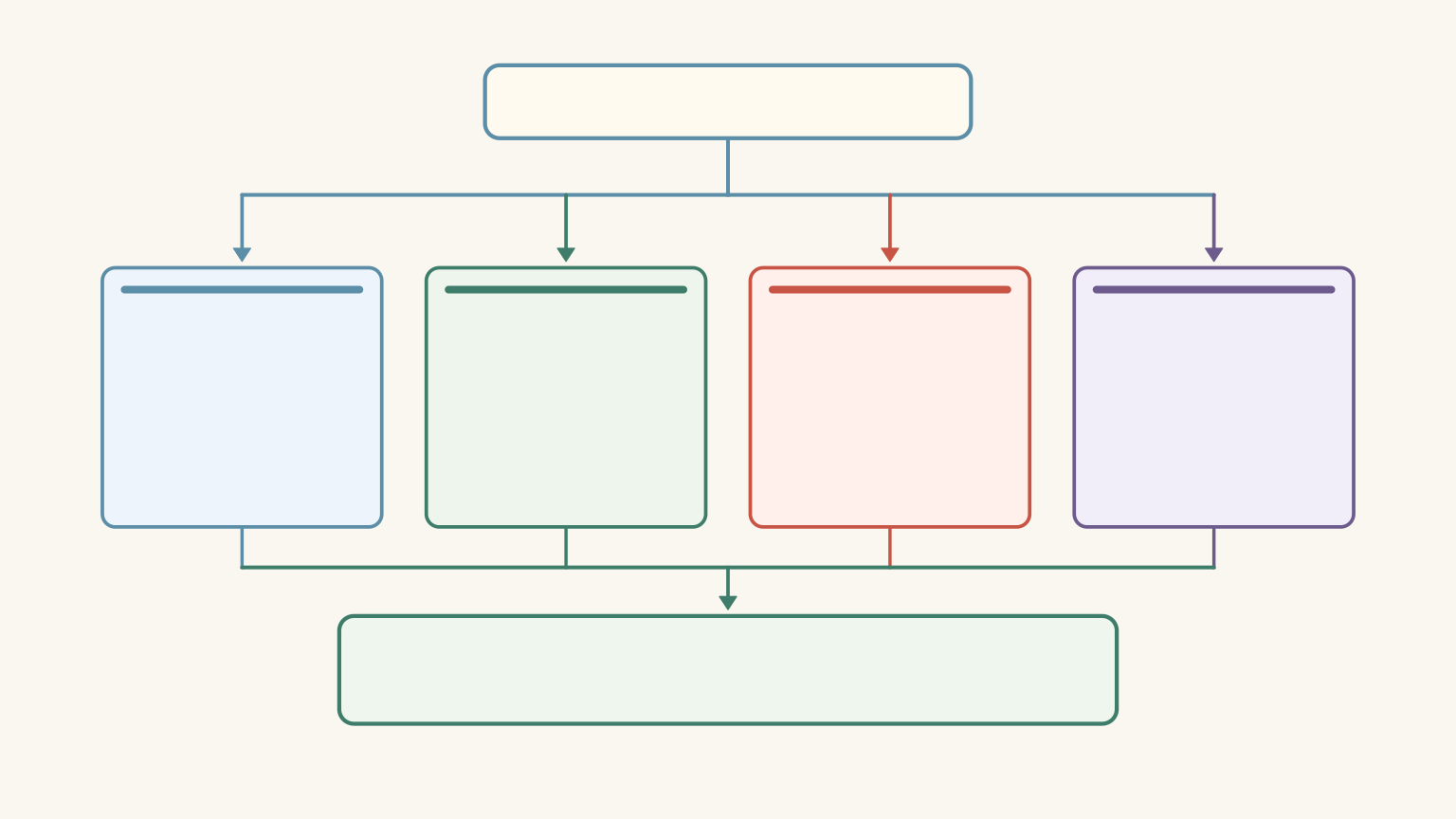
06A simple correction routine for exam day
When you notice a mistake, use this decision process.
Due to technical limitations, this figure may display incorrectly or contain inaccuracies. Please check key details against your course materials.
You can also use this short checklist before handing in your paper.
- [ ] All unwanted calculations and explanations are clearly crossed out.
- [ ] My intended final answers are easy to identify.
- [ ] I haven’t used correction fluid.
- [ ] My answers are in the correct designated spaces.
- [ ] Every continuation is clearly labelled.
- [ ] Any additional booklets have the correct question numbers and booklet sequence.
- [ ] I’ve indicated where answers continue and completed the required booklet boxes.
- [ ] I’ve followed the instructions for arranging and handing in my exam materials.
For students sitting the 2027 HSC, the relevant official information is available in the NESA 2027 HSC Rules and Procedures guide.
You can also read NESA’s Preparing for the HSC exams advice, which covers legibility, corrections, and where to write your answers.
Rules and procedures can change between examination years, so check the guide for the year in which you’re sitting your exams.
08Questions and solutions
Question 1
You’re answering a Physics question about a car travelling in a straight line.
The initial velocity is \(+18\text{ m/s}\), the final velocity is \(+6\text{ m/s}\), and the time taken is \(3\text{ s}\).
You calculate:
\[ a=\frac{18-6}{3}=+4\text{ m/s}^2 \]
You then realise you’ve calculated the magnitude of the deceleration rather than the signed acceleration.
How should you correct your working?
Solution 1
Cross out the incorrect calculation and write the corrected calculation underneath it.
The acceleration is determined by the change in velocity divided by the time taken:
\[ a=\frac{v-u}{t} \]
Substitute the initial and final velocities:
\[ \begin{aligned} a&=\frac{6-18}{3}\\ &=\frac{-12}{3}\\ &=-4\text{ m/s}^2 \end{aligned} \]
The negative sign indicates that the acceleration is opposite to the chosen positive direction.
You don’t need to erase the entire original attempt. Cross out the incorrect calculation clearly, then show the corrected equation and final answer.
The marker should be able to follow your corrected reasoning without having to guess which sign you intended.
Question 2
A Chemistry student writes the following explanation:
“Increasing the temperature increases the reaction rate because the activation energy becomes smaller.”
They realise this is incorrect and replace it with:
“Increasing temperature gives particles more kinetic energy, so a greater proportion of collisions have enough energy to react.”
What should they do with their original explanation, and is the replacement sufficient?
Solution 2
They should clearly cross out the original explanation and retain the corrected explanation, with one important improvement: explicitly identify successful collisions.
For a given reaction pathway, increasing temperature does not itself lower the activation energy.
Instead, it changes the distribution of particle kinetic energies. A greater proportion of particles have energy equal to or greater than the activation energy, so a greater proportion of collisions can be successful.
A stronger final response would be:
“Increasing temperature increases the average kinetic energy of the reacting particles. Consequently, a greater proportion of collisions have energy equal to or greater than the activation energy, increasing the frequency of successful collisions and therefore the reaction rate.”
The original statement should be crossed out, not left alongside the corrected response.
Notice that the correction process and the scientific reasoning are separate tasks. Crossing out the mistake makes your intended answer clear, but the replacement still needs to explain the chemistry accurately.
Question 3
In a Mathematics Extension 1 examination, you are answering Question 11 in a personalised writing booklet labelled Question 11.
You reach the bottom of the booklet but still have two parts of your solution to complete. There is another unused personalised booklet on your desk labelled Question 12.
Should you use the Question 12 booklet to finish your Question 11 answer?
Explain the correct procedure.
Solution 3
No. You should request an additional generic writing booklet from the exam supervisor.
The personalised Question 12 booklet is intended for Question 12. Using it to complete Question 11 could result in your answer being associated with the wrong marking guidelines.
Instead:
- Raise your hand and request an additional generic writing booklet.
- Clearly label the additional booklet with Question 11 and the relevant part.
- Indicate on the exam paper where your answer continues.
- Mark the continuation box on the last page of the original booklet.
- Label the booklets with their total number, such as
1 of 2and2 of 2.
Continue your mathematical working in the additional booklet.
You don’t need to squeeze your remaining calculations into the original booklet or abandon a valid solution because you’ve run out of room.
The key is to preserve the connection between the original working and its continuation.
Question 4
You have completed Question 8 in your Mathematics examination.
During your final check, you realise that you accidentally wrote the answer in the personalised booklet for Question 9.
You have also used an additional generic booklet to finish the solution. All three booklets are currently on your desk.
What should you do?
Solution 4
Tell the exam supervisor immediately, identify the incorrect booklet placement, and follow NESA’s instructions. Do not rewrite the answer in another booklet.
This situation involves two separate requirements.
First, because you have written an answer in the wrong personalised booklet, the 2027 HSC Rules and Procedures guide instructs you to tell the supervisor and write a note on the front of the relevant booklet or booklets explaining the mistake.
You must not rewrite the answer.
Second, you still need to ensure that all parts of your response are properly identified. Your original Question 9 booklet and additional generic booklet must be labelled so that the complete Question 8 response can be identified.
Make sure all parts of the answer are handed in.
The tempting response is to copy everything into the correct Question 8 booklet. That might seem like the neatest solution, but it is not what NESA instructs you to do when you have written in the wrong booklet.
Follow the supervisor’s directions and make sure none of your completed work is left out.
09The real purpose of clear corrections
A good HSC response doesn’t have to be perfectly written on the first attempt.
You might change a calculation, reconsider a physical principle, or need another booklet to finish a longer explanation. None of these situations requires you to sacrifice the clarity of your final answer.
The important habits are straightforward:
- Make incorrect working visibly incorrect.
- Present replacement working in a logical order.
- Keep your final answer identifiable.
- Follow the booklet instructions rather than improvising when you run out of space.
These habits are particularly useful in Mathematics, where a solution can involve several lines of algebra, and in Physics and Chemistry, where the reasoning behind an answer matters just as much as the final result.
If you want to develop the next part of this skill, read tutorgum’s guide to How to Earn Method Marks When You Cannot Finish an HSC Maths Question. It explores how to communicate valid mathematical reasoning even when you haven’t reached the final answer.