
How to Keep Maths Advanced Skills Strong While Studying Extension 1
Studying Extension 1 can leave important Maths Advanced skills rusty. Learn how to identify gaps, plan short weekly revision sessions, and maintain the foundations you need for more challenging problems.
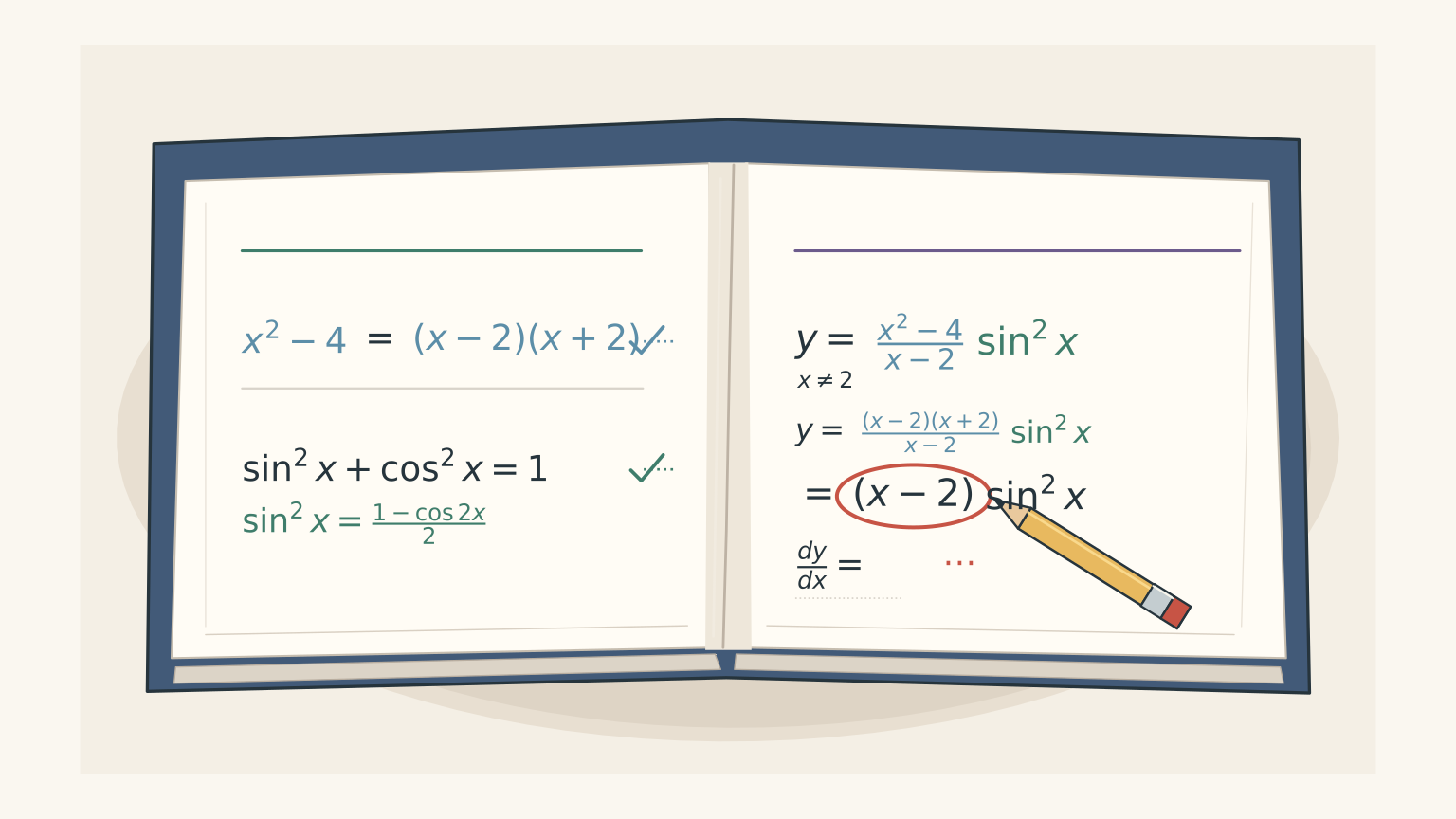
You’ve just spent 25 minutes on an Extension 1 question. The difficult part was supposed to be choosing the right calculus method, but most of your time disappeared into factorising, rearranging fractions, and checking a trigonometric identity. Sound familiar?
This is a sign that your Maths Advanced foundations might be slipping while you’re concentrating on Extension 1.
The solution isn’t to stop practising Extension 1 or spend hours repeating the entire Advanced course. Instead, set aside two short, deliberate sessions each week to maintain your core skills. Focus on the prerequisites that your current Extension 1 topics actually use, and regularly bring those skills back into mixed problems.
The trick is to keep your Advanced knowledge accessible without letting foundation revision take over your study timetable.
Due to technical limitations, this figure may display incorrectly or contain inaccuracies. Please check key details against your course materials.
01Why Maths Advanced skills need regular maintenance
Think about learning a musical instrument. You might be working on a difficult piece, but you still need to practise scales and basic techniques. Otherwise, the difficult sections become harder than they need to be.
Maths works in a similar way.
Extension 1 develops mathematical ideas through more demanding problems, but those problems often rely on skills you’ve already encountered in Maths Advanced.
For example, a question involving further calculus might require you to:
- Recognise which differentiation technique applies.
- Differentiate a complicated expression.
- Factorise the resulting algebra.
- Rearrange an equation.
- Interpret the final expression in the context of the problem.
If your algebra is rusty, every later step becomes more difficult.
The analogy has one important limitation: Maths Advanced and Extension 1 aren’t completely separate courses. Extension 1 builds on and extends Advanced knowledge, so the same mathematical skills often appear in both courses, sometimes in very different contexts.
NESA describes the 2024 Mathematics Extension 1 syllabus as enhancing students’ knowledge and skills in Mathematics Advanced, with an emphasis on rigorous arguments, proofs, and mathematical modelling.
That connection is precisely why maintaining your Advanced skills matters.
A note about the current NSW syllabus
The Mathematics Advanced and Extension 1 syllabuses have undergone a transition:
- The 2024 syllabuses began implementation for Year 11 in Term 1, 2026.
- Implementation for Year 12 begins in Term 4, 2026.
- The first HSC examinations under the new syllabuses are in 2027.
- The 2026 HSC is the final examination under the previous 2017 syllabuses.
Some content has moved or changed between courses. Make sure your revision checklist matches your own cohort rather than relying entirely on an older topic list.
You can check the official NSW Mathematics syllabus implementation information.
02Which Maths Advanced skills should you maintain?
Not every Advanced topic deserves equal attention every week.
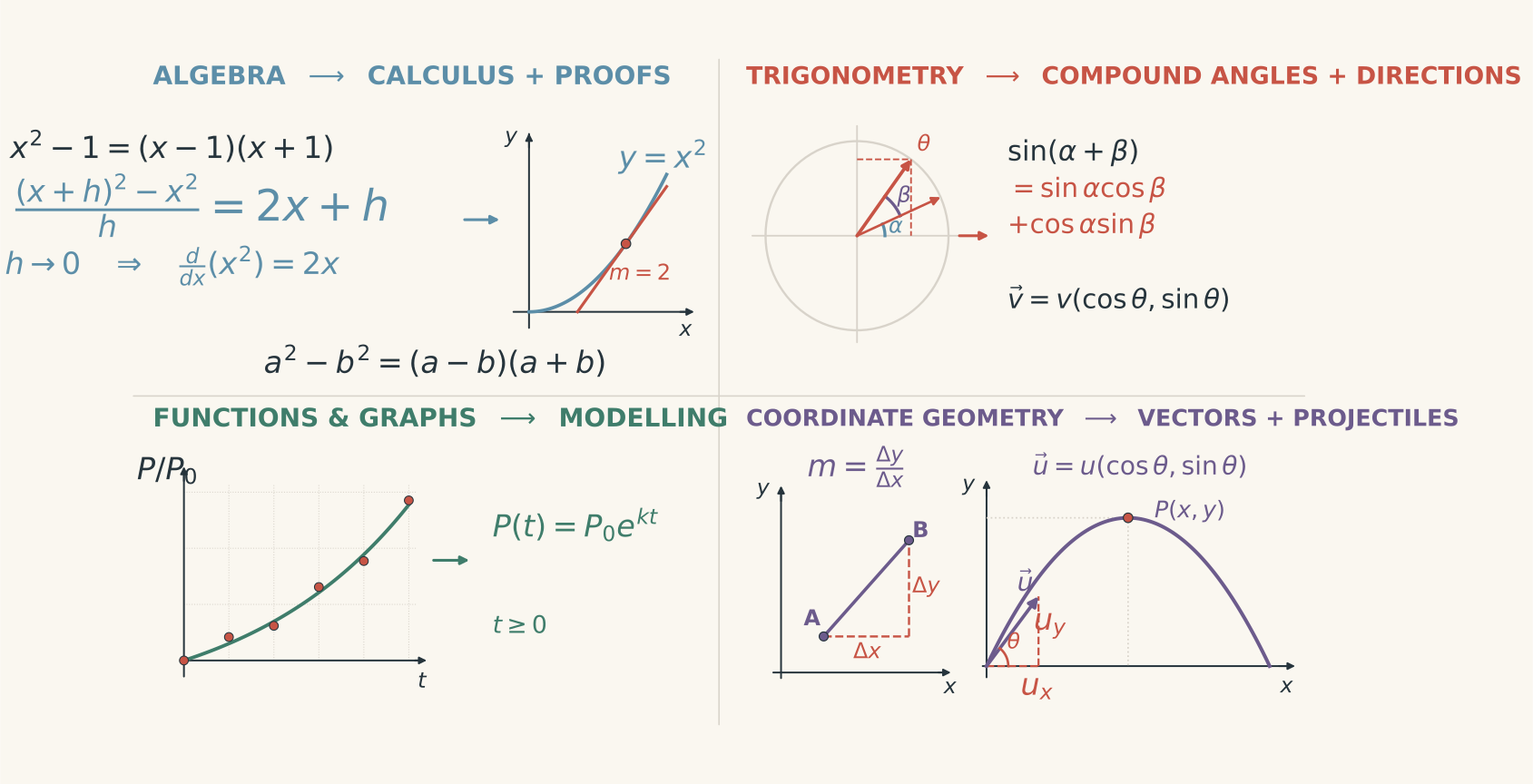
The best place to start is with skills that appear repeatedly across different Extension 1 topics. These are particularly valuable because a weakness in one area can affect several types of questions.
| Advanced skill | What you should be comfortable doing | Where it becomes useful in Extension 1 |
|---|---|---|
| Algebraic manipulation | Factorising, expanding, simplifying fractions, handling indices and rearranging equations | Calculus, proofs, and solving equations |
| Functions and graphs | Understanding domain and range, transformations, inverse functions, and function notation | Calculus, mathematical modelling, and graph interpretation |
| Trigonometry | Using exact values, identities, radians, and understanding quadrants | Compound angles, trigonometric functions, and vector directions |
| Core calculus | Differentiating and integrating, choosing appropriate rules, and interpreting gradients and areas | Further calculus and applied problems |
| Coordinate geometry | Working with gradients, distances, equations of lines, and coordinates | Vectors, projectiles, and geometric applications |
| Probability and statistics | Understanding probability notation, applying probability rules, and interpreting statistical information | Statistical topics in your current course |
Due to technical limitations, this figure may display incorrectly or contain inaccuracies. Please check key details against your course materials.
If you’re unsure where to begin, check your algebra, functions, and trigonometry first. These skills are used in a wide range of mathematical problems.
However, don’t automatically spend equal time on every topic. Your own mistakes should determine what gets priority.
03How to identify which skills are getting rusty
A common mistake is to revise whatever feels familiar.
You might spend an hour practising differentiation because you enjoy it, even though your recent assessment showed that factorising and rearranging equations were causing most of your errors.
Instead, use a short diagnostic session.
Step 1: Attempt a small selection of Advanced questions
Choose around six questions from different areas of your current course.
For example:
- One algebraic factorisation question.
- One algebraic fraction or rearrangement question.
- One functions or graph question.
- One trigonometric identity or equation.
- One differentiation or integration question.
- One mixed question that combines several skills.
Attempt them without notes or worked examples.
You aren’t trying to complete an entire assessment. You’re checking which skills you can still use independently.
Step 2: Identify the first point where your working breaks down
There are several different types of difficulty, and each needs a different response.
| Type of difficulty | What it looks like | What to revise |
|---|---|---|
| Conceptual gap | You don’t understand why a particular method works | Relearn the underlying concept and study a worked example |
| Recall problem | You recognise a method but can’t remember the relevant identity or rule | Practise retrieving the rule without notes |
| Algebraic error | You understand the question but make mistakes manipulating expressions | Complete targeted algebra exercises |
| Method selection | You can solve a question when told which technique to use but struggle to choose independently | Practise mixed questions and identify the appropriate method before solving |
| Transfer problem | You can solve an isolated Advanced question but struggle when the same skill appears inside an Extension 1 problem | Practise combining the skill with current Extension 1 material |
Don’t simply write “careless mistake” beside an incorrect answer.
That doesn’t tell you what to improve.
Instead, identify the exact problem. Was it a negative sign? An incorrect factorisation? Forgetting a domain restriction? Choosing the wrong trigonometric quadrant?
The more precisely you identify the error, the more useful your next revision session becomes.
Step 3: Decide whether the skill needs maintenance or repair
Use this simple rule:
- Secure: You can solve the question independently, explain your method, and repeat the skill after a gap.
- Needs practice: You understand the method but occasionally make errors or need extra time.
- Needs rebuilding: You cannot confidently explain or apply the underlying concept.
One isolated mistake doesn’t automatically mean you’ve forgotten a topic. Look for repeated problems across different questions.
The goal is to spend your time repairing genuine weaknesses rather than endlessly revising material you already understand.
04A weekly revision routine that fits around Extension 1
You don’t need another massive study block.
A practical starting point is two 20-minute Advanced maintenance sessions each week, followed by a short delayed review.
Here’s how to organise them.
Session 1: Target your weakest Advanced skill
20 minutes
| Time | Activity |
|---|---|
| 3 minutes | Write down the relevant formulas, identities, or methods from memory. |
| 12 minutes | Complete two or three questions targeting one weak skill. |
| 5 minutes | Mark your working, identify mistakes, and write down the correct approach. |
Keep this session focused.
If you’re struggling with algebraic fractions, don’t suddenly switch to a full trigonometry revision session halfway through.
You want to understand the skill, practise it, and correct any misunderstandings.
Session 2: Connect Advanced skills to Extension 1
20 minutes
This session is slightly different.
| Time | Activity |
|---|---|
| 5 minutes | Complete a small mixed set of previously studied Advanced questions. |
| 10 minutes | Attempt a current Extension 1 question. |
| 5 minutes | Identify which Advanced skills were needed and correct any errors. |
The important part is recognising where your existing knowledge appears inside a more complicated problem.
For example, you might be studying further calculus and encounter an expression that requires factorisation before you can simplify it.
Don’t just skip the algebra or look at the solution.
Identify the factorisation technique, practise it separately if necessary, and then return to the original question.
Session 3: A short delayed review
5 minutes
Three to seven days after your first session, return to one question you previously got wrong.
Try it again without looking at your previous solution.
If you can now solve it independently, that’s a good sign that the correction has stuck.
If you make the same mistake again, keep that skill on your revision list for another week.
Due to technical limitations, this figure may display incorrectly or contain inaccuracies. Please check key details against your course materials.
Keep an error log
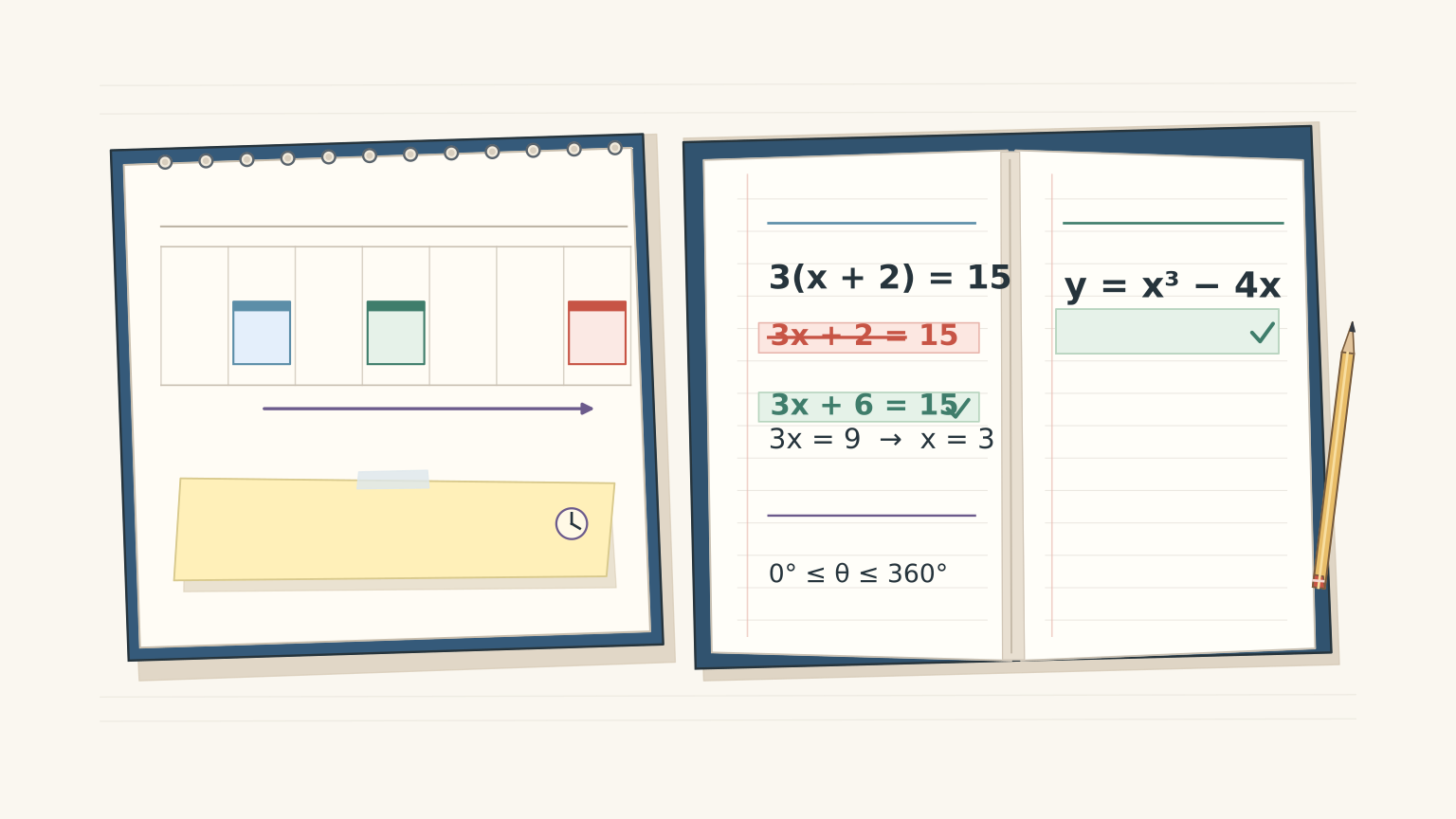
One of the most useful habits you can develop is maintaining a record of mistakes.
You don’t need an elaborate spreadsheet. A simple table in your notebook is enough.
| Date | Skill | What went wrong? | What should I remember? |
|---|---|---|---|
| Monday | Factorisation | Didn’t recognise a difference of two squares | Check for common algebraic identities before expanding |
| Wednesday | Trigonometry | Used the wrong quadrant | Check the signs of both coordinates |
| Friday | Differentiation | Forgot to apply the chain rule | Identify the inner function before differentiating |
This gives your revision a clear purpose.
Rather than asking yourself, “What should I study today?”, you can look at your previous mistakes and make a decision.
05Worked examples: turning Extension 1 mistakes into targeted practice
The following examples show how an apparently difficult Extension 1 problem can reveal a weakness in a more familiar Advanced skill.
The aim isn’t simply to obtain the correct answer. It’s to work out which prerequisite deserves additional practice.
Worked example 1: A calculus question that is really an algebra test
Question:
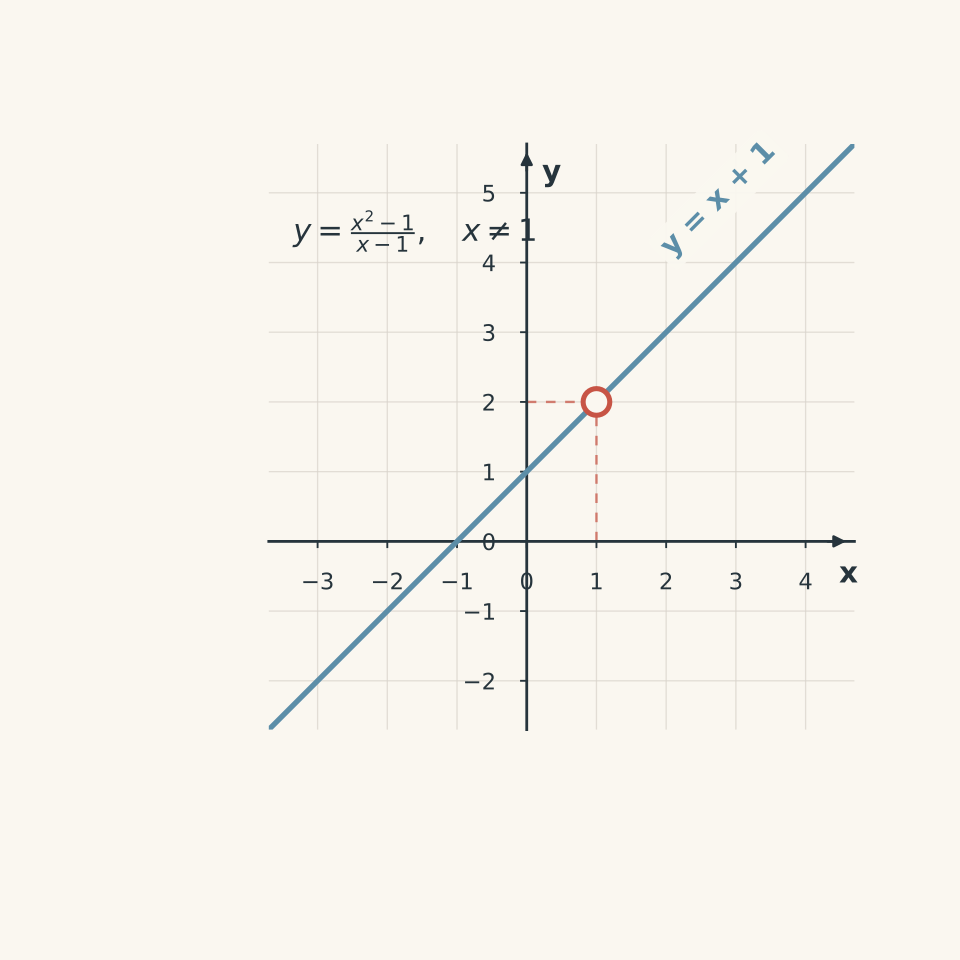
For \(x\ne1\), differentiate
\[ f(x)=\frac{x^2-1}{x-1}. \]
A student knows how to differentiate a simple linear function but struggles when using the quotient rule. Find the derivative using an efficient approach, and identify the Advanced skill that should be revised.
Step 1
Before applying a differentiation rule, inspect the numerator.
The numerator is a difference of two squares:
\[ x^2-1=(x-1)(x+1). \]
This is a standard algebraic identity worth recognising immediately.
Step 2
Substitute the factorised expression:
\[ f(x)=\frac{(x-1)(x+1)}{x-1}. \]
Since \(x\ne1\), cancel the common factor:
\[ f(x)=x+1. \]
Remember that the original function is still undefined at \(x=1\). Simplifying an expression doesn’t automatically change its original domain.
Step 3
Using the basic power rule and constant rule:
\[ \frac{df}{dx} = \frac{d}{dx}(x+1) \]
Therefore,
\[ \boxed{\frac{df}{dx}=1,\quad x\ne1} \]
Step 4
The tempting approach is to apply the quotient rule immediately.
That method is mathematically valid, but it creates unnecessary algebra:
\[ f'(x)= \frac{2x(x-1)-(x^2-1)} {(x-1)^2} \]
The numerator then needs to be simplified and factorised before reaching the same result.
If the student struggles with this process, the main problem might not be differentiation at all.
It could be recognising algebraic identities and simplifying rational expressions.
That’s what should be practised in the next Advanced maintenance session.
Due to technical limitations, this figure may display incorrectly or contain inaccuracies. Please check key details against your course materials.
Worked example 2: A vector question that exposes a trigonometry weakness
Question:
A vector has components
\[ \mathbf{v}=-3\mathbf{i}+4\mathbf{j}. \]
Find its magnitude and direction, measured anticlockwise from the positive \(x\)-axis.
A student correctly calculates the magnitude but obtains a direction of \(-53.1^\circ\). Find the correct direction and explain which Advanced skills need revision.
Step 1
The magnitude of a vector is found using Pythagoras’ theorem:
\[ |\mathbf{v}|= \sqrt{(-3)^2+4^2} \]
\[ =\sqrt{9+16} \]
\[ \boxed{|\mathbf{v}|=5} \]
The magnitude is 5 units.
Step 2
The horizontal component is negative, while the vertical component is positive.
Therefore, the vector lies in the second quadrant.
This matters because the direction must be measured anticlockwise from the positive \(x\)-axis.
Step 3
The reference angle is the acute angle between the vector and the horizontal axis.
Using the tangent ratio:
\[ \tan\alpha=\frac{4}{3} \]
Therefore,
\[ \alpha=\tan^{-1}\left(\frac43\right) \]
\[ \alpha\approx53.1^\circ \]
Step 4
Because the vector lies in the second quadrant, subtract the reference angle from \(180^\circ\):
\[ \theta=180^\circ-53.1^\circ \]
\[ \boxed{\theta=126.9^\circ} \]
The correct direction is approximately \(126.9^\circ\) anticlockwise from the positive \(x\)-axis.
Step 5
The student probably used inverse tangent without considering the quadrant.
A calculator gives the principal value of the inverse tangent, which does not independently determine the correct quadrant of a vector.
The tempting answer of \(-53.1^\circ\) therefore describes a direction in the fourth quadrant, not the second.
The Advanced skills worth revising are:
- Recognising quadrants from positive and negative coordinates.
- Using trigonometric ratios correctly.
- Understanding reference angles.
- Interpreting angle conventions.
Notice how the problem involves vectors, but the mistake comes from trigonometry.
This is exactly why your maintenance practice should target the underlying skill rather than simply repeating questions from the same Extension 1 chapter.
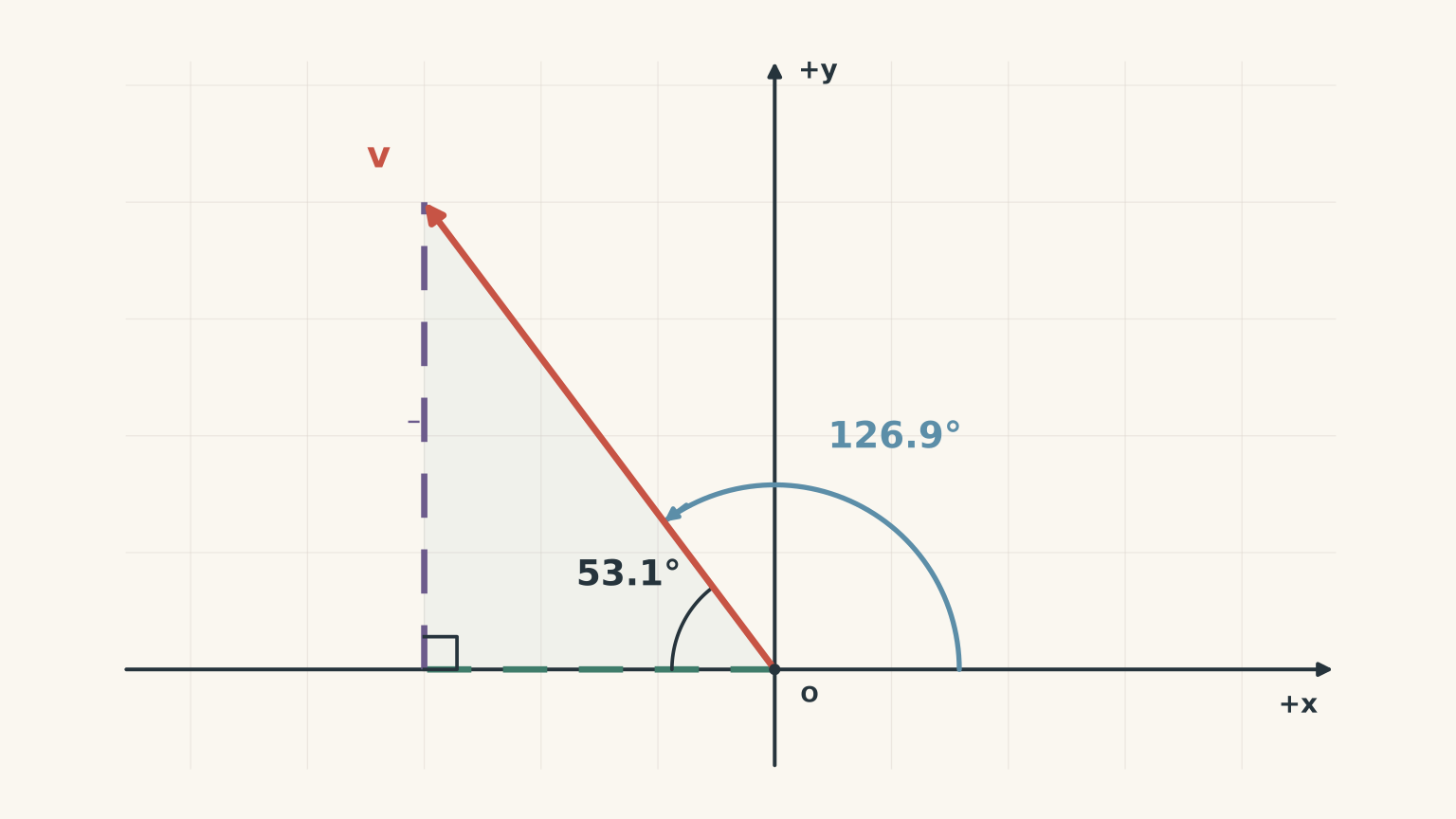
Due to technical limitations, this figure may display incorrectly or contain inaccuracies. Please check key details against your course materials.
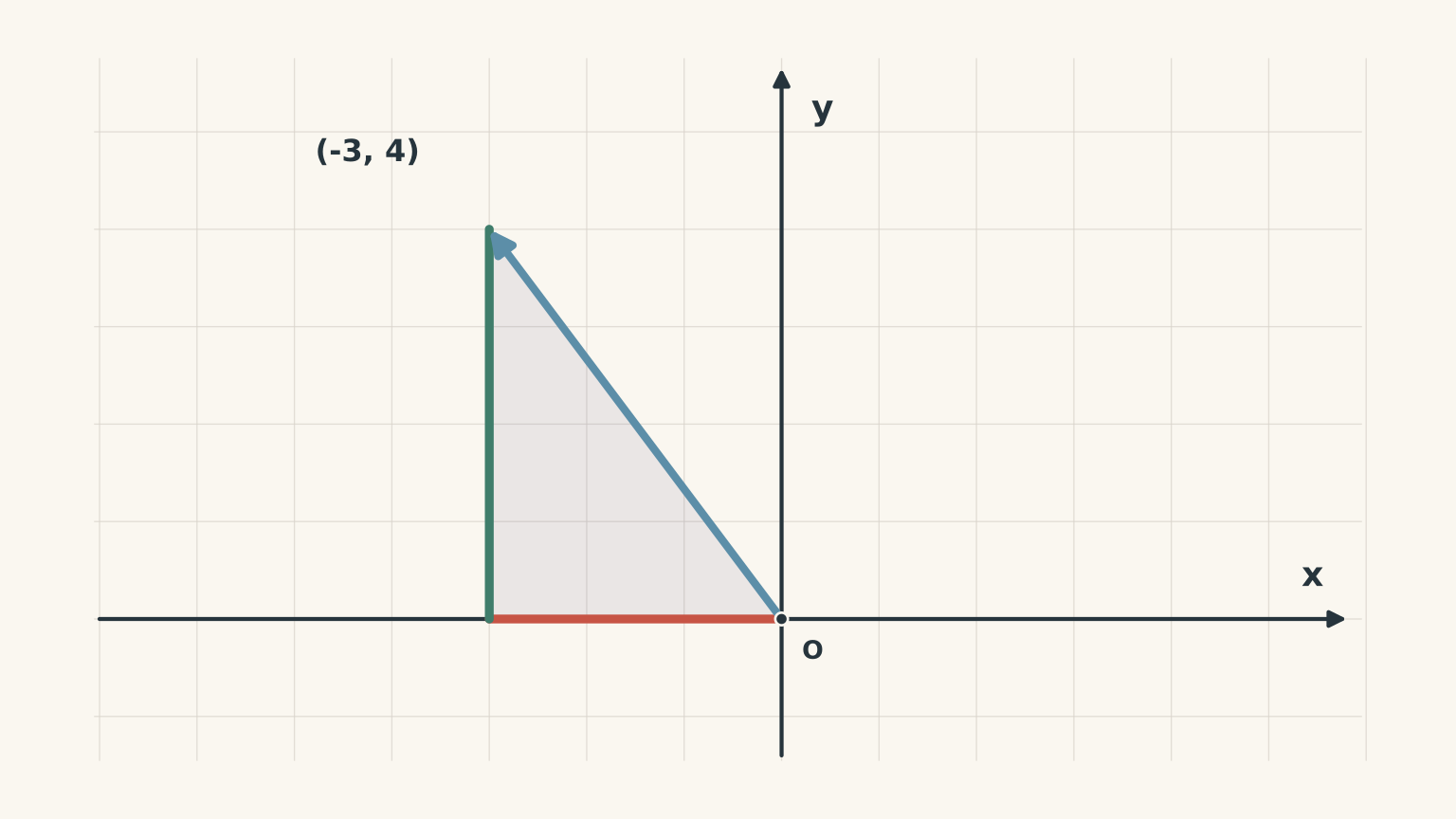
Due to technical limitations, this figure may display incorrectly or contain inaccuracies. Please check key details against your course materials.
06Questions and solutions
Use these questions to check whether you can apply the maintenance approach to your own study.
Question 1
You have completed eight factorisation questions correctly in a row. However, you still struggle when factorisation appears halfway through a more complicated Extension 1 calculus question.
What should you prioritise in your next revision session?
Solution 1
You should practise factorisation inside mixed mathematical problems, rather than completing another long block of isolated factorisation questions.
Your existing results suggest that you understand the basic technique when the question explicitly tells you what to do.
The difficulty is recognising when to use that technique in a different context.
Try this approach:
- Complete one straightforward factorisation question.
- Attempt a differentiation or integration question that requires algebraic simplification.
- Identify where factorisation becomes necessary.
- Explain why the technique applies.
- Repeat the mixed question without looking at your previous working.
The distinction is between knowing a mathematical technique and recognising when to use it independently.
Both skills need to be maintained.
Question 2
Over two weeks, you make three mistakes in trigonometry:
- In the first question, you forget an identity.
- In the second, you use an incorrect quadrant.
- In the third, you give an answer in degrees when the question requires radians.
Should you treat all three mistakes as one general trigonometry weakness?
Explain how you would organise your revision.
Solution 2
No. These are three different weaknesses, even though they all involve trigonometry.
The first is a recall problem. You need to practise retrieving the relevant identities without relying on your notes.
The second is an interpretation problem. You need to understand how the signs of coordinates determine the quadrant and how that affects the angle.
The third is a notation and accuracy problem. You need to pay attention to the required angle units and convert between degrees and radians when necessary.
A useful revision session would include one targeted question for each weakness, followed by a mixed trigonometry question.
This prevents you from becoming very good at one narrow type of question while continuing to struggle with the others.
It also helps you recognise that a chapter heading isn’t always a useful description of what needs improving.
Question 3
You’ve followed a maintenance routine for three weeks.
You can now complete isolated Advanced questions involving algebra, trigonometry, and differentiation quite comfortably.
However, when you attempt a longer Extension 1 question that combines all three areas, you still make mistakes and lose time.
Should you increase the number of isolated Advanced questions, move straight to full timed papers, or change your approach?
Explain what your next two study sessions should look like.
Solution 3
You should shift more of your maintenance practice towards mixed, multi-step problems while keeping a small amount of isolated retrieval practice.
Your results suggest that the individual techniques are becoming secure. The remaining difficulty is combining them without being prompted.
This is a transfer problem.
Completing more isolated questions might improve your fluency, but it won’t necessarily teach you when to switch between different techniques.
A better approach is:
First session:
- Spend five minutes retrieving important identities and algebraic techniques.
- Complete one mixed Advanced question involving at least two different skills.
- Write down why you chose each mathematical method.
Second session:
- Attempt a current Extension 1 question without looking at a worked solution.
- Identify each Advanced technique needed along the way.
- When you make an error, return to that specific prerequisite rather than restarting the entire topic.
- Reattempt the question after correcting the weakness.
Full timed papers have their place, but they are most useful when you can already apply the underlying techniques reasonably independently.
The important change is moving from practising individual skills to practising the connections between them.
07Making Advanced maintenance part of your Extension 1 study
The aim isn’t to spend equal time on both courses or repeatedly revisit everything you’ve already learnt.
It’s to keep your existing mathematical knowledge reliable enough that it doesn’t become an obstacle when you encounter unfamiliar Extension 1 problems.
A useful way to approach each new Extension 1 topic is to ask:
- Which Advanced skills does this topic rely on?
- Which of those skills am I currently confident using?
- Where do I make repeated mistakes?
- What short practice session would address that weakness?
- Can I use the skill independently in a more complicated problem?
Keep your practice targeted, revisit mistakes after a gap, and regularly combine familiar skills in unfamiliar questions.
If you’re studying further calculus, tutorgum’s Further Calculus Skills: Year 12 Maths Extension 1 Guide can help you work through the relevant Extension 1 content.
For vector foundations, see Introduction to Vectors: NSW HSC Mathematics Extension 1.
If the same prerequisite weakness keeps appearing despite targeted practice, a focused tutorgum online tutoring session can help you identify exactly where your working breaks down and what to practise next.
Once your Advanced foundations are reliable, you can put more of your attention towards the next challenge: choosing the right mathematical approach when an Extension 1 question doesn’t tell you which technique to use.