
How to Make HSC Physics Revision Notes That Solve Questions
Learn how to turn Physics revision notes into practical problem-solving tools. Build notes around physical concepts, assumptions, diagrams, equation choices, common mistakes, and worked examples.
You can copy every HSC Physics formula into a notebook and still struggle to solve an unfamiliar question. You might know \(v=u+at\), but when a question describes a car braking, a ball thrown upwards, or a train changing its motion halfway through, you aren’t sure which equation to use or what information matters.
The problem usually isn’t that you need more notes. It’s that your notes aren’t helping you make decisions.
Good Physics revision notes should help you recognise a physical situation, choose an appropriate model, identify the assumptions, select a useful equation, and check whether your answer makes sense. They should help you solve a question you haven’t seen before, not just remember one you’ve already completed.
Here’s how to build them.
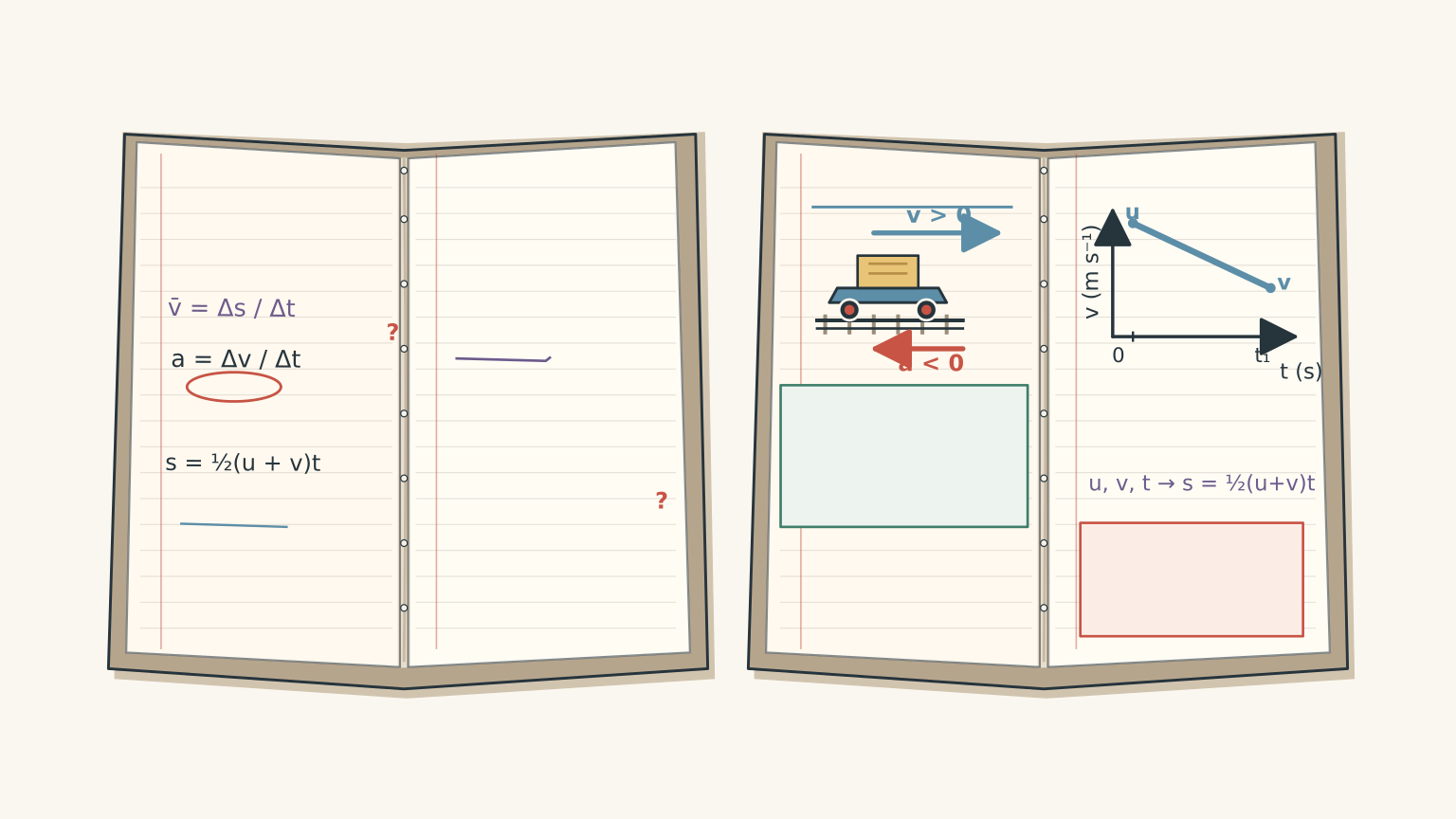
Due to technical limitations, this figure may display incorrectly or contain inaccuracies. Please check key details against your course materials.
01Write notes that help you make decisions
Imagine you’re revising uniformly accelerated motion.
You write down four equations, define velocity and acceleration, and add a paragraph explaining what acceleration means. The page looks complete.
Then you encounter this question:
A car travels at \(24\,\mathrm{m\,s^{-1}}\) and brakes uniformly until it stops. It travels 60 m while braking. Calculate its acceleration.
Which equation should you use?
You might remember several equations but still struggle to identify the right one. That’s because memorising an equation and knowing when it applies are different skills.
A formula sheet is like a toolbox. Knowing which tools you own doesn’t tell you which one fits the job.
Your revision notes need to explain the connection between a physical situation and the mathematical method.
For each concept, include six things:
| What to include | What your notes should explain |
|---|---|
| Physical idea | What is actually happening? |
| Assumptions | Under what conditions does the model apply? |
| Representation | What diagram, graph, or model helps describe the situation? |
| Decision cues | What features of a question suggest using this concept? |
| Equations and method | Which relationships apply, and how should you use them? |
| Checks and traps | What mistakes are tempting, and how can you recognise an unreasonable answer? |
You don’t need six enormous paragraphs. A few precise sentences, a useful diagram, and the relevant equations are often enough.
The important thing is that each part serves a purpose.
02Start with the physical situation, not the formula
Before writing an equation, make sure you understand what it describes.
Take acceleration.
A common starting definition is:
\[ a=\frac{\Delta v}{\Delta t} \]
Acceleration is the rate of change of velocity with time.
But what does that mean in an actual question?
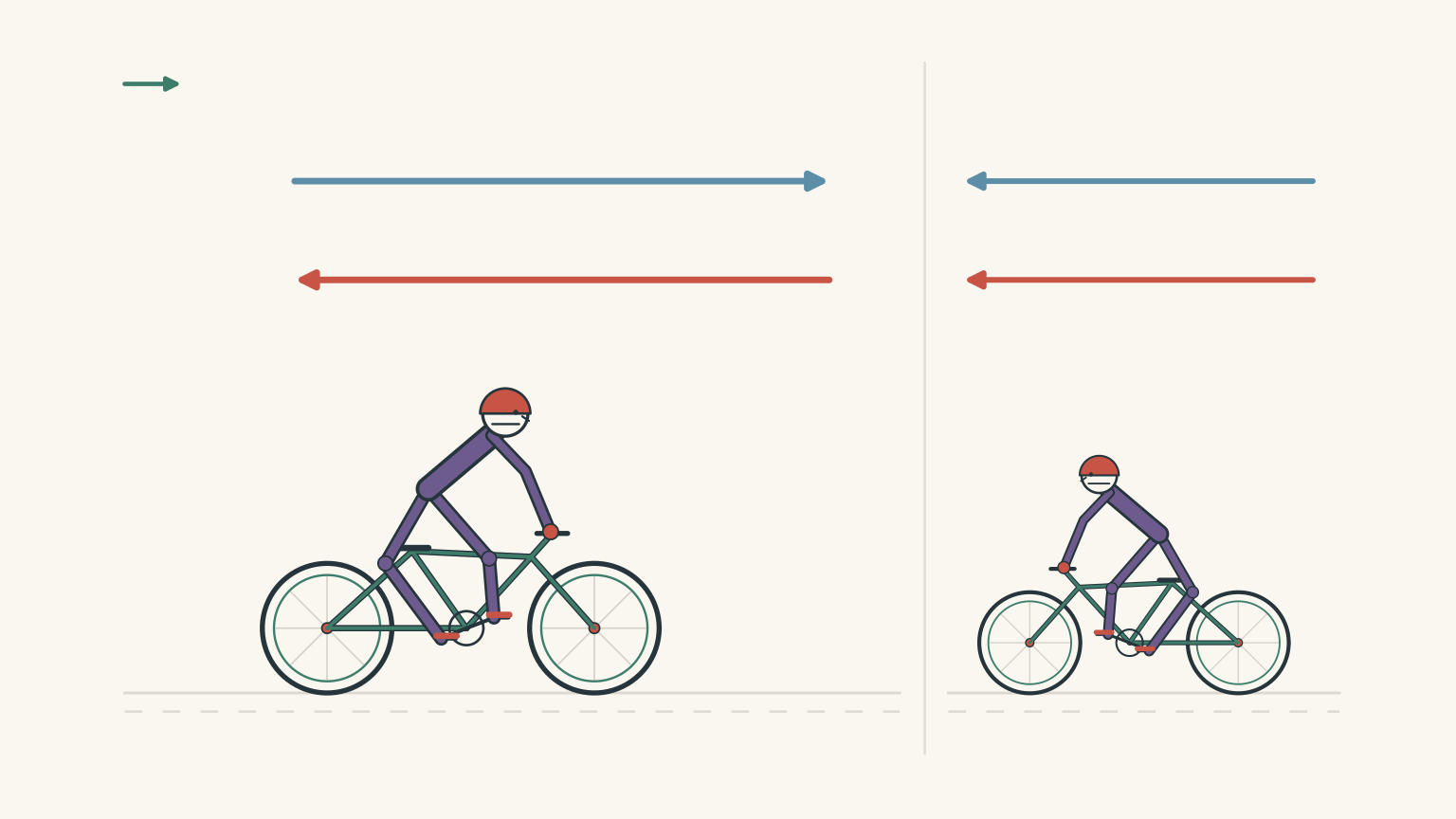
Imagine a cyclist travelling east. The cyclist applies the brakes and gradually slows down.
Predict the direction of the cyclist’s acceleration. Is it east, because that’s the direction of motion, or west, because that’s the direction in which the cyclist’s velocity is changing?
The acceleration is west.
Acceleration describes the change in velocity, not simply the direction an object is travelling.
This distinction becomes important when assigning signs in equations.
If east is defined as positive, the cyclist has positive velocity but negative acceleration.
Your notes should capture that relationship rather than simply stating that acceleration is the rate of change of velocity.
A useful note might read:
Acceleration and direction
- Acceleration describes how velocity changes, including changes in direction.
- If velocity and acceleration point in the same direction, speed increases.
- If they point in opposite directions, speed decreases until the object stops.
- Choose a positive direction before assigning signs.
- Negative acceleration does not automatically mean an object is slowing down.
That final point is particularly important. An object travelling west and accelerating west has negative acceleration if east is positive, but its speed is increasing.
Due to technical limitations, this figure may display incorrectly or contain inaccuracies. Please check key details against your course materials.
Write down the assumptions
Physics equations describe models of the real world. They don’t automatically apply to every situation.
For example, the standard constant-acceleration equations only apply when acceleration remains constant over the interval being considered.
That condition is easy to overlook.
Suppose a car accelerates for five seconds, then travels at constant velocity for another ten seconds. You cannot treat the entire fifteen-second journey as one interval of constant acceleration.
You need to separate the motion into stages.
Your notes should therefore include the conditions under which each relationship is valid.
For example:
| Concept | Important assumptions or conditions |
|---|---|
| Constant-acceleration equations | Acceleration remains constant over the interval. |
| Free fall near Earth’s surface | Air resistance is negligible, and gravitational acceleration is approximately constant. |
| Newton’s second law | Use the resultant external force on the chosen system in an inertial reference frame. |
| Conservation of mechanical energy | Account for whether non-conservative forces transfer energy into or out of the system. |
These conditions are not optional background information. They determine whether your mathematical model is appropriate.
A good test is to ask yourself:
What would have to change for this equation or principle to stop being useful?
If you can answer that, you understand more than just the formula.
03Include diagrams, graphs, and other representations
A page of equations can hide the physical meaning of a question.
Diagrams make that meaning easier to see.
For example, when revising motion, don’t only write the constant-acceleration equations. Draw an object moving along a straight path, choose a positive direction, and label its initial and final velocities.
Then connect that representation to a velocity-time graph.
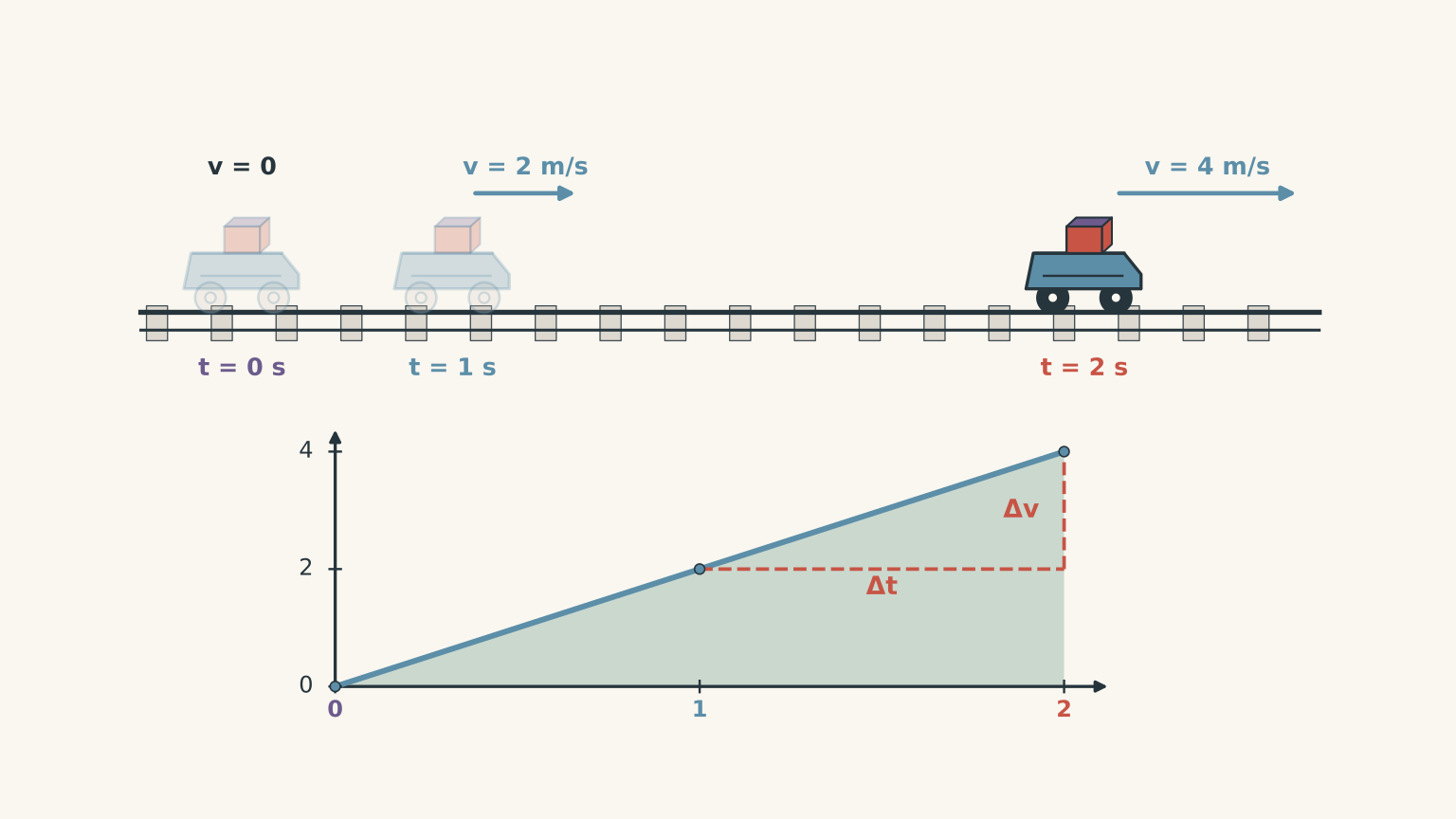
Due to technical limitations, this figure may display incorrectly or contain inaccuracies. Please check key details against your course materials.
Different representations help with different decisions.
| Representation | What it helps you understand |
|---|---|
| Physical sketch | Positions, directions, and the arrangement of objects. |
| Motion diagram | How position and velocity change over time. |
| Velocity-time graph | Acceleration from gradient and displacement from signed area. |
| Free-body diagram | Forces acting on a particular object or system. |
| Circuit diagram | How electrical components are connected. |
| Ray diagram | How light travels and interacts with optical surfaces. |
Don’t draw diagrams just to make your notes look attractive.
Draw them because they help you identify information that might otherwise be difficult to organise.
For example, a free-body diagram is particularly useful when applying Newton’s second law. It forces you to identify the forces acting on the object before calculating the resultant force.
A velocity-time graph can also reveal something that a formula alone might not make obvious: an object can change direction when its velocity crosses zero.
Make sure your notes explain what the diagram means. A graph without an explanation of its gradient or area is only half a revision resource.
04Build a useful equation-selection guide
Now you can introduce the mathematics.
For constant acceleration in one dimension, the standard kinematics equations are:
\[ v=u+at \]
\[ s=ut+\frac{1}{2}at^2 \]
\[ v^2=u^2+2as \]
\[ s=\frac{u+v}{2}t \]
Here:
- \(u\) is initial velocity, measured in \(\mathrm{m\,s^{-1}}\).
- \(v\) is final velocity, measured in \(\mathrm{m\,s^{-1}}\).
- \(a\) is acceleration, measured in \(\mathrm{m\,s^{-2}}\).
- \(t\) is elapsed time, measured in seconds.
- \(s\) is displacement, measured in metres.
All four equations assume constant acceleration over the same interval.
Rather than simply copying them into your notes, add a decision guide.
| What you need to calculate | Useful relationship |
|---|---|
| Final velocity when time is known | \(v=u+at\) |
| Displacement when initial velocity, acceleration, and time are known | \(s=ut+\frac12at^2\) |
| A relationship between velocity, acceleration, and displacement without time | \(v^2=u^2+2as\) |
| Displacement when initial velocity, final velocity, and time are known | \(s=\frac{u+v}{2}t\) |
This gives you a starting point when approaching an unfamiliar question.
However, don’t turn equation selection into a mechanical exercise of matching the missing variable.
First establish that the situation actually involves constant acceleration. Then identify which quantities belong to the same interval and which equation connects the information you have.
Worked example: A trolley accelerates along a track
A trolley moves to the right at an initial velocity of \(2.0\,\mathrm{m\,s^{-1}}\). It accelerates uniformly at \(1.5\,\mathrm{m\,s^{-2}}\) for \(4.0\,\mathrm{s}\).
Calculate its final velocity and displacement.
Step 1
The trolley moves in a straight line with constant acceleration.
This means we can use the constant-acceleration equations.
Choose the rightward direction as positive.
Step 2
\[ u=2.0\,\mathrm{m\,s^{-1}} \]
\[ a=1.5\,\mathrm{m\,s^{-2}} \]
\[ t=4.0\,\mathrm{s} \]
We need to calculate \(v\) and \(s\).
Step 3
To calculate final velocity, use:
\[ v=u+at \]
To calculate displacement, use:
\[ s=ut+\frac12at^2 \]
Both equations apply because acceleration is constant.
Step 4
For final velocity:
\[ \begin{aligned} v&=2.0+(1.5)(4.0)\\ &=8.0\,\mathrm{m\,s^{-1}} \end{aligned} \]
For displacement:
\[ \begin{aligned} s&=(2.0)(4.0)\\ &\quad+\frac12(1.5)(4.0)^2\\ &=8.0+12.0\\ &=20\,\mathrm{m} \end{aligned} \]
Step 5
The trolley speeds up from \(2.0\,\mathrm{m\,s^{-1}}\) to \(8.0\,\mathrm{m\,s^{-1}}\).
Its average velocity is:
\[ v_{\mathrm{avg}}=\frac{2.0+8.0}{2} =5.0\,\mathrm{m\,s^{-1}} \]
Over four seconds, this gives:
\[ s=5.0\times4.0=20\,\mathrm{m} \]
This agrees with our calculated displacement.
The final answers are:
- Final velocity: \(8.0\,\mathrm{m\,s^{-1}}\) to the right.
- Displacement: \(20\,\mathrm{m}\) to the right.
What should you add to your revision notes?
Don’t copy the entire worked solution. Record the decision-making process:
- Identify whether acceleration is constant.
- Define a positive direction.
- List known quantities and the unknown.
- Select an equation that connects those quantities.
- Check signs, units, and physical meaning.
That is the information you want to retrieve when you face a different question.
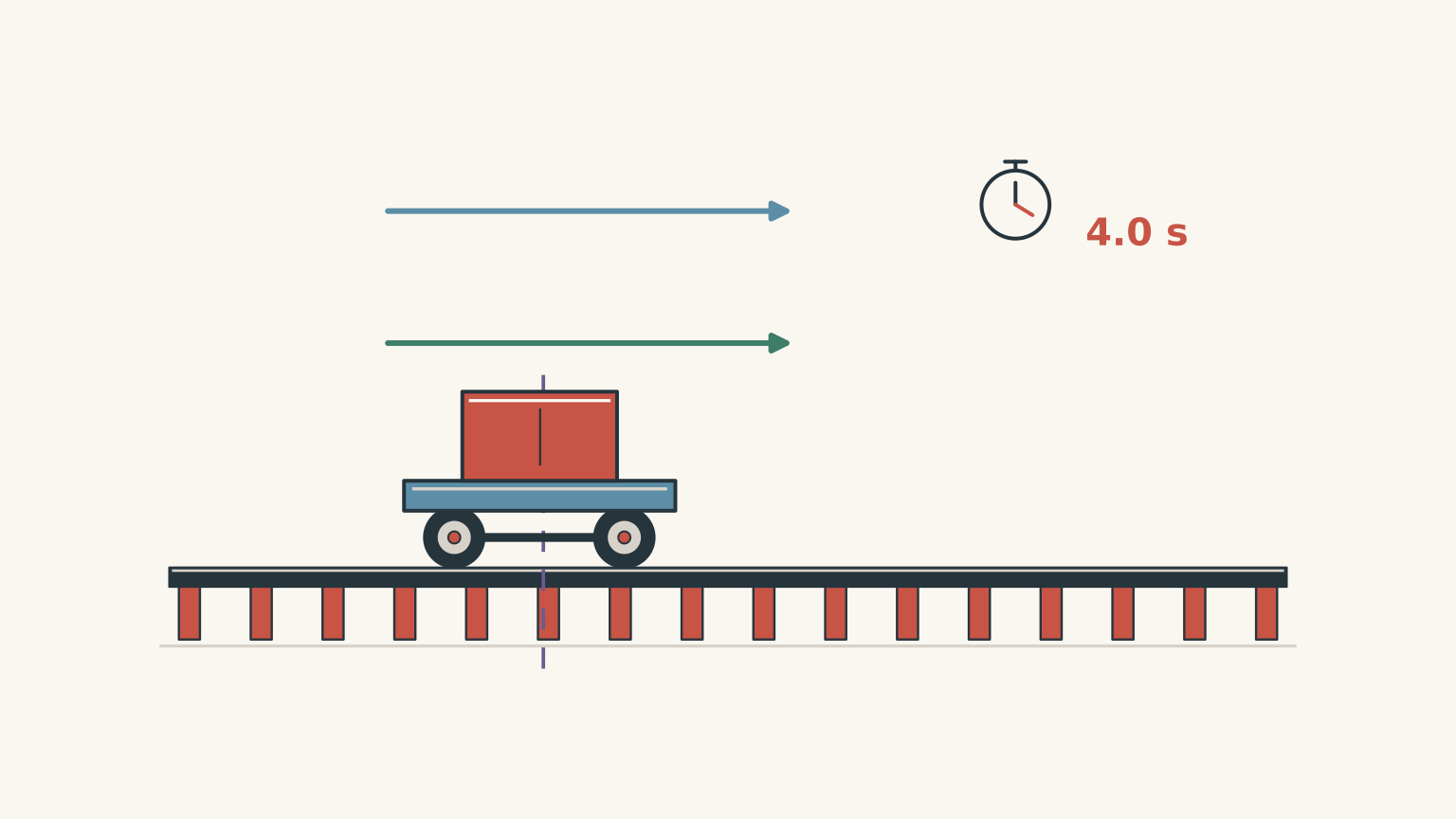
Due to technical limitations, this figure may display incorrectly or contain inaccuracies. Please check key details against your course materials.
Worked example: A car brakes to rest
A car travels along a straight road at \(24\,\mathrm{m\,s^{-1}}\). It brakes uniformly and comes to rest after travelling 60 m.
Calculate its acceleration and the time taken to stop.
Step 1
The car has constant acceleration while braking.
Choose its initial direction of travel as positive.
Step 2
\[ u=24\,\mathrm{m\,s^{-1}} \]
\[ v=0\,\mathrm{m\,s^{-1}} \]
\[ s=60\,\mathrm{m} \]
We need to calculate acceleration and time.
Step 3
We know the initial velocity, final velocity, and displacement, but not time.
Therefore, use:
\[ v^2=u^2+2as \]
Rearranging:
\[ a=\frac{v^2-u^2}{2s} \]
Step 4
\[ \begin{aligned} a&=\frac{0^2-24^2}{2(60)}\\ &=\frac{-576}{120}\\ &=-4.8\,\mathrm{m\,s^{-2}} \end{aligned} \]
The negative sign means acceleration acts opposite to our chosen positive direction.
Step 5
Now that we know acceleration, use:
\[ v=u+at \]
Rearranging:
\[ t=\frac{v-u}{a} \]
Substituting:
\[ \begin{aligned} t&=\frac{0-24}{-4.8}\\ &=5.0\,\mathrm{s} \end{aligned} \]
Step 6
The average velocity during uniform braking is:
\[ v_{\mathrm{avg}}=\frac{24+0}{2} =12\,\mathrm{m\,s^{-1}} \]
Over five seconds:
\[ s=12\times5=60\,\mathrm{m} \]
Our result is consistent with the information in the question.
The final answers are:
- Acceleration: \(-4.8\,\mathrm{m\,s^{-2}}\).
- Stopping time: \(5.0\,\mathrm{s}\).
Notice that the equation-selection process was different from the trolley example.
We first used an equation that excluded time because time wasn’t provided. We then used the newly calculated acceleration to find time.
This is exactly the kind of decision-making your notes should preserve.
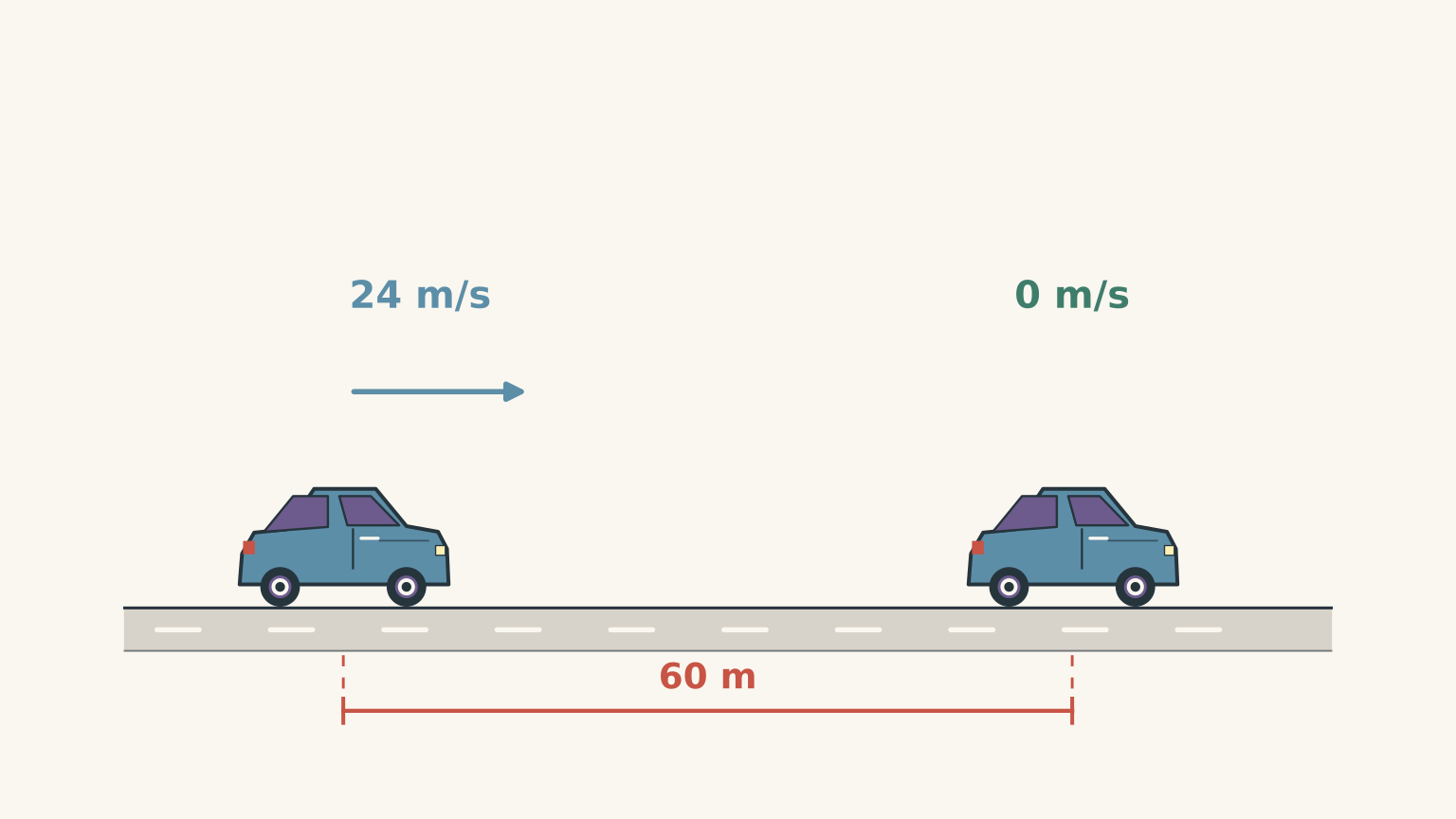
Due to technical limitations, this figure may display incorrectly or contain inaccuracies. Please check key details against your course materials.
05Record mistakes, not just correct answers
One of the most useful additions to your Physics notes is a record of mistakes you’ve actually made.
Imagine you repeatedly lose marks because you confuse distance with displacement.
Copying another explanation of displacement into your notebook probably won’t fix the problem.
Instead, add a specific warning to your notes:
Distance versus displacement
- Displacement is the change in position, including direction.
- Distance is the total length of the path travelled.
- If an object reverses direction, distance is not necessarily equal to the magnitude of displacement.
- When calculating total distance, separate the motion at any turning points.
This gives you a practical warning to look for when reading a question.
Use an error log to identify what needs improving.
| Mistake | What to add to your notes |
|---|---|
| Choosing the wrong equation | Record the conditions and decision cues for each equation. |
| Getting signs wrong | State the positive direction before substituting. |
| Confusing distance and displacement | Record what happens when an object reverses direction. |
| Using an applied force instead of the net force | Include a free-body diagram and resultant-force calculation. |
| Mixing different stages of motion | Separate intervals and identify the conditions at each boundary. |
| Giving an unexplained numerical answer | Add the physical principle and reasoning behind the calculation. |
A mistake becomes useful when it changes how you approach the next question.
Simply writing down the correct answer doesn’t necessarily do that.
Give each concept a boundary case
A particularly effective way to improve your notes is to include one situation where the usual method needs extra care.
For constant-acceleration equations, consider a car that accelerates for five seconds and then brakes.
The equation \(v=u+at\) still applies to each interval if acceleration is constant within that interval.
But you cannot use one acceleration value across the entire journey if acceleration changes between the two stages.
Your note should say:
If the physical conditions change, check whether the question needs to be divided into separate intervals.
For more practice with this decision, see How to Solve Multi-Stage Motion Questions in HSC Physics.
06Make your revision notes active
Writing notes is only the beginning.
You also need to practise retrieving and applying the information without looking at the page.
A useful revision cycle looks like this:
1. Recall the concept.
Cover your notes and explain the physical idea in your own words.
For example, explain why an object can have negative acceleration while travelling in the positive direction.
2. Reconstruct the representation.
Draw the relevant physical diagram, graph, or free-body diagram from memory.
Label the important quantities and choose a positive direction where necessary.
3. Solve an unfamiliar question.
Attempt a question without immediately checking your notes.
Focus on identifying the physical model and selecting the relevant principles before substituting numbers.
4. Identify the missing decision.
If you make a mistake, work out why.
Was an assumption missing? Did you choose the wrong equation? Did you confuse a scalar with a vector?
5. Update the relevant note.
Add a short explanation, decision cue, or warning that addresses the mistake.
Then try another question to see whether the change helps.
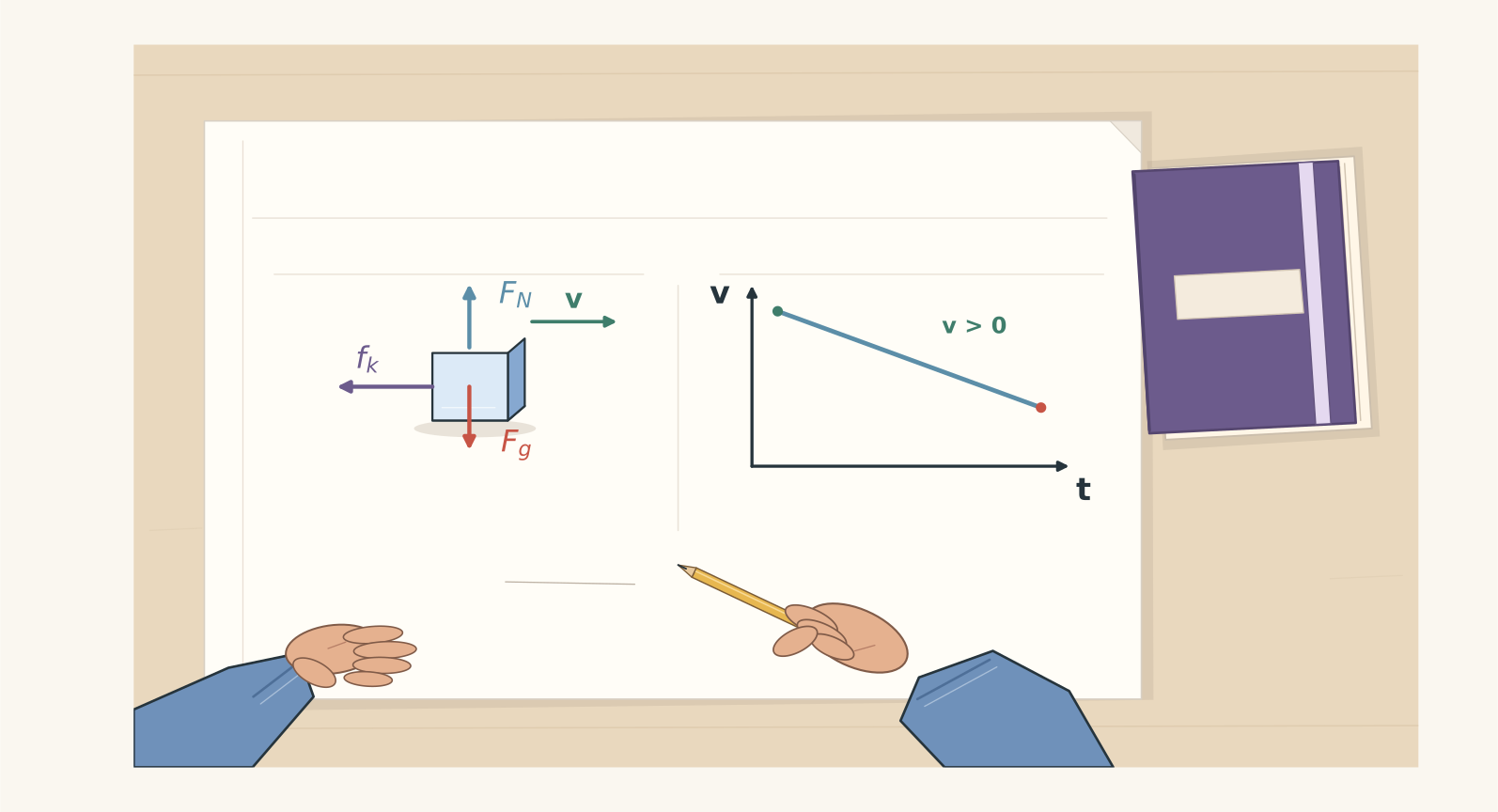
Due to technical limitations, this figure may display incorrectly or contain inaccuracies. Please check key details against your course materials.
Use mixed questions, not just repeated examples
Suppose you’ve just revised kinematics.
You complete ten questions involving uniformly accelerated motion. By the tenth question, you recognise the pattern and know which equations to use.
That’s useful practice, but it doesn’t necessarily mean you can identify the same model in an unfamiliar context.
Try mixing questions from different topics.
For example:
- A question involving constant acceleration.
- A question involving Newton’s second law.
- A question requiring conservation of energy.
- A question involving a velocity-time graph.
- A question where the physical situation changes halfway through.
Mixed practice forces you to decide which concept applies before you start calculating.
That decision is a major part of Physics problem-solving.
07Keep your notes aligned with your HSC syllabus
Before using another student’s notes, an online summary, or an older set of practice questions, check that they match your course.
This matters because the NSW Physics syllabus is changing.
As at November 2026, NESA’s transition arrangements are:
- The Physics Stage 6 Syllabus (2017) continues to be taught to Year 12 students during 2027.
- The new Physics 11-12 Syllabus (2025) begins for Year 11 in Term 1, 2027.
- The new Year 12 course begins in Term 4, 2027.
- The first HSC examination under the new syllabus is in 2028.
If you’re preparing for the 2027 HSC, don’t assume that resources labelled with the 2025 syllabus automatically apply to your course.
Check the relevant syllabus and your school’s program using NESA’s official Physics syllabus information.
Your revision notes should reflect the content and expectations of your own HSC cohort.
08Questions and solutions
The following questions test both your Physics knowledge and your ability to recognise which information belongs in useful revision notes.
Try each question before reading its solution. Pay attention to the assumptions, representations, and decision cues, not just the final calculation.
Question 1
A ball is dropped from rest from a platform 19.6 m above the ground.
Assume air resistance is negligible and take gravitational acceleration as \(9.8\,\mathrm{m\,s^{-2}}\).
Calculate the time taken for the ball to reach the ground. State the physical assumption that allows you to use the constant-acceleration equations.
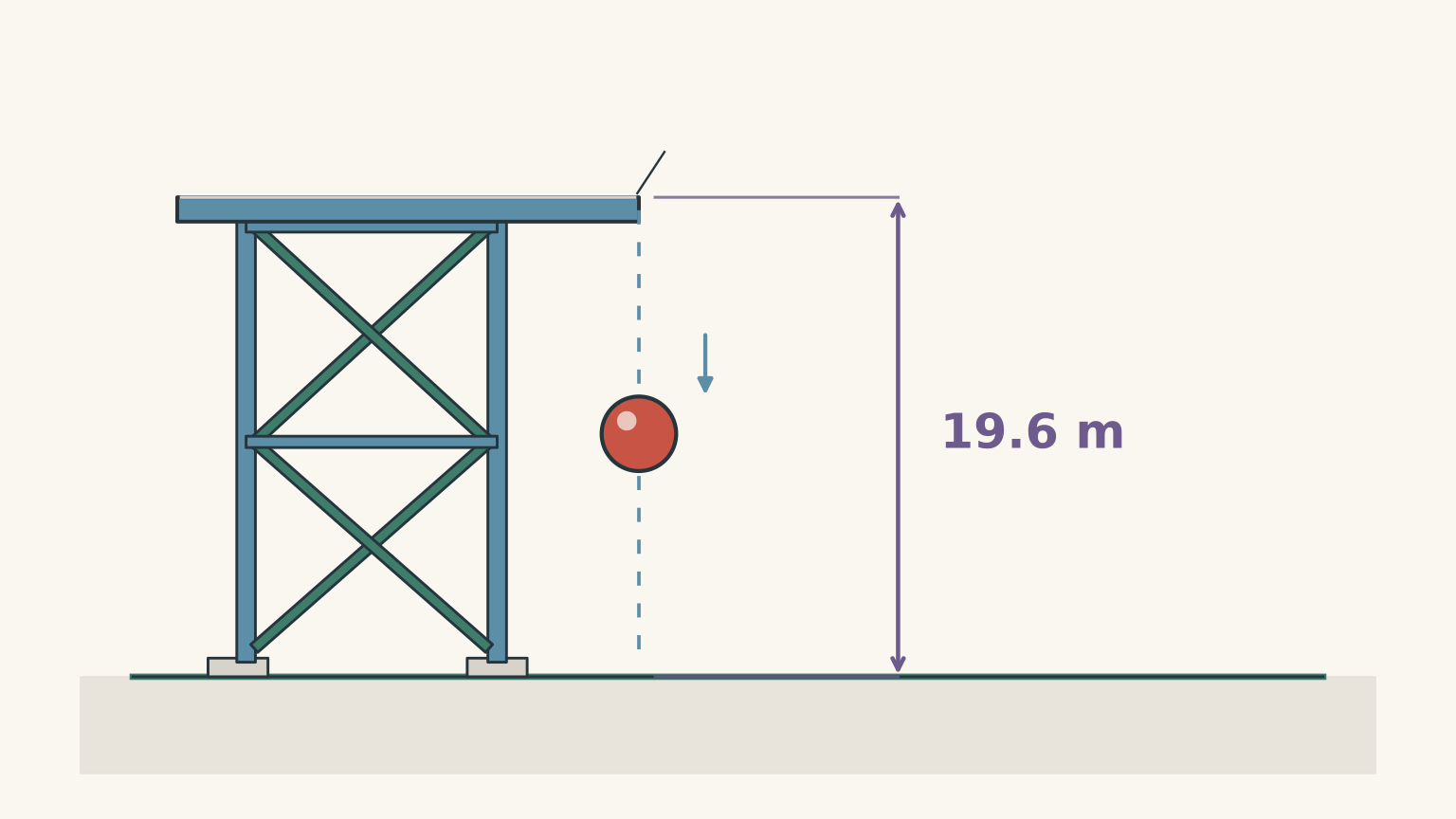
Due to technical limitations, this figure may display incorrectly or contain inaccuracies. Please check key details against your course materials.
Solution 1
The ball takes 2.0 seconds to reach the ground.
Because air resistance is negligible, the only significant force acting on the ball during its fall is gravity. Near Earth’s surface, gravitational acceleration can be treated as approximately constant.
We can therefore use the constant-acceleration equations.
Step 1: Choose a positive direction.
Take downward as positive.
The known quantities are:
\[ u=0\,\mathrm{m\,s^{-1}} \]
\[ s=19.6\,\mathrm{m} \]
\[ a=9.8\,\mathrm{m\,s^{-2}} \]
Step 2: Select the appropriate equation.
We know initial velocity, acceleration, and displacement, and need to calculate time.
Use:
\[ s=ut+\frac12at^2 \]
Step 3: Substitute the values.
\[ 19.6=0+\frac12(9.8)t^2 \]
\[ 19.6=4.9t^2 \]
\[ t^2=4 \]
\[ t=\pm2 \]
Time must be positive, so:
\[ \boxed{t=2.0\,\mathrm{s}} \]
Step 4: Connect the result to your notes.
The important revision point is that the constant-acceleration model relies on negligible air resistance and approximately constant gravitational acceleration.
Your notes should make those assumptions explicit rather than simply listing the equation.
Question 2
A cyclist travels east at \(8.0\,\mathrm{m\,s^{-1}}\). The cyclist then experiences a constant acceleration of \(1.5\,\mathrm{m\,s^{-2}}\) towards the west for \(4.0\) seconds.
Take east as the positive direction.
Calculate the cyclist’s final velocity and determine whether the cyclist has reversed direction.
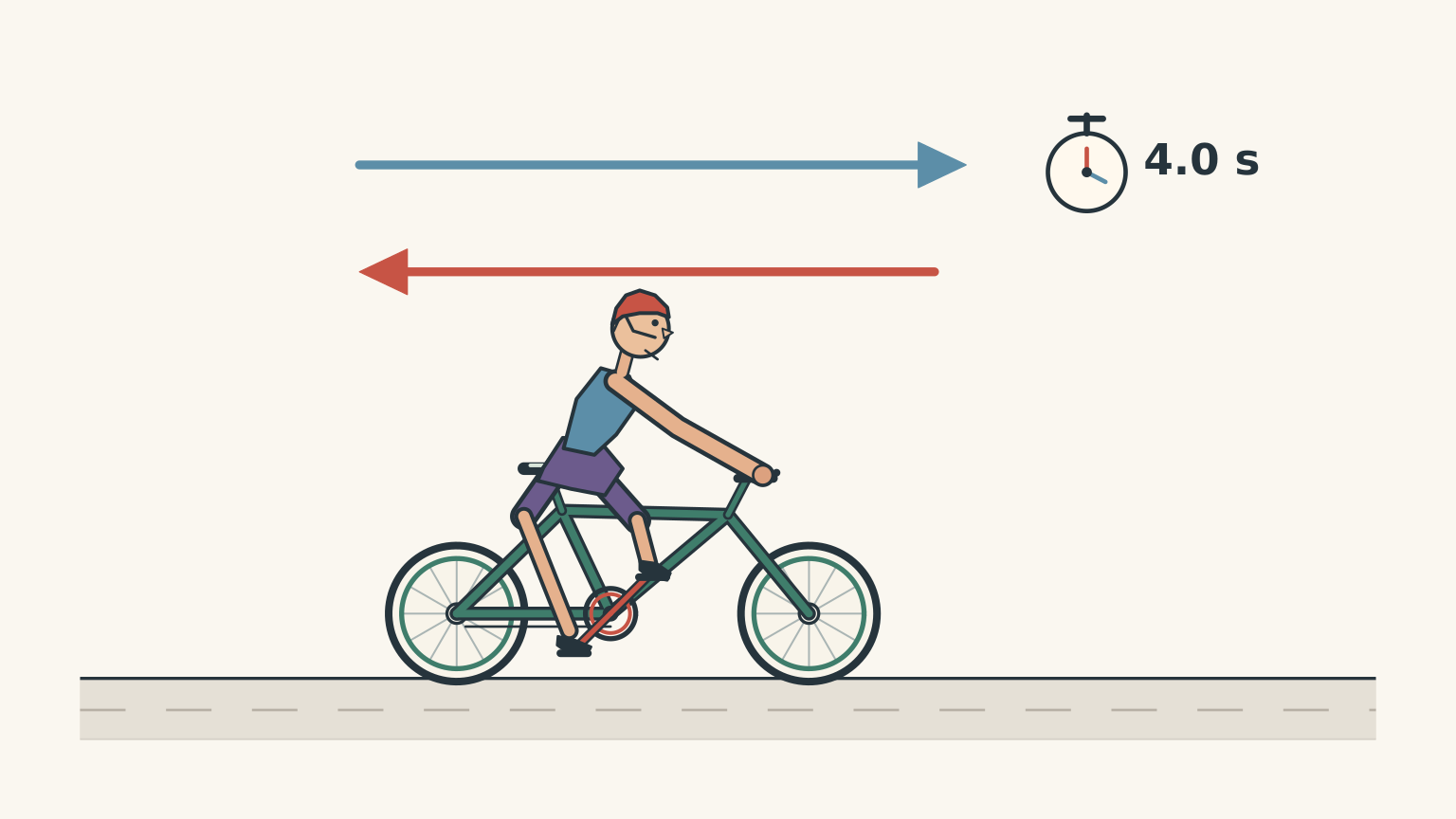
Due to technical limitations, this figure may display incorrectly or contain inaccuracies. Please check key details against your course materials.
Solution 2
The cyclist’s final velocity is \(2.0\,\mathrm{m\,s^{-1}}\) east, so the cyclist has not reversed direction.
The important detail is that acceleration points west, opposite to our chosen positive direction.
Step 1: Assign the correct signs.
Since east is positive:
\[ u=+8.0\,\mathrm{m\,s^{-1}} \]
\[ a=-1.5\,\mathrm{m\,s^{-2}} \]
\[ t=4.0\,\mathrm{s} \]
Step 2: Select the appropriate equation.
We know initial velocity, acceleration, and time.
Use:
\[ v=u+at \]
Step 3: Substitute the values.
\[ \begin{aligned} v&=8.0+(-1.5)(4.0)\\ &=8.0-6.0\\ &=+2.0\,\mathrm{m\,s^{-1}} \end{aligned} \]
Step 4: Interpret the sign.
The final velocity is positive, so the cyclist is still travelling east.
The cyclist is slowing down, but has not yet stopped or reversed direction.
In fact, the time needed to reach zero velocity would be:
\[ t=\frac{0-8.0}{-1.5} =5.33\,\mathrm{s} \]
Since the acceleration only acts for four seconds, the cyclist has not reached the turning point.
The tempting mistake is to treat acceleration as a positive magnitude simply because its numerical value is positive.
Your notes should distinguish between the magnitude of acceleration and its signed value. The sign depends on the coordinate system you choose.
Question 3
A \(2.0\,\mathrm{kg}\) block rests on a horizontal surface.
A horizontal force of \(10\,\mathrm{N}\) acts on the block towards the right, while friction acts towards the left with a magnitude of \(4.0\,\mathrm{N}\).
Assume the vertical forces balance.
Calculate the block’s horizontal acceleration and explain why using \(10\,\mathrm{N}\) directly in \(F=ma\) gives an incorrect result.
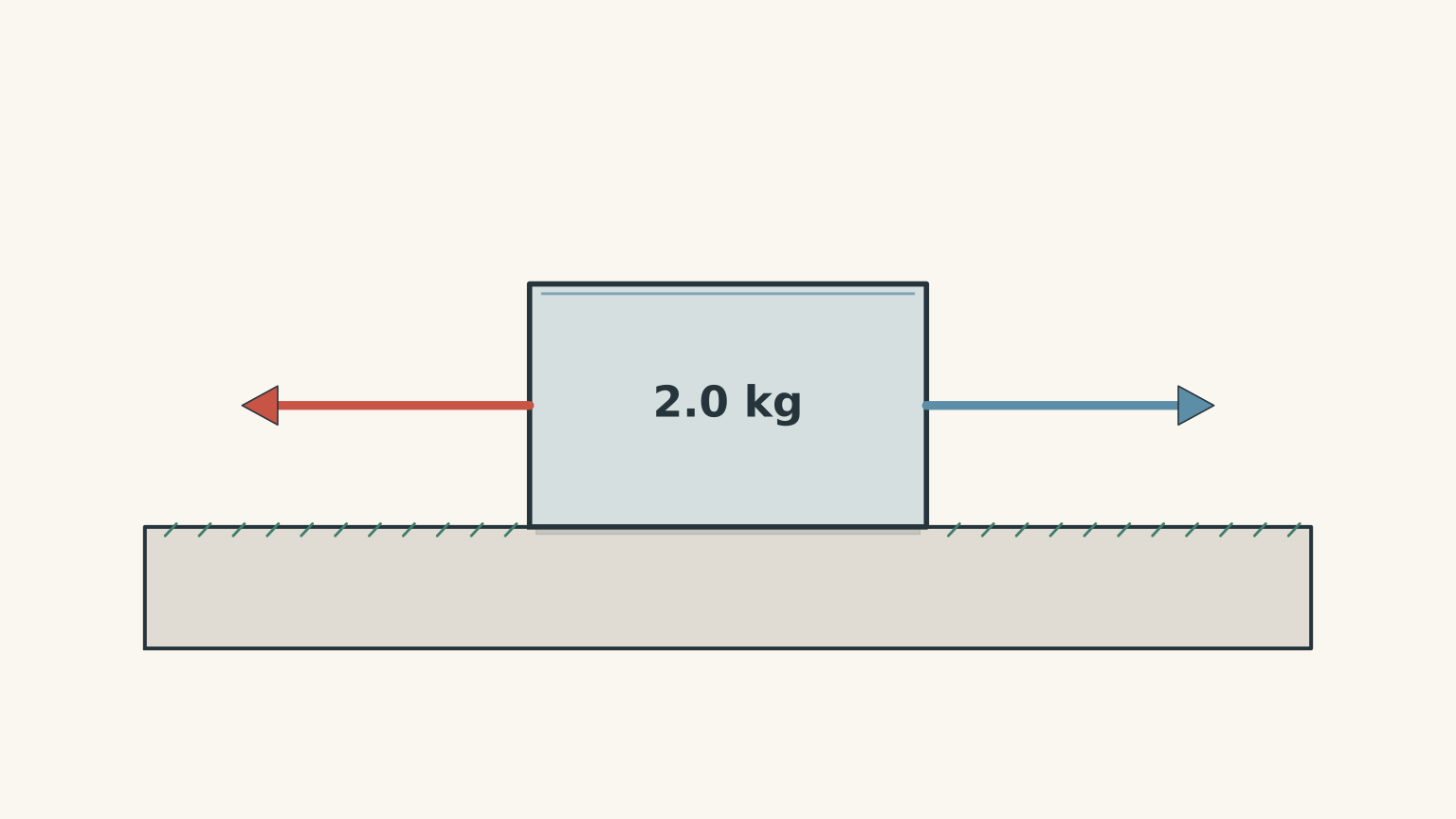
Due to technical limitations, this figure may display incorrectly or contain inaccuracies. Please check key details against your course materials.
Solution 3
The block accelerates at \(3.0\,\mathrm{m\,s^{-2}}\) to the right.
The important principle is Newton’s second law: the acceleration of an object is determined by the resultant external force acting on it, not by one individual force.
Step 1: Identify the forces acting horizontally.
The applied force acts to the right:
\[ F_{\mathrm{applied}}=10\,\mathrm{N} \]
Friction acts to the left:
\[ F_{\mathrm{friction}}=4.0\,\mathrm{N} \]
Step 2: Calculate the resultant horizontal force.
Choose right as positive.
\[ \begin{aligned} F_{\mathrm{net}}&=10-4.0\\ &=6.0\,\mathrm{N} \end{aligned} \]
The resultant force is \(6.0\,\mathrm{N}\) to the right.
The vertical forces balance, so there is no vertical acceleration.
Step 3: Apply Newton’s second law.
\[ F_{\mathrm{net}}=ma \]
Rearrange:
\[ a=\frac{F_{\mathrm{net}}}{m} \]
Substitute:
\[ \begin{aligned} a&=\frac{6.0}{2.0}\\ &=3.0\,\mathrm{m\,s^{-2}} \end{aligned} \]
Therefore:
\[ \boxed{a=3.0\,\mathrm{m\,s^{-2}}\text{ right}} \]
Step 4: Understand the mistake.
Using the applied force alone would give:
\[ a=\frac{10}{2.0} =5.0\,\mathrm{m\,s^{-2}} \]
This is incorrect because it ignores friction.
Newton’s second law relates acceleration to the net force, so every relevant external force must be included.
Your notes should therefore include a decision cue:
Before using \(F=ma\), identify the object or system and calculate the resultant external force.
A free-body diagram is an excellent way to organise this information.
Question 4
A cyclist travels east at an initial velocity of \(12\,\mathrm{m\,s^{-1}}\).
The cyclist experiences a constant acceleration of \(2.0\,\mathrm{m\,s^{-2}}\) towards the west for eight seconds.
Take east as positive.
Calculate:
a) The cyclist’s final velocity.
b) The total displacement.
c) The total distance travelled.
d) The average velocity and average speed over the eight-second interval.
A student claims that the displacement calculated using one constant-acceleration equation must also equal the total distance travelled.
Explain why this claim is incorrect.
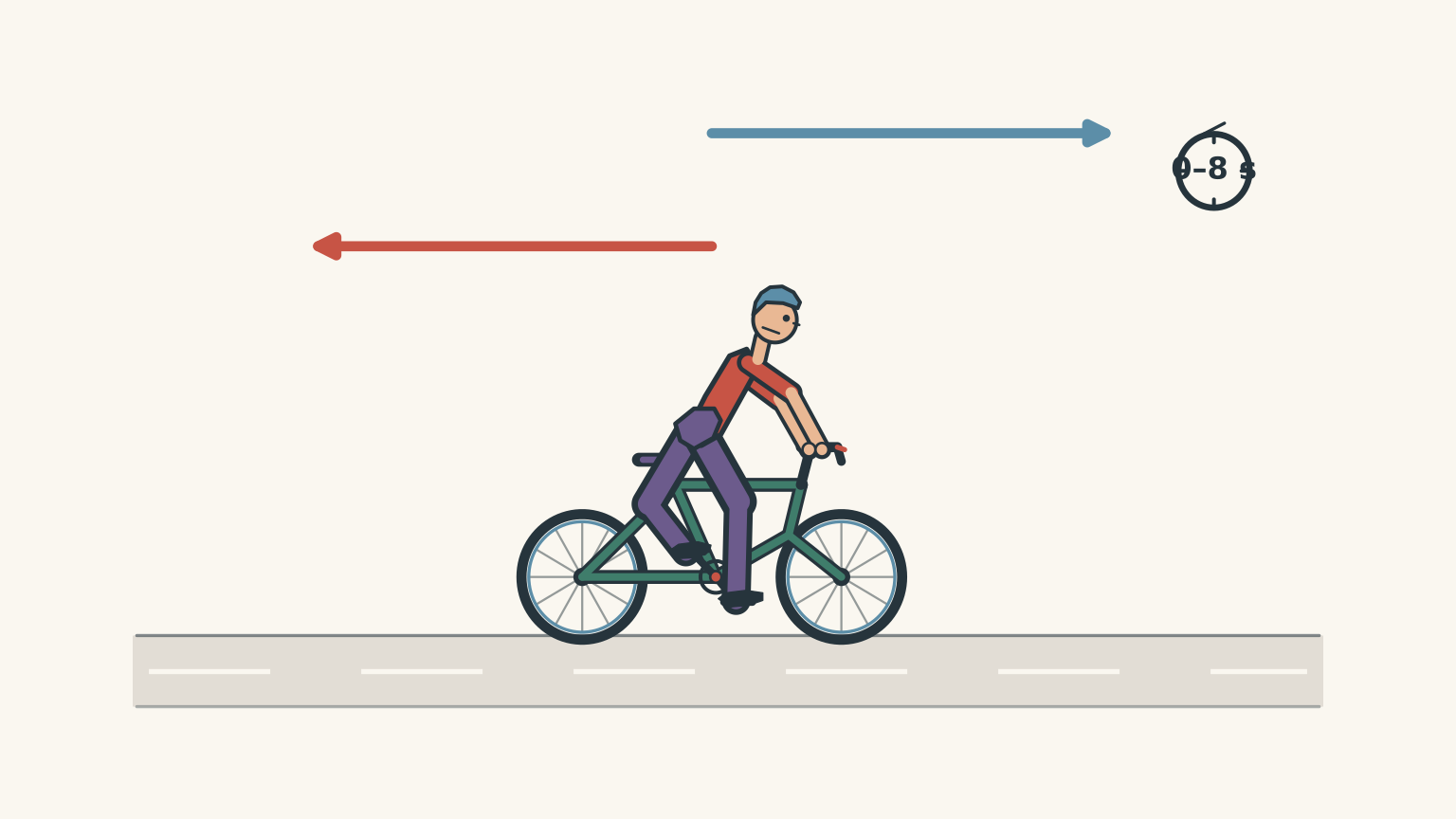
Due to technical limitations, this figure may display incorrectly or contain inaccuracies. Please check key details against your course materials.
Solution 4
The cyclist’s displacement is 32 m east, but the total distance travelled is 40 m.
The difference occurs because the cyclist stops and reverses direction during the eight-second interval.
This is a situation where one equation can calculate the overall displacement, but the total distance requires us to examine the motion more carefully.
Step 1: Establish the signed quantities.
East is positive, so:
\[ u=+12\,\mathrm{m\,s^{-1}} \]
\[ a=-2.0\,\mathrm{m\,s^{-2}} \]
\[ t=8.0\,\mathrm{s} \]
Step 2: Calculate the final velocity.
Use:
\[ v=u+at \]
Substitute:
\[ \begin{aligned} v&=12+(-2.0)(8.0)\\ &=12-16\\ &=-4.0\,\mathrm{m\,s^{-1}} \end{aligned} \]
The negative sign means the cyclist finishes travelling west.
This tells us that the cyclist must have stopped and reversed direction at some point.
Step 3: Determine when the cyclist changes direction.
At the turning point, velocity is zero.
Use:
\[ v=u+at \]
Substitute \(v=0\):
\[ 0=12-2.0t \]
\[ t=6.0\,\mathrm{s} \]
The cyclist travels east for the first six seconds, stops momentarily, and then travels west for the remaining two seconds.
Step 4: Calculate the total displacement.
We can use the constant-acceleration equation across the full eight-second interval:
\[ s=ut+\frac12at^2 \]
Substitute:
\[ \begin{aligned} s&=(12)(8.0)\\ &\quad+\frac12(-2.0)(8.0)^2\\ &=96-64\\ &=32\,\mathrm{m} \end{aligned} \]
Therefore, the displacement is:
\[ \boxed{32\,\mathrm{m}\text{ east}} \]
This is the net change in position.
Step 5: Calculate the total distance travelled.
Here is where the tempting shortcut fails.
The equation in Step 4 calculates displacement, not total distance.
We must separate the journey at the turning point.
During the first six seconds:
\[ \begin{aligned} s_1&=(12)(6.0)\\ &\quad+\frac12(-2.0)(6.0)^2\\ &=72-36\\ &=36\,\mathrm{m} \end{aligned} \]
The cyclist travels 36 m east.
During the remaining two seconds, the cyclist starts from rest and accelerates west.
\[ \begin{aligned} s_2&=0+\frac12(-2.0)(2.0)^2\\ &=-4.0\,\mathrm{m} \end{aligned} \]
The cyclist travels 4.0 m west.
Total distance is the sum of the lengths of both parts of the journey:
\[ \begin{aligned} d&=36+4.0\\ &=40\,\mathrm{m} \end{aligned} \]
Therefore:
\[ \boxed{d=40\,\mathrm{m}} \]
Step 6: Calculate average velocity and average speed.
Average velocity is total displacement divided by elapsed time:
\[ \begin{aligned} v_{\mathrm{avg}}&=\frac{32}{8.0}\\ &=4.0\,\mathrm{m\,s^{-1}} \end{aligned} \]
It is \(4.0\,\mathrm{m\,s^{-1}}\) east.
Average speed is total distance divided by elapsed time:
\[ \begin{aligned} \text{Average speed}&=\frac{40}{8.0}\\ &=5.0\,\mathrm{m\,s^{-1}} \end{aligned} \]
The results are:
| Quantity | Answer |
|---|---|
| Final velocity | \(4.0\,\mathrm{m\,s^{-1}}\) west |
| Total displacement | \(32\,\mathrm{m}\) east |
| Total distance | \(40\,\mathrm{m}\) |
| Average velocity | \(4.0\,\mathrm{m\,s^{-1}}\) east |
| Average speed | \(5.0\,\mathrm{m\,s^{-1}}\) |
The key lesson is that the constant-acceleration equation gives net displacement over the interval. It does not automatically give total distance.
When an object reverses direction, you need to identify the turning point and calculate the distance travelled in each direction separately.
This is exactly the kind of boundary case worth adding to your revision notes.
09The notes worth keeping
A useful Physics revision page should make it easier to answer five questions:
- What physical process is happening?
- Which assumptions allow me to use this model?
- What diagram, graph, or representation will help me understand the situation?
- Which equation or physical principle connects the information given to what I need?
- How can I check that my result is physically reasonable?
If your notes only contain definitions and equations, they’re probably missing the most important part: the reasoning that connects a question to its solution.
Keep your explanations concise, include useful diagrams, record the mistakes you actually make, and practise retrieving the information without looking at the page.
Once you can recognise the model and its limitations, you can start combining concepts in more demanding questions.
For your next step, work on applying the same decision-making process to more specialised problems:
- How to Solve Multi-Stage Motion Questions in HSC Physics – practise identifying when a question needs to be separated into different stages.
- Which Physics Constants Should You Use in HSC Questions? – improve your ability to select and justify the constants used in calculations.
- How to Solve Relativity Questions Using Time, Distance and Speed – practise identifying the relevant reference frame and interpreting measured quantities.
The goal is simple: when you open your revision notebook, you should be able to use it to work out what to do next, even when the question looks completely unfamiliar.