
Diastereomers: How 3D Structure Changes Physical Properties
Learn how diastereomers differ from enantiomers and why different three-dimensional molecular arrangements can produce different physical properties. Explore cis-trans isomerism, multiple stereocentres, meso compounds, and worked examples. This is an extension topic beyond the required HSC Chemistry syllabus.
Two samples of 1,2-dichloroethene have exactly the same molecular formula, C₂H₂Cl₂, and the same atoms connected in the same order. Yet one boils at 60.3 °C, while the other boils at 47.5 °C.
How can moving atoms into a different arrangement change the boiling point by almost 13 °C without changing the molecule’s connectivity?
The answer lies in three-dimensional molecular structure. These two compounds are examples of diastereomers: stereoisomers that are not mirror images of each other.
This article extends beyond the required Year 12 Organic Chemistry syllabus. The 2025 syllabus provides the foundation through molecular structure, geometric isomerism, intermolecular forces, boiling points, and combustibility. The formal classification of stereoisomers into enantiomers and diastereomers, particularly when molecules have multiple stereocentres, takes that knowledge further. This is enrichment material, not an additional HSC assessment requirement.
Due to technical limitations, this figure may display incorrectly or contain inaccuracies. Please check key details against your course materials.
01Start with the physical properties you already know
In Year 12 Chemistry, you learn that molecular structure affects physical properties.
Consider three organic compounds: an alcohol, a carboxylic acid, and an ester. Their functional groups affect their polarity and the intermolecular forces between their molecules.
These forces influence properties such as boiling point, volatility, and solubility.
They also help explain combustibility. A liquid fuel generally needs to produce vapour that can mix with oxygen before combustion can occur. A more volatile liquid can produce vapour more readily, which can influence how easily it ignites.
For similarly sized molecules:
- Alcohols can form hydrogen bonds with one another because they contain an O-H group.
- Carboxylic acids form particularly strong intermolecular associations, including hydrogen-bonded dimers (pairs of molecules).
- Esters can accept hydrogen bonds from suitable molecules, but cannot donate hydrogen bonds to other ester molecules because they lack an O-H bond.
These differences influence boiling points and volatility, which in turn influence the availability of fuel vapour.
However, don’t treat boiling point as a complete measure of combustibility. Molecular composition, flash point, oxygen availability, and other conditions also matter. The amount of energy released during combustion is a separate consideration.
Now make one change to this model.
Instead of changing the functional group, keep the molecular formula and connectivity identical. Change only the arrangement of the atoms in space.
Can the intermolecular forces change?
Yes. The arrangement of polar bonds can change the overall molecular dipole, while the shape of the molecule can affect how molecules pack together.
This is the key idea behind the physical properties of diastereomers.
02What exactly is a diastereomer?
First, distinguish between two different ways molecules can be isomers.
Constitutional isomers have the same molecular formula but different connectivity. Their atoms are joined in different arrangements.
Stereoisomers have the same molecular formula and the same connectivity, but differ in the three-dimensional arrangement of their atoms.
Stereoisomers can be divided into two important categories.
| Type | Relationship between molecules |
|---|---|
| Enantiomers | Non-superimposable mirror images |
| Diastereomers | Stereoisomers that are not mirror images |
The International Union of Pure and Applied Chemistry (IUPAC) defines diastereoisomerism as stereoisomerism other than enantiomerism. IUPAC Gold Book: Diastereoisomerism.
The distinction is about the relationship between two particular molecules.
Two molecules are either enantiomers or diastereomers, provided they are stereoisomers of each other.
A useful way to picture this is to compare two pairs of shoes.
- A left shoe and its corresponding right shoe are mirror images that cannot be superimposed. This illustrates enantiomers.
- Two different left shoes are not mirror images of each other. They illustrate the relationship between diastereomers.
The analogy is only about the geometric relationship. Actual molecular stereochemistry also depends on bond connectivity and the arrangement of individual atoms.
03Example 1: Cis and trans isomers are diastereomers
You may already recognise geometric isomerism in alkenes.
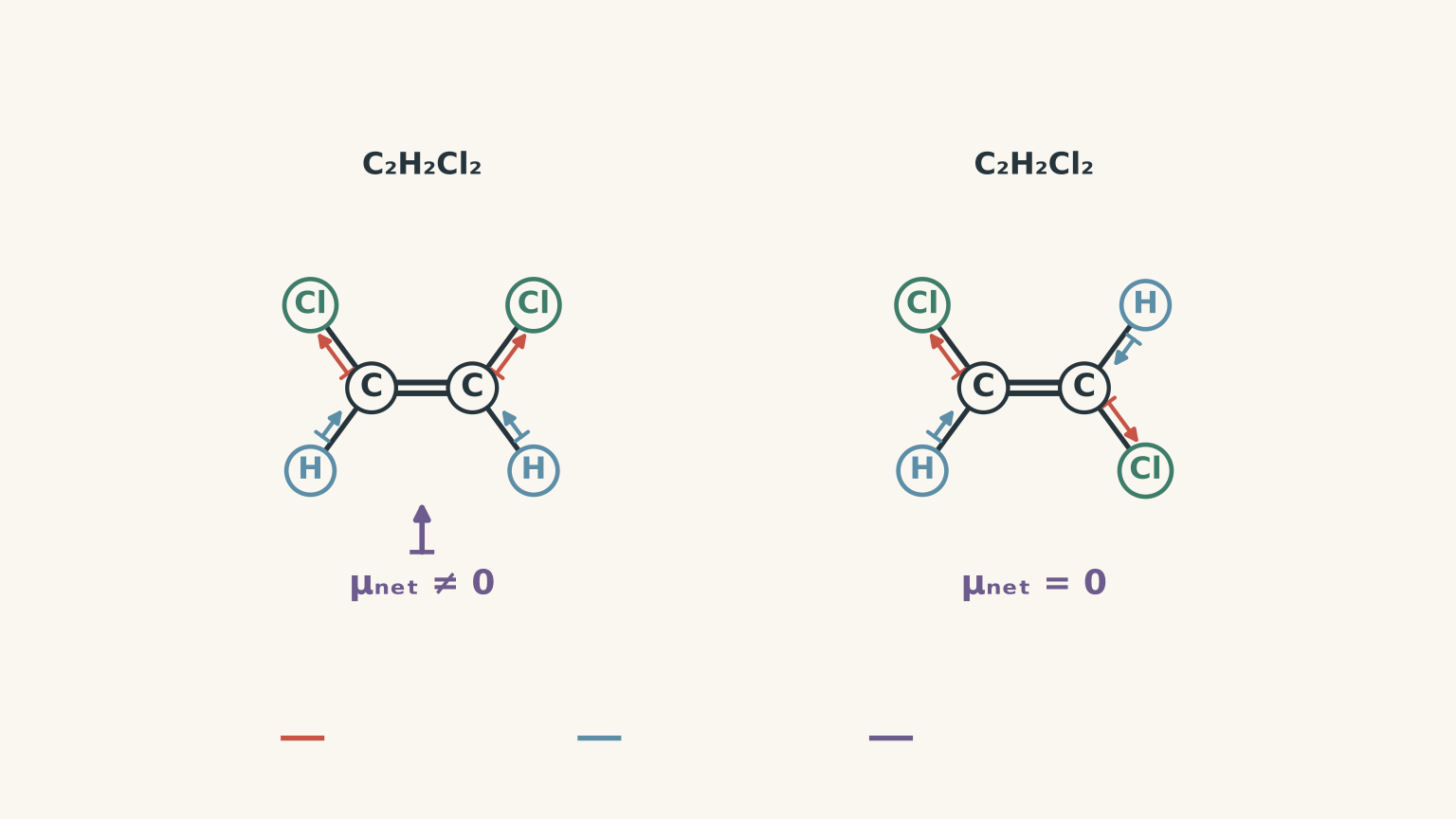
Consider 1,2-dichloroethene, which has the molecular formula C₂H₂Cl₂.
Its carbon-carbon double bond restricts rotation. Each carbon is attached to one hydrogen and one chlorine atom, so two different spatial arrangements are possible.
Cis-1,2-dichloroethene
Both chlorine atoms are on the same side of the double bond.
Trans-1,2-dichloroethene
The chlorine atoms are on opposite sides of the double bond.
These structures have identical connectivity, but their spatial arrangements differ.
They are not mirror images of each other. Therefore, they are diastereomers.
Why does the arrangement change the boiling point?
Look at the polarity of each molecule.
A C-Cl bond is polar because chlorine attracts the shared electrons more strongly than carbon.
A molecule’s overall dipole moment depends on the vector sum of its individual bond dipoles.
In the cis isomer, the two C-Cl bond dipoles point broadly towards the same side of the molecule. They reinforce each other, producing a net molecular dipole.
In the trans isomer, the molecular symmetry means the two bond dipoles cancel.
The trans molecule therefore has no net dipole moment, even though its individual C-Cl bonds remain polar.
The difference affects intermolecular forces.
Both isomers experience London dispersion forces. However, cis-1,2-dichloroethene also experiences permanent dipole-dipole attractions.
Its molecules therefore experience stronger overall attractions in the liquid under comparable conditions.
More energy is needed to separate them into the gas phase.
Consequently, the cis isomer has the higher boiling point.
Experimental reference data from the World Health Organization gives:
| Physical property | Cis isomer | Trans isomer |
|---|---|---|
| Molecular formula | C₂H₂Cl₂ | C₂H₂Cl₂ |
| Boiling point at 760 mmHg | 60.3 °C | 47.5 °C |
| Melting point | −80.5 °C | −50.0 °C |
| Vapour pressure at 25 °C | 27.7 kPa | 35.3 kPa |
Source: WHO, 1,2-Dichloroethene in Drinking-water.
Worked example: Explaining a boiling-point difference
Question
Cis-1,2-dichloroethene boils at 60.3 °C, while trans-1,2-dichloroethene boils at 47.5 °C.
Calculate the difference in boiling point and explain the molecular reason for this difference.
Step 1
Both isomers have the same molecular formula, molar mass, and bond connectivity.
The difference in boiling point cannot be explained by a difference in molecular mass or functional groups.
Step 2
The cis arrangement produces a net molecular dipole because the C-Cl bond dipoles reinforce each other.
The trans arrangement produces no net molecular dipole because the bond dipoles cancel.
Step 3
The cis isomer experiences dipole-dipole attractions as well as London dispersion forces.
The trans isomer experiences London dispersion forces but no permanent dipole-dipole attractions.
Stronger attractions in the cis liquid mean more energy is needed to separate its molecules.
Step 4
\[ \begin{aligned} \Delta T_b &= T_{b,\mathrm{cis}}-T_{b,\mathrm{trans}}\\ &=60.3-47.5\\ &=\boxed{12.8\,^\circ\mathrm C} \end{aligned} \]
Here, \(T_b\) represents boiling point and \(\Delta T_b\) represents the difference between the two boiling points.
Step 5
Cis-1,2-dichloroethene boils 12.8 °C higher than its trans counterpart.
The important point is that changing molecular geometry can alter intermolecular attractions without changing molecular formula or connectivity.
04An interesting complication: Melting points can behave differently
Look again at the physical-property table.
Cis-1,2-dichloroethene has the higher boiling point.
But trans-1,2-dichloroethene has the higher melting point.
Why?
You might initially predict that the cis isomer should have both the higher melting point and the higher boiling point because it has stronger intermolecular attractions.
That prediction overlooks an important difference between melting and boiling.
Boiling involves separating molecules from the liquid into the gas phase.
Melting involves disrupting the ordered arrangement of molecules in a solid crystal.
Crystal packing therefore becomes important.
The trans isomer has a more symmetrical molecular shape, allowing it to pack more regularly in its solid crystal structure. This can stabilise the solid and increase its melting point.
The cis isomer has a less symmetrical arrangement and packs less effectively in this particular crystal.
This gives us an important distinction:
- Boiling point is strongly influenced by intermolecular attractions in the liquid.
- Melting point depends on both intermolecular attractions and how effectively molecules pack in the solid.
There is no universal rule that every trans isomer has a higher melting point than its cis counterpart. This is an explanation of the particular molecular pair above.
05Diastereomers with multiple stereocentres
Geometric isomerism is one way to produce diastereomers.
Another involves molecules containing multiple stereocentres.
A stereocentre is an atom at which exchanging two attached groups produces a different stereoisomer. A common example is a tetrahedral carbon attached to four different groups.
You may already know how to assign these carbons an R or S configuration using the Cahn-Ingold-Prelog (CIP) priority rules.
For a molecule with two stereocentres, we can describe its configuration using two labels.
For example:
- (2R,3R) means carbon 2 has an R configuration and carbon 3 also has an R configuration.
- (2R,3S) means carbon 2 has an R configuration and carbon 3 has an S configuration.
- (2S,3S) means both stereocentres have S configurations.
The numbers identify the positions of the stereocentres in the carbon chain.
The important skill is comparing the configurations at corresponding stereocentres.
The classification rule:
- If the configurations are opposite at every corresponding stereocentre, the molecules are enantiomers.
- If the configurations are the same at some stereocentres but different at others, the molecules are diastereomers.
This is a useful shortcut, provided the molecules have the same connectivity and the stereocentres have been correctly identified.
Worked example: Classifying two stereoisomers
Question
Two stereoisomers of 2,3-dichlorobutane have the configurations (2R,3R) and (2R,3S).
Determine their relationship.
Step 1
Both molecules have an R configuration at carbon 2.
Their arrangements at this stereocentre are identical.
Step 2
The first molecule has an R configuration, while the second has an S configuration.
Their arrangements at this stereocentre are different.
Step 3
For two molecules to be enantiomers, their configurations must be opposite at every corresponding stereocentre.
Here, only one of the two stereocentres has been inverted.
The molecules are therefore not mirror images.
Step 4
The molecules are diastereomers.
They have the same connectivity, the same configuration at carbon 2, and opposite configurations at carbon 3.
This difference in spatial arrangement can produce different physical properties.
06A special case: Meso compounds
There is another complication worth understanding.
A molecule can contain stereocentres but still be achiral overall.
Consider 2,3-dichlorobutane.
It has two stereocentres, so the simple calculation for the maximum number of stereoisomers is:
\[ 2^n \]
where \(n\) is the number of independent stereocentres.
For two stereocentres:
\[ 2^2=4 \]
You might therefore predict four distinct stereoisomers.
However, 2,3-dichlorobutane has identical groups at both ends of its carbon chain. This gives one arrangement an internal plane of symmetry.
That arrangement is called a meso compound.
A meso compound contains stereocentres but is achiral because its mirror image is superimposable on the original molecule.
For 2,3-dichlorobutane, the four theoretical configurations reduce to three distinct stereoisomers:
| Configuration | Relationship |
|---|---|
| (2R,3R) | Enantiomer of (2S,3S) |
| (2S,3S) | Enantiomer of (2R,3R) |
| (2R,3S) | Meso form, identical to (2S,3R) |
The (2R,3S) and (2S,3R) descriptions represent the same meso compound because of the molecule’s internal symmetry.
This is why the maximum \(2^n\) rule does not always give the actual number of distinct stereoisomers.
Symmetry can reduce the total.
The meso compound is also important because it demonstrates that not every diastereomer is chiral.
A meso compound is a single achiral molecule, not a mixture of two enantiomers.
07How do diastereomers differ from enantiomers physically?
Now we can connect stereochemical relationships directly to physical properties.
Enantiomers and diastereomers behave differently in an ordinary, achiral environment.
An achiral environment is one that does not have handedness, such as a typical non-chiral solvent or an ordinary distillation apparatus.
| Property | Enantiomers | Diastereomers |
|---|---|---|
| Mirror-image relationship | Yes | No |
| Molecular connectivity | Identical | Identical |
| Melting point | Identical in an achiral environment | Often different |
| Boiling point | Identical in an achiral environment | Often different |
| Density | Identical in an achiral environment | Can differ |
| Solubility in achiral solvents | Identical | Can differ |
| Optical rotation | Equal magnitude, opposite directions | No fixed relationship |
| Separation by ordinary physical methods | Generally cannot separate the pair | Often possible |
These differences are supported by university stereochemistry teaching resources, including the University of British Columbia’s discussion of chiral species.
Why do enantiomers have identical physical properties in an achiral environment?
Their structures are mirror images. An ordinary achiral environment interacts with both in equivalent ways.
Diastereomers are different. Their spatial arrangements are not related by reflection, so their shapes and charge distributions can produce different intermolecular interactions.
This can affect:
- Boiling point and volatility.
- Melting point and crystal packing.
- Solubility in different solvents.
- Chromatographic behaviour.
- Rates of some chemical reactions.
This is particularly useful when separating mixtures of organic compounds.
Diastereomers can often be separated using conventional physical techniques because their physical properties differ.
Enantiomers are more difficult to separate. A chiral environment, such as a chiral chromatography column, is generally needed to distinguish them.
Three misconceptions to avoid
1. All stereoisomers are mirror images.
Incorrect. Enantiomers are mirror images. Diastereomers are not.
2. All diastereomers must have different values for every physical property.
Incorrect. Diastereomers generally have different physical properties, but individual properties can sometimes be similar or even coincide. You need experimental evidence before claiming a particular numerical difference.
3. R always means positive optical rotation, and S always means negative optical rotation.
Incorrect. R and S describe absolute configuration using the CIP priority system. Positive and negative describe the experimentally observed direction of optical rotation.
There is no universal correspondence between them.
You can revisit Chirality: Chiral Centres, Enantiomers and Optical Activity if you need to refresh the foundations of molecular handedness.
08Questions and solutions
The following questions build from straightforward classification to more involved reasoning about symmetry, physical properties, and optical activity.
Question 1
Two stereoisomers of a molecule have two stereocentres.
Molecule A has the configuration (2R,3R).
Molecule B has the configuration (2R,3S).
Classify the relationship between A and B. Explain how the configurations at the two stereocentres establish your answer.
Solution 1
A and B are diastereomers.
To establish this, compare their configurations at each corresponding stereocentre.
- At carbon 2, both molecules have an R configuration.
- At carbon 3, molecule A has an R configuration, while molecule B has an S configuration.
The molecules therefore have the same configuration at one stereocentre and opposite configurations at the other.
Enantiomers must have opposite configurations at every corresponding stereocentre.
Since that condition is not satisfied, the molecules are not mirror images.
They are diastereomers.
Question 2
The following physical properties are recorded for two stereoisomers of 1,2-dichloroethene.
| Property | Isomer A | Isomer B |
|---|---|---|
| Boiling point | 60.3 °C | 47.5 °C |
| Melting point | −80.5 °C | −50.0 °C |
Isomer A is the cis isomer, and isomer B is the trans isomer.
A student argues:
“Since the cis isomer has stronger intermolecular attractions, it should have both the higher boiling point and the higher melting point.”
Evaluate this prediction. Explain why the experimental results show opposite trends.
Solution 2
The student’s prediction is incorrect. Cis has the higher boiling point, but trans has the higher melting point.
The mistake is assuming that boiling and melting depend on exactly the same physical factors.
For boiling, the important consideration is the energy required to separate molecules from the liquid.
The cis isomer has a net molecular dipole, so its molecules experience dipole-dipole attractions as well as London dispersion forces.
The trans isomer has no net molecular dipole, so it has weaker overall attractions in the liquid.
This explains why cis boils at 60.3 °C, compared with 47.5 °C for trans.
However, melting involves the disruption of a solid crystal structure.
The trans isomer has a more symmetrical shape and can pack more efficiently in its crystal lattice.
This provides a more stable solid arrangement and helps explain its higher melting point of −50.0 °C.
The melting-point difference is:
\[ \begin{aligned} \Delta T_m &=(-50.0)-(-80.5)\\ &=\boxed{30.5\,^\circ\mathrm C} \end{aligned} \]
Here, \(T_m\) represents melting point.
The trans isomer melts 30.5 °C above the cis isomer.
The key distinction is that liquid intermolecular attractions influence boiling, while solid-state packing also plays an important role in melting.
Question 3
2,3-dichlorobutane contains two stereocentres.
A student predicts that it must have four distinct stereoisomers because:
\[ 2^2=4 \]
The four theoretical configurations are:
- (2R,3R)
- (2R,3S)
- (2S,3R)
- (2S,3S)
However, the molecule has identical methyl groups at both ends of its carbon chain.
Determine the actual number of distinct stereoisomers.
Identify the enantiomeric pair and explain the role of molecular symmetry.
Solution 3
There are three distinct stereoisomers, not four.
The calculation \(2^n\) gives the maximum possible number of stereoisomers when there are two independent stereocentres.
The two configurations (2R,3R) and (2S,3S) are non-superimposable mirror images.
They form an enantiomeric pair.
However, the configurations (2R,3S) and (2S,3R) describe the same molecule in this particular case.
Because the molecule has identical ends, it has an internal plane of symmetry in this arrangement.
Its mirror image can therefore be superimposed on the original structure.
This is the meso form.
The three distinct stereoisomers are consequently:
- (2R,3R)
- (2S,3S)
- The meso form, described as (2R,3S) or (2S,3R)
The meso form is a diastereomer of each member of the enantiomeric pair.
The important lesson is that molecular symmetry must be considered before treating \(2^n\) as the actual number of stereoisomers.
Question 4
At 25 °C, the vapour pressures of the two 1,2-dichloroethene isomers are:
| Isomer | Vapour pressure |
|---|---|
| Cis | 27.7 kPa |
| Trans | 35.3 kPa |
A student makes the following prediction:
“The cis isomer is more polar, so its molecules should escape into the gas phase more readily.”
Identify the more volatile isomer and explain why the student’s prediction is incorrect.
Your answer should also be consistent with the measured boiling points of both compounds.
Solution 4
Trans-1,2-dichloroethene is more volatile at 25 °C.
Vapour pressure measures the pressure exerted by vapour above a liquid when the two phases are in equilibrium at a particular temperature.
At the same temperature, a higher vapour pressure indicates that the liquid is more volatile.
The trans isomer has a vapour pressure of 35.3 kPa, compared with 27.7 kPa for the cis isomer.
Therefore, trans is more volatile.
The student’s mistake is assuming that a larger molecular dipole makes molecules escape more readily.
The opposite occurs in this example.
The cis isomer has a net dipole, which produces additional dipole-dipole attractions between its molecules.
These attractions make it harder for molecules to escape from the liquid into the gas phase.
Consequently, cis has the lower vapour pressure and the higher boiling point.
The trans isomer has weaker overall intermolecular attractions, giving it a higher vapour pressure and lower boiling point.
This agrees with the measured boiling points:
- Cis: 60.3 °C.
- Trans: 47.5 °C.
The important relationship is that stronger intermolecular attractions generally reduce volatility at a given temperature.
Question 5
A chemist is studying the stereoisomers of 2,3-dichlorobutane.
Two samples are prepared:
- Sample M: A pure sample of the meso form, (2R,3S).
- Sample R: An equal mixture of (2R,3R) and (2S,3S).
Both samples produce zero optical rotation when tested using plane-polarised light.
A chiral chromatography method produces the following results:
- Sample M produces one peak.
- Sample R produces two peaks of equal area.
A student concludes:
“Both samples have zero optical rotation, so they must contain the same compound. Also, the meso form is an enantiomer of (2R,3R), because only one stereocentre has changed.”
Evaluate both statements.
In your answer:
- Identify why both samples produce zero optical rotation.
- Establish the relationship between the three distinct stereoisomers.
- Explain what the chromatographic results reveal.
- Predict which stereoisomers should have identical physical properties in an achiral environment.
- Explain whether ordinary distillation could separate all three stereoisomers from one another.
Solution 5
The student’s conclusion is incorrect. The two samples are different stereochemical compositions, despite both having zero optical rotation.
This question requires distinguishing between a meso compound and a racemic mixture.
They produce the same optical observation for different reasons.
1. Why are both samples optically inactive?
Sample M contains the pure meso form.
Its internal plane of symmetry makes the molecule achiral. It therefore does not rotate plane-polarised light.
Sample R contains equal quantities of two enantiomers:
- (2R,3R)
- (2S,3S)
These molecules rotate plane-polarised light by equal magnitudes in opposite directions.
Because they are present in equal amounts, their optical rotations cancel.
A 1:1 mixture of enantiomers is called a racemic mixture or racemate.
Both samples therefore produce zero net optical rotation, but for different structural reasons.
2. What are the relationships between the three stereoisomers?
There are three distinct stereoisomers:
| Pair being compared | Relationship |
|---|---|
| (2R,3R) and (2S,3S) | Enantiomers |
| (2R,3R) and (2R,3S) | Diastereomers |
| (2S,3S) and (2R,3S) | Diastereomers |
The meso form differs from each member of the enantiomeric pair at one stereocentre.
It is therefore a diastereomer of both.
The student incorrectly identifies the meso form as an enantiomer of (2R,3R).
For an enantiomeric relationship, both stereocentres would need to be inverted.
The enantiomer of (2R,3R) is (2S,3S), not (2R,3S).
3. What do the chromatographic results reveal?
Sample M produces one peak because it contains one stereoisomer: the meso compound.
Sample R produces two equal-area peaks because it contains two different stereoisomers in equal proportions.
The chiral stationary phase interacts differently with the two enantiomers, allowing them to be separated.
This is important because enantiomers have identical physical properties in an ordinary achiral environment, but can behave differently in a chiral environment.
The chromatogram therefore confirms that Sample R contains two distinguishable enantiomers rather than one meso compound.
4. Which stereoisomers have identical physical properties?
The (2R,3R) and (2S,3S) enantiomers have identical physical properties in an achiral environment.
They have the same melting point, boiling point, density, and solubility in an achiral solvent.
However, the meso form is a diastereomer of each.
Its physical properties may therefore differ from those of either enantiomer.
This is the central distinction being tested.
Zero optical rotation does not establish that two samples have the same molecular structure or physical properties.
5. Could ordinary distillation separate all three stereoisomers?
No.
Ordinary distillation cannot separate the (2R,3R) and (2S,3S) enantiomers because they have identical boiling points in an achiral environment.
However, the meso form is a diastereomer of both.
It may have a different boiling point, allowing it to be separated from the racemic fraction using a suitable physical separation method.
Whether that separation is practically effective depends on the actual boiling-point difference and the behaviour of the mixture.
The crucial distinction is that a racemate contains two enantiomers, while a meso compound is one achiral stereoisomer.
Both can be optically inactive, but they are not the same substance.
09Where this takes you next
Diastereomers show that molecular structure involves more than deciding which atoms are bonded together.
Even when two molecules have identical formulas and connectivity, their three-dimensional arrangements can change molecular polarity, intermolecular attractions, crystal packing, and physical properties.
This extends the structure-property reasoning you already use for alcohols, esters, and carboxylic acids.
The next useful step is to connect stereochemistry with reaction mechanisms. In particular, consider how a reaction can produce one stereoisomer preferentially over another.
That leads to stereoselectivity: the study of why some reactions favour particular three-dimensional arrangements of their products.
It is where understanding diastereomers becomes especially useful for predicting organic reaction products.