
Electronegativity Trends and Bond Polarity for HSC Chemistry
Learn why electronegativity changes across periods and down groups, then use those trends to predict and compare bond polarity.
Two atoms share a pair of electrons, but they do not always share fairly. In an H-F bond, the shared electrons spend much more time near fluorine than hydrogen. In an H-Br bond, the imbalance is smaller.
Before reading on, predict this: which bond should be more polar, H-F or H-Br? Both fluorine and bromine are halogens, so the answer depends on what changes as you move down their group.
The idea that lets us predict this is electronegativity.
01What electronegativity is really describing
Imagine a covalent bond as a tug-of-war over a shared pair of electrons. Both atoms are attached to the same rope, but one atom may pull the electron density closer to itself.
The atom that attracts the shared electrons more strongly has the higher electronegativity.
That picture is useful, but it is not exact. Electrons are not tiny balls being dragged along a rope. A real covalent bond is a region of electron density described by quantum mechanics. The tug-of-war model simply helps us picture an unequal distribution of that electron density.
Electronegativity is therefore:
the ability of an atom in a bond to attract shared electrons towards itself.
The words in a bond matter. Electronegativity describes how an atom behaves when it is bonded to another atom. It is not simply a measurement of how strongly an isolated atom attracts any nearby electron.
The most commonly used values come from the Pauling electronegativity scale. Electronegativity has no unit.
Some useful approximate Pauling values are:
| Element | Electronegativity |
|---|---|
| H | 2.20 |
| C | 2.55 |
| N | 3.04 |
| O | 3.44 |
| F | 3.98 |
| Si | 1.90 |
| P | 2.19 |
| S | 2.58 |
| Cl | 3.16 |
| Br | 2.96 |
You do not need to memorise every decimal value to understand the trend. You do need to understand why the trend occurs.
02Why electronegativity increases across a period
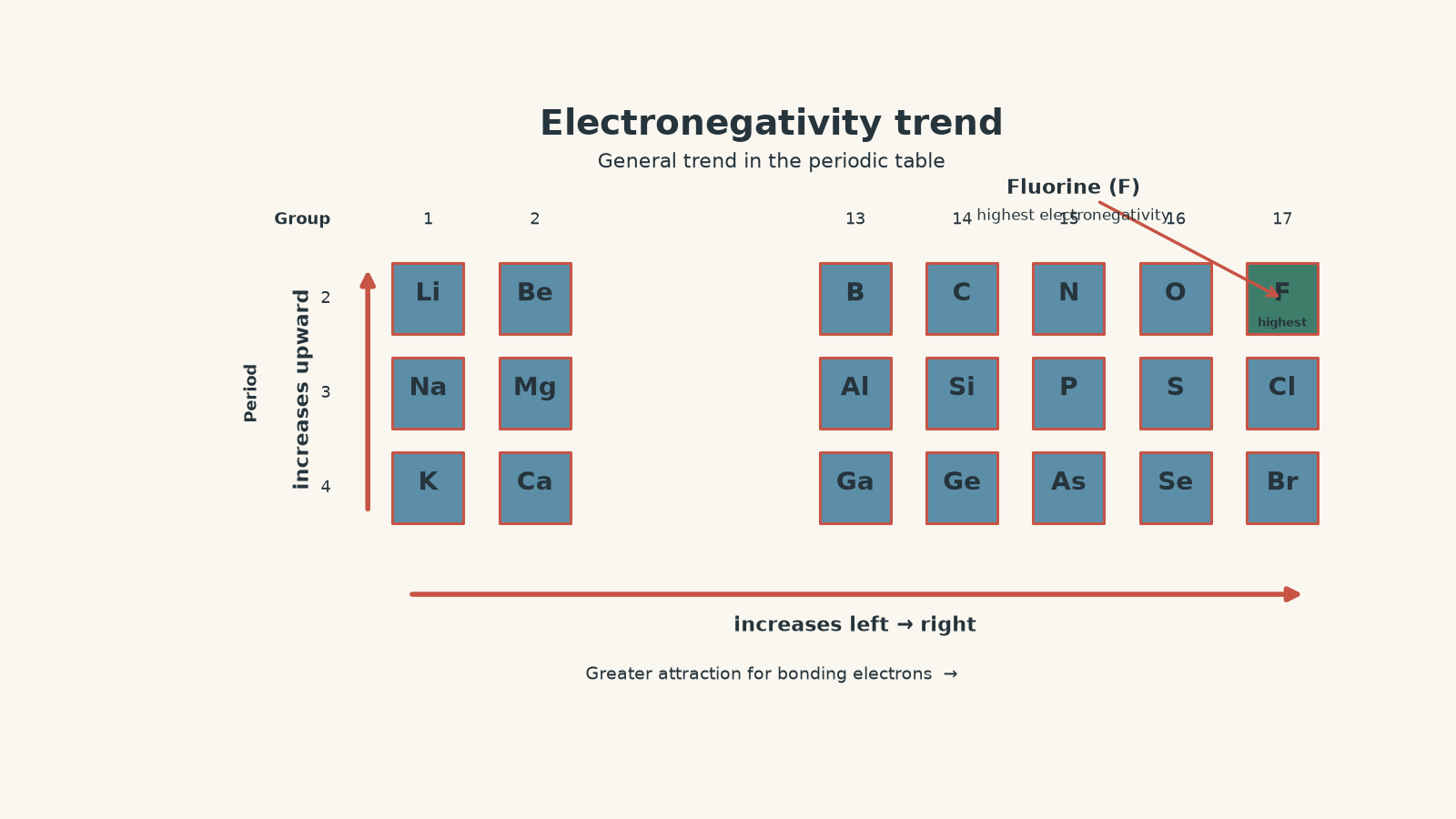
Consider moving from left to right across Period 2, from lithium towards fluorine.
A tempting prediction is that electronegativity might stay roughly constant. After all, every step adds a proton to the nucleus, but it also adds another electron.
That misses one important detail: the added electrons are entering the same principal electron shell.
As you move across a period:
- the number of protons increases
- nuclear charge increases
- additional electrons enter the same main shell
- shielding does not increase very much
- the effective attraction between the nucleus and valence electrons increases
- atomic radius generally decreases
A bonding pair of electrons is therefore attracted more strongly by atoms further to the right.
So, in general:
\[
\text{electronegativity increases from left to right across a period}
\]
Effective nuclear charge is the key idea
Students sometimes explain the trend by saying, “There are more protons, so attraction increases.”
That is incomplete.
If extra protons were the only thing that mattered, electronegativity would keep increasing as you moved down a group too. It does not.
What matters is the attraction actually experienced by the bonding electrons after considering shielding and distance from the nucleus. This is closely related to effective nuclear charge.
Across a period, nuclear charge rises while shielding changes relatively little. The nucleus therefore has a stronger effective pull on bonding electrons.
03Why electronegativity decreases down a group
Now compare fluorine, chlorine, and bromine.
Each step down Group 17 adds more protons. You might therefore predict that bromine should attract bonding electrons more strongly than fluorine.
It does not.
Moving down a group adds an entire electron shell. This causes two important changes.
First, the valence region becomes further from the nucleus. Electrostatic attraction weakens with increasing distance.
Second, the extra inner electrons increase shielding. They reduce the effective attraction between the positive nucleus and electrons involved in bonding.
The increase in distance and shielding outweighs the increase in nuclear charge.
So, in general:
\[
\text{electronegativity decreases down a group}
\]
For the halogens:
\[
\ce{F > Cl > Br}
\]
in electronegativity.
That resolves our opening prediction. H-F is more polar than H-Br because fluorine attracts the bonding electrons more strongly than bromine does.
The two trends together
A useful summary is:
| Movement on the periodic table | Main change | Electronegativity |
|---|---|---|
| Across a period, left to right | Greater effective nuclear attraction, smaller radius | Increases |
| Down a group | More shells, greater shielding, larger radius | Decreases |
This means electronegativity generally increases towards the top-right of the periodic table.
Fluorine is the most electronegative element.
Noble gases are usually left out of the simple trend because many do not commonly form bonds, and electronegativity values are not assigned or used consistently for all of them.
04From electronegativity to bond polarity
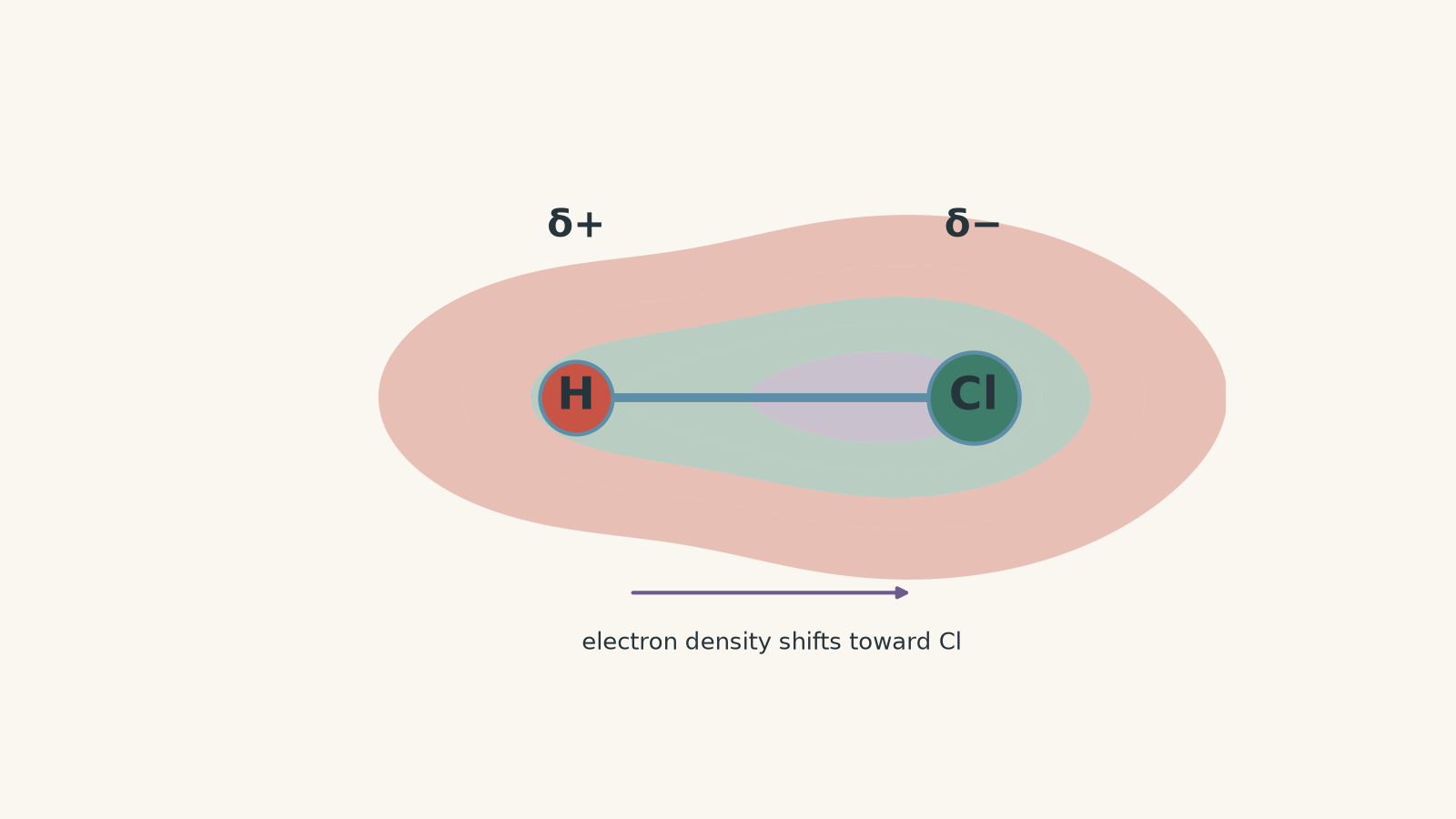
Knowing which atom is more electronegative tells us where the bonding electrons are more likely to be found.
Consider H-Cl.
Chlorine has an electronegativity of about \(3.16\), while hydrogen has an electronegativity of about \(2.20\).
The bonding electrons are pulled towards chlorine.
This gives chlorine a partial negative charge, written \(\delta-\), and hydrogen a partial positive charge, written \(\delta+\):
\[
\ce{H^{\delta+}-Cl^{\delta-}}
\]
These are partial charges, not full ionic charges. The electrons are still being shared, but they are shared unequally.
A covalent bond with unequal electron sharing is called a polar covalent bond.
05Electronegativity difference measures the imbalance
A useful way to compare bond polarities is to calculate the electronegativity difference:
\[
\Delta EN = |EN_1 – EN_2|
\]
where:
- \(\Delta EN\) is the electronegativity difference
- \(EN_1\) is the electronegativity of one bonded atom
- \(EN_2\) is the electronegativity of the other bonded atom
The vertical bars mean take the absolute value, so the answer is positive.
A larger electronegativity difference usually means a greater separation of charge and therefore a more polar bond.
Do not treat particular \(\Delta EN\) cut-offs as laws of nature. Textbooks sometimes divide bonds into “non-polar covalent”, “polar covalent”, and “ionic” using numerical boundaries. Those boundaries are useful rules of thumb, but bonding exists on a continuum.
For HSC questions, the safer reasoning is:
compare the electronegativities, identify which atom attracts the bonding electrons more strongly, and use the size of the difference to compare bond polarity.
Worked example: Which is more polar, C-H or C-F?
Carbon has an electronegativity of \(2.55\), hydrogen \(2.20\), and fluorine \(3.98\). Compare the polarity of a C-H bond with a C-F bond, and identify the partial charges in the more polar bond.
Step 1
\[
\Delta EN_{\ce{C-H}} = |2.55 – 2.20| = 0.35
\]
Step 2
\[
\Delta EN_{\ce{C-F}} = |3.98 – 2.55| = 1.43
\]
Step 3
The C-F bond has the larger electronegativity difference:
\[
1.43 > 0.35
\]
so the C-F bond is more polar.
Step 4
Fluorine is more electronegative than carbon, so the electron density is shifted towards fluorine:
\[
\ce{C^{\delta+}-F^{\delta-}}
\]
The result means that the charge separation in a C-F bond is much greater than in a C-H bond.
06Predicting polarity without exact electronegativity values
You will not always need numerical values.
Suppose you are asked to compare H-F and H-Cl.
Fluorine and chlorine are in the same group. Fluorine is above chlorine, so fluorine is more electronegative.
Hydrogen is unchanged in both bonds. Therefore the electronegativity difference is larger for H-F, making H-F the more polar bond.
Notice the reasoning. You do not need to remember that fluorine is \(3.98\) and chlorine is \(3.16\). The periodic trend is enough.
But be careful when both atoms change. In that situation, a trend alone may not tell you the size of the difference immediately.
Worked example: Compare P-H and P-Cl
Phosphorus has an electronegativity of \(2.19\), hydrogen \(2.20\), and chlorine \(3.16\). Determine which bond is more polar and assign the partial charges.
Step 1
\[
\Delta EN_{\ce{P-H}} = |2.19 – 2.20| = 0.01
\]
The electronegativities are almost identical, so the P-H bond has very little polarity.
Step 2
\[
\Delta EN_{\ce{P-Cl}} = |2.19 – 3.16| = 0.97
\]
Step 3
\[
0.97 > 0.01
\]
The P-Cl bond is therefore much more polar.
Step 4
Chlorine is more electronegative than phosphorus, so:
\[
\ce{P^{\delta+}-Cl^{\delta-}}
\]
The calculation also exposes an important trap. Hydrogen is above phosphorus on the periodic table, but their electronegativities happen to be extremely similar. A rough glance at periodic-table positions is useful, but actual values are better when the comparison is close.
07The misconception that causes most polarity mistakes
A common mistake is to ask:
Which atom has the higher electronegativity?
and then assume that the bond containing that atom must be the most polar.
Bond polarity does not depend on one electronegativity value by itself. It depends on the difference between the two bonded atoms.
For example, compare C-F and Si-F.
Fluorine is the same atom in both bonds. Carbon has an electronegativity of \(2.55\), while silicon has an electronegativity of \(1.90\).
\[
\begin{aligned}
\Delta EN_{\ce{C-F}} &= |3.98 – 2.55| = 1.43 \\
\Delta EN_{\ce{Si-F}} &= |3.98 – 1.90| = 2.08
\end{aligned}
\]
The Si-F bond has the larger electronegativity difference, so it has the greater bond polarity.
Silicon itself is less electronegative than carbon. That is exactly why its difference from fluorine is larger.
Think of two people playing tug-of-war. Knowing that one player is very strong is not enough to predict how one-sided the contest will be. You also need to know the strength of the person on the other end. The analogy breaks because electronegativity is not a literal force measurement, but the comparison captures why the difference matters.
08A reliable method for HSC questions
When a question asks about electronegativity or bond polarity, use this sequence:
- Locate the atoms on the periodic table.
- Apply the trend: electronegativity generally increases across a period and decreases down a group.
- If values are supplied, calculate \(\Delta EN\).
- The more electronegative atom receives \(\delta-\).
- The less electronegative atom receives \(\delta+\).
- A larger \(\Delta EN\) generally means a more polar bond.
- Explain the trend using nuclear charge, shielding, and atomic radius rather than simply stating the trend.
That last step often separates an observation from an explanation.
Saying “chlorine is more electronegative because it is higher in the group” describes the pattern.
Saying “chlorine has fewer occupied electron shells than bromine, so its bonding electrons are closer to the nucleus and experience less shielding” explains the pattern.
09Questions and solutions
Question 1
Oxygen and sulfur are in Group 16. Which element is more electronegative? Explain your answer using atomic structure rather than simply quoting the periodic trend.
Solution 1
Oxygen is more electronegative than sulfur.
Oxygen has fewer occupied electron shells, so bonding electrons are closer to its nucleus and experience less shielding from inner electrons. Sulfur has an additional occupied shell, increasing both atomic radius and electron shielding.
Although sulfur has more protons, the increased distance and shielding reduce the nucleus’s attraction for shared bonding electrons. Oxygen therefore attracts bonding electrons more strongly.
Question 2
Hydrogen has an electronegativity of \(2.20\), and chlorine has an electronegativity of \(3.16\).
Calculate the electronegativity difference in an H-Cl bond and assign the partial positive and partial negative ends.
Solution 2
The electronegativity difference is \(0.96\), with hydrogen as \(\delta+\) and chlorine as \(\delta-\).
The electronegativity difference is:
\[
\Delta EN = |3.16 – 2.20| = 0.96
\]
Chlorine has the higher electronegativity, so it attracts the shared electrons more strongly.
Therefore:
\[
\ce{H^{\delta+}-Cl^{\delta-}}
\]
The bond is polar because the shared electron density is unevenly distributed towards chlorine.
Question 3
Carbon has an electronegativity of \(2.55\), oxygen \(3.44\), and sulfur \(2.58\).
Compare the polarity of a C-O bond with a C-S bond.
Solution 3
The C-O bond is much more polar than the C-S bond.
For C-O:
\[
\Delta EN_{\ce{C-O}} = |3.44 – 2.55| = 0.89
\]
For C-S:
\[
\Delta EN_{\ce{C-S}} = |2.58 – 2.55| = 0.03
\]
Because:
\[
0.89 > 0.03
\]
the C-O bond has a much greater separation of charge.
Oxygen is more electronegative than carbon, so the C-O bond can be represented as:
\[
\ce{C^{\delta+}-O^{\delta-}}
\]
The C-S bond has almost no electronegativity difference on these values.
The tempting mistake is to assume that C-S must be strongly polar because sulfur is a non-metal. Bond polarity depends on the difference in electronegativity, not simply on whether the atoms are metals or non-metals.
Question 4
A student argues:
“Magnesium is more electronegative than sodium, so an Mg-Cl bond must be more polar than a Na-Cl bond.”
Using electronegativities of Na \(=0.93\), Mg \(=1.31\), and Cl \(=3.16\), evaluate the student’s reasoning.
Solution 4
The student’s reasoning is incorrect. The Na-Cl electronegativity difference is larger than the Mg-Cl difference.
For Na-Cl:
\[
\Delta EN_{\ce{Na-Cl}} = |3.16 – 0.93| = 2.23
\]
For Mg-Cl:
\[
\Delta EN_{\ce{Mg-Cl}} = |3.16 – 1.31| = 1.85
\]
Therefore:
\[
2.23 > 1.85
\]
The Na-Cl pair has the greater electronegativity difference.
The student’s mistake is considering only the electronegativity of sodium and magnesium. Bond polarity depends on the difference between both atoms. Increasing the electronegativity of the metal actually makes its value closer to chlorine’s, which reduces \(\Delta EN\).
For compounds such as sodium chloride and magnesium chloride, describing bonding fully also requires discussion of ionic bonding and lattice structure. The electronegativity comparison is useful for showing the tendency towards unequal electron distribution, but a simple “polar covalent bond” model is not the complete description of these solids.
Question 5
Without using numerical electronegativity values, predict the order of bond polarity from greatest to least for:
\[
\ce{H-F},\quad \ce{H-Cl},\quad \ce{H-Br}
\]
Explain your reasoning.
Solution 5
The order of bond polarity is
\[
\ce{H-F > H-Cl > H-Br}
\]
from greatest to least.
Fluorine, chlorine, and bromine are all in Group 17. Electronegativity decreases down the group because additional occupied electron shells increase atomic radius and electron shielding.
Therefore:
\[
EN_{\ce{F}} > EN_{\ce{Cl}} > EN_{\ce{Br}}
\]
Hydrogen is unchanged in all three bonds. As the halogen electronegativity decreases, its electronegativity difference from hydrogen also decreases.
H-F therefore has the greatest bond polarity, while H-Br has the smallest of the three.
A common trap is to focus on bromine having more protons than fluorine. Bromine also has more occupied shells and much greater shielding, so its nucleus attracts bonding electrons less strongly.
Question 6
A student is told only that electronegativity decreases down Group 14. They conclude that a C-F bond must be more polar than a Si-F bond because carbon is more electronegative than silicon.
Using \(EN_{\ce{C}}=2.55\), \(EN_{\ce{Si}}=1.90\), and \(EN_{\ce{F}}=3.98\), determine whether the conclusion is correct and explain why this question cannot be answered by looking at the electronegativity of carbon and silicon alone.
Solution 6
The conclusion is incorrect. The Si-F bond has the larger electronegativity difference and is therefore more polar by this comparison.
For C-F:
\[
\Delta EN_{\ce{C-F}} = |3.98 – 2.55| = 1.43
\]
For Si-F:
\[
\Delta EN_{\ce{Si-F}} = |3.98 – 1.90| = 2.08
\]
Therefore:
\[
2.08 > 1.43
\]
so Si-F has the larger electronegativity difference.
Carbon being more electronegative than silicon does not make C-F more polar. In fact, because carbon’s electronegativity is closer to fluorine’s, the C-F difference is smaller.
The hidden assumption in the student’s reasoning is that “higher electronegativity” and “greater bond polarity” mean the same thing. They do not. Electronegativity is a property assigned to an atom in bonding, while bond polarity depends on the difference between two atoms’ electronegativities.
10What this lets you predict next
Electronegativity gives you the direction and relative size of individual bond dipoles. The next step is to ask what happens when a molecule contains several polar bonds.
Those bond dipoles have directions, so they can reinforce one another or cancel because of molecular shape. That is why a molecule can contain polar bonds but still have no overall molecular dipole.
Understanding electronegativity trends therefore gives you the starting point for predicting molecular polarity, and from there, intermolecular forces, solubility, and many physical properties.