
Enantiomeric Excess: Calculating ee from Optical Rotation
Learn how enantiomeric excess measures the imbalance between two enantiomers and how to calculate it using calibrated optical rotation. Includes worked examples, specific rotation calculations, and challenging practice questions.
Two solutions contain the same chiral compound. A polarimeter gives a reading of +6.0° for the first and +18.0° for the second. Does the second solution contain three times as much of the (+) enantiomer?
Not necessarily. The measured angle also depends on the concentration of the solution and the distance the light travels through it. A more concentrated solution, or a longer sample tube, can produce a larger rotation without changing the proportions of the two enantiomers.
To determine the actual imbalance, we need to compare the measured optical rotation with a calibrated value for a pure enantiomer. This gives us a quantity called enantiomeric excess.
Before continuing, predict what happens when a solution contains exactly 50% of each enantiomer. Will the light rotate, or will the two contributions cancel?
They cancel. Each enantiomer rotates plane-polarised light by the same magnitude, but in the opposite direction. Equal amounts therefore produce zero net rotation.
This article is an extension beyond the required Year 12 Chemistry syllabus content. It builds on the Organic chemistry foundation of the Chemistry 11-12 Syllabus (2025), but enantiomeric excess and its determination using optical rotation are not HSC assessment requirements. The 2025 syllabus is scheduled for implementation for Year 12 in Term 4 of 2028, with its first HSC examination in 2029. Year 12 is the assumed starting level for this article, not an assessment requirement for this topic. NESA syllabus information.
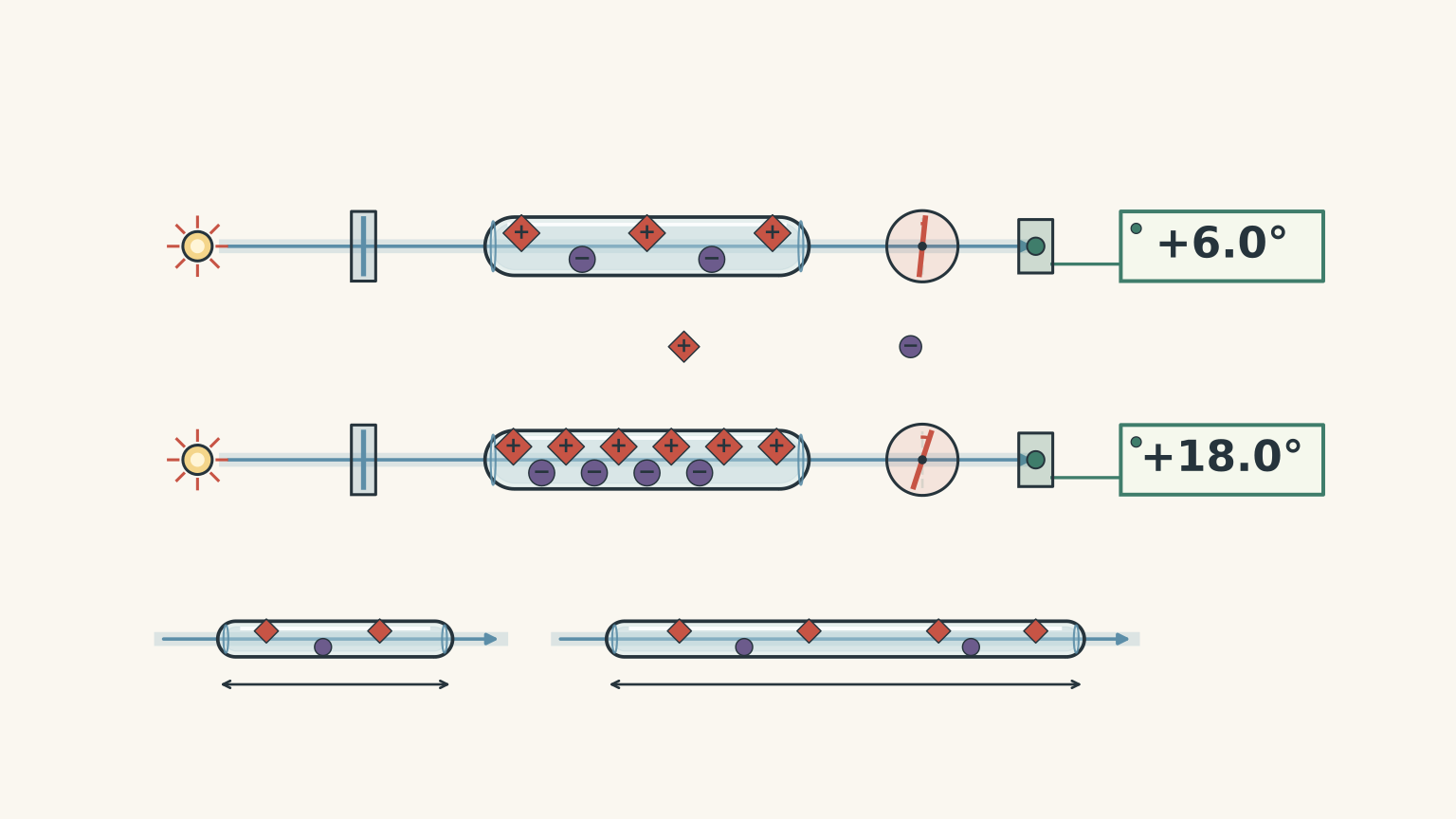
Due to technical limitations, this figure may display incorrectly or contain inaccuracies. Please check key details against your course materials.
01Start with the molecular structure
Before calculating enantiomeric excess, we need to understand what is being counted.
Consider 3-methylhexane, a hydrocarbon with the molecular formula \(\mathrm{C_7H_{16}}\).
We can represent this molecule in several ways.
| Representation | Example or description |
|---|---|
| Molecular formula | \(\mathrm{C_7H_{16}}\) |
| Condensed structural formula | \(\mathrm{CH_3CH_2CH(CH_3)CH_2CH_2CH_3}\) |
| Expanded structural formula | Shows every atom and bond, including the carbon-hydrogen bonds. |
| Skeletal structure | Shows the carbon framework using lines, with carbon atoms and their attached hydrogens implied. |
In 3-methylhexane, carbon 3 is attached to four different groups:
- A hydrogen atom, H
- A methyl group, \(\mathrm{CH_3}\)
- An ethyl group, \(\mathrm{CH_2CH_3}\)
- A propyl group, \(\mathrm{CH_2CH_2CH_3}\)
A local structural representation of this carbon is:
\[ \begin{array}{c} \mathrm{CH_3}\\ |\\ \mathrm{CH_3CH_2-C-CH_2CH_2CH_3}\\ |\\ \mathrm{H} \end{array} \]
The chain groups are condensed here to keep the important carbon visible. A complete expanded structural formula would show every individual bond.
Because carbon 3 has four different attached groups, it is a chiral centre.
Its three-dimensional arrangement is tetrahedral. There are two possible arrangements that are mirror images of each other, and these cannot be superimposed.
These two arrangements are called enantiomers.
The two enantiomers have the same molecular formula and connectivity. They differ in their three-dimensional arrangement.
A molecular formula cannot distinguish them. Even a condensed structural formula or an ordinary skeletal structure is insufficient unless stereochemical information is included.
If you need to revisit how chiral centres and mirror-image molecules work, see Chirality: Chiral Centres, Enantiomers and Optical Activity.
02Why enantiomers cancel each other out
Enantiomers interact differently with plane-polarised light.
When plane-polarised light passes through a solution containing one enantiomer, the plane of polarisation rotates.
- One enantiomer rotates the plane in the positive direction, denoted by \((+)\).
- Its mirror-image enantiomer rotates the plane in the negative direction, denoted by \((-)\).
Under identical conditions, the two enantiomers produce rotations of equal magnitude and opposite sign.
For example, suppose pure enantiomer A produces a rotation of \(+20^\circ\). Pure enantiomer B produces a rotation of \(-20^\circ\).
What happens if we mix equal amounts?
\[ +20^\circ-20^\circ=0^\circ \]
The mixture produces no net optical rotation.
This is called a racemic mixture. It contains equal amounts of two enantiomers.
The cancellation becomes more interesting when the mixture is unequal.
Suppose we have:
- 75% enantiomer A
- 25% enantiomer B
The 25% of B cancels the contribution from 25% of A. This leaves 50% of A’s contribution uncancelled.
The resulting mixture therefore has a net rotation corresponding to 50% of the rotation of pure A.
This difference between the two populations is the central idea behind enantiomeric excess.
03What is enantiomeric excess?
Enantiomeric excess (ee) measures how much more of one enantiomer is present compared with the other, expressed as a percentage of the total mixture.
For two enantiomers, A and B:
\[ ee(\%)= \frac{n_A-n_B}{n_A+n_B}\times100 \]
where:
- \(n_A\) is the amount of enantiomer A, usually measured in moles.
- \(n_B\) is the amount of enantiomer B.
- \(ee\) is the signed enantiomeric excess when A is chosen as the reference enantiomer.
A positive result means A is in excess. A negative result means B is in excess.
The conventional reported ee is the magnitude of this difference, accompanied by the identity of the major enantiomer.
Let’s consider a simple example.
A mixture contains 75% A and 25% B.
\[ ee=\frac{75-25}{75+25}\times100 \]
\[ ee=50\% \]
The mixture has 50% enantiomeric excess in favour of A.
Notice something important: 50% ee does not mean the mixture is 50% A.
It means there is a 50-percentage-point difference between the two enantiomer populations.
The relationship is:
| Major enantiomer | Minor enantiomer | Enantiomeric excess |
|---|---|---|
| 50% | 50% | 0% |
| 60% | 40% | 20% |
| 75% | 25% | 50% |
| 90% | 10% | 80% |
| 100% | 0% | 100% |
Converting ee into the percentage of each enantiomer
There is a useful shortcut when you know the enantiomeric excess and need to calculate the composition.
If the signed excess in favour of A is \(ee_A\), then:
\[ \%A=\frac{100+ee_A}{2} \]
\[ \%B=\frac{100-ee_A}{2} \]
For example, suppose a mixture has 80% ee in favour of A.
\[ \%A=\frac{100+80}{2}=90\% \]
\[ \%B=\frac{100-80}{2}=10\% \]
The mixture contains 90% A and 10% B.
This relationship works because the two enantiomers must account for the entire mixture.
04Measuring enantiomeric excess using optical rotation
So far, we have calculated ee using the known amounts of each enantiomer.
In practice, we may not know those amounts. Instead, we can use a polarimeter to measure optical rotation.
A polarimeter measures the angle through which a sample rotates plane-polarised light.
Its basic operation involves:
- A light source producing unpolarised light.
- A polariser producing plane-polarised light.
- A sample tube containing the solution.
- An analyser and detector measuring the resulting rotation.
The polarimeter gives us an observed rotation, represented by \(\alpha_{\mathrm{obs}}\).
However, this value depends on several factors:
- The concentration of the solution.
- The length of the sample tube.
- The wavelength of light.
- The temperature.
- The solvent used.
This means that an observed rotation cannot automatically be compared with a value from a different experimental setup.
We first need to account for the concentration and path length.
Specific rotation
The quantity used to standardise optical rotation is called specific rotation, represented by \([\alpha]\).
For a solution, we use:
\[ [\alpha]_{\lambda}^{T} = \frac{\alpha_{\mathrm{obs}}}{lc} \]
where:
- \([\alpha]_{\lambda}^{T}\) is the specific rotation at temperature \(T\) and wavelength \(\lambda\).
- \(\alpha_{\mathrm{obs}}\) is the observed rotation, measured in degrees.
- \(l\) is the sample tube length, measured in decimetres (dm).
- \(c\) is the concentration of the substance in grams per millilitre (g/mL).
- \(T\) is the temperature.
- \(\lambda\) is the wavelength of light.
With this concentration convention, specific rotation has units of degrees mL g\(^{-1}\) dm\(^{-1}\).
Some references use concentration in grams per 100 mL instead. In that convention, the equation includes a factor of 100. Always check which concentration convention is being used.
Specific rotation allows us to compare samples with different concentrations and path lengths, provided the relevant experimental conditions are controlled. Its dependence on temperature, wavelength, and solvent must also be considered. University of Utah Valley teaching material; California Institute of Technology, Basic Principles of Organic Chemistry.
Connecting specific rotation to ee
Here is the important relationship.
Suppose pure enantiomer A has a specific rotation of:
\[ [\alpha]_{A,\mathrm{pure}}=+24^\circ \]
Its mirror-image enantiomer B must have:
\[ [\alpha]_{B,\mathrm{pure}}=-24^\circ \]
Now imagine a mixture containing both.
The overall specific rotation depends on the relative amounts of A and B.
If A accounts for 75% and B accounts for 25%, then:
\[ [\alpha]_{\mathrm{mix}} = 0.75(+24)+0.25(-24) \]
\[ [\alpha]_{\mathrm{mix}}=+12^\circ \]
The mixture has half the specific rotation of pure A.
This happens because the contributions from the two enantiomers oppose each other.
More generally, if \(x_A\) and \(x_B\) are the fractions of A and B in the mixture:
\[ [\alpha]_{\mathrm{mix}} = x_A[\alpha]_{A,\mathrm{pure}} + x_B[\alpha]_{B,\mathrm{pure}} \]
Since the pure enantiomers have equal and opposite specific rotations:
\[ [\alpha]_{\mathrm{mix}} = (x_A-x_B)[\alpha]_{A,\mathrm{pure}} \]
Therefore:
\[ \boxed{ ee_A(\%)= \frac{[\alpha]_{\mathrm{mix}}} {[\alpha]_{A,\mathrm{pure}}} \times100 } \]
This is the key equation for calculating enantiomeric excess from calibrated optical rotation.
The sign tells us which enantiomer is in excess. The magnitude tells us how large the excess is.
Because enantiomers have identical molar masses, their relative mass fractions and mole fractions are equal.
When can we use this equation?
The equation is powerful, but it has conditions.
For the calculation to be valid:
- The sample must contain only the two enantiomers of the compound being analysed, unless contributions from other optically active substances are independently accounted for.
- The pure-enantiomer reference and unknown mixture must be measured using the same wavelength.
- The temperature and solvent must match.
- The chemical form of the compound must be the same.
- The concentration must refer to the compound being analysed, rather than the total mass of a sample containing unrelated substances.
- The solution must behave sufficiently close to the linear model used in the calculation. If specific rotation changes with concentration, the calibration must account for that dependence.
An achiral impurity does not contribute its own optical rotation, but it can dilute the compound being measured. A second chiral substance can contribute its own rotation, potentially increasing or decreasing the observed angle.
This distinction becomes important when interpreting real measurements.
05Worked example 1: Calculate ee from the amounts of two enantiomers
A mixture contains 3.6 mmol of enantiomer A and 2.4 mmol of enantiomer B. Calculate the enantiomeric excess and identify the percentage composition of the mixture.
Step 1
\[ n_{\mathrm{total}}=3.6+2.4 \]
\[ n_{\mathrm{total}}=6.0\text{ mmol} \]
Step 2
\[ n_A-n_B=3.6-2.4 \]
\[ =1.2\text{ mmol} \]
Step 3
\[ ee_A= \frac{3.6-2.4}{3.6+2.4} \times100 \]
\[ ee_A=\frac{1.2}{6.0}\times100 \]
\[ \boxed{ee_A=20\%} \]
Step 4
\[ \%A=\frac{3.6}{6.0}\times100=60\% \]
\[ \%B=\frac{2.4}{6.0}\times100=40\% \]
The mixture contains 60% A and 40% B, giving 20% ee in favour of A.
The important point is that ee measures the difference between the populations, not the percentage of the major enantiomer itself.
06Worked example 2: Calculate ee using a calibrated optical rotation
A pure sample of enantiomer A has a specific rotation of \(+24.0^\circ\) under a particular set of experimental conditions.
An unknown mixture of A and B is placed in a polarimeter. The following measurements are recorded:
- Observed rotation: \(+0.864^\circ\)
- Sample tube length: \(1.50\text{ dm}\)
- Concentration: \(0.0400\text{ g/mL}\)
Calculate the specific rotation of the mixture, its enantiomeric excess, and the percentage composition.
All numerical values here are hypothetical teaching data.
Step 1
Use:
\[ [\alpha]_{\mathrm{mix}} = \frac{\alpha_{\mathrm{obs}}}{lc} \]
Substitute the values:
\[ [\alpha]_{\mathrm{mix}} = \frac{+0.864} {1.50\times0.0400} \]
\[ [\alpha]_{\mathrm{mix}} = \frac{+0.864}{0.0600} \]
\[ \boxed{ [\alpha]_{\mathrm{mix}}=+14.4^\circ } \]
The mixture has a positive specific rotation.
Step 2
The pure A reference has a specific rotation of \(+24.0^\circ\).
\[ ee_A= \frac{[\alpha]_{\mathrm{mix}}} {[\alpha]_{A,\mathrm{pure}}} \times100 \]
\[ ee_A= \frac{+14.4}{+24.0}\times100 \]
\[ \boxed{ee_A=60\%} \]
The mixture has 60% ee in favour of A.
Step 3
\[ \%A=\frac{100+60}{2} \]
\[ \boxed{\%A=80\%} \]
Similarly:
\[ \%B=\frac{100-60}{2} \]
\[ \boxed{\%B=20\%} \]
The final mixture contains 80% A and 20% B.
Notice that we did not directly divide the observed rotation by the pure specific rotation. We first corrected for the concentration and path length.
That is the key difference between an ordinary optical rotation calculation and a calibrated determination of enantiomeric excess.
07Common mistakes to avoid
Before attempting the questions, make sure you can recognise these four traps.
Mistake 1: Treating ee as the percentage of the major enantiomer.
An 80% ee mixture contains 90% of the major enantiomer and 10% of the minor enantiomer. It does not contain 80% of the major enantiomer.
Mistake 2: Assuming positive rotation means R configuration.
The labels R and S describe the three-dimensional arrangement of atoms around a chiral centre. The labels (+) and (−) describe the experimentally observed direction of optical rotation.
There is no universal relationship between them. An R enantiomer may rotate light positively or negatively, depending on the compound. University of British Columbia, ChIRP: Properties of Chiral Species.
Mistake 3: Assuming zero optical rotation always means a racemic mixture.
A racemic mixture has zero net rotation, but so does an achiral substance. Other combinations of optically active substances can also produce zero net rotation through cancellation.
A zero reading alone does not identify the composition.
Mistake 4: Comparing raw observed angles without considering concentration and path length.
A sample that rotates light by \(+10^\circ\) is not necessarily more enantiomerically enriched than one that rotates it by \(+5^\circ\).
You need to account for the experimental conditions before comparing their specific rotations.
08Questions and solutions
The following questions progress from straightforward calculations to more demanding applications of calibrated optical rotation.
Question 1
A sample contains 4.5 mmol of enantiomer A and 1.5 mmol of enantiomer B.
Calculate:
a) The enantiomeric excess of the sample.
b) The percentage composition of each enantiomer.
Solution 1
The sample has 50% ee in favour of A, with a composition of 75% A and 25% B.
Part a: Calculate ee.
First, calculate the total amount:
\[ n_{\mathrm{total}}=4.5+1.5=6.0\text{ mmol} \]
The difference is:
\[ n_A-n_B=4.5-1.5=3.0\text{ mmol} \]
Therefore:
\[ ee_A= \frac{4.5-1.5}{4.5+1.5}\times100 \]
\[ \boxed{ee_A=50\%} \]
Part b: Calculate the composition.
\[ \%A=\frac{4.5}{6.0}\times100 \]
\[ \boxed{\%A=75\%} \]
\[ \%B=\frac{1.5}{6.0}\times100 \]
\[ \boxed{\%B=25\%} \]
The result makes sense because the excess of A is 3.0 mmol, which represents half of the total 6.0 mmol sample.
Question 2
A pure sample of enantiomer A is measured in a polarimeter. It produces an observed rotation of \(+1.20^\circ\) when measured using a sample tube of length \(2.00\text{ dm}\) and a concentration of \(0.0500\text{ g/mL}\).
An unknown mixture of A and B produces an observed rotation of \(-0.252^\circ\) in a sample tube of length \(1.50\text{ dm}\) and a concentration of \(0.0200\text{ g/mL}\).
Both measurements are made at the same temperature, wavelength, and solvent conditions.
Calculate:
a) The specific rotation of pure A.
b) The specific rotation of the unknown mixture.
c) The enantiomeric excess and percentage composition of the unknown mixture.
Solution 2
The unknown mixture contains 85% B and 15% A, giving 70% ee in favour of B.
The negative rotation is important because it tells us that B is the major enantiomer.
Part a: Calculate the specific rotation of pure A.
Use:
\[ [\alpha]_{A,\mathrm{pure}} = \frac{\alpha_{\mathrm{obs}}}{lc} \]
Substitute:
\[ [\alpha]_{A,\mathrm{pure}} = \frac{+1.20}{2.00\times0.0500} \]
\[ =\frac{+1.20}{0.100} \]
\[ \boxed{[\alpha]_{A,\mathrm{pure}}=+12.0^\circ} \]
Part b: Calculate the specific rotation of the unknown mixture.
\[ [\alpha]_{\mathrm{mix}} = \frac{-0.252}{1.50\times0.0200} \]
\[ =\frac{-0.252}{0.0300} \]
\[ \boxed{[\alpha]_{\mathrm{mix}}=-8.40^\circ} \]
The unknown mixture has a negative specific rotation.
Part c: Calculate ee and composition.
Use the pure A reference:
\[ ee_A= \frac{-8.40}{+12.0}\times100 \]
\[ \boxed{ee_A=-70\%} \]
The negative sign indicates that B is in excess.
Therefore, the conventional ee is 70% in favour of B.
Calculate the composition:
\[ \%B=\frac{100+70}{2} \]
\[ \boxed{\%B=85\%} \]
\[ \%A=\frac{100-70}{2} \]
\[ \boxed{\%A=15\%} \]
The important detail is that the two polarimeter readings were taken using different path lengths and concentrations. Comparing \(-0.252^\circ\) directly with \(+1.20^\circ\) would give an incorrect result.
Question 3
A pure sample of enantiomer A has a specific rotation of \(+30.0^\circ\).
An unknown mixture of A and B is measured using a polarimeter. The following measurements are recorded:
- Observed rotation: \(+0.450^\circ\)
- Sample tube length: \(1.00\text{ dm}\)
- Concentration: \(0.0300\text{ g/mL}\)
The mixture is then diluted to a new concentration of \(0.0100\text{ g/mL}\), without changing the relative amounts of A and B. The same sample tube is used.
Calculate:
a) The original specific rotation.
b) The original enantiomeric excess and percentage composition.
c) The new observed rotation after dilution.
d) Explain why the enantiomeric excess does not change during dilution.
Solution 3
The original mixture has 50% ee in favour of A, with 75% A and 25% B. After dilution, the observed rotation decreases to \(+0.150^\circ\), but the ee remains 50%.
Part a: Calculate the original specific rotation.
\[ [\alpha]_{\mathrm{mix}} = \frac{+0.450}{1.00\times0.0300} \]
\[ \boxed{[\alpha]_{\mathrm{mix}}=+15.0^\circ} \]
Part b: Calculate ee and composition.
\[ ee_A= \frac{+15.0}{+30.0}\times100 \]
\[ \boxed{ee_A=50\%} \]
The composition is:
\[ \%A=\frac{100+50}{2}=75\% \]
\[ \%B=\frac{100-50}{2}=25\% \]
Part c: Calculate the new observed rotation.
The composition has not changed, so the specific rotation remains \(+15.0^\circ\) under the stated conditions.
Rearrange the specific rotation equation:
\[ \alpha_{\mathrm{obs}}=[\alpha]_{\mathrm{mix}}lc \]
Substitute the new concentration:
\[ \alpha_{\mathrm{obs}} = 15.0\times1.00\times0.0100 \]
\[ \boxed{\alpha_{\mathrm{obs}}=+0.150^\circ} \]
Part d: Explain the effect of dilution.
Dilution reduces the concentration of both enantiomers by the same factor.
The ratio of A to B therefore remains unchanged.
Although the observed rotation decreases, the relative imbalance between the enantiomers is identical.
This is why a smaller observed angle does not necessarily indicate a lower enantiomeric excess.
Question 4
A chemist has a pure sample of enantiomer A with a recorded specific rotation of \(+24.0^\circ\), measured at \(20^\circ\mathrm{C}\) using ethanol as the solvent and a wavelength of 589 nm.
An unknown mixture of A and B produces a specific rotation of \(+12.0^\circ\) when measured at \(30^\circ\mathrm{C}\), also using ethanol and a wavelength of 589 nm.
A student calculates:
\[ ee=\frac{12.0}{24.0}\times100=50\% \]
The student concludes that the mixture contains 75% A and 25% B.
Evaluate this conclusion. Explain whether the available measurements are sufficient to determine the enantiomeric excess.
Solution 4
The student’s conclusion is not justified because the pure reference and unknown mixture were measured at different temperatures.
The calculation assumes that the specific rotation of pure A is \(+24.0^\circ\) at \(30^\circ\mathrm{C}\). However, the only supplied reference value was measured at \(20^\circ\mathrm{C}\).
Specific rotation can depend on temperature, even when the solvent and wavelength remain unchanged.
Therefore, we cannot assume that the pure A reference still has a specific rotation of \(+24.0^\circ\) at the higher temperature.
To calculate the ee reliably, the chemist needs to measure the pure A reference at \(30^\circ\mathrm{C}\), using the same solvent, wavelength, and relevant concentration conditions as the unknown mixture.
If the pure A reference were confirmed to have a specific rotation of \(+24.0^\circ\) at \(30^\circ\mathrm{C}\), the student’s calculation would be valid:
\[ ee_A=\frac{12.0}{24.0}\times100=50\% \]
However, without that matching calibration, the enantiomeric excess cannot be uniquely determined from the supplied data.
The trap is assuming that specific rotation is completely independent of experimental conditions. It is not.
Question 5
A solution contains two enantiomers, A and B, of a target compound X. It also contains a second chiral compound Y as an impurity.
The following information is available:
| Property | Value |
|---|---|
| Specific rotation of pure A | \(+40.0^\circ\) |
| Specific rotation of pure B | \(-40.0^\circ\) |
| Specific rotation of pure Y | \(-20.0^\circ\) |
| Total concentration of X (A + B) | \(0.0500\text{ g/mL}\) |
| Concentration of Y | \(0.0200\text{ g/mL}\) |
| Sample tube length | \(1.00\text{ dm}\) |
| Total observed rotation | \(0.000^\circ\) |
All specific rotations are measured under identical conditions.
Assume that the solution is sufficiently dilute for the optical rotations of the individual substances to add linearly, that there are no significant interactions between the solutes, and that X and Y are the only substances contributing to optical rotation.
A student argues that the target compound X must be a racemic mixture because the polarimeter gives a reading of zero.
Determine:
a) Whether the student’s conclusion is correct.
b) The specific rotation of the A/B mixture of compound X.
c) The enantiomeric excess of X.
d) The percentage composition of A and B.
Explain why the student’s initial prediction is tempting, and identify the interaction that changes the result.
Solution 5
The student’s conclusion is incorrect. Compound X has 20% ee in favour of A, giving a composition of 60% A and 40% B, even though the total observed rotation is zero.
The key is that the polarimeter measures the combined optical rotation of both X and Y. The impurity Y contributes a negative rotation that cancels the positive rotation from the enantiomer mixture of X.
Part a: Assess the student’s conclusion.
A zero reading would indicate a racemic mixture if the solution contained only the two enantiomers A and B.
However, this solution also contains Y, which is optically active.
Therefore, the total rotation can be zero even when the target compound has an unequal proportion of its enantiomers.
Part b: Calculate the specific rotation of the A/B mixture.
Start by calculating the contribution from Y.
\[ \alpha_Y=[\alpha]_Ylc_Y \]
Substitute:
\[ \alpha_Y=(-20.0)(1.00)(0.0200) \]
\[ \alpha_Y=-0.400^\circ \]
The total observed rotation is zero:
\[ \alpha_{\mathrm{total}} = \alpha_X+\alpha_Y \]
Therefore:
\[ 0.000=\alpha_X-0.400 \]
Rearranging:
\[ \alpha_X=+0.400^\circ \]
Now calculate the specific rotation of the A/B mixture:
\[ [\alpha]_{\mathrm{mix},X} = \frac{\alpha_X}{lc_X} \]
\[ = \frac{+0.400}{1.00\times0.0500} \]
\[ \boxed{[\alpha]_{\mathrm{mix},X}=+8.00^\circ} \]
The target compound X therefore has a positive specific rotation.
Part c: Calculate the enantiomeric excess.
The pure A reference has a specific rotation of \(+40.0^\circ\).
\[ ee_A= \frac{+8.00}{+40.0}\times100 \]
\[ \boxed{ee_A=20\%} \]
The target compound has 20% ee in favour of A.
Part d: Calculate the percentage composition.
\[ \%A=\frac{100+20}{2} \]
\[ \boxed{\%A=60\%} \]
\[ \%B=\frac{100-20}{2} \]
\[ \boxed{\%B=40\%} \]
The target compound contains 60% A and 40% B.
The surprising result is that the polarimeter gives zero even though X is not racemic.
The negative contribution from Y exactly cancels the positive contribution from X.
This is why a polarimeter measures the net optical activity of a solution, not the enantiomeric excess of an individual compound automatically.
A reliable ee calculation requires you to understand everything contributing to the measured rotation.
09Where to go next
Enantiomeric excess tells you how strongly a mixture favours one enantiomer. It does not tell you how that imbalance was produced.
The next useful question is how a chemical reaction creates one enantiomer preferentially. This leads to stereoselective reactions, asymmetric synthesis, and methods for separating enantiomers from racemic mixtures.
Understanding the relationship between molecular structure, reaction pathways, and optical rotation gives you a much clearer picture of how chemists control the three-dimensional structures of organic compounds.