
Endothermic and Exothermic Reactions for HSC Chemistry
Learn how temperature changes reveal energy transfer in combustion and ionic dissolution. Includes calorimetry calculations, common errors, and challenging HSC-style questions.
A student burns ethanol under a beaker of water. The water warms by \(18^\circ\text{C}\). In another experiment, they dissolve a white ionic solid in water, and the temperature drops by \(6^\circ\text{C}\).
Both experiments involve energy transfer. But the temperature change you measure belongs to the surroundings, not directly to the reaction.
Before reading on, predict the signs. If the water gets hotter during combustion, is the reaction gaining energy or losing it? If a solution gets colder while a salt dissolves, where has the missing thermal energy gone?
The useful idea is simple: watch what happens to the surroundings, then work backwards to determine what the chemical system did.
01Start with the energy transfer
Imagine holding a warm mug on a cold morning. Energy moves from the hotter mug to your colder hands. Your hands warming tells you that they have gained thermal energy. The mug must therefore have lost it.
A chemical reaction works the same way.
We usually separate the experiment into:
- the system: the chemicals undergoing the reaction or dissolution
- the surroundings: the water, solution, calorimeter, air, and other material around the system
If the surroundings become warmer, the system has transferred energy to them. The chemical change is exothermic.
If the surroundings become colder, the system has taken energy from them. The chemical change is endothermic.
| Observation in the surroundings | Energy transfer | Classification | Sign of \(\Delta H\) |
|---|---|---|---|
| Temperature increases | System transfers heat to surroundings | Exothermic | Negative |
| Temperature decreases | System absorbs heat from surroundings | Endothermic | Positive |
Here, \(\Delta H\) is the enthalpy change of the process, usually measured in \(\text{kJ mol}^{-1}\).
The sign is from the system’s point of view. That is the detail that causes most mistakes.
If a reaction heats the water, the water has \(q>0\), but the reaction has \(q<0\). Energy has not appeared from nowhere. It has moved from one part of the experiment to another.
02What combustion tells you
Suppose ethanol burns below a metal can containing water.
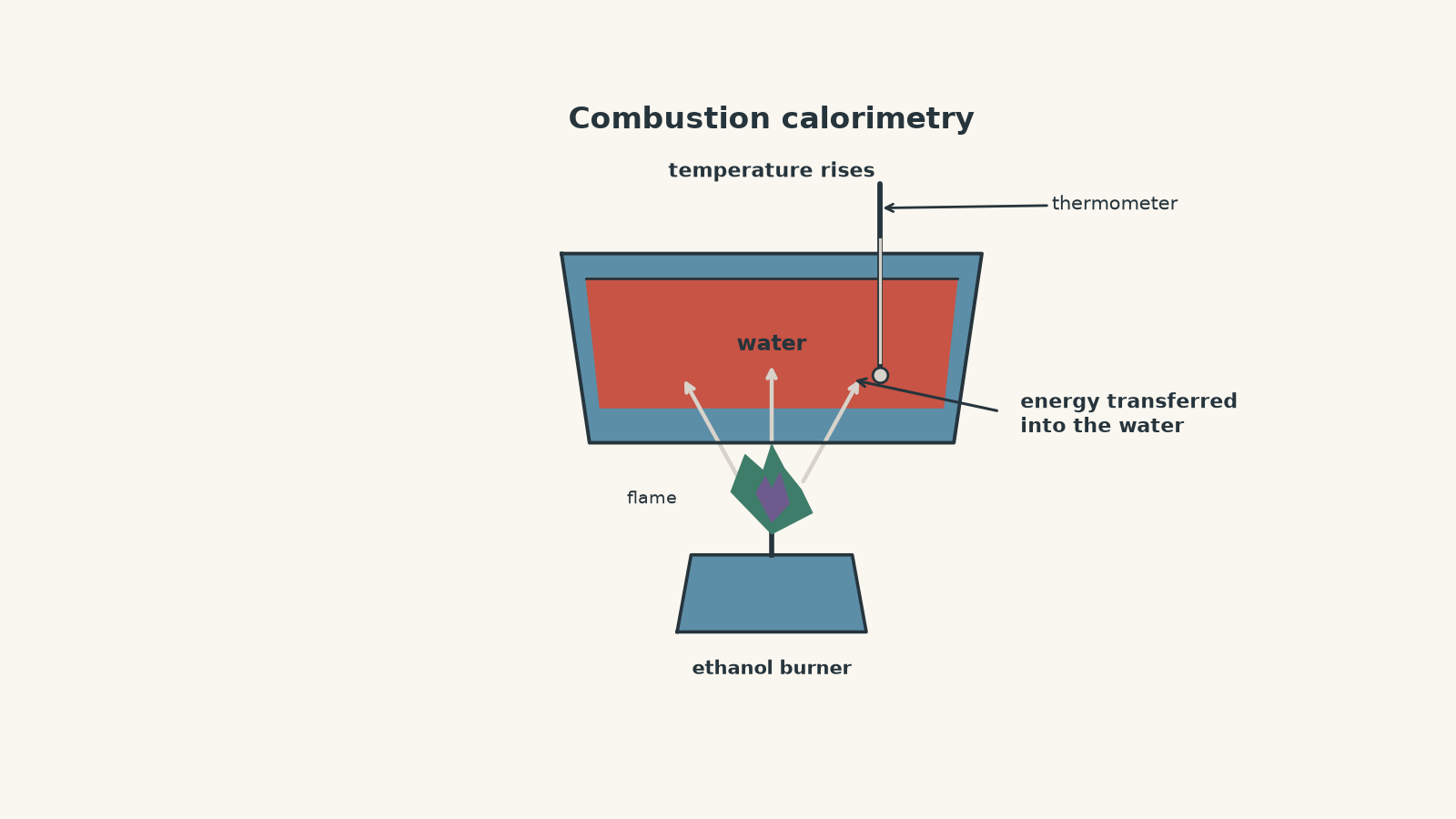
Your first mental model can be:
fuel burns → energy is released → water gains energy → water temperature rises
For ethanol, the combustion reaction can be represented as
\[
\ce{C2H5OH(l) + 3O2(g) -> 2CO2(g) + 3H2O(l)}
\]
Combustion of ethanol is exothermic. Its chemical system transfers energy to its surroundings.
That first model is useful, but incomplete. Not all the released energy reaches the water. Some heats the metal container. Some warms the air. Hot combustion gases escape. Depending on the apparatus, some fuel may evaporate without burning, and combustion may be incomplete.
So the temperature rise lets us estimate the energy released by combustion. A simple school calorimeter does not capture all of it.
Turning a temperature rise into an energy change
For water, the heat absorbed can be estimated using
\[
q=mc\Delta T
\]
where:
- \(q\) is the heat transferred to the water, in joules
- \(m\) is the mass of water, in grams
- \(c\) is the specific heat capacity, in \(\text{J g}^{-1}\text{K}^{-1}\)
- \(\Delta T\) is the temperature change, in \(^\circ\text{C}\) or K
For liquid water, we usually use
\[
c=4.18\ \text{J g}^{-1}\text{K}^{-1}
\]
A temperature difference of \(1^\circ\text{C}\) has the same numerical size as a difference of \(1\text{ K}\), so either unit works for \(\Delta T\).
Notice that \(q=mc\Delta T\) tells you the energy change of the water.
To find the corresponding energy change of the reaction, under the ideal assumption that all reaction heat enters the water,
\[
q_{\text{reaction}}=-q_{\text{water}}
\]
The minus sign is energy conservation doing its job.
Worked example: Burning ethanol to heat water
A student burns \(0.460\text{ g}\) of ethanol beneath \(200.0\text{ g}\) of water. The water temperature rises from \(20.5^\circ\text{C}\) to \(34.0^\circ\text{C}\). Calculate the experimental molar enthalpy of combustion of ethanol. Assume all measured heat is absorbed by the water. The molar mass of ethanol is \(46.07\text{ g mol}^{-1}\).
Step 1
\[
\Delta T=34.0-20.5=13.5^\circ\text{C}
\]
Step 2
\[
\begin{aligned}
q_{\text{water}}&=mc\Delta T\\
&=(200.0)(4.18)(13.5)\\
&=11286\text{ J}\\
&=11.286\text{ kJ}
\end{aligned}
\]
The water gained \(11.286\text{ kJ}\).
Step 3
\[
q_{\text{combustion}}=-11.286\text{ kJ}
\]
The negative sign means ethanol released energy.
Step 4
\[
\begin{aligned}
n&=\frac{m}{M}\\
&=\frac{0.460}{46.07}\\
&=9.98\times10^{-3}\text{ mol}
\end{aligned}
\]
Step 5
\[
\begin{aligned}
\Delta H_c&=\frac{q_{\text{combustion}}}{n}\\
&=\frac{-11.286}{9.98\times10^{-3}}\\
&=-1.13\times10^3\text{ kJ mol}^{-1}
\end{aligned}
\]
So the experimental value is approximately
\[
\Delta H_c=-1.13\times10^3\text{ kJ mol}^{-1}
\]
This means the experiment suggests that one mole of ethanol releases about \(1.13\times10^3\text{ kJ}\) under these experimental conditions.
The word experimental matters. In a simple burner experiment, the measured magnitude is commonly smaller than the true magnitude because not all the released energy reaches the water.
03Ionic solids can warm or cool water
Now replace the burner with an ionic solid.
Suppose you place solid calcium chloride into water and stir. The solid disappears, and the solution becomes warmer.
What actually happened? It is tempting to say, “The bonds in the salt broke, so energy was released.”
That explanation has the energy direction backwards.
Breaking attractive interactions requires energy. Forming attractive interactions releases energy.
For an ionic solid dissolving in water, two important things are happening:
- ions must be separated from the ionic lattice
- water molecules form attractions with the separated ions
For example,
\[
\ce{CaCl2(s) -> Ca^2+(aq) + 2Cl^-(aq)}
\]
The \(\ce{(aq)}\) does not just mean “floating around in water”. It represents ions surrounded and stabilised by water molecules.
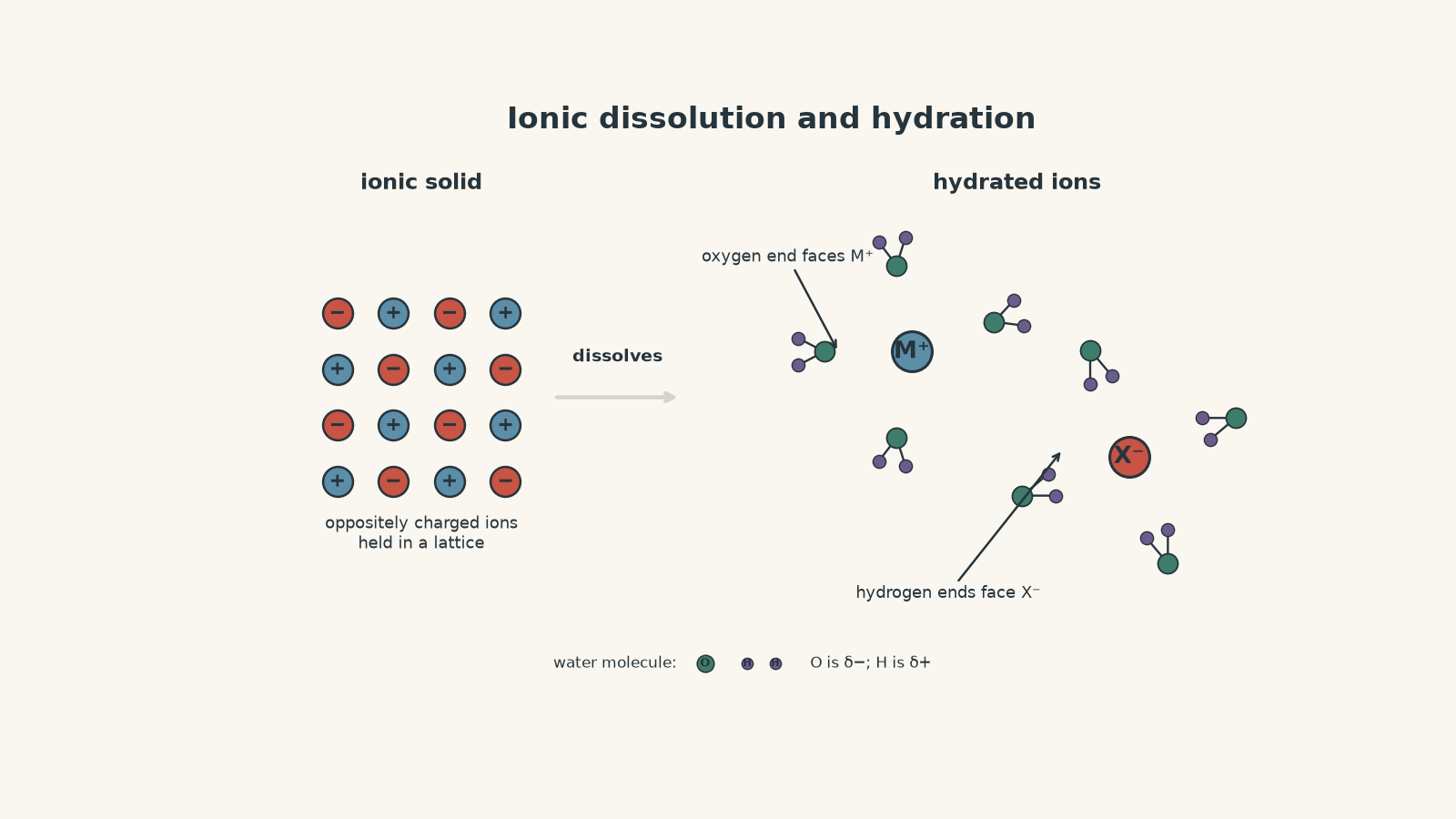
Separating the ions in the crystal requires energy. Hydrating those ions releases energy.
The measured enthalpy of solution depends on the net result.
A useful simplified energy balance is
\[
\Delta H_{\text{solution}}
=
\text{energy required to separate particles}
+
\text{energy released during hydration}
\]
Be careful with the signs. The lattice-separation contribution is positive. Hydration is negative.
If hydration releases more energy than lattice separation requires, then
\[
\Delta H_{\text{solution}}<0
\]
and dissolution is exothermic.
If separating the particles requires more energy than hydration releases, then
\[
\Delta H_{\text{solution}}>0
\]
and dissolution is endothermic.
Think of it like leaving one relationship and immediately starting another. Breaking the original attraction costs energy. Forming the new attractions gives energy back. Whether the whole episode is energetically expensive depends on which effect is larger. The analogy stops there: ions are not reconsidering their life choices, and the actual interactions are electrostatic.
04Measuring the temperature change during dissolution
A common setup uses an insulated polystyrene cup, water, a thermometer or temperature probe, and a measured mass of ionic solid.
The procedure is roughly:
- measure a known mass or volume of water
- record its initial temperature
- add a known mass of ionic solid
- stir so dissolution occurs evenly
- record the highest or lowest temperature reached
Why use a polystyrene cup rather than an open glass beaker?
Because the aim is to reduce energy transfer between the experiment and the external environment. We want the measured temperature change to come mainly from the dissolution process.
Even then, the experiment is not perfectly insulated.
Worked example: An ionic solid cools the solution
A student dissolves \(8.00\text{ g}\) of ammonium nitrate, \(\ce{NH4NO3}\), in \(100.0\text{ g}\) of water. The temperature falls from \(24.0^\circ\text{C}\) to \(18.7^\circ\text{C}\). Estimate the molar enthalpy of solution. Assume the final solution has a specific heat capacity of \(4.18\text{ J g}^{-1}\text{K}^{-1}\), and ignore heat absorbed by the cup. The molar mass of \(\ce{NH4NO3}\) is \(80.04\text{ g mol}^{-1}\).
Step 1
The surroundings – the solution – became colder.
That means the dissolving process took thermal energy from the solution. The dissolution is therefore endothermic, so we expect \(\Delta H_{\text{solution}}>0\).
This sign prediction is worth making first. It catches calculator mistakes later.
Step 2
\[
\Delta T=18.7-24.0=-5.3^\circ\text{C}
\]
Step 3
The dissolved solute is now part of the solution, so
\[
m_{\text{solution}}=100.0+8.00=108.0\text{ g}
\]
Step 4
\[
\begin{aligned}
q_{\text{solution}}&=mc\Delta T\\
&=(108.0)(4.18)(-5.3)\\
&=-2.39\times10^3\text{ J}\\
&=-2.39\text{ kJ}
\end{aligned}
\]
The negative value tells us that the solution lost thermal energy.
Step 5
\[
q_{\text{dissolution}}=-q_{\text{solution}}=+2.39\text{ kJ}
\]
Step 6
\[
\begin{aligned}
n&=\frac{m}{M}\\
&=\frac{8.00}{80.04}\\
&=9.995\times10^{-2}\text{ mol}
\end{aligned}
\]
Step 7
\[
\begin{aligned}
\Delta H_{\text{solution}}
&=\frac{q_{\text{dissolution}}}{n}\\
&=\frac{2.39}{9.995\times10^{-2}}\\
&=+23.9\text{ kJ mol}^{-1}
\end{aligned}
\]
So
\[
\Delta H_{\text{solution}}\approx+23.9\text{ kJ mol}^{-1}
\]
The positive sign agrees with our prediction. Dissolving one mole of ammonium nitrate absorbs about \(23.9\text{ kJ}\) according to this experiment.
05Temperature is evidence, not energy
This distinction is worth slowing down for.
A \(10^\circ\text{C}\) temperature rise does not mean “10 units of heat were released”.
Temperature tells you how the average kinetic energy of particles has changed. The amount of thermal energy transferred also depends on how much material is present and its specific heat capacity.
Heating \(20\text{ g}\) of water by \(10^\circ\text{C}\) requires much less energy than heating \(500\text{ g}\) of water by the same \(10^\circ\text{C}\).
That is why \(q=mc\Delta T\) contains all three quantities.
Suppose two dissolutions each release exactly \(2.0\text{ kJ}\). One occurs in \(50\text{ g}\) of water and the other in \(200\text{ g}\). Should you expect the same temperature rise?
No. The smaller mass should undergo the larger temperature change, assuming the other conditions are comparable.
So “larger temperature rise” does not automatically mean “larger molar enthalpy”.
06The most common sign mistake
Consider an exothermic dissolution.
The solution warms, so
\[
\Delta T_{\text{solution}}>0
\]
and therefore
\[
q_{\text{solution}}>0
\]
A student may stop there and report a positive enthalpy of solution.
But that positive value belongs to the surroundings.
For the chemical process,
\[
q_{\text{dissolution}}=-q_{\text{solution}}
\]
so
\[
q_{\text{dissolution}}<0
\]
and the process is exothermic.
A reliable decision sequence is:
- What happened to the surroundings?
- Did the surroundings gain or lose thermal energy?
- The chemical system did the opposite.
- Assign the sign of \(\Delta H\) to the chemical process.
Do that before touching the calculator.
07What should count as the mass in \(q=mc\Delta T\)?
This depends on what is changing temperature.
In a dissolution experiment, a useful approximation is often
\[
m_{\text{solution}}=m_{\text{water}}+m_{\text{solute}}
\]
because after dissolution, both are part of the material whose temperature is being measured.
In a combustion experiment, if the flame heats only a known mass of water and the apparatus is being ignored, use the mass of the water.
If the calorimeter itself matters, its energy change must be included separately.
For a calorimeter with heat capacity \(C_{\text{cal}}\),
\[
q_{\text{cal}}=C_{\text{cal}}\Delta T
\]
where \(C_{\text{cal}}\) is measured in \(\text{J K}^{-1}\).
The total energy absorbed by the surroundings might then be
\[
q_{\text{surroundings}}
=
mc\Delta T+C_{\text{cal}}\Delta T
\]
and
\[
q_{\text{reaction}}=-q_{\text{surroundings}}
\]
This is more accurate than pretending the calorimeter absorbs no energy.
08Why combustion experiments usually underestimate the magnitude
Suppose a published value for the enthalpy of combustion of a fuel is around \(-1400\text{ kJ mol}^{-1}\), but a simple school experiment gives \(-850\text{ kJ mol}^{-1}\).
Which value represents a larger release of energy?
The \(-1400\text{ kJ mol}^{-1}\) value.
For negative numbers, the more negative value has the larger magnitude.
A simple combustion calorimeter commonly produces a value that is less negative than the accepted value because the calculation assumes
\[
\text{energy released by fuel}=\text{energy absorbed by measured water}
\]
but in reality,
\[
\text{energy released by fuel}
=
\text{energy absorbed by water}
+
\text{energy absorbed elsewhere}
\]
Energy may be transferred to:
- the metal can
- the thermometer
- surrounding air
- the bench or supports
- hot gases leaving the apparatus
Incomplete combustion can also reduce the energy released per mole of fuel consumed, because some carbon may form \(\ce{CO}\) or soot rather than being fully oxidised to \(\ce{CO2}\).
There is another subtle source of error. If a volatile fuel evaporates from the burner between mass measurements, the apparent mass loss is larger than the mass actually combusted. The calculated number of moles “burned” is then too large, making the calculated energy released per mole too small in magnitude.
09Why dissolution results can also be inaccurate
Dissolution calorimetry avoids a flame, but it still has limitations.
If an endothermic dissolution cools the cup below room temperature, energy begins flowing from the warmer room into the cooler experiment. That makes the observed temperature drop smaller than it would be in perfect insulation.
For an exothermic dissolution, the opposite occurs. The warm cup transfers energy to the cooler environment, reducing the observed temperature rise.
Both effects tend to squash the measured temperature change towards room temperature.
Other problems include:
- neglecting the heat capacity of the cup or temperature probe
- assuming every solution has the same specific heat capacity as pure water
- assuming the solution density is exactly \(1.00\text{ g mL}^{-1}\)
- incomplete dissolution
- delayed temperature readings
- splashing or evaporation
- using a solute that has absorbed water from the air before weighing
The important exam habit is not merely naming “heat loss”. State where the energy moves and how that changes the calculated result.
For example:
In an exothermic dissolution, some released energy is transferred from the warm solution to the external environment. The measured temperature rise is therefore too small, so the calculated magnitude of \(\Delta H_{\text{solution}}\) is too small.
That explains the causal chain.
10A deeper model of ionic dissolution
The simple “lattice versus hydration” picture can now be made more precise.
To dissolve an ionic solid, the existing attractions must be rearranged.
For a simplified process:
\[
\ce{MX(s) -> M+(g) + X-(g)}
\]
separating the ionic lattice requires energy.
Then gaseous ions become hydrated:
\[
\ce{M+(g) -> M+(aq)}
\]
and
\[
\ce{X-(g) -> X-(aq)}
\]
Hydration releases energy because ion-dipole attractions form between ions and polar water molecules.
We can represent the overall balance as
\[
\Delta H_{\text{solution}}
=
\Delta H_{\text{lattice separation}}
+
\Delta H_{\text{hydration}}
\]
where the hydration term represents the combined hydration of the ions.
If
\[
|\Delta H_{\text{hydration}}|
>
|\Delta H_{\text{lattice separation}}|
\]
then the negative hydration contribution dominates, and dissolution is exothermic.
If
\[
|\Delta H_{\text{hydration}}|
<
|\Delta H_{\text{lattice separation}}|
\]
then the positive lattice-separation contribution dominates, and dissolution is endothermic.
This explains why you cannot classify every ionic solid’s dissolution just by saying, “ionic attractions are strong”.
Strong ionic attractions may make the lattice difficult to separate, but the ions may also interact very strongly with water. The sign depends on the competition between both effects.
11Questions and solutions
Question 1
A student dissolves \(4.00\text{ g}\) of an ionic solid in \(80.0\text{ g}\) of water. The temperature rises from \(22.4^\circ\text{C}\) to \(27.9^\circ\text{C}\).
Classify the dissolution as endothermic or exothermic, and calculate the heat change of the dissolution. Assume the solution has a specific heat capacity of \(4.18\text{ J g}^{-1}\text{K}^{-1}\) and ignore the calorimeter.
Solution 1
The dissolution is exothermic, and the heat change for the amount dissolved is approximately \(-1.93\text{ kJ}\).
The temperature of the surroundings rose, so the solution gained thermal energy. The dissolving system must therefore have released the same amount.
First find the temperature change:
\[
\Delta T=27.9-22.4=5.5^\circ\text{C}
\]
The total mass of solution is
\[
m=80.0+4.00=84.0\text{ g}
\]
Now calculate the heat gained by the solution:
\[
\begin{aligned}
q_{\text{solution}}
&=mc\Delta T\\
&=(84.0)(4.18)(5.5)\\
&=1931\text{ J}\\
&=1.93\text{ kJ}
\end{aligned}
\]
Therefore,
\[
q_{\text{dissolution}}=-1.93\text{ kJ}
\]
The tempting mistake is to report \(+1.93\text{ kJ}\) because \(\Delta T\) is positive. That value describes the solution. The chemical process has the opposite sign.
Question 2
A student dissolves \(6.00\text{ g}\) of a salt with molar mass \(120.0\text{ g mol}^{-1}\) in \(94.0\text{ g}\) of water inside a calorimeter.
The temperature decreases from \(25.0^\circ\text{C}\) to \(21.0^\circ\text{C}\). The calorimeter has a heat capacity of \(45\text{ J K}^{-1}\). Assume the solution has a specific heat capacity of \(4.18\text{ J g}^{-1}\text{K}^{-1}\).
Calculate the experimental molar enthalpy of solution.
A second student ignores the calorimeter and uses only \(q=mc\Delta T\). Explain whether their calculated value will be too positive, too negative, or unchanged.
Solution 2
The experimental molar enthalpy of solution is approximately \(+37.0\text{ kJ mol}^{-1}\), and ignoring the calorimeter gives a value that is not positive enough, meaning its magnitude is underestimated.
The temperature falls by
\[
\Delta T=21.0-25.0=-4.0^\circ\text{C}
\]
The total mass of solution is
\[
m=94.0+6.00=100.0\text{ g}
\]
The solution loses
\[
\begin{aligned}
q_{\text{solution}}
&=mc\Delta T\\
&=(100.0)(4.18)(-4.0)\\
&=-1672\text{ J}
\end{aligned}
\]
The calorimeter also cools:
\[
\begin{aligned}
q_{\text{cal}}
&=C_{\text{cal}}\Delta T\\
&=(45)(-4.0)\\
&=-180\text{ J}
\end{aligned}
\]
So the total heat change of the measured surroundings is
\[
q_{\text{surroundings}}
=-1672-180
=-1852\text{ J}
\]
The dissolution therefore absorbs
\[
q_{\text{dissolution}}=+1852\text{ J}=+1.852\text{ kJ}
\]
The amount of salt is
\[
\begin{aligned}
n&=\frac{m}{M}\\
&=\frac{6.00}{120.0}\\
&=0.0500\text{ mol}
\end{aligned}
\]
Therefore,
\[
\begin{aligned}
\Delta H_{\text{solution}}
&=\frac{1.852}{0.0500}\\
&=+37.0\text{ kJ mol}^{-1}
\end{aligned}
\]
The second student’s tempting argument is that the cup is only a container, so only the solution matters. But the cup itself changes temperature. Because it cools, it also loses energy to the endothermic dissolution.
Ignoring that contribution gives
\[
q_{\text{surroundings}}=-1672\text{ J}
\]
instead of \(-1852\text{ J}\). The calculated \(\Delta H_{\text{solution}}\) would therefore still be positive, but smaller than it should be.
Question 3
A student burns \(0.600\text{ g}\) of a fuel with molar mass \(60.0\text{ g mol}^{-1}\). The flame heats \(250.0\text{ g}\) of water from \(19.0^\circ\text{C}\) to \(29.0^\circ\text{C}\).
The metal calorimeter also absorbs \(1.20\text{ kJ}\) during the experiment.
Calculate the experimental molar enthalpy of combustion.
The accepted value is \(-1500\text{ kJ mol}^{-1}\). Give two distinct experimental processes that could account for the difference, and for each one explain the direction of its effect.
Solution 3
The experimental molar enthalpy of combustion is approximately \(-1165\text{ kJ mol}^{-1}\). Its magnitude is smaller than the accepted value.
The water temperature rises by
\[
\Delta T=29.0-19.0=10.0^\circ\text{C}
\]
The water absorbs
\[
\begin{aligned}
q_{\text{water}}
&=mc\Delta T\\
&=(250.0)(4.18)(10.0)\\
&=10450\text{ J}\\
&=10.45\text{ kJ}
\end{aligned}
\]
The calorimeter absorbs another \(1.20\text{ kJ}\), so the measured surroundings receive
\[
q_{\text{surroundings}}
=10.45+1.20
=11.65\text{ kJ}
\]
Therefore,
\[
q_{\text{combustion}}=-11.65\text{ kJ}
\]
The amount of fuel burned is
\[
\begin{aligned}
n&=\frac{0.600}{60.0}\\
&=0.0100\text{ mol}
\end{aligned}
\]
Thus,
\[
\begin{aligned}
\Delta H_c
&=\frac{-11.65}{0.0100}\\
&=-1165\text{ kJ mol}^{-1}
\end{aligned}
\]
Two possible explanations for the difference are:
- Energy transfer to the external environment. Some energy heats the air, stand, and other surroundings instead of the measured water and calorimeter. The measured \(q\) is too small, so the calculated \(\Delta H_c\) is less negative than the true value.
- Fuel evaporation without combustion. If the fuel is volatile, part of the measured mass loss may be evaporation rather than burning. The student then calculates too many moles as having combusted. Dividing the measured energy by an amount in moles that is too large makes the calculated \(\text{kJ mol}^{-1}\) too small in magnitude.
Incomplete combustion could also contribute. If some fuel forms \(\ce{CO}\) or carbon rather than being fully oxidised to \(\ce{CO2}\), less energy is released than for complete combustion.
The tempting explanation is simply “experimental error”. That is not enough. Each error must be connected to a physical process and then to its effect on the calculated value.
Question 4
Two salts, A and B, are tested in identical insulated cups.
For salt A, \(0.100\text{ mol}\) is dissolved in \(100\text{ g}\) of water and the temperature rises by \(6.0^\circ\text{C}\).
For salt B, \(0.0500\text{ mol}\) is dissolved in \(200\text{ g}\) of water and the temperature rises by \(4.0^\circ\text{C}\).
A student argues:
“Salt A must have the more exothermic molar enthalpy of solution because it caused the larger temperature rise.”
Assume the mass of each dissolved salt is small enough to neglect, both solutions have \(c=4.18\text{ J g}^{-1}\text{K}^{-1}\), and heat absorbed by the cups is negligible.
Determine which salt has the more negative molar enthalpy of solution. Then explain exactly why temperature change alone gives the wrong comparison.
Solution 4
Salt B has the more negative molar enthalpy of solution: approximately \(-66.9\text{ kJ mol}^{-1}\), compared with \(-25.1\text{ kJ mol}^{-1}\) for salt A.
For salt A,
\[
\begin{aligned}
q_{\text{water,A}}
&=(100)(4.18)(6.0)\\
&=2508\text{ J}\\
&=2.508\text{ kJ}
\end{aligned}
\]
Because the temperature rises,
\[
q_{\text{dissolution,A}}=-2.508\text{ kJ}
\]
for \(0.100\text{ mol}\). Therefore,
\[
\begin{aligned}
\Delta H_{\text{solution,A}}
&=\frac{-2.508}{0.100}\\
&=-25.1\text{ kJ mol}^{-1}
\end{aligned}
\]
For salt B,
\[
\begin{aligned}
q_{\text{water,B}}
&=(200)(4.18)(4.0)\\
&=3344\text{ J}\\
&=3.344\text{ kJ}
\end{aligned}
\]
So
\[
q_{\text{dissolution,B}}=-3.344\text{ kJ}
\]
for only \(0.0500\text{ mol}\).
Therefore,
\[
\begin{aligned}
\Delta H_{\text{solution,B}}
&=\frac{-3.344}{0.0500}\\
&=-66.9\text{ kJ mol}^{-1}
\end{aligned}
\]
The tempting route is to treat temperature rise as though it directly measures the reaction’s molar enthalpy.
It does not.
Salt B heats twice as much water. Raising \(200\text{ g}\) of water by \(4.0^\circ\text{C}\) requires more energy than raising \(100\text{ g}\) by \(6.0^\circ\text{C}\). Salt B also releases that energy from only half as many moles.
The comparison therefore requires both stages:
\[
\Delta T\rightarrow q\rightarrow \frac{q}{n}
\]
Temperature change by itself is not enough.
Question 5
An ionic solid X dissolves endothermically in an insulated calorimeter.
A student places \(0.100\text{ mol}\) of X into water initially at \(25.0^\circ\text{C}\). After complete dissolution, the solution reaches \(20.0^\circ\text{C}\).
Without removing the solution or allowing it to exchange significant energy with the room, the student then uses an electrical heater to raise the solution back to exactly \(25.0^\circ\text{C}\). The heater supplies \(3.50\text{ kJ}\).
A classmate makes this argument:
“The experiment started at \(25.0^\circ\text{C}\) and finished at \(25.0^\circ\text{C}\), so the overall enthalpy change must be zero. The temperature has returned to where it started.”
Assume the heater exactly replaces the thermal energy absorbed during dissolution and that no phase changes occur.
Is the classmate’s conclusion correct? Determine the molar enthalpy of solution of X, and explain why returning to the original temperature does not return the chemical system to its original state.
Solution 5
The classmate’s conclusion is incorrect. The molar enthalpy of solution is \(+35.0\text{ kJ mol}^{-1}\).
The dissolution initially cools the surroundings from \(25.0^\circ\text{C}\) to \(20.0^\circ\text{C}\). That tells us the dissolution absorbs energy, so
\[
\Delta H_{\text{solution}}>0
\]
The electrical heater then supplies \(3.50\text{ kJ}\) to restore the solution to its original temperature.
Under the stated assumption, that \(3.50\text{ kJ}\) replaces the energy that the dissolution had absorbed. Therefore,
\[
q_{\text{dissolution}}=+3.50\text{ kJ}
\]
for \(0.100\text{ mol}\) of X.
Hence,
\[
\begin{aligned}
\Delta H_{\text{solution}}
&=\frac{+3.50}{0.100}\\
&=+35.0\text{ kJ mol}^{-1}
\end{aligned}
\]
The trap is assuming that equal initial and final temperatures mean equal initial and final states.
They do not.
Initially, the system contains solid X and water. Finally, it contains dissolved, hydrated ions in solution. The temperature has returned to \(25.0^\circ\text{C}\), but the chemical composition and particle interactions have changed.
The heater supplied energy after the dissolution. It did not reverse the dissolution.
To return the entire system to its original state, the dissolved ions would need to reform the original solid under appropriate conditions, not merely be warmed.
This is a broader thermochemistry lesson: temperature is only one state variable. Two systems can have the same temperature while having different compositions and different enthalpies.
That idea becomes especially useful when you move beyond simple calorimetry to energy cycles. Instead of asking only whether a beaker warms or cools, you can track energy through several chemical steps and use the fact that enthalpy depends on the initial and final states.