
Functional-Group Interconversion: Reaction Routes Explained
Explore how organic functional groups can be interconverted while preserving carbon frameworks. Learn how oxidation, reduction, esterification, hydrolysis, and selective reduction control the products formed.
Two compounds can have exactly the same molecular formula but behave very differently when they react. Butanoic acid, \(\ce{CH3CH2CH2COOH}\), and methyl propanoate, \(\ce{CH3CH2COOCH3}\), both have the molecular formula \(\ce{C4H8O2}\).
Suppose you hydrolyse methyl propanoate. Do you get butanoic acid?
No. You get propanoic acid and methanol. The ester contains a three-carbon acyl fragment and a one-carbon methoxy fragment, connected through oxygen rather than a carbon-carbon bond.
This small example reveals an important idea: changing a functional group does not necessarily mean changing the carbon framework, but you need to track exactly which parts of the molecule are being retained.
The foundation for this article is the Year 12 organic chemistry knowledge associated with the 2025 syllabus: identifying carboxylic acids and esters, and constructing their functional-group isomers across the stated C1-C8 range.
Functional-group interconversion goes beyond the required syllabus. The reaction pathways in this article are extension chemistry, not an additional list of HSC examinable reactions. Year 12 identifies the assumed starting knowledge, rather than an assessment requirement for these pathways.
01What does it mean to preserve the carbon skeleton?
A functional-group interconversion (FGI) is a reaction that changes one functional group into another.
In the type of transformation we are studying, the aim is to retain the carbon-carbon framework while changing the bonding around a particular carbon atom.
For example, consider these three compounds:
- Butan-1-ol: \(\ce{CH3CH2CH2CH2OH}\)
- Butanal: \(\ce{CH3CH2CH2CHO}\)
- Butanoic acid: \(\ce{CH3CH2CH2COOH}\)
They all contain the same four-carbon chain. What changes is the bonding around the terminal carbon.
A useful way to picture this is to imagine a chain of linked building blocks. The carbon-carbon bonds form the framework, while the functional group acts like a fitting attached to it.
You can change the fitting without rebuilding the chain.
The analogy has one important limitation: an actual chemical reaction involves breaking and forming bonds, not simply swapping labels. You must account for every atom and identify which bonds change.
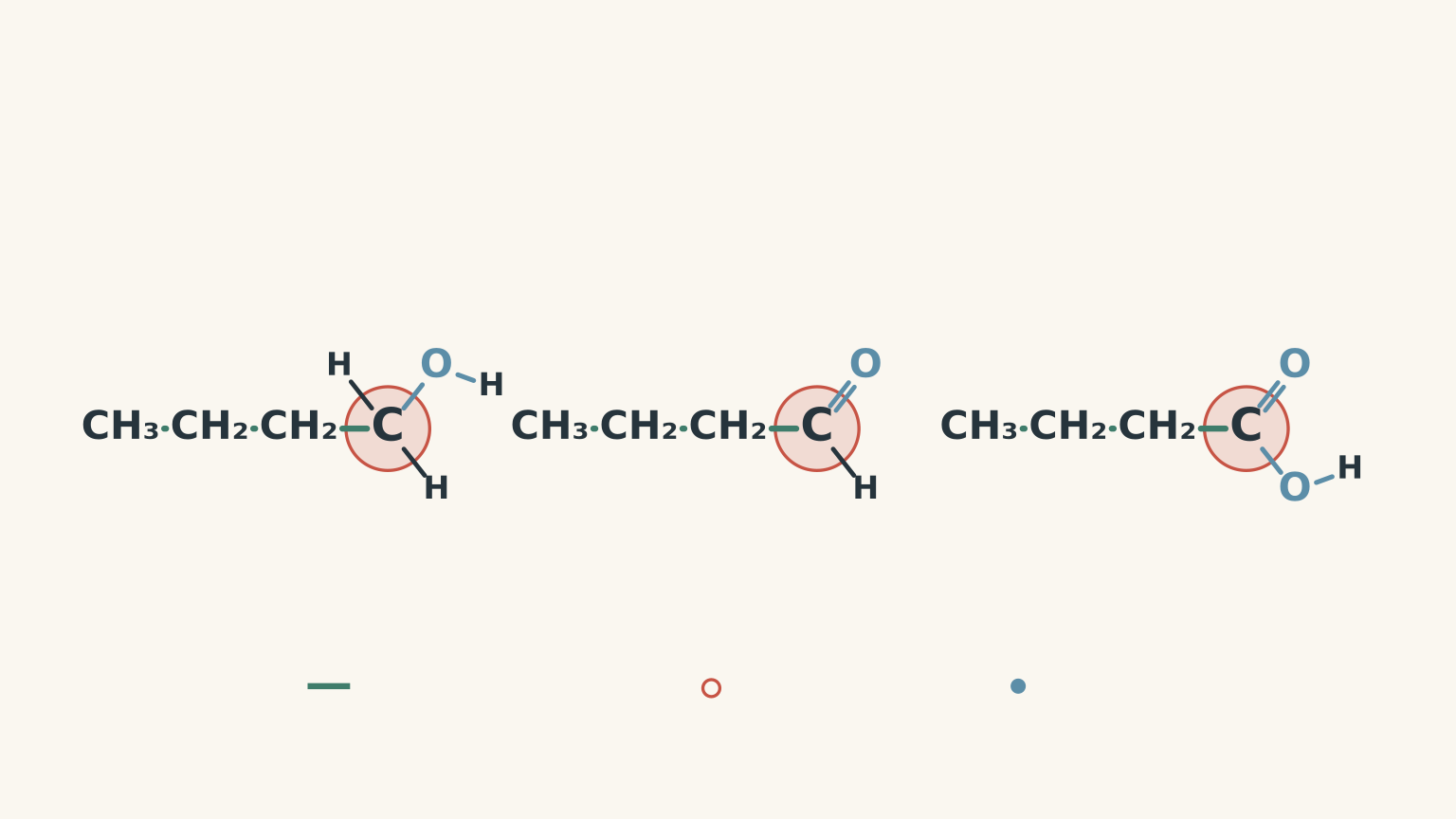
Due to technical limitations, this figure may display incorrectly or contain inaccuracies. Please check key details against your course materials.
A useful notation
Organic chemistry often uses letters to represent parts of a molecule that do not need to be drawn in full.
We will use:
- \(R\): a carbon-containing group attached to the functional carbon.
- \(R'\): a second carbon-containing group, particularly the group attached through oxygen in an ester.
- The carbonyl carbon: the carbon atom in a carbonyl group, \(\ce{C=O}\).
For example:
| Functional group | General structure |
|---|---|
| Primary alcohol | \(\mathrm{R{-}CH_2OH}\) |
| Aldehyde | \(\mathrm{R{-}CHO}\) |
| Carboxylic acid | \(\mathrm{R{-}COOH}\) |
| Ester | \(\mathrm{R{-}COO{-}R'}\) |
| Ketone | \(\mathrm{R{-}CO{-}R'}\) |
For an ester, it is particularly important to distinguish the two carbon-containing parts.
In \(\mathrm{R{-}COO{-}R'}\), the acyl fragment is \(\mathrm{R{-}CO{-}}\), while \(R'\) is attached to the other side of the oxygen.
The carbonyl carbon belongs to the acyl fragment. The \(R'\) group does not form a continuous carbon chain with it.
This distinction will become important when we look at ester hydrolysis and reduction.
If you need to refresh the structural foundation, see How to Identify Functional-Group Isomers of Acids and Esters.
02Route family 1: Oxidation and reduction
One of the most useful ways to interconvert functional groups is to change the oxidation state of a particular carbon atom.
You already know the basic idea from redox chemistry. Oxidation involves an increase in oxidation state, while reduction involves a decrease.
In organic chemistry, pay particular attention to the bonds between carbon and hydrogen, and carbon and oxygen.
- More bonding between carbon and oxygen generally means a higher oxidation state for that carbon.
- More bonding between carbon and hydrogen generally means a lower oxidation state.
Consider the terminal carbon of a primary alcohol.
It has two bonds to hydrogen and one bond to oxygen. Oxidising it changes its bonding pattern, first producing an aldehyde and potentially producing a carboxylic acid.
The primary alcohol-aldehyde-acid sequence
The general reaction sequence is:
\[ \mathrm{R{-}CH_2OH} \xrightarrow{\text{oxidation}} \mathrm{R{-}CHO} \xrightarrow{\text{further oxidation}} \mathrm{R{-}COOH} \]
The three structures represent:
- Primary alcohol.
- Aldehyde.
- Carboxylic acid.
The same terminal carbon is present throughout the sequence.
We can make the difference more precise by examining the formal oxidation state of that carbon.
| Compound | Structure | Oxidation state of functional carbon |
|---|---|---|
| Primary alcohol | \(\mathrm{R{-}CH_2OH}\) | −1 |
| Aldehyde | \(\mathrm{R{-}CHO}\) | +1 |
| Carboxylic acid | \(\mathrm{R{-}COOH}\) | +3 |
These values refer to the functional carbon, not the overall molecule.
Notice that the oxidation state increases by two at each stage. The carbon progressively loses its carbon-hydrogen bonding and gains bonding to oxygen.
Why does the choice of oxidising conditions matter?
Suppose you want to convert butan-1-ol into butanal.
You might think that any oxidising agent will do because both products have the same carbon skeleton.
Not quite.
A sufficiently strong aqueous oxidising system can continue oxidising the aldehyde to a carboxylic acid. The aldehyde is an intermediate, rather than necessarily the final isolated product.
If butanal is the desired product, the reaction needs conditions and an oxidising reagent that allow the oxidation to stop at the aldehyde stage.
If butanoic acid is the target, further oxidation is appropriate.
This is an example of reaction selectivity: choosing conditions that favour the desired transformation without continuing to an unwanted product.
A related pattern occurs with secondary alcohols:
\[ \mathrm{R{-}CH(OH){-}R'} \xrightarrow{\text{oxidation}} \mathrm{R{-}CO{-}R'} \]
A secondary alcohol becomes a ketone.
The carbon skeleton remains intact, but the carbon bearing the hydroxyl group becomes a carbonyl carbon.
Tertiary alcohols behave differently. Under ordinary oxidation conditions, they do not readily form a simple carbonyl compound because the carbon bearing the hydroxyl group has no hydrogen atom to remove. Oxidation generally requires more extensive structural changes, potentially including carbon-carbon bond cleavage.
Reversing the process: reduction
Oxidation and reduction provide routes in opposite directions.
For example:
- Aldehyde → primary alcohol.
- Ketone → secondary alcohol.
- Carboxylic acid → primary alcohol.
The important detail is that not every reducing agent can perform every conversion.
Two reagents commonly discussed in organic chemistry are sodium borohydride, \(\ce{NaBH4}\), and lithium aluminium hydride, \(\ce{LiAlH4}\).
| Reducing agent | Aldehydes | Ketones | Carboxylic acids | Esters |
|---|---|---|---|---|
| \(\ce{NaBH4}\) | Yes | Yes | No | Not under standard conditions |
| \(\ce{LiAlH4}\) | Yes | Yes | Yes | Yes |
Sodium borohydride is suitable for reducing aldehydes and ketones to alcohols.
Lithium aluminium hydride is considerably more reactive and can also reduce carboxylic acids and esters.
For example:
\[ \mathrm{R{-}COOH} \xrightarrow{\ce{LiAlH4}} \mathrm{R{-}CH_2OH} \]
The carboxylic acid becomes a primary alcohol, with its carbon framework retained.
Do not assume that sodium borohydride can do the same job. Under the standard conditions used in organic chemistry, it is not sufficiently reactive to reduce carboxylic acids or esters.
Safety note: Lithium aluminium hydride is highly reactive with water. These transformations are reaction-planning concepts, not instructions for unsupervised laboratory work.
For a more detailed university-level treatment of alcohol oxidation, see Chemistry LibreTexts: Oxidation of Alcohols.
03Route family 2: Interconverting carboxylic acids and esters
Oxidation and reduction change the bonding and oxidation state of a functional carbon.
However, not every functional-group interconversion is a redox reaction.
Consider converting a carboxylic acid into an ester.
A carboxylic acid reacts with an alcohol in an acid-catalysed reaction called Fischer esterification.
The general equation is:
\[ \mathrm{RCOOH + R'OH} \rightleftharpoons \mathrm{RCOOR' + H_2O} \]
The carboxylic acid and alcohol produce an ester and water.
The important structural change is that the hydroxyl group, \(\mathrm{-OH}\), attached to the carboxylic acid is replaced by an alkoxy group, \(\mathrm{-OR'}\).
The carbonyl carbon remains in place.
This is a substitution reaction at the acyl carbon, rather than an oxidation or reduction.
Why is the reaction reversible?
Fischer esterification is an equilibrium reaction.
The forward reaction forms the ester, while the reverse reaction is ester hydrolysis.
Consider propanoic acid reacting with ethanol:
\[ \ce{CH3CH2COOH + CH3CH2OH} \]
\[ \ce{<=> CH3CH2COOCH2CH3 + H2O} \]
The ester produced is ethyl propanoate.
Because the reaction is reversible, the amount of ester formed depends on the reaction conditions.
You can favour ester formation by:
- Using an excess of the alcohol.
- Removing water as it forms.
Conversely, adding excess water favours the reverse reaction and increases the amount of carboxylic acid formed.
The acid catalyst increases the rates of the forward and reverse reactions. It does not independently change the equilibrium position.
Reversing esterification: hydrolysis
Hydrolysis is the reaction of a compound with water that breaks a chemical bond.
For an ester, hydrolysis produces a carboxylic acid and an alcohol under acidic conditions.
\[ \mathrm{RCOOR' + H_2O} \rightleftharpoons \mathrm{RCOOH + R'OH} \]
The ester bond is broken, and the two carbon-containing fragments become separate products.
There are two important approaches to ester hydrolysis.
Acid-catalysed hydrolysis
This is the reverse of Fischer esterification.
Water attacks the activated carbonyl carbon, and a series of proton transfers allows the alcohol-containing fragment to leave.
The products are a carboxylic acid and an alcohol.
Base hydrolysis
Ester hydrolysis can also occur under basic conditions. This is commonly called saponification.
The overall reaction is:
\[ \ce{RCOOR' + OH^- -> RCOO^- + R'OH} \]
The products are a carboxylate ion and an alcohol.
The carboxylate ion can subsequently be protonated to form the carboxylic acid.
Base hydrolysis is effectively driven towards products because the carboxylate ion forms under the basic conditions. This makes the process different from simply reversing an acid-catalysed esterification equilibrium.
The carbon-skeleton complication
Return to methyl propanoate:
\[ \ce{CH3CH2COOCH3} \]
It contains four carbon atoms, but these are not arranged as one continuous four-carbon chain.
There are two fragments:
- The propanoate fragment contains three carbon atoms, including the carbonyl carbon.
- The methoxy fragment contains one carbon atom.
Hydrolysis gives:
\[ \ce{CH3CH2COOCH3 + H2O} \]
\[ \ce{-> CH3CH2COOH + CH3OH} \]
The three-carbon fragment becomes propanoic acid. The one-carbon fragment becomes methanol.
No carbon-carbon bond needs to be broken.
This is why it is important to distinguish between preserving the acyl carbon skeleton and preserving the entire carbon arrangement of the starting molecule.
For a more detailed explanation of the reaction mechanism, see Chemistry LibreTexts: Reactions of Carboxylic Acids.
04Selective reduction: stopping at an aldehyde
There is another useful extension of ester chemistry.
An ester can be reduced to an aldehyde rather than being reduced all the way to an alcohol.
This is called partial reduction.
The two possible transformations are:
Partial reduction:
\[ \mathrm{RCOOR'} \longrightarrow \mathrm{RCHO + R'OH} \]
Complete reduction:
\[ \mathrm{RCOOR'} \longrightarrow \mathrm{RCH_2OH + R'OH} \]
The difference is the oxidation state of the acyl carbon in the final product.
In partial reduction, it becomes an aldehyde.
In complete reduction, it becomes a primary alcohol.
How is the reduction controlled?
A specialised reducing agent called diisobutylaluminium hydride, commonly abbreviated DIBAL-H, can reduce esters to aldehydes under carefully controlled conditions.
The reaction is typically performed at low temperature, with careful control of the reducing conditions.
DIBAL-H allows the reaction to stop at the aldehyde stage rather than proceeding directly to the primary alcohol.
By comparison, lithium aluminium hydride generally reduces the ester further, producing primary alcohols.
This is not simply a case of choosing a weaker reagent. The selectivity depends on the reagent and reaction conditions, including temperature and the extent of reduction.
One particularly useful detail is that ester reduction produces two organic products.
The acyl fragment becomes the aldehyde or primary alcohol. The alkoxy fragment becomes an alcohol.
For example, reducing methyl butanoate gives:
- Partial reduction: butanal and methanol.
- Complete reduction: butan-1-ol and methanol.
All five carbon atoms are accounted for.
DIBAL-H is a highly reactive specialist reagent requiring controlled laboratory handling. The conditions described here explain reaction selectivity, not a practical synthesis procedure.
A university-level discussion of this selectivity is available in Harvard Chemistry 115: Reduction lecture notes.
05Choosing the right interconversion route
You can now compare the main pathways without treating every reaction as an unrelated fact to memorise.
| Starting functional group | Desired functional group | Conceptual route | What happens to the carbon framework? |
|---|---|---|---|
| Primary alcohol | Aldehyde | Controlled oxidation | Retained |
| Primary alcohol | Carboxylic acid | Further oxidation | Retained |
| Aldehyde | Primary alcohol | Reduction | Retained |
| Aldehyde | Carboxylic acid | Oxidation | Retained |
| Carboxylic acid | Primary alcohol | Strong reduction | Retained |
| Carboxylic acid | Ester | Fischer esterification | Acyl fragment retained; alcohol fragment added |
| Ester | Carboxylic acid | Hydrolysis | Acyl fragment retained; alcohol fragment released |
| Ester | Aldehyde | Partial reduction | Acyl fragment retained; alcohol fragment released |
| Ester | Primary alcohol | Complete reduction | Both carbon-containing fragments become alcohols |
A reliable way to approach an unfamiliar conversion is to make three decisions.
First: identify the functional carbon.
Which carbon atom is directly involved in the functional group you want to change?
Second: decide what type of reaction is required.
Are you changing the oxidation state of that carbon, or replacing a group attached to it?
Oxidation and reduction change the bonding at the functional carbon. Esterification and hydrolysis replace groups at the acyl carbon.
Third: account for every carbon atom.
Check whether the starting molecule contains one continuous carbon chain or multiple carbon fragments connected through oxygen.
This last step prevents some surprisingly common errors.
06Worked examples
Worked example: Converting a primary alcohol into a carboxylic acid
Convert butan-1-ol into butanoic acid. Identify the intermediate and explain whether the carbon skeleton changes.
Step 1
Butan-1-ol is a primary alcohol because the carbon attached to the hydroxyl group is connected to only one other carbon atom.
Step 2
Oxidation of the primary alcohol produces butanal:
\[ \ce{CH3CH2CH2CH2OH} \]
\[ \ce{->[oxidation] CH3CH2CH2CHO} \]
Step 3
Further oxidation converts butanal into butanoic acid:
\[ \ce{CH3CH2CH2CHO} \]
\[ \ce{->[further oxidation] CH3CH2CH2COOH} \]
An aqueous oxidising system such as permanganate can carry out the overall conversion from primary alcohol to carboxylic acid.
The aldehyde intermediate is generally not isolated under sufficiently strong aqueous oxidation conditions.
Step 4
Both the starting compound and final product contain four carbon atoms connected in the same sequence.
No carbon-carbon bonds have been broken or formed.
The functional group changes because the terminal carbon undergoes oxidation.
Worked example: Predicting the products of ester hydrolysis and reduction
Methyl propanoate, \(\ce{CH3CH2COOCH3}\), undergoes either acid-catalysed hydrolysis or complete reduction using lithium aluminium hydride. Identify the organic products of each reaction and account for all four carbon atoms.
Step 1
The structure is:
\[ \ce{CH3CH2COOCH3} \]
The acyl fragment is \(\ce{CH3CH2CO-}\), containing three carbon atoms.
The methoxy fragment is \(\ce{-OCH3}\), containing one carbon atom.
Step 2
Hydrolysis produces a carboxylic acid and an alcohol:
\[ \ce{CH3CH2COOCH3 + H2O} \]
\[ \ce{<=> CH3CH2COOH + CH3OH} \]
The products are propanoic acid and methanol.
Step 3
Lithium aluminium hydride reduces the ester’s acyl fragment to a primary alcohol.
The alkoxy fragment also becomes an alcohol:
\[ \ce{CH3CH2COOCH3} \]
\[ \ce{->[LiAlH4][work-up]} \ce{CH3CH2CH2OH + CH3OH} \]
The products are propan-1-ol and methanol.
Step 4
In both reactions:
- The acyl fragment contributes three carbon atoms.
- The methoxy fragment contributes one carbon atom.
The products contain four carbon atoms altogether.
The important point is that the methoxy carbon does not become part of the propan-1-ol chain. It remains a separate one-carbon fragment and becomes methanol.
07Questions and solutions
Question 1
Butan-2-ol is oxidised using a suitable oxidising agent.
Identify the organic product and explain whether the carbon skeleton is retained. Why does the reaction not produce butanoic acid?
Solution 1
The product is butanone, and the four-carbon skeleton is retained.
Butan-2-ol is a secondary alcohol because its hydroxyl-bearing carbon is connected to two other carbon atoms.
Oxidation converts this carbon into a carbonyl carbon:
\[ \ce{CH3CH(OH)CH2CH3} \]
\[ \ce{->[oxidation] CH3COCH2CH3} \]
The product, butanone, is a ketone.
It does not become butanoic acid because oxidation of a secondary alcohol produces a ketone, not a carboxylic acid. The carbonyl carbon remains attached to two carbon-containing groups.
No carbon-carbon bonds are broken.
The common mistake is to assume that all alcohols become carboxylic acids under oxidation. The product depends on whether the starting alcohol is primary, secondary, or tertiary.
Question 2
Propanoic acid reacts with ethanol to produce ethyl propanoate and water:
\[ \ce{CH3CH2COOH + CH3CH2OH} \]
\[ \ce{<=> CH3CH2COOCH2CH3 + H2O} \]
The reaction is at equilibrium in the presence of an acid catalyst.
A student makes three changes:
- Adds more acid catalyst.
- Adds more water.
- Adds more ethanol.
Predict the effect of each change on the equilibrium composition. Explain your reasoning.
Solution 2
Adding more acid catalyst does not change the equilibrium position. Adding water shifts the equilibrium towards the reactants, while adding ethanol shifts it towards the ester products.
The reaction is reversible, so both forward and reverse reactions occur.
Adding more acid catalyst
The catalyst increases the rate of both reactions. Equilibrium is reached more quickly, but the equilibrium composition does not change.
Adding more water
Water is a product of esterification.
Increasing its concentration shifts the equilibrium towards the reactants to oppose the change.
More propanoic acid and ethanol are favoured, and less ethyl propanoate remains at the new equilibrium.
Adding more ethanol
Ethanol is a reactant.
Increasing its concentration shifts the equilibrium towards the products.
More ethyl propanoate and water are favoured.
The important distinction is between reaction rate and equilibrium position. A catalyst changes how quickly equilibrium is reached, while changing reactant or product concentrations can change the equilibrium composition.
Question 3
A chemist reduces \(0.0400\ \mathrm{mol}\) of butanoic acid to butan-1-ol.
The reaction has an isolated yield of \(78.0\%\).
Calculate the mass of butan-1-ol obtained.
The molar mass of butan-1-ol is \(74.12\ \mathrm{g\,mol^{-1}}\).
Assume the theoretical reaction stoichiometry is one mole of alcohol per mole of carboxylic acid.
Solution 3
The mass of butan-1-ol obtained is 2.31 g.
First, write the overall transformation:
\[ \ce{CH3CH2CH2COOH} \]
\[ \ce{->[LiAlH4][work-up]} \ce{CH3CH2CH2CH2OH} \]
The reaction has a 1:1 mole ratio.
Step 1: Calculate the theoretical amount of alcohol.
\[ n_{\text{theoretical}}=0.0400\ \mathrm{mol} \]
Step 2: Apply the percentage yield.
The actual amount is:
\[ n_{\text{actual}} =0.780\times 0.0400 \]
\[ =0.0312\ \mathrm{mol} \]
Step 3: Calculate the mass.
Use:
\[ m=nM \]
where:
- \(m\) is the mass in grams.
- \(n\) is the amount in moles.
- \(M\) is the molar mass in grams per mole.
Substitute:
\[ m=0.0312\times 74.12 \]
\[ m=2.311\ \mathrm{g} \]
To three significant figures:
\[ \boxed{m=2.31\ \mathrm{g}} \]
The acid and alcohol have the same four-carbon framework. Their functional groups differ, but the overall conversion has a 1:1 organic-product stoichiometry.
Question 4
A chemist needs to convert butanoic acid into butanal while retaining the four-carbon acyl framework.
Direct reduction of the carboxylic acid using lithium aluminium hydride would produce butan-1-ol instead.
Propose a two-stage route that produces butanal. Identify the intermediate ester, the specialised reducing agent, and the other organic product.
Solution 4
Use esterification followed by partial reduction with DIBAL-H. The intermediate is methyl butanoate, and the other organic product is methanol.
Step 1: Convert butanoic acid into an ester.
React butanoic acid with methanol under acid-catalysed esterification conditions:
\[ \ce{CH3CH2CH2COOH + CH3OH} \]
\[ \ce{<=> CH3CH2CH2COOCH3 + H2O} \]
The ester produced is methyl butanoate.
The four-carbon acyl fragment remains intact. The methyl group is supplied by methanol.
Step 2: Partially reduce the ester.
Use DIBAL-H under carefully controlled conditions to reduce the ester to an aldehyde.
\[ \ce{CH3CH2CH2COOCH3} \]
\[ \ce{->[DIBAL-H][work-up]} \ce{CH3CH2CH2CHO + CH3OH} \]
The products are butanal and methanol.
Step 3: Explain why this route is selective.
Lithium aluminium hydride would generally continue reducing the ester-derived intermediate to a primary alcohol.
That would give butan-1-ol rather than the desired aldehyde.
DIBAL-H can stop the reduction at the aldehyde stage when the reaction is suitably controlled.
Step 4: Check the carbon framework.
The original four-carbon acyl fragment becomes the four-carbon aldehyde.
The additional methyl carbon, introduced during esterification, leaves as methanol.
No new carbon-carbon bond is required.
This example illustrates why a useful interconversion route is not always a single reaction. Sometimes an intermediate functional group is introduced because it allows a more selective transformation.
Question 5
Two ester isomers, X and Y, have the molecular formula \(\ce{C5H10O2}\).
Their hydrolysis produces the following organic products:
| Ester | Carboxylic acid produced | Alcohol produced |
|---|---|---|
| X | Butanoic acid | Methanol |
| Y | Propanoic acid | Ethanol |
Both esters are then subjected to complete reduction using lithium aluminium hydride.
A student argues:
“Both starting esters contain five carbon atoms. Therefore, reducing either one should produce pentan-1-ol, because reduction changes the functional group but preserves the carbon skeleton.”
Assume that the reactions involve no carbon-carbon bond formation or cleavage outside the transformations described.
(a) Identify the structures of X and Y.
(b) Predict the two organic products from complete reduction of each ester.
(c) Evaluate the student’s claim. Explain why the total number of carbon atoms in the starting molecule does not determine the length of the carbon chain in the primary alcohol product.
Solution 5
X is methyl butanoate, and Y is ethyl propanoate.
Complete reduction produces:
- X: butan-1-ol and methanol.
- Y: propan-1-ol and ethanol.
Neither ester produces pentan-1-ol through a skeleton-preserving functional-group interconversion.
The student’s argument is tempting because both molecules contain five carbon atoms. However, it assumes that all five carbons belong to one continuous carbon chain.
That assumption is incorrect.
Part (a): Identify the ester structures
For X, hydrolysis produces butanoic acid and methanol.
The acid fragment contains four carbons, while the alcohol fragment contains one.
Therefore, X must be methyl butanoate:
\[ \boxed{\ce{CH3CH2CH2COOCH3}} \]
For Y, hydrolysis produces propanoic acid and ethanol.
The acid fragment contains three carbons, while the alcohol fragment contains two.
Therefore, Y must be ethyl propanoate:
\[ \boxed{\ce{CH3CH2COOCH2CH3}} \]
Both have the molecular formula \(\ce{C5H10O2}\), but their carbon atoms are distributed differently.
Part (b): Predict the reduction products
For X, methyl butanoate:
\[ \ce{CH3CH2CH2COOCH3} \]
Complete reduction gives:
\[ \boxed{\ce{CH3CH2CH2CH2OH + CH3OH}} \]
The products are butan-1-ol and methanol.
The four-carbon acyl fragment becomes butan-1-ol. The one-carbon methoxy fragment becomes methanol.
For Y, ethyl propanoate:
\[ \ce{CH3CH2COOCH2CH3} \]
Complete reduction gives:
\[ \boxed{\ce{CH3CH2CH2OH + CH3CH2OH}} \]
The products are propan-1-ol and ethanol.
The three-carbon acyl fragment becomes propan-1-ol. The two-carbon ethoxy fragment becomes ethanol.
Part (c): Evaluate the claim
The claim is incorrect because the ester contains two carbon-containing fragments connected through oxygen, not one continuous five-carbon chain.
For X, the carbon distribution is:
\[ 4+1=5 \]
For Y, the carbon distribution is:
\[ 3+2=5 \]
Complete reduction preserves these separate carbon frameworks while changing their functional groups.
The ester linkage is transformed, allowing the two fragments to form separate alcohol molecules.
To produce pentan-1-ol, the two fragments would need to become joined by a new carbon-carbon bond.
That would be a carbon-carbon bond-forming reaction, not simply a functional-group interconversion that preserves the original carbon framework.
This is the key limitation of using molecular formula alone to predict reaction products: the formula tells you how many atoms are present, but not how those atoms are connected.
08Where to go next
Functional-group interconversion becomes much easier when you stop memorising isolated reaction equations and start tracking individual carbon atoms.
You now have three distinct reaction ideas to work with:
- Oxidation and reduction change the oxidation state of a functional carbon.
- Esterification and hydrolysis exchange groups attached to an acyl carbon.
- Selective reduction allows an ester to become an aldehyde or a primary alcohol, depending on the reaction conditions.
The next useful step is applying this reasoning to unknown organic intermediates.
When given a starting material and a final product, work backwards from the target functional group, identify the carbon framework that must survive, and select a sequence that reaches the target without introducing unwanted structural changes.
For that next skill, see How to Identify an Unknown Intermediate from Its Functional Group.