
Gas-Phase Acidity: Why Acid Rankings Change Without Water
Why can the same acid be stronger in water but weaker in the gas phase? Explore how conjugate-base stability, hydration, and Gibbs free energy explain changes in acid strength across different environments.
Put ethanol and tert-butanol side by side. In water, ethanol is the stronger acid: its aqueous pKa is approximately 15.9, compared with approximately 18.0 for tert-butanol. Yet in the gas phase, tert-butanol is more acidic than ethanol.
The same two molecules give different acidity rankings depending on their environment. How can removing water change which molecule gives up a proton more readily?
This is an extension beyond the required 2025 NSW Year 12 Chemistry syllabus. Your understanding of aqueous acid-base equilibria, conjugate acid-base pairs, and ionic equations provides the foundation, but gas-phase acidity is not a required HSC assessment topic.
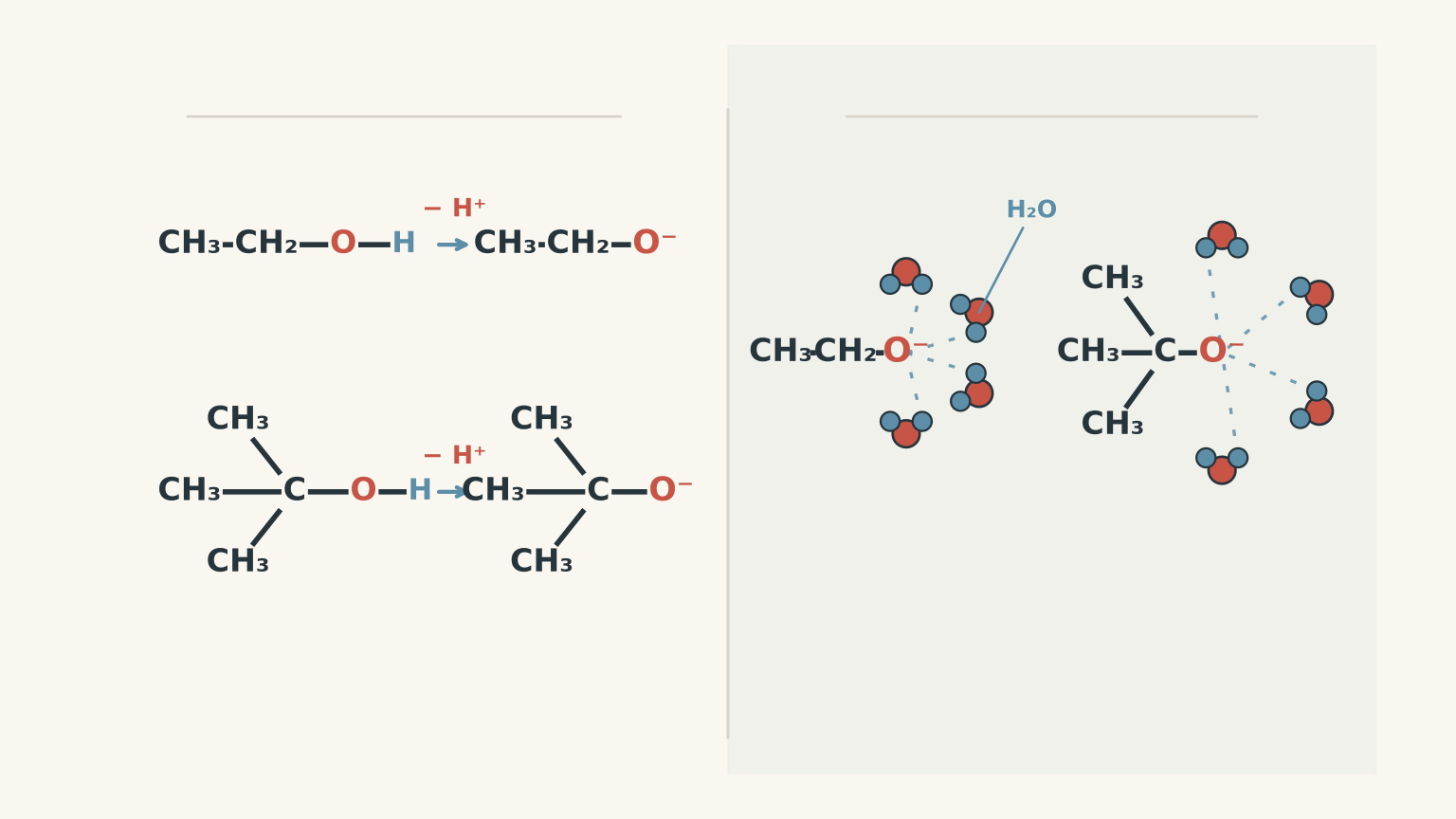
Due to technical limitations, this figure may display incorrectly or contain inaccuracies. Please check key details against your course materials.
01Start with the model you already know: acids in water
In Year 12 Chemistry, you describe an acid as a proton donor and a base as a proton acceptor.
When an acid dissolves in water, it can transfer a proton to a water molecule:
\[ \ce{HA(aq) + H2O(l) <=> H3O+(aq) + A^-(aq)} \]
Here:
- \(\ce{HA}\) is the acid.
- \(\mathrm{A}^{-}\) is its conjugate base, formed when the acid loses a proton.
- \(\ce{H2O}\) acts as a Brønsted-Lowry base.
- \(\ce{H3O+}\) is the conjugate acid of water.
The two conjugate acid-base pairs are \(\ce{HA/A^-}\) and \(\ce{H3O+/H2O}\).
A base can also react with water:
\[ \ce{B(aq) + H2O(l) <=> BH+(aq) + OH^-(aq)} \]
Here, \(\ce{B}\) accepts a proton and becomes its conjugate acid, \(\ce{BH+}\).
Some ions can act as either acids or bases. For example, hydrogencarbonate, \(\mathrm{HCO_{3}}^{-}\), can donate a proton to form \(\mathrm{CO_{3}}^{2-}\), or accept a proton to form \(\ce{H2CO3}\). This is its amphiprotic behaviour.
The important point is that aqueous acid-base reactions involve more than the acid and its conjugate base. Water participates in the proton transfer and interacts with the resulting ions.
How aqueous acidity is measured
For a weak acid, the acid dissociation constant is:
\[ K_a=\frac{[\ce{H3O+}][\mathrm{A}^{-}]}{[\ce{HA}]} \]
The pKa is defined as:
\[ \mathrm{p}K_a=-\log_{10}K_a \]
A larger \(K_a\) or smaller pKa indicates a stronger acid.
This is the model you need for the HSC course. However, notice something important: these values describe acidity in water.
Water molecules stabilise dissolved ions through electrostatic attractions and hydrogen bonding. Consequently, an aqueous pKa includes the effects of the solvent.
Remove the water, and you remove an important part of the equilibrium.
02What happens when there is no solvent?
Imagine a single molecule of an acid floating in a region of extremely low pressure.
There are no surrounding water molecules. There is no hydration shell. The acid can still lose a proton, but the process is now described by a different reaction:
\[ \ce{HA(g) <=> H+(g) + A^-(g)} \]
The neutral acid separates into a gaseous proton and a gaseous conjugate base.
This is gas-phase deprotonation.
Chemists describe the process using the gas-phase acidity, usually represented by \(\Delta G^\circ_{\mathrm{acid}}\).
It is the standard Gibbs free energy change for the deprotonation reaction, commonly reported at 298 K.
The Gibbs free energy change tells us how favourable the proton-loss process is.
- A smaller \(\Delta G^\circ_{\mathrm{acid}}\) means a stronger gas-phase acid.
- A larger \(\Delta G^\circ_{\mathrm{acid}}\) means a weaker gas-phase acid.
The distinction is important. A gas-phase acidity value is not an aqueous pKa, and you cannot simply transfer an aqueous acidity ranking into the gas phase.
The formal definition is given in the NIST Chemistry WebBook’s gas-phase ion thermochemistry reference.
Why use Gibbs free energy?
You might initially think that gas-phase acidity should depend only on the energy required to break the O-H or other acidic bond.
That is incomplete.
The reaction involves changes in both enthalpy and entropy:
\[ \Delta G^\circ_{\mathrm{acid}} = \Delta H^\circ_{\mathrm{acid}} - T\Delta S^\circ_{\mathrm{acid}} \]
Where:
- \(\Delta G^\circ_{\mathrm{acid}}\) is the Gibbs free energy change, in kJ mol\(^{-1}\).
- \(\Delta H^\circ_{\mathrm{acid}}\) is the enthalpy change, in kJ mol\(^{-1}\).
- \(\Delta S^\circ_{\mathrm{acid}}\) is the entropy change, in kJ mol\(^{-1}\) K\(^{-1}\).
- \(T\) is the absolute temperature, in kelvin.
Entropy matters because one gaseous molecule becomes two gaseous particles.
The resulting change in molecular freedom can influence the overall free-energy cost of deprotonation.
This also explains why you must check what a data table actually reports. Gas-phase deprotonation enthalpy and gas-phase acidity are related, but they are not interchangeable.
The related quantity, proton affinity, describes the enthalpy change associated with protonation of a base. It is useful for understanding the basicity of the conjugate base, but it is not the same measurement as gas-phase acidity. See tutorgum’s Proton Affinity: Why Gas-Phase and Aqueous Basicity Differ.
03Why do acidity rankings change?
Let’s return to ethanol and tert-butanol.
Their structures are:
- Ethanol: \(\ce{CH3CH2OH}\)
- Tert-butanol: \(\ce{(CH3)3COH}\)
Both can lose the proton attached to oxygen.
\[ \ce{CH3CH2OH -> CH3CH2O^- + H+} \]
\[ \ce{(CH3)3COH -> (CH3)3CO^- + H+} \]
The resulting negative ions are called alkoxide ions.
The difference is the group attached to the oxygen atom.
Ethanol has an ethyl group. Tert-butanol has three methyl groups attached to its central carbon.
That structural difference affects the stability of the conjugate bases in two different ways.
1. In the gas phase, polarizability matters
Without water, the alkoxide ions must be considered in isolation.
The electron cloud surrounding an atom or molecule can distort in response to nearby electrical charges. This property is called polarizability.
Larger alkyl groups are generally more polarizable than smaller ones.
In this alcohol series, the increasing polarizability of the alkyl groups helps stabilise the negative charge in the gas phase. This contributes to the observed trend in which tert-butanol is more acidic than ethanol.
The effect can seem surprising.
You may have learned that alkyl groups donate electron density through the inductive effect. You might therefore predict that adding methyl groups makes an already negatively charged oxygen less stable.
That prediction overlooks polarizability. Electron donation is not the only factor controlling the stability of a gas-phase anion.
The gas-phase trend is supported by experimental studies of alcohol acidities, including the review by C. H. DePuy, An Introduction to the Gas Phase Chemistry of Anions.
2. In water, hydration changes the result
Now put those alkoxide ions into water.
Water is a polar molecule. Its oxygen atom has a partial negative charge, while its hydrogen atoms have partial positive charges.
When an alkoxide ion dissolves, water molecules orient themselves so that their partially positive hydrogen atoms point towards the negatively charged oxygen.
These attractions help stabilise the ion.
This interaction between water molecules and dissolved ions is called hydration.
Here is the important difference.
The ethoxide ion is relatively small. Water molecules can approach its negatively charged oxygen more easily.
The tert-butoxide ion is much bulkier. Its three methyl groups make it harder for water molecules to approach the oxygen closely.
Consequently, ethoxide receives more effective hydration stabilisation than tert-butoxide.
In water, this contribution favours the formation of ethoxide, making ethanol the stronger acid.
Compare the two environments
| Feature | Gas phase | Aqueous solution |
|---|---|---|
| Surrounding water | Absent | Present |
| Main additional stabilising influence | Intrinsic molecular structure and polarizability | Hydration and hydrogen bonding |
| Ethoxide versus tert-butoxide | Less favourable intrinsic stabilisation than the bulky alkoxide in this series | Ethoxide is more effectively hydrated |
| Stronger acid in the comparison | Tert-butanol | Ethanol |
The same structural change can therefore have different consequences depending on the environment.
An analogy is to imagine a charged object that benefits from being surrounded by a crowd of supportive people. In water, molecules cluster around the ion and stabilise it. A bulky structure can make it harder for that crowd to get close.
In the gas phase, the crowd disappears entirely. The intrinsic properties of the isolated ion become much more important.
The analogy has limits: water molecules are not static supporters. They constantly move, rotate, and form and break hydrogen bonds.
04The full explanation: a balance of solvation energies
So far, we have focused on stabilising the conjugate base.
That is a useful starting point, but it is not the complete thermodynamic explanation.
Water can stabilise the original neutral acid as well as the conjugate base. It also stabilises the proton.
To understand aqueous acidity properly, we need to consider all the species involved.
The gas-phase reaction is:
\[ \ce{HA(g) -> H+(g) + A^-(g)} \]
The aqueous reaction is:
\[ \ce{HA(aq) + H2O(l) -> H3O+(aq) + A^-(aq)} \]
The difference between these reactions can be described using a thermodynamic cycle.
A simplified relationship is:
\[ \begin{aligned} \Delta G^\circ_{\mathrm{acid,aq}} \approx {}& \Delta G^\circ_{\mathrm{acid,gas}}\\ &+\Delta G_{\mathrm{solv}}(A^-)\\ &+\Delta G_{\mathrm{solv}}(H^+)\\ &-\Delta G_{\mathrm{solv}}(HA) \end{aligned} \]
A standard-state correction is also required for a rigorous numerical conversion between gas and solution data.
The symbols mean:
- \(\Delta G^\circ_{\mathrm{acid,aq}}\): Gibbs free energy change for acid dissociation in aqueous solution.
- \(\Delta G^\circ_{\mathrm{acid,gas}}\): Gibbs free energy change for gas-phase deprotonation.
- \(\Delta G_{\mathrm{solv}}(A^-)\): free energy change when the conjugate base moves from the gas phase into water.
- \(\Delta G_{\mathrm{solv}}(H^+)\): corresponding solvation free energy of the proton.
- \(\Delta G_{\mathrm{solv}}(HA)\): solvation free energy of the neutral acid.
A negative solvation free energy indicates that the species is stabilised by entering the solvent.
The aqueous \(H^+\) notation is thermodynamic shorthand. In the HSC aqueous model, we represent the proton as \(\ce{H3O+}\).
This equation explains an important limitation of a common shortcut.
You might hear that a stronger acid is simply one that forms a more stable conjugate base.
That is useful when comparing similar acids in the same environment, but it is not a complete rule for comparing different phases.
You must consider the stability of the original acid as well.
If water stabilises the neutral acid particularly strongly, it can make proton loss less favourable, even if the resulting anion is also strongly hydrated.
Connecting free energy to pKa
There is a useful mathematical connection between aqueous pKa and Gibbs free energy:
\[ \Delta G^\circ_{\mathrm{acid,aq}} = 2.303RT\,\mathrm{p}K_a \]
At 298 K:
\[ 2.303RT \approx 5.71\ \mathrm{kJ\,mol^{-1}} \]
This means that a difference of one pKa unit corresponds to approximately 5.71 kJ mol\(^{-1}\) in standard Gibbs free energy.
A lower pKa means a more favourable acid dissociation reaction.
The equation also shows why a relatively small difference in free energy can produce a substantial difference in equilibrium position.
For comparisons between different solvents, however, you must use the appropriate solvent-specific equilibrium data.
05How do chemists measure gas-phase acidity?
You cannot simply remove all the water from a normal pH experiment and expect to obtain a gas-phase acidity measurement.
Instead, chemists can compare acids using gas-phase proton-transfer reactions.
Consider:
\[ \ce{AH(g) + B^-(g) <=> A^-(g) + BH(g)} \]
Here:
- \(\ce{AH}\) is the acid being investigated.
- \(\mathrm{B}^{-}\) is a reference base.
- \(\mathrm{A}^{-}\) is the conjugate base of \(\ce{AH}\).
- \(\ce{BH}\) is the conjugate acid of the reference base.
The proton transfers from \(\ce{AH}\) to \(\mathrm{B}^{-}\).
Predict what happens if the products are favoured.
The acid \(\ce{AH}\) must be stronger than \(\ce{BH}\). It gives up its proton more readily, producing its conjugate base and the weaker acid \(\ce{BH}\).
The free-energy relationship is:
\[ \Delta G^\circ_{\mathrm{rxn}} = \Delta G^\circ_{\mathrm{acid}}(AH) - \Delta G^\circ_{\mathrm{acid}}(BH) \]
And the equilibrium constant is related to free energy by:
\[ \Delta G^\circ_{\mathrm{rxn}}=-RT\ln K \]
Where:
- \(K\) is the dimensionless equilibrium constant.
- \(R=8.314\ \mathrm{J\,mol^{-1}\,K^{-1}}\) is the universal gas constant.
- \(T\) is the temperature in kelvin.
A positive or negative value of \(\Delta G^\circ_{\mathrm{rxn}}\) tells us which direction is thermodynamically favoured.
Specialist mass spectrometry techniques can generate ions, allow them to interact with neutral reference molecules, and distinguish the resulting ions according to their mass-to-charge ratios.
By measuring suitable ion-molecule equilibria against reference acids, researchers can establish relative gas-phase acidities.
There is one important experimental distinction: an equilibrium measurement tells you about thermodynamic stability, whereas an early-time measurement can reflect reaction rates. A reaction that produces more ions quickly is not necessarily the one with the more favourable equilibrium.
Keep that distinction in mind for the questions.
06Worked examples
Worked example: Comparing the gas-phase acidity of methanol and water
At 298 K, methanol is approximately 36.0 kJ mol\(^{-1}\) more acidic than water in the gas phase.
Calculate the equilibrium constant for:
\[ \ce{CH3OH(g) + OH^-(g) <=> CH3O^-(g) + H2O(g)} \]
Step 1
Methanol has a gas-phase acidity 36.0 kJ mol\(^{-1}\) lower than water.
Therefore, methanol is the stronger acid, and proton transfer towards methoxide and water is favoured.
Step 2
For this proton-transfer reaction:
\[ \begin{aligned} \Delta G^\circ_{\mathrm{rxn}} &=\Delta G^\circ_{\mathrm{acid}}(\ce{CH3OH})\\ &\quad-\Delta G^\circ_{\mathrm{acid}}(\ce{H2O})\\ &=-36.0\ \mathrm{kJ\,mol^{-1}} \end{aligned} \]
Step 3
\[ \Delta G^\circ=-RT\ln K \]
Rearranging:
\[ \ln K=\frac{-\Delta G^\circ}{RT} \]
Substitute the values, converting the free energy into joules:
\[ \begin{aligned} \ln K &=\frac{36000}{8.314\times298}\\ &=14.53 \end{aligned} \]
Therefore:
\[ K=e^{14.53} \]
\[ \boxed{K\approx2.0\times10^6} \]
Step 4
The equilibrium strongly favours methoxide and water.
This confirms that methanol is substantially more acidic than water in the gas phase under the stated conditions.
The 36.0 kJ mol\(^{-1}\) comparison is reported in the Journal of Chemical Education article Acidities of Water and Methanol in Aqueous Solution and DMSO.
The result is specific to the gas phase. It does not establish the aqueous acidity ranking.
Worked example: Comparing ethanol and tert-butanol in water
Use the following approximate aqueous pKa values:
- Ethanol: 15.9
- Tert-butanol: 18.0
Calculate the equilibrium constant for:
\[ \ce{CH3CH2OH(aq) + (CH3)3CO^-(aq)} \]
\[ \ce{<=> CH3CH2O^-(aq) + (CH3)3COH(aq)} \]
Step 1
The reactant acid is ethanol.
The product acid is tert-butanol.
Since ethanol has the smaller pKa, it is the stronger acid in water.
Step 2
For a proton-transfer reaction:
\[ K=\frac{K_a(\text{reactant acid})} {K_a(\text{product acid})} \]
Using \(K_a=10^{-\mathrm{p}K_a}\):
\[ K=10^{\mathrm{p}K_a(\text{product acid})- \mathrm{p}K_a(\text{reactant acid})} \]
Step 3
\[ \begin{aligned} K&=10^{18.0-15.9}\\ &=10^{2.1}\\ &\approx126 \end{aligned} \]
Step 4
\[ \boxed{K\approx126} \]
The equilibrium favours ethoxide and tert-butanol.
Ethanol is therefore approximately 126 times stronger as an acid than tert-butanol on this aqueous pKa scale.
The key is that this ranking applies to water. In the gas phase, the relative acidity of these two alcohols reverses.
The approximate aqueous values are tabulated in University of Texas at Austin chemistry teaching notes.
07Questions and solutions
Question 1
Two acids, \(\ce{XH}\) and \(\ce{YH}\), are compared using the gas-phase reaction:
\[ \ce{XH(g) + Y^-(g) <=> X^-(g) + YH(g)} \]
At 298 K, the equilibrium constant is \(K=25\).
Calculate the standard Gibbs free energy change for the reaction and identify which acid is stronger in the gas phase.
Solution 1
XH is the stronger gas-phase acid, and the standard Gibbs free energy change is approximately \(-8.0\ \mathrm{kJ\,mol^{-1}}\).
Since \(K=25\), the equilibrium favours the products. This means XH transfers its proton to Y− more readily than YH would transfer its proton in the reverse reaction.
Step 1: Apply the Gibbs free energy relationship.
\[ \Delta G^\circ=-RT\ln K \]
Step 2: Substitute the values.
\[ \begin{aligned} \Delta G^\circ &=-(8.314)(298)\ln(25)\\ &=-7970\ \mathrm{J\,mol^{-1}} \end{aligned} \]
Convert to kilojoules:
\[ \boxed{\Delta G^\circ=-7.97\ \mathrm{kJ\,mol^{-1}}} \]
Step 3: Interpret the result.
The negative value means the forward proton-transfer reaction is thermodynamically favoured.
Therefore, XH has a lower gas-phase acidity free energy than YH and is the stronger gas-phase acid.
Remember that a lower gas-phase acidity value indicates a stronger acid. This is the opposite direction to the pKa scale, where a lower value also indicates a stronger acid, but the two quantities describe different environments.
Question 2
A comparison of gas-phase acidities reports that propanoic acid is more acidic than acetic acid in the gas phase.
In aqueous solution, their approximate pKa values are:
| Acid | Aqueous pKa |
|---|---|
| Acetic acid, \(\ce{CH3COOH}\) | 4.76 |
| Propanoic acid, \(\ce{CH3CH2COOH}\) | 4.87 |
Consider the aqueous proton-transfer reaction:
\[ \ce{CH3CH2COOH + CH3COO^-} \]
\[ \ce{<=> CH3CH2COO^- + CH3COOH} \]
(a) Calculate the equilibrium constant.
(b) Identify which direction is favoured in water.
(c) Explain why the aqueous and gas-phase rankings can differ.
Solution 2
Acetic acid is slightly stronger in water, and the equilibrium favours the reactants. Propanoic acid is stronger in the gas phase.
The difference arises because the solvent changes the relative stabilisation of the neutral acids and their conjugate bases.
Step 1: Identify the acid on each side.
The reactant acid is propanoic acid.
The product acid is acetic acid.
Step 2: Apply the pKa relationship.
\[ K=10^{\mathrm{p}K_a(\text{product acid})- \mathrm{p}K_a(\text{reactant acid})} \]
Substitute:
\[ \begin{aligned} K&=10^{4.76-4.87}\\ &=10^{-0.11}\\ &\approx0.78 \end{aligned} \]
Therefore:
\[ \boxed{K\approx0.78} \]
Step 3: Determine the favoured direction.
Since \(K<1\), the reactants are slightly favoured.
Acetic acid has the lower aqueous pKa, so it is the stronger acid in water.
Step 4: Explain the phase-dependent ranking.
In the gas phase, the additional alkyl group in propanoic acid contributes to the polarizability and intrinsic stabilisation of its conjugate base.
In water, however, the smaller acetate ion can be more effectively hydrated than the larger propanoate ion. The relative solvation of the neutral acids also contributes to the final equilibrium.
Consequently, the gas-phase and aqueous rankings can reverse.
The aqueous pKa values are consistent with experimental values reported in Analytical Sciences, 2004. The gas-phase reversal is also discussed in March’s Advanced Organic Chemistry.
The important lesson is that a substituent does not have one universal effect on acidity. Its influence depends on the environment and the species being stabilised.
Question 3
Two hypothetical acids, \(\ce{UH}\) and \(\ce{VH}\), have the following gas-phase thermodynamic data at 298 K.
| Property | Acid UH | Acid VH |
|---|---|---|
| \(\Delta H^\circ_{\mathrm{acid}}\) (kJ mol\(^{-1}\)) | 1495 | 1488 |
| \(\Delta S^\circ_{\mathrm{acid}}\) (J mol\(^{-1}\) K\(^{-1}\)) | +85 | +55 |
(a) Calculate the gas-phase acidity, \(\Delta G^\circ_{\mathrm{acid}}\), for each acid.
(b) Identify the stronger gas-phase acid.
(c) Explain why ranking the acids using deprotonation enthalpy alone would give the wrong answer.
The values are hypothetical teaching data, not experimental measurements.
Solution 3
UH is the stronger gas-phase acid at 298 K, even though its deprotonation enthalpy is higher than that of VH.
The difference comes from the entropy contribution to Gibbs free energy.
Step 1: Write the Gibbs free energy equation.
\[ \Delta G^\circ=\Delta H^\circ-T\Delta S^\circ \]
Remember to convert entropy from joules into kilojoules before substituting.
Step 2: Calculate the gas-phase acidity of UH.
For UH:
\[ \Delta S^\circ=85\ \mathrm{J\,mol^{-1}K^{-1}} \]
\[ =0.085\ \mathrm{kJ\,mol^{-1}K^{-1}} \]
Therefore:
\[ \begin{aligned} \Delta G^\circ_{\mathrm{UH}} &=1495-(298\times0.085)\\ &=1495-25.33\\ &=1469.67\ \mathrm{kJ\,mol^{-1}} \end{aligned} \]
Step 3: Calculate the gas-phase acidity of VH.
\[ \Delta S^\circ=55\ \mathrm{J\,mol^{-1}K^{-1}} \]
\[ =0.055\ \mathrm{kJ\,mol^{-1}K^{-1}} \]
Therefore:
\[ \begin{aligned} \Delta G^\circ_{\mathrm{VH}} &=1488-(298\times0.055)\\ &=1488-16.39\\ &=1471.61\ \mathrm{kJ\,mol^{-1}} \end{aligned} \]
Step 4: Compare the results.
| Acid | Gas-phase acidity (kJ mol\(^{-1}\)) |
|---|---|
| UH | 1469.67 |
| VH | 1471.61 |
UH has the smaller Gibbs free energy change.
\[ \boxed{\text{UH is the stronger gas-phase acid.}} \]
Step 5: Explain the misleading prediction.
If you considered only enthalpy, you would predict VH to be stronger because its deprotonation enthalpy is lower.
However, UH has a more favourable entropy contribution. This more than compensates for its higher enthalpy.
Gas-phase acidity is defined using Gibbs free energy, not enthalpy alone.
Question 4
Two separate gas-phase proton-transfer experiments are conducted at 298 K using the same reference acid, \(\ce{BH}\).
The reactions are:
\[ \ce{AH(g) + B^-(g) <=> A^-(g) + BH(g)} \]
\[ K_A=10^3 \]
And:
\[ \ce{CH(g) + B^-(g) <=> C^-(g) + BH(g)} \]
\[ K_C=10^{-2} \]
In a separate short-time experiment, a mass spectrometer detects a greater abundance of \(\mathrm{C}^{-}\) than \(\mathrm{A}^{-}\) shortly after the reactions begin.
(a) Calculate the standard Gibbs free energy change for each equilibrium reaction.
(b) Determine which of AH and CH is the stronger gas-phase acid.
(c) Explain why the short-time ion abundances do not contradict your answer to part (b).
Solution 4
AH is the stronger gas-phase acid, despite the greater early-time abundance of C−.
The equilibrium constants establish the thermodynamic preference, while the short-time measurements can reflect reaction kinetics.
Step 1: Calculate the Gibbs free energy change for AH.
\[ \Delta G_A^\circ=-RT\ln K_A \]
Substitute:
\[ \begin{aligned} \Delta G_A^\circ &=-(8.314)(298)\ln(10^3)\\ &=-17100\ \mathrm{J\,mol^{-1}} \end{aligned} \]
Therefore:
\[ \boxed{\Delta G_A^\circ=-17.1\ \mathrm{kJ\,mol^{-1}}} \]
Step 2: Calculate the Gibbs free energy change for CH.
\[ \Delta G_C^\circ=-RT\ln K_C \]
Substitute:
\[ \begin{aligned} \Delta G_C^\circ &=-(8.314)(298)\ln(10^{-2})\\ &=+11400\ \mathrm{J\,mol^{-1}} \end{aligned} \]
Therefore:
\[ \boxed{\Delta G_C^\circ=+11.4\ \mathrm{kJ\,mol^{-1}}} \]
Step 3: Compare the two acids.
For the first reaction:
\[ \Delta G_A^\circ = \Delta G^\circ_{\mathrm{acid}}(AH) - \Delta G^\circ_{\mathrm{acid}}(BH) \]
For the second:
\[ \Delta G_C^\circ = \Delta G^\circ_{\mathrm{acid}}(CH) - \Delta G^\circ_{\mathrm{acid}}(BH) \]
Subtracting the expressions:
\[ \begin{aligned} \Delta G_A^\circ-\Delta G_C^\circ &=-17.1-11.4\\ &=-28.5\ \mathrm{kJ\,mol^{-1}} \end{aligned} \]
Thus, AH has a gas-phase acidity 28.5 kJ mol\(^{-1}\) lower than CH.
\[ \boxed{AH\text{ is the stronger acid.}} \]
Step 4: Explain the short-time measurement.
The equilibrium constant describes the ratio of products to reactants once equilibrium has been established.
A short-time measurement does not necessarily represent equilibrium.
The amount of product formed initially depends on reaction rates, which can be affected by activation barriers, collision frequencies, and molecular orientation.
CH could react more quickly than AH under the experimental conditions, producing more \(\mathrm{C}^{-}\) initially, even though its equilibrium reaction is less favourable.
The tempting mistake is to treat the amount of product detected at any moment as a direct measure of acid strength.
Only an appropriate equilibrium measurement establishes the thermodynamic ranking.
Question 5
Two hypothetical acids, \(\ce{PH}\) and \(\ce{QH}\), are compared at 298 K.
Their gas-phase acidities are:
| Acid | \(\Delta G^\circ_{\mathrm{acid,gas}}\) (kJ mol\(^{-1}\)) |
|---|---|
| PH | 1490 |
| QH | 1502 |
Their solvation free energies when transferred from the gas phase into water are:
| Species | Solvation free energy (kJ mol\(^{-1}\)) |
|---|---|
| \(\mathrm{P}^{-}\) | −360 |
| \(\mathrm{Q}^{-}\) | −350 |
| \(\ce{PH}\) | −40 |
| \(\ce{QH}\) | −10 |
Assume:
- Both acids are compared at the same temperature and standard states.
- The solvation free energy of \(\mathrm{H}^{+}\) is identical in both calculations.
- The standard-state corrections are identical and therefore cancel when comparing the acids.
- The supplied values are hypothetical teaching data, not experimental measurements.
A student makes the following prediction:
“PH must be the stronger acid in water because it is already the stronger acid in the gas phase, and its conjugate base, P−, is also more strongly hydrated than Q−.”
Is the student correct?
Calculate the difference in aqueous deprotonation Gibbs free energies and determine which acid is actually stronger in water.
Solution 5
The student is incorrect. QH is the stronger acid in water, even though PH is the stronger gas-phase acid and P− receives more favourable hydration.
The mistake is considering only the stabilisation of the conjugate bases while ignoring the stabilisation of the neutral acids.
This is exactly where the full thermodynamic cycle becomes important.
Step 1: Compare the gas-phase acidities.
\[ \Delta G^\circ_{\mathrm{gas}}(PH)=1490 \]
\[ \Delta G^\circ_{\mathrm{gas}}(QH)=1502 \]
Since 1490 is smaller than 1502:
\[ \boxed{PH\text{ is the stronger gas-phase acid.}} \]
Its gas-phase deprotonation requires a smaller Gibbs free energy change.
Step 2: Compare the conjugate-base solvation.
For P−:
\[ \Delta G_{\mathrm{solv}}(P^-)=-360 \]
For Q−:
\[ \Delta G_{\mathrm{solv}}(Q^-)=-350 \]
P− is stabilised by an additional 10 kJ mol\(^{-1}\) compared with Q−.
If we considered only these values, we might predict that PH remains the stronger acid in water.
However, this ignores the neutral acids.
Step 3: Compare the neutral-acid solvation.
For PH:
\[ \Delta G_{\mathrm{solv}}(PH)=-40 \]
For QH:
\[ \Delta G_{\mathrm{solv}}(QH)=-10 \]
PH is stabilised by an additional 30 kJ mol\(^{-1}\) compared with QH.
This stabilises the reactant side of its deprotonation reaction.
It therefore makes proton loss from PH less favourable relative to proton loss from QH.
Step 4: Calculate the relative aqueous acidities.
The common proton solvation and standard-state terms cancel.
Therefore:
\[ \begin{aligned} &\Delta G^\circ_{\mathrm{aq}}(PH) -\Delta G^\circ_{\mathrm{aq}}(QH)\\ &=(1490-1502)\\ &\quad+[-360-(-350)]\\ &\quad-[-40-(-10)] \end{aligned} \]
Simplifying:
\[ \begin{aligned} \Delta\Delta G^\circ_{\mathrm{aq}} &=-12-10+30\\ &=+8\ \mathrm{kJ\,mol^{-1}} \end{aligned} \]
Therefore:
\[ \boxed{ \Delta G^\circ_{\mathrm{aq}}(PH) - \Delta G^\circ_{\mathrm{aq}}(QH) =+8\ \mathrm{kJ\,mol^{-1}} } \]
Step 5: Interpret the result.
The deprotonation of PH has a Gibbs free energy change 8 kJ mol\(^{-1}\) greater than that of QH.
Consequently:
\[ \boxed{QH\text{ is the stronger aqueous acid.}} \]
The difference corresponds to approximately:
\[ \Delta\mathrm{p}K_a = \frac{8}{5.71} \approx1.40 \]
Thus, QH has a pKa approximately 1.40 units lower than PH. Its acid dissociation constant is approximately 25 times larger.
The subtle point is that P− really is more strongly hydrated. The student’s observation is correct, but the conclusion is not.
The extra stabilisation of neutral PH is larger than the extra stabilisation of P−. That difference reverses the final aqueous acidity ranking.
This is why acidity cannot always be predicted by looking at the conjugate base alone.
Gas-phase acidity gives you a way to examine proton transfer without the additional influence of a surrounding solvent. Aqueous acidity tells you what happens when hydration becomes part of the reaction.
Neither ranking is universally correct. Each describes a particular chemical environment.
Once you understand this distinction, you can start asking a more interesting question: what happens when you replace water with another solvent, or use a solvent that cannot distinguish between certain strong acids?
That leads naturally to the Solvent Levelling Effect: Why Acids Behave Differently.
The central principle to carry forward is simple: acid strength describes the favourability of proton transfer in a specified environment, not an unchanging property that can be ranked independently of the solvent.