
How to Calculate Carbonate Purity Using Back Titration
Learn how to calculate carbonate purity using back titration by separating the hydrochloric acid added, remaining, and consumed. Follow step-by-step worked examples covering aliquot corrections, percentage purity, and common calculation errors.
A carbonate rock sample is not necessarily pure calcium carbonate. It might contain sand, other minerals, or substances that do not react with hydrochloric acid. If you simply weigh the sample and calculate as though every gram is CaCO₃, you'll overestimate the amount of calcium carbonate.

Back titration solves this problem by adding more hydrochloric acid than the sample can consume, then measuring how much acid is left over. The difference tells you how much acid reacted with the carbonate, which lets you calculate the carbonate mass and its percentage purity.

The central calculation is:

\[
\boxed{n(\mathrm{HCl\ consumed})=
n(\mathrm{HCl\ added})-
n(\mathrm{HCl\ remaining})}
\]

For calcium carbonate, two moles of hydrochloric acid react with one mole of calcium carbonate:

\[
\ce{CaCO3 + 2HCl -> CaCl2 + CO2 + H2O}
\]

Therefore:

\[
n(\mathrm{CaCO_3})=
\frac{n(\mathrm{HCl\ consumed})}{2}
\]

Once you have the mass of CaCO₃, calculate its percentage purity:

\[
\boxed{\%\text{ purity}=
\frac{\text{mass of pure CaCO3}}
{\text{mass of original sample}}\times100}
\]

The important skill is keeping three quantities separate: the acid you added, the acid left over, and the acid consumed. Mixing up the last two is one of the easiest ways to get a completely wrong answer.

## 1. Understand what the back titration measures

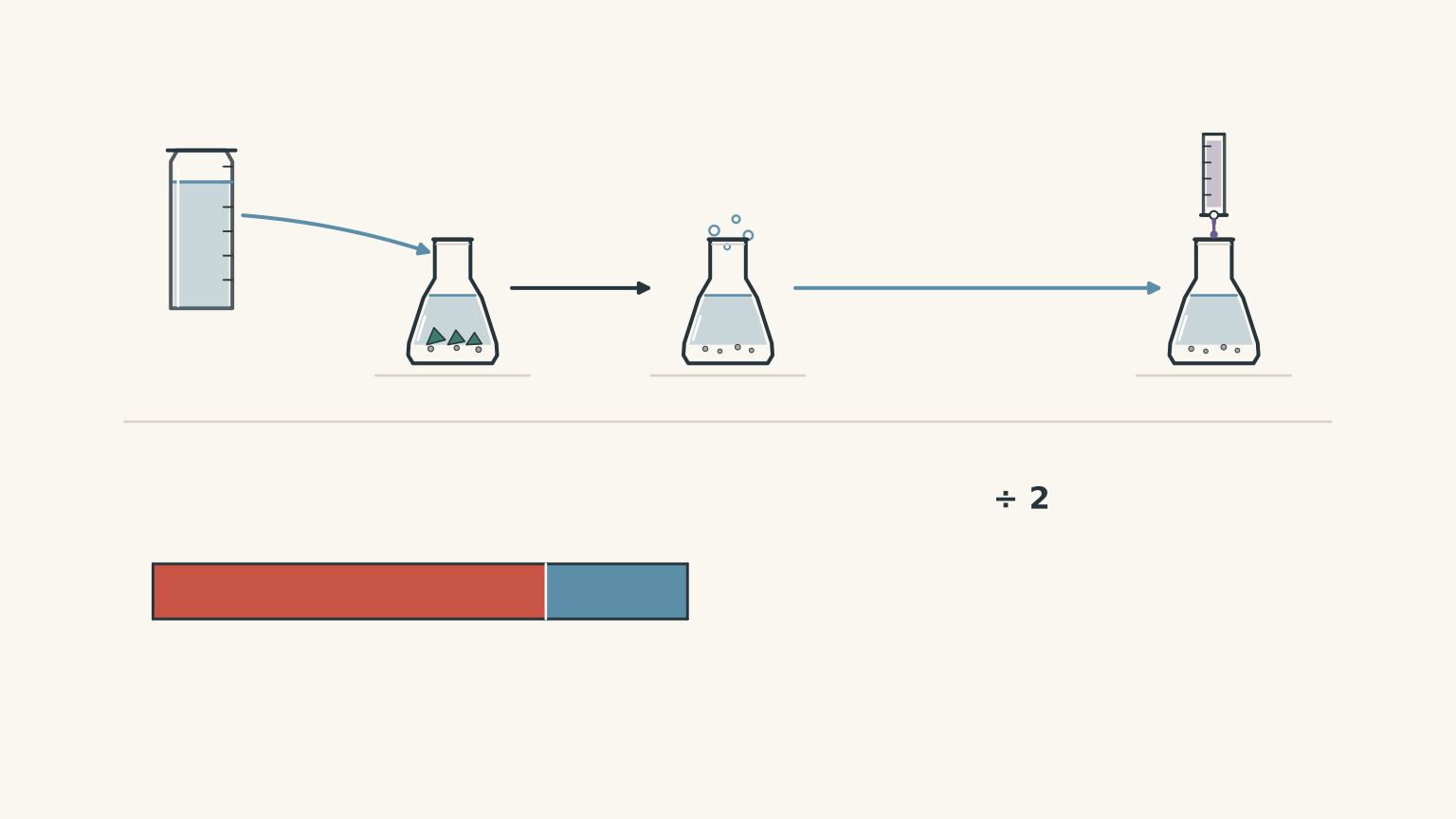
Imagine weighing 2.00 g of an impure calcium carbonate sample. You add 50.00 mL of hydrochloric acid, knowing that this is more acid than the sample needs.

Some of the acid reacts with the calcium carbonate. Any unreacted acid remains in the solution.

You cannot directly see how much acid reacted. However, you can measure the acid that remains by titrating it with sodium hydroxide.

The method is essentially an accounting exercise:

- **Acid added:** the total amount of hydrochloric acid initially placed in the reaction flask.
- **Acid remaining:** the hydrochloric acid that did not react with the sample.
- **Acid consumed:** the difference between the amount added and the amount remaining.

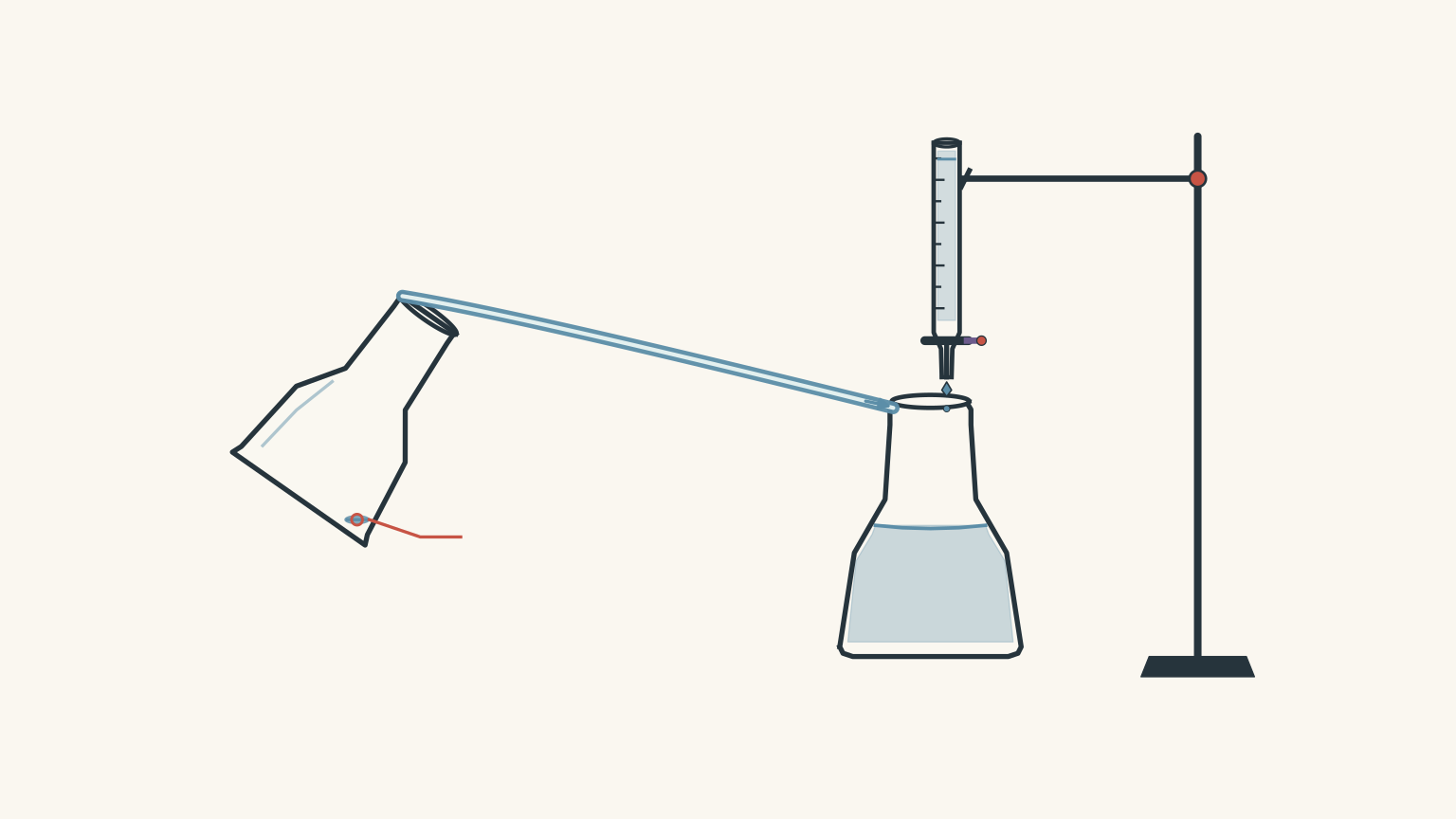
[IMAGE: An annotated scientific illustration of a back titration setup. Show a conical flask containing an impure calcium carbonate sample reacting with a measured excess of hydrochloric acid. Show a separate burette containing standard sodium hydroxide above a conical flask containing the remaining acidic solution and indicator. Include arrows showing the initial acid addition, the carbon dioxide escaping during the carbonate reaction, and the sodium hydroxide added during the second titration. Clearly distinguish the two reaction stages and label the measured volumes.]

### Why use sodium hydroxide?

Sodium hydroxide neutralises the hydrochloric acid that remains in the flask:

\[
\ce{HCl + NaOH -> NaCl + H2O}
\]

The mole ratio is 1:1.

This gives us a useful shortcut:

\[
n(\mathrm{HCl\ remaining})=n(\mathrm{NaOH\ used})
\]

So, if a solution requires 0.0120 mol of NaOH to neutralise it, it contained 0.0120 mol of leftover HCl.

Notice what this does not tell us: it does not tell us how much acid the original carbonate sample consumed. We still need to subtract the leftover acid from the initial amount.

### The three quantities at a glance

| Quantity | How to calculate it | What it represents |
|---|---|---|
| HCl added | \(n=cV\) | Initial amount of acid |
| HCl remaining | \(n(\mathrm{NaOH})=cV\) | Acid left after the carbonate reaction |
| HCl consumed | HCl added − HCl remaining | Acid that reacted with the sample |

Here, \(n\) is the amount in moles, \(c\) is concentration in mol L⁻¹, and \(V\) is volume in litres.

**Watch the volume conversion:** divide millilitres by 1000 before substituting into \(n=cV\).

## 2. The calculation method, step by step

Use this sequence whenever a question asks you to calculate carbonate purity using back titration.

**Step 1: Calculate the moles of hydrochloric acid added.**

Use the supplied acid concentration and volume:

\[
n(\mathrm{HCl\ added})=cV
\]

**Step 2: Calculate the moles of sodium hydroxide used.**

Use the sodium hydroxide concentration and the average titre:

\[
n(\mathrm{NaOH})=cV
\]

**Step 3: Convert the sodium hydroxide amount into leftover hydrochloric acid.**

Because the neutralisation reaction has a 1:1 mole ratio:

\[
n(\mathrm{HCl\ remaining})=n(\mathrm{NaOH})
\]

This equality applies directly when the entire remaining acid solution is titrated. If only an aliquot is titrated, you must account for the fraction of the solution tested.

**Step 4: Calculate the hydrochloric acid consumed.**

\[
n(\mathrm{HCl\ consumed})=
n(\mathrm{HCl\ added})-
n(\mathrm{HCl\ remaining})
\]

**Step 5: Use the carbonate reaction ratio to calculate the carbonate moles.**

For calcium carbonate:

\[
n(\mathrm{CaCO_3})=
\frac{n(\mathrm{HCl\ consumed})}{2}
\]

**Step 6: Convert carbonate moles into mass.**

Use the molar mass of calcium carbonate:

\[
M(\mathrm{CaCO_3})=100.09\ \mathrm{g\,mol^{-1}}
\]

\[
m=nM
\]

**Step 7: Calculate the percentage purity.**

Divide the calculated mass of pure calcium carbonate by the original mass of the impure sample, then multiply by 100.
03What does the purity calculation actually assume?
There is an important distinction between calculating how much acid a sample consumes and calculating how much calcium carbonate it contains.
The back titration measures acid consumption. It does not identify which substance consumed the acid.
To report the result as calcium carbonate purity, you must assume that calcium carbonate is the only substance in the sample that reacts with hydrochloric acid.
For example, imagine a limestone sample containing:
- Calcium carbonate, which reacts with hydrochloric acid.
- Silica, which does not react with hydrochloric acid under the experimental conditions.
In this case, the acid consumption can be attributed to calcium carbonate. The remaining mass is treated as inert impurity.
However, if the sample also contains magnesium carbonate, that substance will consume hydrochloric acid too. Your calculation would incorrectly count its contribution as calcium carbonate.
Assumptions to check
| Assumption | Why it matters |
|---|---|
| HCl is in excess | All the carbonate must have an opportunity to react. |
| The reaction goes to completion | Unreacted carbonate would make the calculated purity too low. |
| Only CaCO₃ consumes HCl | Other acid-reactive impurities would make the calculated CaCO₃ purity too high. |
| All remaining solution is accounted for | Losing acid during transfer makes the calculated purity too high. |
| The original sample is dry | Moisture adds to the measured sample mass and lowers the calculated percentage. |
| The titration measures the remaining HCl accurately | Dissolved CO₂ and endpoint errors can affect the measured leftover acidity. |
One experimental detail deserves attention: carbon dioxide produced by the carbonate reaction can dissolve in water and form carbonic acid. If it contributes to the subsequent NaOH titration, some of the measured NaOH will neutralise carbonic acid rather than leftover HCl.
The experiment must therefore account for dissolved CO₂, using the specified experimental procedure. Otherwise, the calculated amount of leftover HCl may be too large, causing the carbonate purity to be underestimated.
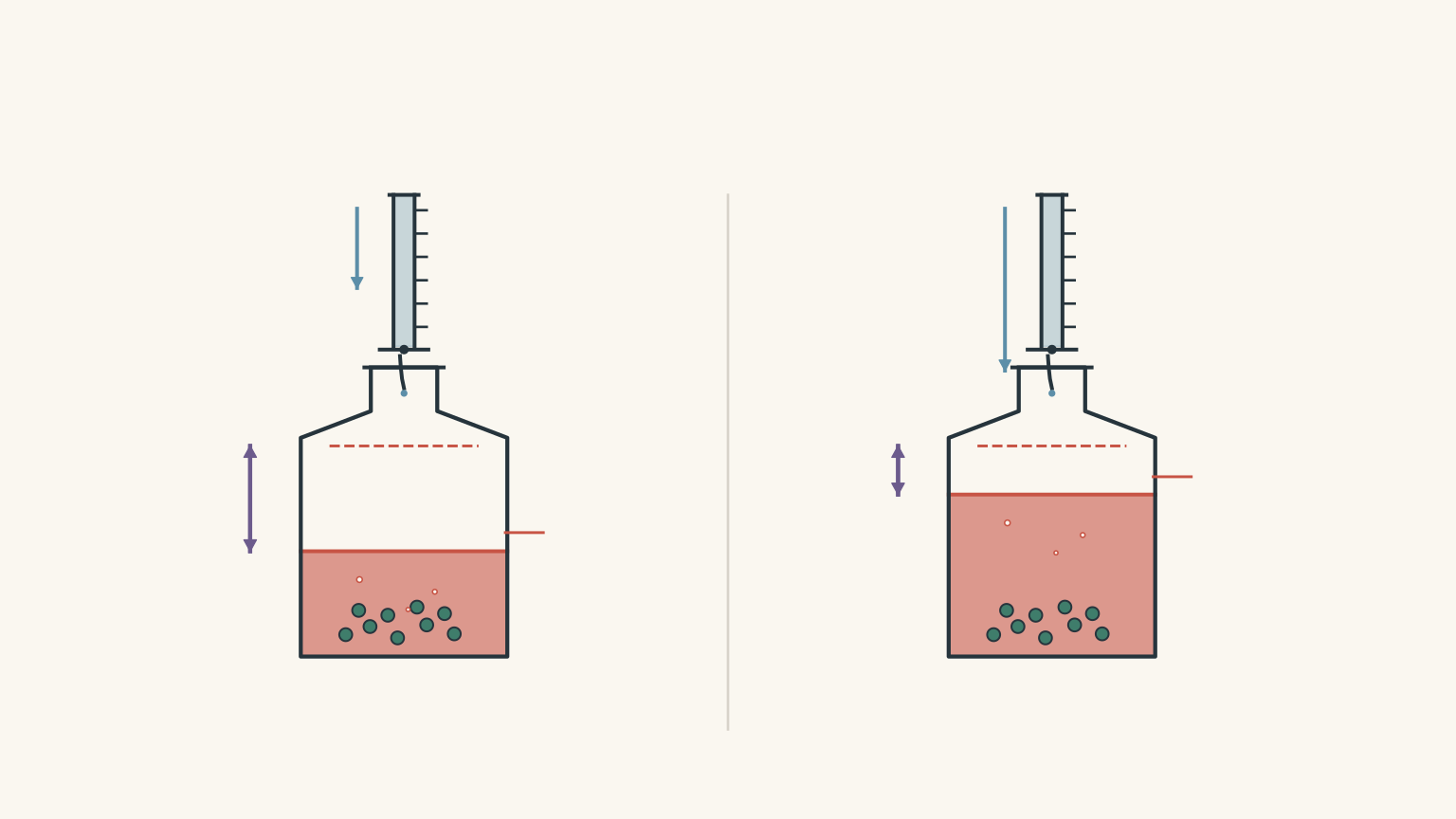
A common misconception: a larger titre means more carbonate
Suppose two equal-mass limestone samples receive exactly the same amount of hydrochloric acid.
Sample A requires 12.00 mL of NaOH to neutralise its leftover acid.
Sample B requires 25.00 mL.
Which sample contains more calcium carbonate?
It is tempting to choose B because it required more NaOH. But remember what the NaOH is measuring: the acid that did not react with the carbonate.
Sample B has more acid remaining, so it consumed less acid during the original reaction. Therefore, assuming both samples contain only CaCO₃ as their acid-reactive component, sample A contains more calcium carbonate.
Due to technical limitations, this figure may display incorrectly or contain inaccuracies. Please check key details against your course materials.
Keep this direction straight:
- More carbonate → more HCl consumed → less HCl remaining → smaller NaOH titre.
- Less carbonate → less HCl consumed → more HCl remaining → larger NaOH titre.
This comparison only works when the initial acid amount, sample mass, carbonate identity, and titration conditions are the same.
04Worked examples
Worked example: Calculate the purity of a limestone sample
A 1.800 g limestone sample contains calcium carbonate and acid-inert impurities. It is treated with 40.00 mL of 0.5000 mol L⁻¹ hydrochloric acid.
After the reaction is complete, the entire remaining acidic solution requires 26.50 mL of 0.2000 mol L⁻¹ sodium hydroxide for neutralisation.
Calculate the mass percentage of calcium carbonate in the original sample.
Assume all the calcium carbonate reacts completely and no other substance in the sample consumes hydrochloric acid.
Step 1: Calculate the initial amount of hydrochloric acid.
Convert the volume into litres:
\[ 40.00\ \mathrm{mL}=0.04000\ \mathrm{L} \]
Use \(n=cV\):
\[ \begin{aligned} n(\ce{HCl})&=0.5000\times0.04000\\ &=0.02000\ \mathrm{mol} \end{aligned} \]
This is the total amount of hydrochloric acid added.
Step 2: Calculate the amount of hydrochloric acid remaining.
The NaOH titre is 26.50 mL, or 0.02650 L.
\[ \begin{aligned} n(\ce{NaOH})&=0.2000\times0.02650\\ &=0.005300\ \mathrm{mol} \end{aligned} \]
The neutralisation reaction has a 1:1 mole ratio.
Therefore:
\[ n(\ce{HCl\ remaining})=0.005300\ \mathrm{mol} \]
Step 3: Calculate the hydrochloric acid consumed.
Subtract the remaining acid from the initial amount:
\[ \begin{aligned} n(\ce{HCl\ consumed}) &=0.02000-0.005300\\ &=0.01470\ \mathrm{mol} \end{aligned} \]
This is the amount of hydrochloric acid that reacted with the calcium carbonate.
Step 4: Calculate the moles of calcium carbonate.
From the balanced equation:
\[ \ce{CaCO3 + 2HCl -> CaCl2 + CO2 + H2O} \]
The mole ratio is 1 mol CaCO₃ to 2 mol HCl.
\[ \begin{aligned} n(\ce{CaCO3}) &=\frac{0.01470}{2}\\ &=0.007350\ \mathrm{mol} \end{aligned} \]
Step 5: Convert the moles into mass.
Using the molar mass of calcium carbonate:
\[ M(\ce{CaCO3})=100.09\ \mathrm{g\\,mol^{-1}} \]
\[ \begin{aligned} m&=nM\\ &=0.007350\times100.09\\ &=0.7357\ \mathrm{g} \end{aligned} \]
The original sample contains 0.7357 g of calcium carbonate.
Step 6: Calculate the percentage purity.
The original sample weighed 1.800 g.
\[ \begin{aligned} \%\text{ purity} &=\frac{0.7357}{1.800}\times100\\ &=40.9\% \end{aligned} \]
Final answer: 40.9%
The limestone sample is 40.9% calcium carbonate by mass. The remaining 59.1% consists of other material, under the assumption that the impurities do not consume hydrochloric acid.
Due to technical limitations, this figure may display incorrectly or contain inaccuracies. Please check key details against your course materials.
Worked example: Calculate purity when only an aliquot is titrated
A 2.500 g carbonate sample is treated with 60.00 mL of 0.4000 mol L⁻¹ hydrochloric acid.
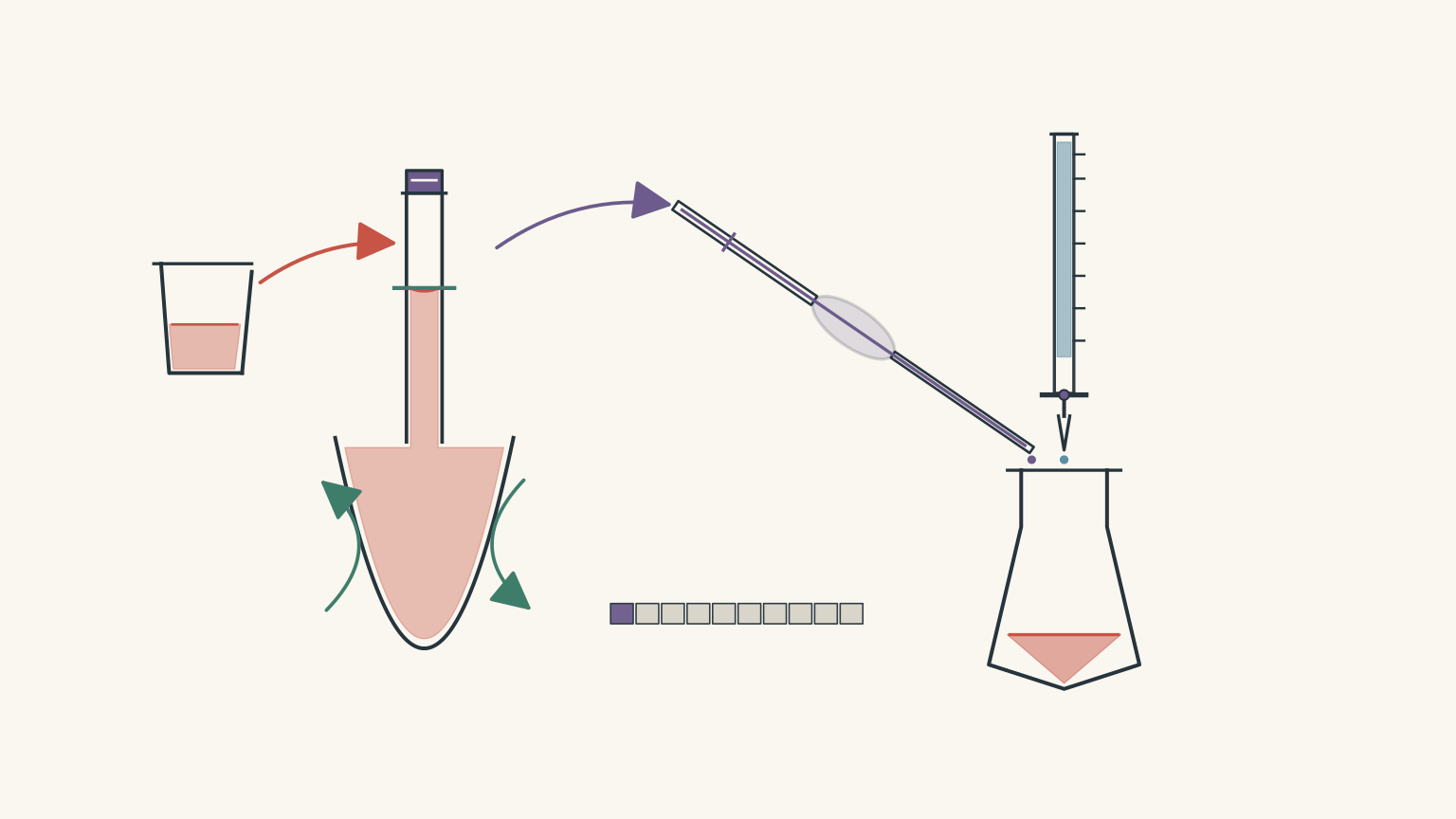
After the reaction, the solution is quantitatively transferred into a 250.0 mL volumetric flask and diluted to the calibration mark.
A 25.00 mL aliquot of this solution requires 16.20 mL of 0.1000 mol L⁻¹ sodium hydroxide for complete neutralisation.
Calculate the calcium carbonate purity of the original sample.
Assume calcium carbonate is the only substance consuming hydrochloric acid.
Step 1: Calculate the initial amount of hydrochloric acid.
Convert 60.00 mL into litres:
\[ 60.00\ \mathrm{mL}=0.06000\ \mathrm{L} \]
\[ \begin{aligned} n(\ce{HCl\ added}) &=cV\\ &=0.4000\times0.06000\\ &=0.02400\ \mathrm{mol} \end{aligned} \]
Step 2: Calculate the amount of sodium hydroxide used for the aliquot.
Convert 16.20 mL into litres:
\[ 16.20\ \mathrm{mL}=0.01620\ \mathrm{L} \]
\[ \begin{aligned} n(\ce{NaOH}) &=0.1000\times0.01620\\ &=0.001620\ \mathrm{mol} \end{aligned} \]
The aliquot therefore contains 0.001620 mol of leftover hydrochloric acid.
Step 3: Scale up to find the total leftover acid.
This is the important extra step.
The aliquot is 25.00 mL, while the full solution is 250.0 mL.
The fraction of the total solution titrated is:
\[ \frac{25.00}{250.0}=\frac{1}{10} \]
Therefore, the total amount of remaining hydrochloric acid is ten times the amount in the aliquot.
\[ \begin{aligned} n(\ce{HCl\ remaining}) &=0.001620\times10\\ &=0.01620\ \mathrm{mol} \end{aligned} \]
Do not subtract the aliquot’s acid directly from the original acid amount. They represent different quantities of solution.
Step 4: Calculate the amount of hydrochloric acid consumed.
\[ \begin{aligned} n(\ce{HCl\ consumed}) &=0.02400-0.01620\\ &=0.007800\ \mathrm{mol} \end{aligned} \]
Step 5: Calculate the moles of calcium carbonate.
Using the 1:2 mole ratio:
\[ \begin{aligned} n(\ce{CaCO3}) &=\frac{0.007800}{2}\\ &=0.003900\ \mathrm{mol} \end{aligned} \]
Step 6: Calculate the mass of calcium carbonate.
\[ \begin{aligned} m(\ce{CaCO3}) &=0.003900\times100.09\\ &=0.3904\ \mathrm{g} \end{aligned} \]
Step 7: Calculate the percentage purity.
\[ \begin{aligned} \%\text{ purity} &=\frac{0.3904}{2.500}\times100\\ &=15.6\% \end{aligned} \]
Final answer: 15.6%
The sample is 15.6% calcium carbonate by mass.
Notice how much the aliquot correction matters. If you had forgotten to multiply the leftover acid by ten, you would have calculated a purity of approximately 44.8%.
The dilution itself does not change the number of moles of acid. It changes the concentration. The aliquot correction is necessary because you only titrated one-tenth of the solution.
Due to technical limitations, this figure may display incorrectly or contain inaccuracies. Please check key details against your course materials.
05Questions and solutions
The following questions progress from a standard purity calculation to problems involving experimental errors and limitations of the method.
Question 1
A 1.250 g sample of limestone contains calcium carbonate as its only acid-reactive component.
The sample reacts completely with 25.00 mL of 0.5000 mol L⁻¹ hydrochloric acid. The entire remaining solution requires 20.00 mL of 0.1000 mol L⁻¹ sodium hydroxide for neutralisation.
Calculate the mass percentage of calcium carbonate in the sample.
Solution 1
The sample is 42.0% calcium carbonate by mass.
First, calculate the initial amount of hydrochloric acid:
\[ \begin{aligned} n(\ce{HCl\ added}) &=0.5000\times0.02500\\ &=0.01250\ \mathrm{mol} \end{aligned} \]
Next, calculate the leftover hydrochloric acid using the NaOH titre:
\[ \begin{aligned} n(\ce{NaOH}) &=0.1000\times0.02000\\ &=0.002000\ \mathrm{mol} \end{aligned} \]
Since HCl and NaOH react in a 1:1 ratio:
\[ n(\ce{HCl\ remaining})=0.002000\ \mathrm{mol} \]
Subtract to find the acid consumed:
\[ \begin{aligned} n(\ce{HCl\ consumed}) &=0.01250-0.002000\\ &=0.01050\ \mathrm{mol} \end{aligned} \]
Convert this into calcium carbonate moles:
\[ \begin{aligned} n(\ce{CaCO3}) &=\frac{0.01050}{2}\\ &=0.005250\ \mathrm{mol} \end{aligned} \]
Calculate its mass:
\[ \begin{aligned} m(\ce{CaCO3}) &=0.005250\times100.09\\ &=0.5255\ \mathrm{g} \end{aligned} \]
Finally:
\[ \begin{aligned} \%\text{ purity} &=\frac{0.5255}{1.250}\times100\\ &=42.0\% \end{aligned} \]
The sample contains approximately 0.5255 g of calcium carbonate, with the remaining mass attributed to inert impurities.
Question 2
A 1.600 g limestone sample is treated with 50.00 mL of 0.5000 mol L⁻¹ hydrochloric acid.
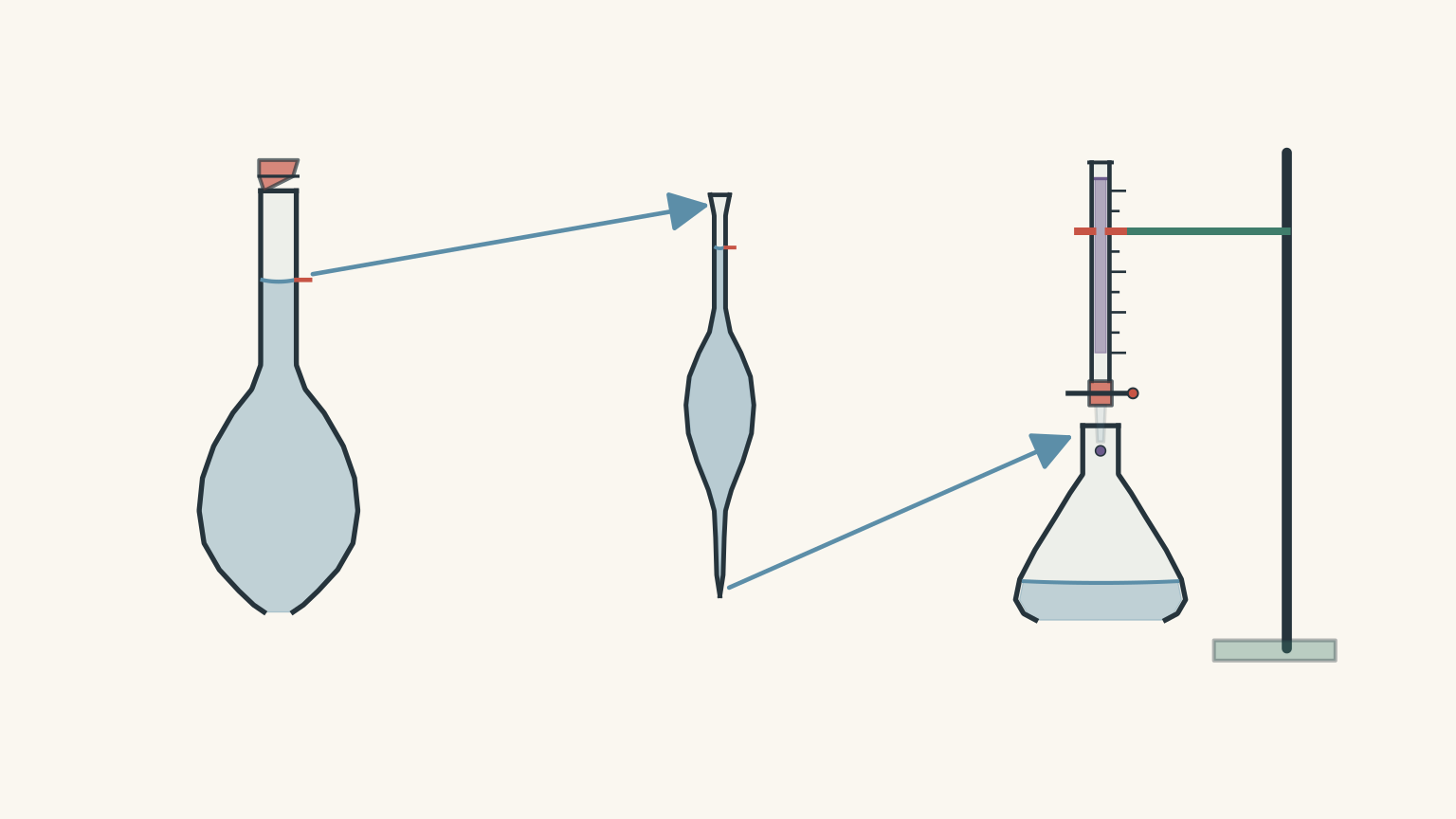
After the reaction is complete, the solution is quantitatively transferred into a 250.0 mL volumetric flask and diluted to the mark.
A 25.00 mL aliquot requires 15.60 mL of 0.1000 mol L⁻¹ sodium hydroxide for neutralisation.
Assume calcium carbonate is the only substance in the sample that reacts with hydrochloric acid.
(a) Calculate the percentage purity of the original limestone sample.
(b) A student subtracts the moles of NaOH used in the aliquot directly from the initial moles of HCl. Explain why this is incorrect and determine the purity the student would incorrectly calculate.
Due to technical limitations, this figure may display incorrectly or contain inaccuracies. Please check key details against your course materials.
Solution 2
(a) The correct calcium carbonate purity is 29.4%.
Start with the initial hydrochloric acid:
\[ \begin{aligned} n(\ce{HCl\ added}) &=0.5000\times0.05000\\ &=0.02500\ \mathrm{mol} \end{aligned} \]
Calculate the NaOH used in the aliquot:
\[ \begin{aligned} n(\ce{NaOH}) &=0.1000\times0.01560\\ &=0.001560\ \mathrm{mol} \end{aligned} \]
This represents only one-tenth of the remaining acid.
Therefore, the total remaining acid is:
\[ \begin{aligned} n(\ce{HCl\ remaining}) &=0.001560\times10\\ &=0.01560\ \mathrm{mol} \end{aligned} \]
Calculate the acid consumed:
\[ \begin{aligned} n(\ce{HCl\ consumed}) &=0.02500-0.01560\\ &=0.009400\ \mathrm{mol} \end{aligned} \]
Convert into calcium carbonate moles:
\[ \begin{aligned} n(\ce{CaCO3}) &=\frac{0.009400}{2}\\ &=0.004700\ \mathrm{mol} \end{aligned} \]
Calculate the calcium carbonate mass:
\[ \begin{aligned} m(\ce{CaCO3}) &=0.004700\times100.09\\ &=0.4704\ \mathrm{g} \end{aligned} \]
Calculate purity:
\[ \begin{aligned} \%\text{ purity} &=\frac{0.4704}{1.600}\times100\\ &=29.4\% \end{aligned} \]
(b) The student’s incorrect calculation gives approximately 73.3% purity.
The mistake is treating the aliquot as though it represents the entire solution.
The student calculates:
\[ \begin{aligned} n(\ce{HCl\ consumed}) &=0.02500-0.001560\\ &=0.02344\ \mathrm{mol} \end{aligned} \]
This is incorrect because 0.001560 mol represents only one-tenth of the leftover acid.
Continuing with the student’s incorrect value:
\[ n(\ce{CaCO3})=\frac{0.02344}{2} =0.01172\ \mathrm{mol} \]
\[ m(\ce{CaCO3})=0.01172\times100.09 =1.173\ \mathrm{g} \]
\[ \%\text{ purity}= \frac{1.173}{1.600}\times100 =73.3\% \]
The incorrect result is much higher because the student underestimates the leftover acid and consequently overestimates the amount consumed by the carbonate.
Question 3
Two 1.000 g limestone samples, A and B, are analysed separately.
Each sample receives exactly 25.00 mL of 0.2000 mol L⁻¹ hydrochloric acid. After the reaction, the entire remaining acidic solution is titrated with 0.1000 mol L⁻¹ sodium hydroxide.
The following titres are recorded:
| Sample | NaOH titre |
|---|---|
| A | 11.00 mL |
| B | 18.00 mL |
Assume both samples contain calcium carbonate as their only acid-reactive component.
(a) Calculate the calcium carbonate purity of each sample.
(b) Identify which sample contains more calcium carbonate.
(c) Explain why the sample with the larger NaOH titre has the lower carbonate purity.
Due to technical limitations, this figure may display incorrectly or contain inaccuracies. Please check key details against your course materials.
Solution 3
Sample A has the higher calcium carbonate purity: 19.5%, compared with 16.0% for sample B.
(a) Calculate the purity of each sample.
Both samples initially receive the same amount of hydrochloric acid:
\[ \begin{aligned} n(\ce{HCl\ added}) &=0.2000\times0.02500\\ &=0.005000\ \mathrm{mol} \end{aligned} \]
For sample A, calculate the remaining acid:
\[ \begin{aligned} n(\ce{HCl\ remaining}) &=0.1000\times0.01100\\ &=0.001100\ \mathrm{mol} \end{aligned} \]
The acid consumed is:
\[ \begin{aligned} n(\ce{HCl\ consumed}) &=0.005000-0.001100\\ &=0.003900\ \mathrm{mol} \end{aligned} \]
Convert into calcium carbonate moles:
\[ n(\ce{CaCO3})=\frac{0.003900}{2} =0.001950\ \mathrm{mol} \]
Calculate the mass:
\[ m(\ce{CaCO3})=0.001950\times100.09 =0.1952\ \mathrm{g} \]
Therefore:
\[ \%\text{ purity A} =\frac{0.1952}{1.000}\times100 =19.5\% \]
Now repeat for sample B.
The remaining acid is:
\[ \begin{aligned} n(\ce{HCl\ remaining}) &=0.1000\times0.01800\\ &=0.001800\ \mathrm{mol} \end{aligned} \]
The acid consumed is:
\[ \begin{aligned} n(\ce{HCl\ consumed}) &=0.005000-0.001800\\ &=0.003200\ \mathrm{mol} \end{aligned} \]
The calcium carbonate moles are:
\[ n(\ce{CaCO3})=\frac{0.003200}{2} =0.001600\ \mathrm{mol} \]
The mass is:
\[ m(\ce{CaCO3})=0.001600\times100.09 =0.1601\ \mathrm{g} \]
Therefore:
\[ \%\text{ purity B} =\frac{0.1601}{1.000}\times100 =16.0\% \]
(b) Sample A contains more calcium carbonate.
Sample A contains 0.1952 g of CaCO₃, while sample B contains 0.1601 g.
The difference is:
\[ 0.1952-0.1601=0.0351\ \mathrm{g} \]
(c) Sample B requires more NaOH because it has more hydrochloric acid remaining.
The larger titre does not indicate more carbonate. It indicates that more acid survived the original reaction.
Sample A consumed 0.003900 mol of HCl, while sample B consumed only 0.003200 mol.
Since the samples received identical initial amounts of acid, the smaller NaOH titre identifies the sample that reacted with more hydrochloric acid.
Question 4
A 1.500 g limestone sample is treated with 50.00 mL of 0.4000 mol L⁻¹ hydrochloric acid.
Assume the reaction is complete and calcium carbonate is the only acid-reactive substance.
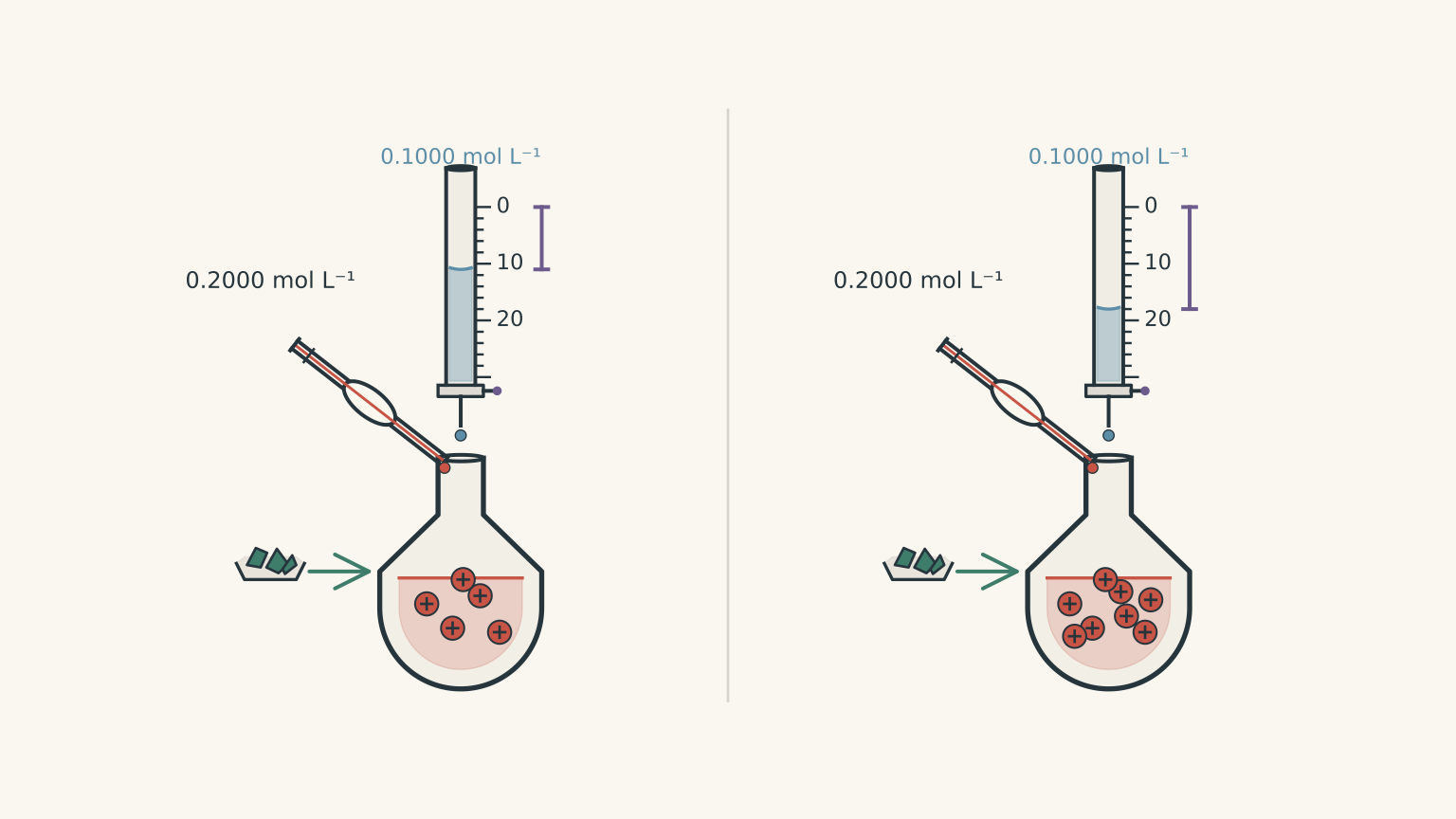
If the entire remaining solution were transferred quantitatively, it would require 24.00 mL of 0.2000 mol L⁻¹ NaOH for neutralisation.
However, a student leaves 10.0% of the homogeneous post-reaction solution in the original reaction flask. Only the remaining 90.0% is transferred and titrated.
The student treats the measured titre as though it represents all the leftover acid.
(a) Calculate the actual calcium carbonate purity of the sample.
(b) Calculate the purity the student would report.
(c) Explain the direction of the error.
Due to technical limitations, this figure may display incorrectly or contain inaccuracies. Please check key details against your course materials.
Solution 4
The correct purity is 50.7%, but the student would report 52.3%, an overestimate of approximately 1.6 percentage points.
(a) Calculate the actual purity.
First, calculate the initial hydrochloric acid:
\[ \begin{aligned} n(\ce{HCl\ added}) &=0.4000\times0.05000\\ &=0.02000\ \mathrm{mol} \end{aligned} \]
The complete solution would require 24.00 mL of NaOH.
Therefore:
\[ \begin{aligned} n(\ce{HCl\ remaining}) &=0.2000\times0.02400\\ &=0.004800\ \mathrm{mol} \end{aligned} \]
The amount of acid consumed is:
\[ \begin{aligned} n(\ce{HCl\ consumed}) &=0.02000-0.004800\\ &=0.01520\ \mathrm{mol} \end{aligned} \]
Convert into calcium carbonate moles:
\[ n(\ce{CaCO3})=\frac{0.01520}{2} =0.007600\ \mathrm{mol} \]
Calculate the mass:
\[ m(\ce{CaCO3})=0.007600\times100.09 =0.7607\ \mathrm{g} \]
The actual purity is:
\[ \begin{aligned} \%\text{ purity} &=\frac{0.7607}{1.500}\times100\\ &=50.7\% \end{aligned} \]
(b) Calculate the student’s incorrect purity.
Only 90.0% of the remaining acid reaches the titration flask.
The measured NaOH titre is therefore:
\[ 24.00\times0.900=21.60\ \mathrm{mL} \]
The student calculates the remaining acid as:
\[ \begin{aligned} n(\ce{HCl\ measured}) &=0.2000\times0.02160\\ &=0.004320\ \mathrm{mol} \end{aligned} \]
They incorrectly treat this as the total remaining acid.
Their calculated acid consumption becomes:
\[ \begin{aligned} n(\ce{HCl\ consumed}) &=0.02000-0.004320\\ &=0.01568\ \mathrm{mol} \end{aligned} \]
The apparent calcium carbonate amount is:
\[ n(\ce{CaCO3})=\frac{0.01568}{2} =0.007840\ \mathrm{mol} \]
Its calculated mass is:
\[ m(\ce{CaCO3})=0.007840\times100.09 =0.7847\ \mathrm{g} \]
The reported purity is:
\[ \begin{aligned} \%\text{ purity} &=\frac{0.7847}{1.500}\times100\\ &=52.3\% \end{aligned} \]
(c) Explain the error.
The student has lost some of the leftover acid during the transfer.
They consequently measure fewer moles of remaining HCl than actually exist in the original reaction mixture.
Because the initial amount of acid is unchanged, subtracting this artificially low leftover amount makes the calculated acid consumption too large.
That produces an overestimate of the calcium carbonate mass and therefore its purity.
The important lesson is that quantitative transfer matters. Any remaining acidic solution must be included in the titration, not left behind in the original flask.
Question 5
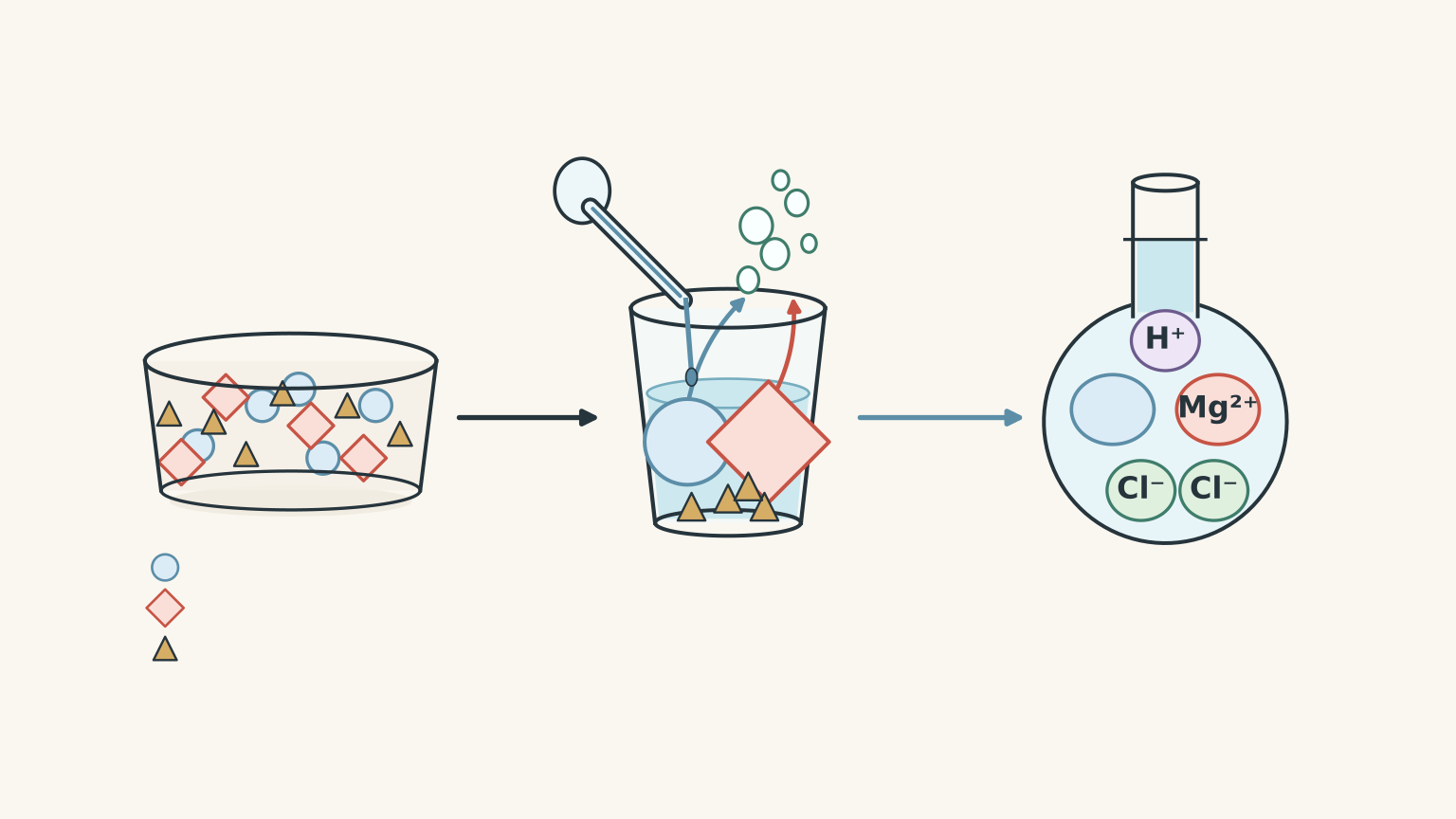
A mineral sample has a mass of 1.000 g. It contains an unknown mixture of calcium carbonate, magnesium carbonate, and silica.
Both carbonates react completely with hydrochloric acid, while silica does not react under the experimental conditions.
The sample is treated with 50.00 mL of 0.4000 mol L⁻¹ hydrochloric acid. After the reaction, the solution is quantitatively transferred into a 200.0 mL volumetric flask and diluted to the mark.
A 20.00 mL aliquot requires 16.00 mL of 0.1000 mol L⁻¹ sodium hydroxide for neutralisation.
The relevant molar masses are:
- \(M(\ce{CaCO3})=100.09\ \mathrm{g\\,mol^{-1}}\)
- \(M(\ce{MgCO3})=84.31\ \mathrm{g\\,mol^{-1}}\)
For this question, define carbonate purity as the combined mass percentage of calcium carbonate and magnesium carbonate in the sample.
(a) Calculate the total number of moles of carbonate present in the sample.
(b) Can the exact carbonate mass purity be determined from the back titration alone? Explain your reasoning.
(c) Calculate the minimum and maximum possible carbonate mass purity.
(d) Construct two different possible mineral compositions, each consistent with the experimental data, that produce different carbonate mass purities. Explain why this demonstrates a limitation of the method.
Due to technical limitations, this figure may display incorrectly or contain inaccuracies. Please check key details against your course materials.
Solution 5
The exact carbonate mass purity cannot be determined uniquely. The experiment establishes that the sample contains 0.00200 mol of carbonate, but it does not establish how much of that carbonate is CaCO₃ versus MgCO₃.
This is a limitation of what the titration measures, rather than an arithmetic problem.
(a) Calculate the total carbonate moles.
First, calculate the initial hydrochloric acid:
\[ \begin{aligned} n(\ce{HCl\ added}) &=0.4000\times0.05000\\ &=0.02000\ \mathrm{mol} \end{aligned} \]
Calculate the NaOH used in the aliquot:
\[ \begin{aligned} n(\ce{NaOH}) &=0.1000\times0.01600\\ &=0.001600\ \mathrm{mol} \end{aligned} \]
The aliquot represents:
\[ \frac{20.00}{200.0}=\frac{1}{10} \]
Therefore, the total remaining hydrochloric acid is:
\[ \begin{aligned} n(\ce{HCl\ remaining}) &=0.001600\times10\\ &=0.01600\ \mathrm{mol} \end{aligned} \]
The amount of acid consumed is:
\[ \begin{aligned} n(\ce{HCl\ consumed}) &=0.02000-0.01600\\ &=0.004000\ \mathrm{mol} \end{aligned} \]
Both calcium carbonate and magnesium carbonate consume two moles of HCl per mole of carbonate.
For calcium carbonate:
\[ \ce{CaCO3 + 2HCl -> CaCl2 + CO2 + H2O} \]
For magnesium carbonate:
\[ \ce{MgCO3 + 2HCl -> MgCl2 + CO2 + H2O} \]
Therefore:
\[ \begin{aligned} n(\text{total carbonates}) &=\frac{0.004000}{2}\\ &=0.002000\ \mathrm{mol} \end{aligned} \]
This is the combined number of moles of CaCO₃ and MgCO₃.
(b) The exact carbonate mass purity cannot be determined.
The back titration gives the total number of carbonate moles, but the two carbonates have different molar masses.
One mole of CaCO₃ has a mass of 100.09 g.
One mole of MgCO₃ has a mass of 84.31 g.
Therefore, the same number of carbonate moles can correspond to different total carbonate masses.
The titration cannot distinguish between the two substances because both consume hydrochloric acid in the same 1:2 mole ratio.
(c) Calculate the minimum and maximum possible purity.
The minimum carbonate mass occurs if all the carbonate is magnesium carbonate, because it has the smaller molar mass.
\[ \begin{aligned} m_{\min} &=0.002000\times84.31\\ &=0.16862\ \mathrm{g} \end{aligned} \]
The minimum possible purity is:
\[ \begin{aligned} \%\text{ purity}_{\min} &=\frac{0.16862}{1.000}\times100\\ &=16.9\% \end{aligned} \]
The maximum carbonate mass occurs if all the carbonate is calcium carbonate.
\[ \begin{aligned} m_{\max} &=0.002000\times100.09\\ &=0.20018\ \mathrm{g} \end{aligned} \]
The maximum possible purity is:
\[ \begin{aligned} \%\text{ purity}_{\max} &=\frac{0.20018}{1.000}\times100\\ &=20.0\% \end{aligned} \]
Therefore, the possible carbonate mass purity lies between 16.9% and 20.0%.
(d) Construct two possible compositions.
Consider two different mixtures. Both contain 0.002000 mol of total carbonate.
Possible composition A:
- 0.001500 mol CaCO₃
- 0.000500 mol MgCO₃
Calculate the combined carbonate mass:
\[ \begin{aligned} m_{\ce{CaCO3}} &=0.001500\times100.09\\ &=0.15014\ \mathrm{g} \end{aligned} \]
\[ \begin{aligned} m_{\ce{MgCO3}} &=0.000500\times84.31\\ &=0.04216\ \mathrm{g} \end{aligned} \]
Total carbonate mass:
\[ m_{\text{carbonate}}=0.19229\ \mathrm{g} \]
Therefore:
\[ \%\text{ purity A}=19.2\% \]
Possible composition B:
- 0.000500 mol CaCO₃
- 0.001500 mol MgCO₃
Calculate the combined carbonate mass:
\[ \begin{aligned} m_{\ce{CaCO3}} &=0.000500\times100.09\\ &=0.05005\ \mathrm{g} \end{aligned} \]
\[ \begin{aligned} m_{\ce{MgCO3}} &=0.001500\times84.31\\ &=0.12647\ \mathrm{g} \end{aligned} \]
Total carbonate mass:
\[ m_{\text{carbonate}}=0.17651\ \mathrm{g} \]
Therefore:
\[ \%\text{ purity B}=17.7\% \]
Both compositions contain exactly 0.002000 mol of carbonate. Both consume exactly 0.004000 mol of hydrochloric acid.
Both are consistent with the measured titre and the original 1.000 g sample mass, with the remaining mass consisting of silica.
Yet their carbonate mass purities are different.
This proves that the back titration alone cannot determine the exact mass purity of an unknown mixture of carbonates.
You would need an additional measurement that distinguishes calcium from magnesium, such as an independent analysis of the dissolved metal ions.
The deeper principle is that a titration measures the amount of substance reacting according to a particular stoichiometric relationship. It does not automatically identify the chemical composition or mass of an unknown mixture.
06A final checklist for carbonate purity calculations
Before submitting a back titration calculation, check these points:
- Have you converted every volume from mL to L before using \(n=cV\)?
- Have you calculated the initial moles of HCl?
- Have you used the NaOH titre to calculate the leftover HCl?
- If you titrated an aliquot, have you scaled up to the entire solution?
- Have you subtracted leftover acid from added acid, rather than the other way around?
- Have you used the correct 2:1 HCl-to-CaCO₃ mole ratio?
- Have you converted carbonate moles into mass using the correct molar mass?
- Have you divided by the original sample mass, not the mass of the reacted residue?
- Have you checked that your calculated carbonate mass does not exceed the original sample mass?
- Have you considered whether other substances could also consume the acid?
One particularly useful check is:
\[ n(\ce{HCl\ added})= n(\ce{HCl\ consumed})+ n(\ce{HCl\ remaining}) \]
If this relationship does not balance, revisit your calculations.
For more practice with the shared acid-balance method, see Back Titration of an Antacid: Calculating Calcium Carbonate.
Once you have calculated the amount of calcium carbonate, you can also use the carbonate reaction’s mole ratio to calculate the carbon dioxide produced. See How to Calculate CO₂ Volume from a Carbonate Reaction.
The key distinction to carry into other quantitative chemistry problems is this: the titration measures what remains, subtraction tells you what reacted, and stoichiometry tells you what that reaction represents. Percentage purity is the final mass calculation, not something you can read directly from a titre.