
How to Convert mg/L to mol/L in HSC Chemistry
Learn how to convert milligrams per litre (mg/L) into moles per litre (mol/L) using molar mass and unit conversions. Includes worked examples covering hydrated salts, density, dilution, and ion concentrations, plus HSC-style practice questions with fully explained solutions.
A water sample is labelled 250 mg/L sodium chloride, but your chemistry question asks for its concentration in mol/L. How do you convert between the two?
You might be tempted to divide 250 by the molar mass of NaCl, which is 58.44 g/mol. There’s a problem with that calculation: the concentration is in milligrams, while molar mass is measured in grams per mole.
The conversion is straightforward:
- Convert mg/L into g/L by dividing by 1000.
- Divide the result by the molar mass of the substance.
For example:
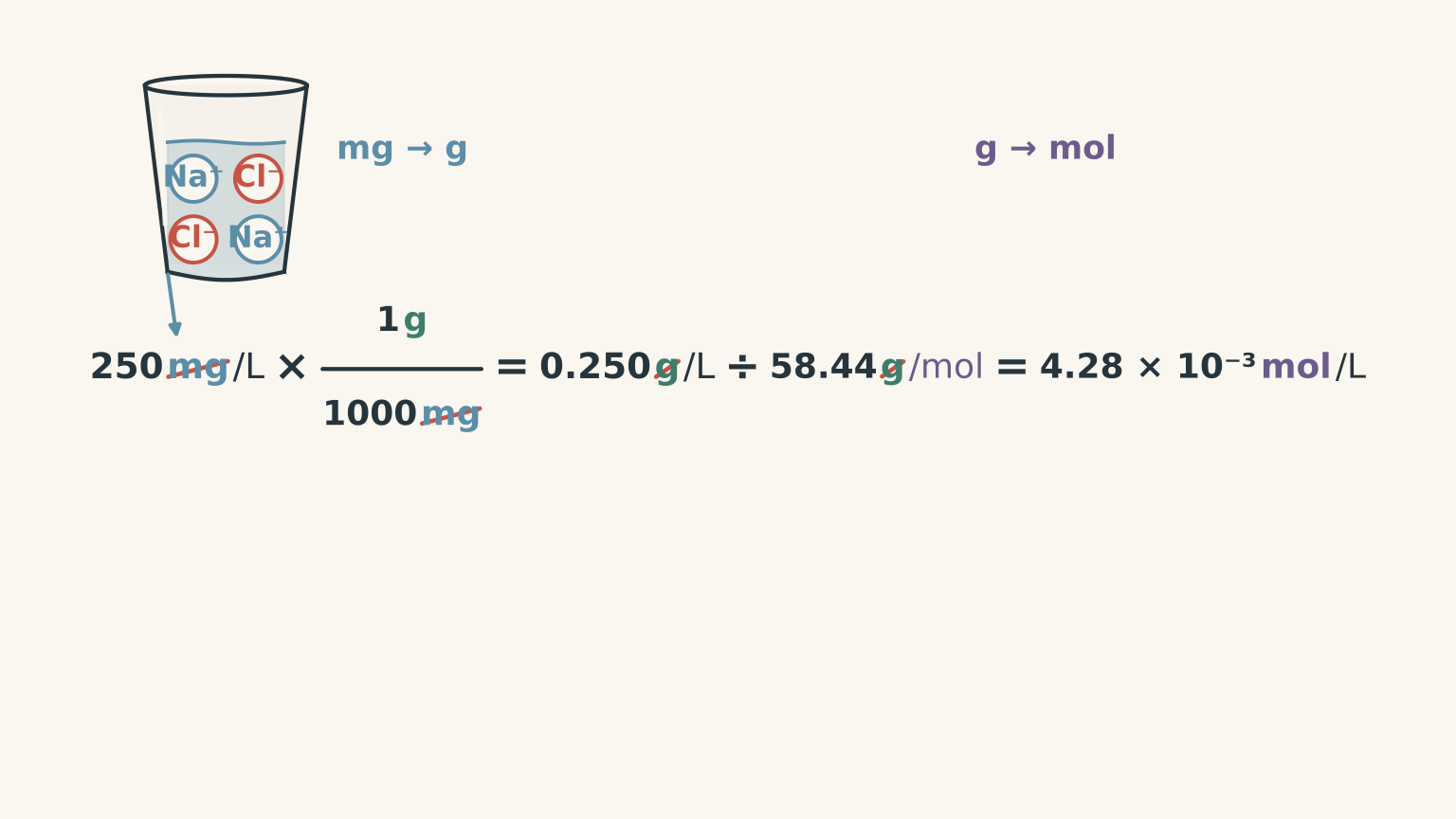
\[ 250\ \mathrm{mg/L}=0.250\ \mathrm{g/L} \]
\[ c=\frac{0.250}{58.44} =4.28\times10^{-3}\ \mathrm{mol/L} \]
So, 250 mg/L NaCl is equivalent to \(4.28\times10^{-3}\) mol/L NaCl.
Let’s work through why this method works, when you need density, and how to avoid the mistakes that commonly appear in HSC Chemistry calculations.
Due to technical limitations, this figure may display incorrectly or contain inaccuracies. Please check key details against your course materials.
01Understand what each concentration measures
Before converting anything, identify what the units actually represent.
There are two different types of concentration involved.
| Concentration type | What it measures | Common units |
|---|---|---|
| Mass concentration | Mass of solute per volume of solution | mg/L, g/L |
| Amount concentration | Amount of solute in moles per volume of solution | mol/L |
A concentration in mg/L is therefore mass-based, while a concentration in mol/L is amount-based.
Both have volume in the denominator, but their numerators are different.
- mg/L tells you how many milligrams of a substance are present in each litre of solution.
- mol/L tells you how many moles of a substance are present in each litre of solution.
The goal of the conversion is to replace the mass measurement with an amount measurement.
What does 250 mg/L actually mean?
Imagine preparing a sodium chloride solution.
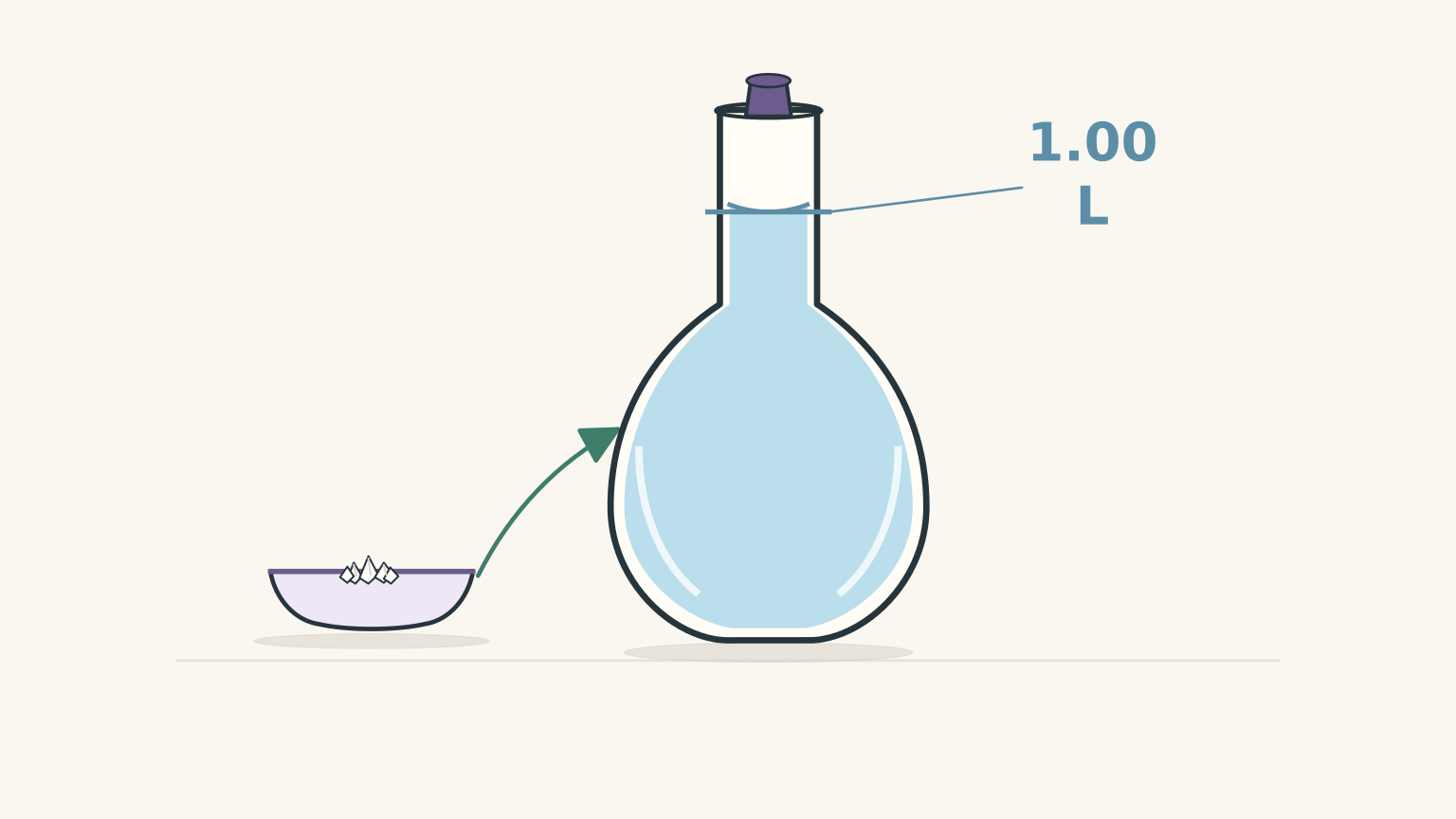
You weigh out 250 mg of NaCl, dissolve it in some water, and then add more water until the total solution volume reaches exactly 1.00 L.
The resulting mass concentration is 250 mg/L.
Notice that the final volume is 1.00 L of solution, not 1.00 L of water before the salt is added.
This distinction matters when preparing solutions experimentally. Concentration is calculated using the final solution volume.
02The conversion formula
The key relationship is:
\[ n=\frac{m}{M} \]
where:
- \(n\) is the amount of substance, measured in mol.
- \(m\) is the mass of the substance, measured in g.
- \(M\) is the molar mass, measured in g/mol.
This is the standard relationship between mass, amount, and molar mass.
If you want a more detailed explanation of this relationship, see Moles from Mass and Molar Mass: HSC Chemistry Guide.
Now consider a solution with a mass concentration measured in mg/L.
You first need to convert milligrams into grams:
\[ C_{\mathrm{g/L}}=\frac{C_{\mathrm{mg/L}}}{1000} \]
Then divide by the molar mass:
\[ \boxed{c=\frac{C_{\mathrm{mg/L}}}{1000M}} \]
Here:
- \(c\) is the amount concentration in mol/L.
- \(C_{\mathrm{mg/L}}\) is the mass concentration in mg/L.
- \(M\) is the molar mass in g/mol.
This is the formula you can use directly in HSC Chemistry calculations.
Due to technical limitations, this figure may display incorrectly or contain inaccuracies. Please check key details against your course materials.
What if the concentration is already in g/L?
You can skip the first conversion.
Simply use:
\[ \boxed{c=\frac{C_{\mathrm{g/L}}}{M}} \]
For example, a solution containing 0.250 g/L NaCl has:
\[ c=\frac{0.250}{58.44} \]
\[ c=4.28\times10^{-3}\ \mathrm{mol/L} \]
This is exactly the same result as converting 250 mg/L.
Remember:
- mg/L: divide by 1000, then divide by molar mass.
- g/L: divide directly by molar mass.
03Worked example: Converting mg/L of sodium chloride into mol/L
A sodium chloride solution has a mass concentration of 250 mg/L.
Calculate its amount concentration in mol/L.
Step 1
The chemical formula is NaCl.
Using the periodic table:
\[ M(\mathrm{NaCl})=22.99+35.45 \]
\[ M(\mathrm{NaCl})=58.44\ \mathrm{g/mol} \]
Step 2
There are 1000 mg in 1 g.
\[ 250\div1000=0.250 \]
Therefore:
\[ C=0.250\ \mathrm{g/L} \]
Step 3
\[ c=\frac{C}{M} \]
Substitute the values:
\[ c=\frac{0.250}{58.44} \]
\[ c=0.004277\ldots\ \mathrm{mol/L} \]
Step 4
To three significant figures:
\[ \boxed{c=4.28\times10^{-3}\ \mathrm{mol/L}} \]
The solution contains approximately 0.00428 mol of NaCl per litre.
Notice that the answer is much smaller than 250. That’s reasonable: 250 mg is only 0.250 g, and a mole of sodium chloride has a mass of 58.44 g.
04Be careful with the chemical formula
Here’s where things become slightly more interesting.
Suppose two solutions both have a mass concentration of 100 mg/L. Does that mean they have the same molar concentration?
No.
The answer depends on the molar mass of each substance.
A gram of a substance with a small molar mass contains more moles than a gram of a substance with a large molar mass.
This means equal mass concentrations do not necessarily produce equal amount concentrations.
You also need to use the correct chemical formula when calculating molar mass.
Worked example: Converting the concentration of a hydrated salt
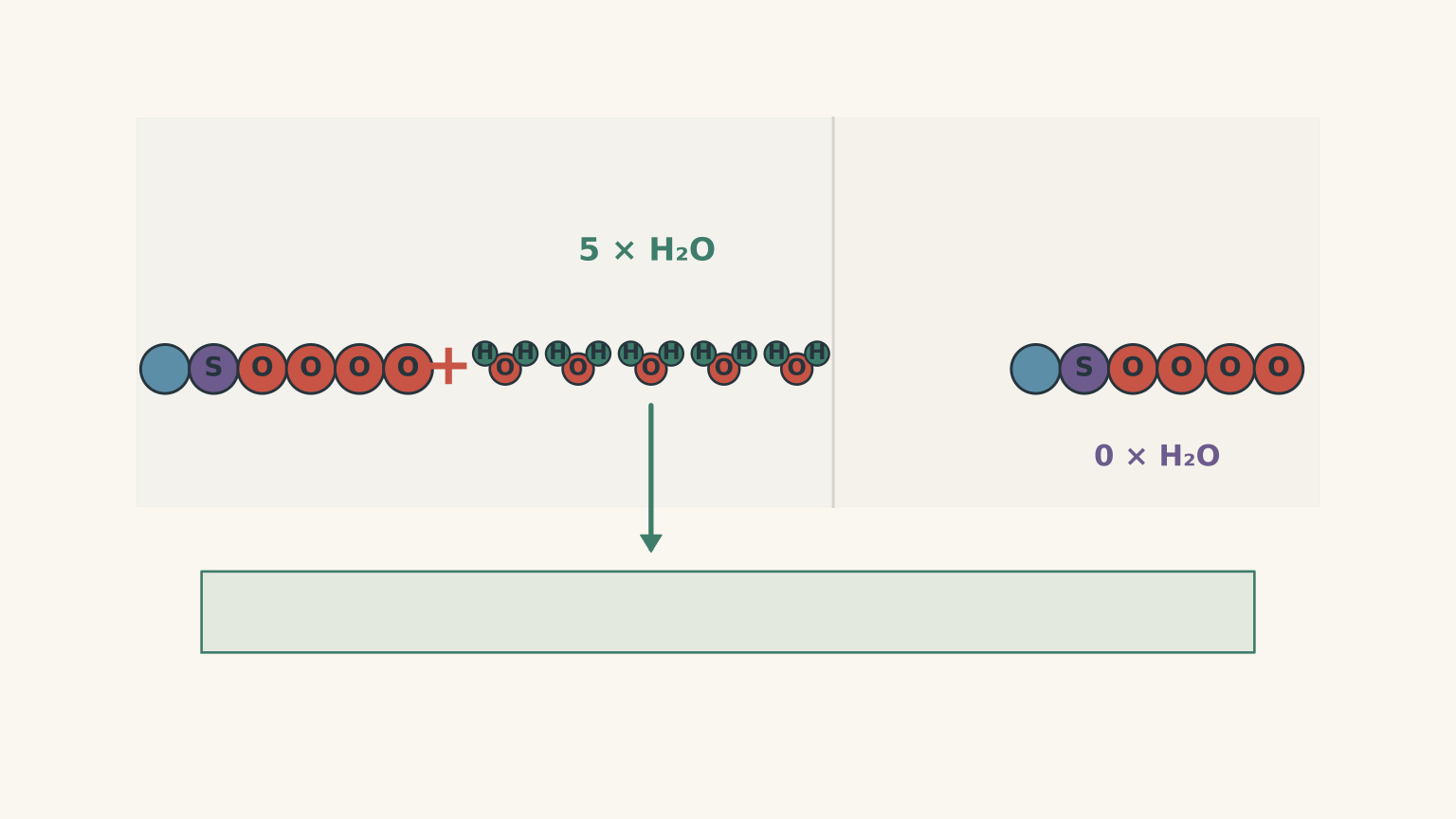
A laboratory solution contains 64.0 mg/L of copper(II) sulfate pentahydrate, \(\mathrm{CuSO_4\cdot5H_2O}\).
Calculate the amount concentration of the hydrated salt in mol/L.
Step 1
The compound contains:
- One copper atom.
- One sulfur atom.
- Four oxygen atoms in the sulfate group.
- Five water molecules.
Therefore:
\[ \begin{aligned} M={}&63.55+32.06+4(16.00)\\ &+5[2(1.008)+16.00] \end{aligned} \]
\[ M=249.69\ \mathrm{g/mol} \]
The five water molecules must be included because they contribute to the mass of each mole of hydrated salt.
Step 2
\[ 64.0\div1000=0.0640 \]
Therefore:
\[ C=0.0640\ \mathrm{g/L} \]
Step 3
\[ c=\frac{0.0640}{249.69} \]
\[ c=2.563\times10^{-4}\ \mathrm{mol/L} \]
Step 4
\[ \boxed{c=2.56\times10^{-4}\ \mathrm{mol/L}} \]
This is the concentration of hydrated copper(II) sulfate formula units.
If the question instead asked for the concentration of \(\mathrm{Cu^{2+}}\) ions, the answer would have the same numerical value, assuming complete dissolution, because each formula unit contains one copper ion.
However, if the label gave the concentration in mg/L as copper, you would use the molar mass of copper itself, not the molar mass of the hydrated salt.
Due to technical limitations, this figure may display incorrectly or contain inaccuracies. Please check key details against your course materials.
05Do you need density to convert mg/L into mol/L?
This is a common source of confusion.
No, you do not need density when converting a genuine mass concentration in mg/L into mol/L.
Why?
Because mg/L already tells you the mass of solute per volume of solution.
You can convert the mass into moles and keep the volume denominator unchanged.
Density becomes necessary when your original concentration is based on mass of solution rather than volume of solution.
Compare the following:
| Given concentration | What it represents | Is density needed? |
|---|---|---|
| 250 mg/L | 250 mg solute per litre of solution | No |
| 0.250 g/L | 0.250 g solute per litre of solution | No |
| 250 mg/kg | 250 mg solute per kilogram of solution | Yes, to convert to a per-litre basis |
| 5.0% by mass | 5.0 g solute per 100 g of solution | Yes, to convert to mol/L |
The important difference is the denominator.
mg/L uses volume. mg/kg uses mass.
Contrasting example: When density is required
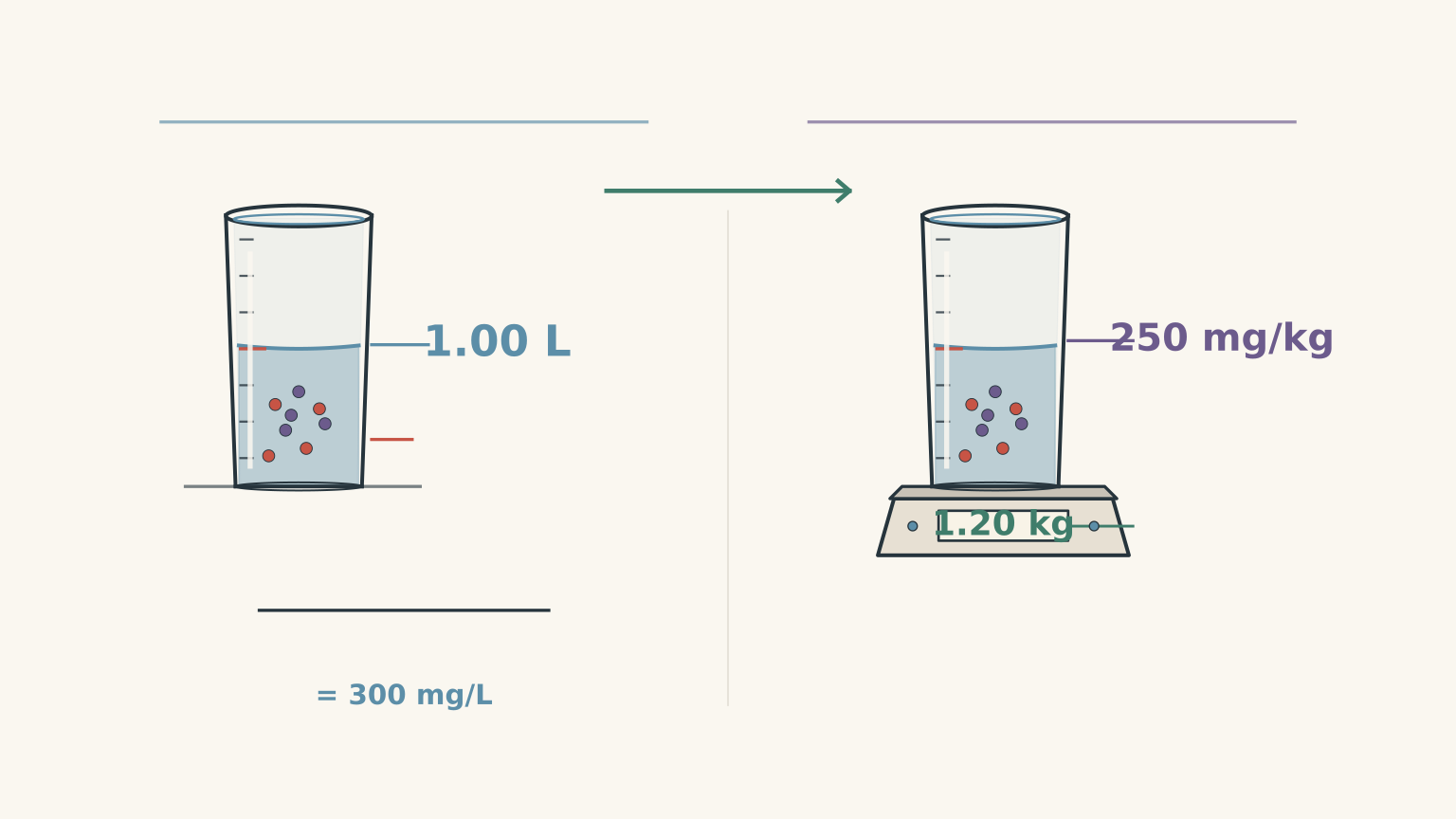
Suppose a solution contains 250 mg/kg NaCl.
Its density is 1.20 kg/L.
Calculate its molar concentration.
Step 1: Recognise that the given concentration is mass-based on both sides.
You know there are 250 mg of NaCl in every kilogram of solution.
You cannot directly treat this as 250 mg/L because the solution does not necessarily have a density of 1.00 kg/L.
Step 2: Use density to convert from mg/kg to mg/L.
The density tells us that 1.00 L of this solution has a mass of 1.20 kg.
Therefore:
\[ 250\times1.20=300\ \mathrm{mg/L} \]
Step 3: Convert mg/L into g/L.
\[ 300\div1000=0.300\ \mathrm{g/L} \]
Step 4: Divide by the molar mass of NaCl.
Using \(M=58.44\ \mathrm{g/mol}\):
\[ c=\frac{0.300}{58.44} \]
\[ \boxed{c=5.13\times10^{-3}\ \mathrm{mol/L}} \]
Density was essential because the original concentration was expressed per kilogram of solution, not per litre.
Due to technical limitations, this figure may display incorrectly or contain inaccuracies. Please check key details against your course materials.
A useful rule is to never assume that a solution has the same density as pure water unless the question explicitly permits that approximation.
For more involved conversions involving mass percentage and molarity, see How to Convert Between Mass Percentage and Molarity Using Density.
06A reliable method for HSC Chemistry questions
When you encounter a question asking you to convert mg/L into mol/L, work through these decisions in order.
First: Identify the chemical substance.
Is the given concentration for NaCl, \(\mathrm{CaCl_2}\), an ion such as \(\mathrm{Cl^-}\), or something else?
The molar mass must match the substance whose mass is being measured.
Second: Check the concentration units.
If the units are mg/L, convert to g/L.
If they are already g/L, you can skip this step.
Third: Calculate the correct molar mass.
Use the complete chemical formula, including waters of crystallisation where applicable.
Fourth: Divide by the molar mass.
Use:
\[ c=\frac{\text{mass concentration in g/L}} {\text{molar mass in g/mol}} \]
Finally: Check the units and answer.
Your final unit must be mol/L.
If your calculation still contains mg, you have not completed the conversion correctly.
One last distinction is important: converting a salt concentration into mol/L gives the amount concentration of the salt formula units. Calculating the concentration of individual ions may require an additional stoichiometric step.
07Questions and solutions
The following questions progress from a standard conversion to more demanding problems involving hydrates, comparisons, dilution, and mixtures.
Question 1
A solution contains 58.4 mg/L of sodium chloride, NaCl.
Calculate its molar concentration in mol/L.
Use \(M(\mathrm{NaCl})=58.44\ \mathrm{g/mol}\).
Solution 1
The molar concentration is \(1.00\times10^{-3}\ \mathrm{mol/L}\).
Start by converting the mass concentration into g/L:
\[ 58.4\div1000=0.0584\ \mathrm{g/L} \]
Now divide by the molar mass:
\[ c=\frac{0.0584}{58.44} \]
\[ c=9.99\times10^{-4}\ \mathrm{mol/L} \]
To three significant figures:
\[ \boxed{c=1.00\times10^{-3}\ \mathrm{mol/L}} \]
The important step is converting milligrams into grams before using the molar mass. Dividing 58.4 directly by 58.44 would give an answer 1000 times too large.
Question 2
A student dissolves 25.0 mg of calcium chloride dihydrate, \(\mathrm{CaCl_2\cdot2H_2O}\), in water and makes the solution up to a final volume of 250.0 mL.
Calculate:
(a) The amount concentration of calcium chloride dihydrate formula units in mol/L.
(b) The chloride ion concentration, \([\mathrm{Cl^-}]\), assuming complete dissolution and dissociation.
Use the following atomic masses:
- Ca = 40.08
- Cl = 35.45
- H = 1.008
- O = 16.00
Solution 2
(a) The amount concentration of calcium chloride dihydrate is \(6.80\times10^{-4}\ \mathrm{mol/L}\).
The first challenge is to use the molar mass of the entire hydrated compound.
Calculate:
\[ \begin{aligned} M={}&40.08+2(35.45)\\ &+2[2(1.008)+16.00] \end{aligned} \]
\[ M=147.02\ \mathrm{g/mol} \]
Next, convert the mass into grams:
\[ 25.0\ \mathrm{mg}=0.0250\ \mathrm{g} \]
Convert the final solution volume into litres:
\[ 250.0\ \mathrm{mL}=0.2500\ \mathrm{L} \]
Calculate the mass concentration:
\[ C=\frac{0.0250}{0.2500} \]
\[ C=0.100\ \mathrm{g/L} \]
Now divide by the molar mass:
\[ c=\frac{0.100}{147.02} \]
\[ \boxed{c=6.80\times10^{-4}\ \mathrm{mol/L}} \]
(b) The chloride ion concentration is \(1.36\times10^{-3}\ \mathrm{mol/L}\).
Now consider the dissociation equation:
\[ \ce{CaCl2 -> Ca^2+ + 2Cl^-} \]
Each formula unit of calcium chloride produces two chloride ions.
Therefore:
\[ [\mathrm{Cl^-}]=2c(\mathrm{CaCl_2}) \]
\[ =2(6.80\times10^{-4}) \]
\[ \boxed{[\mathrm{Cl^-}]=1.36\times10^{-3}\ \mathrm{mol/L}} \]
The key distinction is that the amount concentration of the salt and the amount concentration of chloride ions are not necessarily equal. You must use the chemical equation to determine their relationship.
Question 3
Two separate solutions have the same mass concentration:
\[ 45.0\ \mathrm{mg/L} \]
One solution contains glucose, \(\mathrm{C_6H_{12}O_6}\), while the other contains urea, \(\mathrm{CH_4N_2O}\).
Calculate the amount concentration of each solution and determine which contains more solute molecules per litre.
Use:
- \(M(\mathrm{C_6H_{12}O_6})=180.16\ \mathrm{g/mol}\)
- \(M(\mathrm{CH_4N_2O})=60.06\ \mathrm{g/mol}\)
Solution 3
The urea solution contains three times as many solute molecules per litre as the glucose solution.
Although the two solutions have equal mass concentrations, their molar masses are different.
Start by converting the shared mass concentration:
\[ 45.0\ \mathrm{mg/L}=0.0450\ \mathrm{g/L} \]
Calculate the glucose concentration:
\[ c(\mathrm{glucose})=\frac{0.0450}{180.16} \]
\[ \boxed{c(\mathrm{glucose})=2.50\times10^{-4}\ \mathrm{mol/L}} \]
Now calculate the urea concentration:
\[ c(\mathrm{urea})=\frac{0.0450}{60.06} \]
\[ \boxed{c(\mathrm{urea})=7.49\times10^{-4}\ \mathrm{mol/L}} \]
To compare the two solutions, calculate the ratio:
\[ \text{Ratio}= \frac{7.49\times10^{-4}} {2.50\times10^{-4}} \]
\[ \text{Ratio}=3.00 \]
Therefore, the urea solution contains three times the amount of solute per litre.
This also means it contains three times as many urea molecules per litre as there are glucose molecules in the glucose solution.
The tempting assumption is that equal mass concentrations mean equal numbers of particles. They do not. A mole of glucose has three times the mass of a mole of urea, so the same mass of urea contains three times as many molecules.
Question 4
A magnesium chloride solution has a mass concentration of 480 mg/L.
A student transfers 75.0 mL of this solution into a volumetric flask and dilutes it with water to a final volume of 300.0 mL.
Calculate the final amount concentration of magnesium chloride in mol/L.
Use:
\[ M(\mathrm{MgCl_2})=95.21\ \mathrm{g/mol} \]
Assume the solution volumes are additive.
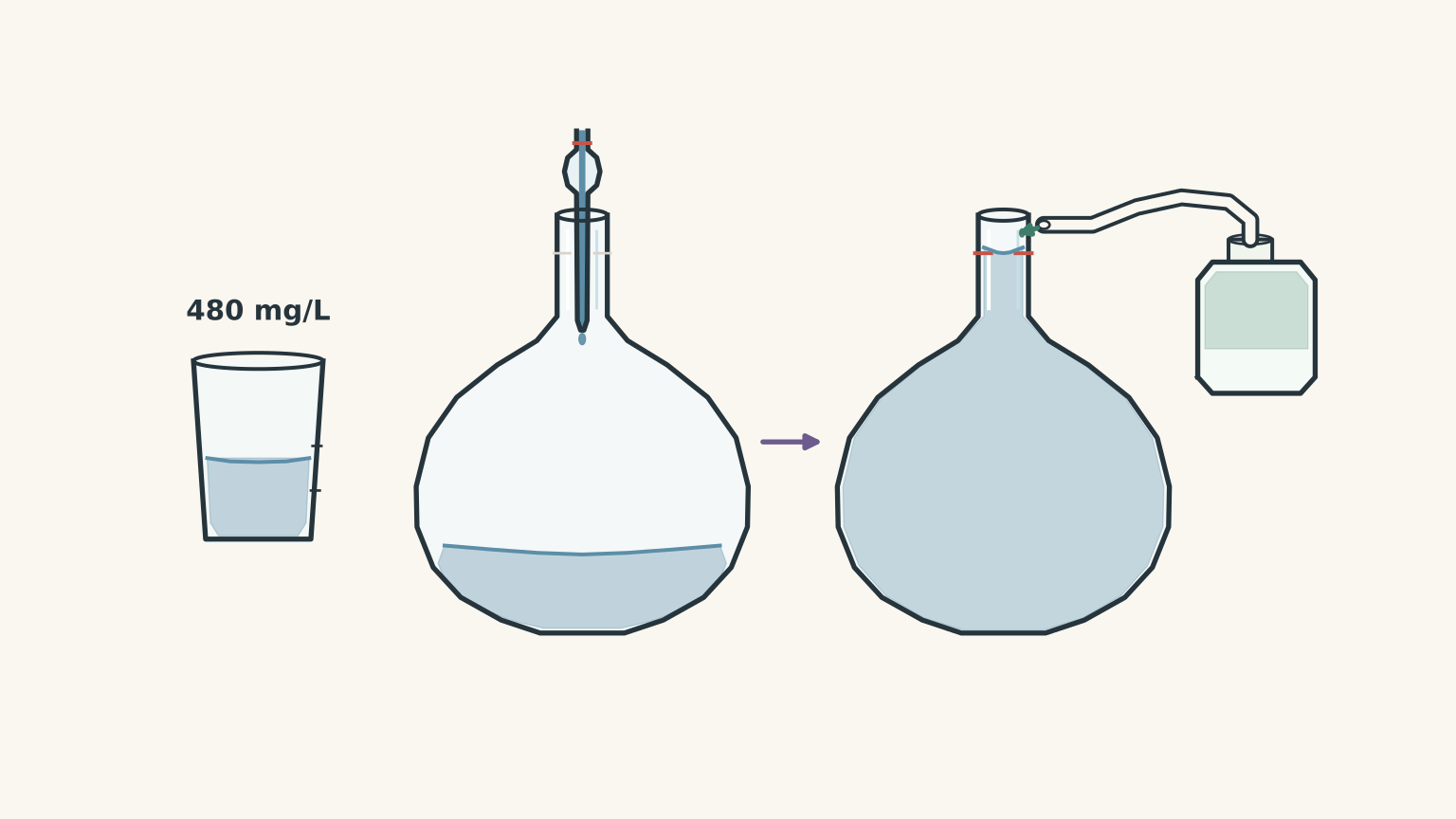
Due to technical limitations, this figure may display incorrectly or contain inaccuracies. Please check key details against your course materials.
Solution 4
The final magnesium chloride concentration is \(1.26\times10^{-3}\ \mathrm{mol/L}\).
This question combines mass-to-molar conversion with dilution.
There are two ways to approach it. We can first calculate the stock molarity and then apply the dilution relationship.
Step 1: Convert the original mass concentration into g/L.
\[ 480\div1000=0.480\ \mathrm{g/L} \]
Step 2: Calculate the original molar concentration.
\[ c_1=\frac{0.480}{95.21} \]
\[ c_1=5.04\times10^{-3}\ \mathrm{mol/L} \]
Step 3: Apply the dilution equation.
The dilution relationship is:
\[ c_1V_1=c_2V_2 \]
where:
- \(c_1\) is the initial concentration.
- \(V_1\) is the initial volume transferred.
- \(c_2\) is the final concentration.
- \(V_2\) is the final solution volume.
Rearrange to find the final concentration:
\[ c_2=\frac{c_1V_1}{V_2} \]
Substitute:
\[ c_2= \frac{(5.04\times10^{-3})(75.0)} {300.0} \]
\[ c_2=1.26\times10^{-3}\ \mathrm{mol/L} \]
Therefore:
\[ \boxed{c_2=1.26\times10^{-3}\ \mathrm{mol/L}} \]
The concentration has decreased to one-quarter of its original value because the solution volume has increased fourfold while the amount of magnesium chloride remains constant.
Be careful with the wording: the question says the final volume is 300.0 mL. It does not say that 300.0 mL of water was added.
Question 5
A laboratory analyses an unknown aqueous sample and obtains two measurements:
- Chloride concentration: 71.0 mg/L, reported as \(\mathrm{Cl^-}\).
- Sodium concentration: 13.8 mg/L, reported as \(\mathrm{Na^+}\).
Assume that the only dissolved salts in the sample are sodium chloride, NaCl, and calcium chloride, \(\mathrm{CaCl_2}\).
Both salts are assumed to dissolve and dissociate completely. There are no other sources of sodium or chloride ions.
Determine:
(a) The amount concentration of chloride ions.
(b) The amount concentration of sodium ions.
(c) The amount concentrations of NaCl and \(\mathrm{CaCl_2}\) formula units.
(d) The total amount concentration of dissolved salt formula units.
(e) Explain why directly dividing 71.0 mg/L by the molar mass of NaCl would produce an incorrect result.
Use:
- \(M(\mathrm{Na})=22.99\ \mathrm{g/mol}\)
- \(M(\mathrm{Cl})=35.45\ \mathrm{g/mol}\)
- \(M(\mathrm{NaCl})=58.44\ \mathrm{g/mol}\)
Solution 5
The total amount concentration of dissolved salt formula units is \(1.30\times10^{-3}\ \mathrm{mol/L}\).
The important detail is that the laboratory has reported the mass concentrations of individual ions, not the mass concentrations of the original salts.
We need to convert each measurement into moles of the relevant ion before using the chemical equations to determine the salt concentrations.
(a) Calculate the chloride ion concentration.
The measurement is 71.0 mg/L as chloride.
Convert to g/L:
\[ 71.0\div1000=0.0710\ \mathrm{g/L} \]
Use the molar mass of chloride:
\[ [\mathrm{Cl^-}]=\frac{0.0710}{35.45} \]
\[ \boxed{[\mathrm{Cl^-}]=2.00\times10^{-3}\ \mathrm{mol/L}} \]
(b) Calculate the sodium ion concentration.
The measurement is 13.8 mg/L as sodium.
Convert to g/L:
\[ 13.8\div1000=0.0138\ \mathrm{g/L} \]
Use the molar mass of sodium:
\[ [\mathrm{Na^+}]=\frac{0.0138}{22.99} \]
\[ \boxed{[\mathrm{Na^+}]=6.00\times10^{-4}\ \mathrm{mol/L}} \]
(c) Determine the concentrations of the two salts.
We now need to use the dissociation equations:
\[ \ce{NaCl -> Na^+ + Cl^-} \]
\[ \ce{CaCl2 -> Ca^2+ + 2Cl^-} \]
Notice that sodium chloride produces one chloride ion per formula unit, while calcium chloride produces two.
This difference is the key to solving the problem.
Since NaCl is the only source of sodium ions, its formula-unit concentration must equal the sodium ion concentration:
\[ c(\mathrm{NaCl})=[\mathrm{Na^+}] \]
Therefore:
\[ \boxed{c(\mathrm{NaCl})=6.00\times10^{-4}\ \mathrm{mol/L}} \]
Next, calculate how much chloride comes from calcium chloride.
The total chloride concentration is:
\[ 2.00\times10^{-3}\ \mathrm{mol/L} \]
The chloride supplied by NaCl is:
\[ 6.00\times10^{-4}\ \mathrm{mol/L} \]
Subtract to find the chloride supplied by calcium chloride:
\[ 2.00\times10^{-3}-6.00\times10^{-4} \]
\[ =1.40\times10^{-3}\ \mathrm{mol/L} \]
Each formula unit of calcium chloride produces two chloride ions.
Therefore:
\[ c(\mathrm{CaCl_2})= \frac{1.40\times10^{-3}}{2} \]
\[ \boxed{c(\mathrm{CaCl_2})=7.00\times10^{-4}\ \mathrm{mol/L}} \]
(d) Calculate the total amount concentration of salt formula units.
Add the two salt concentrations:
\[ c_{\mathrm{total}}= c(\mathrm{NaCl})+c(\mathrm{CaCl_2}) \]
\[ =6.00\times10^{-4}+7.00\times10^{-4} \]
\[ \boxed{c_{\mathrm{total}}=1.30\times10^{-3}\ \mathrm{mol/L}} \]
This is the total amount concentration of the two dissolved salts, not the total concentration of all ions.
As a useful check, the total positive charge concentration must balance the chloride charge concentration:
\[ [\mathrm{Na^+}]+2[\mathrm{Ca^{2+}}] \]
\[ =0.600+2(0.700) \]
\[ =2.00\ \mathrm{mmol/L} \]
This matches the chloride concentration of 2.00 mmol/L.
(e) Explain why using the molar mass of NaCl directly is incorrect.
The incorrect calculation would be:
\[ \frac{0.0710}{58.44} =1.21\times10^{-3}\ \mathrm{mol/L} \]
The problem is that 71.0 mg/L represents the mass of chloride ions, not the mass of sodium chloride.
Using the molar mass of NaCl treats every 71.0 mg of chloride as though it were 71.0 mg of the entire salt.
That is not what the measurement tells us.
Even if all the chloride came from NaCl, we would first calculate the chloride ion concentration using 35.45 g/mol. We could then use the 1:1 ratio between NaCl and chloride ions to find the salt concentration.
In this question, some chloride also comes from calcium chloride, which produces two chloride ions per formula unit.
There is another important point: the chloride measurement alone would not be enough to determine the total salt concentration. Many different mixtures of NaCl and CaCl2 could produce the same chloride concentration.
The additional sodium measurement gives us the second relationship needed to determine the mixture.
This is why identifying the exact chemical species represented by a mass concentration is just as important as performing the unit conversion.
The central method is simple: convert mg/L into g/L, then divide by the correct molar mass.
The harder questions come when you need to identify what the measured mass represents, account for dilution, or connect the resulting molar concentration to a chemical equation. Those are the next steps to master once the basic conversion becomes automatic.