
How to Draw an Ester Link Without Reversing Its Connectivity
Learn how to draw ester structural formulae without reversing their connectivity. Work through how to identify the acid and alcohol components, distinguish structural isomers, and interpret esterification, equilibrium, and chemical tests.
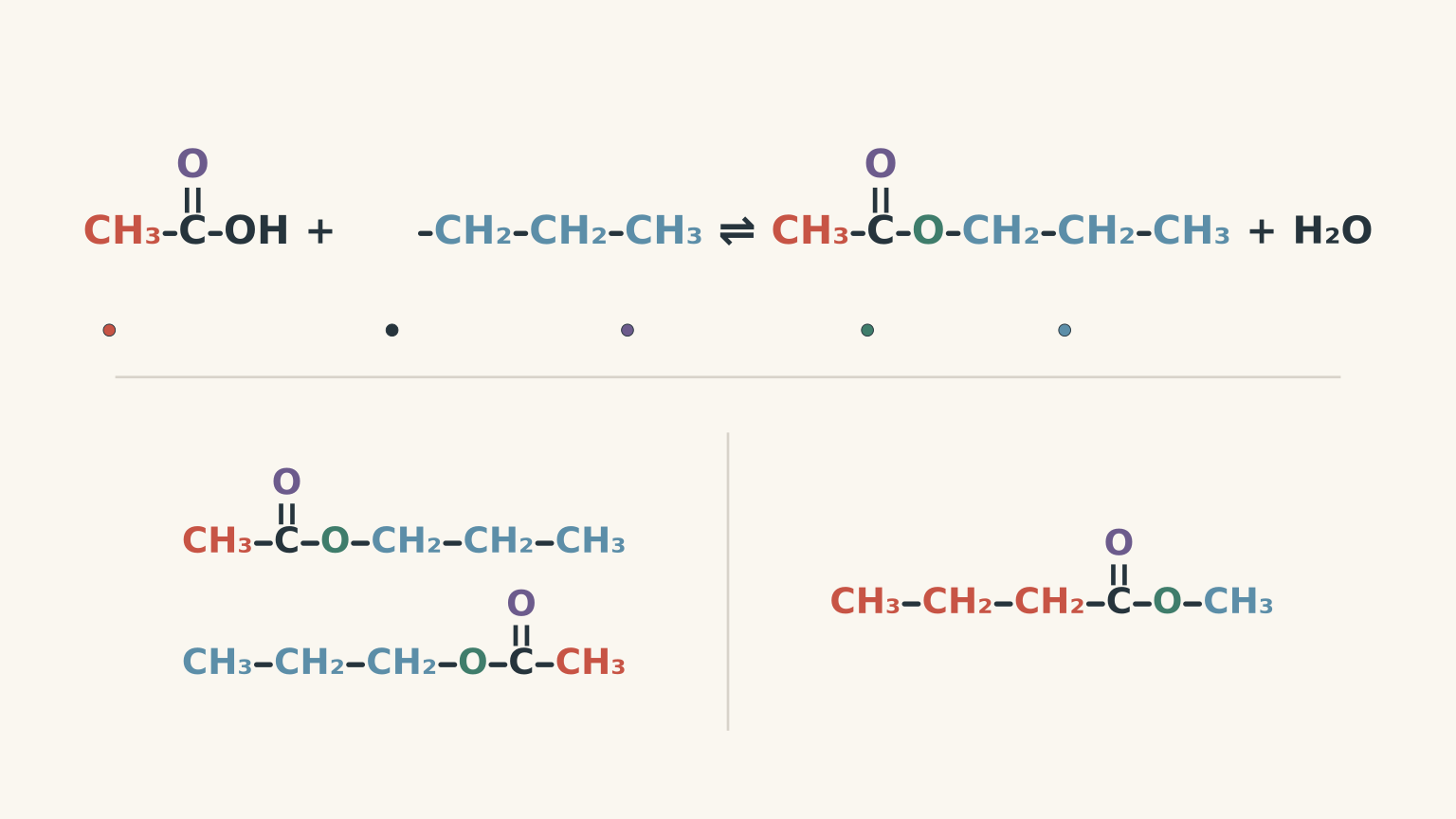
You react ethanoic acid with propan-1-ol and need to draw the ester. You write CH3C(=O)OCH2CH2CH3. A classmate writes CH3CH2CH2OC(=O)CH3 and claims your structures are different.
Who is right?
Neither of you is wrong. Both structures describe the same molecule, propyl ethanoate. The second structure simply reads the same sequence of bonds from the opposite direction.
The actual mistake would be drawing CH3CH2CH2C(=O)OCH3. That is methyl butanoate, a different ester with the same molecular formula.
The rule is simple: keep the carboxylic acid’s carbon chain attached to the carbonyl carbon, and attach the alcohol’s carbon chain to the single-bonded oxygen.
The general ester structure is:
\[ \boxed{\mathrm{R-C(=O)-O-R'}} \]
Understanding which atoms stay connected is more important than which direction you write the formula.
01Understanding the ester link
An ester contains two different oxygen atoms:
- The carbonyl oxygen is double-bonded to a carbon atom.
- The ester oxygen is single-bonded to the carbonyl carbon and another carbon atom.
These oxygen atoms have different bonding arrangements. They are not interchangeable.
The complete ester linkage is:
\[ \mathrm{-C(=O)-O-} \]
The two carbon-containing groups sit on opposite sides of this linkage.
- \(R\) represents the carbon-containing part of the carboxylic acid.
- \(R'\) represents the carbon-containing part of the alcohol.
The resulting structure is:
\[ \underbrace{\mathrm{R-C(=O)-}}_{\text{Acid-derived part}} \underbrace{\mathrm{O-R'}}_{\text{Alcohol-derived part}} \]
Due to technical limitations, this figure may display incorrectly or contain inaccuracies. Please check key details against your course materials.
Why reversing the written formula does not change the ester
Consider these two structures:
\[ \mathrm{CH_3-C(=O)-O-CH_2-CH_2-CH_3} \]
\[ \mathrm{CH_3-CH_2-CH_2-O-C(=O)-CH_3} \]
Both have exactly the same atom-to-atom connections.
The methyl group is attached to the carbonyl carbon, and the propyl group is attached to the ester oxygen. Only the direction in which the structure is written has changed.
Now compare this structure:
\[ \mathrm{CH_3-CH_2-CH_2-C(=O)-O-CH_3} \]
Here, the three-carbon chain is attached directly to the carbonyl carbon, while the methyl group is attached to the ester oxygen.
This is methyl butanoate.
| Feature | Propyl ethanoate | Methyl butanoate |
|---|---|---|
| Acid-derived part | Ethanoate | Butanoate |
| Alcohol-derived part | Propyl | Methyl |
| Carbon chain attached to carbonyl carbon | 1 carbon | 3 carbons |
| Carbon chain attached to ester oxygen | 3 carbons | 1 carbon |
| Molecular formula | C5H10O2 | C5H10O2 |
Notice something important: both compounds have the same molecular formula.
A molecular formula tells you how many atoms are present. It does not tell you how those atoms are connected.
These compounds are constitutional isomers because their atoms are connected differently.
02A reliable method for drawing an ester
When you are given a carboxylic acid and an alcohol, follow this method.
Step 1: Identify the carboxylic acid.
Find the carboxyl group, \(\mathrm{-COOH}\).
Keep its carbonyl carbon attached to the original carbon chain.
For example, ethanoic acid is:
\[ \mathrm{CH_3-C(=O)-OH} \]
The methyl group must remain attached to the carbonyl carbon.
Step 2: Identify the alcohol.
Find the hydroxyl group, \(\mathrm{-OH}\).
For example, propan-1-ol is:
\[ \mathrm{HO-CH_2-CH_2-CH_3} \]
The three-carbon propyl chain will become attached to the ester oxygen.
Step 3: Construct the ester linkage.
Join the acid-derived carbonyl carbon to an oxygen atom, then connect that oxygen to the alcohol-derived carbon chain.
The result is:
\[ \mathrm{CH_3-C(=O)-O-CH_2-CH_2-CH_3} \]
Step 4: Check the bonds.
Before moving on, check:
- The carbonyl carbon has one double bond to oxygen and two single bonds.
- The ester oxygen has two single bonds.
- The alcohol-derived carbon chain is attached to the ester oxygen, not directly to the carbonyl carbon.
Step 5: Name the ester.
Ester names follow this pattern:
\[ \text{Alkyl group}+\text{Alkanoate} \]
The alkyl name comes from the alcohol. The alkanoate name comes from the carboxylic acid.
For the example above:
- Propan-1-ol gives propyl.
- Ethanoic acid gives ethanoate.
The product is propyl ethanoate.
One common source of mistakes is that the name starts with the alcohol-derived group, whereas the condensed structural formula is often written starting with the acid-derived group.
Don’t rearrange the structure just to make its written order match the name.
Worked example: Drawing ethyl butanoate
Butanoic acid reacts with ethanol. Draw the condensed structural formula of the ester and give its correct name.
Step 1
\[ \mathrm{CH_3CH_2CH_2COOH} \]
The acid contains four carbon atoms, including the carbonyl carbon.
Step 2
\[ \mathrm{CH_3CH_2OH} \]
Ethanol contributes a two-carbon ethyl group.
Step 3
\[ \mathrm{CH_3CH_2CH_2C(=O)OCH_2CH_3} \]
Step 4
The alcohol provides the ethyl group, while the acid provides the butanoate group.
The correct name is ethyl butanoate.
Step 5
Butanoic acid has the formula C4H8O2, and ethanol has the formula C2H6O.
Removing the elements of one water molecule gives:
\[ \mathrm{C_4H_8O_2+C_2H_6O-H_2O} \]
\[ \mathrm{=C_6H_{12}O_2} \]
The product contains six carbon atoms and two oxygen atoms, as expected.
03Ester formation is reversible
Getting the structure right is only part of the problem. You also need to understand what happens during esterification and why the reaction does not necessarily produce 100% ester.
A carboxylic acid reacts with an alcohol to form an ester and water.
The general reaction is:
\[ \mathrm{RCOOH+R'OH} \]
\[ \mathrm{\rightleftharpoons RCOOR'+H_2O} \]
The double arrow is important.
Esterification is reversible. The ester can react with water to reform the carboxylic acid and alcohol.
At equilibrium, the forward and reverse reaction rates are equal. The concentrations remain constant, but they do not have to be equal.
What do the reagents actually do?
Different reagents and conditions have different jobs.
| Reagent or condition | Role | Effect |
|---|---|---|
| Concentrated sulfuric acid | Acid catalyst | Increases the rates of the forward and reverse reactions |
| Excess alcohol | Reactant in excess | Favours ester formation |
| Excess carboxylic acid | Reactant in excess | Favours ester formation |
| Removal of water | Removes a product | Favours ester formation |
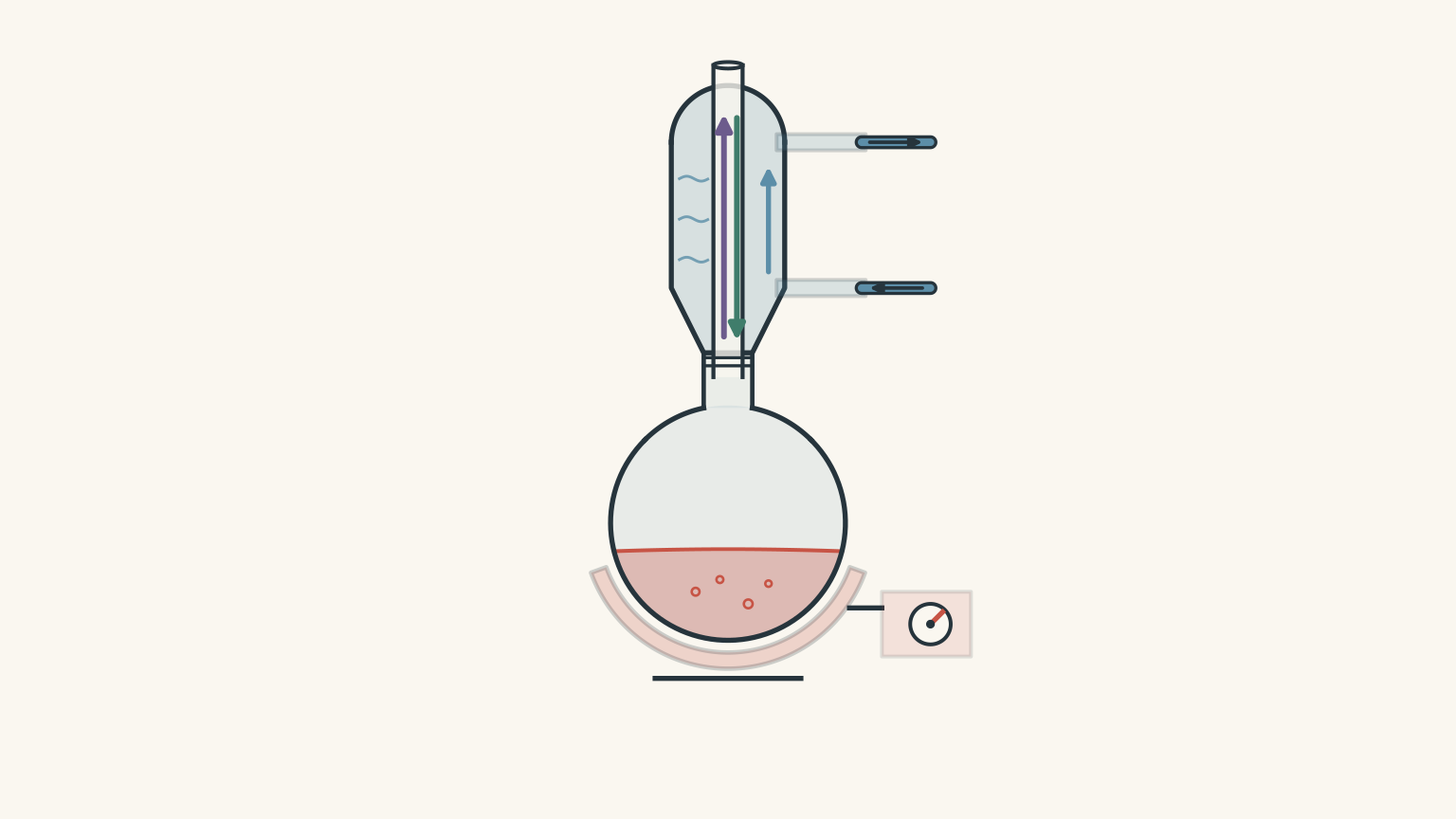
| Heating under reflux | Provides heat while retaining volatile substances | Increases reaction rate without losing vapours from the reaction vessel |
Concentrated sulfuric acid is particularly important.
It acts as an acid catalyst, helping the reaction proceed more quickly. It does not become part of the ester product.
It can also act as a dehydrating agent, binding some of the water produced. This can help favour ester formation.
Keep these two roles separate.
A catalyst increases the rate of both forward and reverse reactions. It does not change the equilibrium constant or independently increase the equilibrium yield.
Removing water, on the other hand, changes the equilibrium position because water is a product.
Due to technical limitations, this figure may display incorrectly or contain inaccuracies. Please check key details against your course materials.
Why does heating under reflux help?
Heating increases the rate of esterification by allowing particles to react more frequently and effectively.
However, many alcohols and esters are volatile. Heating an open reaction vessel could cause some reactants or products to escape.
Reflux solves this problem.
Vapour rises from the reaction flask into the condenser, cools, and turns back into liquid. The liquid returns to the flask.
This allows the mixture to be heated while reducing the loss of volatile substances.
Remember that reflux does not automatically remove the water produced. It retains condensed vapours in the reaction vessel.
Worked example: Calculating the equilibrium constant for esterification
A mixture of propanoic acid and ethanol reaches equilibrium in a closed vessel.
The measured equilibrium concentrations are:
| Substance | Equilibrium concentration |
|---|---|
| Propanoic acid | 0.20 mol L⁻¹ |
| Ethanol | 0.20 mol L⁻¹ |
| Ethyl propanoate | 0.30 mol L⁻¹ |
| Water | 0.30 mol L⁻¹ |
Calculate the equilibrium constant, \(K_c\), assuming a homogeneous reaction mixture.
Step 1
\[ \ce{CH3CH2COOH + CH3CH2OH} \]
\[ \ce{<=> CH3CH2COOCH2CH3 + H2O} \]
Step 2
For this reaction:
\[ K_c= \frac{[\text{ester}][\text{water}]} {[\text{acid}][\text{alcohol}]} \]
Step 3
\[ K_c=\frac{0.30\times0.30}{0.20\times0.20} \]
\[ K_c=\frac{0.090}{0.040} \]
Step 4
\[ K_c=2.25 \]
The equilibrium constant is 2.25 under the specified conditions.
This value describes the equilibrium position at that temperature. It does not tell you that 2.25 moles of ester form, or that 2.25 times as much ester as reactant must be present.
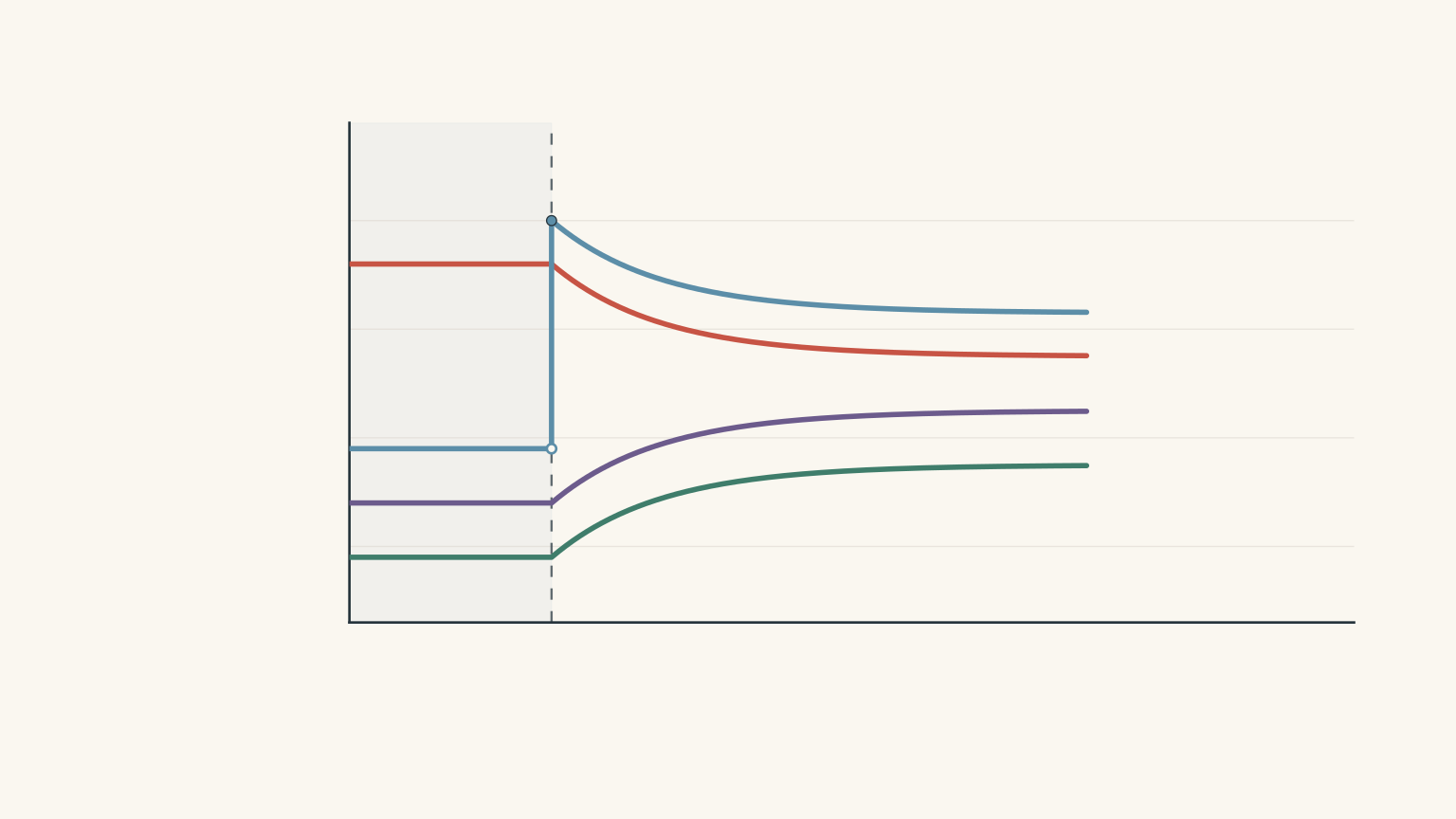
What happens when you add more alcohol?
Suppose you add extra ethanol to a mixture that has already reached equilibrium.
You might predict that the ester concentration increases immediately.
It doesn’t.
Immediately after adding ethanol, its concentration increases. The other species have not yet had time to react.
The reaction quotient is now different from the equilibrium constant. The forward reaction becomes favoured, consuming some of the additional ethanol and propanoic acid while producing more ester and water.
The mixture eventually reaches a new equilibrium.
Due to technical limitations, this figure may display incorrectly or contain inaccuracies. Please check key details against your course materials.
This is an application of Le Chatelier’s principle: when an equilibrium system is disturbed, it responds in a way that partially opposes the disturbance.
If you are asked to calculate the maximum mass of ester from measured reactant amounts, that is a separate stoichiometry problem. See How to Calculate Theoretical Ester Yield from Two Reactants.
04Testing an ester: What do the reagents actually tell you?
A particularly common mistake is confusing a test for leftover acid with evidence that an ester has formed.
Consider a mixture after esterification. It may contain:
- The ester product.
- Unreacted carboxylic acid.
- Unreacted alcohol.
- Water.
- Sulfuric acid catalyst.
The reaction mixture is not pure ester.
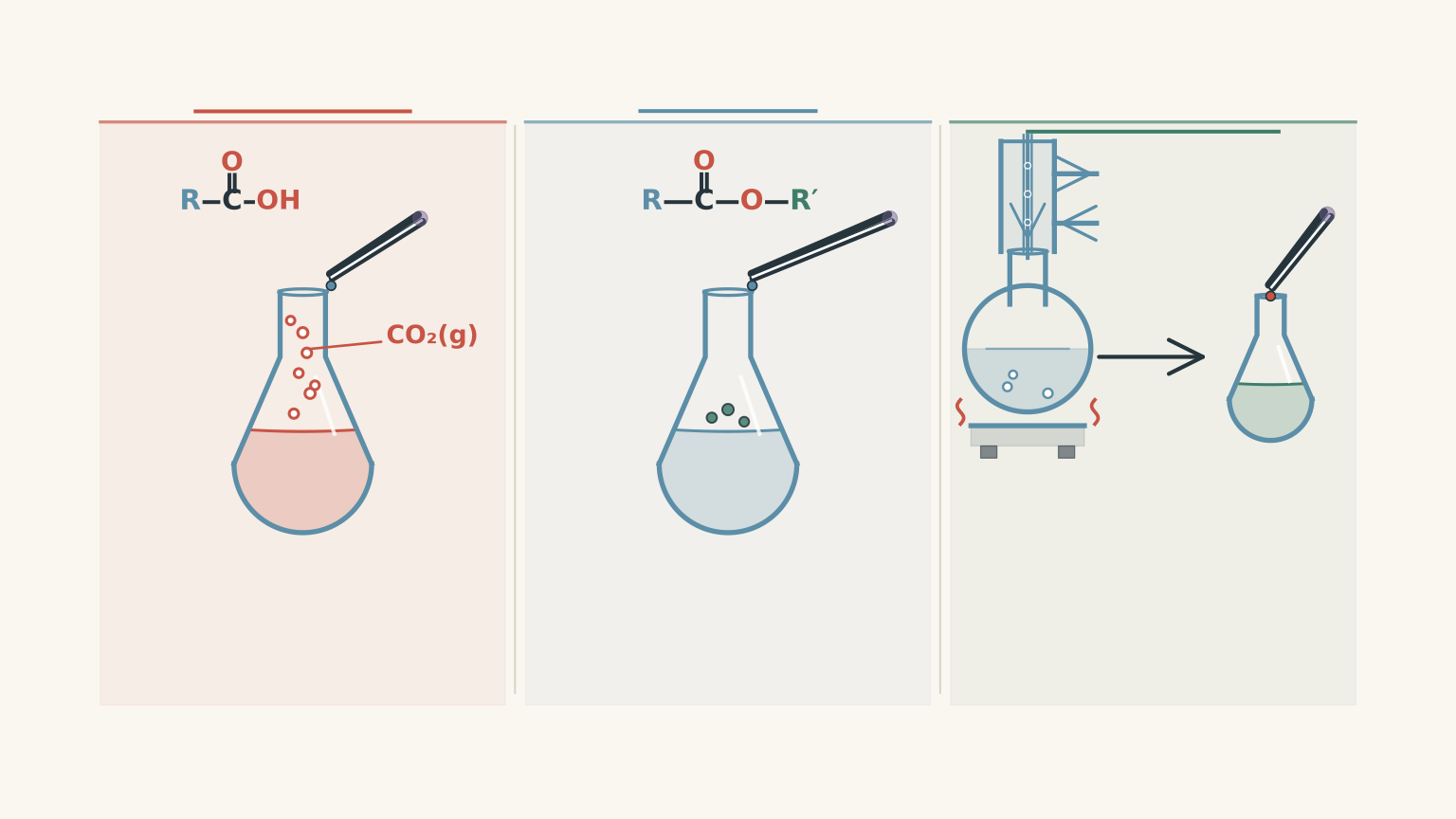
Sodium carbonate: Testing for residual acid
Sodium carbonate can be used to neutralise leftover carboxylic acid.
The reaction produces carbon dioxide gas, which causes visible bubbling.
For a carboxylic acid:
\[ \ce{2RCOOH + Na2CO3} \]
\[ \ce{-> 2RCOONa + H2O + CO2} \]
The bubbles are carbon dioxide.
But here is the trap: concentrated sulfuric acid also reacts with sodium carbonate and produces carbon dioxide.
\[ \ce{H2SO4 + Na2CO3} \]
\[ \ce{-> Na2SO4 + H2O + CO2} \]
Therefore, bubbling in a crude esterification mixture does not prove that an ester has formed.
It shows that an acid is present and reacting with the carbonate. That acid could be unreacted carboxylic acid, the sulfuric acid catalyst, or both.
A pure ester does not normally produce carbon dioxide when treated with sodium carbonate under mild washing conditions.
Sodium hydroxide: Hydrolysing the ester
A more direct way to investigate an ester is to hydrolyse it.
Hydrolysis means breaking a chemical bond using water. Esters can be hydrolysed using aqueous acid or aqueous alkali.
With aqueous sodium hydroxide and heating, the ester forms an alcohol and a carboxylate salt.
\[ \ce{RCOOR' + NaOH} \]
\[ \ce{-> RCOONa + R'OH} \]
This reaction is called alkaline hydrolysis or saponification.
The carboxylate salt can then be acidified to produce the original carboxylic acid.
\[ \ce{RCOONa + HCl} \]
\[ \ce{-> RCOOH + NaCl} \]
The distinction between the two reactions matters:
- Sodium carbonate neutralises residual acids during washing.
- Sodium hydroxide under suitable heated conditions hydrolyses the ester itself.
Alkaline hydrolysis is effectively driven towards products because the carboxylic acid is converted into a carboxylate ion. Acidification afterwards restores the carboxylic acid.
Due to technical limitations, this figure may display incorrectly or contain inaccuracies. Please check key details against your course materials.
For the full practical method, including separation, product identification and laboratory safety, see Simple Ester Production: HSC Chemistry Lab Explained.
05Questions and solutions
The following questions move from drawing a straightforward ester to interpreting competing structures, equilibrium changes and chemical tests.
Question 1
Ethanoic acid reacts with butan-1-ol in an acid-catalysed esterification reaction.
Draw the condensed structural formula of the ester produced and give its correct IUPAC name.
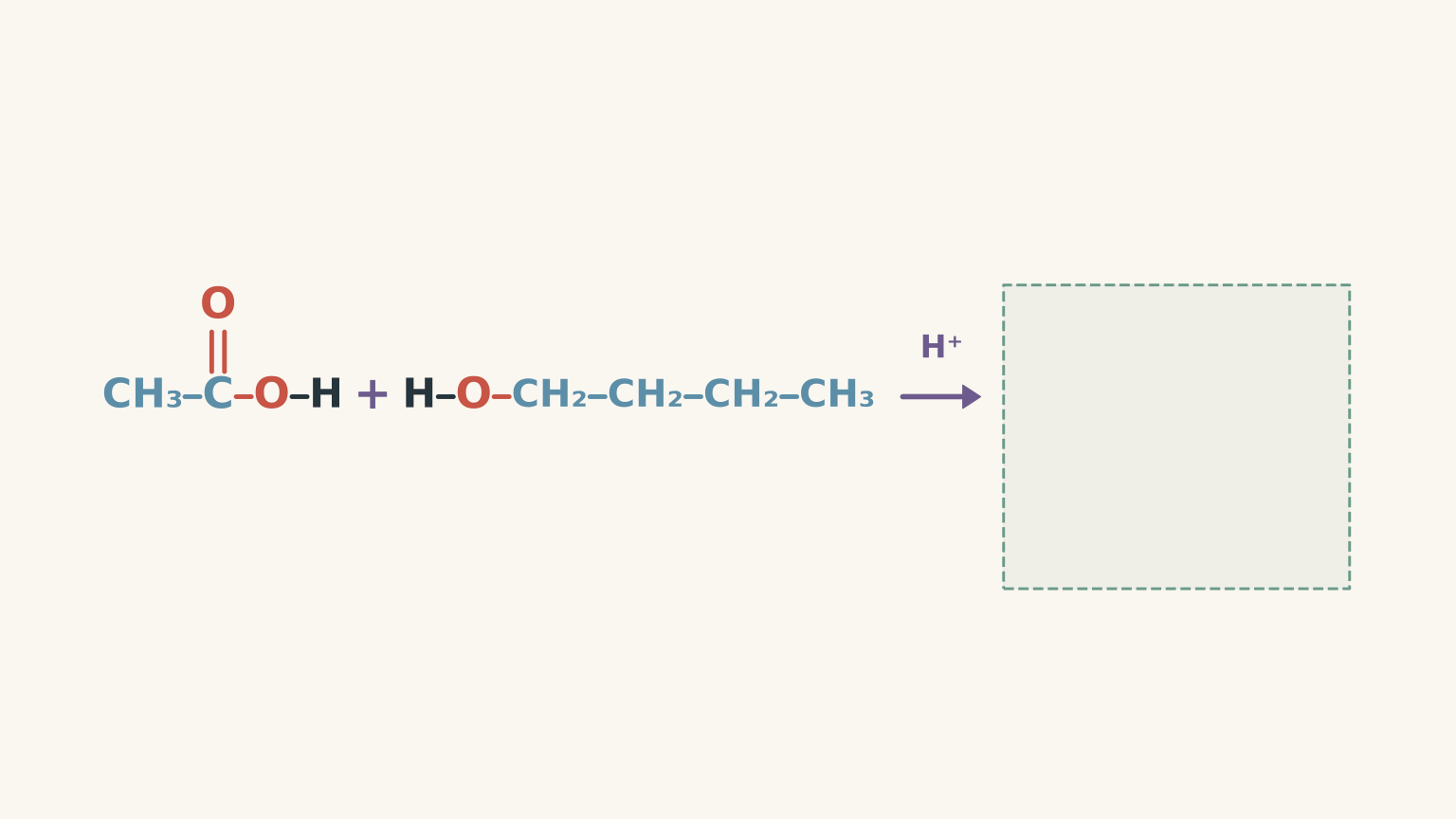
Due to technical limitations, this figure may display incorrectly or contain inaccuracies. Please check key details against your course materials.
Solution 1
The product is butyl ethanoate, with the condensed structural formula \(\mathrm{CH_3COOCH_2CH_2CH_2CH_3}\).
The key is to preserve the ethanoic acid’s carbonyl carbon and attach the butyl group through the ester oxygen.
Step 1: Identify the acid-derived part.
Ethanoic acid is:
\[ \mathrm{CH_3C(=O)OH} \]
The methyl group remains attached to the carbonyl carbon.
Step 2: Identify the alcohol-derived part.
Butan-1-ol is:
\[ \mathrm{HOCH_2CH_2CH_2CH_3} \]
The alcohol contributes a four-carbon butyl group.
Step 3: Construct the ester.
Connect the acid-derived carbonyl carbon to the ester oxygen, then attach the butyl chain to that oxygen.
\[ \mathrm{CH_3C(=O)OCH_2CH_2CH_2CH_3} \]
Step 4: Name the product.
- Butan-1-ol gives butyl.
- Ethanoic acid gives ethanoate.
Therefore, the correct name is butyl ethanoate.
A useful check is that the ester contains six carbon atoms in total: two from the acid and four from the alcohol.
Question 2
A student is given the following ester structure:
\[ \mathrm{CH_3CH_2O-C(=O)-CH_2CH_2CH_3} \]
They are asked to identify the compound and its starting reactants.
Another student claims that the following structure represents a different ester:
\[ \mathrm{CH_3CH_2CH_2-C(=O)-O-CH_2CH_3} \]
A third student proposes:
\[ \mathrm{CH_3CH_2CH_2O-C(=O)-CH_2CH_3} \]
Identify the first ester, determine which proposed structures represent the same compound, and explain the difference between the structures.
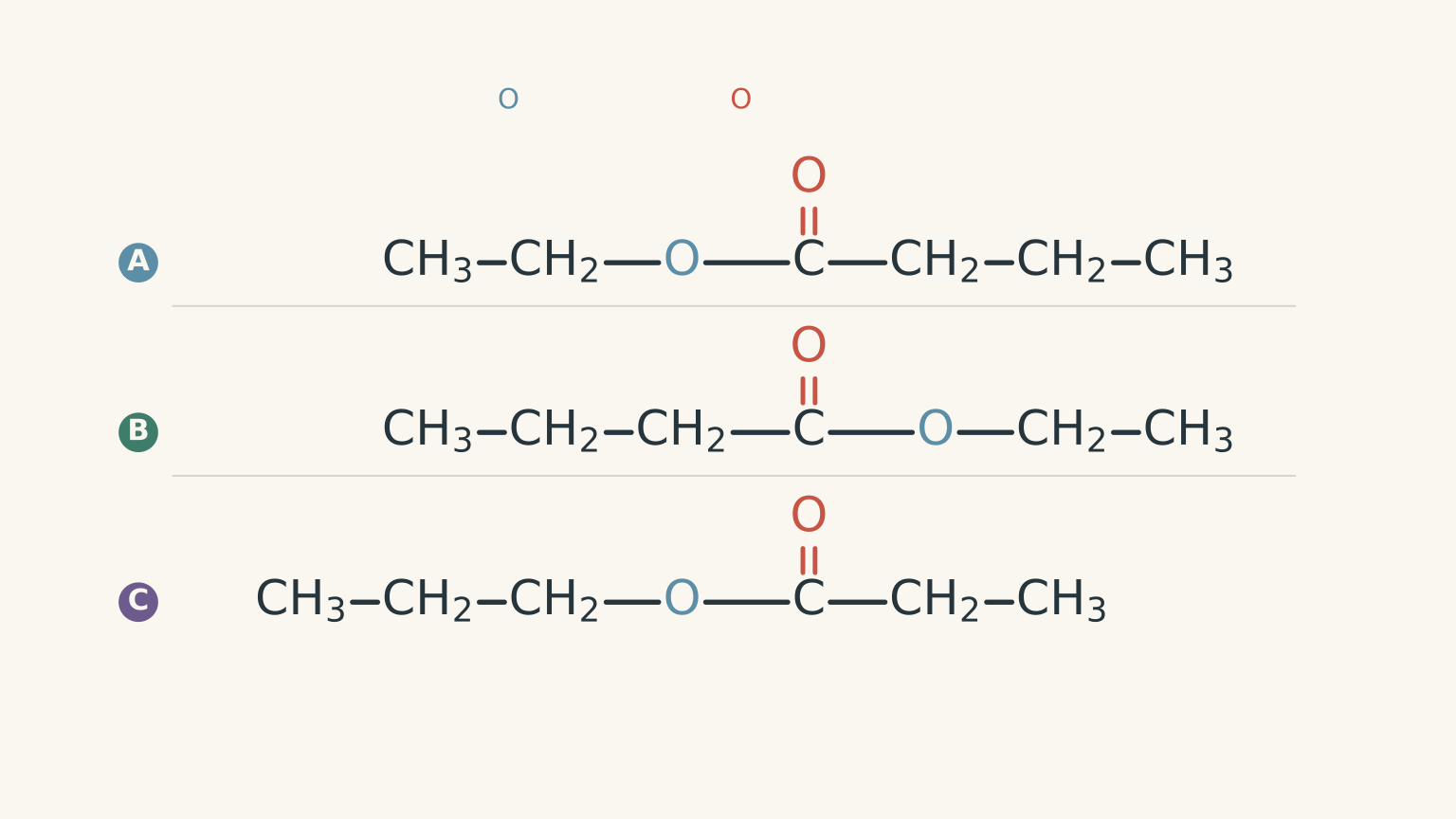
Due to technical limitations, this figure may display incorrectly or contain inaccuracies. Please check key details against your course materials.
Solution 2
Structures A and B represent the same compound, ethyl butanoate. Structure C represents a different compound, propyl propanoate.
The key is to follow the bonds from the carbonyl carbon rather than simply reading the formula from left to right.
Step 1: Identify the structure of the first ester.
\[ \mathrm{CH_3CH_2O-C(=O)-CH_2CH_2CH_3} \]
The ethyl group is attached to the single-bonded oxygen.
The carbonyl carbon is attached to a three-carbon chain. Including the carbonyl carbon, the acid-derived part contains four carbon atoms.
Therefore, the acid is butanoic acid, and the alcohol is ethanol.
The ester is ethyl butanoate.
Step 2: Compare structures A and B.
Structure B is:
\[ \mathrm{CH_3CH_2CH_2-C(=O)-O-CH_2CH_3} \]
It has exactly the same connections:
- A three-carbon chain attached to the carbonyl carbon.
- A single-bonded oxygen attached to an ethyl group.
- A carbonyl oxygen double-bonded to the carbonyl carbon.
The order has simply been reversed.
Structures A and B are identical.
Step 3: Examine structure C.
\[ \mathrm{CH_3CH_2CH_2O-C(=O)-CH_2CH_3} \]
Here, the propyl group is attached to the ester oxygen, while the carbonyl carbon is attached to an ethyl group.
The acid-derived part is now propanoate, and the alcohol-derived part is propyl.
The compound is propyl propanoate.
Step 4: Explain why the compounds are different.
Ethyl butanoate and propyl propanoate both have the molecular formula C6H12O2.
However, their atoms are connected differently.
This is why molecular formulae alone cannot establish whether two ester structures represent the same compound.
The correct method is to compare the actual bonds around the carbonyl carbon and ester oxygen.
Question 3
Propanoic acid reacts with ethanol to form ethyl propanoate and water.
The reaction reaches equilibrium in a closed vessel with a volume of 1.00 L.
The initial equilibrium concentrations are:
| Substance | Concentration |
|---|---|
| Propanoic acid | 0.180 mol L⁻¹ |
| Ethanol | 0.180 mol L⁻¹ |
| Ethyl propanoate | 0.240 mol L⁻¹ |
| Water | 0.240 mol L⁻¹ |
A student then adds 0.100 mol of ethanol. Assume that the vessel volume remains 1.00 L and the temperature stays constant.
Calculate:
(a) The equilibrium constant, \(K_c\), before the ethanol is added.
(b) The direction in which the equilibrium shifts.
(c) The new equilibrium concentrations of all four substances.
Solution 3
The equilibrium shifts to the right, producing additional ethyl propanoate and water.
The new equilibrium concentrations are 0.155 mol L⁻¹ propanoic acid, 0.255 mol L⁻¹ ethanol, and 0.265 mol L⁻¹ each of ethyl propanoate and water.
Step 1: Write the equilibrium equation.
\[ \ce{CH3CH2COOH + CH3CH2OH} \]
\[ \ce{<=> CH3CH2COOCH2CH3 + H2O} \]
The mole ratio is 1:1:1:1.
Step 2: Calculate the original equilibrium constant.
\[ K_c= \frac{[\text{ester}][\text{water}]} {[\text{acid}][\text{ethanol}]} \]
Substitute the original equilibrium concentrations:
\[ K_c=\frac{0.240\times0.240} {0.180\times0.180} \]
\[ K_c=1.78 \]
Step 3: Determine the immediate effect of adding ethanol.
The additional ethanol increases its concentration by 0.100 mol L⁻¹ because the volume is 1.00 L.
The new concentration immediately after addition is:
\[ [\text{ethanol}]=0.180+0.100 \]
\[ =0.280\text{ mol L}^{-1} \]
The other concentrations initially remain unchanged.
Step 4: Determine the direction of the shift.
Calculate the reaction quotient, \(Q\), using the new concentrations:
\[ Q=\frac{0.240\times0.240} {0.180\times0.280} \]
\[ Q=1.14 \]
Since:
\[ Q<K_c \]
the forward reaction is favoured.
The system produces more ester and water, consuming some of the added ethanol and the remaining propanoic acid.
Step 5: Set up the equilibrium changes.
Let \(x\) represent the concentration change, in mol L⁻¹.
| Substance | Immediately after addition | Change | New equilibrium |
|---|---|---|---|
| Propanoic acid | 0.180 | \(-x\) | \(0.180-x\) |
| Ethanol | 0.280 | \(-x\) | \(0.280-x\) |
| Ethyl propanoate | 0.240 | \(+x\) | \(0.240+x\) |
| Water | 0.240 | \(+x\) | \(0.240+x\) |
Step 6: Substitute into the equilibrium expression.
\[ 1.78= \frac{(0.240+x)^2} {(0.180-x)(0.280-x)} \]
Solving the quadratic equation gives the physically valid solution:
\[ x=0.0250\text{ mol L}^{-1} \]
The other mathematical root would produce a negative propanoic acid concentration, so it must be rejected.
Step 7: Calculate the new concentrations.
Propanoic acid:
\[ 0.180-0.0250=0.155 \]
Ethanol:
\[ 0.280-0.0250=0.255 \]
Ethyl propanoate:
\[ 0.240+0.0250=0.265 \]
Water:
\[ 0.240+0.0250=0.265 \]
The final results are:
| Substance | New equilibrium concentration |
|---|---|
| Propanoic acid | 0.155 mol L⁻¹ |
| Ethanol | 0.255 mol L⁻¹ |
| Ethyl propanoate | 0.265 mol L⁻¹ |
| Water | 0.265 mol L⁻¹ |
Adding ethanol increases the equilibrium amount of ester, but it does not convert all the reactants into products.
Question 4
A student prepares an ester by reacting propanoic acid with ethanol using concentrated sulfuric acid.
After the reaction, they add aqueous sodium carbonate to the crude reaction mixture. Vigorous bubbling occurs.
The student concludes:
“The ester must have reacted with sodium carbonate, proving that esterification was successful.”
Evaluate this conclusion.
In your answer:
(a) Identify the gas responsible for the bubbles.
(b) Explain which substances in the reaction mixture could produce the gas.
(c) Explain the actual purpose of sodium carbonate during the work-up.
(d) Describe a more useful chemical approach for investigating whether the ester has formed.
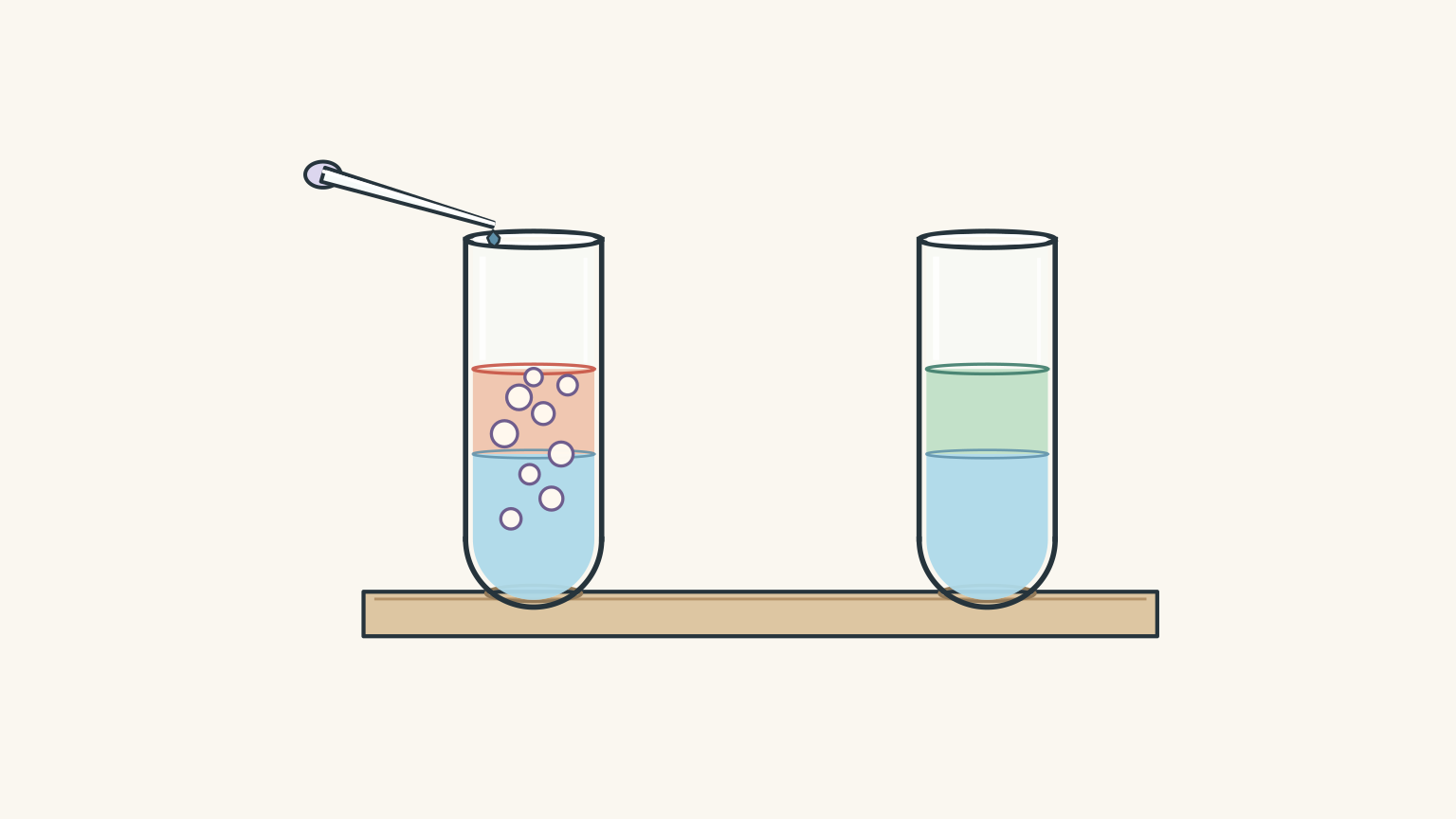
Due to technical limitations, this figure may display incorrectly or contain inaccuracies. Please check key details against your course materials.
Solution 4
The student’s conclusion is incorrect. The bubbles indicate that an acid is reacting with sodium carbonate, not that the ester has been positively identified.
Step 1: Identify the gas.
The gas is carbon dioxide, \(\ce{CO2}\).
Carbon dioxide is produced when carbonate ions react with acids.
Step 2: Identify possible sources of the gas.
There are at least two possible sources of acidity in the crude mixture.
First, unreacted propanoic acid can react with sodium carbonate:
\[ \ce{2CH3CH2COOH + Na2CO3} \]
\[ \ce{-> 2CH3CH2COONa + H2O + CO2} \]
Second, the sulfuric acid catalyst can also react:
\[ \ce{H2SO4 + Na2CO3} \]
\[ \ce{-> Na2SO4 + H2O + CO2} \]
Both reactions produce carbon dioxide.
Step 3: Explain the purpose of sodium carbonate.
Sodium carbonate is used to neutralise leftover acids during the work-up.
It helps remove unreacted carboxylic acid and sulfuric acid from the crude ester mixture.
The bubbling is evidence of acid neutralisation.
It is not evidence that the ester itself has reacted.
Step 4: Suggest a more useful chemical approach.
A purified ester sample can be subjected to alkaline hydrolysis using aqueous sodium hydroxide and heating.
The ester breaks down to form an alcohol and a carboxylate salt.
After acidification, the carboxylate can be converted back into the carboxylic acid.
Identifying these hydrolysis products provides more useful information about the original ester structure.
The important distinction is that sodium carbonate tests for residual acidity, whereas alkaline hydrolysis investigates the ester linkage itself.
Question 5
An unknown ester, P, has the molecular formula C5H10O2.
Three proposed structural representations are shown below:
Structure I
\[ \mathrm{CH_3-C(=O)-O-CH_2-CH_2-CH_3} \]
Structure II
\[ \mathrm{CH_3-CH_2-CH_2-O-C(=O)-CH_3} \]
Structure III
\[ \mathrm{CH_3-CH_2-CH_2-C(=O)-O-CH_3} \]
A crude sample from the preparation of P produces bubbles when treated with aqueous sodium carbonate.
A separate purified sample is then heated under reflux with excess aqueous sodium hydroxide. The reaction is allowed to proceed to completion.
After the hydrolysis mixture is acidified, the carboxylic acid recovered is identified as ethanoic acid. The alcohol produced during hydrolysis is identified as propan-1-ol.
Assume that P is a single pure ester, that hydrolysis is complete, and that no competing reactions occur.
Answer the following:
(a) Determine which of the three structures represent the same compound.
(b) Identify P and explain which structural representation is correct.
(c) Explain why the molecular formula alone cannot distinguish the proposed compounds.
(d) Explain what the sodium carbonate bubbling establishes and why it does not identify the ester.
(e) Write the equations for the alkaline hydrolysis of P and the subsequent acidification.
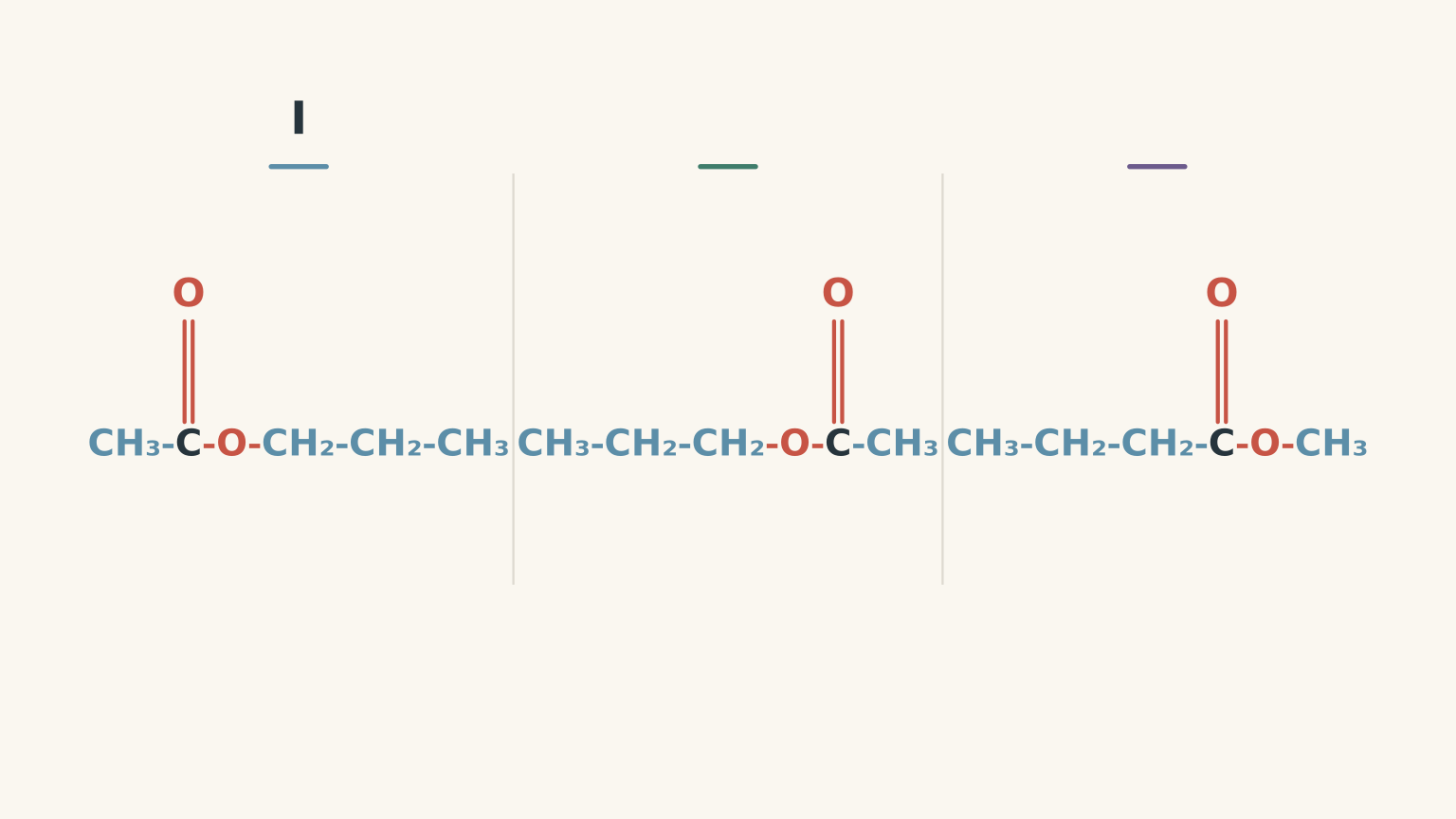
Due to technical limitations, this figure may display incorrectly or contain inaccuracies. Please check key details against your course materials.
Solution 5
P is propyl ethanoate. Structures I and II represent the same molecule, while Structure III represents a different constitutional isomer.
The hydrolysis products identify the original acid-derived and alcohol-derived portions. The sodium carbonate bubbles provide separate evidence of residual acidity, not ester formation.
Step 1: Compare the three structures by their atom-to-atom connections.
Structure I is:
\[ \mathrm{CH_3-C(=O)-O-CH_2-CH_2-CH_3} \]
Structure II is:
\[ \mathrm{CH_3-CH_2-CH_2-O-C(=O)-CH_3} \]
Both have:
- A methyl group attached to the carbonyl carbon.
- A carbonyl oxygen double-bonded to that carbon.
- A single-bonded oxygen connecting the carbonyl carbon to a propyl group.
They are the same molecular structure written in opposite directions.
Structure III is different:
\[ \mathrm{CH_3-CH_2-CH_2-C(=O)-O-CH_3} \]
The three-carbon chain is now attached to the carbonyl carbon, and the methyl group is attached to the ester oxygen.
This is methyl butanoate.
Step 2: Use the hydrolysis products to identify the original ester.
The experiment produces ethanoic acid after acidification and propan-1-ol during hydrolysis.
This tells us that:
- The acid-derived portion must be ethanoate.
- The alcohol-derived portion must be propyl.
Therefore, the original ester must be propyl ethanoate.
Its structure is:
\[ \mathrm{CH_3-C(=O)-O-CH_2-CH_2-CH_3} \]
Structures I and II are both correct representations of P.
Structure III is inconsistent with the observed products.
Step 3: Explain why the molecular formula is insufficient.
Propyl ethanoate and methyl butanoate both have the molecular formula C5H10O2.
They contain the same number of carbon, hydrogen and oxygen atoms.
However, their carbon chains are distributed differently across the ester linkage.
Propyl ethanoate forms from ethanoic acid and propan-1-ol.
Methyl butanoate forms from butanoic acid and methanol.
Both compounds have the same molecular formula, but their structural formulae and hydrolysis products are different.
This is why identifying an ester requires examining connectivity rather than simply counting atoms.
Step 4: Interpret the sodium carbonate test.
The bubbles are carbon dioxide.
The crude reaction mixture may contain unreacted ethanoic acid and concentrated sulfuric acid catalyst.
Either acid can react with sodium carbonate to produce carbon dioxide.
Therefore, the observation establishes that acidic substances are present in the crude mixture.
It does not prove that P has formed, nor does it distinguish propyl ethanoate from methyl butanoate.
The purified ester itself is not expected to produce carbon dioxide with sodium carbonate under mild conditions.
Step 5: Write the alkaline hydrolysis equation.
Propyl ethanoate reacts with sodium hydroxide to produce sodium ethanoate and propan-1-ol.
\[ \ce{CH3COOCH2CH2CH3 + NaOH} \]
\[ \ce{-> CH3COONa + CH3CH2CH2OH} \]
Notice that the alcohol is recovered with its three-carbon propyl chain.
The carboxylic acid initially exists as sodium ethanoate, not free ethanoic acid.
Step 6: Write the subsequent acidification equation.
Adding hydrochloric acid converts sodium ethanoate into ethanoic acid.
\[ \ce{CH3COONa + HCl} \]
\[ \ce{-> CH3COOH + NaCl} \]
The recovered ethanoic acid and propan-1-ol confirm the original structure.
The crucial reasoning is that hydrolysis separates the two sides of the ester linkage. The identity of the acid and alcohol tells you which carbon chain was originally attached to the carbonyl carbon and which was attached through the ester oxygen.
06Where to go next
When drawing an ester, always establish the carbonyl-carbon connection first. Once that is correct, the alcohol-derived group has only one place to go: the single-bonded ester oxygen.
Then identify what the question is actually testing:
- Structural formula questions require correct atom-to-atom connectivity.
- Equilibrium questions require you to consider reaction direction, \(K_c\), and changes in concentration.
- Practical questions require you to distinguish ester formation from neutralisation, separation and hydrolysis.
- Yield questions require stoichiometric calculations, not assumptions that equilibrium converts every reactant into ester.
Syllabus scope: This article follows the esterification treatment in the Chemistry Stage 6 Syllabus (2017). It is not presented as a claim that this exact content is prescribed by the Chemistry 11-12 Syllabus (2025). Students should check the requirements applying to their cohort.
Getting these distinctions right makes ester questions much easier to approach, particularly when an HSC question combines structural formulae with equilibrium data or experimental observations.