
How to Identify an Element from Its Noble-Gas Configuration
Learn how to identify an element from its noble-gas electron configuration by counting electrons and accounting for ionic charge. Includes worked examples covering neutral atoms, positive and negative ions, and transition-metal ionisation.
An ion is written with the electron configuration \([\mathrm{Ne}]\,3s^2\,3p^6\). You add the electrons and get 18, so you identify argon. Seems straightforward.
But there is a catch. Chloride ions, \(\mathrm{Cl}^{-}\), and potassium ions, \(\mathrm{K}^{+}\), have exactly the same electron configuration as argon. They all contain 18 electrons, but they are three different elements.
So how do you find the element?
Count the electrons in the configuration, then use the charge of the atom or ion to calculate its atomic number.
The relationship you need is:
\[ \boxed{Z=N_e+q} \]
where:
- \(Z\) is the atomic number, equal to the number of protons.
- \(N_e\) is the total number of electrons.
- \(q\) is the signed ionic charge, expressed as a whole number.
For a neutral atom, \(q=0\). For a \(2+\) ion, \(q=+2\). For a \(2-\) ion, \(q=-2\).
This gives you a reliable way to identify an element from its noble-gas shorthand, whether the configuration belongs to a neutral atom or an ion.
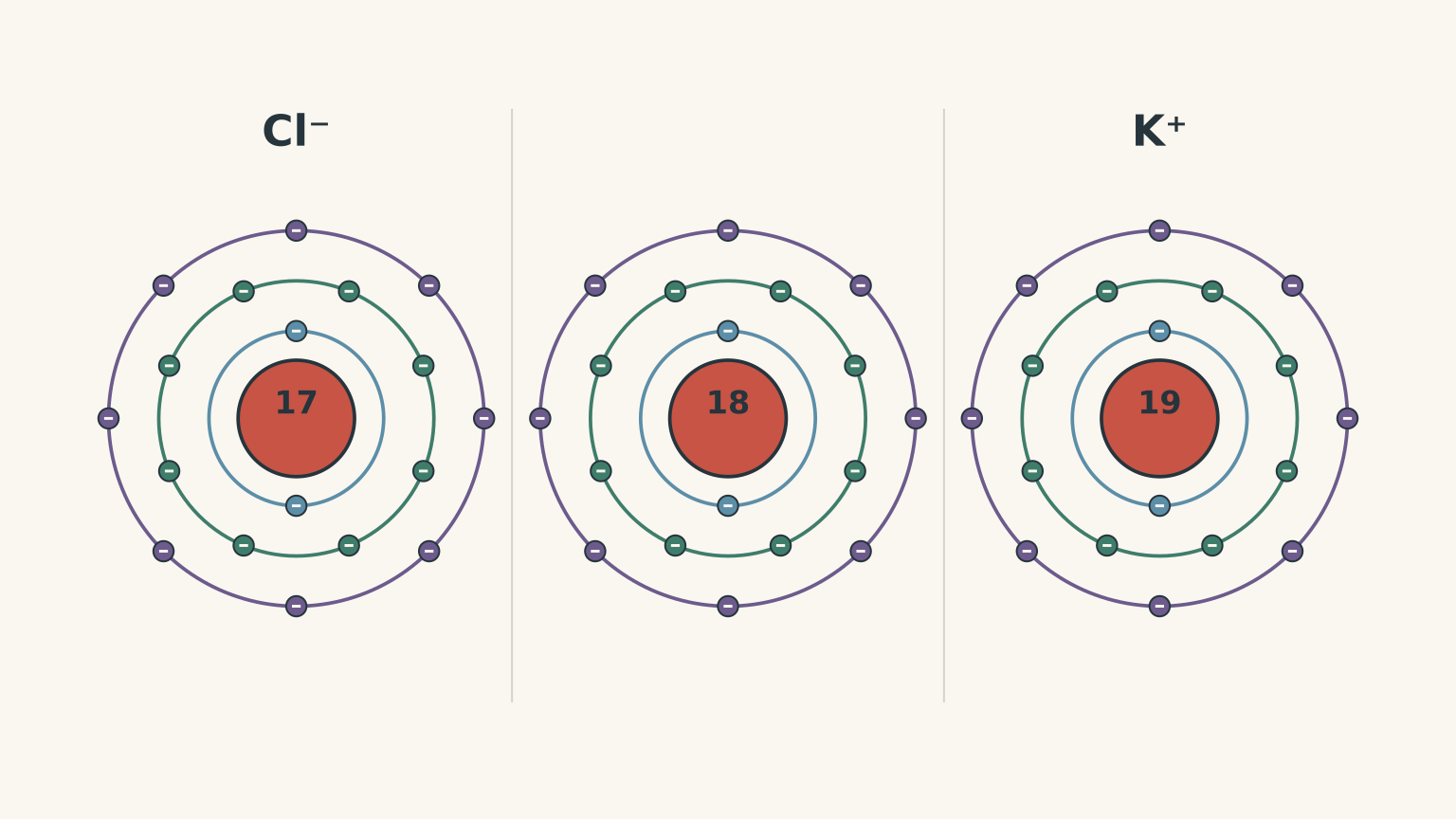
Due to technical limitations, this figure may display incorrectly or contain inaccuracies. Please check key details against your course materials.
01Why atomic number, not electron count, identifies an element
There is a reason we use atomic number rather than electron number to identify an element.
An atom can gain or lose electrons without changing its identity. When sodium loses an electron, it becomes a sodium ion, not a different element. Its nucleus still contains 11 protons.
The number of protons is what determines the element. This is the atomic number, \(Z\).
That distinction became particularly important in the development of the periodic table.
The experiment that established atomic number
In the early twentieth century, scientists had a problem with the periodic table. Elements were largely arranged according to their atomic masses, but some elements appeared in the wrong order if mass alone was used.
Consider cobalt and nickel. Cobalt has a slightly greater relative atomic mass than nickel, yet cobalt belongs before nickel in the periodic table.
Scientists needed to establish what actually determined an element’s position.
In 1913, physicist Henry Moseley investigated the characteristic X-rays emitted by different elements. His work provided experimental evidence that atomic number was a physical property associated with the positive charge of the nucleus.
How did the experiment work?
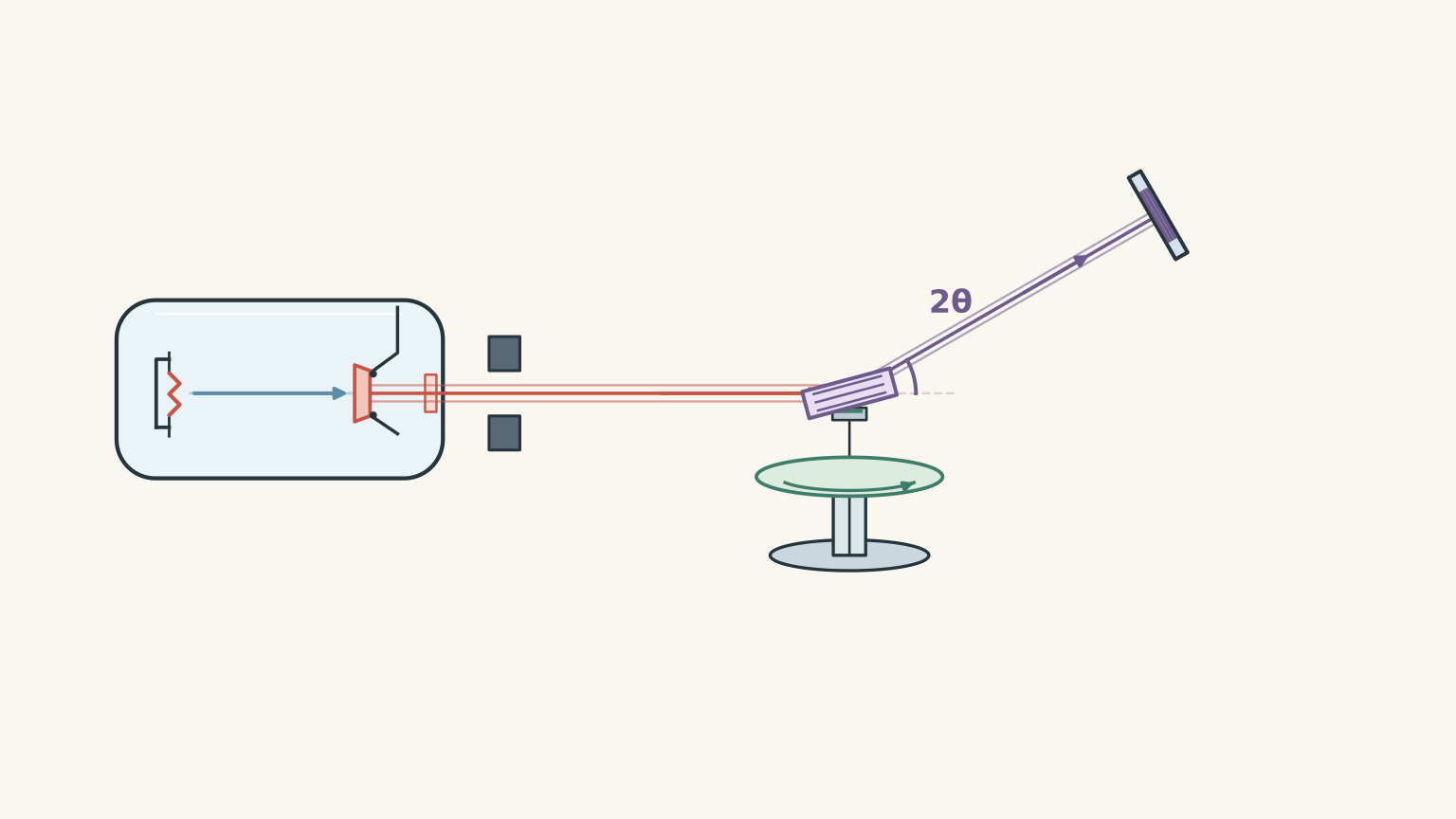
The apparatus followed a specific sequence:
- Electrons were accelerated inside an evacuated X-ray tube and directed towards a metal target.
- The target emitted X-rays with characteristic wavelengths.
- The X-rays passed through a narrow slit towards a crystal.
- The crystal diffracted the X-rays at particular angles, depending on their wavelengths.
- A detector measured the radiation. In Moseley’s later survey, a photographic plate recorded the diffracted spectral lines.
Due to technical limitations, this figure may display incorrectly or contain inaccuracies. Please check key details against your course materials.
What should the experiment show if atomic number is the quantity controlling an element’s identity?
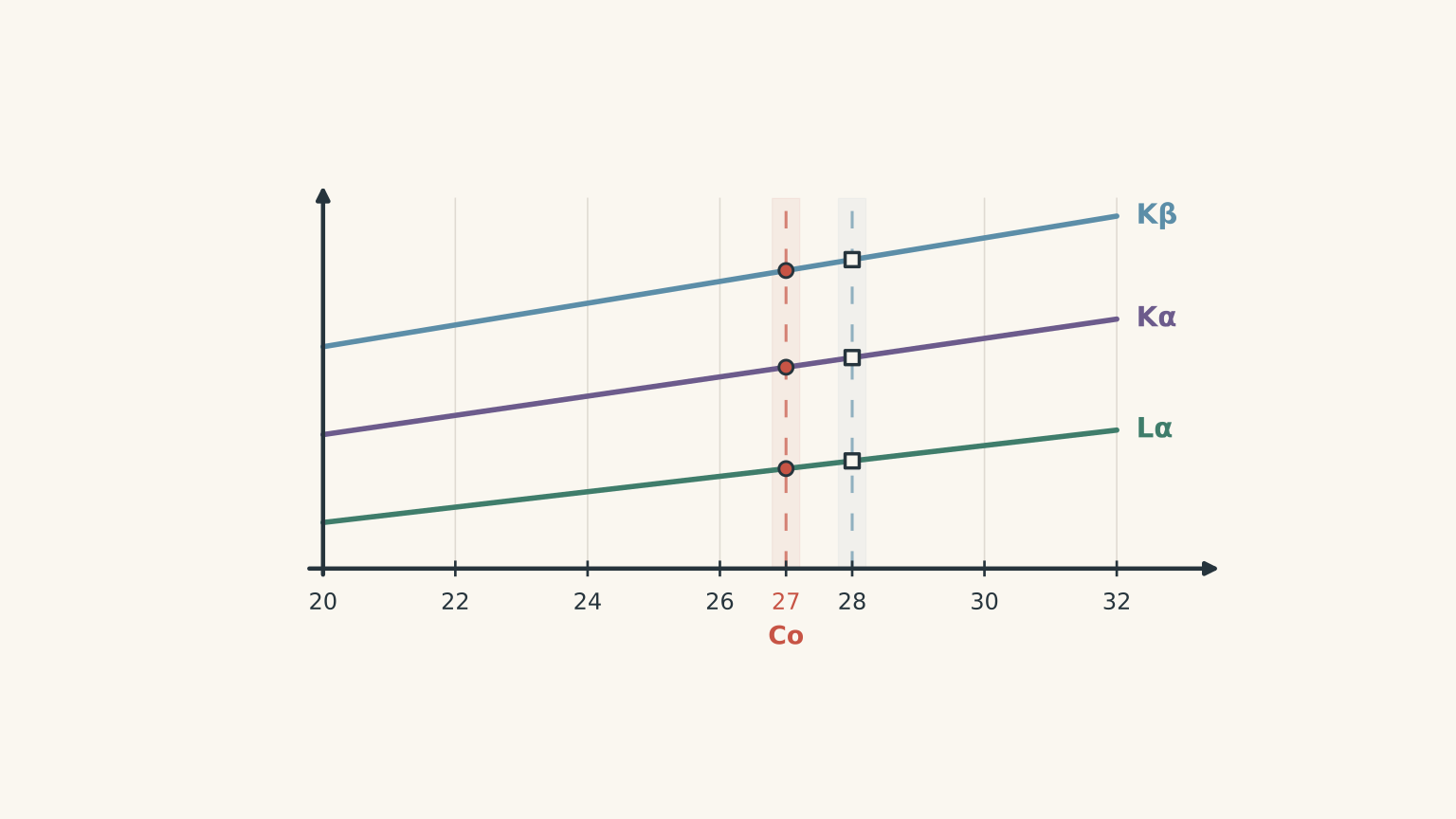
The characteristic X-ray frequencies should change systematically with the element’s position in the periodic table.
Moseley observed exactly this kind of pattern. When he compared the square root of X-ray frequency with atomic number, the results followed an approximately straight-line relationship. Crucially, the spectra followed the periodic order of elements rather than their atomic-mass order. This resolved the cobalt-nickel problem.
Due to technical limitations, this figure may display incorrectly or contain inaccuracies. Please check key details against your course materials.
Moseley’s work established the physical significance of atomic number: it corresponds to the number of positive elementary charges in the nucleus, which we now describe as the number of protons.
The important distinction for our problem is:
- Electron configuration tells you how many electrons a species has and how they are arranged.
- Atomic number tells you how many protons its nucleus contains.
- Ionic charge connects the two.
The experiment measured a property of the nucleus, not the number of electrons in an individual ion. That is why you must account for ionic charge when identifying an element.
The historical apparatus and its development are described in the International Union of Crystallography’s account of Moseley’s work and the University of Oxford’s history of Moseley’s X-ray experiments.
Extension: How a diffraction angle gives a wavelength
Moseley used X-ray diffraction to determine wavelengths. The relationship is Bragg’s law:
\[ m\lambda=2d\sin\theta \]
Here:
- \(m\) is the diffraction order.
- \(\lambda\) is the X-ray wavelength.
- \(d\) is the spacing between crystal planes.
- \(\theta\) is the diffraction angle.
Suppose an illustrative experiment uses a crystal with plane spacing \(d=0.200\text{ nm}\). A first-order diffraction line occurs at an angle of \(15.0^\circ\).
Using \(m=1\):
\[ \begin{aligned} \lambda&=\frac{2d\sin\theta}{m}\\ &=\frac{2(0.200)\sin15.0^\circ}{1}\\ &=0.104\text{ nm} \end{aligned} \]
The measured wavelength can then be converted into frequency using \(c=\lambda\nu\), where \(c\) is the speed of light and \(\nu\) is frequency.
These values are illustrative, not historical measurements from Moseley’s apparatus. Bragg’s law is an extension of the experimental discussion, not a requirement for performing the electron-configuration lookup.
02Step 1: Understand what the noble-gas bracket represents
Before counting electrons, you need to know what the noble-gas symbol contributes.
In noble-gas shorthand, the symbol inside square brackets represents the complete electron configuration of that noble gas.
For example:
\[ [\mathrm{Ne}] \]
represents the electron configuration of neon:
\[ 1s^2\,2s^2\,2p^6 \]
That means it represents 10 electrons.
You can use the following table to quickly identify the electron count of common noble-gas cores.
| Noble-gas core | Atomic number | Electrons represented |
|---|---|---|
| \([\mathrm{He}]\) | 2 | 2 |
| \([\mathrm{Ne}]\) | 10 | 10 |
| \([\mathrm{Ar}]\) | 18 | 18 |
| \([\mathrm{Kr}]\) | 36 | 36 |
| \([\mathrm{Xe}]\) | 54 | 54 |
The bracket is a shortcut. It does not represent an additional atom, an ionic charge, or a separate group of particles.
For example:
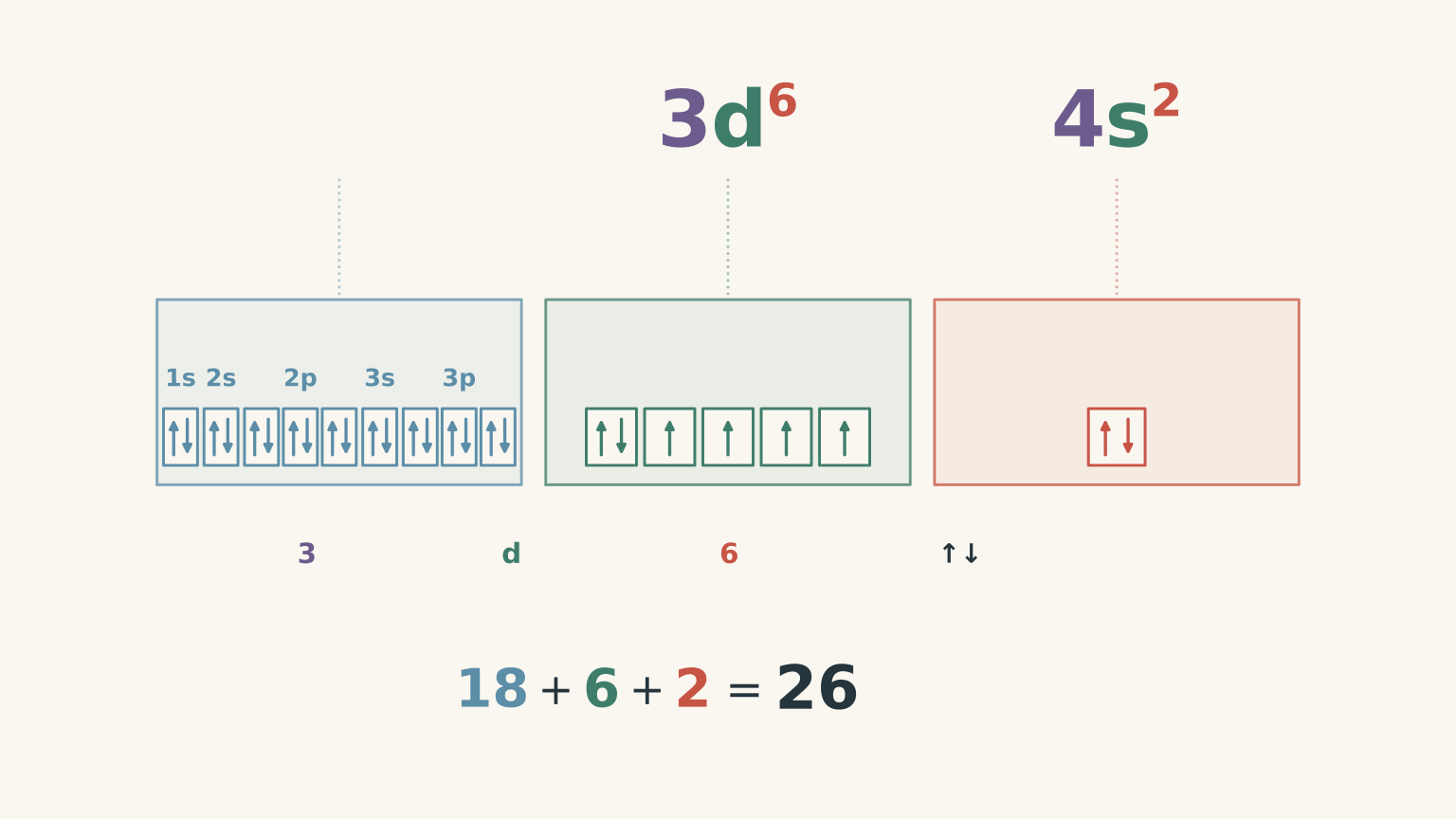
\[ [\mathrm{Ar}]\,3d^6\,4s^2 \]
contains:
- 18 electrons represented by \([\mathrm{Ar}]\).
- 6 electrons in \(3d\).
- 2 electrons in \(4s\).
Therefore:
\[ N_e=18+6+2=26 \]
The configuration represents 26 electrons.
Due to technical limitations, this figure may display incorrectly or contain inaccuracies. Please check key details against your course materials.
One detail matters here: the numbers in front of the subshell letters identify the shell, not the number of electrons.
In \(3d^6\), the 3 identifies shell 3, while the superscript 6 tells you that there are six electrons.
If you need to revise how to interpret the notation itself, see spdf Notation: Electron Configurations and Valence Electrons.
03Step 2: Calculate the atomic number from the electron count
Once you know the total number of electrons, you can calculate the atomic number.
Remember:
\[ Z=N_e+q \]
The sign of the charge determines whether you add or subtract.
| Species | Charge number \(q\) | Calculation |
|---|---|---|
| Neutral atom | 0 | \(Z=N_e\) |
| \(1+\) ion | +1 | \(Z=N_e+1\) |
| \(2+\) ion | +2 | \(Z=N_e+2\) |
| \(1-\) ion | -1 | \(Z=N_e-1\) |
| \(2-\) ion | -2 | \(Z=N_e-2\) |
Think about what happens physically.
A positive ion has lost electrons. It therefore has more protons than electrons, so its atomic number must be greater than its electron count.
A negative ion has gained electrons. It therefore has fewer protons than electrons, so its atomic number must be smaller than its electron count.
Worked example: Identify a neutral atom from its electron configuration
A neutral atom has the noble-gas electron configuration
\[ [\mathrm{Ne}]\,3s^2\,3p^4 \]
Identify the element.
Step 1
Neon has an atomic number of 10, so:
\[ N_e=10 \]
Step 2
The remaining subshells contain:
\[ 2+4=6\text{ electrons} \]
Step 3
\[ N_e=10+2+4=16 \]
Step 4
The atom is neutral, so its charge number is zero.
\[ Z=16+0=16 \]
Final answer: The element is sulfur, \(\mathrm{S}\).
Sulfur has atomic number 16, which means it has 16 protons and, as a neutral atom, 16 electrons.
Worked example: Identify a transition-metal ion
A transition-metal ion has the electron configuration
\[ [\mathrm{Ar}]\,3d^5 \]
The ion has a charge of \(3+\).
Identify the element and explain how its neutral atom forms this configuration.
Step 1
The argon core contains 18 electrons, and the \(3d\) subshell contains five.
\[ N_e=18+5=23 \]
Step 2
The ion has lost three electrons, so it must have three more protons than electrons.
\[ Z=23+3=26 \]
Step 3
Atomic number 26 corresponds to iron, \(\mathrm{Fe}\).
Step 4
A neutral iron atom has 26 electrons.
Its ground-state configuration is:
\[ \mathrm{Fe}: [\mathrm{Ar}]\,3d^6\,4s^2 \]
When iron forms \(\mathrm{Fe}^{3+}\), it loses two electrons from \(4s\), followed by one electron from \(3d\):
\[ \mathrm{Fe}^{3+}: [\mathrm{Ar}]\,3d^5 \]
Final answer: The element is iron, and the ion is \(\mathrm{Fe}^{3+}\).
Notice that identifying the element required two separate ideas: counting the electrons and understanding which electrons are removed during ionisation.
04Step 3: Watch the filling and ionisation conventions
This is particularly important when your configuration contains \(4s\) and \(3d\) subshells.
You might remember that \(4s\) fills before \(3d\) in the usual ground-state filling sequence for neutral atoms.
So you might predict that \(3d\) electrons should be removed first when a transition metal forms a positive ion.
That prediction is incorrect.
For the first-row transition metals, the \(4s\) electrons are removed before the \(3d\) electrons when forming cations.
The relative energies of these subshells change as the \(3d\) subshell becomes occupied. In the resulting transition-metal cations, the \(4s\) electrons are generally less tightly held.
This is why filling order and ionisation order must be treated as separate rules.
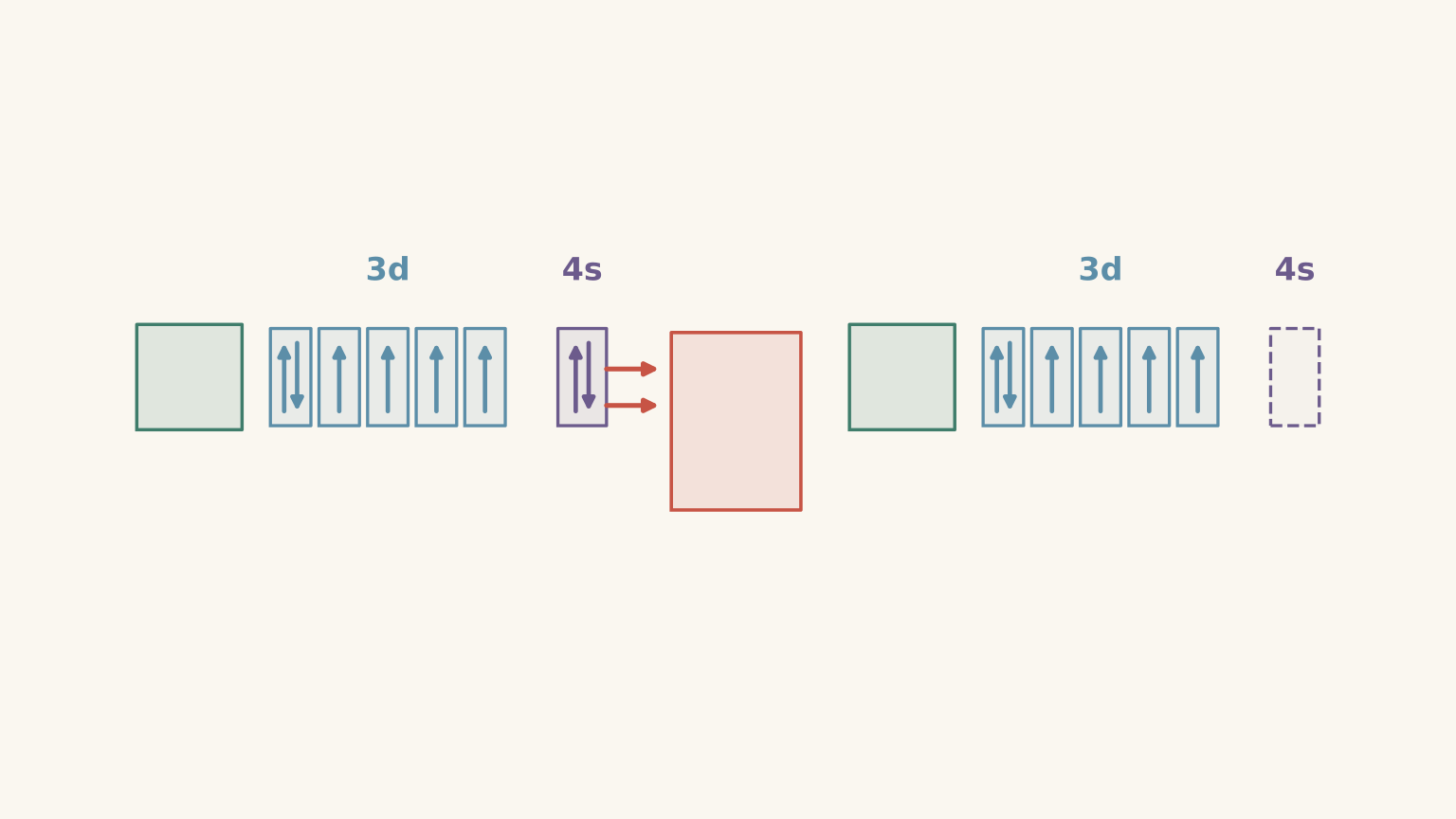
Due to technical limitations, this figure may display incorrectly or contain inaccuracies. Please check key details against your course materials.
Here are some useful examples.
| Neutral atom | Ground-state configuration | Ion | Ion configuration |
|---|---|---|---|
| Potassium | \([\mathrm{Ar}]\,4s^1\) | \(\mathrm{K}^{+}\) | \([\mathrm{Ar}]\) |
| Calcium | \([\mathrm{Ar}]\,4s^2\) | \(\mathrm{Ca}^{2+}\) | \([\mathrm{Ar}]\) |
| Chromium | \([\mathrm{Ar}]\,3d^5\,4s^1\) | \(\mathrm{Cr}^{2+}\) | \([\mathrm{Ar}]\,3d^4\) |
| Iron | \([\mathrm{Ar}]\,3d^6\,4s^2\) | \(\mathrm{Fe}^{3+}\) | \([\mathrm{Ar}]\,3d^5\) |
| Copper | \([\mathrm{Ar}]\,3d^{10}\,4s^1\) | \(\mathrm{Cu}^{2+}\) | \([\mathrm{Ar}]\,3d^9\) |
There are also two important neutral-atom exceptions to the simple filling sequence in the first transition series:
- Chromium has \([\mathrm{Ar}]\,3d^5\,4s^1\), rather than the predicted \([\mathrm{Ar}]\,3d^4\,4s^2\).
- Copper has \([\mathrm{Ar}]\,3d^{10}\,4s^1\), rather than the predicted \([\mathrm{Ar}]\,3d^9\,4s^2\).
The \(3d\) and \(4s\) subshells are close in energy, and the balance of electron interactions favours these alternative ground-state arrangements.
Half-filled and completely filled \(d\) subshells are useful patterns to recognise, but don’t turn them into a universal rule for predicting every configuration.
For main-group elements, the simpler outer-shell convention applies. For example:
\[ \mathrm{Mg}: [\mathrm{Ne}]\,3s^2 \]
Losing two electrons gives:
\[ \mathrm{Mg}^{2+}: [\mathrm{Ne}] \]
For negative ions, electrons are added to the next available subshell. For example:
\[ \mathrm{S}: [\mathrm{Ne}]\,3s^2\,3p^4 \]
Gaining two electrons gives:
\[ \mathrm{S}^{2-}: [\mathrm{Ne}]\,3s^2\,3p^6 \]
The resulting configuration is the same as argon’s.
For a more detailed explanation of shells, subshells, and the ionisation of transition metals, see How to Distinguish Shells, Subshells and Orbitals in Chemistry.
05Step 4: Recognise when different species share the same configuration
Here is the misconception that causes the most trouble with this topic:
The same electron configuration does not necessarily mean the same element.
Consider five species:
| Species | Electron configuration | Electrons | Protons |
|---|---|---|---|
| \(\mathrm{S}^{2-}\) | \([\mathrm{Ar}]\) | 18 | 16 |
| \(\mathrm{Cl}^{-}\) | \([\mathrm{Ar}]\) | 18 | 17 |
| \(\mathrm{Ar}\) | \([\mathrm{Ar}]\) | 18 | 18 |
| \(\mathrm{K}^{+}\) | \([\mathrm{Ar}]\) | 18 | 19 |
| \(\mathrm{Ca}^{2+}\) | \([\mathrm{Ar}]\) | 18 | 20 |
All five species have 18 electrons.
They are called isoelectronic species because they have the same number of electrons and, in this case, the same electron configuration.
However, they have different atomic numbers because they contain different numbers of protons.
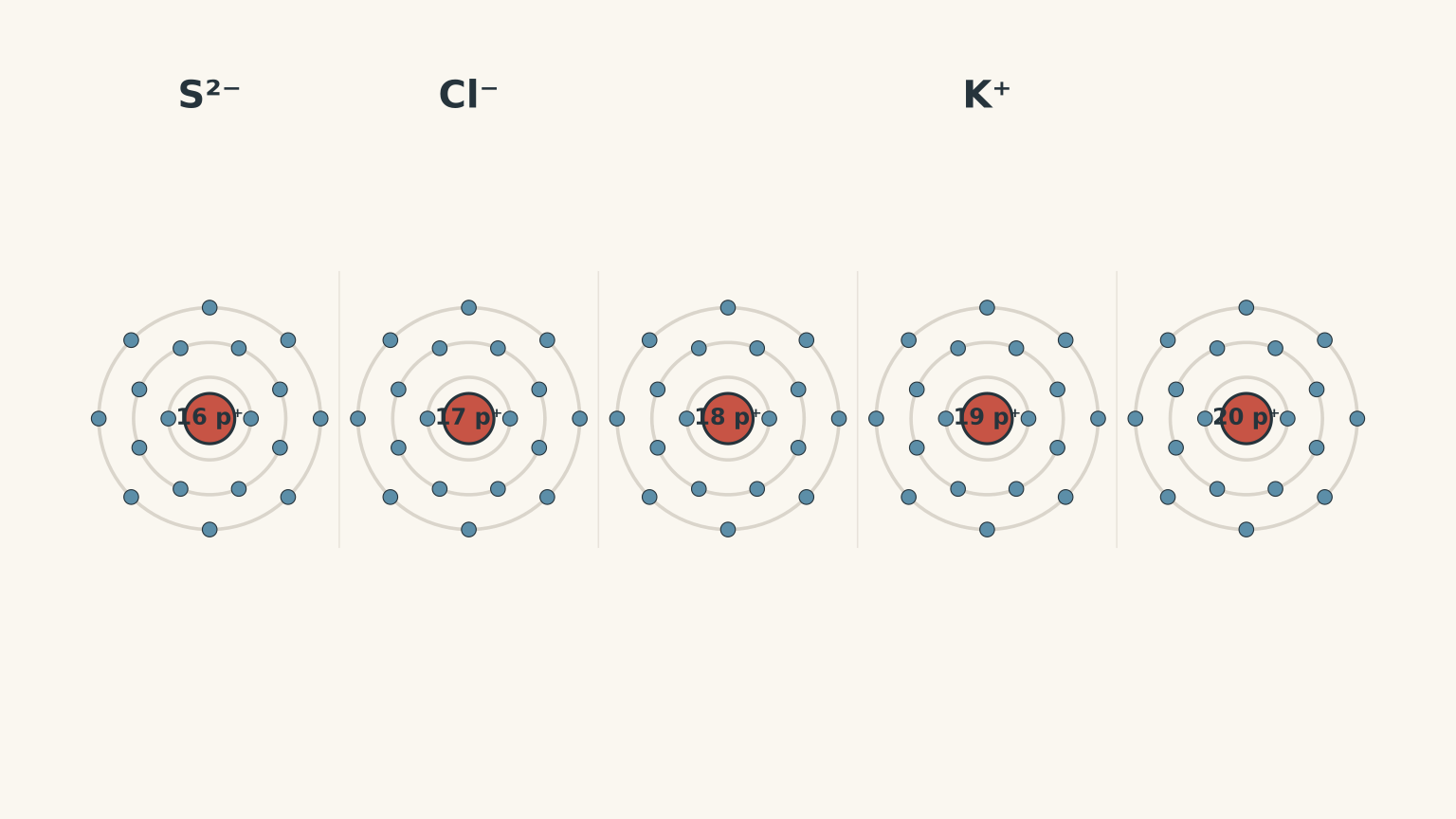
Due to technical limitations, this figure may display incorrectly or contain inaccuracies. Please check key details against your course materials.
This gives you an important diagnostic rule:
- If you are given \([\mathrm{Ar}]\) and told the species is neutral, the element is argon.
- If you are given \([\mathrm{Ar}]\) and told the species is \(2-\), the element is sulfur.
- If you are given \([\mathrm{Ar}]\) and told the species is \(2+\), the element is calcium.
Without the charge or another piece of information about the nucleus, you cannot uniquely identify the element.
06Questions and solutions
The following questions progress from straightforward electron counting to more demanding combinations of ionic charge, transition-metal configurations, and ionisation conventions.
Question 1
A neutral atom has the noble-gas electron configuration
\[ [\mathrm{Ne}]\,3s^2\,3p^1 \]
Identify the element and show how you obtained its atomic number.
Solution 1
The element is aluminium, \(\mathrm{Al}\), with atomic number 13.
First, expand the neon core:
\[ N_e=10+2+1=13 \]
Because the atom is neutral, its number of electrons equals its number of protons.
Therefore:
\[ Z=13 \]
Atomic number 13 corresponds to aluminium.
The important point is that the noble-gas core contributes 10 electrons. You must include these when calculating the total.
Question 2
An unknown element forms a negative ion with the configuration
\[ [\mathrm{Ne}]\,3s^2\,3p^6 \]
The ion has a charge of \(2-\).
(a) Identify the element.
(b) Write the chemical formula of the ion.
(c) Write the ground-state electron configuration of the neutral atom.
Explain why the ion should not be identified as argon.
Solution 2
The element is sulfur, and the ion is \(\mathrm{S}^{2-}\).
Part (a): Calculate the atomic number.
First, count the electrons:
\[ N_e=10+2+6=18 \]
The ion has a charge of \(2-\), so \(q=-2\).
Using the atomic number relationship:
\[ \begin{aligned} Z&=N_e+q\\ &=18+(-2)\\ &=16 \end{aligned} \]
Atomic number 16 identifies sulfur.
Part (b): Write the ion formula.
Sulfur has gained two electrons, so the ion is:
\[ \mathrm{S}^{2-} \]
Part (c): Find the neutral configuration.
A neutral sulfur atom has 16 electrons.
Its ground-state configuration is:
\[ [\mathrm{Ne}]\,3s^2\,3p^4 \]
It gains two electrons in the \(3p\) subshell to form the ion:
\[ [\mathrm{Ne}]\,3s^2\,3p^6 \]
The tempting mistake is to identify the ion as argon because it has 18 electrons.
However, argon has 18 protons, while the sulfur ion has only 16. Gaining electrons changes the charge, not the identity of the element.
Question 3
A singly charged positive ion has the electron configuration
\[ [\mathrm{Ar}]\,3d^{10} \]
Identify the element and write the ground-state electron configuration of its neutral atom.
Explain which subshell loses an electron during ion formation.
Solution 3
The element is copper, \(\mathrm{Cu}\), and its neutral ground-state configuration is \([\mathrm{Ar}]\,3d^{10}\,4s^1\).
Step 1: Calculate the electron count.
\[ N_e=18+10=28 \]
Step 2: Apply the ionic charge.
The ion has a charge of \(1+\).
\[ \begin{aligned} Z&=28+1\\ &=29 \end{aligned} \]
Atomic number 29 identifies copper.
Step 3: Write the neutral atom’s configuration.
Neutral copper has 29 electrons.
Its actual ground-state configuration is:
\[ \mathrm{Cu}: [\mathrm{Ar}]\,3d^{10}\,4s^1 \]
Step 4: Check the ionisation process.
Copper loses its single \(4s\) electron to form \(\mathrm{Cu}^{+}\):
\[ \mathrm{Cu}^{+}: [\mathrm{Ar}]\,3d^{10} \]
The \(3d\) subshell remains full.
A common mistake is to predict a neutral copper configuration of \([\mathrm{Ar}]\,3d^9\,4s^2\) using the simple filling sequence.
Copper is one of the important exceptions. Its actual ground-state configuration has a completely filled \(3d\) subshell and one electron in \(4s\).
Question 4
Two different ions have the same electron configuration:
\[ \mathrm{A}^{+}: [\mathrm{Ar}]\,3d^5 \]
\[ \mathrm{B}^{2+}: [\mathrm{Ar}]\,3d^5 \]
(a) Identify elements A and B.
(b) Write the ground-state electron configuration of each neutral atom.
(c) Explain why two different elements can have exactly the same electron configuration in their ions.
Solution 4
Element A is chromium, and element B is manganese.
Both ions contain 23 electrons, but their different charges mean that their nuclei contain different numbers of protons.
Part (a): Identify element A.
The electron count is:
\[ N_e=18+5=23 \]
For \(\mathrm{A}^{+}\):
\[ \begin{aligned} Z_A&=23+1\\ &=24 \end{aligned} \]
Atomic number 24 identifies chromium.
Therefore:
\[ \mathrm{A}=\mathrm{Cr} \]
Part (b): Identify element B.
For \(\mathrm{B}^{2+}\), the electron count remains 23, but the charge is \(+2\).
\[ \begin{aligned} Z_B&=23+2\\ &=25 \end{aligned} \]
Atomic number 25 identifies manganese.
Therefore:
\[ \mathrm{B}=\mathrm{Mn} \]
Part (c): Write the neutral configurations.
Chromium has 24 electrons and the ground-state configuration:
\[ \mathrm{Cr}: [\mathrm{Ar}]\,3d^5\,4s^1 \]
Manganese has 25 electrons and the ground-state configuration:
\[ \mathrm{Mn}: [\mathrm{Ar}]\,3d^5\,4s^2 \]
The two neutral atoms differ by one electron in their \(4s\) subshells.
When chromium loses its \(4s\) electron, it forms:
\[ \mathrm{Cr}^{+}: [\mathrm{Ar}]\,3d^5 \]
When manganese loses its two \(4s\) electrons, it forms:
\[ \mathrm{Mn}^{2+}: [\mathrm{Ar}]\,3d^5 \]
Both ions end up with the same electron arrangement.
The trap is assuming that an electron configuration uniquely identifies an element. It identifies an electron count and arrangement. The ionic charge is what allows you to work backwards to the proton count.
Question 5
An unknown first-row transition element, X, forms two positive ions with the following ground-state electron configurations:
\[ \mathrm{X}^{+}: [\mathrm{Ar}]\,3d^5 \]
\[ \mathrm{X}^{2+}: [\mathrm{Ar}]\,3d^4 \]
A student confidently identifies X as manganese because \(\mathrm{Mn}^{2+}\) has the configuration \([\mathrm{Ar}]\,3d^5\).
Another student argues that the two configurations cannot belong to the same element. Their reasoning is that \(4s\) fills before \(3d\), so \(3d\) electrons should be removed first.
Determine:
(a) The identity of X.
(b) The ground-state electron configuration of neutral X.
(c) Whether the two supplied ion configurations are consistent with the same element.
(d) Why both students’ arguments are incorrect.
Assume the ions are in their ground states and use the standard first-row transition-metal ionisation convention.
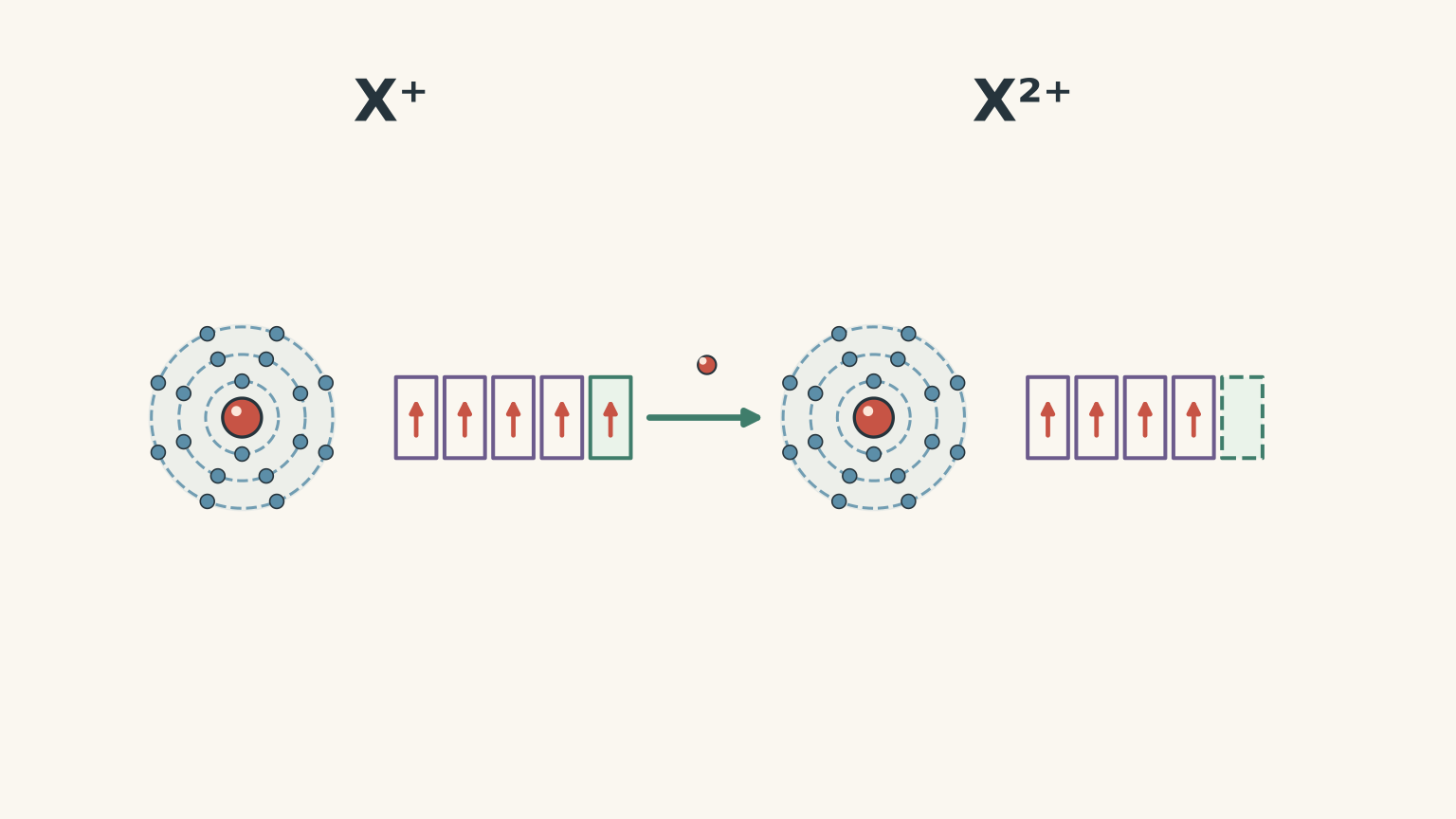
Due to technical limitations, this figure may display incorrectly or contain inaccuracies. Please check key details against your course materials.
Solution 5
X is chromium, and its neutral ground-state electron configuration is:
\[ \boxed{[\mathrm{Ar}]\,3d^5\,4s^1} \]
Both supplied ion configurations are consistent with chromium. The mistake is treating an electron configuration as a unique identifier and reversing the filling sequence when considering ionisation.
Step 1: Use the first ion to calculate the atomic number.
For \(\mathrm{X}^{+}\):
\[ N_e=18+5=23 \]
The ion has lost one electron, so:
\[ \begin{aligned} Z&=23+1\\ &=24 \end{aligned} \]
Therefore, X has atomic number 24.
This identifies chromium.
Step 2: Independently check the second ion.
For \(\mathrm{X}^{2+}\):
\[ N_e=18+4=22 \]
The ion has lost two electrons, so:
\[ \begin{aligned} Z&=22+2\\ &=24 \end{aligned} \]
Both configurations give the same atomic number.
This is an important consistency check. If the calculations produced different atomic numbers, the two configurations could not represent the stated charge states of the same element.
Step 3: Reconstruct the neutral atom.
Chromium has 24 electrons when neutral.
Its actual ground-state configuration is:
\[ \mathrm{Cr}: [\mathrm{Ar}]\,3d^5\,4s^1 \]
A simple application of the usual filling sequence might suggest:
\[ [\mathrm{Ar}]\,3d^4\,4s^2 \]
However, this is not the actual ground-state configuration of chromium.
Chromium is an exception because the \(3d\) and \(4s\) subshells are close in energy. The balance of electron interactions favours the arrangement with five \(3d\) electrons and one \(4s\) electron.
Step 4: Check whether the ionisation sequence works.
Starting with neutral chromium:
\[ [\mathrm{Ar}]\,3d^5\,4s^1 \]
The first electron is removed from \(4s\):
\[ \mathrm{Cr}^{+}: [\mathrm{Ar}]\,3d^5 \]
The second electron is removed from \(3d\):
\[ \mathrm{Cr}^{2+}: [\mathrm{Ar}]\,3d^4 \]
Both configurations match the question.
Step 5: Explain the two misconceptions.
The first student identifies manganese because manganese ions can have the configuration \([\mathrm{Ar}]\,3d^5\).
That configuration is indeed possible for \(\mathrm{Mn}^{2+}\). However, the question specifies \(\mathrm{X}^{+}\), not \(\mathrm{X}^{2+}\).
For manganese:
\[ N_e=23,\qquad q=+2 \]
Therefore:
\[ Z=23+2=25 \]
But the unknown ion has a charge of \(+1\), giving:
\[ Z=23+1=24 \]
The charge changes the answer.
The second student assumes that filling order must be reversed during ionisation.
This is also incorrect. Although \(4s\) fills before \(3d\) in the usual neutral-atom filling sequence, the relative energies change as the \(3d\) subshell becomes occupied. In transition-metal cations, the \(4s\) electrons are removed first.
The two processes are not simple reversals of each other.
Final conclusion: X is chromium. Its neutral configuration is \([\mathrm{Ar}]\,3d^5\,4s^1\), and its two ion configurations are both consistent with the same nucleus containing 24 protons.
07What to do next with an electron configuration
Once you can identify the element and account for its ionic charge, you can use the same configuration to make further predictions.
For example, you can determine:
- The number of electrons in each occupied shell.
- The number of unpaired electrons.
- Whether an ion is isoelectronic with a noble gas.
- How an atom’s electron arrangement changes during ionisation.
The next useful step is learning to identify unpaired electrons from an electron configuration. That lets you move beyond identifying an element and start predicting some of its chemical and magnetic properties.