
HSC Chemistry Module 7 Organic Reactions Reference Guide
A decision-focused guide to identifying organic reaction pathways in HSC Chemistry Module 7. Learn how reagents, conditions, and functional groups determine products.
A student sees the name of an organic compound in a question and thinks: “I know the functional group, but how do I know what it turns into?”
That is the real challenge in Module 7 organic reactions. The hard part is usually not memorising that a reaction exists. It is choosing the right reaction pathway from clues: the starting functional group, the reagent, the conditions, and what atoms can be added or removed.
For example, an alkene contains a carbon-carbon double bond. If you add hydrogen gas, what should happen? You might predict that the molecule gets heavier, because something has been added. That is true, but the important change is more specific: the double bond becomes a single bond because hydrogen atoms attach across the bond.
Organic reaction questions are really decision questions.
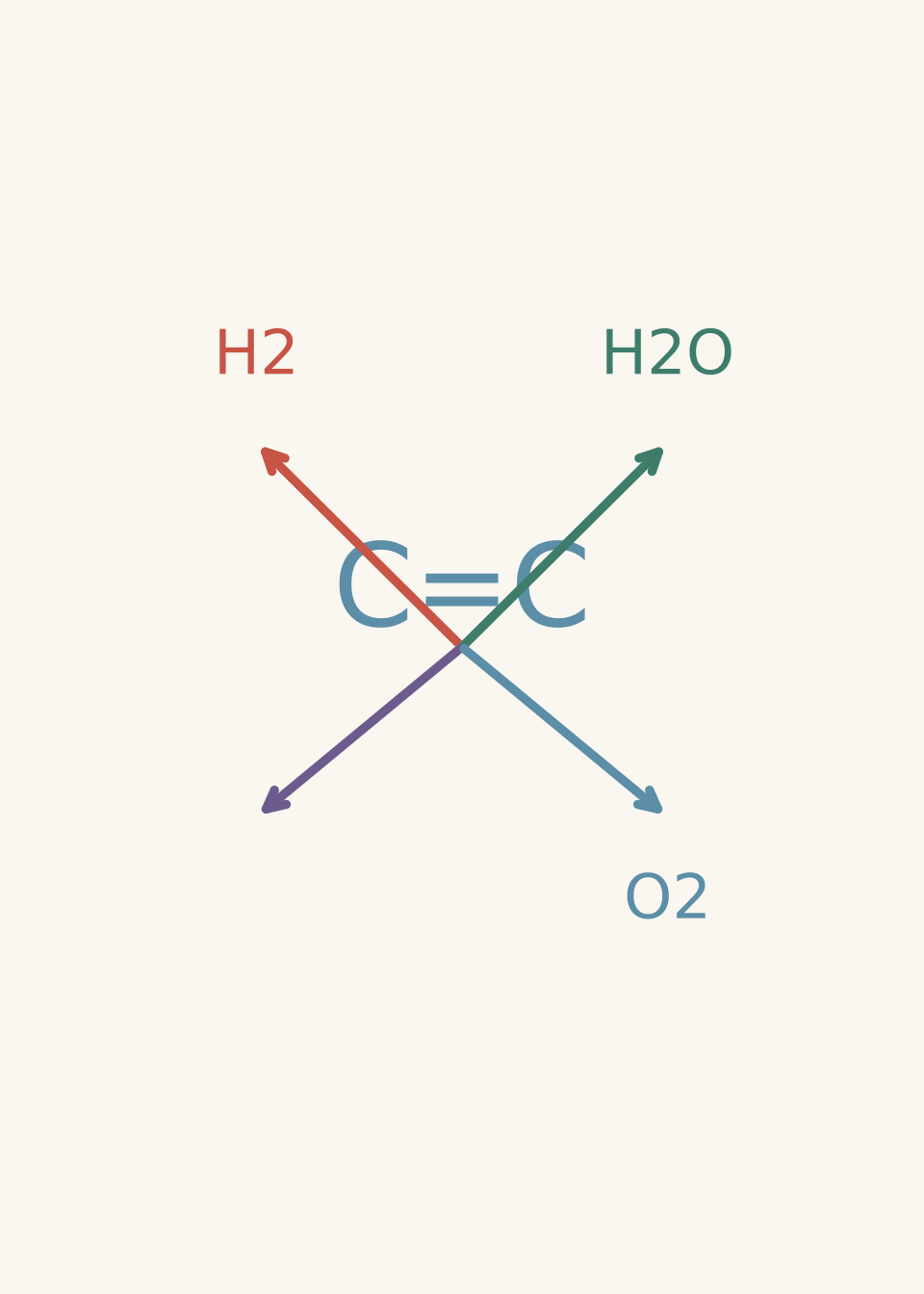
01The organic reaction decision rule
When you are given an organic reaction question, use this order:
- Identify the functional group in the reactant.
- Identify the reagent and conditions.
- Decide which bond is being broken or formed.
- Check whether atoms are added, removed, replaced, or rearranged.
- Name the product and check that the carbon skeleton still makes sense.
A quick memory aid:
| Starting functional group | Reagent or condition | Reaction type | Main product clue |
|---|---|---|---|
| Alkene \( \ce{C=C} \) | \( \ce{H2} \), metal catalyst, heat | Addition (hydrogenation) | Double bond becomes single bond |
| Alkene \( \ce{C=C} \) | \( \ce{H2O} \), acid catalyst, heat | Addition (hydration) | Alcohol forms |
| Alkene \( \ce{C=C} \) | \( \ce{X2} \) such as \( \ce{Br2} \) | Addition (halogenation) | Dihaloalkane forms |
| Alkane \( \ce{C-C} \) | Halogen, UV light | Substitution | Hydrogen replaced by halogen |
| Primary alcohol | Oxidising agent | Oxidation | Aldehyde, then carboxylic acid |
| Secondary alcohol | Oxidising agent | Oxidation | Ketone |
| Carboxylic acid + alcohol | Acid catalyst, heat | Esterification | Ester + water |
| Ester + water | Acid or base, heat | Hydrolysis | Acid and alcohol products |
This table is a starting map, not the whole answer. The reagent tells you the pathway, but the structure tells you exactly where the change happens.
02A mental model: organic molecules are built from carbon skeletons
Most organic reactions in Module 7 can be understood by looking at the carbon skeleton first.
Imagine a carbon chain as a row of houses. The carbon atoms are the houses, and the functional group is the front door that controls who can enter, leave, or swap places.
An alkene has a “double connection” between two carbon atoms. It is more reactive because that bond can open and allow new atoms to attach.
An alkane has only single bonds. It is more stable, so it usually needs stronger conditions, such as UV light, before it reacts.
The analogy helps because it shows why alkenes react more easily than alkanes. The double bond is like an unlocked door.
The analogy breaks down because molecules are not houses. Reaction behaviour depends on electron movement, bond energies, and molecular structure, not a physical opening.
03Addition reactions: adding atoms across a double bond
An addition reaction occurs when atoms are added to a molecule and the double bond is converted into a single bond.
The general pattern is:
\[ \ce{C=C + A-B -> C-C} \]
where \(A\) and \(B\) attach to the two carbon atoms that were connected by the double bond.
Hydrogenation
Hydrogenation adds hydrogen to an alkene.
Conditions:
- hydrogen gas, \( \ce{H2} \)
- metal catalyst such as nickel
- heat
Example:
\[ \ce{CH2=CH2 + H2 -> CH3-CH3} \]
Ethene becomes ethane.
A common prediction is that “adding hydrogen must create a hydrogen-containing product”, which is correct but incomplete. The key exam observation is that the alkene loses its double bond.
Hydration
Hydration adds water across an alkene.
Conditions:
- steam
- acid catalyst
- heat
Example:
\[ \ce{CH2=CH2 + H2O -> CH3CH2OH} \]
Ethene becomes ethanol.
The oxygen from water becomes part of the hydroxyl group in the alcohol.
Halogenation
Halogenation adds a halogen molecule across a double bond.
Example:
\[ \ce{CH2=CH2 + Br2 -> CH2Br-CH2Br} \]
Ethene becomes 1,2-dibromoethane.
The bromine molecule does not simply “stick on the end”. Each carbon from the original double bond receives one bromine atom.
04Substitution reactions: replacing one atom with another
Alkanes are relatively unreactive because they contain strong single bonds. Under UV light, however, halogens can replace hydrogen atoms.
Example:
\[ \ce{CH4 + Cl2 -> CH3Cl + HCl} \]
Conditions:
- chlorine gas
- UV light
The important idea is replacement, not addition.
Students often confuse this with alkene halogenation. The difference is the starting molecule:
- Alkene + bromine: addition across a double bond.
- Alkane + chlorine + UV: substitution of a hydrogen atom.
05Oxidation reactions: recognising what oxygen does
Oxidation in organic chemistry often involves adding oxygen or removing hydrogen.
The product depends on the alcohol type.
| Alcohol type | Oxidation product |
|---|---|
| Primary alcohol | Aldehyde, then carboxylic acid |
| Secondary alcohol | Ketone |
| Tertiary alcohol | Does not oxidise easily under normal HSC conditions |
Primary alcohol pathway
A primary alcohol can oxidise in two stages:
\[ \ce{R-CH2OH -> R-CHO -> R-COOH} \]
where:
- \(R\) represents the rest of the carbon chain.
- \(\ce{-CHO}\) is an aldehyde functional group.
- \(\ce{-COOH}\) is a carboxylic acid functional group.
For example:
\[ \ce{CH3CH2OH -> CH3CHO -> CH3COOH} \]
Ethanol can become ethanal, then ethanoic acid.
The reaction conditions matter. If the goal is to stop at the aldehyde, the aldehyde must be removed from the reaction mixture before further oxidation occurs.
06Esterification: combining an acid and an alcohol
Esterification forms an ester from a carboxylic acid and an alcohol.
General reaction:
\[ \ce{carboxylic\ acid + alcohol <=> ester + water} \]
Conditions:
- concentrated sulfuric acid catalyst
- heat
Example:
\[ \ce{CH3COOH + C2H5OH <=> CH3COOC2H5 + H2O} \]
Ethanoic acid reacts with ethanol to form ethyl ethanoate.
Naming esters is easier if you split the name:
- first part: alcohol source
- second part: acid source
For ethyl ethanoate:
- ethyl comes from ethanol
- ethanoate comes from ethanoic acid
07Hydrolysis: breaking an ester apart
Hydrolysis is the reverse idea of esterification.
An ester reacts with water to produce an alcohol and a carboxylic acid.
General pattern:
\[ \ce{ester + water -> alcohol + carboxylic acid} \]
Under acidic conditions, the reaction is reversible.
Under basic conditions, ester hydrolysis is often called saponification.
The decision point is simple:
- If you are building an ester, think esterification.
- If you are breaking an ester, think hydrolysis.
08Worked example: Identify the product of alkene hydrogenation
Question
Predict the product when propene reacts with hydrogen gas in the presence of a nickel catalyst.
Solution
Step 1
Propene contains a carbon-carbon double bond:
\[ \ce{CH3CH=CH2} \]
This tells us it is an alkene.
Step 2
Hydrogen gas with a nickel catalyst indicates hydrogenation, which is an addition reaction.
Step 3
The double bond becomes a single bond:
\[ \ce{CH3CH=CH2 + H2 -> CH3CH2CH3} \]
Step 4
The product is propane.
The carbon skeleton has stayed the same, but the alkene has become a saturated alkane.
09Worked example: Choosing the oxidation product
Question
Ethanol is oxidised using an oxidising agent. Predict the organic product if the reaction conditions allow complete oxidation.
Solution
Step 1
Ethanol is:
\[ \ce{CH3CH2OH} \]
The carbon containing the hydroxyl group is attached to one other carbon, so ethanol is a primary alcohol.
Step 2
A primary alcohol can oxidise to an aldehyde and then a carboxylic acid.
\[ \ce{CH3CH2OH -> CH3CHO -> CH3COOH} \]
Step 3
The product is ethanoic acid.
The key clue is “complete oxidation”. If the question had asked for controlled oxidation with removal of the aldehyde product, ethanal would be the answer instead.
10Common mistakes in organic reaction questions
Choosing a reaction based only on the reagent
A student may see bromine and immediately write “addition”. That is only true when bromine reacts with an alkene.
The starting functional group must be checked first.
Forgetting reaction conditions
Conditions are often the difference between two pathways.
For example:
- chlorine + alkane + UV light → substitution
- bromine + alkene → addition
Changing the carbon chain accidentally
Most Module 7 reactions modify functional groups rather than breaking the whole carbon skeleton.
Check that the number of carbon atoms is still correct.
Confusing oxidation products
Primary and secondary alcohols behave differently.
A secondary alcohol forms a ketone. It does not continue to a carboxylic acid under normal HSC conditions.
Naming the ester backwards
Ethyl ethanoate is not named ethanoethyl. The alcohol contributes the first part of the name, and the acid contributes the second part.
11Questions and solutions
Question 1
Ethene reacts with bromine water. Identify the reaction type and the product.
Solution 1
The reaction is addition, and the product is 1,2-dibromoethane.
Ethene contains a carbon-carbon double bond, so bromine adds across this bond:
\[ \ce{CH2=CH2 + Br2 -> CH2Br-CH2Br} \]
The tempting mistake is to think bromine simply attaches to one carbon. Addition reactions split the halogen molecule so that one bromine atom attaches to each carbon of the original double bond.
Question 2
Propane reacts with chlorine gas under UV light. Explain the type of reaction and write the main organic product formed.
Solution 2
The reaction is substitution, and the main product is chloropropane.
Propane is an alkane, so the chlorine does not add across a double bond. Instead, UV light provides energy for a hydrogen atom to be replaced:
\[ \ce{C3H8 + Cl2 -> C3H7Cl + HCl} \]
The exact position of substitution can produce different chloropropane isomers, so assuming a single product requires the usual HSC simplification that the main product is being considered without detailed isomer distribution.
Question 3
An unknown compound reacts with sodium metal and is identified as an alcohol. It is then oxidised to a ketone. Identify the type of alcohol and explain why.
Solution 3
The compound is a secondary alcohol.
A secondary alcohol has the structure:
\[ \ce{R-CHOH-R} \]
When oxidised, the carbon attached to the hydroxyl group loses hydrogen and forms a carbonyl group:
\[ \ce{secondary\ alcohol -> ketone} \]
The tempting route is to think all alcohols become carboxylic acids when oxidised. That only applies to primary alcohols. The carbon arrangement around the hydroxyl group determines the product.
Question 4
A student reacts ethanoic acid with ethanol and predicts the product will be a molecule containing two hydroxyl groups because water is involved. Evaluate this prediction.
Solution 4
The prediction is incorrect; the product is ethyl ethanoate and water is produced.
The reaction is esterification:
\[ \ce{CH3COOH + C2H5OH <=> CH3COOC2H5 + H2O} \]
Water is a product, not a reactant that becomes attached to the ester.
The tempting idea makes sense because hydration reactions add water to molecules. The constraint that changes the answer is the reaction type: esterification removes water while joining the acid and alcohol.
Question 5
A chemist starts with ethanol and wants to produce ethene rather than ethanal, ethanoic acid, or ethyl ethanoate. Explain the reaction pathway required and why the other pathways are avoided.
Solution 5
The required pathway is elimination (dehydration) of ethanol to form ethene.
The reaction is:
\[ \ce{CH3CH2OH -> CH2=CH2 + H2O} \]
using concentrated sulfuric acid and heat.
The first tempting answer is oxidation because ethanol commonly appears in oxidation questions. However, oxidation changes the alcohol functional group into carbonyl-containing products. It does not remove water to create a double bond.
The second tempting answer is esterification because ethanol can react with carboxylic acids, but no carboxylic acid is present.
The deciding constraint is the desired product. Ethene requires creating a carbon-carbon double bond, which means removing atoms from ethanol rather than replacing or adding groups. The pathway must therefore be elimination.
12A final decision checklist for exams
Before committing to an organic product, ask:
- What functional group did I start with?
- What reagent is present?
- What conditions are stated?
- Am I adding atoms, replacing atoms, removing atoms, or rearranging bonds?
- Does my product still have the correct number of carbon atoms?
- Does the name match the structure?
Once these decisions become automatic, organic reactions stop feeling like a list of unrelated equations. They become a pattern-recognition problem: identify the starting structure, read the conditions, and follow the change. The next useful step is practising reaction pathways where the starting molecule can undergo more than one possible reaction, because those are the questions that test understanding rather than memory.