
M4 Drivers of Reactions: 60-Mark Chemistry Revision Exam
Test your understanding of the Chemistry 2017 legacy M4 unit with this original 60-mark timed practice paper. Includes 12 questions, full worked solutions, and a detailed marking guide.
This is an original tutorgum practice paper for the supplied Chemistry 2017 legacy unit M4: Drivers of Reactions. It tests reaction enthalpy, calorimetry, Hess’s law, energy profiles, entropy, and Gibbs free energy through a mix of calculations and written responses. It is a focused revision assessment, not a full-course Chemistry examination or an official, endorsed, past, or predicted NESA paper.
01Exam instructions
- Suggested reading time: 5 minutes.
- Suggested working time: 90 minutes.
- Total marks: 60.
- Questions: 12. Attempt all questions.
- Permitted equipment: Scientific calculator, ruler, and writing equipment.
- Show your working, include units, and give answers to a sensible number of significant figures.
- For calorimetry, use the specific heat capacity of aqueous solutions as \(4.18\ \text{J g}^{-1}\text{ K}^{-1}\), unless stated otherwise.
- For numerical calorimetry calculations, assume the heat measured by the solution is the only heat transfer to consider. When evaluating experimental results, consider why a real experiment may not satisfy this assumption.
- For Gibbs free energy calculations, use temperature in kelvin and consistent energy units. If \(\Delta H^\circ\) is in \(\text{kJ mol}^{-1}\), convert \(\Delta S^\circ\) to \(\text{kJ mol}^{-1}\text{ K}^{-1}\).
- Unless stated otherwise, use standard-state thermodynamic data at the temperature specified.
Assessed scope: The supplied Chemistry 2017 legacy unit covering reaction enthalpy, bond enthalpies, calorimetry, heat of combustion, Hess’s law, carbon monoxide and carbon dioxide energy pathways, photosynthesis, respiration, energy profiles, catalysts, entropy, Gibbs free energy, and temperature-dependent spontaneity.
Exclusions: Other modules, other syllabus editions, and detailed reaction-rate calculations beyond the qualitative effects of catalysts.
02Questions
Question 1 (6 marks)
A student burns ethanol in a spirit burner beneath a container of water. The following measurements are recorded.
| Measurement | Value |
|---|---|
| Mass of water | 200.0 g |
| Initial water temperature | 21.5°C |
| Final water temperature | 34.2°C |
| Mass of ethanol burned | 0.920 g |
| Molar mass of ethanol | 46.0 g mol\(^{-1}\) |
The accepted standard molar enthalpy of combustion of ethanol, for complete combustion producing liquid water, is \(-1367\ \text{kJ mol}^{-1}\).
(a) Calculate the heat gained by the water. (2 marks)
(b) Calculate the experimental molar enthalpy of combustion of ethanol. (2 marks)
(c) Compare the experimental result with the accepted value and identify one plausible reason for the difference. (2 marks)
Question 2 (5 marks)
Methane undergoes complete combustion according to the equation:
\[ \ce{CH4(g) + 2O2(g) -> CO2(g) + 2H2O(g)} \]
The following average bond enthalpies are supplied.
| Bond | Average bond enthalpy (kJ mol\(^{-1}\)) |
|---|---|
| C-H | 413 |
| O=O | 498 |
| C=O in \(\ce{CO2}\) | 805 |
| O-H | 463 |
(a) Calculate the total energy required to break all bonds in the reactants for one mole of methane reacting. (2 marks)
(b) Calculate the total energy released when the product bonds form, then estimate the reaction enthalpy using the supplied bond enthalpies. (2 marks)
(c) Explain why this method gives an estimate rather than an exact standard reaction enthalpy. (1 mark)
Question 3 (5 marks)
Carbon can react with oxygen in two steps, forming carbon monoxide before carbon dioxide.
The following enthalpy changes are supplied:
\[ \ce{C(s, graphite) + \tfrac{1}{2}O2(g) -> CO(g)} \]
\[ \Delta H_1^\circ=-110.5\ \text{kJ mol}^{-1} \]
The overall reaction has the following enthalpy change:
\[ \ce{C(s, graphite) + O2(g) -> CO2(g)} \]
\[ \Delta H_{\text{overall}}^\circ=-393.5\ \text{kJ mol}^{-1} \]
(a) Use Hess’s law to calculate the standard enthalpy change for the reaction of carbon monoxide with oxygen to form carbon dioxide. (3 marks)
(b) Explain why the overall enthalpy change is the same whether carbon forms carbon dioxide directly or reacts through carbon monoxide. (2 marks)
Question 4 (6 marks)
For a particular reaction, the following relative enthalpies have been determined.
| Feature | Enthalpy (kJ mol\(^{-1}\)) |
|---|---|
| Reactants | 35 |
| Products | 5 |
| Peak on the uncatalysed pathway | 95 |
| Peak on the catalysed pathway | 65 |
(a) Sketch energy profiles for both pathways on the same axes. Label the reactants, products, activation energy for each pathway, and overall enthalpy change. (3 marks)
(b) Calculate the activation energy for the uncatalysed reaction and the overall enthalpy change. (2 marks)
(c) State how the catalyst affects the activation energy and the overall enthalpy change. (1 mark)
Question 5 (5 marks)
A student dissolves \(8.00\ \text{g}\) of ammonium nitrate, \(\ce{NH4NO3(s)}\), in \(100.0\ \text{g}\) of water. The final solution has a mass of \(108.0\ \text{g}\).
The temperature falls from \(22.00^\circ\text{C}\) to \(16.50^\circ\text{C}\).
Use the following data:
- Specific heat capacity of the solution: \(4.18\ \text{J g}^{-1}\text{ K}^{-1}\)
- Molar mass of ammonium nitrate: \(80.0\ \text{g mol}^{-1}\)
Assume the reaction exchanges heat only with the solution.
(a) Calculate the heat change of the solution. (2 marks)
(b) Calculate the molar enthalpy of dissolution of ammonium nitrate. (2 marks)
(c) Classify the dissolution as endothermic or exothermic and explain your answer using the temperature change. (1 mark)
Question 6 (4 marks)
The overall respiration reaction for glucose is represented by:
\[ \ce{C6H12O6(s) + 6O2(g) -> 6CO2(g) + 6H2O(l)} \]
Its standard enthalpy change is:
\[ \Delta H_{\text{resp}}^\circ =-2803\ \text{kJ mol}^{-1} \]
For this question, treat the overall photosynthesis reaction as the reverse of the equation above, with the same physical states.
(a) Write the balanced equation for photosynthesis, including physical states. (1 mark)
(b) Calculate the standard enthalpy change for photosynthesis. (1 mark)
(c) Explain the energy changes involved in photosynthesis and respiration, referring to their enthalpy signs. (2 marks)
Question 7 (5 marks)
A student is asked to determine the standard enthalpy of formation of methane, \(\ce{CH4(g)}\), using Hess’s law.
The following standard enthalpy data are supplied. All values apply to the reactions as written.
| Reaction | \(\Delta H^\circ\) (kJ mol\(^{-1}\)) |
|---|---|
| \(\ce{C(s, graphite) + O2(g) -> CO2(g)}\) | \(-393.5\) |
| \(\ce{H2(g) + \tfrac{1}{2}O2(g) -> H2O(l)}\) | \(-285.8\) |
| \(\ce{CH4(g) + 2O2(g) -> CO2(g) + 2H2O(l)}\) | \(-890.3\) |
(a) Use Hess’s law to calculate the standard enthalpy of formation of methane. Show a labelled energy cycle or an equivalent enthalpy equation. (5 marks)
Question 8 (5 marks)
Entropy, represented by \(S\), describes how energy and matter can be distributed among the accessible arrangements of a system.
(a) Distinguish entropy from enthalpy. (1 mark)
(b) Consider the reaction:
\[ \ce{2NO2(g) -> N2O4(g)} \]
Predict whether the entropy change is positive or negative. Justify your prediction using the balanced equation. (2 marks)
(c) Consider the reaction:
\[ \ce{CaCO3(s) -> CaO(s) + CO2(g)} \]
Predict whether the entropy change is positive or negative. Justify your prediction using the physical states of the reactants and products. (2 marks)
Question 9 (6 marks)
A reaction has the following standard thermodynamic data:
\[ \Delta H^\circ=+48.0\ \text{kJ mol}^{-1} \]
\[ \Delta S^\circ=+160\ \text{J mol}^{-1}\text{ K}^{-1} \]
Use:
\[ \Delta G^\circ=\Delta H^\circ-T\Delta S^\circ \]
For this question, a negative \(\Delta G^\circ\) indicates that the forward reaction is thermodynamically spontaneous under the stated standard conditions. A positive \(\Delta G^\circ\) indicates that it is nonspontaneous under those conditions.
(a) Calculate \(\Delta G^\circ\) at \(298\ \text{K}\) and classify the forward reaction. (2 marks)
(b) Calculate \(\Delta G^\circ\) at \(350\ \text{K}\) and classify the forward reaction. (2 marks)
(c) Calculate the temperature at which \(\Delta G^\circ=0\). State the spontaneity pattern below and above this temperature. (2 marks)
Question 10 (5 marks)
Another reaction has the following standard thermodynamic data:
\[ \Delta H^\circ=-65.0\ \text{kJ mol}^{-1} \]
\[ \Delta S^\circ=-150\ \text{J mol}^{-1}\text{ K}^{-1} \]
(a) Calculate \(\Delta G^\circ\) at \(298\ \text{K}\) and classify the forward reaction under standard conditions. (2 marks)
(b) Calculate \(\Delta G^\circ\) at \(500\ \text{K}\) and classify the forward reaction under standard conditions. (2 marks)
(c) Explain why increasing temperature can make this reaction less thermodynamically favourable, despite its negative enthalpy change. (1 mark)
Question 11 (4 marks)
Two trials are performed for the same exothermic reaction in aqueous solution. Different amounts of reactants are used in each trial.
Assume the solution absorbs the heat released by the reaction, with no heat lost to the surroundings.
| Measurement | Trial A | Trial B |
|---|---|---|
| Mass of solution | 50.0 g | 100.0 g |
| Temperature change | \(+6.00^\circ\text{C}\) | \(+3.00^\circ\text{C}\) |
| Amount of reactant consumed | 0.0100 mol | 0.0200 mol |
Use a specific heat capacity of \(4.18\ \text{J g}^{-1}\text{ K}^{-1}\).
(a) Calculate the heat gained by the solution in each trial. (1 mark)
(b) Calculate the experimental molar enthalpy change for each trial. (2 marks)
(c) State whether the results are consistent with the same molar enthalpy change for the reaction. (1 mark)
Question 12 (4 marks)
At \(298\ \text{K}\), a reaction has a standard Gibbs free energy change of:
\[ \Delta G^\circ=-18\ \text{kJ mol}^{-1} \]
A catalyst is added to the reaction.
(a) What does the sign of \(\Delta G^\circ\) indicate about the forward reaction under standard conditions? (1 mark)
(b) Explain how the catalyst affects activation energy and reaction rate. (1 mark)
(c) State whether the catalyst changes the overall \(\Delta H\) or \(\Delta G\) of the reaction. Explain why a spontaneous reaction is not necessarily a fast reaction. (2 marks)
03Worked solutions and marking guide
Solution 1
(a) Heat gained by the water
First calculate the temperature change:
\[ \Delta T=34.2-21.5=12.7^\circ\text{C} \]
Use the calorimetry equation:
\[ \begin{aligned} q&=mc\Delta T\\ &=200.0\times4.18\times12.7\\ &=10617.2\ \text{J}\\ &=10.6\ \text{kJ} \end{aligned} \]
The water gains \(10.6\ \text{kJ}\) of heat. Its heat change is positive.
Marking (2 marks):
- Correct temperature change and substitution into \(q=mc\Delta T\): 1 mark.
- Correct heat gained, \(+10.6\ \text{kJ}\), with units: 1 mark.
(b) Experimental molar enthalpy of combustion
Calculate the amount of ethanol burned:
\[ \begin{aligned} n&=\frac{m}{M}\\ &=\frac{0.920}{46.0}\\ &=0.0200\ \text{mol} \end{aligned} \]
The water gains heat, so the ethanol combustion reaction releases an equal amount under the stated calculation assumption. The reaction enthalpy is negative.
\[ \begin{aligned} \Delta H_{c,\text{exp}} &=-\frac{10.6}{0.0200}\\ &=-5.30\times10^2\ \text{kJ mol}^{-1} \end{aligned} \]
The experimental molar enthalpy of combustion is approximately \(-530\ \text{kJ mol}^{-1}\).
Marking (2 marks):
- Correct amount of ethanol, \(0.0200\ \text{mol}\): 1 mark.
- Correct division, negative sign, and units for the molar enthalpy: 1 mark.
(c) Comparison with the accepted value
The experimental result is much less exothermic than the accepted value. Its magnitude is approximately \(530\ \text{kJ mol}^{-1}\), compared with \(1367\ \text{kJ mol}^{-1}\).
One plausible reason is that some heat escapes to the surroundings or is absorbed by the apparatus rather than heating the water. Incomplete combustion can also reduce the energy transferred to the water.
Marking (2 marks):
- Correct comparison with the accepted value: 1 mark.
- One valid experimental reason: 1 mark.
Solution 2
(a) Energy required to break reactant bonds
One methane molecule contains four C-H bonds. Each oxygen molecule contains one O=O bond, and two oxygen molecules react.
Therefore,
\[ \begin{aligned} E_{\text{broken}} &=4(413)+2(498)\\ &=1652+996\\ &=2648\ \text{kJ mol}^{-1} \end{aligned} \]
The energy required to break the reactant bonds is \(2648\ \text{kJ mol}^{-1}\).
Marking (2 marks):
- Correct identification and counting of the reactant bonds: 1 mark.
- Correct total of \(2648\ \text{kJ mol}^{-1}\): 1 mark.
(b) Energy released when product bonds form
The carbon dioxide molecule contains two C=O bonds. The two water molecules contain four O-H bonds altogether.
\[ \begin{aligned} E_{\text{formed}} &=2(805)+4(463)\\ &=1610+1852\\ &=3462\ \text{kJ mol}^{-1} \end{aligned} \]
Forming the product bonds releases \(3462\ \text{kJ mol}^{-1}\).
Using conservation of energy, the estimated reaction enthalpy is the energy absorbed to break bonds minus the energy released when new bonds form:
\[ \begin{aligned} \Delta H_{\text{reaction}} &\approx E_{\text{broken}}-E_{\text{formed}}\\ &=2648-3462\\ &=-814\ \text{kJ mol}^{-1} \end{aligned} \]
The negative value indicates an exothermic reaction.
Marking (2 marks):
- Correct energy released from forming product bonds: 1 mark.
- Correct subtraction and negative reaction enthalpy: 1 mark.
(c) Why the result is an estimate
Average bond enthalpies are mean values measured across different chemical environments. The energy associated with a particular bond can differ from its average value, so the calculated reaction enthalpy is approximate.
Marking (1 mark):
- Identifies the average nature of bond enthalpies or another valid reason for the approximation: 1 mark.
Solution 3
(a) Enthalpy change for the oxidation of carbon monoxide
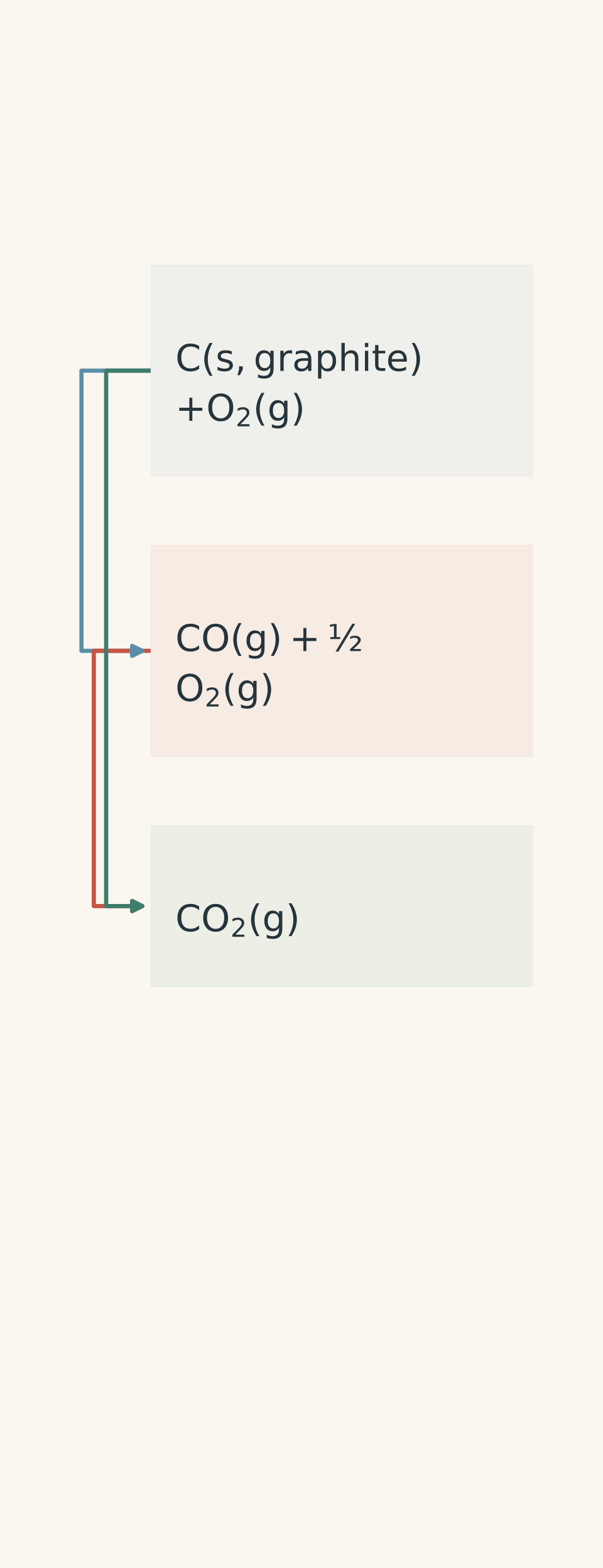
The two steps are:
\[ \ce{C(s, graphite) + \tfrac{1}{2}O2(g) -> CO(g)} \]
\[ \ce{CO(g) + \tfrac{1}{2}O2(g) -> CO2(g)} \]
Adding the steps gives the overall reaction. Hess’s law states that the sum of the step enthalpies equals the enthalpy change for the overall reaction.
Therefore,
\[ \begin{aligned} \Delta H_1^\circ+\Delta H_2^\circ &=\Delta H_{\text{overall}}^\circ\\ -110.5+\Delta H_2^\circ &=-393.5\\ \Delta H_2^\circ &=-393.5-(-110.5)\\ &=-283.0\ \text{kJ mol}^{-1} \end{aligned} \]
The standard enthalpy change for the oxidation of carbon monoxide is \(-283.0\ \text{kJ mol}^{-1}\).
Marking (3 marks):
- Correct Hess’s law relationship: 1 mark.
- Correct rearrangement and substitution: 1 mark.
- Correct answer with sign and units: 1 mark.
(b) Why the overall enthalpy change is unchanged
Both pathways begin with the same reactants, carbon and oxygen, and finish with the same product, carbon dioxide. Enthalpy is a state function, meaning its overall change depends on the initial and final states, not the route taken.
The intermediate formation of carbon monoxide changes the individual steps, but not the overall enthalpy change.
Marking (2 marks):
- Identifies the same initial and final states: 1 mark.
- Explains that enthalpy change is path-independent: 1 mark.
Solution 4
(a) Energy profiles
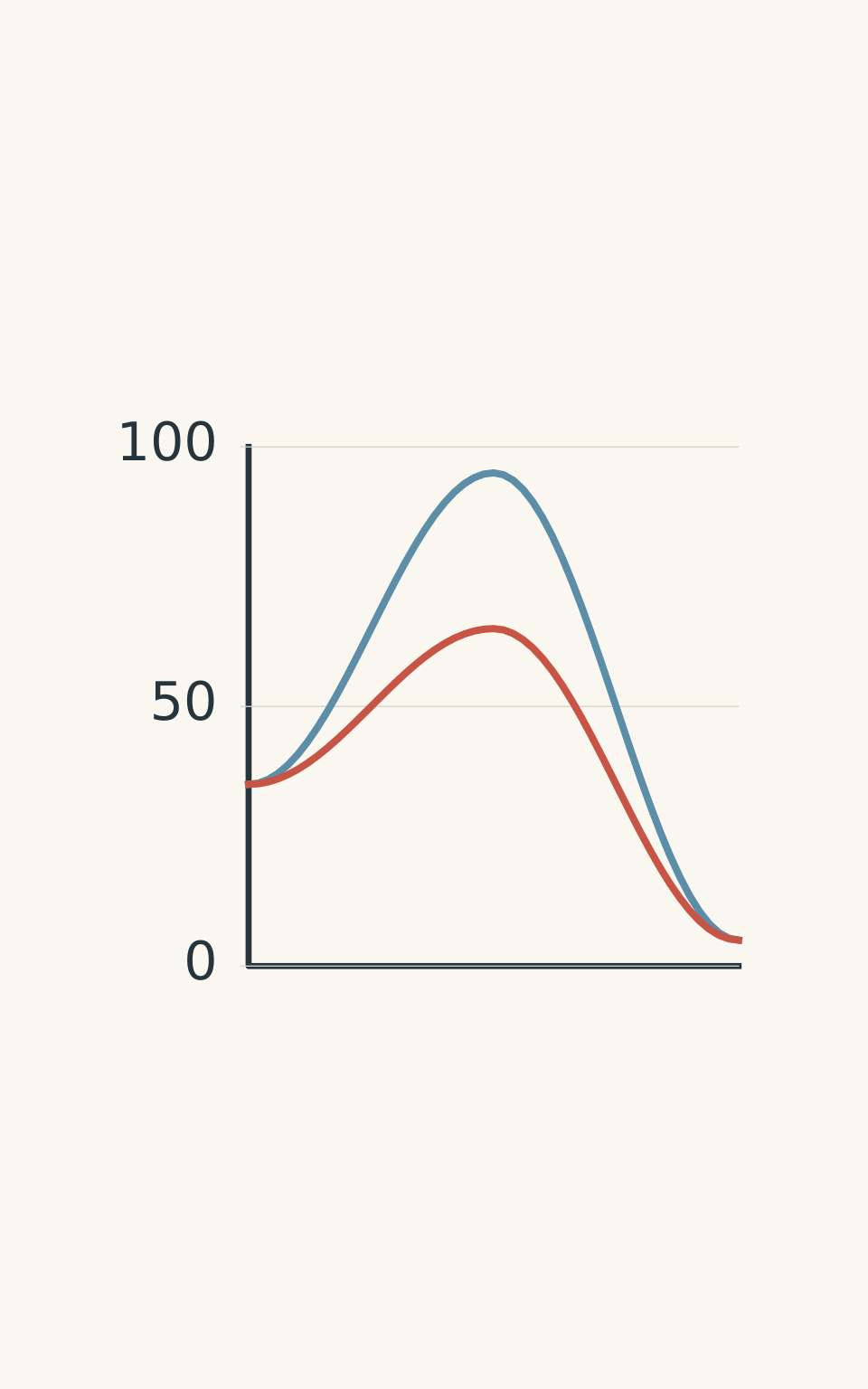
The profiles must begin at the reactant enthalpy of \(35\ \text{kJ mol}^{-1}\) and finish at the product enthalpy of \(5\ \text{kJ mol}^{-1}\).
The uncatalysed pathway reaches a peak of \(95\ \text{kJ mol}^{-1}\). The catalysed pathway reaches a lower peak of \(65\ \text{kJ mol}^{-1}\). Both pathways must have the same starting and finishing enthalpies.
- Uncatalysed
- Catalysed
Marking (3 marks):
- Correct axes and reactant and product energy levels: 1 mark.
- Two pathways with the correct relative peak heights and shared endpoints: 1 mark.
- Correct labels for both activation energies and the overall enthalpy change: 1 mark.
(b) Activation energy and enthalpy change
Activation energy is the energy difference between the reactants and the peak of the reaction pathway.
For the uncatalysed reaction:
\[ \begin{aligned} E_a&=95-35\\ &=60\ \text{kJ mol}^{-1} \end{aligned} \]
The overall enthalpy change is the product enthalpy minus the reactant enthalpy:
\[ \begin{aligned} \Delta H&=H_{\text{products}}-H_{\text{reactants}}\\ &=5-35\\ &=-30\ \text{kJ mol}^{-1} \end{aligned} \]
The reaction is exothermic because the products have lower enthalpy than the reactants.
Marking (2 marks):
- Correct uncatalysed activation energy: 1 mark.
- Correct overall enthalpy change, including the negative sign: 1 mark.
(c) Effect of the catalyst
The catalyst lowers the activation energy by providing an alternative reaction pathway. It does not change the overall enthalpy change because the reactant and product states remain the same.
Marking (1 mark):
- States that the activation energy decreases while the overall enthalpy change remains unchanged: 1 mark.
Solution 5
(a) Heat change of the solution
First calculate the temperature change:
\[ \Delta T=16.50-22.00=-5.50^\circ\text{C} \]
Then use \(q=mc\Delta T\):
\[ \begin{aligned} q_{\text{solution}} &=108.0\times4.18\times(-5.50)\\ &=-2482.9\ \text{J}\\ &=-2.48\ \text{kJ} \end{aligned} \]
The solution loses \(2.48\ \text{kJ}\) of heat.
Marking (2 marks):
- Correct temperature change and substitution: 1 mark.
- Correct heat change, \(-2.48\ \text{kJ}\): 1 mark.
(b) Molar enthalpy of dissolution
Calculate the amount of ammonium nitrate:
\[ \begin{aligned} n&=\frac{m}{M}\\ &=\frac{8.00}{80.0}\\ &=0.100\ \text{mol} \end{aligned} \]
The solution loses heat, so the dissolving process absorbs that heat. Under the stated assumption,
\[ q_{\text{reaction}}=-q_{\text{solution}} =+2.48\ \text{kJ} \]
The molar enthalpy change is:
\[ \begin{aligned} \Delta H_{\text{diss}} &=\frac{q_{\text{reaction}}}{n}\\ &=\frac{+2.48}{0.100}\\ &=+24.8\ \text{kJ mol}^{-1} \end{aligned} \]
Marking (2 marks):
- Correct amount of ammonium nitrate: 1 mark.
- Correct molar enthalpy with positive sign and units: 1 mark.
(c) Classification
The dissolution is endothermic. The solution cools because the dissolving process absorbs heat from its surroundings, including the water.
Marking (1 mark):
- Correct classification with an explanation linked to the temperature decrease: 1 mark.
Solution 6
(a) Balanced photosynthesis equation
Reverse the respiration equation:
\[ \ce{6CO2(g) + 6H2O(l) -> C6H12O6(s) + 6O2(g)} \]
Marking (1 mark):
- Correct balanced reverse equation with physical states: 1 mark.
(b) Enthalpy change for photosynthesis
Reversing a reaction reverses the sign of its enthalpy change while keeping the magnitude unchanged.
\[ \begin{aligned} \Delta H_{\text{photo}}^\circ &=-\Delta H_{\text{resp}}^\circ\\ &=-(-2803)\\ &=+2803\ \text{kJ mol}^{-1} \end{aligned} \]
Marking (1 mark):
- Correct positive enthalpy change, \(+2803\ \text{kJ mol}^{-1}\): 1 mark.
(c) Comparing the energy changes
Photosynthesis is endothermic overall. It requires an energy input to form glucose and oxygen from carbon dioxide and water.
Respiration is exothermic overall. Glucose reacts with oxygen to form carbon dioxide and water, releasing energy.
Under the stated model, the reactions are exact reverses, so their enthalpy changes have equal magnitudes and opposite signs.
Marking (2 marks):
- Correctly identifies photosynthesis as endothermic and requiring energy input: 1 mark.
- Correctly identifies respiration as exothermic and explains the opposite signs for reverse reactions: 1 mark.
Solution 7
Let \(x\) represent the standard enthalpy of formation of methane:
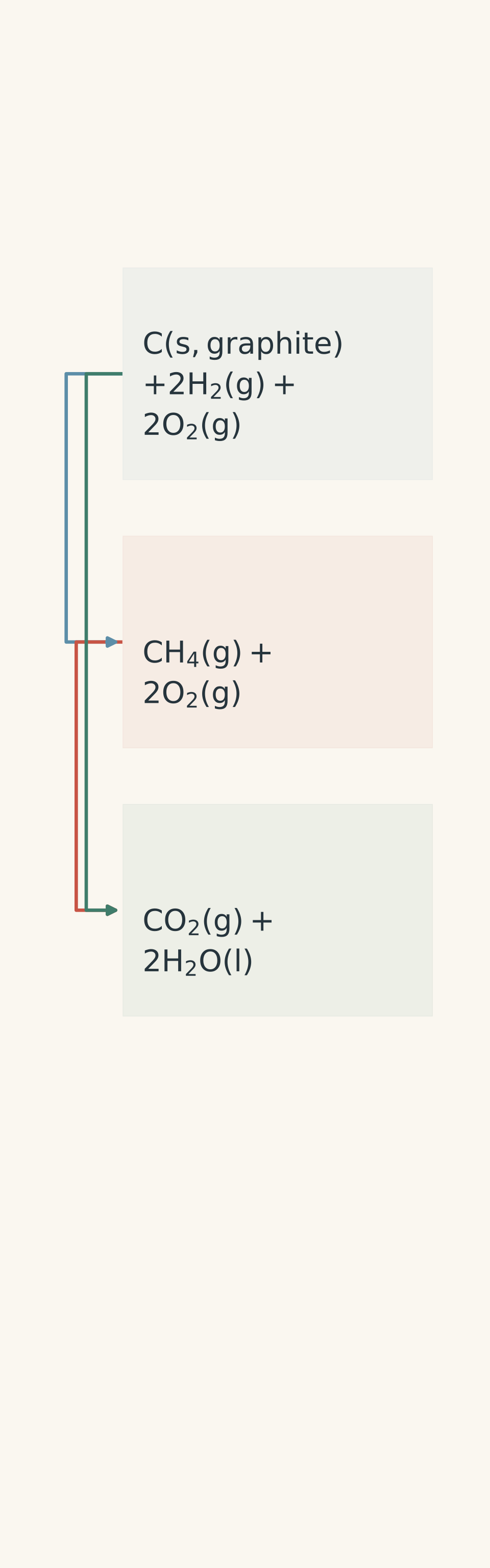
\[ \ce{C(s, graphite) + 2H2(g) -> CH4(g)} \]
The target reaction forms one mole of methane from its elements in their standard states.
Combustion of the elements produces carbon dioxide and two moles of liquid water. By Hess’s law, the enthalpy change for that alternative route is:
\[ \begin{aligned} \Delta H_{\text{alternative}}^\circ &=-393.5+2(-285.8)\\ &=-393.5-571.6\\ &=-965.1\ \text{kJ mol}^{-1} \end{aligned} \]
The alternative route and the route through methane reach the same final products. Therefore,
\[ \begin{aligned} x+(-890.3)&=-965.1\\ x&=-965.1+890.3\\ x&=-74.8\ \text{kJ mol}^{-1} \end{aligned} \]
The standard enthalpy of formation of methane is:
\[ \boxed{\Delta H_f^\circ(\ce{CH4(g)}) =-74.8\ \text{kJ mol}^{-1}} \]
Marking (5 marks):
- Identifies the target formation reaction and establishes a valid Hess cycle or enthalpy relationship: 2 marks.
- Correctly calculates the alternative route as \(-965.1\ \text{kJ mol}^{-1}\): 1 mark.
- Correctly rearranges the relationship and obtains \(-74.8\ \text{kJ mol}^{-1}\): 1 mark.
- Gives the correct sign and units for the standard enthalpy of formation: 1 mark.
Solution 8
(a) Entropy and enthalpy
Entropy describes the possible distributions of energy and matter among the accessible arrangements of a system. Enthalpy change describes the energy transferred as heat at constant pressure.
Marking (1 mark):
- Correctly distinguishes entropy from enthalpy: 1 mark.
(b) Formation of dinitrogen tetroxide
\[ \ce{2NO2(g) -> N2O4(g)} \]
The entropy change is predicted to be negative, so \(\Delta S<0\).
Two gas molecules combine to form one gas molecule. The number of gas particles decreases, reducing the number of possible arrangements available to the gas.

- NO₂
- N₂O₄
Marking (2 marks):
- Correctly predicts a negative entropy change: 1 mark.
- Explains the prediction using the reduction in gas particles and possible arrangements: 1 mark.
(c) Decomposition of calcium carbonate
\[ \ce{CaCO3(s) -> CaO(s) + CO2(g)} \]
The entropy change is predicted to be positive, so \(\Delta S>0\).
The reaction produces a gas from solid reactants and products. Gas particles can occupy many more possible arrangements than particles confined to a solid, so the overall entropy is expected to increase.
Marking (2 marks):
- Correctly predicts a positive entropy change: 1 mark.
- Explains the prediction using the formation of a gas and increased possible arrangements: 1 mark.
Solution 9
First convert the entropy change into units consistent with the enthalpy change:
\[ \Delta S^\circ =160\ \text{J mol}^{-1}\text{ K}^{-1} =0.160\ \text{kJ mol}^{-1}\text{ K}^{-1} \]
(a) Gibbs free energy at 298 K
\[ \begin{aligned} \Delta G^\circ &=\Delta H^\circ-T\Delta S^\circ\\ &=48.0-(298)(0.160)\\ &=48.0-47.68\\ &=+0.32\ \text{kJ mol}^{-1} \end{aligned} \]
Since \(\Delta G^\circ>0\), the forward reaction is nonspontaneous under the stated standard conditions at \(298\ \text{K}\).
Marking (2 marks):
- Correct entropy conversion and substitution: 1 mark.
- Correct result and classification: 1 mark.
(b) Gibbs free energy at 350 K
\[ \begin{aligned} \Delta G^\circ &=48.0-(350)(0.160)\\ &=48.0-56.0\\ &=-8.0\ \text{kJ mol}^{-1} \end{aligned} \]
Since \(\Delta G^\circ<0\), the forward reaction is spontaneous under the stated standard conditions at \(350\ \text{K}\).
Marking (2 marks):
- Correct substitution and calculation: 1 mark.
- Correct result and classification: 1 mark.
(c) Temperature at which \(\Delta G^\circ=0\)
At the threshold temperature,
\[ 0=\Delta H^\circ-T\Delta S^\circ \]
Rearranging gives:
\[ \begin{aligned} T&=\frac{\Delta H^\circ}{\Delta S^\circ}\\ &=\frac{48.0}{0.160}\\ &=300\ \text{K} \end{aligned} \]
Below \(300\ \text{K}\), the forward reaction is nonspontaneous under standard conditions. Above \(300\ \text{K}\), it is spontaneous under standard conditions. At \(300\ \text{K}\), \(\Delta G^\circ=0\).
This happens because the positive entropy change makes the term \(-T\Delta S^\circ\) increasingly negative as temperature rises.
Marking (2 marks):
- Correct threshold temperature: 1 mark.
- Correct spontaneity pattern below and above the threshold: 1 mark.
Solution 10
Convert the entropy change into consistent units:
\[ \Delta S^\circ=-150\ \text{J mol}^{-1}\text{ K}^{-1} =-0.150\ \text{kJ mol}^{-1}\text{ K}^{-1} \]
(a) Gibbs free energy at 298 K
\[ \begin{aligned} \Delta G^\circ &=\Delta H^\circ-T\Delta S^\circ\\ &=-65.0-(298)(-0.150)\\ &=-65.0+44.7\\ &=-20.3\ \text{kJ mol}^{-1} \end{aligned} \]
The negative value indicates that the forward reaction is spontaneous under standard conditions at \(298\ \text{K}\).
Marking (2 marks):
- Correct conversion and substitution: 1 mark.
- Correct result and classification: 1 mark.
(b) Gibbs free energy at 500 K
\[ \begin{aligned} \Delta G^\circ &=-65.0-(500)(-0.150)\\ &=-65.0+75.0\\ &=+10.0\ \text{kJ mol}^{-1} \end{aligned} \]
The positive value indicates that the forward reaction is nonspontaneous under standard conditions at \(500\ \text{K}\).
Marking (2 marks):
- Correct substitution and calculation: 1 mark.
- Correct result and classification: 1 mark.
(c) Effect of increasing temperature
The entropy change is negative. Therefore, the term \(-T\Delta S^\circ\) is positive and increases as temperature rises. Eventually, this positive contribution outweighs the negative enthalpy change, making \(\Delta G^\circ\) positive.
Marking (1 mark):
- Correctly explains that the negative entropy change makes increasing temperature less favourable through the Gibbs free energy equation: 1 mark.
Solution 11
(a) Heat gained by the solution
For Trial A:
\[ \begin{aligned} q_A&=mc\Delta T\\ &=50.0\times4.18\times6.00\\ &=1254\ \text{J} \end{aligned} \]
For Trial B:
\[ \begin{aligned} q_B&=100.0\times4.18\times3.00\\ &=1254\ \text{J} \end{aligned} \]
Both solutions gain approximately \(1.25\ \text{kJ}\) of heat.
Marking (1 mark):
- Correctly determines the heat gained in both trials: 1 mark.
(b) Experimental molar enthalpy change
The solutions warm up, so they gain heat. Under the stated assumption, the reaction loses an equal amount of heat. The reaction enthalpy is therefore negative.
For Trial A:
\[ \begin{aligned} \Delta H_A &=-\frac{1.254}{0.0100}\\ &=-125\ \text{kJ mol}^{-1} \end{aligned} \]
For Trial B:
\[ \begin{aligned} \Delta H_B &=-\frac{1.254}{0.0200}\\ &=-62.7\ \text{kJ mol}^{-1} \end{aligned} \]
Marking (2 marks):
- Correct molar enthalpy for Trial A: 1 mark.
- Correct molar enthalpy for Trial B: 1 mark.
(c) Consistency of the results
The two results are not consistent with a single molar enthalpy change. The calculated values differ substantially, even though the same reaction is being investigated.
The difference indicates that the experimental data or the assumptions used in the calculations would need to be examined.
Marking (1 mark):
- Correctly identifies that the two values are inconsistent: 1 mark.
Solution 12
(a) Meaning of the negative Gibbs free energy change
Since \(\Delta G^\circ=-18\ \text{kJ mol}^{-1}\), the forward reaction is thermodynamically spontaneous under the stated standard conditions.
Marking (1 mark):
- Correct interpretation of the negative sign: 1 mark.
(b) Effect of the catalyst
The catalyst provides an alternative reaction pathway with a lower activation energy. This allows a greater proportion of reacting particles to overcome the energy barrier per unit time, increasing the reaction rate.
Marking (1 mark):
- Identifies the lower activation energy and resulting increase in rate: 1 mark.
(c) Effect on enthalpy, Gibbs free energy, and reaction speed
The catalyst does not change the overall enthalpy change, \(\Delta H\), or Gibbs free energy change, \(\Delta G\), for the reaction between the same initial and final states.
Spontaneity does not guarantee a fast reaction. Gibbs free energy indicates thermodynamic favourability, while the activation energy influences how quickly the reaction proceeds. A spontaneous reaction can still be slow if its activation energy is high.
Marking (2 marks):
- States that the catalyst leaves the overall \(\Delta H\) and \(\Delta G\) unchanged: 1 mark.
- Distinguishes thermodynamic spontaneity from reaction speed, linking speed to activation energy: 1 mark.
End of paper – 60 marks