
Year 12 Chemistry Acid-Base Reactions: 80-Mark Practice Exam
Test your understanding of Year 12 Chemistry acid-base reactions with this original 80-mark timed practice exam. Covering the supplied Chemistry 2025 syllabus scope, it includes exam-style questions, calculations, and fully worked solutions with a detailed marking guide.
This is an original tutorgum practice paper for Year 12 Chemistry revision on acid-base reactions. It covers the supplied Chemistry 2025 syllabus content area, from acid-base theories and pH calculations to titrations, buffers, and equilibrium constants. It is an original practice resource, not an official, NESA-endorsed, past, or predicted NESA paper.
01Exam instructions
- Suggested working time: 120 minutes.
- Suggested reading time: 5 minutes.
- Total marks: 80.
- Equipment: scientific calculator, ruler, and writing materials. No notes.
- Attempt every question. Show working for calculations, include units, and give answers to appropriate significant figures.
- Unless stated otherwise, all solutions are at \(25^\circ\mathrm{C}\), volumes are additive, and concentrations may be used in place of activities.
- Assume strong acids and bases dissociate completely in water. Treat weak acids and bases using the equilibrium assumptions stated in the relevant questions.
- Report pH values to two decimal places unless the question specifies otherwise. Report concentrations to three significant figures where appropriate.
Useful relationships:
\[ \begin{aligned} \mathrm{pH}&=-\log_{10}[\ce{H3O+}]\\ \mathrm{pOH}&=-\log_{10}[\ce{OH-}]\\ \mathrm{pH}+\mathrm{pOH}&=14.00\\ K_w&=[\ce{H3O+}][\ce{OH-}]\\ K_w&=1.00\times10^{-14} \end{aligned} \]
\[ \mathrm{p}K_a=-\log_{10}K_a \qquad \mathrm{p}K_b=-\log_{10}K_b \]
For a conjugate acid-base pair at \(25^\circ\mathrm{C}\),
\[ K_aK_b=K_w \]
For buffer calculations, you may use
\[ \mathrm{pH} = \mathrm{p}K_a+ \log_{10}\left( \frac{[\mathrm{A}^{-}]}{[\ce{HA}]} \right) \]
When both species are in the same solution, their mole ratio may be used in place of their concentration ratio.
02Questions
Question 1 (8 marks)
(a) Common inorganic acids and bases (4 marks)
Give the requested name or formula for each substance.
(i) Name \(\ce{HNO3}\).
(ii) Write the formula for sulfuric acid.
(iii) Name \(\ce{Ca(OH)2}\).
(iv) Write the formula for phosphoric acid.
(b) Ionic equations (2 marks)
Write a balanced equation showing:
(i) the dissociation of nitric acid in water;
(ii) the dissociation of barium hydroxide in water.
(c) Acid-base models (2 marks)
State the Arrhenius definitions of an acid and a base. Then identify one limitation of the Arrhenius model that the Brønsted-Lowry model addresses.
Question 2 (10 marks)
(a) Reactions of acids (3 marks)
Write a balanced molecular equation for each reaction.
(i) Magnesium reacts with hydrochloric acid.
(ii) Sodium carbonate reacts with nitric acid.
(iii) Sulfuric acid reacts with potassium hydroxide.
(b) Proton transfer and conjugate pairs (3 marks)
Consider the equilibrium:
\[ \ce{NH3(aq) + H2O(l) <=> NH4+(aq) + OH-(aq)} \]
(i) Identify the Brønsted-Lowry acid and base. (1 mark)
(ii) Identify both conjugate acid-base pairs. (1 mark)
(iii) Define the term amphiprotic. (1 mark)
(c) Amphiprotic ions (4 marks)
The salts sodium hydrogen carbonate, \(\ce{NaHCO3}\), and potassium dihydrogen phosphate, \(\ce{KH2PO4}\), contain the ions \(\ce{HCO3-}\) and \(\ce{H2PO4-}\), respectively.
For each ion, write:
(i) a balanced net ionic equation showing the ion acting as a Brønsted-Lowry acid in water;
(ii) a balanced net ionic equation showing the ion acting as a Brønsted-Lowry base in water.
Omit spectator ions.
Question 3 (7 marks)
(a) Acid-base indicators (2 marks)
A hypothetical indicator has the equilibrium:
\[ \ce{HIn(aq) <=> H+(aq) + In-(aq)} \]
The \(\ce{HIn}\) form is red, while the \(\mathrm{In}^{-}\) form is yellow.
Two forms of an acid–base indicator
| HIn — red | HIn Protonated indicator form |
|---|---|
| In⁻ — yellow | In⁻ Deprotonated indicator form |
Explain the colour change expected when a small amount of acid is added and when a small amount of base is added. Explain why the colour change is reversible.
(b) Acid strength and concentration (3 marks)
Two solutions have the following properties.
| Solution | Acid | Analytical concentration (mol L\(^{-1}\)) | Measured pH |
|---|---|---|---|
| A | \(\ce{HCl}\) | 0.0100 | 2.00 |
| B | \(\ce{CH3COOH}\) | 0.100 | 2.88 |
(i) Calculate \([\ce{H3O+}]\) for each solution. (2 marks)
(ii) Use your results to explain why acid strength cannot be ranked from concentration alone. Include a particle-level description of the difference between the two acids. (1 mark)
(c) Monoprotic and polyprotic acids (2 marks)
Define a monoprotic acid and a polyprotic acid. Explain why successive acid dissociation constants for a polyprotic acid generally decrease.
Question 4 (9 marks)
(a) pH, pOH, and ion concentrations (4 marks)
A \(2.50\times10^{-3}\ \mathrm{mol\,L^{-1}}\) solution of \(\ce{Ba(OH)2}\) is prepared at \(25^\circ\mathrm{C}\).
Assume complete dissociation.
Calculate:
(i) \([\ce{OH-}]\);
(ii) pOH;
(iii) pH;
(iv) \([\ce{H3O+}]\).
(b) Mixing an acid and a base (3 marks)
A student mixes \(25.00\ \mathrm{mL}\) of \(0.120\ \mathrm{mol\,L^{-1}}\) \(\ce{HCl}\) with \(40.00\ \mathrm{mL}\) of \(0.0500\ \mathrm{mol\,L^{-1}}\) \(\ce{NaOH}\).
Assuming complete dissociation, calculate the pH of the final solution.
(c) Dilution of an acid (2 marks)
A student transfers \(10.0\ \mathrm{mL}\) of \(0.100\ \mathrm{mol\,L^{-1}}\) \(\ce{HNO3}\) into a volumetric flask and dilutes the solution to a final volume of \(250.0\ \mathrm{mL}\).
Calculate the final pH.
Question 5 (8 marks)
(a) Preparing a standard solution (3 marks)
A student must prepare \(250.0\ \mathrm{mL}\) of \(0.1000\ \mathrm{mol\,L^{-1}}\) sodium carbonate solution using pure, anhydrous \(\ce{Na2CO3}\).
The molar mass of \(\ce{Na2CO3}\) is \(106.0\ \mathrm{g\,mol^{-1}}\).
(i) Calculate the mass of sodium carbonate required. (1 mark)
(ii) Describe the steps needed to prepare the standard solution accurately. (2 marks)
(b) Experimental determination of \(K_a\) (3 marks)
A student prepares a \(0.1000\ \mathrm{mol\,L^{-1}}\) solution of a monoprotic weak acid, \(\ce{HA}\). A calibrated digital pH probe records a stable pH of 2.87 at \(25^\circ\mathrm{C}\).
Assume that the measured pH reflects the equilibrium hydronium concentration, that water ionisation can be neglected in the acid equilibrium calculation, and that concentrations approximate activities.
Calculate:
(i) the equilibrium concentration of \(\ce{H3O+}\);
(ii) the acid dissociation constant, \(K_a\);
(iii) the value of \(pK_a\).
(c) Evaluating pH measurements (2 marks)
State one calibration or handling step that improves the reliability of a digital pH probe. Identify one assumption or limitation that should be considered when estimating \(K_a\) from a single pH measurement.
Question 6 (10 marks)
(a) Interpreting titration curves (3 marks)
Two \(25.00\ \mathrm{mL}\) samples, A and B, each contain a monoprotic acid with an analytical concentration of \(0.100\ \mathrm{mol\,L^{-1}}\). Each sample is titrated separately with \(0.100\ \mathrm{mol\,L^{-1}}\) \(\ce{NaOH}\).
The measured pH values are shown below.
| Volume of \(\ce{NaOH}\) added (mL) | A: pH | B: pH |
|---|---|---|
| 0.00 | 1.00 | 2.88 |
| 12.50 | 1.48 | 4.76 |
| 25.00 | 7.00 | 8.73 |
| 30.00 | 11.96 | 11.96 |
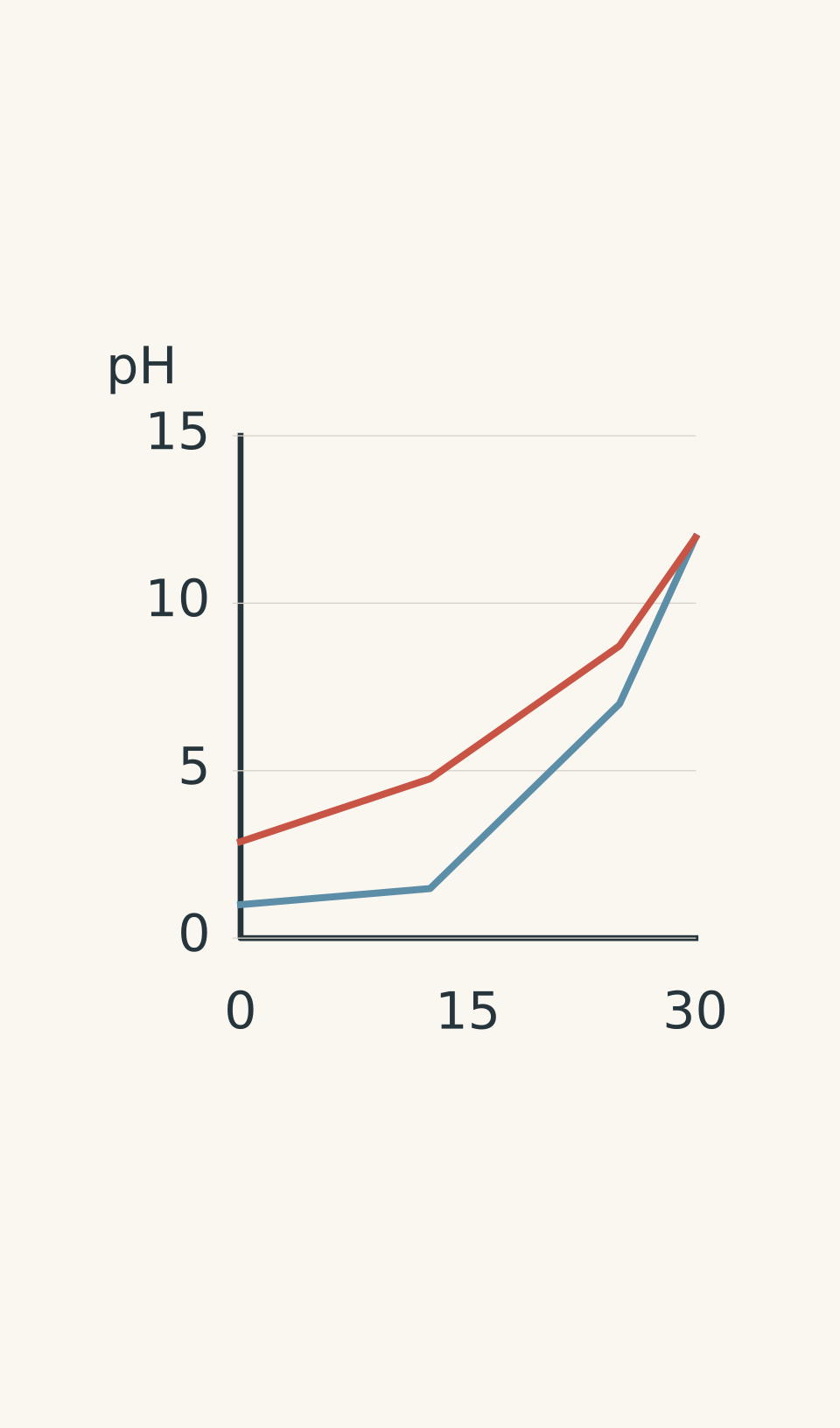
- A: strong acid
- B: weak acid
(i) Identify which sample contains the strong acid and which contains the weak acid. (1 mark)
(ii) State the equivalence volume and measured equivalence pH for each sample. (1 mark)
(iii) A third titration, C, has an equivalence-point pH of 5.30. Identify the most likely combination of acid and base strengths for this titration. (1 mark)
(b) Half-equivalence and equivalence behaviour (2 marks)
For titration B:
(i) Use the data to estimate the \(pK_a\) of the weak acid. (1 mark)
(ii) Explain why the equivalence-point pH is greater than 7. (1 mark)
(c) Conductivity during titration (2 marks)
A \(25.00\ \mathrm{mL}\) sample of \(0.100\ \mathrm{mol\,L^{-1}}\) \(\ce{HCl}\) is titrated with \(0.100\ \mathrm{mol\,L^{-1}}\) \(\ce{NaOH}\).
The following conductivity readings are recorded.
| Volume of \(\ce{NaOH}\) added (mL) | Conductivity (mS cm\(^{-1}\)) |
|---|---|
| 0 | 42.6 |
| 10 | 21.9 |
| 20 | 10.3 |
| 25 | 6.1 |
| 30 | 8.0 |
| 40 | 10.6 |
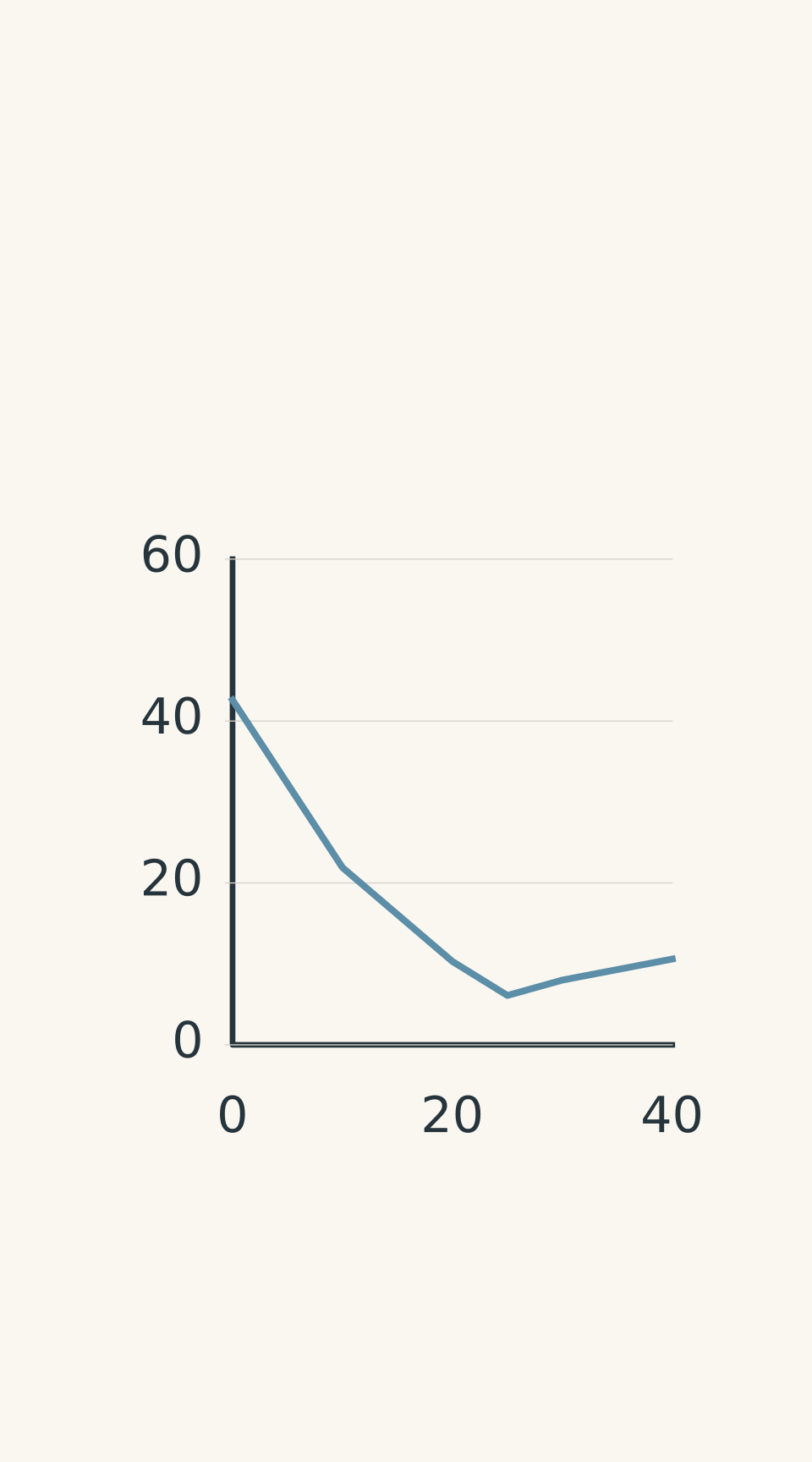
- Measured conductivity
(i) Estimate the equivalence volume from the conductivity data. (1 mark)
(ii) Explain the trend in conductivity before and after equivalence. (1 mark)
(d) Symbolic neutralisation models (3 marks)
Write the balanced net ionic equation for each neutralisation reaction.
(i) A strong acid reacting with a strong base. (1 mark)
(ii) Ethanoic acid reacting with a strong base. (1 mark)
(iii) Hydrochloric acid reacting with aqueous ammonia, a weak base. (1 mark)
Question 7 (8 marks)
(a) Preparing a buffer (2 marks)
A student mixes \(50.0\ \mathrm{mL}\) of \(0.100\ \mathrm{mol\,L^{-1}}\) ethanoic acid, \(\ce{CH3COOH}\), with \(50.0\ \mathrm{mL}\) of \(0.100\ \mathrm{mol\,L^{-1}}\) sodium ethanoate, \(\ce{CH3COONa}\).
The \(pK_a\) of ethanoic acid is 4.76.
Calculate the pH of the resulting buffer.
(b) Testing buffer behaviour (4 marks)
Separate \(25.0\ \mathrm{mL}\) portions of the buffer from part (a) are placed in two clean containers.
- Container 1 receives \(1.00\ \mathrm{mL}\) of \(0.100\ \mathrm{mol\,L^{-1}}\) \(\ce{HCl}\).
- Container 2 receives \(1.00\ \mathrm{mL}\) of \(0.100\ \mathrm{mol\,L^{-1}}\) \(\ce{NaOH}\).
Calculate the pH in each container after the addition. Assume the neutralisation reactions proceed completely and use the buffer equation supplied in the exam instructions.
(c) Buffers in natural systems (2 marks)
Explain why buffers are important in natural systems. Name one natural buffer system and outline a practical method for demonstrating that a buffer resists pH change better than distilled water when small amounts of acid or base are added.
Question 8 (7 marks)
(a) Back titration of an antacid (4 marks)
An antacid sample has a mass of \(0.2500\ \mathrm{g}\) and contains magnesium hydroxide, \(\ce{Mg(OH)2}\).
The sample is treated with \(50.00\ \mathrm{mL}\) of \(0.1000\ \mathrm{mol\,L^{-1}}\) \(\ce{HCl}\). After the reaction is complete, the excess acid requires \(18.40\ \mathrm{mL}\) of \(0.1000\ \mathrm{mol\,L^{-1}}\) \(\ce{NaOH}\) for neutralisation.
The reaction between magnesium hydroxide and hydrochloric acid is:
\[ \ce{Mg(OH)2 + 2HCl -> MgCl2 + 2H2O} \]
The molar mass of \(\ce{Mg(OH)2}\) is \(58.32\ \mathrm{g\,mol^{-1}}\).
For the calculation, assume that all the magnesium hydroxide reacts completely and that no other component of the sample consumes hydrochloric acid.
Calculate the mass percentage of \(\ce{Mg(OH)2}\) in the sample.
(b) Limiting reagents (1 mark)
Identify the limiting reagent and the excess reagent in the initial reaction between the antacid sample and the added hydrochloric acid.
(c) Evaluating back titration (2 marks)
State one realistic limitation of back titration when analysing an actual antacid sample, and explain how it could affect the calculated mass percentage of magnesium hydroxide.
Question 9 (6 marks)
A weak base, \(\ce{B}\), has an analytical concentration of \(0.0500\ \mathrm{mol\,L^{-1}}\). Its equilibrium pH at \(25^\circ\mathrm{C}\) is 11.00.
Assume that water ionisation can be neglected in calculating the base dissociation constant.
(a) Hydroxide concentration (2 marks)
Calculate the pOH and equilibrium concentration of \(\ce{OH-}\).
(b) Base strength (2 marks)
Calculate \(K_b\) and \(pK_b\) for the weak base.
(c) Conjugate acid equilibrium (2 marks)
Calculate \(K_a\) and \(pK_a\) for the conjugate acid, \(\ce{BH+}\). Verify the relationship between \(pK_a\) and \(pK_b\) at \(25^\circ\mathrm{C}\).
Question 10 (7 marks)
Three solutions, X, Y, and Z, are each prepared at an analytical concentration of \(0.0100\ \mathrm{mol\,L^{-1}}\). They are known to contain one each of hydrochloric acid, ethanoic acid, and sodium hydroxide, but their labels have been mixed up.
All measurements are taken at \(25^\circ\mathrm{C}\).
| Solution | pH reading 1 | pH reading 2 | pH reading 3 | Conductivity (mS cm\(^{-1}\)) |
|---|---|---|---|---|
| X | 2.02 | 2.00 | 2.01 | 4.1 |
| Y | 3.39 | 3.42 | 3.40 | 0.17 |
| Z | 11.99 | 12.02 | 12.00 | 2.5 |
(a) Processing pH data (2 marks)
Calculate the mean pH of solutions X and Y, reporting each answer to two decimal places.
(b) Interpreting pH and conductivity (2 marks)
Identify which solution contains sodium hydroxide and which contains the stronger acid. Use the pH and conductivity data to justify your answer.
(c) Reliable pH measurements (2 marks)
Outline a practical procedure for measuring the pH of all three solutions with a digital pH probe. Include two steps that improve measurement reliability.
(d) Evaluating conductivity data (1 mark)
State one limitation of using conductivity alone to determine acid strength.
03Worked solutions and marking guide
For calculation questions, award follow-through credit where a student uses a previous result consistently and the subsequent chemistry and method are correct, even if an earlier arithmetic error occurred. Equivalent balanced equations and mathematically equivalent methods should be accepted.
Solution 1
(a) Common inorganic acids and bases
(i) \(\ce{HNO3}\): nitric acid.
(ii) Sulfuric acid: \(\ce{H2SO4}\).
(iii) \(\ce{Ca(OH)2}\): calcium hydroxide.
(iv) Phosphoric acid: \(\ce{H3PO4}\).
Marking (4 marks): 1 mark for each correct name or formula.
(b) Ionic equations
Nitric acid transfers a proton to water:
\[ \ce{HNO3(aq) + H2O(l) -> H3O+(aq) + NO3-(aq)} \]
Barium hydroxide dissociates into barium and hydroxide ions:
\[ \ce{Ba(OH)2(aq) -> Ba^2+(aq) + 2OH-(aq)} \]
Marking (2 marks): 1 mark for each correct, balanced equation.
(c) Acid-base models
An Arrhenius acid increases the hydronium ion concentration in aqueous solution. An Arrhenius base increases the hydroxide ion concentration in aqueous solution.
The Brønsted-Lowry model defines an acid as a proton donor and a base as a proton acceptor. It can describe proton-transfer reactions outside aqueous solution, including:
\[ \ce{HCl(g) + NH3(g) -> NH4Cl(s)} \]
This reaction can be understood as proton transfer even though it does not involve an aqueous solution producing hydronium or hydroxide ions.
Marking (2 marks):
- 1 mark for both Arrhenius definitions.
- 1 mark for a valid limitation of the Arrhenius model and an explanation of how Brønsted-Lowry addresses it.
Solution 2
(a) Reactions of acids
(i) Magnesium and hydrochloric acid:
\[ \ce{Mg(s) + 2HCl(aq) -> MgCl2(aq) + H2(g)} \]
(ii) Sodium carbonate and nitric acid:
\[ \ce{Na2CO3(aq) + 2HNO3(aq) -> 2NaNO3(aq) + H2O(l) + CO2(g)} \]
(iii) Sulfuric acid and potassium hydroxide:
\[ \ce{H2SO4(aq) + 2KOH(aq) -> K2SO4(aq) + 2H2O(l)} \]
These equations represent the typical products of acid reactions with a reactive metal, a carbonate, and a base, respectively.
Marking (3 marks): 1 mark for each correctly balanced equation with appropriate products.
(b) Proton transfer and conjugate pairs
In the reaction
\[ \ce{NH3 + H2O <=> NH4+ + OH-} \]
- \(\ce{H2O}\) is the Brønsted-Lowry acid because it donates a proton.
- \(\ce{NH3}\) is the Brønsted-Lowry base because it accepts a proton.
- The conjugate pairs are \(\ce{NH3/NH4+}\) and \(\ce{H2O/OH-}\).
An amphiprotic species can both donate and accept a proton, depending on the reaction.
Marking (3 marks):
- 1 mark for identifying the acid and base.
- 1 mark for both conjugate pairs.
- 1 mark for defining amphiprotic.
(c) Amphiprotic ions
Hydrogen carbonate, \(\ce{HCO3-}\), can donate a proton:
\[ \ce{HCO3- + H2O <=> CO3^2- + H3O+} \]
It can also accept a proton from water:
\[ \ce{HCO3- + H2O <=> H2CO3 + OH-} \]
Dihydrogen phosphate, \(\ce{H2PO4-}\), can donate a proton:
\[ \ce{H2PO4- + H2O <=> HPO4^2- + H3O+} \]
It can also accept a proton from water:
\[ \ce{H2PO4- + H2O <=> H3PO4 + OH-} \]
In each equation, water participates in proton transfer. Sodium and potassium are spectator ions, so they do not appear in the net ionic equations.
Marking (4 marks): 1 mark for each correctly balanced net ionic equation, including charges.
Solution 3
(a) Acid-base indicators
The indicator exists in two forms:
\[ \ce{HIn <=> H+ + In-} \]
Adding acid increases the hydronium concentration, shifting the equilibrium towards \(\ce{HIn}\). The indicator therefore becomes redder.
Adding base removes hydronium ions through neutralisation. The equilibrium shifts towards \(\mathrm{In}^{-}\), making the indicator yellower.
The change is reversible because the equilibrium can shift in either direction as the solution’s pH changes.
Marking (2 marks):
- 1 mark for the correct shift and colour in acidic conditions.
- 1 mark for the correct shift and colour in basic conditions, including the reversible nature of the equilibrium.
(b) Acid strength and concentration
Use:
\[ [\ce{H3O+}]=10^{-\mathrm{pH}} \]
For solution A:
\[ [\ce{H3O+}]=10^{-2.00} =1.00\times10^{-2}\ \mathrm{mol\,L^{-1}} \]
For solution B:
\[ [\ce{H3O+}]=10^{-2.88} =1.32\times10^{-3}\ \mathrm{mol\,L^{-1}} \]
Solution A has the higher hydronium concentration, even though its analytical acid concentration is ten times lower.
This is consistent with hydrochloric acid being a strong acid that ionises essentially completely, while ethanoic acid is weak and only partially ionises. In a particle model, the strong acid is represented predominantly by separated ions, while a weak acid contains a substantial proportion of undissociated acid molecules.
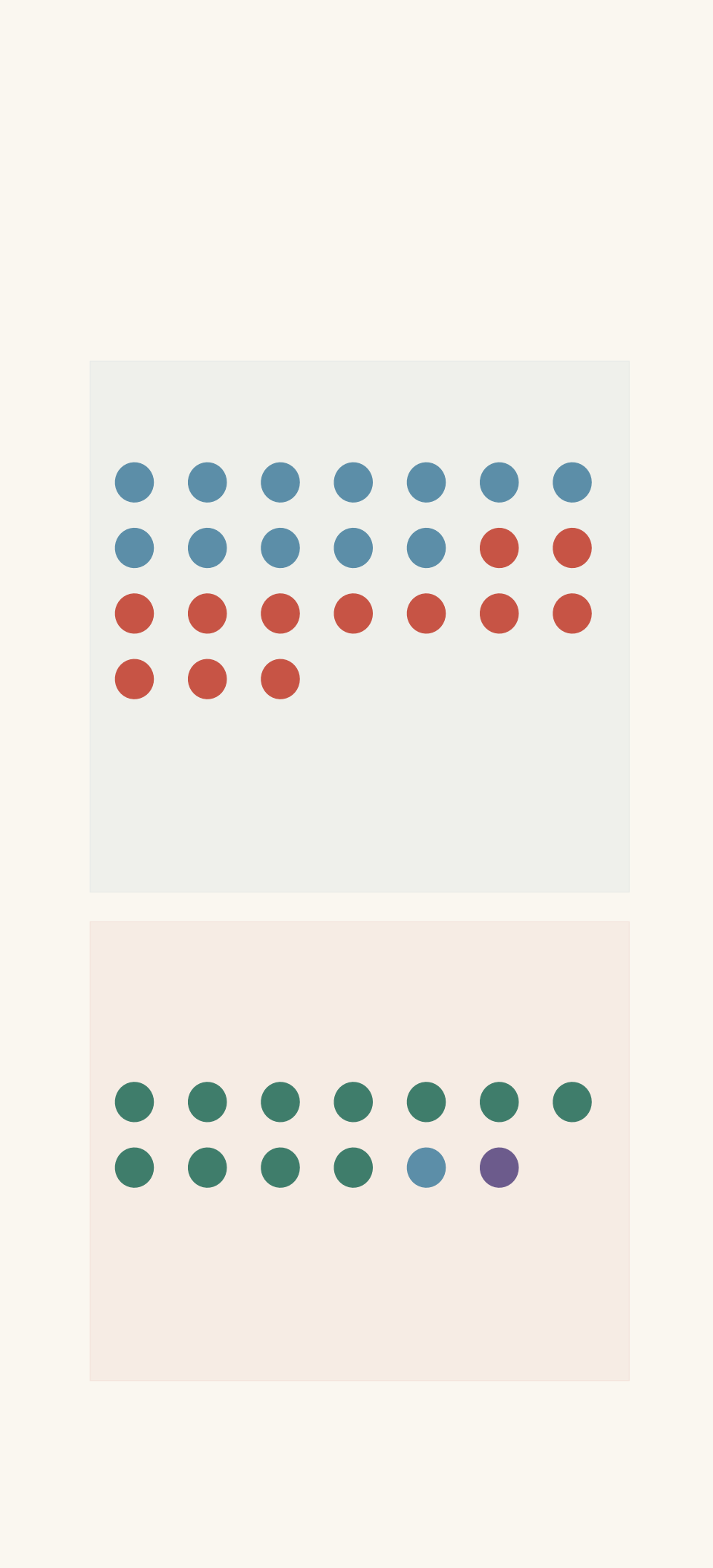
- H₃O⁺
- Cl⁻
- CH₃COOH
- CH₃COO⁻
Acid strength describes the extent of ionisation, not the amount of acid dissolved per litre. Concentration and strength are different properties.
Marking (3 marks):
- 1 mark for the correct hydronium concentration of A.
- 1 mark for the correct hydronium concentration of B.
- 1 mark for explaining the difference between strength and concentration using ionisation.
(c) Monoprotic and polyprotic acids
A monoprotic acid can donate one proton per molecule. A polyprotic acid can donate more than one proton per molecule.
Successive dissociation constants generally decrease because removing each additional proton becomes less favourable. After a proton has been removed, the remaining species is usually more negatively charged, making further proton loss less favourable electrostatically.
Marking (2 marks):
- 1 mark for the definitions.
- 1 mark for a valid explanation of the trend in successive \(K_a\) values.
Solution 4
(a) pH, pOH, and ion concentrations
Barium hydroxide dissociates completely:
\[ \ce{Ba(OH)2 -> Ba^2+ + 2OH-} \]
Each formula unit produces two hydroxide ions.
\[ \begin{aligned} [\ce{OH-}]&=2(2.50\times10^{-3})\\ &=5.00\times10^{-3}\ \mathrm{mol\,L^{-1}} \end{aligned} \]
Calculate pOH:
\[ \begin{aligned} \mathrm{pOH} &=-\log_{10}(5.00\times10^{-3})\\ &=2.301 \end{aligned} \]
Calculate pH:
\[ \begin{aligned} \mathrm{pH}&=14.000-2.301\\ &=11.699 \end{aligned} \]
Finally, use \(K_w\):
\[ \begin{aligned} [\ce{H3O+}] &=\frac{1.00\times10^{-14}}{5.00\times10^{-3}}\\ &=2.00\times10^{-12}\ \mathrm{mol\,L^{-1}} \end{aligned} \]
Answers:
- \([\ce{OH-}]=5.00\times10^{-3}\ \mathrm{mol\,L^{-1}}\)
- \(\mathrm{pOH}=2.301\)
- \(\mathrm{pH}=11.699\)
- \([\ce{H3O+}]=2.00\times10^{-12}\ \mathrm{mol\,L^{-1}}\)
Marking (4 marks): 1 mark for each correct quantity.
(b) Mixing an acid and a base
First calculate the initial amounts in moles.
For hydrochloric acid:
\[ \begin{aligned} n(\ce{H3O+})&=0.120\times0.02500\\ &=0.00300\ \mathrm{mol} \end{aligned} \]
For sodium hydroxide:
\[ \begin{aligned} n(\ce{OH-})&=0.0500\times0.04000\\ &=0.00200\ \mathrm{mol} \end{aligned} \]
The reaction is:
\[ \ce{H3O+ + OH- -> 2H2O} \]
Hydronium is in excess:
\[ \begin{aligned} n_{\mathrm{excess}}(\ce{H3O+}) &=0.00300-0.00200\\ &=0.00100\ \mathrm{mol} \end{aligned} \]
The total volume is:
\[ V=25.00+40.00=65.00\ \mathrm{mL} =0.06500\ \mathrm{L} \]
Therefore,
\[ \begin{aligned} [\ce{H3O+}]&=\frac{0.00100}{0.06500}\\ &=0.0154\ \mathrm{mol\,L^{-1}} \end{aligned} \]
\[ \mathrm{pH}=-\log_{10}(0.0154)=1.81 \]
The final solution is acidic because hydronium remains in excess.
Marking (3 marks):
- 1 mark for calculating the excess amount of hydronium.
- 1 mark for calculating its concentration using the total volume.
- 1 mark for the correct final pH.
(c) Dilution of an acid
Dilution changes the concentration but not the amount of acid transferred.
Using \(C_1V_1=C_2V_2\):
\[ \begin{aligned} C_2&=\frac{0.100\times10.0}{250.0}\\ &=0.00400\ \mathrm{mol\,L^{-1}} \end{aligned} \]
Nitric acid is a strong acid, so:
\[ [\ce{H3O+}]=0.00400\ \mathrm{mol\,L^{-1}} \]
Therefore,
\[ \mathrm{pH}=-\log_{10}(0.00400)=2.40 \]
Marking (2 marks):
- 1 mark for the final concentration.
- 1 mark for the final pH.
Solution 5
(a) Preparing a standard solution
First calculate the number of moles required:
\[ \begin{aligned} n&=CV\\ &=0.1000\times0.2500\\ &=0.02500\ \mathrm{mol} \end{aligned} \]
Then calculate the mass:
\[ \begin{aligned} m&=nM\\ &=0.02500\times106.0\\ &=2.650\ \mathrm{g} \end{aligned} \]
The student needs \(2.650\ \mathrm{g}\) of anhydrous sodium carbonate.
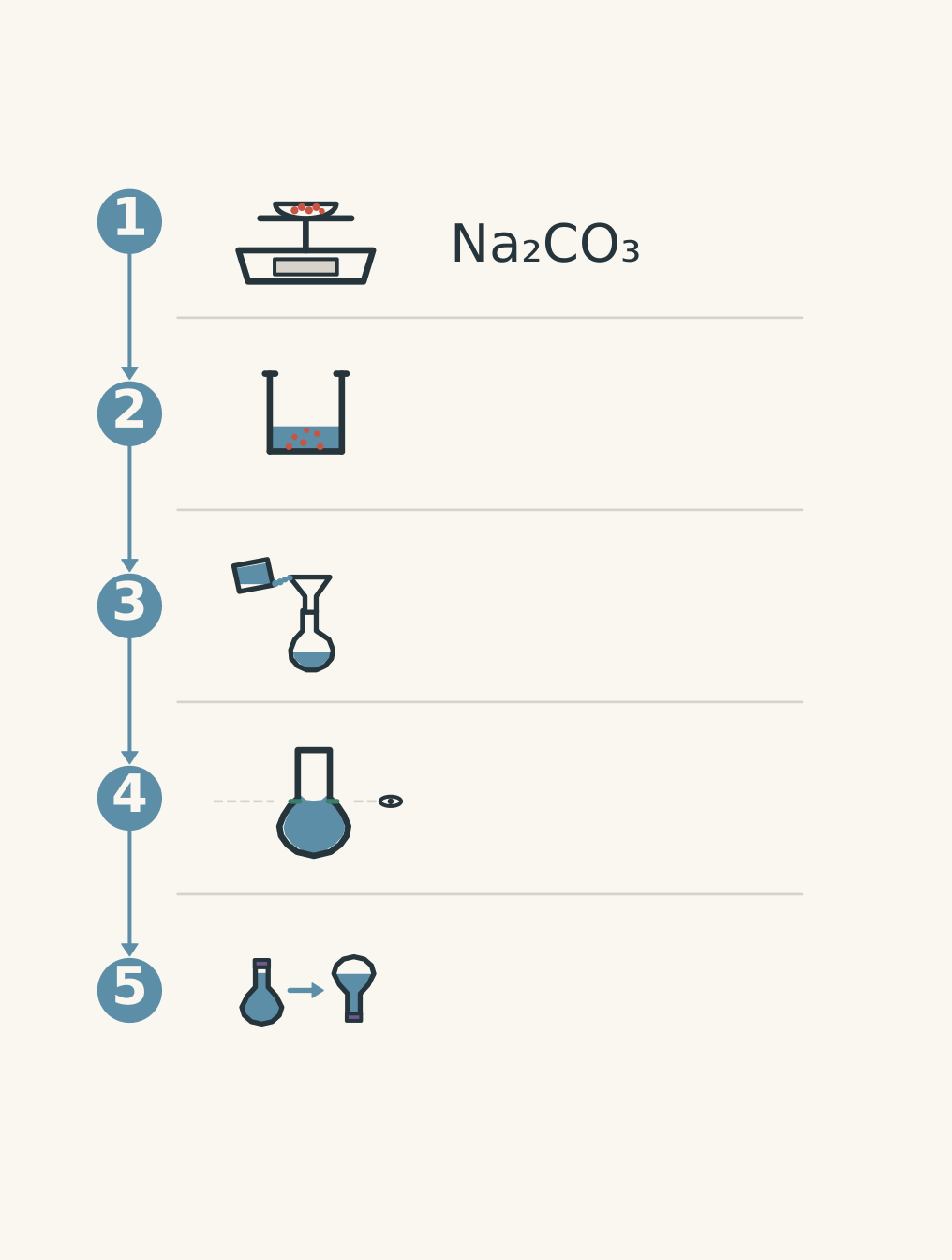
A suitable preparation procedure is:
- Accurately weigh \(2.650\ \mathrm{g}\) of sodium carbonate.
- Dissolve the solid in a small volume of distilled water.
- Transfer the solution quantitatively into a \(250.0\ \mathrm{mL}\) volumetric flask. Rinse the beaker and any transfer equipment into the flask.
- Add distilled water until the bottom of the meniscus reaches the calibration line at eye level.
- Stopper the flask and invert it several times to mix thoroughly.
Marking (3 marks):
- 1 mark for the correct mass.
- 1 mark for dissolution and quantitative transfer, including rinsing.
- 1 mark for accurate dilution to the mark and thorough mixing.
(b) Experimental determination of \(K_a\)
The measured pH is 2.87.
First calculate the hydronium concentration:
\[ \begin{aligned} [\ce{H3O+}]&=10^{-2.87}\\ &=1.35\times10^{-3}\ \mathrm{mol\,L^{-1}} \end{aligned} \]
For the equilibrium
\[ \ce{HA + H2O <=> H3O+ + A-} \]
assume the acid produces equal equilibrium concentrations of hydronium and conjugate base. Therefore,
\[ [\mathrm{A}^{-}]=1.35\times10^{-3}\ \mathrm{mol\,L^{-1}} \]
The equilibrium concentration of undissociated acid is:
\[ \begin{aligned} [\ce{HA}]&=0.1000-0.00135\\ &=0.09865\ \mathrm{mol\,L^{-1}} \end{aligned} \]
Substitute into the acid dissociation expression:
\[ \begin{aligned} K_a&=\frac{[\ce{H3O+}][\mathrm{A}^{-}]}{[\ce{HA}]}\\ &=\frac{(1.35\times10^{-3})^2}{0.09865}\\ &=1.84\times10^{-5} \end{aligned} \]
Finally,
\[ \begin{aligned} pK_a&=-\log_{10}(1.84\times10^{-5})\\ &=4.73 \end{aligned} \]
Answers:
- \([\ce{H3O+}]=1.35\times10^{-3}\ \mathrm{mol\,L^{-1}}\)
- \(K_a=1.84\times10^{-5}\)
- \(pK_a=4.73\)
Marking (3 marks):
- 1 mark for the correct hydronium concentration.
- 1 mark for the equilibrium expression and correct \(K_a\).
- 1 mark for the correct \(pK_a\).
(c) Evaluating pH measurements
A digital pH probe should be calibrated with appropriate standard buffer solutions before use. The electrode should be rinsed with distilled water between samples, gently blotted rather than rubbed, and allowed to stabilise before the reading is recorded.
One limitation of estimating \(K_a\) from a single pH measurement is that probe calibration error or temperature variation can affect the calculated equilibrium concentration. The calculation also assumes that the stated acid concentration is accurate and that the chosen equilibrium model is appropriate.
Marking (2 marks):
- 1 mark for a valid calibration or handling step.
- 1 mark for a valid assumption or limitation.
Solution 6
(a) Interpreting titration curves
Sample A has an initial pH of 1.00 and an equivalence-point pH of 7.00. These values are consistent with a strong acid titrated with a strong base.
Sample B has an initial pH of 2.88 and an equivalence-point pH of 8.73. These values are consistent with a weak acid titrated with a strong base.
Both equivalence volumes are \(25.00\ \mathrm{mL}\). Each sample initially contains:
\[ \begin{aligned} n(\text{acid})&=0.100\times0.02500\\ &=0.002500\ \mathrm{mol} \end{aligned} \]
The same amount of \(0.100\ \mathrm{mol\,L^{-1}}\) sodium hydroxide is required to neutralise either monoprotic acid.
For titration C, an equivalence pH of 5.30 is below 7. This is consistent with a strong acid titrated with a weak base, such as hydrochloric acid with ammonia.
Marking (3 marks):
- 1 mark for correctly identifying A and B.
- 1 mark for the equivalence volumes and pH values.
- 1 mark for identifying the likely acid-base combination in C.
(b) Half-equivalence and equivalence behaviour
At half-equivalence, half the original weak acid has been converted to its conjugate base. Their concentrations are equal.
Therefore,
\[ \begin{aligned} \mathrm{pH}&=pK_a+\log_{10}(1)\\ &=pK_a \end{aligned} \]
The measured half-equivalence pH is 4.76, so:
\[ pK_a=4.76 \]
At equivalence, the ethanoic acid has been converted mainly into ethanoate ions. Ethanoate is a weak base and reacts with water:
\[ \ce{CH3COO- + H2O <=> CH3COOH + OH-} \]
The production of hydroxide ions makes the solution basic, so the equivalence-point pH is greater than 7.
Marking (2 marks):
- 1 mark for \(pK_a=4.76\).
- 1 mark for explaining the basic equivalence point using the conjugate base.
(c) Conductivity during titration
The conductivity reaches a minimum at approximately \(25.0\ \mathrm{mL}\), which is the equivalence volume.
Before equivalence, highly mobile hydronium ions are consumed and replaced by sodium ions, which have lower ionic mobility. Conductivity therefore decreases.
After equivalence, excess hydroxide ions accumulate and conductivity rises. Conductivity does not fall to zero because the solution still contains ions, including sodium and chloride.
Marking (2 marks):
- 1 mark for identifying the equivalence volume.
- 1 mark for explaining the decrease and subsequent increase using the changing ions.
(d) Symbolic neutralisation models
(i) Strong acid with strong base:
\[ \ce{H3O+(aq) + OH-(aq) -> 2H2O(l)} \]
(ii) Ethanoic acid with a strong base:
\[ \ce{CH3COOH(aq) + OH-(aq) -> CH3COO-(aq) + H2O(l)} \]
(iii) Hydrochloric acid with aqueous ammonia:
\[ \ce{H3O+(aq) + NH3(aq) -> NH4+(aq) + H2O(l)} \]
The equations differ because the weak acid and weak base participate as molecules in proton-transfer reactions, whereas a strong acid is represented by its ions in aqueous solution.
Marking (3 marks): 1 mark for each correct net ionic equation.
Solution 7
(a) Preparing a buffer
The buffer contains equal volumes of solutions with equal concentrations. Therefore, the initial amounts of ethanoic acid and ethanoate are equal.
After mixing, both species have a concentration of \(0.0500\ \mathrm{mol\,L^{-1}}\), so:
\[ \frac{[\ce{CH3COO-}]}{[\ce{CH3COOH}]}=1 \]
Using the buffer equation:
\[ \begin{aligned} \mathrm{pH}&=pK_a+\log_{10}(1)\\ &=4.76 \end{aligned} \]
The buffer pH is 4.76.
Marking (2 marks):
- 1 mark for recognising the equal acid and conjugate-base amounts.
- 1 mark for the correct pH.
(b) Testing buffer behaviour
Each \(25.0\ \mathrm{mL}\) aliquot contains equal amounts of ethanoic acid and ethanoate.
The amount of each species before addition is:
\[ \begin{aligned} n&=0.0500\times0.0250\\ &=0.00125\ \mathrm{mol} \end{aligned} \]
The added acid or base contains:
\[ \begin{aligned} n&=0.100\times0.00100\\ &=0.000100\ \mathrm{mol} \end{aligned} \]
Container 1: hydrochloric acid added
Hydronium ions react with ethanoate:
\[ \ce{CH3COO- + H3O+ -> CH3COOH + H2O} \]
The final amounts are:
\[ \begin{aligned} n(\ce{CH3COO-})&=0.00125-0.000100\\ &=0.00115\ \mathrm{mol}\\ n(\ce{CH3COOH})&=0.00125+0.000100\\ &=0.00135\ \mathrm{mol} \end{aligned} \]
Therefore,
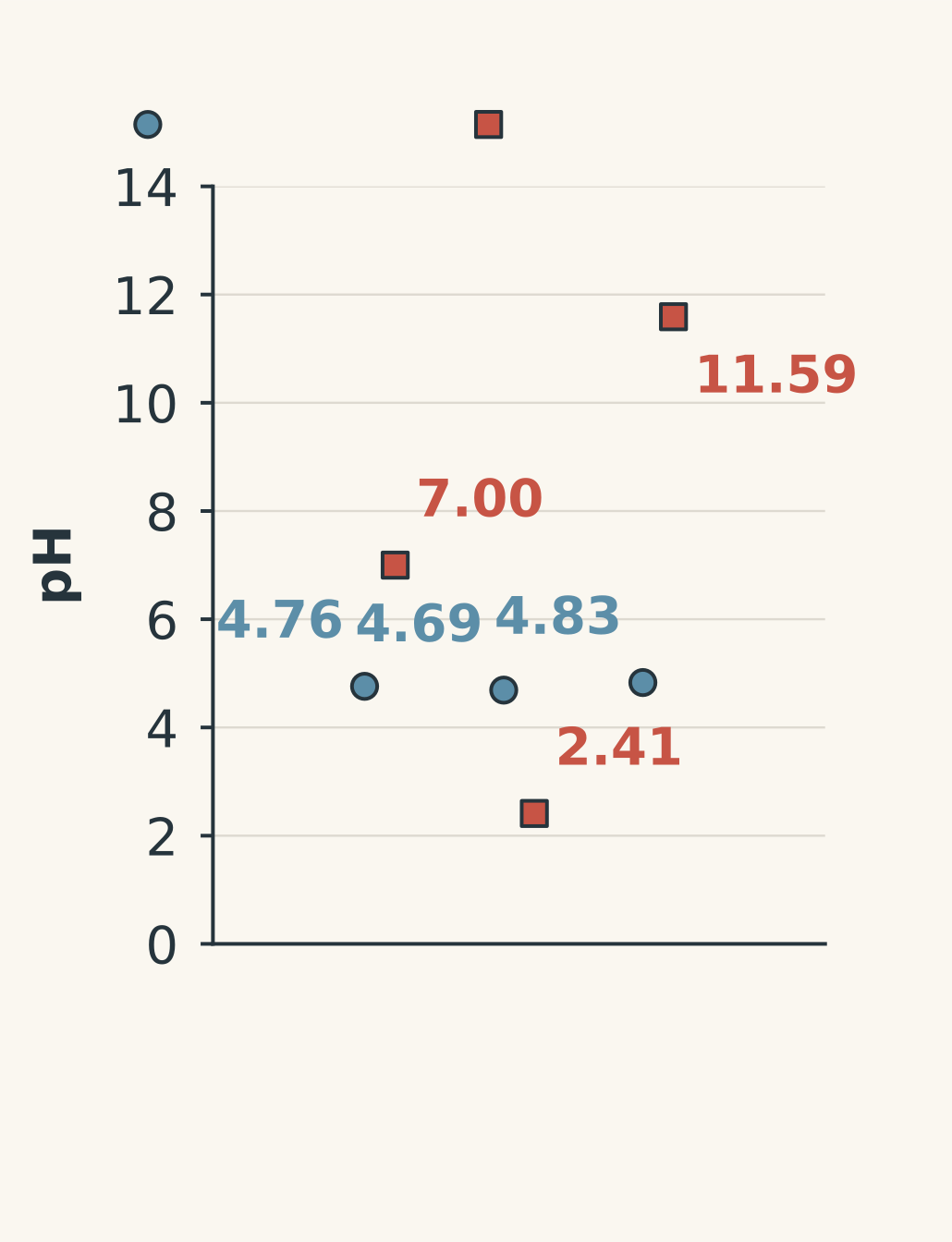
\[ \begin{aligned} \mathrm{pH} &=4.76+\log_{10}\left(\frac{0.00115}{0.00135}\right)\\ &=4.69 \end{aligned} \]
Container 2: sodium hydroxide added
Hydroxide ions react with ethanoic acid:
\[ \ce{CH3COOH + OH- -> CH3COO- + H2O} \]
The final amounts are:
\[ \begin{aligned} n(\ce{CH3COOH})&=0.00125-0.000100\\ &=0.00115\ \mathrm{mol}\\ n(\ce{CH3COO-})&=0.00125+0.000100\\ &=0.00135\ \mathrm{mol} \end{aligned} \]
Therefore,
\[ \begin{aligned} \mathrm{pH} &=4.76+\log_{10}\left(\frac{0.00135}{0.00115}\right)\\ &=4.83 \end{aligned} \]
The final pH values are 4.69 after adding acid and 4.83 after adding base. Both changes are relatively small because the buffer consumes much of the added acid or base.
Marking (4 marks):
- 2 marks for the acid-addition calculation, including the mole changes and final pH.
- 2 marks for the base-addition calculation, including the mole changes and final pH.
(c) Buffers in natural systems
Buffers help maintain a relatively stable pH when small amounts of acid or base enter a system. Stable pH is important because many biological processes depend on enzymes and other molecules functioning within a suitable pH range.
One example is the carbonic acid-hydrogen carbonate buffer system in blood.
To test buffer behaviour, measure the initial pH of equal volumes of buffer and distilled water using a calibrated pH probe. Add equal, measured amounts of dilute acid to separate portions, then repeat with dilute base. Record the pH changes and compare them. The buffer should show a smaller pH change than the distilled water.
Marking (2 marks):
- 1 mark for explaining the role of a natural buffer and naming a valid example.
- 1 mark for a valid practical comparison using controlled additions and pH measurements.
Solution 8
(a) Back titration of an antacid
The initial amount of hydrochloric acid is:
\[ \begin{aligned} n(\ce{HCl})_{\mathrm{initial}} &=0.1000\times0.05000\\ &=0.005000\ \mathrm{mol} \end{aligned} \]
The excess hydrochloric acid is measured by titration with sodium hydroxide. Since hydrochloric acid and sodium hydroxide react in a 1:1 mole ratio:
\[ \begin{aligned} n(\ce{NaOH}) &=0.1000\times0.01840\\ &=0.001840\ \mathrm{mol} \end{aligned} \]
Thus, the excess hydrochloric acid is \(0.001840\ \mathrm{mol}\).
The amount of acid consumed by the antacid is:
\[ \begin{aligned} n(\ce{HCl})_{\mathrm{consumed}} &=0.005000-0.001840\\ &=0.003160\ \mathrm{mol} \end{aligned} \]
From the balanced equation,
\[ \ce{Mg(OH)2 + 2HCl -> MgCl2 + 2H2O} \]
two moles of hydrochloric acid react with one mole of magnesium hydroxide. Therefore,
\[ \begin{aligned} n(\ce{Mg(OH)2}) &=\frac{0.003160}{2}\\ &=0.001580\ \mathrm{mol} \end{aligned} \]
Calculate the mass of magnesium hydroxide:
\[ \begin{aligned} m&=nM\\ &=0.001580\times58.32\\ &=0.09215\ \mathrm{g} \end{aligned} \]
Finally, calculate the mass percentage:
\[ \begin{aligned} \%\ce{Mg(OH)2} &=\frac{0.09215}{0.2500}\times100\\ &=36.9\% \end{aligned} \]
The antacid sample contains \(36.9\%\) magnesium hydroxide by mass, under the stated assumptions.
Marking (4 marks):
- 1 mark for the initial amount of hydrochloric acid.
- 1 mark for the excess amount of acid from the back titration.
- 1 mark for the amount of magnesium hydroxide using the 2:1 stoichiometric ratio.
- 1 mark for the mass and final mass percentage.
(b) Limiting reagents
Magnesium hydroxide is the limiting reagent because the hydrochloric acid is deliberately added in excess. The magnesium hydroxide is consumed, leaving some hydrochloric acid unreacted for the back titration.
Marking (1 mark): correctly identifies magnesium hydroxide as limiting and hydrochloric acid as excess.
(c) Evaluating back titration
One limitation is that a real antacid may contain other substances that also react with hydrochloric acid. If those substances consume acid, the calculation would incorrectly attribute all the acid consumed to magnesium hydroxide and overestimate its mass percentage.
Another possible limitation is incomplete dissolution or reaction of the sample, which would reduce the measured acid consumption and could lead to an underestimate of the magnesium hydroxide content.
Marking (2 marks):
- 1 mark for a realistic limitation.
- 1 mark for correctly explaining its likely effect on the result.
Solution 9
(a) Hydroxide concentration
The pH is 11.00.
At \(25^\circ\mathrm{C}\):
\[ \begin{aligned} \mathrm{pOH}&=14.00-11.00\\ &=3.00 \end{aligned} \]
Therefore,
\[ \begin{aligned} [\ce{OH-}]&=10^{-3.00}\\ &=1.00\times10^{-3}\ \mathrm{mol\,L^{-1}} \end{aligned} \]
Marking (2 marks):
- 1 mark for the correct pOH.
- 1 mark for the correct hydroxide concentration.
(b) Base strength
The base ionisation equilibrium is:
\[ \ce{B + H2O <=> BH+ + OH-} \]
The equilibrium concentrations of \(\ce{BH+}\) and \(\ce{OH-}\) are equal under the stated assumptions.
Thus,
\[ [\ce{BH+}]=1.00\times10^{-3}\ \mathrm{mol\,L^{-1}} \]
The equilibrium concentration of the remaining base is:
\[ \begin{aligned} [\ce{B}]&=0.0500-0.00100\\ &=0.0490\ \mathrm{mol\,L^{-1}} \end{aligned} \]
Calculate \(K_b\):
\[ \begin{aligned} K_b&=\frac{[\ce{BH+}][\ce{OH-}]}{[\ce{B}]}\\ &=\frac{(1.00\times10^{-3})^2}{0.0490}\\ &=2.04\times10^{-5} \end{aligned} \]
Then,
\[ \begin{aligned} pK_b&=-\log_{10}(2.04\times10^{-5})\\ &=4.69 \end{aligned} \]
Marking (2 marks):
- 1 mark for the correct equilibrium expression and \(K_b\).
- 1 mark for the correct \(pK_b\).
(c) Conjugate acid equilibrium
For the conjugate acid \(\ce{BH+}\):
\[ K_aK_b=K_w \]
Therefore,
\[ \begin{aligned} K_a&=\frac{1.00\times10^{-14}}{2.04\times10^{-5}}\\ &=4.90\times10^{-10} \end{aligned} \]
Calculate \(pK_a\):
\[ \begin{aligned} pK_a&=-\log_{10}(4.90\times10^{-10})\\ &=9.31 \end{aligned} \]
Check the relationship:
\[ pK_a+pK_b=9.31+4.69=14.00 \]
The result is consistent with the conjugate acid-base relationship at \(25^\circ\mathrm{C}\).
Marking (2 marks):
- 1 mark for the correct \(K_a\).
- 1 mark for the correct \(pK_a\) and verification that the sum is 14.00.
Solution 10
(a) Processing pH data
For solution X:
\[ \begin{aligned} \overline{\mathrm{pH}}_X &=\frac{2.02+2.00+2.01}{3}\\ &=2.01 \end{aligned} \]
For solution Y:
\[ \begin{aligned} \overline{\mathrm{pH}}_Y &=\frac{3.39+3.42+3.40}{3}\\ &=3.40 \end{aligned} \]
Answers:
- Mean pH of X: 2.01.
- Mean pH of Y: 3.40.
Marking (2 marks): 1 mark for each correct mean pH.
(b) Interpreting pH and conductivity
Solution Z contains sodium hydroxide because its pH is approximately 12, indicating a basic solution.
Solution X contains hydrochloric acid, the stronger acid, while solution Y contains ethanoic acid, the weaker acid.
At the same analytical concentration, hydrochloric acid ionises essentially completely, producing a higher hydronium concentration and more mobile ions than the partially ionised ethanoic acid solution. This is consistent with X having a lower pH and higher conductivity than Y.
Marking (2 marks):
- 1 mark for correctly identifying Z as sodium hydroxide and X as the stronger acid.
- 1 mark for using the pH and conductivity data to explain the difference between X and Y.
(c) Reliable pH measurements
A suitable procedure is:
- Calibrate the digital pH probe with appropriate standard buffer solutions, ideally covering the expected pH range.
- Rinse the probe with distilled water between samples and gently blot it dry to reduce contamination.
- Immerse the electrode in the solution and wait for the reading to stabilise.
- Record replicate readings and calculate a mean where appropriate.
Two important reliability measures are calibration against known standards and preventing carry-over between samples by rinsing the probe.
Marking (2 marks):
- 1 mark for appropriate calibration.
- 1 mark for suitable handling, stable readings, or replicate measurements.
(d) Evaluating conductivity data
Conductivity depends on the concentration and mobility of all ions present, as well as temperature. It cannot uniquely determine acid strength or pH without additional information.
Marking (1 mark): identifies a valid limitation of conductivity as a standalone measure of acid strength.