
Year 12 Chemistry Equilibrium: Original 100-Mark Revision Exam
Test your understanding of Year 12 Chemistry equilibrium with this original 100-mark timed practice paper. Includes exam-style questions, complete worked solutions, and a marking guide to help you check your calculations and strengthen your revision.
This original tutorgum practice paper tests the Year 12 Chemistry equilibrium content in the supplied chemistry-2025 scope. It covers chemical equilibrium, reaction rates, equilibrium calculations, solubility, precipitation, practical investigations, environmental applications, and industrial processes. It is a focused module paper, not a full-course examination, and is not an official, endorsed, past, or predicted NESA paper.
01Exam instructions
- Suggested working time: 120 minutes.
- Suggested reading time: 5 minutes.
- Total marks: 100.
- Permitted equipment: A scientific calculator and a periodic table. No notes are assumed.
- Working: Show calculations, write balanced equations where requested, and include appropriate units.
- Precision: Give numerical answers to 2-3 significant figures unless otherwise indicated.
- Assumptions: Unless stated otherwise, assume constant temperature, ideal dilute solutions, and no unlisted reactions. Use the concentration-based equilibrium expressions specified in each question. Pure solids and pure liquids are omitted from equilibrium expressions.
- Precipitation: Use standard solubility rules for common ionic compounds. All nitrate salts and Group 1 salts are soluble. All supplied \(K_{sp}\) values apply at \(25^\circ\text{C}\).
- Marking: Equivalent valid methods are acceptable. Follow-through marks may be awarded when a later calculation correctly uses an earlier numerical result.
The paper assesses only the equilibrium content listed in the supplied brief. It does not combine content from other syllabus editions or unrelated modules.
02Questions
Question 1 (10 marks)
Chemical equilibrium, collision theory, and reversibility
(a) Distinguish between static equilibrium and dynamic chemical equilibrium. (2 marks)
(b) A sealed vessel contains the reversible reaction
\[ \ce{A(g) <=> B(g)} \]
After 40 seconds, the measured concentrations of A and B remain constant.
Explain what this observation tells you about the macroscopic composition of the system and the microscopic reaction rates. (2 marks)
(c) Initially, only A is present in the vessel. Use collision theory to explain how the forward and reverse reaction rates change as the system approaches equilibrium. (2 marks)
(d) The reaction
\[ \ce{X(aq) <=> Y(aq) + Z(g)} \]
is carried out in an open beaker. Explain why sustained chemical equilibrium may not be established and state one necessary condition for maintaining equilibrium. (2 marks)
(e) Magnesium ribbon burns in air to form a white solid. Steel wool also reacts when heated strongly in oxygen, forming a dark solid.
What can these observations establish about the reactions under the conditions used? What additional evidence would be needed to demonstrate that either reaction is reversible? (2 marks)
Question 2 (10 marks)
Equilibrium expressions, reaction quotient, and reciprocal constants
Consider the homogeneous equilibrium in aqueous solution:
\[ \ce{A(aq) + 2B(aq) <=> 2C(aq)} \]
(a) Write the equilibrium constant expression, \(K_c\), for this reaction. (2 marks)
(b) At a particular temperature, an equilibrium mixture has the following concentrations:
| Species | Equilibrium concentration (mol L\(^{-1}\)) |
|---|---|
| A | 0.200 |
| B | 0.100 |
| C | 0.400 |
Calculate \(K_c\). (3 marks)
(c) A different mixture at the same temperature has the concentrations below at a particular instant.
| Species | Concentration (mol L\(^{-1}\)) |
|---|---|
| A | 0.100 |
| B | 0.200 |
| C | 0.300 |
Calculate the reaction quotient, \(Q_c\), and use it to predict the direction of the net reaction. (3 marks)
(d) Write the equilibrium constant expression for the reverse reaction and calculate its equilibrium constant. (2 marks)
Question 3 (10 marks)
Equilibrium concentrations and ICE tables
Consider the gas-phase equilibrium:
\[ \ce{H2(g) + I2(g) <=> 2HI(g)} \]
At a particular temperature, the equilibrium constant is denoted by \(K_c\).
(a) A 2.00 L vessel at equilibrium contains 0.200 mol of \(\ce{H2}\), 0.200 mol of \(\ce{I2}\), and 0.600 mol of \(\ce{HI}\).
Calculate \(K_c\). (3 marks)
(b) At the same temperature, a second vessel initially contains:
- \([\ce{H2}] = 0.400\ \text{mol L}^{-1}\)
- \([\ce{I2}] = 0.400\ \text{mol L}^{-1}\)
- \([\ce{HI}] = 0.000\ \text{mol L}^{-1}\)
Determine the equilibrium concentrations of all three species. Show an ICE table or equivalent working. (6 marks)
(c) Explain why the equilibrium constant is unchanged between the two vessels, even though their initial compositions differ. (1 mark)
Question 4 (12 marks)
Le Chatelier’s principle, temperature, pressure, and catalysts
Three reversible systems are investigated.
System A: Cobalt(II) chloride equilibrium
The pink species is \(\ce{[Co(H2O)6]^2+}\), and the blue species is \(\ce{[CoCl4]^2-}\).
The equilibrium can be represented as:
\[ \ce{[Co(H2O)6]^2+ + 4Cl^-} \]
\[ \ce{<=> [CoCl4]^2- + 6H2O} \]
The forward reaction, from pink to blue, is endothermic.
(a) Predict the expected colour change when each disturbance is applied to an equilibrium mixture.
(i) Concentrated chloride solution is added. (1 mark)
(ii) Water is added. (1 mark)
System B: Nitrogen dioxide equilibrium
\[ \ce{N2O4(g) <=> 2NO2(g)} \]
\(\ce{N2O4}\) is colourless, while \(\ce{NO2}\) is brown. The forward reaction is endothermic.
(b) Answer the following.
(i) The volume of a closed vessel is decreased at constant temperature. Predict the equilibrium shift and colour change. Explain the immediate change in reaction rates using collision theory. (3 marks)
(ii) The temperature is increased at constant pressure. Predict the equilibrium shift, the colour change, and the effect on \(K_c\). (2 marks)
(iii) A catalyst is added at constant temperature. Explain its effect on activation energy, the forward and reverse rates, the equilibrium position, and \(K_c\). (2 marks)
System C: Iron(III) thiocyanate equilibrium
\[ \ce{Fe^3+(aq) + SCN^-(aq) <=> FeSCN^2+(aq)} \]
The product \(\mathrm{FeSCN}^{2+}\) is red. The forward reaction is exothermic.
(c) Predict the effect of each disturbance.
(i) A small amount of concentrated \(\ce{Fe(NO3)3}\) solution is added. (1 mark)
(ii) The equilibrium mixture is diluted with water. (1 mark)
(iii) The temperature is increased. State the effect on \(K_c\). (1 mark)
Question 5 (12 marks)
Dissolution, solubility rules, and precipitation reactions
(a) Describe what happens at the particle level when solid sodium chloride dissolves in water. Explain the energy transfers involved. (2 marks)
(b) Write the balanced dissolution equation for calcium fluoride, \(\ce{CaF2}\), and derive its solubility-product expression, \(K_{sp}\). (2 marks)
(c) Three pairs of aqueous solutions are mixed. For each pair, predict whether a precipitate forms, identify the precipitate, and write the balanced net ionic equation.
(i) \(\ce{KCl(aq)}\) and \(\ce{AgNO3(aq)}\). (2 marks)
(ii) \(\ce{KI(aq)}\) and \(\ce{Pb(NO3)2(aq)}\). (2 marks)
(iii) \(\ce{Na2SO4(aq)}\) and \(\ce{Ba(NO3)2(aq)}\). (2 marks)
(d) A student concludes from these tests that all chlorides, iodides, and sulfates are insoluble.
State one conclusion supported by the observations and explain why the student’s broader conclusion is not justified. (2 marks)
Question 6 (10 marks)
Solubility calculations and predicting precipitation using \(K_{sp}\)
At \(25^\circ\text{C}\), use the following solubility-product values:
| Compound | \(K_{sp}\) |
|---|---|
| \(\ce{AgCl}\) | \(1.8\times10^{-10}\) |
| \(\ce{CaF2}\) | \(3.9\times10^{-11}\) |
(a) Calculate the molar solubility of silver chloride in pure water. (3 marks)
(b) Calculate the molar solubility of calcium fluoride in pure water. Show how the stoichiometry of its dissolution affects your expression. (3 marks)
(c) Equal volumes of the following solutions are mixed:
- 50.0 mL of \(1.00\times10^{-3}\ \text{mol L}^{-1}\) \(\ce{AgNO3}\)
- 50.0 mL of \(2.00\times10^{-3}\ \text{mol L}^{-1}\) \(\ce{NaCl}\)
Calculate the ion concentrations immediately after mixing, determine \(Q_{sp}\) for silver chloride, and predict whether a precipitate forms. (3 marks)
(d) State the criterion involving \(Q_{sp}\) and \(K_{sp}\) that predicts precipitation. (1 mark)
Question 7 (10 marks)
Determining the equilibrium constant of iron(III) thiocyanate
The equilibrium is:
\[ \ce{Fe^3+(aq) + SCN^-(aq) <=> FeSCN^2+(aq)} \]
A student mixes 5.00 mL of \(2.00\times10^{-3}\ \text{mol L}^{-1}\) \(\ce{Fe(NO3)3}\) with 5.00 mL of \(2.00\times10^{-3}\ \text{mol L}^{-1}\) \(\ce{KSCN}\).
Assume the volumes are additive. A calibration curve gives an equilibrium concentration of
\[ [\mathrm{FeSCN}^{2+}]_{eq} =3.60\times10^{-4}\ \text{mol L}^{-1} \]
For the calculation, consider only the equilibrium shown.
(a) Calculate the initial concentrations of \(\mathrm{Fe}^{3+}\) and \(\mathrm{SCN}^{-}\) after mixing. (2 marks)
(b) Determine the equilibrium concentrations of \(\mathrm{Fe}^{3+}\) and \(\mathrm{SCN}^{-}\). Show the stoichiometric relationship used. (3 marks)
(c) Calculate \(K_c\) for the equilibrium at the experimental temperature. (3 marks)
(d) State two experimental or chemical limitations that could affect how accurately this calculated value represents the equilibrium constant of a real solution. (2 marks)
Question 8 (8 marks)
Environmental lead and phosphate solubility
Lead(II) ions can form a sparingly soluble solid with phosphate ions. For this question, use the following model value at \(25^\circ\text{C}\):
\[ K_{sp}\big(\ce{Pb3(PO4)2}\big) =1.0\times10^{-54} \]
The dissolution equilibrium is:
\[ \ce{Pb3(PO4)2(s) <=> 3Pb^2+(aq) + 2PO4^3-(aq)} \]
(a) Write the \(K_{sp}\) expression for lead(II) phosphate. (2 marks)
(b) A water sample has the following free-ion concentrations:
\[ [\mathrm{Pb}^{2+}]=2.0\times10^{-7}\ \text{mol L}^{-1} \]
\[ [\mathrm{PO_{4}}^{3-}]=1.0\times10^{-10}\ \text{mol L}^{-1} \]
Calculate \(Q_{sp}\) and predict whether lead(II) phosphate precipitation is thermodynamically favoured under the model assumptions. (3 marks)
(c) Explain how adding phosphate can reduce the concentration of dissolved lead. Give two limitations of applying this \(K_{sp}\) calculation directly to environmental water. (3 marks)
Question 9 (8 marks)
Identifying two unknown ions using precipitation tests
Two separate aqueous samples, X and Y, each contain one unknown anion. Each anion is selected from:
\[ \mathrm{Cl}^{-},\qquad \mathrm{I}^{-},\qquad \mathrm{SO_{4}}^{2-} \]
Separate portions of each sample are tested with three reagent solutions. The observations are shown below.
| Reagent added | Sample X | Sample Y |
|---|---|---|
| \(\ce{AgNO3(aq)}\) | White precipitate | Pale-yellow precipitate |
| \(\ce{Pb(NO3)2(aq)}\) | White precipitate | Yellow precipitate |
| \(\ce{Ba(NO3)2(aq)}\) | No visible precipitate | No visible precipitate |
Assume the reagents are sufficiently concentrated for the listed precipitates to be visible, and no other ions interfere.
(a) Identify the anion in each sample. Justify each identification using the observations. (4 marks)
(b) Write a balanced net ionic equation for one diagnostic precipitation test for sample X and one for sample Y. (2 marks)
(c) State one procedural control that would improve the reliability of these tests and one limitation of qualitative precipitation analysis. (2 marks)
Question 10 (10 marks)
Industrial equilibrium yield and economics
Ammonia is produced through the equilibrium:
\[ \ce{N2(g) + 3H2(g) <=> 2NH3(g)} \]
The forward reaction is exothermic. An iron catalyst is used in all four operating conditions below.
The following data are illustrative plant-design data created for this question. They are not real plant specifications.
| Condition | Temperature | Pressure | Equilibrium \(\ce{NH3}\) mole fraction | Relative operating cost (units) |
|---|---|---|---|---|
| A | \(350^\circ\text{C}\) | 100 bar | 28% | 8 |
| B | \(450^\circ\text{C}\) | 100 bar | 12% | 5 |
| C | \(350^\circ\text{C}\) | 250 bar | 39% | 13 |
| D | \(450^\circ\text{C}\) | 250 bar | 22% | 10 |
A plant requires an equilibrium ammonia mole fraction of at least 20%.
(a) Explain why decreasing temperature and increasing pressure favour ammonia formation at equilibrium. (2 marks)
(b) Identify the least expensive operating condition that meets the target. Justify your selection using the data. (2 marks)
(c) Explain the role of the iron catalyst. Why does it not change the equilibrium constant or equilibrium composition at a fixed temperature? (2 marks)
(d) Describe two industrial strategies that can improve overall ammonia production or economics without changing \(K_c\) at a fixed temperature. Explain how each strategy helps. (4 marks)
03Worked solutions and marking guide
Solution 1
(a) Static and dynamic equilibrium
Static equilibrium describes a situation in which no ongoing change occurs. In a static system, the relevant processes have stopped.
Dynamic chemical equilibrium occurs when the forward and reverse reactions continue at equal rates. The macroscopic composition remains constant even though particles continue reacting.
Marking guide (2 marks):
- Static equilibrium correctly described. (1)
- Dynamic equilibrium identified as equal, ongoing opposing reaction rates. (1)
(b) Constant concentrations
The constant concentrations show that the macroscopic composition is no longer changing.
At dynamic equilibrium, the forward and reverse rates are equal and non-zero. The reactions have not stopped.
Marking guide (2 marks):
- Identifies constant macroscopic concentrations. (1)
- States that forward and reverse rates are equal and ongoing. (1)
(c) Collision theory and the approach to equilibrium
Initially, A is abundant, so successful collisions involving A occur frequently and the forward rate is high. As A is consumed, its concentration falls and the forward rate decreases.
Meanwhile, B accumulates. More B particles are available to collide and react in the reverse direction, so the reverse rate increases. The rates eventually become equal.
Marking guide (2 marks):
- Explains the decrease in forward rate as A is consumed. (1)
- Explains the increase in reverse rate as B accumulates, leading to equal rates. (1)
(d) Open and closed systems
In an open beaker, gaseous Z can escape. This removes matter from the reacting system and can prevent the reverse reaction from balancing the forward reaction.
A suitable condition is to use a closed system that retains Z and the other reacting species. Energy may still be exchanged with the surroundings.
Marking guide (2 marks):
- Explains that gas loss disrupts the reacting system. (1)
- Identifies a closed system or another arrangement that retains the reacting species. (1)
(e) Combustion and reversibility
The observations show that magnesium and steel wool react with oxygen to form solid oxides under the conditions used. Visible combustion does not, by itself, establish that every particle of reactant has been consumed.
Nor does it demonstrate reversibility. Evidence of reversibility would require showing that the products can react to reform the original reactants under appropriate conditions.
Marking guide (2 marks):
- Correctly interprets the observations as evidence of oxidation and product formation without overclaiming complete conversion. (1)
- Explains that reversibility requires evidence of the reverse process or reactant re-formation. (1)
- A
- B
Solution 2
(a) Equilibrium expression
For
\[ \ce{A(aq) + 2B(aq) <=> 2C(aq)} \]
the equilibrium constant expression is
\[ K_c=\frac{[\ce{C}]^2} {[\ce{A}][\ce{B}]^2} \]
Each concentration is raised to the power of its coefficient in the balanced equation.
Marking guide (2 marks):
- Correct placement of products over reactants. (1)
- Correct stoichiometric powers. (1)
(b) Calculate \(K_c\)
Substitute the equilibrium concentrations:
\[ K_c=\frac{(0.400)^2} {(0.200)(0.100)^2} \]
\[ K_c=\frac{0.160}{0.00200} \]
\[ \boxed{K_c=80.0} \]
Marking guide (3 marks):
- Correct expression and substitution. (1)
- Correct numerator and denominator. (1)
- Correct numerical value. (1)
(c) Calculate \(Q_c\) and predict the direction
The reaction quotient has the same form as \(K_c\), but uses the concentrations at the instant being examined.
\[ Q_c=\frac{(0.300)^2} {(0.100)(0.200)^2} \]
\[ Q_c=\frac{0.0900}{0.00400} =22.5 \]
Compare the values:
\[ Q_c=22.5<K_c=80.0 \]
The mixture contains too little C relative to the equilibrium ratio. The net reaction proceeds forward, consuming A and B and producing more C.
Marking guide (3 marks):
- Correct \(Q_c\) expression and substitution. (1)
- Correct value of \(Q_c\). (1)
- Correct comparison and prediction of the forward direction. (1)
(d) Reciprocal equilibrium constant
The reverse reaction is
\[ \ce{2C(aq) <=> A(aq) + 2B(aq)} \]
Its equilibrium constant expression is
\[ K_{c,\mathrm{reverse}} =\frac{[\ce{A}][\ce{B}]^2} {[\ce{C}]^2} \]
Reversing a reaction inverts its equilibrium constant:
\[ K_{c,\mathrm{reverse}}=\frac{1}{80.0} \]
\[ \boxed{K_{c,\mathrm{reverse}}=0.0125} \]
Marking guide (2 marks):
- Correct reverse expression. (1)
- Correct reciprocal value. (1)
Using Q to predict reaction direction
| Calculate Q | Use current concentrations in the equilibrium expression. |
|---|---|
| Compare Q with K | Use K at the same temperature. |
| Q < K | Net forward reaction; Q increases towards K. |
| Q = K | Dynamic equilibrium; forward and reverse rates are equal. |
| Q > K | Net reverse reaction; Q decreases towards K. |
Solution 3
(a) Calculate \(K_c\) from equilibrium amounts
First convert each amount to concentration using
\[ c=\frac{n}{V} \]
For hydrogen and iodine:
\[ [\ce{H2}]=[\ce{I2}] =\frac{0.200}{2.00} =0.100\ \text{mol L}^{-1} \]
For hydrogen iodide:
\[ [\ce{HI}]=\frac{0.600}{2.00} =0.300\ \text{mol L}^{-1} \]
The equilibrium expression is
\[ K_c=\frac{[\ce{HI}]^2} {[\ce{H2}][\ce{I2}]} \]
Substituting:
\[ K_c=\frac{(0.300)^2} {(0.100)(0.100)} \]
\[ \boxed{K_c=9.00} \]
Marking guide (3 marks):
- Correct equilibrium concentrations. (1)
- Correct equilibrium expression. (1)
- Correct value of \(K_c\). (1)
(b) Calculate the new equilibrium concentrations
Let \(x\) be the concentration of \(\ce{H2}\) and \(\ce{I2}\) consumed as the reaction proceeds forward.
The balanced equation shows that consuming \(x\) of each reactant produces \(2x\) of HI.
| Species | Initial | Change | Equilibrium |
|---|---|---|---|
| \(\ce{H2}\) | 0.400 | \(-x\) | \(0.400-x\) |
| \(\ce{I2}\) | 0.400 | \(-x\) | \(0.400-x\) |
| \(\ce{HI}\) | 0.000 | \(+2x\) | \(2x\) |
Substitute these expressions into the equilibrium constant:
\[ 9.00=\frac{(2x)^2} {(0.400-x)^2} \]
Taking the positive square root gives
\[ 3.00=\frac{2x}{0.400-x} \]
Rearrange:
\[ 3.00(0.400-x)=2x \]
\[ 1.20-3x=2x \]
\[ x=0.240\ \text{mol L}^{-1} \]
Therefore,
\[ [\ce{H2}]_{eq}=0.400-0.240 \]
\[ [\ce{I2}]_{eq}=0.400-0.240 \]
\[ [\ce{HI}]_{eq}=2(0.240) \]
The final equilibrium concentrations are
\[ \boxed{[\ce{H2}]=0.160\ \text{mol L}^{-1}} \]
\[ \boxed{[\ce{I2}]=0.160\ \text{mol L}^{-1}} \]
\[ \boxed{[\ce{HI}]=0.480\ \text{mol L}^{-1}} \]
These values satisfy \(K_c=9.00\).
Marking guide (6 marks):
- Correct stoichiometric changes in the ICE table. (1)
- Correct equilibrium concentration expressions. (1)
- Correct substitution into the \(K_c\) expression. (1)
- Correct rearrangement and solution for \(x\). (2)
- All three equilibrium concentrations correct. (1)
(c) Why \(K_c\) remains unchanged
For a given reaction, the equilibrium constant depends on temperature. Since both vessels are at the same temperature, they have the same \(K_c\), even though their equilibrium concentrations differ.
Marking guide (1 mark):
- States that \(K_c\) depends on temperature, not the initial composition. (1)
Solution 4
(a) Cobalt(II) chloride equilibrium
(i) Adding concentrated chloride increases the concentration of \(\mathrm{Cl}^{-}\). The equilibrium shifts towards the blue \(\ce{[CoCl4]^2-}\) species, so the mixture becomes bluer.
(ii) Adding water dilutes the dissolved species. The equilibrium shifts towards the side with more dissolved particles, which is the pink side. The mixture becomes pinker.
Marking guide (2 marks):
- Chloride addition produces a shift towards blue. (1)
- Dilution produces a shift towards pink. (1)
(b)(i) Compressing the nitrogen dioxide equilibrium
The equilibrium is
\[ \ce{N2O4(g) <=> 2NO2(g)} \]
The left side has one mole of gas per reaction event, while the right side has two. Decreasing the volume increases the pressure, so the equilibrium shifts towards the side with fewer gas particles: the left.
As the brown \(\ce{NO2}\) concentration decreases, the mixture becomes paler.
Compression also increases the concentrations and collision frequencies of the gas particles. Encounters between \(\ce{NO2}\) particles that can recombine become more frequent, so the reverse reaction becomes faster relative to the forward reaction immediately after compression. The system then shifts left until the forward and reverse rates are equal again.
Marking guide (3 marks):
- Predicts the shift towards \(\ce{N2O4}\), the side with fewer gas particles. (1)
- Predicts that the brown colour becomes paler. (1)
- Explains the initial rate imbalance using increased collision frequency and faster relative recombination. (1)
(b)(ii) Increasing temperature
The forward reaction is endothermic, so increasing temperature favours the forward direction. More brown \(\ce{NO2}\) forms, and the mixture becomes darker brown.
For an endothermic forward reaction, increasing temperature increases \(K_c\).
Marking guide (2 marks):
- Predicts a shift right, increasing the brown colour. (1)
- States that \(K_c\) increases. (1)
(b)(iii) Adding a catalyst
A catalyst provides an alternative reaction pathway with a lower activation energy. A greater fraction of collisions can lead to reaction, so both forward and reverse reactions become faster.
The catalyst does not change the equilibrium position or \(K_c\) at a fixed temperature. It helps the system reach equilibrium more quickly.
Marking guide (2 marks):
- Explains the reduction in activation energy and the increase in both reaction rates. (1)
- States that the equilibrium position and \(K_c\) remain unchanged. (1)
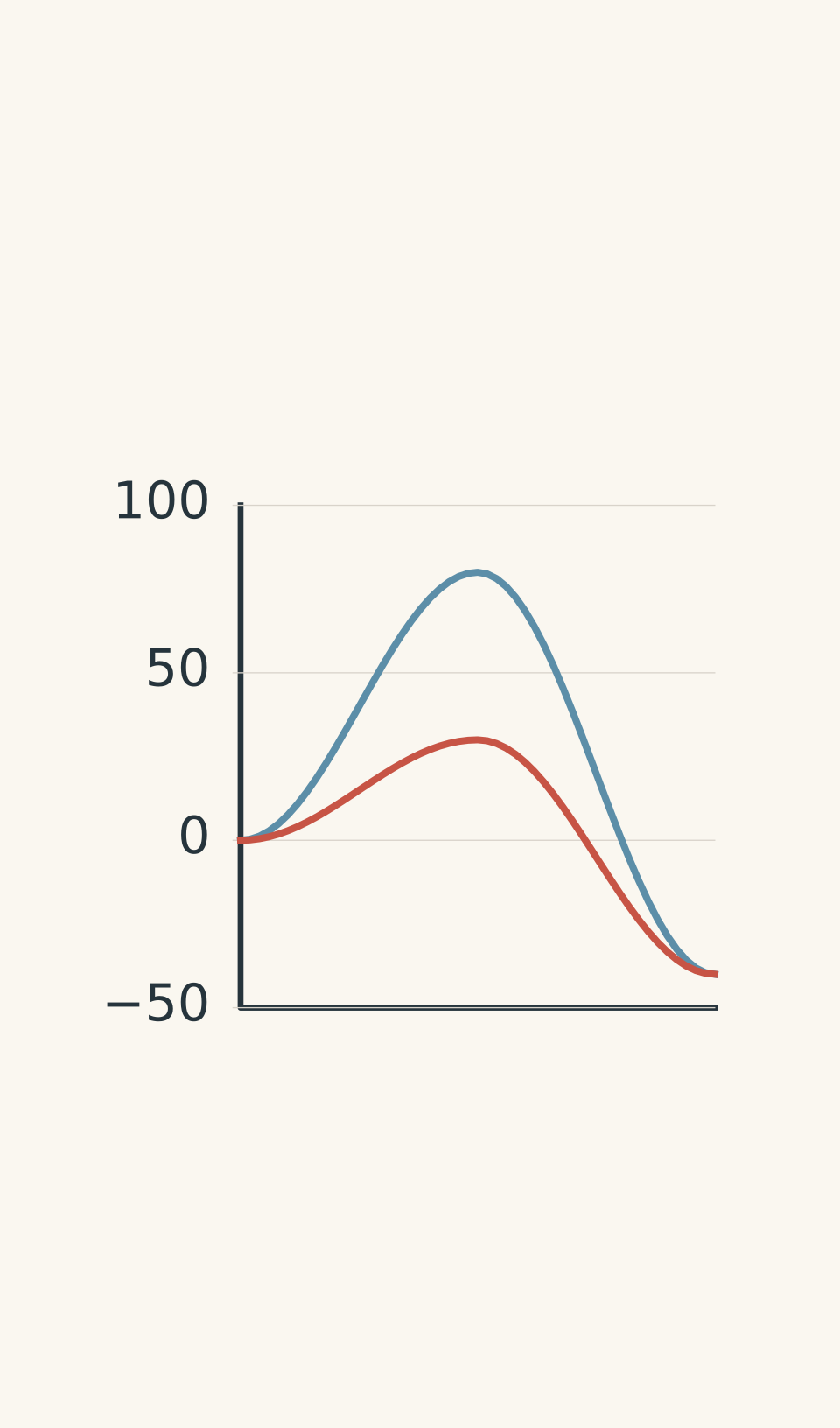
- Uncatalysed: Ea,fwd = 80; Ea,rev = 120
- Catalysed: Ea,fwd = 30; Ea,rev = 70
(c)(i) Adding iron(III) nitrate
Adding \(\mathrm{Fe}^{3+}\) increases a reactant concentration. The equilibrium shifts right, forming more red \(\mathrm{FeSCN}^{2+}\), so the red colour intensifies.
Marking guide (1 mark):
- Predicts the shift towards the red product. (1)
(c)(ii) Dilution
Dilution favours the side with more dissolved particles. The left side has two dissolved ions for each reaction event, while the right side has one complex ion. The equilibrium shifts left, and the red colour fades.
Marking guide (1 mark):
- Predicts a shift left and a fading red colour. (1)
(c)(iii) Increasing temperature
The forward reaction is exothermic. Heating favours the reverse, endothermic direction, so the equilibrium constant for the forward reaction decreases.
Marking guide (1 mark):
- States that \(K_c\) decreases. (1)
Solution 5
(a) Dissolving sodium chloride
Water is polar. Its partially negative oxygen end attracts \(\mathrm{Na}^{+}\), while its partially positive hydrogen ends attract \(\mathrm{Cl}^{-}\). These ion-dipole attractions help separate the ions from the ionic lattice and surround them with water molecules.
Separating the lattice ions requires energy, while hydration releases energy. The overall enthalpy change depends on the balance between these contributions. For sodium chloride, dissolution is slightly endothermic under ordinary conditions.
Marking guide (2 marks):
- Describes ion separation and hydration by polar water molecules. (1)
- Explains the energy absorbed in lattice separation and released during hydration. (1)
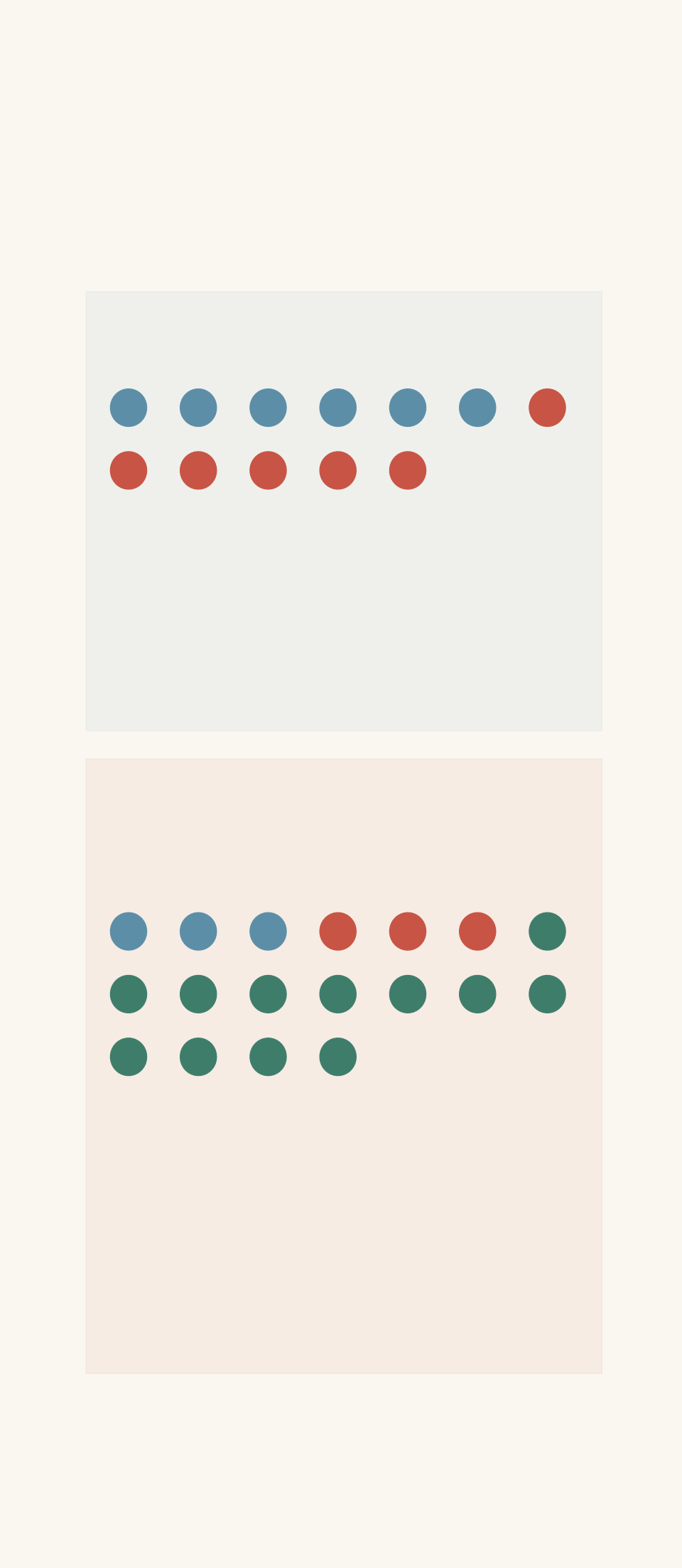
- Na⁺
- Cl⁻
- H₂O
(b) Calcium fluoride and \(K_{sp}\)
The balanced dissolution equation is
\[ \ce{CaF2(s) <=> Ca^2+(aq) + 2F^-(aq)} \]
The solid is omitted from the equilibrium expression. The dissolved ion concentrations are raised to the powers given by their coefficients.
\[ \boxed{K_{sp}=[\mathrm{Ca}^{2+}][\mathrm{F}^{-}]^2} \]
Marking guide (2 marks):
- Correct balanced dissolution equation. (1)
- Correct \(K_{sp}\) expression. (1)
(c)(i) Potassium chloride and silver nitrate
A precipitate of silver chloride forms.
\[ \boxed{\ce{Ag+(aq) + Cl^-(aq) -> AgCl(s)}} \]
Marking guide (2 marks):
- Identifies \(\ce{AgCl}\) as the precipitate. (1)
- Writes the correct balanced net ionic equation. (1)
(c)(ii) Potassium iodide and lead(II) nitrate
A yellow precipitate of lead(II) iodide forms.
\[ \boxed{\ce{Pb^2+(aq) + 2I^-(aq) -> PbI2(s)}} \]
Marking guide (2 marks):
- Identifies \(\ce{PbI2}\) as the precipitate. (1)
- Writes the correct balanced net ionic equation. (1)
(c)(iii) Sodium sulfate and barium nitrate
A white precipitate of barium sulfate forms.
\[ \boxed{\ce{Ba^2+(aq) + SO4^2-(aq) -> BaSO4(s)}} \]
Marking guide (2 marks):
- Identifies \(\ce{BaSO4}\) as the precipitate. (1)
- Writes the correct balanced net ionic equation. (1)
(d) Interpreting solubility tests
The observations support the conclusion that \(\ce{AgCl}\), \(\ce{PbI2}\), and \(\ce{BaSO4}\) are sparingly soluble under the test conditions.
They do not establish that every chloride, iodide, or sulfate is insoluble. Solubility depends on the ions present, and only a small selection of combinations has been tested. Further experiments are needed to establish broader solubility patterns.
Marking guide (2 marks):
- States a defensible conclusion about the specific products. (1)
- Explains why the results cannot establish a universal rule for all chlorides, iodides, and sulfates. (1)
Solution 6
(a) Molar solubility of silver chloride
The dissolution equilibrium is
\[ \ce{AgCl(s) <=> Ag+(aq) + Cl^-(aq)} \]
Let \(s\) be the molar solubility of \(\ce{AgCl}\). Each mole dissolved produces one mole of each ion, so
\[ [\mathrm{Ag}^{+}]=[\mathrm{Cl}^{-}]=s \]
Therefore,
\[ K_{sp}=s^2 \]
Substitute the supplied value:
\[ s^2=1.8\times10^{-10} \]
\[ s=\sqrt{1.8\times10^{-10}} \]
\[ \boxed{s=1.3\times10^{-5}\ \text{mol L}^{-1}} \]
Marking guide (3 marks):
- Relates both ion concentrations to \(s\). (1)
- Correctly solves \(s=\sqrt{K_{sp}}\). (1)
- Gives the answer with units and appropriate precision. (1)
(b) Molar solubility of calcium fluoride
The dissolution equilibrium is
\[ \ce{CaF2(s) <=> Ca^2+(aq) + 2F^-(aq)} \]
Let the molar solubility be \(s\). The stoichiometry gives
\[ [\mathrm{Ca}^{2+}]=s \]
\[ [\mathrm{F}^{-}]=2s \]
Substitute into the solubility-product expression:
\[ K_{sp}=s(2s)^2 \]
\[ 3.9\times10^{-11}=4s^3 \]
\[ s^3=\frac{3.9\times10^{-11}}{4} \]
\[ s=\sqrt[3]{9.75\times10^{-12}} \]
\[ \boxed{s=2.1\times10^{-4}\ \text{mol L}^{-1}} \]
Marking guide (3 marks):
- Correctly relates the ion concentrations to \(s\). (1)
- Obtains \(K_{sp}=4s^3\) and solves for \(s\). (1)
- Gives the answer with units and appropriate precision. (1)
(c) Predicting silver chloride precipitation
The total volume after mixing is
\[ V=50.0+50.0=100.0\ \text{mL} \]
Both solutions are diluted to twice their original volume.
For silver ions:
\[ [\mathrm{Ag}^{+}] =1.00\times10^{-3}\times\frac{50.0}{100.0} \]
\[ [\mathrm{Ag}^{+}]=5.00\times10^{-4}\ \text{mol L}^{-1} \]
For chloride ions:
\[ [\mathrm{Cl}^{-}] =2.00\times10^{-3}\times\frac{50.0}{100.0} \]
\[ [\mathrm{Cl}^{-}]=1.00\times10^{-3}\ \text{mol L}^{-1} \]
Calculate the reaction quotient for silver chloride:
\[ Q_{sp}=[\mathrm{Ag}^{+}][\mathrm{Cl}^{-}] \]
\[ Q_{sp}=(5.00\times10^{-4}) (1.00\times10^{-3}) \]
\[ Q_{sp}=5.00\times10^{-7} \]
Since
\[ Q_{sp}>K_{sp} \]
the mixture is supersaturated with respect to \(\ce{AgCl}\). A silver chloride precipitate forms.
Marking guide (3 marks):
- Correct concentrations after mixing. (1)
- Correct calculation of \(Q_{sp}\). (1)
- Correct comparison with \(K_{sp}\) and precipitation prediction. (1)
(d) Precipitation criterion
A precipitate is thermodynamically favoured when
\[ \boxed{Q_{sp}>K_{sp}} \]
At \(Q_{sp}=K_{sp}\), the solution is saturated. If \(Q_{sp}<K_{sp}\), precipitation is not predicted by this criterion.
Marking guide (1 mark):
- Correctly states \(Q_{sp}>K_{sp}\). (1)
Solution 7
(a) Initial concentrations after mixing
The total volume is
\[ V=5.00+5.00=10.00\ \text{mL} \]
Each stock solution is diluted by a factor of two.
For iron(III) ions:
\[ [\mathrm{Fe}^{3+}]_0 =2.00\times10^{-3}\times\frac{5.00}{10.00} \]
\[ [\mathrm{Fe}^{3+}]_0 =1.00\times10^{-3}\ \text{mol L}^{-1} \]
The same calculation applies to thiocyanate ions:
\[ [\mathrm{SCN}^{-}]_0 =1.00\times10^{-3}\ \text{mol L}^{-1} \]
Marking guide (2 marks):
- Correct initial \(\mathrm{Fe}^{3+}\) concentration. (1)
- Correct initial \(\mathrm{SCN}^{-}\) concentration. (1)
(b) Equilibrium concentrations
The measured equilibrium concentration is
\[ [\mathrm{FeSCN}^{2+}]_{eq} =3.60\times10^{-4}\ \text{mol L}^{-1} \]
The reaction consumes \(\mathrm{Fe}^{3+}\) and \(\mathrm{SCN}^{-}\) in a 1:1 ratio. Therefore, each reactant decreases by \(3.60\times10^{-4}\ \text{mol L}^{-1}\).
For iron(III) ions:
\[ [\mathrm{Fe}^{3+}]_{eq} =1.00\times10^{-3} -3.60\times10^{-4} \]
\[ [\mathrm{Fe}^{3+}]_{eq} =6.40\times10^{-4}\ \text{mol L}^{-1} \]
For thiocyanate ions:
\[ [\mathrm{SCN}^{-}]_{eq} =1.00\times10^{-3} -3.60\times10^{-4} \]
\[ [\mathrm{SCN}^{-}]_{eq} =6.40\times10^{-4}\ \text{mol L}^{-1} \]
Marking guide (3 marks):
- Uses the 1:1 stoichiometric relationship correctly. (1)
- Calculates equilibrium \(\mathrm{Fe}^{3+}\) concentration. (1)
- Calculates equilibrium \(\mathrm{SCN}^{-}\) concentration. (1)
(c) Calculate \(K_c\)
The equilibrium expression is
\[ K_c= \frac{[\mathrm{FeSCN}^{2+}]} {[\mathrm{Fe}^{3+}][\mathrm{SCN}^{-}]} \]
Substitute the equilibrium concentrations:
\[ K_c= \frac{3.60\times10^{-4}} {(6.40\times10^{-4})^2} \]
\[ K_c= \frac{3.60\times10^{-4}} {4.096\times10^{-7}} \]
\[ \boxed{K_c=8.79\times10^2} \]
This value applies to the experimental temperature and the concentration-based model used in the calculation.
Marking guide (3 marks):
- Correct equilibrium expression. (1)
- Correct substitution and arithmetic. (1)
- Correct final value with appropriate precision. (1)
(d) Experimental limitations
Two limitations are:
- Other chemical processes, such as iron(III) hydrolysis or formation of additional complexes, may affect the actual free-ion concentrations.
- Measurement uncertainty in the calibration curve or absorbance affects the calculated complex concentration and therefore \(K_c\).
Real solutions may also deviate from ideal behaviour because equilibrium activities are not always equal to measured concentrations.
Marking guide (2 marks):
- Identifies one valid experimental or chemical limitation. (1)
- Identifies a second distinct limitation. (1)
Solution 8
(a) Lead(II) phosphate \(K_{sp}\)
The dissolution equilibrium is
\[ \ce{Pb3(PO4)2(s) <=> 3Pb^2+(aq) + 2PO4^3-(aq)} \]
The solid is excluded from the equilibrium expression. The ion concentrations are raised to their stoichiometric powers.
\[ \boxed{ K_{sp}= [\mathrm{Pb}^{2+}]^3 [\mathrm{PO_{4}}^{3-}]^2 } \]
Marking guide (2 marks):
- Correct stoichiometric powers for the dissolved ions. (1)
- Correct expression with the solid omitted. (1)
(b) Calculate \(Q_{sp}\)
Use the same concentration expression as \(K_{sp}\), but substitute the current free-ion concentrations:
\[ Q_{sp}= [\mathrm{Pb}^{2+}]^3 [\mathrm{PO_{4}}^{3-}]^2 \]
\[ Q_{sp}= (2.0\times10^{-7})^3 (1.0\times10^{-10})^2 \]
\[ Q_{sp}= (8.0\times10^{-21}) (1.0\times10^{-20}) \]
\[ \boxed{Q_{sp}=8.0\times10^{-41}} \]
Compare the quotient with the supplied solubility product:
\[ 8.0\times10^{-41} > 1.0\times10^{-54} \]
Thus \(Q_{sp}>K_{sp}\). Under the model assumptions, lead(II) phosphate precipitation is thermodynamically favoured.
Marking guide (3 marks):
- Correct quotient expression and substitution. (1)
- Correct numerical value. (1)
- Correct comparison and precipitation prediction. (1)
(c) Environmental significance and limitations
Adding phosphate can favour the formation of a sparingly soluble lead phosphate solid. This reduces the free dissolved \(\mathrm{Pb}^{2+}\) concentration and can immobilise some lead.
However, the lead has not been destroyed. It has been transferred into a solid phase, which may require careful management.
Two important limitations are:
- Phosphate speciation: The proportion of total dissolved phosphate present as \(\mathrm{PO_{4}}^{3-}\) depends strongly on pH. Total phosphate concentration cannot automatically be substituted for free \(\mathrm{PO_{4}}^{3-}\) concentration.
- Other chemical processes: Dissolved organic matter, competing ions, other lead-containing solids, and reaction kinetics can affect the actual dissolved lead concentration.
A \(K_{sp}\) calculation is useful for predicting precipitation under specified conditions, but it does not fully describe every process in natural water.
Marking guide (3 marks):
- Explains how phosphate can lower free dissolved lead through precipitation or immobilisation. (1)
- Gives one valid limitation of the simplified model. (1)
- Gives a second distinct limitation. (1)
Lead immobilisation by phosphate
| Dissolved ions | Pb²⁺(aq) + PO₄³⁻(aq) Lead and phosphate ions are dissolved in water. |
|---|---|
| Precipitation | Pb₃(PO₄)₂(s) Some ions form a solid; lead remains in the system. |
Solution 9
(a) Identify the unknown ions
Sample X contains chloride ions, \(\mathrm{Cl}^{-}\).
The white precipitate with silver nitrate is consistent with silver chloride:
\[ \ce{Ag+(aq) + Cl^-(aq) -> AgCl(s)} \]
The white precipitate with lead(II) nitrate is also consistent with lead(II) chloride. The absence of a visible precipitate with barium nitrate is consistent with soluble barium chloride under the test conditions.
Sample Y contains iodide ions, \(\mathrm{I}^{-}\).
Silver nitrate produces pale-yellow silver iodide, while lead(II) nitrate produces yellow lead(II) iodide:
\[ \ce{Ag+(aq) + I^-(aq) -> AgI(s)} \]
\[ \ce{Pb^2+(aq) + 2I^-(aq) -> PbI2(s)} \]
The absence of a visible precipitate with barium nitrate is consistent with soluble barium iodide.
The sulfate option is ruled out because sulfate would be expected to produce a precipitate with barium ions under these conditions.
Marking guide (4 marks):
- Identifies X as \(\mathrm{Cl}^{-}\). (1)
- Justifies X using the observations. (1)
- Identifies Y as \(\mathrm{I}^{-}\). (1)
- Justifies Y using the observations. (1)
(b) Net ionic equations
One valid diagnostic equation for X is
\[ \boxed{\ce{Ag+(aq) + Cl^-(aq) -> AgCl(s)}} \]
One valid diagnostic equation for Y is
\[ \boxed{\ce{Ag+(aq) + I^-(aq) -> AgI(s)}} \]
The balanced lead(II) iodide equation is also acceptable for Y.
Marking guide (2 marks):
- Correct balanced net ionic equation for X. (1)
- Correct balanced net ionic equation for Y. (1)
(c) Controls and limitations
A useful procedural control is to use clean test tubes and separate droppers for each reagent. This reduces the risk of cross-contamination, which could create a false precipitate.
One limitation is that qualitative tests may be unreliable when ion concentrations are too low to produce visible precipitates. Mixed ions can also interfere with the observations.
Marking guide (2 marks):
- Gives one valid procedural control. (1)
- Gives one valid limitation of qualitative precipitation analysis. (1)
Solution 10
(a) Temperature and pressure
The forward ammonia reaction is exothermic. Decreasing temperature favours the exothermic direction, shifting the equilibrium towards ammonia.
The reactant side contains four moles of gas per balanced reaction event, while the product side contains two. Increasing pressure favours the side with fewer gas particles, so the equilibrium shifts towards ammonia.
Marking guide (2 marks):
- Correctly explains the effect of decreasing temperature for an exothermic reaction. (1)
- Correctly explains the effect of increasing pressure using gas stoichiometry. (1)
(b) Select the least expensive condition
The minimum acceptable ammonia mole fraction is 20%.
- Condition A gives 28% at a cost of 8 units.
- Condition C gives 39% at a cost of 13 units.
- Condition D gives 22% at a cost of 10 units.
- Condition B gives only 12%, so it fails the target.
Condition A is the least expensive option that meets the target.
\[ \boxed{\text{Condition A}} \]
Marking guide (2 marks):
- Identifies A as meeting the minimum yield requirement. (1)
- Correctly identifies A as the lowest-cost qualifying option. (1)
(c) Role of the catalyst
The iron catalyst provides an alternative reaction pathway with a lower activation energy. This increases the forward and reverse reaction rates, allowing equilibrium to be reached more quickly.
A catalyst does not change the equilibrium constant or equilibrium composition at a fixed temperature. It changes how quickly equilibrium is reached, not the equilibrium position itself.
Marking guide (2 marks):
- Explains the reduction in activation energy and faster approach to equilibrium. (1)
- States that \(K_c\) and the equilibrium composition are unchanged at fixed temperature. (1)
(d) Industrial strategies
Two valid strategies are:
1. Remove ammonia as it forms.
Ammonia can be cooled and separated from the gas mixture. Removing a product reduces its concentration and favours the forward reaction, allowing further ammonia to form. The equilibrium constant at the fixed temperature remains unchanged.
2. Recycle unreacted nitrogen and hydrogen.
Unreacted feed gases can be separated from the product stream and returned to the reactor. This gives the reactants further opportunities to form ammonia and reduces waste, improving overall production efficiency.
Other valid strategies include choosing an economically suitable compromise between temperature and pressure, improving heat recovery, or using efficient separation equipment. Each strategy must be explained in terms of its effect on production or operating cost.
Marking guide (4 marks):
- Identifies a valid first strategy. (1)
- Explains how the first strategy improves production or economics. (1)
- Identifies a distinct valid second strategy. (1)
- Explains how the second strategy improves production or economics. (1)