
HSC Chemistry Multiple Choice: How to Eliminate Wrong Answers
Learn how to identify misleading distractors, apply chemical principles, and eliminate incorrect HSC Chemistry multiple-choice answers. Includes worked examples and original practice questions with detailed solutions.
Two acid samples have the same volume and concentration. One contains hydrochloric acid, HCl, and the other contains sulfuric acid, H₂SO₄. You titrate each sample with sodium hydroxide of the same concentration.
A tempting multiple-choice answer says both samples require the same volume of sodium hydroxide. After all, the starting volumes and concentrations are identical.
Predict before reading on: is that answer correct?
No. The sulfuric acid requires twice as much sodium hydroxide. The reason is the mole ratio in the balanced equations:
\(\ce{HCl + NaOH -> NaCl + H2O}\)
\(\ce{H2SO4 + 2NaOH -> Na2SO4 + 2H2O}\)
One mole of HCl reacts with one mole of NaOH, while one mole of H₂SO₄ reacts with two moles of NaOH during complete neutralisation.
The incorrect option uses two true pieces of information but ignores a third: the reaction stoichiometry.
This is exactly what makes HSC Chemistry multiple-choice questions challenging. An incorrect option often contains something familiar and scientifically reasonable. Your job is to find the condition, relationship, or chemical principle that makes it wrong.
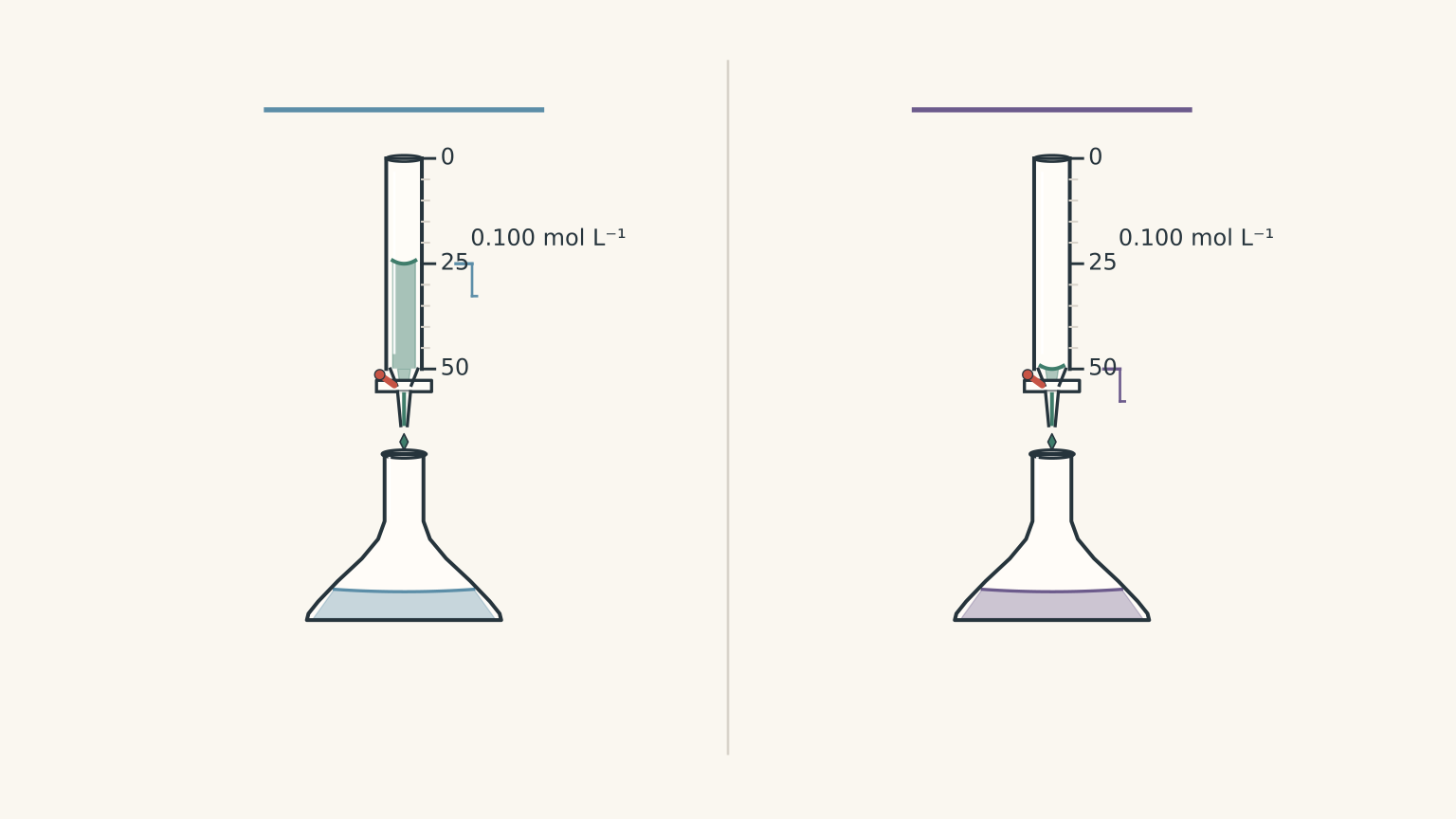
Due to technical limitations, this figure may display incorrectly or contain inaccuracies. Please check key details against your course materials.
01The elimination method: five steps that work
The most reliable way to eliminate an answer is to identify a chemical constraint that it violates.
A constraint is something that must be true for the chemistry to work. It might be conservation of atoms, conservation of charge, a mole ratio, an equilibrium condition, or a restriction imposed by the experimental setup.
You don’t always need to complete a lengthy calculation to reject an option. Sometimes one constraint is enough.
Step 1: Identify exactly what the question asks
Before looking at the options, translate the question into a simpler statement.
For example:
- Calculate the concentration means you need an amount of solute and a solution volume.
- Identify the oxidising agent means you need to determine which species is reduced.
- Predict the equilibrium shift means you need to consider what changed and what remained constant.
- Determine the functional group means you need to interpret the available structural or experimental evidence.
Pay particular attention to words such as:
- initially
- finally
- at equilibrium
- in excess
- completely
- aqueous
- constant temperature
- NOT or EXCEPT
These words can change the correct answer.
A question asking what happens immediately after a change is not necessarily asking what happens after equilibrium is restored.
Step 2: Find something that must be true
Before attempting complicated calculations, identify the strongest constraint available.
Different areas of chemistry have different useful starting points.
| Question topic | First constraint to check |
|---|---|
| Stoichiometry | Balanced equation and mole ratios |
| Dilution | Number of moles of solute remains constant |
| Acid-base chemistry | Acid-base strength, mole ratios, and volume |
| Equilibrium | Reaction conditions and equilibrium expression |
| Electrochemistry | Oxidation, reduction, and charge balance |
| Organic chemistry | Functional groups and reaction conditions |
| Spectroscopy | Whether all the observed features support the proposed structure |
For example, a proposed chemical equation that doesn’t conserve atoms can be eliminated immediately. There is no need to calculate anything else.
Similarly, an electrochemical answer that has electrons flowing in the wrong direction cannot be correct, even if its description of the electrodes sounds convincing.
Step 3: Eliminate contradictions, not unfamiliar words
An option isn’t incorrect just because it uses terminology you don’t recognise immediately.
Instead, ask whether it contradicts a known principle.
Consider these two statements:
- A catalyst increases the rate of a reaction.
- A catalyst shifts an equilibrium towards the products.
The first is correct. The second is not generally correct.
A catalyst provides an alternative reaction pathway with a lower activation energy. It increases the rates of both forward and reverse reactions, allowing equilibrium to be reached faster without changing the equilibrium composition.
An option containing two claims is only correct if both claims are correct.
This is particularly important when an answer begins with a familiar scientific fact and then draws an incorrect conclusion.
Step 4: Use estimates before detailed calculations
If a question involves numbers, estimate the expected direction and approximate size of the answer.
Suppose a solution is diluted to four times its original volume.
Its concentration must decrease to one-quarter of its original value.
If an answer suggests that the concentration increases, you can eliminate it without using a calculator.
If two options remain, calculate the answer properly and check the units.
Useful checks include:
- Concentration should have units such as mol L⁻¹.
- Amount of substance should be measured in mol.
- Mass should be measured in g.
- Volume conversions must be consistent.
- pH is logarithmic, not a linear measure.
A numerical answer with the wrong units is not correct simply because its number looks reasonable.
Step 5: Compare the final two options carefully
This is where many students lose marks.
When you have eliminated two answers, don’t reread the entire topic. Find the exact difference between the remaining options.
Do they disagree about:
- reaction rate or equilibrium position?
- total pressure or partial pressure?
- moles of a compound or moles of its ions?
- the direction of electron flow?
- whether a reaction is complete or at equilibrium?
Identify the principle that distinguishes the two statements.
Then check the question’s conditions again.
A familiar rule applied under the wrong conditions is still an incorrect answer.
02Worked examples: applying elimination across chemistry
The best way to develop this skill is to practise it across different areas of the course. The following examples demonstrate how the same reasoning works in numerical and conceptual questions.
Worked example: identifying the correct dilution calculation
A student takes 25.0 mL of a 0.160 mol L⁻¹ potassium nitrate solution and adds water until the total volume is 200.0 mL.
What is the final concentration?
A. 0.0200 mol L⁻¹
B. 0.0800 mol L⁻¹
C. 0.160 mol L⁻¹
D. 1.28 mol L⁻¹
Step 1
Adding water does not change the amount of potassium nitrate present.
The number of moles of solute remains constant, even though the volume increases.
The relationship we need is:
\[ n=cV \]
where:
- \(n\) is the amount of solute in mol
- \(c\) is concentration in mol L⁻¹
- \(V\) is solution volume in L
Step 2
Convert the initial volume into litres:
\[ 25.0\ \mathrm{mL}=0.0250\ \mathrm{L} \]
Then:
\[ \begin{aligned} n&=cV\\ &=0.160\times0.0250\\ &=0.00400\ \mathrm{mol} \end{aligned} \]
Step 3
The final volume is 200.0 mL, or 0.2000 L.
\[ \begin{aligned} c&=\frac{n}{V}\\ &=\frac{0.00400}{0.2000}\\ &=0.0200\ \mathrm{mol\,L^{-1}} \end{aligned} \]
Step 4
The correct answer is A, 0.0200 mol L⁻¹.
Notice how the options reveal common calculation errors:
- B is too high because it only halves the concentration.
- C ignores the dilution entirely.
- D incorrectly multiplies the concentration by the volume ratio.
There is also a useful elimination check: because the volume increases while the number of moles stays constant, the concentration must decrease.
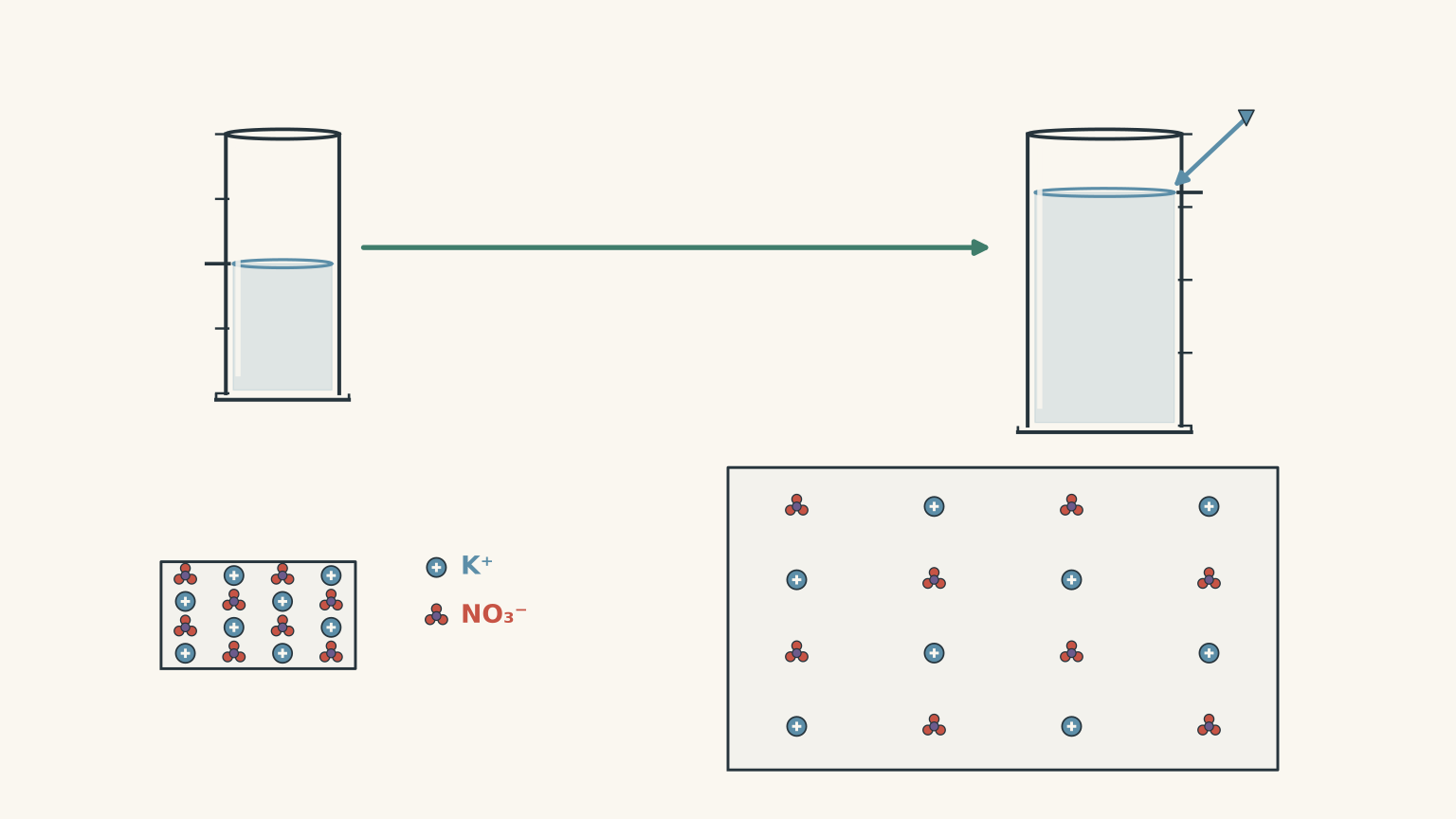
Due to technical limitations, this figure may display incorrectly or contain inaccuracies. Please check key details against your course materials.
Worked example: identifying the correct electrode reactions
A galvanic cell contains a magnesium electrode in magnesium nitrate solution and a silver electrode in silver nitrate solution.
The two half-cells are connected by a salt bridge and an external wire.
The standard reduction potentials are:
\[ \ce{Mg^2+(aq) + 2e^- -> Mg(s)} \]
\[ E^\circ=-2.37\ \mathrm{V} \]
\[ \ce{Ag+(aq) + e^- -> Ag(s)} \]
\[ E^\circ=+0.80\ \mathrm{V} \]
Which statement is correct?
A. Magnesium is the cathode.
B. Electrons flow from the silver electrode towards the magnesium electrode.
C. Silver ions gain electrons at the cathode.
D. Positive ions from the salt bridge migrate towards the magnesium half-cell.
Step 1
The standard reduction potential, \(E^\circ\), indicates the tendency of a species to undergo reduction under standard conditions.
The more positive reduction potential is associated with the half-reaction that occurs as reduction in a spontaneous galvanic cell.
Silver has the more positive reduction potential:
\[ +0.80\ \mathrm{V}>-2.37\ \mathrm{V} \]
Therefore, silver ions are reduced.
Step 2
Reduction occurs at the cathode.
Oxidation occurs at the anode.
The silver electrode is therefore the cathode, while magnesium is the anode.
The reactions are:
Oxidation at the anode:
\[ \ce{Mg(s) -> Mg^2+(aq) + 2e^-} \]
Reduction at the cathode:
\[ \ce{2Ag+(aq) + 2e^- -> 2Ag(s)} \]
Step 3
Magnesium releases electrons during oxidation.
Those electrons travel through the external wire towards the silver electrode, where silver ions gain them.
Therefore, electrons flow from magnesium to silver.
Step 4
As magnesium oxidises, \(\mathrm{Mg}^{2+}\) ions enter the magnesium solution.
This increases the positive charge in that half-cell, so negative ions from the salt bridge migrate towards it.
At the silver electrode, \(\mathrm{Ag}^{+}\) ions are consumed during reduction. Positive ions from the salt bridge migrate towards the silver half-cell to maintain charge balance.
Therefore, option D is also incorrect.
The correct answer is C: silver ions gain electrons at the cathode.
The important elimination strategy here is to establish oxidation and reduction first. Once you know which electrode is the anode and which is the cathode, the electron flow and salt bridge movement follow.
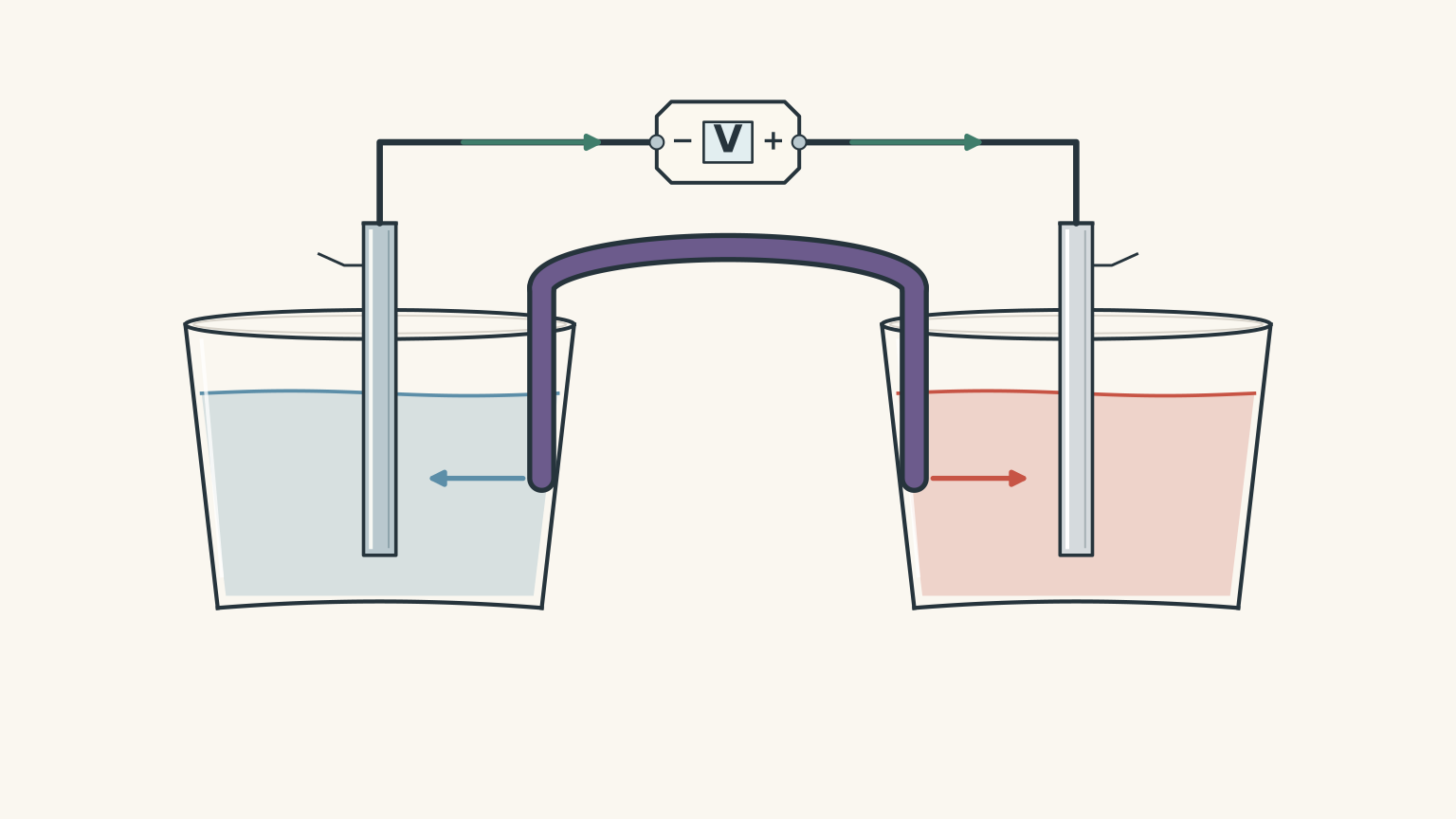
Due to technical limitations, this figure may display incorrectly or contain inaccuracies. Please check key details against your course materials.
03Recognising common HSC Chemistry distractors
Once you understand how questions are constructed, you can start recognising the reasoning behind incorrect options.
The following patterns appear across many different chemistry topics.
| Distractor pattern | What the question is testing |
|---|---|
| Correct substances, incorrect coefficients | Whether you understand mole ratios |
| Correct equation, incorrect calculation | Whether you can apply the equation correctly |
| Correct reaction direction, incorrect explanation | Whether you understand the governing principle |
| Confusing reaction rate with equilibrium position | Whether you distinguish kinetics from equilibrium |
| Confusing total pressure with partial pressure | Whether you understand gaseous equilibrium |
| Correct functional group clue, incomplete identification | Whether you can interpret multiple pieces of evidence |
| Correct numerical value, incorrect units | Whether you understand what the calculated quantity represents |
Watch out for statements that are only partly correct
This is one of the most useful habits to develop.
Suppose an option says:
“A catalyst increases the reaction rate and therefore increases the equilibrium yield of products.”
The first part is correct. The second part does not follow.
A catalyst increases the rates of both forward and reverse reactions. It does not change the equilibrium constant or the final equilibrium composition.
The whole option is therefore incorrect.
The same problem occurs with statements about acids, redox reactions, and organic chemistry.
An option might correctly identify a functional group but incorrectly describe its reaction. Another might identify the correct oxidising agent but reverse the direction of electron flow.
Always evaluate the complete statement.
Be careful with experimental conditions
A chemical principle does not operate independently of its conditions.
For example, an increase in pressure can affect a gaseous equilibrium when the volume of the system changes.
However, adding an inert gas at constant volume does not necessarily shift the equilibrium.
Similarly:
- A catalyst changes reaction rates, not the equilibrium constant.
- Increasing temperature changes the equilibrium constant.
- Dilution changes concentration, but not the number of moles of dissolved solute.
- The endpoint of a titration is not automatically identical to the theoretical equivalence point.
When an option uses words such as always, never, or must, check whether the statement is true under the conditions actually given.
04Questions and solutions
The following original questions apply elimination to different areas of HSC Chemistry.
Try each question before reading its solution. More importantly, identify the reason each incorrect option fails.
Question 1
A sample containing 0.0150 mol of calcium chloride, \(\ce{CaCl2}\), is dissolved completely in water.
How many moles of chloride ions are produced?
A. 0.00750 mol
B. 0.0150 mol
C. 0.0300 mol
D. 0.0450 mol
Solution 1
The correct answer is C, 0.0300 mol of chloride ions.
The key is the chemical formula of calcium chloride.
When calcium chloride dissolves, it dissociates according to:
\[ \ce{CaCl2(s) -> Ca^2+(aq) + 2Cl^-(aq)} \]
One mole of calcium chloride produces two moles of chloride ions.
Therefore:
\[ \begin{aligned} n(\mathrm{Cl}^{-})&=2\times n(\ce{CaCl2})\\ &=2\times0.0150\\ &=0.0300\ \mathrm{mol} \end{aligned} \]
The tempting answer is B because it uses the original number of moles without considering the subscript 2.
Option D counts three total ions per formula unit, rather than counting only chloride ions.
The elimination lesson is simple: distinguish between the number of moles of a compound and the number of moles of a particular ion produced by that compound.
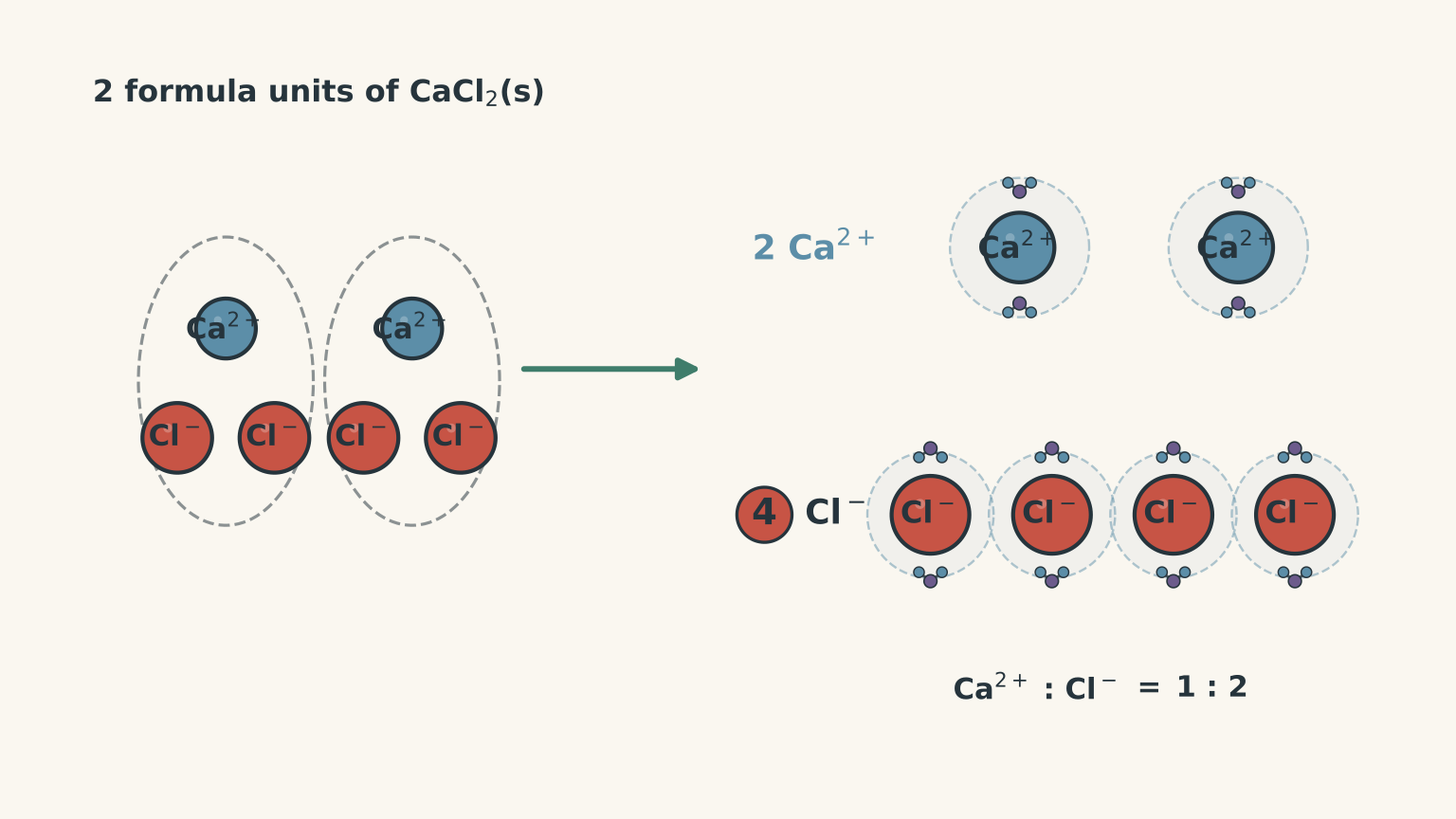
Due to technical limitations, this figure may display incorrectly or contain inaccuracies. Please check key details against your course materials.
Question 2
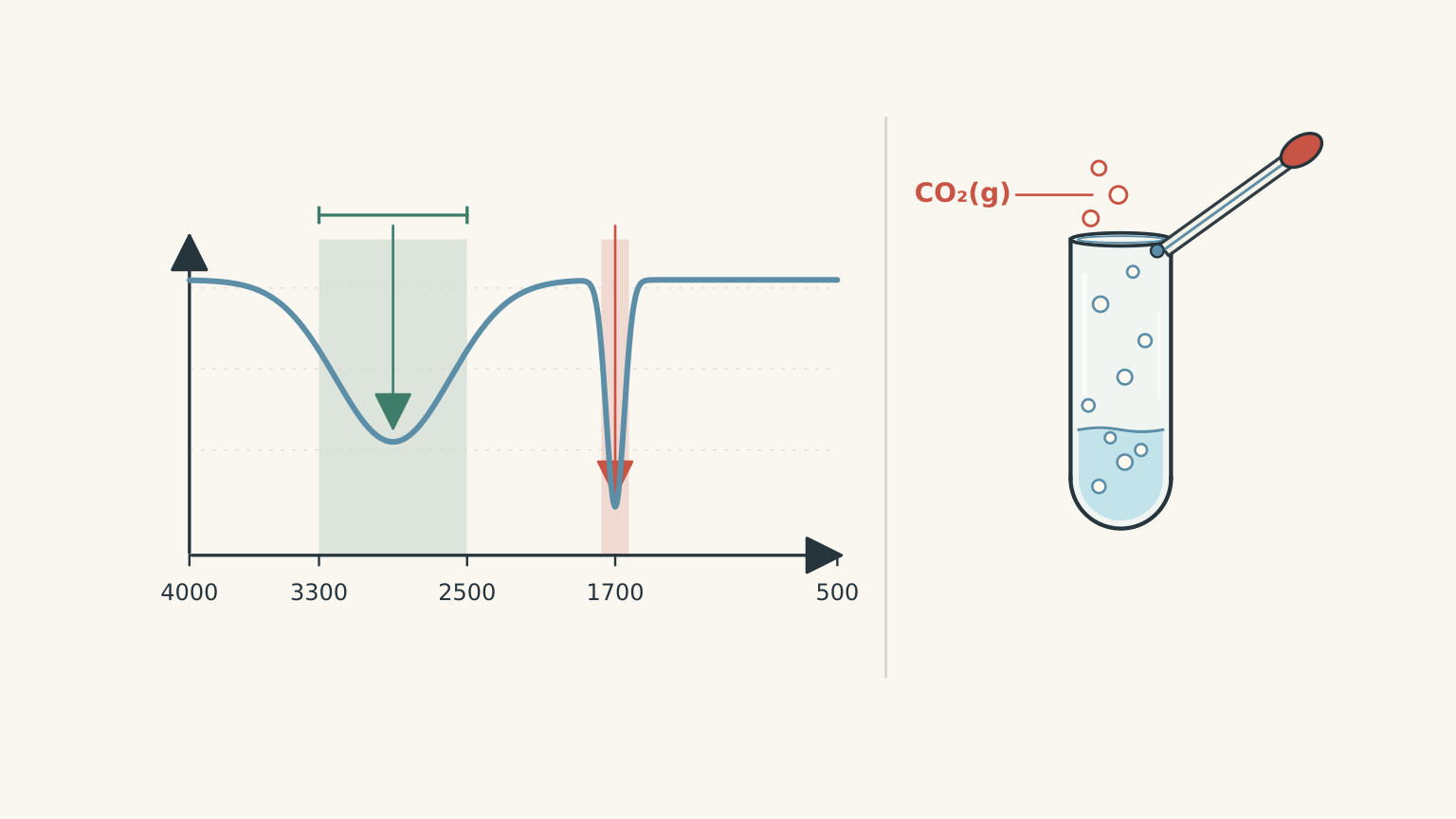
An unknown liquid has the molecular formula \(\ce{C2H4O2}\).
Its infrared spectrum shows:
- A strong absorption near \(1700\ \mathrm{cm^{-1}}\).
- A very broad absorption between \(2500\) and \(3300\ \mathrm{cm^{-1}}\).
The liquid also reacts with aqueous sodium hydrogencarbonate, producing bubbles.
Which conclusion is best supported by this evidence?
A. The compound is an ester because it contains a carbonyl group.
B. The compound is a carboxylic acid because its infrared spectrum and reaction with sodium hydrogencarbonate support this functional group.
C. The compound is an alcohol because an O-H absorption is present.
D. The compound is an aldehyde because a carbonyl absorption is present.
Solution 2
The correct answer is B: the compound is a carboxylic acid.
The important strategy is to combine the evidence rather than identifying the compound from a single absorption.
The strong absorption near \(1700\ \mathrm{cm^{-1}}\) indicates a carbonyl group, \(\ce{C=O}\).
However, carbonyl groups occur in several functional groups, including aldehydes, ketones, esters, and carboxylic acids.
That absorption alone does not identify the compound.
The broad absorption between \(2500\) and \(3300\ \mathrm{cm^{-1}}\) is characteristic of the O-H bond in a carboxylic acid.
The chemical test provides further confirmation.
Carboxylic acids react with sodium hydrogencarbonate to produce carbon dioxide gas:
\[ \ce{2CH3COOH + 2NaHCO3 -> 2CH3COONa + 2CO2 + 2H2O} \]
The bubbles are consistent with the release of carbon dioxide.
Together, the evidence supports a carboxylic acid. Given the molecular formula, the compound is ethanoic acid.
Why are the other options wrong?
- A identifies a carbonyl group but ignores the broad acid O-H absorption and the bicarbonate reaction.
- C recognises an O-H bond but ignores the carbonyl absorption and the chemical test.
- D recognises the carbonyl group but ignores the additional evidence for a carboxylic acid.
The important lesson is that one piece of experimental evidence rarely tells the whole story. Look for agreement between different observations.
Due to technical limitations, this figure may display incorrectly or contain inaccuracies. Please check key details against your course materials.
Question 3
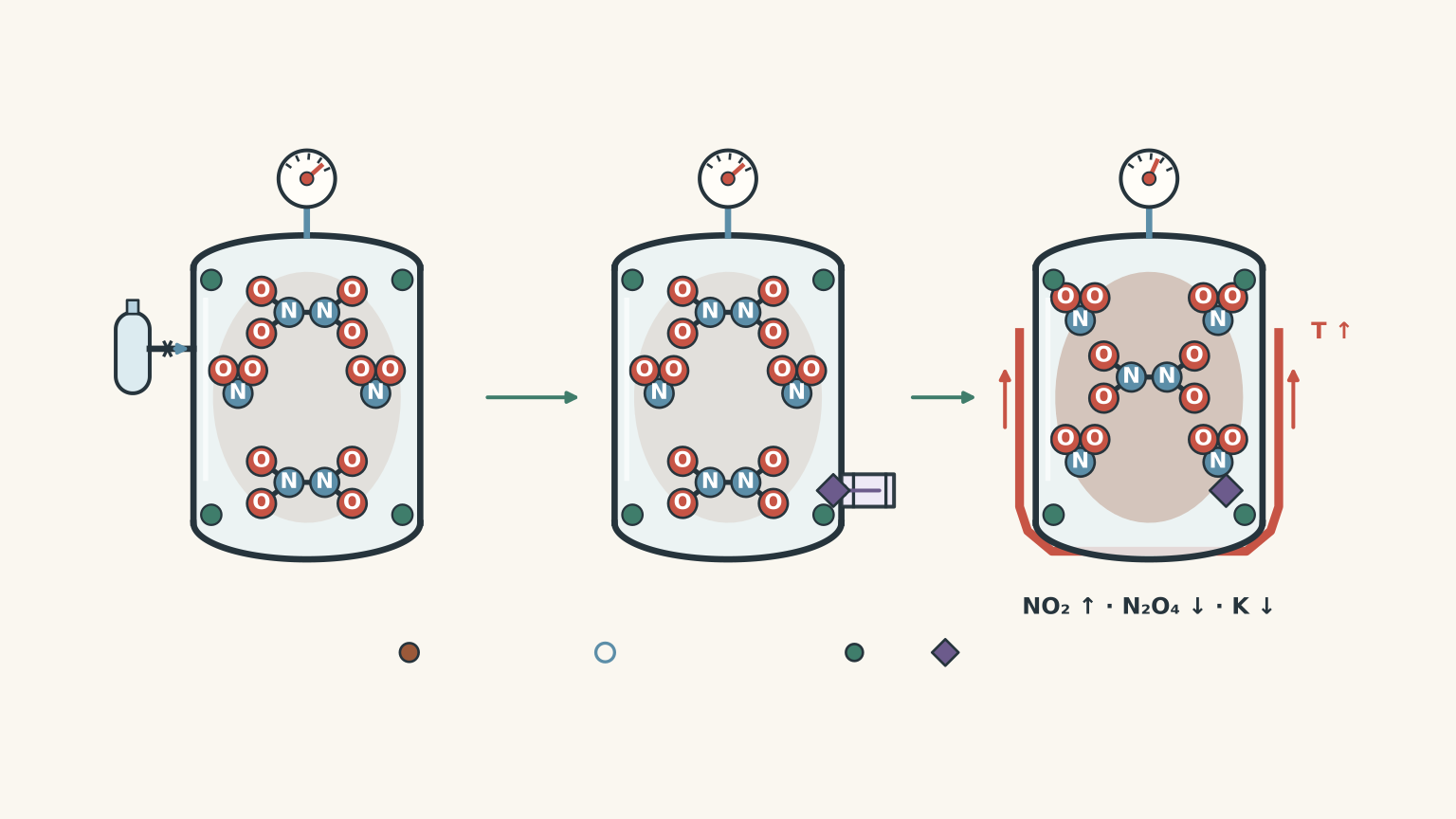
At equilibrium, a rigid, sealed vessel contains brown nitrogen dioxide gas and colourless dinitrogen tetroxide gas.
The reaction is:
\[ \ce{2NO2(g) <=> N2O4(g)} \]
The forward reaction is exothermic.
A student makes three changes in sequence:
- Adds helium gas without changing the vessel volume.
- Adds a catalyst.
- Increases the temperature while keeping the vessel volume constant.
The pressure gauge records an increase in total pressure after helium is added.
Assume ideal gas behaviour and allow the system to reach equilibrium after each change.
Which statement correctly describes the changes to the equilibrium mixture and equilibrium constant?
A. Adding helium shifts the equilibrium to the right. Adding a catalyst shifts it further right. Heating shifts it left and decreases the equilibrium constant.
B. Adding helium causes no equilibrium shift. Adding a catalyst causes no equilibrium shift. Heating shifts the equilibrium to the left and decreases the equilibrium constant.
C. Adding helium causes no equilibrium shift. Adding a catalyst shifts the equilibrium to the right. Heating shifts the equilibrium to the right and increases the equilibrium constant.
D. Adding helium shifts the equilibrium to the left. Adding a catalyst decreases the equilibrium constant. Heating causes no equilibrium shift.
Solution 3
The correct answer is B.
The important distinction is between total pressure, the partial pressures of reacting gases, reaction rates, and the equilibrium constant.
Each change affects a different part of the system.
First change: adding helium
The vessel is rigid, so its volume does not change.
The temperature also remains constant.
Adding helium increases the total pressure because there are now more gas particles in the vessel.
However, the partial pressures of nitrogen dioxide and dinitrogen tetroxide remain unchanged.
For an ideal gas:
\[ p_i=\frac{n_iRT}{V} \]
where \(p_i\) is the partial pressure of a gas, \(n_i\) is its amount in moles, \(R\) is the gas constant, \(T\) is absolute temperature, and \(V\) is volume.
The amounts of both reacting gases, the temperature, and the volume have not changed.
Therefore, their partial pressures remain constant.
The reaction quotient remains equal to the equilibrium constant, so there is no net shift.
This is where option A becomes tempting. It notices that total pressure increases and assumes the equilibrium must respond.
But the pressure increase comes from adding an inert gas, not from changing the partial pressures of the reacting gases.
Second change: adding a catalyst
A catalyst provides an alternative reaction pathway with a lower activation energy.
It increases the rates of both the forward and reverse reactions.
Because the system was already at equilibrium, the two rates remain equal after the catalyst is added.
There is no net shift in equilibrium position.
The equilibrium constant also remains unchanged.
A catalyst affects how quickly equilibrium is reached, not the final equilibrium composition.
Third change: increasing the temperature
This change does affect the equilibrium constant.
The forward reaction is exothermic, meaning heat is released.
We can represent the reaction conceptually as:
\[ \ce{2NO2(g) <=> N2O4(g) + heat} \]
Increasing temperature adds heat to the system.
According to Le Chatelier’s principle, the equilibrium responds in the direction that opposes the temperature increase.
It therefore favours the reverse, endothermic reaction.
The equilibrium shifts to the left, producing more nitrogen dioxide.
Because the forward reaction is exothermic, increasing temperature decreases the equilibrium constant for the reaction as written.
The brown colour of the mixture also becomes more intense as the concentration of brown nitrogen dioxide increases.
Due to technical limitations, this figure may display incorrectly or contain inaccuracies. Please check key details against your course materials.
The key lesson is that several changes can affect a chemical system in different ways. You must identify exactly what each change affects before predicting the result.
05Turn incorrect answers into useful revision
Getting a multiple-choice question wrong is useful only if you understand why.
Simply recording that the answer was C instead of B doesn’t tell you what to revise.
After completing a practice paper, create a short error log.
| Your mistake | What you should revise |
|---|---|
| Ignored a coefficient in a balanced equation | Stoichiometric mole ratios |
| Used the initial volume instead of final volume | Dilution calculations |
| Confused anode and cathode | Oxidation and reduction |
| Assumed a catalyst changes equilibrium position | Reaction kinetics and equilibrium |
| Identified an organic compound from one IR absorption | Functional groups and spectroscopy |
| Treated total pressure as partial pressure | Gaseous equilibrium |
Try to write one sentence explaining why your chosen answer was wrong.
For example:
“I chose the answer that predicted a shift after adding helium because I confused total pressure with the partial pressures of the reacting gases.”
That sentence identifies a specific misunderstanding you can correct.
Over time, you’ll also notice which types of distractors repeatedly catch you out. Those are the areas worth revisiting before attempting another paper.
06Check that your practice matches your HSC syllabus
There is an important syllabus consideration for NSW Chemistry students.
At the time of writing, November 2026, the Chemistry Stage 6 (2017) syllabus remains the current syllabus for Years 11 and 12.
NESA’s new Chemistry 11-12 (2025) syllabus has a different implementation schedule:
- 2026 and 2027: schools prepare for the new syllabus.
- Term 1, 2028: the new syllabus begins for Year 11.
- During 2028: Year 12 continues with the Chemistry Stage 6 (2017) syllabus.
- 2029: the first HSC examination based on the new Chemistry syllabus.
This means students sitting the 2026, 2027, and 2028 HSC examinations should prepare using the 2017 Chemistry syllabus.
Don’t assume that a newly published syllabus has already replaced the one you’re studying.
You can check the official NESA senior syllabus list and the Chemistry 11-12 (2025) syllabus implementation schedule.
When practising with past HSC papers, prioritise recent examinations and their marking feedback. Check older questions against your syllabus before treating them as examinable content.
07The skill that makes the difference
Strong multiple-choice performance isn’t about spotting familiar-looking answers or memorising tricks.
It’s about understanding what must be true.
A balanced equation constrains the mole ratios. Conservation of charge constrains ion movement. Reaction conditions constrain equilibrium behaviour. Experimental evidence constrains which chemical structures are plausible.
When you can explain why three options are wrong, you usually understand the chemistry much better than when you simply recognise the correct letter.
The next step is to apply that same reasoning to short-answer and extended-response questions, where you need to make your chemical thinking explicit through equations, calculations, and explanations.
This is also the approach used in tutorgum’s online HSC Chemistry tutoring: building the underlying understanding needed to tackle unfamiliar questions, rather than relying on memorised answer patterns.