
R and S Configuration: Assigning Absolute Configuration
Learn how to assign R and S configuration to simple stereocentres using CIP priority rules and three-dimensional molecular drawings. This extension guide builds on HSC Year 12 organic chemistry and goes beyond the required syllabus.
Two bottles can contain molecules with exactly the same atoms and bonds, yet the molecules can be mirror images that cannot be superimposed. The difference is not in which atoms are connected. It is in how those atoms are arranged in three dimensions.
Take 2-butanol, \(\ce{CH3CH(OH)CH2CH3}\). Its central carbon is attached to four different groups: \(\ce{OH}\), \(\ce{H}\), \(\ce{CH3}\), and \(\ce{CH2CH3}\). There are two possible spatial arrangements, and chemists need a reliable way to distinguish them.
That is the problem solved by R and S configuration. It gives a molecule a precise label based on the three-dimensional arrangement of its groups.
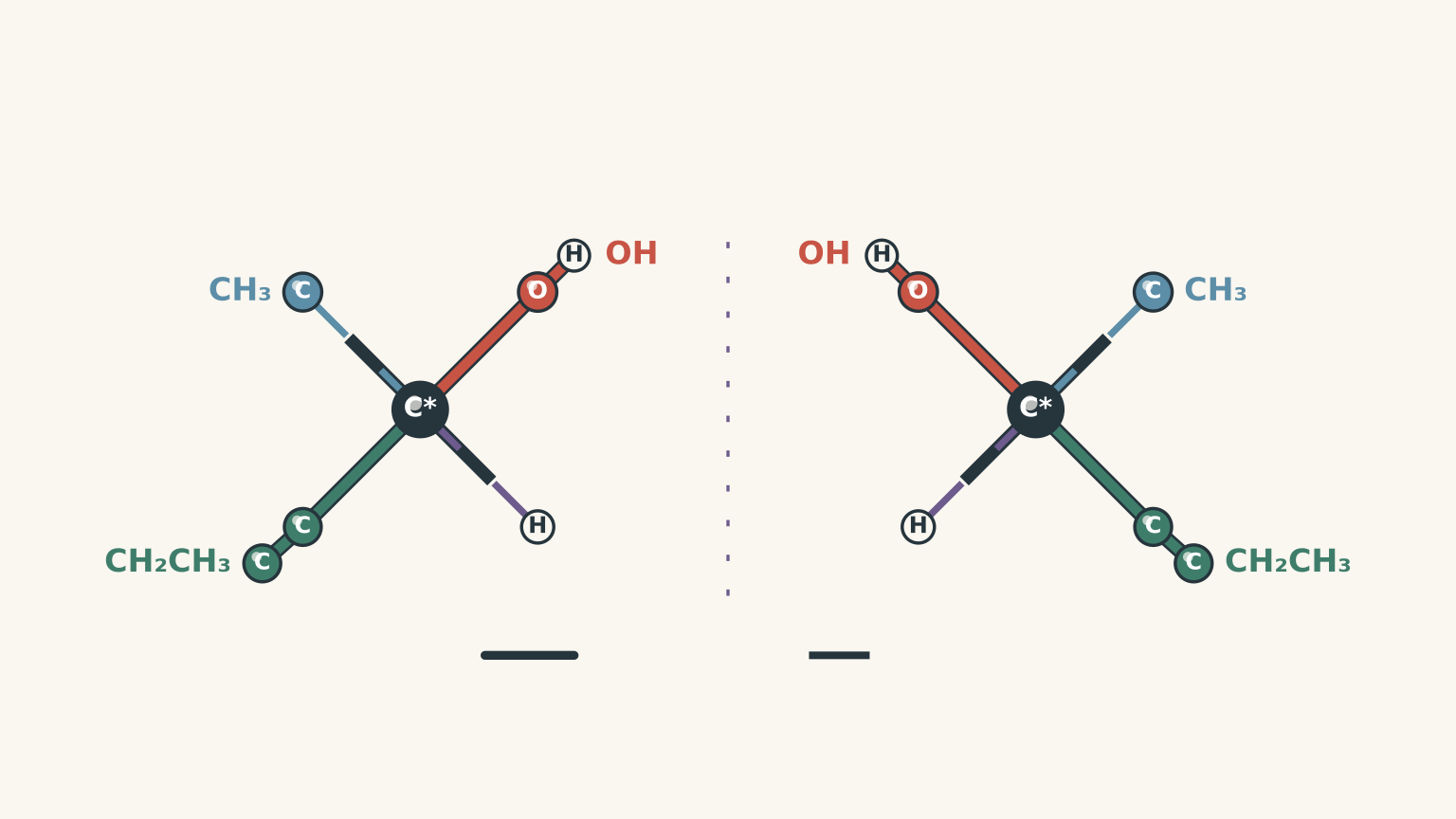
Due to technical limitations, this figure may display incorrectly or contain inaccuracies. Please check key details against your course materials.
First, a syllabus distinction: assigning R and S configuration is an extension beyond the required HSC Chemistry content covered by the relevant organic chemistry syllabus dot points. It is not an additional HSC assessment requirement.
The Year 12 organic chemistry content is the starting point for this explanation, rather than an assessment prerequisite. The Chemistry 11-12 Syllabus (2025) includes using molecular formulas, condensed structural formulas, expanded structural formulas, and skeletal structures to represent hydrocarbons. R/S notation takes that structural knowledge further by introducing a way to describe three-dimensional arrangements.
There is also a timing detail worth knowing: the 2025 syllabus is scheduled for implementation from 2028, with the first HSC examination under the new syllabus in 2029. Until then, the existing Chemistry Stage 6 Syllabus (2017) continues to apply to Year 12 students. You can check the implementation details in the official NESA syllabus information.
01From a structural formula to a 3D molecule
Before assigning R or S, you need to be comfortable reading the structure of an organic molecule. Different structural representations show different amounts of information.
Consider butane, a four-carbon hydrocarbon with the molecular formula \(\ce{C4H10}\).
| Representation | Example or description | What it tells you |
|---|---|---|
| Molecular formula | \(\ce{C4H10}\) | The number of each type of atom, but not how they are connected. |
| Condensed structural formula | \(\ce{CH3CH2CH2CH3}\) | The order of the carbon atoms and their attached hydrogens. |
| Expanded structural formula | Every C-C and C-H bond is drawn explicitly. | The individual atoms and their connectivity. |
| Skeletal structure | A four-carbon zigzag chain. | The carbon framework, with carbon atoms at line ends and corners and carbon-bound hydrogens omitted. |
These representations are useful, but they do not automatically show the three-dimensional arrangement of atoms around a carbon.
For that, we need to look more closely at the geometry of the molecule.
02What makes a carbon a stereocentre?
Imagine a carbon atom connected to four different groups. Each bond points in a different direction, creating a roughly tetrahedral arrangement.
This carbon is called a chiral centre or, in this context, a stereocentre.
The important condition is that all four attached groups must be different.
For example, the central carbon in 2-butanol has:
- An \(\ce{OH}\) group.
- A hydrogen atom.
- A methyl group, \(\ce{CH3}\).
- An ethyl group, \(\ce{CH2CH3}\).
All four are different, so the carbon is a stereocentre.
Now imagine replacing the ethyl group with another methyl group. The carbon would have two identical groups, so it would no longer meet this condition. You could not assign R or S to that carbon using the method in this guide.
A useful way to picture chirality is to compare your left and right hands. They are mirror images, but rotating one hand cannot make it fit exactly over the other. Chiral molecules can have the same problem: their mirror images are not superimposable.
The R and S labels distinguish these two possible arrangements. They describe the molecule’s absolute configuration: its actual three-dimensional arrangement, rather than how it happens to look from a particular viewing angle.
03Reading three-dimensional chemical drawings
Chemists use three types of bond lines to represent the three-dimensional arrangement around a stereocentre.
| Drawing convention | Meaning |
|---|---|
| Ordinary straight line | Bond lies approximately in the plane of the page. |
| Solid wedge | Bond projects towards you, out of the page. |
| Hashed wedge | Bond projects away from you, behind the page. |
Think of the central carbon as a four-way junction. The ordinary lines show two groups in the drawing’s plane, while the wedges show which of the remaining groups is closer to you and which is further away.
This distinction is essential. A solid wedge does not mean a group has higher priority. It only tells you its direction in space.
A flat structural formula might tell you that a carbon is attached to Br, OH, CH3, and H. A wedge-and-dash drawing tells you how those four groups are arranged around it.
04Step 1: Give each group a priority
To assign R or S, you first need to rank the four attached groups from highest to lowest priority.
Chemists use the Cahn-Ingold-Prelog rules, usually shortened to the CIP rules.
For the simple tetrahedral carbon centres in this article, the rules can be applied in a few manageable steps.
Rule 1: Compare the atoms directly attached to the stereocentre
The atom with the higher atomic number receives the higher priority.
Atomic number is the number of protons in an atom’s nucleus.
For example:
| Atom | Atomic number |
|---|---|
| Bromine (Br) | 35 |
| Chlorine (Cl) | 17 |
| Sulfur (S) | 16 |
| Oxygen (O) | 8 |
| Nitrogen (N) | 7 |
| Carbon (C) | 6 |
| Hydrogen (H) | 1 |
Therefore, if a stereocentre is attached to Br, OH, CH3, and H, the priorities begin as follows:
- Br, because bromine has the highest atomic number.
- OH, because its directly attached atom is oxygen.
- CH3, because its directly attached atom is carbon.
- H, because hydrogen has the lowest atomic number.
Notice that we compare the atoms directly attached to the central carbon, not the total number of atoms in each group.
Rule 2: If the directly attached atoms are identical, move outwards
This is where priority assignment becomes more interesting.
Suppose two groups are both attached to the stereocentre through carbon. You cannot distinguish them using the first rule.
Instead, compare the atoms attached to each of those carbon atoms.
List the attached atoms in descending order of atomic number. Compare the lists one position at a time. The first difference determines which group has higher priority.
Consider these two groups:
- \(\ce{CH2OH}\)
- \(\ce{CH3}\)
Both attach to the stereocentre through carbon.
However, the carbon in \(\ce{CH2OH}\) is attached to oxygen, hydrogen, and hydrogen. Its comparison list is:
\[ [O,H,H] \]
The carbon in \(\ce{CH3}\) is attached to three hydrogen atoms:
\[ [H,H,H] \]
Oxygen has a higher atomic number than hydrogen, so:
\[ \ce{CH2OH > CH3} \]
The hydroxymethyl group receives the higher priority.
A useful way to think about this is alphabetical sorting. When comparing two words, the first letter that differs decides which comes first. You do not add up all the letters or search for the most impressive letter somewhere near the end.
CIP priority works similarly, except the comparison uses atomic numbers and the molecular branches must be examined systematically.
Rule 3: Keep comparing until you find a difference
Sometimes the first attached atoms are identical, and the next atoms are identical too.
Do not guess based on which group looks longer. Continue comparing corresponding atoms further along each branch until you find the first difference.
For example, compare:
- \(\ce{CH(CH3)2}\), an isopropyl group.
- \(\ce{CH2CH3}\), an ethyl group.
Both attach to the stereocentre through carbon.
The carbon in the isopropyl group is attached to:
\[ [C,C,H] \]
The carbon in the ethyl group is attached to:
\[ [C,H,H] \]
The first entries are equal, but the second entries differ. Carbon has a higher atomic number than hydrogen, so:
\[ \ce{CH(CH3)2 > CH2CH3} \]
The isopropyl group has higher priority.
This is an important rule: the first point of difference wins. You do not keep comparing once a difference has been established.
Rule 4: Account for double and triple bonds
Multiple bonds need a small adjustment.
For CIP priority comparisons, a double bond is treated as though each atom were connected to a duplicate copy of the atom at the other end of the double bond.
These duplicate atoms are bookkeeping devices. They are not extra atoms physically present in the molecule.
Consider an aldehyde group, \(\ce{CHO}\), compared with a hydroxymethyl group, \(\ce{CH2OH}\).
The carbon in \(\ce{CHO}\) is double-bonded to oxygen and bonded to hydrogen. For priority purposes, its comparison list is:
\[ [O,O,H] \]
The carbon in \(\ce{CH2OH}\) is bonded to oxygen and two hydrogens:
\[ [O,H,H] \]
The first entries are equal. The second entries differ, and oxygen has a higher atomic number than hydrogen.
Therefore:
\[ \ce{CHO > CH2OH} \]
The aldehyde group receives higher priority.
The same bookkeeping idea applies to carbon-carbon double bonds. Triple bonds require two duplicate entries for the atom at the other end.
A note about isotopes
If two directly attached atoms are isotopes of the same element, the isotope with the higher mass number receives higher priority.
For example, deuterium (\({}^{2}\mathrm{H}\)) has higher priority than ordinary hydrogen (\({}^{1}\mathrm{H}\)).
You will not need this detail for most simple examples, but it is part of the CIP priority system.
The rules above are the basic toolkit for a single tetrahedral stereocentre. More complicated molecules, particularly those containing rings or multiple stereogenic centres, can require additional CIP sequence rules. The complete system is set out in the IUPAC Blue Book, Chapter P-9.
05Step 2: Turn the priorities into R or S
Once you have ranked all four groups, assigning the configuration is straightforward.
The key is to look at the molecule from the correct direction.
First, position the lowest-priority group (priority 4) pointing away from you.
This is normally shown using a hashed wedge.
Then follow the remaining groups in order:
\[ 1 \longrightarrow 2 \longrightarrow 3 \]
There are two possibilities:
- Clockwise movement from 1 to 2 to 3 gives R.
- Anticlockwise movement from 1 to 2 to 3 gives S.
The letters come from Latin: R stands for rectus (right), and S stands for sinister (left).
There is one catch.
What if priority 4 points towards you instead of away?
You reverse the result.
| Position of priority 4 | Clockwise 1 → 2 → 3 | Anticlockwise 1 → 2 → 3 |
|---|---|---|
| Away from you (hashed wedge) | R | S |
| Towards you (solid wedge) | S | R |
This reversal is one of the most common sources of mistakes.
If priority 4 lies in the plane of the page, do not simply guess the direction. Reorient the entire three-dimensional molecule until priority 4 points away, keeping the arrangement of all four groups intact.
Remember the difference between rotating a molecule and swapping two groups. Rotating the entire molecule does not change its configuration. Swapping the positions of any two groups does change the configuration.
06Worked examples
Worked example: Assign the configuration of 2-butanol
A molecule of 2-butanol has a stereocentre attached to OH, H, CH3, and CH2CH3. In the drawing, H points away from the viewer on a hashed wedge. OH is at the top, CH2CH3 is at the lower-right, and CH3 is at the lower-left. Determine whether the stereocentre is R or S.
Step 1
The directly attached atoms are:
- OH: oxygen.
- H: hydrogen.
- CH3: carbon.
- CH2CH3: carbon.
Oxygen has the highest atomic number, so OH is priority 1. Hydrogen has the lowest, so H is priority 4.
We still need to compare the two carbon groups.
Step 2
The carbon in CH2CH3 is attached to C, H, and H.
The carbon in CH3 is attached to H, H, and H.
Carbon outranks hydrogen, so the ethyl group receives higher priority.
The final ranking is:
| Priority | Group |
|---|---|
| 1 | OH |
| 2 | CH2CH3 |
| 3 | CH3 |
| 4 | H |
Step 3
Hydrogen is on a hashed wedge, so it points away from the viewer.
We can read the sequence directly.
Step 4
Starting at OH at the top, moving to ethyl at the lower-right, and then to methyl at the lower-left gives a clockwise direction.
Answer: The stereocentre has R configuration.
The important part is that we ranked the groups before following the direction. If you had simply followed the positions of the groups without checking their priorities, you could easily assign the wrong configuration.
Worked example: Compare two carbon branches
A stereocentre is attached to F, H, CH2OH, and CH(CH3)2. In the drawing, H points away from the viewer, F is at the top, CH2OH is at the lower-right, and CH(CH3)2 is at the lower-left. Determine its configuration.
Step 1
Fluorine has atomic number 9, while hydrogen has atomic number 1.
Therefore:
- F is priority 1.
- H is priority 4.
The remaining two groups both attach through carbon, so we need another comparison.
Step 2
For CH2OH, the attached atoms are:
\[ [O,H,H] \]
For CH(CH3)2, the attached atoms are:
\[ [C,C,H] \]
Oxygen has a higher atomic number than carbon.
Therefore, CH2OH receives priority 2, while CH(CH3)2 receives priority 3.
Step 3
The complete priority order is:
- F
- CH2OH
- CH(CH3)2
- H
Hydrogen points away from the viewer, so we can follow the sequence directly.
Step 4
The sequence moves from F at the top to CH2OH at the lower-right and then to CH(CH3)2 at the lower-left.
This is clockwise.
Answer: The stereocentre has R configuration.
Notice the interesting result: the CH2OH group outranks the isopropyl group even though the latter has two carbon branches. The oxygen is encountered at the first point of difference, so it determines the ranking.
07R/S configuration is not optical rotation
There is one final distinction worth making before you practise.
You may have encountered the symbols (+) and (−) when studying optical activity. These describe the experimentally observed direction in which a chiral substance rotates plane-polarised light.
They are not alternative ways of writing R and S.
A polarimeter measures optical rotation. R/S configuration, by contrast, is assigned from the three-dimensional structure using CIP priorities.
There is no general rule that an R molecule must rotate light clockwise or that an S molecule must rotate it anticlockwise.
For a pair of pure enantiomers measured under identical conditions, the optical rotations have equal magnitudes and opposite signs. A 50:50 mixture of the two enantiomers is called a racemic mixture and has no net optical rotation because the effects cancel.
This distinction matters when interpreting experimental results. A measurement of positive optical rotation cannot, by itself, tell you whether a molecule has R or S configuration.
For a further explanation of the relationship between chiral centres, enantiomers, and optical activity, see Chirality: Chiral Centres, Enantiomers and Optical Activity.
08Questions and solutions
The questions move from a straightforward assignment to situations where the priority rules interact. For every question, establish the priority order before interpreting the three-dimensional drawing.
Question 1
A molecule of 2-bromobutane has a stereocentre attached to Br, H, CH3, and CH2CH3.
In the drawing, H points away from the viewer on a hashed wedge. Br is at the top, CH2CH3 is at the lower-right, and CH3 is at the lower-left.
Determine the R or S configuration.
Solution 1
The stereocentre has R configuration.
First, compare the atoms directly attached to the central carbon.
Br has a higher atomic number than carbon, and carbon has a higher atomic number than hydrogen. Therefore, Br is priority 1 and H is priority 4.
To compare ethyl and methyl, examine the atoms attached to their first carbon atoms:
- Ethyl: [C, H, H].
- Methyl: [H, H, H].
Ethyl has higher priority, giving the complete order:
- Br
- CH2CH3
- CH3
- H
Hydrogen points away from the viewer, so no reversal is needed.
Following Br → ethyl → methyl gives a clockwise direction.
Therefore, the configuration is R.
Question 2
A stereocentre is attached to four groups: CHO, CH2OH, CH3, and H.
The hydrogen points away from the viewer on a hashed wedge. CHO is at the top, CH2OH is at the lower-right, and CH3 is at the lower-left.
Determine the configuration. Explain how the double bond in CHO affects its priority.
Solution 2
The stereocentre has R configuration.
The directly attached atoms are carbon for CHO, carbon for CH2OH, carbon for CH3, and hydrogen for H.
Hydrogen is immediately priority 4. We must compare the three carbon groups.
For CHO, the carbonyl carbon is treated as though it is attached to two oxygen entries and one hydrogen:
\[ [O,O,H] \]
For CH2OH, the attached carbon has:
\[ [O,H,H] \]
For CH3, the attached carbon has:
\[ [H,H,H] \]
Comparing the lists in order:
- CHO outranks CH2OH because its second entry is oxygen rather than hydrogen.
- CH2OH outranks CH3 because its first entry is oxygen rather than hydrogen.
The final priority order is:
- CHO
- CH2OH
- CH3
- H
Since hydrogen points away, follow the sequence directly.
CHO → CH2OH → CH3 is clockwise.
Therefore, the configuration is R.
The key detail is that a double bond changes the comparison list. If you treated the carbonyl carbon as having only one oxygen attached, you would miss the correct priority order.
Question 3
A chemist measures the optical rotation of two pure samples of the same compound under identical conditions.
- Sample A produces an optical rotation of +12.0°.
- Sample B produces an optical rotation of −12.0°.
The samples are known to be enantiomers.
Can you determine which sample is R and which is S from these measurements? Explain what the results do establish.
Solution 3
No. The measurements cannot tell us which sample is R or S.
The positive and negative signs describe the experimentally observed directions of optical rotation. They do not describe the absolute configurations assigned using CIP rules.
The equal magnitudes and opposite signs are consistent with the behaviour expected of a pair of pure enantiomers under identical measurement conditions.
However, there is no universal relationship between R/S configuration and the sign of optical rotation.
To identify which sample is R, the chemist would need independent information about its absolute configuration, such as a suitable structural determination or a reliable comparison with a compound of known configuration.
The tempting mistake is to interpret R as meaning right-hand rotation and S as meaning left-hand rotation. The Latin origins of the letters do not establish a relationship with optical rotation.
Question 4
Consider 3-methylhexane:
\[ \ce{CH3CH2CH(CH3)CH2CH2CH3} \]
Its third carbon is attached to four different groups:
- Propyl, \(\ce{CH2CH2CH3}\).
- Ethyl, \(\ce{CH2CH3}\).
- Methyl, \(\ce{CH3}\).
- Hydrogen.
In the drawing, hydrogen is on a solid wedge pointing towards the viewer. Propyl is at the top, ethyl is at the lower-right, and methyl is at the lower-left.
Determine the R or S configuration.
Solution 4
The stereocentre has S configuration.
First, rank the four groups.
Hydrogen is directly attached through an H atom, while the other three groups are attached through carbon. Hydrogen is therefore priority 4.
We must distinguish propyl, ethyl, and methyl.
The first carbon of both propyl and ethyl is a CH2 group. Each has the comparison list:
\[ [C,H,H] \]
They are tied at this level.
Move one atom further along each chain:
- The next carbon in propyl is CH2, giving [C, H, H].
- The next carbon in ethyl is CH3, giving [H, H, H].
Carbon outranks hydrogen, so propyl has higher priority than ethyl.
Methyl has the lowest priority of the three carbon groups because its first carbon is attached to [H, H, H].
The complete ranking is:
- Propyl
- Ethyl
- Methyl
- Hydrogen
Now follow priority 1 → 2 → 3.
From propyl at the top to ethyl at the lower-right and then methyl at the lower-left is clockwise.
However, hydrogen points towards the viewer on a solid wedge.
We must reverse the apparent direction.
Clockwise therefore becomes anticlockwise for the purpose of assigning the descriptor.
The correct configuration is S.
This question tests two separate decisions. First, you must distinguish the two carbon chains by comparing their atoms outwards. Then you must remember to reverse the result because the lowest-priority group points towards you.
Question 5
A molecule contains a single stereocentre, C*, attached to four groups:
- \(\ce{CH2CH2Cl}\), positioned at the top.
- \(\ce{CH2CH2OH}\), positioned at the lower-right.
- \(\ce{CH3}\), positioned at the lower-left.
- H, pointing away from the viewer on a hashed wedge.
A chemical reaction replaces the terminal chlorine atom in the \(\ce{CH2CH2Cl}\) group with an \(\ce{NH2}\) group, producing \(\ce{CH2CH2NH2}\).
Assume that:
- No bond directly attached to C* is broken.
- The spatial arrangement of the four groups around C* is unchanged.
- The only structural change is the replacement of terminal Cl by NH2.
Determine the R/S descriptor before and after the reaction.
Then explain whether the change in descriptor proves that the stereocentre has undergone inversion. Are the starting molecule and product enantiomers?
Solution 5
The starting molecule is R, while the product is S. However, the stereocentre has not undergone inversion. The two molecules are also not enantiomers.
This is a particularly important distinction: an R/S descriptor can change even when the actual spatial arrangement around the stereocentre remains unchanged.
Step 1: Establish the initial priority order.
The three carbon groups all attach to C* through carbon, so their first directly attached atoms have equal priority.
Hydrogen is the lowest-priority group:
\[ 4 = H \]
Now compare the two longer carbon chains.
The first carbon in each chain is CH2 and is attached to:
\[ [C,H,H] \]
The chains remain tied at this level.
Move one carbon further along each branch.
For \(\ce{CH2CH2Cl}\), the second carbon is attached to:
\[ [Cl,H,H] \]
For \(\ce{CH2CH2OH}\), the second carbon is attached to:
\[ [O,H,H] \]
Chlorine has atomic number 17, while oxygen has atomic number 8.
Therefore, the chloroethyl group receives higher priority.
The methyl group is lower than both longer chains because its first carbon is attached to three hydrogen atoms.
The initial ranking is:
- CH2CH2Cl
- CH2CH2OH
- CH3
- H
Step 2: Assign the initial configuration.
Hydrogen points away, so we follow the sequence directly.
From the top group (priority 1), to the lower-right group (priority 2), and then to the lower-left group (priority 3), the direction is clockwise.
The starting molecule therefore has R configuration.
Step 3: Reassess the priorities after the reaction.
The terminal chlorine has now been replaced by nitrogen.
The first carbon atoms in the two longer chains are still tied at [C, H, H].
At the next comparison:
- The aminoethyl branch has [N, H, H].
- The hydroxyethyl branch has [O, H, H].
Oxygen has a higher atomic number than nitrogen.
Therefore, the priority order of the two longer chains has reversed.
The new ranking is:
- CH2CH2OH
- CH2CH2NH2
- CH3
- H
Step 4: Assign the product’s configuration.
The physical arrangement around C* has not changed.
Hydrogen still points away. However, priority 1 is now at the lower-right, and priority 2 is at the top.
Following priority 1 → 2 → 3 now gives an anticlockwise direction.
The product therefore has S configuration.
Step 5: Decide whether inversion has occurred.
It has not.
The apparent R-to-S change happened because the chemical modification altered the priority ranking of two groups. No bond at C* was broken, and the arrangement around that carbon was retained.
A genuine inversion would involve a change in the spatial arrangement at the stereocentre itself.
The starting molecule and product are also not enantiomers. Enantiomers must have the same molecular connectivity and be non-superimposable mirror images. Here, one compound contains a terminal chlorine while the other contains a terminal amino group. They are different compounds, not an enantiomeric pair.
This is the subtle point that makes the question difficult: a change from R to S does not, by itself, prove that a stereocentre has inverted. You must check whether the geometry changed or whether the CIP priority order changed.
09Where to go next
You can now assign R and S to a simple tetrahedral stereocentre, even when the attached carbon groups require several levels of comparison.
The next useful step is to track what happens to these arrangements during organic reactions. In particular, SN2 reactions generally produce inversion at the reacting stereocentre, while SN1 reactions can produce mixtures of configurations through a planar carbocation intermediate.
That is where absolute configuration becomes useful beyond naming molecules: it lets you connect a reaction mechanism to the three-dimensional structure of its products.
Continue with SN1 and SN2 Reactions: Mechanisms, Rates and Key Differences.
Scientific reference: The priority conventions and wedge-and-dash representation used in this article follow the IUPAC Recommendations on the Nomenclature of Organic Chemistry, Chapter P-9. The distinction between absolute configuration and optical rotation is also explained in the University of British Columbia’s ChIRP stereochemistry resource.