
Acid/Base Dissociation Equilibria: HSC Chemistry Practice Exam
Prepare for HSC Chemistry with an original 40-mark timed practice paper focused on acid/base dissociation equilibria. Test your understanding with exam-style calculations, experimental data, and complete worked solutions with a marking guide.
This original tutorgum timed practice paper assesses a focused part of acid/base dissociation equilibria: writing weak-acid equilibrium equations, calculating and interpreting \(K_a\) and \(pK_a\), comparing acid and conjugate-base strength, checking equilibrium approximations, and determining \(K_a\) experimentally from pH measurements. It uses the Chemistry 11-12 Syllabus (2025) scope specified for this resource. This is an original tutorgum practice paper, not an official, endorsed, past, or predicted NESA paper, and it is not a full-course mock exam.
01Exam instructions
- Reading time: 5 minutes.
- Working time: 50 minutes.
- Total marks: 40.
- Equipment: Scientific calculator, ruler, and writing equipment. No notes or external resources.
- Show your working, include units for concentrations, and use appropriate significant figures.
- Unless stated otherwise, assume a temperature of \(25.0^\circ\mathrm{C}\). Treat solutions as ideal for the calculations in this paper.
Useful relationships:
\[ pH=-\log_{10}[\ce{H3O+}] \]
\[ pK_a=-\log_{10}K_a \]
For this paper, use the following 5% rule: approximating the equilibrium concentration of a weak acid as its initial concentration is acceptable only when the calculated percentage ionisation is below 5%.
Here, \(c_0\) denotes the initial acid concentration, and \(x\) denotes the concentration of acid that dissociates. Percentage ionisation is calculated as \(100x/c_0\).
The paper excludes buffer calculations, titration stoichiometry, and unrelated equilibrium topics.
02Questions
Question 1 (7 marks)
The particle diagrams below represent two aqueous solutions containing different weak monoprotic acids, HX and HY, at equilibrium.
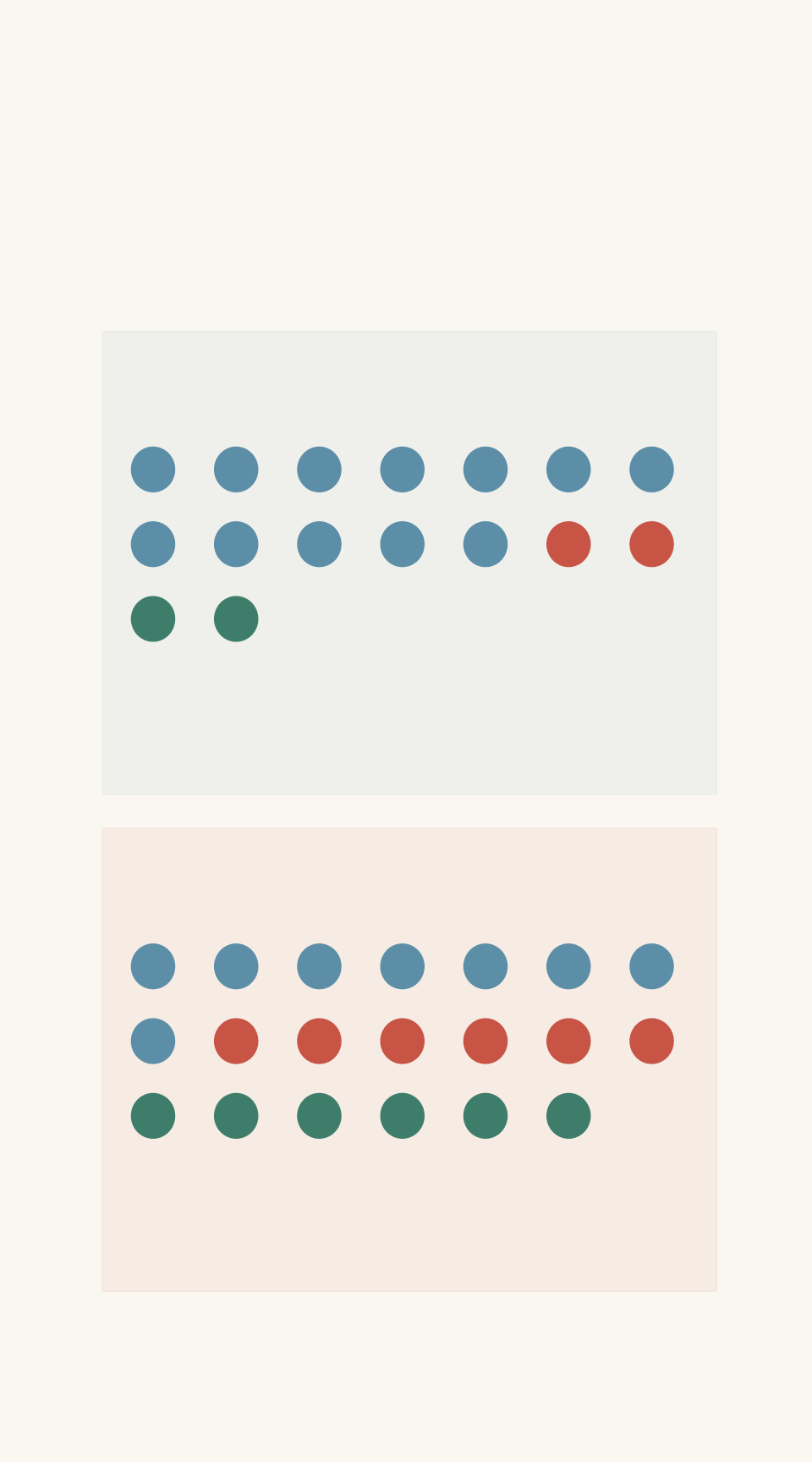
- HA
- H₃O⁺
- A⁻
Both boxes represent the same volume and the same total analytical concentration of acid. Treat the particle counts as proportional to concentrations, and assume water autoionisation is negligible.
(a) Write a balanced equation for the dissociation of a generic weak monoprotic acid, HA, in water. Include state symbols. (2 marks)
(b) Identify the conjugate base of HA. (1 mark)
(c) Identify which acid, HX or HY, has the greater fraction of acid molecules dissociated. Support your answer using the particle counts. (2 marks)
(d) Calculate the ratio \(K_{a,Y}/K_{a,X}\) using the particle counts. Show your working. (2 marks)
Question 2 (5 marks)
Three weak monoprotic acids have the following dissociation constants at the same temperature.
| Acid | \(K_a\) |
|---|---|
| HX | \(4.0\times10^{-6}\) |
| HY | \(2.5\times10^{-4}\) |
| HZ | \(1.0\times10^{-5}\) |
(a) Calculate the \(pK_a\) of each acid to two decimal places. (3 marks)
(b) Rank the three acids from strongest to weakest. (1 mark)
(c) Compare the strengths of the conjugate bases \(Y^-\) and \(Z^-\). Justify your answer using the acid data. (1 mark)
Question 3 (7 marks)
A solution of weak monoprotic acid HB has an initial concentration of \(0.0800\ \mathrm{mol\,L^{-1}}\) and a measured pH of 2.80 at \(25.0^\circ\mathrm{C}\).
Assume HB is the only significant source of \(\ce{H3O+}\) ions and that water autoionisation is negligible.
(a) Calculate the equilibrium concentration of \(\ce{H3O+}\). (1 mark)
(b) Determine the equilibrium concentrations of \(\mathrm{B}^{-}\) and HB. (2 marks)
(c) Calculate \(K_a\) for HB using the equilibrium concentrations. (2 marks)
(d) Calculate the percentage ionisation of HB. Use the 5% rule to determine whether the approximation \([\ce{HB}]_{\mathrm{eq}}\approx 0.0800\ \mathrm{mol\,L^{-1}}\) is justified. (2 marks)
Question 4 (8 marks)
A student determines the \(K_a\) of a weak monoprotic acid, HA, experimentally.
The student prepares a solution with an initial acid concentration of \(0.0250\ \mathrm{mol\,L^{-1}}\). The solution is maintained at \(25.0^\circ\mathrm{C}\). A pH probe is calibrated using standard buffer solutions, and three pH readings are recorded.
| Trial | Measured pH |
|---|---|
| 1 | 2.77 |
| 2 | 2.79 |
| 3 | 2.78 |
Assume HA is the only significant source of \(\ce{H3O+}\) ions and that water autoionisation is negligible.
(a) Calculate the mean pH of the solution. (1 mark)
(b) Use the mean pH to calculate the equilibrium concentration of \(\ce{H3O+}\). (1 mark)
(c) Calculate \(K_a\) using the full equilibrium expression. Do not approximate the equilibrium concentration of HA as its initial concentration. (2 marks)
(d) Calculate the percentage ionisation of HA. Determine whether the approximation \([\ce{HA}]_{\mathrm{eq}}\approx c_0\) is justified under the 5% rule. (2 marks)
(e) Identify one limitation or source of uncertainty in this experimental method and suggest a specific improvement. (2 marks)
Question 5 (6 marks)
A student investigates the effect of initial concentration on the measured pH of the same weak monoprotic acid at \(25.0^\circ\mathrm{C}\).
The pH probe is calibrated before use. The measured pH values are rounded to the nearest 0.01.
| Solution | Initial acid concentration (\(\mathrm{mol\,L^{-1}}\)) | Measured pH |
|---|---|---|
| A | 0.100 | 2.88 |
| B | 0.0100 | 3.38 |
Assume water autoionisation is negligible.
(a) Calculate \(K_a\) separately for each solution. Use the exact equilibrium concentration of the undissociated acid in your calculations. (4 marks)
(b) Explain whether the results support the conclusion that \(K_a\) is constant for a given acid at a fixed temperature. Refer to your calculated values. (2 marks)
Question 6 (7 marks)
A weak monoprotic acid, HB, has \(K_a=4.0\times10^{-5}\) at \(25.0^\circ\mathrm{C}\). Its initial concentration is \(0.0100\ \mathrm{mol\,L^{-1}}\).
Assume water autoionisation is negligible.
(a) Write the dissociation equation for HB in water and the corresponding \(K_a\) expression. (2 marks)
(b) Let \(x\) be the equilibrium concentration of \(\ce{H3O+}\). Use the full equilibrium expression to calculate \(x\). Show the equation you solve and identify the physically meaningful root. (2 marks)
(c) Calculate the pH of the solution. (1 mark)
(d) Calculate the percentage ionisation of HB. Determine whether the approximation \([\ce{HB}]_{\mathrm{eq}}\approx c_0\) is justified under the 5% rule. (2 marks)
03Worked solutions and marking guide
Solution 1
(a) Dissociation equation
\[ \ce{HA(aq) + H2O(l) <=> H3O+(aq) + A-(aq)} \]
The acid, HA, donates a proton to water. The reversible arrow indicates that the forward and reverse reactions occur at equilibrium.
Marking guide (2 marks):
- 1 mark for the correct reactants and products.
- 1 mark for the reversible arrow, correct charges, and appropriate state symbols.
(b) Conjugate base
The conjugate base is \(\mathrm{A}^{-}\).
When HA donates a proton, it becomes \(\mathrm{A}^{-}\).
Marking guide (1 mark):
- 1 mark for identifying \(\mathrm{A}^{-}\).
(c) Comparing the fraction dissociated
Acid HY has the greater fraction of acid molecules dissociated.
For HX, there are 12 undissociated HX molecules and 2 conjugate-base ions. The fraction dissociated is therefore
\[ \frac{2}{12+2}=\frac{2}{14}=0.143 \]
For HY, there are 8 undissociated HY molecules and 6 conjugate-base ions.
\[ \frac{6}{8+6}=\frac{6}{14}=0.429 \]
The fraction dissociated is approximately 14.3% for HX and 42.9% for HY.
Marking guide (2 marks):
- 1 mark for identifying HY.
- 1 mark for supporting the choice using the particle counts or calculated fractions.
(d) Ratio of dissociation constants
For a monoprotic acid HX,
\[ K_{a,X}=\frac{[\ce{H3O+}][\mathrm{X}^{-}]}{[\ce{HX}]} \]
Because the volumes are equal, the common volume factor cancels when calculating the ratio of the constants.
Using the particle counts,
\[ K_{a,X}\propto\frac{2\times2}{12} \]
Similarly,
\[ K_{a,Y}\propto\frac{6\times6}{8} \]
Therefore,
\[ \begin{aligned} \frac{K_{a,Y}}{K_{a,X}} &=\frac{36/8}{4/12}\\ &=\frac{4.5}{0.3333}\\ &=13.5 \end{aligned} \]
The ratio is \(K_{a,Y}/K_{a,X}=13.5\).
Marking guide (2 marks):
- 1 mark for correctly forming the ratio from the particle counts.
- 1 mark for obtaining 13.5.
Solution 2
(a) Calculating \(pK_a\)
Use
\[ pK_a=-\log_{10}K_a \]
For HX,
\[ pK_{a,X}=-\log_{10}(4.0\times10^{-6}) \]
\[ \boxed{pK_{a,X}=5.40} \]
For HY,
\[ pK_{a,Y}=-\log_{10}(2.5\times10^{-4}) \]
\[ \boxed{pK_{a,Y}=3.60} \]
For HZ,
\[ pK_{a,Z}=-\log_{10}(1.0\times10^{-5}) \]
\[ \boxed{pK_{a,Z}=5.00} \]
Marking guide (3 marks):
- 1 mark for each correctly calculated \(pK_a\), to two decimal places.
Ka and pKa change in opposite directions
| Ka increases ↑ | pKa decreases ↓ Acid strength increases ↑ |
|---|---|
| Ka decreases ↓ | pKa increases ↑ Acid strength decreases ↓ |
(b) Ranking acid strength
The strongest-to-weakest order is
\[ \boxed{\ce{HY > HZ > HX}} \]
A larger \(K_a\) indicates greater dissociation at equilibrium and therefore a stronger acid. Because \(pK_a=-\log_{10}K_a\), a lower \(pK_a\) corresponds to a larger \(K_a\) and a stronger acid.
Marking guide (1 mark):
- 1 mark for the correct order: HY, HZ, HX.
(c) Comparing conjugate-base strength
The conjugate base \(\mathrm{Y}^{-}\) is weaker than \(\mathrm{Z}^{-}\).
HY has a larger \(K_a\) than HZ, so HY is the stronger acid. Its conjugate base, \(\mathrm{Y}^{-}\), is consequently weaker than the conjugate base of HZ.
Marking guide (1 mark):
- 1 mark for identifying \(\mathrm{Y}^{-}\) as the weaker base and linking this to the relative acid strengths.
Solution 3
(a) Equilibrium concentration of \(\ce{H3O+}\)
The pH relationship is
\[ pH=-\log_{10}[\ce{H3O+}] \]
Rearranging,
\[ [\ce{H3O+}]=10^{-pH} \]
Substituting the measured pH,
\[ [\ce{H3O+}]=10^{-2.80} \]
\[ \boxed{[\ce{H3O+}]=1.6\times10^{-3}\ \mathrm{mol\,L^{-1}}} \]
Marking guide (1 mark):
- 1 mark for the correct concentration.
(b) Equilibrium concentrations
Each molecule of HB that dissociates produces one \(\ce{H3O+}\) ion and one \(\mathrm{B}^{-}\) ion.
Because water autoionisation is negligible,
\[ [\mathrm{B}^{-}]=[\ce{H3O+}] \]
Therefore,
\[ \boxed{[\mathrm{B}^{-}]=1.58\times10^{-3}\ \mathrm{mol\,L^{-1}}} \]
The equilibrium concentration of undissociated HB is the initial concentration minus the concentration that dissociated.
\[ \begin{aligned} [\ce{HB}]_{\mathrm{eq}} &=0.0800-0.0015849\\ &=0.0784151\ \mathrm{mol\,L^{-1}} \end{aligned} \]
Thus,
\[ \boxed{[\ce{HB}]_{\mathrm{eq}}\approx0.0784\ \mathrm{mol\,L^{-1}}} \]
Marking guide (2 marks):
- 1 mark for the correct equilibrium concentration of \(\mathrm{B}^{-}\).
- 1 mark for the correct equilibrium concentration of HB.
(c) Calculating \(K_a\)
For the dissociation of HB,
\[ K_a=\frac{[\ce{H3O+}][\mathrm{B}^{-}]}{[\ce{HB}]} \]
Substituting the equilibrium concentrations,
\[ \begin{aligned} K_a &=\frac{(1.5849\times10^{-3})^2}{0.0784151}\\ &=3.203\times10^{-5} \end{aligned} \]
Therefore,
\[ \boxed{K_a=3.2\times10^{-5}} \]
Marking guide (2 marks):
- 1 mark for the correct equilibrium expression.
- 1 mark for correct substitution and the calculated value.
(d) Percentage ionisation and the approximation
Percentage ionisation is
\[ \%\text{ ionisation}=\frac{x}{c_0}\times100 \]
Substituting,
\[ \begin{aligned} \%\text{ ionisation} &=\frac{1.5849\times10^{-3}}{0.0800}\times100\\ &=1.98\% \end{aligned} \]
The percentage ionisation is approximately 2.0%, which is below 5%.
Therefore, the approximation
\[ [\ce{HB}]_{\mathrm{eq}}\approx c_0 \]
is justified under the 5% rule.
Marking guide (2 marks):
- 1 mark for the correct percentage ionisation.
- 1 mark for correctly concluding that the approximation is justified.
Solution 4
(a) Mean pH
Calculate the arithmetic mean of the three readings.
\[ \begin{aligned} \text{Mean pH} &=\frac{2.77+2.79+2.78}{3}\\ &=2.78 \end{aligned} \]
\[ \boxed{\text{Mean pH}=2.78} \]
Marking guide (1 mark):
- 1 mark for the correct mean.
(b) Equilibrium concentration of \(\ce{H3O+}\)
Using the mean pH,
\[ [\ce{H3O+}]=10^{-2.78} \]
\[ [\ce{H3O+}]=1.6596\times10^{-3}\ \mathrm{mol\,L^{-1}} \]
Therefore,
\[ \boxed{[\ce{H3O+}]\approx1.7\times10^{-3}\ \mathrm{mol\,L^{-1}}} \]
Marking guide (1 mark):
- 1 mark for the correct concentration.
(c) Calculating \(K_a\)
The dissociation equation is
\[ \ce{HA(aq) + H2O(l) <=> H3O+(aq) + A-(aq)} \]
Since each dissociation produces one \(\ce{H3O+}\) ion and one \(\mathrm{A}^{-}\) ion,
\[ [\mathrm{A}^{-}]=[\ce{H3O+}]=x \]
The equilibrium concentration of HA is
\[ \begin{aligned} [\ce{HA}]_{\mathrm{eq}} &=0.0250-0.0016596\\ &=0.0233404\ \mathrm{mol\,L^{-1}} \end{aligned} \]
Now substitute into the equilibrium expression.
\[ \begin{aligned} K_a &=\frac{[\ce{H3O+}][\mathrm{A}^{-}]}{[\ce{HA}]}\\ &=\frac{(1.6596\times10^{-3})^2}{0.0233404}\\ &=1.18\times10^{-4} \end{aligned} \]
Therefore,
\[ \boxed{K_a\approx1.2\times10^{-4}} \]
Marking guide (2 marks):
- 1 mark for using the correct equilibrium expression and \(c_0-x\) for the undissociated acid.
- 1 mark for correct substitution and the calculated value.
(d) Percentage ionisation and the approximation
\[ \begin{aligned} \%\text{ ionisation} &=\frac{1.6596\times10^{-3}}{0.0250}\times100\\ &=6.64\% \end{aligned} \]
The percentage ionisation is greater than 5%.
Therefore, the approximation \([\ce{HA}]_{\mathrm{eq}}\approx c_0\) is not justified under the 5% rule. The calculation in part (c) correctly uses \(c_0-x\).
Marking guide (2 marks):
- 1 mark for calculating approximately 6.64%.
- 1 mark for concluding that the approximation is not justified.
(e) Experimental limitation and improvement
One valid limitation is the resolution of the pH probe. Small uncertainties in pH affect the calculated hydronium concentration, which then affects the calculated \(K_a\).
A suitable improvement is to use a higher-resolution pH probe, calibrate it carefully before measurement, and collect additional replicate readings to reduce uncertainty.
Another valid response is to maintain the solution at a constant temperature, because temperature changes can change the value of \(K_a\).
Marking guide (2 marks):
- 1 mark for identifying a relevant limitation or source of uncertainty.
- 1 mark for proposing a specific improvement that addresses it.
Solution 5
(a) Calculating \(K_a\) for each solution
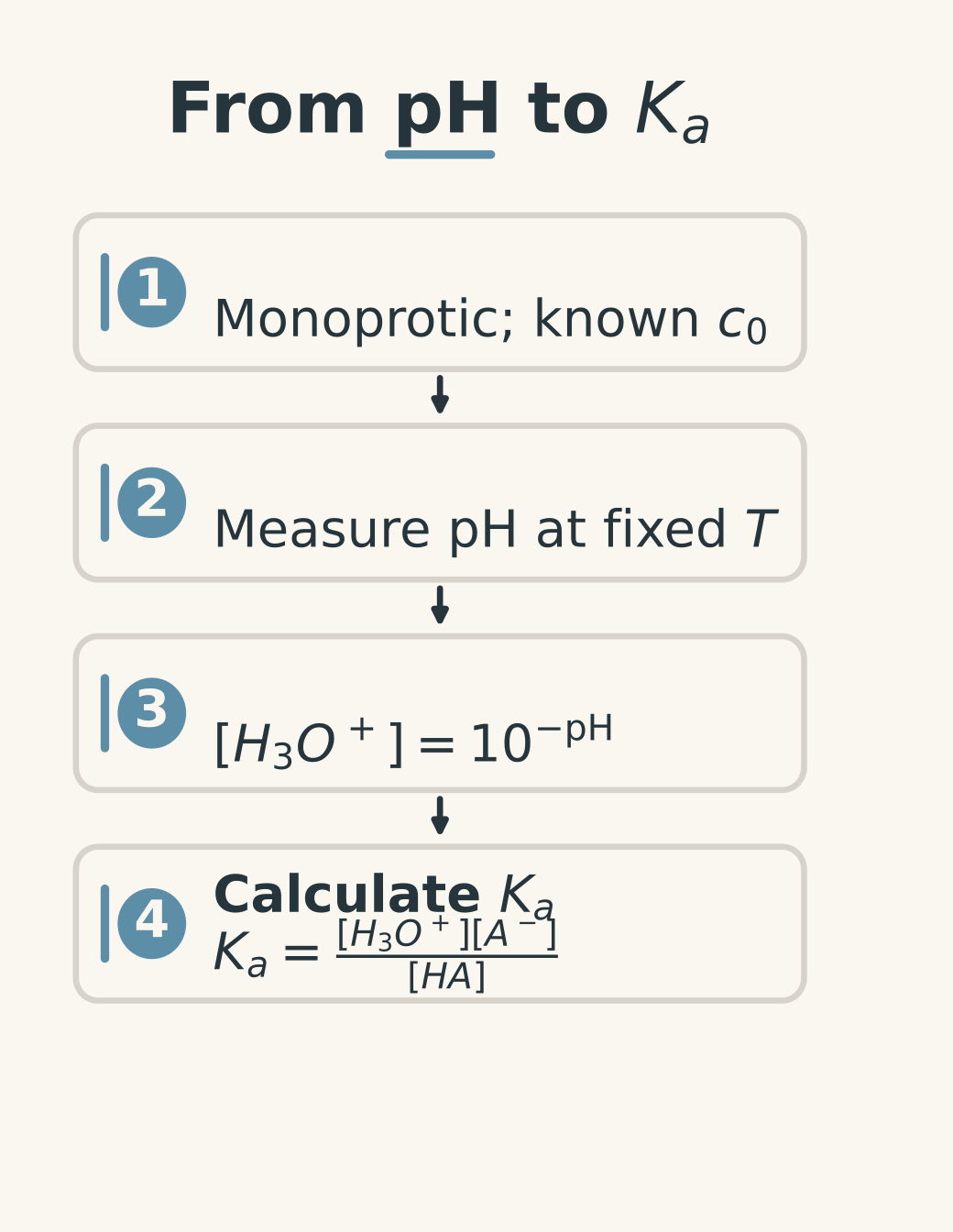
For each solution, first calculate \([\ce{H3O+}]\) from the measured pH. Then use
\[ K_a=\frac{[\ce{H3O+}]^2}{[\ce{HA}]_{\mathrm{eq}}} \]
where
\[ [\ce{HA}]_{\mathrm{eq}}=c_0-[\ce{H3O+}] \]
This relationship assumes the acid is the only significant source of \(\ce{H3O+}\) and water autoionisation is negligible.
Solution A
The initial concentration is \(0.100\ \mathrm{mol\,L^{-1}}\), and the pH is 2.88.
\[ [\ce{H3O+}]=10^{-2.88} =1.3183\times10^{-3}\ \mathrm{mol\,L^{-1}} \]
The equilibrium concentration of HA is
\[ \begin{aligned} [\ce{HA}]_{\mathrm{eq}} &=0.100-0.0013183\\ &=0.0986817\ \mathrm{mol\,L^{-1}} \end{aligned} \]
Therefore,
\[ \begin{aligned} K_{a,A} &=\frac{(1.3183\times10^{-3})^2}{0.0986817}\\ &=1.76\times10^{-5} \end{aligned} \]
\[ \boxed{K_{a,A}\approx1.8\times10^{-5}} \]
Solution B
The initial concentration is \(0.0100\ \mathrm{mol\,L^{-1}}\), and the pH is 3.38.
\[ [\ce{H3O+}]=10^{-3.38} =4.1687\times10^{-4}\ \mathrm{mol\,L^{-1}} \]
The equilibrium concentration of HA is
\[ \begin{aligned} [\ce{HA}]_{\mathrm{eq}} &=0.0100-0.00041687\\ &=0.00958313\ \mathrm{mol\,L^{-1}} \end{aligned} \]
Therefore,
\[ \begin{aligned} K_{a,B} &=\frac{(4.1687\times10^{-4})^2}{0.00958313}\\ &=1.81\times10^{-5} \end{aligned} \]
\[ \boxed{K_{a,B}\approx1.8\times10^{-5}} \]
Marking guide (4 marks):
- 1 mark for the correct \([\ce{H3O+}]\) in Solution A.
- 1 mark for the correct \(K_a\) for Solution A.
- 1 mark for the correct \([\ce{H3O+}]\) in Solution B.
- 1 mark for the correct \(K_a\) for Solution B.
(b) Interpreting the results
The two estimates, \(1.76\times10^{-5}\) and \(1.81\times10^{-5}\), are close. They support the conclusion that the acid has approximately the same \(K_a\) at the same temperature.
The estimates are not identical because experimental measurements have uncertainty, and the pH readings have been rounded. The acid’s \(K_a\) is constant at a fixed temperature, but the fraction of acid molecules that dissociate can change with initial concentration.
Marking guide (2 marks):
- 1 mark for concluding that the values are consistent with a single \(K_a\).
- 1 mark for referring to the closeness of the values and explaining the difference through measurement uncertainty or rounding.
Solution 6
(a) Dissociation equation and \(K_a\) expression
The dissociation equation is
\[ \ce{HB(aq) + H2O(l) <=> H3O+(aq) + B-(aq)} \]
The equilibrium expression is
\[ \boxed{K_a=\frac{[\ce{H3O+}][\mathrm{B}^{-}]}{[\ce{HB}]}} \]
Marking guide (2 marks):
- 1 mark for the balanced dissociation equation with a reversible arrow.
- 1 mark for the correct equilibrium expression.
(b) Calculating the equilibrium concentration
Let
\[ x=[\ce{H3O+}]=[\mathrm{B}^{-}] \]
The equilibrium concentration of HB is
\[ [\ce{HB}]_{\mathrm{eq}}=0.0100-x \]
Substitute into the \(K_a\) expression.
\[ \frac{x^2}{0.0100-x}=4.0\times10^{-5} \]
Rearrange:
\[ \begin{aligned} x^2&=4.0\times10^{-5}(0.0100-x)\\ x^2&=4.0\times10^{-7}-4.0\times10^{-5}x\\ x^2+4.0\times10^{-5}x-4.0\times10^{-7}&=0 \end{aligned} \]
Using the quadratic formula,
\[ x=\frac{-b\pm\sqrt{b^2-4ac}}{2a} \]
The positive root gives
\[ x=6.1277\times10^{-4}\ \mathrm{mol\,L^{-1}} \]
The negative root is not physically meaningful because a concentration cannot be negative.
Therefore,
\[ \boxed{[\ce{H3O+}]\approx6.1\times10^{-4}\ \mathrm{mol\,L^{-1}}} \]
Marking guide (2 marks):
- 1 mark for correctly rearranging the equilibrium expression into the quadratic equation.
- 1 mark for obtaining the correct positive root with units.
(c) Calculating pH
Using the equilibrium concentration,
\[ pH=-\log_{10}[\ce{H3O+}] \]
\[ \begin{aligned} pH&=-\log_{10}(6.1277\times10^{-4})\\ &=3.2127 \end{aligned} \]
Therefore,
\[ \boxed{pH=3.21} \]
Marking guide (1 mark):
- 1 mark for the correct pH.
(d) Percentage ionisation and the approximation
The percentage ionisation is
\[ \begin{aligned} \%\text{ ionisation} &=\frac{x}{c_0}\times100\\ &=\frac{6.1277\times10^{-4}}{0.0100}\times100\\ &=6.13\% \end{aligned} \]
The percentage ionisation is greater than 5%. Therefore, the approximation \([\ce{HB}]_{\mathrm{eq}}\approx c_0\) is not justified under the 5% rule.
The exact equilibrium expression used in part (b) is the appropriate method for this question.
Marking guide (2 marks):
- 1 mark for calculating approximately 6.13% ionisation.
- 1 mark for correctly concluding that the approximation is not justified.
End of practice paper – 40 marks.