
Bond and Combustion Enthalpy: HSC Chemistry Practice Exam
Test your understanding of bond enthalpy, photosynthesis, respiration, and heat of combustion with this original 50-mark Chemistry practice paper. Includes timed exam instructions, calculation questions, fully worked solutions, and a detailed marking guide.
This is an original tutorgum practice paper for the supplied Chemistry 2017 syllabus scope. It assesses bond enthalpy, energy cycles for photosynthesis and respiration, and the enthalpy of complete combustion. All questions and data are original. This is a focused revision paper, not an official or NESA-endorsed examination.
01Exam instructions
- Suggested working time: 75 minutes, plus 5 minutes of reading time.
- Total marks: 50.
- Equipment: Scientific calculator, pen, and pencil. No notes.
- Working: Show your calculations, include units, and give final numerical answers to 3 significant figures unless otherwise indicated.
- Sign convention: A negative \(\Delta H\) indicates an exothermic reaction, which releases energy. A positive \(\Delta H\) indicates an endothermic reaction, which absorbs energy.
- Bond enthalpy calculations: Use the supplied average bond enthalpies and the relationship below.
\[ \Delta H \approx \sum E_{\text{bonds broken}} - \sum E_{\text{bonds formed}} \]
Here, \(\Delta H\) is the reaction enthalpy change, and \(E\) is the average bond enthalpy. Bond enthalpies are expressed in \(\text{kJ mol}^{-1}\) of bonds. The calculation gives an estimate, generally for gaseous reactants and products.
Unless stated otherwise, enthalpy values refer to the reaction as written. Use the physical states specified in each equation.
Assessed scope: The supplied Chemistry 2017 content covering bond breaking and formation, conservation of energy, enthalpy cycles for photosynthesis and respiration, and heat of complete combustion.
Exclusions: Other syllabus editions, reaction kinetics, equilibrium, electrochemistry, reaction mechanisms, and unrelated organic reaction pathways. This paper does not assess the full Chemistry course.
02Questions
Question 1 (8 marks)
During a chemical reaction, breaking all the reactant bonds requires \(1460\ \text{kJ}\) per reaction as written. Forming all the product bonds releases \(1810\ \text{kJ}\) per reaction as written.
(a) Calculate the enthalpy change, \(\Delta H\), for the reaction as written. (2 marks)
(b) State whether the reaction is exothermic or endothermic. Describe the net energy transfer. (2 marks)
(c) Determine the enthalpy change for the reverse reaction. (2 marks)
(d) Determine the enthalpy change if the original reaction equation is multiplied by 2. (2 marks)
Question 2 (10 marks)
Ethene undergoes complete combustion according to the equation:
\[ \ce{C2H4(g) + 3O2(g) -> 2CO2(g) + 2H2O(g)} \]
Use the following average bond enthalpies.
| Bond | Average bond enthalpy (\(\text{kJ mol}^{-1}\)) |
|---|---|
| C-H | 413 |
| C=C | 614 |
| O=O | 498 |
| C=O in \(\ce{CO2}\) | 805 |
| O-H | 463 |
(a) List the types and numbers of bonds broken in the reactants. (2 marks)
(b) Calculate the total energy required to break the reactant bonds for the reaction as written. (2 marks)
(c) List the types and numbers of bonds formed in the products, then calculate the total energy released when these bonds form. (2 marks)
(d) Use your results to estimate the enthalpy change for the combustion of one mole of ethene. (3 marks)
(e) State one reason why a bond enthalpy estimate may differ from an experimentally measured enthalpy change. (1 mark)
Question 3 (8 marks)
Photosynthesis can be represented by the following overall equation:
\[ \ce{6CO2(g) + 6H2O(l) -> C6H12O6(s) + 6O2(g)} \]
The standard enthalpy of formation, \(\Delta H_f^\circ\), is the enthalpy change when one mole of a substance forms from its elements in their standard states.
Use the following supplied values.
| Substance | \(\Delta H_f^\circ\) (\(\text{kJ mol}^{-1}\)) |
|---|---|
| \(\ce{CO2(g)}\) | −394 |
| \(\ce{H2O(l)}\) | −286 |
| \(\ce{C6H12O6(s)}\) | −1273 |
| \(\ce{O2(g)}\) | 0 |
(a) Construct a Hess cycle through the elements in their standard states and calculate the enthalpy change for the photosynthesis equation. Label your energy pathways and show your working. (6 marks)
(b) Interpret the sign of your calculated enthalpy change. State whether the reaction releases or requires energy, and identify the energy source that drives photosynthesis. (2 marks)
Question 4 (8 marks)
Aerobic respiration can be represented by the equation:
\[ \ce{C6H12O6(s) + 6O2(g) -> 6CO2(g) + 6H2O(l)} \]
For this question, use an enthalpy change of \(-2807\ \text{kJ mol}^{-1}\) per mole of glucose completely respired. This value is consistent with the formation enthalpies supplied in Question 3.
(a) Calculate the enthalpy change when \(0.0150\ \text{mol}\) of glucose is completely respired. (3 marks)
(b) Calculate the amount, in moles, of glucose that must be completely respired to release \(70.2\ \text{kJ}\) of energy. (3 marks)
(c) Explain the relationship between the enthalpy changes for photosynthesis and respiration when their equations are exact reverses and all physical states are identical. (2 marks)
Question 5 (10 marks)
A sample of ethanol is completely combusted in a simple combustion test. The energy transferred to \(250.0\ \text{g}\) of water raises its temperature from \(20.0^\circ\text{C}\) to \(30.4^\circ\text{C}\).
The complete combustion equation is:
\[ \ce{C2H5OH(l) + 3O2(g) -> 2CO2(g) + 3H2O(l)} \]
The following data are available:
- Mass of ethanol combusted: \(0.500\ \text{g}\)
- Molar mass of ethanol: \(46.07\ \text{g mol}^{-1}\)
- Specific heat capacity of water: \(4.18\ \text{J g}^{-1}\,^\circ\text{C}^{-1}\)
Use the relationship
\[ q=mc\Delta T \]
where \(q\) is the heat absorbed by the water in joules, \(m\) is the mass of water in grams, \(c\) is its specific heat capacity, and \(\Delta T\) is its temperature change in degrees Celsius.
For this question, use the heat gained by the water as the measured heat in the experimental estimate.
(a) Calculate the temperature change of the water. (1 mark)
(b) Calculate the heat absorbed by the water in kilojoules. (2 marks)
(c) Calculate the amount of ethanol combusted in moles. (2 marks)
(d) Calculate the experimental molar enthalpy of combustion of ethanol. Include the sign and units. (3 marks)
(e) Give one reason why the magnitude of your experimental result could be smaller than the actual molar enthalpy of combustion, even if the ethanol burns completely. (2 marks)
Question 6 (6 marks)
Consider the complete combustion of methane producing water vapour:
\[ \ce{CH4(g) + 2O2(g) -> CO2(g) + 2H2O(g)} \]
A calculation using average bond enthalpies gives an estimated reaction enthalpy of \(-814\ \text{kJ mol}^{-1}\) of methane.
The enthalpy change for condensation of water vapour is:
\[ \ce{H2O(g) -> H2O(l)} \]
\[ \Delta H_{\text{cond}}=-44\ \text{kJ mol}^{-1} \]
A reference enthalpy change for the complete combustion of methane producing liquid water is \(-890\ \text{kJ mol}^{-1}\).
(a) Calculate the total enthalpy correction required to change the products from water vapour to liquid water. (2 marks)
(b) Calculate the corrected bond enthalpy estimate for methane combustion producing liquid water. (1 mark)
(c) Calculate the difference between your corrected estimate and the reference value. State which value represents the more exothermic reaction. (2 marks)
(d) Explain one reason why the corrected estimate may still differ from the reference value. (1 mark)
03Worked solutions and marking guide
Solution 1
(a) Calculate the reaction enthalpy. (2 marks)
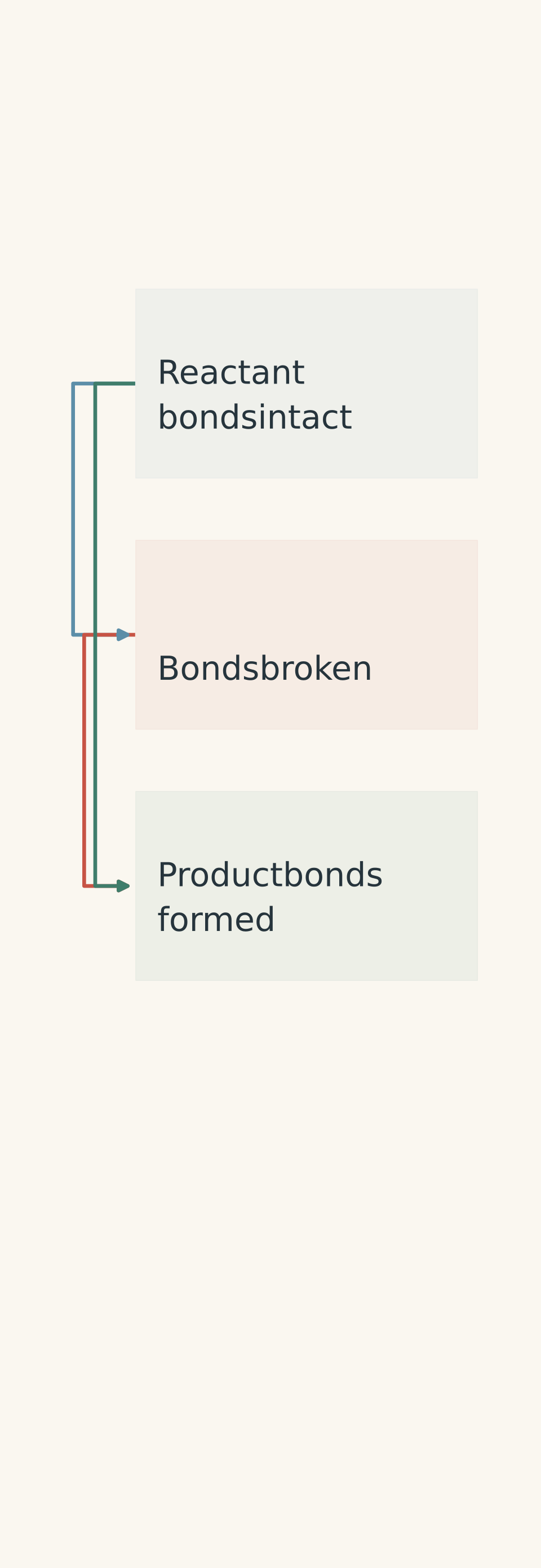
The enthalpy change is the energy absorbed to break the reactant bonds minus the energy released when the product bonds form.
\[ \begin{aligned} \Delta H &= 1460-1810\\ &=-350\ \text{kJ} \end{aligned} \]
The enthalpy change is \(-350\ \text{kJ}\) per reaction as written.
Marking:
- 1 mark for subtracting the energy released from the energy absorbed.
- 1 mark for the correct value and unit, including the negative sign.
(b) Classify the reaction. (2 marks)
The reaction is exothermic because \(\Delta H\) is negative. A net \(350\ \text{kJ}\) of energy is released to the surroundings per reaction as written.
The key comparison is that forming the product bonds releases more energy than breaking the reactant bonds requires.
Marking:
- 1 mark for identifying the reaction as exothermic.
- 1 mark for stating that \(350\ \text{kJ}\) is released per reaction as written.
(c) Reverse the reaction. (2 marks)
Reversing a reaction changes the sign of its enthalpy change:
\[ \Delta H_{\text{reverse}}=+350\ \text{kJ} \]
The reverse reaction is endothermic. It absorbs the same amount of energy that the forward reaction releases.
Marking:
- 1 mark for \(+350\ \text{kJ}\).
- 1 mark for explaining that reversing the reaction reverses the sign of \(\Delta H\).
(d) Double the reaction equation. (2 marks)
Doubling every stoichiometric coefficient doubles the amount of each substance reacting. The enthalpy change also doubles.
\[ \begin{aligned} \Delta H_{\text{doubled}}&=2(-350)\\ &=-700\ \text{kJ} \end{aligned} \]
Marking:
- 1 mark for multiplying the original enthalpy change by 2.
- 1 mark for the correct result and unit.
Solution 2
(a) Count the bonds broken. (2 marks)
The reactants contain one molecule of ethene and three molecules of oxygen.
Ethene, \(\ce{C2H4}\), contains:
- Four C-H bonds.
- One C=C bond.
Three molecules of \(\ce{O2}\) contain three O=O bonds.
Marking:
- 1 mark for identifying four C-H bonds and one C=C bond.
- 1 mark for identifying three O=O bonds.
(b) Calculate the energy absorbed. (2 marks)
Multiply each bond count by its average bond enthalpy, then add the results.
\[ \begin{aligned} E_{\text{broken}}&=4(413)+614+3(498)\\ &=1652+614+1494\\ &=3760\ \text{kJ mol}^{-1} \end{aligned} \]
The energy required to break the reactant bonds is \(3760\ \text{kJ}\) per mole of ethene combusted.
Marking:
- 1 mark for the correct bond counts and substitution.
- 1 mark for the correct total and unit.
(c) Count the bonds formed and calculate the energy released. (2 marks)
Each \(\ce{CO2}\) molecule contains two C=O bonds. Two molecules therefore form four C=O bonds.
Each \(\ce{H2O}\) molecule contains two O-H bonds. Two molecules therefore form four O-H bonds.
The total energy released is:
\[ \begin{aligned} E_{\text{formed}}&=4(805)+4(463)\\ &=3220+1852\\ &=5072\ \text{kJ mol}^{-1} \end{aligned} \]
Marking:
- 1 mark for the correct product bond counts.
- 1 mark for the correct total energy released.
(d) Estimate the combustion enthalpy. (3 marks)
Use the difference between the energy required to break bonds and the energy released when new bonds form.
\[ \begin{aligned} \Delta H&=E_{\text{broken}}-E_{\text{formed}}\\ &=3760-5072\\ &=-1312\ \text{kJ mol}^{-1} \end{aligned} \]
To three significant figures, the estimated enthalpy change is:
\[ \boxed{\Delta H\approx-1.31\times10^3\ \text{kJ mol}^{-1}} \]
The negative sign indicates that the combustion reaction is exothermic.
Marking:
- 1 mark for using the correct enthalpy relationship.
- 1 mark for correct substitution and arithmetic.
- 1 mark for the negative sign, appropriate precision, and units.
Count the bonds in ethene combustion
| Reactants: bonds broken | C₂H₄ + 3O₂ 4 C–H bonds 1 C=C bond 3 O=O bonds |
|---|---|
| Products: bonds formed | 2CO₂ + 2H₂O 4 C=O bonds across 2 CO₂ molecules 4 O–H bonds across 2 H₂O molecules |
(e) Explain a limitation of the estimate. (1 mark)
Average bond enthalpies are mean values from different chemical environments. The energy of a particular bond can differ from its average value, so the calculated reaction enthalpy is an estimate rather than an exact value.
Marking:
- 1 mark for a valid limitation, such as the use of average rather than exact bond enthalpies.
Solution 3
(a) Construct a Hess cycle and calculate the enthalpy change. (6 marks)
The photosynthesis equation is:
\[ \ce{6CO2(g) + 6H2O(l) -> C6H12O6(s) + 6O2(g)} \]
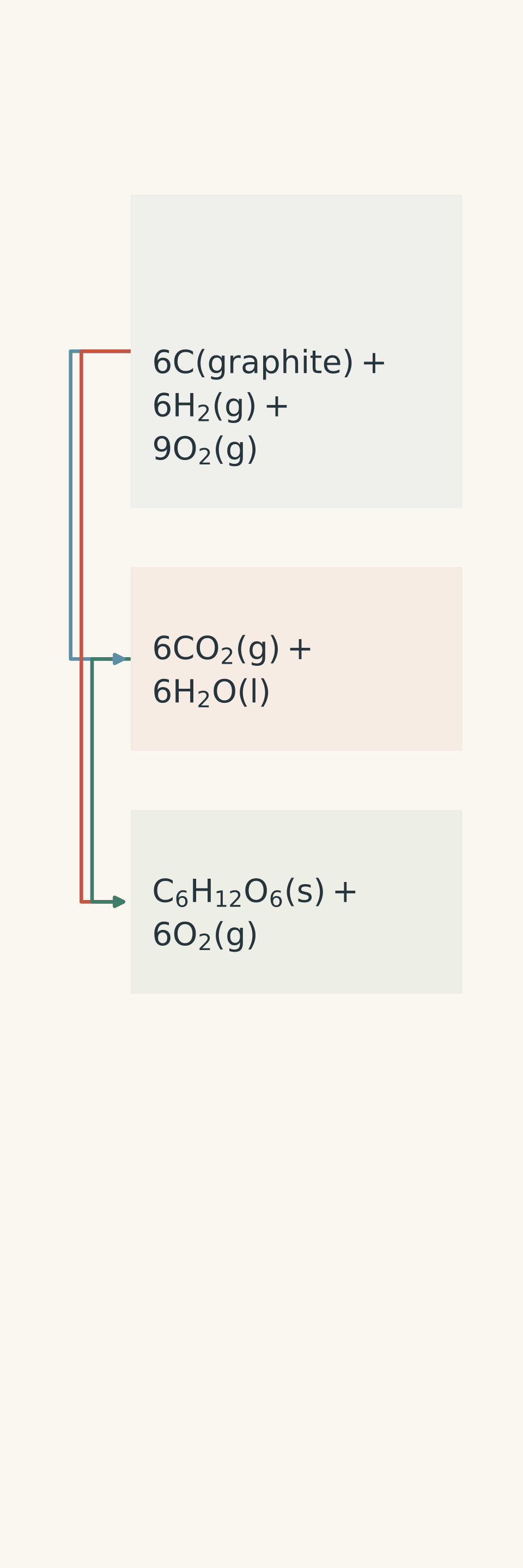
A Hess cycle compares two routes between the same initial and final states. Here, use the elements in their standard states as the common reference state:
\[ \ce{6C(s, graphite) + 6H2(g) + 9O2(g)} \]
First, calculate the enthalpy change from the elements to the reactants.
\[ \begin{aligned} \Delta H_{\text{reactants}} &=6(-394)+6(-286)\\ &=-2364-1716\\ &=-4080\ \text{kJ} \end{aligned} \]
Next, calculate the enthalpy change from the elements to the products. The formation enthalpy of oxygen in its standard state is zero.
\[ \begin{aligned} \Delta H_{\text{products}} &=(-1273)+6(0)\\ &=-1273\ \text{kJ} \end{aligned} \]
By Hess’s law, the enthalpy change depends only on the initial and final states, not on the pathway taken.
Therefore:
\[ \begin{aligned} \Delta H_{\text{photo}} &=\Delta H_{\text{products}} -\Delta H_{\text{reactants}}\\ &=-1273-(-4080)\\ &=+2807\ \text{kJ mol}^{-1} \end{aligned} \]
To three significant figures:
\[ \boxed{\Delta H_{\text{photo}}=+2.81\times10^3\ \text{kJ mol}^{-1}} \]
This is the enthalpy change per mole of glucose produced.
Marking:
- 1 mark for the correct common elemental reference state.
- 1 mark for the reactant formation pathway, giving \(-4080\ \text{kJ}\).
- 1 mark for the product formation pathway, giving \(-1273\ \text{kJ}\).
- 1 mark for the correct Hess’s law relationship.
- 1 mark for the subtraction and arithmetic.
- 1 mark for the positive result, units, and appropriate precision.
(b) Interpret the sign. (2 marks)
The positive enthalpy change means the overall photosynthesis reaction is endothermic. It requires an energy input rather than releasing energy overall.
In photosynthesis, light supplies the energy that drives the process.
Marking:
- 1 mark for identifying the reaction as endothermic.
- 1 mark for stating that energy is absorbed and identifying light as the energy source.
Solution 4
(a) Calculate the enthalpy change for \(0.0150\ \text{mol}\) of glucose. (3 marks)
The amount of glucose, \(n\), is \(0.0150\ \text{mol}\). The molar reaction enthalpy is \(-2807\ \text{kJ mol}^{-1}\).
Multiply the amount of glucose by the enthalpy change per mole.
\[ \begin{aligned} \Delta H&=n\Delta H_{\text{resp}}\\ &=0.0150(-2807)\\ &=-42.105\ \text{kJ} \end{aligned} \]
To three significant figures:
\[ \boxed{\Delta H=-42.1\ \text{kJ}} \]
The negative sign means that \(42.1\ \text{kJ}\) is released to the surroundings.
Marking:
- 1 mark for relating the enthalpy change to the amount of glucose.
- 1 mark for correct substitution and arithmetic.
- 1 mark for the signed answer and unit.
(b) Calculate the amount of glucose needed to release \(70.2\ \text{kJ}\). (3 marks)
Use the magnitude of the molar enthalpy because the question asks for the amount of energy released.
\[ \begin{aligned} n&=\frac{70.2}{2807}\\ &=0.0250\ \text{mol} \end{aligned} \]
Therefore, approximately \(0.0250\ \text{mol}\) of glucose must be respired.
Marking:
- 1 mark for using the energy magnitude and the molar enthalpy.
- 1 mark for correct calculation.
- 1 mark for the amount in moles, with appropriate precision.
(c) Compare photosynthesis and respiration. (2 marks)
The overall equations are exact reverses when the same physical states are used:
\[ \ce{6CO2(g) + 6H2O(l) -> C6H12O6(s) + 6O2(g)} \]
\[ \ce{C6H12O6(s) + 6O2(g) -> 6CO2(g) + 6H2O(l)} \]
The photosynthesis enthalpy change is approximately \(+2807\ \text{kJ mol}^{-1}\), while the respiration enthalpy change is \(-2807\ \text{kJ mol}^{-1}\).
Reversing a reaction swaps its initial and final states. The enthalpy change therefore has the same magnitude but the opposite sign.
Marking:
- 1 mark for stating that the two enthalpy changes have equal magnitudes and opposite signs.
- 1 mark for explaining that reversing the reaction reverses the sign of \(\Delta H\).
Solution 5
(a) Calculate the temperature change. (1 mark)
Temperature change is final temperature minus initial temperature.
\[ \begin{aligned} \Delta T&=30.4-20.0\\ &=10.4^\circ\text{C} \end{aligned} \]
Marking:
- 1 mark for \(10.4^\circ\text{C}\).
(b) Calculate the heat absorbed by the water. (2 marks)
Use \(q=mc\Delta T\), with the water mass in grams and the specific heat capacity in \(\text{J g}^{-1}\,^\circ\text{C}^{-1}\).
\[ \begin{aligned} q&=250.0(4.18)(10.4)\\ &=10868\ \text{J}\\ &=10.868\ \text{kJ} \end{aligned} \]
To three significant figures:
\[ \boxed{q=10.9\ \text{kJ}} \]
Marking:
- 1 mark for the correct formula and substitution.
- 1 mark for the correct heat value, converted to kilojoules.
(c) Calculate the amount of ethanol. (2 marks)
The amount of substance, \(n\), is the mass divided by the molar mass, \(M\).
\[ \begin{aligned} n&=\frac{m}{M}\\ &=\frac{0.500}{46.07}\\ &=0.010853\ldots\ \text{mol} \end{aligned} \]
To three significant figures:
\[ \boxed{n=0.0109\ \text{mol}} \]
Marking:
- 1 mark for the correct formula and substitution.
- 1 mark for the correct amount in moles.
(d) Calculate the experimental molar enthalpy of combustion. (3 marks)
The water absorbs \(10.868\ \text{kJ}\). The combustion reaction releases this measured energy, so the reaction enthalpy has a negative sign.
Divide the reaction’s measured energy change by the amount of ethanol combusted.
\[ \begin{aligned} \Delta H_c&=-\frac{q}{n}\\ &=-\frac{10.868}{0.010853\ldots}\\ &\approx-1001\ \text{kJ mol}^{-1} \end{aligned} \]
To three significant figures:
\[ \boxed{\Delta H_c\approx-1.00\times10^3\ \text{kJ mol}^{-1}} \]
This is the experimental estimate based on the heat measured in the water.
Marking:
- 1 mark for relating the molar enthalpy to the measured heat and amount of ethanol.
- 1 mark for correct substitution and arithmetic.
- 1 mark for the negative sign, units, and appropriate precision.
(e) Explain why the magnitude may be smaller than the actual value. (2 marks)
Not all the energy released by combustion necessarily reaches the water. Some can heat the surrounding air, the burner, or other parts of the experimental setup.
The water therefore records less energy than the reaction releases overall. The calculated enthalpy change has a smaller magnitude, meaning it is less negative than the actual value.
Marking:
- 1 mark for identifying a valid source of energy loss from the water’s measurement.
- 1 mark for explaining that this causes the calculated combustion enthalpy to be less negative.
Where does combustion energy go?
| Measured by water | Heat absorbed: 10.9 kJ |
|---|---|
| Transferred elsewhere | Heats air, burner, and equipment Amount not measured |
Solution 6
(a) Calculate the enthalpy correction for condensation. (2 marks)
The methane combustion equation produces two moles of water vapour for every mole of methane combusted.
Each mole of water condenses with an enthalpy change of \(-44\ \text{kJ mol}^{-1}\). Therefore, the total correction is:
\[ \begin{aligned} \Delta H_{\text{correction}}&=2(-44)\\ &=-88\ \text{kJ mol}^{-1} \end{aligned} \]
The correction is negative because condensation releases energy.
Marking:
- 1 mark for multiplying the condensation enthalpy by two.
- 1 mark for the correct total and negative sign.
(b) Calculate the corrected estimate. (1 mark)
Add the condensation correction to the estimate for producing water vapour.
\[ \begin{aligned} \Delta H_{\text{corrected}}&=-814+(-88)\\ &=-902\ \text{kJ mol}^{-1} \end{aligned} \]
Marking:
- 1 mark for the corrected value with the correct sign and unit.
(c) Compare the corrected estimate with the reference value. (2 marks)
The corrected estimate is \(-902\ \text{kJ mol}^{-1}\), while the reference value is \(-890\ \text{kJ mol}^{-1}\).
The difference is:
\[ \begin{aligned} \text{Difference}&=(-902)-(-890)\\ &=-12\ \text{kJ mol}^{-1} \end{aligned} \]
The magnitude of the difference is \(12\ \text{kJ mol}^{-1}\). The corrected estimate is more exothermic because it is more negative.
Marking:
- 1 mark for the difference of \(12\ \text{kJ mol}^{-1}\).
- 1 mark for correctly identifying the corrected estimate as more exothermic.
(d) Explain the remaining difference. (1 mark)
Average bond enthalpies are approximate mean values. Actual bond energies vary with the chemical environment, so a calculation using average values will not necessarily match the reference enthalpy exactly.
Marking:
- 1 mark for explaining that average bond enthalpies are approximations, or giving another valid limitation of the bond enthalpy method.