
Calorimetry and Molar Enthalpy: HSC Chemistry Practice Exam
Test your understanding of calorimetry and molar enthalpy with this original 40-mark NSW HSC Chemistry practice paper. Includes a 60-minute assessment, fully worked solutions, and a marking guide.
This original tutorgum practice paper targets NSW HSC Chemistry (Chemistry 2025 syllabus edition). It focuses on calorimetry and molar enthalpy: calculating heat transfer from temperature changes, determining molar enthalpies, interpreting the signs of energy transfer, and evaluating experimental limitations. It is an original practice assessment, not an official or NESA-endorsed paper.
01Exam instructions
- Suggested working time: 60 minutes.
- Suggested reading time: 5 minutes.
- Total marks: 40.
- Permitted equipment: scientific calculator and periodic table.
- Answer all questions. Show your working, include units, and give calculated quantities to three significant figures unless the supplied data limit precision.
Use the following data and assumptions unless a question states otherwise:
- Specific heat capacity of water and aqueous solutions: \(c = 4.18\ \mathrm{J\,g^{-1}\,^\circ C^{-1}}\).
- Density of aqueous solutions: \(1.00\ \mathrm{g\,mL^{-1}}\).
- Assume solution volumes are additive.
- Heat transferred to a substance is positive when that substance gains energy and negative when it loses energy.
- Use \(q = mc\Delta T\), where \(q\) is heat transferred in joules (J), \(m\) is mass in grams (g), \(c\) is specific heat capacity, and \(\Delta T = T_{\mathrm{final}} - T_{\mathrm{initial}}\) is the temperature change in degrees Celsius.
- When the calorimeter’s heat capacity and heat exchange with the external surroundings are negligible, use \(q_{\mathrm{reaction}} = -q_{\mathrm{solution}}\).
- A negative reaction enthalpy indicates an exothermic reaction. A positive reaction enthalpy indicates an endothermic reaction.
Assessed scope: Calorimetry using \(q = mc\Delta T\), molar enthalpy calculated from calorimetry, heat-transfer signs, and the evaluation of heat loss, measurement, and calorimeter assumptions.
Exclusions: Hess’s law, bond enthalpy calculations, and thermochemistry calculations outside the stated calorimetry scope.
These are conditions for this practice paper, not a statement of official examination rules.
02Questions
Question 1 (4 marks)
A reaction is carried out in a polystyrene cup. The total mass of the reaction mixture is \(100.0\ \mathrm{g}\). Its temperature rises from \(21.4^\circ\mathrm{C}\) to \(27.8^\circ\mathrm{C}\).
Assume the cup absorbs negligible energy and no heat is exchanged with the external surroundings.
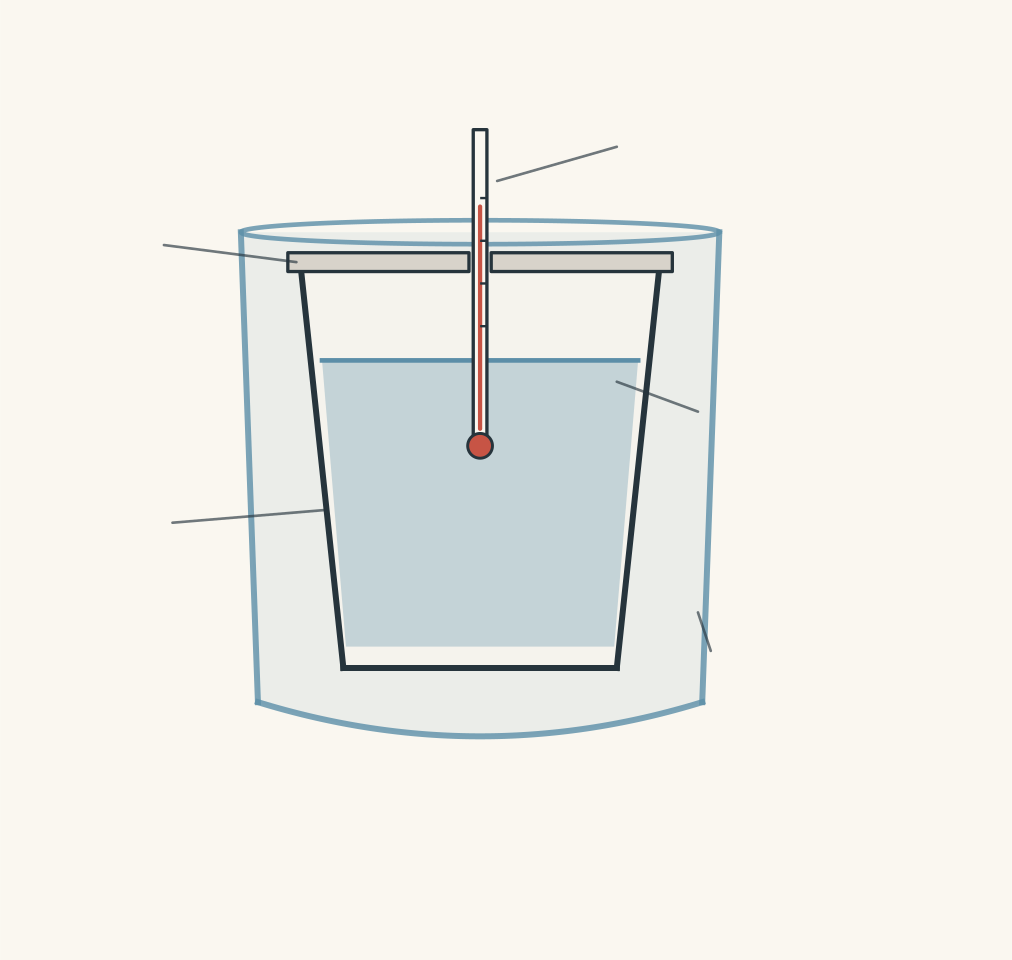
(a) Calculate the heat gained by the reaction mixture, \(q_{\mathrm{solution}}\), in kJ. (2 marks)
(b) Determine the heat transferred by the reaction, \(q_{\mathrm{reaction}}\), in kJ. Explain the sign of your answer. (2 marks)
Question 2 (7 marks)
Two trials investigate the neutralisation of hydrochloric acid with sodium hydroxide. Both solutions have a concentration of \(1.00\ \mathrm{mol\,L^{-1}}\), and the reaction follows the equation:
\[ \ce{HCl(aq) + NaOH(aq) -> NaCl(aq) + H2O(l)} \]
The experimental conditions and temperature measurements are shown below.
| Measurement | Trial A | Trial B |
|---|---|---|
| Volume of HCl | 40.0 mL | 60.0 mL |
| Volume of NaOH | 40.0 mL | 60.0 mL |
| Total solution mass | 80.0 g | 120.0 g |
| Initial temperature | 19.5°C | 19.5°C |
| Peak temperature | 25.0°C | 24.0°C |
Assume the reaction proceeds according to the equation shown. For calculating the experimental molar enthalpy, use the measured heat gained by the solution as an estimate of the heat released by the reaction.
(a) Calculate the heat gained by the solution in each trial. (2 marks)
(b) Calculate the experimental molar enthalpy of neutralisation for each trial, per mole of water formed. Include the sign and units. (3 marks)
(c) The same reaction was used in both trials. Assess whether the calculated molar enthalpies are consistent with one another, and suggest one experimental factor that could explain the difference. (2 marks)
Question 3 (7 marks)
A student mixes \(100.0\ \mathrm{mL}\) of \(0.800\ \mathrm{mol\,L^{-1}}\) hydrochloric acid with \(60.0\ \mathrm{mL}\) of \(1.00\ \mathrm{mol\,L^{-1}}\) sodium hydroxide.
Both solutions initially have a temperature of \(20.2^\circ\mathrm{C}\). The maximum temperature of the mixture is \(25.4^\circ\mathrm{C}\).
The reaction is represented by:
\[ \ce{HCl(aq) + NaOH(aq) -> NaCl(aq) + H2O(l)} \]
Assume the cup absorbs negligible energy and no heat is exchanged with the external surroundings.
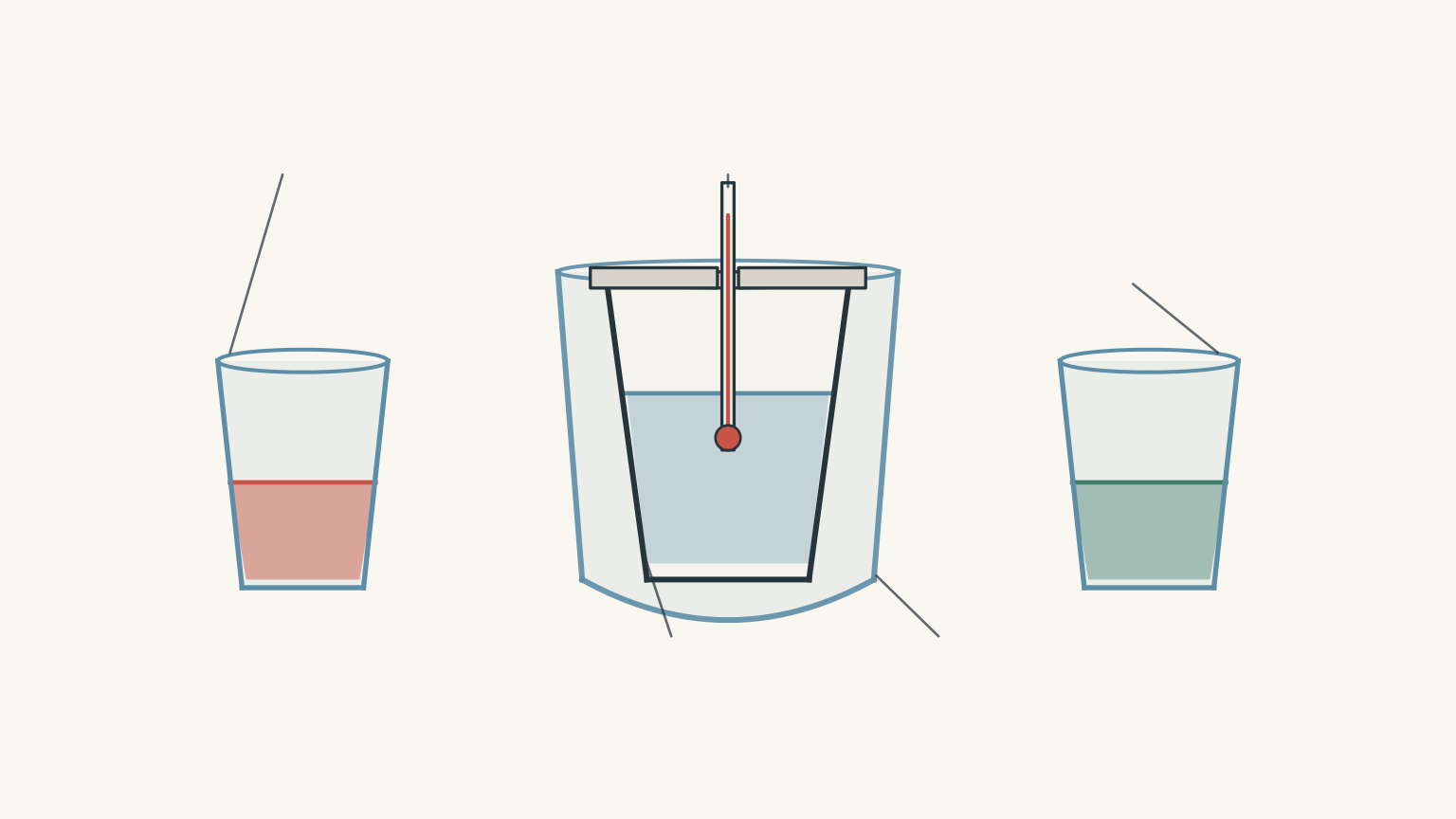
(a) Calculate the heat gained by the reaction mixture, in kJ. (2 marks)
(b) Calculate the amount, in moles, of each reactant initially present. Identify the limiting reactant and determine the amount of water formed. (3 marks)
(c) Calculate the molar enthalpy of neutralisation per mole of water formed, including its sign and units. (2 marks)
Question 4 (5 marks)
A student dissolves \(5.00\ \mathrm{g}\) of solid X in \(100.0\ \mathrm{g}\) of water using an insulated cup.
The molar mass of X is \(125.0\ \mathrm{g\,mol^{-1}}\). The temperature of the water decreases from \(24.8^\circ\mathrm{C}\) to \(21.9^\circ\mathrm{C}\).
For this question, take the mass of the final solution to be \(105.0\ \mathrm{g}\). Assume the cup absorbs negligible energy and no heat is exchanged with the external surroundings.
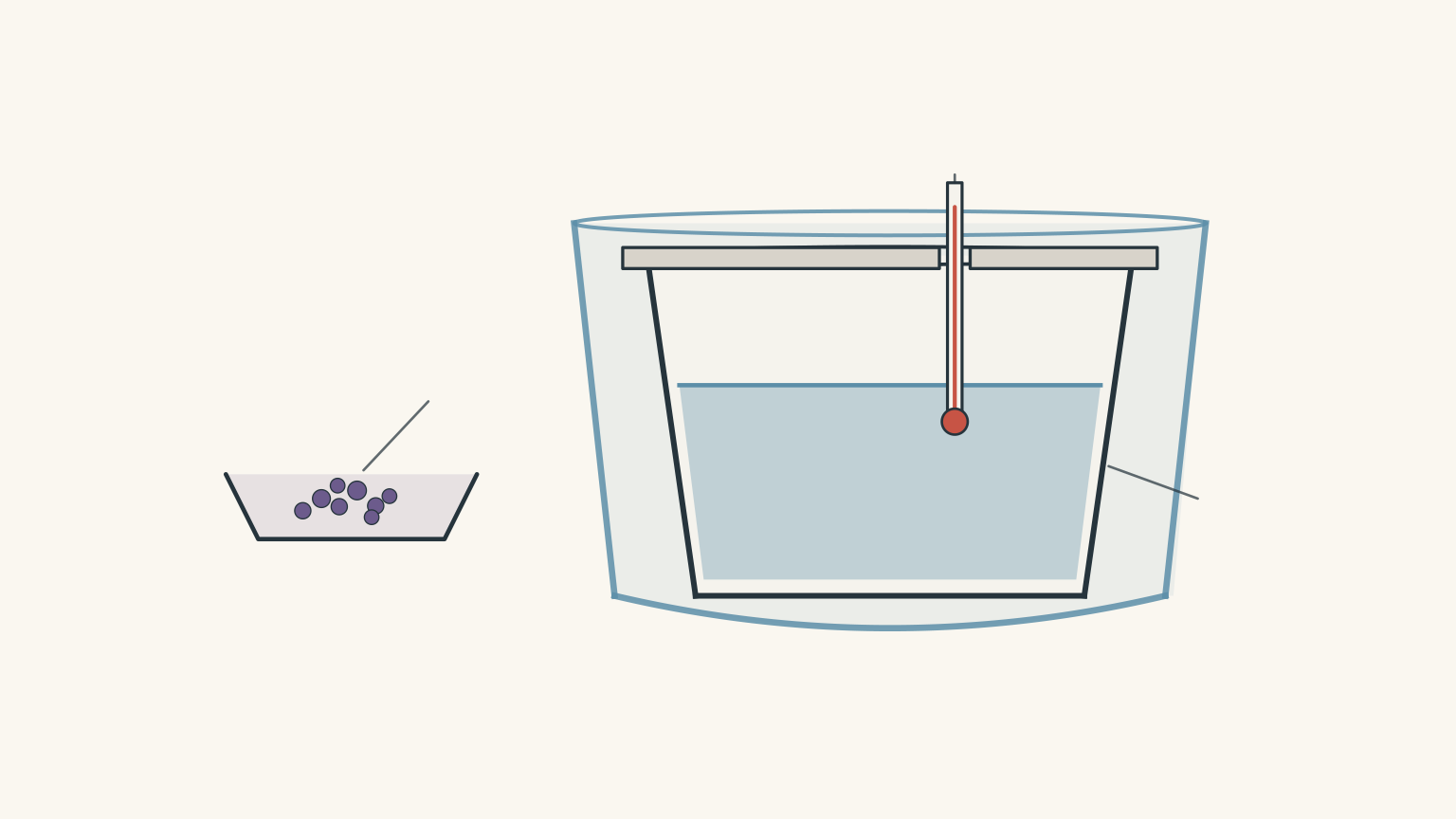
(a) Calculate the heat transferred to the solution, \(q_{\mathrm{solution}}\), in kJ. (2 marks)
(b) Calculate the amount of solid X dissolved, in moles. (1 mark)
(c) Calculate the molar enthalpy of dissolution of X, including its sign and units. State whether the process is endothermic or exothermic. (2 marks)
Question 5 (8 marks)
A student uses an ethanol spirit burner to heat \(150.0\ \mathrm{g}\) of water in an uninsulated metal can.
The water temperature increases from \(18.5^\circ\mathrm{C}\) to \(39.0^\circ\mathrm{C}\). The burner has a mass of \(152.340\ \mathrm{g}\) before heating and \(151.880\ \mathrm{g}\) after heating.
The molar mass of ethanol is \(46.07\ \mathrm{g\,mol^{-1}}\).
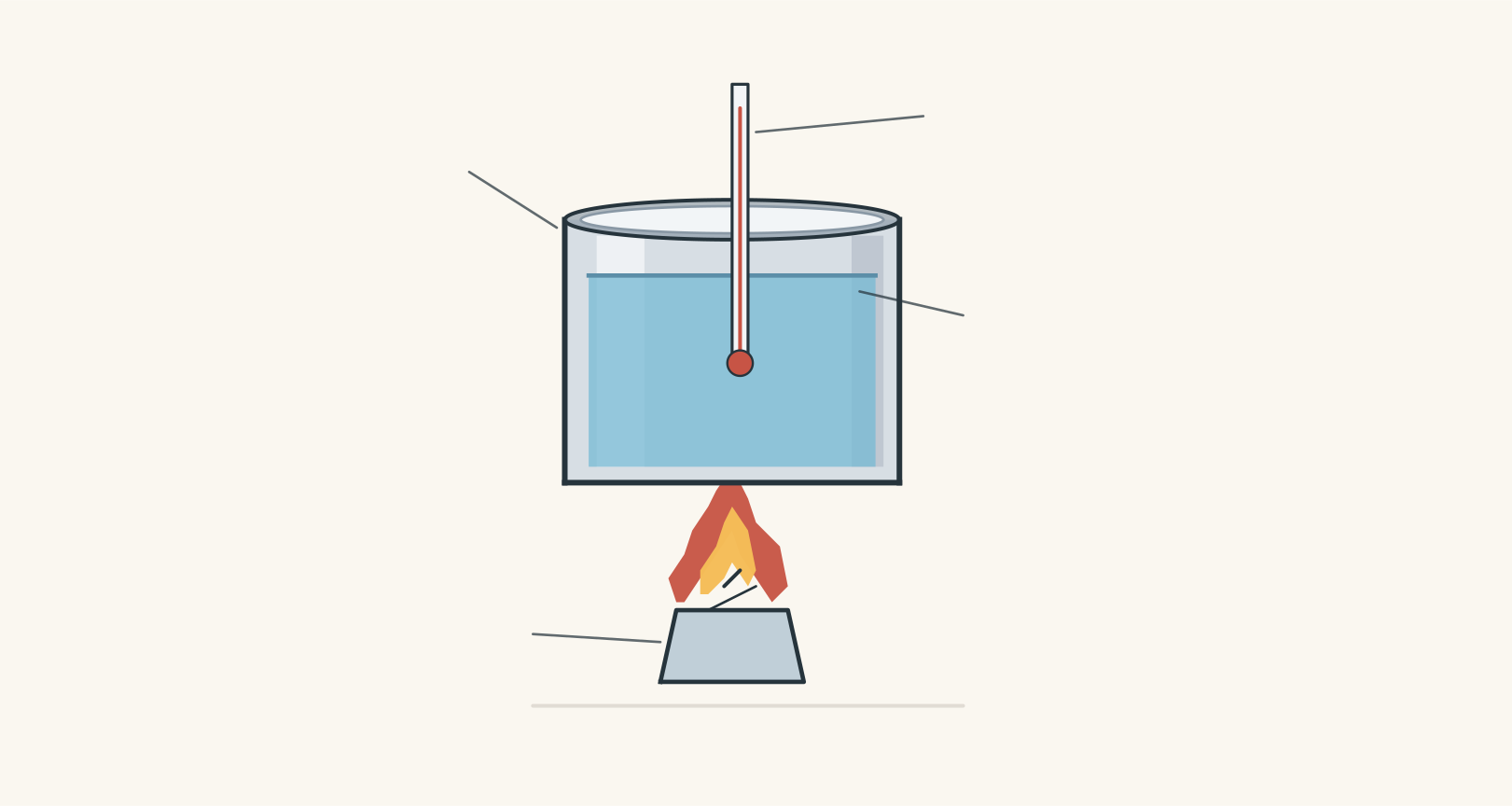
(a) Calculate the heat gained by the water, in kJ. (2 marks)
(b) Calculate the mass of ethanol consumed and the amount of ethanol burned, in moles. (2 marks)
(c) Calculate the experimental molar enthalpy of combustion of ethanol, using the heat gained by the water as the measured heat released. Include the sign and units. (2 marks)
(d) If some energy is transferred to the surroundings rather than the water, explain how this affects the calculated molar enthalpy compared with the true value. Suggest one improvement to the apparatus that would address this limitation. (2 marks)
Question 6 (9 marks)
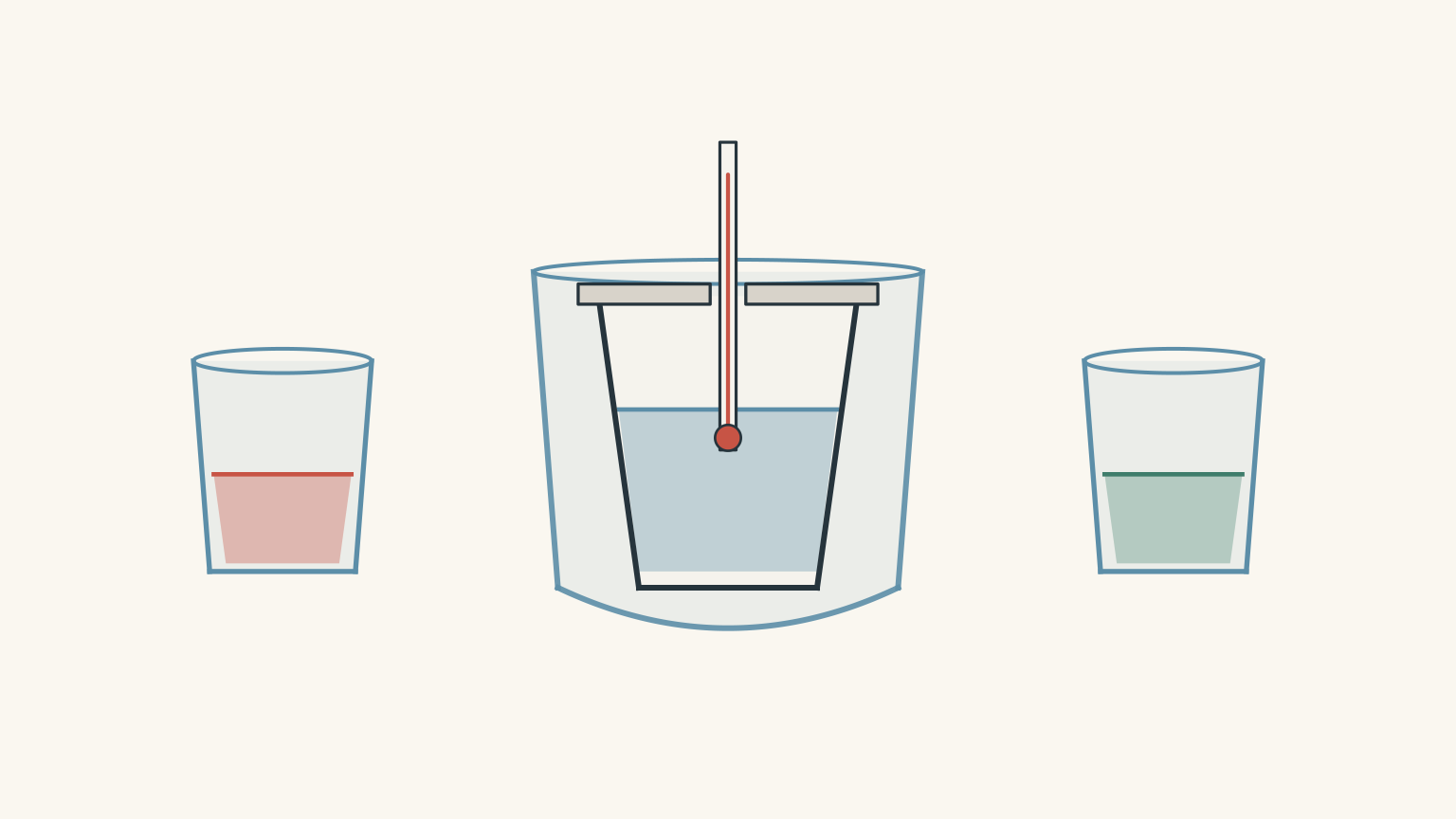
A student investigates the neutralisation of nitric acid with potassium hydroxide.
The student mixes \(50.0\ \mathrm{mL}\) of \(1.00\ \mathrm{mol\,L^{-1}}\) nitric acid with \(50.0\ \mathrm{mL}\) of \(1.00\ \mathrm{mol\,L^{-1}}\) potassium hydroxide. Both solutions initially have a temperature of \(22.0^\circ\mathrm{C}\), and the final maximum temperature is \(27.6^\circ\mathrm{C}\).
The reaction is represented by:
\[ \ce{HNO3(aq) + KOH(aq) -> KNO3(aq) + H2O(l)} \]
For the ideal calculation, assume the cup absorbs negligible energy and no heat is exchanged with the external surroundings.
The student incorrectly uses \(50.0\ \mathrm{g}\) as the mass in \(q = mc\Delta T\), taking the mass of only one solution rather than the combined mixture. The student reports a molar enthalpy of neutralisation of \(-23.4\ \mathrm{kJ\,mol^{-1}}\).
(a) Determine the correct total mass of the mixed solution and its temperature change. (2 marks)
(b) Calculate the heat gained by the solution and the corresponding heat transferred by the reaction, in kJ. (2 marks)
(c) Calculate the amount of each reactant and the corrected molar enthalpy of neutralisation per mole of water formed. Include the sign and units. (3 marks)
(d) Explain why the student’s reported value is incorrect. Then identify one additional assumption in the calorimetry model that could limit the accuracy of a real experiment, and explain its likely effect on the calculated enthalpy. (2 marks)
03Worked solutions and marking guide
Solution 1
(a) Heat gained by the reaction mixture (2 marks)
First calculate the temperature change:
\[ \begin{aligned} \Delta T &= T_{\mathrm{final}}-T_{\mathrm{initial}}\\ &=27.8-21.4\\ &=6.4^\circ\mathrm{C} \end{aligned} \]
Using \(q=mc\Delta T\):
\[ \begin{aligned} q_{\mathrm{solution}} &= mc\Delta T\\ &=100.0\times4.18\times6.4\\ &=2675.2\ \mathrm{J}\\ &=2.68\ \mathrm{kJ} \end{aligned} \]
The solution gains \(2.68\ \mathrm{kJ}\) of heat.
Marking guide:
- 1 mark for the correct temperature change of \(6.4^\circ\mathrm{C}\).
- 1 mark for the correct calculation and answer of \(2.68\ \mathrm{kJ}\).
(b) Heat transferred by the reaction (2 marks)
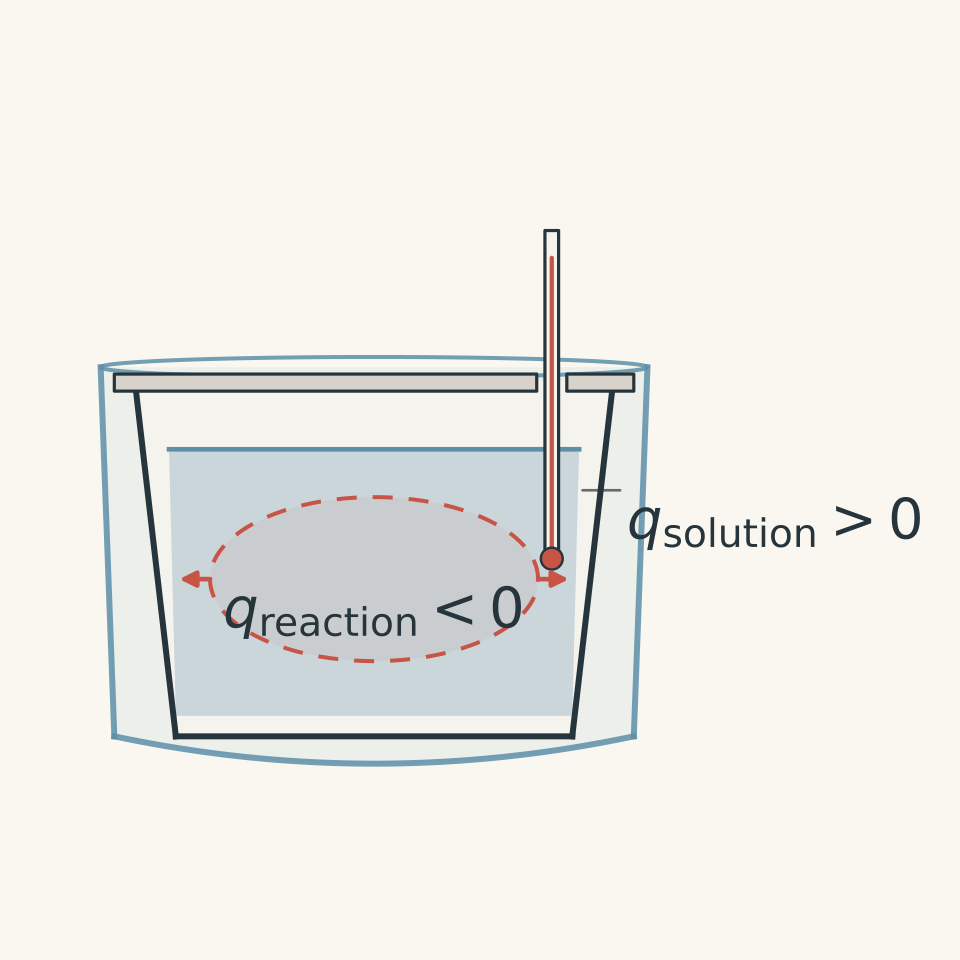
The cup and external surroundings are assumed to absorb no energy. Therefore, the energy lost by the reaction equals the energy gained by the solution.
\[ \begin{aligned} q_{\mathrm{reaction}}&=-q_{\mathrm{solution}}\\ &=-2.68\ \mathrm{kJ} \end{aligned} \]
The negative sign means the reaction releases energy. The reaction is exothermic because the solution gains heat while the reacting system loses it.
Marking guide:
- 1 mark for \(q_{\mathrm{reaction}}=-2.68\ \mathrm{kJ}\).
- 1 mark for explaining that the reaction loses energy as the solution gains energy, so the reaction enthalpy is negative.
Solution 2
(a) Heat gained in each trial (2 marks)
For Trial A, the temperature change is:
\[ \Delta T_A=25.0-19.5=5.5^\circ\mathrm{C} \]
The heat gained is:
\[ \begin{aligned} q_A&=mc\Delta T\\ &=80.0\times4.18\times5.5\\ &=1839.2\ \mathrm{J}\\ &=1.84\ \mathrm{kJ} \end{aligned} \]
For Trial B:
\[ \Delta T_B=24.0-19.5=4.5^\circ\mathrm{C} \]
\[ \begin{aligned} q_B&=120.0\times4.18\times4.5\\ &=2257.2\ \mathrm{J}\\ &=2.26\ \mathrm{kJ} \end{aligned} \]
Trial B gains more heat, even though its temperature rise is smaller. Its solution has a greater mass, so temperature change alone cannot determine the heat transferred.
Marking guide:
- 1 mark for \(q_A=1.84\ \mathrm{kJ}\).
- 1 mark for \(q_B=2.26\ \mathrm{kJ}\).
(b) Experimental molar enthalpy of neutralisation (3 marks)
The balanced equation shows that HCl and NaOH react in a 1:1 ratio to produce water.
For Trial A:
\[ \begin{aligned} n(\ce{HCl})&=1.00\times0.0400\\ &=0.0400\ \mathrm{mol} \end{aligned} \]
The same amount of NaOH reacts, so \(0.0400\ \mathrm{mol}\) of water forms.
Using the measured heat gain as the estimate of the heat released by the reaction:
\[ \begin{aligned} \Delta H_A&=\frac{-q_A}{n(\ce{H2O})}\\ &=\frac{-1.8392}{0.0400}\\ &=-46.0\ \mathrm{kJ\,mol^{-1}} \end{aligned} \]
For Trial B, the amount of water formed is:
\[ \begin{aligned} n(\ce{H2O})&=1.00\times0.0600\\ &=0.0600\ \mathrm{mol} \end{aligned} \]
Therefore:
\[ \begin{aligned} \Delta H_B&=\frac{-2.2572}{0.0600}\\ &=-37.6\ \mathrm{kJ\,mol^{-1}} \end{aligned} \]
The experimental molar enthalpies are \(-46.0\ \mathrm{kJ\,mol^{-1}}\) for Trial A and \(-37.6\ \mathrm{kJ\,mol^{-1}}\) for Trial B.
Marking guide:
- 1 mark for the correct amounts of water formed in both trials.
- 1 mark for the correct signed molar enthalpy for Trial A.
- 1 mark for the correct signed molar enthalpy for Trial B.
(c) Consistency of the results (2 marks)
The results are not particularly consistent. Both trials measure the same reaction, so their experimental molar enthalpies should be reasonably similar if the experiments are performed under comparable conditions.
Trial B gives a less negative result. One possible explanation is that more energy was lost to the surroundings in Trial B, or that its peak temperature was recorded too late. Either would reduce the measured temperature rise relative to the heat actually released by the reaction.
Marking guide:
- 1 mark for identifying that the values differ more than expected for the same reaction under comparable conditions.
- 1 mark for a plausible experimental factor and its effect on the measured heat or enthalpy.
Solution 3
(a) Heat gained by the reaction mixture (2 marks)
The total volume is:
\[ V=100.0+60.0=160.0\ \mathrm{mL} \]
Using the supplied density, the mass of the mixture is \(160.0\ \mathrm{g}\).
The temperature change is:
\[ \Delta T=25.4-20.2=5.2^\circ\mathrm{C} \]
Therefore:
\[ \begin{aligned} q_{\mathrm{solution}}&=mc\Delta T\\ &=160.0\times4.18\times5.2\\ &=3477.76\ \mathrm{J}\\ &=3.48\ \mathrm{kJ} \end{aligned} \]
The reaction mixture gains \(3.48\ \mathrm{kJ}\).
Marking guide:
- 1 mark for the correct mass of \(160.0\ \mathrm{g}\) and temperature change of \(5.2^\circ\mathrm{C}\).
- 1 mark for the correct heat calculation and answer of \(3.48\ \mathrm{kJ}\).
(b) Limiting reactant and amount of water formed (3 marks)
Calculate the amount of each reactant using \(n=cV\), with volume in litres.
For hydrochloric acid:
\[ \begin{aligned} n(\ce{HCl})&=0.800\times0.1000\\ &=0.0800\ \mathrm{mol} \end{aligned} \]
For sodium hydroxide:
\[ \begin{aligned} n(\ce{NaOH})&=1.00\times0.0600\\ &=0.0600\ \mathrm{mol} \end{aligned} \]
The equation has a 1:1 ratio between HCl and NaOH. Only \(0.0600\ \mathrm{mol}\) of each can react, so NaOH is the limiting reactant.
The amount of water formed is therefore:
\[ n(\ce{H2O})=0.0600\ \mathrm{mol} \]
Marking guide:
- 1 mark for \(n(\ce{HCl})=0.0800\ \mathrm{mol}\).
- 1 mark for \(n(\ce{NaOH})=0.0600\ \mathrm{mol}\).
- 1 mark for identifying NaOH as limiting and determining \(n(\ce{H2O})=0.0600\ \mathrm{mol}\).
(c) Molar enthalpy of neutralisation (2 marks)
The solution gains \(3.48\ \mathrm{kJ}\), so the reaction loses the same amount under the stated assumptions.
\[ q_{\mathrm{reaction}}=-3.48\ \mathrm{kJ} \]
The molar enthalpy is calculated using the amount of water formed:
\[ \begin{aligned} \Delta H_{\mathrm{neut}}&=\frac{q_{\mathrm{reaction}}}{n(\ce{H2O})}\\ &=\frac{-3.48}{0.0600}\\ &=-58.0\ \mathrm{kJ\,mol^{-1}} \end{aligned} \]
The negative value indicates an exothermic neutralisation reaction.
Marking guide:
- 1 mark for the correct reaction heat of \(-3.48\ \mathrm{kJ}\).
- 1 mark for the correct molar enthalpy of \(-58.0\ \mathrm{kJ\,mol^{-1}}\).
Solution 4
(a) Heat transferred to the solution (2 marks)
The temperature change is:
\[ \begin{aligned} \Delta T&=21.9-24.8\\ &=-2.9^\circ\mathrm{C} \end{aligned} \]
The temperature decreases, so the heat transferred to the solution is negative.
\[ \begin{aligned} q_{\mathrm{solution}}&=mc\Delta T\\ &=105.0\times4.18\times(-2.9)\\ &=-1272.8\ \mathrm{J}\\ &=-1.27\ \mathrm{kJ} \end{aligned} \]
Marking guide:
- 1 mark for \(\Delta T=-2.9^\circ\mathrm{C}\).
- 1 mark for \(q_{\mathrm{solution}}=-1.27\ \mathrm{kJ}\).
(b) Amount of solid X dissolved (1 mark)
Use the molar mass to convert mass into moles:
\[ \begin{aligned} n(X)&=\frac{m}{M}\\ &=\frac{5.00}{125.0}\\ &=0.0400\ \mathrm{mol} \end{aligned} \]
Marking guide:
- 1 mark for \(n(X)=0.0400\ \mathrm{mol}\).
(c) Molar enthalpy of dissolution (2 marks)
The solution loses \(1.27\ \mathrm{kJ}\), so the dissolving process absorbs that energy under the stated assumptions.
\[ q_{\mathrm{dissolution}}=+1.27\ \mathrm{kJ} \]
Divide by the amount of solid dissolved:
\[ \begin{aligned} \Delta H_{\mathrm{dissolution}}&=\frac{q_{\mathrm{dissolution}}}{n(X)}\\ &=\frac{+1.27}{0.0400}\\ &=+31.8\ \mathrm{kJ\,mol^{-1}} \end{aligned} \]
The positive molar enthalpy indicates an endothermic process. The dissolving solid absorbs energy from the surrounding solution, causing the temperature to fall.
Marking guide:
- 1 mark for the correct signed molar enthalpy of \(+31.8\ \mathrm{kJ\,mol^{-1}}\).
- 1 mark for identifying the process as endothermic and linking this to the solution’s temperature decrease.
Solution 5
(a) Heat gained by the water (2 marks)
The temperature change is:
\[ \begin{aligned} \Delta T&=39.0-18.5\\ &=20.5^\circ\mathrm{C} \end{aligned} \]
Using the mass of water:
\[ \begin{aligned} q_{\mathrm{water}}&=mc\Delta T\\ &=150.0\times4.18\times20.5\\ &=12844.5\ \mathrm{J}\\ &=12.8\ \mathrm{kJ} \end{aligned} \]
The water gains \(12.8\ \mathrm{kJ}\) of heat.
Marking guide:
- 1 mark for \(\Delta T=20.5^\circ\mathrm{C}\).
- 1 mark for \(q_{\mathrm{water}}=12.8\ \mathrm{kJ}\).
(b) Amount of ethanol burned (2 marks)
The mass of ethanol consumed is the decrease in the burner’s mass:
\[ \begin{aligned} m(\text{ethanol})&=152.340-151.880\\ &=0.460\ \mathrm{g} \end{aligned} \]
Convert this mass to moles:
\[ \begin{aligned} n(\text{ethanol})&=\frac{m}{M}\\ &=\frac{0.460}{46.07}\\ &=0.00998\ \mathrm{mol} \end{aligned} \]
Marking guide:
- 1 mark for the mass of ethanol burned, \(0.460\ \mathrm{g}\).
- 1 mark for \(n(\text{ethanol})=0.00998\ \mathrm{mol}\).
(c) Experimental molar enthalpy of combustion (2 marks)
The water gains heat, so the combustion reaction is assigned the opposite sign when the water’s heat gain is used as the estimate of the reaction’s heat release.
\[ q_{\mathrm{combustion,\,measured}}=-12.8\ \mathrm{kJ} \]
The experimental molar enthalpy is:
\[ \begin{aligned} \Delta H_{\mathrm{c,\,exp}}&=\frac{q_{\mathrm{combustion,\,measured}}}{n(\text{ethanol})}\\ &=\frac{-12.8445}{0.0099848}\\ &=-1.29\times10^3\ \mathrm{kJ\,mol^{-1}} \end{aligned} \]
The negative value is consistent with an exothermic combustion reaction.
Marking guide:
- 1 mark for using a reaction heat of approximately \(-12.8\ \mathrm{kJ}\).
- 1 mark for the correct molar enthalpy of approximately \(-1.29\times10^3\ \mathrm{kJ\,mol^{-1}}\).
(d) Heat loss and improvement (2 marks)
If energy escapes to the surroundings instead of heating the water, the water gains less energy than the combustion reaction releases.
The calculated molar enthalpy will therefore be less negative than the true value. Its magnitude is underestimated because the calculation uses only the heat measured by the water.
One improvement is to use a well-insulated calorimeter with a lid. This reduces heat transfer to the surrounding air and allows a greater proportion of the released energy to be measured.
Marking guide:
- 1 mark for explaining that heat loss causes the calculated molar enthalpy to be less negative than the true value.
- 1 mark for a suitable improvement and an explanation of how it reduces energy loss.
Solution 6
(a) Correct mass and temperature change (2 marks)
The total solution volume is:
\[ V=50.0+50.0=100.0\ \mathrm{mL} \]
Using the supplied density:
\[ m=100.0\ \mathrm{g} \]
The temperature change is:
\[ \begin{aligned} \Delta T&=27.6-22.0\\ &=5.6^\circ\mathrm{C} \end{aligned} \]
Marking guide:
- 1 mark for the correct total mass of \(100.0\ \mathrm{g}\).
- 1 mark for \(\Delta T=5.6^\circ\mathrm{C}\).
(b) Heat gained by the solution and heat transferred by the reaction (2 marks)
Calculate the heat gained by the solution:
\[ \begin{aligned} q_{\mathrm{solution}}&=mc\Delta T\\ &=100.0\times4.18\times5.6\\ &=2340.8\ \mathrm{J}\\ &=2.34\ \mathrm{kJ} \end{aligned} \]
The reaction transfers this energy to the solution. Under the ideal assumptions:
\[ q_{\mathrm{reaction}}=-2.34\ \mathrm{kJ} \]
Marking guide:
- 1 mark for \(q_{\mathrm{solution}}=+2.34\ \mathrm{kJ}\).
- 1 mark for \(q_{\mathrm{reaction}}=-2.34\ \mathrm{kJ}\).
(c) Correct molar enthalpy of neutralisation (3 marks)
Calculate the amount of nitric acid:
\[ \begin{aligned} n(\ce{HNO3})&=cV\\ &=1.00\times0.0500\\ &=0.0500\ \mathrm{mol} \end{aligned} \]
Similarly:
\[ n(\ce{KOH})=0.0500\ \mathrm{mol} \]
The equation has a 1:1 ratio, so \(0.0500\ \mathrm{mol}\) of water forms.
The corrected molar enthalpy is:
\[ \begin{aligned} \Delta H_{\mathrm{neut}}&=\frac{q_{\mathrm{reaction}}}{n(\ce{H2O})}\\ &=\frac{-2.3408}{0.0500}\\ &=-46.8\ \mathrm{kJ\,mol^{-1}} \end{aligned} \]
Marking guide:
- 1 mark for \(n(\ce{HNO3})=0.0500\ \mathrm{mol}\).
- 1 mark for \(n(\ce{KOH})=n(\ce{H2O})=0.0500\ \mathrm{mol}\).
- 1 mark for the corrected molar enthalpy of \(-46.8\ \mathrm{kJ\,mol^{-1}}\), including the sign and units.
(d) Evaluating the student’s calculation and the experimental assumptions (2 marks)
The student used only \(50.0\ \mathrm{g}\) instead of the total solution mass of \(100.0\ \mathrm{g}\). Since \(q=mc\Delta T\), halving the mass while keeping the same specific heat capacity and temperature change halves the calculated heat.
The student’s calculated heat would be \(1.17\ \mathrm{kJ}\), giving:
\[ \Delta H=\frac{-1.17}{0.0500} =-23.4\ \mathrm{kJ\,mol^{-1}} \]
This explains why the reported value has half the magnitude of the corrected result.
A separate limitation is the assumption that the cup absorbs no energy and that no heat escapes to the surroundings. In a real experiment, some energy may heat the cup or escape to the air. The solution would then gain less heat than the reaction releases, making the calculated molar enthalpy less negative than the true value.
Marking guide:
- 1 mark for explaining that using half the correct mass halves the calculated heat and molar enthalpy.
- 1 mark for identifying a realistic limitation of the ideal calorimetry assumptions and explaining its likely effect on the calculated result.