
Concentration and Dilution: HSC Chemistry Practice Exam
Test your understanding of concentration and dilution problems with this original 40-mark HSC Chemistry practice exam. Includes timed exam conditions, six questions, complete worked solutions, and a detailed marking guide.
This original tutorgum practice paper tests concentration and dilution problems within the Chemistry 2017 syllabus scope. It covers molarity calculations, concentration-unit conversions, percentage concentrations, serial dilutions, and the practical preparation of diluted solutions using volumetric glassware. All questions are original, and complete worked solutions and a marking guide are provided after the paper.
01Exam instructions
Paper: Original tutorgum Chemistry Practice Paper
Course: NSW HSC Chemistry – Chemistry 2017 syllabus scope
Topic: Concentration and dilution problems
Suggested reading time: 5 minutes
Suggested working time: 60 minutes
Total marks: 40
This is a focused topic assessment, not a full-course examination or an official, endorsed, or predicted NESA paper.
Assessed content
This paper assesses:
- Molarity calculations using \(c = \frac{n}{V}\), including rearrangements to calculate concentration, amount, mass, and volume.
- Conversion between concentration units, including \(\mathrm{mol\,L^{-1}}\) and \(\mathrm{g\,L^{-1}}\).
- Percentage concentration, including \(\%\ m/v\), \(\%\ v/v\), and \(\%\ m/m\).
- Dilution calculations using conservation of solute.
- Serial dilution calculations involving multiple transfers.
- Practical preparation of diluted solutions using pipettes and volumetric flasks.
- Accuracy, experimental technique, and sources of error when preparing solutions.
Excluded content
This paper does not assess titrations, reaction stoichiometry, equilibrium, acids and bases, redox chemistry, or other Chemistry modules.
Equipment and assumptions
- Scientific calculator.
- Pen and pencil.
- Ruler, if required.
- No notes or internet access.
All necessary molar masses are supplied in the questions.
Use the following conventions:
- Convert volumes into litres before using \(c = \frac{n}{V}\).
- Give numerical answers to three significant figures unless otherwise stated.
- Include appropriate units in all numerical answers.
- Show your working, including equations and substitutions.
- Treat stated volumetric glassware volumes as their nominal values for calculation purposes.
02Questions
Question 1 (6 marks)
A student has prepared a sodium chloride solution containing \(0.0180\) mol of NaCl in a total solution volume of \(150.0\) mL.
Assume the solution is homogeneous.
(a) Convert the total solution volume into litres. (1 mark)
(b) Calculate the amount concentration of the sodium chloride solution in \(\mathrm{mol\,L^{-1}}\). (2 marks)
(c) Calculate the amount of NaCl, in moles, present in a \(25.0\) mL sample taken from this solution. (2 marks)
(d) Calculate the mass of NaCl originally dissolved to prepare the \(150.0\) mL solution.
The molar mass of NaCl is \(58.44\ \mathrm{g\,mol^{-1}}\). (1 mark)
Question 2 (7 marks)
A glucose solution is labelled as having a concentration of \(1.20\%\ m/v\).
The molar mass of glucose is \(180.0\ \mathrm{g\,mol^{-1}}\).
(a) Explain what a concentration of \(1.20\%\ m/v\) means. (1 mark)
(b) Convert this percentage concentration into a mass concentration in \(\mathrm{g\,L^{-1}}\). (1 mark)
(c) Calculate the amount concentration of the glucose solution in \(\mathrm{mol\,L^{-1}}\). (2 marks)
A separate sodium chloride solution has a mass concentration of \(12.0\ \mathrm{g\,L^{-1}}\).
The molar mass of NaCl is \(58.44\ \mathrm{g\,mol^{-1}}\).
(d) Calculate the amount concentration of the sodium chloride solution in \(\mathrm{mol\,L^{-1}}\). (2 marks)
(e) Which solution has the greater amount concentration? Explain why comparing their mass concentrations alone would not establish which solution contains more moles of solute per litre. (1 mark)
Question 3 (8 marks)
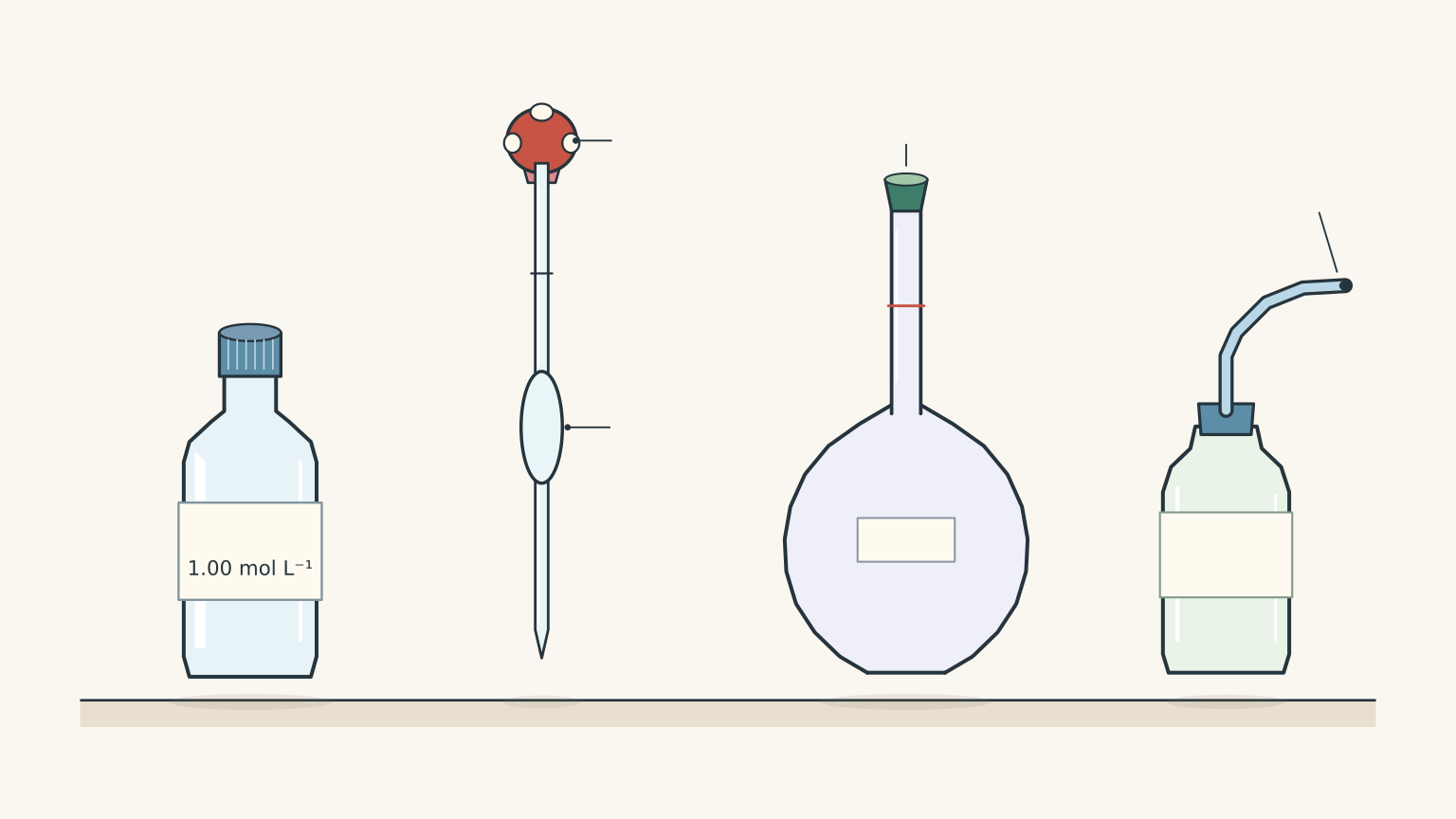
A student needs to prepare \(250.0\) mL of a \(0.100\ \mathrm{mol\,L^{-1}}\) sodium chloride solution from a stock solution with a concentration of \(1.00\ \mathrm{mol\,L^{-1}}\).
The available equipment includes:
- A \(25.0\) mL volumetric pipette.
- A pipette filler.
- A \(250.0\) mL volumetric flask.
- A deionised water wash bottle.
(a) Calculate the volume of stock solution required to prepare the desired diluted solution. (2 marks)
(b) Describe the procedure the student should follow to prepare the diluted solution accurately using the supplied equipment. (4 marks)
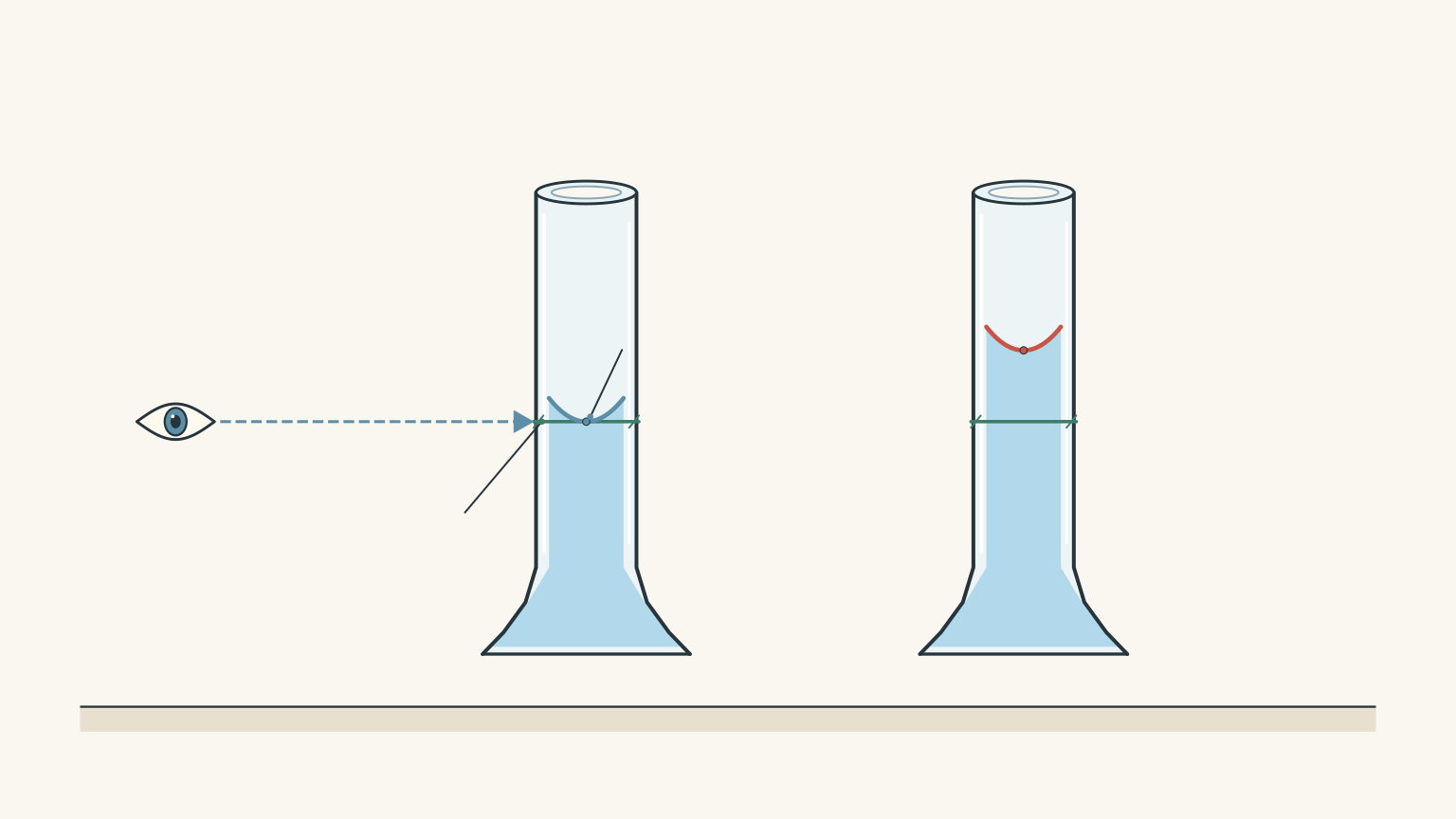
(c) During preparation, the student accidentally adds water until the bottom of the meniscus sits above the calibration mark on the volumetric flask.
Identify how this error affects the final concentration compared with the intended concentration. Explain your reasoning. (2 marks)
Question 4 (8 marks)
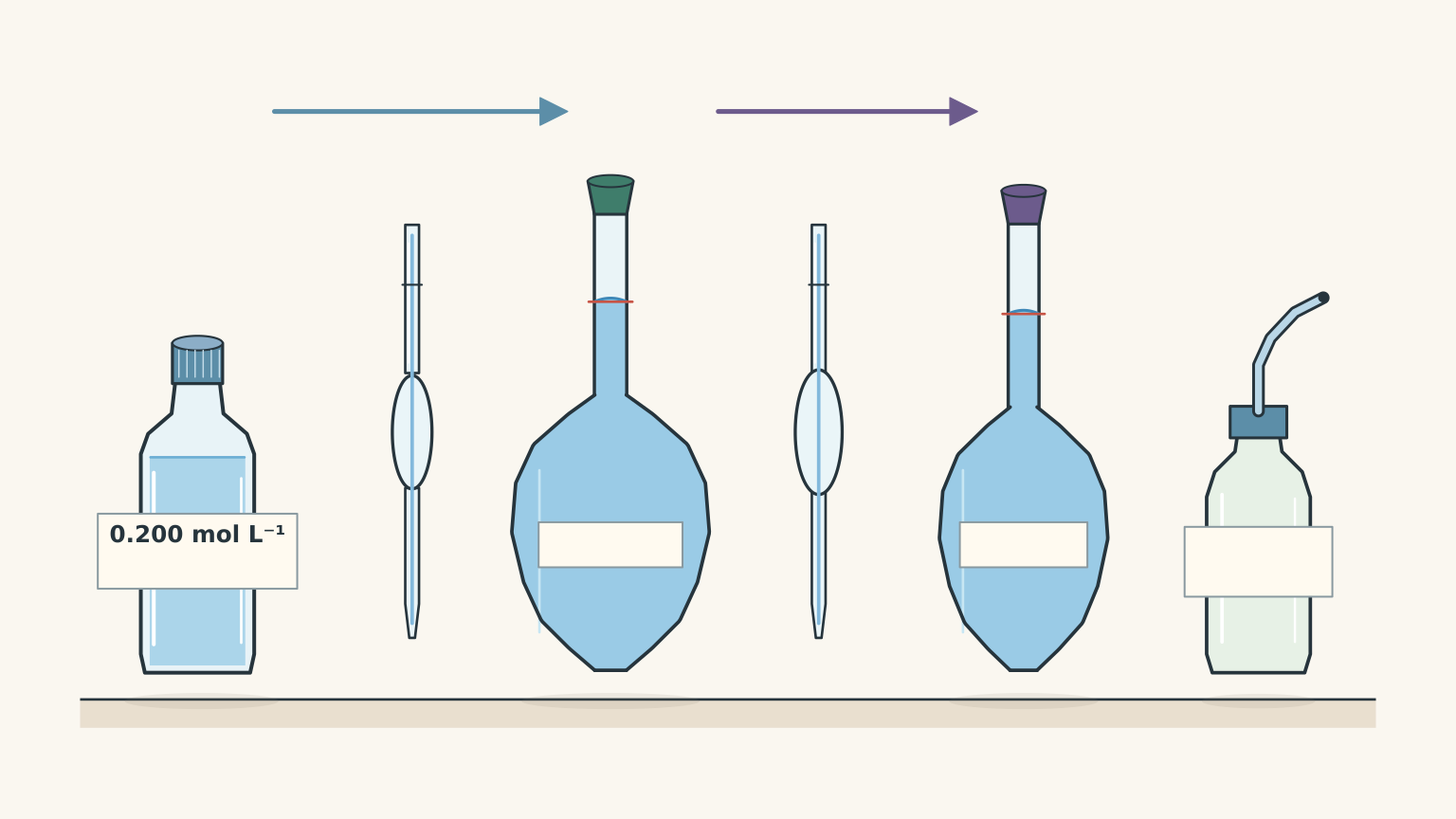
A student performs a two-stage dilution using a copper sulfate solution.
The original stock solution has an amount concentration of \(0.200\ \mathrm{mol\,L^{-1}}\).
The student follows this procedure:
- Transfers \(10.0\) mL of the stock solution into a \(100.0\) mL volumetric flask.
- Adds deionised water until the solution reaches the calibration mark and mixes thoroughly.
- Transfers \(20.0\) mL of the first diluted solution into a second \(50.0\) mL volumetric flask.
- Adds deionised water until the second flask reaches its calibration mark and mixes thoroughly.
(a) Calculate the amount concentration of the solution in the first volumetric flask after dilution. (2 marks)
(b) Calculate the amount concentration of the solution in the second volumetric flask after the second dilution. (2 marks)
(c) Calculate the amount of copper sulfate, in moles, present in the final \(50.0\) mL solution. (2 marks)
(d) Explain why the amount of copper sulfate in the second flask is not equal to the total amount of copper sulfate originally present in the first flask. (2 marks)
Question 5 (6 marks)
A laboratory solution of calcium chloride has a mass concentration of \(4.50\ \mathrm{g\,L^{-1}}\).
The molar mass of calcium chloride, \(\mathrm{CaCl_2}\), is \(111.0\ \mathrm{g\,mol^{-1}}\).
A student takes a \(40.0\) mL sample of this solution.
(a) Calculate the amount concentration of the calcium chloride solution in \(\mathrm{mol\,L^{-1}}\). (2 marks)
(b) Calculate the amount of calcium chloride, in moles, present in the \(40.0\) mL sample. (2 marks)
(c) Calculate the mass of calcium chloride in the sample. Express your answer in milligrams. (2 marks)
Question 6 (5 marks)
A laboratory prepares two aqueous propan-2-ol solutions.
Their concentration labels are:
- Solution A: \(70.0\%\ v/v\) propan-2-ol.
- Solution B: \(70.0\%\ m/m\) propan-2-ol.
(a) Explain what a concentration of \(70.0\%\ v/v\) means. (1 mark)
(b) Calculate the volume of propan-2-ol present in \(250\) mL of Solution A. (1 mark)
(c) Explain what a concentration of \(70.0\%\ m/m\) means. (1 mark)
(d) Calculate the mass of propan-2-ol present in \(80.0\) g of Solution B. (1 mark)
(e) A student claims that Solutions A and B must have the same concentration because both are labelled \(70.0\%\).
Explain the flaw in this conclusion. (1 mark)
03Worked solutions and marking guide
Solution 1
(a) Convert the volume into litres.
There are \(1000\) mL in one litre.
\[ V = \frac{150.0}{1000} \]
\[ \boxed{V = 0.1500\ \mathrm{L}} \]
Marking guide:
- Correct conversion from millilitres to litres: 1 mark.
(b) Calculate the amount concentration.
The relationship between amount concentration, amount of solute, and solution volume is:
\[ c = \frac{n}{V} \]
Where:
- \(c\) is amount concentration in \(\mathrm{mol\,L^{-1}}\).
- \(n\) is amount of solute in mol.
- \(V\) is solution volume in L.
Substitute the supplied values:
\[ c = \frac{0.0180}{0.1500} \]
\[ \boxed{c = 0.120\ \mathrm{mol\,L^{-1}}} \]
Marking guide:
- Correct equation: 1 mark.
- Correct substitution and final answer with units: 1 mark.
(c) Calculate the amount of NaCl in a 25.0 mL sample.
The sample volume must first be converted into litres:
\[ V = \frac{25.0}{1000} = 0.0250\ \mathrm{L} \]
Rearrange the concentration equation to make \(n\) the subject:
\[ n = cV \]
Substitute:
\[ n = 0.120 \times 0.0250 \]
\[ \boxed{n = 0.00300\ \mathrm{mol}} \]
The sample contains \(3.00 \times 10^{-3}\) mol of sodium chloride.
Marking guide:
- Correct volume conversion and use of \(n=cV\): 1 mark.
- Correct amount with units: 1 mark.
(d) Calculate the original mass of NaCl.
Use the relationship:
\[ m = nM \]
Where:
- \(m\) is mass in g.
- \(n\) is amount in mol.
- \(M\) is molar mass in \(\mathrm{g\,mol^{-1}}\).
Substitute:
\[ m = 0.0180 \times 58.44 \]
\[ \boxed{m = 1.05\ \mathrm{g}} \]
Marking guide:
- Correct mass calculation and answer with units: 1 mark.
Total: 6 marks.
Solution 2
(a) Explain what \(1.20\%\ m/v\) means.
Percentage mass/volume concentration describes the mass of solute, in grams, present in every \(100\) mL of solution.
Therefore:
\[ 1.20\%\ m/v \]
means that \(1.20\) g of glucose is present in every \(100\) mL of the final solution.
It refers to the volume of the entire solution, not the volume of water used to prepare it.
Marking guide:
- Correctly identifies \(1.20\) g of glucose per \(100\) mL of solution: 1 mark.
(b) Convert the percentage concentration into \(\mathrm{g\,L^{-1}}\).
We know:
\[ 1.20\ \mathrm{g} \text{ per }100\ \mathrm{mL} \]
One litre contains \(1000\) mL, which is ten times \(100\) mL.
Therefore:
\[ 1.20 \times 10 = 12.0 \]
\[ \boxed{12.0\ \mathrm{g\,L^{-1}}} \]
Marking guide:
- Correct conversion to \(\mathrm{g\,L^{-1}}\): 1 mark.
(c) Calculate the amount concentration of glucose.
We now have the mass concentration:
\[ 12.0\ \mathrm{g\,L^{-1}} \]
The molar mass of glucose is:
\[ M = 180.0\ \mathrm{g\,mol^{-1}} \]
To calculate the amount concentration, divide the mass concentration by the molar mass.
\[ c = \frac{\text{mass concentration}}{M} \]
Substitute:
\[ c = \frac{12.0}{180.0} \]
\[ \boxed{c = 0.0667\ \mathrm{mol\,L^{-1}}} \]
Marking guide:
- Correct relationship between mass concentration and molar mass: 1 mark.
- Correct calculation and units: 1 mark.
(d) Calculate the amount concentration of sodium chloride.
The sodium chloride solution has a mass concentration of:
\[ 12.0\ \mathrm{g\,L^{-1}} \]
Its molar mass is:
\[ M = 58.44\ \mathrm{g\,mol^{-1}} \]
Apply the same relationship:
\[ c = \frac{12.0}{58.44} \]
\[ \boxed{c = 0.205\ \mathrm{mol\,L^{-1}}} \]
Marking guide:
- Correct relationship and substitution: 1 mark.
- Correct answer with units: 1 mark.
(e) Compare the two solutions.
The sodium chloride solution has the greater amount concentration.
\[ c_{\mathrm{NaCl}} = 0.205\ \mathrm{mol\,L^{-1}} \]
\[ c_{\mathrm{glucose}} = 0.0667\ \mathrm{mol\,L^{-1}} \]
Both solutions have the same mass concentration of \(12.0\ \mathrm{g\,L^{-1}}\), but their molar masses are different.
A gram of glucose contains fewer moles than a gram of sodium chloride because glucose has a much greater molar mass.
This is why equal mass concentrations do not necessarily mean equal amount concentrations.
Marking guide:
- Identifies sodium chloride and explains the importance of the different molar masses: 1 mark.
Total: 7 marks.
Solution 3
(a) Calculate the volume of stock solution required.
This is a dilution problem.
During dilution, the amount of solute stays constant. Only the total solution volume changes.
Therefore:
\[ n_{\mathrm{before}} = n_{\mathrm{after}} \]
Using \(n=cV\):
\[ c_1V_1 = c_2V_2 \]
Where:
- \(c_1\) is the original stock concentration.
- \(V_1\) is the volume of stock solution required.
- \(c_2\) is the desired final concentration.
- \(V_2\) is the final solution volume.
Rearrange:
\[ V_1 = \frac{c_2V_2}{c_1} \]
Substitute:
\[ V_1 = \frac{0.100 \times 250.0}{1.00} \]
\[ \boxed{V_1 = 25.0\ \mathrm{mL}} \]
The student needs \(25.0\) mL of the original stock solution.
Marking guide:
- Correct dilution equation and rearrangement: 1 mark.
- Correct stock volume with units: 1 mark.
(b) Describe the procedure for preparing the diluted solution.
The student should follow these steps:
Rinse the volumetric pipette with a small amount of the original sodium chloride stock solution. Use a pipette filler to draw up the solution. This prevents residual water in the pipette from diluting the stock solution before measurement.
Measure \(25.0\) mL of the stock solution using the volumetric pipette. Transfer it into the \(250.0\) mL volumetric flask, allowing the pipette to drain as designed.
Add deionised water to the volumetric flask. Swirl gently, then add water dropwise as the liquid approaches the calibration mark. Read the bottom of the meniscus at eye level and bring it exactly to the mark.
Stopper the flask and invert it several times to mix the solution thoroughly and ensure a uniform concentration throughout.
Marking guide:
- Correct pipette preparation and use of a pipette filler: 1 mark.
- Accurate transfer of the measured stock solution into the volumetric flask: 1 mark.
- Correct addition of deionised water and meniscus alignment: 1 mark.
- Stoppering and thorough mixing by inversion: 1 mark.
(c) Explain the effect of adding too much water.
The final volume will be greater than the intended \(250.0\) mL.
However, the amount of sodium chloride transferred from the stock solution remains unchanged.
Since:
\[ c = \frac{n}{V} \]
increasing the volume while keeping the amount of solute constant decreases the concentration.
Therefore, the final concentration will be lower than the intended \(0.100\ \mathrm{mol\,L^{-1}}\).
Marking guide:
- Identifies that the final volume is greater than intended: 1 mark.
- Explains that the unchanged solute amount is distributed through a greater volume, producing a lower concentration: 1 mark.
Total: 8 marks.
Solution 4
This question tests an important idea: dilution conserves the amount of solute, but transferring only part of a solution means transferring only part of its solute.
(a) Calculate the concentration in the first volumetric flask.
The original stock solution has:
\[ c_1 = 0.200\ \mathrm{mol\,L^{-1}} \]
The student transfers:
\[ V_1 = 10.0\ \mathrm{mL} \]
The final volume is:
\[ V_2 = 100.0\ \mathrm{mL} \]
Use the dilution equation:
\[ c_1V_1 = c_2V_2 \]
Rearrange:
\[ c_2 = \frac{c_1V_1}{V_2} \]
Substitute:
\[ c_2 = \frac{0.200 \times 10.0}{100.0} \]
\[ \boxed{c_2 = 0.0200\ \mathrm{mol\,L^{-1}}} \]
Marking guide:
- Correct dilution relationship and substitution: 1 mark.
- Correct final concentration with units: 1 mark.
(b) Calculate the concentration in the second volumetric flask.
The student transfers \(20.0\) mL of the first diluted solution into a \(50.0\) mL volumetric flask.
The starting concentration for this second dilution is:
\[ c_1 = 0.0200\ \mathrm{mol\,L^{-1}} \]
The transferred volume is:
\[ V_1 = 20.0\ \mathrm{mL} \]
The final volume is:
\[ V_2 = 50.0\ \mathrm{mL} \]
Apply the dilution equation again:
\[ c_1V_1 = c_2V_2 \]
Rearrange and substitute:
\[ c_2 = \frac{0.0200 \times 20.0}{50.0} \]
\[ \boxed{c_2 = 0.00800\ \mathrm{mol\,L^{-1}}} \]
Notice that the original stock concentration is not used directly in this second calculation. The second dilution starts with the concentration produced by the first dilution.
Marking guide:
- Correct use of the first diluted concentration in the second dilution: 1 mark.
- Correct final concentration with units: 1 mark.
(c) Calculate the amount of copper sulfate in the final solution.
We know:
\[ c = 0.00800\ \mathrm{mol\,L^{-1}} \]
\[ V = 50.0\ \mathrm{mL} \]
Convert the volume into litres:
\[ V = 0.0500\ \mathrm{L} \]
Rearrange the molarity equation:
\[ n = cV \]
Substitute:
\[ n = 0.00800 \times 0.0500 \]
\[ \boxed{n = 0.000400\ \mathrm{mol}} \]
Or, in scientific notation:
\[ \boxed{n = 4.00 \times 10^{-4}\ \mathrm{mol}} \]
Marking guide:
- Correct use of \(n=cV\), including volume conversion: 1 mark.
- Correct amount with units: 1 mark.
(d) Explain why the second flask does not contain all the copper sulfate from the first flask.
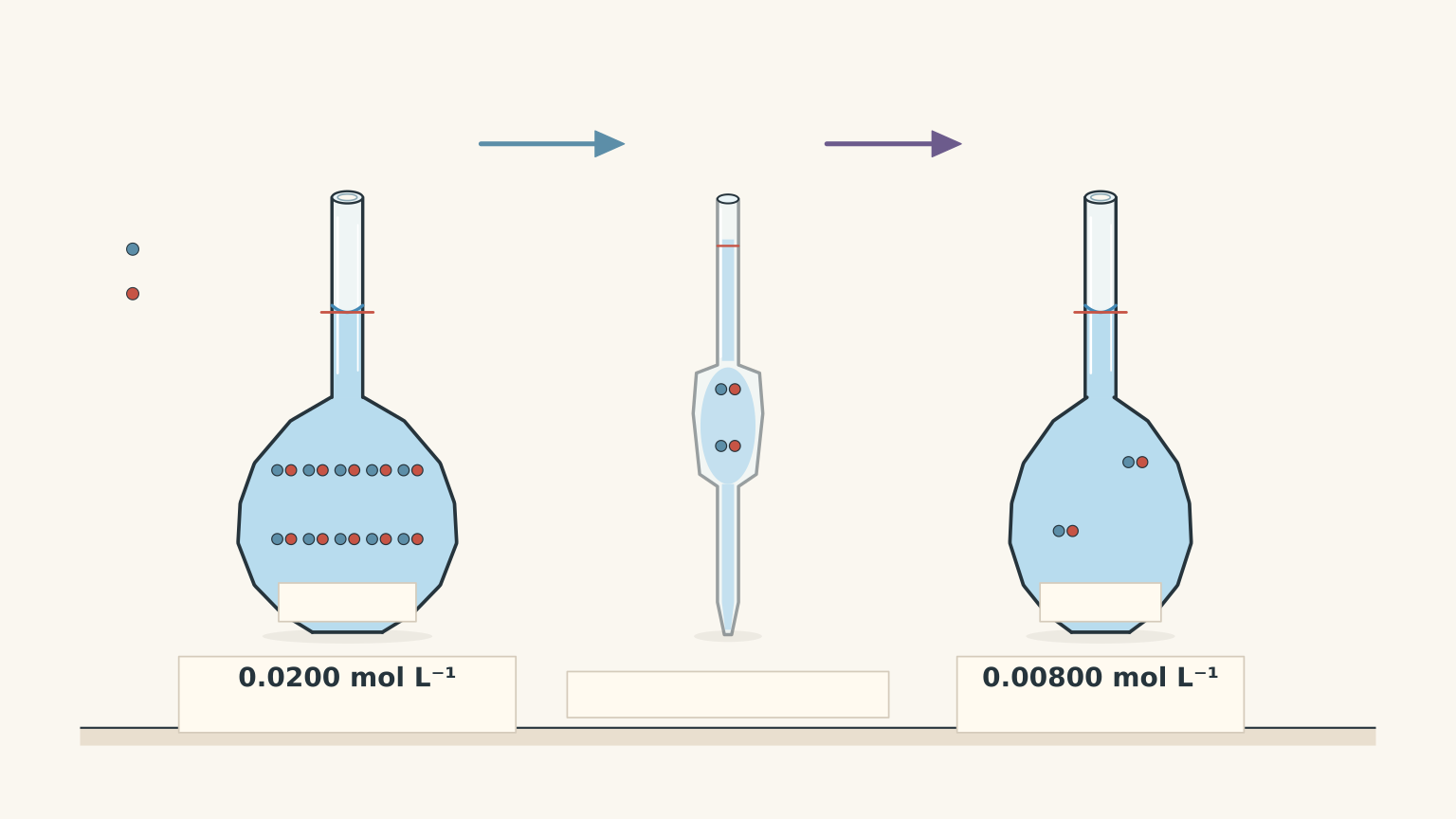
The first diluted flask contains more copper sulfate than the amount transferred into the second flask.
The first flask has a concentration of \(0.0200\ \mathrm{mol\,L^{-1}}\) and a total volume of \(0.1000\) L.
Its total amount of copper sulfate is:
\[ n = cV \]
\[ n = 0.0200 \times 0.1000 \]
\[ n = 0.00200\ \mathrm{mol} \]
However, the student only transfers \(20.0\) mL from this \(100.0\) mL solution.
The fraction transferred is:
\[ \frac{20.0}{100.0} = 0.200 \]
Therefore, the amount transferred is:
\[ n = 0.200 \times 0.00200 \]
\[ n = 0.000400\ \mathrm{mol} \]
Adding water to the second flask does not add or remove copper sulfate. It only increases the solution volume.
Marking guide:
- Explains that only the \(20.0\) mL aliquot, rather than the entire first solution, is transferred: 1 mark.
- Explains that adding water changes the volume and concentration but does not change the amount of copper sulfate in the transferred sample: 1 mark.
Total: 8 marks.
Solution 5
(a) Calculate the amount concentration.
We are given a mass concentration rather than an amount concentration.
The mass concentration is:
\[ \gamma = 4.50\ \mathrm{g\,L^{-1}} \]
The molar mass is:
\[ M = 111.0\ \mathrm{g\,mol^{-1}} \]
To convert mass concentration into amount concentration, divide by the molar mass:
\[ c = \frac{\gamma}{M} \]
Substitute:
\[ c = \frac{4.50}{111.0} \]
\[ \boxed{c = 0.0405\ \mathrm{mol\,L^{-1}}} \]
Marking guide:
- Correct relationship between mass concentration and molar mass: 1 mark.
- Correct answer with units: 1 mark.
(b) Calculate the amount of calcium chloride in the sample.
The sample volume is:
\[ V = 40.0\ \mathrm{mL} \]
Convert into litres:
\[ V = 0.0400\ \mathrm{L} \]
Use:
\[ n = cV \]
Substitute:
\[ n = 0.0405 \times 0.0400 \]
\[ \boxed{n = 1.62 \times 10^{-3}\ \mathrm{mol}} \]
Marking guide:
- Correct volume conversion and use of \(n=cV\): 1 mark.
- Correct amount with units: 1 mark.
(c) Calculate the mass of calcium chloride in milligrams.
There are two useful approaches.
Using the mass concentration directly:
\[ m = \gamma V \]
Substitute:
\[ m = 4.50 \times 0.0400 \]
\[ m = 0.180\ \mathrm{g} \]
Convert grams into milligrams:
\[ 0.180 \times 1000 = 180 \]
Therefore:
\[ \boxed{m = 180\ \mathrm{mg}} \]
You could also calculate the mass using \(m=nM\). Both methods give the same result.
Marking guide:
- Correct use of mass concentration and sample volume, or equivalent \(m=nM\) method: 1 mark.
- Correct conversion and final answer in milligrams: 1 mark.
Total: 6 marks.
Solution 6
(a) Explain what \(70.0\%\ v/v\) means.
Percentage volume/volume concentration describes the volume of solute present in every \(100\) mL of final solution.
Therefore, \(70.0\%\ v/v\) means:
\[ 70.0\ \mathrm{mL} \]
of propan-2-ol is present in every \(100\) mL of solution.
Marking guide:
- Correct interpretation as \(70.0\) mL of solute per \(100\) mL of solution: 1 mark.
(b) Calculate the volume of propan-2-ol in Solution A.
The concentration is \(70.0\%\ v/v\).
Convert the percentage into a decimal:
\[ \frac{70.0}{100} = 0.700 \]
Multiply by the total solution volume:
\[ V_{\mathrm{solute}} = 0.700 \times 250 \]
\[ \boxed{V_{\mathrm{solute}} = 175\ \mathrm{mL}} \]
Marking guide:
- Correct calculation and answer with units: 1 mark.
(c) Explain what \(70.0\%\ m/m\) means.
Percentage mass/mass concentration describes the mass of solute present in every \(100\) g of final solution.
Therefore, \(70.0\%\ m/m\) means:
\[ 70.0\ \mathrm{g} \]
of propan-2-ol is present in every \(100\) g of solution.
Marking guide:
- Correct interpretation as \(70.0\) g of solute per \(100\) g of solution: 1 mark.
(d) Calculate the mass of propan-2-ol in Solution B.
The concentration is \(70.0\%\ m/m\).
Convert the percentage into a decimal:
\[ \frac{70.0}{100} = 0.700 \]
Multiply by the total solution mass:
\[ m_{\mathrm{solute}} = 0.700 \times 80.0 \]
\[ \boxed{m_{\mathrm{solute}} = 56.0\ \mathrm{g}} \]
Marking guide:
- Correct calculation and answer with units: 1 mark.
(e) Explain why the two solutions cannot automatically be considered equally concentrated.
The student is confusing two different ways of expressing percentage concentration.
Solution A uses percentage volume/volume, which compares the volume of solute with the total volume of solution.
Solution B uses percentage mass/mass, which compares the mass of solute with the total mass of solution.
Although both labels show \(70.0\%\), they describe different ratios. They cannot be treated as equivalent without additional information, such as the relevant densities needed to convert between mass and volume.
Marking guide:
- Identifies the different measurement bases and explains why the numerical percentages are not directly interchangeable: 1 mark.
Total: 5 marks.
04Final mark summary
| Question | Assessed skills | Marks |
|---|---|---|
| 1 | Molarity, volume conversion, amount, and mass | 6 |
| 2 | Percentage, mass concentration, and amount concentration | 7 |
| 3 | Dilution calculations and practical laboratory technique | 8 |
| 4 | Serial dilution and conservation of solute | 8 |
| 5 | Mass concentration, molarity, and sample calculations | 6 |
| 6 | Percentage concentration descriptions and calculations | 5 |
| Total | 40 |
Reviewing your performance
After marking your paper, pay particular attention to the type of error you made.
- Calculation errors: Check whether you rearranged the correct equation and converted millilitres into litres before using \(c=n/V\).
- Unit errors: Check whether you included the correct units for mass concentration, amount concentration, and percentage concentration.
- Dilution errors: Check whether you used the concentration of the correct starting solution at each dilution stage.
- Conceptual errors: Check whether you understand that dilution changes concentration but conserves the amount of solute in the transferred sample.
- Practical errors: Check whether you understand how volumetric pipettes and volumetric flasks are used, particularly how to read the meniscus accurately.
A particularly important skill is recognising when to use \(c=n/V\) and when to use \(c_1V_1=c_2V_2\). The first calculates concentration from the amount and volume of a solution. The second is a shortcut for dilution problems, where the amount of solute remains constant.
If you can choose between these relationships confidently, keep your units consistent, and explain what happens to the solute during a dilution, you’re building a solid foundation for concentration calculations in HSC Chemistry.