
HSC Chemistry Practice Exam: Electron Configurations and Spectra
Test your understanding of electron configurations, orbital filling, flame tests, and atomic spectra with this original 50-mark tutorgum HSC Chemistry practice exam. Includes timed exam conditions, complete worked solutions, and a detailed marking guide.
This original tutorgum practice paper assesses a focused section of HSC Chemistry: electron configurations and atomic spectra. It tests ground-state configurations of atoms and ions, shell and spdf notation, orbital filling rules, flame-test evidence, and the relationship between atomic energy levels and emission spectra.
The paper includes accessible, standard, and challenging questions. It is a topic-specific revision exam, not a full-course Chemistry examination.
01Exam instructions
| Assessment condition | Details |
|---|---|
| Suggested working time | 60 minutes |
| Reading time | 5 minutes |
| Total marks | 50 |
| Permitted equipment | Scientific calculator, periodic table, ruler, pens and pencils |
| Calculations | Give numerical answers to three significant figures unless otherwise stated |
Assessed syllabus scope
This paper uses the supplied focused electron-configurations-and-atomic-spectra scope, compatible with the chemistry-2017 and chemistry-2025 syllabus editions.
The assessed content includes:
- Ground-state electronic configurations of atoms and ions.
- Shell notation and subshell notation using s, p, d and f.
- Orbital filling rules and electron arrangements.
- Identification of valence electrons.
- Flame-test colours as evidence of quantised energy changes in metal ions.
- Evaluation of flame-test investigations.
- Emission spectra as evidence for discrete electron energy levels.
- Comparison of the Bohr and Schrödinger models of the atom.
Excluded content
This is not a full-course examination. It does not assess chemical bonding, periodic trends, quantum number calculations, orbital hybridisation, photoelectron spectroscopy, or other Chemistry modules.
General assumptions and constants
- Unless stated otherwise, all atoms and ions are in their ground state.
- Electronic configurations describe the arrangement of electrons in the lowest available energy states.
- Photon energies are calculated per photon.
- Use the following constants where required:
\[ h=6.63\times10^{-34}\ \mathrm{J\,s} \]
\[ c=3.00\times10^8\ \mathrm{m\,s^{-1}} \]
where \(h\) is Planck’s constant and \(c\) is the speed of light.
The relationship between photon energy and wavelength is:
\[ E=\frac{hc}{\lambda} \]
where \(E\) is photon energy in joules and \(\lambda\) is wavelength in metres.
This is an original tutorgum practice paper. It is not an official, endorsed, past, or predicted NESA examination, and its suggested conditions are not claims about official examination requirements.
02Questions
Question 1 (12 marks)
Electronic configurations and orbital filling
(a) Write the full ground-state electronic configuration, using spdf notation, for a phosphorus atom with atomic number 15. (2 marks)
(b) Express the electronic configuration of phosphorus using shell notation. State the number of valence electrons in the atom. (2 marks)
(c) Calcium has atomic number 20.
Write the full ground-state electronic configuration of the calcium ion, \(\mathrm{Ca}^{2+}\). State how many electrons must be removed from a neutral calcium atom to produce this ion. (3 marks)
(d) Sulfur has atomic number 16.
Write the full ground-state electronic configuration of the sulfide ion, \(\mathrm{S}^{2-}\), and state its total number of electrons. (2 marks)
(e) An oxygen atom has four electrons occupying its 2p subshell.
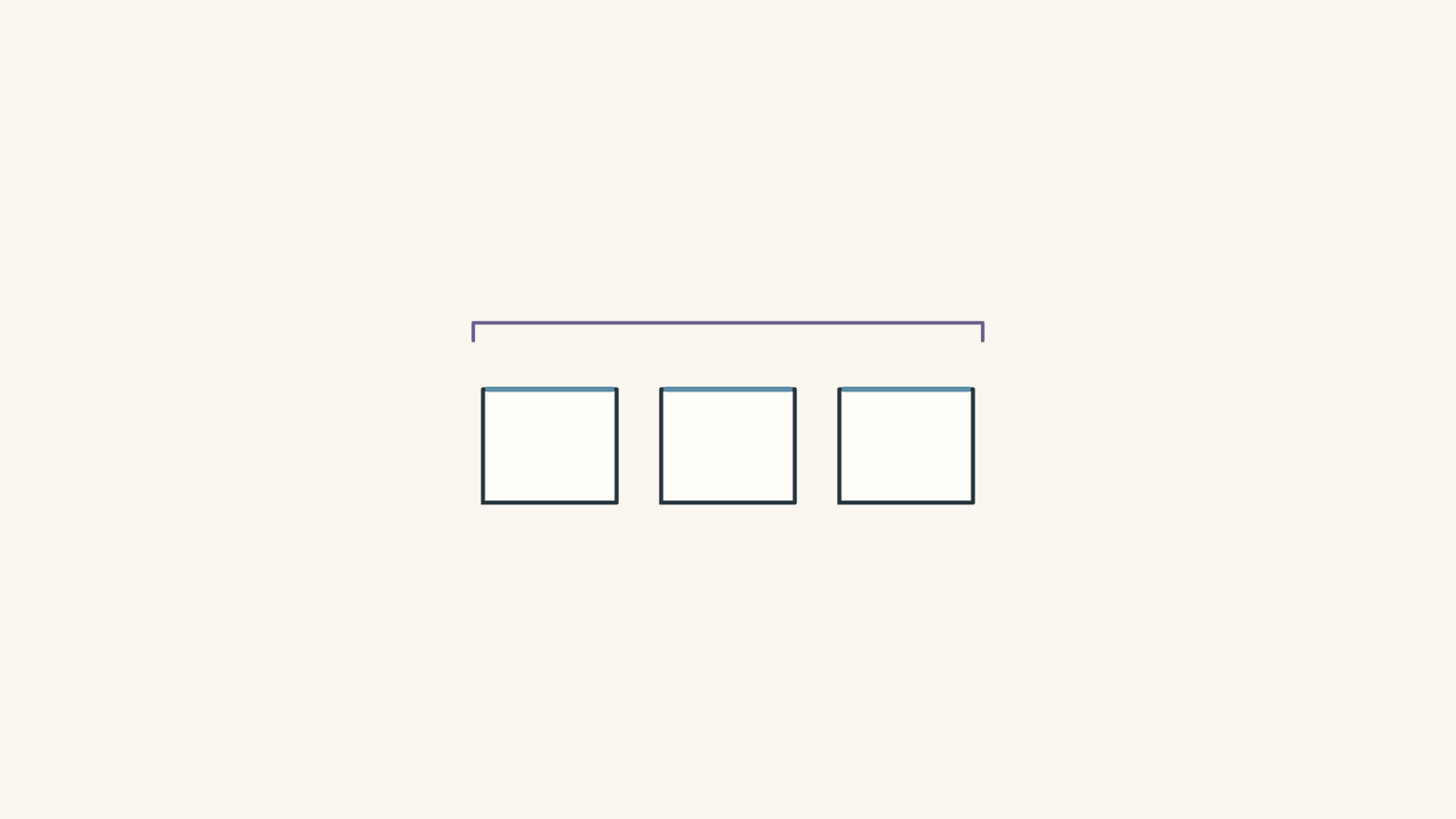
Draw an orbital box diagram showing the arrangement of these four electrons across the three 2p orbitals.
Identify the rule that determines how electrons occupy orbitals of equal energy before pairing occurs. (3 marks)
Question 2 (8 marks)
Subshells and valence electrons
Ytterbium, Yb, is a neutral atom with atomic number 70.
(a) Write the abbreviated ground-state electronic configuration of ytterbium using noble gas notation. (2 marks)
(b) State:
- The number of electrons occupying the 4f subshell.
- The maximum number of electrons that the f subshell can hold. (2 marks)
(c) Ytterbium can form a \(\mathrm{Yb}^{3+}\) ion.
Write the abbreviated ground-state electronic configuration of this ion. Explain which electrons are removed from the neutral atom and the order in which they are removed. (3 marks)
(d) Identify the outermost occupied electron shell in a neutral ytterbium atom and state how many electrons occupy that shell. (1 mark)
Question 3 (12 marks)
Atomic emission spectra and atomic models
A sample of hydrogen gas is excited and produces a visible emission spectrum.
Four observed emission lines have the following wavelengths:
| Emission line | Wavelength (nm) |
|---|---|
| A | 656.3 |
| B | 486.1 |
| C | 434.0 |
| D | 410.2 |
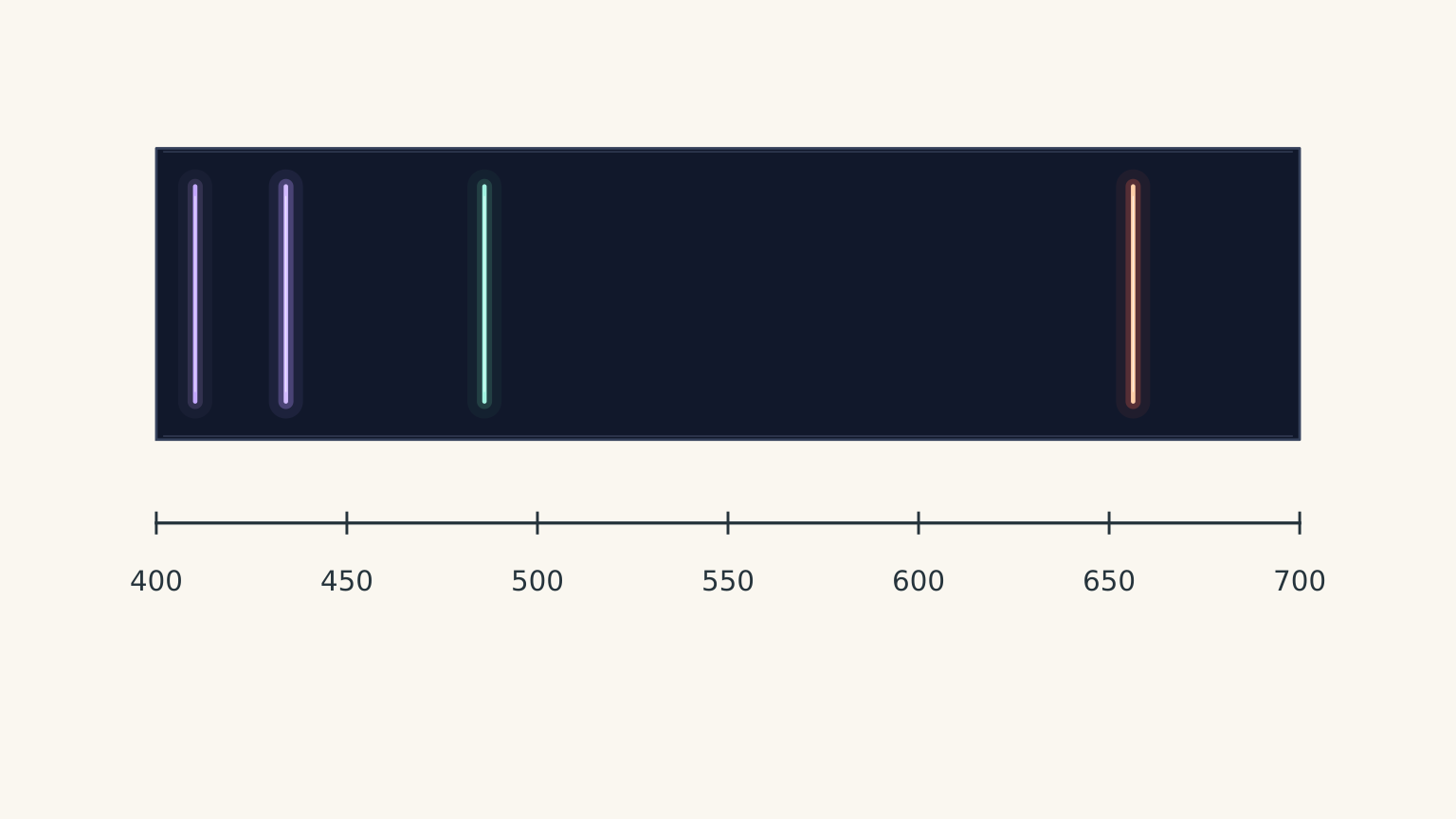
(a) Explain why the presence of separate emission lines, rather than a continuous spectrum, provides evidence for quantised electron energy levels.
Include what happens to an electron when an emission photon is produced. (3 marks)
(b) Calculate the energy of a photon corresponding to emission line A.
Show your working and give your answer in joules. (3 marks)
(c) Identify which of the four emission lines corresponds to the largest photon energy.
Justify your answer using the relationship between photon energy and wavelength. (2 marks)
(d) Compare the Bohr and Schrödinger models of the atom.
In your response:
- Describe how each model represents the location or behaviour of electrons.
- Explain how both models account for discrete emission lines.
- Identify one important difference between their descriptions of electron location. (4 marks)
Question 4 (10 marks)
Flame tests and ionic energy levels
A student conducts flame tests on four unknown chloride salts. Each sample contains one of the metal ions listed in the reference table.
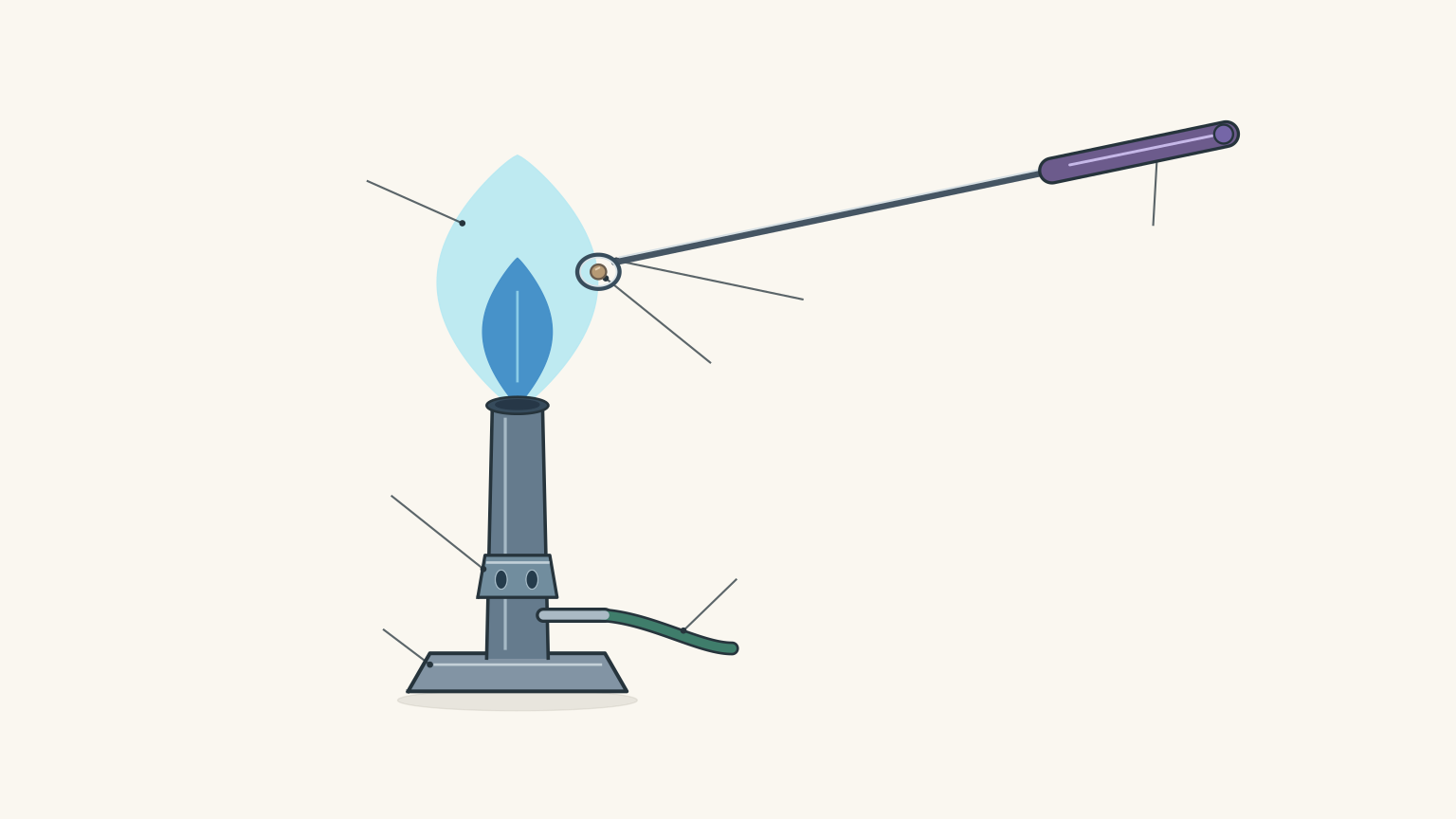
The student uses a nichrome wire loop to introduce a small amount of each sample into a non-luminous Bunsen burner flame.
The following reference data are provided.
| Metal ion | Typical flame-test colour |
|---|---|
| \(\mathrm{Li}^{+}\) | Crimson red |
| \(\mathrm{Na}^{+}\) | Yellow |
| \(\mathrm{K}^{+}\) | Lilac |
| \(\mathrm{Ca}^{2+}\) | Orange-red |
The student records these observations:
| Unknown sample | Observed flame colour |
|---|---|
| A | Bright yellow |
| B | Lilac |
| C | Crimson red |
| D | Orange-red |
(a) Identify the metal ion present in each of the four unknown samples. (2 marks)
(b) Explain why heating a metal-containing sample in a flame can produce a characteristic visible colour.
Your answer must refer to electron excitation, energy levels, and photon emission. (3 marks)
(c) Another student performs the same investigation but reuses one nichrome wire loop for every sample, rinsing it with tap water between tests.
Identify one potential source of contamination, describe an improvement to the procedure, and explain why repeating each test is useful. (3 marks)
(d) A mixture contains both sodium ions and potassium ions.
Explain why a visual flame test may not reliably identify both ions in this mixture. Suggest one technique that would improve the identification. (2 marks)
Question 5 (8 marks)
Relationships between emission wavelengths and energy levels
A hypothetical gas produces three distinct emission lines with wavelengths of:
- 600 nm
- 400 nm
- 240 nm
Assume these three lines correspond to all three possible downward electron transitions between exactly three allowed energy levels.
Use the constants supplied in the exam instructions.
(a) Arrange the three emission lines in order of increasing photon energy. (1 mark)
(b) Calculate the energy of a photon with a wavelength of 600 nm and the energy of a photon with a wavelength of 400 nm.
Calculate the sum of these two photon energies. (3 marks)
(c) Calculate the energy of a photon with a wavelength of 240 nm.
Compare this value with your answer to part (b). (2 marks)
(d) Draw an energy-level diagram showing three allowed energy levels and the electron transitions that are consistent with the three observed emission wavelengths.
Label each transition with its corresponding wavelength. (2 marks)
03Worked solutions and marking guide
Solution 1
(a) Phosphorus electronic configuration (2 marks)
Phosphorus has 15 electrons because its atomic number is 15.
Electrons fill the available subshells in order of increasing energy.
The full ground-state electronic configuration is:
\[ \boxed{ 1s^2\ 2s^2\ 2p^6\ 3s^2\ 3p^3 } \]
Check the electron count:
\[ 2+2+6+2+3=15 \]
The configuration therefore accounts for all 15 electrons.
Marking guide:
- 1 mark: Correct subshell arrangement and filling order.
- 1 mark: Correct electron occupancy, with 15 electrons in total.
(b) Shell notation and valence electrons (2 marks)
The shell notation groups electrons according to their principal energy level.
For phosphorus:
| Shell | Number of electrons |
|---|---|
| First shell | 2 |
| Second shell | 8 |
| Third shell | 5 |
Therefore, the shell notation is:
\[ \boxed{2,8,5} \]
Valence electrons are the electrons in the outermost occupied shell.
Phosphorus has five electrons in its third shell, so it has:
\[ \boxed{5\text{ valence electrons}} \]
Marking guide:
- 1 mark: Correct shell notation, \(2,8,5\).
- 1 mark: Identifies five valence electrons.
(c) Calcium ion configuration (3 marks)
A neutral calcium atom has 20 electrons.
Its ground-state configuration is:
\[ 1s^2\ 2s^2\ 2p^6\ 3s^2\ 3p^6\ 4s^2 \]
The charge of \(\mathrm{Ca}^{2+}\) indicates that the atom has lost two electrons.
These electrons are removed from the outermost occupied 4s subshell.
The resulting configuration is:
\[ \boxed{ 1s^2\ 2s^2\ 2p^6\ 3s^2\ 3p^6 } \]
The ion now contains 18 electrons.
Marking guide:
- 1 mark: Identifies that two electrons are removed.
- 1 mark: Correctly identifies the 4s subshell as the source of the removed electrons.
- 1 mark: Gives the correct full electronic configuration.
(d) Sulfide ion configuration (2 marks)
A neutral sulfur atom contains 16 electrons.
The \(\mathrm{S}^{2-}\) ion has gained two additional electrons.
Therefore:
\[ 16+2=18\text{ electrons} \]
Its full electronic configuration is:
\[ \boxed{ 1s^2\ 2s^2\ 2p^6\ 3s^2\ 3p^6 } \]
Marking guide:
- 1 mark: Correctly identifies 18 electrons.
- 1 mark: Gives the correct full electronic configuration.
(e) Orbital box diagram for oxygen (3 marks)
Oxygen has eight electrons.
Its ground-state electronic configuration is:
\[ 1s^2\ 2s^2\ 2p^4 \]
The 2p subshell contains three orbitals of equal energy. Four electrons must be distributed across these three orbitals.
The correct arrangement is:
\[ 2p:\quad [\uparrow\downarrow]\quad [\uparrow]\quad [\uparrow] \]
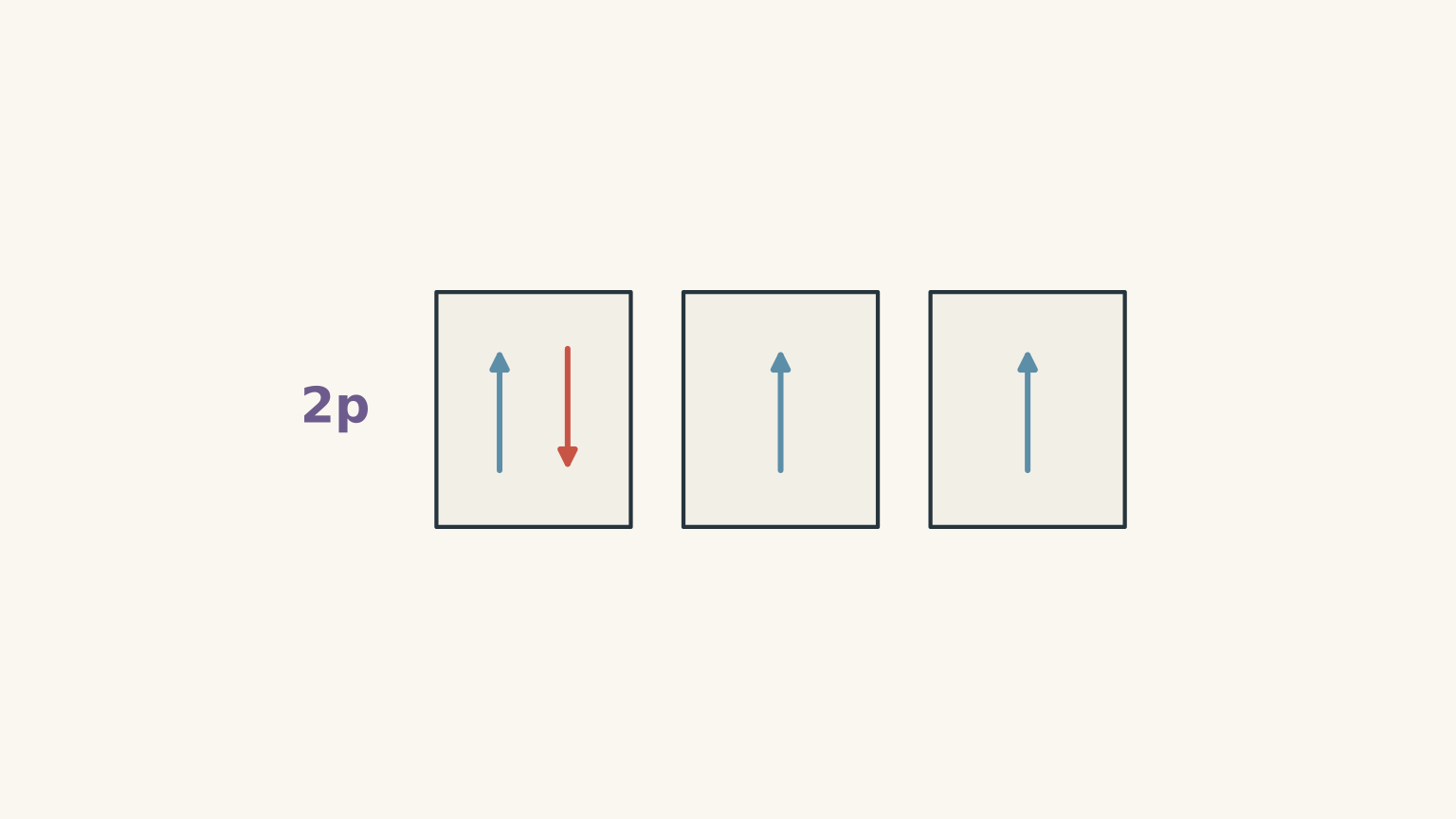
The relevant rule is Hund’s rule.
Hund’s rule states that electrons occupy orbitals of equal energy individually, with parallel spins, before they begin pairing.
The two electrons sharing an orbital must also have opposite spins, in accordance with the Pauli exclusion principle.
Marking guide:
- 1 mark: Correctly distributes four electrons across the three orbitals, with one pair and two unpaired electrons.
- 1 mark: Shows opposite spins for the paired electrons.
- 1 mark: Identifies Hund’s rule and the parallel arrangement of the unpaired electrons.
Total: 12 marks
Solution 2
(a) Ytterbium electronic configuration (2 marks)
Ytterbium has atomic number 70, so a neutral atom contains 70 electrons.
The noble gas immediately preceding ytterbium is xenon, which has 54 electrons.
The remaining 16 electrons occupy the 4f and 6s subshells.
The abbreviated ground-state configuration is:
\[ \boxed{ [\mathrm{Xe}]\ 4f^{14}\ 6s^2 } \]
Check:
\[ 54+14+2=70 \]
Marking guide:
- 1 mark: Correct identification of the xenon core.
- 1 mark: Correctly writes \(4f^{14}\ 6s^2\).
(b) Capacity of the f subshell (2 marks)
The 4f subshell contains 14 electrons.
An f subshell contains seven orbitals, and each orbital can hold a maximum of two electrons.
Therefore:
\[ 7\times2=14 \]
The maximum capacity of any f subshell is:
\[ \boxed{14\text{ electrons}} \]
Marking guide:
- 1 mark: Identifies 14 electrons in the 4f subshell.
- 1 mark: Correctly identifies the maximum f subshell capacity as 14 electrons.
(c) Formation of the ytterbium ion (3 marks)
A neutral ytterbium atom has the configuration:
\[ [\mathrm{Xe}]\ 4f^{14}\ 6s^2 \]
To form \(\mathrm{Yb}^{3+}\), three electrons must be removed.
The two electrons in the outermost 6s subshell are removed first.
One additional electron is then removed from the 4f subshell.
The resulting configuration is:
\[ \boxed{ [\mathrm{Xe}]\ 4f^{13} } \]
The 6s electrons are removed first because they occupy the outermost occupied principal energy shell.
Marking guide:
- 2 marks: Correctly writes the \(\mathrm{Yb}^{3+}\) configuration.
- 1 mark: Explains that the two 6s electrons are removed first, followed by one 4f electron.
(d) Outermost occupied shell (1 mark)
The outermost occupied shell is the sixth shell, \(n=6\).
It contains the two electrons in the 6s subshell.
\[ \boxed{n=6,\quad 2\text{ electrons}} \]
Marking guide:
- 1 mark: Correctly identifies the sixth shell and its two electrons.
Total: 8 marks
Solution 3
(a) Evidence for quantised energy levels (3 marks)
An emission spectrum containing separate lines shows that atoms emit photons with only certain specific wavelengths.
Photon energy is related to wavelength by:
\[ E=\frac{hc}{\lambda} \]
Therefore, each emission line corresponds to a specific photon energy.
This provides evidence that electrons can only occupy certain allowed energy levels. They cannot have just any energy value.
When an electron moves from a higher energy level to a lower energy level, it releases the energy difference as a photon.
The photon energy is equal to the difference between the two electron energy levels:
\[ E_{\text{photon}}=\Delta E \]
Because only certain energy differences are allowed, only certain photon wavelengths are emitted.
Marking guide:
- 1 mark: Explains that separate lines represent specific wavelengths or photon energies.
- 1 mark: Links the evidence to discrete, quantised electron energy levels.
- 1 mark: Explains that an electron moving to a lower energy level emits a photon carrying the energy difference.
(b) Energy of the 656.3 nm photon (3 marks)
We are given:
\[ \lambda=656.3\ \mathrm{nm} \]
First, convert nanometres to metres:
\[ \lambda=6.563\times10^{-7}\ \mathrm{m} \]
Use the photon energy equation:
\[ E=\frac{hc}{\lambda} \]
Substitute the values:
\[ \begin{aligned} E&=\frac{(6.63\times10^{-34})(3.00\times10^8)} {6.563\times10^{-7}}\\ &=3.03\times10^{-19}\ \mathrm{J} \end{aligned} \]
Therefore:
\[ \boxed{E=3.03\times10^{-19}\ \mathrm{J}} \]
Marking guide:
- 1 mark: Correctly selects and applies \(E=hc/\lambda\).
- 1 mark: Correctly converts the wavelength into metres.
- 1 mark: Obtains the correct energy with units.
(c) Largest photon energy (2 marks)
The four wavelengths are:
| Emission line | Wavelength |
|---|---|
| A | 656.3 nm |
| B | 486.1 nm |
| C | 434.0 nm |
| D | 410.2 nm |
Photon energy is inversely proportional to wavelength:
\[ E\propto\frac{1}{\lambda} \]
This means that a shorter wavelength corresponds to a higher photon energy.
Line D has the shortest wavelength, 410.2 nm.
Therefore:
\[ \boxed{\text{Line D has the largest photon energy.}} \]
Marking guide:
- 1 mark: Correctly identifies line D.
- 1 mark: Explains the inverse relationship between wavelength and photon energy.
(d) Comparing the Bohr and Schrödinger models (4 marks)
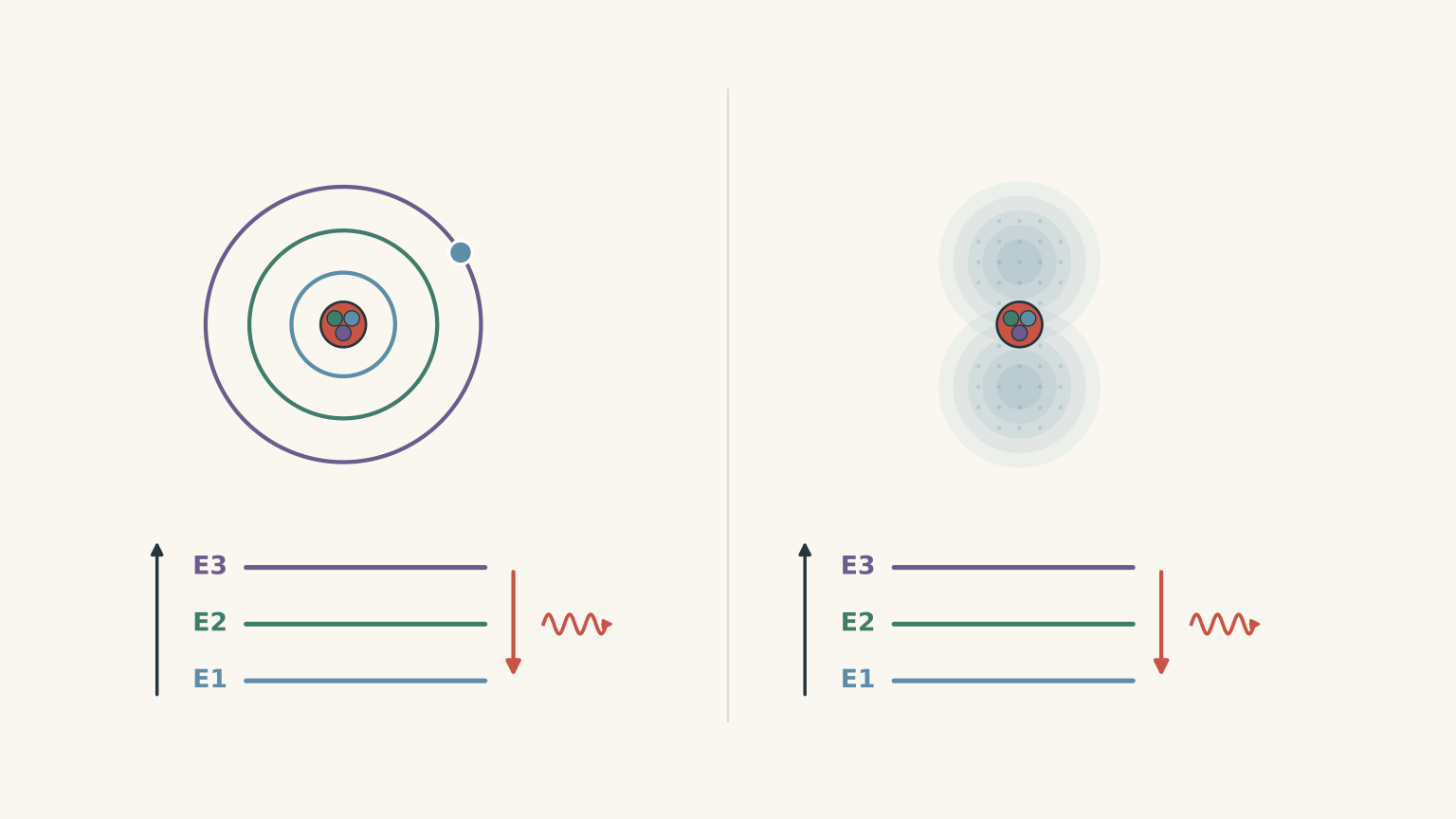
The Bohr and Schrödinger models both describe electrons as having quantised energy levels, but they represent electron location differently.
Bohr model
The Bohr model describes electrons as occupying fixed circular orbits around the nucleus.
Each orbit has a specific energy. An electron can move between these allowed energy levels by absorbing or emitting a photon.
The energy of the photon corresponds to the difference between the initial and final energy levels.
Schrödinger model
The Schrödinger model describes electrons using mathematical wavefunctions.
These wavefunctions give information about the probability of finding an electron in different regions around the nucleus.
These regions are called orbitals.
Unlike the Bohr model, the Schrödinger model does not describe electrons as travelling along fixed circular paths.
The allowed electron energies are still quantised, so transitions between energy levels can produce discrete emission lines.
The key difference
The Bohr model assigns electrons fixed circular orbits, whereas the Schrödinger model describes electron probability distributions.
Both models can account for discrete spectral lines because both involve allowed energy states and specific energy differences between them.
However, observing discrete spectral lines does not establish that electrons travel along fixed circular paths.
Marking guide:
- 1 mark: Correctly describes the Bohr model’s fixed circular orbits and discrete energy levels.
- 1 mark: Explains that transitions between Bohr energy levels involve photon absorption or emission.
- 1 mark: Correctly describes Schrödinger orbitals as probability distributions rather than fixed paths.
- 1 mark: Explains that both models account for discrete spectral lines through quantised energy differences.
Total: 12 marks
Solution 4
(a) Identifying the metal ions (2 marks)
Compare the observed flame colours with the reference table.
| Unknown sample | Observed colour | Identified ion |
|---|---|---|
| A | Bright yellow | \(\mathrm{Na}^{+}\) |
| B | Lilac | \(\mathrm{K}^{+}\) |
| C | Crimson red | \(\mathrm{Li}^{+}\) |
| D | Orange-red | \(\mathrm{Ca}^{2+}\) |
Marking guide:
- 0.5 marks for each correctly identified ion.
- 2 marks total.
(b) Explaining characteristic flame colours (3 marks)
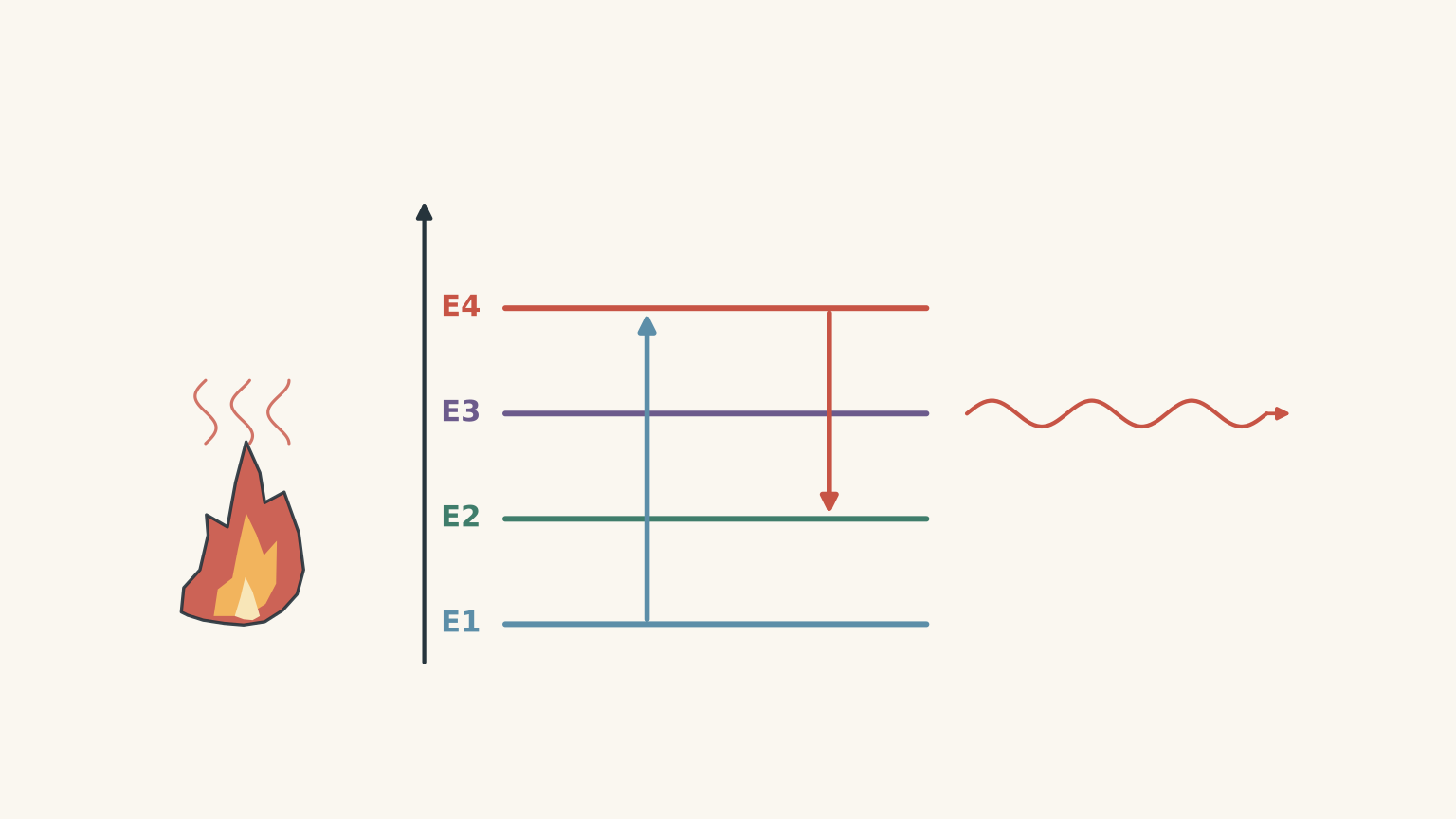
When a metal-containing sample is heated in a flame, thermal energy is transferred to the electrons associated with the metal ions.
The electrons can absorb this energy and move from lower energy levels to higher energy levels. This is called excitation.
The excited electrons are unstable in those higher energy states. They can return to lower energy levels, releasing energy as photons.
The energy of each emitted photon corresponds to the difference between the electron’s initial and final energy levels.
\[ E_{\text{photon}}=\Delta E \]
Different metal ions have different arrangements of allowed electron energy levels.
This means they can produce different sets of photon energies and wavelengths, giving characteristic flame colours.
Marking guide:
- 1 mark: Explains that thermal energy excites electrons into higher energy levels.
- 1 mark: Explains that electrons returning to lower energy levels emit photons.
- 1 mark: Links characteristic colours to different quantised energy differences and photon wavelengths.
(c) Evaluating the investigation (3 marks)
One potential source of contamination is the tap water.
Tap water contains dissolved ions. These ions may introduce additional colours into the flame, affecting the observations.
Residue from a previous sample may also remain on the nichrome loop.
A suitable improvement would be to use separate clean wire loops for each sample, or thoroughly clean the loop between tests using an appropriate laboratory cleaning procedure and distilled water.
The loop should also be heated until no residual colour is visible before testing the next sample.
Repeating each test improves reliability because it allows the student to check whether the same colour is consistently observed.
Repeated trials help identify random variation, although they do not automatically remove systematic contamination.
Marking guide:
- 1 mark: Identifies a plausible contamination source, such as dissolved ions in tap water or residue from previous samples.
- 1 mark: Suggests an appropriate cleaning procedure or separate clean loops.
- 1 mark: Explains that repeat trials improve reliability by checking consistency.
(d) Limitations of flame tests for mixtures (2 marks)
Sodium produces a strong yellow flame colour.
If sodium and potassium ions are both present, the intense yellow emission may mask the weaker lilac emission from potassium.
This makes visual identification unreliable.
A suitable improvement is to use a spectroscope.
A spectroscope separates the emitted light into its component wavelengths, allowing individual emission lines to be distinguished more clearly.
Marking guide:
- 1 mark: Explains that the strong sodium yellow emission can mask potassium’s lilac emission.
- 1 mark: Suggests using a spectroscope to distinguish the separate emission wavelengths.
Total: 10 marks
Solution 5
(a) Ordering photon energies (1 mark)
Photon energy is inversely proportional to wavelength:
\[ E=\frac{hc}{\lambda} \]
Therefore, the longest wavelength corresponds to the lowest photon energy, while the shortest wavelength corresponds to the highest photon energy.
The wavelengths are 600 nm, 400 nm and 240 nm.
The order of increasing photon energy is:
\[ \boxed{ 600\ \mathrm{nm} < 400\ \mathrm{nm} < 240\ \mathrm{nm} } \]
Here, the inequality represents increasing photon energy, not increasing wavelength.
Marking guide:
- 1 mark: Correctly orders the three wavelengths from lowest to highest photon energy.
(b) Calculating the 600 nm and 400 nm photon energies (3 marks)
Use:
\[ E=\frac{hc}{\lambda} \]
For the 600 nm photon:
Convert the wavelength:
\[ 600\ \mathrm{nm}=6.00\times10^{-7}\ \mathrm{m} \]
Substitute:
\[ \begin{aligned} E_{600}&=\frac{hc}{\lambda}\\ &=\frac{(6.63\times10^{-34})(3.00\times10^8)} {6.00\times10^{-7}}\\ &=3.32\times10^{-19}\ \mathrm{J} \end{aligned} \]
For the 400 nm photon:
\[ 400\ \mathrm{nm}=4.00\times10^{-7}\ \mathrm{m} \]
Substitute:
\[ \begin{aligned} E_{400}&=\frac{hc}{\lambda}\\ &=\frac{(6.63\times10^{-34})(3.00\times10^8)} {4.00\times10^{-7}}\\ &=4.97\times10^{-19}\ \mathrm{J} \end{aligned} \]
Now add the two photon energies:
\[ \begin{aligned} E_{\text{sum}}&=E_{600}+E_{400}\\ &=3.32\times10^{-19} +4.97\times10^{-19}\\ &=8.29\times10^{-19}\ \mathrm{J} \end{aligned} \]
Therefore:
\[ \boxed{E_{\text{sum}}=8.29\times10^{-19}\ \mathrm{J}} \]
Marking guide:
- 1 mark: Correct energy for the 600 nm photon.
- 1 mark: Correct energy for the 400 nm photon.
- 1 mark: Correct sum, including units.
(c) Calculating the 240 nm photon energy (2 marks)
Convert the wavelength:
\[ 240\ \mathrm{nm}=2.40\times10^{-7}\ \mathrm{m} \]
Apply the photon energy equation:
\[ \begin{aligned} E_{240}&=\frac{hc}{\lambda}\\ &=\frac{(6.63\times10^{-34})(3.00\times10^8)} {2.40\times10^{-7}}\\ &=8.29\times10^{-19}\ \mathrm{J} \end{aligned} \]
Therefore:
\[ \boxed{E_{240}=8.29\times10^{-19}\ \mathrm{J}} \]
Compare this with the result from part (b):
\[ \boxed{E_{240}=E_{600}+E_{400}} \]
The energy of the 240 nm photon is equal, to the stated precision, to the sum of the energies of the 600 nm and 400 nm photons.
Marking guide:
- 1 mark: Correct calculation of the 240 nm photon energy.
- 1 mark: Correctly identifies that its energy equals the sum calculated in part (b).
(d) Energy-level diagram (2 marks)
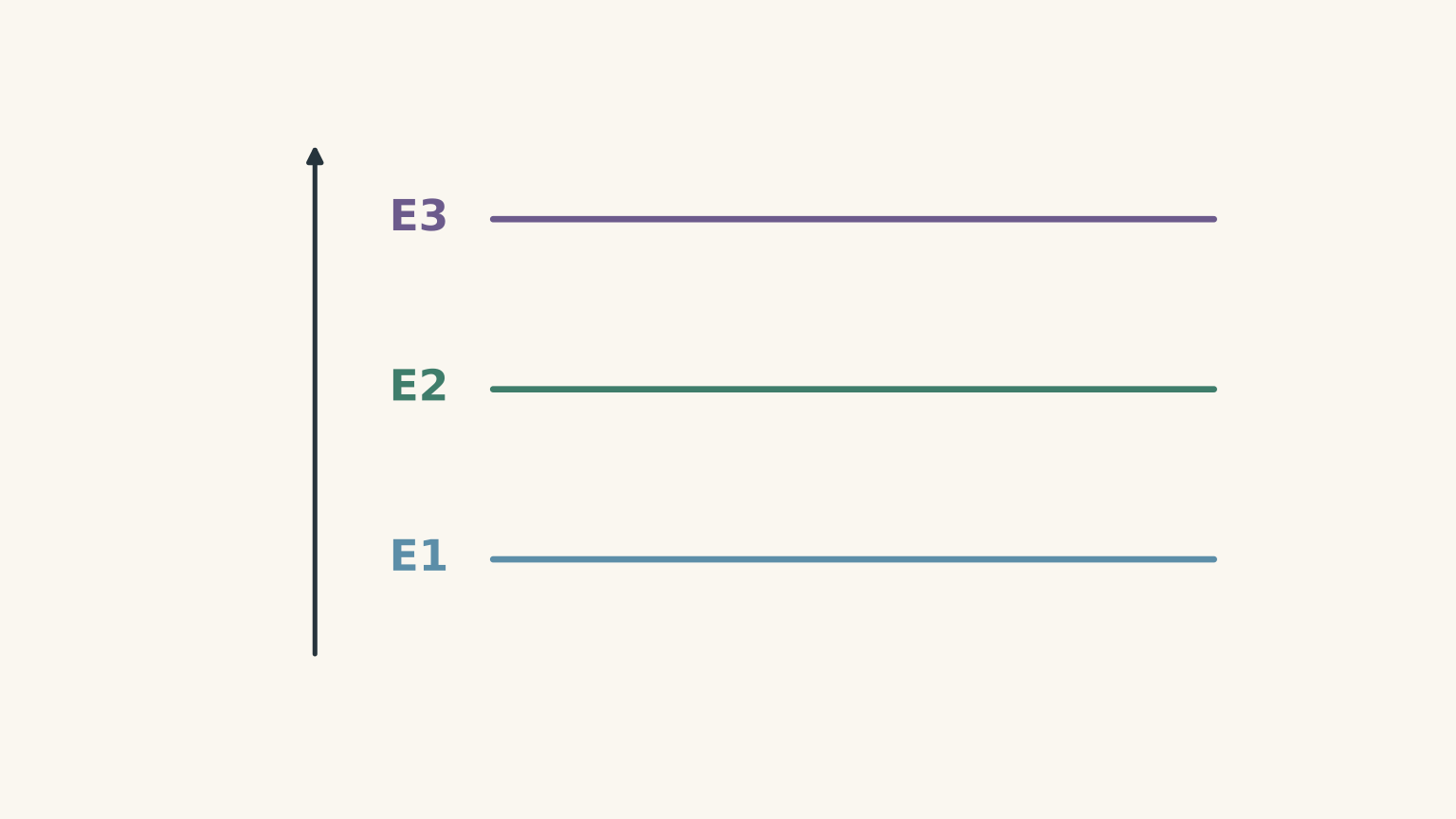
We are told that there are exactly three allowed energy levels and that the three emission lines correspond to all three possible downward transitions.
Call the energy levels:
- \(E_1\): lowest energy level.
- \(E_2\): middle energy level.
- \(E_3\): highest energy level.
The 600 nm photon corresponds to the transition from \(E_3\) to \(E_2\).
The 400 nm photon corresponds to the transition from \(E_2\) to \(E_1\).
The 240 nm photon corresponds to the transition directly from \(E_3\) to \(E_1\).
The completed energy-level diagram is:
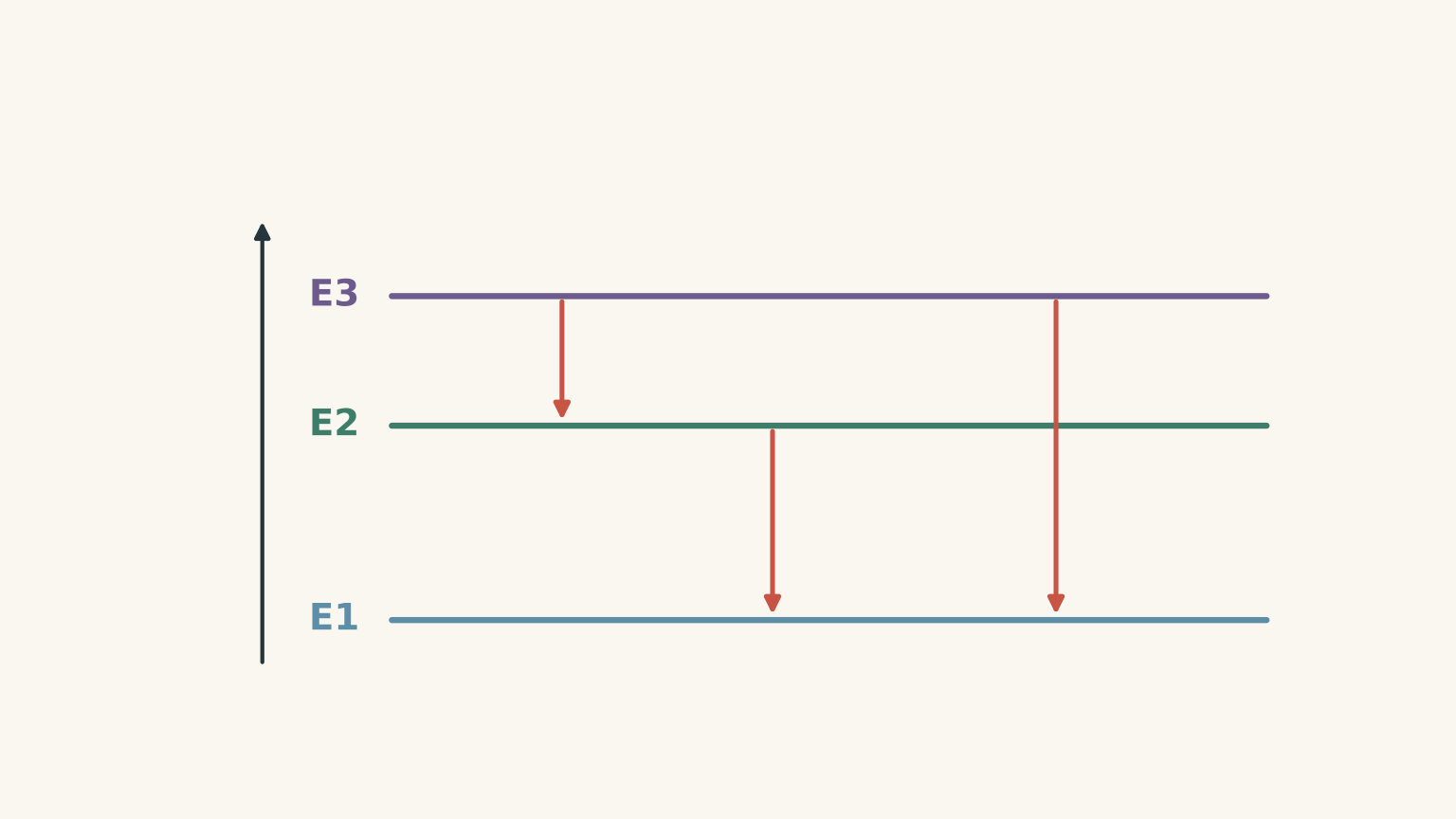
The relationship between the energy levels is:
\[ E_3-E_2=E_{600} \]
\[ E_2-E_1=E_{400} \]
\[ E_3-E_1=E_{240} \]
Adding the first two relationships gives:
\[ \begin{aligned} E_{600}+E_{400} &=(E_3-E_2)+(E_2-E_1)\\ &=E_3-E_1\\ &=E_{240} \end{aligned} \]
This is consistent with the calculated photon energies.
Marking guide:
- 1 mark: Correctly shows three ordered energy levels and downward transitions.
- 1 mark: Correctly labels all three transitions with their corresponding wavelengths.
Total: 8 marks
04Final mark summary
| Question | Assessed content | Marks |
|---|---|---|
| 1 | Electronic configurations and orbital filling | 12 |
| 2 | Subshells and valence electrons | 8 |
| 3 | Atomic spectra and atomic models | 12 |
| 4 | Flame tests and ionic energy levels | 10 |
| 5 | Emission wavelengths and energy levels | 8 |
| Total | 50 |
Checking your performance
When reviewing your answers, pay particular attention to these common errors:
Removing electrons from the wrong subshell: When forming positive ions, remember that the outermost electrons are removed first. The order in which subshells are filled does not always determine the order in which electrons are removed.
Confusing shell notation with spdf notation: The configuration \(2,8,5\) describes electron distribution across shells. The configuration \(1s^2\,2s^2\,2p^6\,3s^2\,3p^3\) provides more detailed information about subshell occupancy.
Pairing electrons too early: Apply Hund’s rule before pairing electrons in orbitals of equal energy.
Assuming a shorter wavelength means less energy: Photon energy increases as wavelength decreases. Use \(E=hc/\lambda\), rather than relying on colour descriptions alone.
Confusing the Bohr and Schrödinger models: Bohr’s model uses fixed circular orbits. Schrödinger’s model uses probability distributions and orbitals, not definite electron paths.
Treating flame colours as continuous energy changes: Characteristic flame colours arise from photons associated with specific electron energy differences.
A useful target when marking this paper is to identify not just which questions you missed, but why. If your calculations are correct but your explanations are weak, practise connecting the evidence to the underlying electron energy-level model. If your configurations are incorrect, revisit orbital filling, electron counts, and ion formation before attempting another timed paper.