
Energy Profiles and Bonding: 35-Mark Chemistry Practice Exam
Test your understanding of energy profiles and bonding with this original 35-mark Chemistry 2025 practice paper. Includes timed exam conditions, complete worked solutions, and a question-by-question marking guide.
This original tutorgum practice paper covers the Chemistry 2025 syllabus scope on energy profiles and bonding. It is a focused revision assessment, designed to test your ability to interpret energy profiles, calculate reaction enthalpy using bond enthalpies, explain the effect of catalysts, and analyse temperature changes in chemical processes.
The paper is worth 35 marks and includes a mixture of calculations, diagrams, and written explanations. Complete all questions before checking the worked solutions and marking guide.
01Exam instructions
Paper conditions
| Condition | Details |
|---|---|
| Suggested reading time | 5 minutes |
| Suggested working time | 45 minutes |
| Total marks | 35 |
| Permitted equipment | Scientific calculator, ruler, pens, and pencils |
| Notes | No notes or textbooks |
| Working | Show all calculations and include units |
| Diagrams | Draw and label energy profiles where requested |
These are the conditions for this original practice paper, not a statement of official NESA examination rules.
This is an original tutorgum practice paper. It is not an official, endorsed, past, or predicted NESA examination.
Assessed syllabus scope
This paper assesses the following content from the Chemistry 2025 syllabus:
- Bond enthalpy and conservation of energy.
- The effect of catalysts on activation energy and reaction enthalpy.
- Endothermic and exothermic reactions, including combustion and ionic dissociation in aqueous solution.
- Construction and interpretation of energy profile diagrams, including activation energies and enthalpy changes in both reaction directions.
The paper does not assess other chemistry modules, equilibrium, electrochemistry, reaction-rate calculations, Hess’s law cycles, or calorimetry calculations using specific heat capacity.
Assumptions and conventions
- All energy values are given in \(\mathrm{kJ\,mol^{-1}}\), unless otherwise stated.
- Treat supplied bond enthalpies as average bond enthalpies. Calculations using these values give estimates of reaction enthalpy.
- All enthalpy values on a given energy profile use the same reference level.
- The transition state is the highest-energy point along a reaction pathway.
- Unless stated otherwise, energy values refer to one mole of reaction as written.
- Use the convention \(\Delta H = H_{\mathrm{products}}-H_{\mathrm{reactants}}\).
02Questions
Question 1 (7 marks)
A reaction proceeds from reactants R to products P.
The following enthalpy values are measured relative to a common reference level:
| Part of reaction | Enthalpy (\(\mathrm{kJ\,mol^{-1}}\)) |
|---|---|
| Reactants R | 45 |
| Products P | 125 |
| Transition state | 205 |
(a) Calculate the enthalpy change, \(\Delta H\), for the forward reaction. Classify the reaction as endothermic or exothermic. (2 marks)
(b) Calculate the activation energy for the forward reaction. (1 mark)
(c) Calculate the activation energy for the reverse reaction. (1 mark)
(d) Draw a labelled energy profile diagram for the forward reaction.
Your diagram must include:
- A labelled vertical axis and horizontal axis.
- The reactants, products, and transition state.
- The forward activation energy.
- The enthalpy change, \(\Delta H\). (3 marks)
Question 2 (8 marks)
Consider the following reaction:
\[ \ce{H2(g) + Cl2(g) -> 2HCl(g)} \]
The average bond enthalpies are provided below.
| Bond | Average bond enthalpy (\(\mathrm{kJ\,mol^{-1}}\)) |
|---|---|
| H-H | 436 |
| Cl-Cl | 243 |
| H-Cl | 432 |
(a) Identify all the bonds that must be broken and all the bonds that must be formed during this reaction. Include the number of each bond. (2 marks)
(b) Calculate the total energy absorbed when all the bonds in the reactants are broken. (2 marks)
(c) Calculate the total energy released when all the bonds in the products are formed. (2 marks)
(d) Calculate the estimated enthalpy change of the reaction. Use your result to classify the reaction as endothermic or exothermic, and explain your reasoning using conservation of energy. (2 marks)
Question 3 (6 marks)
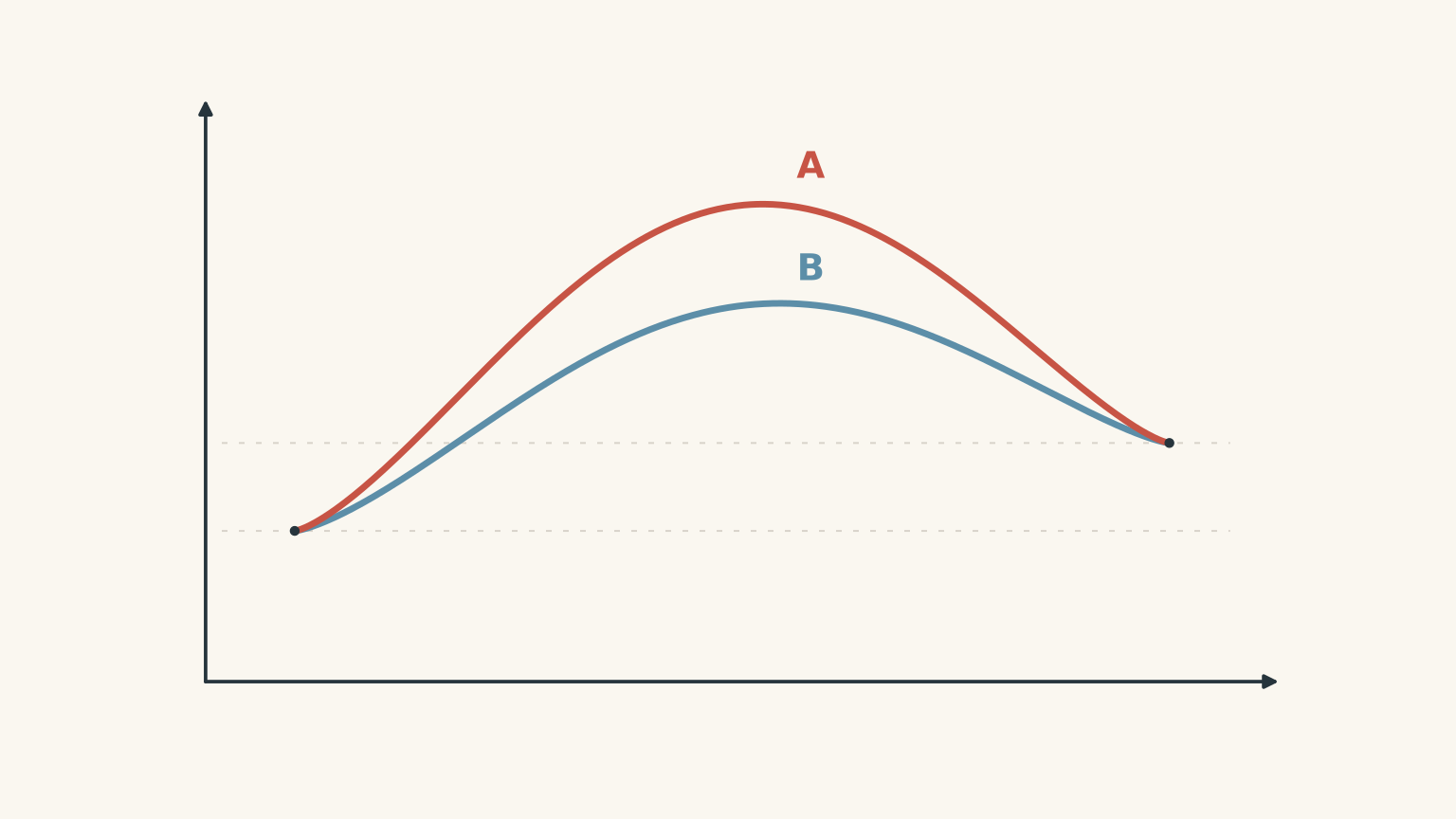
A chemical reaction can proceed through either of two alternative pathways, labelled A and B.
The energy profile below shows the two possible pathways.
The following enthalpy values apply:
| Part of reaction | Enthalpy (\(\mathrm{kJ\,mol^{-1}}\)) |
|---|---|
| Reactants | 40 |
| Products | 110 |
| Transition state on pathway A | 190 |
| Transition state on pathway B | 155 |
(a) Identify which pathway represents the catalysed reaction. Justify your answer using the energy profile. (2 marks)
(b) Calculate the activation energy for each pathway. (2 marks)
(c) Calculate the enthalpy change of the reaction. Explain why introducing a catalyst does not change this value. (2 marks)
Question 4 (6 marks)
A student investigates temperature changes during two chemical processes.
The first experiment involves burning ethanol beneath a beaker of water. The second involves dissolving solid ammonium nitrate in water.
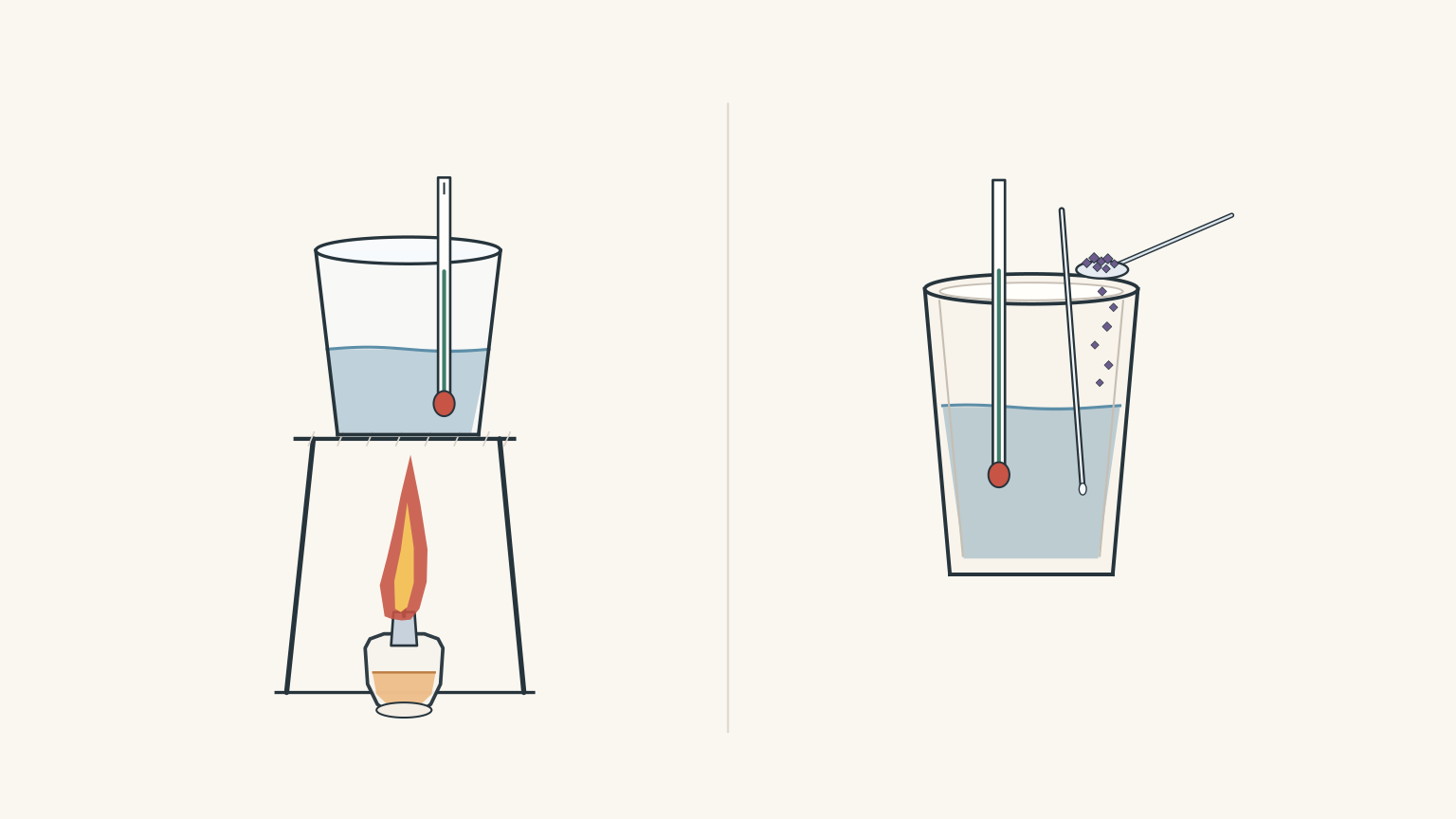
The chemical processes are represented by the following equations:
Ethanol combustion:
\[ \ce{C2H5OH(l) + 3O2(g) -> 2CO2(g) + 3H2O(l)} \]
Ammonium nitrate dissociation:
\[ \ce{NH4NO3(s) -> NH4+(aq) + NO3-(aq)} \]
The following temperature readings are recorded.
| Experiment | Initial temperature | Final temperature |
|---|---|---|
| Ethanol combustion (water) | \(19.8^\circ\mathrm{C}\) | \(34.1^\circ\mathrm{C}\) |
| Ammonium nitrate dissociation (water/solution) | \(22.6^\circ\mathrm{C}\) | \(17.9^\circ\mathrm{C}\) |
For this question, treat the process being investigated as the system and the measured liquid as its thermal surroundings.
(a) Calculate the temperature change, \(\Delta T\), for each experiment. Use:
\[ \Delta T=T_{\mathrm{final}}-T_{\mathrm{initial}} \]
(2 marks)
(b) Classify each process as endothermic or exothermic. (2 marks)
(c) For each experiment, explain the direction of energy transfer between the chemical process and the measured liquid. (2 marks)
Question 5 (8 marks)
A hypothetical gas-phase reaction has the following energy data.
- Total energy absorbed to break all reactant bonds: \(780\ \mathrm{kJ\,mol^{-1}}\).
- Total energy released when all product bonds form: \(910\ \mathrm{kJ\,mol^{-1}}\).
- Enthalpy of the reactants: \(150\ \mathrm{kJ\,mol^{-1}}\).
- Enthalpy of the transition state: \(390\ \mathrm{kJ\,mol^{-1}}\).
All values refer to one mole of reaction and use the same reference level.
(a) Calculate the estimated enthalpy change of the reaction using the bond enthalpy data. (2 marks)
(b) Calculate the enthalpy of the products. (1 mark)
(c) Calculate the activation energy for the forward reaction. (1 mark)
(d) Calculate the activation energy for the reverse reaction. (2 marks)
(e) Explain why this reaction is exothermic, even though energy must be absorbed to break the reactant bonds. Refer to conservation of energy in your explanation. (2 marks)
03Worked solutions and marking guide
Solution 1
(a) Calculate the enthalpy change and classify the reaction.
The enthalpy change is calculated by subtracting the reactant enthalpy from the product enthalpy.
\[ \begin{aligned} \Delta H &= H_{\mathrm{products}}-H_{\mathrm{reactants}}\\ &=125-45\\ &=+80\ \mathrm{kJ\,mol^{-1}} \end{aligned} \]
The reaction is endothermic because its enthalpy change is positive.
The products have a higher enthalpy than the reactants, meaning the reaction absorbs energy overall.
(b) Calculate the forward activation energy.
Activation energy is the energy difference between the reactants and the transition state.
\[ \begin{aligned} E_{a,\mathrm{forward}} &=H_{\mathrm{transition\ state}}-H_{\mathrm{reactants}}\\ &=205-45\\ &=160\ \mathrm{kJ\,mol^{-1}} \end{aligned} \]
(c) Calculate the reverse activation energy.
For the reverse reaction, the products become the starting point.
Therefore, the activation energy is measured from the product enthalpy to the transition state.
\[ \begin{aligned} E_{a,\mathrm{reverse}} &=H_{\mathrm{transition\ state}}-H_{\mathrm{products}}\\ &=205-125\\ &=80\ \mathrm{kJ\,mol^{-1}} \end{aligned} \]
Notice that the forward and reverse activation energies are different.
The transition state is the same for both directions, but the reactions start at different enthalpy levels.
(d) Draw and label the energy profile.
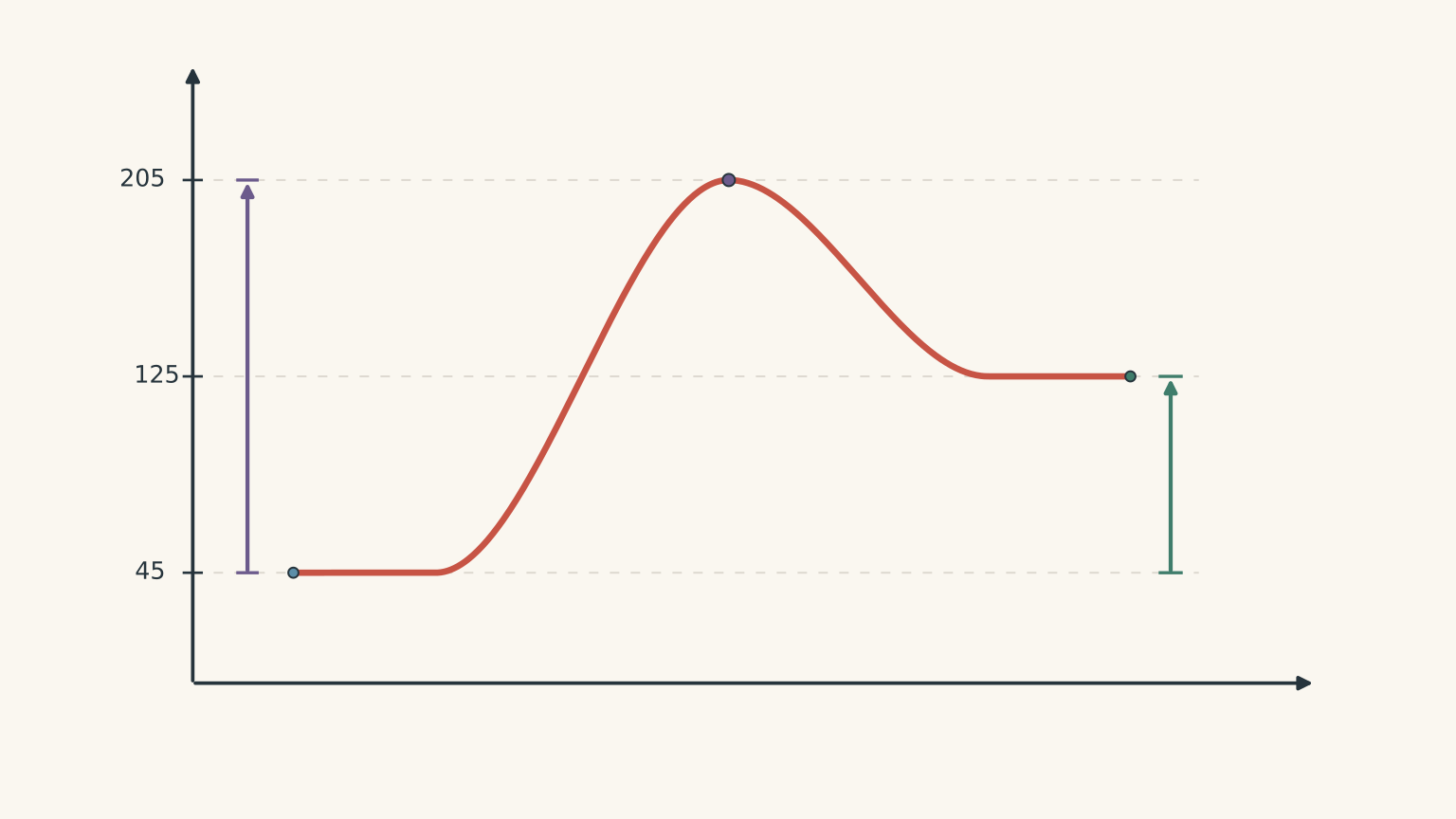
The key feature is that the products sit above the reactants on the enthalpy axis.
This is what an endothermic energy profile looks like.
Marking breakdown
| Part | Required working or idea | Marks |
|---|---|---|
| (a) | Correct enthalpy calculation, including positive sign | 1 |
| (a) | Correctly identifies the reaction as endothermic | 1 |
| (b) | Correct forward activation energy | 1 |
| (c) | Correct reverse activation energy | 1 |
| (d) | Correct axes, reactants, products, and transition state | 1 |
| (d) | Correct relative energy levels and profile shape | 1 |
| (d) | Correctly labelled forward activation energy and enthalpy change | 1 |
| Total | 7 |
Solution 2
(a) Identify the bonds broken and formed.
The reaction is:
\[ \ce{H2 + Cl2 -> 2HCl} \]
The reactants contain:
- One H-H bond.
- One Cl-Cl bond.
These bonds must be broken before the new product bonds can form.
The products contain:
- Two H-Cl bonds.
Therefore, two H-Cl bonds must form.
(b) Calculate the energy absorbed during bond breaking.
Breaking bonds requires energy.
There is one H-H bond and one Cl-Cl bond to break.
\[ \begin{aligned} E_{\mathrm{absorbed}} &=436+243\\ &=679\ \mathrm{kJ\,mol^{-1}} \end{aligned} \]
The total energy absorbed is \(679\ \mathrm{kJ\,mol^{-1}}\).
(c) Calculate the energy released during bond formation.
Forming bonds releases energy.
Two H-Cl bonds form, so the bond enthalpy must be multiplied by two.
\[ \begin{aligned} E_{\mathrm{released}} &=2\times432\\ &=864\ \mathrm{kJ\,mol^{-1}} \end{aligned} \]
The total energy released is \(864\ \mathrm{kJ\,mol^{-1}}\).
(d) Calculate the enthalpy change and classify the reaction.
Use the relationship:
\[ \Delta H=E_{\mathrm{broken}}-E_{\mathrm{formed}} \]
Substitute the calculated values:
\[ \begin{aligned} \Delta H&=679-864\\ &=-185\ \mathrm{kJ\,mol^{-1}} \end{aligned} \]
The reaction is exothermic because the energy released when new bonds form is greater than the energy absorbed when the original bonds break.
The difference is \(185\ \mathrm{kJ\,mol^{-1}}\).
This is the net energy released to the surroundings.
This question tests an important distinction: breaking bonds always requires energy, while forming bonds releases energy. The overall reaction can still be exothermic if bond formation releases more energy than bond breaking absorbs.
Marking breakdown
| Part | Required working or idea | Marks |
|---|---|---|
| (a) | Identifies one H-H and one Cl-Cl bond broken | 1 |
| (a) | Identifies two H-Cl bonds formed | 1 |
| (b) | Correct addition of bond enthalpies | 1 |
| (b) | Correct energy absorbed, with units | 1 |
| (c) | Correct multiplication by two | 1 |
| (c) | Correct energy released, with units | 1 |
| (d) | Correct enthalpy calculation and negative sign | 1 |
| (d) | Correct classification and conservation-of-energy explanation | 1 |
| Total | 8 |
Follow-through marking: If a student makes an arithmetic error in part (b) or (c), award the calculation method mark in part (d) if they correctly apply the bond enthalpy relationship to their own values.
Solution 3
(a) Identify the catalysed pathway.
Pathway B represents the catalysed reaction.
A catalyst provides an alternative reaction pathway with a lower activation energy.
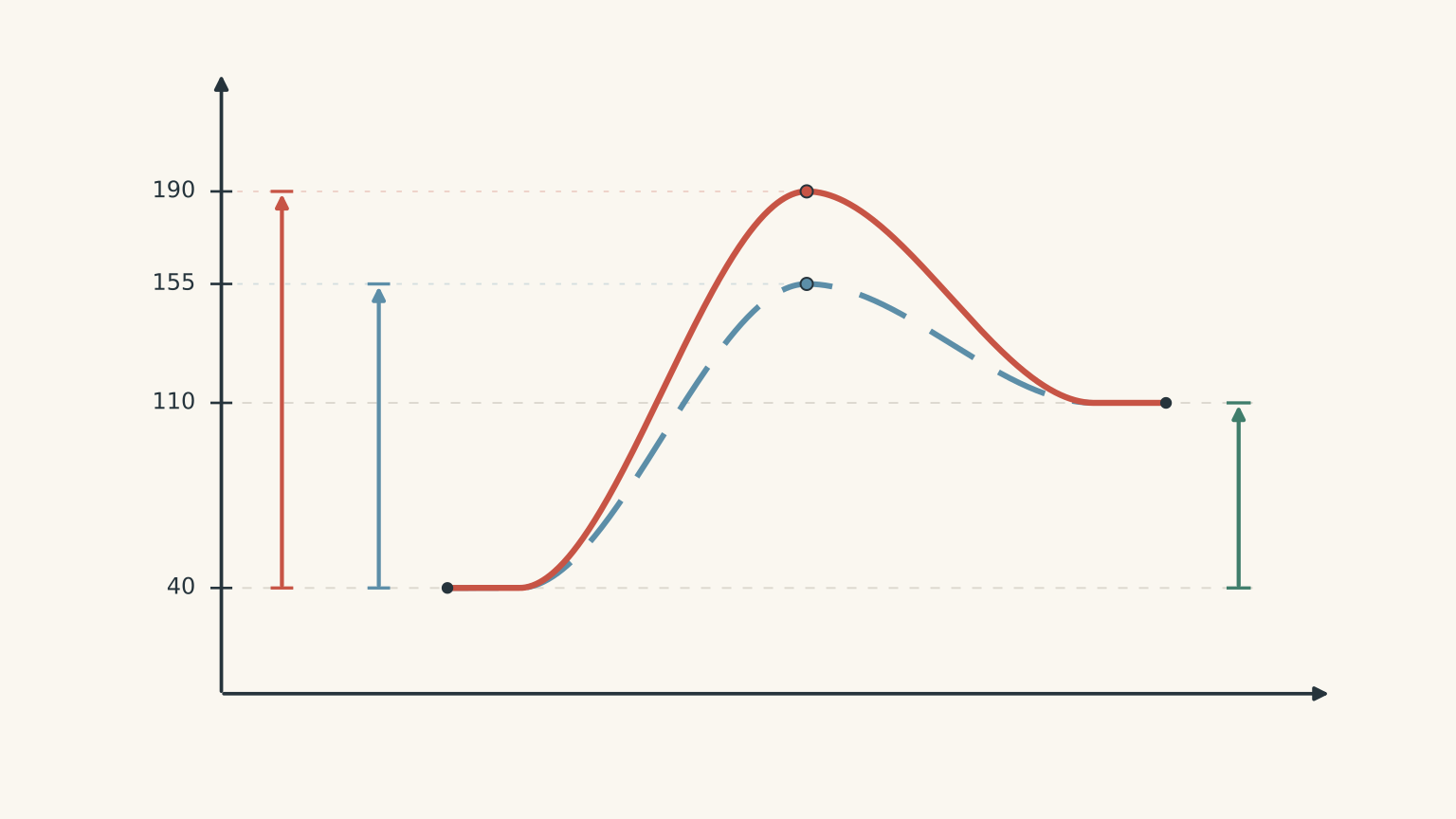
On the graph, pathway B has a lower peak than pathway A, while both pathways start and finish at the same enthalpy levels.
Therefore, pathway B has the lower activation energy and represents the catalysed pathway.
(b) Calculate the activation energy for each pathway.
For both pathways, activation energy is calculated by subtracting the reactant enthalpy from the transition-state enthalpy.
For pathway A:
\[ \begin{aligned} E_{a,A}&=190-40\\ &=150\ \mathrm{kJ\,mol^{-1}} \end{aligned} \]
For pathway B:
\[ \begin{aligned} E_{a,B}&=155-40\\ &=115\ \mathrm{kJ\,mol^{-1}} \end{aligned} \]
The catalysed pathway has an activation energy of \(115\ \mathrm{kJ\,mol^{-1}}\), compared with \(150\ \mathrm{kJ\,mol^{-1}}\) for the uncatalysed pathway.
(c) Calculate the enthalpy change and explain the effect of the catalyst.
The enthalpy change is:
\[ \begin{aligned} \Delta H&=H_{\mathrm{products}}-H_{\mathrm{reactants}}\\ &=110-40\\ &=+70\ \mathrm{kJ\,mol^{-1}} \end{aligned} \]
The reaction is endothermic.
Introducing a catalyst does not change the enthalpy change.
This is because the reactants and products have the same enthalpy values regardless of which pathway the reaction follows.
A catalyst changes the reaction pathway and lowers the activation energy. It does not change the energy difference between the reactants and products.
Marking breakdown
| Part | Required working or idea | Marks |
|---|---|---|
| (a) | Identifies pathway B | 1 |
| (a) | Explains that its lower peak represents a lower activation energy | 1 |
| (b) | Correct activation energy for pathway A | 1 |
| (b) | Correct activation energy for pathway B | 1 |
| (c) | Correct enthalpy change, including positive sign | 1 |
| (c) | Explains that the catalyst changes the pathway but not the reactant and product enthalpies | 1 |
| Total | 6 |
Solution 4
(a) Calculate the temperature changes.
Use:
\[ \Delta T=T_{\mathrm{final}}-T_{\mathrm{initial}} \]
For ethanol combustion:
\[ \begin{aligned} \Delta T&=34.1-19.8\\ &=+14.3^\circ\mathrm{C} \end{aligned} \]
The water temperature increases by \(14.3^\circ\mathrm{C}\).
For ammonium nitrate dissociation:
\[ \begin{aligned} \Delta T&=17.9-22.6\\ &=-4.7^\circ\mathrm{C} \end{aligned} \]
The solution temperature decreases by \(4.7^\circ\mathrm{C}\).
(b) Classify each process.
Ethanol combustion is exothermic.
The water temperature increases because energy is transferred from the combustion process to the surrounding water.
Ammonium nitrate dissociation is endothermic.
The solution temperature decreases because the dissociation process absorbs energy from its surroundings.
(c) Explain the direction of energy transfer.
For ethanol combustion:
- The combustion reaction is the system.
- The water is the measured surroundings.
- Energy transfers from the reacting system to the water.
- The water temperature increases.
For ammonium nitrate dissociation:
- The dissociation process is the system.
- The measured liquid is the thermal surroundings.
- Energy transfers from the liquid surroundings into the dissociation process.
- The liquid temperature decreases.
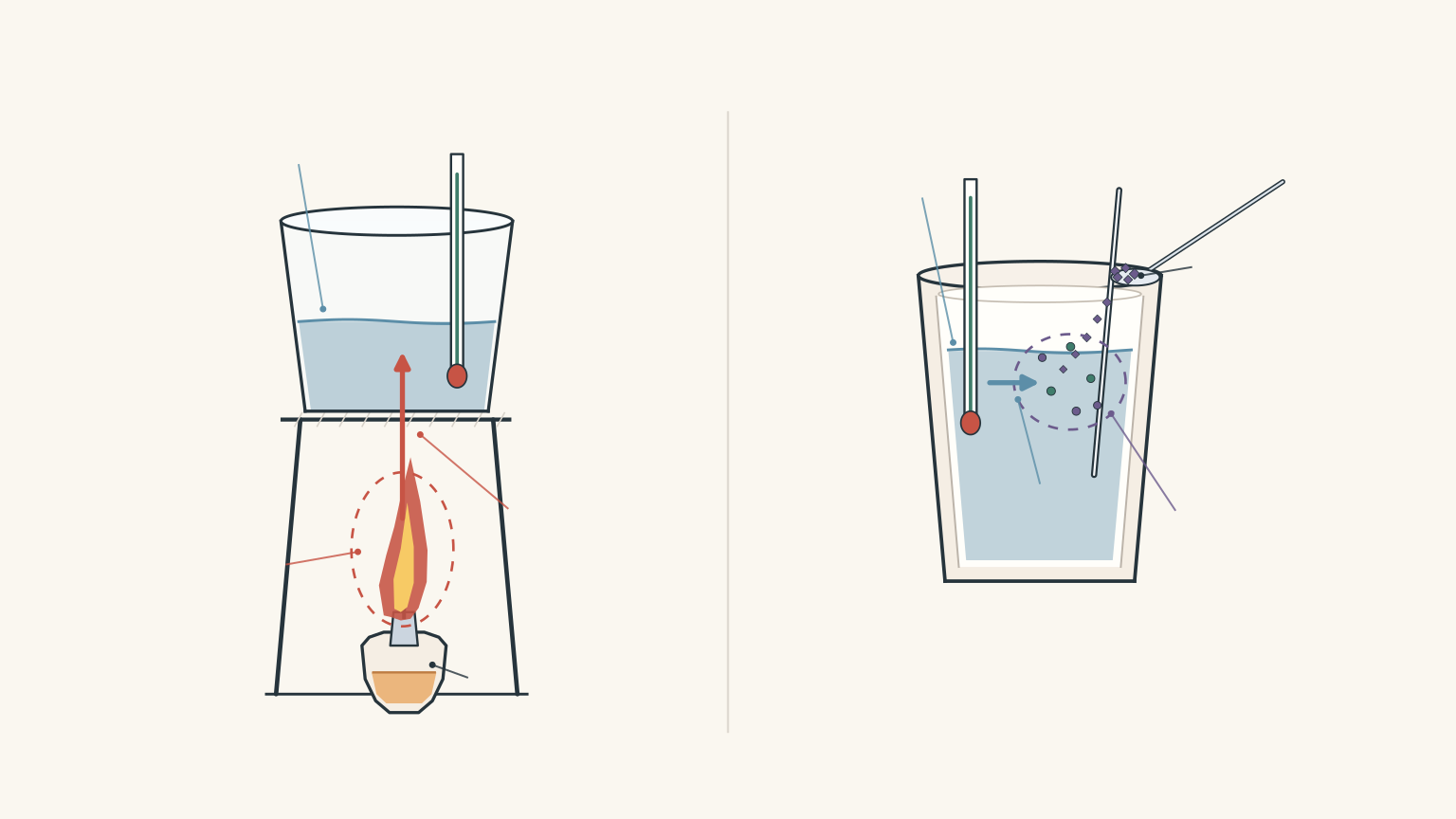
A useful rule for these experiments is:
- If the measured surroundings warm up, the process transferring energy to them is exothermic.
- If the measured surroundings cool down, the process absorbing energy from them is endothermic.
Be careful not to confuse the temperature change of the surroundings with the direction of energy transfer for the chemical process itself.
Marking breakdown
| Part | Required working or idea | Marks |
|---|---|---|
| (a) | Correct temperature change for ethanol experiment | 1 |
| (a) | Correct temperature change for ammonium nitrate experiment | 1 |
| (b) | Identifies ethanol combustion as exothermic | 1 |
| (b) | Identifies ammonium nitrate dissociation as endothermic | 1 |
| (c) | Explains energy transfer from combustion to water | 1 |
| (c) | Explains energy transfer from surroundings to dissociation process | 1 |
| Total | 6 |
Solution 5
(a) Calculate the estimated enthalpy change using bond enthalpies.
The relationship between bond enthalpy and reaction enthalpy is:
\[ \Delta H=E_{\mathrm{broken}}-E_{\mathrm{formed}} \]
Substitute the supplied values:
\[ \begin{aligned} \Delta H&=780-910\\ &=-130\ \mathrm{kJ\,mol^{-1}} \end{aligned} \]
The estimated enthalpy change is:
\[ \boxed{\Delta H=-130\ \mathrm{kJ\,mol^{-1}}} \]
(b) Calculate the product enthalpy.
The enthalpy change is the difference between the product and reactant enthalpies.
Rearrange:
\[ H_{\mathrm{products}}=H_{\mathrm{reactants}}+\Delta H \]
Substitute:
\[ \begin{aligned} H_{\mathrm{products}}&=150+(-130)\\ &=20\ \mathrm{kJ\,mol^{-1}} \end{aligned} \]
The product enthalpy is \(20\ \mathrm{kJ\,mol^{-1}}\).
(c) Calculate the forward activation energy.
The forward activation energy is the difference between the transition-state and reactant enthalpies.
\[ \begin{aligned} E_{a,\mathrm{forward}}&=390-150\\ &=240\ \mathrm{kJ\,mol^{-1}} \end{aligned} \]
(d) Calculate the reverse activation energy.
The reverse reaction begins at the product enthalpy of \(20\ \mathrm{kJ\,mol^{-1}}\).
Therefore:
\[ \begin{aligned} E_{a,\mathrm{reverse}}&=390-20\\ &=370\ \mathrm{kJ\,mol^{-1}} \end{aligned} \]
The reverse activation energy is \(370\ \mathrm{kJ\,mol^{-1}}\).
Notice that the reverse activation energy is larger than the forward activation energy.
This happens because the products have a lower enthalpy than the reactants, so the reverse reaction must overcome a larger energy difference to reach the transition state.
(e) Explain why the reaction is exothermic.
Breaking bonds absorbs energy. In this reaction, breaking the reactant bonds absorbs \(780\ \mathrm{kJ\,mol^{-1}}\).
Forming new bonds releases energy. In this reaction, forming the product bonds releases \(910\ \mathrm{kJ\,mol^{-1}}\).
The energy released is \(130\ \mathrm{kJ\,mol^{-1}}\) greater than the energy absorbed.
Therefore, the overall process releases energy to the surroundings and is exothermic.
This is consistent with conservation of energy. The energy absorbed during bond breaking is accounted for, but more energy is released during bond formation.
Marking breakdown
| Part | Required working or idea | Marks |
|---|---|---|
| (a) | Correct relationship between energy absorbed and released | 1 |
| (a) | Correct enthalpy change, including negative sign and units | 1 |
| (b) | Correct calculation of product enthalpy | 1 |
| (c) | Correct forward activation energy | 1 |
| (d) | Correct relationship between transition state and product enthalpy | 1 |
| (d) | Correct reverse activation energy | 1 |
| (e) | Identifies that bond formation releases more energy than bond breaking absorbs | 1 |
| (e) | Explains the net energy release using conservation of energy and identifies the reaction as exothermic | 1 |
| Total | 8 |
Follow-through marking: In part (b), award the method mark for correctly adding the student’s calculated enthalpy change to the reactant enthalpy, even if part (a) contains an arithmetic error. In part (d), award the method mark for subtracting the student’s product enthalpy from the transition-state enthalpy.
04Final mark summary
| Question | Main assessed content | Marks |
|---|---|---|
| 1 | Energy profiles and activation energies in both directions | 7 |
| 2 | Bond enthalpies and conservation of energy | 8 |
| 3 | Catalysts and alternative reaction pathways | 6 |
| 4 | Temperature changes and reaction classification | 6 |
| 5 | Integrated bond enthalpy and energy profile calculations | 8 |
| Total | 35 |
What to review after marking
Use your results to identify which part of the topic needs more work.
- If Question 1 was difficult, practise reading and constructing energy profiles. Pay particular attention to measuring activation energy from the correct starting level.
- If Question 2 was difficult, revise which bonds break, which bonds form, and why the two energy contributions have opposite effects on reaction enthalpy.
- If Question 3 was difficult, make sure you understand that a catalyst lowers activation energy without changing the enthalpy of the reactants or products.
- If Question 4 was difficult, revisit the difference between the chemical process and its surroundings. A rise or fall in the measured liquid temperature tells you about the direction of energy transfer.
- If Question 5 was difficult, practise combining bond enthalpy calculations with energy profile information. Make sure you can move between reaction enthalpy, product enthalpy, and forward and reverse activation energies.
The most important relationships to remember are:
\[ \Delta H=E_{\mathrm{broken}}-E_{\mathrm{formed}} \]
\[ \Delta H=H_{\mathrm{products}}-H_{\mathrm{reactants}} \]
\[ E_{a,\mathrm{forward}}=H_{\mathrm{TS}}-H_{\mathrm{reactants}} \]
\[ E_{a,\mathrm{reverse}}=H_{\mathrm{TS}}-H_{\mathrm{products}} \]
If you can apply these four relationships confidently, interpret the direction of energy transfer, and explain what a catalyst actually changes, you’ve covered the central skills assessed in this paper.