
Ester Preparation and Synthesis Pathways: Chemistry Practice Exam
Test your understanding of ester preparation and synthesis pathways with this original 50-mark Chemistry practice exam. Includes timed exam conditions, multistep synthesis questions, ester stoichiometry, polyester formation, laboratory preparation, and complete worked solutions with a marking guide.
This original tutorgum practice paper assesses ester preparation and synthesis pathways within the Chemistry 11-12 Syllabus (2025). It is a focused topic assessment, not a full-course HSC mock, and is not an official, endorsed, past, or predicted NESA examination.
The paper tests four areas: ester reaction stoichiometry, multistep organic synthesis pathways, polyester formation through condensation polymerisation, and the preparation and purification of a simple ester in a school laboratory.
01Exam instructions
Assessment conditions
| Component | Details |
|---|---|
| Suggested reading time | 5 minutes |
| Suggested working time | 85 minutes |
| Total marks | 50 |
| Permitted equipment | Scientific calculator, periodic table, ruler, writing equipment |
| Notes | Not permitted |
Assessed content
- Calculating reacting quantities and product amounts in esterification reactions.
- Identifying limiting reactants and calculating theoretical and percentage yields.
- Constructing flow charts for ester synthesis, including multistep pathways.
- Explaining polyester formation through condensation polymerisation.
- Preparing and purifying a simple ester in a school laboratory.
- Explaining the purpose of laboratory equipment, reagents, and safety procedures.
Exclusions
This paper does not assess the full Organic chemistry focus area. It excludes unrelated organic reaction pathways, spectroscopy, ester physical-property trends, and equilibrium calculations. Only the Chemistry 11-12 Syllabus (2025) scope specified for this paper is assessed.
Numerical conventions and assumptions
Use the following relative atomic masses:
- \(A_r(\mathrm{H})=1.0\)
- \(A_r(\mathrm{C})=12.0\)
- \(A_r(\mathrm{O})=16.0\)
For theoretical ester yield calculations, assume complete conversion of the limiting reactant and ignore product losses. Use balanced chemical equations to establish mole ratios.
For polyester calculations, assume a linear, high-molar-mass polymer and ignore the contribution of chain-end groups.
Show all working in calculations. Include units and give numerical answers to three significant figures unless otherwise indicated.
All conditions in this paper are suggested practice-paper conditions, not claims about official NESA examination requirements.
02Questions
Question 1 (8 marks)
Ethanoic acid reacts with ethanol to produce ethyl ethanoate and water.
A student combines 12.0 g of ethanoic acid with 6.90 g of ethanol.
(a) Write a balanced chemical equation for this reaction using condensed structural formulae. (2 marks)
(b) Calculate the amount, in moles, of each reactant initially present. (2 marks)
(c) Identify the limiting reactant. Justify your answer using the mole ratio of the reaction. (2 marks)
(d) Calculate the maximum theoretical mass of ethyl ethanoate that can be produced. (2 marks)
Question 2 (10 marks)
A student prepares ethyl propanoate by reacting propanoic acid with ethanol.
The student combines:
- 10.0 g of propanoic acid, \(\ce{CH3CH2COOH}\)
- 9.20 g of ethanol, \(\ce{CH3CH2OH}\)
The reaction produces ethyl propanoate, \(\ce{CH3CH2COOCH2CH3}\), and water.
After completing the preparation and purification, the student collects 9.65 g of dry ethyl propanoate.
(a) Calculate the initial amount, in moles, of propanoic acid and ethanol. (2 marks)
(b) Determine the limiting reactant and calculate the maximum amount, in moles, of ethyl propanoate that can form. (2 marks)
(c) Calculate the theoretical mass of ethyl propanoate. (2 marks)
(d) Calculate the percentage yield of ethyl propanoate obtained by the student. (2 marks)
(e) Identify two reasons why the actual mass of purified ester may be lower than the theoretical mass. (2 marks)
Question 3 (10 marks)
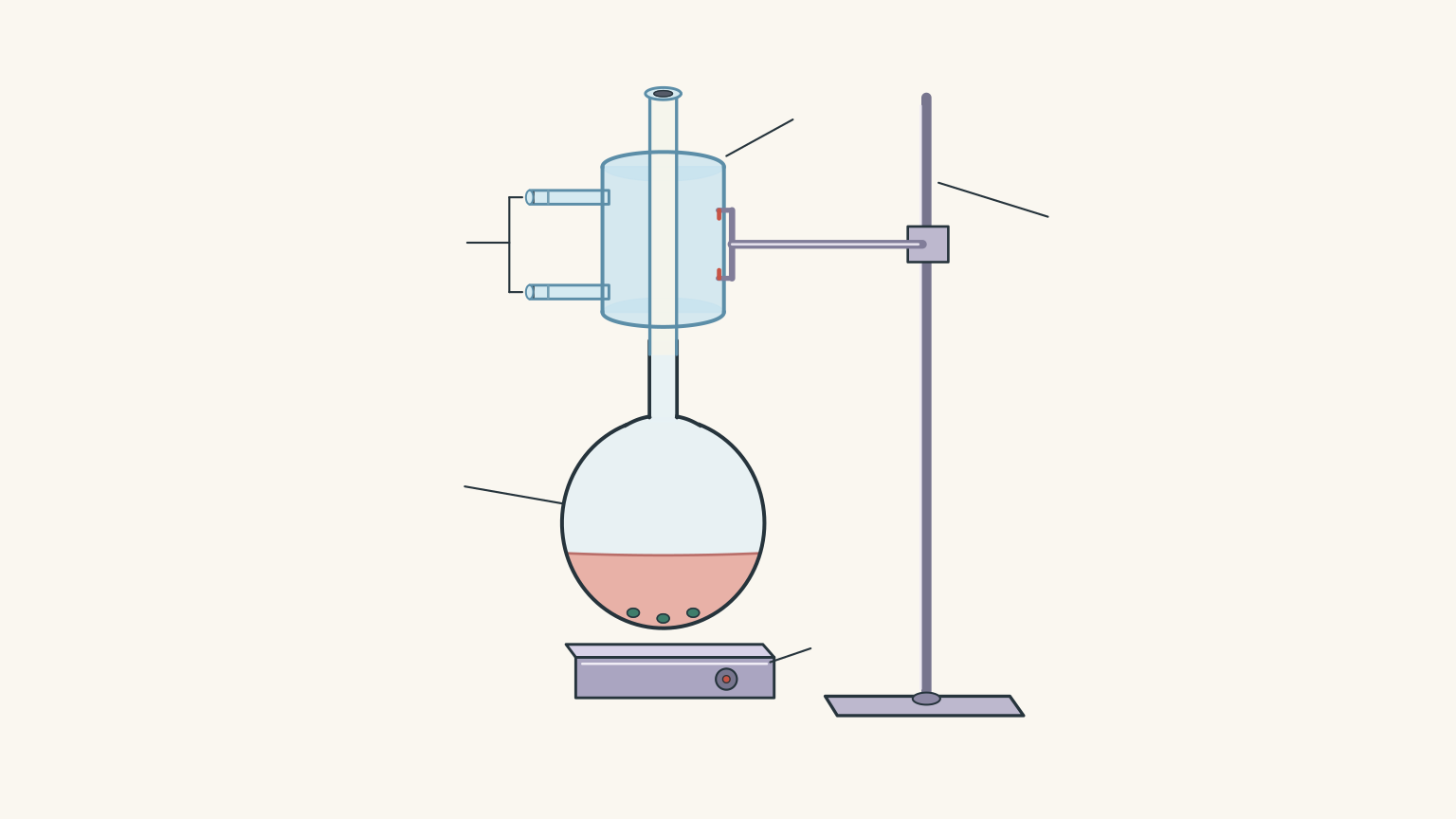
A school laboratory prepares ethyl ethanoate by reacting ethanol with ethanoic acid in the presence of a small amount of concentrated sulfuric acid.
The reaction mixture is heated under reflux before being cooled and distilled.
(a) Write a balanced chemical equation for the reaction using condensed structural formulae. Identify the type of reaction occurring. (2 marks)
(b) Explain why the reaction mixture is heated under reflux. State where cooling water should enter and leave the condenser. (2 marks)
(c) Explain the role of concentrated sulfuric acid in the preparation. Identify two safety controls that should be used, explaining the hazards they address. (3 marks)
(d) After distillation, the crude distillate contains ethyl ethanoate, some unreacted ethanol, and small amounts of acidic impurities and water.
The laboratory has the following purification materials available:
- Aqueous sodium carbonate solution
- Saturated calcium chloride solution
- Anhydrous sodium sulfate
Outline a suitable sequence of purification steps using these materials. Explain the purpose of each step. (3 marks)
Question 4 (12 marks)
Ethyl ethanoate can be synthesised using ethene as the only organic starting material.
Water and suitable inorganic reagents are available.
A chemist wants to design a multistep synthesis pathway that produces both the alcohol and carboxylic acid required for the final esterification reaction.
(a) Construct a flow chart showing a suitable synthesis pathway from ethene to ethyl ethanoate.
Your flow chart must include:
- All organic intermediates.
- The separate pathways needed to produce the alcohol and carboxylic acid.
- The final esterification reaction.
(4 marks)
(b) Write balanced chemical equations for each of the three reaction stages in your pathway. Use condensed structural formulae. (3 marks)
(c) State a suitable reagent and the required reaction conditions for each stage of your pathway. (3 marks)
(d) Explain why the synthesis pathway requires two separate portions of ethanol rather than oxidising all the ethanol produced. (2 marks)
Question 5 (10 marks)
A polyester is produced by condensation polymerisation between two bifunctional monomers:
- Butanedioic acid: \(\ce{HOOC-CH2-CH2-COOH}\)
- Ethane-1,2-diol: \(\ce{HO-CH2-CH2-OH}\)
Assume the polymer is linear and that chain-end effects are negligible.
(a) Draw the structural repeating unit of the polyester. Clearly show the ester linkages and use brackets with \(n\) to represent the repeating structure. (4 marks)
(b) Explain why the formation of this polyester is classified as condensation polymerisation. Identify the small molecule eliminated during the reaction and explain why both monomers can form an extended polymer chain. (2 marks)
(c) A reaction uses 0.250 mol of butanedioic acid and 0.250 mol of ethane-1,2-diol. Assuming complete polymerisation, calculate:
- The amount, in moles, of water produced.
- The mass of water produced.
(2 marks)
(d) Calculate the mass of polyester repeating units formed in this reaction. (2 marks)
03Worked solutions and marking guide
Solution 1
(a) Balanced chemical equation (2 marks)
Ethanoic acid reacts with ethanol to produce ethyl ethanoate and water.
\[ \ce{CH3COOH + CH3CH2OH -> CH3COOCH2CH3 + H2O} \]
The equation is balanced with a 1:1:1:1 mole ratio.
Marking:
- Correct condensed structural formulae for reactants and products: 1 mark.
- Correct balanced equation, including water: 1 mark.
(b) Calculate the amount of each reactant (2 marks)
Use:
\[ n=\frac{m}{M} \]
where:
- \(n\) is the amount in moles.
- \(m\) is the mass in grams.
- \(M\) is the molar mass in grams per mole.
First, calculate the molar masses.
For ethanoic acid, \(\ce{CH3COOH}\):
\[ M=2(12.0)+4(1.0)+2(16.0) \]
\[ M=60.0\ \mathrm{g\,mol^{-1}} \]
For ethanol, \(\ce{CH3CH2OH}\):
\[ M=2(12.0)+6(1.0)+16.0 \]
\[ M=46.0\ \mathrm{g\,mol^{-1}} \]
Calculate the amounts:
\[ \begin{aligned} n(\text{ethanoic acid}) &=\frac{12.0}{60.0}\\ &=0.200\ \mathrm{mol} \end{aligned} \]
\[ \begin{aligned} n(\text{ethanol}) &=\frac{6.90}{46.0}\\ &=0.150\ \mathrm{mol} \end{aligned} \]
Marking:
- Correct amount of ethanoic acid: 1 mark.
- Correct amount of ethanol: 1 mark.
(c) Identify the limiting reactant (2 marks)
The balanced equation shows a 1:1 mole ratio between ethanoic acid and ethanol.
This means one mole of ethanoic acid reacts with one mole of ethanol.
The student has:
- 0.200 mol of ethanoic acid.
- 0.150 mol of ethanol.
There is less ethanol available relative to the required 1:1 ratio.
Therefore, ethanol is the limiting reactant.
Marking:
- Correctly identifies ethanol: 1 mark.
- Justifies the answer using the 1:1 mole ratio: 1 mark.
(d) Calculate the maximum mass of ester (2 marks)
The balanced equation shows that one mole of ethanol produces one mole of ethyl ethanoate.
Therefore:
\[ n(\text{ester})=0.150\ \mathrm{mol} \]
The molar mass of ethyl ethanoate, \(\ce{CH3COOCH2CH3}\), is:
\[ M=4(12.0)+8(1.0)+2(16.0) \]
\[ M=88.0\ \mathrm{g\,mol^{-1}} \]
Calculate the maximum mass:
\[ \begin{aligned} m&=nM\\ &=0.150\times88.0\\ &=13.2\ \mathrm{g} \end{aligned} \]
Final answer: 13.2 g of ethyl ethanoate.
Marking:
- Correctly determines the maximum amount of ester: 1 mark.
- Correct mass calculation with units: 1 mark.
Solution 2
(a) Calculate the initial amounts (2 marks)
First, calculate the molar masses.
Propanoic acid, \(\ce{CH3CH2COOH}\):
\[ M=3(12.0)+6(1.0)+2(16.0) \]
\[ M=74.0\ \mathrm{g\,mol^{-1}} \]
Ethanol, \(\ce{CH3CH2OH}\):
\[ M=46.0\ \mathrm{g\,mol^{-1}} \]
Now calculate the amounts.
\[ \begin{aligned} n(\text{propanoic acid}) &=\frac{10.0}{74.0}\\ &=0.135\ \mathrm{mol} \end{aligned} \]
\[ \begin{aligned} n(\text{ethanol}) &=\frac{9.20}{46.0}\\ &=0.200\ \mathrm{mol} \end{aligned} \]
Marking:
- Correct amount of propanoic acid: 1 mark.
- Correct amount of ethanol: 1 mark.
(b) Identify the limiting reactant (2 marks)
The balanced esterification reaction is:
\[ \ce{CH3CH2COOH + CH3CH2OH -> CH3CH2COOCH2CH3 + H2O} \]
The mole ratio between propanoic acid and ethanol is 1:1.
The student has 0.135 mol of propanoic acid and 0.200 mol of ethanol.
Propanoic acid is present in the smaller amount, so it is the limiting reactant.
Therefore, the maximum amount of ethyl propanoate produced is:
\[ n(\text{ester})=0.135\ \mathrm{mol} \]
Marking:
- Correctly identifies propanoic acid as limiting: 1 mark.
- Correctly determines the maximum amount of ester: 1 mark.
(c) Calculate the theoretical mass of ester (2 marks)
The formula of ethyl propanoate is \(\ce{CH3CH2COOCH2CH3}\).
Its molar mass is:
\[ M=5(12.0)+10(1.0)+2(16.0) \]
\[ M=102\ \mathrm{g\,mol^{-1}} \]
Use the amount calculated in part (b):
\[ \begin{aligned} m&=nM\\ &=0.135135\times102\\ &=13.8\ \mathrm{g} \end{aligned} \]
The theoretical yield is 13.8 g.
Marking:
- Correct molar mass: 1 mark.
- Correct theoretical mass: 1 mark.
(d) Calculate percentage yield (2 marks)
Percentage yield compares the actual amount of product collected with the maximum theoretical amount.
\[ \%\text{ yield} = \frac{\text{actual yield}} {\text{theoretical yield}} \times100 \]
Substitute the values:
\[ \begin{aligned} \%\text{ yield} &=\frac{9.65}{13.7838}\times100\\ &=70.0\% \end{aligned} \]
Final answer: 70.0%.
Marking:
- Correct percentage-yield formula and substitution: 1 mark.
- Correct answer: 1 mark.
(e) Explain why actual yield may be lower (2 marks)
Two valid reasons are:
- The reaction may not proceed to complete conversion, meaning some reactants remain unreacted.
- Some ester may be lost during transfer, separation, washing, or distillation.
Other acceptable explanations include product remaining dissolved in an unwanted layer during purification.
Marking:
- First valid reason: 1 mark.
- Second valid reason: 1 mark.
Follow-through marking: If a student makes an arithmetic error in part (a), award subsequent method marks where they correctly apply the mole ratio and percentage-yield formula to their calculated values.
Solution 3
(a) Write the balanced equation and identify the reaction (2 marks)
The reaction is:
\[ \ce{CH3COOH + CH3CH2OH -> CH3COOCH2CH3 + H2O} \]
This is a condensation reaction.
A condensation reaction occurs when two molecules combine to form a larger molecule while eliminating a small molecule. In this case, the small molecule produced is water.
Marking:
- Correct balanced equation: 1 mark.
- Correctly identifies condensation and water formation: 1 mark.
(b) Explain reflux (2 marks)
Reflux allows the reaction mixture to be heated for an extended period without losing large amounts of volatile reactants or products.
When vapours rise through the condenser, they cool, condense, and flow back into the reaction flask.
This allows sustained heating while keeping the volatile substances within the apparatus.
Cooling water should:
- Enter through the lower condenser connection.
- Leave through the upper condenser connection.
This keeps the condenser jacket full of cooling water.
Marking:
- Explains that vapours condense and return to the flask, reducing material loss: 1 mark.
- Correctly identifies water entering at the bottom and leaving at the top: 1 mark.
(c) Explain the catalyst and safety precautions (3 marks)
Concentrated sulfuric acid acts as an acid catalyst.
It increases the rate of the esterification reaction without being consumed overall.
Two important safety considerations are:
- Avoid naked flames. Ethanol and ethyl ethanoate are flammable, so heating should use an electric heating mantle or a suitable water bath.
- Use appropriate personal protective equipment and suitable ventilation. Concentrated sulfuric acid is highly corrosive, while volatile organic vapours should not be inhaled.
Safety equipment should include safety glasses, appropriate gloves, and a laboratory coat. Work should be carried out in a suitable ventilated laboratory area, such as a fume cupboard where required.
Marking:
- Correctly explains the catalytic role of sulfuric acid: 1 mark.
- Identifies a safe heating method and links it to flammability: 1 mark.
- Identifies an appropriate further safety control and its associated hazard: 1 mark.
(d) Explain the purification process (3 marks)
The crude distillate contains ethyl ethanoate, unreacted ethanol, acidic impurities, and water.
A suitable purification sequence is:
- Add aqueous sodium carbonate solution and mix carefully. This neutralises acidic impurities, including remaining ethanoic acid and sulfuric acid. Carbon dioxide is produced, so pressure must be released regularly when using a separating funnel.
- Separate the layers and wash the organic layer with saturated calcium chloride solution. This helps remove remaining ethanol. Allow the layers to separate again and retain the ester-containing organic layer.
- Add anhydrous sodium sulfate to the organic layer. This drying agent removes residual water. Decant or filter the dried ester to remove the drying agent.
The final product is a much purer sample of ethyl ethanoate.
Marking:
- Correct use of sodium carbonate to neutralise acidic impurities, including pressure management: 1 mark.
- Correct use of calcium chloride solution to remove residual ethanol and separate the layers: 1 mark.
- Correct use of anhydrous sodium sulfate to dry the ester: 1 mark.
Solution 4
(a) Construct the synthesis flow chart (4 marks)
The target ester is ethyl ethanoate.
It requires two reactants:
- Ethanol.
- Ethanoic acid.
Both can be produced using ethene as the starting organic compound.
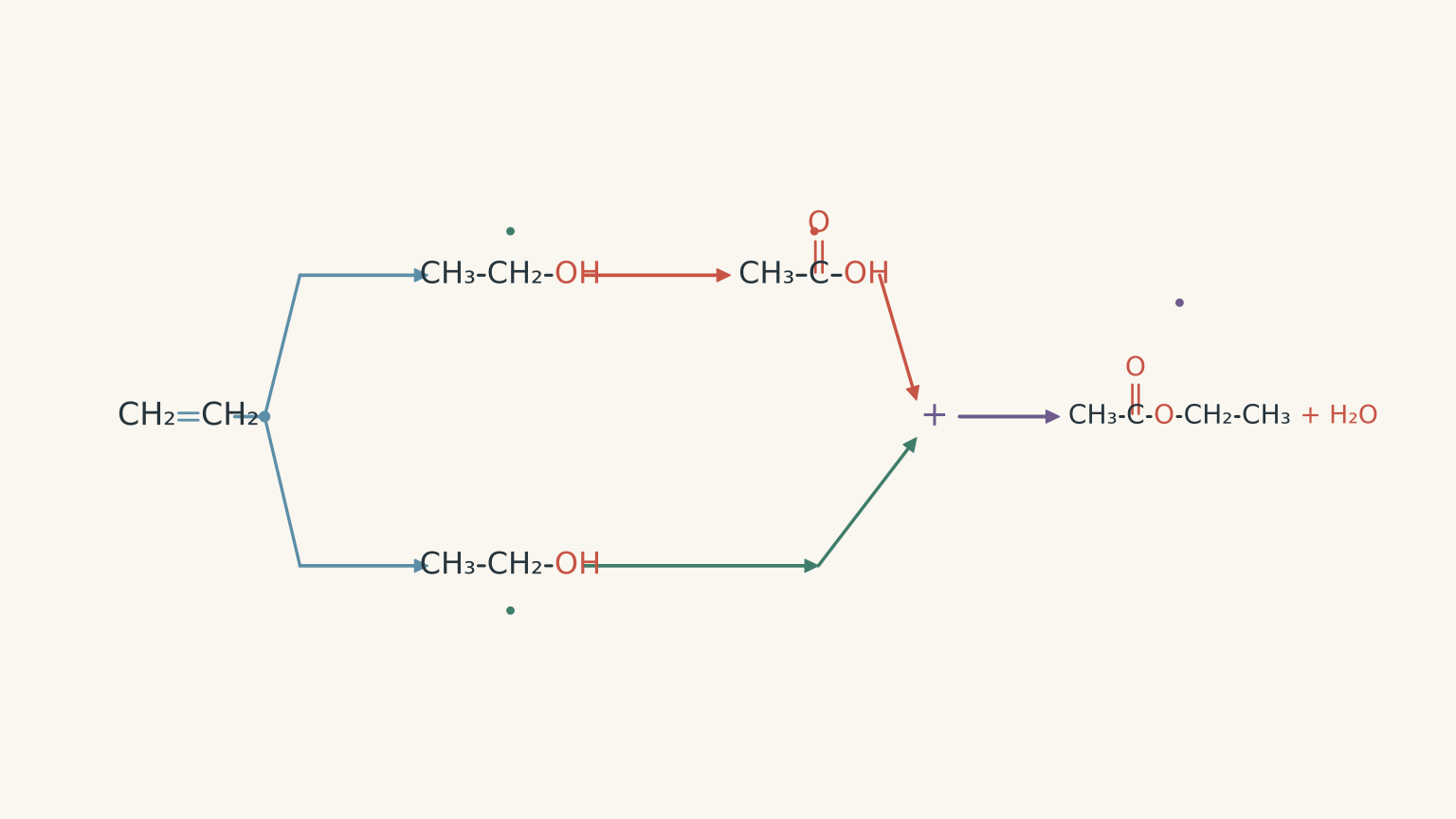
The first step is to convert ethene into ethanol through an addition reaction with water.
Two separate portions of ethanol are then used.
The first portion is oxidised to produce ethanoic acid. The second portion is retained as ethanol for the final esterification.
The pathway is:
Pathway 1: Production of ethanoic acid
\[ \ce{CH2=CH2} \]
\[ \downarrow\quad\text{Hydration} \]
\[ \ce{CH3CH2OH} \]
\[ \downarrow\quad\text{Oxidation} \]
\[ \ce{CH3COOH} \]
Pathway 2: Production of ethanol
\[ \ce{CH2=CH2} \]
\[ \downarrow\quad\text{Hydration} \]
\[ \ce{CH3CH2OH} \]
Final esterification
\[ \ce{CH3COOH + CH3CH2OH} \]
\[ \downarrow\quad\text{Esterification} \]
\[ \ce{CH3COOCH2CH3 + H2O} \]
The two pathways meet at the final esterification stage.
Marking:
- Correctly shows ethene converted into ethanol in two separate branches: 1 mark.
- Correctly shows oxidation of one ethanol portion to ethanoic acid: 1 mark.
- Correctly retains the second ethanol portion: 1 mark.
- Correctly combines ethanoic acid and ethanol to produce ethyl ethanoate: 1 mark.
(b) Write balanced equations for each reaction (3 marks)
Stage 1: Hydration of ethene.
\[ \ce{CH2=CH2 + H2O -> CH3CH2OH} \]
Stage 2: Oxidation of ethanol to ethanoic acid.
\[ \ce{CH3CH2OH + 2[O] -> CH3COOH + H2O} \]
Stage 3: Esterification.
\[ \ce{CH3COOH + CH3CH2OH -> CH3COOCH2CH3 + H2O} \]
Each equation is balanced.
Marking:
- Correct hydration equation: 1 mark.
- Correct oxidation equation: 1 mark.
- Correct esterification equation: 1 mark.
(c) State the reagents and conditions (3 marks)
Each stage requires different reaction conditions.
| Reaction stage | Reagent and conditions |
|---|---|
| Ethene to ethanol | Steam, phosphoric acid catalyst, elevated temperature and pressure |
| Ethanol to ethanoic acid | Acidified potassium dichromate(VI), heating under reflux |
| Ethanoic acid to ethyl ethanoate | Concentrated sulfuric acid catalyst, heating under reflux |
For the oxidation step, another suitable oxidising agent may be accepted if the conditions allow complete oxidation of the primary alcohol to the carboxylic acid.
Marking:
- Suitable hydration reagent and conditions: 1 mark.
- Suitable oxidation reagent and conditions: 1 mark.
- Suitable esterification catalyst and conditions: 1 mark.
(d) Explain why two portions of ethanol are required (2 marks)
The final esterification reaction requires both an alcohol and a carboxylic acid.
In this pathway, both can be obtained from ethanol.
One portion of ethanol is oxidised to ethanoic acid.
The other portion must remain as ethanol so that it can react with the ethanoic acid during esterification.
If all the ethanol were oxidised, there would be no alcohol remaining for the final esterification reaction.
Marking:
- Identifies that esterification requires both an alcohol and a carboxylic acid: 1 mark.
- Explains that one ethanol portion must remain unoxidised to supply the alcohol reactant: 1 mark.
Solution 5
(a) Draw the repeating unit (4 marks)
The two monomers are:
Butanedioic acid:
\[ \ce{HOOC-CH2-CH2-COOH} \]
Ethane-1,2-diol:
\[ \ce{HO-CH2-CH2-OH} \]
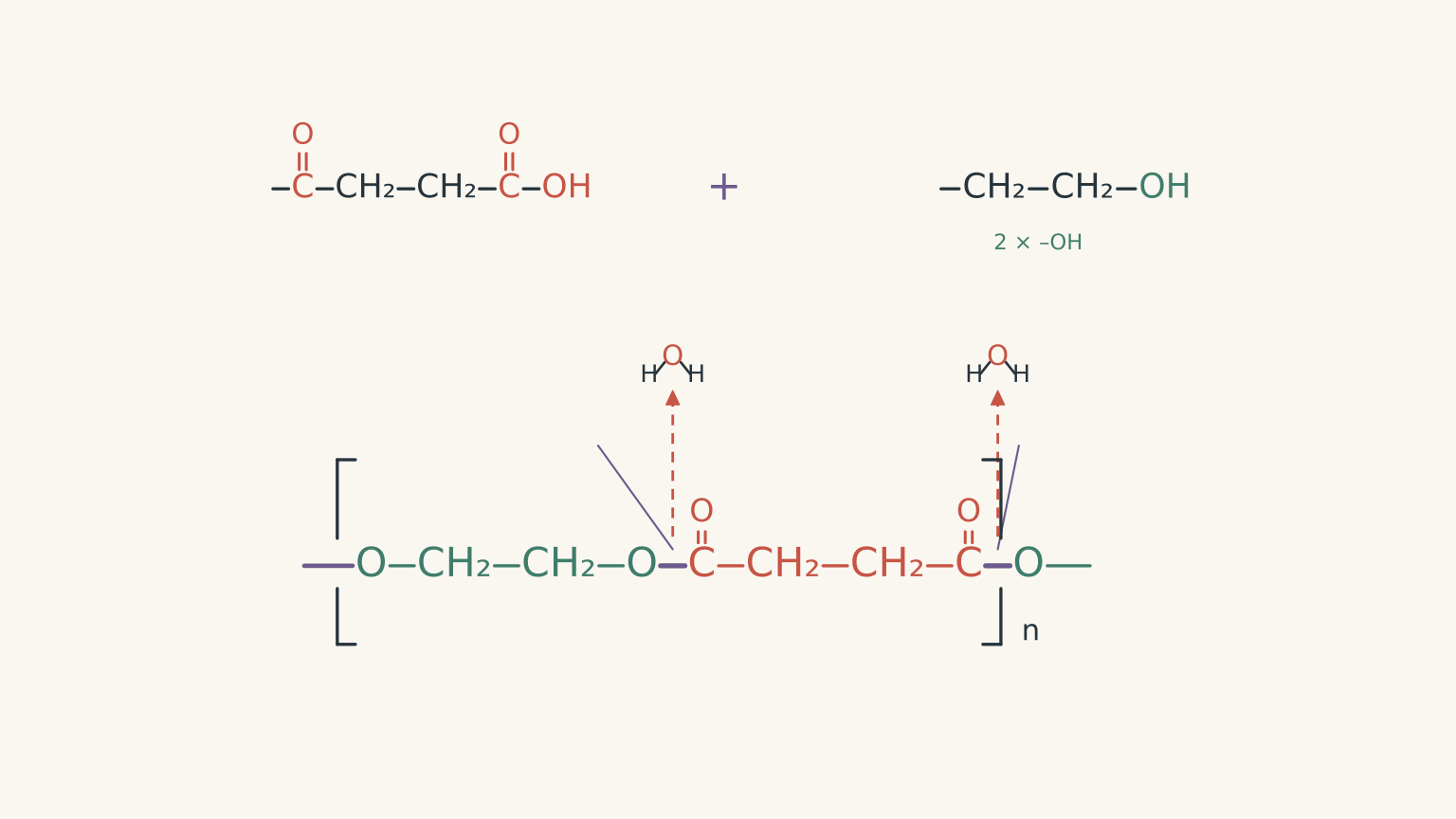
The hydroxyl groups of the diol react with the carboxyl groups of the diacid.
Ester linkages form between the two monomers.
The repeating unit is:
\[ \boxed{ \left[ \mathrm{-O-CH_2-CH_2-O-C(=O)-CH_2-CH_2-C(=O)-} \right]_n } \]
The brackets indicate that this structure repeats many times along the polymer chain.
The ester linkage contains the arrangement:
\[ \ce{-C(=O)-O-} \]
There are two ester linkages per idealised repeating unit.
Marking:
- Correct arrangement of the diol and diacid residues: 1 mark.
- Correct first ester linkage: 1 mark.
- Correct second ester linkage, including the connection across the repeat boundary: 1 mark.
- Correct brackets and \(n\) notation: 1 mark.
Equivalent orientations of the repeating unit are acceptable.
(b) Explain condensation polymerisation (2 marks)
This reaction is classified as condensation polymerisation because monomers join together to form a larger polymer while eliminating a small molecule.
In this reaction, the small molecule eliminated is water.
Both monomers are bifunctional, meaning each has two reactive functional groups:
- Butanedioic acid has two carboxyl groups.
- Ethane-1,2-diol has two hydroxyl groups.
Because each monomer can react at both ends, the molecules can continue joining together to form an extended polymer chain.
Marking:
- Explains that condensation polymerisation involves joining monomers with elimination of water: 1 mark.
- Explains that the two reactive functional groups on each monomer allow continued chain growth: 1 mark.
(c) Calculate the amount and mass of water produced (2 marks)
Each idealised repeating unit forms two ester linkages.
Each ester linkage produces one water molecule.
Therefore, one mole of each monomer produces two moles of water.
The initial amounts are:
\[ n(\text{butanedioic acid})=0.250\ \mathrm{mol} \]
\[ n(\text{ethane-1,2-diol})=0.250\ \mathrm{mol} \]
The amount of water produced is:
\[ \begin{aligned} n(\ce{H2O}) &=2\times0.250\\ &=0.500\ \mathrm{mol} \end{aligned} \]
The molar mass of water is:
\[ M(\ce{H2O})=2(1.0)+16.0 \]
\[ M(\ce{H2O})=18.0\ \mathrm{g\,mol^{-1}} \]
Calculate the mass:
\[ \begin{aligned} m&=nM\\ &=0.500\times18.0\\ &=9.00\ \mathrm{g} \end{aligned} \]
Final answers:
- Amount of water: 0.500 mol.
- Mass of water: 9.00 g.
Marking:
- Correct amount of water: 1 mark.
- Correct mass of water: 1 mark.
(d) Calculate the mass of polyester produced (2 marks)
First, calculate the molar mass of butanedioic acid.
\[ \begin{aligned} M(\text{butanedioic acid}) &=4(12.0)+6(1.0)+4(16.0)\\ &=118\ \mathrm{g\,mol^{-1}} \end{aligned} \]
The molar mass of ethane-1,2-diol is:
\[ \begin{aligned} M(\text{ethane-1,2-diol}) &=2(12.0)+6(1.0)+2(16.0)\\ &=62.0\ \mathrm{g\,mol^{-1}} \end{aligned} \]
One mole of each monomer forms one mole of idealised repeating units.
However, two moles of water are eliminated per mole of repeating units.
Therefore, the molar mass of the repeating unit is:
\[ \begin{aligned} M(\text{repeat unit}) &=118+62.0-2(18.0)\\ &=144\ \mathrm{g\,mol^{-1}} \end{aligned} \]
The amount of repeating units formed is 0.250 mol.
Calculate the mass:
\[ \begin{aligned} m(\text{polyester}) &=nM\\ &=0.250\times144\\ &=36.0\ \mathrm{g} \end{aligned} \]
Final answer: 36.0 g of polyester repeating units.
Marking:
- Correct molar mass of the repeating unit, accounting for the loss of two water molecules: 1 mark.
- Correct mass of polyester: 1 mark.
Follow-through marking: Award method marks if a student makes an earlier arithmetic error but correctly applies the repeating-unit mole ratio and mass calculation. Do not award follow-through where the underlying chemical structure or number of condensation reactions is incorrect.
Final mark allocation check
| Question | Marks |
|---|---|
| Question 1: Ester stoichiometry | 8 |
| Question 2: Limiting reactants and yield | 10 |
| Question 3: Laboratory preparation and purification | 10 |
| Question 4: Multistep synthesis pathways | 12 |
| Question 5: Polyester formation | 10 |
| Total | 50 |
All questions are assessed within the specified ester preparation and synthesis pathways scope. All subpart allocations sum to their respective question totals.