
Esterification and Organic Pathways: 40-Mark HSC Chemistry Practice Exam
Test your understanding of esterification and multi-step organic synthesis pathways with this original 40-mark HSC Chemistry practice paper. Includes timed exam conditions, five original questions, fully worked solutions, and a detailed marking guide.
This original tutorgum practice paper assesses esterification and organic synthesis pathways from the Chemistry 2017 syllabus edition. It covers multi-step reaction pathways, the preparation of simple esters in a school laboratory, equilibrium, and the separation and purification of ester products.
The paper is designed as a focused revision assessment, not a full-course Chemistry examination. All questions are original and are followed by fully worked solutions and a marking guide.
01Exam instructions
| Assessment detail | Conditions |
|---|---|
| Paper | Original tutorgum practice paper |
| Subject | HSC Chemistry |
| Syllabus edition | Chemistry 2017 |
| Working time | 50 minutes |
| Reading time | 5 minutes |
| Total marks | 40 |
| Calculator | Scientific calculator permitted |
| Other equipment | Pens, pencils, and ruler |
| Notes | No notes or textbooks |
Assessed topics
This paper assesses:
- Organic synthesis pathways involving multiple reaction steps.
- Selection of reagents and conditions for organic conversions.
- Preparation of a simple ester in a school laboratory.
- The chemistry and equilibrium of esterification.
- Practical safety considerations during ester preparation.
- Separation and purification of ester products.
The oxidation of primary alcohols to carboxylic acids is assessed only as a step in an organic synthesis pathway.
This paper does not assess other organic reaction families, polymerisation, spectroscopy, or unrelated Chemistry modules.
Instructions to students
- Answer all five questions.
- Show all working for calculations.
- Include appropriate units and significant figures.
- Write balanced chemical equations where requested.
- Explain your chemical reasoning rather than simply stating an answer.
- Marks are awarded for correct chemical knowledge, appropriate working, and clear explanations.
These are practice-paper conditions, not claims about official NESA examination requirements. This paper is not an official, endorsed, past, or predicted NESA examination.
02Questions
Question 1 (8 marks)
Esterification is an important reaction in organic chemistry. It involves the reaction between a carboxylic acid and an alcohol to produce an ester and water.
Consider the reaction between ethanoic acid and propan-1-ol.
(a) Write a balanced chemical equation for this reaction using condensed structural formulae. Use a reversible reaction arrow. (3 marks)
(b) Name the ester produced. Identify which part of its name comes from the alcohol and which part comes from the carboxylic acid. (2 marks)
(c) Esterification is reversible. Explain what is meant by dynamic equilibrium when this reaction occurs in a closed reaction vessel at constant temperature. (3 marks)
Question 2 (8 marks)
A chemist wants to prepare butyl butanoate, an ester, starting with butan-1-ol.
The synthesis requires two reaction steps:
- First, butan-1-ol is converted into a carboxylic acid.
- The carboxylic acid is then converted into the desired ester.
(a) Construct a flow chart showing the two reaction steps required to produce butyl butanoate from butan-1-ol.
Your flow chart must include:
- The intermediate compound.
- The reagent required for the first reaction.
- The conditions required for the first reaction.
- The additional reactant required for the second reaction.
- The reagent and conditions required for the second reaction.
(5 marks)
(b) A student suggests using distillation during the first reaction rather than heating under reflux.
Explain why heating under reflux is more suitable when the desired product is a carboxylic acid. (3 marks)
Question 3 (9 marks)
A student is preparing ethyl butanoate in a school laboratory by reacting ethanol with butanoic acid.
The student uses the following quantities:
- 2.0 mL of ethanol.
- 2.0 mL of butanoic acid.
- 3 drops of concentrated sulfuric acid.
The reaction mixture is heated gently using the apparatus shown.
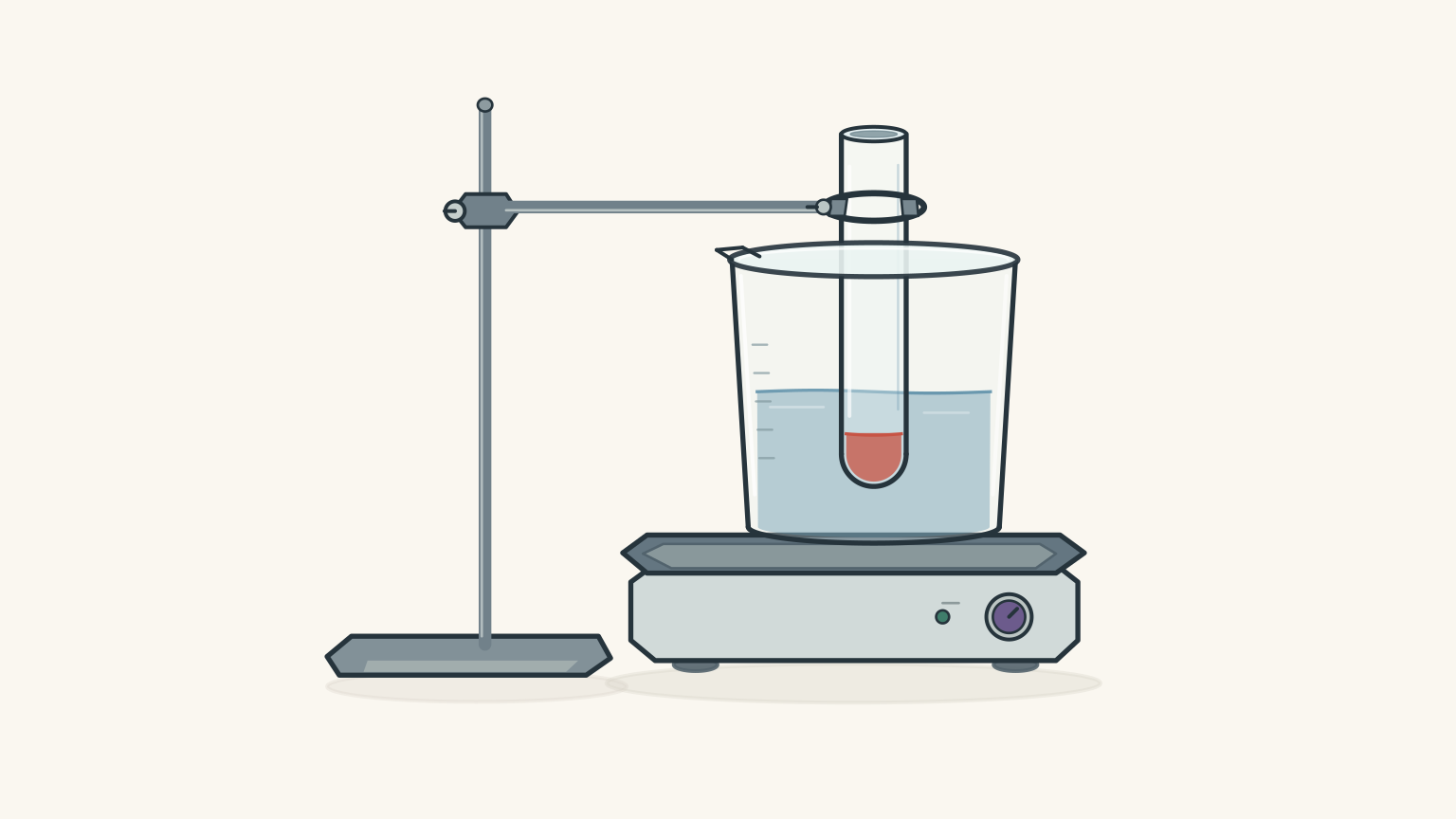
(a) Outline a suitable experimental procedure for preparing ethyl butanoate using the quantities provided. (3 marks)
(b) Explain the role of concentrated sulfuric acid in this reaction. (2 marks)
(c) Explain why a water bath is used instead of directly heating the reaction mixture over a naked flame. State one additional safety precaution and explain the chemical hazard it addresses. (4 marks)
Question 4 (9 marks)
After the esterification reaction in Question 3, the student has a crude mixture containing ethyl butanoate, excess reactants, water, and sulfuric acid.
The student transfers the cooled mixture into a separating funnel and washes it with aqueous sodium carbonate.
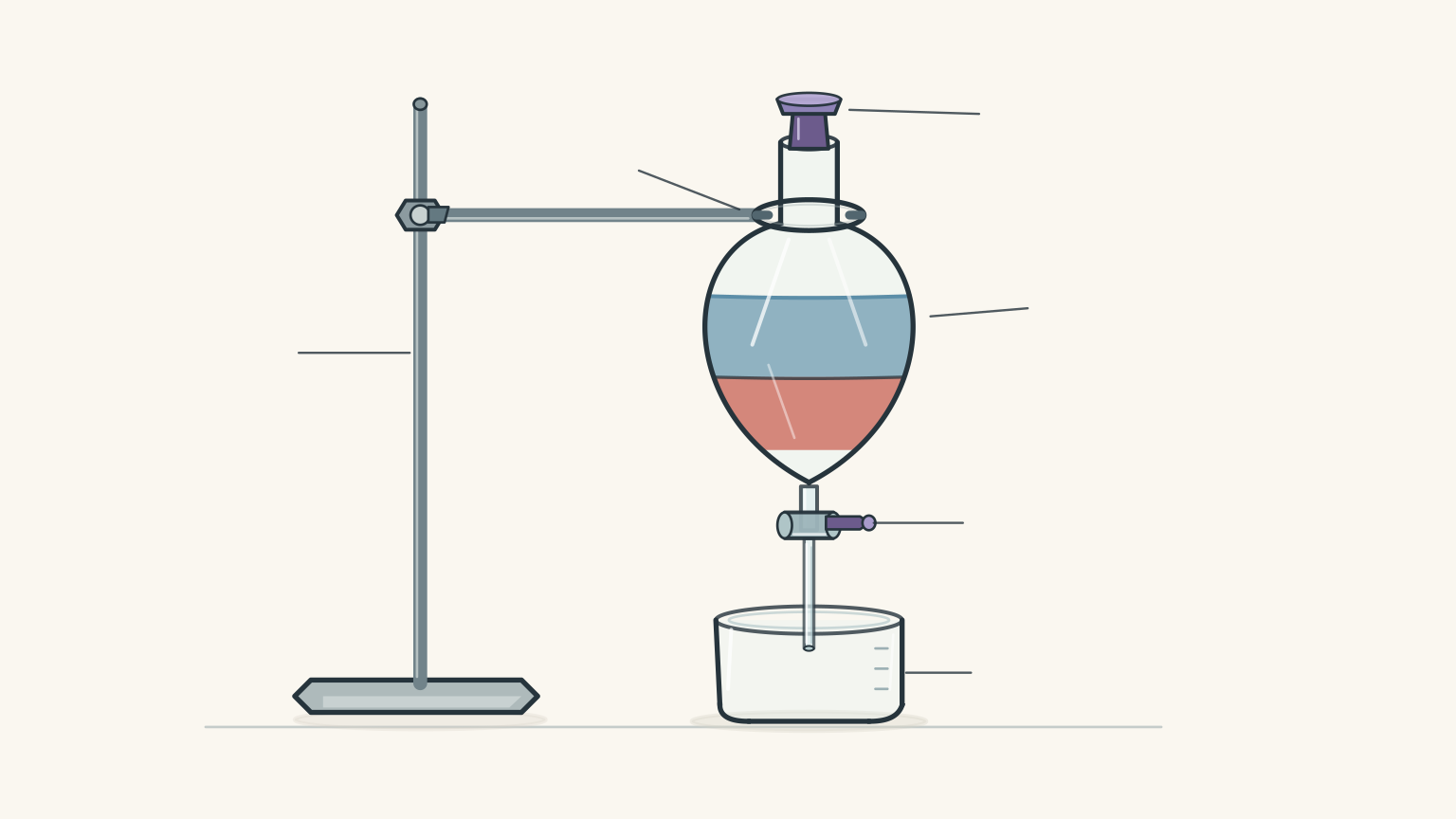
The following data are available:
Density data
| Substance | Density (g mL\(^{-1}\)) |
|---|---|
| Ethyl butanoate | 0.88 |
| Aqueous layer | 1.00 |
Ethyl butanoate has limited solubility in water, and two distinct liquid layers form under the conditions used.
Boiling-point data at 1 atm
| Substance | Boiling point (°C) |
|---|---|
| Ethanol | 78 |
| Water | 100 |
| Ethyl butanoate | 121 |
| Butanoic acid | 164 |
Answer the following questions.
(a) Explain why aqueous sodium carbonate is added to the reaction mixture. Explain why the separating funnel must be vented during this process. (3 marks)
(b) Identify which liquid layer contains ethyl butanoate. Justify your answer using the density data. (2 marks)
(c) After separating the organic layer, the student adds anhydrous sodium sulfate.
Explain the purpose of this substance and how the student should remove it before the final purification step. (2 marks)
(d) The student then uses distillation to purify the ester.
Identify the approximate temperature at which the desired ester fraction should be collected. Explain your choice using the supplied boiling-point data. (2 marks)
Question 5 (6 marks)
A student investigates how changing the initial amount of ethanol affects the equilibrium yield of ethyl butanoate.
The reaction is:
\[ \ce{CH3CH2CH2COOH + CH3CH2OH <=> CH3CH2CH2COOCH2CH3 + H2O} \]
Two reaction mixtures are prepared under identical conditions.
Both are maintained at the same temperature and allowed to reach equilibrium. The total reaction volume is the same in both experiments, and the initial amount of water is negligible.
The results are shown below.
| Measurement | Batch A | Batch B |
|---|---|---|
| Initial ethanol (mol) | 0.10 | 0.20 |
| Initial butanoic acid (mol) | 0.10 | 0.10 |
| Ethyl butanoate at equilibrium (mol) | 0.055 | 0.072 |
(a) Calculate the percentage of the initial butanoic acid converted into ethyl butanoate for each batch. (2 marks)
(b) Explain why Batch B produces a greater amount of ethyl butanoate at equilibrium than Batch A. (2 marks)
(c) A student suggests that adding more concentrated sulfuric acid to Batch A will increase the equilibrium amount of ethyl butanoate.
Evaluate this claim. For this question, assume sulfuric acid acts only as a catalyst and does not remove water from the reaction mixture. (2 marks)
03Worked solutions and marking guide
Solution 1
(a) Balanced chemical equation (3 marks)
The reaction involves ethanoic acid and propan-1-ol.
The balanced equation is:
\[ \ce{CH3COOH + CH3CH2CH2OH <=> CH3COOCH2CH2CH3 + H2O} \]
The reactants are:
- Ethanoic acid: \(\ce{CH3COOH}\)
- Propan-1-ol: \(\ce{CH3CH2CH2OH}\)
The products are:
- Propyl ethanoate: \(\ce{CH3COOCH2CH2CH3}\)
- Water: \(\ce{H2O}\)
The equation uses a reversible arrow because esterification can proceed in both directions.
The equation is balanced: the same number of carbon, hydrogen, and oxygen atoms appears on each side.
Marking:
- Correct reactant formulae: 1 mark.
- Correct ester and water product formulae: 1 mark.
- Correct reversible arrow and balanced equation: 1 mark.
(b) Naming the ester (2 marks)
The ester is called propyl ethanoate.
The name has two parts:
- Propyl comes from propan-1-ol, the alcohol.
- Ethanoate comes from ethanoic acid, the carboxylic acid.
A useful rule for naming esters is:
\[ \text{Alcohol part}+\text{Carboxylic acid part} \]
When naming the acid-derived part, change the ending from -oic acid to -oate.
For example:
- Propanol produces the propyl part.
- Ethanoic acid produces the ethanoate part.
Marking:
- Correct name, propyl ethanoate: 1 mark.
- Correct identification of the alcohol-derived and acid-derived parts: 1 mark.
(c) Dynamic equilibrium (3 marks)
Dynamic equilibrium occurs when the forward and reverse reactions continue at equal rates.
In esterification:
- The forward reaction produces ester and water.
- The reverse reaction uses ester and water to produce the original alcohol and carboxylic acid.
At equilibrium, both reactions are still occurring. However, they occur at the same rate.
This means the concentrations of the reactants and products remain constant over time.
An important distinction: constant concentrations do not mean equal concentrations. There can be much more ester than alcohol, or much more alcohol than ester, at equilibrium.
Marking:
- Identifies that both forward and reverse reactions continue: 1 mark.
- States that their rates are equal at equilibrium: 1 mark.
- Explains that concentrations remain constant: 1 mark.
Solution 2
(a) Two-step synthesis pathway (5 marks)
The target compound is butyl butanoate.
The first step is oxidation of butan-1-ol to butanoic acid.
The second step is esterification of butanoic acid with butan-1-ol.
The completed pathway is:
Step 1: Oxidation
\[ \text{Butan-1-ol} \longrightarrow \text{Butanoic acid} \]
Reagent: Acidified potassium dichromate(VI).
Conditions: Heat under reflux.
The oxidising agent converts the primary alcohol into a carboxylic acid.
Step 2: Esterification
\[ \text{Butanoic acid} + \text{Butan-1-ol} \rightleftharpoons \text{Butyl butanoate} + \text{Water} \]
Reagent: Concentrated sulfuric acid as a catalyst.
Conditions: Gentle heating.
The completed synthesis pathway can therefore be represented as:
\[ \begin{aligned} \text{Butan-1-ol} &\xrightarrow[\text{reflux}] {\text{acidified } \ce{K2Cr2O7}}\\ &\text{Butanoic acid}\\ &\xrightarrow[\text{gentle heating}] {\text{butan-1-ol, conc. } \ce{H2SO4}}\\ &\text{Butyl butanoate} \end{aligned} \]
The key skill is recognising that the starting alcohol must first become a carboxylic acid before it can undergo esterification.
Marking:
- Correct intermediate, butanoic acid: 1 mark.
- Correct oxidising reagent, acidified potassium dichromate(VI): 1 mark.
- Correct first-step conditions, reflux: 1 mark.
- Correct second reactant, butan-1-ol: 1 mark.
- Correct second-step catalyst and heating conditions: 1 mark.
(b) Reflux versus distillation (3 marks)
Reflux is more suitable because the aim is to oxidise the primary alcohol fully into a carboxylic acid.
When a reaction mixture is heated under reflux, volatile substances evaporate, enter the condenser, cool, and return to the reaction vessel.
This prevents the loss of volatile reactants and intermediates. It also allows the mixture to remain heated in contact with the oxidising agent for an extended period.
During the oxidation of a primary alcohol, an aldehyde can form as an intermediate before further oxidation produces the carboxylic acid.
Distillation could remove volatile material from the reaction mixture before oxidation is complete.
Therefore, reflux is preferred when the desired product is the carboxylic acid.
Marking:
- Explains that vapours condense and return to the reaction vessel: 1 mark.
- Explains that volatile reactants or intermediates are not lost: 1 mark.
- Links prolonged heating and contact with the oxidising agent to further oxidation into the carboxylic acid: 1 mark.
Solution 3
(a) Experimental procedure (3 marks)
A suitable procedure is:
- Measure 2.0 mL of ethanol and 2.0 mL of butanoic acid into a small reaction vessel.
- Add three drops of concentrated sulfuric acid and carefully mix the contents.
- Place the reaction vessel in a water bath maintained at approximately 50-60°C. Warm for around five minutes, then remove the vessel and allow the mixture to cool.
The reaction is:
\[ \ce{CH3CH2CH2COOH + CH3CH2OH <=> CH3CH2CH2COOCH2CH3 + H2O} \]
The ester produced is ethyl butanoate.
The reaction should be conducted using small quantities and appropriate laboratory supervision.
Marking:
- Correctly measures and combines the alcohol and carboxylic acid: 1 mark.
- Adds the concentrated sulfuric acid catalyst: 1 mark.
- Uses gentle heating in a water bath and allows the mixture to cool: 1 mark.
(b) Role of concentrated sulfuric acid (2 marks)
Concentrated sulfuric acid acts as an acid catalyst.
A catalyst increases the rate of a chemical reaction without being consumed overall.
In this reaction, it helps esterification proceed more quickly, allowing equilibrium to be reached sooner.
Marking:
- Identifies concentrated sulfuric acid as an acid catalyst: 1 mark.
- Explains that it increases the reaction rate: 1 mark.
(c) Laboratory safety (4 marks)
A water bath is used because ethanol is flammable.
Direct heating over a naked flame could ignite ethanol vapour, creating a fire hazard.
A water bath provides indirect heating and reduces this risk.
One additional precaution is to wear safety goggles when handling concentrated sulfuric acid.
Concentrated sulfuric acid is highly corrosive and can cause serious chemical burns if it contacts the eyes or skin.
Another acceptable precaution would be to work in a fume cupboard because butanoic acid has strong, unpleasant vapours.
Marking:
- Identifies that ethanol is flammable: 1 mark.
- Explains that a naked flame could ignite ethanol vapour and that a water bath reduces this risk: 1 mark.
- States one appropriate additional safety precaution: 1 mark.
- Correctly explains the associated chemical hazard: 1 mark.
Solution 4
(a) Purpose of sodium carbonate and venting (3 marks)
Aqueous sodium carbonate is added to neutralise excess acid remaining in the crude reaction mixture.
There may be unreacted butanoic acid and concentrated sulfuric acid left after esterification.
Sodium carbonate reacts with these acids, producing carbon dioxide gas.
The formation of carbon dioxide increases pressure inside the separating funnel.
The funnel must therefore be vented regularly during washing to release the gas and prevent pressure from building up.
When venting, the outlet should be directed away from people.
Marking:
- Identifies that sodium carbonate neutralises excess acids: 1 mark.
- Identifies carbon dioxide as a reaction product: 1 mark.
- Explains that venting prevents dangerous pressure build-up: 1 mark.
(b) Identifying the ester layer (2 marks)
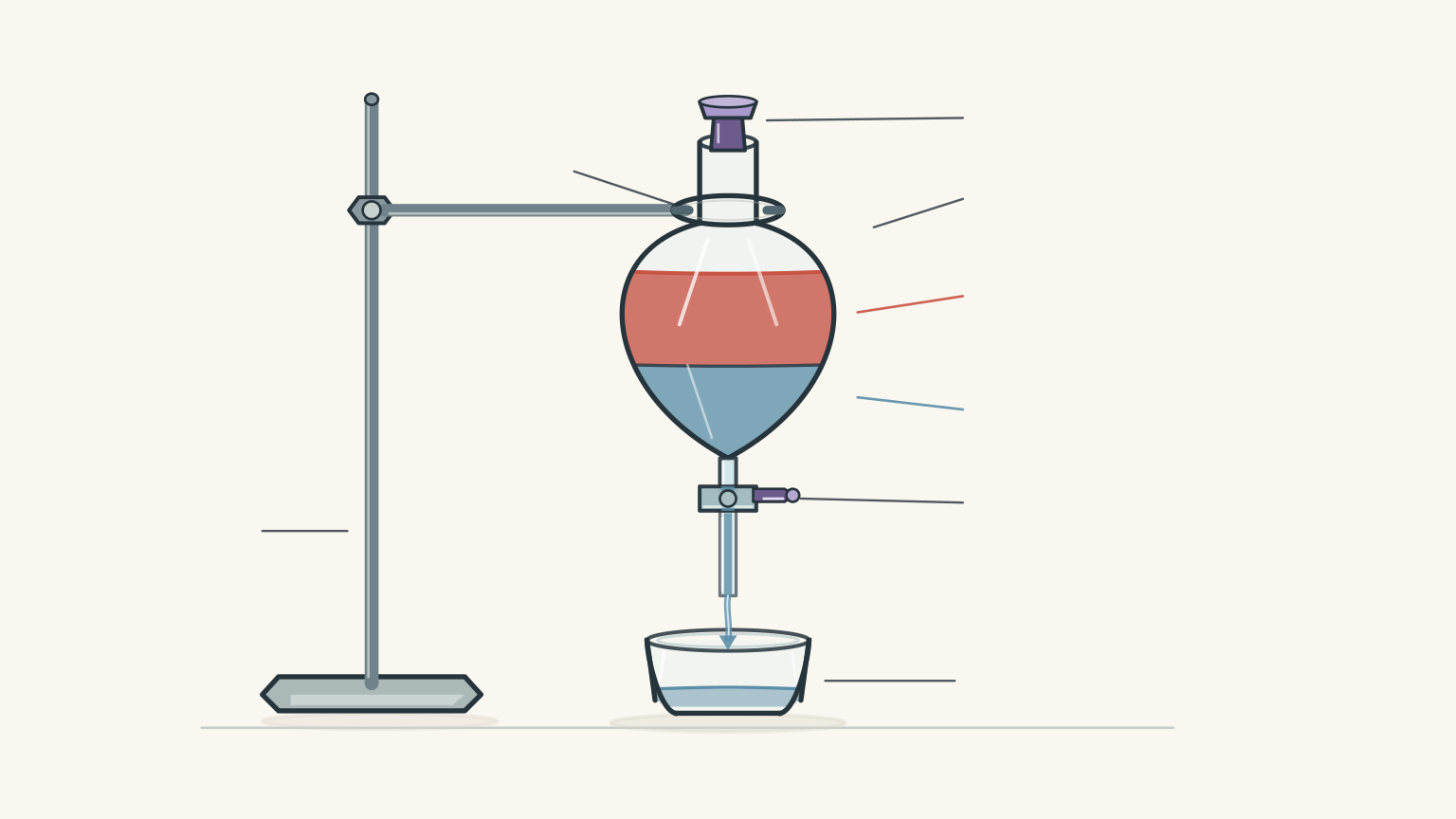
The ethyl butanoate is found in the upper layer.
The density of ethyl butanoate is:
\[ 0.88\ \text{g mL}^{-1} \]
The density of the aqueous layer is:
\[ 1.00\ \text{g mL}^{-1} \]
Because ethyl butanoate is less dense than the aqueous layer, it floats above it.
The two layers form because ethyl butanoate has limited solubility in water.
Therefore, the upper organic layer contains the desired ester.
Marking:
- Identifies the upper layer as ethyl butanoate: 1 mark.
- Correctly justifies this using the relative densities: 1 mark.
(c) Drying the organic layer (2 marks)
Anhydrous sodium sulfate is used as a drying agent.
A drying agent removes small amounts of residual water from an organic liquid.
Even after separating the two layers, some water may remain dissolved in the organic layer.
The student adds anhydrous sodium sulfate to absorb this remaining water.
The solid drying agent is then removed by filtration or careful decanting.
The remaining liquid is the dried ester mixture, ready for further purification.
Marking:
- Explains that anhydrous sodium sulfate absorbs residual water: 1 mark.
- Identifies filtration or decanting as a suitable removal method: 1 mark.
(d) Purifying the ester by distillation (2 marks)
The desired ester is ethyl butanoate, which has a boiling point of approximately:
\[ 121^\circ\text{C} \]
The student should collect the fraction that distils near \(121^\circ\text{C}\).
This temperature is higher than the boiling points of ethanol and water, but lower than the boiling point of butanoic acid.
The drying step is important because it removes residual water before distillation.
This allows the ester to be separated from the remaining substances based on their different boiling points.
Marking:
- Identifies approximately \(121^\circ\text{C}\) as the collection temperature: 1 mark.
- Correctly explains the separation using the boiling-point differences: 1 mark.
Solution 5
(a) Percentage conversion (2 marks)
The question asks what percentage of the initial butanoic acid has been converted into ethyl butanoate.
The balanced equation shows a 1:1 mole ratio between butanoic acid and ethyl butanoate.
Therefore:
\[ \text{Percentage conversion} = \frac{\text{Moles of ester formed}} {\text{Initial moles of acid}} \times 100 \]
Batch A
Initial butanoic acid:
\[ 0.10\text{ mol} \]
Ethyl butanoate formed:
\[ 0.055\text{ mol} \]
Substituting:
\[ \begin{aligned} \text{Conversion} &=\frac{0.055}{0.10}\times100\\ &=55\% \end{aligned} \]
Batch B
Initial butanoic acid:
\[ 0.10\text{ mol} \]
Ethyl butanoate formed:
\[ 0.072\text{ mol} \]
Substituting:
\[ \begin{aligned} \text{Conversion} &=\frac{0.072}{0.10}\times100\\ &=72\% \end{aligned} \]
Therefore:
- Batch A: 55% conversion.
- Batch B: 72% conversion.
Marking:
- Correct calculation for Batch A: 1 mark.
- Correct calculation for Batch B: 1 mark.
(b) Explaining the higher ester production in Batch B (2 marks)
Batch B contains twice as much ethanol initially as Batch A.
This means ethanol is present in a greater concentration in Batch B.
According to Le Chatelier’s principle, increasing the concentration of a reactant causes the equilibrium position to shift in the direction that reduces that increase.
Therefore, the equilibrium shifts towards the products, producing more ethyl butanoate and water.
This explains why Batch B produces more ester at equilibrium.
Marking:
- Identifies the greater initial ethanol concentration in Batch B: 1 mark.
- Explains that the equilibrium shifts towards the products, increasing ester production: 1 mark.
(c) Effect of adding more catalyst (2 marks)
The student’s claim is incorrect under the stated assumption.
A catalyst increases the rates of both the forward and reverse reactions.
It allows the reaction to reach equilibrium more quickly, but it does not change the equilibrium position.
Therefore, adding more sulfuric acid catalyst does not increase the final equilibrium amount of ethyl butanoate.
It only changes how quickly equilibrium is reached.
Marking:
- Explains that a catalyst increases the rates of both forward and reverse reactions: 1 mark.
- States that a catalyst does not change the equilibrium position or final equilibrium amount of ester: 1 mark.
04Final marking summary
| Question | Topic | Marks |
|---|---|---|
| 1 | Esterification and dynamic equilibrium | 8 |
| 2 | Multi-step organic synthesis pathways | 8 |
| 3 | Laboratory ester preparation and safety | 9 |
| 4 | Separation and purification | 9 |
| 5 | Equilibrium and percentage conversion | 6 |
| Total | 40 |
Suggested performance guide
Use your result to identify which parts of esterification and organic pathways need more revision. These are informal tutorgum practice benchmarks, not official NESA grade boundaries.
| Mark | Performance | What to focus on |
|---|---|---|
| 34-40 | Strong | Refine explanations and improve precision in extended responses. |
| 28-33 | Good | Practise multi-step pathways and equilibrium reasoning. |
| 20-27 | Developing | Review reagent selection, ester naming, and practical procedures. |
| 0-19 | Needs further revision | Revisit the reaction pathways, esterification equations, and laboratory processes before attempting another paper. |
Final revision checklist
After marking your paper, make sure you can confidently:
- [ ] Write balanced equations for esterification reactions.
- [ ] Name esters using the alcohol and carboxylic acid.
- [ ] Explain dynamic equilibrium using forward and reverse reaction rates.
- [ ] Construct a multi-step organic synthesis flow chart.
- [ ] Select suitable reagents and conditions for each reaction step.
- [ ] Explain why reflux is used when producing carboxylic acids from primary alcohols.
- [ ] Describe a safe school-laboratory ester preparation.
- [ ] Explain the role of concentrated sulfuric acid as a catalyst.
- [ ] Explain how sodium carbonate, separating funnels, and drying agents are used during purification.
- [ ] Use density and boiling-point data to identify and purify an ester.
- [ ] Apply Le Chatelier’s principle to explain changes in equilibrium ester production.
A particularly important skill is being able to connect the entire process: selecting the starting materials, choosing the correct reaction conditions, producing the ester, and then separating and purifying the final product.
If you can explain each of those stages clearly, rather than just memorising the esterification equation, you’re developing the understanding needed for more demanding HSC Chemistry questions.