
Hydrocarbon Naming and Isomer Problems: HSC Chemistry Practice Exam
Test your understanding of hydrocarbon naming and isomer problems with this original 56-mark NSW HSC Chemistry practice paper. Includes timed exam instructions, questions covering the supplied syllabus scope, and complete worked solutions with a marking guide.
This original tutorgum practice paper assesses hydrocarbon naming and isomer problems within the supplied NSW HSC Chemistry 2025 syllabus scope. It covers IUPAC nomenclature of alkanes, alkenes, alkynes, and haloalkanes; methyl and ethyl branching; structural isomerism; and geometric isomerism of alkenes. The questions progress from standard naming and drawing tasks to more challenging isomer problems.
This is a focused topic assessment, not a full-course Chemistry examination. It is an original tutorgum practice paper, not an official, endorsed, past, or predicted NESA paper.
01Exam instructions
| Assessment condition | Details |
|---|---|
| Total marks | 56 |
| Suggested working time | 75 minutes |
| Reading time | 5 minutes |
| Permitted equipment | Pen, pencil, ruler, and non-programmable calculator |
| Reference materials | No notes or textbooks |
| Molecular models | Not required |
Assessed topics
This paper assesses:
- IUPAC naming and formulae for alkanes, alkenes, and alkynes containing up to eight carbon atoms.
- Simple methyl- and ethyl-branched hydrocarbons.
- Bond locants and parent-chain selection.
- IUPAC naming and structural representation of haloalkanes.
- Chain, position, and functional-group isomerism in saturated and unsaturated organic compounds.
- Geometric isomerism of alkenes, using cis/trans notation.
Exclusions and conventions
- Reaction pathways, reaction mechanisms, and haloalkane reactions are excluded.
- Aromatic and cyclic hydrocarbons are excluded.
- E/Z priority-rule nomenclature is not assessed. Use cis/trans notation where appropriate.
- Assume open-chain structures unless stated otherwise.
- Use the longest suitable parent chain and the lowest possible locants.
- List different substituents alphabetically when naming compounds.
- Show all relevant bonds clearly in structural formulae.
Attempt every question. Show your reasoning where requested, and include units where relevant. For structure-drawing questions, make sure the number of carbon atoms and the positions of all multiple bonds and branches are unambiguous.
02Questions
Question 1 (11 marks)
Consider the following compounds.
(a) Name the following compound:
\[ \ce{CH3CH(CH3)CH2CH2CH3} \]
(2 marks)
(b) Name the following compound:
\[ \ce{CH3CH2CH(CH2CH3)CH2CH2CH3} \]
(2 marks)
(c) Name the following compound:
\[ \ce{CH3CH2C\bond{#}CCH3} \]
(2 marks)
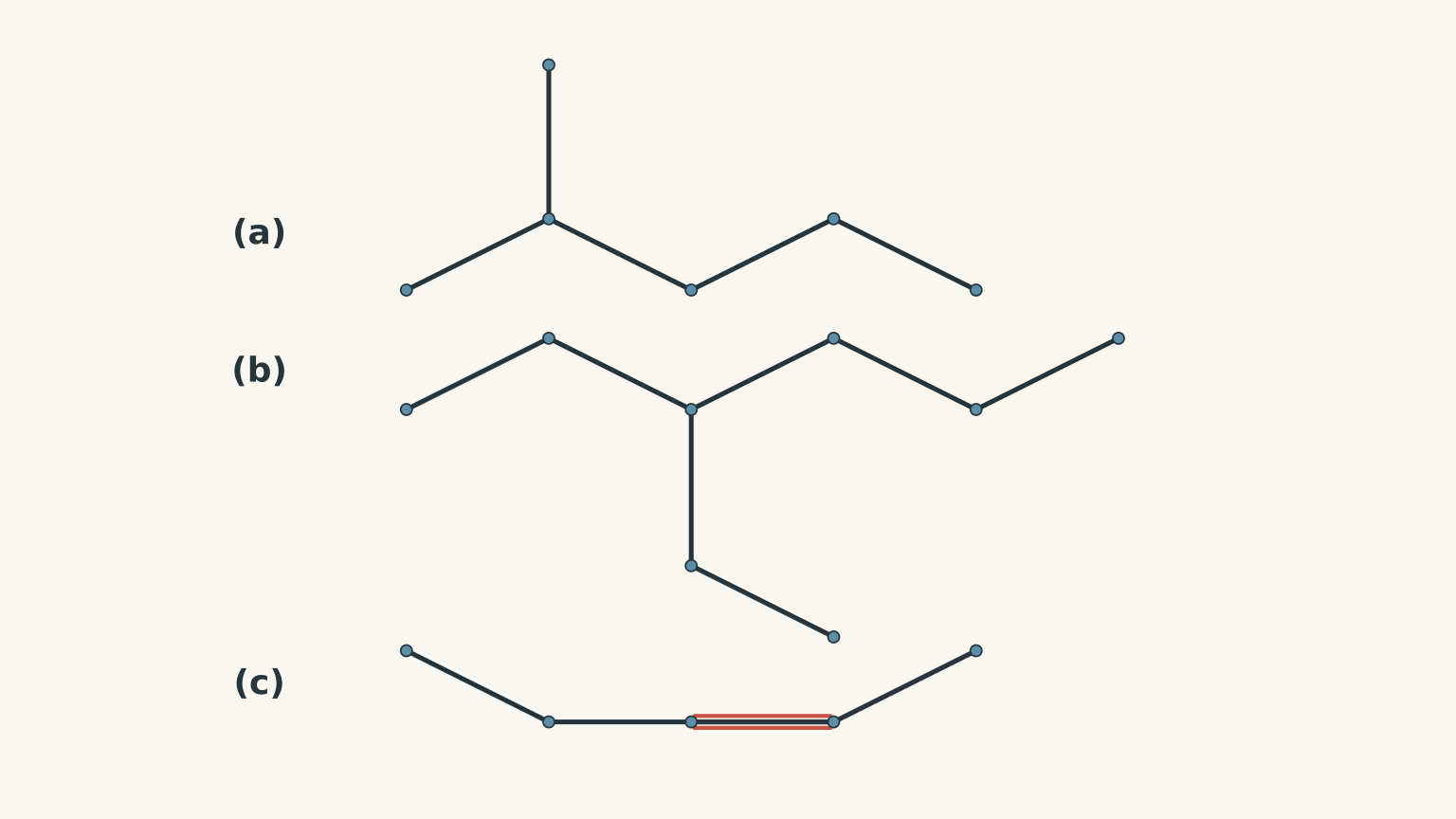
(d) Write the condensed structural formula for 4-methylhex-2-ene. (3 marks)
(e) Write the molecular formula for each of the following:
- Octane.
- Pent-1-yne.
(2 marks)
Question 2 (7 marks)
(a) Determine the correct IUPAC name for the following haloalkane:
\[ \ce{CH3CH(Br)CH2CH(Cl)CH3} \]
(3 marks)
(b) Determine the correct IUPAC name for:
\[ \ce{CH3CH2C(Cl)(CH3)CH2CH3} \]
(2 marks)
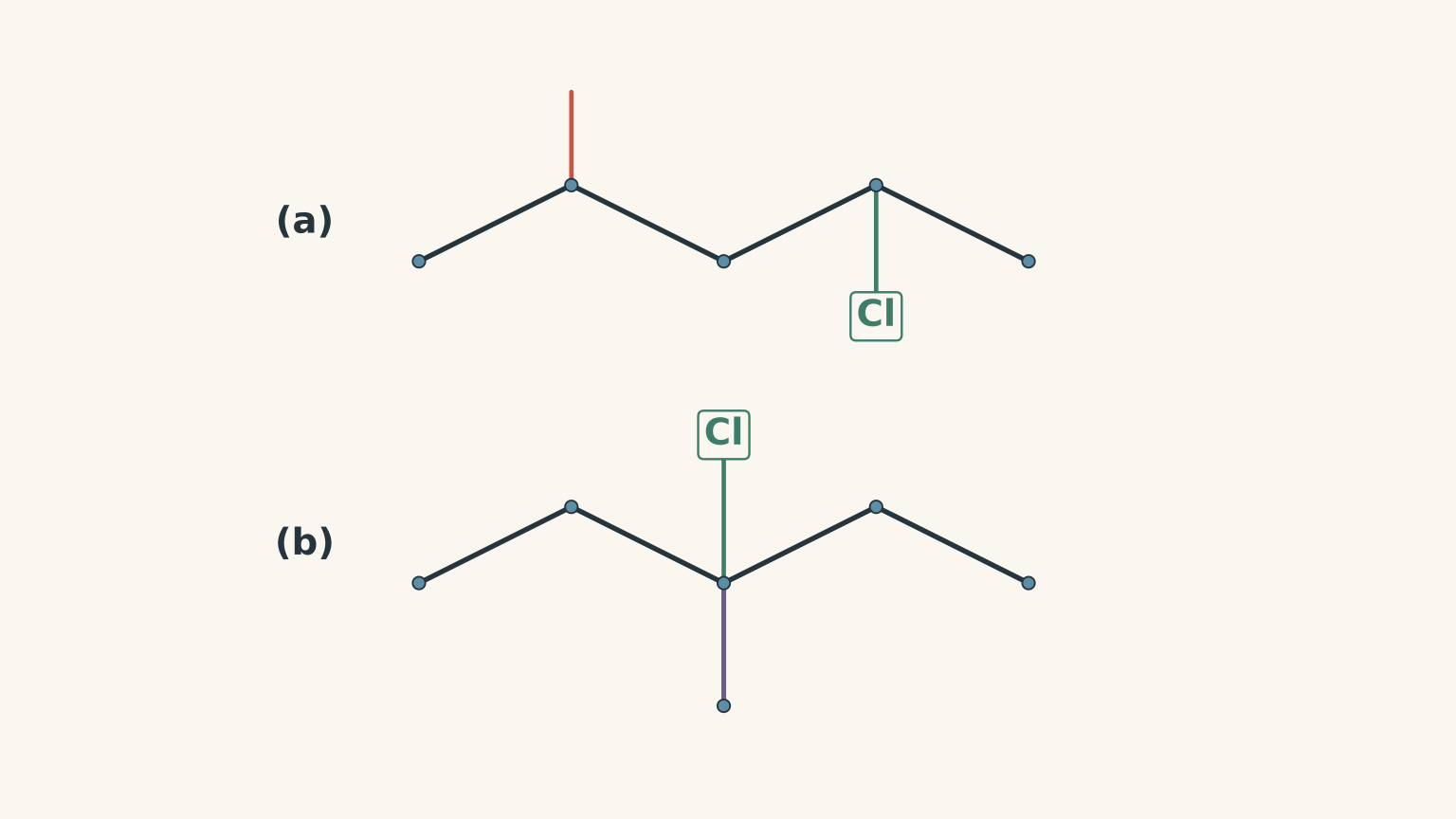
(c) Write the condensed structural formula for 1-bromo-2-chloro-3-methylbutane. (2 marks)
Question 3 (10 marks)
This question examines chain and functional-group isomerism in saturated organic compounds.
(a) Draw and name two different chain isomers with the molecular formula \(\ce{C5H12}\). (4 marks)
(b) Draw and name two functional-group isomers with the molecular formula \(\ce{C2H6O}\). (4 marks)
(c) Explain why the two compounds in part (b) are functional-group isomers rather than chain isomers. (2 marks)
Question 4 (10 marks)
This question examines structural isomerism in unsaturated organic compounds.
(a) Draw and name two position isomers with the molecular formula \(\ce{C4H8}\), assuming both compounds are acyclic alkenes. (4 marks)
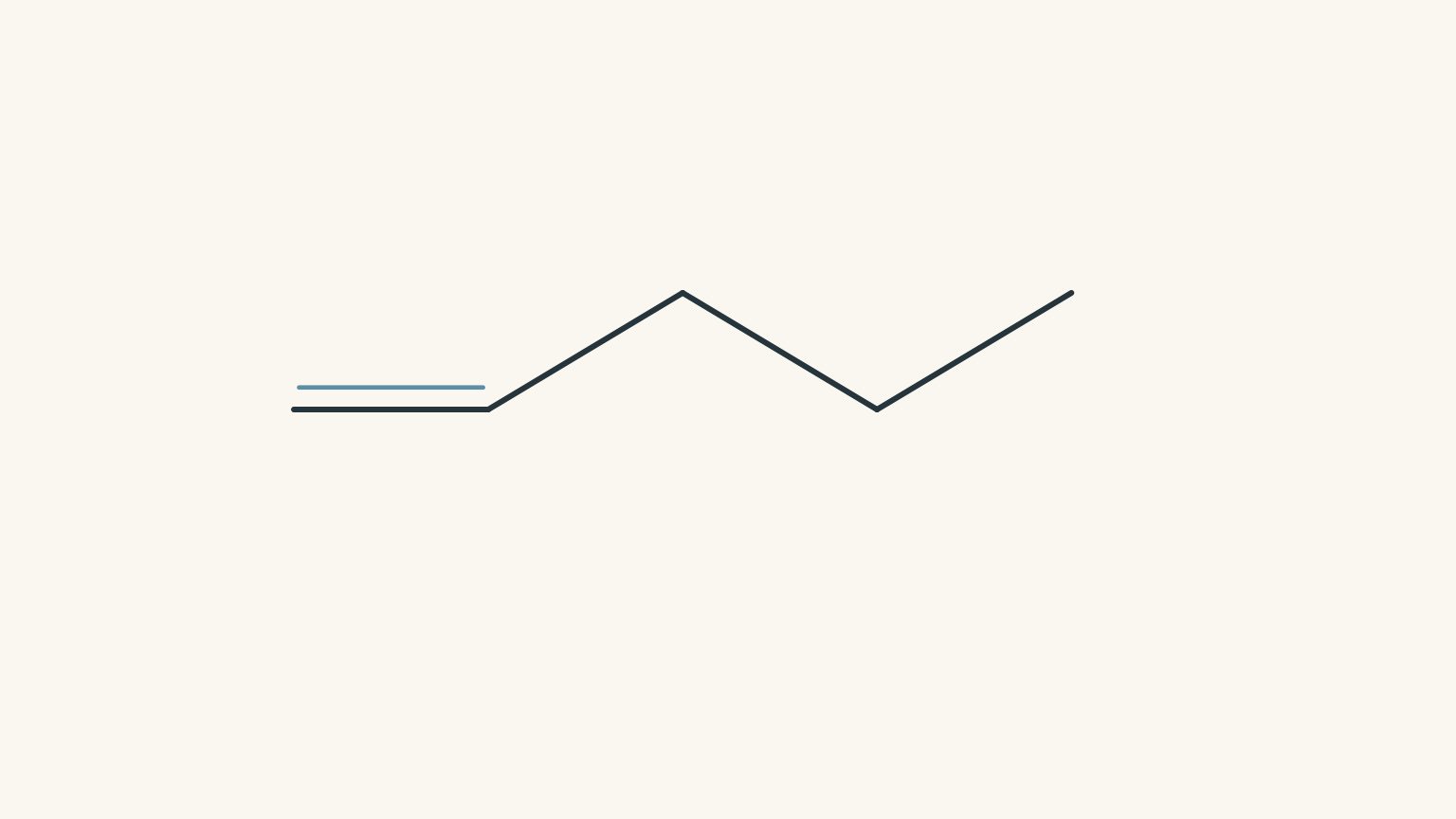
(b) Pent-1-ene has the molecular formula \(\ce{C5H10}\) and an unbranched carbon skeleton.
Draw and name one chain isomer of pent-1-ene. Your compound must be an acyclic alkene. (3 marks)
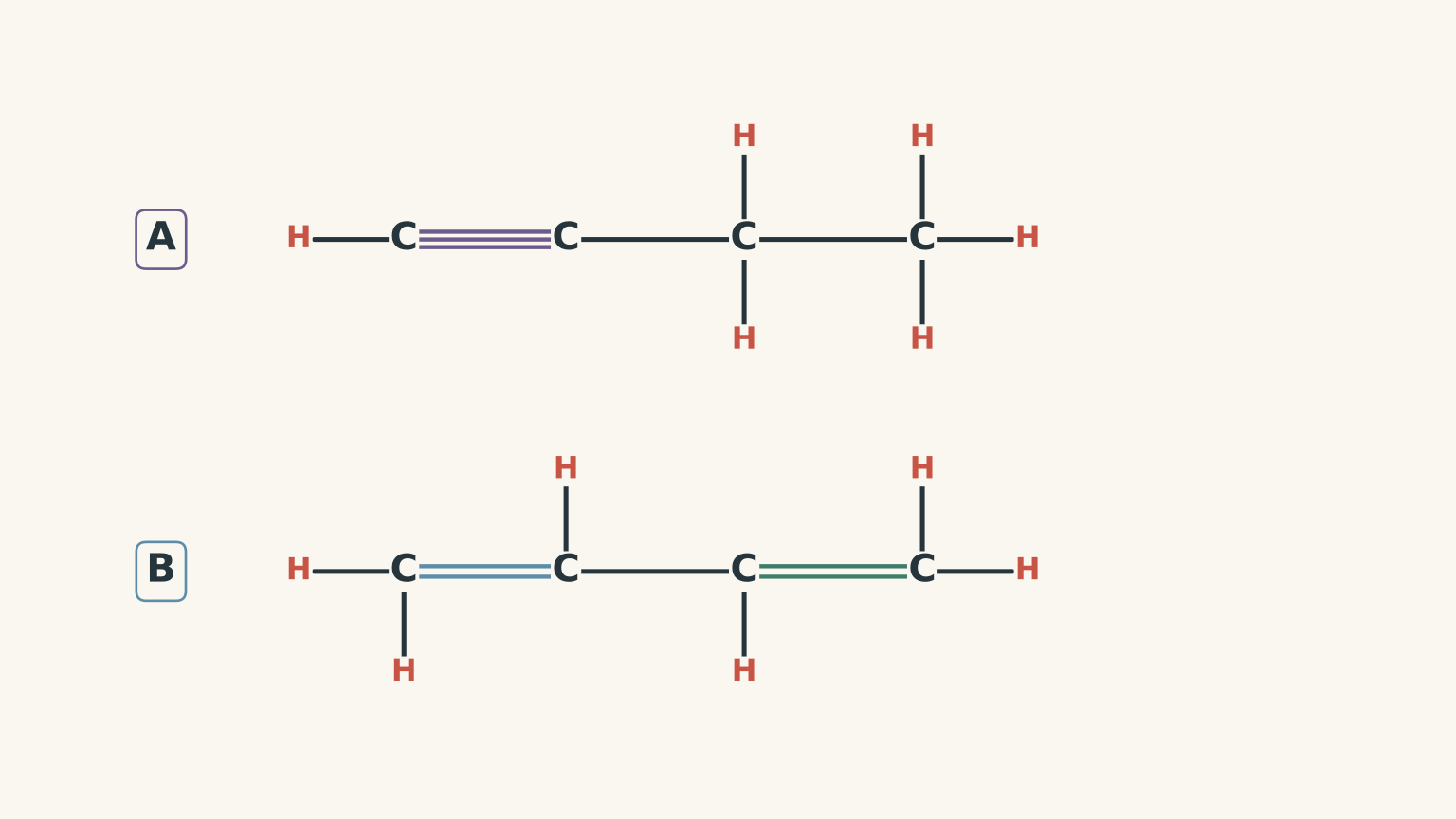
(c) Consider the following two compounds:
Compound A:
\[ \ce{HC\bond{#}CCH2CH3} \]
Compound B:
\[ \ce{CH2=CHCH=CH2} \]
Both compounds have the molecular formula \(\ce{C4H6}\).
Identify the type of carbon-carbon unsaturation in each compound and explain why they are functional-group isomers rather than position isomers. (3 marks)
Question 5 (9 marks)
Geometric isomerism occurs in certain alkenes because rotation around a carbon-carbon double bond is restricted.
(a) Draw the two geometric isomers of but-2-ene. Clearly label each structure as cis or trans. (4 marks)
(b) Explain why rotation around a carbon-carbon double bond is restricted. Then state the structural condition that must be satisfied by the groups attached to each carbon atom involved in the double bond for geometric isomerism to occur. (3 marks)
(c) Consider the following compound:
\[ \ce{CH3C(CH3)=CHCH3} \]
Does this compound exhibit geometric isomerism? Justify your answer using the groups attached to the carbon atoms in the double bond. (2 marks)
Question 6 (9 marks)
An organic compound has the molecular formula \(\ce{C6H12}\). It is an acyclic, unbranched hydrocarbon containing exactly one carbon-carbon double bond.
(a) Write the IUPAC names of all distinct position isomers that can exist on this unbranched six-carbon skeleton. (3 marks)
(b) Identify which of the position isomers from part (a) can exhibit geometric isomerism.
Justify your answer by considering the groups attached to each carbon atom involved in the double bond. (3 marks)
(c) Draw both geometric isomers of hex-3-ene. Clearly label each structure as cis or trans. (3 marks)
03Worked solutions and marking guide
Solution 1
(a) 2-methylpentane
The longest continuous carbon chain contains five carbon atoms. This gives the parent name pentane.
There is one methyl branch attached to the second carbon when the chain is numbered from the end closest to the branch.
Therefore, the correct name is 2-methylpentane.
Marking:
- 1 mark for identifying the five-carbon parent chain.
- 1 mark for correctly identifying the methyl branch and its position.
(b) 3-ethylhexane
The longest continuous carbon chain contains six carbon atoms, so the parent name is hexane.
The remaining two-carbon branch is an ethyl group. Numbering from the left gives the ethyl branch the lower possible locant, carbon 3.
Therefore, the correct name is 3-ethylhexane.
Marking:
- 1 mark for identifying the six-carbon parent chain.
- 1 mark for identifying the ethyl substituent at carbon 3.
(c) Pent-2-yne
The longest chain containing the triple bond has five carbon atoms.
Number the chain from the end closest to the triple bond. This places the triple bond between carbons 2 and 3.
The suffix for an alkyne is -yne.
Therefore, the correct name is pent-2-yne.
Marking:
- 1 mark for identifying the five-carbon parent chain.
- 1 mark for correctly identifying the triple-bond locant and using the -yne suffix.
(d) 4-methylhex-2-ene
The parent chain contains six carbon atoms. The double bond begins at carbon 2, and the methyl branch is attached to carbon 4.
The correct condensed structural formula is:
\[ \boxed{\ce{CH3CH=CHCH(CH3)CH2CH3}} \]
Check the structure:
- Six carbon atoms form the parent chain.
- The double bond is between carbons 2 and 3.
- The methyl branch is attached to carbon 4.
Marking:
- 1 mark for the correct six-carbon parent chain.
- 1 mark for placing the double bond between carbons 2 and 3.
- 1 mark for correctly including the methyl branch at carbon 4.
(e) Molecular formulae
Octane is an alkane. Acyclic alkanes follow the general formula:
\[ \ce{C_nH_{2n+2}} \]
For eight carbon atoms:
\[ \ce{C8H_{2(8)+2}}=\ce{C8H18} \]
Pent-1-yne is an acyclic alkyne containing one triple bond. Its general formula is:
\[ \ce{C_nH_{2n-2}} \]
For five carbon atoms:
\[ \ce{C5H_{2(5)-2}}=\ce{C5H8} \]
Final answers:
- Octane: \(\ce{C8H18}\)
- Pent-1-yne: \(\ce{C5H8}\)
Marking:
- 1 mark for each correct molecular formula.
Total: 11 marks.
Solution 2
(a) 2-bromo-4-chloropentane
First, identify the longest carbon chain. It contains five carbon atoms, so the parent name is pentane.
There are two substituents:
- A bromine atom.
- A chlorine atom.
Numbering from either end produces the locant set 2,4. When two numbering directions give the same set of locants, alphabetical order determines which substituent receives the lower number.
Bromo comes before chloro alphabetically.
Therefore:
\[ \boxed{\text{2-bromo-4-chloropentane}} \]
Marking:
- 1 mark for identifying pentane as the parent chain.
- 1 mark for correctly resolving the locant tie using alphabetical order.
- 1 mark for the complete correct IUPAC name.
(b) 3-chloro-3-methylpentane
The longest continuous carbon chain contains five carbon atoms.
Both substituents are attached to carbon 3:
- Chlorine.
- Methyl.
The substituents are written alphabetically, so chloro comes before methyl.
Therefore:
\[ \boxed{\text{3-chloro-3-methylpentane}} \]
Marking:
- 1 mark for correctly identifying the parent chain and substituent positions.
- 1 mark for the complete name with the correct alphabetical order.
(c) 1-bromo-2-chloro-3-methylbutane
The parent chain contains four carbon atoms.
Number it so that the substituents receive the lowest possible locants:
- Bromine at carbon 1.
- Chlorine at carbon 2.
- Methyl at carbon 3.
The correct condensed structural formula is:
\[ \boxed{\ce{BrCH2CH(Cl)CH(CH3)CH3}} \]
Marking:
- 1 mark for the correct four-carbon chain and placement of bromine and chlorine.
- 1 mark for the correctly positioned methyl branch and complete structure.
Total: 7 marks.
Solution 3
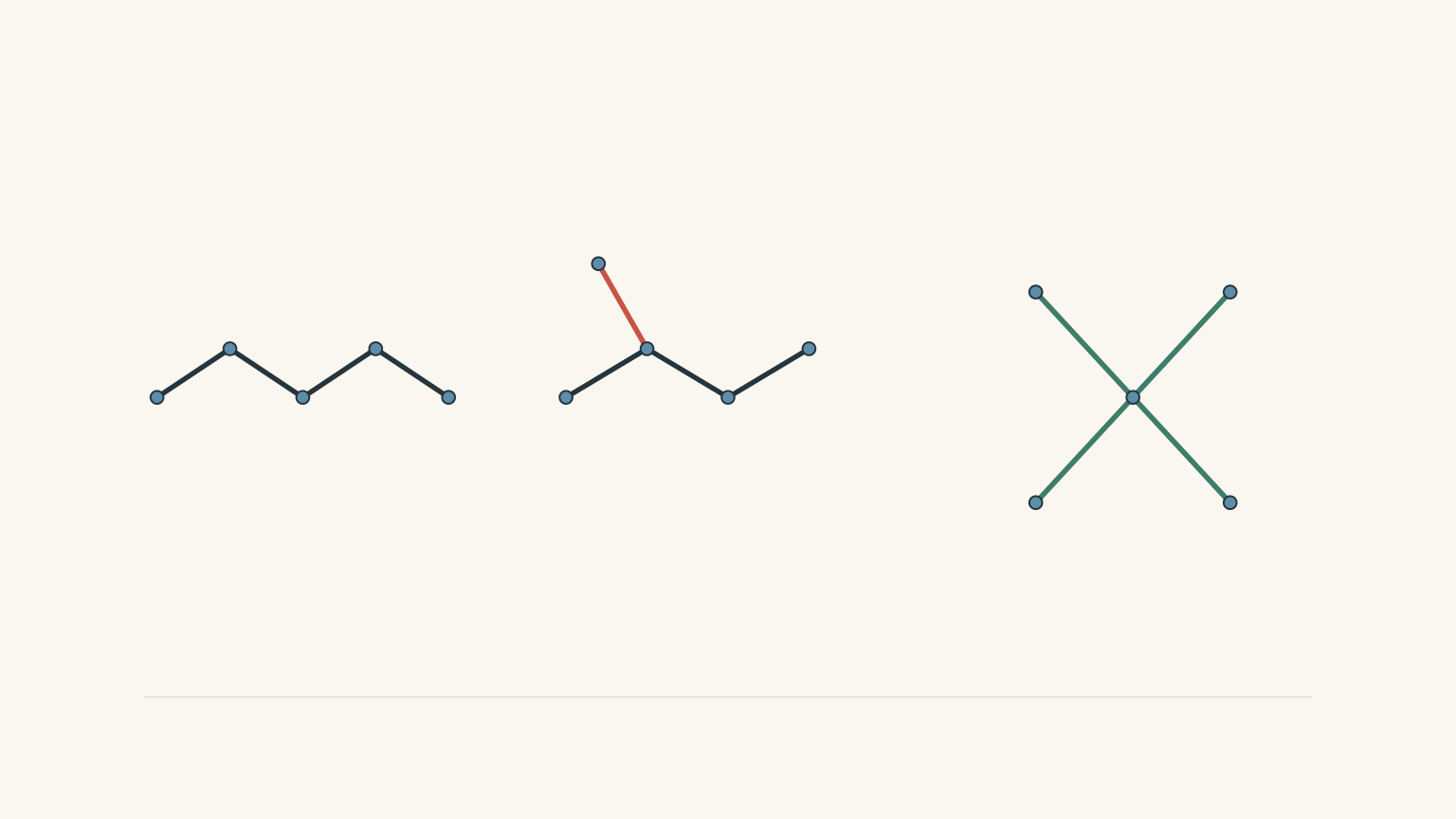
(a) Chain isomers of \(\ce{C5H12}\)
Chain isomers have the same molecular formula and functional group but different arrangements of their carbon skeletons.
Two valid examples are pentane and 2-methylbutane.
Pentane:
\[ \ce{CH3CH2CH2CH2CH3} \]
2-methylbutane:
\[ \ce{CH3CH(CH3)CH2CH3} \]
Both contain five carbon atoms and twelve hydrogen atoms. However, pentane has an unbranched carbon chain, while 2-methylbutane has a branched carbon chain.
A third valid isomer is 2,2-dimethylpropane:
\[ \ce{C(CH3)4} \]
Any two distinct, correctly named structures receive full marks.
Marking:
- 1 mark for the correct structure of the first isomer.
- 1 mark for its correct name.
- 1 mark for the correct structure of the second, different isomer.
- 1 mark for its correct name.
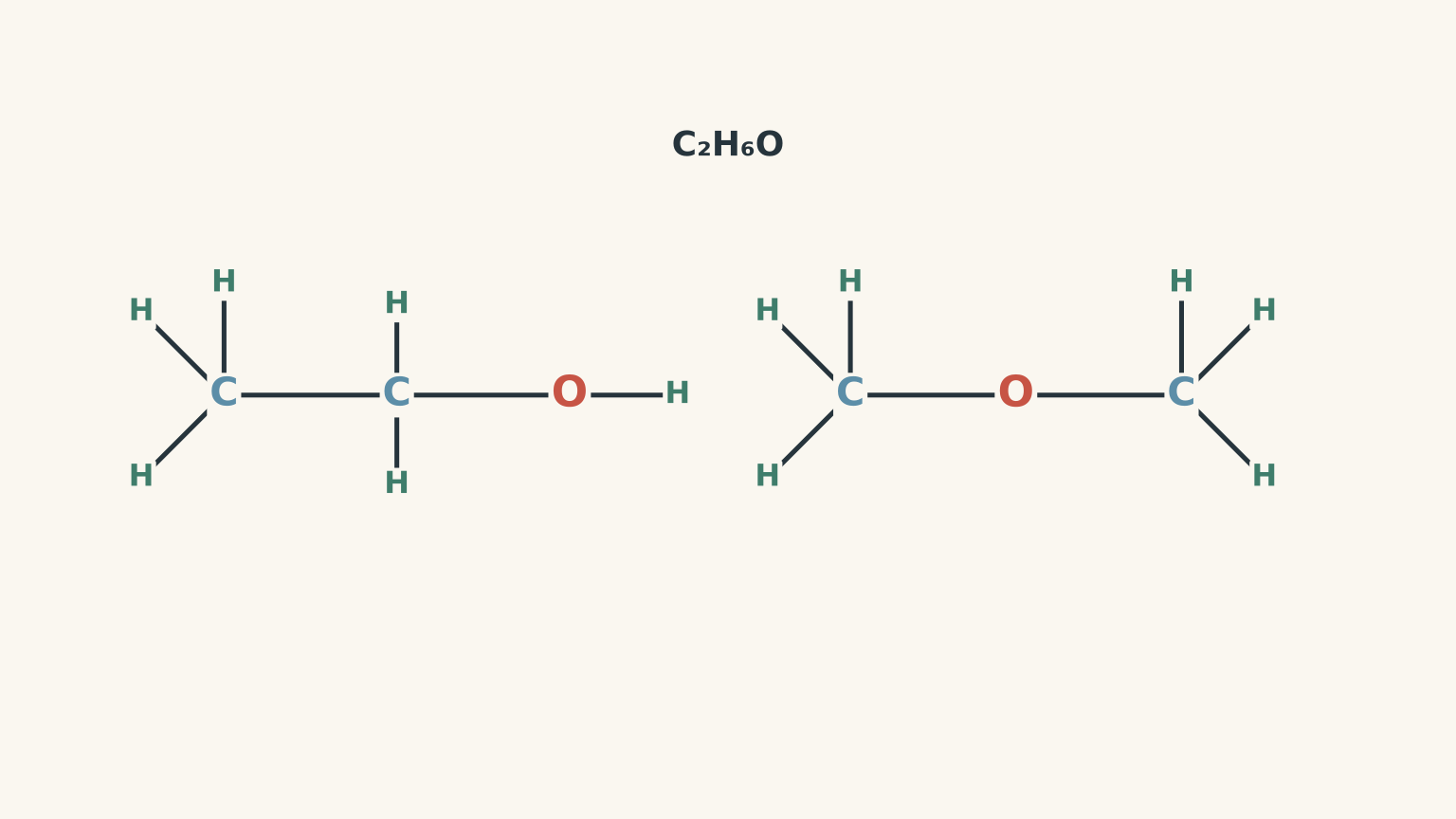
(b) Functional-group isomers of \(\ce{C2H6O}\)
Two valid functional-group isomers are ethanol and methoxymethane.
Ethanol:
\[ \ce{CH3CH2OH} \]
Methoxymethane:
\[ \ce{CH3OCH3} \]
Both compounds have the molecular formula \(\ce{C2H6O}\), but their oxygen-containing functional groups are different.
Ethanol contains an alcohol hydroxyl group, \(\ce{-OH}\).
Methoxymethane contains an ether linkage, \(\ce{-O-}\), between two carbon groups.
Marking:
- 1 mark for the correct ethanol structure.
- 1 mark for the correct name ethanol.
- 1 mark for the correct methoxymethane structure.
- 1 mark for the correct name methoxymethane.
(c) Why are these functional-group isomers?
Both compounds have the same molecular formula, \(\ce{C2H6O}\), but contain different functional groups.
Ethanol is an alcohol, while methoxymethane is an ether.
Chain isomers differ in their carbon skeletons while retaining the same functional group. The difference here is the functional group, not simply the arrangement of a carbon chain.
Marking:
- 1 mark for identifying the shared molecular formula.
- 1 mark for explaining the difference between the alcohol and ether functional groups.
Total: 10 marks.
Solution 4
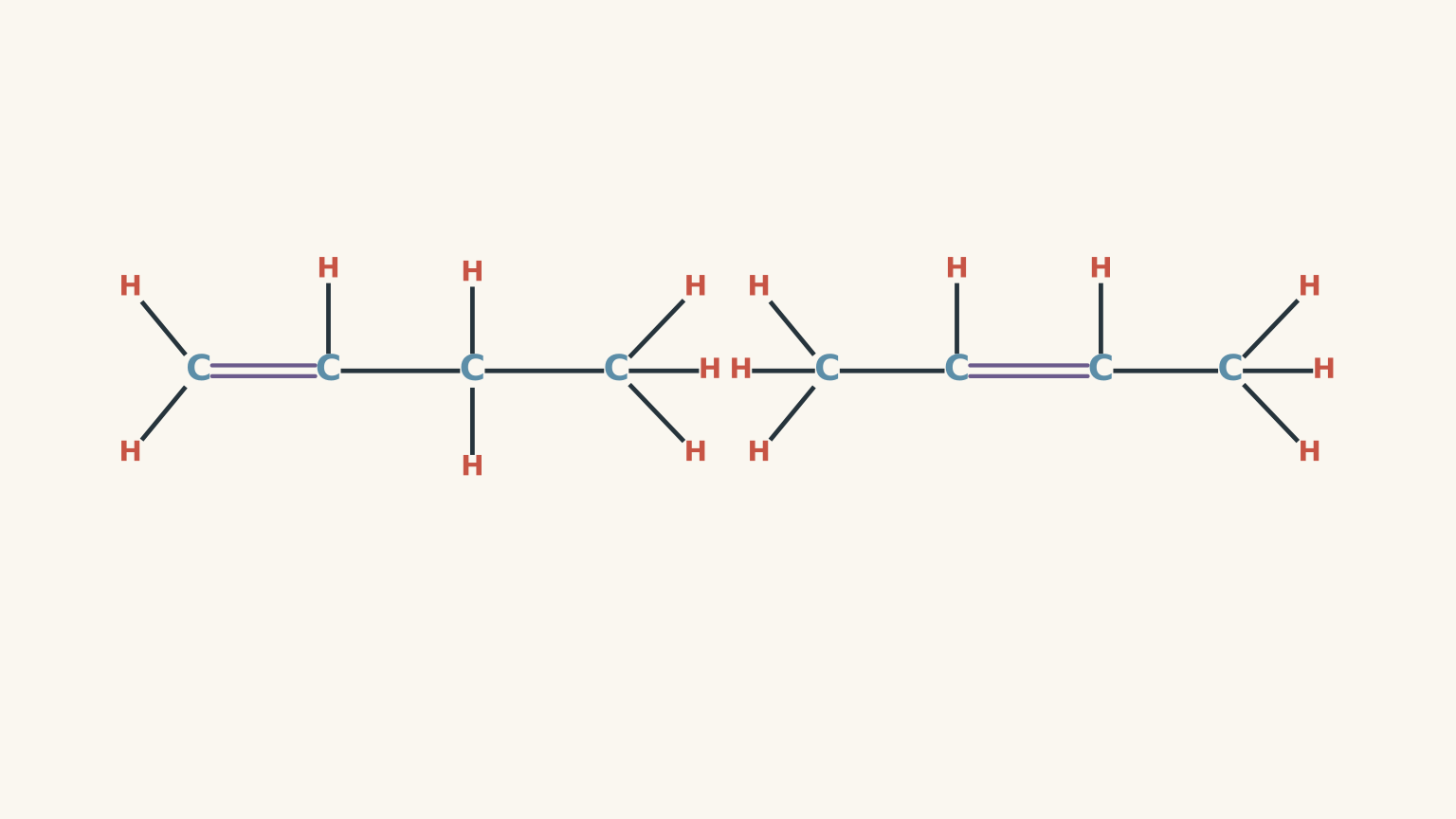
(a) Position isomers of \(\ce{C4H8}\)
Two position isomers are but-1-ene and but-2-ene.
But-1-ene:
\[ \ce{CH2=CHCH2CH3} \]
But-2-ene:
\[ \ce{CH3CH=CHCH3} \]
Both molecules have four carbon atoms and the same molecular formula, \(\ce{C4H8}\).
They also have the same unbranched carbon skeleton and the same functional group.
The only difference is the position of the carbon-carbon double bond.
Marking:
- 1 mark for the correct but-1-ene structure.
- 1 mark for the correct name.
- 1 mark for the correct but-2-ene structure.
- 1 mark for the correct name.
(b) Chain isomer of pent-1-ene
One valid answer is 3-methylbut-1-ene.
Its condensed structural formula is:
\[ \boxed{\ce{CH2=CHCH(CH3)CH3}} \]
This compound contains five carbon atoms and has the molecular formula \(\ce{C5H10}\).
It retains the terminal double bond but has a branched carbon skeleton rather than the unbranched skeleton of pent-1-ene.
Therefore, it is a chain isomer.
Another acceptable answer is 2-methylbut-1-ene:
\[ \ce{CH2=C(CH3)CH2CH3} \]
Marking:
- 1 mark for a valid five-carbon acyclic alkene structure.
- 1 mark for correctly showing the branched skeleton and terminal double bond.
- 1 mark for the correct IUPAC name.
(c) Functional-group isomers of \(\ce{C4H6}\)
Compound A:
\[ \ce{HC\bond{#}CCH2CH3} \]
Compound A contains a carbon-carbon triple bond. It belongs to the alkyne family.
Compound B:
\[ \ce{CH2=CHCH=CH2} \]
Compound B contains two carbon-carbon double bonds. It belongs to the diene family.
Both compounds have the same molecular formula, \(\ce{C4H6}\), but contain different types of carbon-carbon multiple bonds.
Therefore, they are functional-group isomers rather than position isomers.
In position isomerism, the same type of functional group is retained but its position changes. Here, the types of unsaturation are different.
Marking:
- 1 mark for identifying A as an alkyne.
- 1 mark for identifying B as a diene.
- 1 mark for explaining that they have the same molecular formula but different types of unsaturation.
Total: 10 marks.
Solution 5
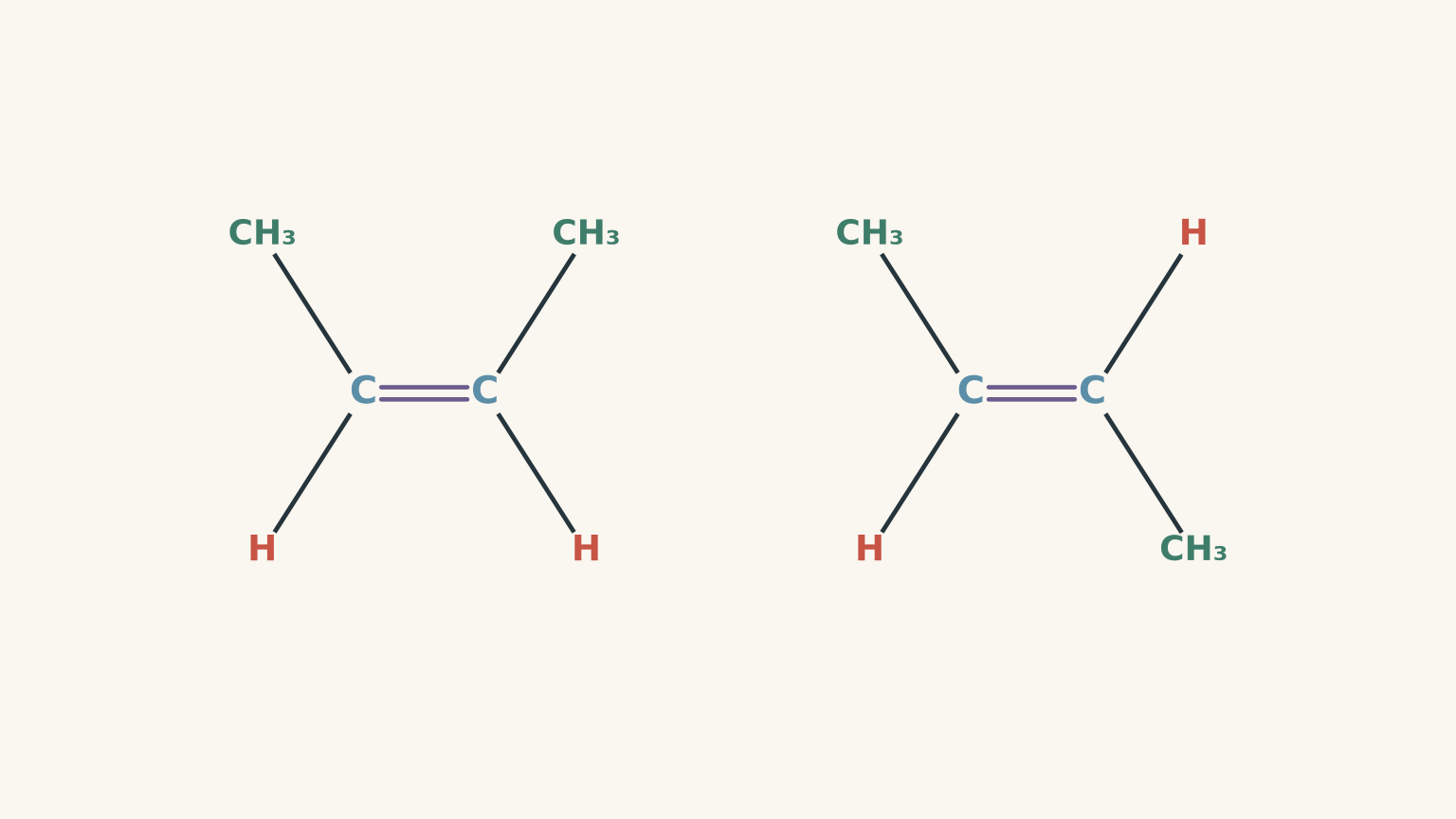
(a) Geometric isomers of but-2-ene
But-2-ene has the condensed structural formula:
\[ \ce{CH3CH=CHCH3} \]
Each carbon atom in the double bond is attached to a hydrogen atom and a methyl group.
This allows two different spatial arrangements.
In cis-but-2-ene, the two methyl groups are on the same side of the double bond.
In trans-but-2-ene, the two methyl groups are on opposite sides of the double bond.
Marking:
- 1 mark for the correct connectivity of cis-but-2-ene.
- 1 mark for its correct same-side arrangement and label.
- 1 mark for the correct connectivity of trans-but-2-ene.
- 1 mark for its correct opposite-side arrangement and label.
(b) Why does geometric isomerism occur?
A carbon-carbon double bond consists of one sigma bond and one pi bond.
The pi bond forms through sideways overlap of p orbitals on the two carbon atoms.
Rotation around the double bond would disrupt this sideways overlap. The pi bond would need to be broken before free rotation could occur.
As a result, the attached groups remain in fixed relative positions, allowing different geometric arrangements.
For geometric isomerism to occur, each carbon atom in the double bond must be attached to two different groups.
For but-2-ene:
- The first carbon is attached to H and \(\ce{CH3}\).
- The second carbon is also attached to H and \(\ce{CH3}\).
Both carbon atoms satisfy the condition.
Marking:
- 1 mark for identifying the pi bond as the source of restricted rotation.
- 1 mark for explaining that rotation disrupts the sideways orbital overlap.
- 1 mark for stating that each carbon in the double bond must have two different attached groups.
(c) Geometric isomerism of \(\ce{CH3C(CH3)=CHCH3}\)
This compound does not exhibit geometric isomerism.
Examine the groups attached to each carbon atom in the double bond.
The first carbon is attached to two methyl groups:
\[ \ce{CH3-C(CH3)=} \]
These groups are identical.
Therefore, this carbon does not satisfy the requirement that each carbon atom in the double bond must have two different groups attached.
The compound cannot form a pair of cis/trans geometric isomers.
Marking:
- 1 mark for correctly stating that geometric isomerism does not occur.
- 1 mark for identifying the two identical methyl groups attached to one double-bonded carbon.
Total: 9 marks.
Solution 6
(a) Position isomers of \(\ce{C6H12}\)
The compound must have:
- Six carbon atoms.
- An unbranched carbon skeleton.
- Exactly one carbon-carbon double bond.
The double bond can occupy three distinct positions.
The three possible position isomers are:
- Hex-1-ene:
\[ \ce{CH2=CHCH2CH2CH2CH3} \]
- Hex-2-ene:
\[ \ce{CH3CH=CHCH2CH2CH3} \]
- Hex-3-ene:
\[ \ce{CH3CH2CH=CHCH2CH3} \]
There are no additional distinct positions.
For example, placing the double bond at carbon 4 produces the same connectivity as hex-2-ene when the chain is numbered from the opposite end. Similarly, position 5 is equivalent to position 1.
Marking:
- 1 mark for hex-1-ene.
- 1 mark for hex-2-ene.
- 1 mark for hex-3-ene.
(b) Which compounds exhibit geometric isomerism?
Hex-2-ene and hex-3-ene can exhibit geometric isomerism.
Hex-1-ene cannot.
Consider each structure separately.
Hex-1-ene:
\[ \ce{CH2=CHCH2CH2CH2CH3} \]
The first carbon in the double bond is attached to two hydrogen atoms.
These groups are identical, so hex-1-ene does not satisfy the condition for geometric isomerism.
Hex-2-ene:
\[ \ce{CH3CH=CHCH2CH2CH3} \]
The first carbon in the double bond is attached to H and \(\ce{CH3}\).
The second carbon is attached to H and a propyl group.
Both carbons have two different groups attached. Therefore, hex-2-ene exhibits geometric isomerism.
Hex-3-ene:
\[ \ce{CH3CH2CH=CHCH2CH3} \]
Each carbon in the double bond is attached to H and an ethyl group.
Again, both carbons have two different groups attached. Therefore, hex-3-ene exhibits geometric isomerism.
Final answer:
- Hex-1-ene: no geometric isomerism.
- Hex-2-ene: geometric isomerism occurs.
- Hex-3-ene: geometric isomerism occurs.
Marking:
- 1 mark for correctly identifying hex-2-ene and hex-3-ene.
- 1 mark for explaining why hex-1-ene cannot exhibit geometric isomerism.
- 1 mark for explaining why hex-2-ene and hex-3-ene satisfy the structural condition.
(c) Geometric isomers of hex-3-ene
Hex-3-ene has the condensed structural formula:
\[ \ce{CH3CH2CH=CHCH2CH3} \]
Each carbon atom in the double bond is attached to:
- One hydrogen atom.
- One ethyl group.
This allows two geometric arrangements.
In cis-hex-3-ene, both ethyl groups are on the same side of the double bond.
In trans-hex-3-ene, the ethyl groups are on opposite sides of the double bond.
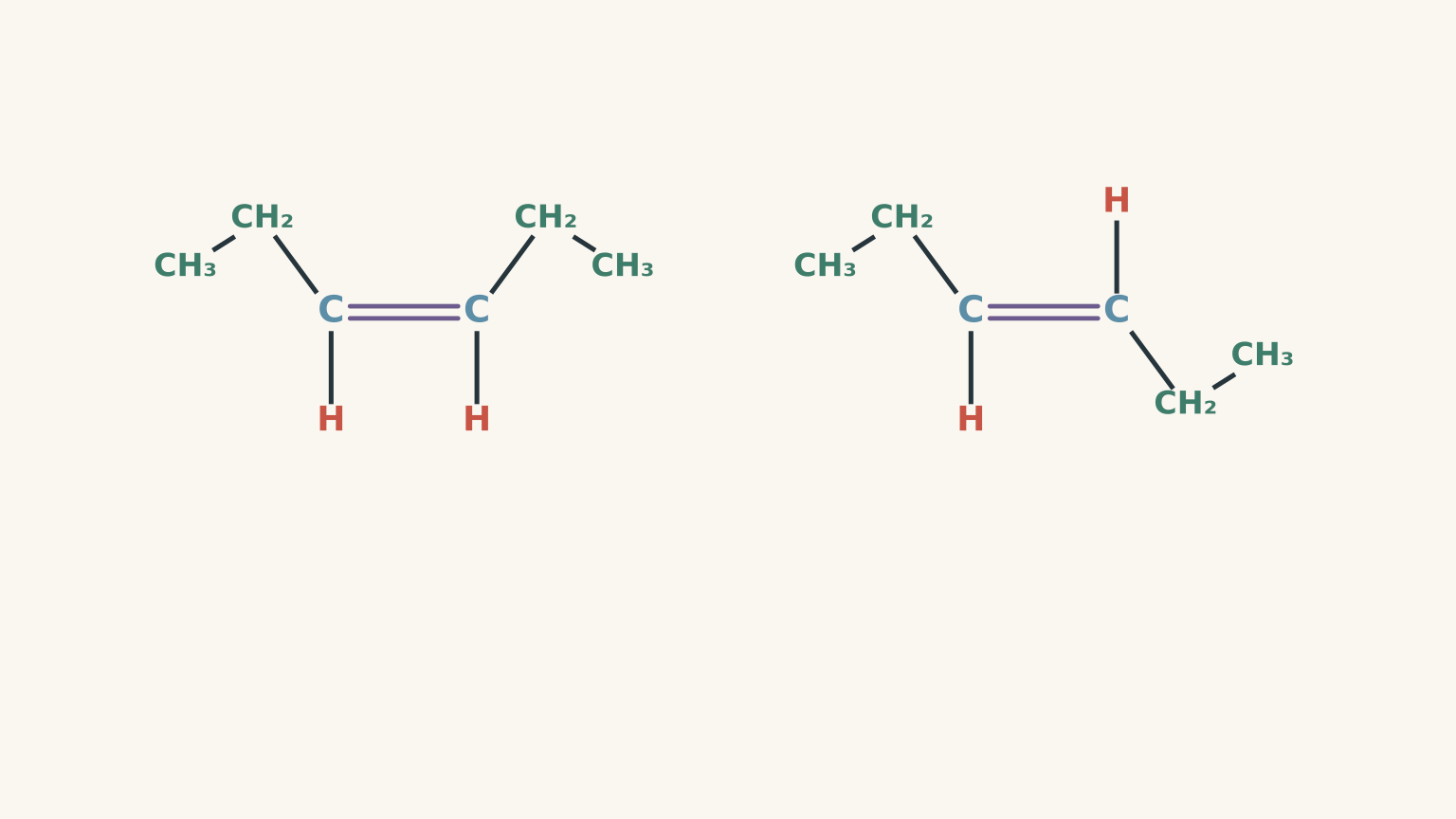
Marking:
- 1 mark for the correct six-carbon structure with the double bond between carbons 3 and 4.
- 1 mark for correctly showing the cis and trans spatial arrangements.
- 1 mark for correctly labelling both structures.
Total: 9 marks.
04Final mark summary
| Question | Assessed content | Marks |
|---|---|---|
| 1 | Hydrocarbon nomenclature and formulae | 11 |
| 2 | Haloalkane nomenclature | 7 |
| 3 | Chain and functional-group isomerism | 10 |
| 4 | Position, chain, and unsaturated functional-group isomerism | 10 |
| 5 | Geometric isomerism of alkenes | 9 |
| 6 | Position and geometric isomerism in an unbranched alkene series | 9 |
| Total | 56 |
Marking considerations
- Alternative valid structural isomers should receive credit when they satisfy the specified molecular formula and isomer classification.
- Equivalent, correctly formatted IUPAC names should be accepted.
- Where a student makes an earlier structural error but applies the correct naming method consistently afterwards, appropriate follow-through marks may be awarded.
- A correct molecular formula alone does not establish that a proposed structure is a valid isomer. Check carbon count, hydrogen count, bonding, and the specified isomer relationship.
- Geometric-isomer drawings must show the relative positions of the substituents clearly. Merely writing cis or trans beside an incorrect structure is insufficient.
A useful final check when reviewing your work is to distinguish the three main structural-isomer questions:
- Chain isomerism: Has the carbon skeleton changed?
- Position isomerism: Has the position of the same functional group or multiple bond changed?
- Functional-group isomerism: Has the type of functional group changed while the molecular formula remains the same?
For geometric isomerism, check the groups attached to both carbon atoms of the C=C bond before deciding whether cis/trans forms are possible.