
Selective Precipitation: Using Ksp to Separate Ions
Learn how Ksp, pH and free-ion concentrations affect selective precipitation, with worked lead and calcium examples beyond the core HSC Chemistry course.
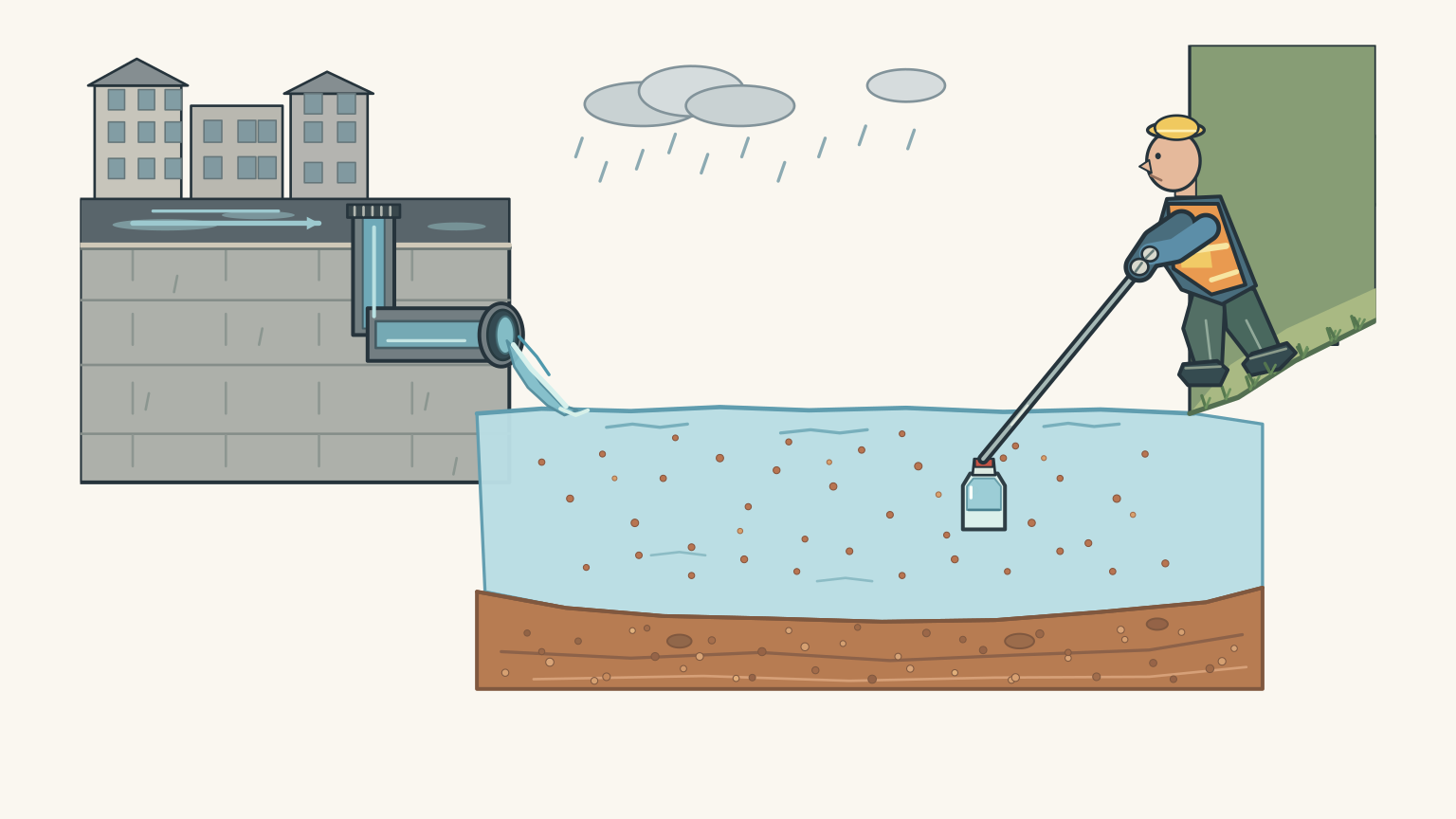
A water sample from a creek near an industrial site contains dissolved lead and phosphate. You add a phosphate-containing reagent, and a solid begins to form. Has the lead been removed? Possibly. But what if calcium forms a phosphate precipitate at the same time? Or what if most of the dissolved lead is tied up in complexes rather than existing as free Pb²⁺ ions?
The challenge is not simply finding an insoluble salt. It is choosing conditions under which one particular solid forms while competing ions remain dissolved. This is the central idea behind selective precipitation.
Scope: This article extends beyond the required 2025 NSW HSC Chemistry syllabus. Year 12 Equilibrium provides the prerequisite knowledge, particularly solubility equilibria and \(K_{sp}\), but selective precipitation and the detailed environmental applications discussed here are not HSC assessment requirements.
Due to technical limitations, this figure may display incorrectly or contain inaccuracies. Please check key details against your course materials.
01Start with the HSC equilibrium model
You already know that a sparingly soluble ionic compound establishes an equilibrium between its solid and dissolved ions.
For example, lead(II) phosphate dissolves according to:
\[ \ce{Pb3(PO4)2(s) <=> 3Pb^2+(aq) + 2PO4^3-(aq)} \]
Its solubility product expression is:
\[ K_{sp}=[\mathrm{Pb}^{2+}]^3 [\mathrm{PO_4}^{3-}]^2 \]
The solubility product, \(K_{sp}\), describes the equilibrium between a particular solid and its dissolved ions at a specified temperature.
However, when you’re investigating a solution that isn’t necessarily at equilibrium, you need another quantity: the ion product, \(Q\).
\[ Q=[\mathrm{Pb}^{2+}]^3 [\mathrm{PO_4}^{3-}]^2 \]
The comparison is straightforward:
| Comparison | What it means |
|---|---|
| \(Q<K_{sp}\) | The solution is unsaturated. Precipitation is not favoured. |
| \(Q=K_{sp}\) | The solution is saturated and at equilibrium with the solid. |
| \(Q>K_{sp}\) | The solution is supersaturated. Precipitation is thermodynamically favoured. |
This is the same principle used when predicting precipitation with \(K_{sp}\) for HSC Chemistry.
The important extension is that a solution may contain several different cations capable of forming insoluble compounds with the same reagent.
That means you need to calculate which compound reaches saturation first.
A smaller \(K_{sp}\) can indicate lower solubility, but it does not automatically tell you which compound precipitates first. The starting concentrations matter too.
02Why lead phosphate matters in environmental chemistry
Lead is a toxic heavy metal. In contaminated soils and sediments, its mobility depends partly on the chemical forms in which it exists.
One possible way of reducing dissolved lead is to introduce phosphate, encouraging the formation of poorly soluble lead phosphate minerals.
The equilibrium involving lead(II) phosphate is:
\[ \ce{Pb3(PO4)2(s) <=> 3Pb^2+ + 2PO4^3-} \]
A critical evaluation by the International Union of Pure and Applied Chemistry (IUPAC) gives a provisional solubility product at 25°C of:
\[ \log_{10}K_{sp}=-44.4\pm1.0 \]
For the calculations in this article, we will use the rounded value:
\[ K_{sp}\approx4.0\times10^{-45} \]
This is exceptionally small, indicating that lead(II) phosphate is sparingly soluble.
The IUPAC value is provisional, and it applies to the particular lead phosphate solid represented by the equation. Different lead phosphate minerals have different solubility constants.
There is an important environmental distinction here.
Lead can also form minerals called pyromorphites, with the general formula:
\[ \ce{Pb5(PO4)3X} \]
Here, \(X\) represents an anion such as chloride, fluoride, bromide, or hydroxide.
Pyromorphites are among the least soluble lead(II) minerals found in aerobic soils. Their formation is one reason phosphate-based treatments have been investigated for immobilising lead contamination.
A peer-reviewed review published by researchers at Macquarie University examines this application, including the formation, stability, and environmental limitations of phosphate-based metal immobilisation.
However, an important qualification is necessary: a thermodynamically favourable reaction does not guarantee that a particular mineral forms immediately or completely. Crystal formation can be slow, and other solid phases may compete.
The IUPAC review also discusses experimental observations where dissolved lead concentrations were higher than predicted from pyromorphite solubility alone. Incomplete crystallisation, non-equilibrium conditions, and more soluble lead-containing phases can explain some of this difference.
Sources: IUPAC Technical Report (2009) and Hafsteinsdóttir et al. (2015), Applied Geochemistry.
03The free phosphate concentration depends on pH
Before calculating whether lead phosphate precipitates, we need to address a complication.
In an aqueous environmental sample, phosphate does not exist exclusively as \(\mathrm{PO_{4}}^{3-}\).
It undergoes successive acid dissociation reactions:
\[ \ce{H3PO4 <=> H+ + H2PO4-} \]
\[ \ce{H2PO4- <=> H+ + HPO4^2-} \]
\[ \ce{HPO4^2- <=> H+ + PO4^3-} \]
Each reaction has an acid dissociation constant, \(K_a\). The corresponding \(pK_a\) is defined as:
\[ pK_a=-\log_{10}K_a \]
At approximately 25°C, the three values are:
| Dissociation | \(pK_a\) |
|---|---|
| First | 2.16 |
| Second | 7.21 |
| Third | 12.32 |
These values are reported in a US Environmental Protection Agency assessment of inorganic phosphate salts.
The relative amounts of each phosphate species depend on pH.
At pH 7.21, the concentrations of \(\ce{H2PO4-}\) and \(\mathrm{HPO_{4}}^{2-}\) are approximately equal.
At pH 8, \(\mathrm{HPO_{4}}^{2-}\) is the predominant species.
At pH 8, the ratio between hydrogen phosphate and phosphate ions is:
\[ \frac{[\mathrm{PO_4^{3-}}]} {[\mathrm{HPO_4^{2-}}]} =10^{8.00-12.32} \]
\[ =4.8\times10^{-5} \]
So there is approximately one free phosphate ion for every 21,000 hydrogen phosphate ions.
This is a surprisingly small proportion.
Why does this matter?
Because the \(K_{sp}\) expression for lead phosphate contains the concentration of free \(\mathrm{PO_{4}}^{3-}\), not the total concentration of dissolved phosphate.
Define total dissolved orthophosphate, \(P_T\), as the sum of the four dissolved acid-base forms:
\[ P_T= [\mathrm{H_3PO_4}] +[\mathrm{H_2PO_4^-}] +[\mathrm{HPO_4^{2-}}] +[\mathrm{PO_4^{3-}}] \]
These are not interchangeable quantities.
If you substitute \(P_T\) directly into the lead phosphate \(K_{sp}\) expression, you can substantially overestimate the likelihood of precipitation.
Worked example: Will lead phosphate precipitate?
A water sample has a free lead ion concentration of \(1.0\times10^{-6}\ \mathrm{mol\,L^{-1}}\) and a free phosphate ion concentration of \(2.0\times10^{-13}\ \mathrm{mol\,L^{-1}}\).
Determine whether lead(II) phosphate is expected to precipitate at 25°C.
Use \(K_{sp}=4.0\times10^{-45}\).
Step 1
\[ Q=[\mathrm{Pb}^{2+}]^3 [\mathrm{PO_4}^{3-}]^2 \]
Step 2
\[ Q=(1.0\times10^{-6})^3 (2.0\times10^{-13})^2 \]
\[ Q=1.0\times10^{-18} \times4.0\times10^{-26} \]
\[ Q=4.0\times10^{-44} \]
Step 3
\[ 4.0\times10^{-44} > 4.0\times10^{-45} \]
Therefore:
\[ Q>K_{sp} \]
Lead(II) phosphate precipitation is thermodynamically favoured.
Notice that the free phosphate concentration is extremely small. Nevertheless, it is sufficient to make the solution supersaturated because lead phosphate has such a small solubility product.
This is why using the correct free-ion concentrations matters.
Worked example: How does pH affect lead phosphate precipitation?
A filtered water sample contains:
- Total dissolved orthophosphate: \(1.0\times10^{-5}\ \mathrm{mol\,L^{-1}}\)
- Free lead ions: \(1.0\times10^{-8}\ \mathrm{mol\,L^{-1}}\)
- Temperature: 25°C
The pH is 8.00.
Determine whether lead phosphate precipitation is thermodynamically favoured.
Step 1
Using the second acid dissociation constant:
\[ \frac{[\mathrm{HPO_4^{2-}}]} {[\mathrm{H_2PO_4^-}]} =10^{8.00-7.21} \]
\[ =6.2 \]
Using the third acid dissociation constant:
\[ \frac{[\mathrm{PO_4^{3-}}]} {[\mathrm{HPO_4^{2-}}]} =10^{8.00-12.32} \]
\[ =4.8\times10^{-5} \]
Step 2
Taking the amount of \(\ce{H2PO4-}\) as 1 relative unit gives:
- \(\ce{H2PO4-}\): 1
- \(\mathrm{HPO_{4}}^{2-}\): 6.2
- \(\mathrm{PO_{4}}^{3-}\): \(6.2\times4.8\times10^{-5}\)
Therefore, the fraction present as phosphate ions is approximately:
\[ f_{\mathrm{PO_4}} = \frac{6.2(4.8\times10^{-5})} {1+6.2+6.2(4.8\times10^{-5})} \]
\[ f_{\mathrm{PO_4}}\approx4.1\times10^{-5} \]
Step 3
\[ [\mathrm{PO_4^{3-}}] =P_Tf_{\mathrm{PO_4}} \]
\[ =(1.0\times10^{-5})(4.1\times10^{-5}) \]
\[ =4.1\times10^{-10}\ \mathrm{mol\,L^{-1}} \]
Step 4
\[ Q=(1.0\times10^{-8})^3 (4.1\times10^{-10})^2 \]
\[ Q=1.7\times10^{-43} \]
Step 5
\[ 1.7\times10^{-43} > 4.0\times10^{-45} \]
Therefore, lead phosphate precipitation is thermodynamically favoured.
The key result is that a total orthophosphate concentration of \(1.0\times10^{-5}\ \mathrm{mol\,L^{-1}}\) produces a free \(\mathrm{PO_{4}}^{3-}\) concentration of only \(4.1\times10^{-10}\ \mathrm{mol\,L^{-1}}\) at this pH.
The distinction between total phosphate and free phosphate is essential to the prediction.
04Selective precipitation: Which solid forms first?
Now consider a water sample containing two dissolved metal ions:
- Lead, \(\mathrm{Pb}^{2+}\)
- Calcium, \(\mathrm{Ca}^{2+}\)
Both can form sparingly soluble phosphates.
For calcium phosphate, consider the simplified equilibrium:
\[ \ce{Ca3(PO4)2(s) <=> 3Ca^2+ + 2PO4^3-} \]
For this comparison, use:
\[ K_{sp,\mathrm{Ca}}=2.07\times10^{-33} \]
at 25°C, following the teaching value used by the University of California Davis chemistry material.
Different calcium phosphate mineral phases have different solubility constants, so this is a simplified model rather than a universal value for environmental water.
We now have two competing precipitation reactions.
Which one happens first?
The answer depends on the free-ion concentrations.
For either metal phosphate, the general expression is:
\[ K_{sp}=[\mathrm{M}^{2+}]^3 [\mathrm{PO_4^{3-}}]^2 \]
Here, \(\mathrm{M}^{2+}\) represents the relevant metal ion.
We can rearrange this expression to calculate the critical phosphate concentration at which precipitation begins:
\[ [\mathrm{PO_4^{3-}}]_{\mathrm{crit}} = \sqrt{\frac{K_{sp}}{[\mathrm{M}^{2+}]^3}} \]
This is the key equation for designing a selective precipitation.
Calculate the critical phosphate concentration for each metal.
The metal with the lower threshold begins precipitating first.
Worked example: Can phosphate selectively separate lead from calcium?
A water sample contains:
\[ [\mathrm{Pb}^{2+}]=2.0\times10^{-6}\ \mathrm{M} \]
\[ [\mathrm{Ca}^{2+}]=1.0\times10^{-3}\ \mathrm{M} \]
Assume negligible initial free phosphate.
Determine which metal phosphate precipitates first as phosphate is introduced. Then determine how much lead can be removed before calcium phosphate begins precipitating.
Step 1
\[ [\mathrm{PO_4^{3-}}]_{\mathrm{crit,Pb}} = \sqrt{ \frac{4.0\times10^{-45}} {(2.0\times10^{-6})^3} } \]
\[ = \sqrt{5.0\times10^{-28}} \]
\[ =2.2\times10^{-14}\ \mathrm{M} \]
Step 2
\[ [\mathrm{PO_4^{3-}}]_{\mathrm{crit,Ca}} = \sqrt{ \frac{2.07\times10^{-33}} {(1.0\times10^{-3})^3} } \]
\[ =\sqrt{2.07\times10^{-24}} \]
\[ =1.4\times10^{-12}\ \mathrm{M} \]
Step 3
Lead phosphate begins precipitating at:
\[ 2.2\times10^{-14}\ \mathrm{M} \]
Calcium phosphate begins precipitating at:
\[ 1.4\times10^{-12}\ \mathrm{M} \]
Lead phosphate therefore begins forming first.
There is an interval in which lead phosphate is supersaturated while calcium phosphate remains unsaturated.
This is a selective precipitation window.
Step 4
This is where the model becomes more interesting.
As lead phosphate forms, the free lead concentration decreases. The system must satisfy the lead phosphate equilibrium:
\[ K_{sp,\mathrm{Pb}} = [\mathrm{Pb}^{2+}]^3 [\mathrm{PO_4^{3-}}]^2 \]
At the point where calcium phosphate is just reaching saturation:
\[ [\mathrm{PO_4^{3-}}] =1.4\times10^{-12}\ \mathrm{M} \]
Substitute this value into the lead phosphate expression:
\[ [\mathrm{Pb}^{2+}]^3 = \frac{4.0\times10^{-45}} {(1.4\times10^{-12})^2} \]
Taking the cube root gives:
\[ [\mathrm{Pb}^{2+}] \approx1.2\times10^{-7}\ \mathrm{M} \]
Therefore, approximately 94% of the initial dissolved lead has been removed when calcium phosphate first reaches saturation.
The separation is useful, but it is not complete.
This is the crucial distinction: a selective precipitation window does not necessarily allow complete removal of the target ion.
As the target concentration falls, more precipitating reagent may be required to continue precipitation. Eventually, another compound may also reach saturation.
05Designing a conceptual environmental separation
We can now use these principles to design a conceptual monitoring sequence for a sample containing lead and phosphate.
The first decision is to define exactly what you want to measure.
Environmental samples can contain lead dissolved in water, lead associated with suspended particles, and lead incorporated into sediment minerals.
These are not necessarily measured in the same way.
The NSW Environment Protection Authority distinguishes dissolved lead from acid-extractable lead. It also distinguishes dissolved reactive phosphate from total phosphorus.
A useful conceptual sequence is:
1. Define the sample fraction.
Decide whether the investigation concerns dissolved lead, total or acid-extractable lead, dissolved reactive phosphate, or total phosphorus.
For dissolved measurements, sample preparation must separate the dissolved fraction from suspended material.
2. Establish the chemical conditions.
Record pH and temperature. Identify potentially important competing ions, particularly calcium, magnesium, chloride, and carbonate.
These species can influence which solids form and how much free lead remains in solution.
3. Calculate the relevant free-ion concentrations.
Use acid-base equilibria to determine the free phosphate concentration.
Use complex-ion equilibria to estimate the free lead concentration.
For example, lead can form dissolved complexes with carbonate and chloride:
\[ \ce{Pb^2+ + CO3^2- <=> PbCO3(aq)} \]
\[ \ce{Pb^2+ + Cl- <=> PbCl+(aq)} \]
The free \(\mathrm{Pb}^{2+}\) concentration can therefore be substantially different from the total dissolved lead concentration.
This is where complex-ion equilibria becomes relevant.
4. Compare the saturation conditions.
Calculate the ion products for lead phosphate and relevant competing solids.
A useful selective precipitation requires conditions where:
\[ Q_{\mathrm{Pb}}>K_{sp,\mathrm{Pb}} \]
while:
\[ Q_{\mathrm{competing}}<K_{sp,\mathrm{competing}} \]
If no suitable interval exists, phosphate cannot provide the required selective separation under those conditions.
5. Separate and identify the solid.
If a suitable precipitation window exists, the lead-containing solid can be separated from the remaining solution.
Its composition must then be confirmed. The appearance of a precipitate alone does not prove that it contains lead.
6. Measure phosphate independently.
Do not assume that the phosphate concentration in the treated solution is the original phosphate concentration.
The precipitation reaction has consumed some phosphate.
A separate, untreated aliquot is therefore useful for determining the original dissolved reactive phosphate concentration.
This sequence is conceptual, not a validated field-testing protocol.
For quantitative environmental monitoring, NSW EPA-approved analytical methods include established methods for filterable reactive phosphate, such as APHA 4500-P and USEPA 365.2, and methods for dissolved metals, including lead.
These methods provide analytical measurements rather than relying on the visual appearance of a precipitate.
See the NSW EPA’s Approved methods for the sampling and analysis of water pollutants in NSW.
06Can phosphate itself be collected as a precipitate?
So far, we have mainly used phosphate to precipitate lead.
But what if phosphate is the substance we want to collect?
One possible solid is magnesium ammonium phosphate hexahydrate, commonly called struvite.
Its formation can be represented as:
\[ \ce{MgNH4PO4.6H2O(s) <=> Mg^2+ + NH4+ + PO4^3- + 6H2O} \]
Its solubility product is:
\[ K_{sp} = [\mathrm{Mg}^{2+}] [\mathrm{NH_4^+}] [\mathrm{PO_4^{3-}}] \]
A peer-reviewed study by Bhuiyan, Mavinic, and Beckie (2007) reported a thermodynamic \(pK_{sp}\) of approximately 13.36 at 25°C.
Here:
\[ pK_{sp}=-\log_{10}K_{sp} \]
Therefore:
\[ K_{sp}\approx4.4\times10^{-14} \]
The same free-ion principle applies.
You cannot substitute total phosphate or total ammonia directly into the expression.
There are two additional complications.
First, increasing pH increases the proportion of phosphate present as \(\mathrm{PO_{4}}^{3-}\).
Second, increasing pH also shifts ammonium towards ammonia:
\[ \ce{NH4+ <=> NH3 + H+} \]
The \(pK_a\) of ammonium is approximately 9.25.
Therefore, increasing pH has competing effects: it increases the free phosphate fraction but decreases the proportion of total ammonia present as \(\ce{NH4+}\).
There is no simple rule that higher pH always produces more struvite.
There are also competing precipitation reactions. Calcium can form calcium phosphate solids, while any remaining free lead can form lead phosphate.
Consequently, struvite precipitation is most useful in a controlled system where competing ions have been accounted for and lead has already been removed or sufficiently suppressed.
It is an established approach to phosphate recovery in wastewater treatment, but it is not a stand-alone test for phosphate in an untreated environmental sample.
07Why a very small Ksp is not enough
A common shortcut is to choose whichever reagent produces a salt with the smallest \(K_{sp}\).
That is not a reliable separation strategy.
Consider lead sulfate:
\[ \ce{PbSO4(s) <=> Pb^2+ + SO4^2-} \]
Its \(K_{sp}\) at 25°C is approximately:
\[ K_{sp}=1.6\times10^{-8} \]
Suppose the free lead concentration in an environmental sample is:
\[ [\mathrm{Pb}^{2+}]=1.0\times10^{-8}\ \mathrm{M} \]
The sulfate concentration required to reach saturation would be:
\[ [\mathrm{SO_4^{2-}}] = \frac{1.6\times10^{-8}} {1.0\times10^{-8}} \]
\[ =1.6\ \mathrm{M} \]
That is an extremely high sulfate concentration for an environmental water sample.
The IUPAC review concludes that the limited solubility of lead sulfate is unlikely to control lead speciation under normal environmental conditions.
So although lead sulfate is sparingly soluble, it is not automatically a useful way to remove trace concentrations of dissolved lead.
The choice of precipitating reagent must account for:
- The solubility product of the proposed solid.
- The initial free-ion concentrations.
- The stoichiometry of the precipitation reaction.
- Competing ions and possible precipitates.
- pH-dependent speciation.
- Complex formation and non-ideal solution behaviour.
There is another important limitation.
Strictly, thermodynamic solubility products are expressed using ion activities rather than raw concentrations. Activity represents the effective concentration of an ion, accounting for interactions with other dissolved species.
In sufficiently dilute solutions, activity can often be approximated by concentration. In more concentrated or saline environmental samples, this approximation becomes less reliable.
This is why detailed environmental models use activity coefficients and complex-ion equilibria rather than relying on concentration-based \(K_{sp}\) calculations alone.
08Questions and solutions
Question 1
A filtered water sample contains:
\[ [\mathrm{Pb}^{2+}]=2.0\times10^{-6}\ \mathrm{M} \]
\[ [\mathrm{PO_4^{3-}}]=1.0\times10^{-13}\ \mathrm{M} \]
At 25°C, determine whether lead(II) phosphate is expected to precipitate.
Use:
\[ K_{sp}=4.0\times10^{-45} \]
Solution 1
Yes, lead(II) phosphate precipitation is thermodynamically favoured. The ion product exceeds the solubility product.
Step 1: Write the ion product expression.
\[ Q=[\mathrm{Pb}^{2+}]^3 [\mathrm{PO_4^{3-}}]^2 \]
Step 2: Substitute the concentrations.
\[ Q=(2.0\times10^{-6})^3 (1.0\times10^{-13})^2 \]
\[ Q=8.0\times10^{-18} \times1.0\times10^{-26} \]
\[ Q=8.0\times10^{-44} \]
Step 3: Compare with \(K_{sp}\).
\[ 8.0\times10^{-44} > 4.0\times10^{-45} \]
Therefore:
\[ Q>K_{sp} \]
The solution is supersaturated with respect to lead phosphate, so precipitation is thermodynamically favoured.
Remember that this predicts whether precipitation is favourable, not how quickly a visible solid will appear.
Question 2
A water sample contains:
- Total dissolved orthophosphate: \(1.0\times10^{-5}\ \mathrm{M}\)
- Free \(\mathrm{Pb}^{2+}\): \(1.0\times10^{-8}\ \mathrm{M}\)
Assume that the free lead concentration remains constant as pH changes.
Determine whether lead phosphate precipitation is favoured at:
(a) pH 7.00
(b) pH 8.00
Use:
\[ pK_{a2}=7.21 \]
\[ pK_{a3}=12.32 \]
\[ K_{sp}=4.0\times10^{-45} \]
Assume ideal dilute behaviour.
Solution 2
Precipitation is not favoured at pH 7.00, but it is favoured at pH 8.00. The increase in pH increases the free \(\mathrm{PO_{4}}^{3-}\) concentration sufficiently to make the solution supersaturated.
Step 1: Calculate the phosphate ratios at pH 7.00.
\[ \frac{[\mathrm{HPO_4^{2-}}]} {[\mathrm{H_2PO_4^-}]} =10^{7.00-7.21} \]
\[ =0.617 \]
Also:
\[ \frac{[\mathrm{PO_4^{3-}}]} {[\mathrm{HPO_4^{2-}}]} =10^{7.00-12.32} \]
\[ =4.79\times10^{-6} \]
Step 2: Calculate the fraction of total phosphate present as \(\mathrm{PO_{4}}^{3-}\).
\[ f_{\mathrm{PO_4}} = \frac{0.617(4.79\times10^{-6})} {1+0.617+0.617(4.79\times10^{-6})} \]
\[ f_{\mathrm{PO_4}} \approx1.8\times10^{-6} \]
Therefore:
\[ [\mathrm{PO_4^{3-}}] = (1.0\times10^{-5})(1.8\times10^{-6}) \]
\[ =1.8\times10^{-11}\ \mathrm{M} \]
Step 3: Calculate \(Q\) at pH 7.00.
\[ Q=(1.0\times10^{-8})^3 (1.8\times10^{-11})^2 \]
\[ Q\approx3.3\times10^{-46} \]
Since:
\[ 3.3\times10^{-46} < 4.0\times10^{-45} \]
the solution is unsaturated.
No precipitation is thermodynamically predicted.
Step 4: Repeat the calculation at pH 8.00.
At this pH, the phosphate fraction is approximately:
\[ f_{\mathrm{PO_4}}=4.1\times10^{-5} \]
Therefore:
\[ [\mathrm{PO_4^{3-}}] = (1.0\times10^{-5})(4.1\times10^{-5}) \]
\[ =4.1\times10^{-10}\ \mathrm{M} \]
Step 5: Calculate the new ion product.
\[ Q=(1.0\times10^{-8})^3 (4.1\times10^{-10})^2 \]
\[ Q\approx1.7\times10^{-43} \]
Since:
\[ 1.7\times10^{-43} > 4.0\times10^{-45} \]
precipitation is thermodynamically favoured.
The free phosphate concentration has increased by approximately 23 times, causing the ion product to increase by approximately 510 times.
The \(K_{sp}\) has not changed. The phosphate speciation has changed.
Question 3
A water sample contains the following free-ion concentrations:
\[ [\mathrm{Pb}^{2+}]=5.0\times10^{-9}\ \mathrm{M} \]
\[ [\mathrm{Ca}^{2+}]=1.0\times10^{-3}\ \mathrm{M} \]
Assume negligible initial free phosphate.
A student proposes gradually adding phosphate to precipitate lead while leaving calcium dissolved.
Using the following values:
\[ K_{sp,\mathrm{Pb}}=4.0\times10^{-45} \]
\[ K_{sp,\mathrm{Ca}}=2.07\times10^{-33} \]
Determine:
(a) The critical free phosphate concentration for each precipitation reaction.
(b) Which solid forms first.
(c) Whether phosphate can selectively precipitate lead from this sample.
Assume the simplified solid phases and ideal dilute behaviour.
Solution 3
Calcium phosphate precipitates first, so phosphate cannot selectively remove lead from this particular sample under the stated conditions. Despite the much smaller \(K_{sp}\) of lead phosphate, the calcium concentration is sufficiently high to change the precipitation order.
Step 1: Calculate the critical phosphate concentration for lead.
\[ [\mathrm{PO_4^{3-}}]_{\mathrm{crit,Pb}} = \sqrt{ \frac{4.0\times10^{-45}} {(5.0\times10^{-9})^3} } \]
\[ = \sqrt{ \frac{4.0\times10^{-45}} {1.25\times10^{-25}} } \]
\[ =1.8\times10^{-10}\ \mathrm{M} \]
Step 2: Calculate the critical phosphate concentration for calcium.
\[ [\mathrm{PO_4^{3-}}]_{\mathrm{crit,Ca}} = \sqrt{ \frac{2.07\times10^{-33}} {(1.0\times10^{-3})^3} } \]
\[ =\sqrt{2.07\times10^{-24}} \]
\[ =1.4\times10^{-12}\ \mathrm{M} \]
Step 3: Compare the thresholds.
\[ 1.4\times10^{-12} < 1.8\times10^{-10} \]
Calcium phosphate reaches saturation first.
Therefore, the solution begins forming calcium phosphate before it reaches the threshold for lead phosphate.
Step 4: Explain why the smaller lead phosphate \(K_{sp}\) does not determine the outcome.
The lead phosphate \(K_{sp}\) is approximately twelve orders of magnitude smaller than the calcium phosphate \(K_{sp}\).
However, calcium is present at a concentration 200,000 times greater than lead.
Because the metal concentration is raised to the third power in both expressions, this difference has a substantial effect on the precipitation thresholds.
The tempting assumption that the salt with the smallest \(K_{sp}\) must precipitate first ignores the starting ion concentrations.
Conclusion: Phosphate is not a suitable selective precipitating reagent for lead in this particular mixture. A different separation method or a change in the chemical conditions would be required.
Question 4
An environmental water sample has a total dissolved lead concentration of:
\[ [\mathrm{Pb}]_{\mathrm{total}} =2.0\times10^{-8}\ \mathrm{M} \]
A speciation calculation estimates that only 5% of this lead exists as free \(\mathrm{Pb}^{2+}\). The remainder is present in dissolved complexes.
The free phosphate concentration is:
\[ [\mathrm{PO_4^{3-}}]=1.0\times10^{-10}\ \mathrm{M} \]
A student incorrectly substitutes total dissolved lead into the lead phosphate \(K_{sp}\) expression.
Calculate the ion product using:
(a) The correct free lead concentration.
(b) The total dissolved lead concentration.
(c) Explain the effect of using the incorrect concentration on the precipitation prediction.
Use:
\[ K_{sp}=4.0\times10^{-45} \]
Solution 4
Using total dissolved lead gives an incorrect prediction of precipitation. The correct free-ion calculation predicts an unsaturated solution, whereas substituting total dissolved lead incorrectly predicts supersaturation.
Step 1: Calculate the free lead concentration.
Only 5% of the total lead is free:
\[ [\mathrm{Pb}^{2+}] = 0.05(2.0\times10^{-8}) \]
\[ =1.0\times10^{-9}\ \mathrm{M} \]
Step 2: Calculate the correct ion product.
\[ Q_{\mathrm{free}} = (1.0\times10^{-9})^3 (1.0\times10^{-10})^2 \]
\[ Q_{\mathrm{free}}=1.0\times10^{-47} \]
Compare this with \(K_{sp}\):
\[ 1.0\times10^{-47} < 4.0\times10^{-45} \]
The solution is unsaturated.
Step 3: Calculate the incorrect ion product using total dissolved lead.
\[ Q_{\mathrm{total}} = (2.0\times10^{-8})^3 (1.0\times10^{-10})^2 \]
\[ Q_{\mathrm{total}} = 8.0\times10^{-44} \]
This gives:
\[ 8.0\times10^{-44} > 4.0\times10^{-45} \]
The incorrect calculation predicts precipitation.
Step 4: Explain the difference.
The ion product calculated using total dissolved lead is:
\[ \frac{Q_{\mathrm{total}}}{Q_{\mathrm{free}}} = 8000 \]
The error is a factor of 8000 because the lead concentration is cubed in the solubility product expression.
Dissolved complexes cannot simply be counted as free lead ions.
This question demonstrates why environmental chemical speciation is essential when applying solubility equilibria to real water samples.
Question 5
A sediment sample contains solid lead(II) phosphate in equilibrium with its surrounding porewater.
At 25°C, the water initially has:
- pH 8.00
- Total dissolved orthophosphate of \(1.0\times10^{-5}\ \mathrm{M}\)
A large independent phosphate reservoir maintains this total dissolved orthophosphate concentration during the following change.
After heavy rainfall, the porewater becomes more acidic, and its pH decreases from 8.00 to 6.00.
Assume:
- The same solid lead phosphate phase remains present.
- The system eventually reaches equilibrium again.
- Activities can be approximated by concentrations.
- There are no competing carbonate, chloride, or organic complexes.
- The total dissolved orthophosphate concentration remains constant.
An engineer argues:
“The temperature hasn’t changed, so \(K_{sp}\) is constant. Therefore, the dissolved lead concentration must remain unchanged.”
Is this reasoning correct?
Calculate the approximate free lead concentration at both pH values and determine the factor by which it changes.
Solution 5
The engineer is incorrect. The free lead concentration increases by approximately 130 times in the simplified equilibrium model. Although \(K_{sp}\) remains constant, the free phosphate concentration changes substantially when pH decreases.
Step 1: Calculate the free phosphate concentration at pH 8.00.
From the earlier phosphate speciation calculation:
\[ f_{\mathrm{PO_4}}=4.1\times10^{-5} \]
Therefore:
\[ [\mathrm{PO_4^{3-}}]_8 = (1.0\times10^{-5})(4.1\times10^{-5}) \]
\[ =4.1\times10^{-10}\ \mathrm{M} \]
Step 2: Calculate the equilibrium free lead concentration at pH 8.00.
The lead phosphate equilibrium is:
\[ K_{sp} = [\mathrm{Pb}^{2+}]^3 [\mathrm{PO_4^{3-}}]^2 \]
Rearranging:
\[ [\mathrm{Pb}^{2+}] = \left( \frac{K_{sp}} {[\mathrm{PO_4^{3-}}]^2} \right)^{1/3} \]
Substituting:
\[ [\mathrm{Pb}^{2+}]_8 = \left( \frac{4.0\times10^{-45}} {(4.1\times10^{-10})^2} \right)^{1/3} \]
\[ \approx2.9\times10^{-9}\ \mathrm{M} \]
Step 3: Calculate the phosphate fraction at pH 6.00.
First:
\[ \frac{[\mathrm{HPO_4^{2-}}]} {[\mathrm{H_2PO_4^-}]} = 10^{6.00-7.21} \]
\[ =0.0617 \]
Next:
\[ \frac{[\mathrm{PO_4^{3-}}]} {[\mathrm{HPO_4^{2-}}]} = 10^{6.00-12.32} \]
\[ =4.8\times10^{-7} \]
The fraction of total phosphate present as \(\mathrm{PO_{4}}^{3-}\) is approximately:
\[ f_{\mathrm{PO_4}} = \frac{0.0617(4.8\times10^{-7})} {1+0.0617+0.0617(4.8\times10^{-7})} \]
\[ \approx2.8\times10^{-8} \]
Therefore:
\[ [\mathrm{PO_4^{3-}}]_6 = (1.0\times10^{-5})(2.8\times10^{-8}) \]
\[ =2.8\times10^{-13}\ \mathrm{M} \]
Step 4: Calculate the new equilibrium lead concentration.
Using the same solubility product:
\[ [\mathrm{Pb}^{2+}]_6 = \left( \frac{4.0\times10^{-45}} {(2.8\times10^{-13})^2} \right)^{1/3} \]
\[ \approx3.7\times10^{-7}\ \mathrm{M} \]
Step 5: Calculate the change in free lead concentration.
\[ \text{Increase factor} = \frac{3.7\times10^{-7}} {2.9\times10^{-9}} \]
\[ \approx130 \]
The equilibrium free lead concentration increases by approximately 130 times.
Step 6: Explain the physical chemistry.
The pH decrease shifts the phosphate equilibrium towards more protonated phosphate species.
Consequently, the free \(\mathrm{PO_{4}}^{3-}\) concentration decreases.
Because the lead phosphate equilibrium requires:
\[ [\mathrm{Pb}^{2+}]^3 [\mathrm{PO_4^{3-}}]^2 =K_{sp} \]
a decrease in free phosphate requires an increase in free lead concentration to maintain equilibrium.
Some of the solid lead phosphate must dissolve to restore the equilibrium condition.
The important distinction is that the solubility product has not changed. The concentrations of the dissolved species have changed.
This does not mean that the total amount of lead in the sediment has suddenly increased. Rather, lead has been redistributed between the solid and dissolved phases.
In real environmental systems, the exact numerical change would also depend on other lead minerals, complex formation, activity coefficients, and the rate at which solid phases dissolve.
09What to understand next
Selective precipitation connects three equilibrium ideas that are often studied separately: solubility equilibria, acid-base speciation, and complex-ion formation.
The most useful habit is to stop treating a measured total concentration as though it represents the free ion concentration.
Before predicting precipitation, identify the actual species present, calculate their free concentrations, and compare the saturation conditions of competing solids.
That is what turns a simple \(K_{sp}\) calculation into a meaningful chemical separation strategy.