
Solid Solutions: Substitutional Mixing and Phase Separation
Learn how different ions share a crystal lattice, how this differs from separate solid phases, and why composition, charge, and entropy affect solid-solution stability.
Take a sample containing equal amounts of magnesium oxide and nickel(II) oxide. Have you made a mixture of two separate solids, a new chemical compound, or a single crystal structure containing both types of metal ion?
Under suitable conditions, magnesium ions and nickel ions can occupy the same positions in a shared crystal lattice. The result is a solid solution: a homogeneous solid containing more than one chemical component.
This is an extension beyond the required Year 12 Chemistry syllabus. The Year 12 Equilibrium material is the prerequisite starting point, not an additional HSC assessment requirement. The NSW Chemistry 11-12 Syllabus (2025) identifies Equilibrium as a Year 12 focus area.
To understand solid solutions, we first need to distinguish two processes that can sound remarkably similar: dissolving an ionic solid in water and mixing different ions within a solid crystal.
01Start with the familiar: dissolving an ionic solid in water
Consider what happens when sodium chloride dissolves in water.
A crystal of sodium chloride contains a repeating three-dimensional arrangement of sodium ions, \(\mathrm{Na}^+\), and chloride ions, \(\mathrm{Cl}^-\). The oppositely charged ions attract one another through electrostatic forces.
Water can disrupt this arrangement because water molecules are polar.
The oxygen atom carries a partial negative charge, \(\delta^-\), while the hydrogen atoms carry partial positive charges, \(\delta^+\).
Before reading on, predict which end of a water molecule will point towards each ion.
The oxygen end points towards \(\mathrm{Na}^+\), while the hydrogen ends point towards \(\mathrm{Cl}^-\). Opposite charges attract, so these orientations are energetically favourable.
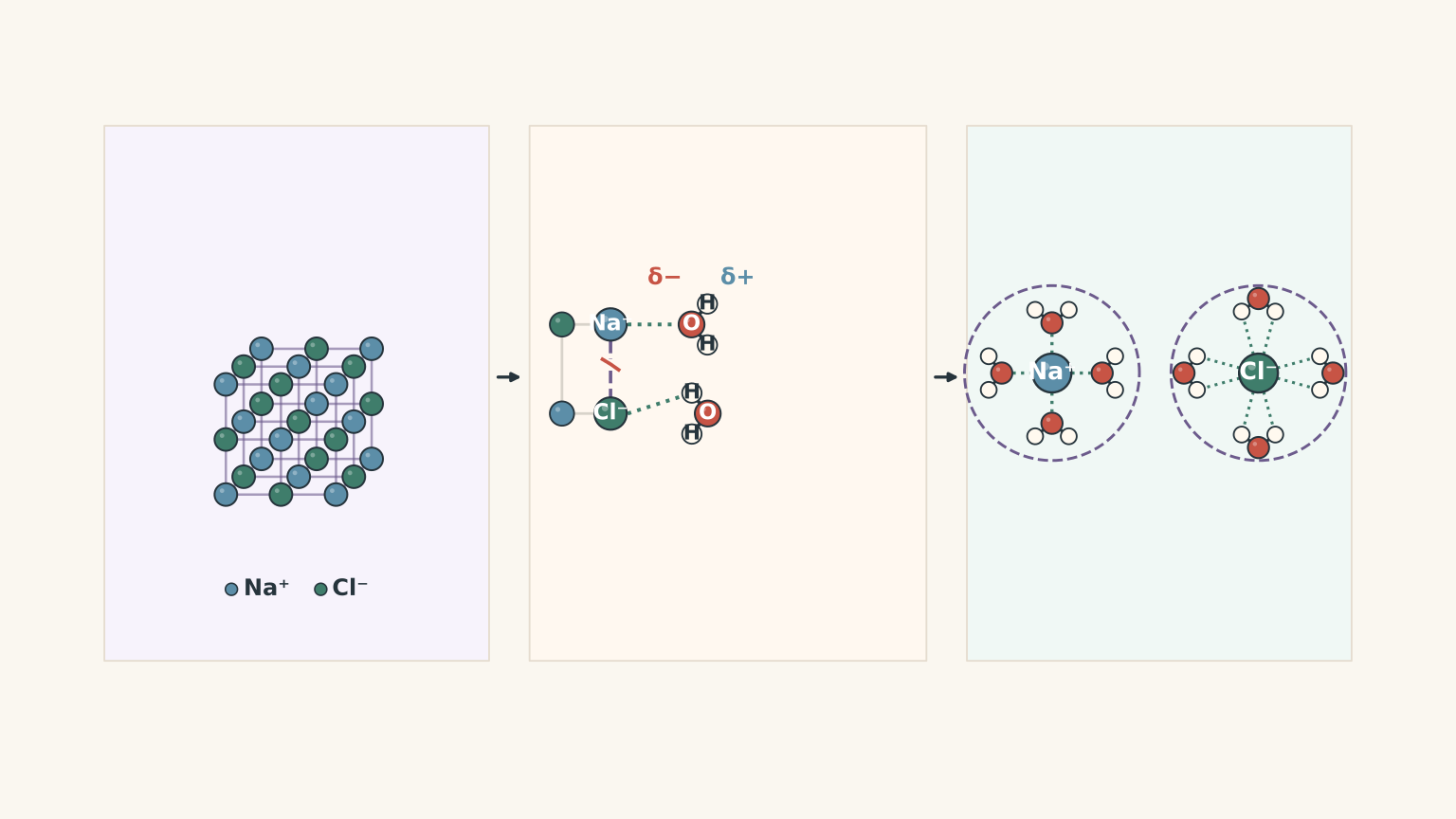
Due to technical limitations, this figure may display incorrectly or contain inaccuracies. Please check key details against your course materials.
What interactions are broken and formed?
Dissolution involves several changes in particle interactions.
Ionic attractions are overcome. Water molecules interact with ions at the crystal surface. Some of the electrostatic attractions holding the ionic lattice together must be overcome for ions to separate.
Water molecules rearrange. The water molecules reorganise around the separating ions. Some existing water-water hydrogen-bond interactions are disrupted or rearranged.
Hydration occurs. Water molecules surround the separated ions, forming attractive ion-dipole interactions.
An ion surrounded by water molecules is described as hydrated. The surrounding water molecules form a hydration shell, although the molecules within it are continually exchanging.
Notice something important: no new covalent bonds between sodium, chlorine, and water are required. The new attractions are primarily ion-dipole interactions.
The overall dissolution process is represented by:
\[ \ce{NaCl(s) <=> Na+(aq) + Cl-(aq)} \]
The symbol \((aq)\) indicates that the ions are dissolved and hydrated in aqueous solution.
If the solution is unsaturated, there is a net transfer of ions from the solid into the water. Once the solution becomes saturated, a dynamic equilibrium can establish between dissolution and crystallisation.
Where does the energy go?
Separating ions from an ionic lattice requires energy. This is an endothermic process.
Hydrating the separated ions releases energy because attractive interactions form between the ions and water molecules. This is exothermic.
We can represent these changes using a thermochemical cycle.
For a general 1:1 ionic compound, \(MX\), the first hypothetical step is:
\[ \ce{MX(s) -> M+(g) + X-(g)} \]
This represents lattice dissociation. Energy must be supplied to separate the ions.
The second step is hydration:
\[ \ce{M+(g) + X-(g) -> M+(aq) + X-(aq)} \]
This releases energy as the ions become surrounded by water molecules.
The overall enthalpy change is:
\[ \begin{aligned} \Delta H_{\mathrm{soln}} ={}&\Delta H_{\mathrm{latt,diss}}\\ &+\Delta H_{\mathrm{hyd}}(\mathrm{M}^+)\\ &+\Delta H_{\mathrm{hyd}}(\mathrm{X}^-) \end{aligned} \]
Here:
- \(\Delta H_{\mathrm{soln}}\) is the enthalpy change per mole of ionic solid dissolved.
- \(\Delta H_{\mathrm{latt,diss}}\) is the positive lattice dissociation enthalpy.
- \(\Delta H_{\mathrm{hyd}}\) is the negative hydration enthalpy for each gaseous ion becoming hydrated.
All enthalpy values are measured in \(\mathrm{kJ\,mol^{-1}}\).
The hydration terms include the energy changes associated with introducing the ions into water and reorganising the surrounding solvent. Do not add a separate water-separation term when using this particular thermochemical cycle.
The overall enthalpy change can be positive or negative, depending on the balance between these contributions.
However, an important limitation remains: enthalpy alone does not determine whether dissolution is spontaneous or how much solid will dissolve. Entropy and Gibbs free energy also influence the equilibrium position.
For a more detailed explanation of this energy model, see Chemistry LibreTexts: Lattice and Hydration Energies.
02What makes a solid solution different?
Now consider a completely different situation.
Instead of separating ions into water, imagine two different metal ions occupying positions within the same solid crystal.
A solid solution is a homogeneous solid phase containing two or more chemical components. Its components are incorporated into a shared crystal structure rather than existing as separate crystals.
There are different ways this can happen, but we will focus on substitutional solid solutions.
In a substitutional solid solution, an incoming ion replaces another ion at a normal position in the crystal lattice.
Think of the lattice as a stadium with rows of fixed seats. Magnesium ions occupy certain seats. Nickel ions can take some of those same seats without changing the overall seating arrangement.
The analogy is useful because the positions remain the same while the occupants change.
It has a limitation, though. Real crystal lattices are not rigid seating arrangements. Ions vibrate, attract and repel one another, and their surroundings can distort slightly when a different ion occupies a site.
The example: magnesium oxide and nickel(II) oxide
Magnesium oxide, \(\mathrm{MgO}\), and nickel(II) oxide, \(\mathrm{NiO}\), are particularly useful examples.
Both have the rock-salt crystal structure, the same general arrangement found in sodium chloride.
Their crystal lattices contain:
- Negative oxide ions, \(\mathrm{O}^{2-}\), occupying the anion positions.
- Positive metal ions occupying the cation positions.
In pure magnesium oxide, the metal-ion positions are occupied by \(\mathrm{Mg}^{2+}\).
In pure nickel(II) oxide, those positions are occupied by \(\mathrm{Ni}^{2+}\).
The two cations have the same charge and similar ionic sizes. This makes it possible for them to substitute for one another without fundamentally changing the crystal structure.
We can represent the resulting solid solution using:
\[ \mathrm{Mg}_{1-x}\mathrm{Ni}_x\mathrm O \]
Here, \(x\) is the mole fraction of cation sites occupied by nickel ions.
The fraction occupied by magnesium ions is \(1-x\).
For example:
| Value of \(x\) | Magnesium fraction | Nickel fraction | Composition |
|---|---|---|---|
| 0 | 1.00 | 0.00 | MgO |
| 0.25 | 0.75 | 0.25 | Mg₀.₇₅Ni₀.₂₅O |
| 0.50 | 0.50 | 0.50 | Mg₀.₅₀Ni₀.₅₀O |
| 0.75 | 0.25 | 0.75 | Mg₀.₂₅Ni₀.₇₅O |
| 1 | 0.00 | 1.00 | NiO |
For this example, the solid solution can extend across the full composition range under suitable conditions.
Notice why charge balance is maintained.
Both metal ions have a charge of \(+2\). Regardless of their relative proportions, each oxide ion has a charge of \(-2\).
There is no need to introduce additional ions or vacancies simply to compensate for a change in charge.
The overall rock-salt structure remains, although local metal-oxygen distances and the lattice spacing can change.
A natural example: olivine
Solid solutions are not restricted to manufactured materials.
Olivine is a group of minerals found in many igneous rocks. Its composition varies between two end members:
- Forsterite: \(\mathrm{Mg_2SiO_4}\)
- Fayalite: \(\mathrm{Fe_2SiO_4}\)
Magnesium ions and iron(II) ions can substitute for each other in the same crystal structure.
The general composition is written:
\[ (\mathrm{Mg},\mathrm{Fe})_2\mathrm{SiO_4} \]
Both \(\mathrm{Mg}^{2+}\) and \(\mathrm{Fe}^{2+}\) have the same charge and similar ionic sizes, making substitution possible.
The Open University describes olivine as a continuous solid-solution series between forsterite and fayalite.
This example demonstrates that a mineral does not always have one exact chemical composition. Its formula can describe a range of compositions while retaining the same underlying crystal structure.
03Solid solution versus separate compounds and phases
This is the central distinction.
Suppose a sample contains equal amounts of magnesium oxide and nickel(II) oxide.
Knowing its overall composition does not tell us how the ions are arranged.
There are three different models to consider.
Model 1: Substitutional solid solution
Magnesium and nickel ions occupy the same type of cation site throughout one homogeneous crystal phase.
The composition can vary continuously within the solid-solution range.
For example:
\[ \mathrm{Mg}_{0.5}\mathrm{Ni}_{0.5}\mathrm O \]
This describes a shared lattice with equal proportions of magnesium and nickel on the cation sites.
Model 2: Separate solid phases
Magnesium oxide and nickel(II) oxide remain in separate crystalline regions.
One region may contain predominantly MgO, while another contains predominantly NiO.
The sample can still have an overall 1:1 Mg:Ni ratio, but the ions are not uniformly distributed throughout one lattice.
A phase is a region of material with a uniform composition and structure.
Importantly, two phases do not necessarily have different crystal structures. They can share the same general structure but have different compositions.
Model 3: Formation of a separate compound
A new compound forms with its own characteristic crystal arrangement and composition.
Unlike a substitutional solid solution, which can have a variable composition, a distinct compound often has a fixed or relatively narrow stoichiometric range.
The key difference is that a new phase with a different chemical arrangement has formed.
Why bulk composition can be misleading
Consider two samples with the same overall composition:
\[ \mathrm{Mg:Ni}=1:1 \]
Sample A contains one homogeneous crystal phase with equal proportions of Mg and Ni on the cation sites.
Sample B contains separate MgO and NiO crystals in equal molar amounts.
Both samples have the same overall elemental composition.
However, their internal structures are completely different.
This is why a chemical formula alone cannot prove that a solid solution has formed.
You need evidence about the arrangement of particles and the number of phases present.
How would scientists distinguish the models?
Two useful techniques are X-ray diffraction and elemental mapping.
X-ray diffraction (XRD) examines how X-rays interact with the repeating arrangement of atoms in a crystal.
A single solid-solution phase may produce one set of rock-salt diffraction reflections, with their positions changing as the composition changes.
If separate crystalline phases are present, two sets of reflections may appear, provided their peaks can be distinguished.
Elemental mapping can show where different elements are distributed within a material.
If magnesium and nickel are distributed throughout the same grains, that supports a substitutional solid-solution model. If they occur in distinct regions, a separate-phase model becomes more likely.
Neither technique should be interpreted in isolation. For example, two very fine crystalline phases may produce overlapping diffraction peaks.
There is direct experimental evidence for the MgO-NiO example. Yoshida and colleagues investigated the system using X-ray diffraction, X-ray photoelectron spectroscopy, and X-ray absorption fine structure. Their results supported nickel substitution for magnesium rather than preferential separation into distinct nickel oxide and magnesium oxide regions in the samples examined.
See Yoshida et al. (1996), Study on the Dispersion of Nickel Ions in the NiO-MgO System.
04Why do some ions form solid solutions while others do not?
You might now predict that any two ionic compounds could form a solid solution if their powders were mixed together.
That prediction is too simple.
For substitution to occur successfully, the incoming ion must be compatible with the existing crystal structure.
Three factors are particularly useful.
1. Ionic size
The ions should have reasonably similar ionic radii.
If an incoming ion is much larger or smaller than the ion it replaces, the surrounding lattice may become distorted.
This introduces strain into the crystal.
2. Ionic charge
The substituting ions should ideally have the same charge.
For example, replacing \(\mathrm{Mg}^{2+}\) with \(\mathrm{Ni}^{2+}\) does not change the overall charge balance.
Replacing \(\mathrm{Mg}^{2+}\) with \(\mathrm{Al}^{3+}\) creates a charge imbalance. The crystal would need some form of charge compensation, such as vacancies or additional substitutions.
This makes the substitution more complicated.
3. Crystal structure
The two compounds should have compatible crystal structures.
If their ions prefer very different arrangements, incorporating one into the other’s lattice becomes more difficult.
These factors are useful guidelines, not guarantees. The actual stability of a solid solution depends on thermodynamics as well.
The role of entropy and enthalpy
Mixing two types of ions creates more possible arrangements within the lattice.
This increases configurational entropy, which can favour mixing.
However, the interactions between different ions can also affect the enthalpy of the solid.
If the resulting lattice is energetically unfavourable, the material may prefer to separate into different phases.
The competition can be described qualitatively using Gibbs free energy:
\[ \Delta G_{\mathrm{mix}} = \Delta H_{\mathrm{mix}} - T\Delta S_{\mathrm{mix}} \]
Where:
- \(\Delta G_{\mathrm{mix}}\) is the Gibbs free energy change associated with mixing.
- \(\Delta H_{\mathrm{mix}}\) is the enthalpy change due to mixing.
- \(T\) is absolute temperature in kelvin.
- \(\Delta S_{\mathrm{mix}}\) is the entropy change due to mixing.
The system favours the arrangement with the lowest Gibbs free energy at the specified temperature and pressure.
Entropy often favours mixing because there are many possible ways to distribute different ions across equivalent lattice sites.
However, enthalpy can favour separation if the interactions or lattice distortions make mixing unfavourable.
A negative free energy of mixing relative to the pure components does not automatically guarantee that one homogeneous phase is stable at every composition. Two coexisting solid phases can sometimes have an even lower total free energy.
What is a miscibility gap?
Some solid-solution systems have a range of compositions in which a single homogeneous solid is not the most stable arrangement.
Instead, the material separates into two solid phases with different compositions.
This region is called a miscibility gap.
For example, imagine a hypothetical oxide system containing two divalent cations, A²⁺ and B²⁺.
At a particular temperature, a single homogeneous solid solution may be stable.
After cooling, the same overall composition may separate into:
- An A-rich solid-solution phase.
- A B-rich solid-solution phase.
Both phases may retain the same rock-salt crystal structure. Their compositions are simply different.
This is an important distinction: a solid solution does not necessarily remain a single phase at every temperature and composition.
The miscibility gap describes the conditions under which phase separation is favoured.
05An important connection to chemical equilibrium
There is one more consequence worth understanding.
In HSC solubility calculations, you usually treat a pure solid as having constant activity. Its activity is conventionally assigned a value of 1, so it does not appear in the usual \(K_{sp}\) expression.
A component inside a solid solution behaves differently.
Its chemical potential, which describes its thermodynamic tendency to move or react, depends on the composition of the solid.
Consequently, its activity is generally composition-dependent.
You cannot automatically treat each component of a solid solution as a separate pure solid with an activity of 1.
This is one reason solid-solution equilibria require a more detailed model than the ordinary solubility equilibria studied in the HSC course.
If you want to explore this connection further, see tutorgum’s guides to Chemical Potential and Activities and Activity Coefficients in Non-Ideal Solutions.
06Worked examples
Worked example: Determining the formula of a solid solution
A homogeneous magnesium oxide-nickel(II) oxide solid contains 0.60 mol of \(\mathrm{Mg}^{2+}\) and 0.40 mol of \(\mathrm{Ni}^{2+}\) for every 1.00 mol of \(\mathrm{O}^{2-}\).
Determine the value of \(x\) and write the solid-solution formula.
Step 1
\[ n_{\mathrm{cations}}=0.60+0.40=1.00\text{ mol} \]
Step 2
By definition:
\[ x=\frac{n(\mathrm{Ni}^{2+})} {n(\mathrm{Mg}^{2+})+n(\mathrm{Ni}^{2+})} \]
Substituting:
\[ x=\frac{0.40}{1.00}=0.40 \]
Step 3
\[ 1-x=1-0.40=0.60 \]
Therefore, the solid-solution formula is:
\[ \boxed{\mathrm{Mg}_{0.60}\mathrm{Ni}_{0.40}\mathrm O} \]
Step 4
Both cations have a charge of \(+2\).
The average positive charge per oxide ion is:
\[ (0.60\times 2)+(0.40\times 2)=+2 \]
This balances the \(-2\) charge of the oxide ion.
The formula is therefore consistent with an electrically neutral solid.
The result describes the average composition of the lattice, not a discrete molecule containing fractional atoms.
Worked example: Interpreting a natural solid solution
An olivine sample has the composition:
\[ (\mathrm{Mg}_{0.70}\mathrm{Fe}_{0.30})_2 \mathrm{SiO_4} \]
Determine the average numbers of magnesium and iron ions per formula unit, and verify charge neutrality.
Step 1
The subscript 2 outside the brackets means there are two magnesium/iron cation positions per formula unit.
Step 2
For magnesium:
\[ 2\times 0.70=1.40 \]
For iron:
\[ 2\times 0.30=0.60 \]
The average composition is therefore:
\[ \mathrm{Mg}_{1.40}\mathrm{Fe}_{0.60} \mathrm{SiO_4} \]
Step 3
Both magnesium and iron ions have a charge of \(+2\).
Their combined charge is:
\[ (1.40\times 2)+(0.60\times 2)=+4 \]
Silicon contributes:
\[ 1\times(+4)=+4 \]
The total positive charge is:
\[ +4+4=+8 \]
Step 4
Four oxide ions contribute:
\[ 4\times(-2)=-8 \]
The total charge is therefore zero.
The formula is electrically neutral.
More importantly, the result shows that magnesium and iron share the same type of cation positions in the olivine structure.
The fractions describe the average occupancy across many sites. They do not mean that an individual formula unit literally contains 1.40 magnesium ions.
07Questions and solutions
Question 1
A student dissolves sodium chloride in water and describes the resulting liquid as a solid solution because the sodium and chloride ions are evenly distributed.
Explain why this description is incorrect. Identify the interactions that form when sodium chloride dissolves.
Solution 1
The resulting material is an aqueous ionic solution, not a solid solution.
When sodium chloride dissolves, its ions separate from the ionic lattice and become surrounded by water molecules.
The oxygen ends of water molecules orient towards \(\mathrm{Na}^+\), while the hydrogen ends orient towards \(\mathrm{Cl}^-\).
This produces ion-dipole attractions and hydration shells around the ions.
A solid solution, in contrast, contains different components incorporated into a shared solid crystal structure. Its ions remain in lattice positions rather than becoming dispersed throughout a liquid solvent.
The tempting prediction is that any uniformly distributed mixture is a solid solution. The missing condition is the physical state and particle arrangement: uniform distribution in a liquid does not make a material a solid solution.
Question 2
Two oxide samples have identical overall compositions, with a magnesium-to-nickel mole ratio of 1:1.
The following hypothetical observations are obtained:
| Observation | Sample A | Sample B |
|---|---|---|
| Overall Mg:Ni ratio | 1:1 | 1:1 |
| X-ray diffraction | One set of rock-salt reflections at intermediate positions | Two distinguishable sets of rock-salt reflections |
| Elemental mapping | Both elements distributed throughout individual grains | Separate Mg-rich and Ni-rich grains |
Determine which sample is consistent with a single-phase substitutional solid solution and which is consistent with separate phases.
Explain why the overall composition cannot distinguish the two models by itself.
Solution 2
Sample A is consistent with a single-phase substitutional solid solution, while Sample B is consistent with two separate solid phases.
In Sample A, the single set of diffraction reflections suggests one repeating rock-salt lattice with an intermediate lattice spacing. The elemental mapping supports this interpretation because both metal ions are distributed throughout the same grains.
In Sample B, the two distinguishable sets of reflections suggest two crystalline environments. Elemental mapping reinforces this result by showing Mg-rich and Ni-rich regions.
The important trap is relying on the overall Mg:Ni ratio.
Both samples have the same bulk composition, but their internal particle arrangements differ.
Sample A contains one shared lattice. Sample B contains two compositionally distinct crystalline phases.
The two phases in Sample B can still have the same general rock-salt structure. Different compositions can produce different lattice spacings and therefore different diffraction patterns.
One limitation is that very small domains or overlapping diffraction peaks can make separate phases difficult to identify. Combining structural and compositional evidence gives a more reliable conclusion.
Question 3
A hypothetical 1:1 ionic solid, \(MX\), has the following thermochemical data:
- Lattice dissociation enthalpy: \(+740\ \mathrm{kJ\,mol^{-1}}\)
- Hydration enthalpy of \(\mathrm{M}^+\): \(-420\ \mathrm{kJ\,mol^{-1}}\)
- Hydration enthalpy of \(\mathrm{X}^-\): \(-335\ \mathrm{kJ\,mol^{-1}}\)
Calculate the enthalpy of solution.
A student argues that the large positive lattice dissociation enthalpy means the compound cannot dissolve. Evaluate this argument.
Solution 3
The enthalpy of solution is \(-15\ \mathrm{kJ\,mol^{-1}}\), so the dissolution process is exothermic.
The relevant equation is:
\[ \begin{aligned} \Delta H_{\mathrm{soln}} ={}&\Delta H_{\mathrm{latt,diss}}\\ &+\Delta H_{\mathrm{hyd}}(\mathrm{M}^+)\\ &+\Delta H_{\mathrm{hyd}}(\mathrm{X}^-) \end{aligned} \]
Step 1: Substitute the supplied values.
\[ \begin{aligned} \Delta H_{\mathrm{soln}} &=740-420-335\\ &=-15\ \mathrm{kJ\,mol^{-1}} \end{aligned} \]
Step 2: Interpret the result.
The negative enthalpy change means that hydration releases more energy than is required to separate the ionic lattice.
The overall dissolution process releases energy.
Step 3: Evaluate the student’s argument.
The student’s argument is incorrect because it considers only the energy required to break apart the lattice.
The hydration of the ions must also be included.
Furthermore, even the overall enthalpy change does not independently determine the extent of dissolution. Entropy and Gibbs free energy influence whether dissolution is thermodynamically favourable and where the equilibrium position lies.
An exothermic dissolution does not automatically mean that the entire solid will dissolve.
Question 4
A hypothetical rock-salt oxide, \(AO\), contains \(\mathrm{A}^{2+}\) cations and \(\mathrm{O}^{2-}\) anions.
Three possible substituting ions are investigated:
| Candidate ion | Charge | Ionic radius compared with A²⁺ | Crystal structure compatibility |
|---|---|---|---|
| B²⁺ | +2 | 3% larger | Same |
| C³⁺ | +3 | 3% larger | Same |
| D²⁺ | +2 | 25% larger | Same |
Assume that all candidates are chemically stable in the stated oxidation states.
Which candidate is most likely to form a straightforward substitutional solid solution?
Explain why the other two candidates introduce additional difficulties. Does selecting the most compatible ion guarantee complete solid solubility?
Solution 4
B²⁺ is the most straightforward candidate for substitution into the AO lattice.
It has the same charge as A²⁺, a very similar ionic radius, and is compatible with the existing crystal structure.
These characteristics allow it to occupy normal cation positions with relatively little structural disruption.
C³⁺ introduces a charge imbalance. Replacing A²⁺ with C³⁺ increases the positive charge at that lattice position. The material would need a charge-compensation mechanism, such as vacancies or additional substitutions, to maintain electrical neutrality.
D²⁺ has the correct charge but is substantially larger than A²⁺. Its incorporation may distort the surrounding lattice and introduce significant strain.
However, B²⁺ is not guaranteed to form a complete solid solution.
The structural criteria indicate compatibility, not the final thermodynamic stability of every possible composition. The enthalpy and entropy of mixing, as well as temperature, must also be considered.
The tempting approach is to treat matching charge or matching size as sufficient. In reality, successful substitution depends on the combined effects of charge, size, structure, and thermodynamic stability.
Question 5
Consider a hypothetical binary oxide system containing two divalent cations, \(\mathrm{A}^{2+}\) and \(\mathrm{B}^{2+}\), which can occupy the same cation positions in a rock-salt lattice.
Define \(x_B\) as the mole fraction of cation sites occupied by B²⁺.
At a particular low temperature, the phase diagram indicates that two solid-solution phases coexist at equilibrium:
- An A-rich phase, \(\alpha\), with \(x_B=0.15\).
- A B-rich phase, \(\beta\), with \(x_B=0.75\).
A closed sample has an overall composition of \(x_0=0.45\).
After cooling and reaching equilibrium, determine:
(a) The fraction of formula units belonging to each phase.
(b) The composition formula of each phase.
(c) Why the overall composition \(\mathrm{A}_{0.55}\mathrm{B}_{0.45}\mathrm O\) does not prove that the sample contains one homogeneous solid solution.
(d) Whether the formation of two phases necessarily means that a new chemical compound has formed.
Assume that there are no other phases, no material is lost, and each oxide formula unit contains one cation and one oxide ion.
Solution 5
The sample contains equal amounts of the two solid-solution phases: 50% of the formula units belong to the A-rich phase and 50% belong to the B-rich phase.
The crucial distinction is between the overall composition of a sample and the individual compositions of the phases within it.
(a) Calculate the phase fractions.
Let:
- \(f_\alpha\) be the fraction of formula units in phase \(\alpha\).
- \(f_\beta\) be the fraction of formula units in phase \(\beta\).
- \(x_\alpha=0.15\) be the B fraction in phase \(\alpha\).
- \(x_\beta=0.75\) be the B fraction in phase \(\beta\).
- \(x_0=0.45\) be the overall B fraction.
The fractions must satisfy:
\[ f_\alpha+f_\beta=1 \]
A material balance on the B cations gives:
\[ x_0=f_\alpha x_\alpha+f_\beta x_\beta \]
Substituting \(f_\alpha=1-f_\beta\):
\[ x_0=(1-f_\beta)x_\alpha+f_\beta x_\beta \]
Rearranging:
\[ f_\beta= \frac{x_0-x_\alpha}{x_\beta-x_\alpha} \]
Substitute the given values:
\[ f_\beta= \frac{0.45-0.15}{0.75-0.15} \]
\[ f_\beta=\frac{0.30}{0.60}=0.50 \]
Therefore:
\[ f_\alpha=1-0.50=0.50 \]
The sample contains equal numbers of formula units in each phase.
These are mole fractions of formula units, not necessarily mass fractions. The different molar masses of the phases would need to be considered if mass percentages were requested.
(b) Determine the composition of each phase.
For phase \(\alpha\):
\[ x_B=0.15 \]
Therefore, the A fraction is:
\[ 1-0.15=0.85 \]
Its formula is:
\[ \mathrm{A}_{0.85}\mathrm{B}_{0.15}\mathrm O \]
For phase \(\beta\):
\[ x_B=0.75 \]
Therefore, the A fraction is:
\[ 1-0.75=0.25 \]
Its formula is:
\[ \mathrm{A}_{0.25}\mathrm{B}_{0.75}\mathrm O \]
Both phases contain A²⁺ and B²⁺ ions. They differ in their relative proportions.
(c) Explain the difference between bulk and phase composition.
The overall composition is:
\[ x_0=0.45 \]
This is consistent with the average formula:
\[ \mathrm{A}_{0.55}\mathrm{B}_{0.45}\mathrm O \]
However, neither individual phase has this composition.
Instead, half the sample consists of an A-rich solid solution and half consists of a B-rich solid solution.
Combining their compositions gives:
\[ (0.50\times0.15)+(0.50\times0.75) =0.45 \]
The overall composition is therefore correct, but it describes an average across two different phases.
This is the important trap: calculating an average formula does not establish that the ions are distributed uniformly throughout one lattice.
(d) Does phase separation mean a new compound has formed?
No. The material has separated into two compositionally different solid-solution phases, not necessarily into a new compound.
Both phases retain the rock-salt structure.
The difference is their composition, not their general crystal arrangement.
The system has entered a miscibility gap, where two coexisting compositions are more thermodynamically favourable than one homogeneous phase at the specified temperature.
A distinct compound would require evidence for a separate chemical phase with its own characteristic structural arrangement.
The most tempting interpretation is that a 1:1 overall composition must represent one mixed crystal. The phase diagram and material balance show why this is incorrect.
A sample can have one overall chemical formula while containing multiple distinct phases.
08Where to take this next
The key idea is that a solid solution is defined by how its components occupy a shared crystal structure, not simply by its overall chemical composition.
You can now distinguish three different possibilities:
- Ions separating from an ionic lattice and becoming hydrated in water.
- Different ions substituting for one another within a single solid lattice.
- A material separating into distinct solid phases or forming a new compound.
The next useful step is understanding how the composition of a solid solution affects the chemical potential and activity of its components.
That connection explains why changing the composition of a solid can change its equilibrium behaviour, even when its overall crystal structure remains the same.
Continue with tutorgum’s Chemical Potential and Activities and Activity Coefficients in Non-Ideal Solutions.