
The Hydrogen Electrode and pH: From Activity to Potential
Explore how hydrogen-ion activity, gas pressure, and the Nernst equation determine hydrogen electrode potential. Includes worked examples and challenging extension-level questions.
A platinum electrode sits in an acidic solution at pH 2.00, with hydrogen gas passing over its surface. You keep the hydrogen pressure and temperature constant, then move the electrode into a solution at pH 4.00.
Predict what happens to its electrical potential relative to the standard hydrogen electrode. Does it stay the same, become more positive, or become more negative?
At 25°C, it becomes approximately 0.118 V more negative. The reason is that a hydrogen electrode responds to hydrogen-ion activity, and pH is defined using that activity.
This is an extension beyond the required 2025 NSW HSC Chemistry syllabus. Having studied Year 12 acid-base reactions is the assumed starting point, not an assessment requirement for this extension.
01The pH model you already know
In Year 12 Chemistry, you use pH to describe the acidity of an aqueous solution.
The familiar relationship is:
\[ \mathrm{pH}=-\log_{10}[H^+] \]
Here, \([H^+]\) is the hydrogen-ion concentration in mol L\(^{-1}\).
The logarithmic scale means that a change of one pH unit represents a tenfold change in hydrogen-ion concentration.
For example:
| pH | Hydrogen-ion concentration |
|---|---|
| 1 | \(1.0\times10^{-1}\) mol L\(^{-1}\) |
| 2 | \(1.0\times10^{-2}\) mol L\(^{-1}\) |
| 3 | \(1.0\times10^{-3}\) mol L\(^{-1}\) |
| 4 | \(1.0\times10^{-4}\) mol L\(^{-1}\) |
A solution at pH 2 has ten times the hydrogen-ion concentration of a solution at pH 3, assuming ideal dilute-solution behaviour.
If you need to revise the logarithmic calculations first, see How to Convert pH into Hydrogen-Ion Concentration.
This concentration-based model is useful, but it leaves out something important.
Not every hydrogen ion behaves as though it is completely independent of its surroundings.
02Concentration versus activity
Imagine two solutions containing the same concentration of hydrogen ions.
You might expect them to behave identically. After all, they contain the same number of hydrogen ions per unit volume.
However, dissolved ions interact with one another and with surrounding water molecules. These interactions affect how species participate in chemical equilibria.
The thermodynamic quantity that accounts for these interactions is called activity.
Activity is an effective measure of a species’ chemical influence. It is related to concentration, but the two are not necessarily identical.
A useful analogy is a crowded hallway. Concentration tells you how many people are present per square metre. However, the extent to which each person can move freely also depends on how crowded the hallway is.
Activity plays a similar role in accounting for interactions between particles. The analogy is not exact: activity is a thermodynamic quantity, not a literal count of freely moving ions.
For a concentration-based activity convention:
\[ a_{H^+}=\gamma_{H^+} \frac{[H^+]}{c^\circ} \]
where:
- \(a_{H^+}\) is the dimensionless activity of hydrogen ions.
- \(\gamma_{H^+}\) is the dimensionless activity coefficient.
- \([H^+]\) is the hydrogen-ion concentration.
- \(c^\circ\) is the standard concentration, taken here as \(1.00\ \mathrm{mol\,L^{-1}}\).
The activity coefficient accounts for non-ideal interactions in the solution.
In sufficiently dilute solutions, these interactions become relatively unimportant, so:
\[ \gamma_{H^+}\approx 1 \]
Consequently:
\[ a_{H^+}\approx\frac{[H^+]}{c^\circ} \]
This is why the familiar HSC concentration-based pH calculation works well for many dilute aqueous solutions.
The more rigorous definition of pH is:
\[ \boxed{\mathrm{pH}=-\log_{10}a_{H^+}} \]
This is the definition given by the IUPAC Gold Book.
One subtlety: the activity coefficient of an individual ion cannot be independently measured without adopting a convention. Practical pH values are therefore assigned using agreed measurement procedures and standard buffer solutions. This does not make pH arbitrary; it provides a reproducible measurement scale.
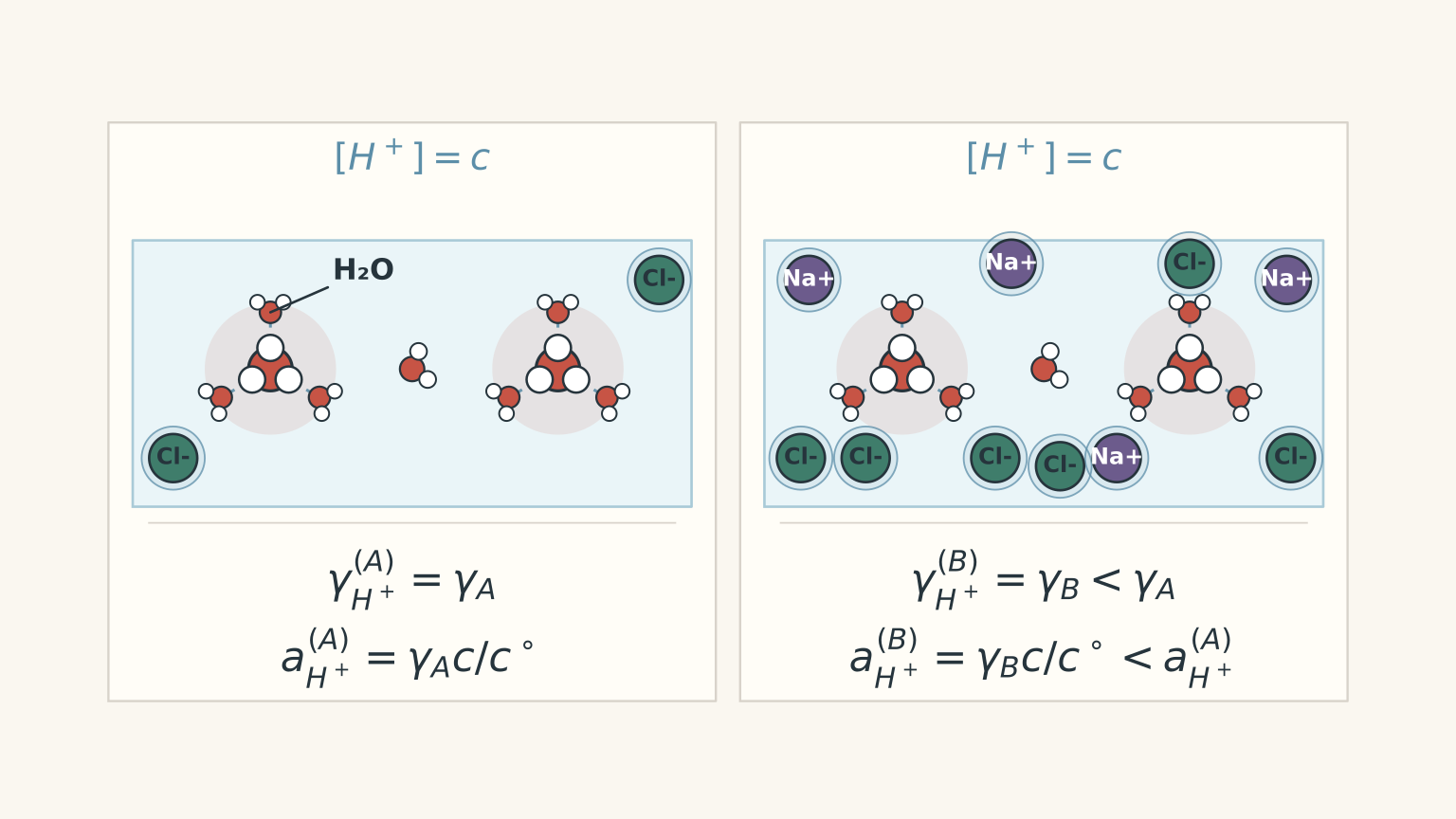
Due to technical limitations, this figure may display incorrectly or contain inaccuracies. Please check key details against your course materials.
Why introduce activity?
Because electrode potentials depend on chemical activity, not simply on the number of particles present.
To understand that connection, we need an electrode that responds directly to hydrogen ions.
03What is a hydrogen electrode?
A hydrogen electrode is an electrochemical electrode that establishes an equilibrium between hydrogen ions in solution and hydrogen gas.
Its essential components are:
- A platinum electrode immersed in an acidic aqueous solution.
- Hydrogen gas supplied to the platinum surface.
- An electrical connection through the platinum.
- A reference electrode or another half-cell against which its potential can be measured.
The platinum is usually coated with finely divided platinum, known as platinised platinum. This increases the available surface area and helps catalyse the hydrogen reaction.
The platinum provides a conducting surface. It is not consumed in the overall electrode reaction.
At the platinum surface, the following reversible half-equation occurs:
\[ \ce{2H+(aq) + 2e- <=> H2(g)} \]
There are two possible directions.
Reduction:
\[ \ce{2H+(aq) + 2e- -> H2(g)} \]
Hydrogen ions gain electrons and form hydrogen gas.
Oxidation:
\[ \ce{H2(g) -> 2H+(aq) + 2e-} \]
Hydrogen gas loses electrons and forms hydrogen ions.
At equilibrium, both directions occur at equal rates.
The electrode develops an electrical potential that depends on the conditions at its surface, particularly the hydrogen-ion activity and hydrogen gas pressure.
Hydrogen gas is highly flammable, so this is specialist electrochemical equipment rather than a suitable DIY experiment.
04The standard hydrogen electrode: establishing a reference
Here is an important problem.
A voltmeter measures a potential difference between two electrodes. It cannot independently measure the absolute potential of a single electrode.
We therefore need an agreed reference electrode.
The standard hydrogen electrode (SHE) provides this reference.
It consists of a platinum electrode in contact with hydrogen gas and an aqueous solution under standard conditions.
Its defining conditions are:
| Property | Standard condition |
|---|---|
| Hydrogen-ion activity | \(a_{H^+}=1\) |
| Hydrogen gas pressure | 1 bar |
| Temperature | Specified temperature |
| Electrode | Pure platinum, conventionally platinised |
The standard hydrogen electrode is assigned a standard reduction potential of:
\[ \boxed{E^\circ_{\mathrm{SHE}}=0.000\ \mathrm{V}} \]
This value is zero by convention.
It is not a claim that the electrode has no electrical properties. It establishes the reference against which other electrode potentials are measured.
The distinction between concentration and activity matters here. The rigorous standard condition is \(a_{H^+}=1\), not simply a hydrogen-ion concentration of exactly 1 mol L\(^{-1}\).
The standard hydrogen electrode is recognised by IUPAC as the universal reference electrode for aqueous protonic systems.
See the IUPAC definition of the standard hydrogen electrode.
Once this reference is established, we can express the potential of a hydrogen electrode in any other solution relative to it.
05Connecting hydrogen activity to electrode potential
The relationship between electrode potential and chemical activity is described by the Nernst equation.
In its general form for a reduction half-reaction:
\[ E=E^\circ-\frac{RT}{nF}\ln Q \]
where:
- \(E\) is the electrode reduction potential, in volts.
- \(E^\circ\) is the standard reduction potential, in volts.
- \(R\) is the gas constant, \(8.314\ \mathrm{J\,mol^{-1}\,K^{-1}}\).
- \(T\) is the absolute temperature, in kelvins.
- \(n\) is the number of electrons transferred.
- \(F\) is the Faraday constant, approximately \(96\,485\ \mathrm{C\,mol^{-1}}\).
- \(Q\) is the dimensionless reaction quotient.
- \(\ln\) represents the natural logarithm.
The Nernst equation describes how an electrode potential changes when the conditions differ from their standard states.
It is particularly useful for the hydrogen electrode because the reaction involves hydrogen-ion activity and hydrogen gas pressure.
Applying the Nernst equation to hydrogen
Consider the reduction half-equation again:
\[ \ce{2H+(aq) + 2e- -> H2(g)} \]
There are two electrons transferred, so \(n=2\).
The reaction quotient is:
\[ Q=\frac{a_{H_2}}{a_{H^+}^2} \]
Here, \(a_{H_2}\) is the dimensionless activity of hydrogen gas.
For hydrogen behaving approximately as an ideal gas:
\[ a_{H_2}\approx\frac{p_{H_2}}{p^\circ} \]
where \(p_{H_2}\) is its partial pressure and \(p^\circ=1\ \mathrm{bar}\) is the standard pressure.
Substituting into the Nernst equation:
\[ E=E^\circ-\frac{RT}{2F} \ln\left(\frac{p_{H_2}/p^\circ}{a_{H^+}^2}\right) \]
For the hydrogen electrode, \(E^\circ=0\) V by convention.
Rearranging:
\[ E=\frac{RT}{F}\ln a_{H^+} -\frac{RT}{2F}\ln\left(\frac{p_{H_2}}{p^\circ}\right) \]
Now use the activity-based definition of pH:
\[ \mathrm{pH}=-\log_{10}a_{H^+} \]
Converting between natural and base-10 logarithms gives:
\[ \boxed{ E=-\frac{2.303RT}{F}\mathrm{pH} -\frac{2.303RT}{2F} \log_{10}\left(\frac{p_{H_2}}{p^\circ}\right) } \]
This is the more general relationship for the hydrogen electrode under the stated assumptions.
The simplified relationship at standard hydrogen pressure
If hydrogen gas is maintained at its standard pressure of 1 bar:
\[ \frac{p_{H_2}}{p^\circ}=1 \]
Since \(\log_{10}(1)=0\), the pressure term disappears.
We obtain:
\[ E=-\frac{2.303RT}{F}\mathrm{pH} \]
At 25°C, or 298.15 K:
\[ \frac{2.303RT}{F}=0.05916\ \mathrm{V} \]
Therefore:
\[ \boxed{E=-0.05916\,\mathrm{pH}} \]
This is one of the most useful results in understanding the hydrogen electrode.
At 25°C and a hydrogen pressure of 1 bar, every increase of one pH unit makes the hydrogen electrode potential approximately 59.16 mV more negative relative to the SHE.
Consider the following values:
| pH | Hydrogen electrode potential vs SHE |
|---|---|
| 0 | 0.000 V |
| 2 | -0.118 V |
| 4 | -0.237 V |
| 7 | -0.414 V |
| 10 | -0.592 V |
| 14 | -0.828 V |
Notice that the relationship is linear when temperature and hydrogen pressure remain constant.
Worked example: Calculate the potential at pH 3.20
A hydrogen electrode is immersed in a solution with a pH of 3.20. Hydrogen gas is maintained at a pressure of 1.00 bar, and the temperature is 25°C.
Calculate the electrode potential relative to the standard hydrogen electrode.
Step 1
Since the hydrogen pressure is 1 bar and the temperature is 25°C, use:
\[ E=-0.05916\,\mathrm{pH} \]
Step 2
\[ E=-0.05916(3.20) \]
\[ E=-0.189312\ \mathrm{V} \]
Step 3
\[ \boxed{E=-0.189\ \mathrm{V\ vs\ SHE}} \]
The negative potential means that the hydrogen electrode has a lower reduction potential than the standard hydrogen electrode.
This makes sense because the solution has a lower hydrogen-ion activity than the standard hydrogen electrode.
06Why hydrogen pressure also matters
So far, we have assumed that hydrogen gas is maintained at 1 bar.
What happens if the pressure changes?
Return to the full Nernst equation:
\[ E=-\frac{2.303RT}{F}\mathrm{pH} -\frac{2.303RT}{2F} \log_{10}\left(\frac{p_{H_2}}{p^\circ}\right) \]
At 25°C, this becomes:
\[ \boxed{ E=-0.05916\,\mathrm{pH} -0.02958\log_{10} \left(\frac{p_{H_2}}{1\ \mathrm{bar}}\right) } \]
There are now two factors affecting the electrode potential:
- Hydrogen-ion activity, represented by pH.
- Hydrogen gas pressure.
Increasing hydrogen gas pressure makes the reduction potential more negative, provided pH and temperature remain constant.
Why?
The reduction reaction produces hydrogen gas:
\[ \ce{2H+ + 2e- -> H2(g)} \]
Increasing the pressure of a product makes its formation less favourable at equilibrium. The reduction potential therefore decreases.
Conversely, lowering hydrogen pressure makes the reduction potential more positive.
This leads to an important rule:
You cannot determine the hydrogen electrode potential from pH alone unless the hydrogen pressure and temperature are also specified.
Worked example: Include activity and hydrogen pressure
An aqueous solution has a hydrogen-ion concentration of \(0.0200\ \mathrm{mol\,L^{-1}}\).
Its activity coefficient is \(0.75\), using the concentration-based convention defined earlier. Hydrogen gas is supplied at a pressure of 0.50 bar.
The temperature is 25°C.
Calculate:
- The thermodynamic pH.
- The hydrogen electrode potential relative to the SHE.
Assume ideal gas behaviour and \(c^\circ=1.00\ \mathrm{mol\,L^{-1}}\).
Step 1
Use:
\[ a_{H^+}=\gamma_{H^+}\frac{[H^+]}{c^\circ} \]
Substitute:
\[ a_{H^+}=0.75\times\frac{0.0200}{1.00} \]
\[ a_{H^+}=0.0150 \]
Step 2
\[ \mathrm{pH}=-\log_{10}(0.0150) \]
\[ \boxed{\mathrm{pH}=1.824} \]
Notice that simply using the concentration would give:
\[ -\log_{10}(0.0200)=1.699 \]
The difference occurs because the activity coefficient is not equal to one.
Step 3
Since the hydrogen pressure is not 1 bar, use the full simplified Nernst relationship:
\[ E=-0.05916\,\mathrm{pH} -0.02958\log_{10} \left(\frac{p_{H_2}}{1\ \mathrm{bar}}\right) \]
Substitute:
\[ E=-0.05916(1.824) -0.02958\log_{10}(0.50) \]
\[ E=-0.1079+0.00890 \]
\[ \boxed{E=-0.0990\ \mathrm{V\ vs\ SHE}} \]
Step 4
Two corrections have affected the potential.
First, the activity coefficient reduces the hydrogen-ion activity below the value predicted by concentration alone. This makes the potential more negative.
Second, the hydrogen pressure is below standard pressure. This makes the potential more positive.
The two effects partially cancel.
This is exactly why it is important to distinguish concentration, activity, and gas pressure rather than treating them as interchangeable.
07What does this mean for actual pH measurements?
You might now expect a typical laboratory pH meter to contain a platinum electrode with hydrogen gas bubbling over it.
It generally doesn’t.
The hydrogen electrode is a fundamental reference for pH measurement, but it is inconvenient for routine laboratory work. It requires a controlled hydrogen gas supply, a suitable platinum surface, and careful control of experimental conditions.
Most practical pH meters use a glass electrode together with a reference electrode.
The glass electrode has a special membrane whose surface potential responds to hydrogen-ion activity in the surrounding solution.
The pH meter measures the potential difference between the indicator electrode and the reference electrode. It then converts that electrical response into a pH value using calibration with standard buffer solutions.
Its response is approximately Nernstian over suitable operating ranges, although real glass electrodes do not always follow the theoretical slope exactly.
The National Bureau of Standards’ report on standardisation of pH measurements discusses the hydrogen electrode as a fundamental indicator of hydrogen-ion activity and the glass electrode as the more convenient instrument for routine measurements.
Where the simplified model has limits
There are several assumptions behind the relationship:
\[ E=-0.05916\,\mathrm{pH} \]
It assumes:
- A temperature of 25°C.
- Hydrogen gas at a pressure of 1 bar.
- A reversible hydrogen electrode at equilibrium.
- A suitable platinum surface.
- No significant interfering electrode reactions.
If the temperature changes, the theoretical slope changes because it depends on \(T\):
\[ \text{slope}=-\frac{2.303RT}{F} \]
Also, if the solution is concentrated, activity may differ significantly from concentration.
At sufficiently high gas pressures, the ideal-gas approximation must be replaced by a treatment using gas fugacity.
Finally, practical pH measurements have limitations arising from electrode response, reference-electrode behaviour, and liquid-junction potentials.
The Nernst equation is therefore a thermodynamic model with defined conditions, not a guarantee that every real electrode will produce an ideal voltage.
08Questions and solutions
The following questions build from direct Nernst-equation calculations to problems where activity, pressure, and cell potential interact.
Question 1
A hydrogen electrode is immersed in an aqueous solution with a pH of 3.50.
The hydrogen gas pressure is 1.00 bar, and the temperature is 25°C.
Calculate the electrode potential relative to the standard hydrogen electrode.
Solution 1
The electrode potential is:
\[ \boxed{E=-0.2071\ \mathrm{V\ vs\ SHE}} \]
Since hydrogen pressure is 1 bar and the temperature is 25°C, use:
\[ E=-0.05916\,\mathrm{pH} \]
Substitute:
\[ E=-0.05916(3.50) \]
\[ E=-0.20706\ \mathrm{V} \]
Therefore:
\[ E=-0.2071\ \mathrm{V} \]
The potential is negative because the hydrogen-ion activity is below its standard-state value.
The important condition is that the hydrogen pressure is 1 bar. Without that information, the simplified equation would not necessarily apply.
Question 2
A hydrogen electrode has a measured reduction potential of \(-0.1000\ \mathrm{V}\) relative to the SHE at 25°C.
The hydrogen gas pressure is 0.200 bar.
Assuming ideal gas behaviour and equilibrium:
(a) Calculate the pH of the solution.
(b) Calculate its hydrogen-ion activity.
(c) Explain why directly using \(E=-0.05916\,\mathrm{pH}\) would produce an incorrect result.
Solution 2
The solution has a pH of approximately 2.04 and a hydrogen-ion activity of approximately \(9.12\times10^{-3}\).
Step 1: Use the full pressure-dependent equation.
\[ E=-0.05916\,\mathrm{pH} -0.02958\log_{10} \left(\frac{p_{H_2}}{1\ \mathrm{bar}}\right) \]
Substitute the known values:
\[ -0.1000=-0.05916\,\mathrm{pH} -0.02958\log_{10}(0.200) \]
Since:
\[ \log_{10}(0.200)=-0.6990 \]
we obtain:
\[ -0.1000=-0.05916\,\mathrm{pH}+0.02067 \]
Step 2: Rearrange to find pH.
\[ -0.12067=-0.05916\,\mathrm{pH} \]
\[ \mathrm{pH}=\frac{0.12067}{0.05916} \]
\[ \boxed{\mathrm{pH}=2.04} \]
Step 3: Calculate hydrogen-ion activity.
Using:
\[ \mathrm{pH}=-\log_{10}a_{H^+} \]
Rearrange:
\[ a_{H^+}=10^{-\mathrm{pH}} \]
\[ a_{H^+}=10^{-2.0398} \]
\[ \boxed{a_{H^+}=9.12\times10^{-3}} \]
Step 4: Explain the importance of hydrogen pressure.
The simplified relationship assumes a hydrogen pressure of 1 bar.
Here, the pressure is only 0.200 bar. The pressure term therefore contributes to the electrode potential.
Ignoring it would give:
\[ \mathrm{pH}=\frac{0.1000}{0.05916} \]
\[ \mathrm{pH}=1.69 \]
This is incorrect because it ignores the actual hydrogen pressure.
The Nernst equation must account for every relevant species whose activity differs from its standard state.
Question 3
Two aqueous solutions, A and B, have the same analytical hydrogen-ion concentration:
\[ [H^+]=1.00\times10^{-3}\ \mathrm{mol\,L^{-1}} \]
However, their activity coefficients differ:
\[ \gamma_A=0.80 \]
\[ \gamma_B=0.40 \]
Both solutions are at 25°C, and both hydrogen electrodes operate at a hydrogen pressure of 1.00 bar.
Using the supplied activity coefficients and a standard concentration of \(1.00\ \mathrm{mol\,L^{-1}}\):
(a) Calculate the pH of each solution.
(b) Calculate the electrode potential of each hydrogen electrode relative to the SHE.
(c) Explain why the two solutions have different pH values despite having the same hydrogen-ion concentration.
Solution 3
Solution A has a pH of 3.097 and a potential of \(-0.1832\ \mathrm{V}\).
Solution B has a pH of 3.398 and a potential of \(-0.2010\ \mathrm{V}\).
Solution B has a lower hydrogen-ion activity, despite having the same hydrogen-ion concentration.
Step 1: Calculate the activity in solution A.
\[ a_A=0.80\times \frac{1.00\times10^{-3}}{1.00} \]
\[ a_A=8.00\times10^{-4} \]
Step 2: Calculate its pH.
\[ \mathrm{pH}_A=-\log_{10}(8.00\times10^{-4}) \]
\[ \boxed{\mathrm{pH}_A=3.097} \]
Step 3: Calculate the activity in solution B.
\[ a_B=0.40\times \frac{1.00\times10^{-3}}{1.00} \]
\[ a_B=4.00\times10^{-4} \]
Therefore:
\[ \mathrm{pH}_B=-\log_{10}(4.00\times10^{-4}) \]
\[ \boxed{\mathrm{pH}_B=3.398} \]
Step 4: Calculate the electrode potentials.
Both hydrogen electrodes operate at 1 bar and 25°C, so:
\[ E=-0.05916\,\mathrm{pH} \]
For solution A:
\[ E_A=-0.05916(3.097) \]
\[ \boxed{E_A=-0.1832\ \mathrm{V}} \]
For solution B:
\[ E_B=-0.05916(3.398) \]
\[ \boxed{E_B=-0.2010\ \mathrm{V}} \]
Step 5: Explain the difference.
Both solutions contain the same analytical concentration of hydrogen ions, but their activity coefficients differ.
Solution B has a lower activity coefficient, resulting in a lower hydrogen-ion activity.
Because pH depends on activity rather than concentration alone, solution B has a higher pH.
Its hydrogen electrode also has a more negative reduction potential.
The tempting assumption is that equal concentrations must produce equal pH values. That is only a good approximation when the solutions behave sufficiently ideally.
Question 4
Two hydrogen half-cells are connected by a salt bridge and an external electrical circuit.
Both are at 25°C, and both have hydrogen gas supplied at 1.00 bar.
The conditions are:
- Half-cell A contains a solution at pH 2.00.
- Half-cell B contains a solution at pH 5.00.
Assume that the stated pH values represent hydrogen-ion activities, the platinum surfaces are reversible, and liquid-junction potentials are negligible.
(a) Calculate the reduction potential of each half-cell relative to the SHE.
(b) Calculate the cell potential.
(c) Identify the anode and cathode.
(d) State the direction of electron flow through the external circuit.
(e) Write the half-equation occurring at each electrode and predict how the pH of each compartment initially changes as the cell operates.
Solution 4
The cell potential is \(+0.1775\ \mathrm{V}\), with A acting as the cathode and B acting as the anode. Electrons flow from B to A.
Step 1: Calculate the reduction potential of each half-cell.
Since both hydrogen pressures are 1 bar:
\[ E=-0.05916\,\mathrm{pH} \]
For half-cell A:
\[ E_A=-0.05916(2.00) \]
\[ E_A=-0.11832\ \mathrm{V} \]
For half-cell B:
\[ E_B=-0.05916(5.00) \]
\[ E_B=-0.29580\ \mathrm{V} \]
Step 2: Determine the cell potential.
The cell potential is calculated using:
\[ E_{\mathrm{cell}}= E_{\mathrm{cathode}}-E_{\mathrm{anode}} \]
The cathode is the electrode with the higher reduction potential.
Since \(-0.11832\ \mathrm{V}\) is greater than \(-0.29580\ \mathrm{V}\), A is the cathode and B is the anode.
Therefore:
\[ E_{\mathrm{cell}}=-0.11832-(-0.29580) \]
\[ \boxed{E_{\mathrm{cell}}=+0.17748\ \mathrm{V}} \]
Step 3: Determine electron flow.
Oxidation occurs at the anode, B.
Reduction occurs at the cathode, A.
Electrons therefore travel through the external circuit:
\[ \boxed{B\longrightarrow A} \]
Step 4: Write the half-equations.
At the anode, hydrogen gas is oxidised:
\[ \ce{H2(g) -> 2H+(aq) + 2e-} \]
At the cathode, hydrogen ions are reduced:
\[ \ce{2H+(aq) + 2e- -> H2(g)} \]
Step 5: Predict the pH changes.
At B, oxidation produces hydrogen ions. Its hydrogen-ion activity tends to increase, so its pH tends to decrease.
At A, reduction consumes hydrogen ions. Its hydrogen-ion activity tends to decrease, so its pH tends to increase.
The cell therefore initially acts to reduce the difference in acidity between the two compartments.
The important distinction is that the half-cell with the lower pH has the more positive hydrogen-electrode reduction potential when gas pressures and temperatures are identical.
Question 5
Two hydrogen half-cells, A and B, are connected through a salt bridge and an external electrical circuit.
Both solutions have the same analytical hydrogen-ion concentration:
\[ [H^+]=1.00\times10^{-3}\ \mathrm{mol\,L^{-1}} \]
However, their conventional activity coefficients differ:
\[ \gamma_A=0.80 \]
\[ \gamma_B=0.40 \]
Both are described using the same concentration-based activity convention, with:
\[ c^\circ=1.00\ \mathrm{mol\,L^{-1}} \]
The temperature is 25°C.
Half-cell A has hydrogen gas supplied at 1.00 bar. The hydrogen pressure in half-cell B can be adjusted independently.
A high-impedance voltmeter is connected with its positive lead attached to A and its negative lead attached to B. Initially, the voltmeter reads:
\[ E_{\mathrm{cell}}=0.000\ \mathrm{V} \]
Assume ideal hydrogen gas behaviour, reversible platinum surfaces, negligible liquid-junction potential, and no significant change in solution composition during the initial pressure adjustment.
(a) Calculate the pH of solutions A and B.
(b) Determine the hydrogen gas pressure required in B to produce the initial zero voltmeter reading.
(c) The hydrogen pressure in B is then increased to 1.00 bar. Determine the new signed voltmeter reading and the direction of electron flow.
(d) Explain why the initial zero reading does not establish that the two solutions have the same pH. Your explanation must account for both activity and hydrogen gas pressure.
Solution 5
The two solutions have different pH values, but their initial electrode potentials are equal when the hydrogen pressure in B is 0.250 bar.
After increasing B’s hydrogen pressure to 1.00 bar, the voltmeter reads:
\[ \boxed{+0.0178\ \mathrm{V}} \]
Electrons flow from B to A.
This problem combines two effects that can compensate for one another: non-ideal solution behaviour and hydrogen gas pressure.
Step 1: Calculate the hydrogen-ion activity in each solution.
For A:
\[ a_A=0.80\times \frac{1.00\times10^{-3}}{1.00} \]
\[ a_A=8.00\times10^{-4} \]
For B:
\[ a_B=0.40\times \frac{1.00\times10^{-3}}{1.00} \]
\[ a_B=4.00\times10^{-4} \]
Although the concentrations are identical, the activities are different.
Step 2: Calculate the pH of each solution.
For A:
\[ \mathrm{pH}_A=-\log_{10}(8.00\times10^{-4}) \]
\[ \boxed{\mathrm{pH}_A=3.097} \]
For B:
\[ \mathrm{pH}_B=-\log_{10}(4.00\times10^{-4}) \]
\[ \boxed{\mathrm{pH}_B=3.398} \]
Solution B has a higher pH because its hydrogen-ion activity is lower.
Step 3: Calculate the potential of electrode A.
Its hydrogen pressure is 1.00 bar, so:
\[ E_A=-0.05916(3.097) \]
\[ \boxed{E_A=-0.1832\ \mathrm{V}} \]
Step 4: Use the zero voltmeter reading to determine the pressure in B.
The voltmeter initially reads zero.
Therefore, the two electrode potentials must be equal:
\[ E_A=E_B \]
For electrode B, use the full pressure-dependent equation:
\[ E_B=-0.05916(3.398) -0.02958\log_{10} \left(\frac{p_B}{1\ \mathrm{bar}}\right) \]
Equating the potentials:
\[ -0.1832=-0.2010 -0.02958\log_{10} \left(\frac{p_B}{1\ \mathrm{bar}}\right) \]
Rearranging:
\[ 0.0178=-0.02958 \log_{10}\left(\frac{p_B}{1\ \mathrm{bar}}\right) \]
Using the unrounded pH values:
\[ \log_{10}\left(\frac{p_B}{1\ \mathrm{bar}}\right) =-0.60206 \]
Therefore:
\[ \frac{p_B}{1\ \mathrm{bar}}=10^{-0.60206} \]
\[ \boxed{p_B=0.250\ \mathrm{bar}} \]
The lower hydrogen pressure in B compensates for its higher pH, making the two electrode potentials equal.
Step 5: Increase the hydrogen pressure in B to 1.00 bar.
The solution composition remains unchanged, so its pH remains 3.398.
However, the pressure is now standard, allowing us to use:
\[ E_B=-0.05916(3.398) \]
\[ E_B=-0.2010\ \mathrm{V} \]
The potential of A remains:
\[ E_A=-0.1832\ \mathrm{V} \]
The positive voltmeter lead is connected to A, so the signed reading is:
\[ E_{\mathrm{cell}}=E_A-E_B \]
\[ E_{\mathrm{cell}}=-0.1832-(-0.2010) \]
\[ \boxed{E_{\mathrm{cell}}=+0.0178\ \mathrm{V}} \]
Step 6: Determine the direction of electron flow.
A has the higher reduction potential, so it is the cathode.
B has the lower reduction potential, so it is the anode.
Electrons therefore flow:
\[ \boxed{B\longrightarrow A} \]
Hydrogen is oxidised at B, while hydrogen ions are reduced at A.
Step 7: Explain the underlying concept.
There are two separate reasons why the initial result might seem surprising.
First, equal hydrogen-ion concentrations do not necessarily produce equal pH values. The activity coefficients differ, so the hydrogen-ion activities differ.
Second, electrode potential depends on both hydrogen-ion activity and hydrogen gas pressure.
The full relationship can be rearranged to show the combined dependence:
\[ E=\frac{RT}{2F} \ln\left(\frac{a_{H^+}^2}{a_{H_2}}\right) \]
The electrode potential therefore depends on the ratio of hydrogen-ion activity squared to hydrogen gas activity.
In this question, the lower hydrogen pressure in B exactly compensates for its lower hydrogen-ion activity.
That is why the initial voltmeter reading is zero even though the solutions have different pH values.
The tempting conclusion is that equal electrode potentials must mean equal pH. That is only true when the other relevant conditions, particularly hydrogen pressure and temperature, are held constant.
This is the central idea of the hydrogen electrode: electrical potential reflects the combined thermodynamic conditions of the electrode reaction, not hydrogen-ion concentration in isolation.
09Where to go next
The hydrogen electrode gives you a particularly clear example of how chemical activity controls electrode potential.
The same reasoning applies to other redox reactions involving hydrogen ions.
For example, consider a reduction half-equation containing \(\mathrm{H}^{+}\). Changing the pH can shift its electrode potential, even if the other reactants and products remain unchanged.
That connection is the foundation for understanding how acidity influences redox reactions and, at a more advanced level, potential-pH diagrams.
The useful question to carry forward is no longer just how much hydrogen ion is present, but how its activity influences the equilibrium and potential of the entire reaction.