
What Happens When a Salt Bridge Is Removed from a Galvanic Cell?
Discover why removing a salt bridge causes a galvanic cell to stop producing sustained current. Explore ion movement, charge imbalance, electrode reactions, and why a voltmeter may still show a temporary voltage.
A zinc-copper galvanic cell is producing current. You lift one end of its potassium nitrate (\(\ce{KNO3}\)) salt bridge out of the solution, but leave the electrodes, solutions, and external wire untouched.
Does the cell keep working because the electrons still have a wire to travel through?
No. The current rapidly falls towards zero because removing the salt bridge breaks the internal ionic pathway. Without that pathway, electrical charge begins to accumulate in the two half-cells. This increasingly opposes the electrode reactions, preventing the cell from sustaining current.
There is an important distinction, though: the current stopping does not mean the standard cell potential instantly becomes zero. A voltmeter may still show a temporary or drifting voltage after the bridge is removed.
Understanding that difference requires looking at what happens immediately before, during, and after removal.
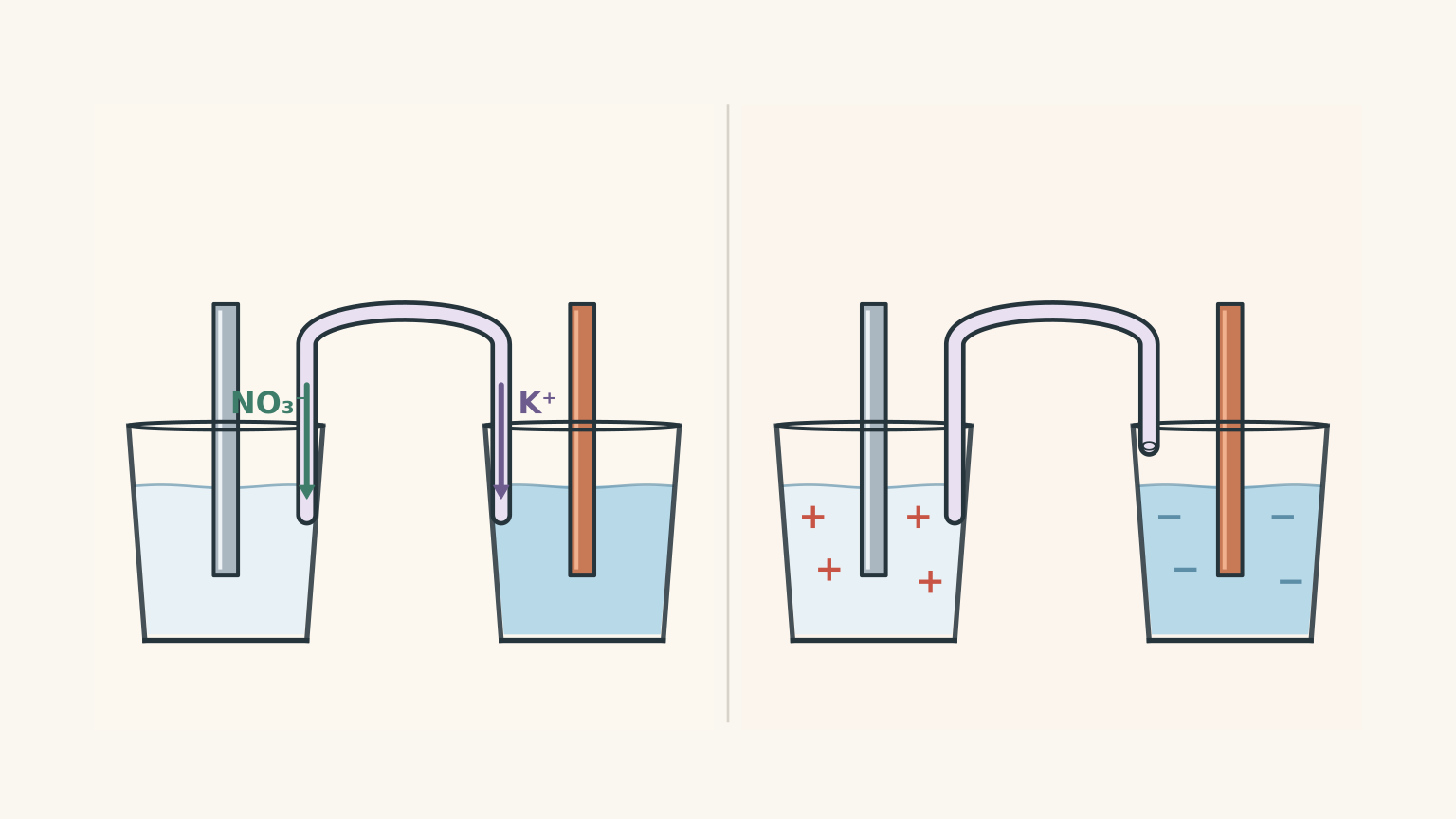
Due to technical limitations, this figure may display incorrectly or contain inaccuracies. Please check key details against your course materials.
01What actually happens when the salt bridge is removed?
Let’s follow a zinc-copper cell through a simple removal experiment.
The apparatus contains:
- A zinc strip immersed in zinc sulfate solution, \(\ce{ZnSO4(aq)}\).
- A copper strip immersed in copper sulfate solution, \(\ce{CuSO4(aq)}\).
- A potassium nitrate salt bridge connecting the two solutions.
- An external wire connecting the electrodes through an ammeter and a resistor.
The ammeter measures the current flowing through the external circuit.
Before removing the salt bridge
When the circuit operates, two electrode reactions occur.
At the zinc electrode, zinc atoms lose electrons and enter the solution as zinc ions:
\[ \ce{Zn(s) -> Zn^2+(aq) + 2e^-} \]
This is oxidation, so zinc is the anode.
At the copper electrode, copper ions gain electrons and form solid copper:
\[ \ce{Cu^2+(aq) + 2e^- -> Cu(s)} \]
This is reduction, so copper is the cathode.
Electrons travel through the external wire from the zinc anode to the copper cathode.
The solutions also need to maintain electrical neutrality. This is where the salt bridge becomes important.
As zinc ions enter the anode solution, nitrate ions from the bridge migrate towards the zinc half-cell.
At the cathode, copper ions are removed from the solution. Potassium ions migrate from the bridge towards the copper half-cell to compensate for the negative charge left behind by the remaining sulfate ions.
The two bridge ions therefore have different net migration directions:
- \(\mathrm{NO_{3}}^{-}\) moves towards the zinc anode.
- \(\mathrm{K}^{+}\) moves towards the copper cathode.
These ions do not supply electrons or participate in the overall redox reaction. Their role is to maintain charge balance.
Immediately after removing the salt bridge
Now remove the bridge while keeping the external wire connected.
Predict what happens to the two solutions.
The zinc electrode continues to have a tendency to oxidise, producing \(\mathrm{Zn}^{2+}\) ions. However, there is no longer a bridge supplying nitrate ions to compensate for the additional positive charge.
Meanwhile, copper ions can no longer be replenished by the ionic movement needed to maintain charge balance. As \(\mathrm{Cu}^{2+}\) ions are reduced, the remaining solution develops a small excess of negative charge.
The result is:
| Half-cell | What happens | Developing charge imbalance |
|---|---|---|
| Zinc anode | \(\mathrm{Zn}^{2+}\) ions are produced | Positive |
| Copper cathode | \(\mathrm{Cu}^{2+}\) ions are consumed | Negative |
These charge imbalances create an electric field that opposes further electron transfer.
Consequently, the current rapidly decreases.
One detail is worth remembering: the solutions do not need to become visibly charged. A very small charge separation is enough to strongly oppose continued operation.
What happens to the reactions?
The electrode reactions are not necessarily switched off at the exact instant the bridge is lifted.
A brief amount of further oxidation and reduction may occur while charge separation develops. However, the reactions quickly become strongly suppressed.
The cell can no longer sustain its normal redox reaction and current.
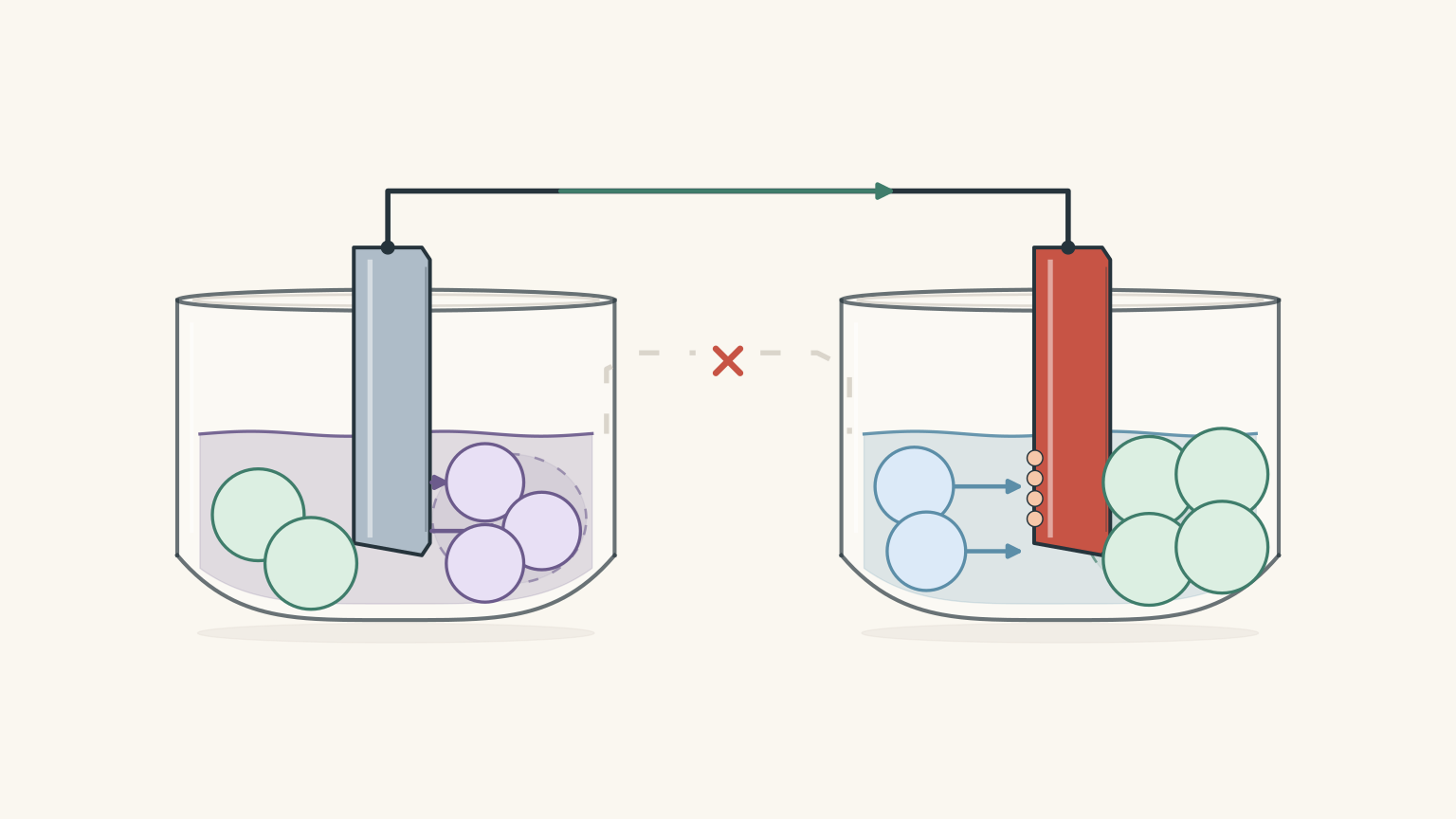
Due to technical limitations, this figure may display incorrectly or contain inaccuracies. Please check key details against your course materials.
02A removal experiment: what should the meters show?
A useful way to investigate this is to measure the current before and after removing the bridge.
Keep the external circuit unchanged throughout the experiment. Only remove the salt bridge.
For this demonstration, suppose the external circuit contains a \(200\ \Omega\) resistor. An ammeter is connected in series, and a voltmeter measures the potential difference across the resistor.
The following readings are illustrative rather than universal experimental results.
| Stage | Salt bridge | Measured current |
|---|---|---|
| Initial operation | Connected | 4.00 mA |
| 0.5 seconds after removal | Disconnected | 0.60 mA |
| 2.0 seconds after removal | Disconnected | 0.05 mA |
| After reinsertion | Reconnected | 3.80 mA |
Notice two things.
First, the current rapidly decreases when the bridge is removed, even though the external wire remains connected.
Second, reconnecting the bridge allows current to resume.
The current returns in the same direction because the zinc oxidation and copper reduction reactions remain favourable, assuming sufficient reactants are available.
It may not return to exactly its original value. Some reaction has already occurred, and the concentrations and electrode conditions may have changed slightly.
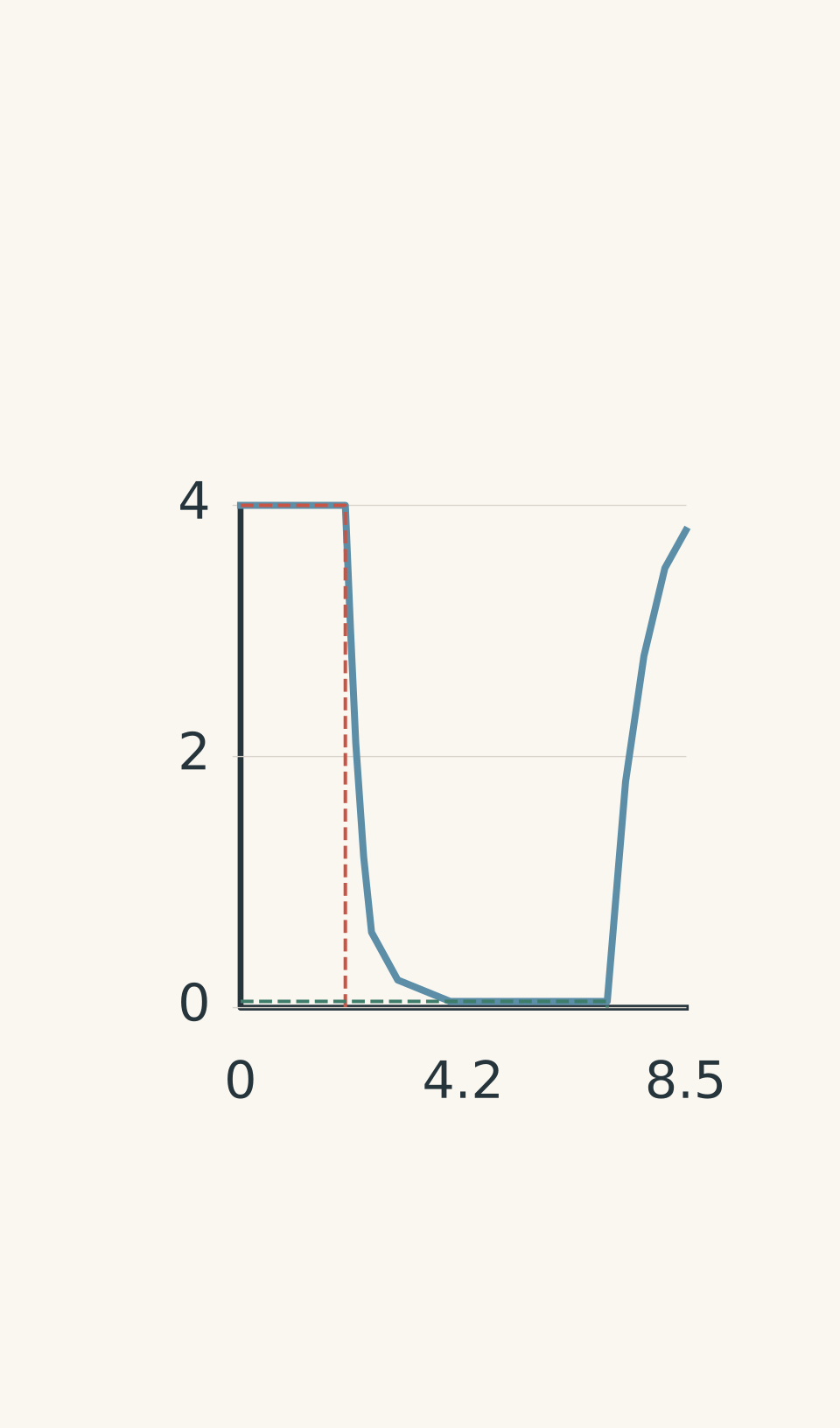
- Illustrative current
- Salt bridge removed
- Salt bridge reinserted
Due to technical limitations, this figure may display incorrectly or contain inaccuracies. Please check key details against your course materials.
Worked example: Calculate the voltage across the resistor
A zinc-copper galvanic cell is connected to a \(200\ \Omega\) resistor.
The ammeter records:
- \(4.00\ \mathrm{mA}\) before the salt bridge is removed.
- \(0.05\ \mathrm{mA}\) two seconds after removal.
Calculate the voltage across the resistor at each stage.
Step 1
Ohm’s law relates voltage, current, and resistance:
\[ V=IR \]
where:
- \(V\) is the voltage across the resistor, in volts (V).
- \(I\) is the current, in amperes (A).
- \(R\) is the resistance, in ohms (\(\Omega\)).
Step 2
Convert the current into amperes:
\[ 4.00\ \mathrm{mA}=0.00400\ \mathrm{A} \]
Substitute:
\[ \begin{aligned} V&=IR\\ &=0.00400\times200\\ &=0.800\ \mathrm{V} \end{aligned} \]
Step 3
Convert the new current:
\[ 0.05\ \mathrm{mA}=0.00005\ \mathrm{A} \]
Then:
\[ \begin{aligned} V&=IR\\ &=0.00005\times200\\ &=0.010\ \mathrm{V} \end{aligned} \]
Step 4
The voltage across the resistor falls from \(0.800\ \mathrm{V}\) to \(0.010\ \mathrm{V}\).
This confirms that the external circuit is no longer receiving a sustained current.
However, the \(0.010\ \mathrm{V}\) reading is the voltage across the external resistor. It is not the standard cell potential.
That distinction is particularly important when interpreting galvanic-cell experiments.
03Does removing the salt bridge make the cell voltage zero?
Not necessarily.
This is one of the easiest mistakes to make in electrochemistry questions.
You might reason that if the current stops, the cell must have zero voltage. But voltage and current describe different electrical properties.
Voltage describes the potential difference between two points. Current describes the rate at which electric charge flows.
A cell can have a potential difference without delivering a sustained current.
To understand what happens, we need to distinguish three quantities.
1. Standard cell potential, \(E^\circ_{\text{cell}}\)
The standard cell potential is calculated using standard reduction potentials.
For a galvanic cell:
\[ E^\circ_{\text{cell}} = E^\circ_{\text{cathode}} - E^\circ_{\text{anode}} \]
Both electrode potentials in this equation are reduction potentials.
For a zinc-copper cell, the standard reduction potentials are:
| Reduction half-equation | Standard reduction potential |
|---|---|
| \(\ce{Cu^2+(aq) + 2e^- -> Cu(s)}\) | \(+0.34\ \mathrm{V}\) |
| \(\ce{Zn^2+(aq) + 2e^- -> Zn(s)}\) | \(-0.76\ \mathrm{V}\) |
Copper has the more positive reduction potential, so it is the cathode. Zinc is the anode.
Substituting:
\[ \begin{aligned} E^\circ_{\text{cell}} &=+0.34-(-0.76)\\ &=\boxed{+1.10\ \mathrm{V}} \end{aligned} \]
The positive result indicates that the reaction is spontaneous under standard conditions.
For the familiar HSC convention, standard conditions use aqueous species at \(1.0\ \mathrm{mol\,L^{-1}}\), gases at \(100\ \mathrm{kPa}\), and a temperature of \(25^\circ\mathrm{C}\), with pure solids and liquids in their standard states.
The standard reduction potentials are referenced to the standard hydrogen electrode.
Removing the salt bridge does not change the tabulated standard reduction potentials or make \(E^\circ_{\text{cell}}\) become zero.
The standard potential describes the thermodynamic driving force under standard conditions. The salt bridge provides the ionic connection needed for the cell to operate.
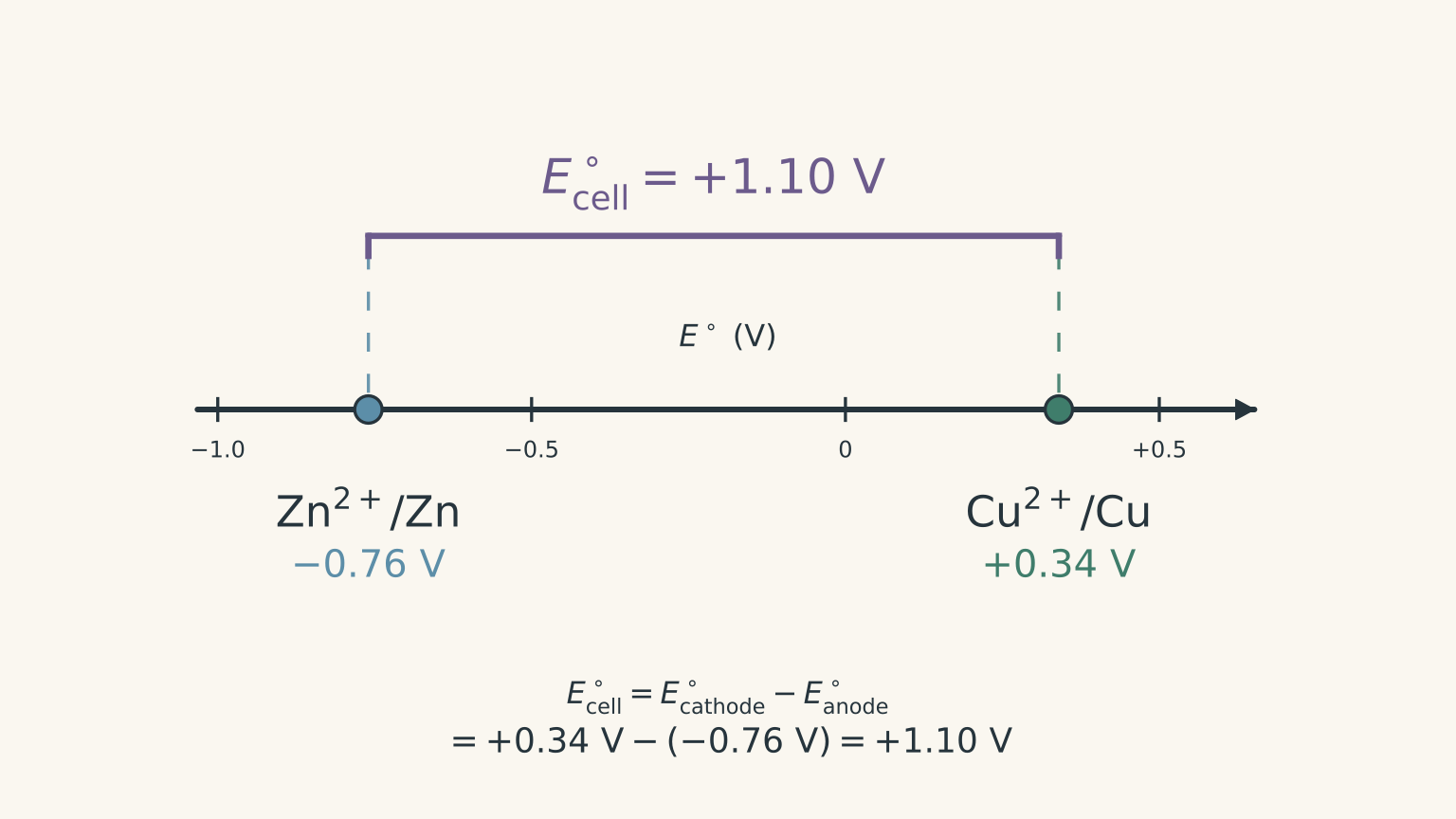
Due to technical limitations, this figure may display incorrectly or contain inaccuracies. Please check key details against your course materials.
2. Actual cell potential, \(E_{\text{cell}}\)
A real galvanic cell does not always operate under standard conditions.
Its actual potential depends on factors such as:
- The concentrations of the reacting ions.
- Temperature.
- Gas pressures, where relevant.
A voltmeter connected across a working cell with a high resistance draws very little current. This allows the potential difference to be measured with minimal disturbance.
The actual open-circuit voltage may therefore differ from the standard cell potential.
For example, a zinc-copper cell might have a measured open-circuit voltage of \(1.03\ \mathrm{V}\), even though its standard cell potential is \(1.10\ \mathrm{V}\).
There is no contradiction. The actual conditions are not necessarily standard conditions.
3. Terminal voltage under load
A different measurement is obtained when the cell supplies current to an external resistor or appliance.
This is the terminal voltage under load.
It can be lower than the open-circuit voltage because of internal resistance and other losses within the cell.
When the salt bridge is removed, the internal ionic resistance effectively becomes extremely large. The current falls towards zero, so the voltage across the external resistor also falls.
A high-resistance voltmeter connected directly across the electrodes may still display a voltage briefly after removal. The reading can drift as the electrode-solution interfaces respond to the developing charge separation.
That reading does not demonstrate that the cell is still delivering sustained current.
Compare the three quantities
| Quantity | Meaning | What happens when the bridge is removed? |
|---|---|---|
| \(E^\circ_{\text{cell}}\) | Standard cell potential | Its tabulated value is unchanged. |
| \(E_{\text{cell}}\) | Actual cell potential under the specified conditions | A stable measurement is no longer assured; a transient or drifting reading may occur. |
| \(V_{\text{terminal}}\) | Voltage across the external load | Falls towards zero as sustained current disappears. |
The key is to identify exactly what the question says is being measured.
Do not automatically treat every voltage reading as the standard cell potential.
04Worked example: Interpreting a voltmeter reading after removal
A zinc-copper cell has the following measurements:
- With the salt bridge connected, a high-resistance voltmeter reads \(1.03\ \mathrm{V}\).
- After removing the bridge, the current through the external load falls below the ammeter’s detection limit.
- The voltmeter briefly displays \(0.82\ \mathrm{V}\), before the reading begins to drift.
Explain why these observations are not contradictory.
Step 1
The \(1.03\ \mathrm{V}\) reading is the actual open-circuit potential under the cell’s operating conditions.
It does not have to equal the standard cell potential of \(1.10\ \mathrm{V}\).
Step 2
Removing the bridge interrupts the ionic connection between the half-cells.
Charge imbalances develop, opposing further oxidation and reduction. The cell can no longer sustain its normal current.
Step 3
The electrode-solution interfaces can retain a potential difference for a short time as charge separation develops.
Because the voltmeter has a high resistance, it draws very little current. It may therefore display a non-zero voltage even though the cell cannot deliver a sustained current through the external load.
The reading eventually drifts as the conditions at the interfaces change.
Step 4
The \(0.82\ \mathrm{V}\) reading is not evidence of continued normal cell operation, nor is it a new standard cell potential.
The cell has lost its continuous ionic pathway. The standard cell potential remains a reference value calculated from the standard reduction potentials.
05Questions and solutions
The following questions progress from identifying the immediate effects of bridge removal to interpreting experimental evidence and testing the limits of the usual galvanic-cell model.
Question 1
A galvanic cell consists of a zinc electrode in zinc sulfate solution and a copper electrode in copper sulfate solution. The two solutions are connected by a potassium nitrate salt bridge.
The external circuit contains a wire and an ammeter.
(a) Write the oxidation and reduction half-equations.
(b) Identify the anode and cathode, and state the direction of electron flow.
(c) State the net migration directions of the potassium and nitrate ions in the salt bridge.
(d) Predict what happens to the current if the salt bridge is removed while the external wire remains connected. Explain your answer.
Solution 1
The current rapidly falls towards zero because removing the salt bridge interrupts the internal ionic pathway. The zinc electrode is the anode, and the copper electrode is the cathode.
(a) Half-equations
At the zinc anode, oxidation occurs:
\[ \ce{Zn(s) -> Zn^2+(aq) + 2e^-} \]
At the copper cathode, reduction occurs:
\[ \ce{Cu^2+(aq) + 2e^- -> Cu(s)} \]
Zinc loses electrons, while copper ions gain electrons.
(b) Electrodes and electron flow
- Anode: zinc electrode, where oxidation occurs.
- Cathode: copper electrode, where reduction occurs.
- Electron flow: zinc to copper through the external wire.
For a galvanic cell, the anode is negative, and the cathode is positive.
(c) Ion migration
The nitrate ions migrate towards the zinc anode to balance the positive charge produced by zinc oxidation.
The potassium ions migrate towards the copper cathode to compensate for the negative charge left behind as copper ions are reduced.
(d) Removing the bridge
Without the salt bridge, these compensating ion movements can no longer occur between the half-cells.
The zinc solution develops a small positive charge imbalance, while the copper solution develops a small negative charge imbalance.
The resulting electric field opposes further electron transfer, causing the current to rapidly decrease.
The wire remains connected, but the cell cannot sustain current without an internal ionic pathway.
Question 2
A student wants to investigate whether removing a salt bridge causes the current in a galvanic cell to stop.
They perform two trials.
- In Trial A, they remove the salt bridge and open the external switch at the same time. The ammeter reading falls to zero.
- In Trial B, they keep the external switch closed and remove only the salt bridge. The current falls from \(3.5\ \mathrm{mA}\) to below \(0.1\ \mathrm{mA}\).
- They then reinsert the salt bridge without changing the external circuit. The current increases to \(3.2\ \mathrm{mA}\).
(a) Explain why Trial A does not establish that removing the salt bridge caused the current to stop.
(b) Explain why Trial B provides stronger evidence.
(c) Suggest why the current after reinserting the bridge is slightly lower than the original current.
(d) Identify one limitation of this investigation and suggest an improvement.
Solution 2
Trial B provides stronger evidence because it isolates the removal of the salt bridge as the variable responsible for the current decrease.
(a) Trial A
Trial A changes two conditions simultaneously:
- The ionic connection is interrupted by removing the bridge.
- The external electronic connection is interrupted by opening the switch.
Either change can stop the current.
Therefore, the experiment cannot establish which change caused the ammeter reading to fall.
(b) Trial B
In Trial B, the external circuit remains unchanged.
Only the salt bridge is removed. The current then falls below the meter’s detection limit.
This supports the conclusion that the ionic pathway is necessary for sustained current.
Reinserting the bridge restores the ionic connection, allowing current to flow again.
(c) Slightly lower restored current
The cell has already operated for a short period.
During this time, zinc ions have accumulated, and copper ions have been consumed. The concentrations of the reacting species may therefore have changed slightly.
Changes in electrode surfaces, temperature, and contact resistance can also affect the measured current.
The restored current does not need to match the original value exactly.
(d) Limitation and improvement
One limitation is that the experiment may not establish a precise time-dependent relationship between bridge removal and current decay.
An improvement would be to use a data logger to record current continuously before removal, during the interruption, and after reinsertion.
The temperature, solution concentrations, electrode surface areas, and external resistance should also be kept constant.
Repeated trials would improve confidence in the observations.
Question 3
An aluminium-silver galvanic cell contains aluminium metal in an aluminium nitrate solution and silver metal in a silver nitrate solution.
The two half-cells are connected by a potassium nitrate salt bridge.
The standard reduction potentials are:
| Reduction half-equation | \(E^\circ\) |
|---|---|
| \(\ce{Al^3+(aq) + 3e^- -> Al(s)}\) | \(-1.66\ \mathrm{V}\) |
| \(\ce{Ag+(aq) + e^- -> Ag(s)}\) | \(+0.80\ \mathrm{V}\) |
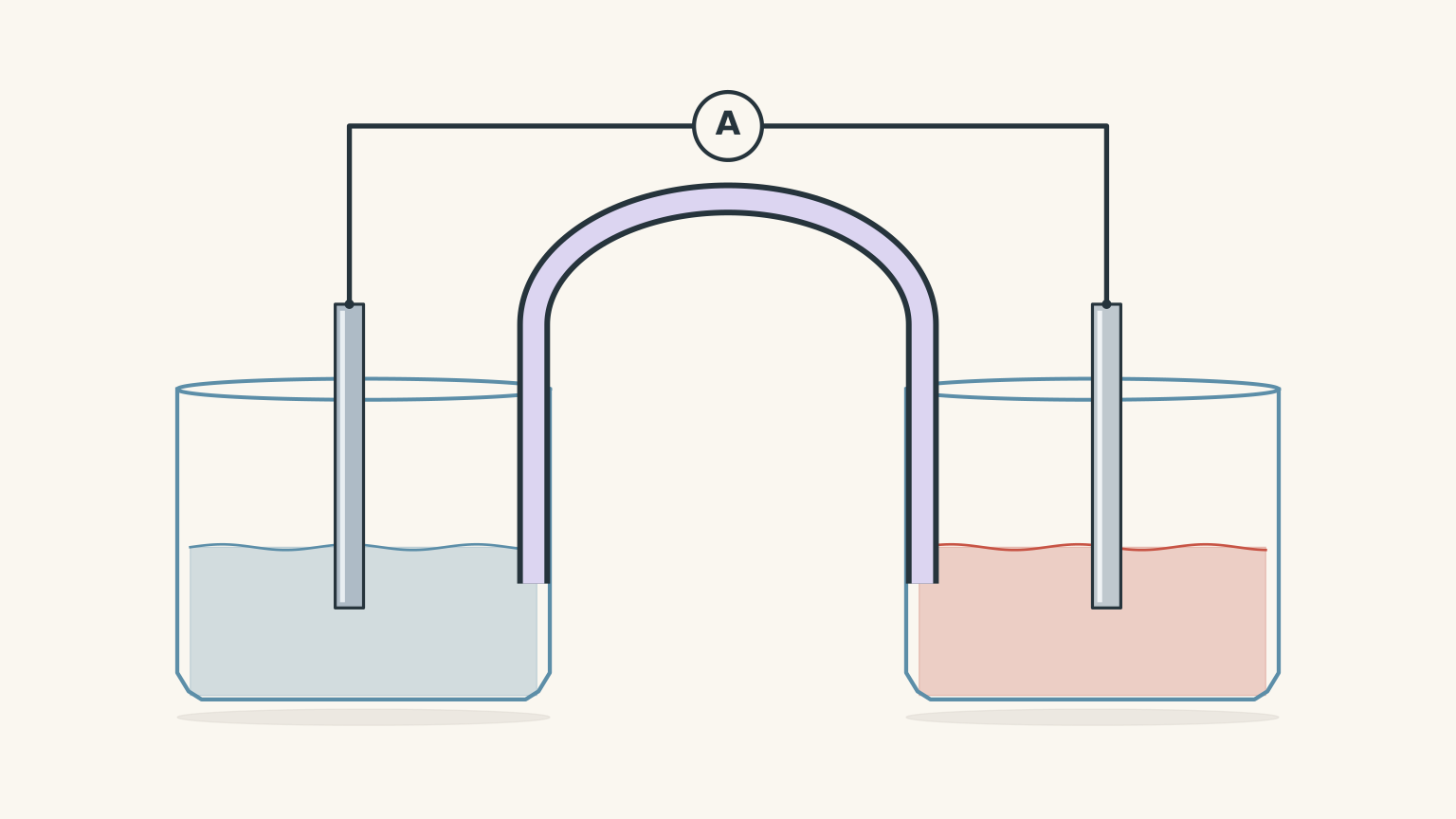
Due to technical limitations, this figure may display incorrectly or contain inaccuracies. Please check key details against your course materials.
(a) Identify the anode and cathode.
(b) Calculate the standard cell potential.
(c) Write the balanced overall redox equation.
(d) State the net migration directions of the potassium and nitrate ions.
(e) Explain what happens if the salt bridge is removed while the external circuit remains connected.
Solution 3
The aluminium electrode is the anode, the silver electrode is the cathode, and the standard cell potential is \(+2.46\ \mathrm{V}\).
(a) Identify the electrodes
Silver has the more positive standard reduction potential, so silver ions are more readily reduced.
Therefore:
- Aluminium is the anode, where oxidation occurs.
- Silver is the cathode, where reduction occurs.
(b) Calculate the standard cell potential
Use:
\[ E^\circ_{\text{cell}} = E^\circ_{\text{cathode}} - E^\circ_{\text{anode}} \]
Substitute the standard reduction potentials:
\[ \begin{aligned} E^\circ_{\text{cell}} &=+0.80-(-1.66)\\ &=\boxed{+2.46\ \mathrm{V}} \end{aligned} \]
The positive value indicates a spontaneous reaction under standard conditions.
Remember that both values used in the calculation are reduction potentials, even though aluminium undergoes oxidation.
(c) Overall redox equation
Aluminium oxidation:
\[ \ce{Al(s) -> Al^3+(aq) + 3e^-} \]
Silver reduction:
\[ \ce{Ag+(aq) + e^- -> Ag(s)} \]
Multiply the silver half-equation by three:
\[ \ce{3Ag+(aq) + 3e^- -> 3Ag(s)} \]
Add the two half-equations:
\[ \boxed{ \ce{Al(s) + 3Ag+(aq) -> Al^3+(aq) + 3Ag(s)} } \]
Three electrons are transferred for every aluminium atom oxidised.
(d) Ion migration
Nitrate ions, \(\mathrm{NO_{3}}^{-}\), migrate towards the aluminium anode.
This balances the positive charge introduced by the production of \(\mathrm{Al}^{3+}\) ions.
Potassium ions, \(\mathrm{K}^{+}\), migrate towards the silver cathode.
This compensates for the positive charge removed from the solution as \(\mathrm{Ag}^{+}\) ions are reduced.
(e) Removing the bridge
Removing the bridge interrupts the ionic pathway.
Aluminium oxidation produces positive ions in the anode solution, while silver reduction removes positive ions from the cathode solution.
The resulting charge imbalances oppose further electron transfer.
The current rapidly falls towards zero, even though the calculated standard cell potential remains \(+2.46\ \mathrm{V}\).
Question 4
A zinc-copper galvanic cell is operating with a salt bridge connected.
A high-resistance voltmeter measures an actual open-circuit potential of \(1.03\ \mathrm{V}\).
The salt bridge is then removed.
The following observations are recorded:
- The ammeter in a separate loaded-cell test indicates that the current falls below its detection limit.
- The high-resistance voltmeter briefly displays \(0.82\ \mathrm{V}\).
- Over the next few seconds, the voltmeter reading begins to drift.
A student makes two claims:
- The cell must still be operating because the voltmeter displays a non-zero voltage.
- The standard cell potential has changed from \(1.10\ \mathrm{V}\) to \(0.82\ \mathrm{V}\).
Evaluate both claims.
Solution 4
Both claims are incorrect. A temporary non-zero voltage does not demonstrate sustained cell operation, and the standard cell potential does not change simply because the salt bridge is removed.
Claim 1: The cell must still be operating.
This confuses the existence of a potential difference with the ability to deliver sustained current.
The high-resistance voltmeter draws very little current. It can detect a potential difference even when the cell is unable to maintain a normal current through an external load.
After the bridge is removed, charge separation develops at the electrode-solution interfaces.
A temporary voltage reading can persist while these conditions change.
The falling ammeter reading shows that the cell is no longer delivering sustained current.
Claim 2: The standard cell potential has changed.
The standard cell potential is calculated using standard reduction potentials:
\[ \begin{aligned} E^\circ_{\text{cell}} &=E^\circ_{\text{cathode}} -E^\circ_{\text{anode}}\\ &=+0.34-(-0.76)\\ &=\boxed{+1.10\ \mathrm{V}} \end{aligned} \]
The standard reduction potentials have not changed because the bridge was removed.
The \(0.82\ \mathrm{V}\) reading is a temporary measured potential under the altered conditions. It is not the standard cell potential.
Overall conclusion
The current can fall to effectively zero while a voltmeter briefly displays a non-zero potential difference.
A galvanic cell needs both an external electronic pathway and an internal ionic pathway to sustain normal operation.
Question 5
An experimental galvanic cell contains two compartments separated by a potassium nitrate-saturated porous glass partition, called a porous frit.
A second ionic connection is also present: a removable U-shaped potassium nitrate salt bridge connecting the same two solutions.
The zinc and copper electrodes are connected through an external circuit containing an ammeter and a resistor.
The following observations are recorded:
| Experimental stage | Ionic connections | Current |
|---|---|---|
| Initial operation | Porous frit and U-tube bridge | 4.0 mA |
| U-tube bridge removed | Porous frit only | 3.6 mA |
| Porous frit sealed with an impermeable film | No ionic connection | Below 0.05 mA |
The external wire, electrodes, and solutions remain in place throughout.
After the porous frit is sealed, a high-resistance voltmeter briefly displays \(0.90\ \mathrm{V}\) before its reading drifts.
Assume the porous frit remains fully wetted and contains mobile potassium and nitrate ions until it is sealed. Both ionic pathways initially conduct, and removing the U-tube bridge increases the total internal resistance.
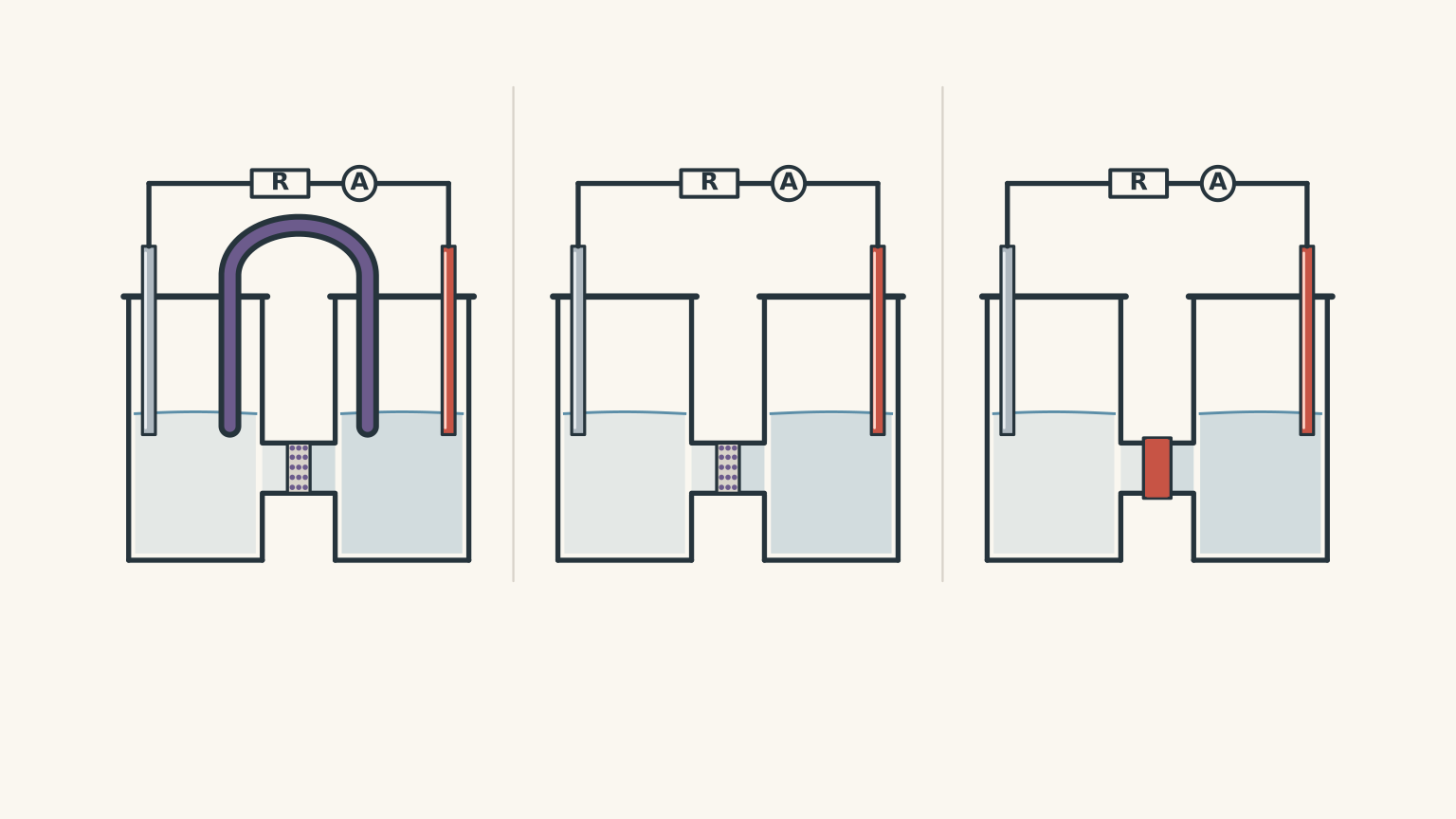
Due to technical limitations, this figure may display incorrectly or contain inaccuracies. Please check key details against your course materials.
(a) Explain why removing the U-tube salt bridge does not stop the current completely.
(b) State the net migration directions of the potassium and nitrate ions through the remaining porous frit.
(c) Explain why the current falls below the detection limit when the porous frit is sealed.
(d) Explain why the voltmeter can briefly display \(0.90\ \mathrm{V}\) after the current has stopped.
(e) Does the standard cell potential change when both ionic pathways are blocked? Explain what this experiment reveals about the actual function of a salt bridge.
Solution 5
The current continues after removing the U-tube bridge because the porous frit provides an alternative ionic pathway. The cell does not require a particular glass tube; it requires a continuous pathway for ion movement between the half-cells.
(a) Why current continues after U-tube removal
Initially, there are two parallel ionic pathways:
- The U-shaped salt bridge.
- The potassium nitrate-saturated porous frit.
Removing the U-tube eliminates one pathway, but the porous frit still allows ions to move between the two compartments.
Therefore, the internal ionic circuit remains complete.
The current decreases from \(4.0\ \mathrm{mA}\) to \(3.6\ \mathrm{mA}\) because removing one conducting pathway increases the total internal resistance.
However, the remaining pathway allows sustained operation.
(b) Ion migration through the porous frit
The net migration directions remain the same as they were through the original salt bridge.
Potassium ions migrate towards the copper cathode, where \(\mathrm{Cu}^{2+}\) ions are consumed.
Nitrate ions migrate towards the zinc anode, where \(\mathrm{Zn}^{2+}\) ions are produced.
The porous frit allows these ions to maintain approximate electrical neutrality in the two compartments.
(c) Why sealing the frit stops the current
Once the frit is sealed, there is no remaining ionic pathway between the half-cells.
The zinc anode continues to have a tendency to produce \(\mathrm{Zn}^{2+}\) ions, while the copper cathode consumes \(\mathrm{Cu}^{2+}\) ions.
However, charge imbalances develop because ions can no longer migrate between the compartments.
These imbalances oppose further electrode reactions, causing the current to fall below the ammeter’s detection limit.
(d) Why the voltmeter still displays a voltage
The brief \(0.90\ \mathrm{V}\) reading does not mean the cell is delivering sustained current.
A potential difference can persist temporarily at the electrode-solution interfaces even after the ionic pathway is interrupted.
The high-resistance voltmeter draws very little current, so it can detect this temporary potential difference.
As charge distribution at the interfaces changes, the reading drifts.
This is not evidence of a functioning galvanic cell under sustained load.
(e) Does the standard cell potential change?
No. The standard cell potential remains:
\[ E^\circ_{\text{cell}}=+1.10\ \mathrm{V} \]
for the zinc-copper reaction under standard conditions.
Neither the removal of the U-tube nor the sealing of the porous frit changes the tabulated standard reduction potentials.
The experiment reveals an important distinction: a salt bridge is one way of providing an ionic pathway, not the only possible way.
A porous separator, suitable electrolyte connection, or another ion-conducting arrangement can perform the same essential function.
The cell stops sustaining current only when its internal ionic pathway is interrupted and no alternative connection remains.
06The key distinction to remember
When a question asks what happens if a salt bridge is removed, work through three separate ideas:
- Ion movement: The bridge normally allows ions to migrate and maintain charge balance between the half-cells.
- Current: Removing the only ionic connection causes charge imbalances to develop, rapidly suppressing the electrode reactions and stopping sustained current.
- Potential: The standard cell potential does not become zero simply because the bridge is removed. A temporary or drifting voltmeter reading may remain, but it does not prove sustained cell operation.
The most important qualification is that removing a salt bridge stops the cell only when it removes the last effective ionic connection.
For a broader explanation of why galvanic cells need this internal pathway, including the roles of the anode, cathode, and salt bridge ions, see Why a Galvanic Cell Needs a Salt Bridge to Keep Current Flowing.
The next useful step is to apply the same reasoning to concentration cells and other galvanic-cell arrangements, where the direction of ion movement and the conditions determining the actual cell potential become especially important.