
What Happens Immediately When You Add Reactant to Equilibrium?
Adding reactant changes concentrations and reaction rates before a new equilibrium is established. Learn what happens immediately, how forward and reverse rates respond, and how to predict the direction of the shift using the reaction quotient, with worked HSC Chemistry examples.
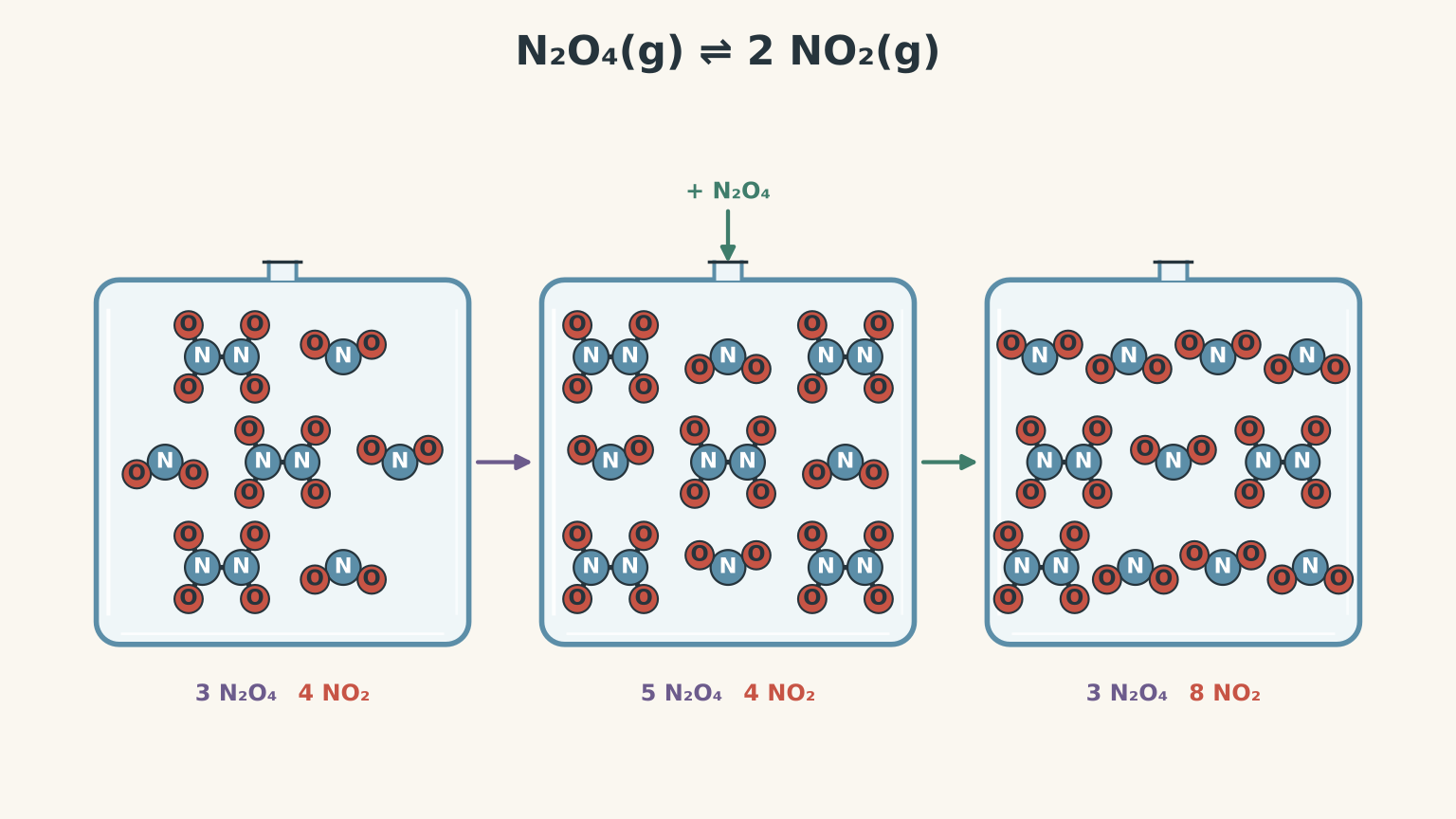
A rigid gas cell contains a mixture of nitrogen tetroxide and nitrogen dioxide at equilibrium:
\[ \ce{N2O4(g) <=> 2NO2(g)} \]
You inject more \(\ce{N2O4}\) into the cell without changing its volume or temperature.
What happens first? The concentration of \(\ce{N2O4}\) increases immediately, but the concentration of \(\ce{NO2}\) does not. The forward reaction rate increases, while the reverse reaction rate initially remains unchanged.
The forward reaction therefore becomes faster than the reverse reaction. More \(\ce{NO2}\) forms until the two rates become equal again.
The important distinction is that adding reactant changes the concentration first. The resulting imbalance in reaction rates causes the subsequent equilibrium shift.
Due to technical limitations, this figure may display incorrectly or contain inaccuracies. Please check key details against your course materials.
01What changes immediately after adding reactant?
We need to separate two events that happen very close together:
- The physical addition of more reactant to the system.
- The chemical reaction that follows because the forward and reverse rates are no longer equal.
Consider the nitrogen tetroxide equilibrium again.
Before adding anything, the system is at dynamic equilibrium. The forward and reverse reactions continue, but they occur at equal rates.
\[ v_{\mathrm{forward}}=v_{\mathrm{reverse}} \]
Here, \(v_{\mathrm{forward}}\) and \(v_{\mathrm{reverse}}\) represent the forward and reverse reaction rates.
Now inject additional \(\ce{N2O4}\).
Immediately after mixing, three things are true:
- The concentration of \(\ce{N2O4}\) increases.
- The concentration of \(\ce{NO2}\) remains unchanged.
- The forward reaction rate increases, while the reverse reaction rate initially remains unchanged.
Therefore:
\[ v_{\mathrm{forward}}>v_{\mathrm{reverse}} \]
The net reaction proceeds forwards, producing more nitrogen dioxide.
Why doesn’t the reverse rate increase immediately?
The reverse reaction is:
\[ \ce{2NO2(g) -> N2O4(g)} \]
Its reactant is \(\ce{NO2}\).
Adding \(\ce{N2O4}\) does not immediately change the concentration of \(\ce{NO2}\). There are no additional nitrogen dioxide molecules available for the reverse reaction at that instant.
Consequently, the reverse rate initially stays the same.
This is the detail that students often miss. Adding a reactant does not automatically increase both reaction rates.
02Follow the experiment: what would we actually observe?
We can investigate this change using a controlled gas-phase experiment.
The aim is to distinguish the immediate effect of injecting reactant from the chemical reaction that follows.
Setting up the apparatus
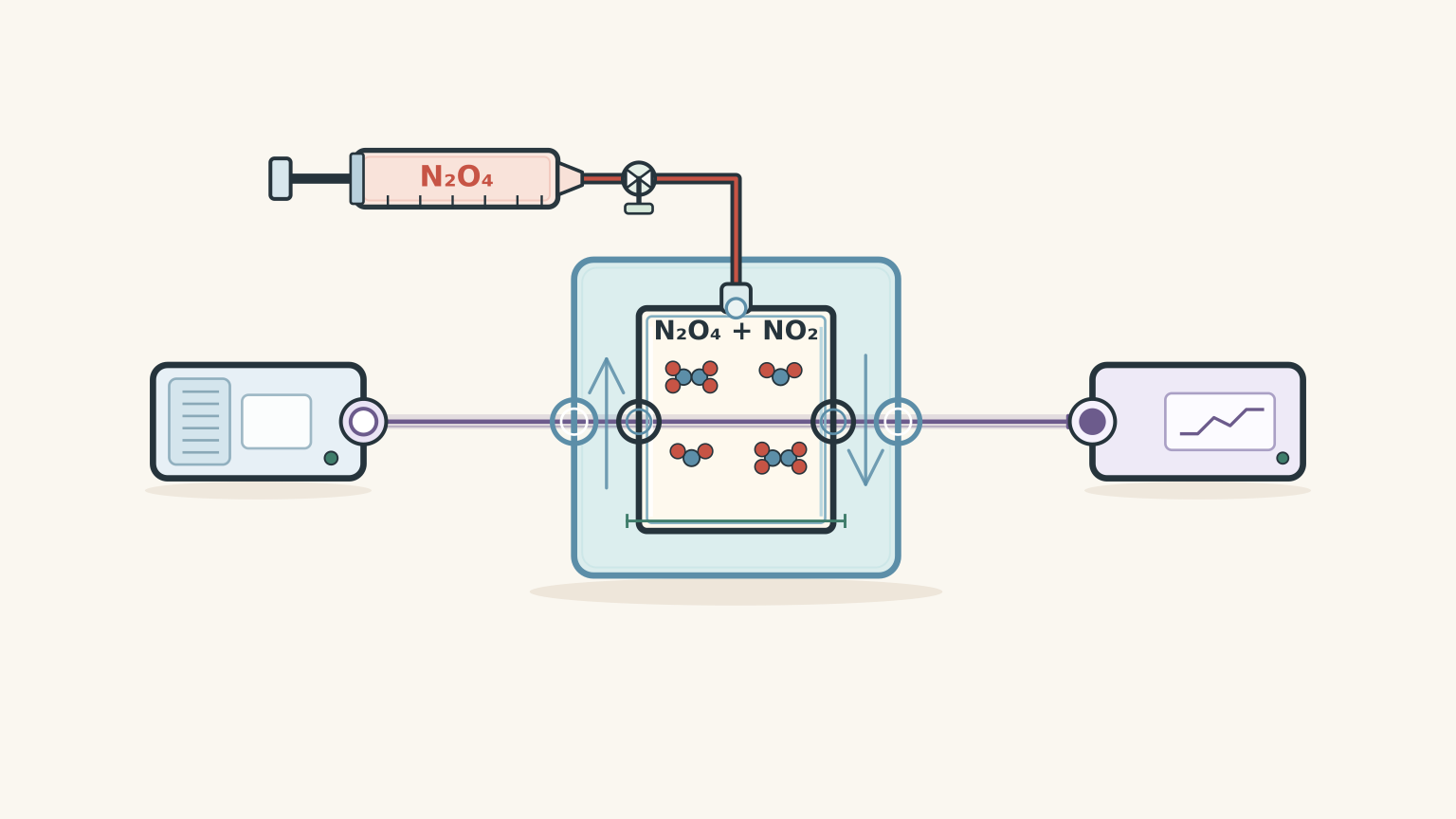
Imagine a rigid gas cell containing an equilibrium mixture of \(\ce{N2O4}\) and \(\ce{NO2}\).
The apparatus consists of:
- A rigid, sealed gas cell with a fixed volume.
- A gas-tight syringe containing additional \(\ce{N2O4}\).
- A valve connecting the syringe to the cell.
- A temperature-controlled jacket surrounding the cell.
- A spectrophotometer that measures the concentration of \(\ce{NO2}\) using its light absorption.
The syringe is initially outside the reaction system. The gases inside the cell form the reacting mixture.
When the valve opens, additional \(\ce{N2O4}\) enters the cell. Once the valve closes, the reaction system is closed to further matter transfer.
The fixed volume and temperature are important. They allow us to investigate the effect of adding reactant without simultaneously changing the volume or temperature.
Due to technical limitations, this figure may display incorrectly or contain inaccuracies. Please check key details against your course materials.
What should the experiment show?
The spectrophotometer measures the absorption of light by \(\ce{NO2}\).
If the added \(\ce{N2O4}\) immediately produces extra \(\ce{NO2}\), we would expect the absorbance to jump at the instant of injection.
But that is not what the rate model predicts.
Immediately after injection, the concentration of \(\ce{NO2}\) is unchanged. Its absorbance should therefore initially remain constant.
As the forward reaction proceeds, more \(\ce{NO2}\) forms, so its absorbance increases. Eventually, the absorbance reaches a new constant value.
Consider the following illustrative data.
| Time after injection | \([\ce{NO2}]\) (mol L⁻¹) | Absorbance |
|---|---|---|
| Before injection | 0.0100 | 0.500 |
| Immediately after | 0.0100 | 0.500 |
| 10 s | 0.0110 | 0.550 |
| 20 s | 0.0118 | 0.590 |
| 30 s | 0.0120 | 0.600 |
| 40 s | 0.0120 | 0.600 |
These are illustrative values, not measurements from a reported experiment.
Assume the calibration relationship is:
\[ A=50.0[\ce{NO2}] \]
where \(A\) is dimensionless absorbance and the calibration factor has units of \(\mathrm{L\,mol^{-1}}\).
The data show two separate events:
- No immediate increase in the concentration of \(\ce{NO2}\).
- A gradual increase as the forward reaction produces more \(\ce{NO2}\).
The final plateau indicates that the concentration has become constant again. It does not mean that the reactions have stopped.
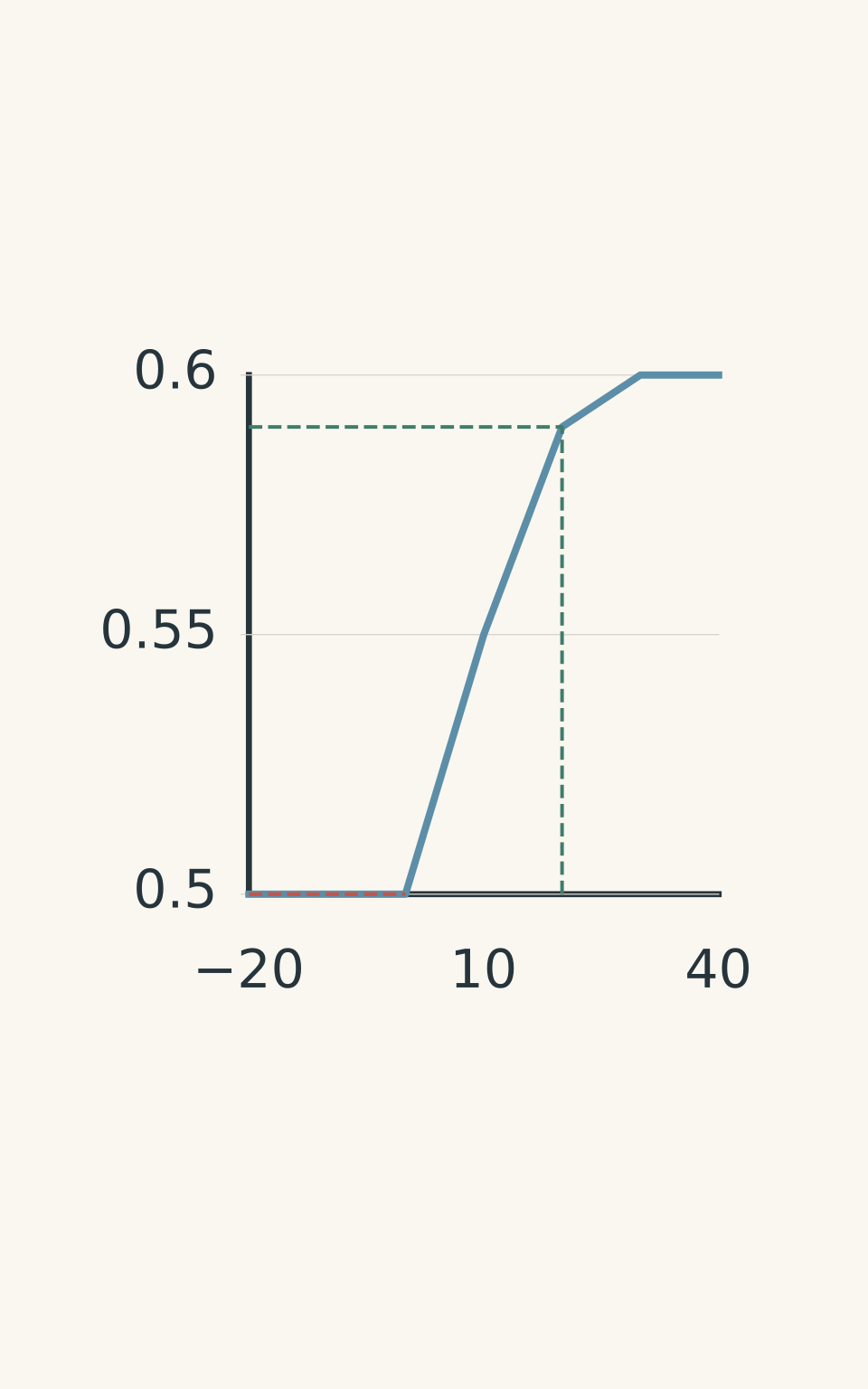
- NO₂ absorbance
- Injection (t = 0): NO₂ unchanged
- Forward reaction: NO₂ increases
Due to technical limitations, this figure may display incorrectly or contain inaccuracies. Please check key details against your course materials.
A small measurement calculation
We can estimate the average rate of formation of \(\ce{NO2}\) over the first 10 seconds.
The absorbance increases from 0.500 to 0.550.
Using the calibration relationship:
\[ \Delta[\ce{NO2}] =\frac{\Delta A}{50.0} \]
\[ =\frac{0.550-0.500}{50.0} \]
\[ =0.00100\ \mathrm{mol\,L^{-1}} \]
The average rate of formation of nitrogen dioxide is:
\[ \frac{\Delta[\ce{NO2}]}{\Delta t} =\frac{0.00100}{10} \]
\[ =1.00\times10^{-4}\ \mathrm{mol\,L^{-1}\,s^{-1}} \]
However, the balanced equation produces two moles of \(\ce{NO2}\) for every mole of \(\ce{N2O4}\) consumed.
Therefore, the average net forward reaction rate is:
\[ v_{\mathrm{net}} =\frac{1}{2}\frac{\Delta[\ce{NO2}]}{\Delta t} \]
\[ =5.00\times10^{-5}\ \mathrm{mol\,L^{-1}\,s^{-1}} \]
This is the average net rate over the first 10 seconds, not the instantaneous rate immediately after injection.
Why does the experimental design matter?
Suppose we used a flexible container instead of a rigid gas cell.
Adding gas could expand the container, changing the concentrations of the existing gases as well as the concentration of the added reactant.
We would no longer be isolating the effect of reactant addition.
The rigid cell avoids this problem. The temperature-controlled jacket also prevents temperature changes from altering the equilibrium constant.
The experiment is an idealised model of a controlled investigation. Its predicted observations support the distinction between the initial concentration change and the subsequent chemical response.
03How do the forward and reverse rates change over time?
We can now describe the entire process using reaction rates.
For the elementary reversible reaction:
\[ \ce{N2O4(g) <=> 2NO2(g)} \]
the rate expressions are:
\[ v_f=k_f[\ce{N2O4}] \]
\[ v_r=k_r[\ce{NO2}]^2 \]
where:
- \(v_f\) is the forward reaction rate.
- \(v_r\) is the reverse reaction rate.
- \(k_f\) is the forward rate constant.
- \(k_r\) is the reverse rate constant.
- Square brackets represent concentration in \(\mathrm{mol\,L^{-1}}\).
These rate expressions apply to the elementary reversible model used here. For a more complicated reaction, you cannot automatically obtain its rate law from the coefficients in the balanced equation.
Before adding reactant
The system is at equilibrium:
\[ v_f=v_r \]
Both reactions are occurring, but there is no net change in concentration.
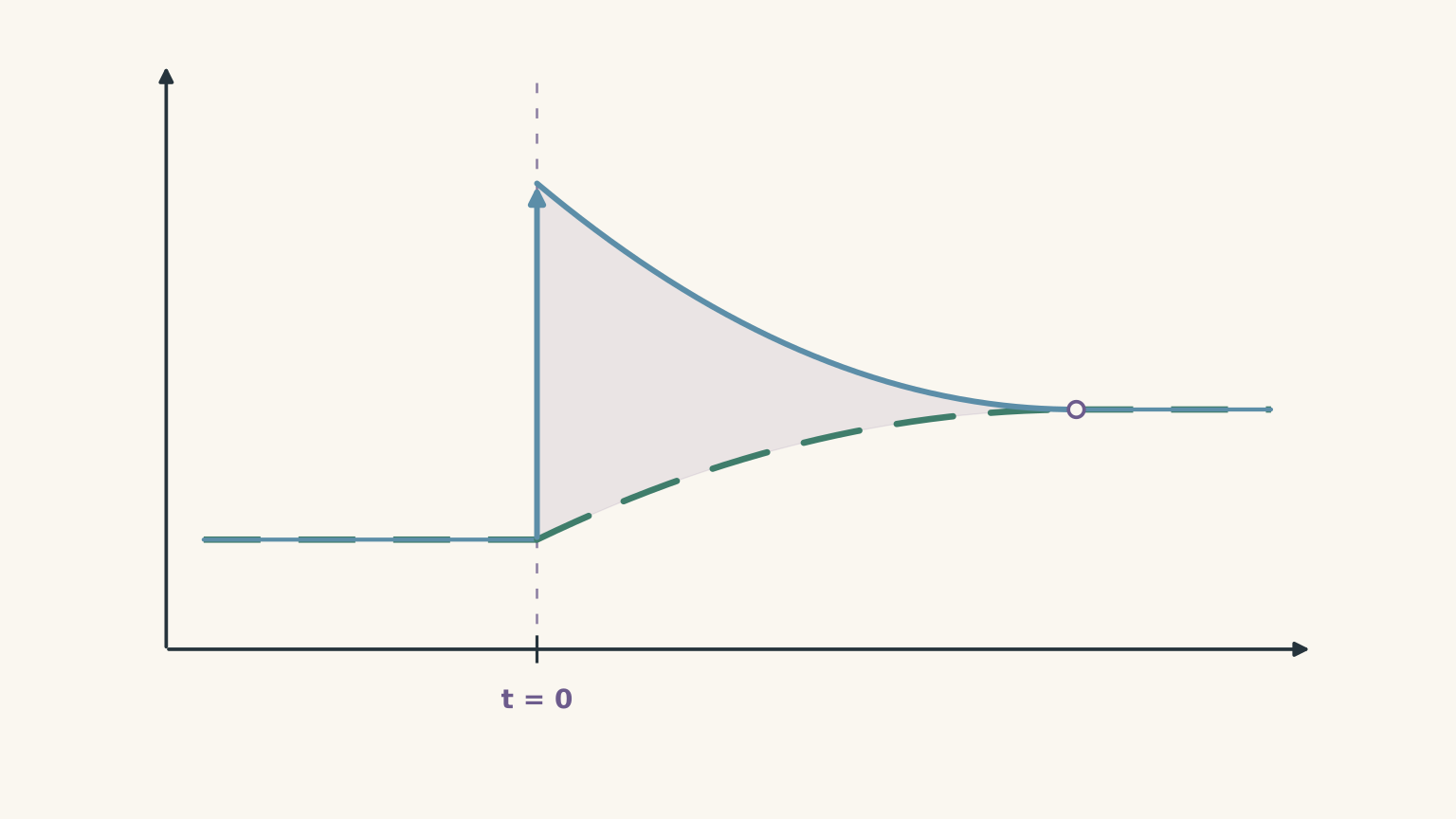
Immediately after adding reactant
The concentration of \(\ce{N2O4}\) increases.
Since the forward rate depends on \([\ce{N2O4}]\), the forward rate increases.
The concentration of \(\ce{NO2}\) has not changed, so the reverse rate remains unchanged.
Therefore:
\[ v_f>v_r \]
During the adjustment
The forward reaction consumes \(\ce{N2O4}\) and produces \(\ce{NO2}\).
As this happens:
- \([\ce{N2O4}]\) decreases from its post-addition value.
- \([\ce{NO2}]\) increases.
- The forward reaction rate decreases.
- The reverse reaction rate increases.
The difference between the two rates gradually becomes smaller.
At the new equilibrium
Eventually:
\[ v_f=v_r \]
The concentrations become constant again.
The system has established a new dynamic equilibrium.
Importantly, the final common reaction rate does not have to equal the original equilibrium rate.
Due to technical limitations, this figure may display incorrectly or contain inaccuracies. Please check key details against your course materials.
04Check the direction using the reaction quotient
There is another way to confirm the direction of the reaction.
The reaction quotient, \(Q_c\), tells us whether the current mixture has the correct concentration ratio for equilibrium.
For:
\[ \ce{N2O4(g) <=> 2NO2(g)} \]
the reaction quotient is:
\[ Q_c=\frac{[\ce{NO2}]^2}{[\ce{N2O4}]} \]
At equilibrium:
\[ Q_c=K_c \]
where \(K_c\) is the equilibrium constant at the given temperature.
After adding \(\ce{N2O4}\), the denominator increases while the numerator initially remains unchanged.
Therefore, \(Q_c\) decreases.
This gives:
\[ Q_c<K_c \]
The forward reaction is favoured until the reaction quotient returns to the equilibrium constant.
The important comparison is:
| Reaction quotient | Net reaction |
|---|---|
| \(Q_c<K_c\) | Forward reaction |
| \(Q_c>K_c\) | Reverse reaction |
| \(Q_c=K_c\) | Equilibrium |
Notice that \(K_c\) has not changed.
Adding reactant changes the current concentrations and therefore changes \(Q_c\). It does not change \(K_c\), provided the temperature remains constant.
For a broader treatment of the distinction between an instantaneous concentration change and a later equilibrium shift, see Instantaneous Concentration Changes vs Equilibrium Shifts.
05Worked examples
Worked example: Compare the rates immediately after adding reactant
An equilibrium mixture contains nitrogen tetroxide and nitrogen dioxide at constant temperature and volume.
Initially:
\[ [\ce{N2O4}]=0.0200\ \mathrm{mol\,L^{-1}} \]
\[ [\ce{NO2}]=0.0100\ \mathrm{mol\,L^{-1}} \]
Additional \(\ce{N2O4}\) is injected, increasing its concentration to \(0.0300\ \mathrm{mol\,L^{-1}}\).
Assuming the elementary rate expressions given earlier, determine how the forward and reverse reaction rates change immediately after injection.
Step 1
Before injection, the system is at equilibrium.
Therefore:
\[ v_f=v_r=v_0 \]
Here, \(v_0\) represents the original equilibrium rate.
Step 2
The forward rate is proportional to the concentration of \(\ce{N2O4}\).
The concentration increases from 0.0200 to 0.0300 mol L⁻¹.
The rate increases by a factor of:
\[ \frac{0.0300}{0.0200}=1.50 \]
Therefore:
\[ v_f=1.50v_0 \]
The forward rate increases by 50%.
Step 3
The reverse rate depends on the concentration of \(\ce{NO2}\):
\[ v_r=k_r[\ce{NO2}]^2 \]
The concentration of \(\ce{NO2}\) has not changed immediately after injection.
Therefore:
\[ v_r=v_0 \]
The reverse rate remains unchanged.
Step 4
Immediately after injection:
\[ v_f=1.50v_0 \]
\[ v_r=v_0 \]
Therefore:
\[ v_f>v_r \]
The net reaction proceeds forwards, producing more \(\ce{NO2}\).
The key result is that the forward rate increases immediately, while the reverse rate only increases later as the concentration of its reactant, \(\ce{NO2}\), rises.
Worked example: Calculate the new equilibrium concentrations
Using the same system, calculate the concentrations of \(\ce{N2O4}\) and \(\ce{NO2}\) at the new equilibrium.
The original equilibrium concentrations were:
\[ [\ce{N2O4}]=0.0200\ \mathrm{M} \]
\[ [\ce{NO2}]=0.0100\ \mathrm{M} \]
The added reactant increases the immediate concentration of \(\ce{N2O4}\) to 0.0300 M.
The equilibrium constant is unchanged.
Step 1
For this reaction:
\[ K_c=\frac{[\ce{NO2}]^2}{[\ce{N2O4}]} \]
Substituting the original equilibrium concentrations:
\[ K_c=\frac{(0.0100)^2}{0.0200} \]
\[ K_c=0.00500\ \mathrm{mol\,L^{-1}} \]
Step 2
The reaction proceeds forwards, so \(\ce{N2O4}\) decreases and \(\ce{NO2}\) increases.
Let \(x\) represent the concentration of \(\ce{N2O4}\) that decomposes.
\[ \ce{N2O4(g) <=> 2NO2(g)} \]
| Species | Immediately after addition | Change | New equilibrium |
|---|---|---|---|
| \(\ce{N2O4}\) | 0.0300 | \(-x\) | \(0.0300-x\) |
| \(\ce{NO2}\) | 0.0100 | \(+2x\) | \(0.0100+2x\) |
The coefficient of 2 in front of \(\ce{NO2}\) means its concentration increases by \(2x\).
Step 3
At the new equilibrium:
\[ K_c=\frac{[\ce{NO2}]^2}{[\ce{N2O4}]} \]
Substitute the equilibrium concentrations:
\[ 0.00500= \frac{(0.0100+2x)^2}{0.0300-x} \]
Multiply both sides:
\[ 0.000150-0.00500x =(0.0100+2x)^2 \]
Expand:
\[ 0.000150-0.00500x =0.000100+0.0400x+4x^2 \]
Rearrange:
\[ 4x^2+0.0450x-0.0000500=0 \]
Step 4
Using the quadratic formula:
\[ x=\frac{-b\pm\sqrt{b^2-4ac}}{2a} \]
The positive solution is:
\[ x=0.001019\ \mathrm{mol\,L^{-1}} \]
The negative solution is rejected because it would represent the opposite direction of concentration change.
Step 5
For nitrogen tetroxide:
\[ [\ce{N2O4}]=0.0300-0.001019 \]
\[ \boxed{[\ce{N2O4}]=0.02898\ \mathrm{M}} \]
For nitrogen dioxide:
\[ [\ce{NO2}]=0.0100+2(0.001019) \]
\[ \boxed{[\ce{NO2}]=0.01204\ \mathrm{M}} \]
Both concentrations are greater than their original equilibrium values.
The important observation is that the forward reaction has consumed some of the added \(\ce{N2O4}\), but it has not consumed all of it.
At the new equilibrium, the forward and reverse rates are equal again, and \(K_c\) remains unchanged.
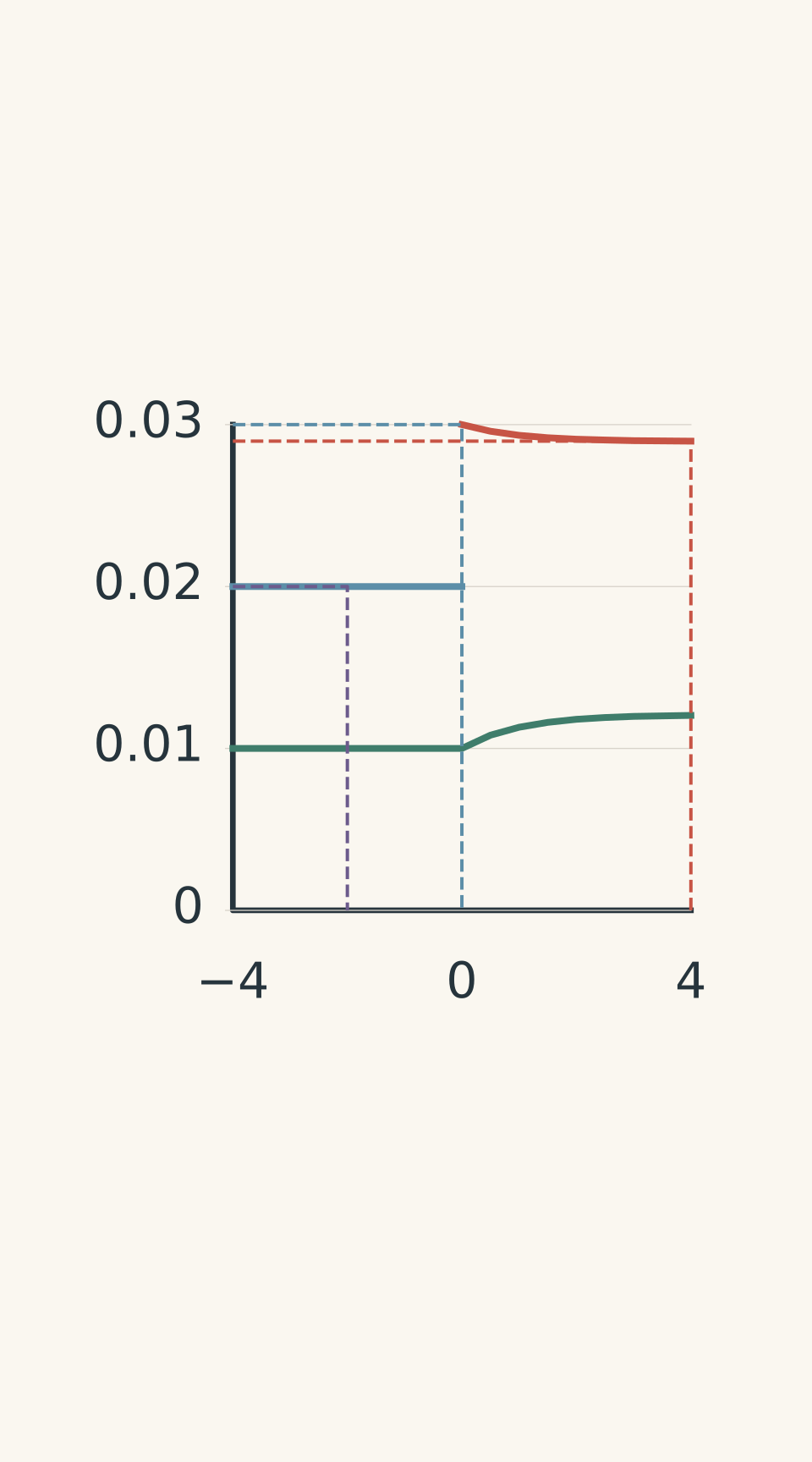
- N₂O₄ before injection (0.0200 M)
- N₂O₄ after injection (0.0300 → 0.02898 M)
- NO₂ (0.0100 → 0.01204 M)
- Original equilibrium
- Injection instant
- New equilibrium
Due to technical limitations, this figure may display incorrectly or contain inaccuracies. Please check key details against your course materials.
06When adding reactant does not produce the simple result
The examples above assume a rigid container with constant volume.
That assumption matters.
If you add an aqueous reactant solution, you also introduce solvent. The total volume increases, which can immediately dilute every dissolved species.
Adding more moles of a reactant does not necessarily mean its concentration increases.
Remember:
\[ c=\frac{n}{V} \]
where:
- \(c\) is concentration in \(\mathrm{mol\,L^{-1}}\).
- \(n\) is the amount of substance in mol.
- \(V\) is the total solution volume in L.
For an aqueous equilibrium, you should calculate the new concentrations after mixing before deciding which direction the reaction proceeds.
A contrasting case: Adding product instead
Return to the nitrogen dioxide equilibrium:
\[ \ce{N2O4(g) <=> 2NO2(g)} \]
What happens if we add \(\ce{NO2}\) instead?
This time, the concentration of the product increases immediately.
The reverse reaction uses \(\ce{NO2}\) as its reactant, so its rate increases.
The forward reaction rate initially remains unchanged because the concentration of \(\ce{N2O4}\) has not changed.
Therefore:
\[ v_r>v_f \]
The net reaction proceeds backwards, producing more \(\ce{N2O4}\).
The comparison is:
| Disturbance | Immediate rate change | Net direction |
|---|---|---|
| Add \(\ce{N2O4}\) | Forward rate increases | Forwards |
| Add \(\ce{NO2}\) | Reverse rate increases | Backwards |
This is why you should identify the actual species being added before predicting the reaction direction.
Another important contrast: Adding an inert gas
An inert gas does not participate in the equilibrium reaction.
If you add an inert gas to a rigid container at constant temperature, the total pressure increases, but the partial pressures and concentrations of the reacting gases remain unchanged.
Therefore, the reaction quotient remains equal to the equilibrium constant.
There is no equilibrium shift.
However, if the container can expand while maintaining constant total pressure, the concentrations of the reacting gases decrease. This can change the reaction quotient and cause an equilibrium shift.
The important factor is not simply whether pressure increases. It is whether the concentrations or partial pressures of the reacting species change.
07Questions and solutions
Question 1
A gaseous equilibrium is established:
\[ \ce{A(g) <=> B(g)} \]
At constant temperature and volume, the equilibrium concentrations are:
\[ [A]=0.40\ \mathrm{mol\,L^{-1}} \]
\[ [B]=0.20\ \mathrm{mol\,L^{-1}} \]
For this question, assume the elementary rate expressions are:
\[ v_f=k_f[A] \]
\[ v_r=k_r[B] \]
Additional A is introduced, increasing its concentration to \(0.60\ \mathrm{mol\,L^{-1}}\).
Determine:
a) The immediate change in the forward reaction rate.
b) The immediate change in the reverse reaction rate.
c) The direction of the net reaction.
Solution 1
The forward rate increases by a factor of 1.5, the reverse rate remains unchanged, and the net reaction proceeds forwards.
Part a: Forward reaction rate
The forward rate is proportional to \([A]\).
Therefore, the rate increases by:
\[ \frac{0.60}{0.40}=1.5 \]
The forward rate becomes 1.5 times its original value.
Part b: Reverse reaction rate
The reverse rate depends on \([B]\).
The concentration of B is unchanged immediately after adding A.
Therefore, the reverse rate initially remains unchanged.
Part c: Net reaction direction
Before the disturbance:
\[ v_f=v_r \]
After adding A:
\[ v_f=1.5v_r \]
Therefore:
\[ v_f>v_r \]
The forward reaction occurs faster than the reverse reaction, producing more B until a new equilibrium is established.
Question 2
Consider the aqueous equilibrium:
\[ \mathrm{2A(aq)\rightleftharpoons B(aq)} \]
A 1.00 L solution is initially at equilibrium, with:
\[ [A]=0.200\ \mathrm{mol\,L^{-1}} \]
\[ [B]=0.100\ \mathrm{mol\,L^{-1}} \]
A student adds 1.00 L of a dilute solution containing \(0.0100\ \mathrm{mol\,L^{-1}}\) of A.
Assume:
- The volumes are additive.
- The temperature remains constant.
- Mixing occurs much faster than the reaction.
- No other reactions occur.
a) Calculate the new concentrations of A and B immediately after mixing.
b) Calculate the original \(K_c\).
c) Calculate the new \(Q_c\) and determine the direction of the net reaction.
d) Explain why adding more moles of A does not necessarily produce a forward shift.
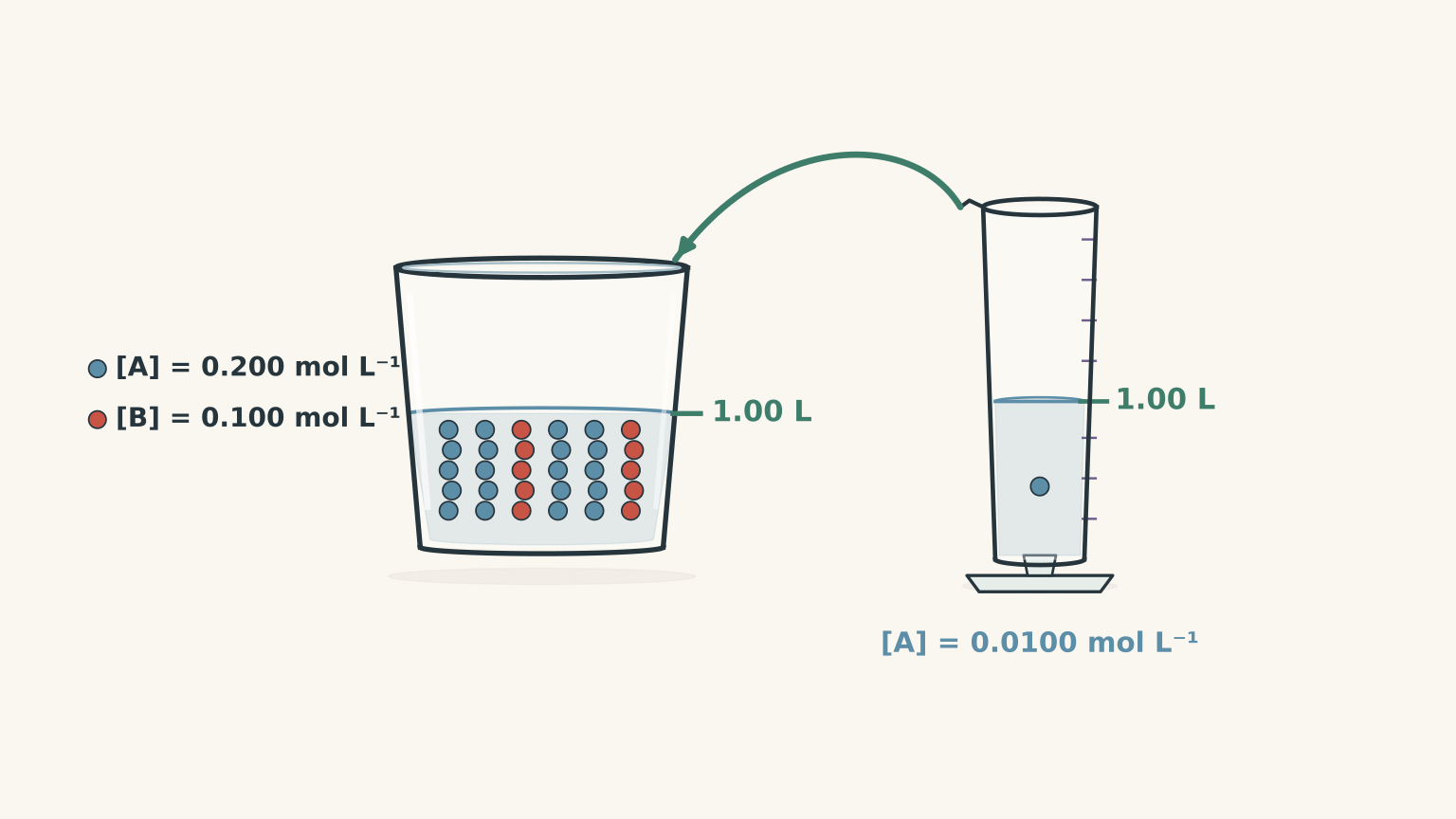
Due to technical limitations, this figure may display incorrectly or contain inaccuracies. Please check key details against your course materials.
Solution 2
The net reaction proceeds backwards, despite additional A being introduced. The added solution causes substantial dilution, and the resulting reaction quotient is greater than the original equilibrium constant.
Part a: Calculate the immediate concentrations
First, calculate the initial amounts of A and B.
For A:
\[ n_A=0.200\times1.00 \]
\[ n_A=0.200\ \mathrm{mol} \]
The added solution contributes:
\[ n_{A,\mathrm{added}}=0.0100\times1.00 \]
\[ =0.0100\ \mathrm{mol} \]
The total amount of A is:
\[ n_A=0.200+0.0100 \]
\[ =0.210\ \mathrm{mol} \]
The total solution volume is:
\[ V=1.00+1.00=2.00\ \mathrm{L} \]
Therefore:
\[ [A]=\frac{0.210}{2.00} \]
\[ \boxed{[A]=0.105\ \mathrm{mol\,L^{-1}}} \]
For B, no additional B is introduced.
Its amount remains:
\[ n_B=0.100\times1.00=0.100\ \mathrm{mol} \]
Therefore:
\[ [B]=\frac{0.100}{2.00} \]
\[ \boxed{[B]=0.0500\ \mathrm{mol\,L^{-1}}} \]
Part b: Calculate the original equilibrium constant
For:
\[ \mathrm{2A(aq)\rightleftharpoons B(aq)} \]
the equilibrium expression is:
\[ K_c=\frac{[B]}{[A]^2} \]
Substitute the original equilibrium concentrations:
\[ K_c=\frac{0.100}{(0.200)^2} \]
\[ \boxed{K_c=2.50\ \mathrm{L\,mol^{-1}}} \]
Part c: Calculate the new reaction quotient
Use the concentrations immediately after mixing:
\[ Q_c=\frac{0.0500}{(0.105)^2} \]
\[ Q_c=\frac{0.0500}{0.011025} \]
\[ \boxed{Q_c=4.54\ \mathrm{L\,mol^{-1}}} \]
Compare:
\[ Q_c>K_c \]
Therefore, the reverse reaction is favoured.
The system produces more A and consumes B until equilibrium is restored.
Part d: Explain the result
The tempting prediction is that adding A must favour the forward reaction.
However, the total volume doubles.
Although more moles of A have been introduced, its concentration decreases from 0.200 to 0.105 mol L⁻¹.
The concentration of B also decreases, but the equilibrium expression contains \([A]^2\).
The effect of dilution on the two sides is therefore not identical.
The final reaction quotient is greater than \(K_c\), so the reverse reaction occurs.
The lesson is that you must calculate concentrations after mixing, not simply count how many moles of reactant were added.
Question 3
Consider the equilibrium:
\[ \ce{H2(g) + I2(g) <=> 2HI(g)} \]
A mixture is initially at equilibrium in a rigid container at constant temperature.
For this question, the rate expressions are:
\[ v_f=k_f[\ce{H2}][\ce{I2}] \]
\[ v_r=k_r[\ce{HI}]^2 \]
A quantity of hydrogen iodide is injected, instantly doubling its concentration.
a) Explain what happens immediately to the concentrations of all three species.
b) Determine the factor by which the reverse reaction rate changes.
c) Determine the relationship between the new reaction quotient and the original equilibrium constant.
d) Explain the subsequent reaction direction and concentration changes.
Solution 3
The reverse rate increases by a factor of four, the forward rate remains unchanged, and the net reaction proceeds backwards.
Part a: Immediate concentration changes
The added substance is \(\ce{HI}\).
Therefore:
- \([\ce{HI}]\) doubles immediately.
- \([\ce{H2}]\) remains unchanged.
- \([\ce{I2}]\) remains unchanged.
The concentration changes are caused by the external addition, not by the chemical reaction.
Part b: Reverse reaction rate
The reverse rate is:
\[ v_r=k_r[\ce{HI}]^2 \]
If the concentration of \(\ce{HI}\) doubles:
\[ v_r'=k_r(2[\ce{HI}])^2 \]
\[ v_r'=4k_r[\ce{HI}]^2 \]
Therefore:
\[ \boxed{v_r'=4v_r} \]
The reverse rate quadruples.
Part c: Reaction quotient
The equilibrium expression is:
\[ K_c=\frac{[\ce{HI}]^2} {[\ce{H2}][\ce{I2}]} \]
Immediately after addition, the concentration of HI doubles while the other concentrations remain unchanged.
Therefore:
\[ Q_c'=4K_c \]
Hence:
\[ Q_c'>K_c \]
Part d: Subsequent reaction
The reverse reaction is now faster than the forward reaction.
Hydrogen iodide is consumed, while hydrogen and iodine are produced.
As \([\ce{HI}]\) decreases, the reverse reaction rate decreases.
The forward and reverse rates eventually become equal again at the new equilibrium.
The important contrast with Question 1 is that adding a product increases the reverse rate first, rather than the forward rate.
Question 4
Consider the gaseous equilibrium:
\[ \ce{N2O4(g) <=> 2NO2(g)} \]
An equilibrium mixture is placed in a container at constant temperature.
An inert gas is introduced.
Compare the effects of adding the inert gas under two different conditions:
Case A: The container is rigid, so its volume remains constant.
Case B: The container has a movable piston that maintains constant total pressure. The addition of inert gas causes the volume to double.
For each case:
a) Explain what happens to the concentrations of \(\ce{N2O4}\) and \(\ce{NO2}\).
b) Determine whether the equilibrium shifts.
c) Justify your answer using the reaction quotient.
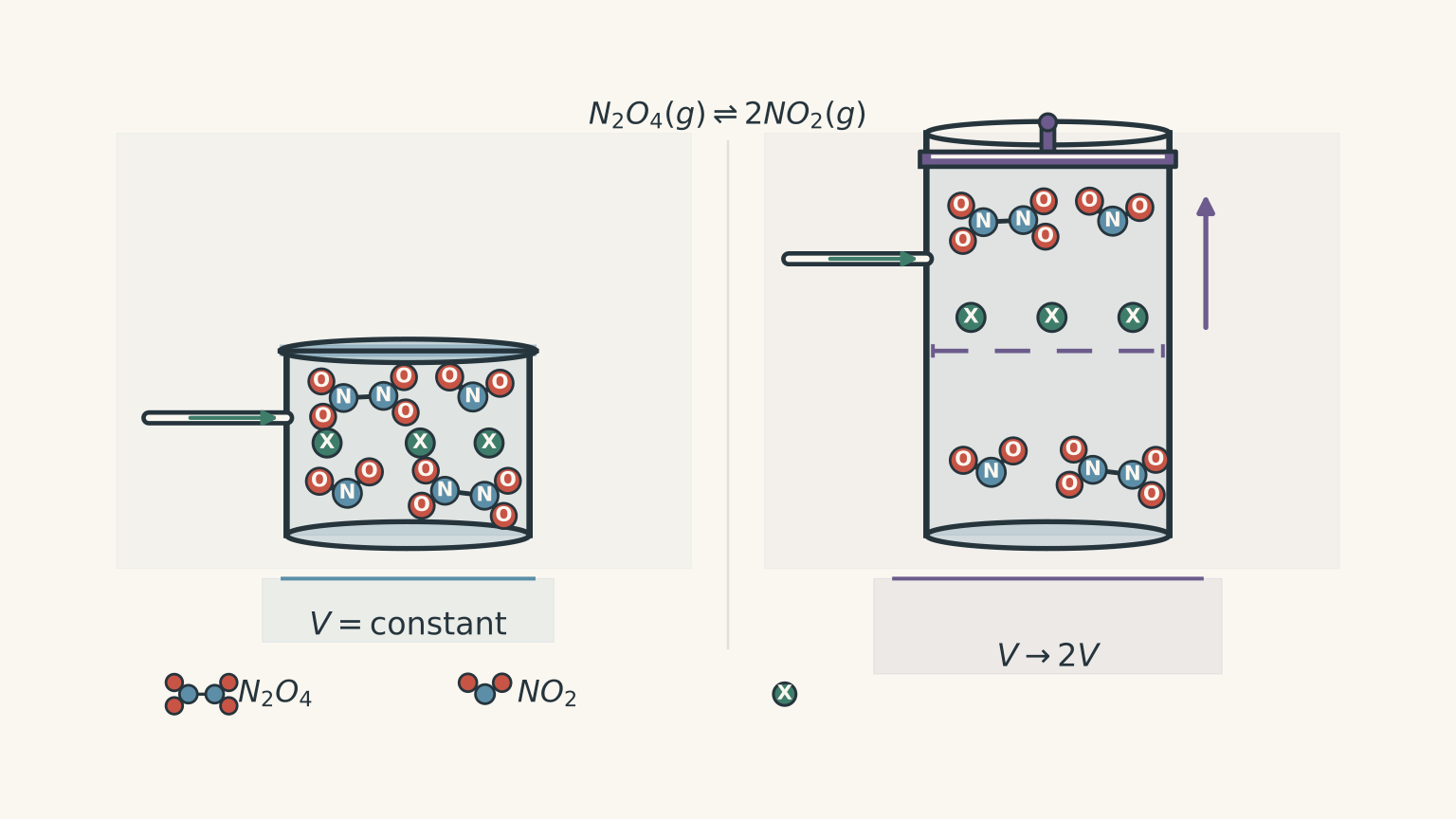
Due to technical limitations, this figure may display incorrectly or contain inaccuracies. Please check key details against your course materials.
Solution 4
Case A produces no equilibrium shift. Case B produces a forward shift towards nitrogen dioxide.
Case A: Constant volume
Adding an inert gas increases the total pressure.
However, the amounts of \(\ce{N2O4}\) and \(\ce{NO2}\) remain unchanged, and the container volume is fixed.
Therefore, their concentrations and partial pressures remain unchanged.
The reaction quotient is still:
\[ Q_c=\frac{[\ce{NO2}]^2}{[\ce{N2O4}]} \]
Since none of the reacting concentrations have changed:
\[ Q_c=K_c \]
There is no net reaction.
Case B: Constant pressure
The piston moves outwards, doubling the container volume.
The amounts of the reacting gases remain unchanged during the immediate expansion, but their concentrations are halved.
Therefore:
\[ [\ce{N2O4}]'=\frac{1}{2}[\ce{N2O4}] \]
\[ [\ce{NO2}]'=\frac{1}{2}[\ce{NO2}] \]
Calculate the new reaction quotient:
\[ Q_c'= \frac{(0.5[\ce{NO2}])^2} {0.5[\ce{N2O4}]} \]
Simplifying:
\[ Q_c'=0.5Q_c \]
Since the original system was at equilibrium:
\[ Q_c=K_c \]
Therefore:
\[ Q_c'=0.5K_c \]
Hence:
\[ Q_c'<K_c \]
The forward reaction is favoured.
More \(\ce{N2O4}\) decomposes, producing additional \(\ce{NO2}\), until equilibrium is restored.
The important distinction is that adding inert gas does not necessarily shift equilibrium. The result depends on whether the volume changes and consequently alters the concentrations or partial pressures of the reacting gases.
Question 5
A rigid 1.00 L vessel contains the following equilibrium mixture at constant temperature:
\[ \ce{2SO2(g) + O2(g) <=> 2SO3(g)} \]
The equilibrium concentrations are:
\[ [\ce{SO2}]=0.200\ \mathrm{mol\,L^{-1}} \]
\[ [\ce{O2}]=0.100\ \mathrm{mol\,L^{-1}} \]
\[ [\ce{SO3}]=0.400\ \mathrm{mol\,L^{-1}} \]
Two rapid operations are performed in sequence.
Operation 1: Additional \(\ce{SO2}\) is injected, increasing its concentration to \(0.300\ \mathrm{mol\,L^{-1}}\). The other concentrations are initially unchanged.
Operation 2: Before any appreciable reaction occurs, a pump removes 60% of the gas mixture. The vessel remains rigid, and all three reacting gases are removed in the same proportion. The pump is then closed.
Assume the temperature remains constant throughout and no other reactions occur.
Determine:
a) The original equilibrium constant, \(K_c\).
b) The reaction direction immediately after Operation 1.
c) The concentrations of all three species immediately after Operation 2.
d) The reaction direction immediately after Operation 2.
e) Explain why the reaction direction after Operation 2 differs from the direction predicted immediately after adding \(\ce{SO2}\).
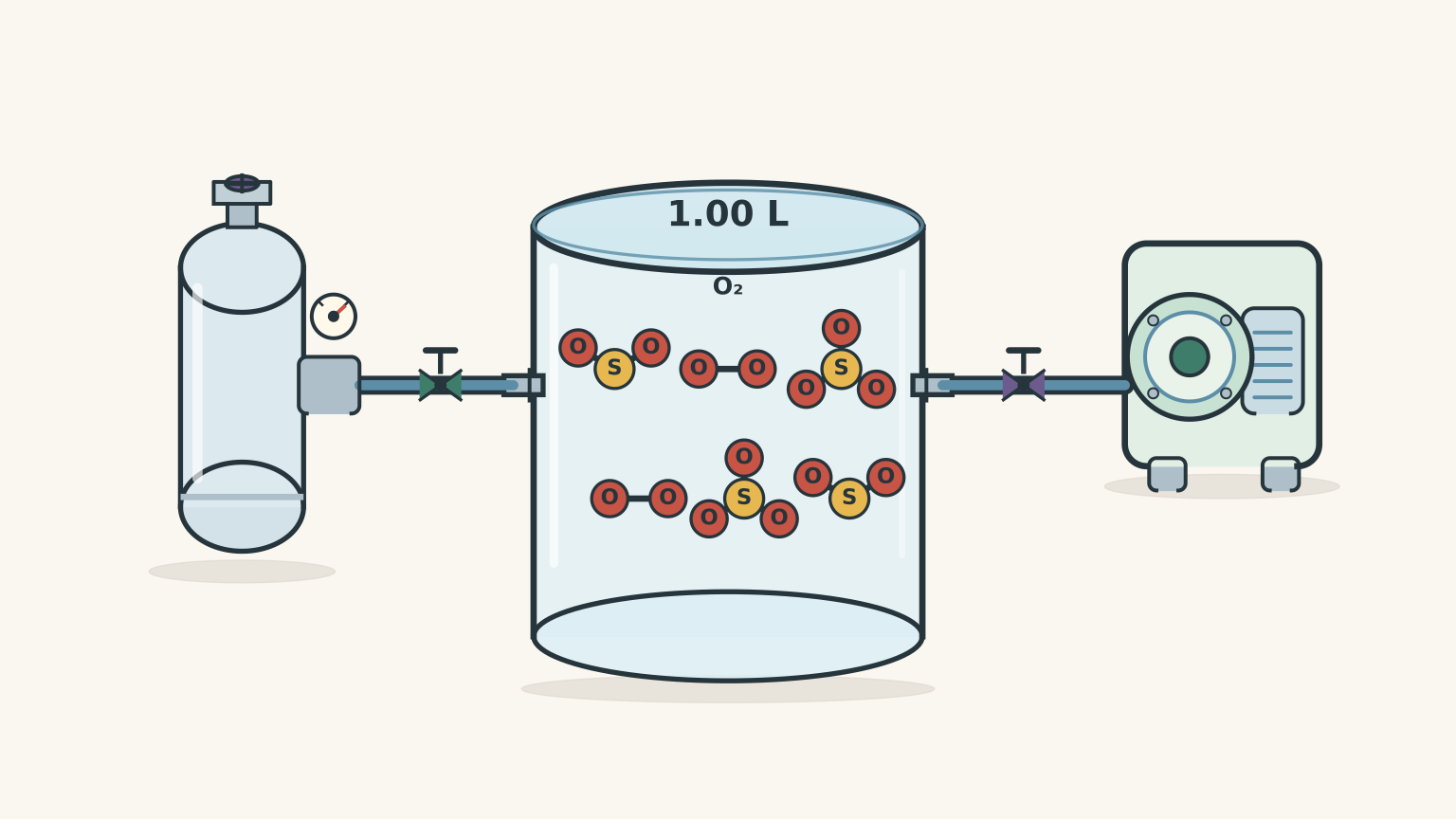
Due to technical limitations, this figure may display incorrectly or contain inaccuracies. Please check key details against your course materials.
Solution 5
The reaction initially proceeds forwards after adding \(\ce{SO2}\), but proceeds backwards after the subsequent removal of 60% of the gas mixture.
This happens because the second operation changes all three concentrations, and their different powers in the equilibrium expression make the reaction quotient increase.
Part a: Calculate the original equilibrium constant
For:
\[ \ce{2SO2(g) + O2(g) <=> 2SO3(g)} \]
the equilibrium expression is:
\[ K_c= \frac{[\ce{SO3}]^2} {[\ce{SO2}]^2[\ce{O2}]} \]
Substitute the original equilibrium concentrations:
\[ K_c= \frac{(0.400)^2} {(0.200)^2(0.100)} \]
\[ K_c=\frac{0.160}{0.00400} \]
\[ \boxed{K_c=40.0\ \mathrm{L\,mol^{-1}}} \]
Part b: Direction after Operation 1
Immediately after adding \(\ce{SO2}\):
\[ [\ce{SO2}]=0.300\ \mathrm{M} \]
The other concentrations remain unchanged.
Calculate the reaction quotient:
\[ Q_c= \frac{(0.400)^2} {(0.300)^2(0.100)} \]
\[ Q_c=\frac{0.160}{0.00900} \]
\[ \boxed{Q_c=17.78\ \mathrm{L\,mol^{-1}}} \]
Compare:
\[ Q_c<K_c \]
Therefore, the forward reaction is favoured.
If the system were left undisturbed at this point, it would consume \(\ce{SO2}\) and \(\ce{O2}\), producing more \(\ce{SO3}\).
However, Operation 2 occurs before appreciable reaction takes place.
Part c: Concentrations after Operation 2
The pump removes 60% of the gas mixture.
Therefore, 40% of each reacting gas remains.
Each concentration is multiplied by:
\[ 0.40 \]
For sulfur dioxide:
\[ [\ce{SO2}]=0.300\times0.40 \]
\[ \boxed{[\ce{SO2}]=0.120\ \mathrm{M}} \]
For oxygen:
\[ [\ce{O2}]=0.100\times0.40 \]
\[ \boxed{[\ce{O2}]=0.0400\ \mathrm{M}} \]
For sulfur trioxide:
\[ [\ce{SO3}]=0.400\times0.40 \]
\[ \boxed{[\ce{SO3}]=0.160\ \mathrm{M}} \]
Part d: Determine the new reaction direction
Calculate the reaction quotient using the concentrations after both operations:
\[ Q_c= \frac{(0.160)^2} {(0.120)^2(0.0400)} \]
\[ Q_c=\frac{0.0256}{0.000576} \]
\[ \boxed{Q_c=44.44\ \mathrm{L\,mol^{-1}}} \]
Compare this with the original equilibrium constant:
\[ Q_c>K_c \]
Therefore, the reverse reaction is favoured.
The system will consume \(\ce{SO3}\) and produce \(\ce{SO2}\) and \(\ce{O2}\) until equilibrium is restored.
Part e: Explain the change in direction
This is the most important part of the problem.
After Operation 1, adding \(\ce{SO2}\) decreases the reaction quotient because the concentration of a reactant in the denominator increases.
That produces a forward reaction.
However, removing 60% of the gas mixture decreases every reacting concentration by the same factor.
It is tempting to assume that this proportional decrease leaves the reaction quotient unchanged.
It does not.
The equilibrium expression contains different powers for the reactants and products:
\[ Q_c= \frac{[\ce{SO3}]^2} {[\ce{SO2}]^2[\ce{O2}]} \]
After multiplying every concentration by 0.40:
- The numerator is multiplied by \(0.40^2\).
- The denominator is multiplied by \(0.40^3\).
Therefore:
\[ Q_c'=Q_c\left(\frac{0.40^2}{0.40^3}\right) \]
\[ Q_c'=\frac{Q_c}{0.40} \]
The reaction quotient increases by a factor of 2.5.
This is why the reaction direction changes.
The tempting prediction considers only the added reactant. The correct prediction considers the concentrations of every reacting species after all disturbances have occurred.
The sequence of changes matters.
08The key distinction to remember
When more reactant is added to an equilibrium mixture at constant temperature and volume, the immediate concentration of that reactant increases while the other reacting concentrations initially remain unchanged.
For a simple reversible reaction, this increases the forward reaction rate while leaving the reverse rate initially unchanged.
The forward rate therefore becomes greater than the reverse rate, and the system proceeds forwards until a new dynamic equilibrium is established.
For HSC Chemistry questions, keep these three stages separate:
- Immediate disturbance: The added reactant changes the concentration of the species entering the system.
- Rate imbalance: The forward and reverse reaction rates become unequal.
- Re-equilibration: The concentrations change as the net reaction proceeds until the forward and reverse rates are equal again.
If you can explain those three stages using the actual chemical species, reaction rates, and reaction quotient, you have a much stronger explanation than simply writing that the equilibrium shifts to the right.
The next useful step is learning to distinguish these concentration changes from temperature and pressure disturbances, where the equilibrium constant or the concentrations of several reacting species may change in different ways.