
Relative Atomic Mass vs Molar Mass: What’s the Difference?
Learn how relative atomic mass and molar mass differ, why their numerical values can match, and how isotopes, ions, and chemical formulas affect calculations. Includes worked examples and HSC Chemistry practice questions with detailed solutions.
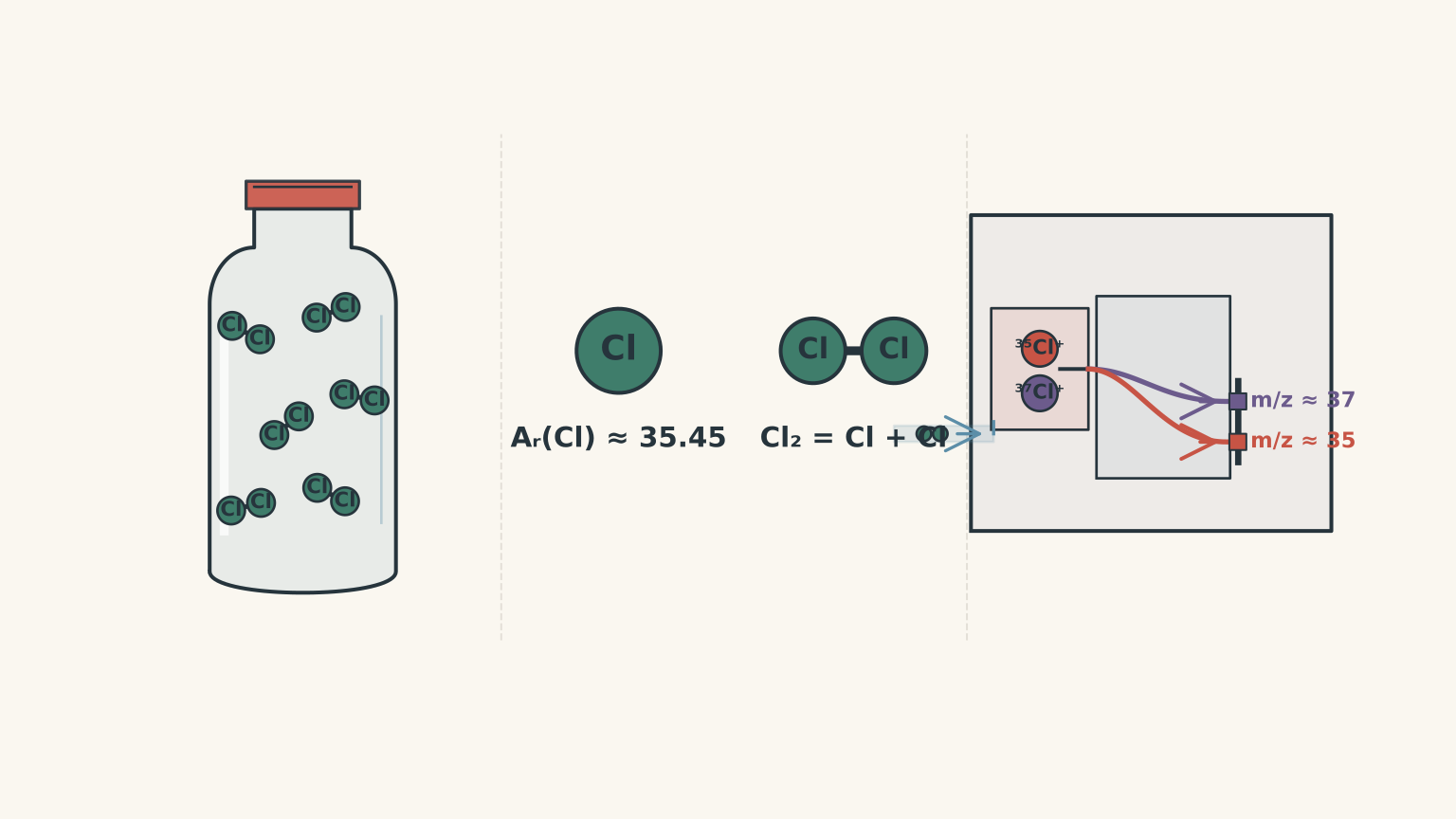
A mass spectrometer detects chlorine atoms with masses close to 35 and 37, but the periodic table gives chlorine a relative atomic mass of about 35.45. Meanwhile, chlorine gas has a molar mass of approximately 70.90 g mol\(^{-1}\).
Three different numbers for the same element. Which one would you use to calculate the mass of 1 mole of chlorine gas?
You need 70.90 g mol\(^{-1}\), because chlorine gas consists of \(\ce{Cl2}\) molecules, each containing two chlorine atoms.
The difference comes down to what you’re measuring:
- Relative atomic mass, \(A_r\), compares the average mass of an element’s atoms with a standard reference mass. It has no units.
- Molar mass, \(M\), tells you the mass of one mole of a specified substance. Its usual unit is g mol\(^{-1}\).
For individual chlorine atoms, the two quantities have almost exactly the same numerical value. For chlorine molecules, they don’t.
Due to technical limitations, this figure may display incorrectly or contain inaccuracies. Please check key details against your course materials.
01Why does a mass spectrometer show two masses instead of one?
Suppose you wanted to find the mass of a chlorine atom.
You might try measuring chlorine gas with a mass spectrometer. But that raises a problem: chlorine naturally contains different isotopes, and chlorine gas consists of molecules rather than isolated atoms.
An instrument must distinguish those different particles before its measurements can tell you the average atomic mass.
Following the particles through the instrument
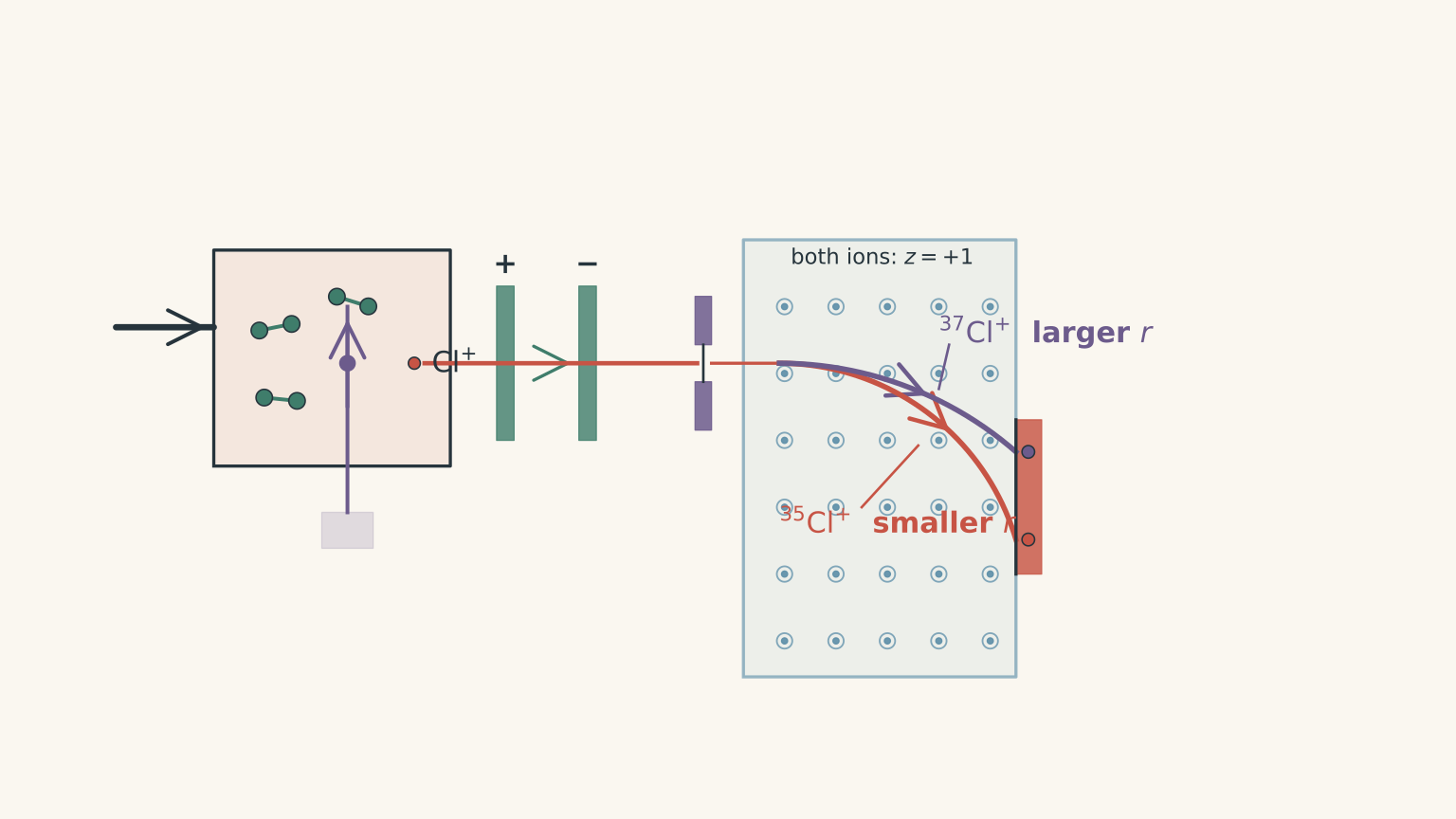
Consider a simplified magnetic-sector mass spectrometer.
The apparatus has five important stages:
- Sample inlet: A small amount of chlorine-containing gas enters the instrument.
- Ion source: Energetic electrons ionise particles. Chlorine molecules can also break into atomic fragments, including \(\mathrm{Cl}^{+}\) ions.
- Accelerating region: Electric fields accelerate the positive ions into a beam.
- Mass analyser: A magnetic field bends the ions along different paths according to their mass-to-charge ratios.
- Detector: The instrument records signals at different mass-to-charge ratios, producing a mass spectrum.
Due to technical limitations, this figure may display incorrectly or contain inaccuracies. Please check key details against your course materials.
The important detail is that a mass spectrometer separates ions according to their mass-to-charge ratio, commonly written \(m/z\).
Here, \(m\) represents ion mass, and \(z\) is the number of elementary charges carried by the ion. For example, \(z=+1\) for a singly charged positive ion.
If two ions have the same positive charge, their different masses can cause them to arrive at different detector positions.
What should the first measurement show?
Imagine that every chlorine atom had exactly the same mass.
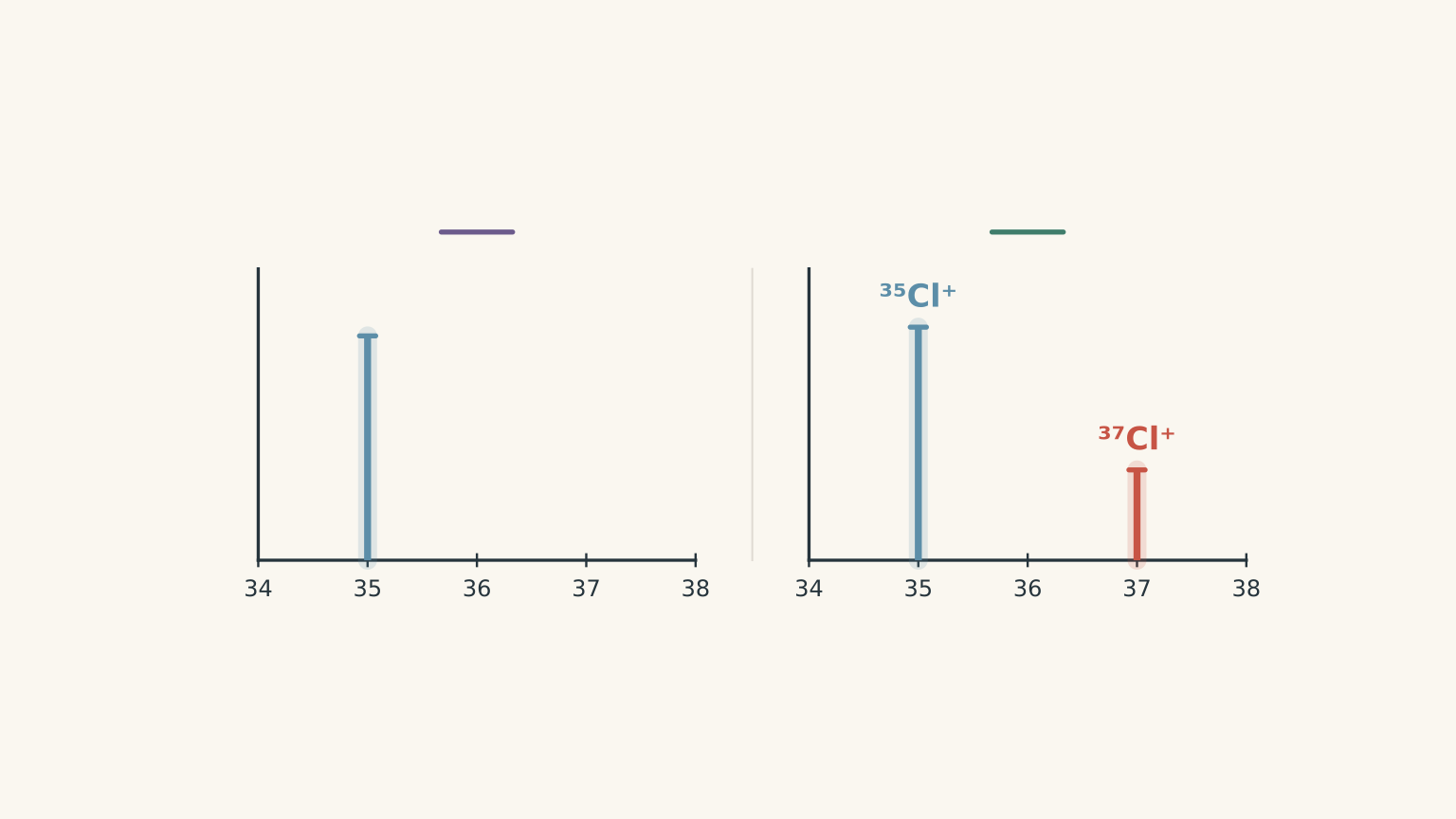
If the instrument detected only singly charged chlorine atomic ions, you’d predict one atomic-ion peak.
But chlorine has two stable isotopes:
- Chlorine-35, \(^{35}_{17}\mathrm{Cl}\)
- Chlorine-37, \(^{37}_{17}\mathrm{Cl}\)
A mass spectrum of their singly charged atomic ions can therefore show two peaks, near \(m/z=35\) and \(m/z=37\).
That observation supports the existence of atoms of the same element with different masses.
Due to technical limitations, this figure may display incorrectly or contain inaccuracies. Please check key details against your course materials.
There’s a complication, though.
If the instrument detects intact molecular ions, \(\mathrm{Cl}_2^{+}\), instead of atomic fragments, the possible nominal molecular masses are 70, 72, and 74.
Those come from three isotope combinations:
| Chlorine molecule | Approximate molecular mass |
|---|---|
| \(^{35}\mathrm{Cl}\)-\(^{35}\mathrm{Cl}\) | 70 u |
| \(^{35}\mathrm{Cl}\)-\(^{37}\mathrm{Cl}\) | 72 u |
| \(^{37}\mathrm{Cl}\)-\(^{37}\mathrm{Cl}\) | 74 u |
The symbol u represents the unified atomic mass unit.
A peak near 72 does not mean that a chlorine atom has a mass of 72 u. It could represent a molecule containing two different chlorine isotopes.
To measure the atomic isotope mixture more directly, the investigator can select correctly identified \(\mathrm{Cl}^{+}\) fragment signals rather than the molecular-ion signals.
The instrument must also account for differences in ion formation and detector response. Raw peak heights are not automatically exact isotope abundances.
This is the experimental distinction: identifying what ion produced a signal comes before interpreting the number.
02From isotope masses to relative atomic mass
Now suppose an atomic-ion measurement gives the following corrected isotope composition.
Illustrative data: The masses and abundances below are deliberately rounded for teaching. They are not a record of an actual chlorine sample.
| Isotope | Approximate atomic mass | Fraction of atoms |
|---|---|---|
| Chlorine-35 | 35.0 u | 0.75 |
| Chlorine-37 | 37.0 u | 0.25 |
Before calculating, predict the average.
Would it be 35.0, 36.0, or somewhere closer to 35.0?
It must be closer to 35.0 because three-quarters of the atoms are the lighter isotope.
The mean atomic mass is:
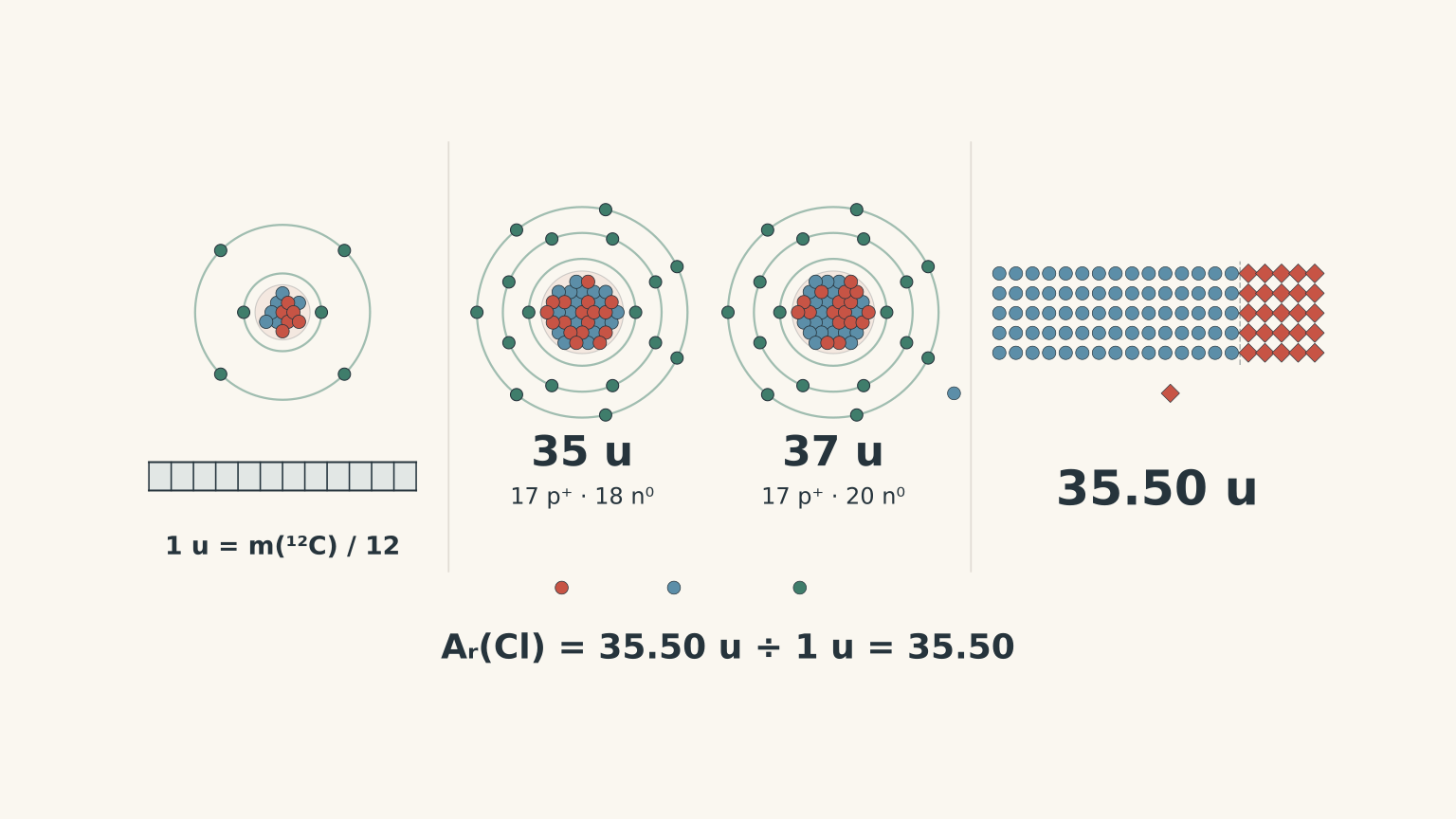
\[ \begin{aligned} \overline{m} &=0.75(35.0)+0.25(37.0)\\ &=26.25+9.25\\ &=35.50\ \mathrm{u} \end{aligned} \]
Here, \(\overline{m}\) is the average mass per atom, and the isotope masses in the calculation are expressed in u.
This is a weighted average: each isotope contributes according to how common it is.
But we haven’t quite defined relative atomic mass yet.
Why carbon-12 is the reference
A relative measurement needs a reference.
Chemists use one-twelfth of the mass of a neutral carbon-12 atom as the standard atomic mass unit:
\[ 1\ \mathrm{u} =\frac{m(^{12}\mathrm{C})}{12} \]
Here, \(m(^{12}\mathrm{C})\) means the mass of one neutral carbon-12 atom.
Relative atomic mass is the ratio:
\[ A_r=\frac{\overline{m}}{1\ \mathrm{u}} \]
For our illustrative chlorine sample:
\[ A_r(\ce{Cl}) =\frac{35.50\ \mathrm{u}}{1\ \mathrm{u}} =35.50 \]
Notice that the units cancel.
The relative atomic mass is 35.50, not 35.50 u and not 35.50 g.
Due to technical limitations, this figure may display incorrectly or contain inaccuracies. Please check key details against your course materials.
In an ordinary periodic table, chlorine’s relative atomic mass is commonly shown as approximately 35.45.
Our calculated 35.50 differs because we used rounded isotope masses and an illustrative 75:25 mixture. Real isotope masses are not exact whole numbers, and isotope abundances can vary between samples.
The periodic-table value is not the mass of one particular chlorine atom. It represents an atomic-weight value appropriate to ordinary elemental material.
If you’d like to practise the weighted-average calculation in more detail, see Relative Atomic Mass from Isotopic Composition.
03Why does molar mass have almost the same numerical value?
An individual chlorine atom has an extremely small mass. A balance normally measures enormous numbers of atoms or molecules together.
Chemists use the mole to connect these two scales.
One mole contains exactly:
\[ 6.02214076\times10^{23} \]
specified entities.
Those entities could be atoms, molecules, ions, or formula units. You must say which.
Molar mass is the mass of one mole of the specified entities:
\[ M=\frac{m}{n} \]
where:
- \(M\) is molar mass, in g mol\(^{-1}\)
- \(m\) is the mass of a sample, in g
- \(n\) is its amount of substance, in mol
The carbon-12 atomic mass scale and the mole are connected so that, at HSC calculation precision, the molar mass of an element’s atoms in g mol\(^{-1}\) has the same numerical value as its relative atomic mass.
For example:
\[ A_r(\ce{Cl})\approx35.45 \]
and:
\[ M(\ce{Cl})\approx35.45\ \mathrm{g\,mol^{-1}} \]
The first is a ratio. The second is a mass per mole of atoms.
This numerical correspondence does not make them the same physical quantity.
Precision note: Under the SI definition effective from 2019, the molar-mass conversion factor is extremely close to, but not mathematically exactly, \(1\ \mathrm{g\,mol^{-1}}\). The difference is negligible for HSC Chemistry calculations.
The chemical formula decides which molar mass you need
Chlorine provides a useful comparison.
Using \(A_r(\ce{Cl})=35.45\):
| Quantity | What it describes | Value |
|---|---|---|
| \(A_r(\ce{Cl})\) | Relative atomic mass of chlorine atoms | 35.45, no unit |
| \(M(\ce{Cl})\) | Mass per mole of chlorine atoms | 35.45 g mol\(^{-1}\) |
| \(M_r(\ce{Cl2})\) | Relative molecular mass of chlorine molecules | 70.90, no unit |
| \(M(\ce{Cl2})\) | Mass per mole of chlorine molecules | 70.90 g mol\(^{-1}\) |
Relative molecular mass, \(M_r\), is the dimensionless sum of the relative atomic masses of atoms in a molecule.
Molar mass, \(M\), gives the corresponding mass per mole.
For chlorine gas:
\[ M(\ce{Cl2})=2M(\ce{Cl}) \]
\[ M(\ce{Cl2})\approx70.90\ \mathrm{g\,mol^{-1}} \]
The factor of two comes from the chemical formula, not from a change in isotopic composition.
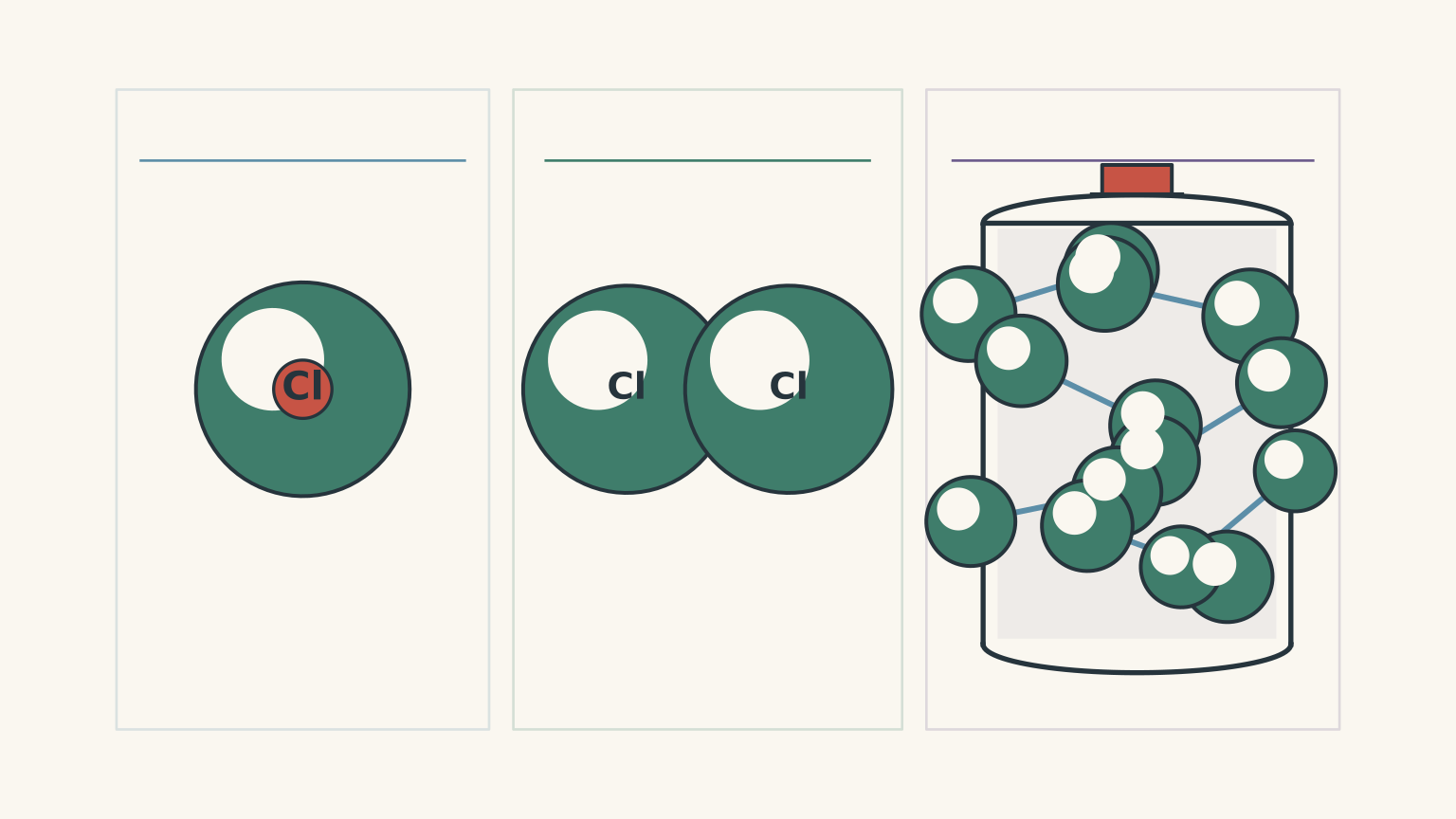
Due to technical limitations, this figure may display incorrectly or contain inaccuracies. Please check key details against your course materials.
Worked example: Which mass applies to bromine gas?
A student has \(0.0750\) mol of bromine gas, \(\ce{Br2}\). The relative atomic mass of bromine is 79.90. Calculate the mass of the sample.
Step 1
The substance is \(\ce{Br2}\), so each molecule contains two bromine atoms.
The relative atomic mass is:
\[ A_r(\ce{Br})=79.90 \]
The molar mass of bromine gas is:
\[ \begin{aligned} M(\ce{Br2}) &=2(79.90)\\ &=159.80\ \mathrm{g\,mol^{-1}} \end{aligned} \]
Step 2
Use \(m=nM\).
\[ \begin{aligned} m&=0.0750(159.80)\\ &=11.985\ \mathrm{g}\\ &\approx12.0\ \mathrm{g} \end{aligned} \]
Step 3
The sample has a mass of approximately 12.0 g.
Using 79.90 directly as the molar mass of bromine gas would give a result half as large.
That would describe the mass associated with the same amount of individual bromine atoms, rather than bromine molecules.
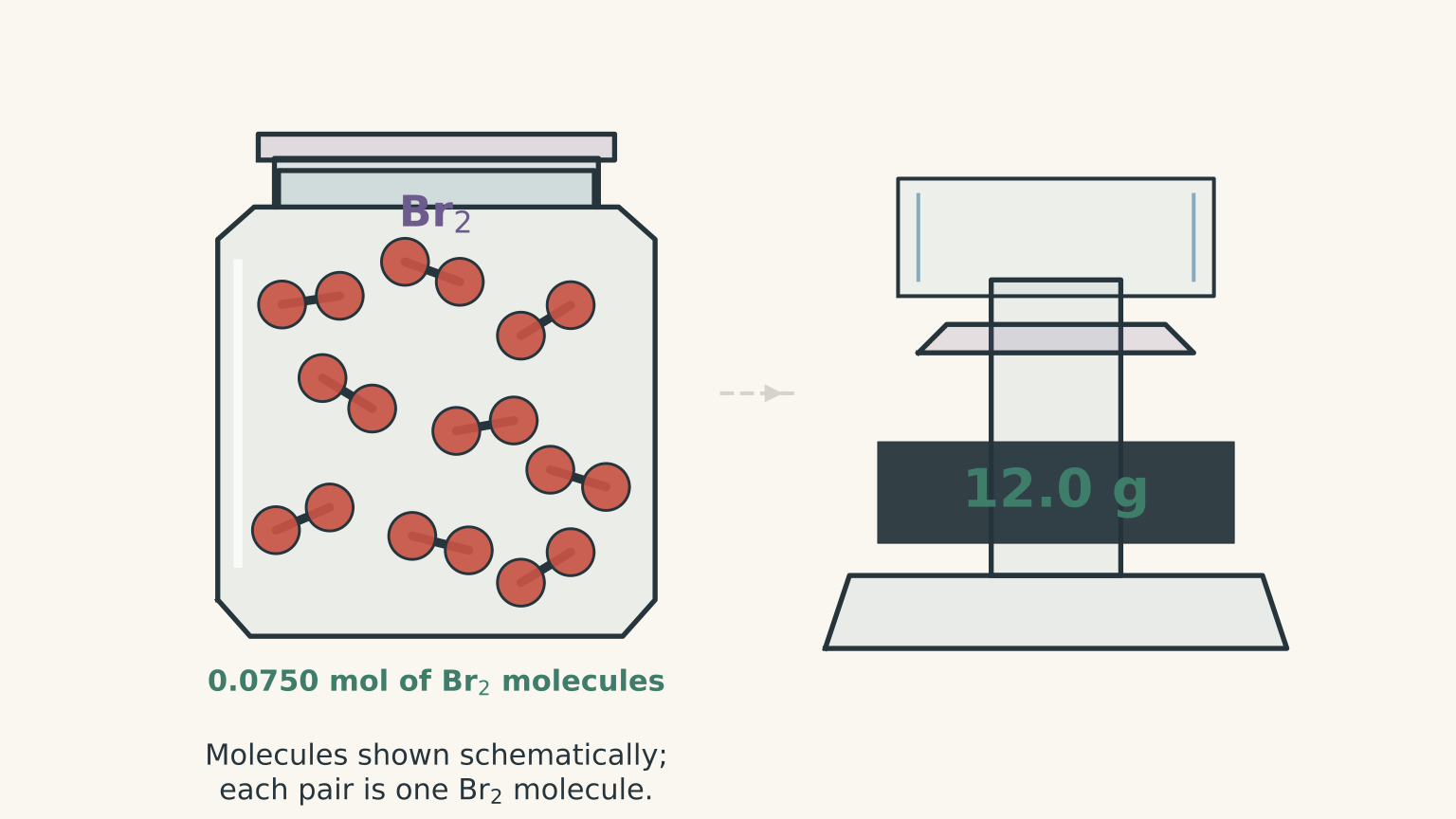
Due to technical limitations, this figure may display incorrectly or contain inaccuracies. Please check key details against your course materials.
04What happens when the isotope mixture or charge changes?
There’s another complication that often appears in questions.
An isotope label, an ionic charge, and a relative atomic mass describe different properties of a particle.
Consider:
\[ {}^{35}_{17}\mathrm{Cl}^{-} \]
Read the notation carefully:
- The upper-left 35 is the mass number: the total number of protons and neutrons.
- The lower-left 17 is the atomic number: the number of protons.
- The upper-right \(-\) means the ion has one extra electron compared with a neutral chlorine atom.
Changing chlorine-35 into chlorine-37 changes the number of neutrons.
Changing neutral chlorine into \(\mathrm{Cl}^{-}\) changes the number of electrons.
These are different changes.
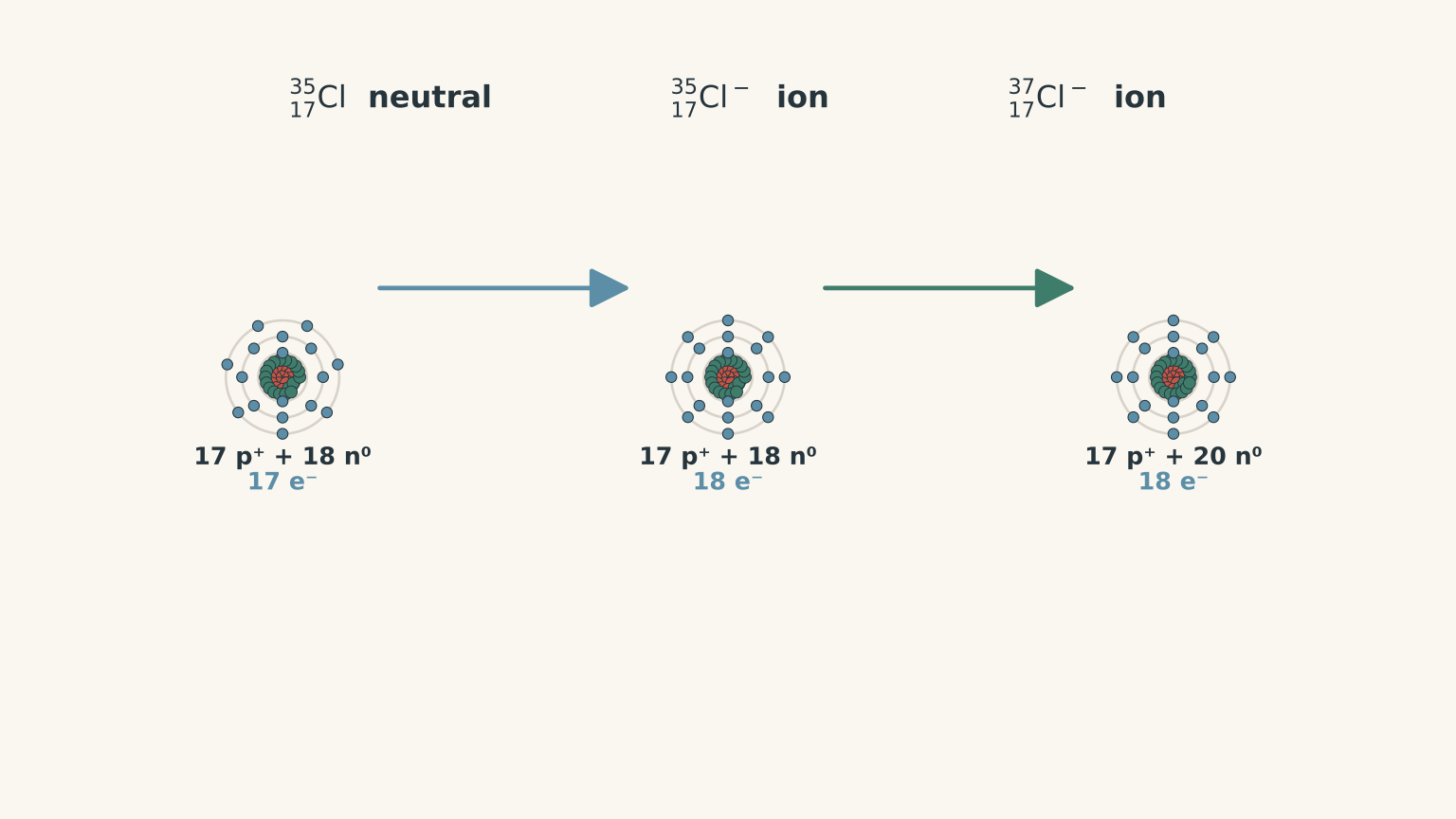
Due to technical limitations, this figure may display incorrectly or contain inaccuracies. Please check key details against your course materials.
Does adding an electron change the mass?
Strictly, yes.
An electron has mass, so forming a negative ion changes a particle’s mass slightly. Electron binding energies also contribute extremely small mass differences.
But these effects are negligible compared with the precision of ordinary HSC molar-mass calculations.
For example, when calculating the molar mass of \(\ce{NaCl}\), you use the tabulated atomic masses of sodium and chlorine. You do not need to add a separate electron-mass correction for the chloride ion.
However, if the chlorine isotope mixture is changed substantially, the average atomic mass really does change.
The distinction is:
- Changing ionic charge has a negligible effect on mass at normal HSC precision.
- Changing isotopic composition can change the molar mass enough to matter in calculations.
- Changing the chemical formula changes how many atoms of each element contribute to each formula unit or molecule.
Worked example: Two salts with different chlorine isotopes
Two samples of sodium chloride each contain \(0.250\) mol of \(\ce{NaCl}\) formula units.
Their chlorine isotope compositions are different.
| Chlorine isotope | Sample A | Sample B |
|---|---|---|
| Chlorine-35 | 80.0% | 20.0% |
| Chlorine-37 | 20.0% | 80.0% |
For this illustrative calculation, use isotope masses of 35.0 and 37.0 u and \(A_r(\ce{Na})=23.0\).
Calculate the mass of each sample and explain the difference.
Step 1
For sample A:
\[ \begin{aligned} A_r(\ce{Cl})_A &=0.80(35.0)+0.20(37.0)\\ &=35.4 \end{aligned} \]
For sample B:
\[ \begin{aligned} A_r(\ce{Cl})_B &=0.20(35.0)+0.80(37.0)\\ &=36.6 \end{aligned} \]
Sample B has a greater average atomic mass because it contains more chlorine-37.
Step 2
Sodium chloride contains one sodium ion and one chloride ion per formula unit.
For sample A:
\[ \begin{aligned} M_A(\ce{NaCl}) &=23.0+35.4\\ &=58.4\ \mathrm{g\,mol^{-1}} \end{aligned} \]
For sample B:
\[ \begin{aligned} M_B(\ce{NaCl}) &=23.0+36.6\\ &=59.6\ \mathrm{g\,mol^{-1}} \end{aligned} \]
Step 3
Using \(m=nM\):
\[ \begin{aligned} m_A&=0.250(58.4)=14.60\ \mathrm{g}\\ m_B&=0.250(59.6)=14.90\ \mathrm{g} \end{aligned} \]
The difference is:
\[ 14.90-14.60=0.30\ \mathrm{g} \]
Step 4
Sample B is 0.30 g heavier.
Both samples contain the same amount of \(\ce{NaCl}\), with the same chemical formula and ionic charges.
The difference comes from the chlorine isotope mixture, not from the chloride ions being negatively charged.
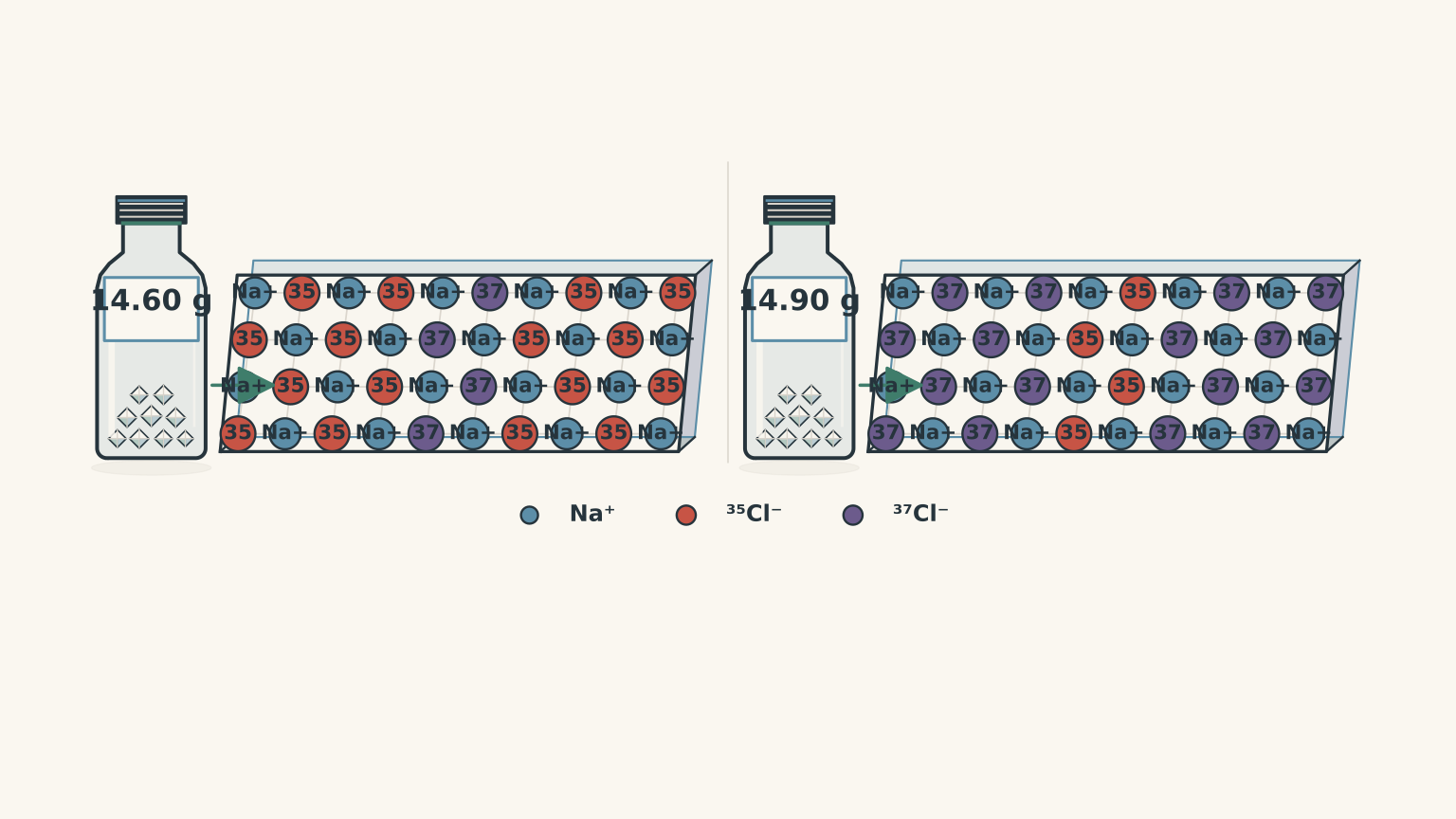
Due to technical limitations, this figure may display incorrectly or contain inaccuracies. Please check key details against your course materials.
05A quick way to choose the right quantity
Before using a number from the periodic table, identify what the question is actually asking for.
| Information or task | Quantity to use |
|---|---|
| Comparing an element’s average atomic mass with carbon-12 | Relative atomic mass, \(A_r\) |
| Identifying the proton-plus-neutron count of one isotope | Mass number |
| Describing the mass of a particular isotope | Isotopic mass, usually in u |
| Finding the mass of one mole of atoms | Molar mass of the atoms, in g mol\(^{-1}\) |
| Finding the mass of one mole of molecules | Molar mass of the molecules, in g mol\(^{-1}\) |
| Finding the mass of an ionic compound | Molar mass per mole of formula units |
| Interpreting mass-spectrometer peaks | Identify the ions and their charges before using \(m/z\) |
A useful check is to read the unit aloud.
If the answer is a relative atomic mass, it should not have a unit.
If the answer is a molar mass in the usual HSC units, it should end in g mol\(^{-1}\).
If the answer is the mass of a particular sample, it should end in grams.
06Questions and solutions
Question 1
The relative atomic mass of oxygen is 16.00.
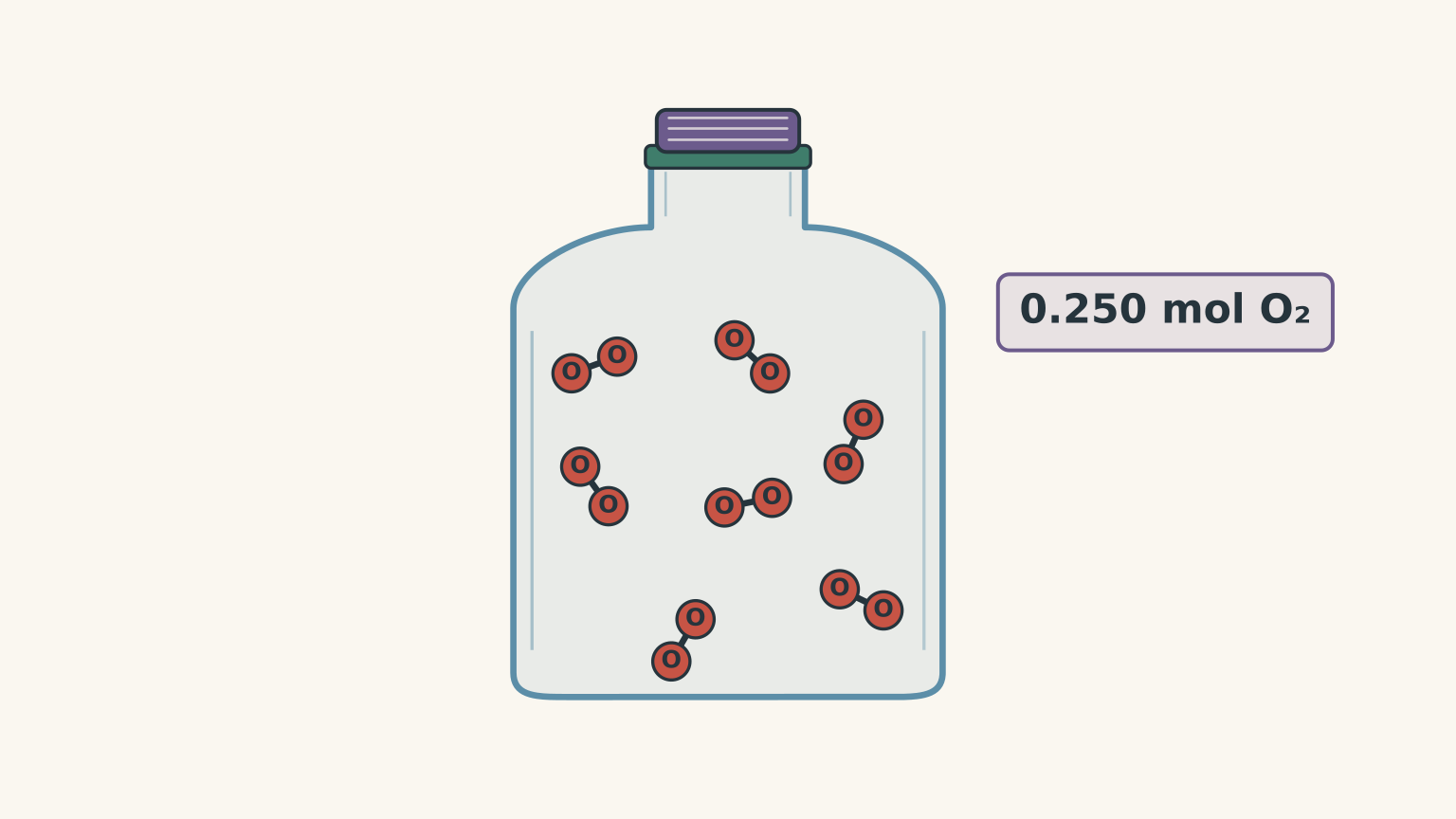
Oxygen gas consists of \(\ce{O2}\) molecules.
Calculate:
a) The molar mass of oxygen gas.
b) The mass of \(0.250\) mol of oxygen gas.
Explain why the relative atomic mass and molar mass have different numerical values in this case.
Due to technical limitations, this figure may display incorrectly or contain inaccuracies. Please check key details against your course materials.
Solution 1
The molar mass of oxygen gas is \(32.00\ \mathrm{g\,mol^{-1}}\), and \(0.250\) mol has a mass of \(8.00\) g.
Part a
Each oxygen molecule contains two oxygen atoms.
Therefore:
\[ \begin{aligned} M(\ce{O2}) &=2A_r(\ce{O})\ \mathrm{g\,mol^{-1}}\\ &=2(16.00)\ \mathrm{g\,mol^{-1}}\\ &=32.00\ \mathrm{g\,mol^{-1}} \end{aligned} \]
Part b
Using \(m=nM\):
\[ \begin{aligned} m&=0.250(32.00)\\ &=8.00\ \mathrm{g} \end{aligned} \]
The relative atomic mass, 16.00, refers to an average oxygen atom and has no unit.
The molar mass of oxygen gas refers to a mole of \(\ce{O2}\) molecules, each containing two atoms.
A tempting error is to use 16.00 g mol\(^{-1}\) directly for oxygen gas. That ignores the subscript 2 in its formula and halves the calculated mass.
Question 2
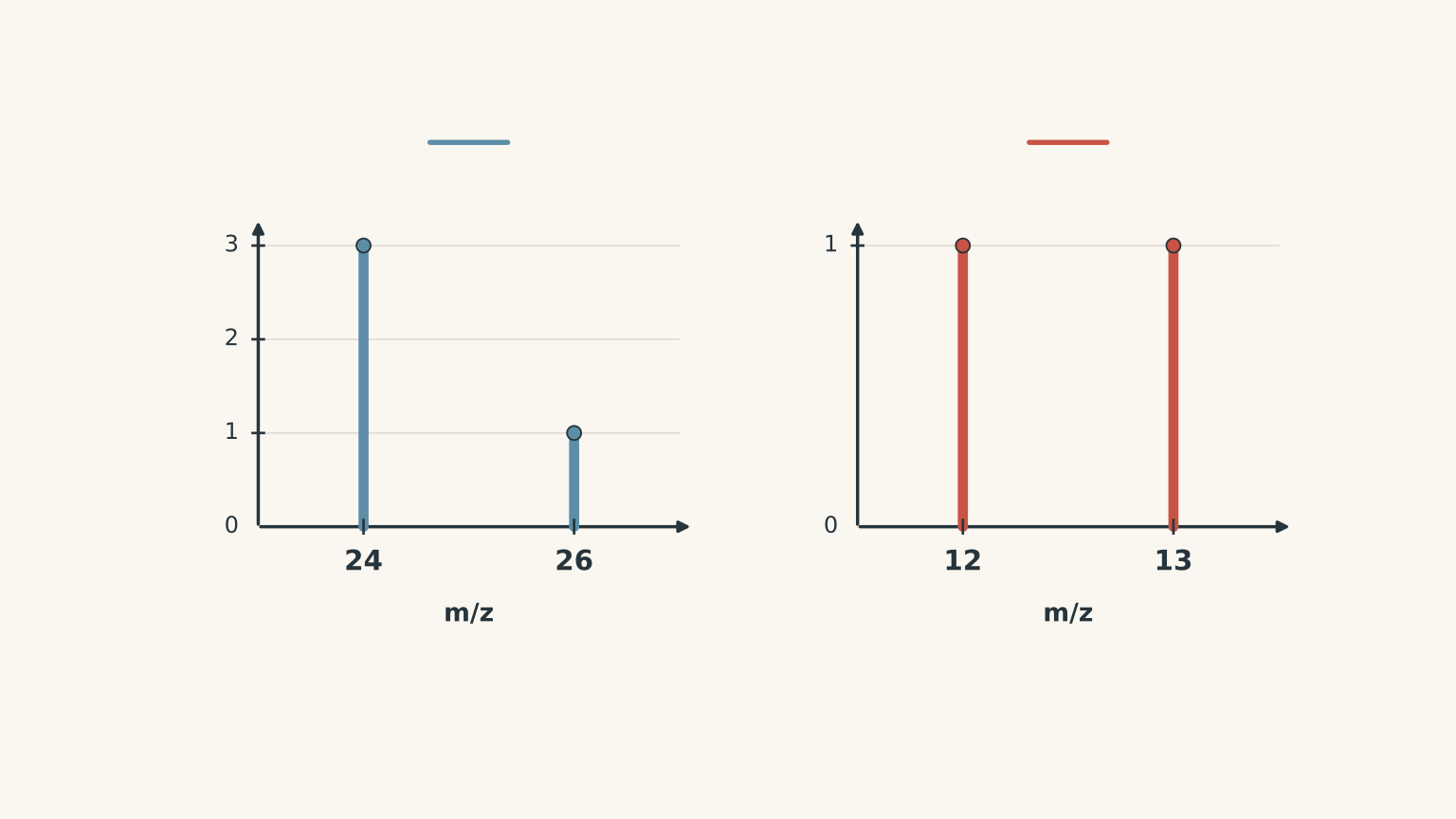
A hypothetical element \(Q\) contains exactly two isotopes with masses of 24.0 u and 26.0 u.
A mass spectrometer produces the following results.
Measurement A: The singly charged atomic ions give corrected detector signals:
| \(m/z\) | Relative corrected signal |
|---|---|
| 24 | 3 |
| 26 | 1 |
Measurement B: The doubly charged atomic ions give uncorrected signals:
| \(m/z\) | Relative raw signal |
|---|---|
| 12 | 1 |
| 13 | 1 |
Assume the corrected signals in measurement A accurately represent isotope abundances.
a) Calculate the relative atomic mass of \(Q\).
b) If the neutral substance exists as diatomic molecules, \(\mathrm{Q}_2\), calculate its molar mass.
c) Explain why the second measurement does not prove that the atomic masses have halved or that the isotope abundances are 50:50.
Due to technical limitations, this figure may display incorrectly or contain inaccuracies. Please check key details against your course materials.
Solution 2
The relative atomic mass is 24.5, the molar mass of \(\mathrm{Q}_2\) is approximately \(49.0\ \mathrm{g\,mol^{-1}}\), and the second measurement does not show a change in atomic mass or a new isotope mixture.
Part a
The corrected signals in measurement A give an isotope ratio of 3:1.
The total is four parts, so:
\[ f_{24}=\frac34=0.75 \]
\[ f_{26}=\frac14=0.25 \]
Here, \(f_{24}\) and \(f_{26}\) represent the fractions of the two isotopes.
Calculate the weighted mean:
\[ \begin{aligned} A_r(Q) &=0.75(24.0)+0.25(26.0)\\ &=18.0+6.5\\ &=24.5 \end{aligned} \]
Relative atomic mass has no unit.
Part b
Each \(\mathrm{Q}_2\) molecule contains two \(Q\) atoms.
Therefore:
\[ \begin{aligned} M(\mathrm{Q}_2) &\approx2(24.5)\\ &=49.0\ \mathrm{g\,mol^{-1}} \end{aligned} \]
Part c
The peaks move to half their previous \(m/z\) values because the ions have twice the positive charge.
For example, the mass-24 isotope gives approximately:
\[ m/z=\frac{24}{2}=12 \]
when its charge state is \(+2\).
Its atomic mass has not changed.
The second measurement also uses uncorrected signals. Different ionisation and detection responses can alter the recorded intensities.
The tempting conclusion is that equal peak heights always mean equal isotope abundances.
But equal raw signals are not sufficient evidence for equal atom counts when the instrument response has not been accounted for.
The corrected measurement A supplies the appropriate abundance information.
Question 3
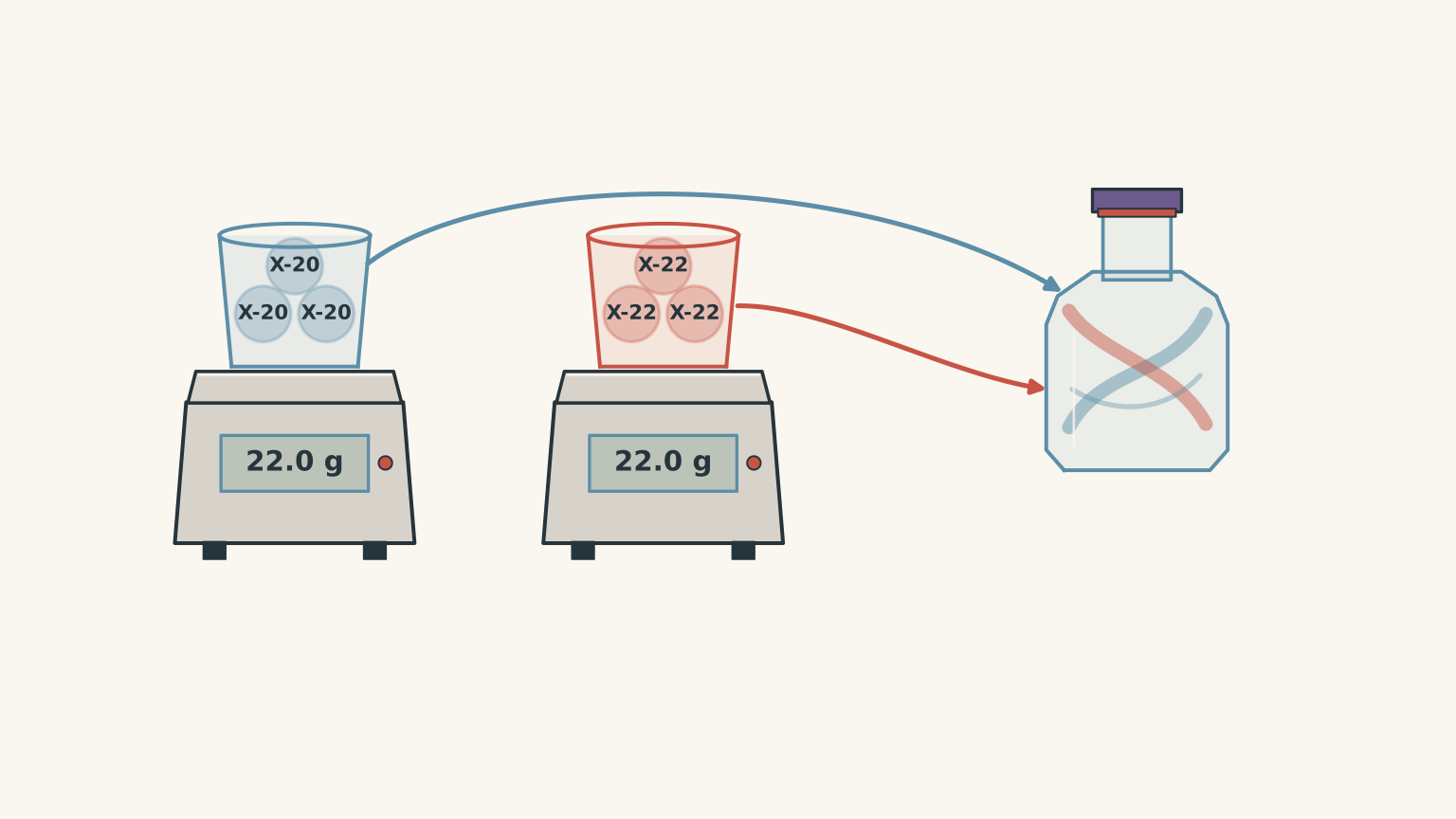
A fictional element \(X\) has exactly two stable isotopes:
- \(X\)-20, with an atomic mass of 20.0 u
- \(X\)-22, with an atomic mass of 22.0 u
A technician mixes 22.0 g of pure \(X\)-20 atoms with 22.0 g of pure \(X\)-22 atoms.
Assume that no atoms are lost, that atomic molar masses follow the usual HSC numerical approximation, and that all atoms later form diatomic molecules, \(\mathrm{X}_2\).
Determine:
a) The percentage of atoms belonging to each isotope in the mixture.
b) The relative atomic mass of \(X\).
c) The amount, in moles, of \(\mathrm{X}_2\) molecules produced.
d) The molar mass of \(\mathrm{X}_2\).
A student claims the mixture must contain 50% of each isotope because equal masses were combined. Evaluate this claim.
Due to technical limitations, this figure may display incorrectly or contain inaccuracies. Please check key details against your course materials.
Solution 3
The mixture contains approximately 52.4% \(X\)-20 atoms and 47.6% \(X\)-22 atoms. Its relative atomic mass is approximately 20.95, it forms \(1.05\) mol of \(\mathrm{X}_2\), and the molecular molar mass is approximately \(41.90\ \mathrm{g\,mol^{-1}}\).
Equal masses do not mean equal numbers of atoms.
Part a
First calculate the amount of each isotope.
For \(X\)-20:
\[ n_{20} =\frac{22.0\ \mathrm{g}}{20.0\ \mathrm{g\,mol^{-1}}} =1.10\ \mathrm{mol} \]
For \(X\)-22:
\[ n_{22} =\frac{22.0\ \mathrm{g}}{22.0\ \mathrm{g\,mol^{-1}}} =1.00\ \mathrm{mol} \]
Total amount of atoms:
\[ n_{\mathrm{atoms}}=2.10\ \mathrm{mol} \]
The fraction of \(X\)-20 atoms is:
\[ f_{20}=\frac{1.10}{2.10}=0.5238 \]
The fraction of \(X\)-22 atoms is:
\[ f_{22}=\frac{1.00}{2.10}=0.4762 \]
Therefore, the atom percentages are approximately 52.4% and 47.6%, respectively.
Part b
Relative atomic mass is weighted by atom counts, not by the proportion of the total mass contributed by each isotope.
\[ \begin{aligned} A_r(X) &=\frac{20.0(1.10)+22.0(1.00)}{2.10}\\ &=\frac{44.0}{2.10}\\ &\approx20.95 \end{aligned} \]
Part c
Every \(\mathrm{X}_2\) molecule contains two atoms.
No atoms have been lost, so:
\[ \begin{aligned} n(\mathrm{X}_2) &=\frac{n_{\mathrm{atoms}}}{2}\\ &=\frac{2.10}{2}\\ &=1.05\ \mathrm{mol} \end{aligned} \]
Part d
The molar mass of \(\mathrm{X}_2\) is:
\[ \begin{aligned} M(\mathrm{X}_2) &\approx2(20.95238)\\ &\approx41.90\ \mathrm{g\,mol^{-1}} \end{aligned} \]
We can independently check the calculation using mass conservation.
The total mass is:
\[ 22.0+22.0=44.0\ \mathrm{g} \]
And:
\[ \begin{aligned} m&=nM\\ &\approx1.05(41.90476)\\ &=44.0\ \mathrm{g} \end{aligned} \]
The values are consistent.
The student’s 50:50 prediction fails because the lighter isotope provides more atoms per gram. Equal masses of different isotopes do not contain equal amounts in moles.
Question 4
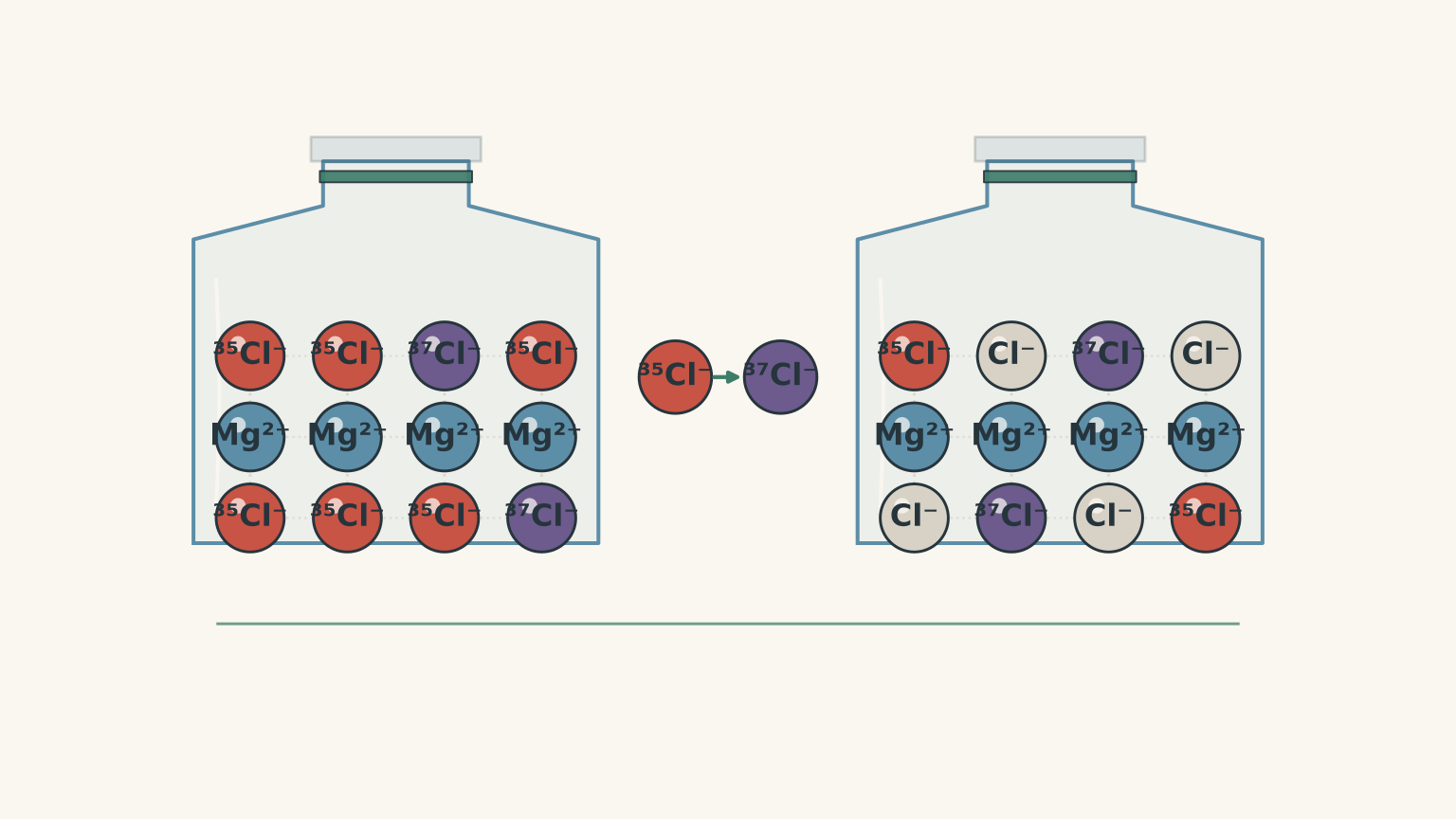
A sample contains \(0.100\) mol of anhydrous magnesium chloride, \(\ce{MgCl2}\).
Initially, its chlorine atoms have the following illustrative composition:
- 75.0% chlorine-35
- 25.0% chlorine-37
Use approximate isotope masses of 35.0 and 37.0 u, and \(A_r(\ce{Mg})=24.3\).
A hypothetical isotope-exchange process replaces some chlorine-35 ions with chlorine-37 ions, one for one. No magnesium ions or formula units are gained or lost, and the total number of chloride ions stays constant.
After exchange, the sample has a mass of 9.68 g.
Determine:
a) The initial mass of the sample.
b) The amount, in moles, of chlorine-35 ions replaced.
c) The percentage of the original chlorine-35 ions that were replaced.
d) The final relative atomic mass of chlorine in the sample and the final molar mass of \(\ce{MgCl2}\).
Ignore the very small mass effects associated with electrons and chemical binding.
Due to technical limitations, this figure may display incorrectly or contain inaccuracies. Please check key details against your course materials.
Solution 4
The initial mass is 9.53 g. Exactly \(0.0750\) mol of chlorine-35 ions were replaced, representing 50.0% of the original chlorine-35 ions. The final chlorine relative atomic mass is 36.25, and the final molar mass of \(\ce{MgCl2}\) is \(96.8\ \mathrm{g\,mol^{-1}}\).
The key is that the heavier isotope replaces the lighter isotope. It is not simply added to the sample.
Part a
Initially:
\[ \begin{aligned} A_r(\ce{Cl}) &=0.75(35.0)+0.25(37.0)\\ &=35.50 \end{aligned} \]
Therefore:
\[ \begin{aligned} M_i(\ce{MgCl2}) &=24.3+2(35.50)\\ &=95.3\ \mathrm{g\,mol^{-1}} \end{aligned} \]
Here, the subscript \(i\) indicates the initial value.
The initial sample mass is:
\[ \begin{aligned} m_i&=nM_i\\ &=0.100(95.3)\\ &=9.53\ \mathrm{g} \end{aligned} \]
Part b
The mass increase is:
\[ \Delta m=9.68-9.53=0.15\ \mathrm{g} \]
Each mole of chlorine-35 ions replaced by chlorine-37 ions increases the sample mass by approximately:
\[ 37.0-35.0=2.0\ \mathrm{g} \]
Therefore, if \(n_r\) is the amount of chloride ions replaced:
\[ \begin{aligned} n_r &=\frac{0.15\ \mathrm{g}}{2.0\ \mathrm{g\,mol^{-1}}}\\ &=0.0750\ \mathrm{mol} \end{aligned} \]
Part c
There are two chloride ions per formula unit.
The total initial amount of chloride ions is:
\[ n(\mathrm{Cl}^{-})=2(0.100)=0.200\ \mathrm{mol} \]
Initially, 75.0% are chlorine-35:
\[ n_{35,i}=0.75(0.200)=0.150\ \mathrm{mol} \]
The percentage replaced is:
\[ \begin{aligned} \frac{0.0750}{0.150}\times100\% &=50.0\% \end{aligned} \]
Part d
After the exchange:
\[ n_{35,f}=0.150-0.0750=0.0750\ \mathrm{mol} \]
Initially, the amount of chlorine-37 was:
\[ 0.25(0.200)=0.0500\ \mathrm{mol} \]
After replacement:
\[ n_{37,f}=0.0500+0.0750=0.1250\ \mathrm{mol} \]
The total remains \(0.200\) mol of chloride ions.
Therefore, the final fractions are:
\[ f_{35}=\frac{0.0750}{0.200}=0.375 \]
\[ f_{37}=\frac{0.1250}{0.200}=0.625 \]
The new relative atomic mass is:
\[ \begin{aligned} A_r(\ce{Cl})_f &=0.375(35.0)+0.625(37.0)\\ &=36.25 \end{aligned} \]
The new molar mass of magnesium chloride is:
\[ \begin{aligned} M_f(\ce{MgCl2}) &=24.3+2(36.25)\\ &=96.8\ \mathrm{g\,mol^{-1}} \end{aligned} \]
Finally:
\[ m_f=0.100(96.8)=9.68\ \mathrm{g} \]
This agrees with the measured final mass.
A tempting mistake is to treat the 0.15 g increase as an additional amount of chlorine-37. But the process replaces existing ions, so only the mass difference between the isotopes contributes.
The formula, the number of formula units, and the ionic charges stay constant. The isotopic composition changes.
Question 5
A chlorine sample is prepared with exactly the following atomic composition:
- 75.0% chlorine-35
- 25.0% chlorine-37
For this problem, assume the isotope masses are exactly 35.0 u and 37.0 u.
The chlorine atoms form diatomic molecules, \(\ce{Cl2}\). Researchers can control which isotopes are paired together, and no isotope exchange occurs during measurement.
A mass spectrometer measures 160 singly charged chlorine molecular ions. Its signals have been corrected so that the peak counts represent actual numbers of molecules.
Three possible molecular spectra are proposed:
| Molecular mass | Spectrum A | Spectrum B | Spectrum C |
|---|---|---|---|
| 70 u | 90 molecules | 80 molecules | 64 molecules |
| 72 u | 60 molecules | 80 molecules | 96 molecules |
| 74 u | 10 molecules | 0 molecules | 0 molecules |
| Total | 160 | 160 | 160 |
Answer all four parts.
a) Which proposed spectra are physically consistent with the stated 75:25 atomic isotope mixture?
b) For each consistent spectrum, calculate the relative atomic mass of chlorine and the molar mass of \(\ce{Cl2}\).
c) Explain why knowing the relative atomic mass does not necessarily determine the molecular mass spectrum.
d) Without assuming random isotope pairing, find the minimum and maximum possible percentages of 70-u molecules in a sample with this atomic composition. Describe the pairing arrangement that produces each extreme.
Assume that all molecules remain diatomic, that the ion charges are the same, and that the sample contains no other chlorine isotopes.
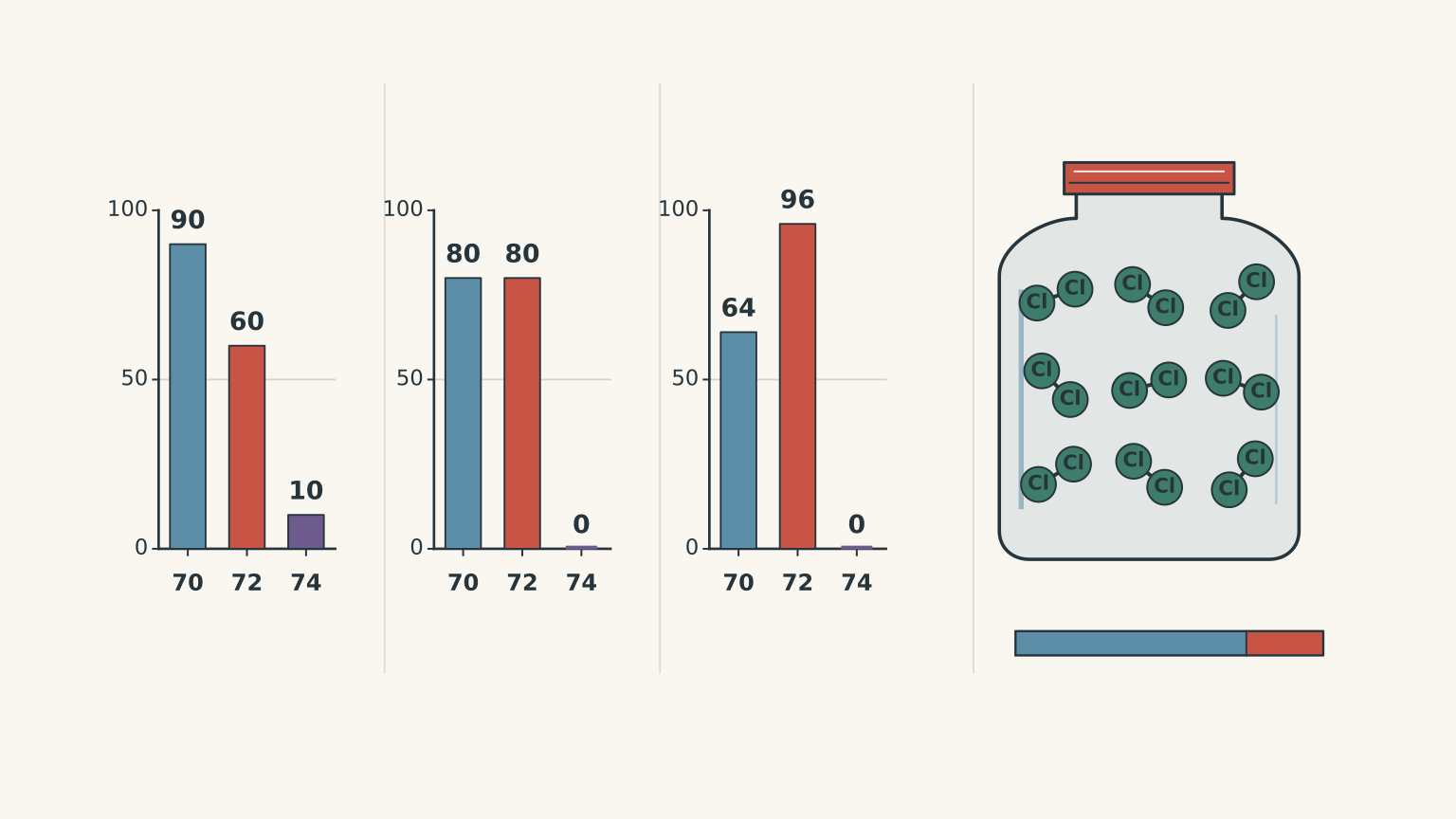
Due to technical limitations, this figure may display incorrectly or contain inaccuracies. Please check key details against your course materials.
Solution 5
Spectra A and B are both possible, but spectrum C is impossible. Both valid samples have \(A_r(\ce{Cl})=35.50\) and \(M(\ce{Cl2})=71.00\ \mathrm{g\,mol^{-1}}\), even though their molecular spectra differ. The fraction of 70-u molecules can range from 50.0% to 75.0%.
The surprising point is that the average atomic mass constrains the molecular masses without uniquely determining how isotopes are paired.
Part a: Test the proposed spectra against the atomic composition
There are 160 molecules, each containing two chlorine atoms.
Therefore:
\[ N_{\mathrm{atoms}}=2(160)=320 \]
Here, \(N\) represents a particle count.
Because 75% of the atoms are chlorine-35:
\[ N_{35}=0.75(320)=240 \]
And:
\[ N_{37}=0.25(320)=80 \]
Every molecular mass corresponds to a particular isotope pairing:
- 70 u: chlorine-35 paired with chlorine-35
- 72 u: chlorine-35 paired with chlorine-37
- 74 u: chlorine-37 paired with chlorine-37
Now test each spectrum.
Spectrum A
There are:
- 90 molecules of mass 70
- 60 molecules of mass 72
- 10 molecules of mass 74
The number of chlorine-35 atoms is:
\[ N_{35}=2(90)+60=240 \]
The number of chlorine-37 atoms is:
\[ N_{37}=60+2(10)=80 \]
Both match the required counts.
Spectrum A is possible.
Spectrum B
There are:
- 80 molecules of mass 70
- 80 molecules of mass 72
- No molecules of mass 74
The number of chlorine-35 atoms is:
\[ N_{35}=2(80)+80=240 \]
The number of chlorine-37 atoms is:
\[ N_{37}=80 \]
Again, both counts match.
Spectrum B is also possible.
Spectrum C
There are:
- 64 molecules of mass 70
- 96 molecules of mass 72
- No molecules of mass 74
The number of chlorine-35 atoms would be:
\[ N_{35}=2(64)+96=224 \]
The number of chlorine-37 atoms would be:
\[ N_{37}=96 \]
That corresponds to:
\[ \frac{224}{320}\times100\%=70.0\% \]
chlorine-35, rather than the required 75.0%.
Spectrum C is impossible for the specified sample.
Its peak counts add to 160, but that alone does not make the spectrum physically consistent.
Part b: Calculate the atomic and molecular masses
The atomic composition is the same in spectra A and B.
Therefore, both have:
\[ \begin{aligned} A_r(\ce{Cl}) &=0.75(35.0)+0.25(37.0)\\ &=35.50 \end{aligned} \]
Each molecule contains two atoms, so:
\[ \begin{aligned} M(\ce{Cl2}) &=2(35.50)\\ &=71.00\ \mathrm{g\,mol^{-1}} \end{aligned} \]
We can independently confirm the mean molecular mass from spectrum A:
\[ \begin{aligned} \overline{m}_A &=\frac{90(70)+60(72)+10(74)}{160}\\ &=\frac{11360}{160}\\ &=71.0\ \mathrm{u} \end{aligned} \]
For spectrum B:
\[ \begin{aligned} \overline{m}_B &=\frac{80(70)+80(72)}{160}\\ &=\frac{11360}{160}\\ &=71.0\ \mathrm{u} \end{aligned} \]
Both averages agree.
Part c: Explain why the spectra can differ
Relative atomic mass describes the average mass of an atom.
It doesn’t describe exactly which atoms are bonded together.
Spectrum A contains some light-light molecules, many mixed-isotope molecules, and a few heavy-heavy molecules.
Spectrum B contains light-light and mixed-isotope molecules but no heavy-heavy molecules.
Yet both arrangements contain exactly the same total numbers of chlorine-35 and chlorine-37 atoms.
The average mass per atom is therefore identical.
This is the limitation of using an average to describe a distribution.
An average preserves information about the total mass divided by the total number of particles. It does not preserve all the information about how individual particles are arranged.
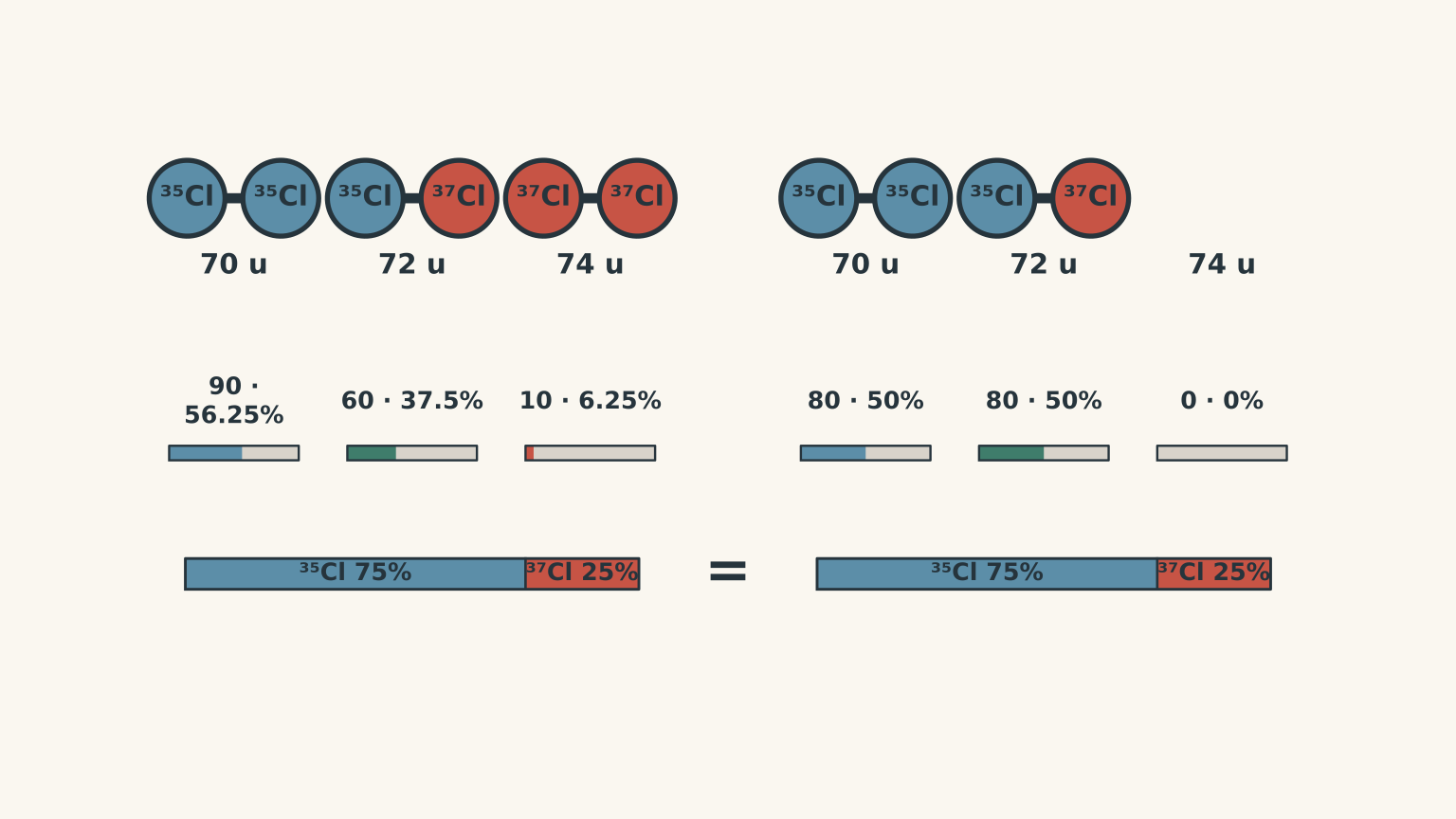
Due to technical limitations, this figure may display incorrectly or contain inaccuracies. Please check key details against your course materials.
Part d: Find the minimum and maximum proportion of 70-u molecules
This is the key constraint.
Every 70-u molecule uses two chlorine-35 atoms.
There are 240 chlorine-35 atoms available and 80 chlorine-37 atoms available.
To maximise the number of 70-u molecules, pair as many chlorine-35 atoms with each other as possible.
That gives:
\[ N_{70,\max}=\frac{240}{2}=120 \]
The 80 chlorine-37 atoms form 40 heavy-heavy molecules.
The total is:
\[ 120+40=160\ \text{molecules} \]
Therefore:
\[ \frac{120}{160}\times100\%=75.0\% \]
The maximum proportion of 70-u molecules is 75.0%.
To minimise their number, use as many chlorine-35 atoms as possible in mixed-isotope molecules.
Each chlorine-37 atom can pair with one chlorine-35 atom.
That uses all 80 chlorine-37 atoms and 80 chlorine-35 atoms, producing 80 mixed molecules.
The number of chlorine-35 atoms remaining is:
\[ 240-80=160 \]
These form:
\[ \frac{160}{2}=80 \]
light-light molecules.
Therefore:
\[ \frac{80}{160}\times100\%=50.0\% \]
The minimum proportion of 70-u molecules is 50.0%.
So the physically possible range is:
\[ 50.0\%\leq f_{70}\leq75.0\% \]
where \(f_{70}\) is the percentage of molecules with nominal mass 70 u.
The maximum occurs when the isotopes are paired separately as much as possible, with no mixed-isotope molecules.
The minimum occurs when every heavy isotope is paired with a light isotope, leaving the remaining light atoms to pair with each other.
The tempting assumption is that a 75:25 atomic isotope mixture must always produce the same 70:72:74 molecular peak ratio.
That would require an additional assumption about how atoms pair. Random independent pairing is one possible model, but the question deliberately permits controlled pairing.
The atomic composition fixes the mean molecular mass and constrains the possible molecular distributions. It does not uniquely determine the distribution.
07Where this distinction becomes useful next
Relative atomic mass connects isotope measurements to a representative atomic mass. Molar mass then connects the mass of a specified particle or formula unit to the amount of substance in a laboratory sample.
When a question gives you both an atomic mass and a chemical formula, identify the species before doing anything else. An isotope label tells you about one kind of atom; the formula tells you what constitutes one molecule or formula unit.
Once the correct molar mass is established, you can use it to move between measurable sample masses and chemical amounts. That’s the next step in Moles from Mass and Molar Mass: HSC Chemistry Guide.
The essential habit is simple: before using a mass value, decide whether it describes an isotope, an average atom, a molecule, or a mole of a specified substance.