
Why a Gas Bubble Doesn’t Automatically Mean a New Substance Formed
A bubble tells you that gas is present, not that a chemical reaction has occurred. Learn how to distinguish physical gas release from the formation of new substances using chemical formulas, experimental evidence, and worked HSC Chemistry examples.
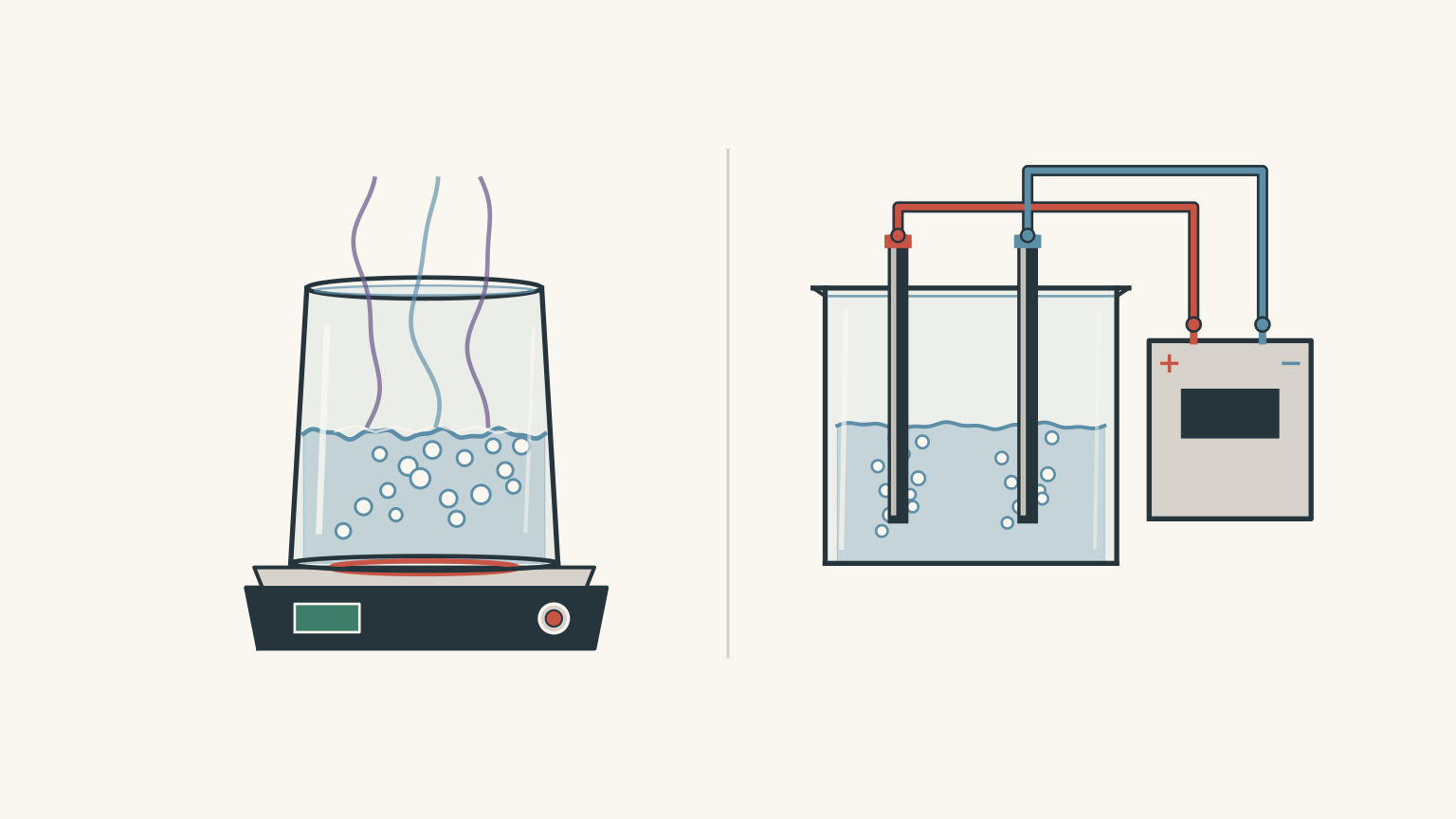
A beaker of water starts boiling. Bubbles rise through the liquid. In another beaker, two electrodes connected to a power supply also produce bubbles.
Both look as though a gas is being made. But have both processes produced a new substance?
No. A gas bubble shows that a gas phase is present. It does not automatically show that a chemical reaction has occurred or that a new chemical species has formed. The gas might already have been dissolved in the liquid, or a liquid might simply be changing into a gas.
To decide whether a reaction has occurred, you need to identify the particles before and after the change. You also need evidence that those particles have actually changed their chemical identity.
Due to technical limitations, this figure may display incorrectly or contain inaccuracies. Please check key details against your course materials.
01The first experiment: two beakers, two kinds of bubbles
Imagine investigating the two beakers using only what you can see.
In the first, water is heated until it boils. Large bubbles form near the bottom, rise, and burst at the surface.
In the second, a small electrical current passes through water containing a suitable dissolved electrolyte, such as sodium sulfate. Bubbles form at the electrodes and rise through the liquid.
If every bubble meant a new substance had formed, you would predict that both experiments were chemical reactions.
That prediction fails.
Beaker A: boiling water
Water is made of molecules with the formula \(\ce{H2O}\). Each molecule contains two hydrogen atoms bonded to one oxygen atom.
At sustained boiling, the bubbles are mainly water vapour. The water molecules have enough energy to enter the gas phase, but their chemical identity remains the same.
We represent the change as:
\[ \ce{H2O(l) -> H2O(g)} \]
The symbol \(\ce{(l)}\) means liquid, while \(\ce{(g)}\) means gas.
The formula stays \(\ce{H2O}\) on both sides. This is a physical change of state, not a chemical reaction producing a different substance.
There is a complication. When water first warms, small bubbles can contain air that was previously dissolved in the water. Those bubbles are not necessarily water vapour.
So even in a simple boiling experiment, the appearance of bubbles doesn’t reliably identify which gas is present.
Due to technical limitations, this figure may display incorrectly or contain inaccuracies. Please check key details against your course materials.
Beaker B: electrolysis of water
Now consider the beaker connected to a power supply.
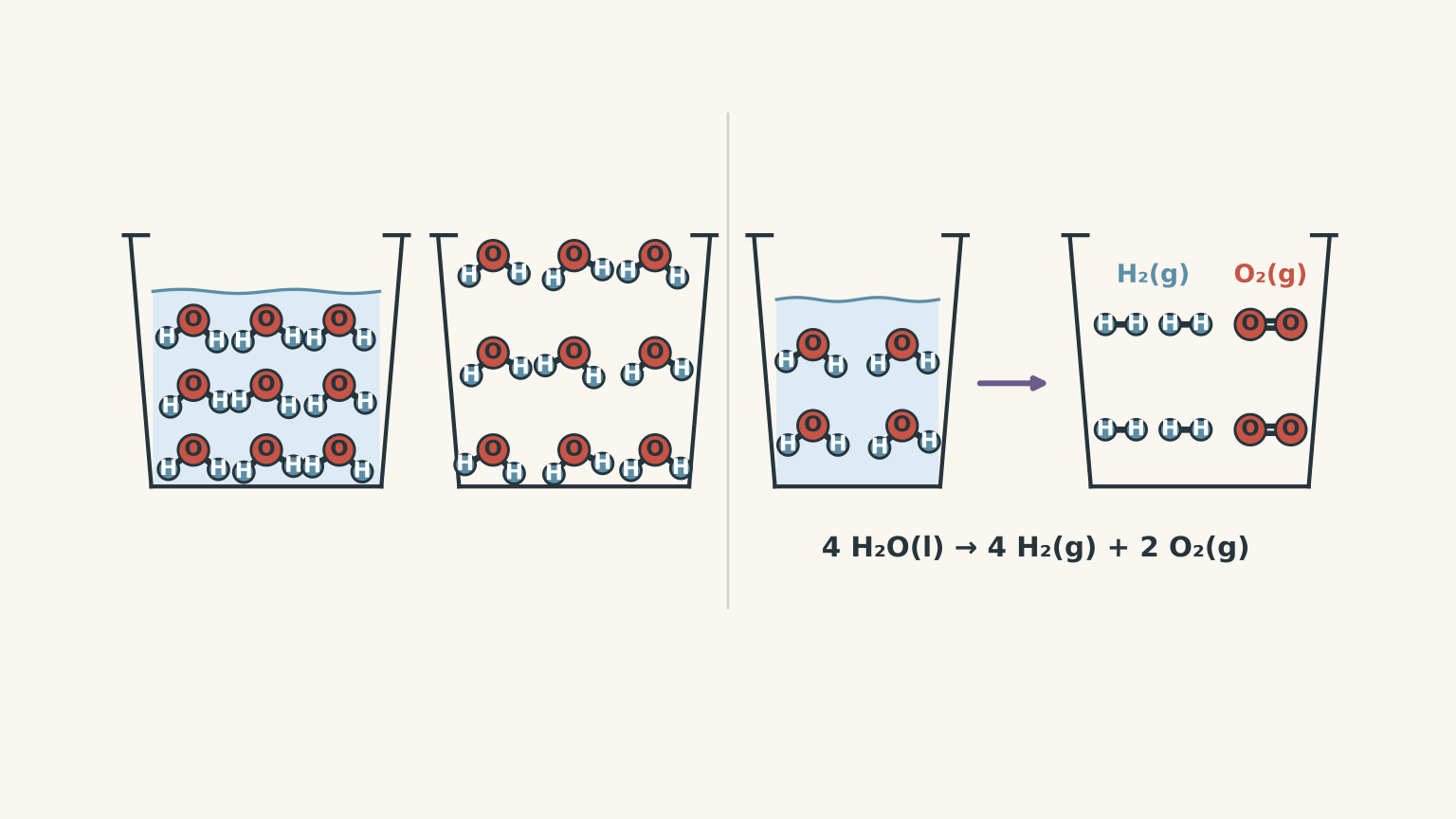
Under appropriate conditions, electrical energy drives a chemical reaction that converts water into hydrogen gas and oxygen gas.
The chemical equation is:
\[ \ce{2H2O(l) -> 2H2(g) + O2(g)} \]
Notice what changed.
The reactant contains \(\ce{H2O}\) molecules. The products contain \(\ce{H2}\) and \(\ce{O2}\) molecules.
These are different chemical species.
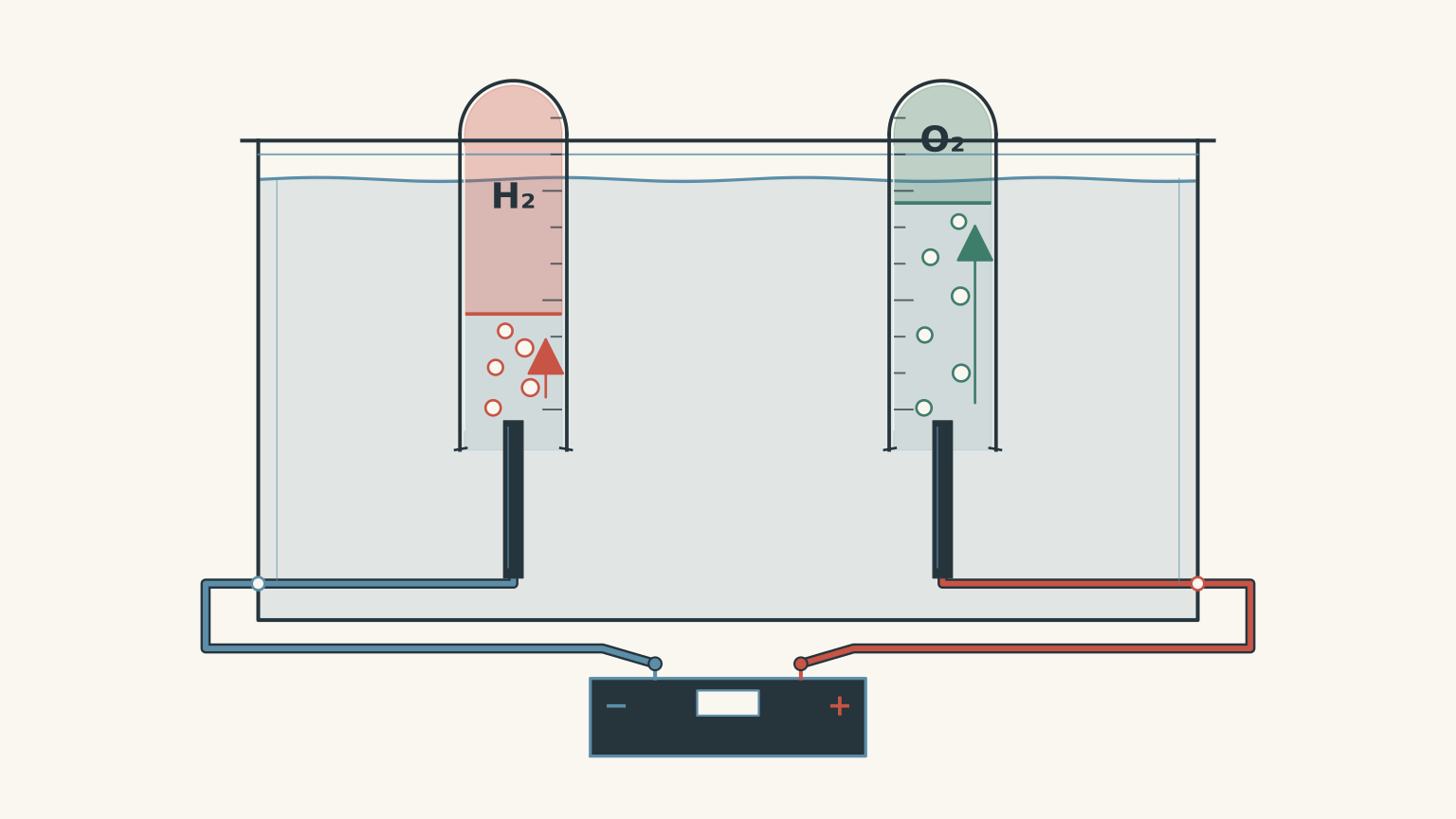
Hydrogen gas, \(\ce{H2}\), is collected at the negative electrode, called the cathode. Oxygen gas, \(\ce{O2}\), is collected at the positive electrode, called the anode.
Unlike boiling, electrolysis produces new substances.
But the bubbles weren’t what proved it. The evidence comes from identifying the products and establishing that a reaction accounts for their formation.
02How an improved experiment distinguishes the gases
The first design only allowed us to watch bubbles. It couldn’t identify their contents.
To improve it, we need to collect the gases separately, observe what happens to them, and connect those observations to the starting substances.
Collecting gas from heated water
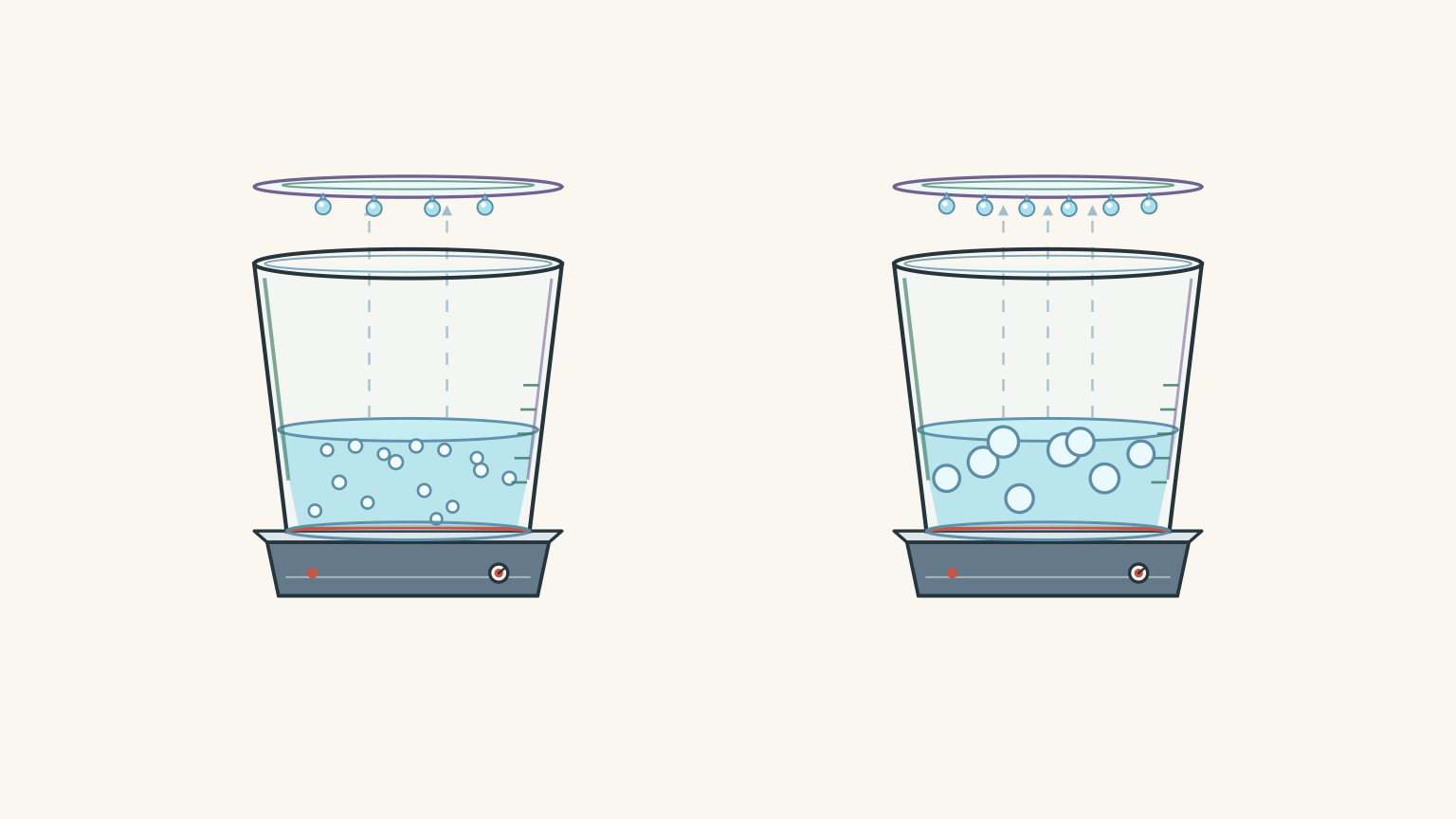
Consider a beaker of water on a hotplate with a thermometer measuring its temperature.
As the water approaches boiling, gas bubbles rise from the heated region. Water vapour passes into the space above the liquid.
A cool glass surface held above the beaker develops droplets as some of that water vapour condenses.
This supports the interpretation that water molecules moved from the liquid phase into the gas phase and then returned to the liquid phase.
The complete sequence is:
\[ \ce{H2O(l) -> H2O(g) -> H2O(l)} \]
The water has changed state twice without changing its molecular formula.
Condensation is useful evidence, but it doesn’t establish that every bubble contained pure water vapour. Initially dissolved air and other gases may also escape during heating.
Collecting gas from electrolysis
The electrolysis apparatus needs a different arrangement.
Picture a container filled with water containing dissolved sodium sulfate, \(\ce{Na2SO4}\), to help conduct electricity. Two inert electrodes sit below the water’s surface.
Each electrode is connected by a wire to a low-voltage DC power supply.
An inverted, water-filled collecting tube sits above each electrode. As bubbles enter a tube, they displace water and accumulate at the top.
The path is:
- Electrical current passes through the electrolysis cell.
- Gas forms at each electrode.
- Bubbles rise directly into the collecting tube above that electrode.
- Water is displaced, allowing the collected gas volume to be measured.
- Separate gas identification tests provide evidence about the gas at each electrode.
In a suitably controlled experiment, the negative electrode produces hydrogen and the positive electrode produces oxygen.
Due to technical limitations, this figure may display incorrectly or contain inaccuracies. Please check key details against your course materials.
Hydrogen can be identified using its characteristic response to an appropriate gas test. Oxygen supports combustion and can relight a glowing splint. Such tests require suitable laboratory supervision.
There is also a quantitative prediction.
The equation contains two molecules of hydrogen gas for every one molecule of oxygen gas:
\[ \ce{2H2O(l) -> 2H2(g) + O2(g)} \]
Therefore, if both gases are collected completely at the same temperature and pressure:
\[ \frac{V_{\ce{H2}}}{V_{\ce{O2}}} =\frac{2}{1} \]
Here, \(V_{\ce{H2}}\) is the volume of hydrogen, and \(V_{\ce{O2}}\) is the volume of oxygen.
The predicted gas volume ratio is \(2:1\).
A measured ratio close to this value supports the proposed reaction. Independent identification of the gases strengthens that conclusion.
However, the ratio alone is not conclusive. Different gases have different solubilities in water, and collection losses can affect the measured volumes.
The revised experiment is more convincing because it tests the chemical identities of the gases instead of treating bubbles as sufficient evidence.
03What are we observing, and what are we inferring?
In Chemistry, there is a difference between describing what happened and explaining what particles must be involved.
An observation is something you can directly see or measure.
An inference is a conclusion about chemical species drawn from that evidence.
| Observation | Reasonable inference | What remains unproven |
|---|---|---|
| Bubbles rise through boiling water | A gas phase is present | The exact composition of every bubble |
| Droplets form when vapour cools | Some water vapour has condensed | That all escaping gas was water vapour |
| Bubbles form at an electrode | Gas is entering the surrounding liquid | Its chemical identity |
| Collected gas is identified as hydrogen | \(\ce{H2}\) molecules are present | Their source without further context |
| Two collected gas volumes are close to a \(2:1\) ratio | The result is consistent with water electrolysis | That the gases are necessarily \(\ce{H2}\) and \(\ce{O2}\) |
An HSC response should make this distinction clear.
For example:
“Bubbles were observed at the negative electrode” describes the observation.
“Hydrogen gas was produced by reduction during electrolysis” is an explanation. It requires supporting chemical evidence and a model of the reaction.
Translate the names into formulas
This is particularly important when a question gives you the names of substances instead of their formulas.
| Named species | Formula | What it represents |
|---|---|---|
| Liquid water | \(\ce{H2O(l)}\) | Water molecules in the liquid phase |
| Water vapour | \(\ce{H2O(g)}\) | The same molecules in the gas phase |
| Hydrogen gas | \(\ce{H2(g)}\) | Molecules made of two hydrogen atoms |
| Oxygen gas | \(\ce{O2(g)}\) | Molecules made of two oxygen atoms |
| Dissolved carbon dioxide | \(\ce{CO2(aq)}\) | Carbon dioxide dissolved in water |
| Carbon dioxide gas | \(\ce{CO2(g)}\) | Carbon dioxide in the gas phase |
The symbol \(\ce{(aq)}\) means aqueous, or dissolved in water.
The difference between \(\ce{H2O(g)}\) and \(\ce{H2(g)}\) is not a small detail.
Water vapour still contains oxygen bonded to hydrogen. Hydrogen gas contains no oxygen.
Likewise, dissolved carbon dioxide and gaseous carbon dioxide are the same chemical species in different physical environments.
If you need more practice translating names into chemical formulas, see IUPAC Naming of Inorganic Substances for HSC Chemistry.
Due to technical limitations, this figure may display incorrectly or contain inaccuracies. Please check key details against your course materials.
04The trickier case: bubbles that are carbon dioxide
Boiling water and electrolysis produce different gases. That makes them relatively straightforward to distinguish.
What if two experiments release exactly the same gas, but only one produces new carbon dioxide molecules?
Consider opening a bottle of sparkling water.
The liquid contains dissolved carbon dioxide, \(\ce{CO2(aq)}\), introduced during carbonation.
While the bottle is sealed, the higher carbon dioxide pressure above the liquid helps keep more gas dissolved.
When the bottle is opened, the pressure falls. Some dissolved carbon dioxide escapes as bubbles.
The main change we want to represent is:
\[ \ce{CO2(aq) -> CO2(g)} \]
No new carbon dioxide molecules need to form to explain those bubbles.
The gas already existed as dissolved \(\ce{CO2}\).
Carbon dioxide also participates in equilibria with water and other dissolved carbon species. Those equilibria can shift as gas escapes, but bubbling alone does not establish that the liquid has undergone a chemical reaction that produced new \(\ce{CO2}\).
Now compare this with hydrochloric acid reacting with calcium carbonate.
The word equation is:
Calcium carbonate + hydrochloric acid \(\rightarrow\) calcium chloride + carbon dioxide + water.
The balanced equation is:
\[ \begin{aligned} &\ce{CaCO3(s) + 2HCl(aq)}\\ &\ce{-> CaCl2(aq) + CO2(g) + H2O(l)} \end{aligned} \]
Here, a chemical reaction converts carbonate into carbon dioxide. Calcium carbonate and hydrochloric acid are consumed, while dissolved calcium chloride, carbon dioxide, and water are produced.
Both experiments can release \(\ce{CO2(g)}\).
Both can produce bubbles that look alike.
Yet their chemical explanations are different.
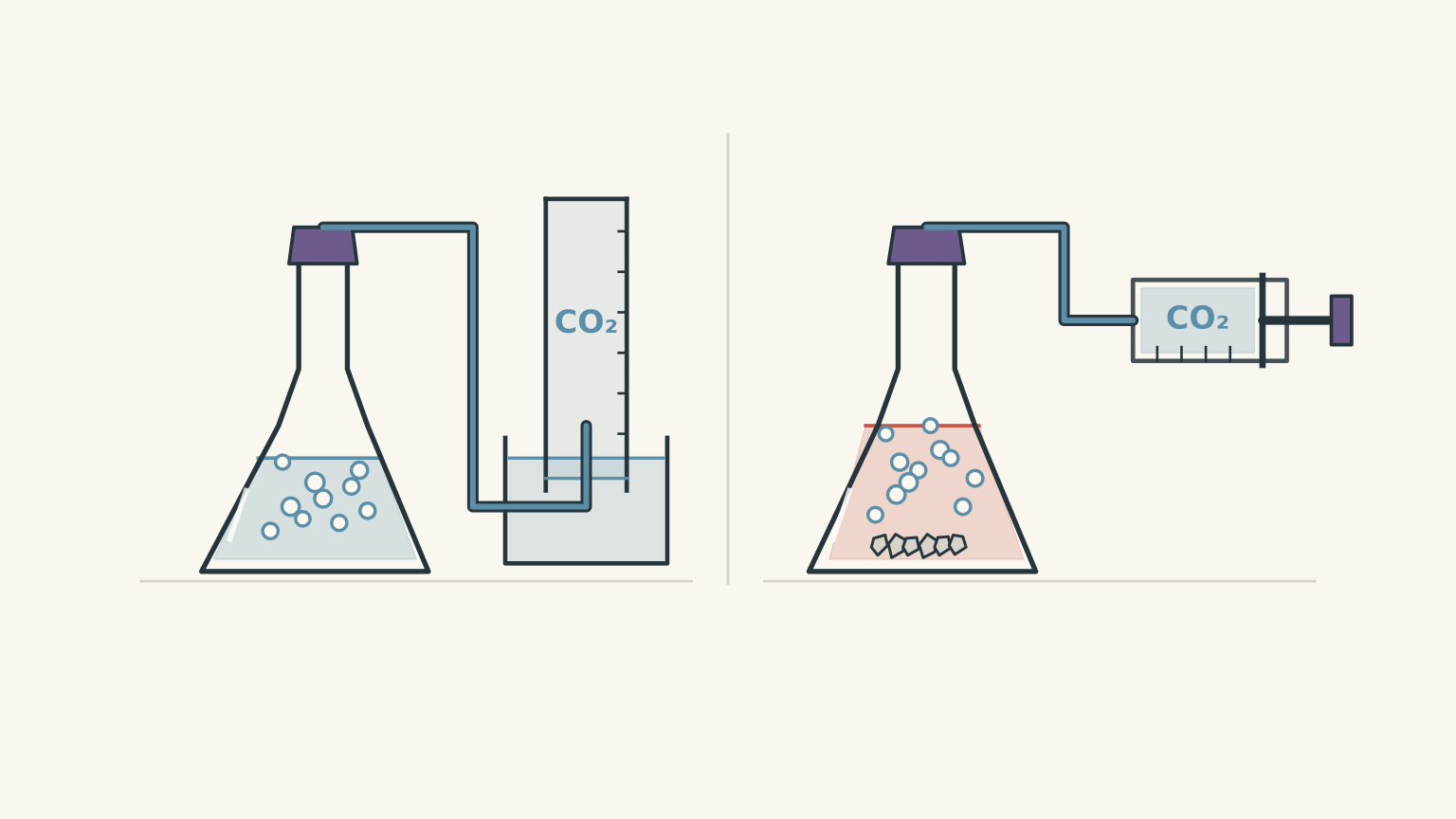
Due to technical limitations, this figure may display incorrectly or contain inaccuracies. Please check key details against your course materials.
Worked example: Does collecting 60.0 mL of gas prove a reaction?
A gas syringe collects \(60.0\ \mathrm{mL}\) of carbon dioxide released from sparkling water when the pressure is reduced. Assume the gas has a molar volume of \(24.0\ \mathrm{L\,mol^{-1}}\) and a molar mass of \(44.0\ \mathrm{g\,mol^{-1}}\).
Calculate the amount and mass of carbon dioxide collected. Explain whether these measurements prove a chemical reaction occurred.
Step 1
\[ V=\frac{60.0}{1000} =0.0600\ \mathrm{L} \]
Step 2
The relationship is:
\[ n=\frac{V}{V_m} \]
Here, \(n\) is the amount in moles, \(V\) is the gas volume in litres, and \(V_m\) is the molar volume in litres per mole.
Substitute:
\[ \begin{aligned} n&=\frac{0.0600}{24.0}\\ &=2.50\times10^{-3}\ \mathrm{mol} \end{aligned} \]
Step 3
Using \(m=nM\), where \(m\) is mass in grams and \(M\) is molar mass:
\[ \begin{aligned} m&=(2.50\times10^{-3})(44.0)\\ &=0.110\ \mathrm{g} \end{aligned} \]
Step 4
The syringe collected \(2.50\times10^{-3}\ \mathrm{mol}\), or \(0.110\ \mathrm{g}\), of carbon dioxide.
That tells us how much gas entered the syringe. It does not tell us whether the gas molecules were newly produced.
The measurements are consistent with dissolved carbon dioxide escaping after the pressure was reduced.
This is the limitation of a gas syringe: it measures gas volume, not the chemical history of the molecules.
05A stronger comparison: predicting products from the equation
In electrolysis, we can go further than measuring the total gas volume. The balanced chemical equation predicts how much of each product should form.
Worked example: How much water was decomposed?
During electrolysis of water using inert electrodes, \(18.0\ \mathrm{mL}\) of oxygen is collected at the positive electrode.
Assume the water electrolysis reaction is the only source of gas, the gases are collected completely, both gases are measured at the same temperature and pressure, and the molar volume is \(24.0\ \mathrm{L\,mol^{-1}}\).
Calculate the expected volume of hydrogen and the mass of water consumed. Use \(M(\ce{H2O})=18.0\ \mathrm{g\,mol^{-1}}\).
Step 1
\[ \ce{2H2O(l) -> 2H2(g) + O2(g)} \]
For every one mole of oxygen produced, two moles of hydrogen and two moles of water are involved.
Step 2
At the same temperature and pressure, gas volumes follow the mole ratio.
\[ \begin{aligned} V_{\ce{H2}}&=2V_{\ce{O2}}\\ &=2(18.0)\\ &=36.0\ \mathrm{mL} \end{aligned} \]
The expected hydrogen volume is \(36.0\ \mathrm{mL}\).
Step 3
Convert \(18.0\ \mathrm{mL}\) to \(0.0180\ \mathrm{L}\).
\[ \begin{aligned} n_{\ce{O2}}&=\frac{0.0180}{24.0}\\ &=7.50\times10^{-4}\ \mathrm{mol} \end{aligned} \]
Step 4
The equation gives a \(2:1\) ratio of water to oxygen.
\[ \begin{aligned} n_{\ce{H2O}}&=2n_{\ce{O2}}\\ &=1.50\times10^{-3}\ \mathrm{mol} \end{aligned} \]
Step 5
\[ \begin{aligned} m_{\ce{H2O}}&=nM\\ &=(1.50\times10^{-3})(18.0)\\ &=0.0270\ \mathrm{g} \end{aligned} \]
Under the stated assumptions, \(0.0270\ \mathrm{g}\) of water was consumed to produce hydrogen and oxygen.
This result matters because the measured oxygen volume is linked to the production of a different chemical species, the predicted hydrogen volume, and the consumption of the original water molecules.
The reaction model gives us a connected set of predictions that can be checked experimentally.
If the measured hydrogen volume differs from \(36.0\ \mathrm{mL}\), that doesn’t automatically disprove the reaction. We would first investigate gas loss, dissolution, impurities, and measurement conditions.
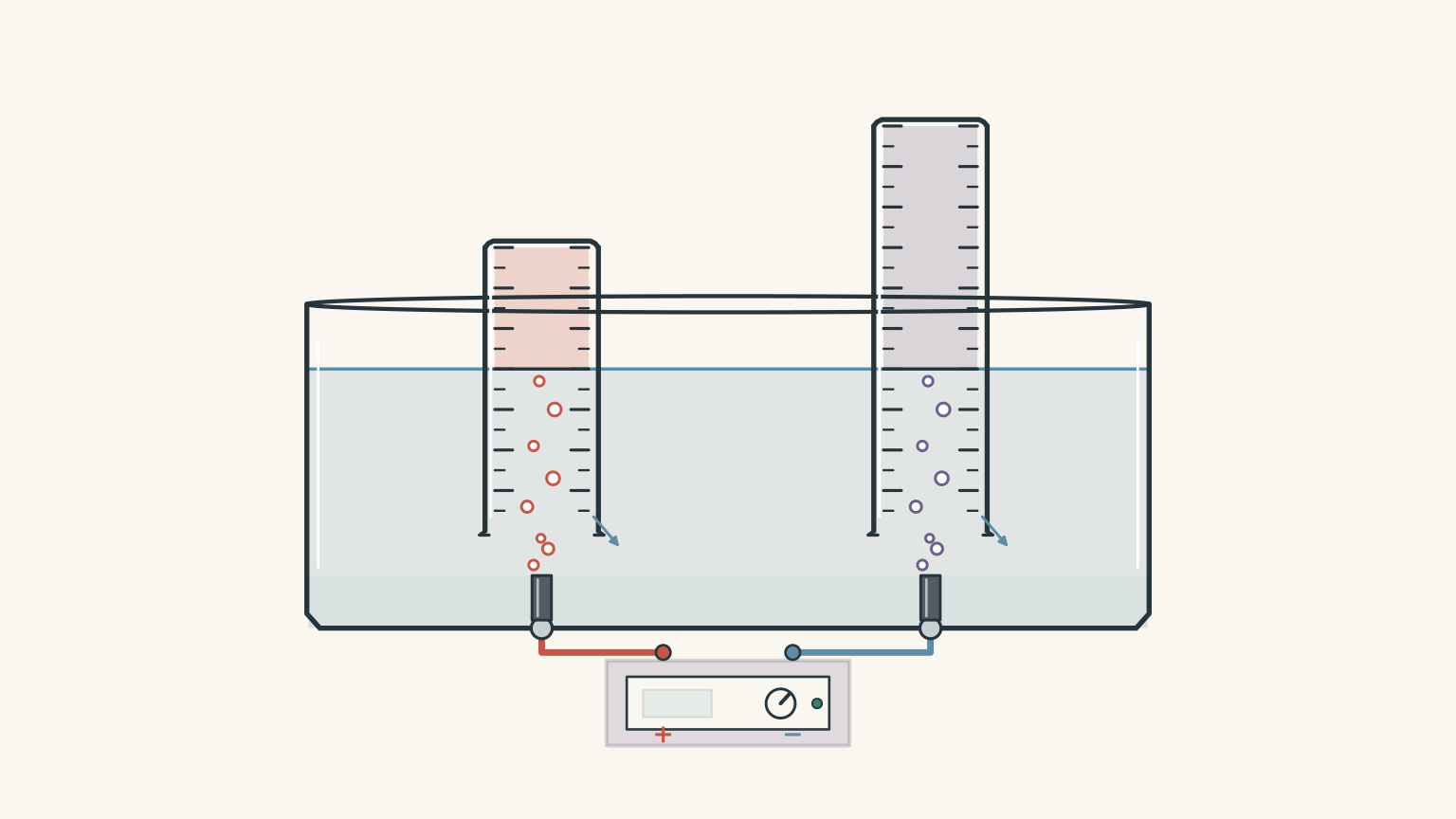
Due to technical limitations, this figure may display incorrectly or contain inaccuracies. Please check key details against your course materials.
06Why identifying the gas is still not enough
Suppose you collect gas from sparkling water and bubble it through limewater.
Limewater is a solution of calcium hydroxide, \(\ce{Ca(OH)2(aq)}\).
If carbon dioxide is introduced, the limewater can turn milky because insoluble calcium carbonate forms.
\[ \begin{aligned} &\ce{CO2(g) + Ca(OH)2(aq)}\\ &\ce{-> CaCO3(s) + H2O(l)} \end{aligned} \]
This test supports the identification of carbon dioxide.
But it tells us what the collected gas is, not necessarily how that gas originated.
Carbon dioxide released physically from sparkling water and carbon dioxide formed by an acid-carbonate reaction can both produce a positive limewater test.
There is another subtlety.
The limewater test is itself a chemical reaction. The new calcium carbonate forms in the test solution.
That does not prove that a chemical reaction produced the gas in the original bottle.
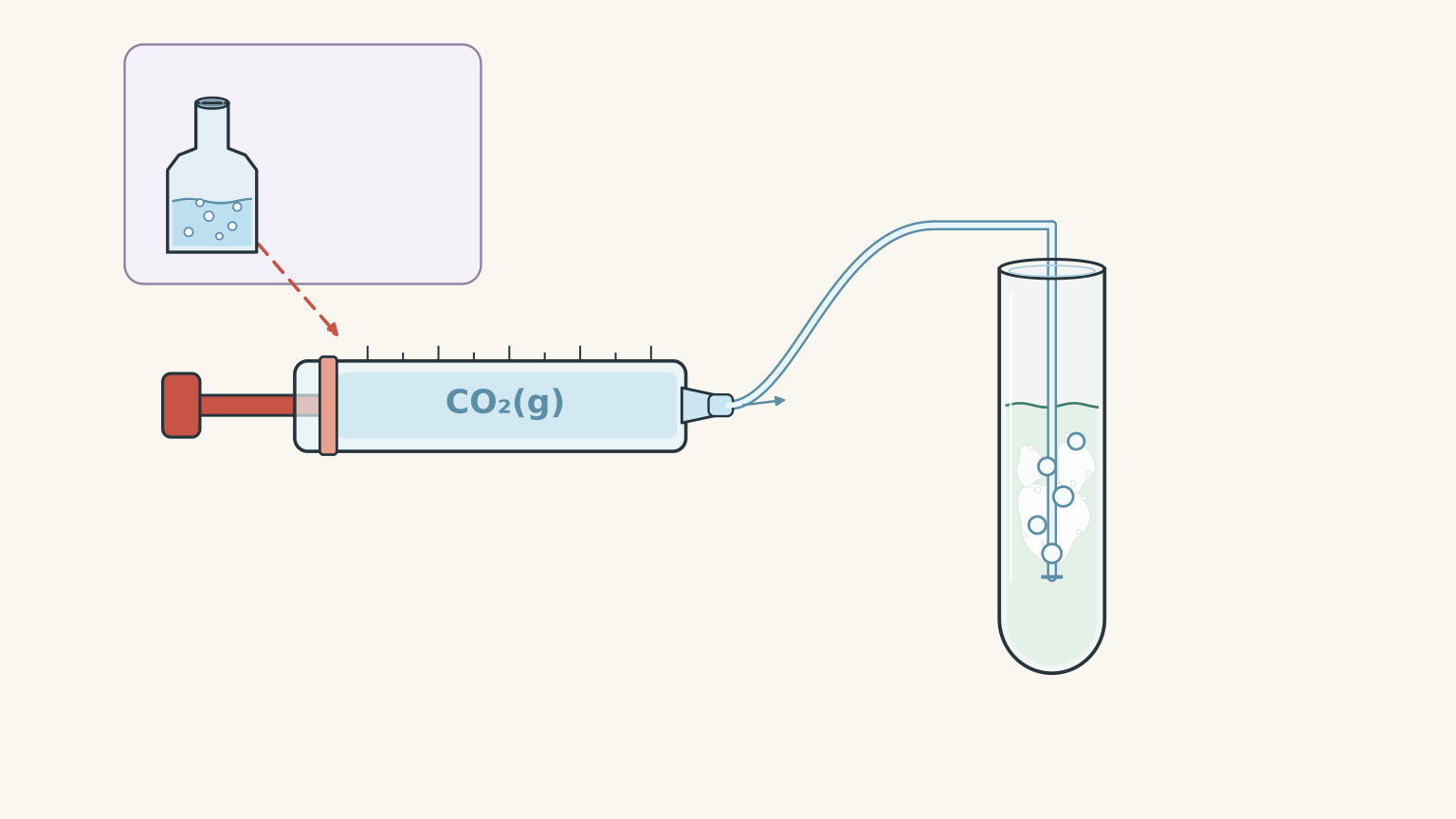
Due to technical limitations, this figure may display incorrectly or contain inaccuracies. Please check key details against your course materials.
What should you test next?
For an unexplained bubbling liquid, use the following evidence in combination.
| Evidence to collect | Why it helps |
|---|---|
| Identity of the collected gas | Establishes which gaseous species is present |
| Starting substances and their formulas | Shows whether that species could already have been present |
| Changes in reactant quantities | Tests whether reactants were consumed |
| Other products formed | Provides independent evidence of chemical change |
| Gas volume compared with stoichiometry | Tests quantitative predictions from a balanced equation |
| A suitable control experiment | Checks whether the gas could be released without the proposed reaction |
A control matters especially when an existing dissolved gas could escape.
For example, adding a rough solid to carbonated water may provide surfaces where gas bubbles can form. A larger gas volume after adding a solid isn’t necessarily the volume chemically produced by that solid.
The solid could have caused more of the pre-existing carbon dioxide to escape.
A useful investigation therefore asks two separate questions:
- How much gas left the liquid?
- How much new gas was produced by a chemical reaction?
Those quantities are not always equal.
07Questions and solutions
The following questions move from recognising a physical change to interpreting experimental evidence and accounting for gas that may have more than one origin.
Question 1
A student heats a beaker containing pure water until it boils. Large bubbles rise through the liquid, and droplets form on a cool glass surface above the beaker.
a) Identify the main gas in the bubbles during sustained boiling and give its chemical formula.
b) Write an equation for the main physical change occurring.
c) Explain why the appearance of bubbles is insufficient evidence that new substances have formed.
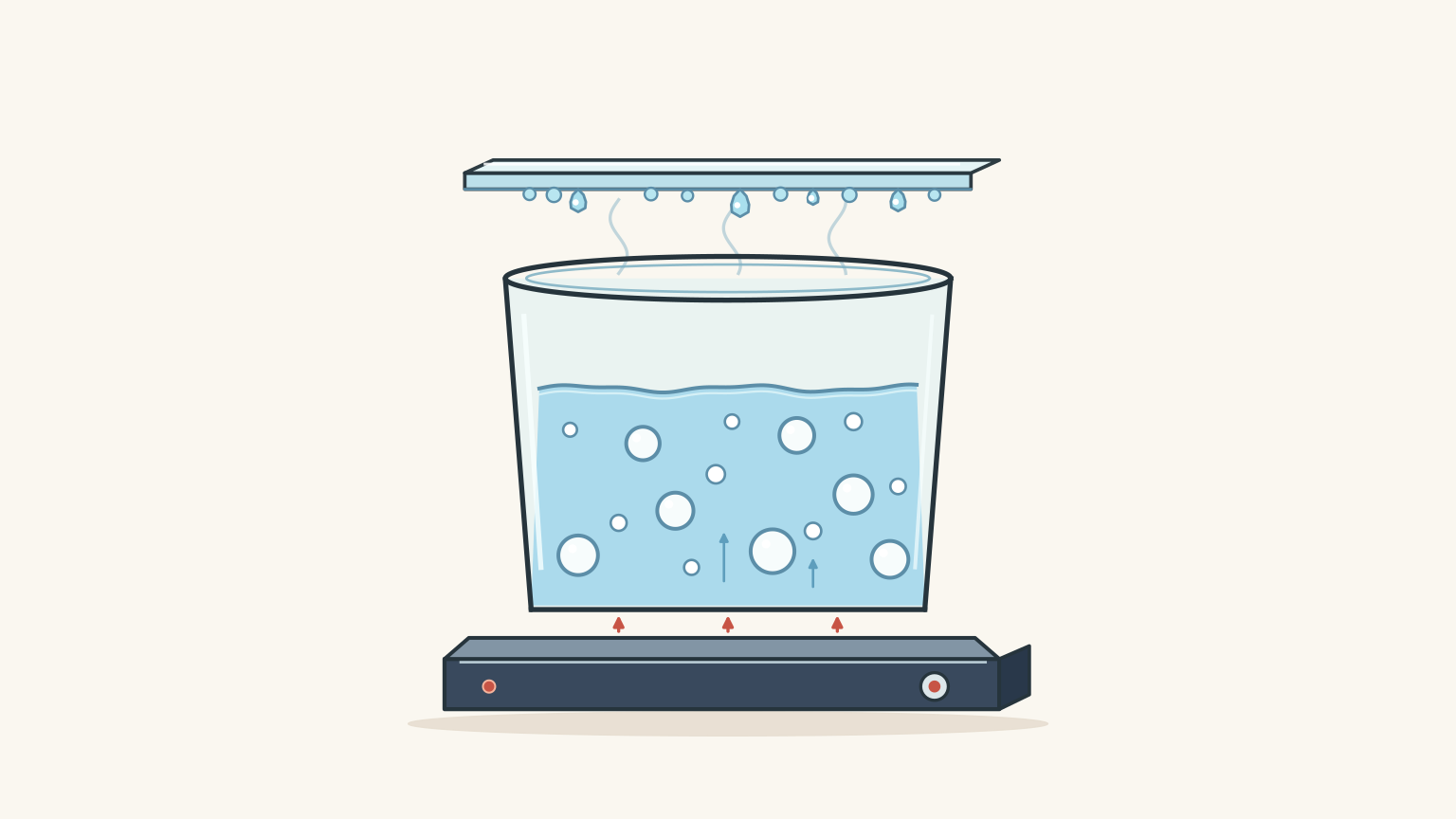
Due to technical limitations, this figure may display incorrectly or contain inaccuracies. Please check key details against your course materials.
Solution 1
The bubbles during sustained boiling contain mainly water vapour, \(\ce{H2O(g)}\), and the process is a physical change rather than evidence of a new substance.
a) The gas is predominantly water vapour.
Its formula is \(\ce{H2O(g)}\), not \(\ce{H2(g)}\) or \(\ce{O2(g)}\).
b) The phase-change equation is:
\[ \ce{H2O(l) -> H2O(g)} \]
Cooling reverses the process:
\[ \ce{H2O(g) -> H2O(l)} \]
c) The water molecules retain the formula \(\ce{H2O}\). Their state changes, but their chemical identity does not.
The droplets on the cool surface are consistent with water vapour condensing back into liquid water.
A tempting explanation is that the water has separated into hydrogen and oxygen because bubbles have appeared.
That would require evidence of \(\ce{H2}\) and \(\ce{O2}\) as products. Boiling alone does not establish their formation.
Small bubbles produced before sustained boiling may also contain previously dissolved air, so the bubble contents depend on the experimental conditions.
Question 2
A student places \(0.250\ \mathrm{g}\) of pure calcium carbonate, \(\ce{CaCO3}\), in a conical flask and adds \(20.0\ \mathrm{mL}\) of \(0.200\ \mathrm{mol\,L^{-1}}\) hydrochloric acid.
The flask is connected to a gas syringe, which collects \(40.0\ \mathrm{mL}\) of dry carbon dioxide at a temperature and pressure where the molar volume is \(24.0\ \mathrm{L\,mol^{-1}}\).
Assume the acid reacts only with the carbonate, all available acid is eventually consumed, and no other gas is produced. Some carbon dioxide may remain dissolved or be lost during collection.
Use \(M(\ce{CaCO3})=100.0\ \mathrm{g\,mol^{-1}}\).
a) Write the balanced reaction equation.
b) Identify the limiting reagent and calculate the theoretical volume of carbon dioxide produced.
c) Calculate the mass of calcium carbonate remaining.
d) Explain why the measured gas volume does not necessarily indicate an incomplete reaction.
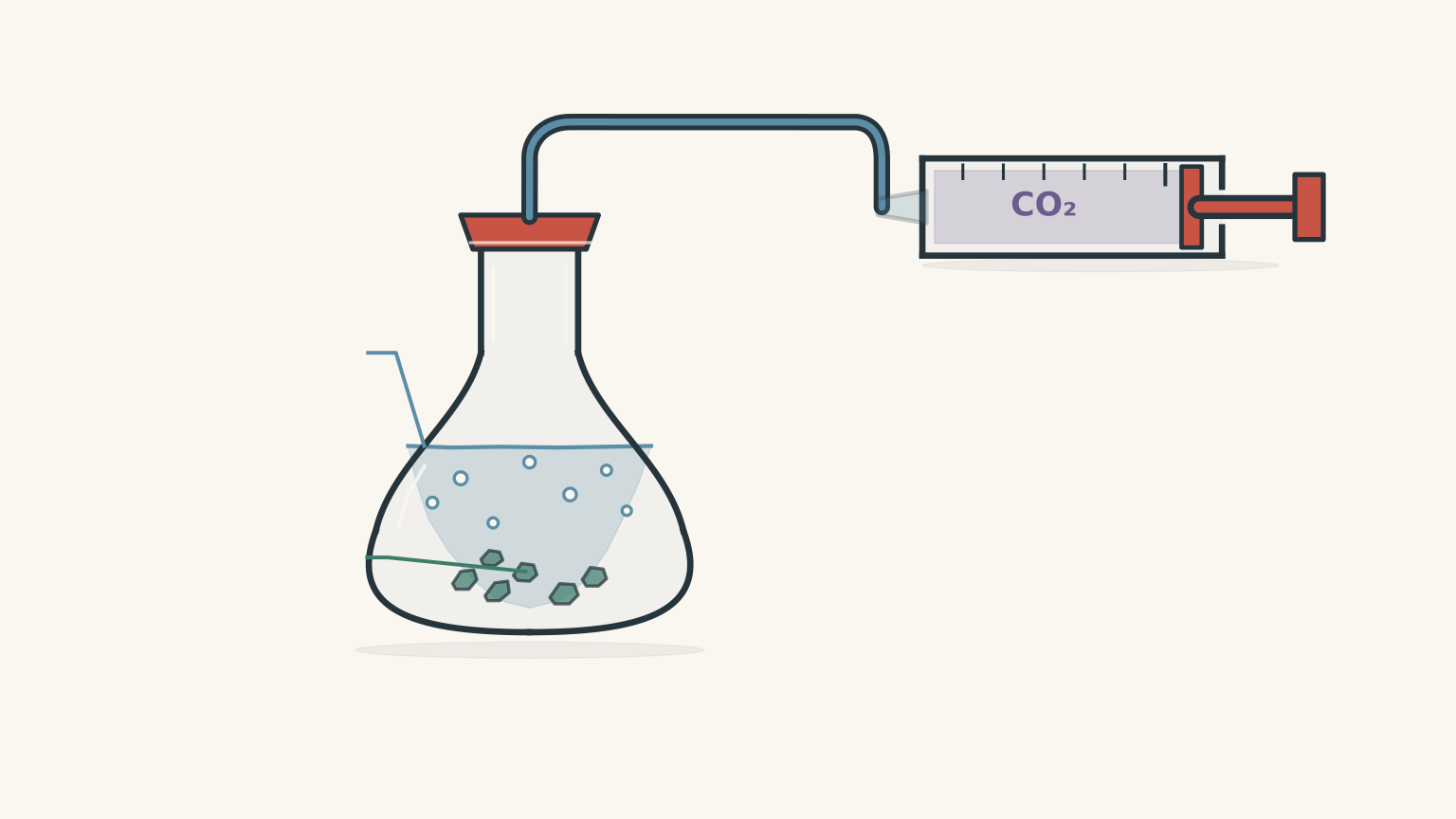
Due to technical limitations, this figure may display incorrectly or contain inaccuracies. Please check key details against your course materials.
Solution 2
Hydrochloric acid is the limiting reagent. The theoretical carbon dioxide volume is \(48.0\ \mathrm{mL}\), and \(0.0500\ \mathrm{g}\) of calcium carbonate remains under the stated assumptions.
a) The balanced equation is:
\[ \begin{aligned} &\ce{CaCO3(s) + 2HCl(aq)}\\ &\ce{-> CaCl2(aq) + CO2(g) + H2O(l)} \end{aligned} \]
b) First calculate the amount of calcium carbonate:
\[ \begin{aligned} n_{\ce{CaCO3}}&=\frac{m}{M}\\ &=\frac{0.250}{100.0}\\ &=0.00250\ \mathrm{mol} \end{aligned} \]
Calculate the amount of hydrochloric acid using \(n=cV\), where \(c\) is concentration and \(V\) is solution volume in litres.
\[ \begin{aligned} n_{\ce{HCl}}&=0.200(0.0200)\\ &=0.00400\ \mathrm{mol} \end{aligned} \]
The reaction requires two moles of hydrochloric acid for every mole of calcium carbonate.
To consume all the carbonate, the required acid amount would be:
\[ \begin{aligned} n_{\ce{HCl,required}}&=2(0.00250)\\ &=0.00500\ \mathrm{mol} \end{aligned} \]
Only \(0.00400\ \mathrm{mol}\) is available. Therefore, hydrochloric acid is limiting.
From the reaction ratio:
\[ \begin{aligned} n_{\ce{CO2}}&=\frac{0.00400}{2}\\ &=0.00200\ \mathrm{mol} \end{aligned} \]
The theoretical gas volume is:
\[ \begin{aligned} V&=nV_m\\ &=0.00200(24.0)\\ &=0.0480\ \mathrm{L}\\ &=48.0\ \mathrm{mL} \end{aligned} \]
c) The amount of calcium carbonate consumed is \(0.00200\ \mathrm{mol}\).
\[ \begin{aligned} m_{\text{consumed}}&=0.00200(100.0)\\ &=0.200\ \mathrm{g} \end{aligned} \]
The remaining mass is:
\[ \begin{aligned} m_{\text{remaining}}&=0.250-0.200\\ &=0.0500\ \mathrm{g} \end{aligned} \]
d) The syringe measured \(40.0\ \mathrm{mL}\), which is \(8.0\ \mathrm{mL}\) less than the theoretical amount.
It would be tempting to conclude that less carbonate reacted than predicted.
However, the gas syringe measures carbon dioxide that reaches the syringe, not necessarily all carbon dioxide produced.
Some may remain dissolved in the reaction mixture or escape through imperfect connections. The measured volume can therefore be lower even if all available hydrochloric acid reacts.
The limiting-reagent calculation and evidence of reactant consumption are necessary for interpreting the result.
Question 3
During the electrolysis of water with inert electrodes, the gas collected at the negative electrode is independently identified as hydrogen. The gas at the positive electrode is identified as oxygen.
At the same temperature and pressure, the measured volumes are:
| Electrode | Gas | Collected volume |
|---|---|---|
| Negative cathode | Hydrogen | \(48.0\ \mathrm{mL}\) |
| Positive anode | Oxygen | \(22.0\ \mathrm{mL}\) |
The molar volume is \(24.0\ \mathrm{L\,mol^{-1}}\).
Assume neither hydrogen nor other substances capable of producing it were present initially, the electrodes are inert, and the collected hydrogen is pure.
A student argues:
“The volume ratio isn’t exactly \(2:1\), so the bubbles must just be air coming out of the water.”
a) Evaluate the student’s explanation.
b) Calculate the expected oxygen volume if all \(48.0\ \mathrm{mL}\) of hydrogen was collected from water electrolysis.
c) Calculate the apparent shortfall in collected oxygen, in moles.
d) Suggest two experimental factors that could explain the discrepancy without requiring a different overall chemical reaction.
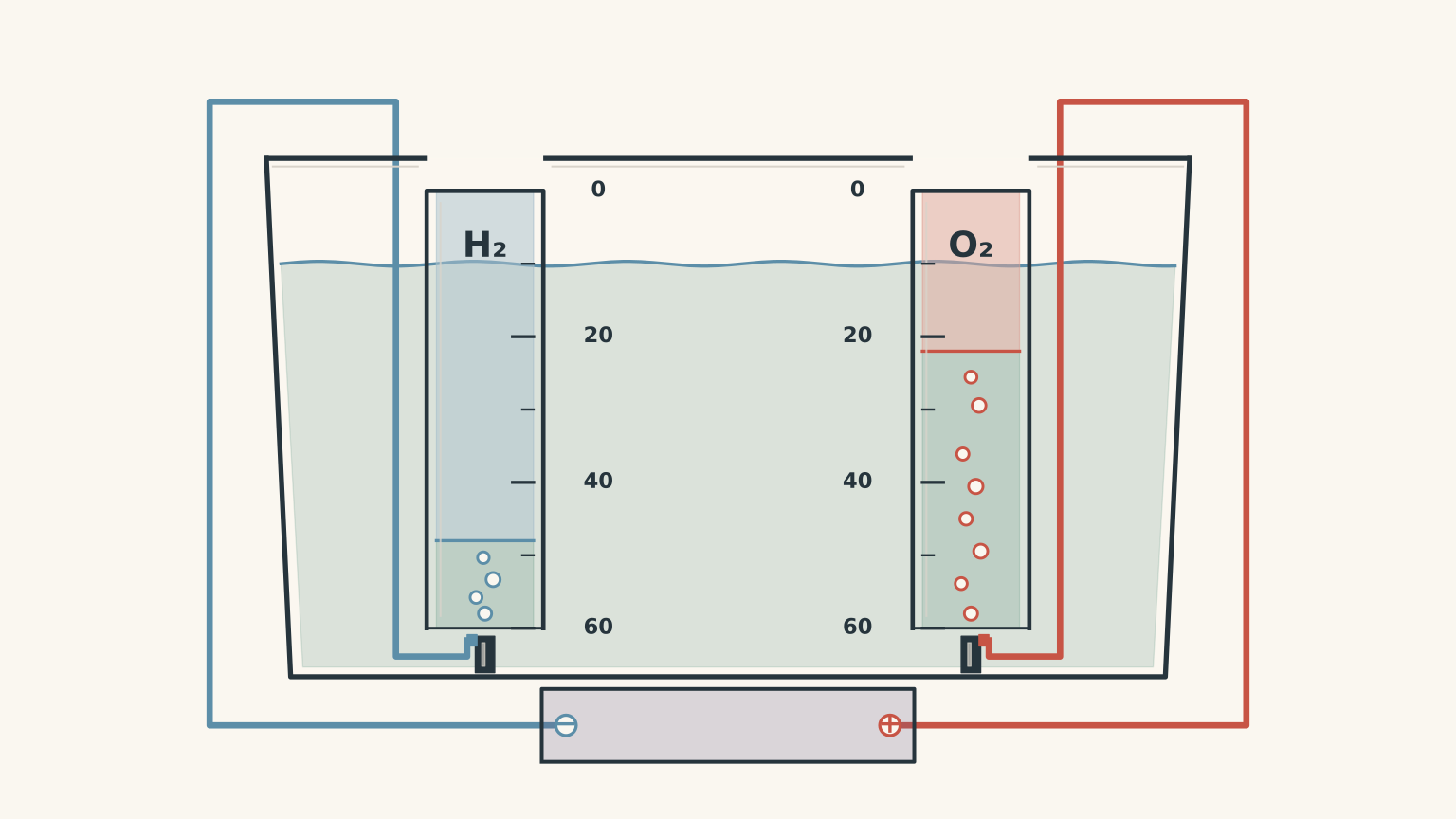
Due to technical limitations, this figure may display incorrectly or contain inaccuracies. Please check key details against your course materials.
Solution 3
The student’s explanation is not supported. The identified hydrogen provides evidence of a chemical reaction, and the \(2.0\ \mathrm{mL}\) oxygen discrepancy could arise from incomplete gas collection.
a) The overall electrolysis reaction is:
\[ \ce{2H2O(l) -> 2H2(g) + O2(g)} \]
Under the stated assumptions, the hydrogen cannot be explained by ordinary dissolved air escaping.
Air contains mainly nitrogen and oxygen, with only a negligible amount of hydrogen.
Identifying hydrogen at the negative electrode, together with oxygen at the positive electrode, supports the production of new chemical species from water.
The imperfect volume ratio does not, by itself, invalidate that explanation.
b) The balanced equation predicts twice as much hydrogen as oxygen at the same temperature and pressure.
\[ \begin{aligned} V_{\ce{O2,expected}}&=\frac{48.0}{2}\\ &=24.0\ \mathrm{mL} \end{aligned} \]
c) The apparent oxygen shortfall is:
\[ \begin{aligned} \Delta V&=24.0-22.0\\ &=2.0\ \mathrm{mL}\\ &=0.0020\ \mathrm{L} \end{aligned} \]
Converting to moles:
\[ \begin{aligned} \Delta n&=\frac{0.0020}{24.0}\\ &=8.33\times10^{-5}\ \mathrm{mol} \end{aligned} \]
The apparent shortfall is \(8.33\times10^{-5}\ \mathrm{mol}\) of oxygen.
d) Two plausible explanations are:
- Some oxygen remains dissolved in the water rather than entering the collecting tube.
- A small amount of oxygen escapes during collection or through a leak.
The important distinction is between the amount of oxygen formed by the reaction and the amount eventually measured.
A student who treats the measured ratio as an infallible chemical fingerprint ignores the limitations of the apparatus.
The correct conclusion is that the observations support water electrolysis, while the discrepancy requires investigation.
Question 4
Carbon dioxide released from an opened bottle of sparkling water is collected in a gas syringe.
The gas is then passed through a test tube containing clear limewater.
At first, the limewater becomes cloudy.
After a much larger quantity of the same gas passes through, the white solid gradually disappears, leaving a clear solution.
A student proposes two explanations:
- The gas must have changed from carbon dioxide into a different gas.
- The original sparkling water must have undergone a chemical reaction because a new solid formed in the limewater.
Explain why neither conclusion follows from the observations.
Identify the solid initially formed, explain its subsequent disappearance, and write equations for both changes in the limewater.
Assume sufficiently large amounts of carbon dioxide are supplied for the second change to occur.
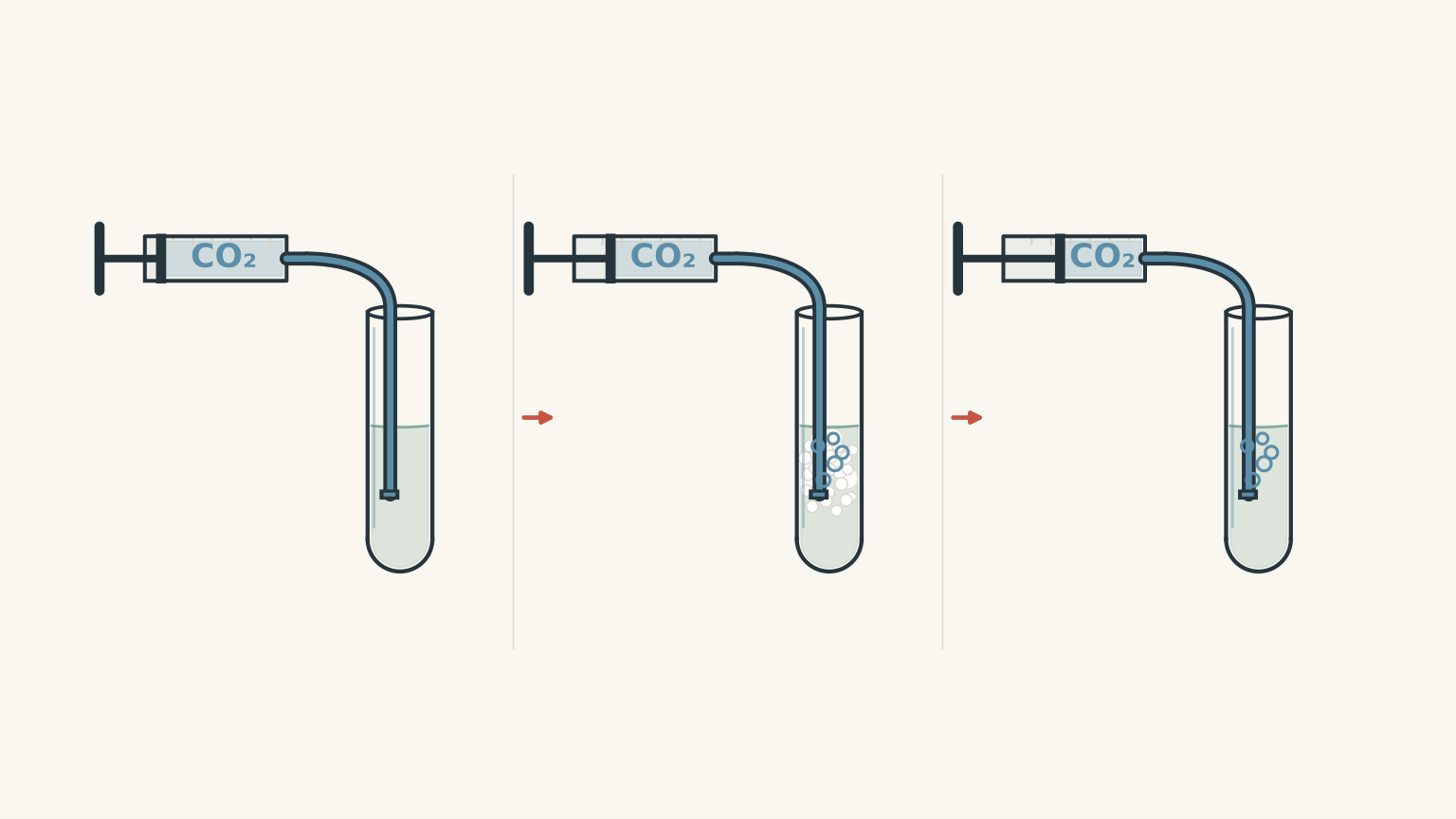
Due to technical limitations, this figure may display incorrectly or contain inaccuracies. Please check key details against your course materials.
Solution 4
The gas can remain carbon dioxide throughout the experiment. The limewater becomes cloudy because calcium carbonate forms, then clears because excess carbon dioxide converts that solid into soluble calcium hydrogencarbonate.
The original gas source may still have involved only the release of previously dissolved carbon dioxide.
First change: calcium carbonate forms.
Carbon dioxide reacts with calcium hydroxide in limewater:
\[ \begin{aligned} &\ce{CO2(g) + Ca(OH)2(aq)}\\ &\ce{-> CaCO3(s) + H2O(l)} \end{aligned} \]
The product \(\ce{CaCO3(s)}\) is calcium carbonate.
It is poorly soluble in water, so a white precipitate appears, making the limewater cloudy.
Second change: the precipitate dissolves.
With sufficient additional carbon dioxide, calcium carbonate reacts with carbon dioxide and water:
\[ \begin{aligned} &\ce{CaCO3(s) + CO2(g) + H2O(l)}\\ &\ce{-> Ca(HCO3)2(aq)} \end{aligned} \]
The product is calcium hydrogencarbonate in aqueous solution. More precisely, the dissolved species include calcium ions, \(\mathrm{Ca}^{2+}\), and hydrogencarbonate ions, \(\mathrm{HCO_3}^{-}\).
The white solid disappears because the calcium carbonate has been converted into soluble species.
The same carbon dioxide gas has participated in both reactions.
Therefore, the disappearance of the cloudiness does not imply that the gas changed identity.
The second claim also fails because the reactions occurred in the limewater test tube.
In the sparkling-water bottle, the main gas-release process was:
\[ \ce{CO2(aq) -> CO2(g)} \]
Carbon dioxide was already present before the bottle was opened.
The surprising feature is that a gas can produce two opposite visual results in the same test solution without changing its own chemical identity.
The observation depends on the other substances present and on how far the chemical system has progressed.
Question 5
Two sealed laboratory systems, A and B, each release carbon dioxide into a gas syringe.
Both syringes collect exactly \(72.0\ \mathrm{mL}\) of carbon dioxide at a molar volume of \(24.0\ \mathrm{L\,mol^{-1}}\).
However, the starting conditions are different.
System A
- Initially contains \(4.00\ \mathrm{mmol}\) of dissolved \(\ce{CO2}\) in water.
- Contains no calcium carbonate, acid, or other reactive material.
- Pressure is reduced, allowing dissolved gas to escape.
- Afterwards, \(1.00\ \mathrm{mmol}\) of \(\ce{CO2}\) remains dissolved.
System B
- Initially contains \(1.00\ \mathrm{mmol}\) of dissolved \(\ce{CO2}\).
- Also contains \(0.250\ \mathrm{g}\) of pure calcium carbonate, initially separated from the liquid.
- Excess hydrochloric acid is introduced, and all the calcium carbonate reacts.
- Afterwards, \(0.500\ \mathrm{mmol}\) of \(\ce{CO2}\) remains dissolved.
Assume the only gas collected is \(\ce{CO2}\), all gas leaving the liquid is collected, there are no leaks, no carbon enters or leaves by other pathways, and other dissolved carbon species are negligible. Use \(M(\ce{CaCO3})=100.0\ \mathrm{g\,mol^{-1}}\).
A student makes this claim:
“Both systems released the same volume of carbon dioxide, so they must have undergone the same chemical change. In System B, we can also say exactly which part of the collected gas came from the reaction.”
a) Determine whether a gas-producing chemical reaction was required in each system.
b) Calculate the amount of carbon dioxide produced chemically in System B.
c) Account for all carbon dioxide in each system, including what was initially dissolved, what was chemically produced, what was collected, and what remained dissolved.
d) Determine the minimum and maximum amounts of the collected carbon dioxide in System B that could have originated from the chemical reaction.
e) Explain why the exact amount of reaction-produced carbon dioxide in the syringe cannot be identified from these bulk measurements, even though the total amount chemically produced is known.
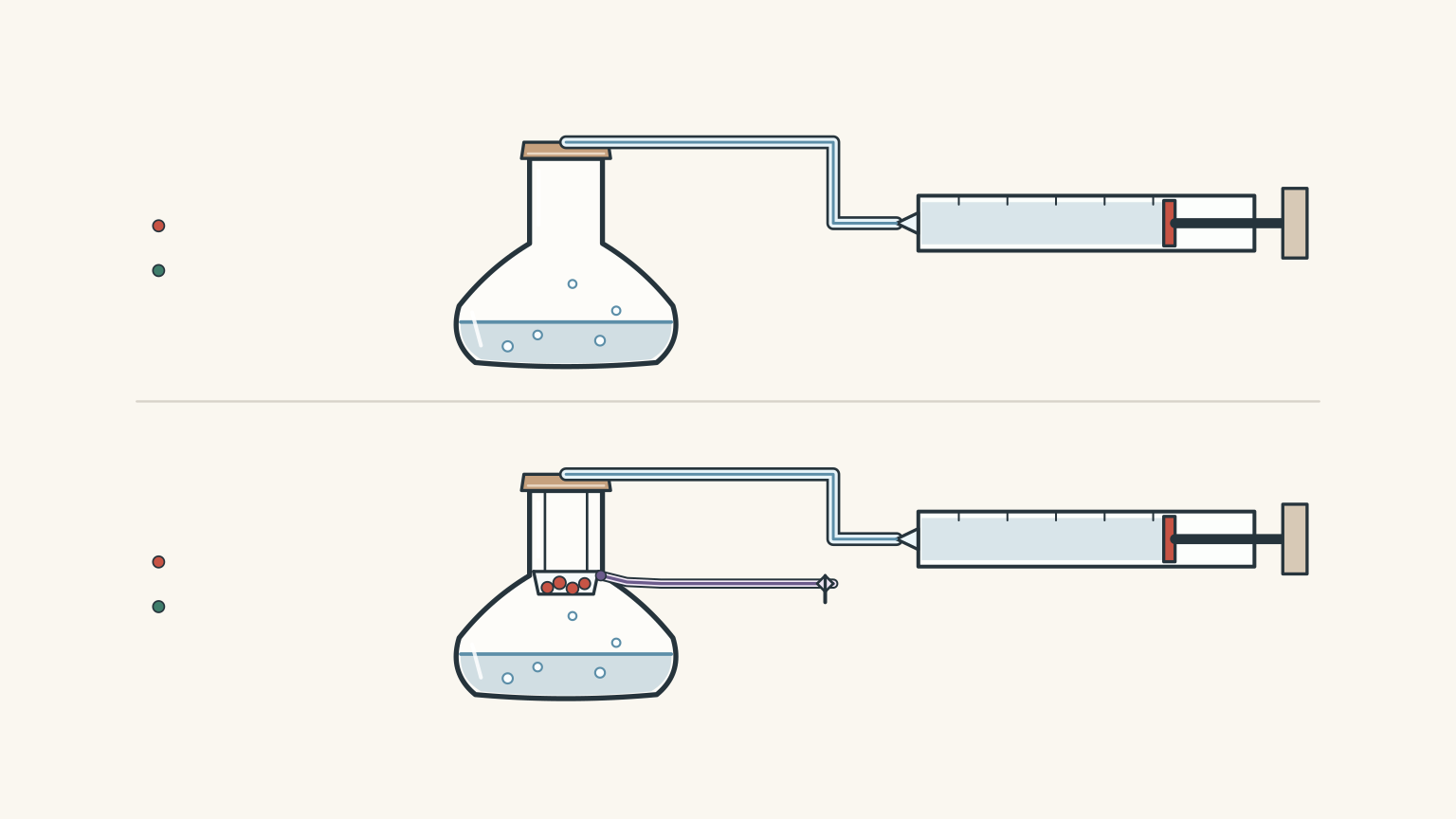
Due to technical limitations, this figure may display incorrectly or contain inaccuracies. Please check key details against your course materials.
Solution 5
System A can release its carbon dioxide through a physical process alone. System B chemically produces \(2.50\ \mathrm{mmol}\) of new carbon dioxide, but only between \(2.00\) and \(2.50\ \mathrm{mmol}\) of the gas collected in its syringe can be attributed to those newly produced molecules.
The equal collected volumes do not imply equal chemical changes.
a) Identify what happened in each system.
In System A, dissolved carbon dioxide escapes when the pressure decreases:
\[ \ce{CO2(aq) -> CO2(g)} \]
No chemical production of new carbon dioxide is required.
In System B, calcium carbonate reacts with hydrochloric acid:
\[ \begin{aligned} &\ce{CaCO3(s) + 2HCl(aq)}\\ &\ce{-> CaCl2(aq) + CO2(g) + H2O(l)} \end{aligned} \]
This reaction creates new carbon dioxide molecules.
System B may release some previously dissolved carbon dioxide as well.
b) Calculate the chemically produced carbon dioxide.
The amount of calcium carbonate is:
\[ \begin{aligned} n_{\ce{CaCO3}}&=\frac{0.250}{100.0}\\ &=0.00250\ \mathrm{mol}\\ &=2.50\ \mathrm{mmol} \end{aligned} \]
The reaction produces one mole of carbon dioxide per mole of calcium carbonate.
Therefore:
\[ n_{\ce{CO2,new}}=2.50\ \mathrm{mmol} \]
c) Complete the carbon dioxide inventories.
First, the amount collected in either syringe is:
\[ \begin{aligned} n_{\text{gas}}&=\frac{0.0720}{24.0}\\ &=0.00300\ \mathrm{mol}\\ &=3.00\ \mathrm{mmol} \end{aligned} \]
For System A:
\[ \begin{aligned} \text{Initial}&=4.00\ \mathrm{mmol}\\ \text{New}&=0\\ \text{Collected}&=3.00\ \mathrm{mmol}\\ \text{Remaining}&=1.00\ \mathrm{mmol} \end{aligned} \]
The inventory balances:
\[ 4.00=3.00+1.00 \]
All collected carbon dioxide can be explained by gas that was already dissolved.
For System B:
\[ \begin{aligned} \text{Initial}&=1.00\ \mathrm{mmol}\\ \text{New}&=2.50\ \mathrm{mmol}\\ \text{Collected}&=3.00\ \mathrm{mmol}\\ \text{Remaining}&=0.500\ \mathrm{mmol} \end{aligned} \]
The inventory also balances:
\[ 1.00+2.50=3.00+0.500 \]
System B contains both initially dissolved carbon dioxide and carbon dioxide produced by the reaction.
d) Determine the possible origins of the collected gas.
This is the key reasoning step.
System B collected \(3.00\ \mathrm{mmol}\) of carbon dioxide.
Initially, only \(1.00\ \mathrm{mmol}\) was available as dissolved carbon dioxide.
Even if every molecule of that original carbon dioxide escaped, the syringe would still require at least:
\[ \begin{aligned} n_{\text{new,min}}&=3.00-1.00\\ &=2.00\ \mathrm{mmol} \end{aligned} \]
So at least \(2.00\ \mathrm{mmol}\) of the collected gas must have originated from the reaction.
But the reaction produced only \(2.50\ \mathrm{mmol}\) of new carbon dioxide in total.
Therefore, no more than \(2.50\ \mathrm{mmol}\) of reaction-produced carbon dioxide could have entered the syringe.
The possible range is:
\[ \boxed{ 2.00\leq n_{\text{new,collected}} \leq2.50\ \mathrm{mmol} } \]
At the stated molar volume, this corresponds to between \(48.0\ \mathrm{mL}\) and \(60.0\ \mathrm{mL}\) of the collected gas.
The remainder must have come from carbon dioxide that was already present.
Notice that the result is not one exact volume. It is a range imposed by conservation of matter.
e) Explain why the exact source cannot be determined.
Once newly produced and previously dissolved carbon dioxide molecules mix, they are chemically indistinguishable.
Both have the same formula, \(\ce{CO2}\), and the same chemical behaviour.
The final measurements tell us the total amount of gas collected and the total amount remaining dissolved.
They don’t identify which individual molecules escaped and which remained.
For example, two possible outcomes are:
| Source of collected gas | Possibility 1 | Possibility 2 |
|---|---|---|
| Initially dissolved \(\ce{CO2}\) | \(1.00\ \mathrm{mmol}\) | \(0.500\ \mathrm{mmol}\) |
| Newly produced \(\ce{CO2}\) | \(2.00\ \mathrm{mmol}\) | \(2.50\ \mathrm{mmol}\) |
| Total collected | \(3.00\ \mathrm{mmol}\) | \(3.00\ \mathrm{mmol}\) |
Both possibilities satisfy the measured inventories.
In the first possibility, all the original carbon dioxide escapes, and some newly produced carbon dioxide remains dissolved.
In the second, some original carbon dioxide remains dissolved, while all newly produced carbon dioxide escapes.
Without an independent way of tracing the molecular source, the measurements cannot distinguish these possibilities.
This exposes the problem with the student’s claim.
The same visible gas volume can result from very different combinations of chemical production, gas dissolution, and physical release.
Even knowing that a reaction occurred does not mean every collected gas molecule was produced by that reaction.
08The next useful question: where did the atoms go?
When you see bubbles in a chemistry question, identify the gas, but don’t stop there.
For a physical process such as boiling water or carbon dioxide escaping from a drink, the same chemical species can move between phases.
For a chemical reaction such as water electrolysis or an acid-carbonate reaction, atoms are rearranged into different chemical species.
The most reliable next step is to write the balanced equation and ask whether it accounts for the observed products and consumed reactants.
For acid-carbonate reactions, you can make that reasoning more precise by removing spectator ions and identifying the particles that actually react. See How to Write Net Ionic Equations for Acid-Carbonate Reactions.
A gas bubble tells you where gas is appearing. The chemical equation, supported by experimental evidence and conservation of matter, tells you whether new chemical species were formed.