
Why Ionic Compounds Split into Ions in Water but Not as Solids
Solid ionic compounds already contain charged ions, but those ions cannot move freely through the crystal lattice. Learn how dissolving and melting make ions mobile, how conductivity experiments reveal the difference, and how to write balanced dissolution equations.
Put a dry sodium chloride crystal between the electrodes of a conductivity tester. The meter barely responds. Dissolve that same salt in water, and the meter responds strongly. If solid sodium chloride contains no ions, where did the ions come from? And if it already contains ions, why doesn’t the solid conduct electricity?
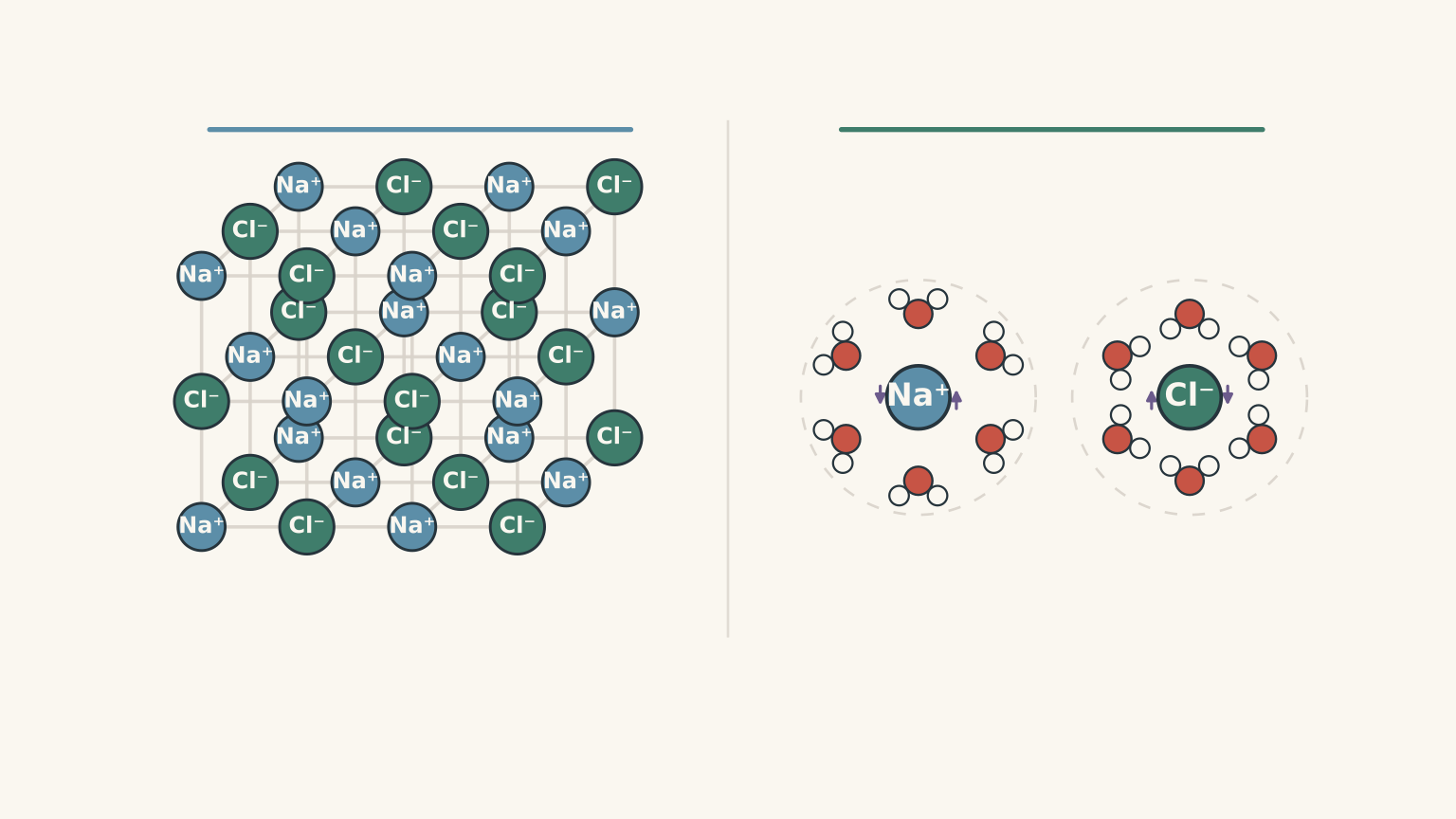
The answer is that ionic compounds already contain ions in the solid state. The difference is what those ions can do. In a solid crystal, positive and negative ions are held in fixed positions within a repeating lattice. When the compound dissolves, the lattice separates, and the ions become hydrated and mobile in the water.
That is why we write solid sodium chloride as \(\ce{NaCl(s)}\), but represent its dissolution as:
\[ \ce{NaCl(s) -> Na+(aq) + Cl-(aq)} \]
We are not showing water creating ions. We are showing existing ions separating from the solid lattice and entering the solution.
Due to technical limitations, this figure may display incorrectly or contain inaccuracies. Please check key details against your course materials.
01The important difference is the arrangement of the ions
Think about what happens inside a crystal of sodium chloride.
It contains:
- Positively charged sodium ions, \(\mathrm{Na}^{+}\).
- Negatively charged chloride ions, \(\mathrm{Cl}^{-}\).
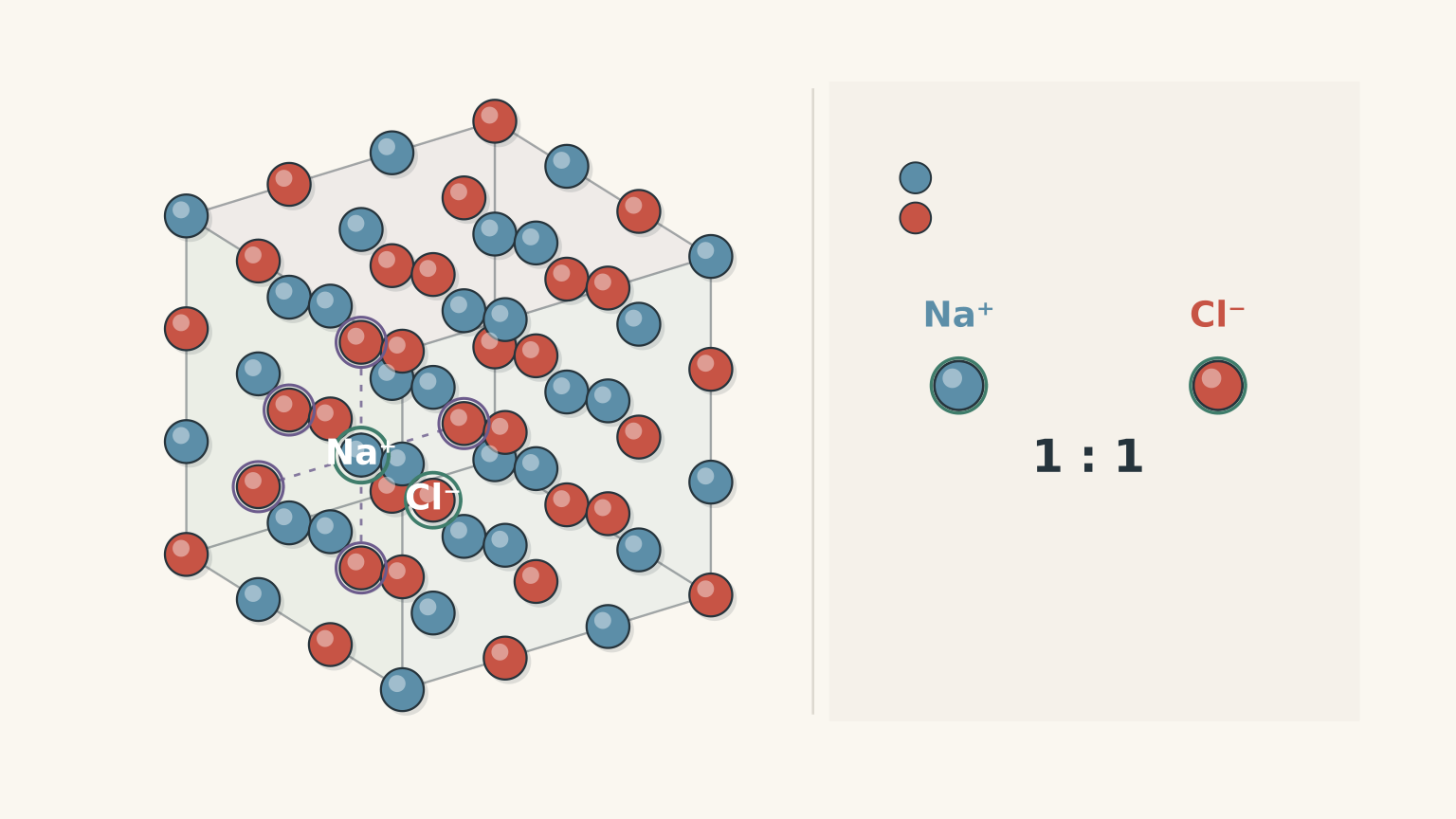
Opposite charges attract, so the ions arrange themselves in a regular, repeating three-dimensional structure called an ionic lattice.
Each sodium ion is surrounded by chloride ions, and each chloride ion is surrounded by sodium ions. The electrostatic attractions hold the entire structure together.
The ions are not neutral. They are not joined into individual sodium chloride molecules, either.
Instead, the crystal contains an extended arrangement of charged particles.
Due to technical limitations, this figure may display incorrectly or contain inaccuracies. Please check key details against your course materials.
Why doesn’t the solid conduct electricity?
Predict what happens if you connect the crystal to a battery.
You might expect charged particles to carry an electric current. After all, that is what ions do in a solution.
But there is a catch: the ions in the solid cannot move freely through the crystal.
They vibrate around their lattice positions because of thermal energy, but they cannot travel through the material in the way dissolved ions can.
An electric current requires charged particles to move through the material. In solid sodium chloride, the ions are present, but they cannot migrate through the lattice.
This explains the apparently strange result:
- Solid sodium chloride contains charged ions but does not conduct electricity appreciably.
- Dissolved sodium chloride contains charged ions that can move, so the solution conducts electricity.
The distinction is the mobility of the ions, not their existence.
02How the conductivity experiment reveals what’s happening
A conductivity experiment helps distinguish two possible explanations.
The first possibility is that water creates ions when sodium chloride dissolves.
The second is that sodium chloride already contains ions, and water allows them to separate and move.
We need an experiment that can tell these explanations apart.
Setting up the experiment
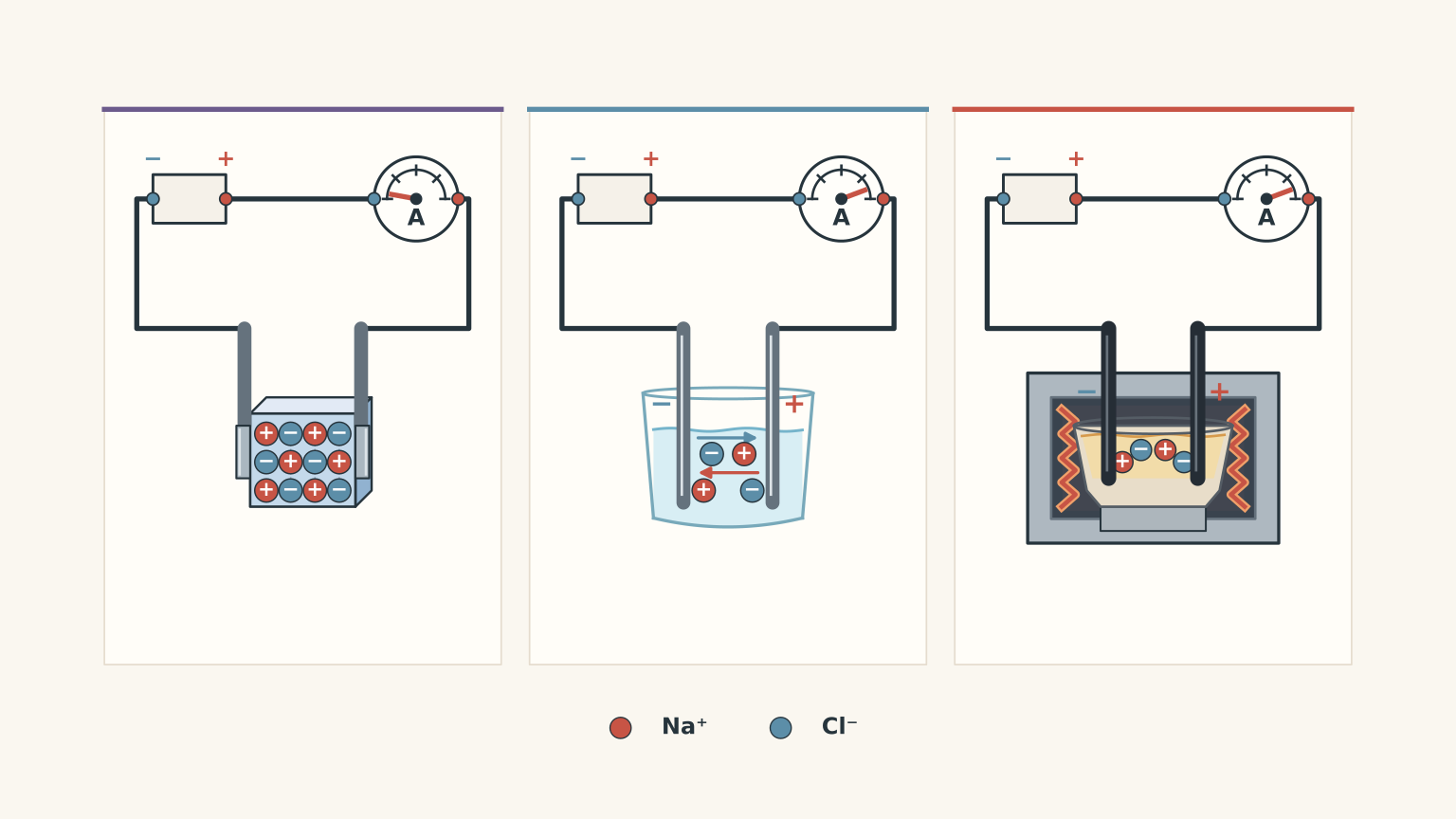
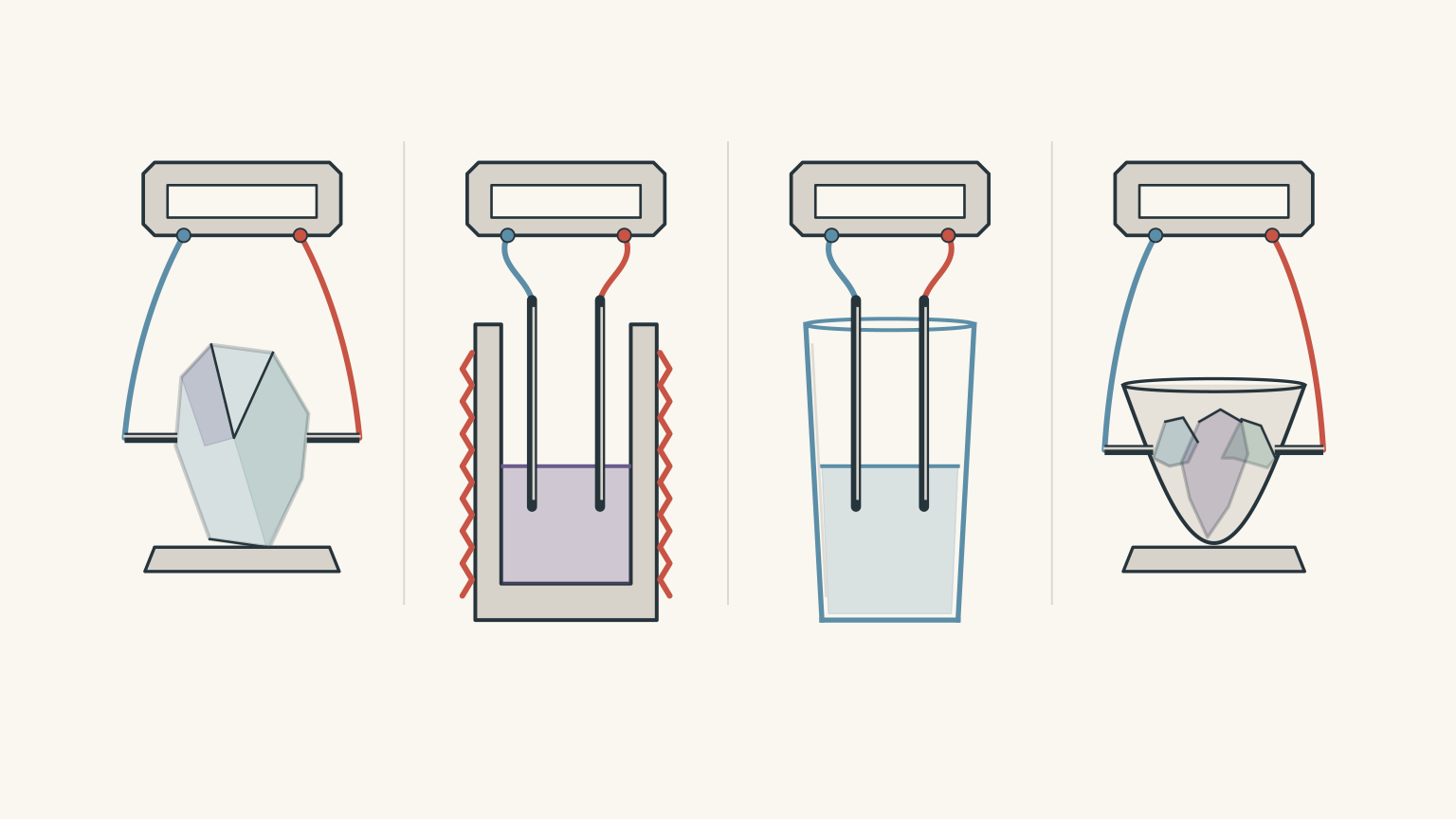
A basic conductivity circuit contains a low-voltage power supply, an ammeter or conductivity meter, and two electrodes connected by wires.
The sample is placed between the electrodes.
First, a dry sodium chloride crystal is tested. The electrodes make contact with the solid, and the meter measures whether current passes through it.
Next, the same compound is dissolved in water. The electrodes are placed into the solution, and the conductivity is measured again.
Finally, a third comparison can be made using molten sodium chloride. This requires specialised high-temperature equipment.
Due to technical limitations, this figure may display incorrectly or contain inaccuracies. Please check key details against your course materials.
Before looking at the results, make a prediction.
If water creates the ions, what should happen when sodium chloride is melted without any water present?
According to that explanation, the molten salt should not conduct through mobile ions. There is no water available to create them.
But that prediction is wrong.
What do we observe?
The expected qualitative pattern is:
| Sample | Conductivity observed |
|---|---|
| Dry solid \(\ce{NaCl(s)}\) | Negligible |
| Sodium chloride solution \(\ce{NaCl(aq)}\) | High |
| Molten sodium chloride \(\ce{NaCl(l)}\) | High |
These are qualitative observations, not numerical measurements from a particular experiment.
The molten salt is especially important.
It contains no water, yet it conducts electricity. This shows that water is not required to create the ions.
Instead, melting disrupts the rigid crystal lattice, allowing the existing ions to move through the liquid.
Dissolving the salt in water achieves a similar result, although water also surrounds the separated ions.
Observation versus inference
This distinction is important in HSC Chemistry. An experiment measures something directly, and you use that observation to infer what is happening at the particle level.
| Experimental observation | Reasonable inference |
|---|---|
| Solid NaCl does not conduct appreciably. | Its ions cannot move freely through the crystal. |
| NaCl(aq) conducts electricity. | Mobile charged particles are present in the solution. |
| Molten NaCl conducts electricity. | Charged particles can move without water being present. |
| The solid conducts again neither before nor after melting when it returns to a crystal. | The formation of the rigid lattice restricts ion movement again. |
Notice what the first observation does not tell us.
The lack of conductivity does not prove that ions are absent. It tells us that there are no sufficiently mobile charge carriers under the experimental conditions.
Similarly, conductivity alone does not identify the exact ions in an unknown solution. You need information about the compound’s composition and other chemical evidence.
This is the difference between an observation and an explanation.
03Why we write ionic compounds differently in equations
Now we can return to the original question.
Why write \(\ce{NaCl(s)}\) on the left-hand side of the dissolution equation, but \(\mathrm{Na}^{+}\) and \(\mathrm{Cl}^{-}\) separately on the right?
It comes down to how we represent the particles in each state.
A solid is represented by its formula unit
The formula \(\ce{NaCl}\) tells us that sodium chloride contains sodium ions and chloride ions in a 1:1 ratio.
This is called a formula unit.
A formula unit is the simplest whole-number ratio of ions in an ionic compound. It does not represent an individual molecule.
For sodium chloride:
\[ \ce{NaCl} \]
means one sodium ion for every chloride ion in the repeating lattice.
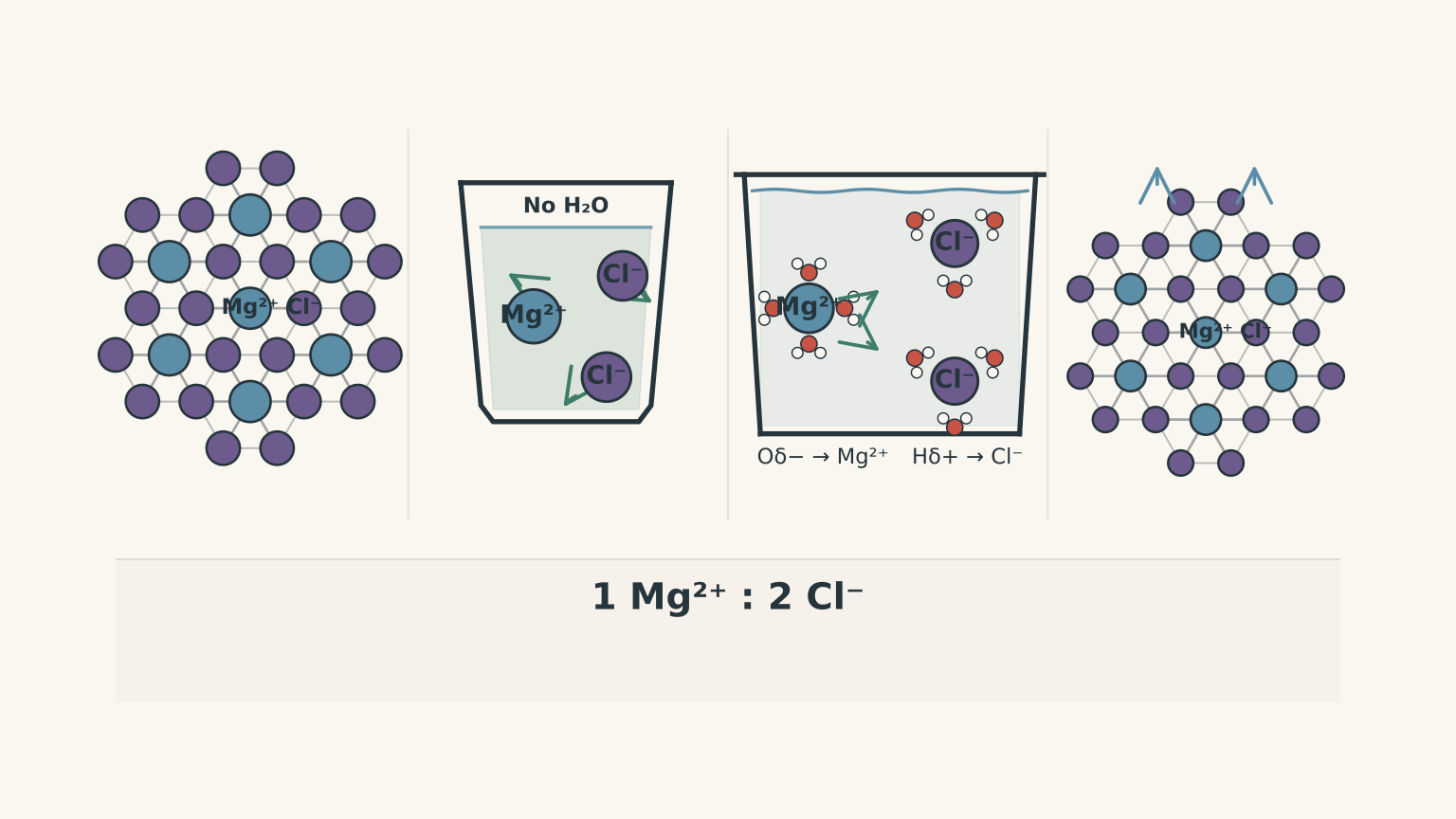
For magnesium chloride:
\[ \ce{MgCl2} \]
means one magnesium ion for every two chloride ions.
The solid is electrically neutral overall because the total positive and negative charges balance.
In magnesium chloride, one \(\mathrm{Mg}^{2+}\) ion balances two \(\mathrm{Cl}^{-}\) ions.
We do not normally write these as separate products in the solid because the ions remain part of one extended ionic lattice.
A dissolved ionic compound is represented by its separate ions
When an ionic compound dissolves, its lattice separates.
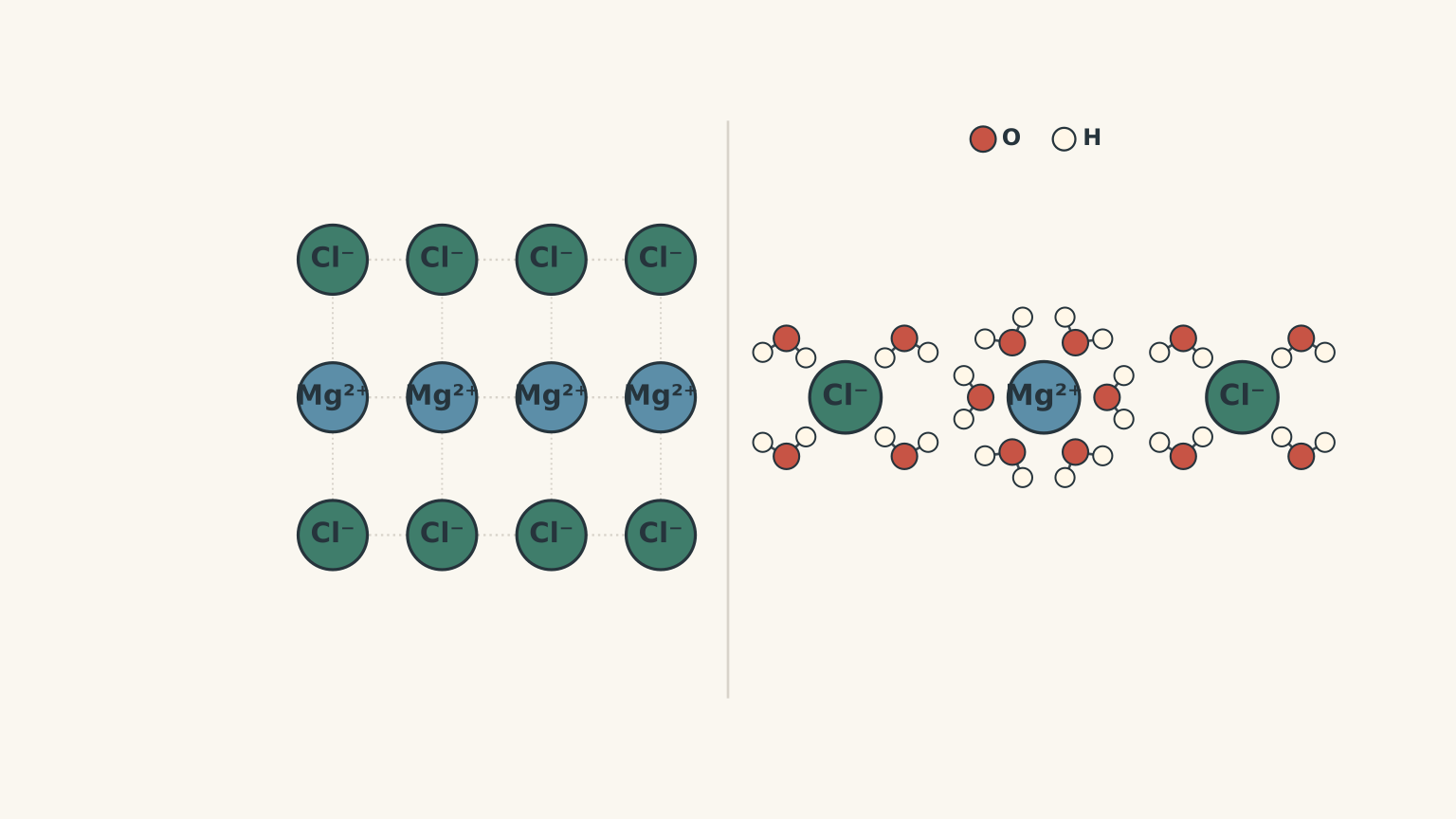
Water molecules surround the individual ions, stabilising them in solution. This process is called hydration.
The ions are now able to move through the solution, so we represent them separately using the aqueous state symbol, \(\ce{(aq)}\).
For sodium chloride:
\[ \ce{NaCl(s) -> Na+(aq) + Cl-(aq)} \]
For magnesium chloride:
\[ \ce{MgCl2(s) -> Mg^2+(aq) + 2Cl-(aq)} \]
The coefficients show how many of each ion are produced from one formula unit.
Due to technical limitations, this figure may display incorrectly or contain inaccuracies. Please check key details against your course materials.
For a more detailed explanation of how water separates and hydrates ions, see Dissolution of Ionic Compounds in Water for HSC Chemistry.
The overall charge must still balance
There is another important detail.
Although the ions are written separately in solution, the solution remains electrically neutral overall.
For magnesium chloride:
\[ \ce{MgCl2(s) -> Mg^2+(aq) + 2Cl-(aq)} \]
The total charge on the products is:
\[ (+2)+2(-1)=0 \]
The products have zero net charge, just like the original solid.
This does not mean the ions have become neutral. Each ion still carries its individual charge.
It means that the total positive charge equals the total negative charge.
That is why a solution can contain separate charged particles and still be electrically neutral overall.
04Translating compound names into aqueous ions
To write a correct dissolution equation, you need to work backwards from the compound’s name to its formula, then separate the formula into the correct ions.
Use this sequence:
- Identify the positive ion (cation).
- Identify the negative ion (anion).
- Use their charges to determine the neutral formula.
- Write the solid formula on the left-hand side.
- Write the aqueous ions on the right-hand side, including the correct coefficients.
- Check that both the atoms and total charge balance.
Here are three useful examples.
| Compound name | Positive ion | Negative ion | Solid formula |
|---|---|---|---|
| Sodium chloride | \(\mathrm{Na}^{+}\) | \(\mathrm{Cl}^{-}\) | \(\ce{NaCl}\) |
| Magnesium chloride | \(\mathrm{Mg}^{2+}\) | \(\mathrm{Cl}^{-}\) | \(\ce{MgCl2}\) |
| Aluminium sulfate | \(\mathrm{Al}^{3+}\) | \(\mathrm{SO_{4}}^{2-}\) | \(\ce{Al2(SO4)3}\) |
The aluminium sulfate example is worth examining.
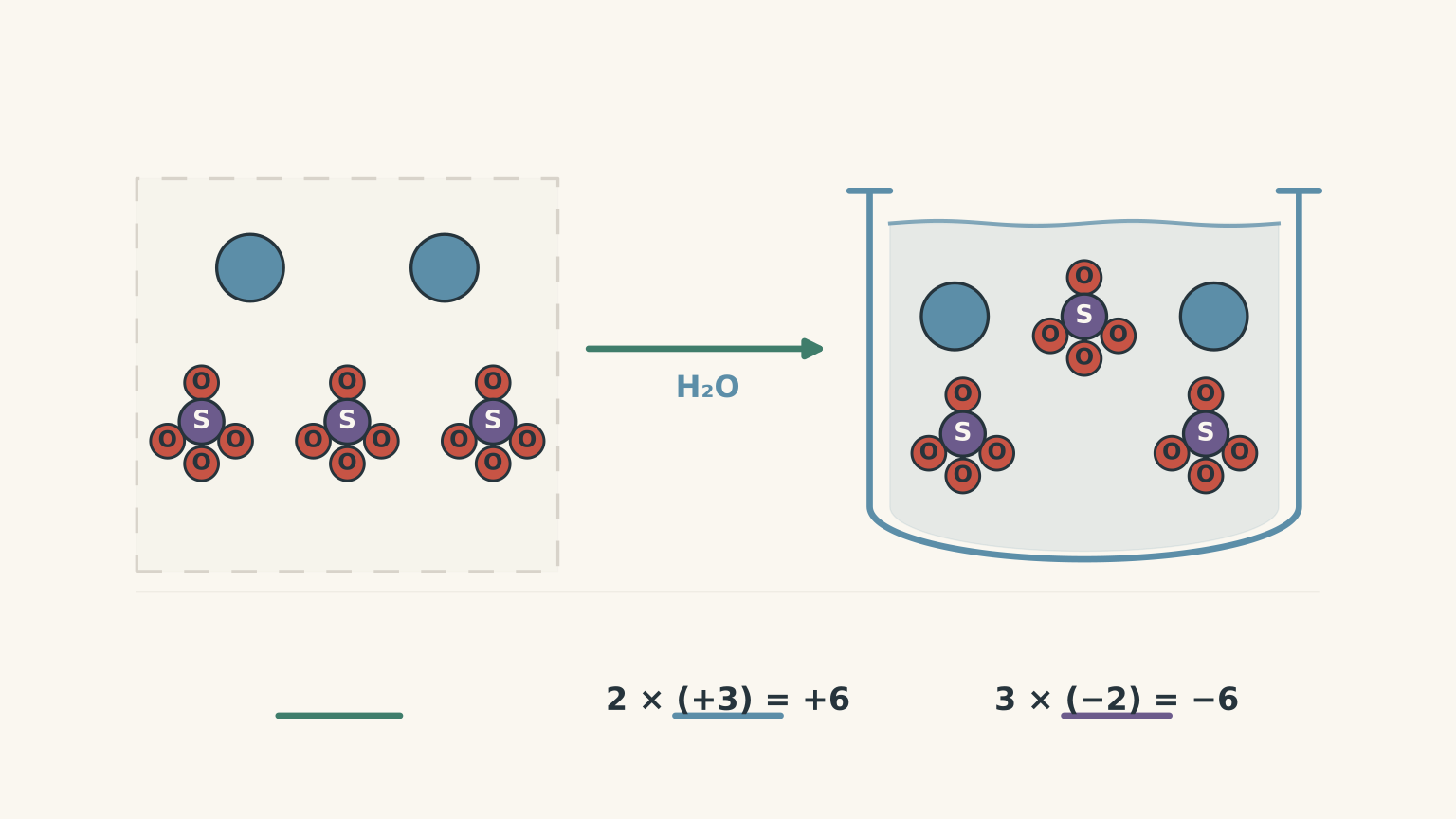
Aluminium has a charge of \(+3\), while sulfate has a charge of \(-2\).
Two aluminium ions give a total charge of \(+6\). Three sulfate ions give a total charge of \(-6\).
Therefore, the formula is:
\[ \ce{Al2(SO4)3} \]
Its dissolution equation is:
\[ \ce{Al2(SO4)3(s) -> 2Al^3+(aq) + 3SO4^2-(aq)} \]
Notice that sulfate stays together as \(\mathrm{SO_{4}}^{2-}\).
Dissolving aluminium sulfate separates its aluminium and sulfate ions. It does not break each sulfate ion into individual sulfur and oxygen ions.
Due to technical limitations, this figure may display incorrectly or contain inaccuracies. Please check key details against your course materials.
Worked example: writing the dissolution equation for calcium nitrate
Solid calcium nitrate is added to water and dissolves completely. Write its balanced dissolution equation and state how many of each ion are produced per formula unit.
Step 1
Calcium forms a \(2+\) ion:
\[ \mathrm{Ca}^{2+} \]
Nitrate is a polyatomic ion with a \(1-\) charge:
\[ \ce{NO3-} \]
Step 2
One calcium ion has a \(+2\) charge. Two nitrate ions provide a combined charge of \(-2\).
Therefore, the neutral formula is:
\[ \ce{Ca(NO3)2} \]
The brackets show that there are two complete nitrate ions.
Step 3
\[ \ce{Ca(NO3)2(s) -> Ca^2+(aq) + 2NO3-(aq)} \]
Step 4
The left-hand side is electrically neutral.
The total charge on the right-hand side is:
\[ (+2)+2(-1)=0 \]
There is one calcium ion and two nitrate ions for every formula unit of calcium nitrate.
The equation is balanced.
The important point is that calcium nitrate already contains these ions in its solid lattice. Dissolving separates them; it does not create them.
Worked example: calculating ion concentrations in aluminium sulfate solution
A student dissolves \(0.0150\text{ mol}\) of aluminium sulfate to make \(300.0\text{ mL}\) of solution.
Assuming complete dissociation, calculate:
- The concentration of aluminium ions.
- The concentration of sulfate ions.
- The total molar concentration of dissolved ions.
Step 1
From the formula, aluminium sulfate produces two aluminium ions and three sulfate ions:
\[ \ce{Al2(SO4)3(s) -> 2Al^3+(aq) + 3SO4^2-(aq)} \]
This means every mole of aluminium sulfate produces two moles of aluminium ions and three moles of sulfate ions.
Step 2
Use:
\[ c=\frac{n}{V} \]
where:
- \(c\) is concentration in \(\text{mol L}^{-1}\),
- \(n\) is amount in moles,
- \(V\) is volume in litres.
Convert the volume:
\[ 300.0\text{ mL}=0.3000\text{ L} \]
Substitute:
\[ c=\frac{0.0150}{0.3000} \]
\[ c=0.0500\text{ mol L}^{-1} \]
Step 3
The equation produces two moles of aluminium ions per mole of aluminium sulfate.
Therefore:
\[ [\mathrm{Al}^{3+}]=2(0.0500) \]
\[ \boxed{[\mathrm{Al}^{3+}]=0.100\text{ mol L}^{-1}} \]
Step 4
The equation produces three moles of sulfate ions per mole of aluminium sulfate.
Therefore:
\[ [\mathrm{SO_{4}}^{2-}]=3(0.0500) \]
\[ \boxed{[\mathrm{SO_{4}}^{2-}]=0.150\text{ mol L}^{-1}} \]
Step 5
Add the concentrations of both types of ions:
\[ c_{\text{total}}=0.100+0.150 \]
\[ \boxed{c_{\text{total}}=0.250\text{ mol L}^{-1}} \]
There are five dissolved ions per formula unit of aluminium sulfate.
Step 6
The total positive charge concentration is:
\[ 3(0.100)=0.300 \]
The total negative charge concentration is:
\[ 2(0.150)=0.300 \]
Both have the same magnitude, so the solution is electrically neutral overall.
The result also confirms why the coefficients in the dissolution equation matter. They determine how many ions are present in solution.
These calculations assume complete dissociation. They do not calculate conductivity directly, because conductivity also depends on ion mobility, charge, temperature, and interactions between ions and the solvent.
05A useful contrast: not everything dissolves into ions
Here is a misconception worth removing.
If you dissolve a solid in water, does it always separate into ions?
No.
Consider sucrose, ordinary table sugar.
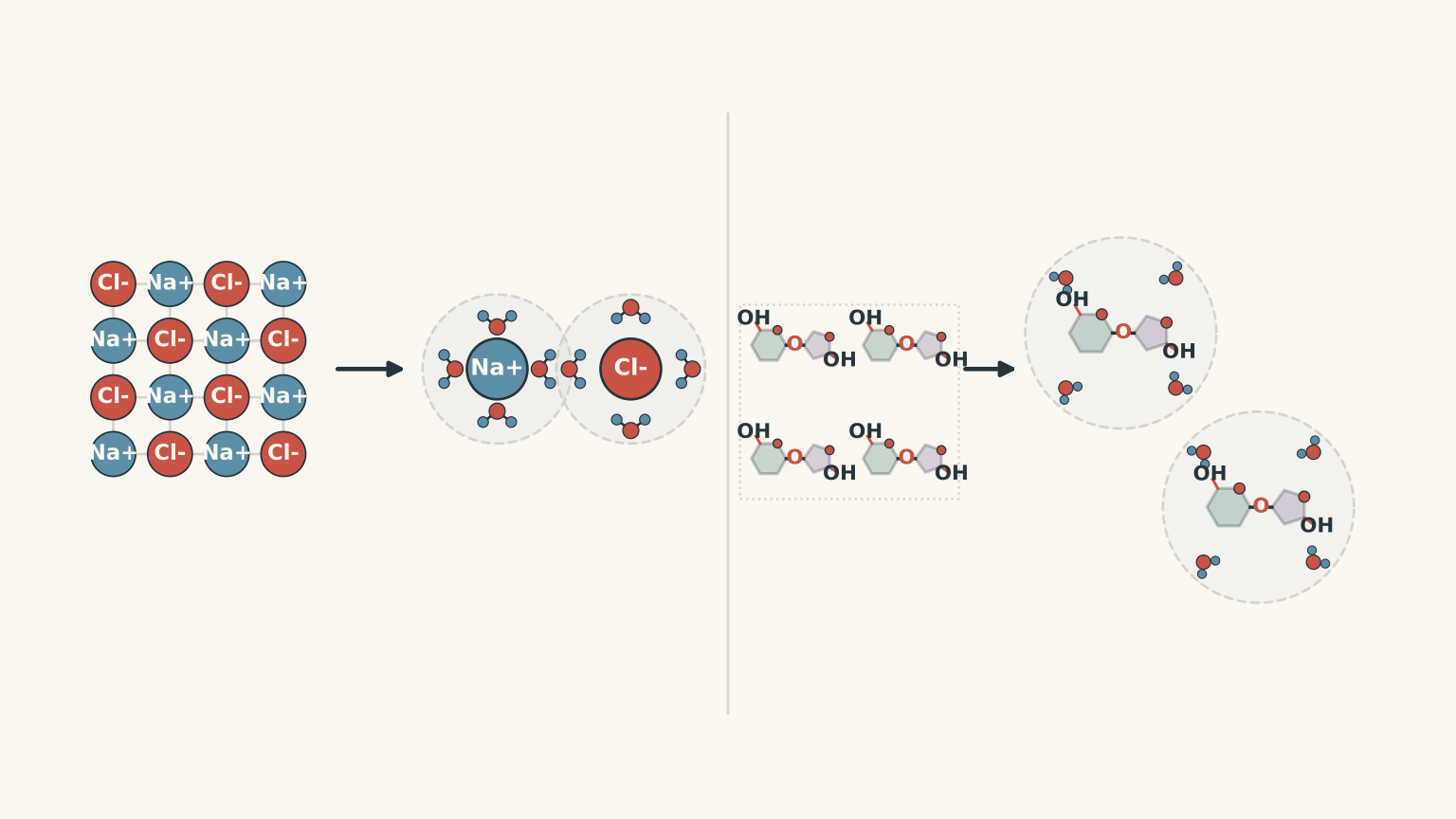
Unlike sodium chloride, sucrose is a molecular compound. Its solid structure contains neutral sucrose molecules rather than a lattice of positive and negative ions.
When sucrose dissolves, the molecules separate and spread through the water. They do not normally break apart into ions.
We represent this as:
\[ \ce{C12H22O11(s) -> C12H22O11(aq)} \]
Compare the two processes:
| Feature | Sodium chloride | Sucrose |
|---|---|---|
| Type of solid | Ionic | Molecular |
| Particles in solid | Positive and negative ions | Neutral molecules |
| What happens in water? | Existing ions separate and become hydrated | Existing molecules separate and become surrounded by water |
| Main dissolved particles | \(\mathrm{Na}^{+}\) and \(\mathrm{Cl}^{-}\) | \(\ce{C12H22O11}\) molecules |
| Electrical conductivity | Conducts well | Very low |
Due to technical limitations, this figure may display incorrectly or contain inaccuracies. Please check key details against your course materials.
This comparison is useful because it shows that dissolving and forming ions are not the same thing.
For ionic compounds, we usually describe the separation of existing ions as dissociation.
For molecular compounds, dissolution may simply involve separating intact molecules. Some molecular substances can also form ions by reacting with water, which is a different process called ionisation.
Do not assume that every substance with the state symbol \(\ce{(aq)}\) must be represented as ions.
06Questions and solutions
Question 1
Potassium bromide is a soluble ionic compound.
Write the balanced equation for its dissolution in water. Explain why the solid is represented using its formula rather than separate aqueous ions.
Solution 1
The correct equation is:
\[ \ce{KBr(s) -> K+(aq) + Br-(aq)} \]
Potassium forms \(\mathrm{K}^{+}\), while bromide forms \(\mathrm{Br}^{-}\).
Their charges balance in a 1:1 ratio, so the solid formula is \(\ce{KBr}\).
In the solid, these ions form an extended ionic lattice. They are already present as charged particles, but they cannot move freely through the crystal.
When the compound dissolves, the lattice separates, and the ions become hydrated and mobile.
This is why the solid is represented by its formula unit, while the dissolved compound is represented by its individual ions.
Question 2
A student tests three samples using a low-voltage conductivity meter.
The following qualitative results are obtained:
| Sample | Conductivity |
|---|---|
| Dry solid potassium bromide | Negligible |
| Potassium bromide dissolved in water | High |
| Sucrose dissolved in water | Very low |
The student concludes:
“Water must create ions when potassium bromide dissolves. The sucrose solution does not conduct because the sucrose has not dissolved.”
Evaluate this explanation. Distinguish between the observations and the particle-level conclusions that can reasonably be drawn.
Solution 2
The student’s explanation is incorrect. Potassium bromide already contains ions in its solid state, while sucrose dissolves as neutral molecules.
The observations are the conductivity results in the table. The particle-level explanations are inferences based on the known composition of the compounds and their behaviour.
For solid potassium bromide, the ions are arranged in a fixed lattice. They cannot migrate through the crystal, so the material does not conduct appreciably.
When potassium bromide dissolves, the lattice separates:
\[ \ce{KBr(s) -> K+(aq) + Br-(aq)} \]
The separated ions can now move through the water and carry electrical charge.
Water does not create the potassium and bromide ions. It allows existing ions to separate and become mobile.
Sucrose behaves differently. It is a molecular compound, so its molecules dissolve without normally forming ions.
The sucrose solution therefore contains very few mobile charged particles and has very low conductivity.
The student’s second conclusion is also wrong. Low conductivity does not mean that sucrose has failed to dissolve. Dissolution can occur without producing ions.
The key distinction is that conductivity provides evidence about mobile charged particles, not simply whether a substance has dissolved.
Question 3
Two separate solutions are prepared at the same formula-unit concentration of \(0.0200\text{ mol L}^{-1}\).
- Solution A contains sodium chloride, \(\ce{NaCl}\).
- Solution B contains magnesium chloride, \(\ce{MgCl2}\).
Assume both compounds dissociate completely.
(a) Write the dissolution equation for each compound.
(b) Calculate the concentration of each ion in both solutions.
(c) Calculate the total molar concentration of dissolved ions in each solution.
(d) A student argues that magnesium chloride must have exactly 1.5 times the conductivity of sodium chloride because it produces 1.5 times as many ions per litre. Explain why this conclusion is not justified.
Solution 3
Magnesium chloride produces a greater total concentration of dissolved ions, but its conductivity cannot be calculated simply by multiplying the sodium chloride conductivity by 1.5.
(a) Write the dissolution equations.
For sodium chloride:
\[ \ce{NaCl(s) -> Na+(aq) + Cl-(aq)} \]
For magnesium chloride:
\[ \ce{MgCl2(s) -> Mg^2+(aq) + 2Cl-(aq)} \]
(b) Calculate the ion concentrations.
For sodium chloride, each mole produces one mole of each ion.
Therefore:
\[ [\mathrm{Na}^{+}]=0.0200\text{ mol L}^{-1} \]
\[ [\mathrm{Cl}^{-}]=0.0200\text{ mol L}^{-1} \]
For magnesium chloride, each mole produces one mole of magnesium ions and two moles of chloride ions.
Therefore:
\[ [\mathrm{Mg}^{2+}]=0.0200\text{ mol L}^{-1} \]
\[ [\mathrm{Cl}^{-}]=2(0.0200) \]
\[ [\mathrm{Cl}^{-}]=0.0400\text{ mol L}^{-1} \]
(c) Calculate the total ion concentrations.
For sodium chloride:
\[ c_{\text{total}}=0.0200+0.0200 \]
\[ \boxed{c_{\text{total}}=0.0400\text{ mol L}^{-1}} \]
For magnesium chloride:
\[ c_{\text{total}}=0.0200+0.0400 \]
\[ \boxed{c_{\text{total}}=0.0600\text{ mol L}^{-1}} \]
The ratio is:
\[ \frac{0.0600}{0.0400}=1.50 \]
Magnesium chloride produces 1.50 times the total molar concentration of dissolved ions.
(d) Explain why the conductivity ratio cannot be assumed.
The student’s conclusion confuses the number of dissolved ions with electrical conductivity.
Conductivity depends on several factors, including:
- The concentration of mobile ions.
- The charge carried by each ion.
- The mobility of each type of ion.
- Temperature and interactions with the surrounding water.
Magnesium ions carry a \(2+\) charge, while sodium ions carry a \(1+\) charge. Their mobilities also differ.
Therefore, even though magnesium chloride produces 1.50 times the total concentration of ions, its conductivity is not necessarily exactly 1.50 times greater.
The calculation tells us about particle concentrations, not the precise electrical behaviour of the solutions.
Question 4
A pure soluble ionic compound contains potassium ions and sulfate ions.
Analysis of its aqueous solution gives:
\[ [\mathrm{K}^{+}]=0.0600\text{ mol L}^{-1} \]
\[ [\mathrm{SO_{4}}^{2-}]=0.0300\text{ mol L}^{-1} \]
Assume complete dissociation and that these are the only ions present.
(a) Determine the formula and name of the original solid compound.
(b) Write its balanced dissolution equation.
(c) Explain why sulfate must remain as a single polyatomic ion in the dissolution equation.
(d) Explain why the solid is not represented as separate aqueous ions.
Solution 4
The original compound is potassium sulfate, \(\ce{K2SO4}\), and its dissolution produces two potassium ions for every sulfate ion.
(a) Determine the formula.
Compare the ion concentrations:
\[ \frac{[\mathrm{K}^{+}]}{[\mathrm{SO_{4}}^{2-}]} = \frac{0.0600}{0.0300} =2 \]
Therefore, the ratio of potassium ions to sulfate ions is:
\[ 2:1 \]
The formula is:
\[ \boxed{\ce{K2SO4}} \]
The compound is called potassium sulfate.
(b) Write the dissolution equation.
One formula unit produces two potassium ions and one sulfate ion:
\[ \boxed{\ce{K2SO4(s) -> 2K+(aq) + SO4^2-(aq)}} \]
(c) Explain why sulfate stays together.
Sulfate is a polyatomic ion. It contains one sulfur atom and four oxygen atoms bonded together, carrying an overall charge of \(2-\).
Dissolving potassium sulfate separates the potassium ions from the sulfate ions. It does not normally break the sulfate ion apart.
Therefore, we write \(\mathrm{SO_{4}}^{2-}\), not separate sulfur and oxygen ions.
(d) Explain the solid representation.
In solid potassium sulfate, potassium and sulfate ions are already present in an ionic lattice.
The formula \(\ce{K2SO4}\) represents their simplest whole-number ratio. It does not represent a neutral molecule.
The solid is written using its formula unit because the ions remain part of the extended lattice.
Once dissolved, the ions are separated and hydrated, so they are represented individually.
The charge balance also checks:
\[ 2(+1)+(-2)=0 \]
The solid and solution are electrically neutral overall.
Question 5
A chemistry student investigates anhydrous magnesium chloride, \(\ce{MgCl2}\), in different physical states.
The following qualitative results are obtained. Treat these as illustrative experimental observations rather than measurements from a real experiment.
| Sample | Conductivity result |
|---|---|
| Dry crystalline \(\ce{MgCl2}\) at room temperature | Negligible |
| Molten \(\ce{MgCl2}\) | High |
| \(\ce{MgCl2}\) dissolved in water | High |
| Anhydrous solid recovered after removing the water and crystallising the salt | Negligible |
The student also dissolves \(0.0100\text{ mol}\) of magnesium chloride to make \(250.0\text{ mL}\) of solution.
Assume:
- The magnesium chloride is pure and anhydrous.
- No decomposition or other chemical reactions occur.
- The dissolved salt dissociates completely.
- The recovered solid is anhydrous magnesium chloride.
The student proposes four explanations:
- Solid magnesium chloride must consist of neutral \(\ce{MgCl2}\) molecules because it does not conduct electricity.
- Water creates \(\mathrm{Mg}^{2+}\) and \(\mathrm{Cl}^{-}\) ions when the salt dissolves.
- The aqueous solution cannot be electrically neutral because it contains positively and negatively charged ions.
- When the water evaporates, the ions must combine into individual neutral \(\ce{MgCl2}\) molecules again.
Construct a particle-level explanation that accounts for all four conductivity observations.
Your response must also:
- Write the balanced dissolution equation.
- Calculate the concentration of each ion.
- Demonstrate how the solution remains electrically neutral.
- Explain what the conductivity results establish and what they cannot establish.
- Evaluate all four proposed explanations.
Due to technical limitations, this figure may display incorrectly or contain inaccuracies. Please check key details against your course materials.
Solution 5
All four proposed explanations are incorrect. Magnesium chloride contains ions in its solid state, and the conductivity changes because the mobility of those ions changes between physical states.
Step 1: Write the dissolution equation.
Magnesium forms \(\mathrm{Mg}^{2+}\), while chlorine forms chloride ions, \(\mathrm{Cl}^{-}\).
One magnesium ion requires two chloride ions to balance its charge.
The dissolution equation is:
\[ \boxed{\ce{MgCl2(s) -> Mg^2+(aq) + 2Cl-(aq)}} \]
The solid already contains these ions in a 1:2 ratio within its ionic lattice.
Step 2: Calculate the concentration of the original salt.
Use:
\[ c=\frac{n}{V} \]
Convert the volume into litres:
\[ 250.0\text{ mL}=0.2500\text{ L} \]
Substitute:
\[ c=\frac{0.0100}{0.2500} \]
\[ c=0.0400\text{ mol L}^{-1} \]
This is the formula-unit concentration used to calculate the concentrations of the dissolved ions.
Step 3: Calculate the magnesium ion concentration.
One mole of magnesium chloride produces one mole of magnesium ions.
Therefore:
\[ [\mathrm{Mg}^{2+}]=1(0.0400) \]
\[ \boxed{[\mathrm{Mg}^{2+}]=0.0400\text{ mol L}^{-1}} \]
Step 4: Calculate the chloride ion concentration.
One mole of magnesium chloride produces two moles of chloride ions.
Therefore:
\[ [\mathrm{Cl}^{-}]=2(0.0400) \]
\[ \boxed{[\mathrm{Cl}^{-}]=0.0800\text{ mol L}^{-1}} \]
The total concentration of dissolved ions is:
\[ c_{\text{total}}=0.0400+0.0800 \]
\[ \boxed{c_{\text{total}}=0.1200\text{ mol L}^{-1}} \]
Step 5: Demonstrate that the solution is electrically neutral.
The magnesium ions carry a \(2+\) charge, while the chloride ions carry a \(1-\) charge.
The total positive charge concentration is:
\[ 2(0.0400)=0.0800 \]
The total negative charge concentration is:
\[ 1(0.0800)=0.0800 \]
Both have the same magnitude.
Therefore, the solution has zero net charge.
This disproves the student’s third explanation.
A solution does not need every individual particle to be neutral. It needs the total positive and negative charges to balance.
Due to technical limitations, this figure may display incorrectly or contain inaccuracies. Please check key details against your course materials.
Step 6: Explain why the conductivity changes.
Consider each observation.
Dry crystalline magnesium chloride
The solid contains \(\mathrm{Mg}^{2+}\) and \(\mathrm{Cl}^{-}\) ions, but the ions are held in fixed positions in the lattice.
They cannot migrate through the crystal to carry electrical current.
This disproves the first explanation. The lack of conductivity does not mean the ions are absent or neutral.
Molten magnesium chloride
When magnesium chloride melts, its rigid lattice breaks down.
The ions can now move through the liquid. They carry electrical charge, so the molten compound conducts.
This is particularly important because there is no water present.
It disproves the second explanation. Water is not required to create the ions.
Aqueous magnesium chloride
When magnesium chloride dissolves, the lattice separates, and water molecules surround the ions.
The hydrated ions can move through the solution and carry electrical charge.
This explains why the aqueous solution conducts.
Recovered crystalline magnesium chloride
When the water is removed and the salt crystallises, the ions become arranged in a repeating lattice again.
They remain charged, but their movement becomes restricted.
The solid therefore returns to its low-conductivity behaviour.
This disproves the fourth explanation. The ions do not need to form individual neutral \(\ce{MgCl2}\) molecules. They become part of an extended ionic lattice.
Step 7: Evaluate what the experiment actually proves.
The experiment provides evidence that the ability of magnesium chloride to conduct electricity depends on whether its charged particles can move.
It supports the model that:
- The solid contains ions held in a fixed lattice.
- The molten compound contains mobile ions.
- The aqueous solution contains mobile hydrated ions.
- Crystallisation restores the restrictions on ion movement.
However, conductivity alone does not identify the exact particles or determine their concentrations. Those conclusions also rely on knowing the compound’s composition, its chemical behaviour, and the balanced formula.
The central distinction is that ionic compounds do not need to create ions when they dissolve. Their existing ions simply become separated and mobile.
07Where this leads next
Once you can identify which ions are present in a solution, the next step is deciding what happens to those ions during a chemical reaction.
Some ions participate in the reaction. Others remain unchanged in solution as spectator ions.
This is the reasoning behind complete ionic equations and net ionic equations.
You can apply the same particle-level thinking in How to Write Net Ionic Equations for Acid-Carbonate Reactions.