
Why Molten Ionic Compounds Conduct but Solids Usually Do Not
Why does solid sodium chloride barely conduct electricity, while molten sodium chloride conducts readily? Learn how ionic structure, charge, and ion mobility explain the difference, with experimental evidence, worked examples, and five HSC-style practice questions.
Place a dry sodium chloride crystal between two electrodes. The conductivity meter barely responds. Heat the same sample until it melts, and suddenly the meter records an electrical current.
Before reading on, predict what has changed. Has melting created ions that weren’t there before, or has it allowed existing ions to move?
It’s the second. Solid sodium chloride already contains positively charged \(\mathrm{Na}^{+}\) ions and negatively charged \(\mathrm{Cl}^{-}\) ions. In the solid, these ions are held near fixed positions in a crystal lattice. When sodium chloride melts, the lattice structure breaks down, allowing the ions to move through the liquid and carry electrical charge.
The key difference is ion mobility, not the presence or absence of ions. A material needs mobile charged particles to conduct electricity. Simply containing charged particles isn’t enough.
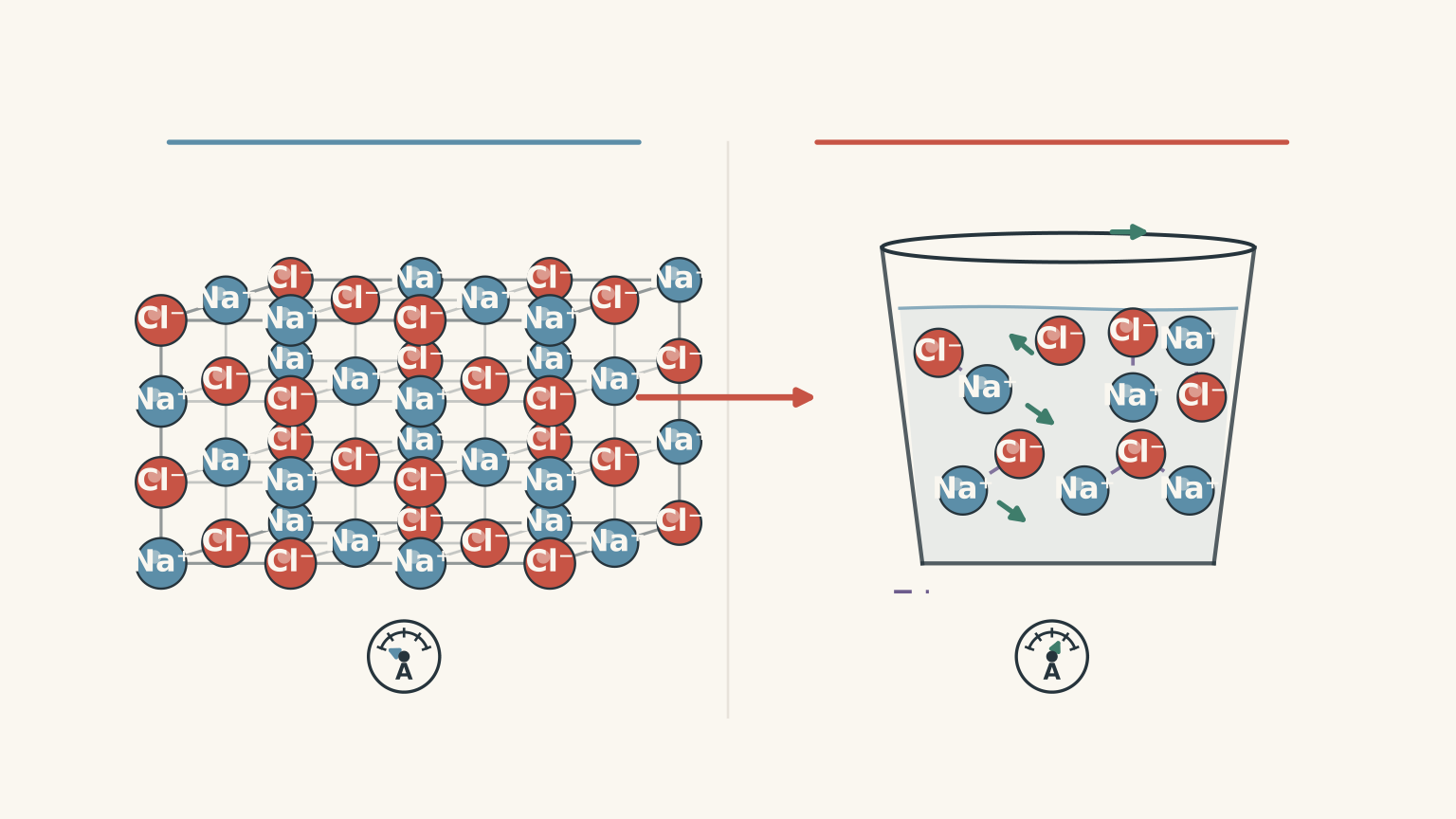
Due to technical limitations, this figure may display incorrectly or contain inaccuracies. Please check key details against your course materials.
01Why solid ionic compounds usually do not conduct
An ionic compound consists of positive and negative ions held together by strong electrostatic attractions.
In the solid state, these ions form an organised, repeating three-dimensional arrangement called an ionic lattice.
Consider solid sodium chloride.
The \(\mathrm{Na}^{+}\) and \(\mathrm{Cl}^{-}\) ions alternate throughout the lattice. Each ion is surrounded by oppositely charged ions, creating a strongly held structure.
The important point is that the ions cannot move freely from one position to another.
This doesn’t mean they are completely motionless. They vibrate around their equilibrium positions, but they cannot migrate through the solid over significant distances.
What happens if you connect the crystal to an electrical circuit?
Although charged particles are present, there is no substantial movement of charge through the material. The solid therefore usually does not conduct electricity.
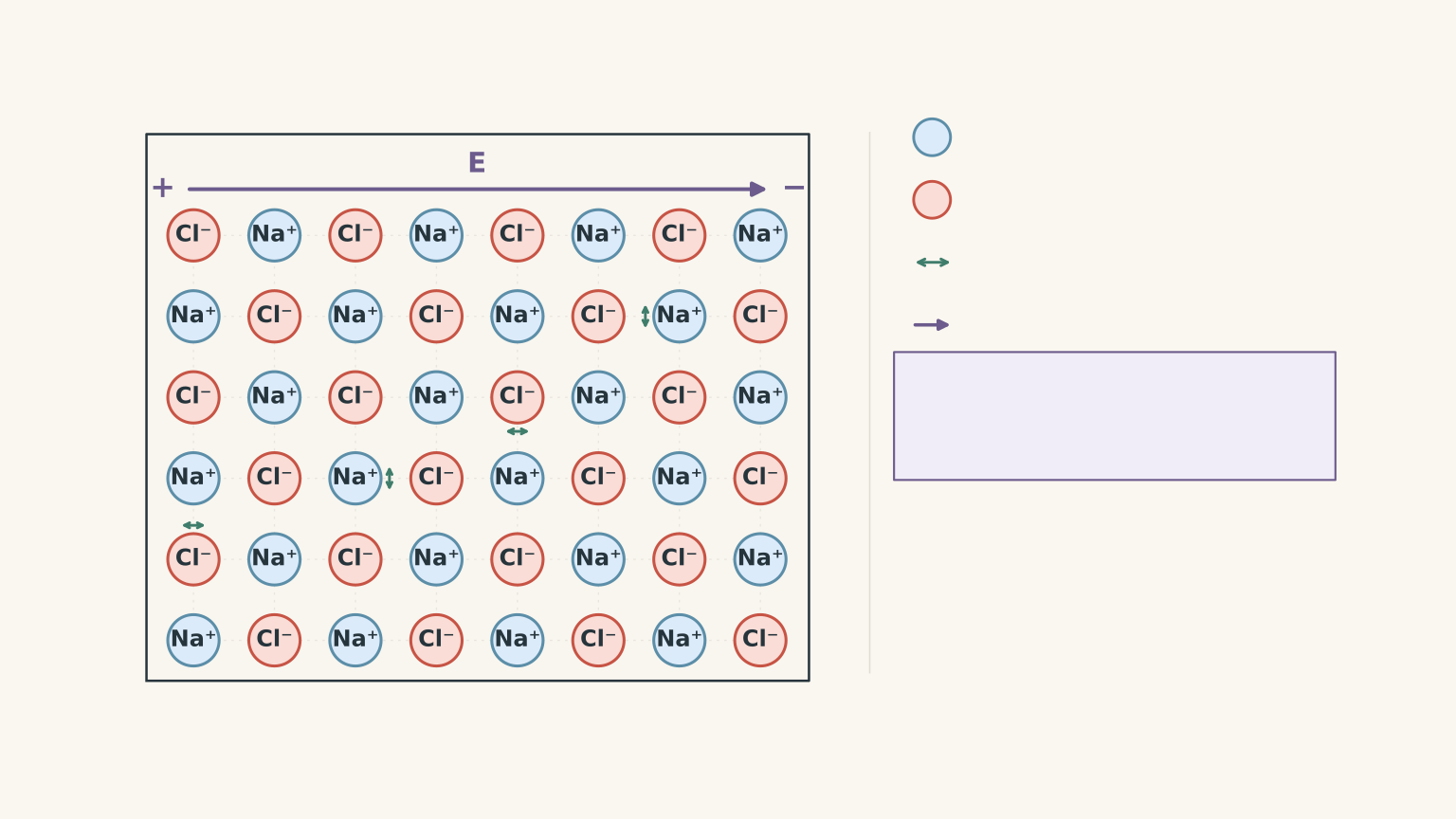
Due to technical limitations, this figure may display incorrectly or contain inaccuracies. Please check key details against your course materials.
What changes when the ionic compound melts?
When an ionic compound is heated sufficiently, it reaches its melting point.
The thermal energy allows the ions to overcome the constraints of the ordered lattice. The regular, long-range arrangement breaks down, and the substance becomes a liquid.
The ions can now move past one another.
They still attract and repel one another through electrostatic forces. Melting does not turn them into neutral atoms or remove their charges. It simply gives them much greater freedom of movement.
| Property | Solid ionic compound | Molten ionic compound |
|---|---|---|
| Particle arrangement | Regular, repeating lattice | Disordered liquid arrangement |
| Ion movement | Vibrations around fixed positions | Movement throughout the liquid |
| Charged particles present? | Yes | Yes |
| Long-range ion migration | Very limited | Possible |
| Electrical conductivity | Usually negligible | Conducts electricity |
Think of the ions as people confined to individual parking bays. In the solid, they can move around within their own spaces but cannot travel across the car park. When the lattice melts, those restrictions disappear, allowing them to move from one side to the other.
The analogy is about mobility only. Real ions still interact with neighbouring ions through electrical attractions and repulsions.
02Where do the ionic charges come from?
To understand why the moving particles carry electricity, we need to connect the ionic structure to valence electrons.
Valence electrons are the electrons in an atom’s outermost electron shell. They are important because they determine how an atom gains or loses electrons when forming ions.
Consider sodium chloride.
A sodium atom has the electron arrangement \(2,8,1\). It has one valence electron.
A chlorine atom has the electron arrangement \(2,8,7\). It has seven valence electrons.
Sodium can transfer its outer electron to chlorine.
The resulting processes are:
\[ \ce{Na -> Na+ + e-} \]
\[ \ce{Cl + e- -> Cl-} \]
Sodium loses an electron and becomes a positively charged ion. Chlorine gains an electron and becomes a negatively charged ion.
The resulting ions have charges of \(+1\) and \(-1\), respectively.
Because the charges balance, the simplest ionic formula is \(\ce{NaCl}\).
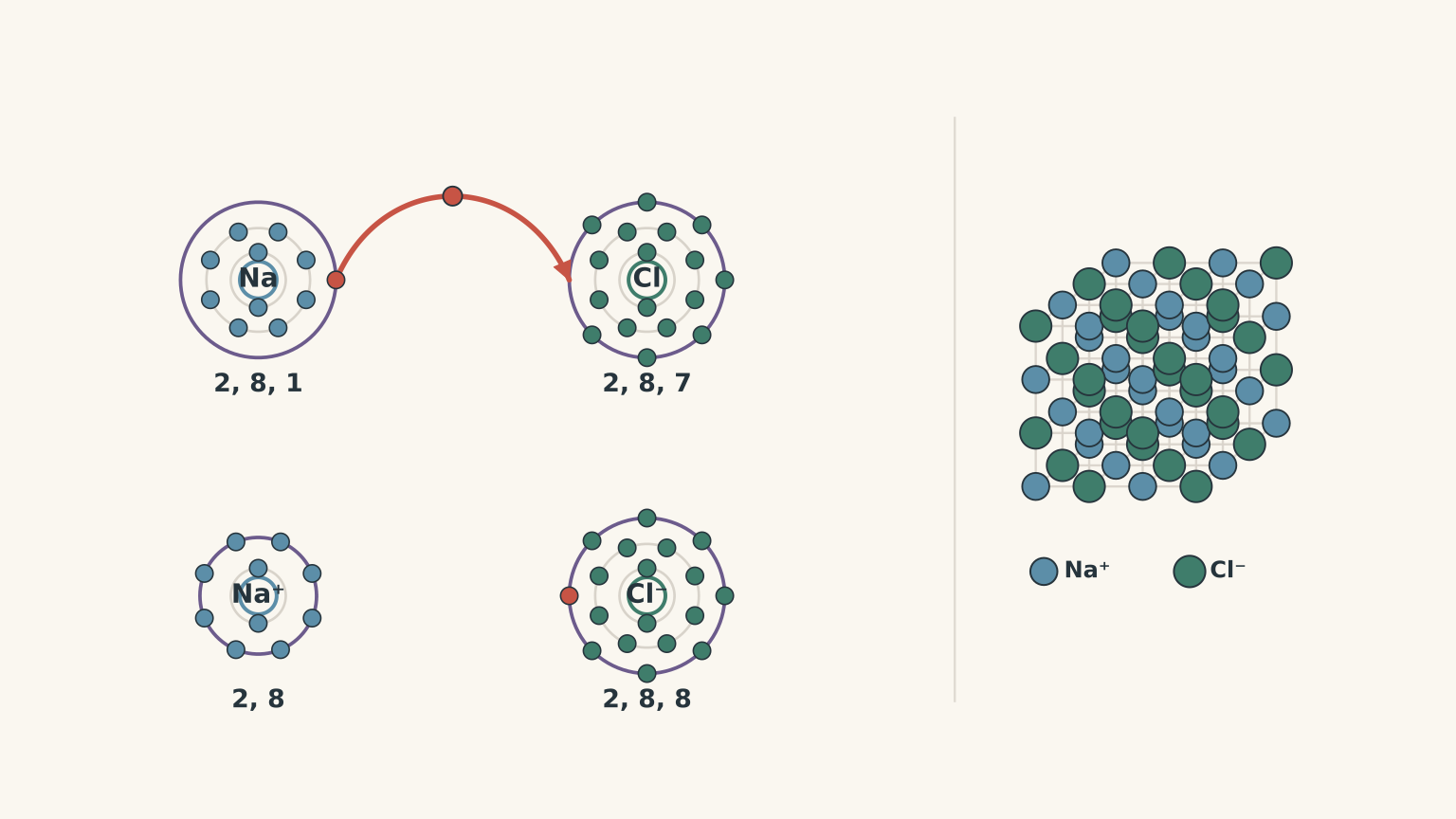
Due to technical limitations, this figure may display incorrectly or contain inaccuracies. Please check key details against your course materials.
Why does magnesium chloride have a different formula?
The same reasoning applies to other ionic compounds.
Magnesium has the electron arrangement \(2,8,2\). It can lose two valence electrons to form \(\mathrm{Mg}^{2+}\).
Each chlorine atom can accept one electron to form \(\mathrm{Cl}^{-}\).
Therefore, one magnesium atom transfers two electrons to two chlorine atoms.
The resulting ions are:
- One \(\mathrm{Mg}^{2+}\) ion.
- Two \(\mathrm{Cl}^{-}\) ions.
Their total charge is:
\[ (+2)+2(-1)=0 \]
This gives the formula \(\ce{MgCl2}\).
Notice that the subscript 2 indicates the number of chloride ions for each magnesium ion. It is not the charge on magnesium.
There is another important structural distinction here.
An ionic formula represents the simplest whole-number ratio of ions in the structure. It does not describe a collection of separate \(\ce{MgCl2}\) molecules.
The solid and molten compounds contain extended collections of ions. The formula tells us their relative proportions.
Worked example: Identifying the ions in molten calcium chloride
A sample containing \(0.0250\text{ mol}\) of calcium chloride is heated until completely molten.
Calculate the amount of each type of ion present. Then determine whether the total positive and negative charge equivalents balance.
Step 1
Calcium forms \(\mathrm{Ca}^{2+}\), while chlorine forms \(\mathrm{Cl}^{-}\).
Each formula unit contains one calcium ion and two chloride ions.
Step 2
For calcium ions:
\[ n(\mathrm{Ca}^{2+})=0.0250\text{ mol} \]
For chloride ions:
\[ n(\mathrm{Cl}^{-})=2(0.0250) \]
\[ n(\mathrm{Cl}^{-})=0.0500\text{ mol} \]
Step 3
The positive charge equivalents are:
\[ 0.0250\times 2=0.0500 \]
The negative charge equivalents are:
\[ 0.0500\times 1=0.0500 \]
The positive and negative charges therefore balance.
Conclusion: The molten sample contains \(0.0250\text{ mol}\) of \(\mathrm{Ca}^{2+}\) ions and \(0.0500\text{ mol}\) of \(\mathrm{Cl}^{-}\) ions. Its overall charge is zero.
However, electrical neutrality does not prevent conduction. The ions can still move independently and transport charge through the liquid.
03The experiment: Testing the same ionic compound in two states
How can we establish that the change in conductivity is caused by the different physical states rather than a change in chemical composition?
A useful experimental investigation compares the conductivity of the same ionic compound before and after melting.
Setting up the experiment
Consider a high-temperature conductivity cell containing dry sodium chloride.
Two suitable high-temperature electrodes are positioned inside the sample at a fixed separation. These electrodes connect through wires to a low-voltage AC conductivity meter.
The cell is placed in a controlled heating apparatus.
The investigation proceeds in two stages:
- Measure the conductivity while the sodium chloride is solid.
- Heat the same sample until it melts, then measure its conductivity again.
Sodium chloride has a melting point of approximately \(801^\circ\text{C}\), so this requires specialist high-temperature equipment.
The electrode spacing, electrode area, applied voltage, and sample composition should remain unchanged.
An AC measurement is useful because it limits sustained electrolysis during the conductivity test.
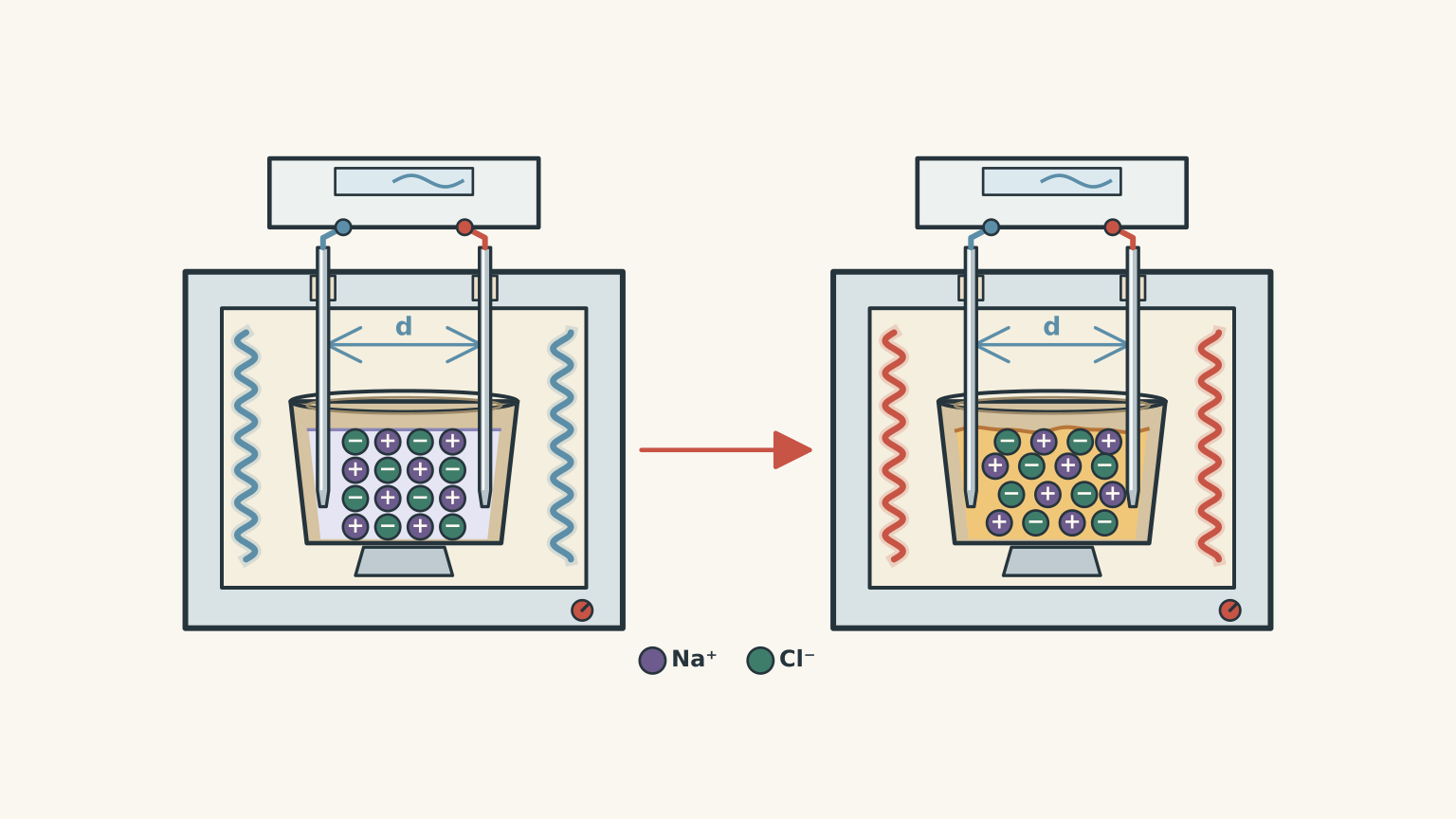
Due to technical limitations, this figure may display incorrectly or contain inaccuracies. Please check key details against your course materials.
What should we predict?
If ions are responsible for conducting electricity, the solid sample should show very little current because its ions cannot migrate through the lattice.
Once the sample melts, the ions should become mobile, producing a measurable current.
If the ions were not present in the solid, melting would need to create them. However, the ionic structural model already tells us that both states contain the same charged particles.
Illustrative experimental results
Suppose the following readings are obtained using the same conductivity cell and an applied voltage of \(2.0\text{ V}\).
| State of sodium chloride | Temperature | Measured current |
|---|---|---|
| Solid | \(25^\circ\text{C}\) | Below \(0.01\text{ mA}\) |
| Molten | \(820^\circ\text{C}\) | \(12.0\text{ mA}\) |
These are illustrative readings, not measurements from a claimed laboratory experiment.
The results show a substantial increase in electrical conduction after melting.
This supports the explanation that the ions become mobile when the ordered lattice breaks down.
Why is the experimental design important?
Imagine instead comparing solid sodium chloride with sodium chloride dissolved in water.
The aqueous solution would conduct electricity, but this comparison introduces another process: water molecules separate and hydrate the ions.
You would no longer be testing only the effect of melting.
A better investigation compares the same compound in its solid and molten states.
There is still one limitation. Temperature and physical state change together in this comparison. Heating a solid can increase ionic mobility even before melting, particularly through defects in its structure.
Measuring the solid at several temperatures below its melting point would help distinguish this gradual increase from the much greater mobility available in the molten state.
The important experimental conclusion is that the large increase in current is consistent with the transition from an ordered ionic lattice to a mobile ionic liquid.
04How do moving ions actually produce an electrical current?
So far, we’ve established that ions can move through a molten ionic compound.
But what makes them move in a particular direction?
An applied potential difference creates an electric field within the conducting material.
In an electrolytic cell connected to a direct-current supply, there are two electrodes:
- The anode is the positive electrode.
- The cathode is the negative electrode.
Oppositely charged ions are attracted to the electrodes carrying the opposite charge.
For molten magnesium chloride:
- \(\mathrm{Mg}^{2+}\) ions move towards the negative cathode.
- \(\mathrm{Cl}^{-}\) ions move towards the positive anode.
The ions still have random thermal motion. The electric field produces a net drift in particular directions.
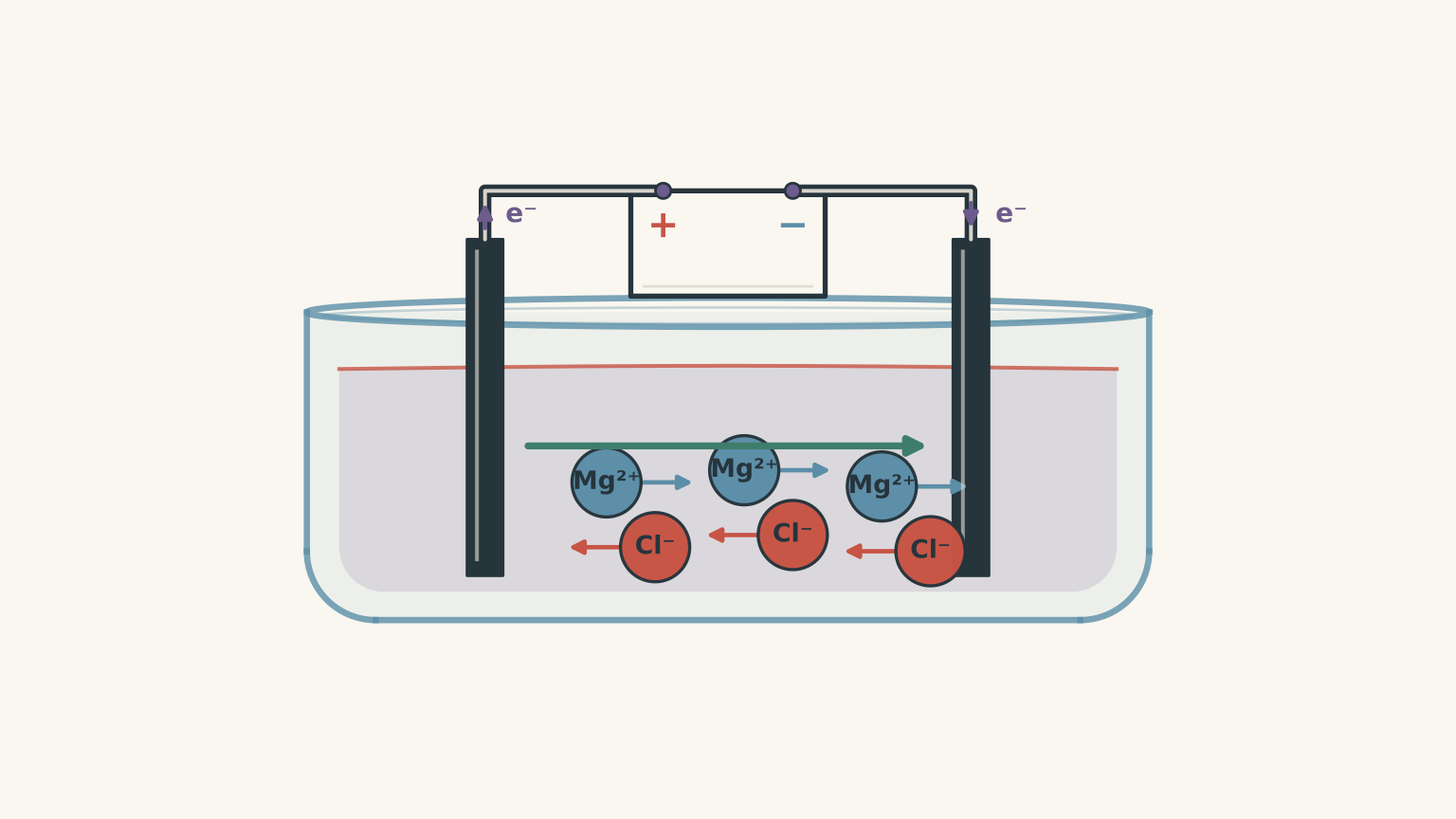
Due to technical limitations, this figure may display incorrectly or contain inaccuracies. Please check key details against your course materials.
An important detail: Both ions contribute to the current
You might think that positive and negative ions moving in opposite directions should cancel each other out.
They don’t.
This is because conventional current describes the direction of positive charge movement.
A positive ion moving towards the cathode contributes to conventional current in that direction.
A negative ion moving towards the anode also contributes to conventional current in the same direction.
The two contributions therefore add together.
This is an important distinction:
- Positive ions carry positive charge towards the cathode.
- Negative ions carry negative charge towards the anode.
- Both contribute to the same conventional current direction.
The molten compound remains approximately electrically neutral overall, even while its ions are moving and transporting charge.
Are electrons moving through the molten compound?
No. In a molten ionic compound, the mobile charge carriers are ions.
In the external metal wires, electrical conduction occurs through mobile electrons.
At the electrode surfaces, electrons are transferred during electrolysis. They are not travelling through the molten ionic liquid as the main charge carriers.
This distinction becomes particularly clear when we examine electrolysis.
05A second experiment: Electrolysis of molten lead(II) bromide
A conductivity meter demonstrates that a molten ionic compound conducts. But can we obtain further evidence that the particles responsible are positively and negatively charged ions?
Electrolysis provides that evidence.
Consider a teacher-controlled demonstration involving molten lead(II) bromide.
A heat-resistant container holds the molten compound. Two graphite electrodes are immersed in the liquid and connected to a direct-current power supply.
The negative electrode is the cathode, while the positive electrode is the anode.
Lead(II) bromide contains:
- \(\mathrm{Pb}^{2+}\) ions.
- \(\mathrm{Br}^{-}\) ions.

Due to technical limitations, this figure may display incorrectly or contain inaccuracies. Please check key details against your course materials.
What should happen?
If the ions are mobile, the positive lead ions should move towards the negative cathode.
At the cathode, lead ions gain electrons and form lead metal.
\[ \ce{Pb^2+ + 2e- -> Pb} \]
The negative bromide ions move towards the positive anode.
At the anode, bromide ions lose electrons and form bromine.
\[ \ce{2Br- -> Br2 + 2e-} \]
The overall reaction is:
\[ \ce{PbBr2(l) -> Pb(l) + Br2(g)} \]
Under the hot experimental conditions, bromine is observed as a vapour.
The formation of lead at one electrode and bromine at the other supports the model of mobile positive and negative ions.
It also connects ionic charge to valence and electron transfer. One \(\mathrm{Pb}^{2+}\) ion needs two electrons to become neutral lead. Two bromide ions release those two electrons when forming bromine.
The important point is that the ions must travel through the molten compound to reach their respective electrodes.
This is further physical evidence that molten ionic compounds conduct through ion movement.
Lead(II) bromide is toxic, and this demonstration involves high temperatures. The discussion here explains the experimental evidence rather than providing a student practical procedure.
06The contrasting case: Why solid metals conduct
There is one important misconception worth removing.
A student might reason that if solid ionic compounds cannot conduct because their particles cannot move, then all solids should be non-conductors.
Copper proves otherwise.
Solid copper conducts electricity very well, even though its atoms are arranged in an organised metallic lattice.
Why?
Metals contain delocalised electrons. These electrons are not confined to individual atoms and can move throughout the metallic structure.
The positive metal ion cores remain arranged in the lattice, but the electrons provide mobile charge carriers.
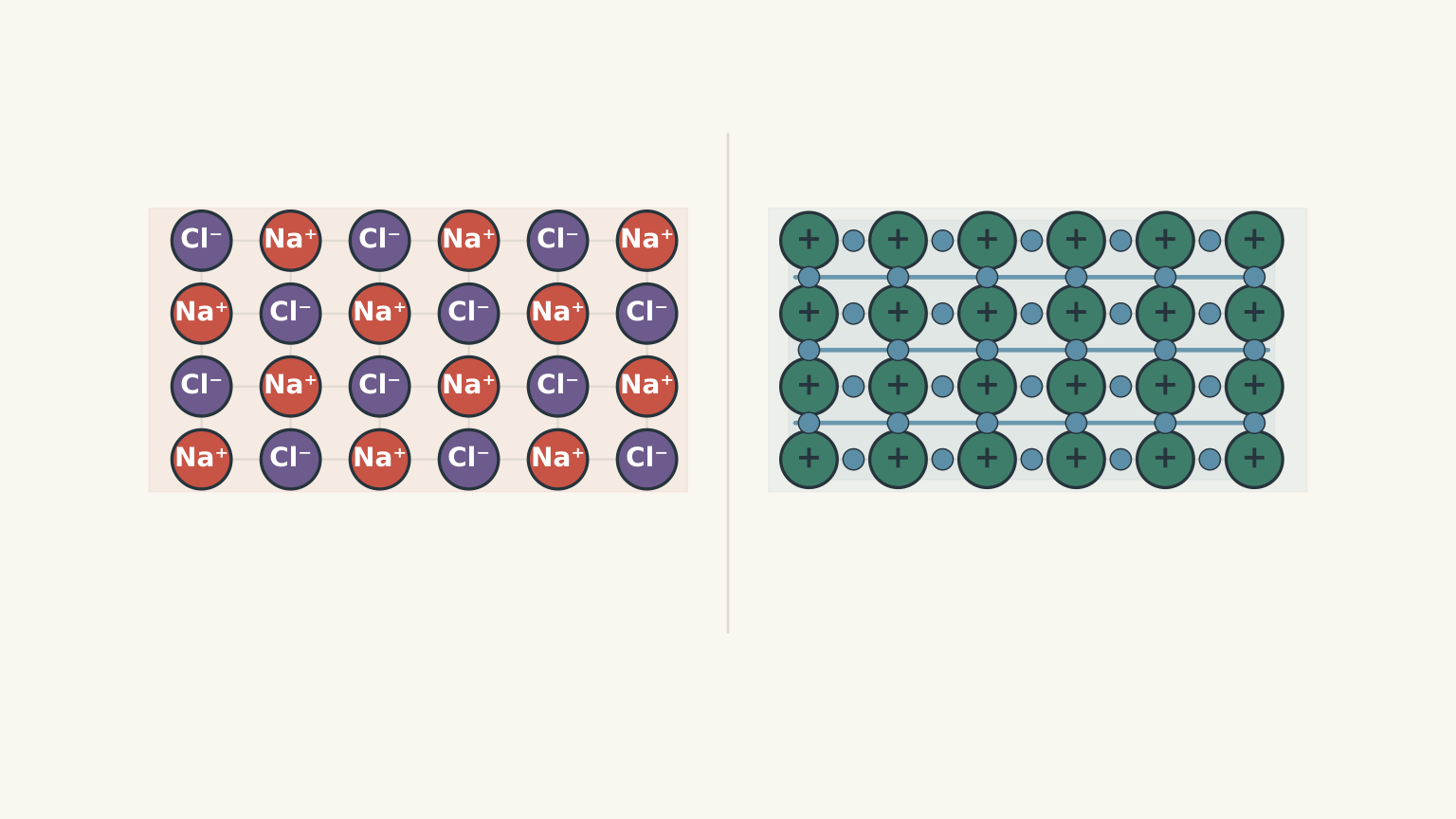
Due to technical limitations, this figure may display incorrectly or contain inaccuracies. Please check key details against your course materials.
This gives us a useful comparison:
| Material | Mobile charge carriers in the solid | Does the solid conduct? |
|---|---|---|
| Sodium chloride | No substantial long-range ion movement | Usually no |
| Copper | Delocalised electrons | Yes |
| Magnesium chloride | No substantial long-range ion movement | Usually no |
When copper melts, its electrons remain mobile, so the molten metal can still conduct.
Melting therefore does not automatically make every substance conductive. The result depends on which charged particles are present and whether they can move.
Why does the word ‘usually’ matter?
It would be too absolute to say that every solid ionic compound is completely non-conducting.
Some solids contain defects in their crystal structures. These defects can allow ions to move between available positions, producing limited ionic conductivity.
Specialised solid electrolytes can even have substantial ionic conductivity while remaining solid.
For ordinary ionic crystals at normal conditions, however, ion movement is sufficiently restricted that their electrical conductivity is usually negligible.
The HSC-level distinction remains:
- Solid ionic compounds: ions are present but generally unable to migrate through the lattice.
- Molten ionic compounds: ions can move and carry charge.
- Solid metals: delocalised electrons can move even while the metal remains solid.
07Common misconceptions to avoid
| Incorrect idea | Correct explanation |
|---|---|
| Solid ionic compounds contain no charged particles. | They contain positive and negative ions, but those ions are held near fixed lattice positions. |
| Melting creates the ions. | The ions already exist. Melting allows them to move. |
| Electrons carry current through molten salts. | The mobile charge carriers in molten ionic compounds are ions. |
| Positive and negative ions cancel each other’s current. | Their movements contribute to conventional current in the same direction. |
| Molten ionic compounds contain neutral molecules. | They contain mobile positive and negative ions that still interact electrostatically. |
| All solids are electrical insulators. | Metals conduct through delocalised electrons, and some solid electrolytes conduct through mobile ions. |
One final distinction is worth remembering: melting an ionic compound and dissolving it in water are not the same process.
Both can produce mobile ions, but dissolving also involves interactions between the ions and polar water molecules.
For the separate process of hydration and dissolution, see Dissolution of Ionic Compounds in Water for HSC Chemistry.
08Questions and solutions
Question 1
Explain why solid potassium bromide does not usually conduct electricity, whereas molten potassium bromide does.
Your answer should identify the charged particles present in both states and explain what changes during melting.
Solution 1
Molten potassium bromide conducts electricity because its positive and negative ions can move through the liquid. Solid potassium bromide usually does not conduct because its ions are held in fixed positions within an ionic lattice.
Potassium bromide contains:
- \(\mathrm{K}^{+}\) ions.
- \(\mathrm{Br}^{-}\) ions.
These ions exist in both the solid and molten states.
In solid potassium bromide, the ions can vibrate around their equilibrium positions but cannot migrate through the structure to transport charge.
When the compound melts, the ordered lattice breaks down. The ions become mobile and can move through the liquid when an electric field is applied.
The important distinction is that melting changes ion mobility, not ionic composition.
Question 2
Magnesium has the electron arrangement \(2,8,2\), while chlorine has the electron arrangement \(2,8,7\).
A sample of molten magnesium chloride is placed in an electrolytic cell with a positive electrode on the left and a negative electrode on the right.

Due to technical limitations, this figure may display incorrectly or contain inaccuracies. Please check key details against your course materials.
(a) Explain how magnesium chloride forms from magnesium and chlorine atoms. Identify the ions and their charges.
(b) Write the ionic formula of magnesium chloride and explain how electrical neutrality is maintained.
(c) State the direction of movement of each ion in the electrolytic cell.
(d) Explain why the two types of ion contribute to conventional current in the same direction.
Solution 2
(a) Magnesium chloride forms when one magnesium atom transfers two electrons to two chlorine atoms.
Magnesium loses two valence electrons:
\[ \ce{Mg -> Mg^2+ + 2e-} \]
Each chlorine atom gains one electron:
\[ \ce{2Cl + 2e- -> 2Cl-} \]
The resulting ions are one \(\mathrm{Mg}^{2+}\) ion and two \(\mathrm{Cl}^{-}\) ions.
(b) The ionic formula is \(\ce{MgCl2}\), and the compound is electrically neutral.
The total charge is:
\[ (+2)+2(-1)=0 \]
One magnesium ion balances the charge of two chloride ions.
This formula describes the ratio of ions in the ionic compound, not a separate neutral molecule moving through the melt.
(c) Magnesium ions move towards the negative cathode, while chloride ions move towards the positive anode.
Therefore:
- \(\mathrm{Mg}^{2+}\) moves to the right.
- \(\mathrm{Cl}^{-}\) moves to the left.
(d) Both types of ion contribute to conventional current from the anode towards the cathode.
The positive magnesium ions move in the direction of conventional current.
The negative chloride ions move in the opposite direction. However, because they carry negative charge, their movement also contributes to conventional current towards the cathode.
The contributions therefore add rather than cancel.
Question 3
A student investigates the conductivity of sodium chloride using the same conductivity cell, electrode spacing, and applied AC voltage of \(2.0\text{ V}\).
The following illustrative readings are obtained:
| State | Temperature | Measured current |
|---|---|---|
| Solid NaCl | \(25^\circ\text{C}\) | Below \(0.01\text{ mA}\) |
| Molten NaCl | \(820^\circ\text{C}\) | \(12.0\text{ mA}\) |
(a) Calculate the minimum ratio of the current through molten sodium chloride to the current through solid sodium chloride.
(b) Explain how the results support the ionic mobility model.
(c) Identify one limitation of using these measurements alone to explain the mechanism of electrical conduction.
Solution 3
(a) The current through molten sodium chloride is more than 1200 times the current through solid sodium chloride.
Using the largest possible solid-state reading as an upper limit:
\[ \frac{I_{\text{molten}}}{I_{\text{solid}}} > \frac{12.0}{0.01} \]
\[ \boxed{\text{Current ratio}>1200} \]
The result is a lower bound because the solid-state current is below the instrument’s detection limit.
(b) The results support the idea that melting allows ions to move through the compound.
The same chemical compound is tested in both states.
In the solid state, the ions are held near fixed positions in the ionic lattice, producing negligible current.
In the molten state, the lattice breaks down, allowing the ions to migrate through the liquid and transport charge.
The substantial increase in current is consistent with this change in ion mobility.
(c) The measurements alone do not identify the charge carriers or isolate the effect of temperature from the effect of melting.
The temperature changes significantly between the two measurements. Increased temperature can also increase ionic mobility before a substance melts.
Furthermore, a current reading establishes that charge is being transported, but does not independently establish whether the carriers are ions or electrons.
The ionic structural model and evidence from electrolysis provide further support for the explanation.
Question 4
A student investigates three materials:
- Solid sodium chloride shows negligible electrical conductivity.
- Solid copper conducts electricity strongly.
- A specialised crystalline ceramic ionic conductor shows a small electrical current that increases as its temperature rises, even though it remains solid.
The student concludes:
“These results disprove the idea that ions in solid ionic compounds cannot move. If solid copper conducts, all the charged particles in a solid must be mobile.”
Evaluate this conclusion.
In your response, explain:
(a) Why solid copper conducts.
(b) Why solid sodium chloride usually does not conduct.
(c) How the ceramic can conduct while remaining solid.
(d) Why these observations do not contradict the explanation of ionic conductivity in molten compounds.
Solution 4
The student’s conclusion is incorrect because the three materials have different charge carriers and different degrees of particle mobility.
(a) Solid copper conducts through mobile delocalised electrons.
Copper has a metallic structure containing positive metal ion cores and delocalised electrons.
The electrons can move through the solid structure and transport charge.
The metal does not need to melt to make these electrons mobile.
(b) Solid sodium chloride usually does not conduct because its ions cannot migrate through the lattice.
Although \(\mathrm{Na}^{+}\) and \(\mathrm{Cl}^{-}\) ions are charged, they are held near fixed positions by strong electrostatic attractions.
Their vibrations do not produce substantial long-range charge transport.
(c) The ceramic can conduct through ion movement enabled by defects in its crystal structure.
Some ionic solids contain vacancies or other structural defects that allow ions to move between available positions.
Increasing temperature can make these movements more frequent, increasing ionic conductivity without the substance melting.
This is an important qualification: solid ionic compounds do not have to be perfect electrical insulators.
(d) The results are consistent with the original explanation because conductivity depends on the mobility of the particular charge carriers.
Copper has mobile electrons in its solid state.
Ordinary sodium chloride has ions that are largely restricted to their lattice positions.
The ceramic has a structure that permits some ion migration even while solid.
Melting ordinary sodium chloride removes the restrictions imposed by its ordered lattice, allowing much greater ion mobility.
The mistake is assuming that all charged particles behave in the same way simply because they carry charge.
Question 5
A molten sample of magnesium chloride is placed in an electrolytic cell.
The positive anode is on the left, and the negative cathode is on the right.
During a \(10.0\text{ s}\) observation period, a tracer investigation measures the following movement across a particular plane inside the molten compound:
- \(1.5\times10^{19}\) magnesium ions move towards the cathode.
- \(4.5\times10^{19}\) chloride ions move towards the anode.
The current measured in the external circuit is \(1.20\text{ A}\).
Assume steady operation with negligible bulk charge accumulation. Use the elementary charge:
\[ e=1.60\times10^{-19}\text{ C} \]
(a) Calculate the magnitude of the charge transported by the magnesium ions during the observation period.
(b) Calculate the magnitude of the charge transported by the chloride ions.
(c) Determine the total charge transported through the molten compound and calculate the current implied by the tracer measurements.
(d) A student argues that the measurements cannot describe magnesium chloride because its formula requires two chloride ions for every magnesium ion, whereas the tracer experiment records three chloride ions crossing the plane for every magnesium ion.
Evaluate this argument. Explain the difference between the composition of an ionic compound and the movement of its ions under an electric field.
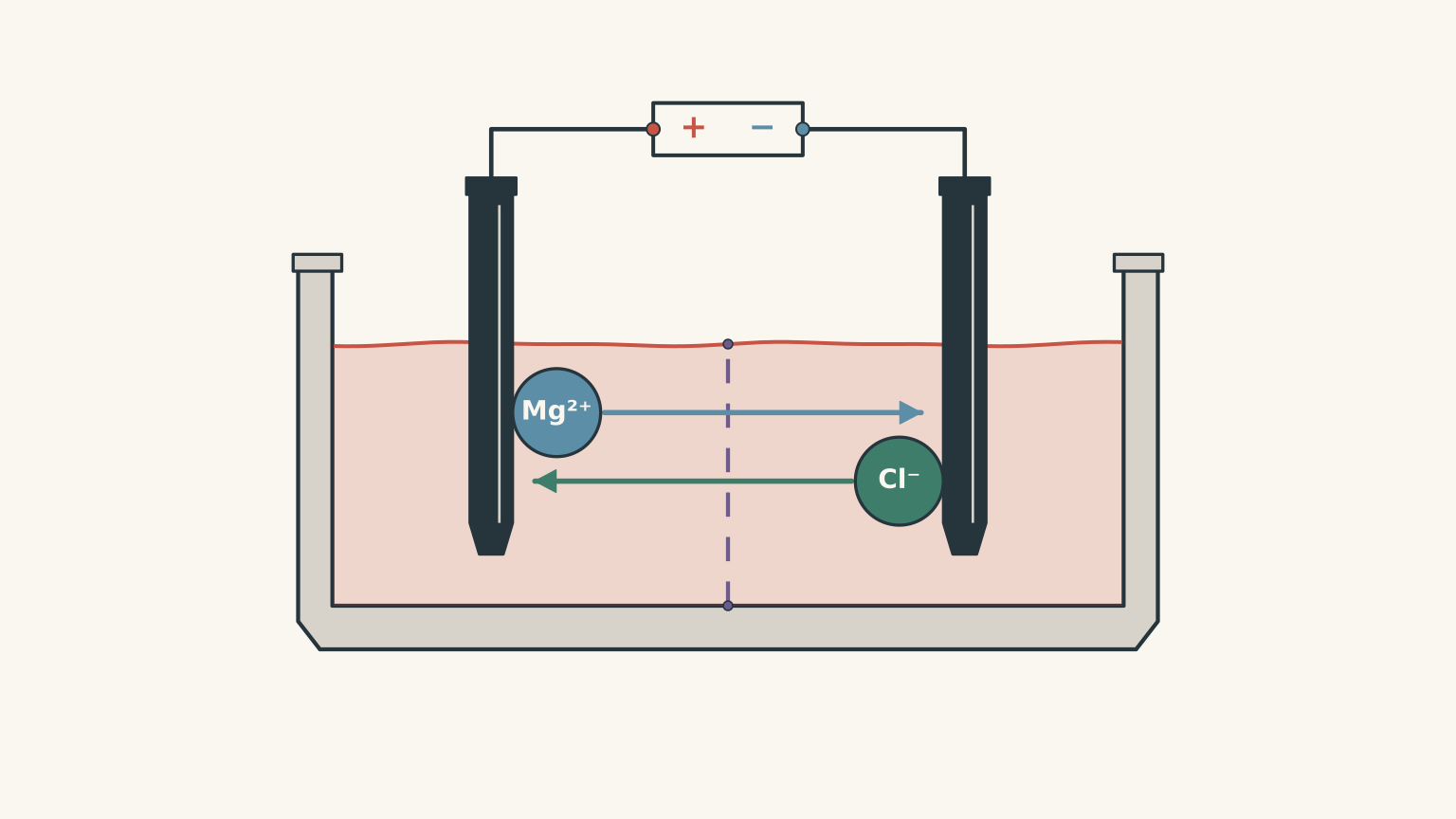
Due to technical limitations, this figure may display incorrectly or contain inaccuracies. Please check key details against your course materials.
Solution 5
The tracer measurements are consistent with molten magnesium chloride and give a total current of \(1.20\text{ A}\). The student’s argument incorrectly assumes that ionic formula ratios determine the number of ions crossing a plane per second.
(a) The magnesium ions transport \(4.80\text{ C}\) of positive charge.
Each magnesium ion carries a charge of \(+2e\).
Therefore, the magnitude of the charge per ion is:
\[ q_{\mathrm{Mg}^{2+}} =2(1.60\times10^{-19}) \]
\[ =3.20\times10^{-19}\text{ C} \]
There are \(1.5\times10^{19}\) magnesium ions crossing the plane.
Therefore:
\[ Q_{\mathrm{Mg}^{2+}} =(1.5\times10^{19})(3.20\times10^{-19}) \]
\[ \boxed{Q_{\mathrm{Mg}^{2+}}=4.80\text{ C}} \]
(b) The chloride ions transport \(7.20\text{ C}\) of negative charge magnitude.
Each chloride ion carries a charge of \(-e\).
The magnitude of its charge is:
\[ q_{\mathrm{Cl}^{-}} =1.60\times10^{-19}\text{ C} \]
There are \(4.5\times10^{19}\) chloride ions crossing the plane.
Therefore:
\[ Q_{\mathrm{Cl}^{-}} =(4.5\times10^{19})(1.60\times10^{-19}) \]
\[ \boxed{Q_{\mathrm{Cl}^{-}}=7.20\text{ C}} \]
(c) The total charge transported is \(12.0\text{ C}\), giving a current of \(1.20\text{ A}\).
The magnesium ions move towards the cathode, carrying positive charge to the right.
The chloride ions move towards the anode, carrying negative charge to the left.
Although their physical movements are opposite, their contributions to conventional current are in the same direction.
Therefore, the charge contributions add:
\[ Q_{\text{total}}=4.80+7.20 \]
\[ Q_{\text{total}}=12.0\text{ C} \]
Current is the rate of charge transfer:
\[ I=\frac{Q}{t} \]
Substituting:
\[ I=\frac{12.0}{10.0} \]
\[ \boxed{I=1.20\text{ A}} \]
This agrees with the current measured in the external circuit.
The magnesium ions contribute \(40\%\) of the current, while the chloride ions contribute \(60\%\) under these particular tracer conditions.
(d) The student’s argument is incorrect because the formula ratio describes the composition of the compound, not the relative rates at which different ions cross a particular plane.
This is the most important conceptual distinction in the question.
The formula \(\ce{MgCl2}\) tells us that the ionic compound contains one magnesium ion for every two chloride ions.
It does not require those ions to move at equal rates or cross an imaginary plane in that same ratio.
The two types of ion have different properties and can have different drift velocities under an applied electric field. Their individual movement rates therefore need not follow the formula ratio.
There is another tempting mistake here.
A student might imagine that molten magnesium chloride consists of intact, neutral \(\ce{MgCl2}\) units moving together. If this were true, the positive and negative charges within each unit would cancel, and that movement would not produce an ionic current.
But the molten compound conducts because its charged ions can move independently.
The ions do not need to travel in neutral groups. Magnesium ions and chloride ions move in opposite physical directions, and both contribute to conventional current in the same direction.
The bulk compound remains approximately electrically neutral, while its ions redistribute and transport charge.
The tracer measurements therefore do not contradict the formula \(\ce{MgCl2}\). They demonstrate why the distinction between ionic composition and ionic mobility is essential when explaining electrical conduction.
Understanding this distinction provides the foundation for the next topic: electrolysis. Once you know which ions move towards each electrode, you can predict which species gain or lose electrons and what products form.
If you are interpreting experimental results to identify an unknown solid, the next useful step is to combine conductivity in different physical states with melting point and hardness data. See How to Identify an Unknown Solid from Chemistry Data.