
Introduction to Complex Numbers: HSC Maths Extension 2 Guide
A comprehensive guide to complex numbers for the NSW 2024 Mathematics Extension 2 syllabus. Learn complex arithmetic, conjugates, polar form, de Moivre’s theorem, roots, vector geometry, and complex loci through clear explanations and worked examples.
Try to solve \(x^2+9=0\).
Rearranging gives \(x^2=-9\). But no real number squared gives a negative result. Does that mean the equation has no solutions, or does it mean the number system we’ve been using is too restrictive?
The second answer leads to one of the most important ideas in Mathematics Extension 2: complex numbers. By extending the real numbers to include a new number, \(i\), defined by \(i^2=-1\), we can solve equations that previously had no real solutions.
But complex numbers do much more than fix a gap in algebra. They give us a way to describe rotations, represent vectors, calculate roots, and solve geometric problems using equations.
The NSW 2024 Mathematics Extension 2 syllabus develops all of these ideas. The key is learning to move comfortably between three ways of thinking about a complex number: algebraically, geometrically, and in polar form.
01Introducing complex numbers
The imaginary unit \(i\)
We define the imaginary unit \(i\) by
\[ i^2=-1 \]
This means that multiplying \(i\) by itself gives negative one.
Consequently,
\[ i=\sqrt{-1} \]
is a useful informal way to think about the new number, although the defining relationship is \(i^2=-1\).
We can now solve equations such as
\[ x^2+k=0 \]
where \(k\) is a positive real number.
Rearranging,
\[ x^2=-k \]
Taking square roots gives
\[ \boxed{x=\pm i\sqrt{k}} \]
For example, consider the original equation:
\[ x^2+9=0 \]
\[ x^2=-9 \]
\[ \boxed{x=\pm 3i} \]
Both solutions work because
\[ (3i)^2=9i^2=-9 \]
and
\[ (-3i)^2=9i^2=-9 \]
Notice that there are two solutions, just as there would be for an equation such as \(x^2=9\).
The important difference is that these solutions are not real numbers.
Extending the number system
Before defining complex numbers properly, it helps to understand where they fit into the number systems you already know.
The NSW syllabus treats each number system as an extension of the previous one.
\[ \boxed{ \mathbb N\subset\mathbb Z\subset\mathbb Q \subset\mathbb R\subset\mathbb C } \]
Each set contains all the numbers in the sets before it, as well as additional numbers.
| Number set | What it contains | Examples |
|---|---|---|
| \(\mathbb N\) | Natural numbers | \(1,2,3,4,\ldots\) |
| \(\mathbb Z\) | Integers, including negative numbers and zero | \(-3,0,5\) |
| \(\mathbb Q\) | Rational numbers, expressible as fractions | \(\frac23,-\frac74,5\) |
| \(\mathbb R\) | All real numbers, including irrational numbers | \(\sqrt2,\pi,-4\) |
| \(\mathbb C\) | All complex numbers | \(2+3i,-4i,5\) |
We use the convention that \(\mathbb N\) contains positive natural numbers. Some textbooks include zero in this set, so follow the convention specified in your course materials.
A useful way to classify numbers is to identify the smallest set they belong to.
For example:
- \(7\) is natural, integer, rational, real, and complex.
- \(-4\) is an integer, rational, real, and complex.
- \(\frac35\) is rational, real, and complex.
- \(\sqrt2\) is irrational, but still real and complex.
- \(3+2i\) is complex, but not real.
This is a hierarchy of inclusion, not five mutually exclusive categories.
Defining the complex numbers
The complex numbers, denoted by \(\mathbb C\), are the set of all numbers that can be expressed in the form
\[ \boxed{z=a+ib} \]
where \(a\) and \(b\) are real numbers.
This is called the Cartesian form of a complex number.
For example,
\[ z=4+3i \]
is a complex number with real component \(4\) and imaginary component \(3i\).
We formally define:
- The real part of \(z\), denoted by \(\operatorname{Re}(z)\), is \(a\).
- The imaginary part of \(z\), denoted by \(\operatorname{Im}(z)\), is \(b\).
Therefore,
\[ \operatorname{Re}(4+3i)=4 \]
\[ \operatorname{Im}(4+3i)=3 \]
Be careful with the second expression. The imaginary part is \(3\), not \(3i\).
A complex number is real if its imaginary part is zero. It is non-real if its imaginary part is non-zero.
For example, \(5=5+0i\) is real, whereas \(5+2i\) is non-real.
When are two complex numbers equal?
Suppose we have
\[ z_1=a+ib \]
and
\[ z_2=c+id \]
The two complex numbers are equal if and only if their real parts are equal and their imaginary parts are equal.
That is,
\[ \boxed{ z_1=z_2 \iff \begin{cases} \operatorname{Re}(z_1)=\operatorname{Re}(z_2)\\ \operatorname{Im}(z_1)=\operatorname{Im}(z_2) \end{cases} } \]
Equivalently,
\[ a=c \quad\text{and}\quad b=d \]
Why does this work?
If
\[ a+ib=c+id \]
then rearranging gives
\[ (a-c)+i(b-d)=0 \]
The only way a complex number can equal zero is if both its real and imaginary parts are zero.
This gives us a useful technique for solving equations involving unknown real and imaginary components.
Example
Find the real values of \(p\) and \(q\) if
\[ (2p-1)+i(q+3)=5-2i \]
Equating real parts,
\[ 2p-1=5 \]
\[ p=3 \]
Equating imaginary parts,
\[ q+3=-2 \]
\[ q=-5 \]
Therefore,
\[ \boxed{p=3,\quad q=-5} \]
Worked example: Solving quadratics with negative discriminants
Solve the following equations over the complex numbers.
(a) \(x^2+16=0\)
(b) \(2x^2-4x+7=0\)
Step 1
\[ x^2=-16 \]
\[ \boxed{x=\pm4i} \]
Step 2
Recall that
\[ x=\frac{-b\pm\sqrt{b^2-4ac}}{2a} \]
For the equation \(2x^2-4x+7=0\),
\[ a=2,\quad b=-4,\quad c=7 \]
The discriminant is
\[ \Delta=(-4)^2-4(2)(7) \]
\[ \Delta=16-56=-40 \]
Step 3
\[ \sqrt{-40}=i\sqrt{40}=2i\sqrt{10} \]
Substitute into the quadratic formula:
\[ x=\frac{4\pm2i\sqrt{10}}{4} \]
Therefore,
\[ \boxed{x=1\pm\frac{\sqrt{10}}{2}i} \]
The two roots are complex conjugates. This is a pattern we will prove later.
02Arithmetic with complex numbers
Once we introduce complex numbers, we need to know how to perform the usual arithmetic operations.
The good news is that most of the rules are familiar. The main additional rule is
\[ i^2=-1 \]
Addition and subtraction
Consider two complex numbers:
\[ z_1=a+ib,\qquad z_2=c+id \]
To add them, collect the real components and imaginary components separately.
\[ \boxed{ z_1+z_2=(a+c)+i(b+d) } \]
Subtraction follows the same principle:
\[ \boxed{ z_1-z_2=(a-c)+i(b-d) } \]
For example,
\[ (3+2i)+(5-4i)=8-2i \]
and
\[ (3+2i)-(5-4i)=-2+6i \]
You cannot combine the real component of one number with the imaginary component of another. Keep the two parts separate.
Multiplication
Multiplication requires slightly more care.
Expand the brackets using the distributive law, just as you would with algebraic expressions.
The difference is that any occurrence of \(i^2\) must be replaced by \(-1\).
Consider
\[ (a+ib)(c+id) \]
Expanding,
\[ =ac+iad+ibc+i^2bd \]
Since \(i^2=-1\),
\[ =ac-bd+i(ad+bc) \]
Therefore,
\[ \boxed{ (a+ib)(c+id)=(ac-bd)+i(ad+bc) } \]
Example
Simplify
\[ (2-3i)(1+4i) \]
Expanding,
\[ =2+8i-3i-12i^2 \]
Substituting \(i^2=-1\),
\[ =2+5i+12 \]
\[ \boxed{14+5i} \]
The most common mistake here is forgetting that \(i^2=-1\), rather than leaving it as \(i^2\) or treating it as \(1\).
Using digital tools for complex arithmetic
A CAS calculator or suitable mathematics application can check complex arithmetic.
When using a digital tool:
- Enter the imaginary unit as \(i\), using the calculator’s complex-number mode where necessary.
- Use brackets around complete complex expressions.
- Check that the output is displayed in Cartesian form if the question asks for \(a+ib\).
- Use exact values rather than rounded decimals when possible.
For example, a calculator can evaluate
\[ (2-3i)(1+4i) \]
and return \(14+5i\).
However, you should still be able to perform the expansion by hand. In an examination, the working demonstrates that you understand why the answer is correct.
The complex conjugate
The complex conjugate is one of the most useful ideas in complex-number algebra.
For a complex number
\[ z=a+ib \]
its complex conjugate is defined as
\[ \boxed{\overline z=a-ib} \]
The conjugate keeps the real part unchanged and reverses the sign of the imaginary part.
For example,
\[ z=3+4i \]
has conjugate
\[ \overline z=3-4i \]
Similarly, the conjugate of \(-2-5i\) is \(-2+5i\).
Geometrically, a complex number and its conjugate are reflections of each other across the real axis.
Important conjugate identities
The conjugate behaves predictably under arithmetic operations.
For any complex numbers \(z_1\) and \(z_2\),
\[ \boxed{\overline{z_1+z_2}=\overline{z_1}+\overline{z_2}} \]
\[ \boxed{\overline{z_1-z_2}=\overline{z_1}-\overline{z_2}} \]
\[ \boxed{\overline{z_1z_2}=\overline{z_1}\,\overline{z_2}} \]
For \(z_2\ne0\),
\[ \boxed{ \overline{\left(\frac{z_1}{z_2}\right)} = \frac{\overline{z_1}}{\overline{z_2}} } \]
We also have
\[ \boxed{\overline{\overline z}=z} \]
and
\[ \boxed{\overline{z^n}=(\overline z)^n} \]
for integer \(n\), provided \(z\ne0\) when \(n\) is negative.
These identities can be established directly from the definition.
For example, let
\[ z_1=a+ib,\qquad z_2=c+id \]
Their product is
\[ z_1z_2=(ac-bd)+i(ad+bc) \]
Taking its conjugate gives
\[ \overline{z_1z_2} =(ac-bd)-i(ad+bc) \]
Now multiply the conjugates separately:
\[ \begin{aligned} \overline{z_1}\,\overline{z_2} &=(a-ib)(c-id)\\ &=ac-iad-ibc+i^2bd\\ &=(ac-bd)-i(ad+bc) \end{aligned} \]
The expressions are identical, proving the product identity.
The other identities follow in the same way by expanding the relevant expressions.
A particularly important result comes from multiplying a complex number by its conjugate.
\[ \begin{aligned} z\overline z &=(a+ib)(a-ib)\\ &=a^2+b^2 \end{aligned} \]
Notice that the imaginary terms cancel.
This gives us a real, non-negative result:
\[ \boxed{z\overline z=a^2+b^2} \]
The modulus of a complex number
The modulus of a complex number is its distance from the origin on the complex plane.
For \(z=a+ib\), it is defined by
\[ \boxed{ |z|=\sqrt{z\overline z} =\sqrt{a^2+b^2} } \]
This is simply Pythagoras’ theorem.
The real part is the horizontal displacement, and the imaginary part is the vertical displacement. The modulus is the length of the resulting vector.
For example, if
\[ z=3+4i \]
then
\[ |z|=\sqrt{3^2+4^2} \]
\[ \boxed{|z|=5} \]
The modulus is always non-negative.
Also notice that
\[ |z|^2=z\overline z \]
This identity is extremely useful in more advanced calculations.
Expressing real and imaginary parts using conjugates
We can use the conjugate to recover the real and imaginary parts of a complex number.
Starting with
\[ z=a+ib \]
and
\[ \overline z=a-ib \]
Add the two equations:
\[ z+\overline z=2a \]
Therefore,
\[ \boxed{ \operatorname{Re}(z)=\frac{z+\overline z}{2} } \]
Now subtract the equations:
\[ z-\overline z=2ib \]
Dividing by \(2i\),
\[ \boxed{ \operatorname{Im}(z)=\frac{z-\overline z}{2i} } \]
These relationships are useful when a question gives you a complex number and its conjugate rather than its Cartesian components.
Reciprocals and division of complex numbers
Suppose you want to calculate
\[ \frac{1}{a+ib} \]
Directly dividing by a complex denominator is inconvenient.
Instead, multiply the numerator and denominator by the conjugate of the denominator.
\[ \frac{1}{z} = \frac{1}{z}\times\frac{\overline z}{\overline z} \]
This gives
\[ \frac{1}{z} = \frac{\overline z}{z\overline z} \]
Since \(z\overline z=|z|^2\),
\[ \boxed{ \frac1z=\frac{\overline z}{|z|^2}, \qquad z\ne0 } \]
This is the standard technique for dividing complex numbers.
For two complex numbers \(z_1\) and \(z_2\), where \(z_2\ne0\),
\[ \boxed{ \frac{z_1}{z_2} = \frac{z_1\overline{z_2}}{|z_2|^2} } \]
Worked example: Dividing two complex numbers
Express the following in Cartesian form:
\[ \frac{3+2i}{1-i} \]
Step 1: Identify the conjugate of the denominator.
The conjugate of \(1-i\) is \(1+i\).
Step 2: Multiply the numerator and denominator by this conjugate.
\[ \frac{3+2i}{1-i} = \frac{(3+2i)(1+i)}{(1-i)(1+i)} \]
Step 3: Expand the numerator.
\[ \begin{aligned} (3+2i)(1+i) &=3+3i+2i+2i^2\\ &=3+5i-2\\ &=1+5i \end{aligned} \]
Step 4: Simplify the denominator.
Using the difference of two squares,
\[ (1-i)(1+i)=1-i^2=2 \]
Step 5: Write the final result in Cartesian form.
\[ \frac{3+2i}{1-i} = \frac{1+5i}{2} \]
Therefore,
\[ \boxed{\frac12+\frac52i} \]
The denominator is now real, which is exactly what we wanted.
A digital calculator can verify this result, but it is important to understand the conjugate method because it is also used in proofs and more complicated problems.
Finding the square roots of a complex number
Finding the square roots of a complex number requires a slightly different approach from ordinary real-number square roots.
Suppose we want to find the square roots of
\[ z=a+ib \]
Let one square root be
\[ w=u+iv \]
where \(u\) and \(v\) are real.
We require
\[ (u+iv)^2=a+ib \]
Expanding,
\[ u^2-v^2+2uvi=a+ib \]
Equating real and imaginary parts gives
\[ u^2-v^2=a \]
and
\[ 2uv=b \]
We also know that
\[ u^2+v^2=|z| \]
Adding the first and third equations gives
\[ 2u^2=|z|+a \]
Similarly,
\[ 2v^2=|z|-a \]
Therefore,
\[ \boxed{ u^2=\frac{|z|+a}{2} } \]
\[ \boxed{ v^2=\frac{|z|-a}{2} } \]
These equations give us a practical method for finding square roots.
If \(b\ne0\), we can take
\[ u=\sqrt{\frac{|z|+a}{2}} \]
and then calculate
\[ v=\frac{b}{2u} \]
The two square roots are
\[ \boxed{\pm(u+iv)} \]
If \(b=0\), handle the real number separately. A positive real number has two real square roots, a negative real number has two purely imaginary square roots, and zero has just one distinct square root.
Worked example: Find the square roots of \(3+4i\)
Step 1: Calculate the modulus.
\[ |z|=\sqrt{3^2+4^2}=5 \]
Step 2: Calculate the real component of a square root.
\[ u=\sqrt{\frac{5+3}{2}} \]
\[ u=2 \]
Step 3: Calculate the imaginary component.
Using \(2uv=b\),
\[ 2(2)v=4 \]
\[ v=1 \]
Step 4: State both square roots.
\[ \boxed{w=2+i\quad\text{or}\quad w=-2-i} \]
Check the first root:
\[ (2+i)^2=4+4i+i^2=3+4i \]
The second root works because it is the negative of the first, and squaring either root gives the same result.
A common mistake is to write \(2+i\) and \(2-i\) as the two square roots. These are not correct because \((2-i)^2=3-4i\), which is the conjugate of the original number.
03Solving quadratic equations with complex coefficients
So far, our quadratic equations have had real coefficients.
The next step is to allow the coefficients themselves to be complex numbers.
Consider the general quadratic equation
\[ ax^2+bx+c=0 \]
where \(a,b,c\in\mathbb C\) and \(a\ne0\).
The quadratic formula still works:
\[ \boxed{ x=\frac{-b\pm\sqrt{b^2-4ac}}{2a} } \]
The difference is that the discriminant
\[ \Delta=b^2-4ac \]
may now be complex.
We therefore need to be comfortable finding the square roots of complex numbers, as developed in the previous section.
Worked example: A quadratic with complex coefficients
Solve
\[ (1+i)x^2-(3+3i)x+(2+4i)=0 \]
Step 1
\[ a=1+i \]
\[ b=-3-3i \]
\[ c=2+4i \]
Step 2
\[ \Delta=b^2-4ac \]
First,
\[ \begin{aligned} b^2 &=(-3-3i)^2\\ &=18i \end{aligned} \]
Next,
\[ \begin{aligned} ac &=(1+i)(2+4i)\\ &=-2+6i \end{aligned} \]
Therefore,
\[ \begin{aligned} \Delta &=18i-4(-2+6i)\\ &=8-6i \end{aligned} \]
Step 3
We notice that
\[ (3-i)^2=9-6i-1 \]
\[ (3-i)^2=8-6i \]
Hence,
\[ \sqrt{\Delta}=\pm(3-i) \]
Step 4
\[ x=\frac{3+3i\pm(3-i)}{2+2i} \]
Using the positive sign,
\[ x=\frac{6+2i}{2+2i}=2-i \]
Using the negative sign,
\[ x=\frac{4i}{2+2i}=1+i \]
Therefore,
\[ \boxed{x=2-i\quad\text{or}\quad x=1+i} \]
The quadratic formula is still valid. The main challenge is handling complex arithmetic correctly.
Complex conjugate roots of real polynomials
There is an important relationship between complex numbers and polynomial equations with real coefficients.
If a polynomial has real coefficients and a non-real complex number is one of its roots, its complex conjugate must also be a root.
This is called the complex conjugate root theorem.
In other words, if
\[ P(z)=0 \]
and \(P\) has real coefficients, then
\[ \boxed{P(\overline z)=0} \]
provided \(z\) is a complex root.
Proving the complex conjugate root theorem
Consider a polynomial
\[ P(x)=a_nx^n+a_{n-1}x^{n-1}+\cdots+a_1x+a_0 \]
where every coefficient \(a_k\) is real.
Suppose \(z\) is a root, so
\[ P(z)=0 \]
Taking the complex conjugate of both sides,
\[ \overline{P(z)}=0 \]
Using the conjugate identities,
\[ \overline{P(z)} = a_n\overline z^{\,n} +a_{n-1}\overline z^{\,n-1} +\cdots+a_1\overline z+a_0 \]
Here we can leave the coefficients unchanged because they are real.
But this expression is exactly \(P(\overline z)\).
Therefore,
\[ \boxed{P(\overline z)=0} \]
Hence, if \(z\) is a root, its conjugate must also be a root.
The condition that the coefficients are real is essential. If a polynomial has complex coefficients, its non-real roots do not necessarily occur in conjugate pairs.
For a quadratic with real coefficients, this theorem explains why non-real roots appear as conjugates.
If
\[ ax^2+bx+c=0 \]
has real coefficients and a negative discriminant, its roots are
\[ \boxed{ x=\frac{-b+i\sqrt{-\Delta}}{2a} \quad\text{and}\quad x=\frac{-b-i\sqrt{-\Delta}}{2a} } \]
The two roots are complex conjugates.
If the discriminant is non-negative, the roots are real, so each root is its own conjugate.
Using conjugate roots to solve polynomial equations
Suppose a polynomial with real coefficients has \(2+i\) as a root.
You immediately know that \(2-i\) must also be a root.
This can save a considerable amount of algebra, particularly when a polynomial has several unknown coefficients.
For example, if a monic cubic has roots \(1\) and \(2+i\), the third root must be \(2-i\).
Therefore, its factorisation is
\[ \begin{aligned} P(x) &=(x-1)(x-(2+i))(x-(2-i))\\ &=(x-1)((x-2)^2+1) \end{aligned} \]
The complex factors combine to give a real quadratic:
\[ \boxed{P(x)=(x-1)(x^2-4x+5)} \]
This is a particularly useful examination technique: identify the conjugate root before attempting to factorise the polynomial.
04The complex plane and arguments
Complex numbers are not just algebraic expressions. We can also represent them geometrically.
This gives us a much more powerful way to understand their properties.
The Argand plane
A complex number
\[ z=a+ib \]
can be represented as a point with coordinates
\[ \boxed{(a,b)} \]
on the complex plane, also called the Argand plane.
The horizontal axis represents real values, and the vertical axis represents imaginary values.
For example,
\[ z=3+2i \]
is represented by the point \((3,2)\).
Similarly,
\[ w=-2+4i \]
is represented by \((-2,4)\).
The complex number can also be viewed as a vector from the origin to its corresponding point.
This gives us two important measurements:
- The modulus is the length of the vector.
- The argument is the angle the vector makes with the positive real axis.
Plotting complex numbers with and without digital tools
To plot a complex number manually:
- Identify its real part.
- Identify its imaginary part.
- Move horizontally to the real coordinate.
- Move vertically to the imaginary coordinate.
- Mark the resulting point.
For example, to plot \(z=-3+2i\), move three units left and two units upwards.
With a graphing application, simply enter the coordinate pair
\[ (-3,2) \]
and label the point \(z=-3+2i\).
Remember that the second coordinate is the imaginary part, not the coefficient multiplied by \(i\).
For more complicated problems, graphing applications can also help you visualise loci, circles, rays, and the effects of multiplying complex numbers.
The argument of a complex number
The argument of a non-zero complex number is the angle measured anticlockwise from the positive real axis to the vector representing that number.
It is denoted by
\[ \arg(z)=\theta \]
For
\[ z=a+ib \]
we already know that
\[ |z|=\sqrt{a^2+b^2} \]
Using right-angled trigonometry,
\[ \cos\theta=\frac{a}{|z|} \]
and
\[ \sin\theta=\frac{b}{|z|} \]
Therefore, the argument satisfies
\[ \boxed{ \cos\theta=\frac{a}{|z|}, \qquad \sin\theta=\frac{b}{|z|} } \]
These equations help us determine the angle.
Notice that we need both sine and cosine information. Simply calculating
\[ \theta=\tan^{-1}\left(\frac ba\right) \]
can give the wrong quadrant.
For example, consider
\[ z=-1+\sqrt3i \]
Its modulus is
\[ |z|=\sqrt{(-1)^2+(\sqrt3)^2}=2 \]
Therefore,
\[ \cos\theta=-\frac12 \]
and
\[ \sin\theta=\frac{\sqrt3}{2} \]
The cosine is negative and the sine is positive, so the angle must be in the second quadrant.
Hence,
\[ \boxed{\theta=\frac{2\pi}{3}} \]
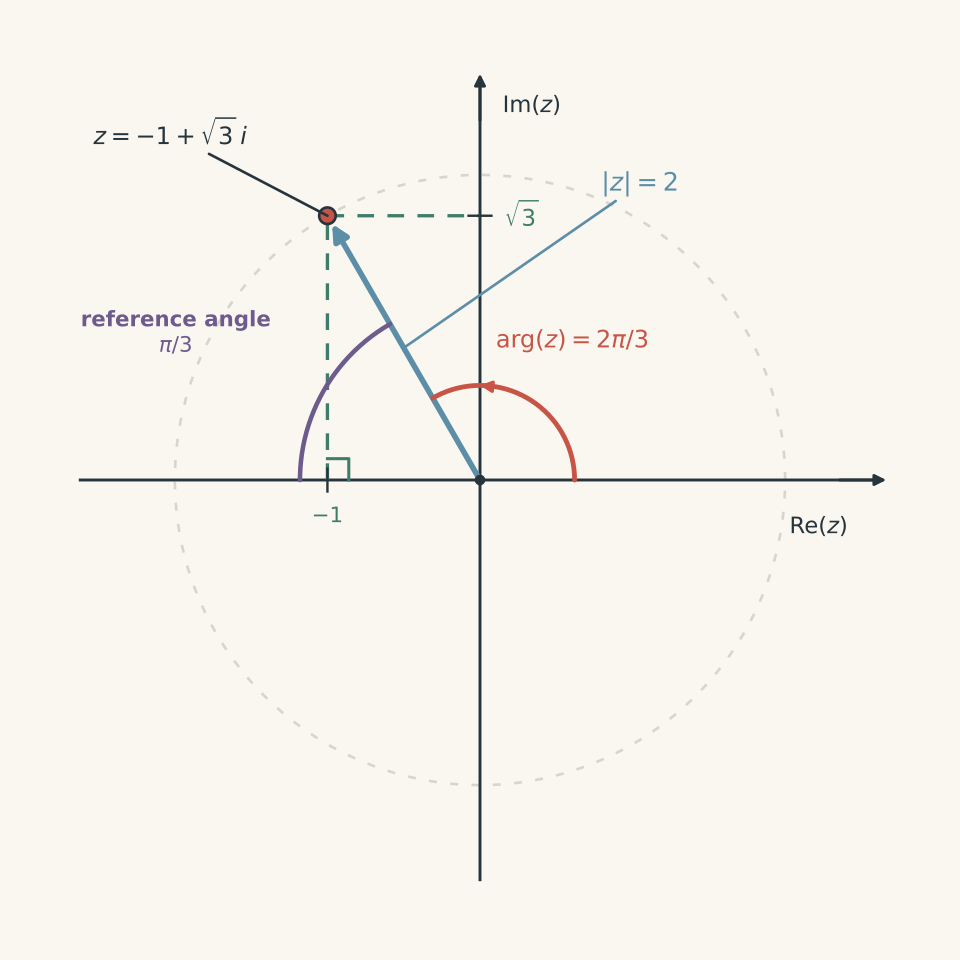
Due to technical limitations, this figure may display incorrectly or contain inaccuracies. Please check key details against your course materials.
Why the argument has multiple values
An angle of \(\frac{2\pi}{3}\) points in exactly the same direction as an angle of
\[ \frac{2\pi}{3}+2\pi \]
or
\[ \frac{2\pi}{3}-2\pi \]
Adding or subtracting a complete revolution does not change the direction of a vector.
Therefore, the argument of a complex number has infinitely many possible values.
The general expression is
\[ \boxed{ \arg(z)=\theta+2n\pi,\qquad n\in\mathbb Z } \]
where \(\theta\) is any one argument of \(z\).
For example, the arguments of \(-1+\sqrt3i\) include
\[ \frac{2\pi}{3},\quad \frac{8\pi}{3},\quad -\frac{4\pi}{3} \]
All represent the same direction.
The principal argument
Having infinitely many possible arguments can make calculations inconvenient.
We therefore define the principal argument, denoted by
\[ \operatorname{Arg}(z) \]
as the unique argument in the interval
\[ \boxed{(-\pi,\pi]} \]
This means the principal argument must be greater than \(-\pi\) and less than or equal to \(\pi\).
For example:
| Complex number | Principal argument |
|---|---|
| \(1+i\) | \(\frac{\pi}{4}\) |
| \(1-i\) | \(-\frac{\pi}{4}\) |
| \(-1+i\) | \(\frac{3\pi}{4}\) |
| \(-1-i\) | \(-\frac{3\pi}{4}\) |
| \(-2\) | \(\pi\) |
| \(2\) | \(0\) |
Notice that the negative real axis has principal argument \(\pi\), not \(-\pi\), because \(-\pi\) is excluded from the interval.
The principal argument gives us one standard angle for each non-zero complex number.
The argument of zero is undefined because the zero vector has no direction.
Polar or modulus-argument form
We can now express a complex number using its modulus and argument instead of its real and imaginary components.
This is called polar form or modulus-argument form.
For a non-zero complex number,
\[ \boxed{ z=r(\cos\theta+i\sin\theta) } \]
where:
- \(r=|z|\) is the modulus.
- \(\theta\) is an argument of \(z\).
The notation
\[ \cos\theta+i\sin\theta \]
is sometimes shortened to \(\operatorname{cis}\theta\).
Therefore,
\[ z=r\operatorname{cis}\theta \]
is an equivalent way of writing polar form.
The zero complex number has modulus zero, but no defined argument.
To convert from Cartesian form to polar form:
\[ a+ib \]
first calculate
\[ r=\sqrt{a^2+b^2} \]
then determine the correct quadrant and angle.
To convert from polar form to Cartesian form, use
\[ \boxed{ a=r\cos\theta } \]
and
\[ \boxed{ b=r\sin\theta } \]
Worked example: Converting between Cartesian and polar form
Express
\[ z=-\sqrt3+i \]
in polar form.
Step 1: Calculate the modulus.
\[ r=\sqrt{(-\sqrt3)^2+1^2} \]
\[ r=\sqrt{3+1}=2 \]
Step 2: Determine the argument.
We have
\[ \cos\theta=-\frac{\sqrt3}{2} \]
and
\[ \sin\theta=\frac12 \]
The point lies in the second quadrant.
Therefore,
\[ \theta=\frac{5\pi}{6} \]
Step 3: Write the answer in polar form.
\[ \boxed{ z=2\left(\cos\frac{5\pi}{6} +i\sin\frac{5\pi}{6}\right) } \]
Now convert the same expression back into Cartesian form.
\[ \begin{aligned} z &=2\left(-\frac{\sqrt3}{2}+\frac12i\right)\\ &=-\sqrt3+i \end{aligned} \]
The two forms represent exactly the same complex number.
05Multiplication, division, and powers in polar form
Polar form is especially useful when multiplying or dividing complex numbers.
In Cartesian form, multiplication involves expanding brackets and collecting terms.
In polar form, the same operation becomes much simpler.
Multiplying complex numbers
Suppose
\[ z_1=r_1(\cos\theta_1+i\sin\theta_1) \]
and
\[ z_2=r_2(\cos\theta_2+i\sin\theta_2) \]
When we multiply these numbers, their moduli multiply and their arguments add.
Therefore,
\[ \boxed{ |z_1z_2|=|z_1||z_2| } \]
and
\[ \boxed{ \arg(z_1z_2) = \arg(z_1)+\arg(z_2) } \]
The argument relationship is understood modulo \(2\pi\).
In polar form,
\[ \boxed{ z_1z_2 = r_1r_2 \left[ \cos(\theta_1+\theta_2) +i\sin(\theta_1+\theta_2) \right] } \]
This has a beautiful geometric interpretation.
Multiplying by a complex number with modulus \(r_2\) and argument \(\theta_2\):
- Multiplies the length of the original vector by \(r_2\).
- Rotates the vector anticlockwise by \(\theta_2\).
For example, multiplying by \(i\) is the same as multiplying by
\[ 1\left(\cos\frac{\pi}{2}+i\sin\frac{\pi}{2}\right) \]
This rotates every non-zero vector \(90^\circ\) anticlockwise without changing its length.
Dividing complex numbers
Division follows the opposite pattern.
When dividing complex numbers in polar form, their moduli are divided and their arguments are subtracted.
For \(z_2\ne0\),
\[ \boxed{ \left|\frac{z_1}{z_2}\right| = \frac{|z_1|}{|z_2|} } \]
and
\[ \boxed{ \arg\left(\frac{z_1}{z_2}\right) = \arg(z_1)-\arg(z_2) } \]
Again, the argument equation is understood modulo \(2\pi\).
The complete expression is
\[ \boxed{ \frac{z_1}{z_2} = \frac{r_1}{r_2} \left[ \cos(\theta_1-\theta_2) +i\sin(\theta_1-\theta_2) \right] } \]
Geometrically, division scales by the reciprocal of the denominator’s modulus and rotates clockwise through its argument.
Raising complex numbers to integer powers
The same pattern continues when raising a complex number to a power.
Suppose
\[ z=r(\cos\theta+i\sin\theta) \]
Then
\[ z^2=r^2(\cos2\theta+i\sin2\theta) \]
and
\[ z^3=r^3(\cos3\theta+i\sin3\theta) \]
In general,
\[ \boxed{ z^n=r^n(\cos n\theta+i\sin n\theta) } \]
for any integer \(n\), provided \(z\ne0\) if \(n\) is negative.
This is a direct consequence of de Moivre’s theorem, which we will prove shortly.
Proving the modulus identities
The modulus rules can be established using complex conjugates.
We know that
\[ |z|^2=z\overline z \]
For two complex numbers \(z_1\) and \(z_2\),
\[ \begin{aligned} |z_1z_2|^2 &=(z_1z_2)\overline{(z_1z_2)}\\ &=z_1z_2\overline{z_1}\,\overline{z_2}\\ &=(z_1\overline{z_1})(z_2\overline{z_2})\\ &=|z_1|^2|z_2|^2 \end{aligned} \]
Taking the non-negative square root gives
\[ \boxed{|z_1z_2|=|z_1||z_2|} \]
For division, where \(z_2\ne0\),
\[ \begin{aligned} \left|\frac{z_1}{z_2}\right|^2 &=\frac{|z_1|^2}{|z_2|^2} \end{aligned} \]
Therefore,
\[ \boxed{ \left|\frac{z_1}{z_2}\right| = \frac{|z_1|}{|z_2|} } \]
For integer powers, repeated application of the product identity gives
\[ \boxed{|z^n|=|z|^n} \]
for positive integers \(n\).
For negative integers, the reciprocal identity gives the same result, provided \(z\ne0\).
Proving the argument identities
The argument identities follow directly from polar form.
If
\[ z_1=r_1\operatorname{cis}\theta_1 \]
and
\[ z_2=r_2\operatorname{cis}\theta_2 \]
then multiplication gives
\[ z_1z_2=r_1r_2\operatorname{cis}(\theta_1+\theta_2) \]
Hence,
\[ \boxed{ \arg(z_1z_2) = \arg(z_1)+\arg(z_2) } \]
Similarly, division gives
\[ \boxed{ \arg\left(\frac{z_1}{z_2}\right) = \arg(z_1)-\arg(z_2) } \]
and integer powers give
\[ \boxed{ \arg(z^n)=n\arg(z) } \]
These identities are understood modulo \(2\pi\), since arguments can differ by complete revolutions.
This is important when using principal arguments.
For example, if
\[ \operatorname{Arg}(z_1)=\frac{3\pi}{4} \]
and
\[ \operatorname{Arg}(z_2)=\frac{\pi}{2} \]
then the sum is
\[ \frac{5\pi}{4} \]
But this is outside the principal argument interval.
Therefore,
\[ \operatorname{Arg}(z_1z_2) = \frac{5\pi}{4}-2\pi \]
\[ \boxed{ \operatorname{Arg}(z_1z_2)=-\frac{3\pi}{4} } \]
The direction is unchanged. We have simply expressed it using the required principal argument.
The triangle inequality
Another important modulus identity is the triangle inequality:
\[ \boxed{ |z_1+z_2|\le |z_1|+|z_2| } \]
This says that the length of the sum of two complex vectors cannot exceed the sum of their individual lengths.
It is exactly the same principle as the triangle inequality in ordinary geometry.
We can prove it algebraically.
Starting with
\[ |z_1+z_2|^2 \]
we obtain
\[ \begin{aligned} |z_1+z_2|^2 &=(z_1+z_2)(\overline{z_1}+\overline{z_2})\\ &=|z_1|^2+|z_2|^2\\ &\quad+z_1\overline{z_2} +\overline{z_1}z_2\\ &=|z_1|^2+|z_2|^2\\ &\quad+2\operatorname{Re}(z_1\overline{z_2}) \end{aligned} \]
For any complex number \(w\),
\[ \operatorname{Re}(w)\le |w| \]
Therefore,
\[ \begin{aligned} |z_1+z_2|^2 &\le |z_1|^2+|z_2|^2\\ &\quad+2|z_1||z_2|\\ &=(|z_1|+|z_2|)^2 \end{aligned} \]
Taking non-negative square roots,
\[ \boxed{|z_1+z_2|\le|z_1|+|z_2|} \]
Equality occurs when the two vectors point in the same direction, including the case where one of them is zero.
06De Moivre’s theorem
De Moivre’s theorem is one of the central results in complex numbers.
It connects powers of complex numbers with multiple-angle trigonometric identities.
The theorem states that
\[ \boxed{ (\cos\theta+i\sin\theta)^n = \cos n\theta+i\sin n\theta } \]
for every integer \(n\).
We will first prove it for positive integers using mathematical induction.
Proving de Moivre’s theorem by induction
Step 1: Establish the base case.
For \(n=1\),
\[ (\cos\theta+i\sin\theta)^1 = \cos\theta+i\sin\theta \]
This is true.
Step 2: Assume the result is true for \(n=k\).
Suppose
\[ (\cos\theta+i\sin\theta)^k = \cos k\theta+i\sin k\theta \]
We want to show that the result is also true for \(n=k+1\).
Step 3: Consider the expression for \(n=k+1\).
\[ \begin{aligned} &(\cos\theta+i\sin\theta)^{k+1}\\ &=(\cos\theta+i\sin\theta)^k\\ &\quad\times(\cos\theta+i\sin\theta) \end{aligned} \]
Using our induction assumption,
\[ \begin{aligned} &=(\cos k\theta+i\sin k\theta)\\ &\quad\times(\cos\theta+i\sin\theta) \end{aligned} \]
Expand:
\[ \begin{aligned} &=\cos k\theta\cos\theta\\ &\quad-\sin k\theta\sin\theta\\ &\quad+i(\sin k\theta\cos\theta\\ &\qquad+\cos k\theta\sin\theta) \end{aligned} \]
Using the compound-angle identities,
\[ \cos(A+B)=\cos A\cos B-\sin A\sin B \]
and
\[ \sin(A+B)=\sin A\cos B+\cos A\sin B \]
we obtain
\[ =\cos((k+1)\theta)+i\sin((k+1)\theta) \]
This is exactly the required result.
Step 4: State the conclusion.
The result is true for \(n=1\), and if it is true for \(n=k\), it is also true for \(n=k+1\).
Therefore, by mathematical induction,
\[ \boxed{ (\cos\theta+i\sin\theta)^n = \cos n\theta+i\sin n\theta } \]
for all positive integers \(n\).
Extending de Moivre’s theorem to negative integers
We also need to prove that the theorem holds for negative integers.
Recall that
\[ \frac{1}{\cos\theta+i\sin\theta} = \cos\theta-i\sin\theta \]
because
\[ (\cos\theta+i\sin\theta) (\cos\theta-i\sin\theta) = \cos^2\theta+\sin^2\theta=1 \]
Also,
\[ \cos\theta-i\sin\theta = \cos(-\theta)+i\sin(-\theta) \]
Let \(n=-m\), where \(m\) is a positive integer.
Then
\[ \begin{aligned} (\cos\theta+i\sin\theta)^n &=(\cos\theta+i\sin\theta)^{-m}\\ &=(\cos(-\theta)+i\sin(-\theta))^m \end{aligned} \]
Applying the positive integer version,
\[ =\cos(-m\theta)+i\sin(-m\theta) \]
Since \(n=-m\),
\[ \boxed{ (\cos\theta+i\sin\theta)^n = \cos n\theta+i\sin n\theta } \]
for negative integers as well.
For \(n=0\), both sides equal \(1\).
Thus, de Moivre’s theorem holds for all integers \(n\).
Using de Moivre’s theorem to calculate powers
Suppose
\[ z=r(\cos\theta+i\sin\theta) \]
Then
\[ \boxed{ z^n=r^n(\cos n\theta+i\sin n\theta) } \]
This makes large powers much easier to calculate.
Worked example: Calculate a complex power
Let
\[ z=2\left(\cos\frac{\pi}{6}+i\sin\frac{\pi}{6}\right) \]
Calculate \(z^{-2}\) in Cartesian form.
Step 1: Apply de Moivre’s theorem.
\[ z^{-2} = 2^{-2} \left( \cos\left(-\frac{2\pi}{6}\right) +i\sin\left(-\frac{2\pi}{6}\right) \right) \]
Step 2: Simplify the modulus and argument.
\[ = \frac14 \left( \cos\left(-\frac{\pi}{3}\right) +i\sin\left(-\frac{\pi}{3}\right) \right) \]
Step 3: Substitute the exact trigonometric values.
\[ = \frac14 \left( \frac12-i\frac{\sqrt3}{2} \right) \]
Therefore,
\[ \boxed{ z^{-2}=\frac18-\frac{\sqrt3}{8}i } \]
Notice how straightforward this became in polar form.
Deriving trigonometric identities
De Moivre’s theorem also gives us a way to derive trigonometric identities.
For example, consider
\[ (\cos\theta+i\sin\theta)^3 = \cos3\theta+i\sin3\theta \]
Let
\[ c=\cos\theta,\qquad s=\sin\theta \]
Expanding the left-hand side,
\[ (c+is)^3 = c^3+3ic^2s-3cs^2-is^3 \]
Collecting real and imaginary parts,
\[ =(c^3-3cs^2)+i(3c^2s-s^3) \]
Equating real parts gives
\[ \boxed{ \cos3\theta = \cos^3\theta-3\cos\theta\sin^2\theta } \]
Equating imaginary parts gives
\[ \boxed{ \sin3\theta = 3\cos^2\theta\sin\theta-\sin^3\theta } \]
These are useful triple-angle identities.
You can derive other trigonometric identities by expanding de Moivre’s theorem for different integer powers.
07Finding the nth roots of complex numbers
De Moivre’s theorem works in the opposite direction as well.
We can use it to find the \(n\)th roots of a complex number.
Suppose we want to solve
\[ z^n=w \]
where
\[ w=\rho(\cos\phi+i\sin\phi) \]
and \(\rho>0\).
Write \(z\) in polar form:
\[ z=r(\cos\theta+i\sin\theta) \]
Applying de Moivre’s theorem,
\[ z^n=r^n(\cos n\theta+i\sin n\theta) \]
Equating moduli,
\[ r^n=\rho \]
Therefore,
\[ r=\rho^{1/n} \]
Equating arguments,
\[ n\theta=\phi+2k\pi \]
where \(k\) is an integer.
Hence,
\[ \theta=\frac{\phi+2k\pi}{n} \]
The \(n\) distinct roots are therefore
\[ \boxed{ z_k=\rho^{1/n} \left[ \cos\left(\frac{\phi+2k\pi}{n}\right) +i\sin\left(\frac{\phi+2k\pi}{n}\right) \right] } \]
where
\[ \boxed{k=0,1,2,\ldots,n-1} \]
For a non-zero complex number, there are exactly \(n\) distinct \(n\)th roots.
If \(w=0\), the only \(n\)th root is zero.
The geometry of nth roots
There is an important geometric pattern here.
All \(n\) roots have the same modulus:
\[ r=\rho^{1/n} \]
Their arguments differ by
\[ \frac{2\pi}{n} \]
Therefore, the roots are equally spaced around a circle centred at the origin.
They form the vertices of a regular \(n\)-sided polygon.
The nth roots of 1
Consider
\[ z^n=1 \]
We can write
\[ 1=\cos0+i\sin0 \]
However, remember that the arguments of \(1\) include every multiple of \(2\pi\).
Therefore, the roots are
\[ \boxed{ z_k= \cos\left(\frac{2k\pi}{n}\right) +i\sin\left(\frac{2k\pi}{n}\right) } \]
where \(k=0,1,\ldots,n-1\).
These are called the \(n\)th roots of unity.
Every root lies on the unit circle because its modulus is \(1\).
The nth roots of -1
Now consider
\[ z^n=-1 \]
We know that the arguments of \(-1\) are
\[ \pi+2k\pi \]
Therefore,
\[ \boxed{ z_k= \cos\left(\frac{(2k+1)\pi}{n}\right) +i\sin\left(\frac{(2k+1)\pi}{n}\right) } \]
where \(k=0,1,\ldots,n-1\).
These roots also lie on the unit circle.
There is a useful relationship between the roots of \(1\) and the roots of \(-1\).
The roots of \(-1\) are obtained by rotating the roots of \(1\) through
\[ \boxed{\frac{\pi}{n}} \]
anticlockwise.
This means the two sets of roots alternate around the unit circle.
Worked example: Find the fourth roots of -16
Solve
\[ z^4=-16 \]
Step 1
The modulus is \(16\), and an argument is \(\pi\).
Therefore,
\[ -16=16(\cos\pi+i\sin\pi) \]
Step 2
\[ r=16^{1/4}=2 \]
Step 3
\[ \theta=\frac{\pi+2k\pi}{4} \]
\[ \theta=\frac{\pi}{4}+\frac{k\pi}{2} \]
For \(k=0,1,2,3\), the four arguments are
\[ \frac{\pi}{4},\quad \frac{3\pi}{4},\quad \frac{5\pi}{4},\quad \frac{7\pi}{4} \]
Step 4
\[ \boxed{ \begin{aligned} z_1&=\sqrt2+\sqrt2i\\ z_2&=-\sqrt2+\sqrt2i\\ z_3&=-\sqrt2-\sqrt2i\\ z_4&=\sqrt2-\sqrt2i \end{aligned} } \]
These four points form a square centred at the origin, with each point having modulus \(2\).
The equal spacing is not a coincidence. It follows directly from the general formula for the \(n\)th roots.
08Complex numbers as vectors
The Argand plane allows us to interpret complex numbers as vectors.
This is particularly useful when solving geometry problems in Mathematics Extension 2.
A complex number
\[ z=a+ib \]
corresponds to the vector
\[ \begin{pmatrix} a\\ b \end{pmatrix} \]
Its magnitude is the modulus \(|z|\), and its direction is determined by its argument.
Addition and subtraction as vectors
Suppose
\[ z_1=a+ib \]
and
\[ z_2=c+id \]
Their sum is
\[ z_1+z_2=(a+c)+i(b+d) \]
This is exactly the same as vector addition.
Geometrically, we can use the parallelogram rule: place the two vectors at the same starting point, complete the parallelogram, and the diagonal represents their sum.
Subtraction works in a similar way.
\[ z_1-z_2=(a-c)+i(b-d) \]
This represents the displacement from the point corresponding to \(z_2\) to the point corresponding to \(z_1\).
Multiplication as rotation and dilation
We have already seen that multiplying complex numbers in polar form involves multiplying their moduli and adding their arguments.
This has a direct geometric interpretation.
Suppose
\[ w=r(\cos\theta+i\sin\theta) \]
and we multiply another complex number \(z\) by \(w\).
The result is
\[ wz \]
The new vector:
- Has its original length multiplied by \(r\).
- Is rotated anticlockwise through \(\theta\).
Changing the length of a vector by a constant factor is called a dilation.
For example, consider multiplication by \(2i\).
Since
\[ 2i=2\left(\cos\frac{\pi}{2} +i\sin\frac{\pi}{2}\right) \]
multiplying by \(2i\) doubles the length of every non-zero vector and rotates it \(90^\circ\) anticlockwise.
Take
\[ z=1+2i \]
Then
\[ \begin{aligned} 2iz &=2i(1+2i)\\ &=2i+4i^2\\ &=-4+2i \end{aligned} \]
The original point is \((1,2)\), and the new point is \((-4,2)\).
The original modulus is
\[ |z|=\sqrt5 \]
The new modulus is
\[ |2iz|=2\sqrt5 \]
The length has doubled, and the vector has rotated \(90^\circ\) anticlockwise.
This interpretation is useful when using a graphing application. Plot the original complex number and its product with a fixed complex number. The rotation and change in length should be immediately visible.
Proving geometric results using complex vectors
Complex numbers can also simplify geometric proofs.
Consider an equilateral triangle \(ABC\), with
\[ A=0,\qquad B=u \]
where \(u\ne0\).
We want to determine the possible complex coordinates of \(C\).
Since the triangle is equilateral,
\[ |C|=|u| \]
and
\[ |C-u|=|u| \]
Divide all complex coordinates by \(u\), and let
\[ v=\frac Cu \]
Then
\[ |v|=1 \]
and
\[ |v-1|=1 \]
Using the modulus identity,
\[ \begin{aligned} |v-1|^2 &=(v-1)(\overline v-1)\\ &=|v|^2-v-\overline v+1\\ &=2-2\operatorname{Re}(v) \end{aligned} \]
Since \(|v-1|=1\),
\[ 1=2-2\operatorname{Re}(v) \]
Therefore,
\[ \operatorname{Re}(v)=\frac12 \]
We also know that
\[ |v|^2= \operatorname{Re}(v)^2+\operatorname{Im}(v)^2=1 \]
Thus,
\[ \frac14+\operatorname{Im}(v)^2=1 \]
\[ \operatorname{Im}(v)=\pm\frac{\sqrt3}{2} \]
Therefore,
\[ v=\frac12\pm\frac{\sqrt3}{2}i \]
Since \(C=uv\),
\[ \boxed{ C=u\left(\frac12\pm\frac{\sqrt3}{2}i\right) } \]
There are two possible positions for the third vertex, one on either side of \(AB\).
This is a geometric result established using complex numbers, modulus, and vector multiplication.
The same approach can be used to prove results involving regular polygons, rotations, equal distances, and angles.
09Loci on the complex plane
The final major application in this focus area is using complex numbers to describe geometric loci.
A locus is a set of all points that satisfy a particular condition.
For example, all points exactly three units from the origin form a circle.
Complex-number equations let us describe these sets precisely.
Let
\[ z=x+iy \]
where \(x\) and \(y\) represent the horizontal and vertical coordinates.
We can now translate complex-number equations into familiar geometric shapes.
Vertical and horizontal lines
Consider the equation
\[ \boxed{\operatorname{Re}(z)=c} \]
Since the real part of \(z\) is \(x\), this becomes
\[ x=c \]
This represents a vertical line through \(x=c\).
Similarly,
\[ \boxed{\operatorname{Im}(z)=k} \]
becomes
\[ y=k \]
This represents a horizontal line through \(y=k\).
For example:
\[ \operatorname{Re}(z)=3 \]
is a vertical line three units to the right of the imaginary axis.
\[ \operatorname{Im}(z)=-2 \]
is a horizontal line two units below the real axis.
The perpendicular bisector locus
Consider the equation
\[ \boxed{|z-z_1|=|z-z_2|} \]
What does this mean geometrically?
Remember that the modulus represents distance on the complex plane.
Therefore, \(|z-z_1|\) is the distance between the point \(z\) and the fixed point \(z_1\).
Similarly, \(|z-z_2|\) is the distance between \(z\) and \(z_2\).
The equation says that \(z\) is equally distant from two fixed points.
The set of all points equidistant from two distinct points is the perpendicular bisector of the line segment joining them.
Let’s establish this algebraically.
Let
\[ z=x+iy \]
and
\[ z_1=x_1+iy_1,\qquad z_2=x_2+iy_2 \]
Then
\[ |z-z_1|=|z-z_2| \]
Squaring both sides,
\[ (x-x_1)^2+(y-y_1)^2 = (x-x_2)^2+(y-y_2)^2 \]
Expanding and simplifying gives
\[ \boxed{ 2(x_2-x_1)x+2(y_2-y_1)y = x_2^2+y_2^2-x_1^2-y_1^2 } \]
This is a linear equation in \(x\) and \(y\), so it represents a straight line.
Geometrically, it is the perpendicular bisector of the segment joining \(z_1\) and \(z_2\).
If \(z_1=z_2\), the equation is true for every point, so the locus is the entire complex plane.
Circles on the complex plane
Consider
\[ \boxed{|z|=r} \]
where \(r>0\).
This says that the distance between \(z\) and the origin is constant.
Therefore, the locus is a circle centred at the origin with radius \(r\).
In Cartesian form,
\[ \sqrt{x^2+y^2}=r \]
Squaring gives
\[ \boxed{x^2+y^2=r^2} \]
Now consider
\[ \boxed{|z-z_1|=r} \]
where \(z_1=a+ib\).
This represents all points whose distance from \(z_1\) is \(r\).
The locus is a circle centred at \((a,b)\) with radius \(r\).
In Cartesian form,
\[ \boxed{ (x-a)^2+(y-b)^2=r^2 } \]
The only difference between the two equations is the centre of the circle.
Rays and arguments
We can also describe rays using complex-number equations.
Consider
\[ \boxed{\arg(z)=\theta} \]
This specifies all non-zero complex numbers whose argument is \(\theta\).
The corresponding locus is a ray starting at the origin and extending in the direction \(\theta\).
In parametric form,
\[ \boxed{ z=t(\cos\theta+i\sin\theta), \qquad t>0 } \]
The origin is excluded because the argument of zero is undefined.
Now consider
\[ \boxed{\arg(z-z_1)=\theta} \]
This describes a ray starting at \(z_1\), extending in the direction \(\theta\).
Its parametric form is
\[ \boxed{ z=z_1+t(\cos\theta+i\sin\theta), \qquad t>0 } \]
The starting point \(z_1\) is excluded.
Be careful not to confuse a ray with a full straight line.
A ray has one fixed direction from its starting point. The opposite direction would require an additional angle of \(\pi\).
Regions defined by complex-number equations
In examination questions, you will often encounter inequalities rather than equalities.
These describe regions of the complex plane.
The following relationships are worth recognising immediately.
| Complex condition | Geometrical description |
|---|---|
| \(\operatorname{Re}(z)>c\) | Region to the right of a vertical line |
| \(\operatorname{Re}(z)<c\) | Region to the left of a vertical line |
| \(\operatorname{Im}(z)>k\) | Region above a horizontal line |
| \(\operatorname{Im}(z)<k\) | Region below a horizontal line |
| \(|z|<r\) | Interior of a circle centred at the origin |
| \(|z|\le r\) | Interior and boundary of that circle |
| \(|z-z_1|<r\) | Interior of a circle centred at \(z_1\) |
| \(|z-z_1|>r\) | Exterior of that circle |
| \(|z-z_1|=|z-z_2|\) | Perpendicular bisector of \(z_1z_2\) |
The distinction between strict and inclusive inequalities matters.
For example:
\[ |z-2|<3 \]
means all points strictly inside the circle centred at \(2\), with radius \(3\).
The boundary is not included.
However,
\[ |z-2|\le3 \]
includes the boundary as well.
Similarly, an angular condition such as
\[ 0<\arg(z)<\frac{\pi}{2} \]
describes the open first-quadrant sector, excluding the two boundary rays and the origin.
When sketching these regions:
- Use a dashed boundary for a strict inequality.
- Use a solid boundary when equality is included.
- Shade the side or region satisfying the inequality.
- Check whether the origin or any circle centre is excluded because an argument is undefined there.
For angular regions, be particularly careful about the interval chosen. Principal arguments are restricted to \((-\pi,\pi]\), so a region crossing the negative real axis may need to be described using separate angular intervals.
Using circle geometry with complex loci
Complex loci often produce intersections between straight lines and circles.
You should be comfortable using standard circle geometry results to solve these problems.
For example, the perpendicular from the centre of a circle to a chord bisects that chord.
This gives a useful relationship between the radius, the perpendicular distance from the centre to the chord, and half the chord length.
If the radius is \(r\) and the perpendicular distance is \(d\), then half the chord length is
\[ \boxed{\sqrt{r^2-d^2}} \]
provided the line intersects the circle.
This also gives a quick way to identify the type of intersection:
- If \(d<r\), the line cuts the circle at two points.
- If \(d=r\), the line is tangent to the circle.
- If \(d>r\), the line does not intersect the circle.
Worked example: Finding the intersection of a line and a circle
Find the points satisfying both
\[ \operatorname{Re}(z)=2 \]
and
\[ |z-(1+i)|=2 \]
Step 1
Since
\[ \operatorname{Re}(z)=2 \]
the locus is the vertical line
\[ x=2 \]
Step 2
The equation
\[ |z-(1+i)|=2 \]
describes a circle centred at \((1,1)\), with radius \(2\).
Step 3
The circle equation is
\[ (x-1)^2+(y-1)^2=4 \]
Substituting \(x=2\),
\[ (2-1)^2+(y-1)^2=4 \]
\[ 1+(y-1)^2=4 \]
\[ (y-1)^2=3 \]
Step 4
\[ y-1=\pm\sqrt3 \]
Therefore,
\[ y=1\pm\sqrt3 \]
The two intersection points are
\[ \boxed{ z=2+(1+\sqrt3)i } \]
and
\[ \boxed{ z=2+(1-\sqrt3)i } \]
The perpendicular distance from the circle’s centre \((1,1)\) to the vertical line \(x=2\) is \(1\).
Using the chord theorem, half the chord length is
\[ \sqrt{2^2-1^2}=\sqrt3 \]
This confirms that the two intersection points are equally spaced above and below the horizontal line through the centre.
10Questions and solutions
The following questions bring together the main ideas from this focus area. They progress from standard complex arithmetic to problems that require several concepts to work together.
Question 1
Let
\[ z=3-4i,\qquad w=1+2i \]
Calculate:
(a) \(z+w\)
(b) \(z-w\)
(c) \(zw\)
(d) \(\overline z\) and \(|z|\)
(e) \(\frac1z\), expressing your answer in Cartesian form.
Solution 1
The answers are:
\[ \boxed{ \begin{aligned} \text{(a)}\quad &4-2i\\ \text{(b)}\quad &2-6i\\ \text{(c)}\quad &11+2i\\ \text{(d)}\quad &\overline z=3+4i,\quad |z|=5\\ \text{(e)}\quad &\frac3{25}+\frac4{25}i \end{aligned} } \]
Each result follows from a different basic property of complex numbers.
(a) Addition
Collect the real parts and imaginary parts separately.
\[ \begin{aligned} z+w &=(3-4i)+(1+2i)\\ &=4-2i \end{aligned} \]
(b) Subtraction
\[ \begin{aligned} z-w &=(3-4i)-(1+2i)\\ &=3-4i-1-2i\\ &=2-6i \end{aligned} \]
Be careful to distribute the negative sign across both terms in the second bracket.
(c) Multiplication
Expand and use \(i^2=-1\).
\[ \begin{aligned} zw &=(3-4i)(1+2i)\\ &=3+6i-4i-8i^2\\ &=3+2i+8\\ &=11+2i \end{aligned} \]
(d) Conjugate and modulus
The conjugate reverses the sign of the imaginary part:
\[ \boxed{\overline z=3+4i} \]
The modulus is
\[ \begin{aligned} |z| &=\sqrt{3^2+(-4)^2}\\ &=\sqrt{25}\\ &=5 \end{aligned} \]
(e) Reciprocal
Use the reciprocal identity:
\[ \frac1z=\frac{\overline z}{|z|^2} \]
Substituting,
\[ \begin{aligned} \frac1z &=\frac{3+4i}{25}\\ &=\boxed{\frac3{25}+\frac4{25}i} \end{aligned} \]
The conjugate makes the denominator real, allowing us to express the reciprocal in Cartesian form.
Question 2
Let
\[ z=-1+\sqrt3i \]
(a) Express \(z\) in polar form, using its principal argument.
(b) Use de Moivre’s theorem to calculate \(z^5\) in Cartesian form.
(c) Find all six sixth roots of \(z\). Give their common modulus and their arguments.
Solution 2
The polar form is
\[ \boxed{ z=2\left(\cos\frac{2\pi}{3} +i\sin\frac{2\pi}{3}\right) } \]
Its fifth power is
\[ \boxed{z^5=-16-16\sqrt3i} \]
Its six sixth roots have modulus
\[ \boxed{2^{1/6}} \]
and arguments
\[ \boxed{ \theta_k=\frac{\pi}{9}+\frac{k\pi}{3}, \quad k=0,1,2,3,4,5 } \]
(a) Polar form
First calculate the modulus:
\[ \begin{aligned} |z| &=\sqrt{(-1)^2+(\sqrt3)^2}\\ &=2 \end{aligned} \]
Now determine the argument.
The real part is negative, and the imaginary part is positive, so \(z\) lies in the second quadrant.
Its reference angle is \(\pi/3\).
Therefore,
\[ \operatorname{Arg}(z)=\frac{2\pi}{3} \]
Hence,
\[ \boxed{ z=2\left(\cos\frac{2\pi}{3} +i\sin\frac{2\pi}{3}\right) } \]
(b) Fifth power
Apply de Moivre’s theorem:
\[ z^5 = 2^5\left( \cos\frac{10\pi}{3} +i\sin\frac{10\pi}{3} \right) \]
The modulus is
\[ 2^5=32 \]
We can reduce the argument by \(2\pi\):
\[ \frac{10\pi}{3}-2\pi=\frac{4\pi}{3} \]
Therefore,
\[ z^5=32\left( \cos\frac{4\pi}{3} +i\sin\frac{4\pi}{3} \right) \]
Using
\[ \cos\frac{4\pi}{3}=-\frac12 \]
and
\[ \sin\frac{4\pi}{3}=-\frac{\sqrt3}{2} \]
we obtain
\[ \boxed{z^5=-16-16\sqrt3i} \]
(c) Sixth roots
We want to solve
\[ w^6=z \]
Using the general formula for \(n\)th roots, the modulus of each root is
\[ r=2^{1/6} \]
The arguments satisfy
\[ 6\theta=\frac{2\pi}{3}+2k\pi \]
Therefore,
\[ \theta=\frac{\pi}{9}+\frac{k\pi}{3} \]
Taking \(k=0,1,2,3,4,5\) gives six distinct roots.
Their arguments are
\[ \frac{\pi}{9},\quad \frac{4\pi}{9},\quad \frac{7\pi}{9},\quad \frac{10\pi}{9},\quad \frac{13\pi}{9},\quad \frac{16\pi}{9} \]
Each root lies on the same circle, centred at the origin, with radius \(2^{1/6}\).
The angular separation between consecutive roots is
\[ \frac{\pi}{3} \]
This is why the six roots form a regular hexagon.
Question 3
Let \(z=x+iy\) represent a point on the complex plane.
Find all points satisfying both conditions:
\[ |z-(2+i)|=|z-(-2+i)| \]
and
\[ |z-1|=\sqrt5 \]
Give a geometrical description of each locus and determine their intersection points.
Solution 3
The two intersection points are
\[ \boxed{z=2i\quad\text{and}\quad z=-2i} \]
The first equation is a perpendicular bisector, and the second is a circle.
Step 1: Interpret the first locus.
We have
\[ |z-(2+i)|=|z-(-2+i)| \]
This states that the point \(z\) is equally distant from the fixed points
\[ A=(2,1) \]
and
\[ B=(-2,1) \]
Therefore, the locus is the perpendicular bisector of \(AB\).
Since \(AB\) is horizontal and has midpoint \((0,1)\), its perpendicular bisector is the vertical line
\[ \boxed{x=0} \]
Step 2: Interpret the second locus.
The equation
\[ |z-1|=\sqrt5 \]
describes a circle centred at \((1,0)\), with radius \(\sqrt5\).
Its Cartesian equation is
\[ (x-1)^2+y^2=5 \]
Step 3: Find the intersections.
Since the first locus gives \(x=0\), substitute into the circle equation:
\[ (0-1)^2+y^2=5 \]
\[ 1+y^2=5 \]
\[ y^2=4 \]
Therefore,
\[ y=\pm2 \]
The intersection points are
\[ (0,2)\quad\text{and}\quad(0,-2) \]
Converting back into complex numbers,
\[ \boxed{z=2i\quad\text{or}\quad z=-2i} \]
The important idea is that the first condition does not describe a circle or an arbitrary line. It specifically describes the perpendicular bisector of the segment joining the two fixed points.
Question 4
Consider the cubic polynomial
\[ P(x)=x^3+px^2+qx+r \]
where \(p,q,r\) are real numbers.
Suppose that
\[ P(1)=0 \]
and
\[ P(2-i)=0 \]
(a) Determine all three roots of \(P(x)=0\).
(b) Find the values of \(p\), \(q\), and \(r\).
(c) Explain why the fact that the coefficients are real is essential to your method.
Solution 4
The three roots are
\[ \boxed{1,\quad 2-i,\quad 2+i} \]
The polynomial is
\[ \boxed{ P(x)=x^3-5x^2+9x-5 } \]
Therefore,
\[ \boxed{p=-5,\quad q=9,\quad r=-5} \]
(a) Finding the roots
We are given that
\[ P(2-i)=0 \]
Since the polynomial has real coefficients, the complex conjugate root theorem tells us that
\[ P(2+i)=0 \]
We are also given that
\[ P(1)=0 \]
Therefore, the three roots are
\[ 1,\quad 2-i,\quad 2+i \]
Since the polynomial is cubic, these account for all three roots, including multiplicity.
(b) Finding the coefficients
Using the three roots, we can factorise the polynomial:
\[ P(x)=(x-1)(x-(2-i))(x-(2+i)) \]
Combine the complex conjugate factors:
\[ \begin{aligned} (x-(2-i))(x-(2+i)) &=((x-2)+i)((x-2)-i)\\ &=(x-2)^2+1 \end{aligned} \]
Therefore,
\[ P(x)=(x-1)((x-2)^2+1) \]
Expanding the quadratic,
\[ P(x)=(x-1)(x^2-4x+5) \]
Expanding again,
\[ P(x)=x^3-5x^2+9x-5 \]
Comparing this with
\[ P(x)=x^3+px^2+qx+r \]
gives
\[ \boxed{p=-5,\quad q=9,\quad r=-5} \]
(c) Why real coefficients matter
The conjugate root theorem only guarantees a conjugate root when all polynomial coefficients are real.
This is because taking the conjugate of the polynomial equation leaves every coefficient unchanged.
If the coefficients were complex, taking the conjugate could change the polynomial itself. We could no longer conclude that \(2+i\) must be a root of the original equation.
This condition is what makes the method work.
Question 5
A non-zero complex number \(z\) satisfies
\[ z^5=\overline z^{\,3} \]
and
\[ |z-1|=\sqrt{2-\sqrt2} \]
Find every possible value of \(z\) in exact Cartesian form.
Your solution must establish that there are no other solutions.
Solution 5
There are exactly two solutions:
\[ \boxed{ z=\frac{1+i}{\sqrt2} \quad\text{or}\quad z=\frac{1-i}{\sqrt2} } \]
The key is to use the complex equation to determine the modulus and possible arguments before applying the geometric condition.
Step 1: Express \(z\) in polar form.
Since \(z\ne0\), write
\[ z=r(\cos\theta+i\sin\theta) \]
where \(r>0\).
Its conjugate is
\[ \overline z = r(\cos\theta-i\sin\theta) \]
Using the trigonometric identities for negative angles,
\[ \overline z = r(\cos(-\theta)+i\sin(-\theta)) \]
The equation becomes
\[ z^5=\overline z^{\,3} \]
Applying de Moivre’s theorem,
\[ r^5(\cos5\theta+i\sin5\theta) = r^3(\cos(-3\theta)+i\sin(-3\theta)) \]
Step 2: Equate the moduli.
Since the two complex numbers are equal, their moduli must be equal.
\[ r^5=r^3 \]
As \(r>0\), divide by \(r^3\):
\[ r^2=1 \]
Therefore,
\[ \boxed{r=1} \]
This is a crucial result. The complex equation forces \(z\) to lie on the unit circle.
Step 3: Equate the arguments.
The arguments of equal non-zero complex numbers can differ by multiples of \(2\pi\).
Therefore,
\[ 5\theta=-3\theta+2k\pi \]
Rearranging,
\[ 8\theta=2k\pi \]
Hence,
\[ \boxed{\theta=\frac{k\pi}{4}} \]
for integer \(k\).
There are eight distinct possible directions:
\[ 0,\frac{\pi}{4},\frac{\pi}{2},\frac{3\pi}{4}, \pi,\frac{5\pi}{4},\frac{3\pi}{2},\frac{7\pi}{4} \]
These correspond to the eighth roots of unity.
Step 4: Apply the geometric condition.
We are also given
\[ |z-1|=\sqrt{2-\sqrt2} \]
Squaring,
\[ |z-1|^2=2-\sqrt2 \]
Since \(|z|=1\),
\[ \begin{aligned} |z-1|^2 &=(z-1)(\overline z-1)\\ &=z\overline z-z-\overline z+1\\ &=1-z-\overline z+1\\ &=2-2\operatorname{Re}(z) \end{aligned} \]
Therefore,
\[ 2-2\operatorname{Re}(z)=2-\sqrt2 \]
Simplifying,
\[ 2\operatorname{Re}(z)=\sqrt2 \]
\[ \boxed{\operatorname{Re}(z)=\frac{\sqrt2}{2}} \]
Step 5: Identify which of the eight possible roots satisfy this condition.
We already know that
\[ \theta=\frac{k\pi}{4} \]
and
\[ z=\cos\theta+i\sin\theta \]
Therefore,
\[ \cos\left(\frac{k\pi}{4}\right) = \frac{\sqrt2}{2} \]
Among the eight possible angles, this occurs only when
\[ \theta=\frac{\pi}{4} \]
or
\[ \theta=\frac{7\pi}{4} \]
Equivalently, the two angles are \(\frac{\pi}{4}\) and \(-\frac{\pi}{4}\).
Step 6: Write the solutions in Cartesian form.
For
\[ \theta=\frac{\pi}{4} \]
we obtain
\[ z=\cos\frac{\pi}{4}+i\sin\frac{\pi}{4} \]
\[ \boxed{z=\frac{1+i}{\sqrt2}} \]
For
\[ \theta=-\frac{\pi}{4} \]
we obtain
\[ z=\cos\left(-\frac{\pi}{4}\right) +i\sin\left(-\frac{\pi}{4}\right) \]
\[ \boxed{z=\frac{1-i}{\sqrt2}} \]
Step 7: Establish that there are no other solutions.
The original complex equation forces the modulus to be \(1\) and restricts the argument to eight possible values.
The geometric condition then requires the real part to equal \(\frac{\sqrt2}{2}\).
Only two of those eight possible arguments satisfy this condition.
Therefore, the two values found are the only solutions.
The tempting approach would be to solve the complex equation and stop after finding eight roots of unity. But satisfying the first equation does not automatically satisfy the second. The circle condition removes six of the eight candidates.
This is the key lesson of the problem: when two complex conditions apply simultaneously, every solution must satisfy both the algebraic and geometrical restrictions.
11Where complex numbers lead next
Complex numbers give us a new way to solve problems that are difficult to approach using real-number algebra alone.
You can now:
- Solve quadratic equations with real or complex coefficients.
- Use conjugates to simplify expressions and identify polynomial roots.
- Move between Cartesian and polar representations.
- Calculate integer powers and roots using de Moivre’s theorem.
- Interpret multiplication as rotation and dilation.
- Use complex numbers as vectors in geometric proofs.
- Translate equations involving modulus, real parts, imaginary parts, and arguments into lines, circles, rays, and regions.
The next useful step is to become comfortable combining these representations rather than treating them as separate techniques.
For example, a question might begin with a polynomial equation, use polar form to identify possible roots, and finish by applying a geometric condition on the Argand plane.
That is where the full value of complex numbers in Mathematics Extension 2 becomes clear: algebra, trigonometry, and geometry are no longer separate parts of the problem. They are different ways of describing the same mathematical object.