
Bose-Einstein Condensates: How Atoms Share a Quantum State
Discover how ultracold bosonic atoms can occupy the same quantum state, why temperature and matter-wave overlap matter, and how scientists produce and detect Bose-Einstein condensates.
Imagine cooling a gas of atoms until their random motion is almost gone. You might predict that the atoms simply move more slowly, with each atom continuing to behave independently.
But something much stranger can happen. Below a sufficiently low temperature, a macroscopic fraction of the atoms can occupy exactly the same lowest-energy quantum state. Instead of behaving like a collection of separate classical particles, the atoms begin to behave collectively as one quantum system.
This is a Bose-Einstein condensate (BEC).
This is extension physics, not a required HSC assessment topic. The NSW Physics 11-12 (2025) syllabus introduces the stationary energy-level model of the atom in its Matter, energy and the cosmos focus area. That model provides a useful starting point for this article, but you are not expected to study Bose-Einstein condensation as prescribed HSC content. The 2025 syllabus is scheduled for implementation from 2027. NESA syllabus information.
One distinction is important from the beginning: the stationary energy-level model describes electrons inside an atom, whereas a Bose-Einstein condensate involves the motion of entire atoms sharing a quantum state.
01From the nuclear model to quantum states
Before looking at Bose-Einstein condensation, let’s revisit the problem that made quantum physics necessary.
The nuclear model of the atom tells us that an atom has a tiny, positively charged nucleus surrounded by electrons. Rutherford’s gold foil experiment provided evidence for this arrangement.
However, the nuclear model had a serious problem. It couldn’t explain why atoms were stable.
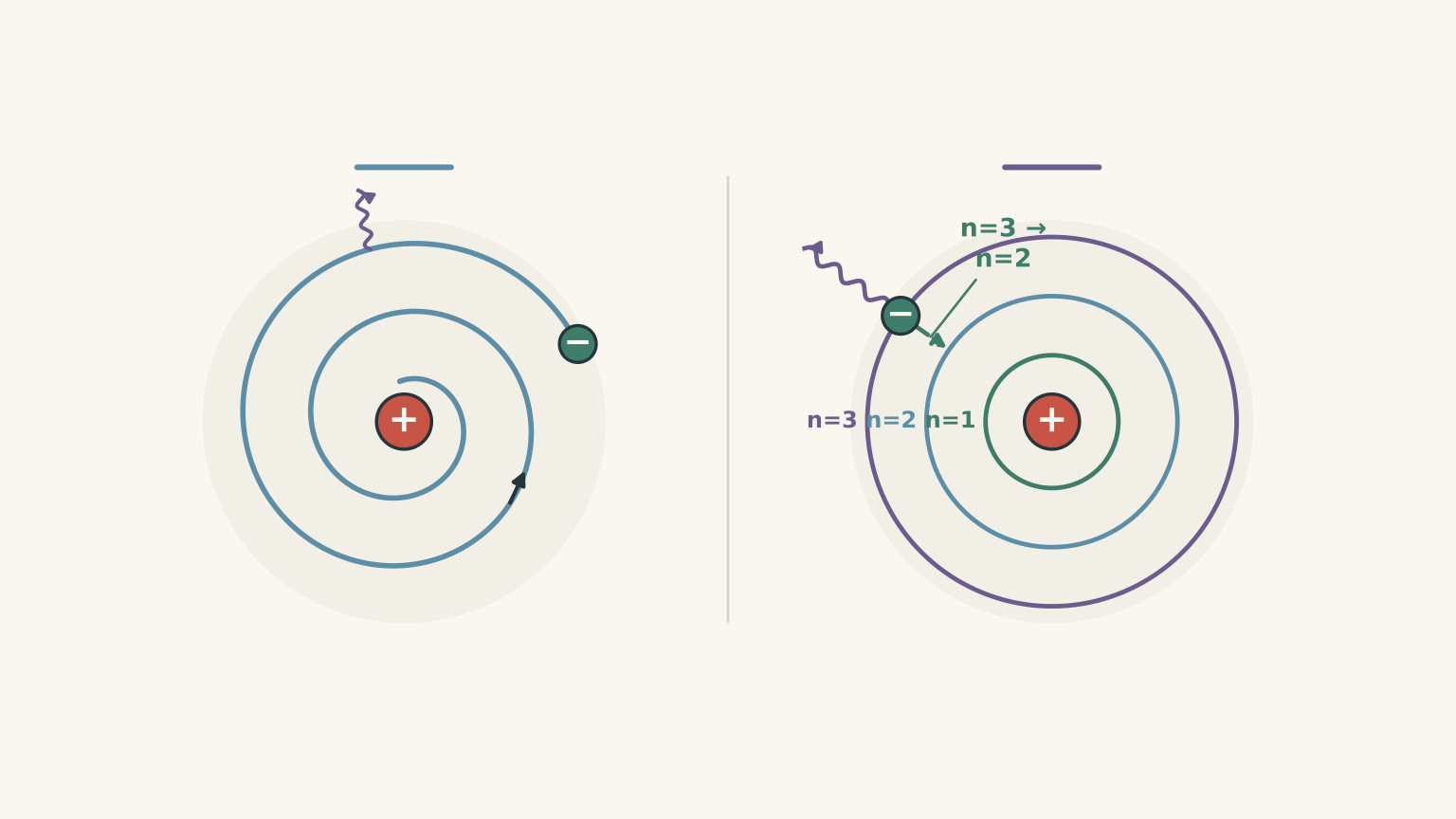
Due to technical limitations, this figure may display incorrectly or contain inaccuracies. Please check key details against your course materials.
Why the classical nuclear model fails
Consider an electron moving in a circular orbit around the nucleus.
Even if its speed remains constant, its direction continually changes. This means it is accelerating.
According to classical electromagnetic theory, an accelerating electric charge radiates electromagnetic energy.
The electron should therefore lose energy continuously. As its energy decreases, its orbit should shrink, eventually causing it to spiral into the nucleus.
That doesn’t happen. Atoms are stable.
There is another problem. If electrons could have any energy, we would expect atoms to produce a continuous range of emitted photon energies. However, hydrogen produces distinct spectral lines.
The classical nuclear model cannot explain either observation.
Introducing stationary energy levels
The stationary energy-level model addresses these problems by combining classical and quantum physics.
It retains some classical ideas:
- The atom has a small, positively charged nucleus.
- The electron experiences an electrostatic attraction towards the nucleus.
- Energy is conserved when an electron changes energy states.
However, it introduces a quantum restriction: electrons can occupy only certain allowed energy levels.
An electron in an allowed stationary state does not continuously radiate energy. It can change between these states by absorbing or emitting a photon.
The energy of the photon must equal the difference between the two energy levels:
\[ \Delta E=hf \]
where:
- \(\Delta E\) is the magnitude of the energy difference between the two states, measured in joules (J).
- \(h\) is Planck’s constant, \(6.626\times10^{-34}\,\mathrm{J\,s}\).
- \(f\) is the frequency of the emitted or absorbed photon, measured in hertz (Hz).
This explains why atoms produce discrete spectral lines rather than a continuous spectrum.
The important point is that the model uses classical physics to describe the electrostatic interaction, but quantum physics to restrict the allowed energy states.
It is a semi-classical model, not the complete modern description of an atom. Modern quantum mechanics replaces the idea of electrons following fixed planetary orbits with quantum wavefunctions and probability distributions.
For Bose-Einstein condensation, we need to take one idea further: quantum particles can occupy particular allowed states, and the rules governing how many particles can share a state depend on the type of particle.
02What makes a particle a boson?
Not all particles follow the same quantum rules.
There are two important categories:
- Bosons
- Fermions
The distinction comes from a quantum property called spin, which is a particle’s intrinsic angular momentum.
| Property | Bosons | Fermions |
|---|---|---|
| Spin | Integer values (0, 1, 2, …) | Half-integer values (1/2, 3/2, …) |
| Occupation of a quantum state | Many identical particles can share one state | Identical particles cannot share the same complete quantum state |
| Examples | Photons, \(^{87}\mathrm{Rb}\) atoms | Electrons, protons, neutrons |
Fermions obey the Pauli exclusion principle. Bosons do not have this restriction.
This difference is essential.
Imagine a collection of identical particles, all cooled towards their lowest possible energy.
If they are fermions, they cannot all occupy the same complete quantum state. They must occupy different available states.
If they are bosons, however, there is no such restriction. Many identical bosons can occupy the same state.
This is the foundation of Bose-Einstein condensation.
Why are some atoms bosons?
You might be wondering how an entire atom can be classified as a boson.
An atom contains protons, neutrons, and electrons. These are all fermions, but a collection of an even number of fermions can behave as a composite boson.
Consider rubidium-87, the isotope used in the first successful demonstration of Bose-Einstein condensation in a dilute atomic gas.
A neutral rubidium-87 atom contains:
- 37 protons
- 50 neutrons
- 37 electrons
That gives a total of 124 constituent fermions.
Because the total number is even, the neutral atom behaves as a boson, with integer total spin.
This makes rubidium-87 a suitable candidate for producing a Bose-Einstein condensate.
If you want to revisit the meaning of intrinsic angular momentum, see Electron Spin: Intrinsic Angular Momentum Explained.
What does sharing a quantum state actually mean?
Let’s picture a collection of identical rubidium atoms confined inside a small region of space.
At relatively high temperatures, the atoms occupy many different motional quantum states. Their thermal motion is relatively large, and the gas behaves approximately like a classical collection of particles.
As the temperature decreases, the population of the lowest-energy state increases.
Eventually, a substantial fraction of the atoms occupies the same lowest-energy motional state.
A useful analogy is a choir.
At first, imagine many singers producing different notes independently. Now imagine a large proportion singing in the same rhythm and on the same note. Their individual contributions combine into one coherent sound.
A Bose-Einstein condensate is somewhat similar: many atoms occupy one shared quantum mode, producing collective matter-wave behaviour.
The analogy has a limit, though. Atoms are not communicating or deliberately synchronising. Their behaviour follows quantum statistics, not instructions from other atoms.
Also, the atoms do not physically merge into one giant atom. They remain individual particles, even though they share a quantum state.
This is what makes a BEC unusual: quantum behaviour that is normally associated with individual microscopic particles becomes observable across a large collection of atoms.
03Why does temperature matter?
We know that bosons can share a quantum state. But why does this only become important at extremely low temperatures?
The answer involves matter waves.
You may have encountered de Broglie’s relationship:
\[ \lambda=\frac{h}{p} \]
where:
- \(\lambda\) is the de Broglie wavelength.
- \(h\) is Planck’s constant.
- \(p\) is the particle’s momentum.
This equation tells us that particles have an associated wavelength. A particle with lower momentum has a longer de Broglie wavelength.
As the temperature of a gas decreases, the typical thermal momentum of its atoms decreases. Their associated matter-wave wavelengths therefore become larger.
At ordinary temperatures, these wavelengths are tiny compared with the average separation between atoms.
At extremely low temperatures, they can become comparable to the separation between neighbouring atoms.
Thermal de Broglie wavelength
To describe this more precisely, physicists use the thermal de Broglie wavelength:
\[ \lambda_T=\frac{h}{\sqrt{2\pi m k_B T}} \]
where:
- \(\lambda_T\) is the thermal de Broglie wavelength, measured in metres.
- \(h\) is Planck’s constant.
- \(m\) is the mass of one atom, measured in kilograms.
- \(k_B\) is Boltzmann’s constant, \(1.381\times10^{-23}\,\mathrm{J\,K^{-1}}\).
- \(T\) is the absolute temperature, measured in kelvin.
Notice that temperature appears in the denominator.
Therefore:
\[ \lambda_T\propto\frac{1}{\sqrt{T}} \]
As temperature decreases, the thermal wavelength increases.
This is the first important prediction.
Suppose the temperature decreases by a factor of four. What happens to the thermal wavelength?
It doubles, because the wavelength is inversely proportional to the square root of temperature.
This increasing wavelength allows neighbouring atomic matter waves to overlap significantly.
When does condensation begin?
We can make the idea of overlapping matter waves more precise.
First, define the average separation between atoms:
\[ d=n^{-1/3} \]
where \(n\) is the number density of atoms, measured in \(\mathrm{m^{-3}}\).
Now consider the ratio between the thermal wavelength and the average separation.
If the wavelength is much smaller than the separation, quantum statistical effects are relatively insignificant.
If the wavelength becomes comparable to the separation, quantum effects become important.
A useful dimensionless quantity is the phase-space density:
\[ D=n\lambda_T^3 \]
It combines the number density and the thermal wavelength.
For a uniform, three-dimensional, non-interacting ideal Bose gas, Bose-Einstein condensation begins when:
\[ \boxed{n\lambda_T^3\approx2.612} \]
The number 2.612 is the value of a mathematical function called \(\zeta(3/2)\).
You don’t need to calculate that function yourself. The important idea is that the phase-space density reaches a critical value.
Why does this happen?
As the temperature decreases, the number of atoms occupying excited states decreases. Eventually, the excited states can no longer accommodate the entire population under the Bose-Einstein distribution.
The excess atoms accumulate in the lowest-energy state.
A macroscopic fraction of the atoms now occupies that single state.
That is Bose-Einstein condensation.
There is an important restriction here: the value 2.612 applies to the ideal, uniform, three-dimensional gas model. Real experiments use trapped gases, and interactions, finite atom numbers, and trap geometry modify the precise transition conditions.
What fraction of the atoms condenses?
For a uniform, non-interacting, three-dimensional ideal Bose gas below its critical temperature, the fraction of atoms in the ground state is:
\[ \frac{N_0}{N} = 1-\left(\frac{T}{T_c}\right)^{3/2} \]
where:
- \(N_0\) is the number of atoms occupying the ground state.
- \(N\) is the total number of atoms.
- \(T\) is the gas temperature.
- \(T_c\) is the critical temperature at which condensation begins.
This equation describes an interesting result.
At \(T=T_c\), the condensate fraction is zero.
As temperature decreases below \(T_c\), the fraction increases.
At absolute zero, the ideal model predicts that all atoms occupy the ground state.
At a finite temperature, however, some atoms remain in excited states. A BEC does not necessarily contain every atom in the condensate.
04How do scientists produce a Bose-Einstein condensate?
Knowing the conditions for condensation is one thing. Achieving them in a laboratory is another.
The temperatures involved are extraordinarily low, often around a few hundred nanokelvin or less.
For comparison:
- Room temperature is approximately 300 K.
- Liquid nitrogen is approximately 77 K.
- A typical atomic BEC experiment operates around \(10^{-7}\) K.
A nanokelvin is one billionth of a kelvin.
Scientists therefore need specialised equipment to cool and confine the atoms.
Step 1: Trap the atoms
Scientists first confine a dilute gas of atoms using magnetic or optical fields.
The trap prevents the atoms from simply spreading out and escaping.
This is important because the gas needs to remain confined while its temperature decreases.
Step 2: Cool the atomic cloud
Laser cooling can reduce the thermal motion of atoms.
The basic idea is to use carefully controlled light to transfer momentum to moving atoms, reducing their average motion.
However, laser cooling alone is generally not enough to reach the temperatures required for BEC.
A further cooling technique is needed.
Step 3: Evaporative cooling
One particularly important technique is evaporative cooling.
The idea is to selectively remove the highest-energy atoms from the trapped cloud.
Think of a group of runners in a race. If the fastest runners leave the track, the average speed of the remaining group decreases.
Evaporative cooling uses a related principle: removing the most energetic atoms lowers the average energy of the remaining gas.
The remaining atoms collide and redistribute their energy, allowing the cloud to reach a lower temperature.
The analogy is not exact. Atoms are not runners, and the cooling depends on collisions and rethermalisation within the gas. However, it captures the basic idea of selectively removing energetic particles.
As cooling continues, the phase-space density increases until the gas reaches the conditions for Bose-Einstein condensation.
Step 4: Detect the condensate
How can scientists tell that condensation has actually occurred?
One technique is time-of-flight imaging.
The trapped cloud is released, allowing the atoms to expand. Scientists then measure the spatial distribution of the atoms after a known expansion time.
Because the atoms expand according to their velocities, the final distribution provides information about their momentum distribution.
The original 1995 rubidium experiment produced an important observation.
The researchers found a narrow peak centred near zero velocity, sitting on top of a broader thermal distribution. As the temperature decreased, the fraction of atoms in the narrow peak increased.
This was evidence that a macroscopic population had entered the lowest-energy quantum state.
The first successful observation of Bose-Einstein condensation in a dilute atomic gas was reported in 1995 by M. H. Anderson and colleagues, using magnetically trapped rubidium-87 atoms and evaporative cooling.
The condensate first appeared near 170 nanokelvin.
This achievement was recognised by the 2001 Nobel Prize in Physics, awarded jointly to Eric Cornell, Carl Wieman, and Wolfgang Ketterle for their work on Bose-Einstein condensation in dilute gases.
You can read the original experimental paper here:
Anderson et al. (1995), Observation of Bose-Einstein Condensation in a Dilute Atomic Vapor.
Does a condensate mean the atoms stop moving?
Not quite.
This is a particularly tempting misconception.
A condensate is associated with atoms occupying the lowest-energy quantum state, but that does not mean every atom has zero kinetic energy.
The atoms are confined within a trap. Confinement gives the lowest motional state a non-zero momentum spread.
The atoms therefore have a quantum distribution of possible momenta, even when they occupy the same ground state.
The correct statement is that many atoms occupy the same lowest-energy quantum state, not that all atoms are motionless.
Likewise, the atoms do not physically collapse into one point or turn into a solid. A BEC is a quantum state of matter, not an ordinary change from gas to liquid or solid.
05Worked examples
The following examples use the ideal, uniform three-dimensional gas model. This makes the calculations manageable while showing how temperature, density, and quantum behaviour are connected.
Worked example: Are the atoms approaching Bose-Einstein condensation?
A uniform gas of rubidium-87 atoms has a temperature of \(100\,\mathrm{nK}\) and a number density of \(1.0\times10^{19}\,\mathrm{m^{-3}}\).
Calculate:
a) The thermal de Broglie wavelength.
b) The average separation between atoms.
c) The phase-space density.
Determine whether the gas has reached the ideal-gas condensation threshold.
Use:
- \(m=1.44\times10^{-25}\,\mathrm{kg}\)
- \(h=6.63\times10^{-34}\,\mathrm{J\,s}\)
- \(k_B=1.38\times10^{-23}\,\mathrm{J\,K^{-1}}\)
Step 1
Since one nanokelvin is \(10^{-9}\) K:
\[ T=100\times10^{-9} =1.00\times10^{-7}\,\mathrm K \]
Step 2
Use:
\[ \lambda_T=\frac{h}{\sqrt{2\pi m k_BT}} \]
Substitute the given values:
\[ \lambda_T= \frac{6.63\times10^{-34}} {\sqrt{2\pi(1.44\times10^{-25}) (1.38\times10^{-23})(1.00\times10^{-7})}} \]
Therefore:
\[ \lambda_T\approx5.9\times10^{-7}\,\mathrm m \]
Or:
\[ \boxed{\lambda_T\approx0.59\,\mathrm{\mu m}} \]
Step 3
Use:
\[ d=n^{-1/3} \]
Substitute:
\[ d=(1.0\times10^{19})^{-1/3} \]
Therefore:
\[ \boxed{d\approx4.6\times10^{-7}\,\mathrm m} \]
Or:
\[ d\approx0.46\,\mathrm{\mu m} \]
Step 4
\[ D=n\lambda_T^3 \]
Substitute:
\[ D=(1.0\times10^{19})(5.9\times10^{-7})^3 \]
\[ \boxed{D\approx2.1} \]
Step 5
For the ideal uniform gas:
\[ D_c\approx2.612 \]
Our calculated value is:
\[ 2.1<2.612 \]
The gas has not quite reached the ideal-gas condensation threshold.
However, its thermal wavelength is already comparable to the average separation between atoms. Quantum statistical effects are therefore significant.
The result shows why cooling an atomic gas can eventually produce a collective quantum state.
Worked example: Calculate the critical temperature and condensate fraction
A uniform gas contains rubidium-87 atoms at a number density of \(1.0\times10^{19}\,\mathrm{m^{-3}}\).
Calculate:
a) The critical temperature for Bose-Einstein condensation.
b) The fraction of atoms in the condensate when the gas reaches \(50\,\mathrm{nK}\).
Assume an ideal, non-interacting gas in three dimensions.
Use:
- \(m=1.44\times10^{-25}\,\mathrm{kg}\)
- \(k_B=1.38\times10^{-23}\,\mathrm{J\,K^{-1}}\)
- \(\hbar=1.055\times10^{-34}\,\mathrm{J\,s}\)
Step 1
For a uniform ideal Bose gas:
\[ T_c= \frac{2\pi\hbar^2}{mk_B} \left(\frac{n}{2.612}\right)^{2/3} \]
Here, \(\hbar\) is the reduced Planck constant, equal to \(h/(2\pi)\).
Substitute:
\[ T_c= \frac{2\pi(1.055\times10^{-34})^2} {(1.44\times10^{-25})(1.38\times10^{-23})} \left(\frac{1.0\times10^{19}}{2.612}\right)^{2/3} \]
This gives:
\[ T_c\approx8.6\times10^{-8}\,\mathrm K \]
Therefore:
\[ \boxed{T_c\approx86\,\mathrm{nK}} \]
Step 2
The gas temperature is:
\[ 50\,\mathrm{nK}<86\,\mathrm{nK} \]
Therefore, the gas is below its critical temperature and a condensate is predicted.
Step 3
Use:
\[ \frac{N_0}{N} = 1-\left(\frac{T}{T_c}\right)^{3/2} \]
Substitute:
\[ \frac{N_0}{N} = 1-\left(\frac{50}{86}\right)^{3/2} \]
\[ \frac{N_0}{N}\approx0.56 \]
Therefore:
\[ \boxed{\text{Condensate fraction}\approx56\%} \]
Step 4
Approximately 56% of the atoms occupy the ground state in this idealised model.
The remaining 44% occupy excited states and form the thermal component.
Notice that reaching a temperature below \(T_c\) does not mean every atom automatically becomes part of the condensate.
The fraction depends on how far below the critical temperature the gas is cooled.
06Questions and solutions
The questions below progress from standard applications of the condensation model to more challenging reasoning involving quantum statistics and thermodynamics.
Question 1
A uniform gas of rubidium-87 atoms is cooled from \(200\,\mathrm{nK}\) to \(50\,\mathrm{nK}\).
Initially, its thermal de Broglie wavelength is \(0.30\,\mathrm{\mu m}\).
Assume the number density remains constant.
a) Calculate the final thermal de Broglie wavelength.
b) By what factor does the phase-space density increase?
c) Does this information alone prove that a Bose-Einstein condensate has formed? Explain.
Solution 1
a) The final thermal de Broglie wavelength is \(0.60\,\mathrm{\mu m}\).
The thermal wavelength is inversely proportional to the square root of temperature:
\[ \lambda_T\propto T^{-1/2} \]
Therefore:
\[ \frac{\lambda_f}{\lambda_i} = \sqrt{\frac{T_i}{T_f}} \]
Substitute:
\[ \frac{\lambda_f}{0.30} = \sqrt{\frac{200}{50}} \]
\[ \lambda_f=0.30\times2 \]
\[ \boxed{\lambda_f=0.60\,\mathrm{\mu m}} \]
The wavelength doubles because the temperature decreases by a factor of four.
b) The phase-space density increases by a factor of 8.
Recall:
\[ D=n\lambda_T^3 \]
The number density remains constant, so:
\[ \frac{D_f}{D_i} = \left(\frac{\lambda_f}{\lambda_i}\right)^3 \]
\[ \frac{D_f}{D_i}=2^3 \]
\[ \boxed{\frac{D_f}{D_i}=8} \]
The phase-space density increases eightfold.
c) No, condensation is not guaranteed.
The gas has moved significantly closer to the quantum-degenerate regime.
However, we need to know its initial phase-space density to determine whether it has crossed the critical value of 2.612.
An eightfold increase could take a gas from well below the threshold to above it, or leave it below the threshold.
The important lesson is that cooling increases the likelihood of condensation, but the initial density also matters.
Question 2
A uniform, non-interacting gas of rubidium-87 atoms is maintained at a temperature of \(80\,\mathrm{nK}\).
Calculate the critical number density required for Bose-Einstein condensation.
Use:
- \(m=1.44\times10^{-25}\,\mathrm{kg}\)
- \(h=6.63\times10^{-34}\,\mathrm{J\,s}\)
- \(k_B=1.38\times10^{-23}\,\mathrm{J\,K^{-1}}\)
- Critical phase-space density \(D_c=2.612\).
Solution 2
The critical number density is approximately \(9.0\times10^{18}\,\mathrm{m^{-3}}\).
We first calculate the thermal de Broglie wavelength, then use the critical phase-space density.
Step 1: Convert the temperature into kelvin.
\[ T=80\times10^{-9} =8.0\times10^{-8}\,\mathrm K \]
Step 2: Calculate the thermal wavelength.
\[ \lambda_T= \frac{h}{\sqrt{2\pi m k_BT}} \]
Substitute:
\[ \lambda_T= \frac{6.63\times10^{-34}} {\sqrt{2\pi(1.44\times10^{-25}) (1.38\times10^{-23})(8.0\times10^{-8})}} \]
Therefore:
\[ \lambda_T\approx6.6\times10^{-7}\,\mathrm m \]
Step 3: Apply the critical phase-space density.
At the transition:
\[ n_c\lambda_T^3=2.612 \]
Rearrange:
\[ n_c=\frac{2.612}{\lambda_T^3} \]
Substitute:
\[ n_c= \frac{2.612}{(6.6\times10^{-7})^3} \]
\[ \boxed{n_c\approx9.1\times10^{18}\,\mathrm{m^{-3}}} \]
Interpretation:
At \(80\,\mathrm{nK}\), the gas must reach approximately \(9.0\times10^{18}\) atoms per cubic metre to reach the ideal-gas condensation threshold.
A higher density increases the phase-space density, just as lowering the temperature does.
This demonstrates that condensation depends on both temperature and number density, not temperature alone.
Question 3
Two dilute gases are cooled to extremely low temperatures.
- Gas A contains rubidium-87 atoms.
- Gas B contains potassium-40 atoms.
Both gases are prepared at similar number densities and temperatures, so their thermal de Broglie wavelengths are comparable.
A student argues that both gases should form Bose-Einstein condensates because their matter waves overlap.
Explain why this conclusion is incorrect.
In your answer, discuss the role of particle spin and the Pauli exclusion principle. Also explain whether a gas of fermionic atoms could ever form a collective condensed state.
Solution 3
Gas A can undergo ordinary Bose-Einstein condensation, but an unpaired gas of potassium-40 atoms cannot undergo the same single-particle condensation.
The key difference is particle statistics, not simply the degree of matter-wave overlap.
Rubidium-87 atoms are bosons. They have integer total spin, allowing many identical atoms to occupy the same complete quantum state.
Potassium-40 atoms are fermions. They have half-integer total spin and obey the Pauli exclusion principle.
This means that identical potassium-40 atoms cannot all occupy the same complete quantum state.
As the temperature decreases, the fermions instead fill different available quantum states, producing a degenerate Fermi gas.
The important distinction is:
- Overlapping matter waves make quantum statistical effects important.
- Whether particles can accumulate in one state depends on whether they are bosons or fermions.
There is one further complication.
Fermions can form pairs under suitable interactions. A pair of fermions can behave as a composite boson because it contains an even number of constituent fermions.
These pairs can undergo a collective condensation process.
This is a different mechanism from ordinary condensation of individual bosonic atoms. It is important in the physics of ultracold fermionic gases and is related to the broader physics of superconductivity and superfluidity.
Therefore, the student’s argument is incomplete: matter-wave overlap is not enough. The quantum statistics of the particles must also be considered.
Question 4
An experimental group investigates a trapped gas of identical bosonic atoms.
They release the atoms from the trap and record their spatial distribution after the same free-expansion time.
They observe two different distributions:
- Sample A produces a broad, smooth distribution of atom velocities.
- Sample B produces a broad distribution with an additional narrow peak centred near zero velocity.
When the temperature of Sample B is lowered further, the fraction of atoms in the narrow peak increases sharply.
a) Explain why Sample B provides evidence of Bose-Einstein condensation.
b) Why is a narrow peak alone more informative than simply observing that the entire velocity distribution becomes narrower?
c) Does the observation prove that every atom in Sample B has zero velocity? Explain.
Solution 4
Sample B provides evidence of Bose-Einstein condensation because a substantial population of atoms has entered the same low-energy quantum state.
a) Explanation of the narrow peak
When the atoms are released from the trap, they expand according to their momentum distribution.
For atoms of the same mass, momentum and velocity are related by:
\[ p=mv \]
The broad distribution represents atoms with a range of thermal momenta.
The narrow central peak represents a population with much smaller momentum spread, associated with the condensate’s lowest-energy motional state.
The fact that this component appears and grows as the temperature decreases supports the interpretation that a macroscopic fraction of the atoms is occupying one quantum state.
b) Why the additional peak matters
Simply cooling a classical gas reduces the typical thermal speeds of its atoms.
We would therefore expect its velocity distribution to become narrower.
However, this would normally produce a progressively narrower thermal distribution.
Sample B shows something more distinctive: an additional narrow component develops on top of the broader thermal background.
Its rapid growth as the temperature decreases is evidence of a change in the population of quantum states, rather than merely a reduction in average thermal speed.
c) No, the atoms do not all have exactly zero velocity.
The narrow peak is centred near zero velocity, but it has a finite width.
Furthermore, Sample B still contains a broad thermal component.
Even atoms in the condensate have a momentum distribution determined by the lowest-energy state of the confining potential.
Therefore, the observation supports macroscopic occupation of a shared quantum state, not the idea that every atom is stationary.
Question 5
An ideal, uniform, three-dimensional gas contains identical bosonic atoms.
Initially, its phase-space density is:
\[ D_i=0.40 \]
The gas is contained in a cubic trap. It is slowly compressed to half its original volume while remaining thermally insulated.
Assume:
- The total number of atoms remains constant.
- The gas behaves as a monatomic classical ideal gas throughout the compression.
- The compression is reversible and adiabatic.
- For this process, the temperature and volume satisfy:
\[ TV^{2/3}=\text{constant} \]
The ideal-gas Bose-Einstein condensation threshold is \(D_c=2.612\).
A student argues:
“The atoms are twice as dense after compression, so their matter waves overlap more. The gas must therefore move closer to Bose-Einstein condensation.”
Is the student correct?
Calculate the final phase-space density and compare it with the result that would occur if the same compression were performed isothermally instead.
Solution 5
The student is incorrect. Under the specified adiabatic conditions, the phase-space density remains unchanged at 0.40.
The tempting argument considers only the increase in number density.
However, compression also increases the temperature. This reduces the thermal de Broglie wavelength, partly cancelling the effect of the increased density.
We need to account for both changes.
Step 1: Determine the change in number density.
The total number of atoms is constant.
The final volume is half the initial volume:
\[ V_f=\frac{V_i}{2} \]
Number density is:
\[ n=\frac{N}{V} \]
Therefore:
\[ n_f=2n_i \]
The number density doubles.
Step 2: Determine the temperature change.
We are given:
\[ TV^{2/3}=\text{constant} \]
Therefore:
\[ T_iV_i^{2/3}=T_fV_f^{2/3} \]
Rearrange:
\[ \frac{T_f}{T_i} = \left(\frac{V_i}{V_f}\right)^{2/3} \]
Substitute:
\[ \frac{T_f}{T_i}=2^{2/3} \]
\[ \boxed{T_f\approx1.59T_i} \]
The temperature increases by approximately 59%.
Step 3: Determine the change in thermal wavelength.
Recall:
\[ \lambda_T\propto T^{-1/2} \]
Therefore:
\[ \frac{\lambda_f}{\lambda_i} = \sqrt{\frac{T_i}{T_f}} \]
Substitute:
\[ \frac{\lambda_f}{\lambda_i} = \frac{1}{\sqrt{2^{2/3}}} \]
\[ \boxed{\frac{\lambda_f}{\lambda_i}=2^{-1/3}} \]
The thermal wavelength decreases to approximately 79% of its original value.
Step 4: Calculate the final phase-space density.
Recall:
\[ D=n\lambda_T^3 \]
Therefore:
\[ \frac{D_f}{D_i} = \frac{n_f}{n_i} \left(\frac{\lambda_f}{\lambda_i}\right)^3 \]
Substitute:
\[ \frac{D_f}{D_i} = 2(2^{-1/3})^3 \]
\[ \frac{D_f}{D_i}=2\times\frac12 \]
Therefore:
\[ \boxed{D_f=D_i=0.40} \]
The phase-space density has not changed.
The increase in number density is exactly cancelled by the decrease in thermal wavelength cubed.
Step 5: Compare with isothermal compression.
Now suppose the gas is compressed to the same final volume, but heat is removed to keep the temperature constant.
Since temperature does not change:
\[ \lambda_f=\lambda_i \]
However, the number density still doubles.
Therefore:
\[ D_f=2D_i \]
\[ D_f=2(0.40) \]
\[ \boxed{D_f=0.80} \]
The isothermal compression increases the phase-space density, bringing the gas closer to condensation.
However, even this result remains below the critical value:
\[ 0.80<2.612 \]
Why this result is important
The student’s mistake was assuming that increasing density automatically makes Bose-Einstein condensation more likely.
Density matters, but so does temperature.
Compression can increase density while simultaneously heating the gas. The resulting decrease in thermal wavelength can cancel the density increase completely.
The deeper principle is that Bose-Einstein condensation depends on the combined quantity \(n\lambda_T^3\), not on density or temperature considered independently.
This is why simply squeezing a gas into a smaller volume is not necessarily an effective way to produce a condensate.
The conclusion relies on the specified ideal-gas and adiabatic assumptions. Real interacting gases and different trapping arrangements can require a more detailed model.
07Where this leads next
Bose-Einstein condensation reveals how the quantum rules governing individual particles can produce collective behaviour across an entire gas.
The next useful connection is superfluidity.
A condensate can behave as a coherent matter wave, allowing physicists to investigate unusual forms of collective motion, including quantised vortices. However, Bose-Einstein condensation and superfluidity are not interchangeable terms: condensation describes occupation of a quantum state, while superfluidity describes the collective flow properties of a system.
There is also an important contrast with fermions.
Electrons cannot all occupy the same quantum state. Instead, the Pauli exclusion principle produces effects such as electron degeneracy pressure, which helps support white dwarfs against gravitational collapse.
You can explore that connection in Electron Degeneracy Pressure: How White Dwarfs Resist Gravity.
The distinction between bosons sharing states and fermions being excluded from identical states is one of the most useful ideas to carry forward when studying quantum physics.
08Sources and further reading
The following sources support the experimental history, quantum-statistical model, and syllabus context discussed in this article.
NSW Education Standards Authority: Physics 11-12 Syllabus (2025). Official syllabus content and implementation information.
Anderson, M. H., Ensher, J. R., Matthews, M. R., Wieman, C. E., and Cornell, E. A. (1995): Observation of Bose-Einstein Condensation in a Dilute Atomic Vapor. Science, 269, 198-201. Original experimental report of Bose-Einstein condensation in rubidium-87.
The Nobel Prize (2001): The Nobel Prize in Physics 2001 – Press Release. Background on the theoretical prediction, experimental achievement, and significance of Bose-Einstein condensation.
Yasuhiro Iye, University of Tokyo: Bose-Einstein Condensation – University Lecture Notes. Additional explanations of bosons, fermions, thermal de Broglie wavelengths, and the condensation condition.